
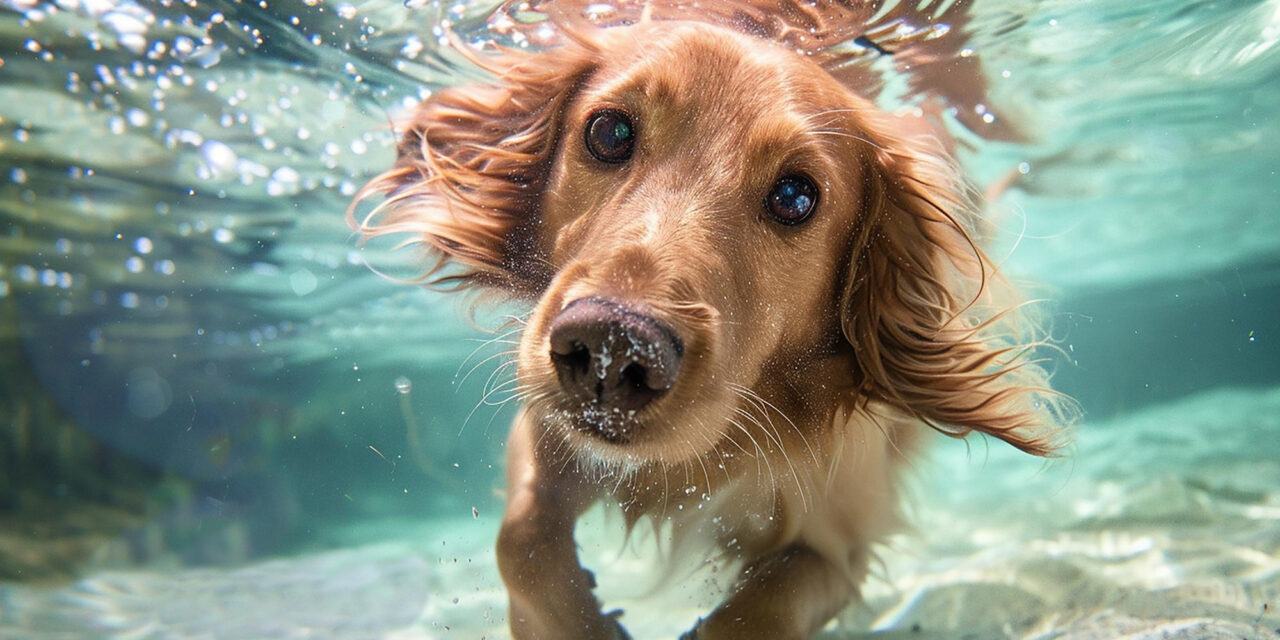
Swimming with dogs looks effortless on video: a happy Lab bounding off a dock, tail going like a propeller. What those clips skip is that plenty of dogs can’t swim well at all, that even confident swimmers can get into real trouble in open water, and that a first introduction gone wrong can create a lifelong fear of the water. None of that means skip swimming. It means do the first few sessions on purpose.
This guide covers who’s a natural fit for swimming and who isn’t, how to introduce a dog to water gradually and safely, what gear actually helps, and the specific hazards that differ between a backyard pool, a lake, and the ocean.
What’s in this guide
- Swimming with dogs: the quick answer
- Not every dog is built to swim well
- First introductions: a gradual approach
- Breed swimming ability, a closer look
- Life jackets: who needs one and how to fit it
- Swimming as exercise and rehab
- Boat safety for dogs
- Swimming in a pool
- Pool safety equipment beyond a life jacket
- Swimming in lakes, ponds, and rivers
- Blue-green algae: a fast-acting danger
- Cold water and hypothermia risk
- Swimming at the beach
- Signs of fatigue or distress in the water
- Ear care after swimming
- Limber tail (swimmer’s tail)
- Choosing a swimming venue
- Dog-friendly beaches, parks, and posted rules
- Swimming with multiple dogs
- Puppies and senior dogs in the water
- Common swimming mistakes
- Common myths about dogs and swimming
- Your dog-swimming checklist
- Common questions about swimming with dogs
- Sources
Swimming with dogs: the quick answer
Introduce water gradually in a calm, shallow, controlled spot, let your dog set the pace, and never assume he can swim just because he’s a dog. Fit a properly sized life jacket for open water, boats, or any dog who’s new, small, brachycephalic, or not a confident swimmer. Rinse and dry ears after every swim, avoid water with algae blooms, foam, or a bad smell, and supervise closely even once your dog seems like a natural.
The biggest risk isn’t usually the swimming itself. It’s assuming competence that hasn’t actually been demonstrated yet, in an open-water setting with currents, drop-offs, or distance from shore that a pool never tests.
Not every dog is built to swim well
“Dogs can swim” is a myth in its literal, universal form. Body shape drives a lot of this. Short-legged, heavy-bodied, or brachycephalic (short-nosed) breeds, like Bulldogs, Dachshunds, Basset Hounds, Pugs, and Boston Terriers, often struggle to swim efficiently or breathe comfortably while doing it. Some genuinely can’t stay afloat well at all.
Never assume, always test in a controlled setting first
The only way to know how your specific dog handles water is a calm, shallow, supervised first attempt, ideally in a life jacket. Don’t find out in open water, at a crowded beach, or off a dock.
Breed tendency is a starting point, not a verdict. Plenty of individual dogs from “natural swimmer” breeds dislike water entirely, and some dogs from less water-suited breeds enjoy it with the right introduction and a well-fitted life jacket.
First introductions: a gradual approach
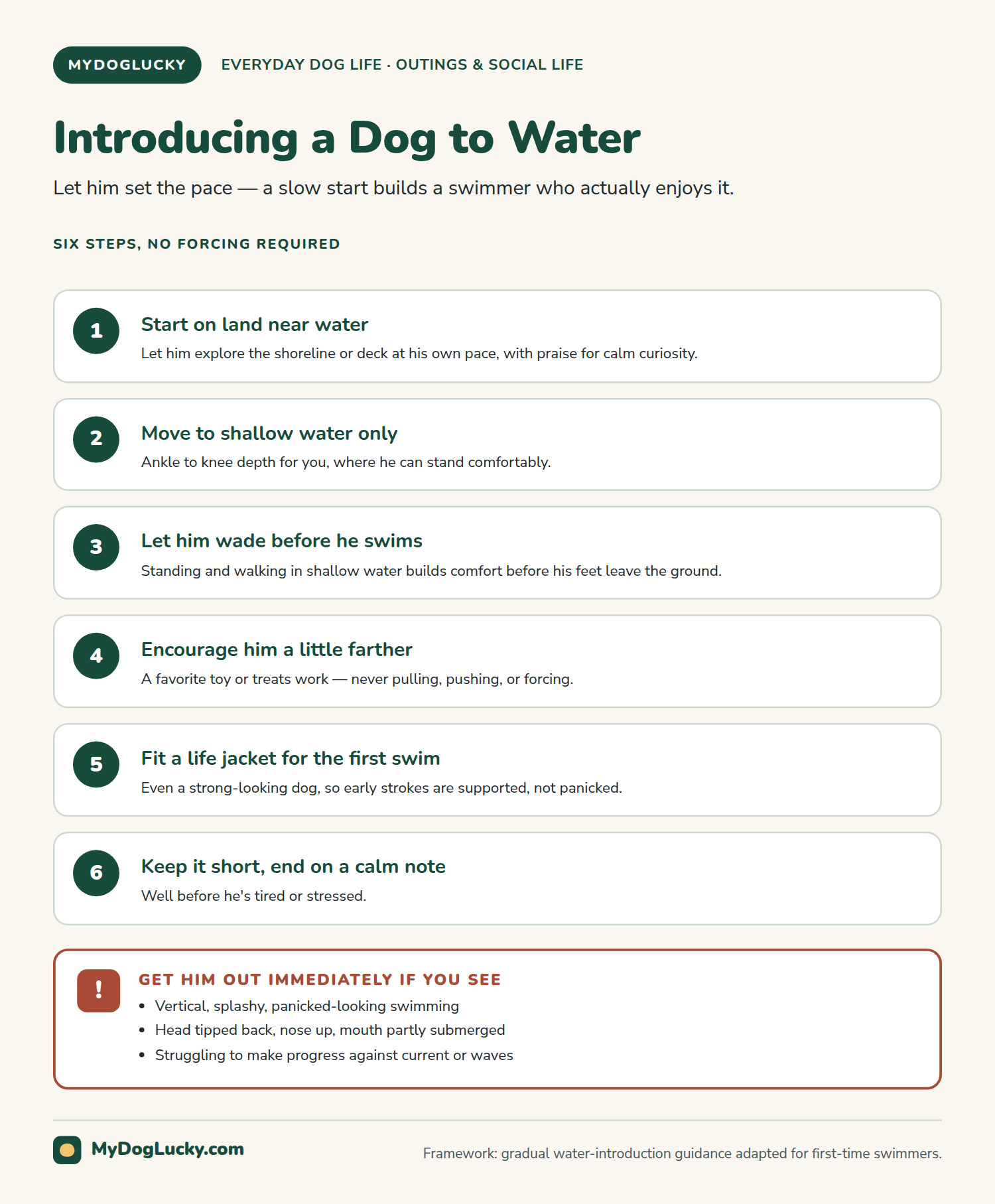
- Start on land near water, letting your dog explore the shoreline or pool deck at his own pace, with treats and praise for calm curiosity.
- Move to shallow water only, ankle to knee depth for you, where he can stand comfortably with his feet on the bottom.
- Let him wade before he swims. Standing and walking in shallow water builds comfort before his feet ever leave the ground.
- Use a favorite toy or treats to encourage him a little farther in, never by pulling, pushing, or forcing him past his comfort.
- Fit a life jacket for his first actual swim, even a strong-looking one, so early strokes are supported rather than panicked.
- Keep first sessions short and end on a calm, positive note, well before he’s tired or stressed.
A dog who’s clearly frightened at any stage, trembling, trying to climb you, or refusing to move forward, needs you to back up a stage and slow down, not push through. Forcing a scared dog into water tends to create a lasting fear rather than confidence.
Breed swimming ability, a closer look
Body shape and coat both influence how naturally a dog swims, though individual variation within any breed is real. Use this as a starting expectation, not a guarantee about your specific dog.
| Body type | Example breeds | What to expect |
|---|---|---|
| Water-bred retrievers | Labrador Retriever, Golden Retriever, Portuguese Water Dog | Often confident, efficient swimmers, but individual dogs still need a proper introduction |
| Short-legged, long-bodied | Dachshund, Corgi, Basset Hound | Can swim, but tire faster and benefit from a life jacket for anything beyond brief, shallow play |
| Brachycephalic (short-nosed) | Bulldog, Pug, Boston Terrier, Boxer | Breathing efficiency drops in water; many struggle to stay afloat safely at all |
| Heavy-chested, dense-muscled | Some Bull breeds, some large mixed breeds | Less natural buoyancy; a well-fitted life jacket makes a bigger difference here |
| Thick double coats | Newfoundland, Golden Retriever, Husky | Coat can get heavy when saturated; factor in a longer, more thorough dry-off |
None of this is destiny. A cautious Labrador and a surprisingly confident Bulldog both exist. Use the table to set your expectations and safety margin going in, then let your own dog’s actual first introduction tell you the rest.
Life jackets: who needs one and how to fit it
A life jacket is a good idea for
- Any dog new to swimming or water in general
- Brachycephalic, short-legged, heavy-bodied, or senior dogs
- Any dog on a boat, regardless of swimming ability
- Open water: lakes, rivers, or the ocean, where currents and distance from shore add real risk
A well-fitted life jacket sits snugly without restricting shoulder movement, has a sturdy top handle for a quick grab-and-lift, and keeps your dog’s head naturally above the waterline. Try it on land first, let him walk around in it, and check the fit again once it’s wet, since some materials shift slightly.
Getting the fit right
- Measure girth and length according to the manufacturer’s sizing chart rather than guessing from his general size category, since fit varies between brands.
- Check for two fingers of clearance under any strap once buckled, snug enough to stay put, loose enough not to chafe.
- Confirm the handle sits over his center of gravity, roughly between the shoulder blades, so a lift stays balanced rather than tipping him.
- Re-check fit as a puppy grows or if an adult dog’s weight changes meaningfully, since a jacket that fit last season may not fit this one.
Swimming as exercise and rehab
Beyond recreation, swimming is genuinely useful as low-impact exercise, and it’s a common component of veterinary rehabilitation for dogs recovering from joint surgery, injury, or living with arthritis. Moving through water lets a dog build and maintain muscle with far less joint impact than walking or running on land.
Ask your vet before using swimming as rehab
A structured, canine-specific hydrotherapy program, sometimes on an underwater treadmill rather than open swimming, is often more appropriate than casual pool time for a dog recovering from surgery or a specific injury. Your vet or a certified canine rehabilitation therapist can point you toward the right setup for your dog’s specific condition.
For a healthy dog who’s simply overweight, has early joint changes, or needs a lower-impact alternative to running, regular, moderate swimming can be a genuinely useful addition to his exercise routine, alongside, not instead of, his regular vet-guided care plan.
Boat safety for dogs
- A life jacket is non-negotiable on a boat, regardless of how strong a swimmer your dog is. A fall from a moving boat is disorienting even for a confident swimmer.
- Practice getting on and off the boat calmly at the dock before heading out, so it isn’t his first experience with the process while already underway.
- Provide shade and fresh water for longer trips, since a boat deck offers little natural shade and sun exposure adds up quickly on open water.
- Know your dog’s motion-sickness tendencies before a long trip. Some dogs handle boat motion fine; others don’t, and it’s better to learn that on a short first outing.
- Keep him leashed or otherwise secured near the edges of a moving boat, even a strong swimmer, since falls happen fast and unexpectedly.
Swimming in a pool
- Show him the steps or a ramp first, so he knows how to exit on his own, not just how to get in.
- Rinse chlorine or salt off after swimming, since residue can dry out skin and coat over repeated exposure.
- Never leave a dog unsupervised near an open pool, even one he’s swum in many times before. Pool covers and steep sides can be disorienting if he falls in unexpectedly.
- Watch for panicked, splashing swimming in a dog who’s fallen in accidentally rather than entered on his own terms. That panic response uses far more energy than confident swimming and tires a dog out fast.
Pool safety equipment beyond a life jacket
A life jacket solves buoyancy, but it doesn’t solve the two most common ways a backyard pool goes wrong for a dog: a fall that happens when no one’s watching, and an exit he can’t find on his own once he’s in.
Pool alarms and fencing
A pool alarm that detects a splash or a change in water displacement adds a layer of protection for a dog who has access to the pool area unsupervised, the same way it would for a young child. A four-sided fence with a self-latching gate, separate from any fence around the yard itself, is the more reliable option where it’s practical to install one, since it keeps him out of the pool area entirely rather than relying on catching a fall after the fact.
Pool ramps and exit points
A dog-specific pool ramp, or even a few wide steps built into one end of the pool, gives a dog a way out that doesn’t require finding the ladder, which most dogs never learn to use on their own. This matters most for a dog who might end up in the pool by accident rather than by choice, since a panicked dog who can’t find an exit is exactly the scenario that leads to exhaustion. If your pool doesn’t have an obvious step or ramp, teaching your dog where the exit is, on purpose, during a calm supervised session, is worth the ten minutes it takes.
Covers, and above-ground versus in-ground pools
A solid, properly rated pool cover keeps a dog from falling in when the pool isn’t in use, but a floating or mesh cover can actually be more dangerous than no cover at all, since a dog can become tangled or trapped underneath it. Check the manufacturer’s rating for pet safety before relying on any cover for this purpose. Above-ground pools add their own wrinkle: the ladder or deck that gets a dog in often isn’t designed for him to climb back down on his own, so an above-ground setup usually needs a dedicated ramp even more than an in-ground pool does.
None of this replaces supervision
Equipment reduces risk; it doesn’t eliminate the need for a person keeping an eye on a dog with pool access, especially in a multi-dog or multi-pet household where one dog’s splashing can mask another’s distress.
Swimming in lakes, ponds, and rivers
- Check for currents before letting your dog swim in moving water, and never in water you wouldn’t swim in yourself.
- Watch for sudden drop-offs near the shoreline that can catch even a confident swimmer off guard.
- Discourage drinking directly from lakes or ponds, since these are common sources of parasites like giardia in addition to algae risk.
- Avoid water with a strong smell, foam, scum, or unusual color (see the algae warning below).
Blue-green algae: a fast-acting danger
Symptoms can appear within 15 minutes, and this can be fatal
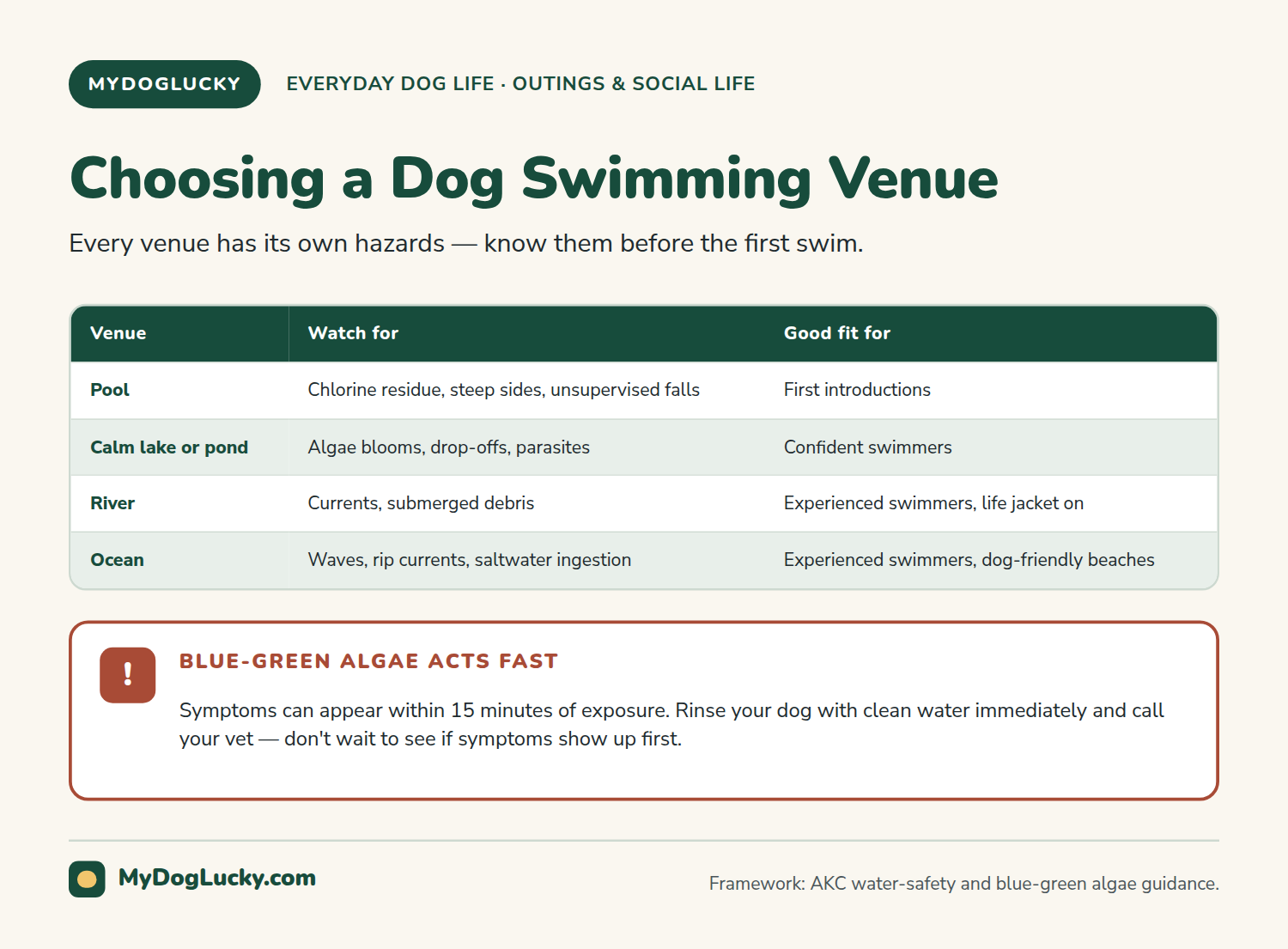
Blue-green algae (cyanobacteria) blooms can be blue, vibrant green, brown, or red, and the water often looks dirty, foamy, or has mats on the surface. According to the AKC, symptoms in dogs, vomiting, drooling, weakness, disorientation, seizures, or collapse, can appear anywhere from 15 minutes to several days after exposure. If your dog swims in or drinks from water you suspect has a bloom, rinse him off immediately with clean water and call your vet right away, even before symptoms appear.
Blooms are most common in warm weather on slow-moving or standing water, but they aren’t always visible, and the smell can actually attract some dogs rather than repel them. Check local advisories before swimming in an unfamiliar lake or pond, especially during summer months.
Cold water and hypothermia risk
Water temperature changes the calculus more than most owners expect. A dog who swims confidently in a sun-warmed pool in July can struggle in a 55°F (13°C) lake in early May, and cold water pulls heat out of a dog’s body far faster than cold air does at the same temperature.
Watch for these signs of cold-water stress
- Violent, uncontrollable shivering, both during the swim and after he’s out
- A sudden change from strong, purposeful strokes to weak or uncoordinated ones
- Lethargy, confusion, or a dog who seems oddly quiet once back on shore
- Gums that look pale or bluish rather than their normal healthy pink
Small, lean, short-coated, young, and senior dogs lose body heat fastest and need the shortest cold-water sessions. A thick double coat helps some, but a fully soaked coat in a cold wind can still chill a dog quickly once he’s out of the water and standing still.
Warming up safely after a cold swim
Towel-dry thoroughly, get him into a warm space or at minimum out of the wind, and offer a favorite blanket or a warm, not hot, spot to settle. A dog who won’t stop shivering after twenty or thirty minutes indoors, or who seems unusually quiet and withdrawn, is worth a call to your vet rather than a wait-and-see approach at home.
Winter and early-season swimming
Some dogs, especially thick-coated working breeds, genuinely enjoy a cold-water dip in fall or even winter, and there’s no rule against it for a healthy adult dog. The adjustment is entirely about duration and supervision: sessions measured in a couple of minutes rather than twenty, a life jacket for the added insulation and visibility, and a warm, dry place ready the moment he’s out. Ice-covered or partially frozen water is a separate and much more serious hazard; a dog who breaks through thin ice can be difficult to rescue safely, so treat any icy shoreline as off-limits rather than a judgment call in the moment.
The practical fix is simple: treat cold water the way you’d treat cold air for a dog without a coat on. Shorter sessions, more frequent warm-up breaks, and a life jacket, which adds a thin layer of insulation along with buoyancy.
Swimming at the beach
- Check for rip currents and posted warnings before letting your dog into ocean water, the same way you would for yourself.
- Rinse saltwater off after swimming, since it can dry and irritate skin, and discourage drinking it, since too much saltwater ingestion can cause vomiting and, in larger amounts, more serious problems.
- Watch wave conditions, since even a confident pool or lake swimmer can be caught off guard by surf and undertow he’s never experienced before.
- Keep first ocean visits calmer and shorter than a familiar lake or pool session, since it’s a genuinely different environment even for an experienced swimmer.
Reading rip currents and surf conditions
A rip current is a narrow, fast-moving channel of water flowing away from shore, and it’s one of the more dangerous ocean hazards for a swimming dog because it’s often not obvious just by looking at the water from the beach. Signs include a channel of choppy, discolored, or foamy water cutting through the surf line, a visible break or gap in the incoming wave pattern, or a line of foam, seaweed, or debris moving steadily out to sea rather than washing in.
If your dog gets caught in a rip current, the instinct to swim straight back toward shore against it is exactly the wrong move, for a dog or a person, since it fights the current head-on and burns energy fast. Call him toward a diagonal path, roughly parallel to the shoreline first, to get out of the current’s pull before turning back toward the beach. Posted flags or a lifeguard’s warning at a staffed beach are the fastest way to know conditions before either of you is already in the water, and an unstaffed or unfamiliar beach deserves extra caution for exactly that reason.
Jellyfish, sand, and other beach-specific hazards
Jellyfish stings, sharp shells, hot sand, and sand ingestion all show up specifically at the beach and rarely anywhere else. A jellyfish sting typically causes localized pain, redness, or swelling; rinse the affected area with seawater, not fresh water, which can sometimes worsen certain stings, and call your vet, especially if you notice facial swelling, drooling, or distress that goes beyond a normal, mild sting reaction.
Hot sand can burn paw pads in summer heat the same way hot pavement does; the same five-second hand test applies before letting him run across it. And a dog who digs enthusiastically at the waterline can swallow enough sand over a single outing to cause an impaction, a genuine medical emergency, particularly in dogs who dig and mouth repeatedly at wet sand rather than just walking through it. Watch for repeated digging-and-mouthing behavior and redirect him with a toy or a game of fetch instead.
Signs of fatigue or distress in the water
Get him out immediately if you see
- Vertical, splashy, panicked-looking swimming instead of a smooth horizontal stroke
- His head tipping back with his nose pointing up and mouth partly submerged
- Struggling to make forward progress against current or waves
- Sudden stiffness, a change in stroke pattern, or visible exhaustion
Fatigue in the water escalates faster than it does on land, since a tired dog can’t simply stop and rest the way he could mid-walk. When in doubt, call him in or go get him well before he looks like he’s struggling.
Ear care after swimming
Trapped moisture in the ear canal is one of the most common causes of swimmer’s ear (otitis externa) in dogs, especially those with floppy ears or narrow ear canals. Dry your dog’s ears gently after every swim, and ask your vet about a vet-approved drying solution if he swims often or has a history of ear infections.
Watch for head shaking, scratching at the ears, a bad odor, or redness in the days after swimming. Any of those is worth a vet visit rather than waiting to see if it clears up on its own.
Limber tail (swimmer’s tail)
Limber tail, also called swimmer’s tail, is a painful but treatable condition caused by overusing the tail muscles, most commonly from swimming, especially in cold water or after a long break from activity. According to the AKC, the hallmark sign is a limp tail that hangs down or droops between the hind legs, sometimes with pain, lethargy, or difficulty squatting to go to the bathroom.
What to do if you see it
Call your vet. They’ll rule out other causes and likely recommend rest, calm, and possibly anti-inflammatory medication. Most dogs recover within a few days to two weeks. Prevent it by building up swim time gradually rather than one long, intense first session, and by avoiding prolonged time in cold water.
Choosing a swimming venue
| Venue | Watch for | Good fit for |
|---|---|---|
| Backyard or public pool | Chlorine residue, steep sides, unsupervised falls | First introductions; controlled, repeatable practice |
| Calm lake or pond | Algae blooms, drop-offs, parasites | Confident swimmers; check local water-quality advisories first |
| River | Currents, submerged debris | Experienced swimmers only, ideally in a life jacket |
| Ocean | Waves, rip currents, saltwater ingestion | Experienced swimmers; check for dog-friendly beaches and posted conditions |
Dog-friendly beaches, parks, and posted rules
Not every beach, lake, or park allows dogs, and the ones that do often have specific rules about leashes, off-leash hours, and which stretch of shoreline is open to them. Checking before you go saves a wasted trip and, more importantly, keeps you out of a situation where you’re managing an off-leash dog somewhere he isn’t actually supposed to be.
What to check before heading out
- Leash requirements, including whether there’s a designated off-leash area versus a leash-required stretch of the same beach or park.
- Seasonal restrictions. Some beaches restrict or ban dogs entirely during peak summer months and relax the rules in the off-season.
- Posted water advisories for algae blooms, bacteria counts, or recent water-quality testing, which many state and local park websites post directly online.
- Waste-disposal expectations, since some more remote swimming spots don’t have trash cans nearby and expect you to pack out what you pack in.
A quick search for the park or beach name plus “dog rules,” or a call to the local parks department, usually settles it in a couple of minutes. It’s worth doing every time you’re trying somewhere new rather than assuming a favorite spot’s rules apply everywhere else too.
Respecting other beachgoers and swimmers
A dog who’s a confident, controlled swimmer around other people is a welcome sight at a dog-friendly beach. A dog who charges toward strangers, other dogs, or swimmers he doesn’t know is a legitimate source of stress for other people trying to enjoy the same shared space. Keep recall sharp before relying on off-leash privileges anywhere new, and don’t assume every person in the water wants a wet, excited dog swimming up to introduce himself.
Swimming with multiple dogs
Group swimming adds a social layer on top of the usual water-safety considerations, and it’s worth planning for both at once.
- Introduce the water separately before swimming together if any dog in the group is new to it, so his first experience isn’t complicated by managing other dogs’ excitement at the same time.
- Watch for resource-guarding around toys or entry points, like a dock or a shallow entry ramp, the same way you would on land.
- High arousal compounds in groups. Dogs playing together in water can escalate faster than they would individually, so keep sessions a little shorter and watch body language closely.
- Make sure every dog in the group can actually exit on their own before letting them swim unsupervised near each other, since a struggling dog trying to climb onto another dog for support is a real hazard for both.
Puppies and senior dogs in the water
Puppies can start supervised, shallow-water introductions once they’re old enough for regular outings and current on core vaccinations, always with extra caution and a life jacket. Senior dogs, especially those with arthritis or reduced stamina, can benefit from swimming as low-impact exercise, but sessions should be shorter and more closely watched, since fatigue can set in faster than it did at a younger age.
Common swimming mistakes
Assuming a “water breed” needs no introduction at all
Even Labs and Golden Retrievers can have individual dogs who are hesitant or inexperienced swimmers. Skip the assumption and start with the gradual introduction regardless of breed.
Throwing a dog into deep water to “teach him to swim”
This is more likely to create fear and a bad association than confidence. A gradual, choice-driven introduction works far better and far more reliably.
Skipping the life jacket because he “seems fine”
Fatigue, cold water, and current can overwhelm even a strong swimmer in open water. A life jacket is a safety margin, not an admission that your dog can’t swim.
Not checking water conditions before swimming somewhere new
Algae blooms, currents, and drop-offs aren’t always visible from the shore. A quick check, and a look at any posted advisories, takes a minute and prevents most swimming emergencies.
Letting a dog swim right after a full meal
Vigorous exercise, including hard swimming, soon after a large meal is a risk factor for bloat (gastric dilatation-volvulus) in deep-chested breeds especially. Give him at least an hour of settled time after eating before a swim session, and go easier on the intensity of play in the water right afterward too.
Common myths about dogs and swimming
“All dogs can swim instinctively”
Some dogs, especially certain brachycephalic and short-legged breeds, struggle to swim efficiently or safely at all, regardless of instinct.
“The doggy paddle means a dog is swimming comfortably”
A frantic, vertical doggy paddle with the head tipped back is often a sign of struggle, not confident swimming. A relaxed swimmer’s body stays more horizontal in the water.
“Pool water is always safer than a lake”
Pools remove the algae and current risks of open water but bring their own hazards, chlorine irritation and steep, hard-to-exit sides among them. Neither venue is automatically risk-free.
“If a dog swam fine last year, he doesn’t need supervision this year”
Fitness, weight, age, and health can all change season to season. Treat each new swimming season as worth a quick reassessment, not an assumed continuation.
“A wagging tail in the water means everything’s fine”
Tail position and motion can carry over from land-based excitement even when a dog is starting to struggle. Body language in the water is read as a whole picture, stroke, head position, and breathing included, not from the tail alone.
Your dog-swimming checklist
- Gradual first introduction completed in shallow, calm water.
- Well-fitted life jacket for open water, boats, or a new swimmer.
- Water conditions checked: no algae, foam, unusual color, or strong currents.
- Ears dried and checked after every swim.
- Close supervision, every time, regardless of experience level.
- Vet’s number handy in case of algae exposure or an injury.
Build swimming into a routine, not a one-off event
Regular, moderate swimming sessions build both fitness and confidence more reliably than occasional, high-intensity ones. It also gives you more chances to notice a change in how your dog handles the water as he ages.
Common questions about swimming with dogs
At what age can puppies start swimming?
Once they’re old enough for regular outings and current on core vaccinations, always in shallow, supervised water with a life jacket for the first sessions.
Do all dogs need a life jacket?
Not necessarily in a shallow backyard pool with a confident swimmer, but yes for open water, boats, new swimmers, or breeds prone to struggling in water.
How do I know if my dog actually likes swimming or is just tolerating it?
Watch his body language: a relaxed dog who returns to the water on his own between breaks likely enjoys it. One who avoids re-entering, tries to climb out immediately, or shows stress signals is tolerating it at best.
Can dogs get sunburned near water?
Yes, especially dogs with light or thin coats. Sun exposure near water is often more intense due to reflection off the surface.
Is it safe for dogs to drink pool water?
Small amounts of chlorinated pool water generally aren’t a major concern, but it’s not ideal as a regular water source. Offer fresh water nearby instead.
What’s the difference between limber tail and a more serious injury?
You often can’t tell just by looking. Any sudden limp or drooping tail after swimming or exertion deserves a vet visit to rule out other causes before assuming it’s simple swimmer’s tail.
How long should a first swimming session last?
Short, often five to ten minutes, and ended on a calm, positive note well before your dog is tired.
Can dogs get ear infections from swimming even with floppy ears dried afterward?
Drying reduces the risk significantly but doesn’t eliminate it entirely, especially for dogs prone to ear issues. Watch for head shaking or odor in the days after swimming regardless.
Is saltwater or freshwater swimming better for dogs?
Neither is universally better. Each carries different considerations, algae in freshwater, currents and salt exposure in ocean water, so match the choice to the venue’s specific conditions rather than a blanket preference.
My dog refuses to go anywhere near water. Should I keep trying?
Not by forcing it. Some dogs simply don’t enjoy water, and that’s a completely fine outcome. If you want to keep trying, go slower than you think you need to and let him lead the pace entirely.
Can dogs swim safely in cold water?
Brief supervised swims are generally fine for a healthy adult dog, but prolonged cold-water exposure raises the risk of both hypothermia and limber tail. Keep cold-water sessions shorter than warm-water ones.
Is dock diving or competitive dog swimming safe?
For a dog who’s already a confident, conditioned swimmer, structured sports like dock diving can be a great outlet, ideally introduced gradually with guidance from an experienced handler or club rather than attempted cold at full height and distance.
Can swimming help an overweight dog lose weight safely?
It can be a useful low-impact piece of a broader weight-management plan, but it isn’t a substitute for the feeding-plan side of weight loss. Talk to your vet about a complete plan rather than relying on swimming alone.
My dog swallows a lot of water while swimming. Is that a problem?
Swallowing small amounts occasionally is common and rarely serious, but drinking large amounts of water during vigorous play can, rarely, cause a dangerous drop in blood sodium. If he seems disoriented, bloated, or unwell after a long swim session, call your vet.
Do life jackets expire or wear out?
Foam padding and buckles both degrade with sun and chlorine exposure over time. Check stitching, buckles, and foam firmness each season, and replace a jacket that’s cracked, waterlogged, or no longer holds its shape.
Should I rinse my dog even after a quick dip?
For chlorine or saltwater, yes, even a short swim leaves residue that can irritate skin over repeated exposure. For a clean freshwater pond with no algae concerns, a quick towel-dry is often enough.
Are some breeds more prone to swimmer’s ear specifically?
Yes. Dogs with floppy ears or narrow, hairy ear canals, like Cocker Spaniels, Basset Hounds, and Poodles, trap moisture more easily than dogs with upright, well-ventilated ears. Ask your vet about a drying routine suited to your dog’s ear shape if he swims regularly.
Can I use a human life jacket on my dog in an emergency?
Not effectively. A dog’s center of gravity and body shape are different enough that a human life jacket won’t fit or float him correctly, and it typically lacks the grab handle that makes a dog-specific jacket useful for a quick rescue. Use a properly fitted dog life jacket instead.
Does swimming count as sufficient exercise on its own?
For many dogs, a good swim session is a genuinely tiring, full-body workout. But it doesn’t fully substitute for the mental engagement of a walk, sniffing new ground, or structured training, so most dogs still do best with a mix rather than swimming as the sole form of exercise.
What should I bring in a basic water-safety kit?
A well-fitted life jacket, a long-line or leash for shoreline control, a towel, fresh drinking water, a basic first-aid kit, and your vet’s phone number saved where you can find it quickly. For open water, add a whistle or another way to get attention at a distance.
Can dogs swim safely in winter?
Healthy adult dogs can, in brief, closely supervised sessions with a life jacket and a warm, dry place ready immediately afterward. Skip it entirely around ice-covered or partially frozen water, which is a far more serious and fast-moving hazard than cold open water alone.
Sources
- American Kennel Club. Blue-Green Algae Poisoning in Dogs: Symptoms and Prevention
- American Kennel Club. Swimmer’s Tail in Dogs: Signs, Symptoms, Treatments
This article is general education for U.S. dog owners. It is not individualized veterinary advice. Ask your veterinarian about anything specific to your dog.






Trackbacks/Pingbacks