
Dog training basics come down to something simpler than most of us expect: your dog repeats whatever works. Food, attention, a door opening, a squirrel finally getting chased off the lawn — anything that pays off becomes more likely next time. Dog training is the practice of deciding what pays off. You arrange the situation so the right answer is easy, then reward it often enough that it becomes a habit.
That is the whole engine. Everything else is detail built on top of it. The cues, the timing, the leash, the treat pouch you keep finding in the washing machine.
This guide walks through what actually moves the needle. How dogs learn. The home skills that make daily life bearable. Walking and recall, and reading your dog’s body language. The everyday complaints that fill training inboxes. And the harder cases — fear, reactivity, distress at being left alone — where practice alone isn’t enough. It also names, plainly, when a problem belongs with a professional rather than a website.
Two things worth saying at the top. First, reward-based training is not the soft option — it is the method veterinary behavior organizations recommend, and the one the research supports. Second, progress in training is rarely a straight line, and a bad week does not undo a good month.
What’s in this guide
- Dog training basics: how dogs learn, and what makes training work
- Potty training and home skills
- Walking, check-ins, and recall
- Body language and social skills
- Everyday behavior challenges
- Fear, reactivity, and separation distress
- Two tools: a practice log and a threshold tracker
- How to find qualified dog training help
- Sources
Dog training basics: how dogs learn, and what makes training work
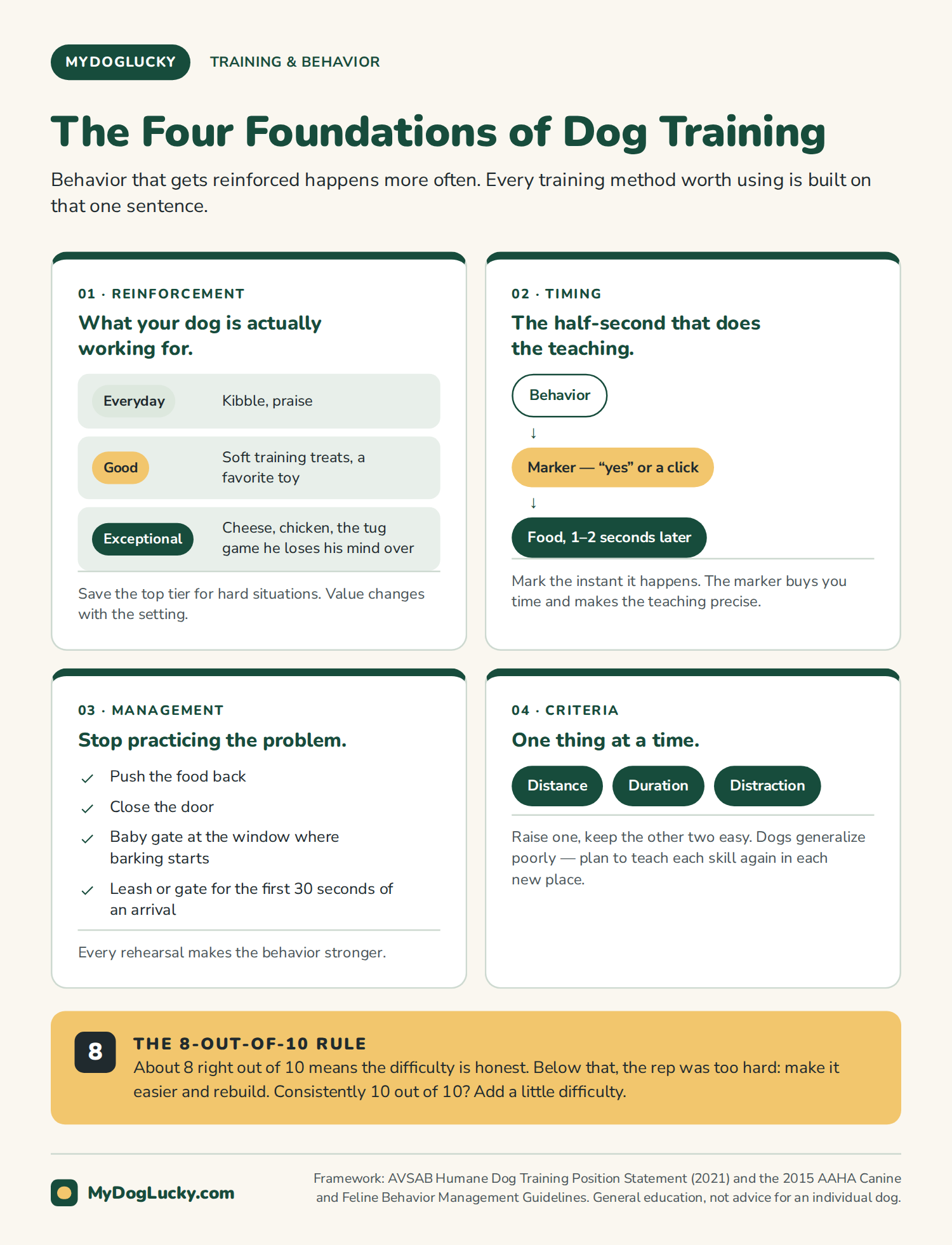
Dog training basics rest on one observation: behavior that gets reinforced happens more often. Reinforcement is not a philosophy, it is a description of what you’ll see. If your dog jumps on visitors and visitors respond by talking to him, jumping is being reinforced whether or not anyone intended it.
Which means most dog training problems are really reinforcement problems. Something in the environment is paying your dog for the behavior you dislike, and usually paying more reliably than you’re paying for the alternative.
Reinforcement: what your dog is actually working for
Food is the workhorse because it’s fast, repeatable, and most dogs will take it. But reinforcement is anything your dog wants in that moment. For a dog straining toward a sniffy patch of grass, permission to go sniff is worth more than a biscuit. For a collie-ish dog at the park, the chance to chase a thrown toy beats both.
Use what your dog values, not what you think should motivate him. And expect the value to change with the setting. The treat that works in the kitchen often stops working on the sidewalk. That isn’t stubbornness. It’s competition.
A quick way to rank rewards
Over a few days, note which rewards your dog will turn away from a mild distraction for. Rank them roughly into three tiers. Everyday: kibble, praise. Good: soft training treats, a favorite toy. Exceptional: cheese, chicken, the tug game he loses his mind over. Save the top tier for hard situations: recall away from something interesting, meeting new people, walking past the dog who barks behind the fence.
Timing: the half-second that does the teaching
Your dog connects the reward with whatever he was doing roughly when it arrived. Reward late and you teach the wrong thing. You meant to reward the sit. The treat landed as he stood up, so you paid for standing.
The fix is a marker: one short sound that means that, right there, earned it. A clicker works. So does a crisp word like “yes,” used only for this. Mark the instant the behavior happens, then deliver the food a second or two later. The marker buys you time and makes your teaching far more precise.
Management: stop practicing the problem
Every repetition of an unwanted behavior makes it stronger. A dog who counter-surfs successfully twice a week is being trained by the counter. It’s a better teacher than you are, because it never forgets to pay.
So before you train, manage. Management is the least glamorous part of dog training and the part that saves the most time. Push the food back. Close the door. Use a baby gate at the window where the barking starts. Management isn’t cheating or a permanent solution — it’s how you stop the behavior from getting more practice while the new skill is still fragile. The 2015 AAHA behavior management guidelines put environmental change and management early in the treatment order, before other steps, for exactly this reason.
Criteria: one thing at a time
Trainers talk about the three D’s — distance, duration, distraction. Raise one, keep the other two easy. A dog who holds a sit for thirty seconds in your kitchen may not hold it for five at the vet’s office. Ask for both at once and you get a dog who has “forgotten everything.”
He hasn’t forgotten. The situation changed, and the skill hasn’t been rebuilt there yet. Dogs generalize poorly; plan to teach each skill again in each new place, though it goes faster every time.
The success-rate rule
If your dog gets it right roughly 8 times out of 10, the difficulty is about right. Below that, you’ve asked for too much — make it easier and rebuild. Consistently at 10 out of 10? Add a little difficulty. This one habit prevents most dog training frustration. It turns “he won’t do it” into “this rep was too hard” — a problem you can actually fix.
What the evidence says about aversive dog training methods
You will still find dog training advice recommending leash corrections, prong collars, shock collars, or “showing him who’s in charge.” The professional consensus has moved away from all of it. The research is worth knowing, because it’s more specific than the shouting match online suggests.
The American Veterinary Society of Animal Behavior’s 2021 position statement recommends reward-based methods only. Aversive tools and techniques, it states, should not be used in dog training or in treating behavior problems. The 2015 AAHA guidelines take the same line, naming prong, choke, and electronic shock collars, alpha rolls, and dominance downs among the techniques the task force opposes.
Two studies are often cited, and they measured different things:
- Welfare. Vieira de Castro and colleagues (PLOS ONE, 2020) observed 92 companion dogs at seven training schools in Portugal, comparing reward-based, mixed, and aversive-based programs. Dogs in aversive-based programs showed more stress behaviors during training, greater rises in salivary cortisol afterward, and more “pessimistic” responses in a judgment-bias task outside of training. It was an observational study, not a randomized trial, and it did not measure how well the dogs learned.
- Effectiveness. China, Mills, and Cooper (Frontiers in Veterinary Science, 2020) randomly assigned 63 pet dogs with poor recall to three groups. E-collar trainers nominated by e-collar manufacturers. Those same trainers working without e-collars. And independent reward-based trainers. The reward-based group produced better responses to “come” and “sit,” with shorter latencies. The e-collar offered no efficiency advantage.
Dominance theory, and why it keeps producing bad advice
Dominance theory deserves its own note, because it’s the source of so much bad dog training advice. AVSAB’s position statement on the subject makes three points. Most unwanted behaviors are accidentally reinforced rather than attempts at rank. Confrontational techniques frequently provoke aggression. And the wolf-pack analogy misreads how wolves actually behave. If a trainer explains your dog’s behavior by saying he’s trying to be the boss, keep looking.
A note on quick fixes
Tools that suppress a behavior can look like they worked. The barking stops, the lunging stops, and the underlying fear is still there — now without its warning signal. That’s the trade nobody mentions in the product description, and it’s why suppression is a poor foundation for anything you want to last.
Potty training and home skills
Housetraining is mostly logistics. A puppy who never gets the chance to make a mistake indoors learns the habit faster than one who is corrected after the fact. The correction teaches nothing useful. It arrives too late to connect to anything.
The schedule that does most of the work
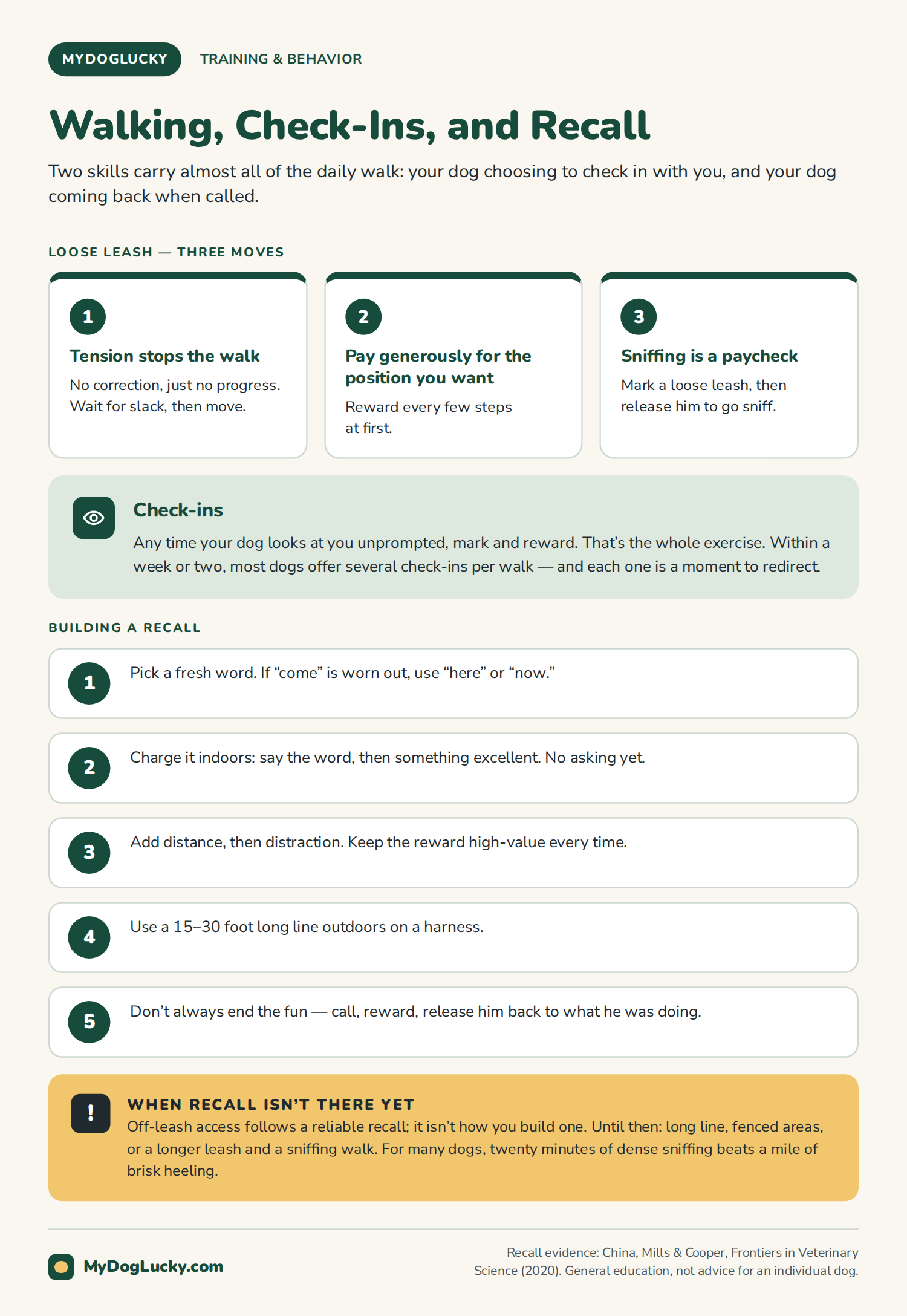
VCA’s veterinary behaviorists suggest taking a puppy out roughly every one to two hours while awake. Also every thirty minutes during active play, after meals, after naps, and overnight until around five months of age. That’s frequent. It is also the single biggest predictor of how quickly this goes.
Go out with your puppy rather than sending him out alone — you need to see it happen so you can reward it. Reward outdoors, immediately, before you go back in. If you wait until you’re inside, you’ve rewarded coming inside.
The accident protocol
- Interrupt gently if you catch him mid-stream — a cheerful noise, not a scare — and carry or lead him out to finish.
- Clean with an enzymatic cleaner. Ordinary household cleaners leave scent markers that invite a repeat.
- Don’t punish, ever. Rubbing a dog’s nose in it teaches him that eliminating near you is dangerous. What you get is a dog who hides to go, often behind the couch.
- Write it down. Time, place, what happened in the twenty minutes before. Three days of notes usually reveal the gap in the schedule.
That “guilty look” when you find a puddle isn’t guilt. It’s a dog reading your face and posture and offering appeasement signals. Dogs are good at noticing that you’ve gone tense; they’re not good at reconstructing what they did an hour ago and connecting it to your mood now.
When house soiling is medical
Any previously housetrained dog who starts soiling indoors needs a veterinary appointment before a training plan. VCA’s behavior team lists several causes worth ruling out. Cystitis, urinary stones, and urinary or fecal incontinence. Inflammatory bowel disease, food hypersensitivity, maldigestion, and intestinal parasites. Age-related cognitive decline. Training a medical problem is a good way to waste weeks and make both of you miserable.
Settling: the skill nobody teaches and everyone needs
Most owners teach sit, down, and stay. Fewer teach the dog to be calm and unoccupied in a room where interesting things are happening — which is, statistically, what you’ll ask of him most often.
Teach it the same way you’d teach anything else. Put down a mat. When your dog lies on it, mark and reward, delivering the food onto the mat so lying down is where the payoff lands. Early on, reward often — every few seconds. Stretch the gaps gradually as he settles in. Start when nothing is going on, then add mild activity: you standing up, walking across the room, loading the dishwasher.
The mat becomes portable, which is the real payoff. A dog with a solid mat habit has somewhere to be. At a café, in a waiting room, or when your in-laws arrive with strong opinions about dogs on furniture.
Confinement, used well
A crate or a gated area is a management tool: it prevents rehearsal of chewing, counter-surfing, and indoor accidents while the alternatives are still being built. It works when the dog likes being there and fails when it’s used as a place things happen to him.
- Feed meals in it, with the door open at first.
- Build duration in small steps — seconds, then a minute, then a few — while you’re still in the room.
- Give something worth staying for: a stuffed chew, a puzzle feeder, a long-lasting treat.
- Never use it for punishment, and don’t shut a distressed dog in and wait it out. A dog panicking in a crate is not settling down; he’s rehearsing panic.
If your dog screams, drools, or tries to dig out of confinement, stop and read the section on separation distress below. That’s a different problem and it needs a different plan.
Walking, check-ins, and recall
Two skills carry almost all of the daily walk: your dog choosing to check in with you, and your dog coming back when called. Loose-leash walking is downstream of both.
Loose leash: pay for the position you want
A tight leash is self-reinforcing. Pulling gets your dog closer to whatever he’s pulling toward, so pulling works, so he does it more. Untangling that has three parts.
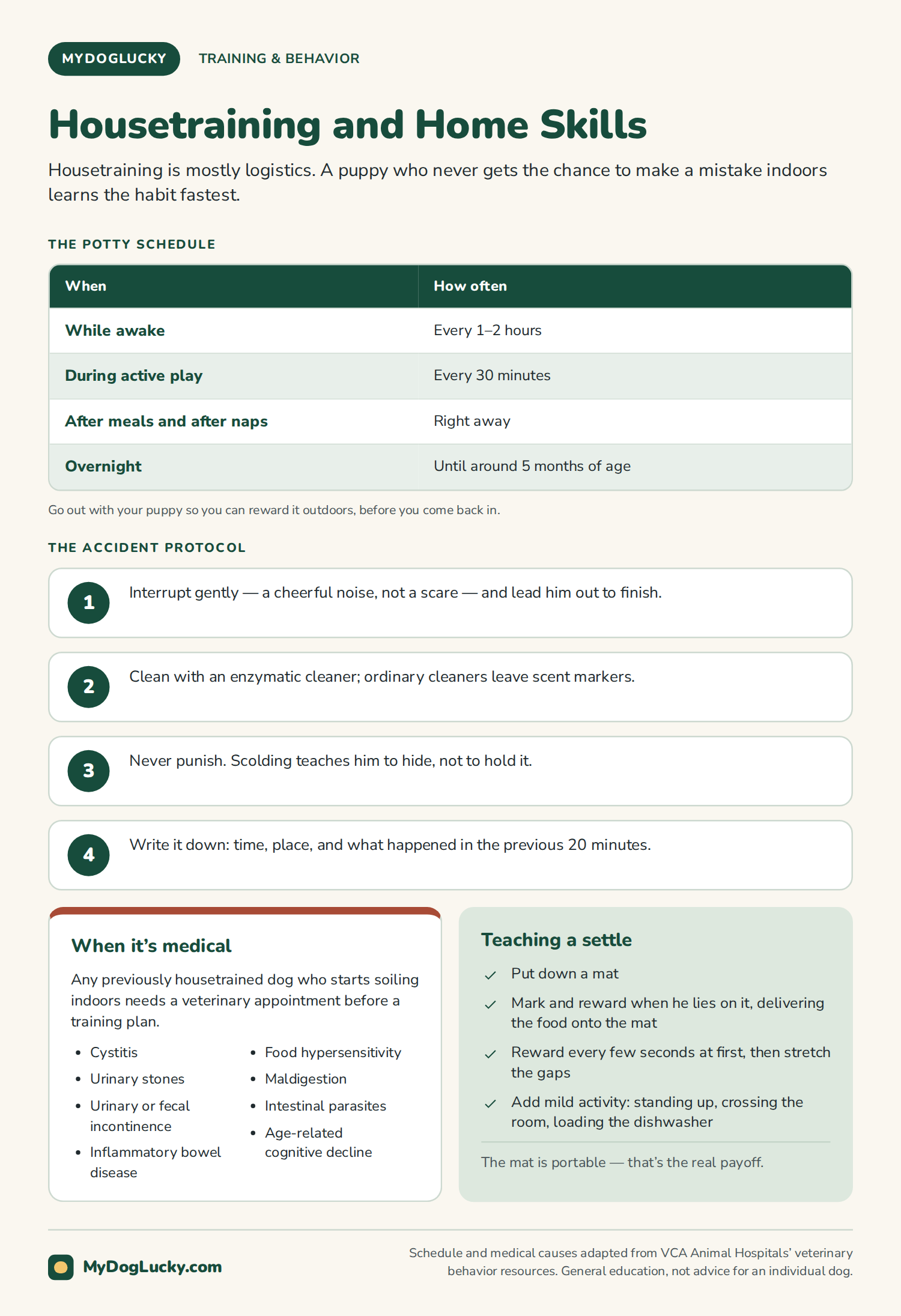
- Stop paying for pulling. When the leash goes tight, the forward motion stops. Not a correction, not a jerk — just no progress. Wait for slack, then move again.
- Pay generously for the position you want. Reward while your dog is beside you and the leash is loose. Most people reward far too rarely at this stage. In the first sessions, think every few steps.
- Use sniffing as a reward. A walk where the dog never gets to sniff is a walk he’ll fight you through. Mark a moment of loose leash, then release him to go sniff. Sniffing is a paycheck your dog values highly and it costs you nothing.
On equipment: a well-fitted harness or flat collar plus a standard leash covers most dogs. Retractable leashes teach constant tension and give you poor control near roads. If your dog is strong enough that you can’t safely hold him, get hands-on help rather than escalating to a tool that works by hurting.
Check-ins: the habit that makes everything else easier
A dog who glances back at you regularly is a dog you can work with. Build it deliberately: any time your dog looks at you on a walk, unprompted, mark and reward. That’s it. Within a week or two most dogs offer check-ins several times per walk. Those glances give you a moment to redirect, before the squirrel becomes the whole story.
Recall: build it as its own skill
Recall fails for predictable reasons. The word gets used when nothing good follows. It gets used to end fun. And it gets tested in hard situations long before it’s been built in easy ones.
Building a recall from scratch
- Pick a fresh word. If “come” is already worn out, use something else. “Here.” “Now.” Your dog doesn’t care which.
- Charge it indoors. Say the word, then immediately give something excellent. Repeat for a few days. Don’t ask for anything yet — you’re teaching the word predicts good things.
- Add distance, then distraction. Across the room. Down the hall. Into the yard. Keep the reward high-value every single time at this stage.
- Use a long line outdoors. A 15- to 30-foot line on a harness gives your dog freedom while you keep the safety net. Practice at the distances where he can still succeed.
- Don’t always end the fun. Call, reward, release him back to what he was doing. If the word reliably means “leash on, party over,” it stops working.
China, Mills, and Cooper’s randomized study is worth remembering here. The dogs in that trial were referred specifically for poor recall and chasing. The reward-based group came out ahead on both the number of cues needed and how quickly the dogs responded. Recall is the exact scenario where shock collars are marketed hardest, and it’s the scenario where the controlled comparison didn’t favor them.
When recall isn’t there yet
Off-leash access is a privilege that follows a reliable recall, not a way to build one. Until then: long line, fenced areas, or a sniffari on a longer leash. This isn’t a lesser walk. For a lot of dogs, twenty minutes of dense sniffing is more satisfying than a mile of brisk heeling.
Body language and social skills
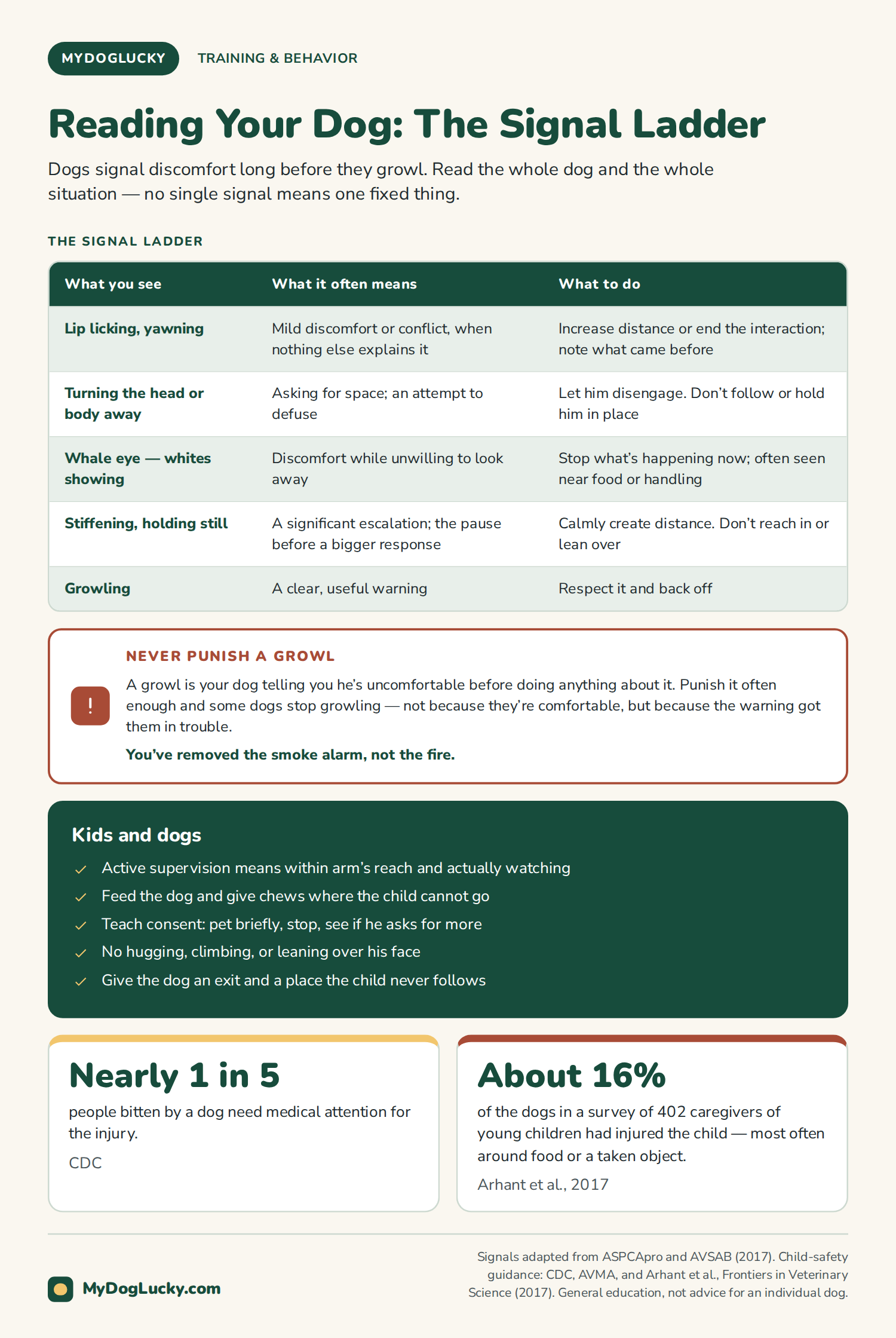
Reading your dog is the skill that makes every other skill safer. Dogs signal discomfort long before they growl, and the signals are easy to miss because several of them look like ordinary dog behavior.
The early signals
ASPCApro’s body language guidance names yawning and lip licking among the early stress signals. It describes “whale eye” as the white of the eye showing. It notes the tucked tail of a fearful dog, and the stiffening and forward ears of an aroused one. AVSAB’s own guide to canine facial expressions adds detail: a relaxed eye tends to look almond-shaped or slightly squinted, while a nervous dog’s eye often looks rounder.
Both sources make the same point, and it matters more than any individual signal: read the whole dog and the whole situation. A yawn in a sunny window is a yawn. A yawn while a stranger leans over him is information.
| What you see | What it often means in context | What to do |
|---|---|---|
| Lip licking, yawning | Mild discomfort or conflict, when nothing else explains it | Increase distance or end the interaction; note what preceded it |
| Turning the head or body away | Asking for space; an attempt to defuse | Let him disengage; don’t follow or hold him in place |
| Whale eye — whites showing | Discomfort while unwilling to look away from something | Stop what’s happening now; often seen near resources or handling |
| Stiffening, holding still | A significant escalation; the pause before a bigger response | Calmly create distance; do not reach in or lean over |
| Growling | A clear, useful warning | Respect it and back off; never punish it |
Don’t punish a growl
A growl is your dog telling you he’s uncomfortable before doing anything about it. Punish the growl often enough and some dogs stop growling — not because they’re comfortable, but because the warning got them in trouble. You’ve removed the smoke alarm, not the fire. If your dog is growling in a situation that keeps recurring, that’s a reason to get professional help, not a reason to correct him.
Children and dogs
This is where body language stops being an interesting topic and starts being a safety one. The CDC notes that nearly one in five people bitten by a dog needs medical attention, and that children are at higher risk. The more severe injuries to children typically happen during ordinary interactions with dogs they know. Young children should never be left to play with a dog unsupervised — including the family dog.
A 2017 study in Frontiers in Veterinary Science surveyed 402 caregivers of children up to age six living with a family dog. Supervision tended to get less attentive as children got older, even as their interactions with the dog became riskier. Around 16% of the dogs had injured the focus child at some point. Most often around treats, or when an object was taken during a game of fetch.
The practical version, supported by the AVMA’s bite-prevention guidance and VCA’s veterinary behaviorists:
- Active supervision means within arm’s reach and actually watching — not in the same room with a phone.
- Feed the dog and give chews somewhere the child cannot go. Most bites to young children involve food or possessions.
- Teach consent: let the dog approach, pet briefly, then stop and see whether he asks for more.
- No hugging, climbing, or leaning over the dog’s face, however tolerant he seems.
- Give the dog an exit and a place the child never follows him to.
Meeting other dogs
Not every dog wants dog friends, and adult dogs are under no obligation to enjoy strangers. A polite greeting is brief, curved rather than head-on, and ends before either dog gets tense. Leash greetings are harder than they look — the leash removes the option of moving away, which is the main way dogs manage each other.
Parallel walking is a better format: two dogs walking in the same direction with distance between them, gradually closing the gap only while both stay loose and relaxed. Dull to watch, far more likely to end well.
Puppy socialization, with the timing that matters
AVSAB’s puppy socialization position statement identifies the first three months of life as the primary window. It recommends classes as early as seven to eight weeks. The conditions: at least one set of vaccines given seven days beforehand, a first deworming, then staying current. The reasoning is blunt: in that window, behavior problems, not infectious disease, are the greater threat to the dog’s life.
Socialization means good experiences, not lots of experiences. A puppy who is overwhelmed at a busy farmers’ market isn’t being socialized; he’s learning the world is a lot. Aim for short, calm, voluntary exposures where he can watch from a distance he chooses, and where good things happen while the new thing is at that distance.
Everyday behavior challenges
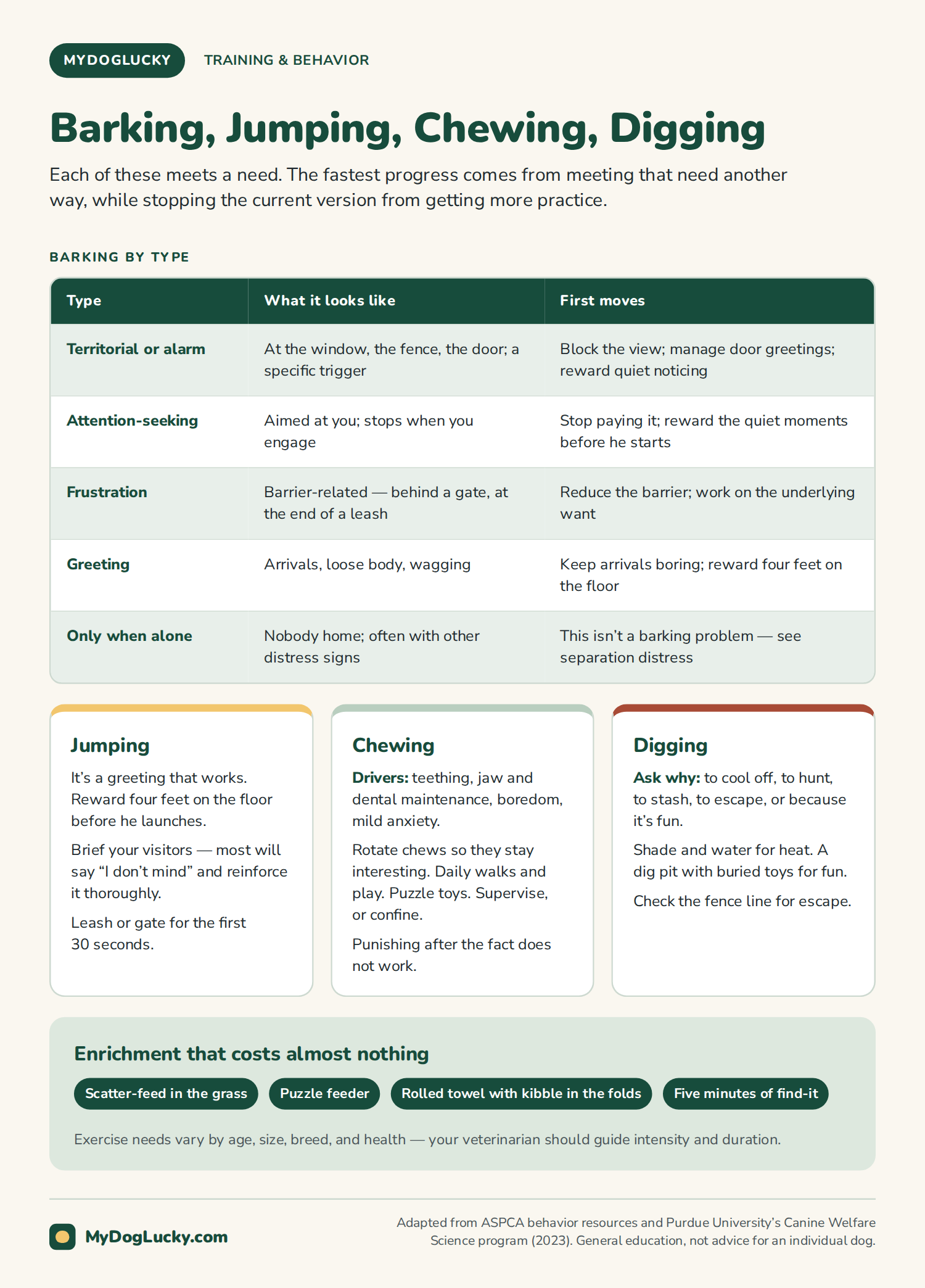
Barking, jumping, chewing, digging. These are the complaints that fill trainers’ inboxes, and they share a structure. The behavior meets a need. The fastest progress comes from meeting that need another way, while preventing the current version from getting more practice.
Barking
The ASPCA’s guidance separates barking into seven categories: territorial, alarm, attention-seeking, greeting, compulsive, socially facilitated, and frustration-induced. You have to identify which one you’re dealing with before treatment makes sense. A dog barking at passers-by and a dog barking because barking has always produced attention need opposite plans.
| Type | What it looks like | First moves |
|---|---|---|
| Territorial / alarm | At the window, the fence, the door; triggered by something specific | Block the view with film or a gate; manage door greetings; reward quiet noticing |
| Attention-seeking | Aimed at you, stops when you engage | Stop paying it; reward the quiet moments before he starts |
| Frustration | Barrier-related — behind a gate, at the end of a leash | Reduce the barrier situation; work on the underlying want |
| Greeting | Arrivals, loose body, wagging | Keep arrivals boring; reward four feet on the floor |
| When alone | Only when nobody’s home; often with other distress signs | Read the separation section — this one isn’t a barking problem |
The ASPCA describes anti-bark collars as punishment devices, notes that dogs often become “collar-wise,” and warns that punishment can make fear- or anxiety-driven barking worse. That last point is the one that catches people out: the collar quiets the dog who was barking because he was worried, and leaves the worry.
Jumping up
Jumping is a greeting that works. It gets faces closer together and produces immediate attention, even if the attention is “off!” delivered in an irritated voice.
Make the alternative pay better. Reward four feet on the floor before your dog has a chance to launch — that means feeding at the moment of approach, not after the jump. Ask visitors to ignore him until he’s settled, which requires actually briefing them, because most people will say “oh, I don’t mind” and then reinforce it thoroughly. A leash or a gate for the first thirty seconds of an arrival prevents the rehearsal while the habit is changing.
Chewing
The ASPCA lists teething, jaw and dental maintenance, boredom, and mild anxiety or frustration among the drivers of destructive chewing. Its recommendations are management-first: rotate appropriate chews so they stay interesting, provide daily walks and play, use puzzle toys, supervise, and confine when you can’t supervise.
And it says plainly what a lot of owners still try: punishing after the fact doesn’t work, because the dog can’t connect your reaction to something he did minutes or hours ago.
The furniture-leg calculation
If your dog chews when left alone for short periods and seems fine otherwise, that’s usually boredom or teething. A different pattern points toward separation distress: chewing focused on doors, window frames, and crate bars — the exits — alongside vocalizing or soiling. In that case the plan below applies.
Digging
Dogs dig to cool off, to hunt something moving underground, to stash food, to escape, or because digging is enjoyable. The response depends on which. Shade and water address heat-related digging. A dig pit — a sandbox with buried toys, in an agreed spot — redirects the dogs who simply like it. Digging along a fence line is often escape-motivated and needs the fence and the underlying motivation addressed together.
Enrichment isn’t optional
Purdue University’s canine welfare program notes that exercise needs vary by age, size, breed, and health. All dogs need daily activity. Your veterinarian should guide intensity and duration for an individual dog — particularly one with joint disease, a heart condition, or a squashed-faced breed’s breathing limits.
Mental work counts. Scatter-feed in the grass. Use a puzzle feeder, or a rolled towel with kibble tucked into the folds. Hide treats around a room and let him find them for five minutes. These tire dogs out in a way that walking the same block again does not. A dog whose day includes some sniffing and problem-solving is usually an easier dog to live with, and much of this is free.
Fear, reactivity, and separation distress
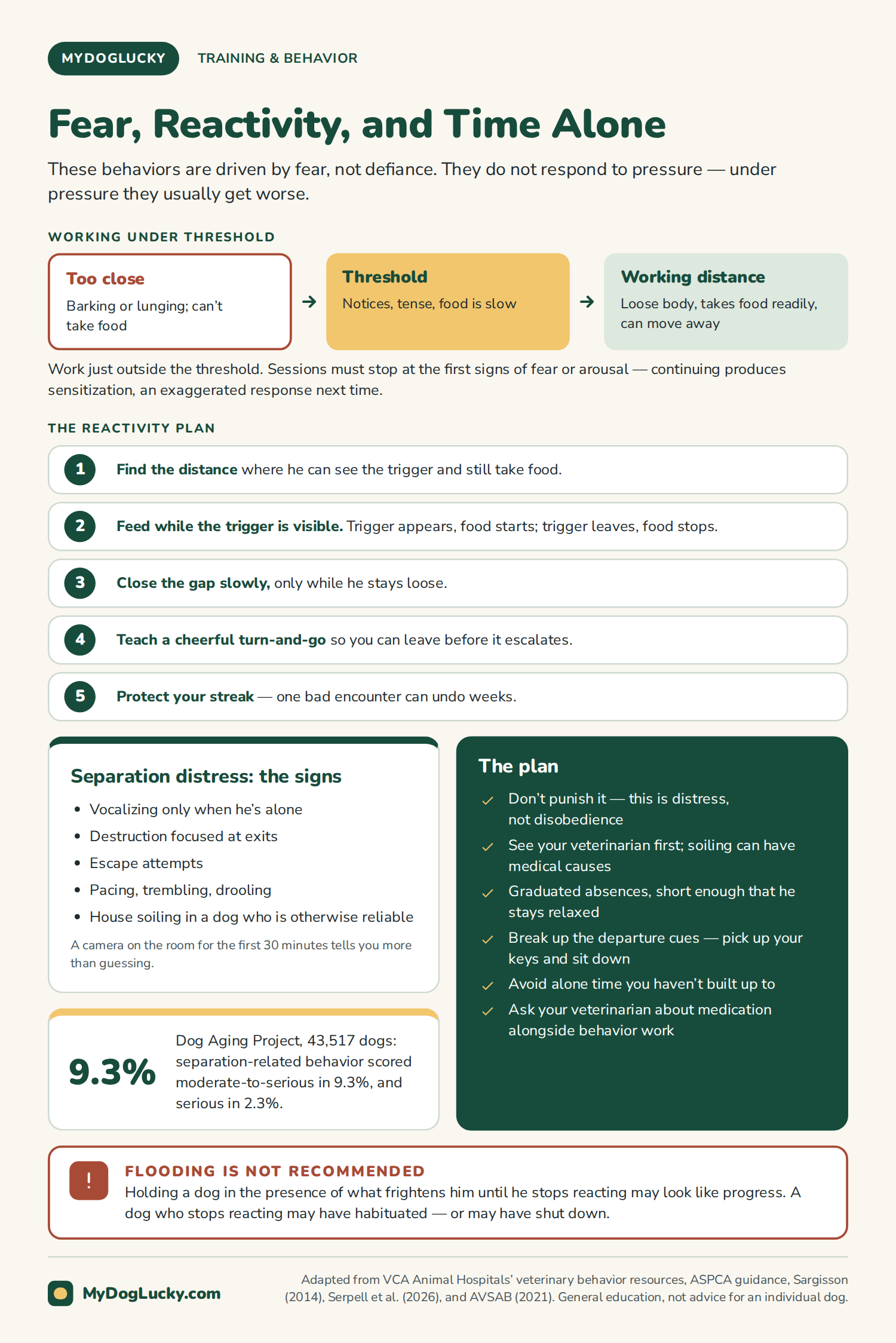
These three sit together because they share a cause. The dog isn’t being difficult — he’s frightened, and behavior driven by fear does not respond to the methods that work for teaching a sit. It usually gets worse under pressure.
The two techniques that do the work
Desensitization and counterconditioning are the backbone of every credible fear protocol. VCA’s veterinary behaviorists describe desensitization as starting with the trigger at an intensity low enough that your dog barely reacts, then increasing it gradually across sessions. Counterconditioning pairs the trigger with something good, so it comes to predict food rather than trouble.
The critical detail is the one most often skipped: sessions have to stop at the first signs of fear or arousal. Continuing to expose a dog who is already uncomfortable produces sensitization — an exaggerated response next time. You don’t get there faster by pushing; you get there slower, from further back.
Why “let him face it” backfires
Flooding — holding a dog in the presence of what scares him until he stops reacting — is listed among the techniques AVSAB’s 2021 statement advises against. A dog who stops reacting may have habituated, or may have shut down. From the outside those look similar. From the inside they are not.
Leash reactivity: work with distance
Distance is your main tool. Every reactive dog has a threshold — the distance at which he notices a trigger but can still eat, respond to you, and move away. Work just outside it and progress is steady. Work inside it and you spend the session managing an emotional response that is no longer learning anything useful.
- Find the distance where your dog can see the trigger and still take food. That’s your starting line, and it may be a lot further than you’d like at first.
- Feed while the trigger is visible. Trigger appears, food starts. Trigger leaves, food stops. The order matters — the trigger predicts the food, not the other way around.
- Close the gap slowly, a little per session, only while he’s staying loose and taking food readily.
- Have an exit. Teach a cheerful turn-and-go so you can leave a situation before it escalates. Retreating is not failure; it’s the plan working.
- Protect your streak. One bad encounter can undo weeks. On days when you can’t control the environment, drive somewhere quiet, or skip the walk and do sniffing games at home instead.
Separation-related behavior
How common is it? A 2026 analysis in the Journal of Veterinary Behavior using Dog Aging Project baseline data from 43,517 dogs found separation-related behavior scored moderate-to-serious in 9.3% of dogs and serious in 2.3%. An older peer-reviewed review put estimates nearer 20% of the dog population, depending on definitions. Either way: common, and not a character flaw.
The signs, drawn from that review and the ASPCA’s guidance, tend to cluster. Vocalizing that happens only when the dog is alone. Destruction focused at exits, escape attempts, pacing, trembling, drooling. House soiling in a dog who is otherwise reliable. A camera pointed at the room for the first thirty minutes after you leave will tell you more than any amount of guessing.
What the plan looks like
- Don’t punish it. The ASPCA is explicit on this point: it’s distress, not disobedience, and punishment adds fear to a dog who already has too much.
- See your veterinarian first. Soiling can have medical causes — urinary tract infection, bladder stones, a weak sphincter, diabetes, kidney disease, and Cushing’s are on the ASPCA’s list of things to rule out.
- Graduated absences. Departures short enough that your dog stays relaxed, lengthened over weeks. If he panics at thirty seconds, the work starts below thirty seconds.
- Break up the departure cues. Pick up your keys and sit down. Put on your coat and make coffee. The cues stop predicting abandonment.
- Avoid alone-time you haven’t built up to during treatment, using daycare, a sitter, a neighbor, or a friend’s house. Every panicked absence is a rehearsal.
- Ask about medication. The peer-reviewed review found modest benefit from medications including clomipramine and fluoxetine, recommended alongside behavior modification rather than instead of it. Dosing and suitability are decisions for your veterinarian or a veterinary behaviorist, not a website.
This is slow work, often measured in months. It is also one of the areas where professional help changes the trajectory most. The plan has to be built around your dog’s actual threshold, and that’s hard to judge from inside the house.
Two tools: a practice log and a threshold tracker
Dog training stalls are usually invisible from the inside. Both of these take about a minute a day and make the pattern obvious.
The practice log
One line per session. The point isn’t record-keeping for its own sake — it’s spotting the moment you raised difficulty too fast.
| Date | Skill | Where | Reps right / total | What changed |
|---|---|---|---|---|
| Mar 3 | Recall | Yard, quiet | 9 / 10 | Added 10 feet |
| Mar 4 | Recall | Park, long line | 4 / 10 | New place — too hard, back to yard |
| Mar 5 | Settle | Kitchen, dinner | Held 4 min | Rewarded every 15 sec |
The threshold tracker
For fear and reactivity work, the number that matters is the distance at which your dog can still think. Track it and you’ll see progress that day-to-day feeling misses entirely.
| Date | Trigger | Distance he could still eat | Body language | Note |
|---|---|---|---|---|
| Mar 3 | Dog across street | ~60 ft | Loose, took food | Good session, ended early |
| Mar 10 | Dog across street | ~45 ft | Brief stiffening, recovered | Stopped at first stiffening |
| Mar 11 | Dog, close pass | Under 15 ft, surprise | Barked, couldn’t eat | Unplanned — avoid that corner |
Take both to a trainer or veterinary behaviorist and you’ve handed them weeks of observation they’d otherwise have to reconstruct from memory.
How to find qualified dog training help
“Dog trainer” and “behaviorist” are not protected titles in the United States. Anyone can use them, which is why credentials and methods are worth checking before you hand someone your dog.
| Who | What the credential means | Best for |
|---|---|---|
| CPDT-KA / CBCC-KA (CCPDT) | Independent certification with documented training hours, an exam, a code of ethics, and continuing education to renew | Manners, foundation skills, common behavior problems |
| CDBC / ADT (IAABC) | Case-study and scenario-based assessment; three or more years’ experience for the consultant credential | Behavior consulting, including fear and reactivity cases |
| KPA CTP | Graduate of a roughly six-month professional program grounded in marker-based positive reinforcement | Training skills, classes, foundation work |
| DACVB (ACVB) | A veterinarian board-certified in behavioral medicine, able to assess medical contributors and prescribe | Aggression, severe anxiety, separation distress, cases not improving |
AVSAB’s handout on choosing a trainer gives a usable checklist. Look for reward-based dog training using treats, toys, and play. Look for techniques the trainer will explain, individual attention, ongoing education, vaccination requirements, and willingness to work with your veterinarian. Walk away from physical force, from choke, prong, or shock collars used as primary methods, from guaranteed results, and from anyone who won’t let you observe a class before enrolling.
When to skip straight to a veterinary behaviorist
The 2015 AAHA guidelines name aggression, self-injurious behavior, and cases that aren’t responding to conventional treatment as reasons for referral to a board-certified veterinary behaviorist. Add to that: any behavior that appeared suddenly in an adult dog, and any behavior that’s getting worse despite consistent work. Sudden behavior change is a medical question until proven otherwise.
Where to start this week
If you take one thing from all of this, make it the success-rate rule. Eight out of ten right means the difficulty is honest. Below that, the rep was too hard — and that’s a setup problem, not a dog problem.
A reasonable first week: pick one skill and practice it twice a day, three to five minutes, in an easy place. Reward more generously than feels necessary. Write one line in the log afterward. Add a second location only when the first one is boringly reliable. That’s it. Training that fits into the gaps in a real day beats an ambitious plan that lasts nine days.
And if what you’re dealing with is fear, aggression, or a dog who falls apart when you leave, that’s not a failure of effort. It also isn’t the kind of thing to work through alone. Those are the cases where a qualified professional is worth the money, and where starting sooner genuinely matters.
Sources
- American Veterinary Society of Animal Behavior. Humane Dog Training Position Statement (2021).
- American Veterinary Society of Animal Behavior. Position Statement on the Use of Dominance Theory in Behavior Modification of Animals (2008).
- American Veterinary Society of Animal Behavior. Position Statement on Puppy Socialization (2008).
- American Veterinary Society of Animal Behavior. How to Choose a Trainer.
- American Veterinary Society of Animal Behavior. Understanding Canine Facial Expressions and Body Postures (2017).
- American Animal Hospital Association. 2015 AAHA Canine and Feline Behavior Management Guidelines.
- Vieira de Castro, A.C., et al. Does training method matter? Evidence for the negative impact of aversive-based methods on companion dog welfare. PLOS ONE (2020).
- China, L., Mills, D.S., Cooper, J.J. Efficacy of dog training with and without remote electronic collars vs. a focus on positive reinforcement. Frontiers in Veterinary Science (2020).
- Arhant, C., Beetz, A., Troxler, J. Caregiver reports of interactions between children up to 6 years and their family dog. Frontiers in Veterinary Science (2017).
- Serpell, J.A., et al. Behavior problems in a large cross-sectional sample of companion dogs. Journal of Veterinary Behavior (2026).
- Sargisson, R.J. Canine separation anxiety: strategies for treatment and management. Veterinary Medicine: Research and Reports (2014).
- Centers for Disease Control and Prevention. Healthy Pets, Healthy People: Dogs.
- American Veterinary Medical Association. Dog Bite Prevention.
- ASPCApro. Canine Body Language Tips.
- ASPCA. Barking.
- ASPCA. Destructive Chewing.
- ASPCA. Separation Anxiety.
- VCA Animal Hospitals. House Training Your Puppy.
- VCA Animal Hospitals. Dog Behavior Problems: House Soiling.
- VCA Animal Hospitals. Introduction to Desensitization and Counterconditioning.
- VCA Animal Hospitals. Dog Behavior Problems: Aggression to Children (2019).
- Purdue University College of Veterinary Medicine, Canine Welfare Science. Exercise (2023).
- Certification Council for Professional Dog Trainers. LIMA Policy (2021) and the certified trainer directory.
- International Association of Animal Behavior Consultants. Credentials and the consultant directory.
- Karen Pryor Academy. Find a Trainer.
- American College of Veterinary Behaviorists. Information for Animal Owners and the Diplomate directory.
This article is general education for U.S. dog owners. It is not behavior or medical advice for an individual dog. Behavior that involves aggression, injury, or significant distress should be assessed by a qualified professional. Any sudden change in an adult dog’s behavior is a reason to speak with your veterinarian.



Trackbacks/Pingbacks