
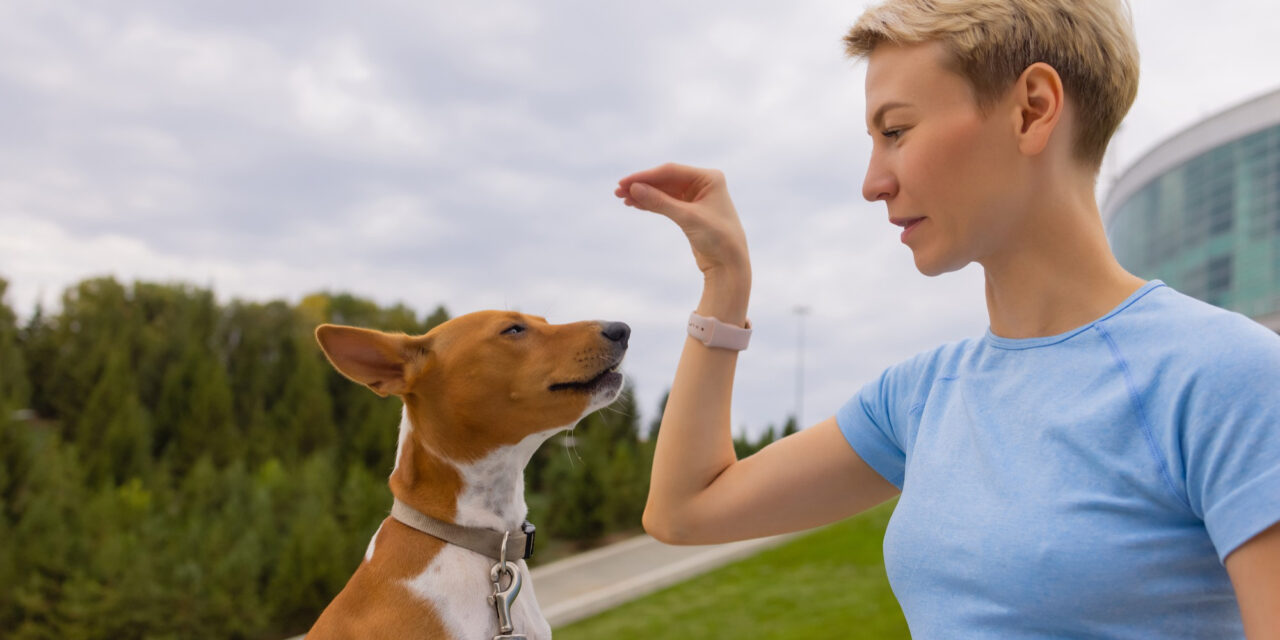
How much exercise does a dog need? Most healthy adult dogs do well with 30 to 90 minutes of activity a day. That’s a wide range on purpose. The right number for your dog depends on his age, breed, size, and health. There’s no single rule that fits every dog.
You’ve probably seen rigid formulas online. Five minutes per month of age. One hour, no matter what. A fixed step count from a fitness app. Most of these oversimplify a genuinely individual question. Even the veterinary guidelines behind this article deliberately avoid a single number. A Labrador puppy, a senior Chihuahua, and a three-year-old Border Collie don’t belong on the same schedule.
This guide covers exercise needs by life stage and breed. It also covers the factors that shift the number day to day, and how to build up safely. It closes with the signs that tell you whether you’ve got it right, common mistakes, and answers to the questions owners ask most.
What’s in this guide
- How much exercise does a dog need? The general range
- Why there’s no single right number
- Exercise needs by life stage
- Exercise needs by breed and body type
- Factors that change the number day to day
- What counts as exercise
- Finding your dog’s number: a simple self-assessment
- Building up safely: a gradual plan
- Walking pace and intensity
- Sample daily exercise plans
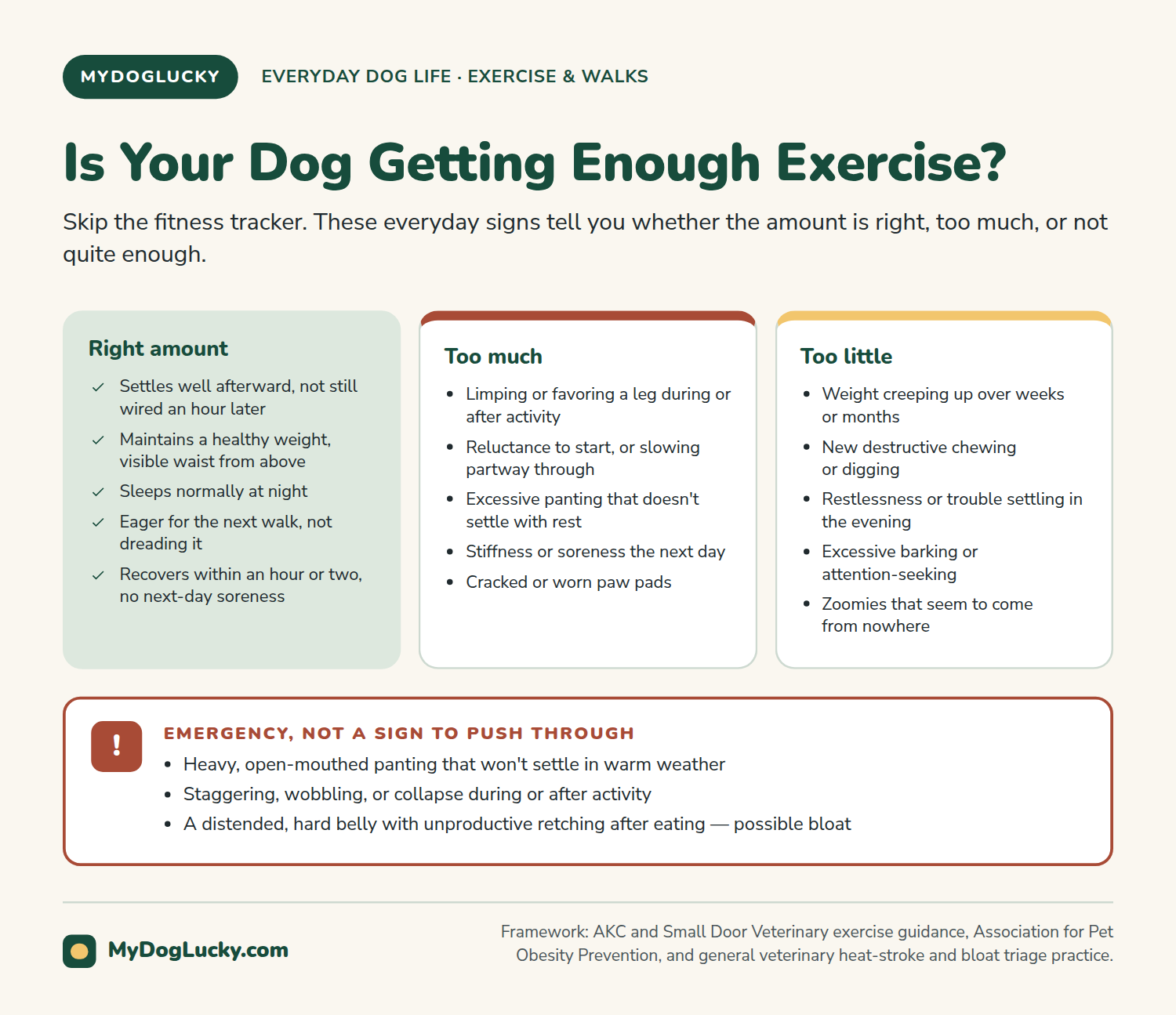
- Signs your dog is getting the right amount
- Signs of too much exercise
- Signs of too little exercise
- Exercise and healthy weight
- Exercise and specific health conditions
- Common mistakes owners make
- Building a routine that fits your life
- Common questions about dog exercise
- Sources
How much exercise does a dog need? The general range
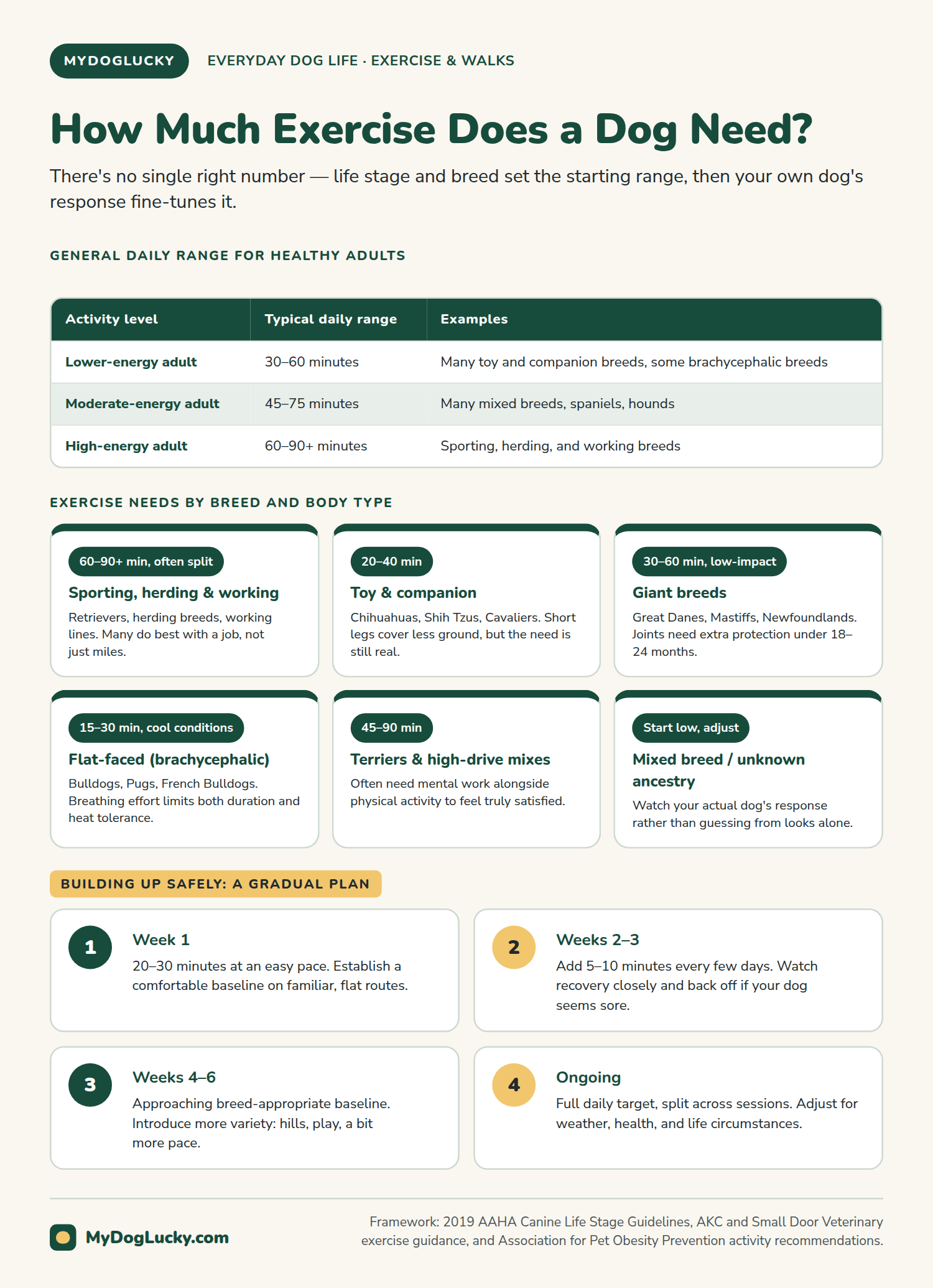
Start with the baseline, then adjust for your dog. Veterinary guidance points to a general minimum of 30 minutes a day for most healthy adult dogs. Many need quite a bit more.
| Activity level | Typical daily range | Examples |
|---|---|---|
| Lower-energy adult | 30–60 minutes | Many toy and companion breeds, some brachycephalic breeds |
| Moderate-energy adult | 45–75 minutes | Many mixed breeds, spaniels, hounds |
| High-energy adult | 60–90+ minutes | Sporting, herding, and working breeds |
Think of this table as a starting point, not a prescription. Your own dog’s ideal number sits somewhere inside these ranges, or occasionally outside them. The rest of this guide helps you find it.
Why there’s no single right number
Search for “how much exercise does a dog need” and you’ll find confident, conflicting answers. One site says an hour. Another says five minutes per month of age until adulthood. A third points you to a step counter.
The 2019 AAHA Canine Life Stage Guidelines take a different approach on purpose. They call for individualized exercise recommendations instead of a fixed number. A dog’s age, breed, health status, and temperament all move the target. A framework built for every dog ends up fitting none of them well.
About the “five minutes per month” rule
This guideline shows up often in puppy exercise advice: five minutes of structured exercise per month of age, twice a day, until adulthood. It’s a reasonable starting point for structured walks, not a hard ceiling. Veterinary sources note it wasn’t built from a single controlled study, and it doesn’t account for breed size or individual joint health. Use it as a rough anchor. Watch your own puppy’s response more than the math.
Rigid rules also tend to ignore health status. A dog recovering from surgery, managing arthritis, or carrying extra weight needs a different plan than a healthy young adult. That’s true even at the same age and breed. That’s why “how much exercise does a dog need” almost always deserves a follow-up question: which dog, on which day?
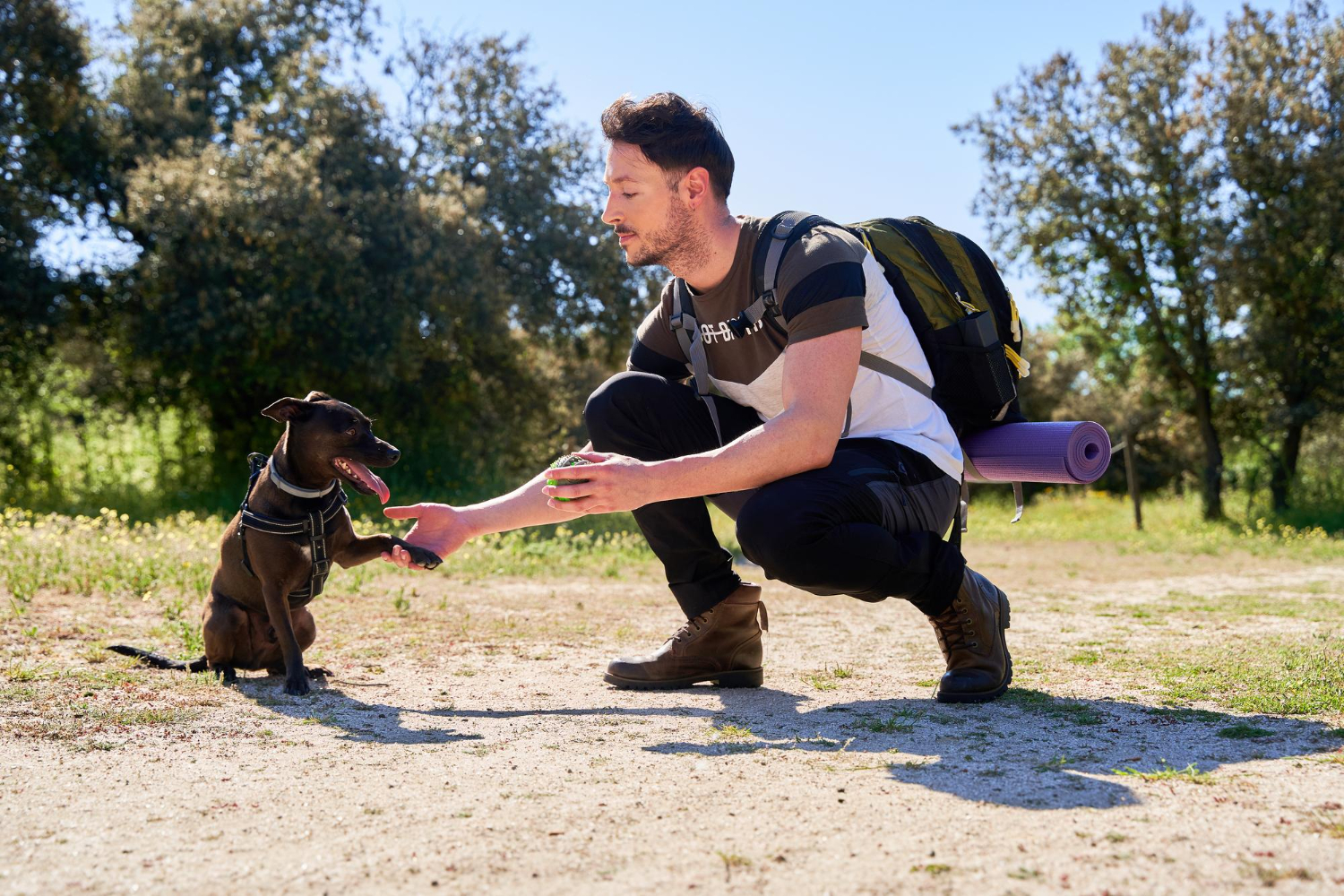
Exercise needs by life stage
Life stage shapes exercise needs more than almost anything else. Here’s what changes at each one.
Puppies: short bursts, protected joints
A puppy’s growth plates stay open well into his first year. In large and giant breeds, they can stay open even longer. Forced, high-impact, or prolonged repetitive exercise during this window can damage developing cartilage. Several short sessions of free play and gentle walking beat one long outing.
Let your puppy set some of the pace himself. Natural bursts of zoomies followed by a nap are normal and healthy. Structured jogging, long hikes, or repetitive fetch on hard surfaces should wait until growth plates close. That’s generally around 12 to 18 months, depending on breed size. Small and toy breeds mature fastest. Giant breeds can take close to two years.
Puppy classes and short, supervised playdates with vaccinated, friendly dogs offer good exercise too. They add mental stimulation and social skills on top of the physical activity, without the joint strain of a forced long walk.
Adults: building a real baseline
A healthy adult dog generally thrives on daily activity, not once-a-week marathons. Consistency matters more than any single big outing. Two moderate sessions most days beat one long weekend hike and nothing else.
High-energy breeds often need real physical output, not just a walk around the block. Lower-energy breeds still need daily movement, just less of it. Both benefit from variety: a mix of walking, play, and mental work most weeks.
Most adult dogs settle into a fairly stable routine once you find their number. Revisit it after any big life change, though. Weight gain, a new limp, a move to a new climate, or simply getting older can all shift things. It’s worth checking whether the old plan still fits.
Seniors: lower impact, still daily
Exercise stays important as your dog ages. What changes is intensity, not necessity. Small Door Veterinary’s guidance recommends at least 30 minutes daily for seniors, broken into shorter, gentler sessions rather than one long walk.
Swap running for walking. Swimming is a joint-friendly option worth considering if your senior dog enjoys water. Watch for stiffness after rest, reluctance on stairs, or slowing down mid-walk, and loop your vet in if any of these show up.
A senior dog’s good days and harder days can vary quite a bit. Plan for flexibility rather than a fixed daily target. A shorter, easier walk on a stiff morning, followed by a slightly longer one later, respects that reality. Forcing the same routine every single day doesn’t.
Exercise needs by breed and body type
Breed and body type shift the number as much as life stage does. Two dogs the same age and size can have very different needs, based on what they were originally bred to do. Use this table as a starting frame, then watch your individual dog.
| Breed group | Typical daily need | Notes |
|---|---|---|
| Sporting, herding & working breeds | 60–90+ minutes, often split | Retrievers, herding breeds, working lines. Many do best with a job, not just miles. |
| Toy & companion breeds | 20–40 minutes | Chihuahuas, Shih Tzus, Cavaliers. Short legs cover less ground, but the need is still real. |
| Giant breeds | 30–60 minutes, low-impact | Great Danes, Mastiffs, Newfoundlands. Joints need extra protection, especially under 18–24 months. |
| Flat-faced (brachycephalic) breeds | 15–30 minutes, cool conditions | Bulldogs, Pugs, French Bulldogs. Breathing effort limits both duration and heat tolerance. |
| Terriers & high-drive mixes | 45–90 minutes | Often need mental work alongside physical activity to feel truly satisfied. |
| Mixed breed or unknown ancestry | Start low, adjust by response | Watch your actual dog rather than guessing from looks alone. |
A dog with a job often needs less raw time
Herding, sporting, and working breeds were bred for purposeful tasks, not just movement. Fifteen minutes of structured training, scent work, or a real “job” can tire out a smart dog fast. Compare that to thirty minutes of aimless walking. Mental effort counts.
Mixed-breed dogs and dogs from a shelter with unknown ancestry deserve a note of their own. Breed guesses from looks alone are unreliable, and DNA tests give ancestry, not a guaranteed temperament. The most reliable approach is starting conservatively, then paying close attention to how your actual dog responds over the first few weeks.
Even within a single breed, energy level varies more than people expect. Littermates raised in the same home can grow into noticeably different adults. Treat every breed table, including the one above, as a rough starting frame rather than a fixed label for your specific dog.
Factors that change the number day to day
Even for one individual dog, the right amount moves around. A few things shift it most.
- Health status. Joint disease, heart conditions, recent surgery, or illness all change what’s safe. Ask your vet before starting or resuming a plan.
- Weather. Heat and humidity, or ice and extreme cold, shorten the safe window regardless of fitness level. Adjust timing, not just duration, on extreme days.
- Current fitness. A dog coming off an injury or an inactive stretch needs to build back up gradually, not jump straight to his old baseline.
- Life circumstances. A stressful week, a new household member, or a recent move can temporarily lower what your dog can handle. That’s normal, not a setback to fix.
- Diet and weight. An overweight dog often needs a slower, more gradual ramp-up than a lean, fit one. Extra weight puts real strain on joints during activity.
- Age and life stage transitions. The shift from adolescent to adult, or from adult to senior, rarely happens on a fixed birthday. Watch behavior and recovery, not just the calendar.
- Social opportunities. Supervised play with a friendly, familiar dog can add real activity on top of a walk. A solo dog may need a bit more structured exercise to make up the difference.
None of these mean skipping exercise entirely. They mean adjusting the plan instead of following a fixed number no matter what. A flexible plan that bends with your dog’s actual week beats a rigid one that ignores it.
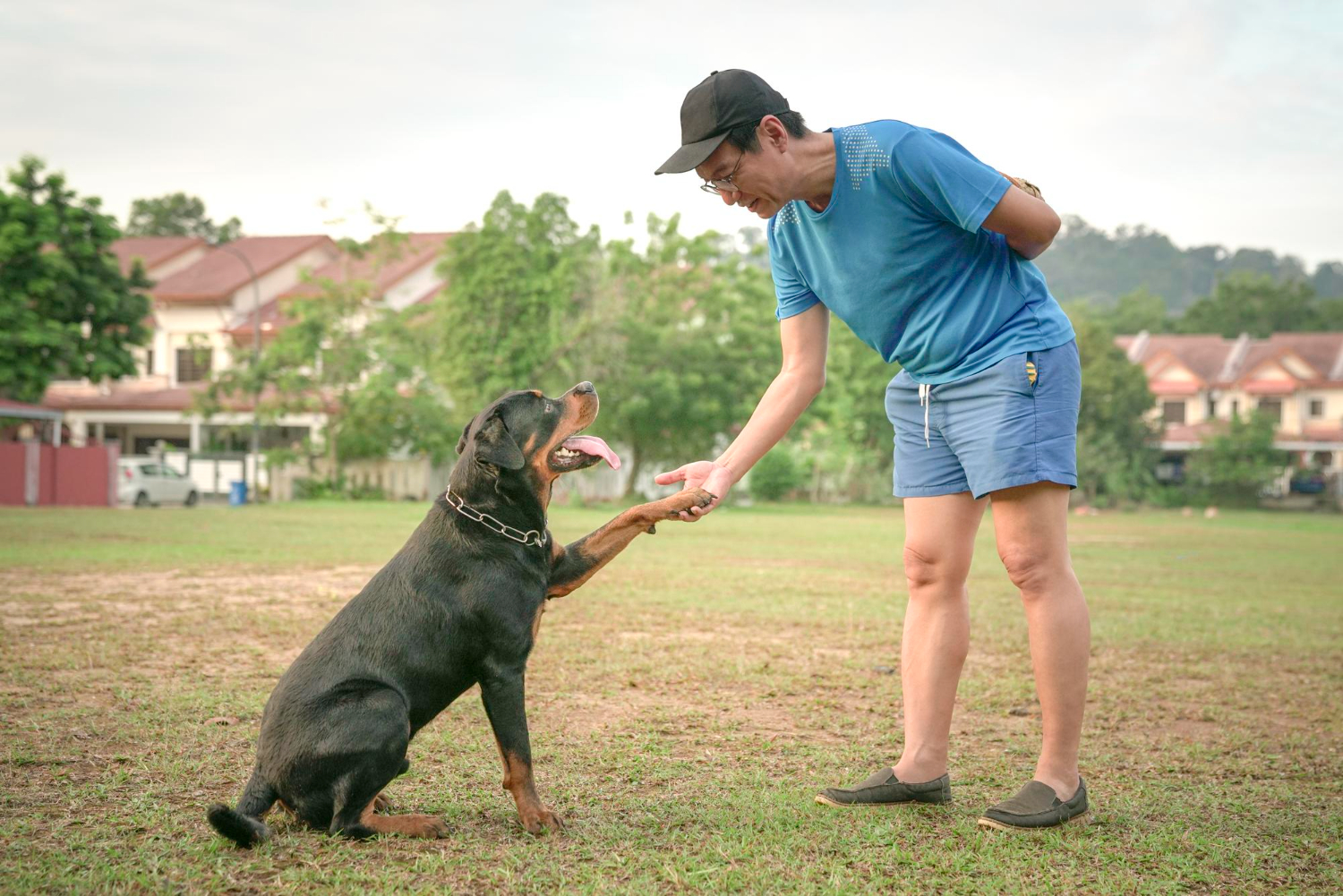
What counts as exercise
Exercise doesn’t have to mean a formal walk. A lot of genuinely useful activity looks like something else entirely.
- Structured walks. The classic, and still a solid baseline for most dogs.
- Free play. Fetch, tug, or chasing a flirt pole in the yard.
- Training sessions. Ten minutes of focused work can be more tiring than it looks.
- Sniffing and scent work. A slow, sniff-heavy walk works a dog’s brain as much as his legs.
- Swimming. Low-impact and excellent for joints, when your dog enjoys water and it’s supervised.
- Stairs and hills. A few extra minutes of incline adds real effort without adding much time.
- Dog sports. Agility, flyball, nose work classes, and similar structured activities combine physical and mental effort in one session.
Mental work deserves a mention here, even though it isn’t physical exercise on its own. A bored, under-stimulated dog often reads as under-exercised, when what he actually needs is a puzzle feeder or a training session. For a deeper dive into enrichment specifically, that’s its own topic worth exploring separately.
A useful mental shift: think in terms of total daily engagement, not just walk minutes. Picture a dog with a 20-minute walk, a 10-minute training session, and a stuffed puzzle toy in one day. That’s a genuinely full day, even though the walk portion looks modest on paper.
Finding your dog’s number: a simple self-assessment
The ranges above are a starting point, not your dog’s actual number. The most reliable way to find it isn’t a formula. It’s a short, structured trial with your own dog, paying close attention to how he responds.
This matters because two dogs with the identical breed, age, and weight can still need noticeably different amounts of activity. Temperament, individual joint health, and plain personality all play a role that no chart can capture. A rigid, one-size-fits-all number skips over exactly the information that matters most: your own dog’s response.
A one-week trial you can run at home
Pick a starting point from the ranges earlier in this guide, based on your dog’s age, breed, and current fitness. Then run it for about a week, watching closely rather than assuming it’s automatically right.
- Days 1–2: establish a baseline. Stick to the low end of your dog’s estimated range. Note his energy, appetite, and sleep before you change anything else.
- Days 3–5: watch the response. Is he settling well afterward, or still restless hours later? Eager for the next session, or reluctant to start? Sleeping normally, or unusually wired or sluggish?
- Days 6–7: adjust once, not constantly. If he seems under-exercised, add 10 to 15 minutes and hold there for another week. If he seems overdone, ease back and build in extra rest.
Resist the urge to change the plan every single day. A dog’s real response takes a few days to show up clearly. Judging by one walk, or one unusually good or bad day, tells you far less than a full week does.
What to track
You don’t need a spreadsheet or a fitness app for this. A few simple notes, even mental ones, are usually enough to spot a pattern.
A quick weekly check-in
- Energy level an hour after activity: calm and satisfied, or still keyed up?
- Appetite and sleep: normal, or noticeably off from his usual pattern?
- Recovery: back to baseline the next morning, or stiff and slow to get going?
- Enthusiasm: eager for the next session, or visibly dragging his feet?
The signs sections later in this guide go into more detail on exactly what “too much” and “too little” look like in practice. Use this weekly check-in alongside them, not instead of them.
Revisit it. Don’t set it once and forget it
Your dog’s number isn’t fixed forever, even once you find it. Weight changes, injuries, aging, and even the seasons all shift what’s realistic and safe. Treat this trial as something you repeat every few months, or any time something meaningful changes in your dog’s life.
A new job, a move, a health diagnosis, or simply getting older are good reasons to run the trial again. Don’t assume the old number still applies. Five minutes of honest observation beats a stale routine that quietly stopped fitting your dog months ago.
This is the real answer to “how much exercise does a dog need”: start with the ranges in this guide. Then let your own dog’s actual response fine-tune the specifics from there. No chart replaces that step, no matter how detailed it looks.
Building up safely: a gradual plan
Going from mostly sedentary to your dog’s full target overnight is a common mistake. A gradual ramp-up works better and causes far fewer injuries. This applies to a rescue dog just settling in, and a dog recovering from illness. It applies just as much to an owner who’s simply been busier than usual lately.
| Week | Daily activity | Focus |
|---|---|---|
| Week 1 | 20–30 minutes, easy pace | Establish a comfortable baseline. Mostly flat, familiar routes. |
| Weeks 2–3 | Add 5–10 minutes every few days | Watch recovery closely. Back off if your dog seems sore or reluctant. |
| Weeks 4–6 | Approaching breed-appropriate baseline | Introduce more variety: hills, play, a bit more pace. |
| Ongoing | Full daily target, split across sessions | Maintain, and adjust for weather, health, and life circumstances. |
Two short sessions usually beat one long one
Splitting activity into two shorter outings, rather than a single long one, tends to suit most dogs better. It’s easier to fit into a real schedule, and it’s gentler on a dog who’s still building fitness.
Watch your dog’s recovery, not just the clock. A dog who’s stiff, slow to rise, or unusually tired the next day needs a slower ramp than the plan above. A dog who’s still bouncing off the walls after a full session might be ready to add more.
A dog returning from injury or surgery needs a plan built with your vet, not this general timeline. Post-surgical exercise restrictions exist for real reasons. Rushing them risks undoing the recovery entirely.
Walking pace and intensity: what “brisk” actually means
Not all walking minutes are equal. A slow amble around the block and a genuinely brisk walk do very different things for fitness.
Veterinary weight-management guidance notes that a lot of dog walking happens near 25 minutes per mile. That’s closer to a stroll than real exercise. A brisk pace, closer to 15 to 18 minutes per mile, does more for cardiovascular fitness and weight management. It does this in the same amount of time.
Both paces have a place. A slow, sniff-heavy walk is genuinely valuable for a dog’s mind. A brisker walk is what moves the needle on fitness and weight. Most dogs benefit from some of each across a week, not just one or the other.
A simple way to gauge intensity: watch your dog’s panting. Light, easy panting during activity is normal. Heavy, open-mouthed panting that doesn’t ease up within a few minutes of slowing down is a signal. The pace or duration outran his fitness that day. Treat it as a signal to ease off, not push through.
Sample daily exercise plans
Sometimes a worked example lands better than another range of numbers. Here are five realistic day plans, built from everything covered so far. Treat them as starting templates, not rigid scripts.
A puppy (5–6 months, medium breed)
Morning: 10 minutes of free play in the yard, followed by a short 10 to 15-minute walk. Midday: a five-minute training session, then a nap. Afternoon: another short walk, plus supervised play with a familiar, vaccinated playmate if one’s available. Evening: quiet settling time, with maybe one more short burst of play before bed. Total: well under an hour of structured activity, with plenty of rest worked in between bursts.
A low-energy toy breed (adult, healthy)
Morning: a 15-minute sniff-heavy walk around the block. Midday: a five-minute training session, working on a new trick or refreshing an old one. Evening: a 15-minute walk at a slightly brisker pace, plus a few minutes of tug or fetch indoors. Total: roughly 35 minutes, split across three short sessions rather than one long one.
A moderate-energy mixed breed (adult, healthy)
Morning: a 25-minute walk, mixing a brisk pace with some sniffing time. Afternoon: 10 minutes of puzzle-feeder or scent-work play indoors. Evening: a 20-minute walk or a game of fetch in the yard, depending on weather and energy left over. Total: roughly 55 minutes, with built-in variety across the day.
A high-energy working or sporting breed (adult, healthy)
Morning: a 30-minute brisk walk or light jog, plus five minutes of obedience work before breakfast. Midday: a 15-minute training or scent-work session, if your schedule allows it. Evening: 30 to 45 minutes of vigorous play, fetch, or a structured activity like agility practice. Total: 75 to 90 minutes, with real mental effort built into more than one session.
A senior dog (10+ years, healthy but slower)
Morning: a 15 to 20-minute walk at an easy, comfortable pace. Midday: a short, sniff-heavy stroll, or a few minutes of gentle puzzle-feeder play. Evening: another 15-minute easy walk, timed for cooler, more comfortable conditions. Total: roughly 30 to 45 minutes, broken into gentler pieces rather than one longer outing.
None of these plans is a fixed prescription. Swap sessions around, shorten them on a busy day, or lengthen them on a free weekend. Multiple shorter sessions matter more than the exact minutes. So does a mix of physical and mental effort, and genuine attention to how your own dog responds.
Signs your dog is getting the right amount
You don’t need a fitness tracker to know if the plan is working. A few everyday signs tell you plenty.
- He settles well afterward. Calm, satisfied, ready to rest, not still wired an hour later.
- He maintains a healthy weight. Ribs easy to feel without pressing hard, a visible waist from above.
- He sleeps normally at night. Neither restless from excess energy nor sluggish from too little activity.
- He’s eager, not dreading it. Genuine excitement for walks and play, not avoidance.
- He recovers quickly. Back to normal within an hour or two, not sore or limping the next day.
- His muscle tone looks good. A well-conditioned dog typically has visible muscle, not just a lean frame.
None of these signs need to be perfect every single day. Look at the overall pattern across a week or two, rather than judging one off day too harshly.
Signs of too much exercise
More isn’t automatically better. Overdoing it shows up in fairly recognizable ways.
- Limping or favoring a leg during or after activity
- Reluctance to start the next walk, or visibly slowing partway through
- Excessive panting that doesn’t settle quickly with rest
- Stiffness or soreness the next day
- Cracked or worn paw pads from too much distance too fast
Heat-related overexertion deserves its own caution, especially for flat-faced breeds, seniors, and dogs carrying extra weight. Heavy panting that won’t settle, staggering, or collapse in warm weather is an emergency, not a sign to push through. A full breakdown of hot- and cold-weather safety lives in a dedicated guide. It deserves more room than this article can give it.
Repetitive strain injuries build up more quietly than acute ones. Repeating the exact same high-impact activity, like fetch on hard pavement, day after day can cause a problem. Chronic joint issues can build up over months rather than from one obvious event. Varying the surface and the activity type helps protect against this.
Signs of too little exercise
Under-exercise tends to show up sideways, in behavior that can look unrelated at first.
- Weight creeping up over weeks or months
- Destructive chewing or digging that’s new for your dog
- Restlessness, pacing, or trouble settling in the evening
- Excessive barking or attention-seeking behavior
- Zoomies that seem to come from nowhere, especially in the evening
None of these guarantee an exercise shortfall on their own. Plenty have other causes, including some covered in this site’s guide to everyday sleep and behavior patterns. But a sudden uptick in any of them is worth testing against a simple question first: has this dog’s activity dropped lately?
Under-exercised dogs sometimes get labeled “hyper” or “difficult” when the real issue is an unmet need. A trial increase in activity for a week or two is a cheap, low-risk way to test that theory. Try it before assuming a bigger behavior problem is at play.
Exercise and healthy weight
Exercise and diet work together, not separately, for weight management. Neither one alone tends to fix the problem.
The scale of the issue is larger than most owners expect. The Association for Pet Obesity Prevention estimates that well over half of U.S. dogs and cats combined are overweight or obese. Carrying extra weight is linked to a shorter lifespan and a higher risk of joint disease, diabetes, and other chronic conditions.
Thirty minutes a day is a meaningful starting target
Veterinary weight-management guidance points to roughly 30 minutes of daily aerobic activity as a practical baseline for most dogs. Build up to it gradually, rather than starting all at once, as your dog works toward a healthier weight. Combine it with a properly portioned, appropriate diet. Exercise alone rarely undoes a feeding problem.
If your dog needs to lose weight, loop your vet in before ramping up activity. A structured plan protects joints already under strain and helps you set a realistic, monitored pace.
A quick way to check body condition at home: run your hands along his ribs. You should feel them easily, without heavy pressure, and see a visible waist when you look down at him from above. No visible waist, or ribs you can’t feel at all, are both worth a conversation with your vet.
Exercise and specific health conditions
Some health conditions change the exercise plan significantly, not just the total minutes. A few of the most common ones are worth knowing about.
- Arthritis. Regular, gentle movement often helps more than rest, but high-impact activity can make things worse. Your vet can help set safe boundaries.
- Heart disease. Some cardiac conditions call for real limits on exertion. Never start or change an exercise plan for a dog with a heart condition without veterinary guidance.
- Respiratory issues. Beyond typical brachycephalic limits, conditions like collapsing trachea or laryngeal paralysis need individualized restrictions.
- Recent surgery. Follow your vet’s specific timeline, not a general guide like this one. Healing tissue has its own schedule.
- Obesity. Extra weight raises injury risk during exercise, which is exactly why the ramp-up needs to be slower and more gradual, not skipped.
- Neurological or vestibular issues. Balance problems, weakness, or coordination changes call for extra caution around stairs, slippery floors, and uneven ground. Your vet can advise on safe terrain and support.
None of these conditions mean no exercise. They mean a plan built around your dog’s specific situation, ideally with your veterinarian’s input.
Common mistakes owners make
The weekend warrior pattern
A quiet week followed by one huge Saturday hike is a common pattern, and a rough one on a dog’s body. Sudden spikes in activity after a sedentary stretch raise injury risk. Steadier, smaller daily doses beat one big weekly burst.
The same walk, every single day
Identical routes and identical paces get less mentally stimulating over time, even if the physical distance stays the same. Mixing in new routes, sniff-heavy walks, or a training session breaks the monotony for both of you.
Treating mental work as optional
A tired body and a bored brain are two different problems. Skipping mental engagement and only counting physical miles leaves a real need unmet, especially in working and herding breeds.
Pushing through pain signals
Limping, slowing down, or reluctance mid-walk are information, not stubbornness. Pushing a dog through those signals to “finish the walk” can turn a minor strain into a bigger problem.
Ignoring individual health status
Following a generic plan without accounting for your dog’s actual joints, weight, and medical history is how injuries happen. What’s right for the dog down the street isn’t automatically right for yours.
Comparing your dog to someone else’s
Your neighbor’s Border Collie doing agility every evening isn’t a fair yardstick for your senior Beagle, or the other way around. Breed, age, health, and plain personality all differ from one dog to the next. Use your own dog’s response as the guide here, not another owner’s routine or a stranger’s social media post.
Building a routine that fits your life
Knowing the right amount is only half the job. Fitting it into a real household schedule, around work, weather, and everyone else’s needs, is the other half. That’s detailed enough to deserve its own guide, covering walk frequency, timing, and realistic scheduling for busy households. This article focuses on the “how much.” The “how often and when” gets its own dedicated walkthrough.
For now, the short version: pick a baseline from the ranges above, and split it across two sessions most days. Adjust as you go, based on how your dog responds. That’s a solid starting routine for almost any dog.
A routine sticks best when it fits naturally into a day you’re already living, rather than becoming a whole extra obligation. Attach a session to something already fixed on your calendar, like right after you wake up, or right before dinner. That small anchor makes it far easier to keep up on genuinely busy days.
Involving the rest of the household helps too, when that’s an option. Rotating who handles which session spreads the load, and can turn exercise into shared family time rather than one person’s daily chore. Even a short training session or a game of fetch in the yard counts. Neither one requires the same free block of time a full walk does.
Pay attention to what your dog actually enjoys, not just what checks the box on paper. A dog who lights up for a training session but visibly tolerates a walk is telling you something useful. Building the routine around genuine enthusiasm, wherever that’s possible, makes the whole thing easier to sustain for years, not just the first motivated week.
Common questions about dog exercise
How much exercise does a small dog need compared to a large dog?
Size alone doesn’t predict energy level. Some small breeds, like many terriers, need substantial daily activity. Some large breeds, like many mastiffs, are content with moderate movement. Breed group and individual temperament matter more than size on the scale.
Can a puppy get too much exercise?
Yes, and it’s a real risk. Forced, repetitive, high-impact exercise before growth plates close can damage developing joints. Free play and short, gentle walks are safer than structured jogging or long hikes for a young puppy.
Is a fenced yard enough exercise for my dog?
Usually not on its own. Dogs left to their own devices in a yard often just patrol the perimeter rather than getting real aerobic activity. A yard is a great supplement to structured exercise, not a full replacement for it.
Do apartment dogs need more walks than dogs with a yard?
Often, yes, simply because they don’t have casual outdoor access between structured walks. The total daily need doesn’t change much by housing type, but apartment dogs usually need that need met more intentionally.
How do I tell if my dog is bored versus under-exercised?
The behaviors often overlap, which makes this a tricky call. Try adding a short training session or puzzle feeder before adding more physical activity. If that settles things, boredom was the bigger piece. If not, physical exercise may be the missing piece.
Should I exercise my dog right after eating?
It’s better to wait. Vigorous exercise on a full stomach is a known risk factor for bloat, a life-threatening emergency, particularly in large and giant, deep-chested breeds. Give your dog an hour or more after a meal before anything strenuous.
Is it safe to exercise my dog in extreme heat or cold?
Both extremes call for real caution, shorter sessions, and close attention to your individual dog’s tolerance. This deserves more detail than a quick answer here can offer, so a full seasonal safety guide covers it in depth.
What if my dog just doesn’t like walks?
Some dogs genuinely prefer play, training, or sniffing over structured walking, and that’s fine. The goal is meeting his activity and mental needs, not forcing one specific format. Experiment with what he actually enjoys.
How should I exercise an overweight dog?
Start low and build slowly. Extra weight raises injury risk, so jumping straight into a full routine can do more harm than good. Begin with short, easy walks, and loop your vet in before adding intensity. Combine it with a properly portioned diet, since exercise alone rarely resolves excess weight by itself. Expect gradual progress over months, not weeks.
Can a dog walker or daycare replace my own exercise routine?
They can cover real ground, especially on busy days. A good dog walker or daycare provides genuine physical activity and social time. But they rarely replace the bond and mental engagement that comes from exercising with your dog yourself. Many owners use both: professional help for daytime coverage, and their own time for connection.
Does spaying or neutering change how much exercise my dog needs?
Not directly, but it can shift metabolism and appetite, which sometimes leads to weight gain if activity doesn’t keep pace afterward. Watch body condition closely in the months after the procedure. Also follow your vet’s specific post-surgical exercise restrictions during recovery. Those restrictions matter more than any general guideline right after surgery.
Do working or service dogs need extra exercise beyond their job?
Often yes, though it depends on the work itself. A service dog’s daily tasks provide real mental engagement, but not necessarily enough physical activity on their own. Many working and service dogs still benefit from dedicated off-duty exercise and play time, kept separate from their working hours.
What’s a reasonable starting routine for a newly adopted dog?
Go gentler than you might expect at first. A new dog is adjusting to an unfamiliar home, routine, and often unfamiliar people, which is its own kind of stress. Start with short, calm walks and light play for the first couple of weeks. Build toward his full breed-appropriate routine gradually, once he’s settled in and you understand his baseline better.
Can mental exercise substitute for physical exercise entirely?
Not entirely, though it helps more than people expect. A dog’s body needs real movement for cardiovascular health, muscle tone, and healthy weight, separate from what his brain needs. The best routines include both. On a day when physical activity genuinely isn’t possible, extra mental work is a reasonable stopgap, not a permanent replacement.
Is running a good way to exercise my dog?
For many healthy adult dogs, yes, within limits. Running suits higher-energy breeds especially well. It’s not appropriate for puppies with open growth plates, brachycephalic breeds with limited airway capacity, or dogs with joint or heart conditions. Build up distance and pace gradually, and check with your vet before starting a running routine.
Which dog breeds need the least exercise?
Many toy and companion breeds, along with some brachycephalic breeds, tend to need less total activity than sporting or working breeds. That said, “less” doesn’t mean “none.” Every healthy dog benefits from some daily movement and mental engagement, whatever his breed’s baseline energy level happens to be.
Do dogs need rest days from exercise?
Most healthy adult dogs do fine with daily activity rather than scheduled rest days, especially at a moderate, sustainable pace. That said, after an unusually intense day, like a long hike or an agility trial, a lighter, easier day afterward helps with recovery. Watch your own dog’s signals rather than following a fixed rest-day rule.
Sources
- AAHA. 2019 AAHA Canine Life Stage Guidelines.
- AKC. How Much Exercise Does a Dog Need Every Day?
- Small Door Veterinary. Exercise Needs for Puppies, Adults and Senior Dogs.
- Lowe, R. Puppy Exercise: 5 Minutes Per Month of Life? Vet Voices.
- Association for Pet Obesity Prevention. Being Active With Your Dog.
This article is general education for U.S. dog owners. It is not individualized veterinary or fitness advice. Ask your veterinarian before starting or changing an exercise plan, especially for a puppy, a senior dog, or a dog with a health condition.


Trackbacks/Pingbacks