
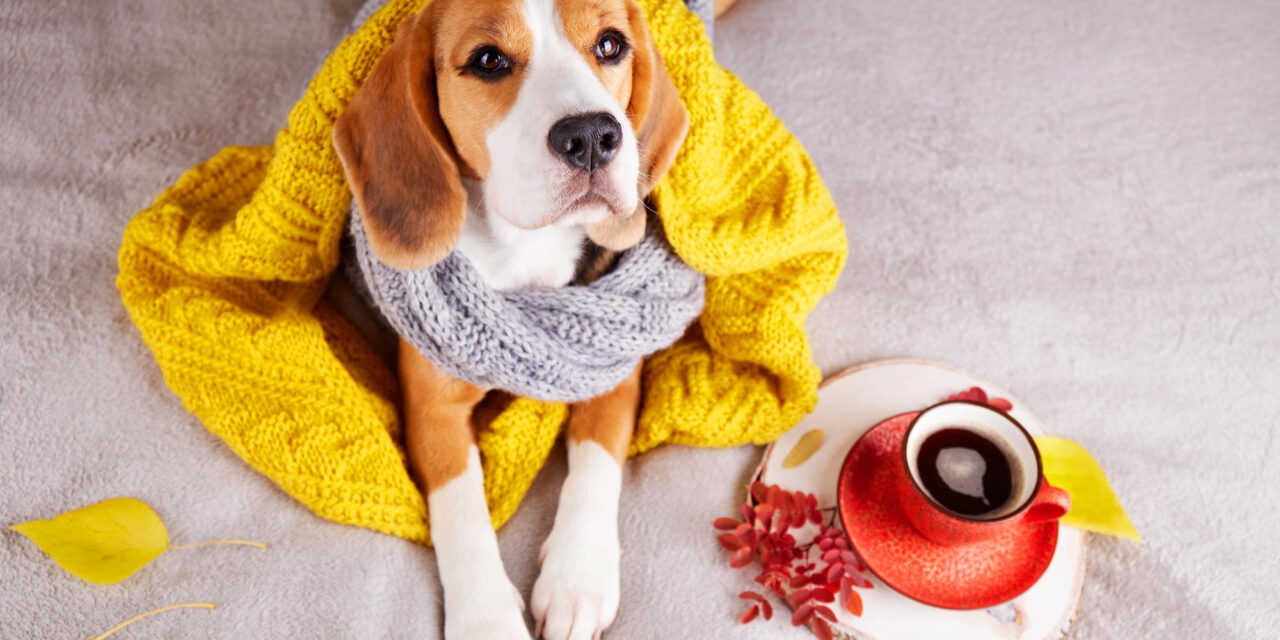
Emergency signs: heatstroke or hypothermia need a vet right now
Heatstroke — heavy panting that won’t settle, bright red gums, stumbling, vomiting, or collapse after heat exposure. Hypothermia — intense shivering that then stops, weakness, pale or gray gums, confusion, or collapse after cold exposure. Either one is an emergency. Start first aid below immediately and call your vet or the nearest emergency clinic on the way. Don’t wait to see if it resolves on its own.
Dog care in hot weather and dog care in cold weather share the same underlying problem: your dog can’t regulate his body temperature the way you can, and by the time it’s obviously a problem, it’s already an emergency. Prevention does almost all the work here. Recognizing trouble early does the rest.
This guide covers both extremes: how to plan walks, adjust gear, and read your dog’s warning signs whether it’s 95 degrees or 15 degrees outside. It also covers the single most dangerous seasonal mistake, leaving a dog in a parked car, which deserves its own space regardless of the season.
What’s in this guide
- Dog care in hot and cold weather: the quick answer
- What changes your dog’s temperature risk
- Recognizing heatstroke
- Heatstroke first aid
- Planning hot-weather walks
- The pavement test
- Humidity and the heat index
- Keeping the home cool
- Recognizing hypothermia and frostbite
- Cold-exposure first aid
- Planning cold-weather walks
- Wind chill and cold-weather risk
- Keeping the home warm
- Gear that actually helps
- Building tolerance gradually
- Cars: hot and cold, both dangerous
- Breeds and individual dogs at higher risk
- Altitude, travel, and sudden climate changes
- Puppies, seniors, and medically vulnerable dogs
- Seasonal grooming adjustments
- Recovery after a heat or cold incident
- Hydration and electrolytes in extreme weather
- Common seasonal safety mistakes
- Common myths about weather and dogs
- Your seasonal safety checklist
- Common questions about dog care in extreme weather
- Sources
Dog care in hot and cold weather: the quick answer
In hot weather, walk during the coolest parts of the day, test the pavement with your hand before every walk, and watch for heavy panting that won’t settle, bright red gums, or stumbling. In cold weather, shorten walks, watch for intense shivering followed by lethargy, and get a wet or shivering dog dry and warm right away. In both cases, small dogs, short-nosed breeds, puppies, seniors, and dogs with heart or lung conditions need extra caution, since they lose the ability to regulate their temperature faster than a healthy adult dog.
Most weather emergencies are preventable with planning rather than luck. A ten-minute check of the forecast before you head out does more than almost anything you could do once your dog is already in trouble.
It also helps to think of hot- and cold-weather safety as one ongoing habit rather than two separate seasonal projects. The same underlying questions apply year-round: what does today’s specific weather actually mean for this specific dog, and what’s the earliest signal that he’s had enough? Building that habit in mild weather, when the stakes are lower, makes it far more automatic once a genuine extreme rolls around.
What changes your dog’s temperature risk
- Coat type. A thick double coat insulates against cold but traps heat in summer. A short, single coat does the opposite.
- Size. Small dogs lose body heat faster in the cold, relative to their body mass, than large dogs.
- Face shape. Brachycephalic (short-nosed) breeds, like Bulldogs, Pugs, and Boxers, cool themselves through panting less efficiently and overheat faster than dogs with longer muzzles.
- Age. Puppies and senior dogs regulate body temperature less efficiently than healthy adults in both directions.
- Weight and fitness. Overweight dogs overheat faster. Out-of-shape dogs of any weight tire and overheat faster during exertion than conditioned ones.
- Existing health conditions. Heart disease, laryngeal paralysis, tracheal collapse, and some medications all raise heat risk specifically.
- Recent activity level. A dog mid-exercise or freshly done with intense play carries elevated body heat into whatever comes next, which changes his margin for additional heat or cold exposure right afterward.
- Acclimation. A dog who’s had a gradual, consistent buildup of exposure to the current season’s temperatures tolerates it noticeably better than one facing a sudden extreme with no recent buildup at all.
Recognizing heatstroke
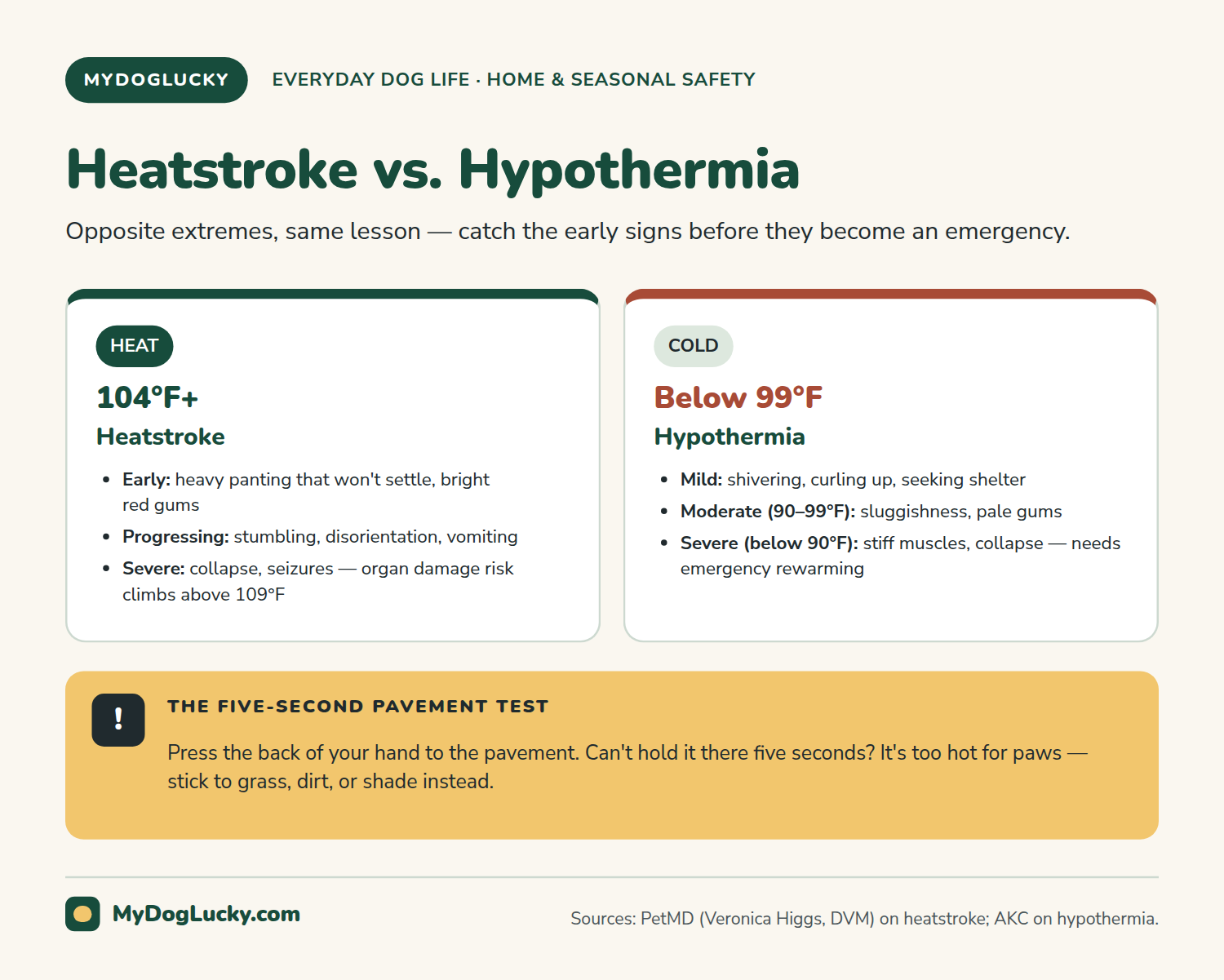
Heatstroke is diagnosed at a body temperature above 104°F, with major organ damage risk climbing sharply above 109°F, according to PetMD (Veronica Higgs, DVM). It develops faster than most owners expect, sometimes within minutes of intense exercise or being left in a hot space.
| Stage | Signs |
|---|---|
| Early | Heavy, rapid panting that doesn’t settle with rest; bright red gums; excessive drooling |
| Progressing | Disorientation, stumbling, weakness, vomiting |
| Severe | Collapse, seizures — a life-threatening emergency |
Any of the early signs after time in heat or exertion is worth stopping immediately and starting first aid. Don’t wait for the progressing signs to appear before taking it seriously.
Heatstroke first aid
Start cooling immediately, then call ahead to a vet
- Move your dog to shade or air conditioning right away.
- Wet him with room-temperature water, focusing on the belly, paws, and ears.
- Add air movement with a fan if one’s available.
- Never use ice or ice water. Cooling too fast can cause shock or send the body into hypothermia.
- Call your vet or an emergency clinic while you cool him, and head there even if he seems to be improving. Internal organ damage isn’t always visible from the outside.
Planning hot-weather walks
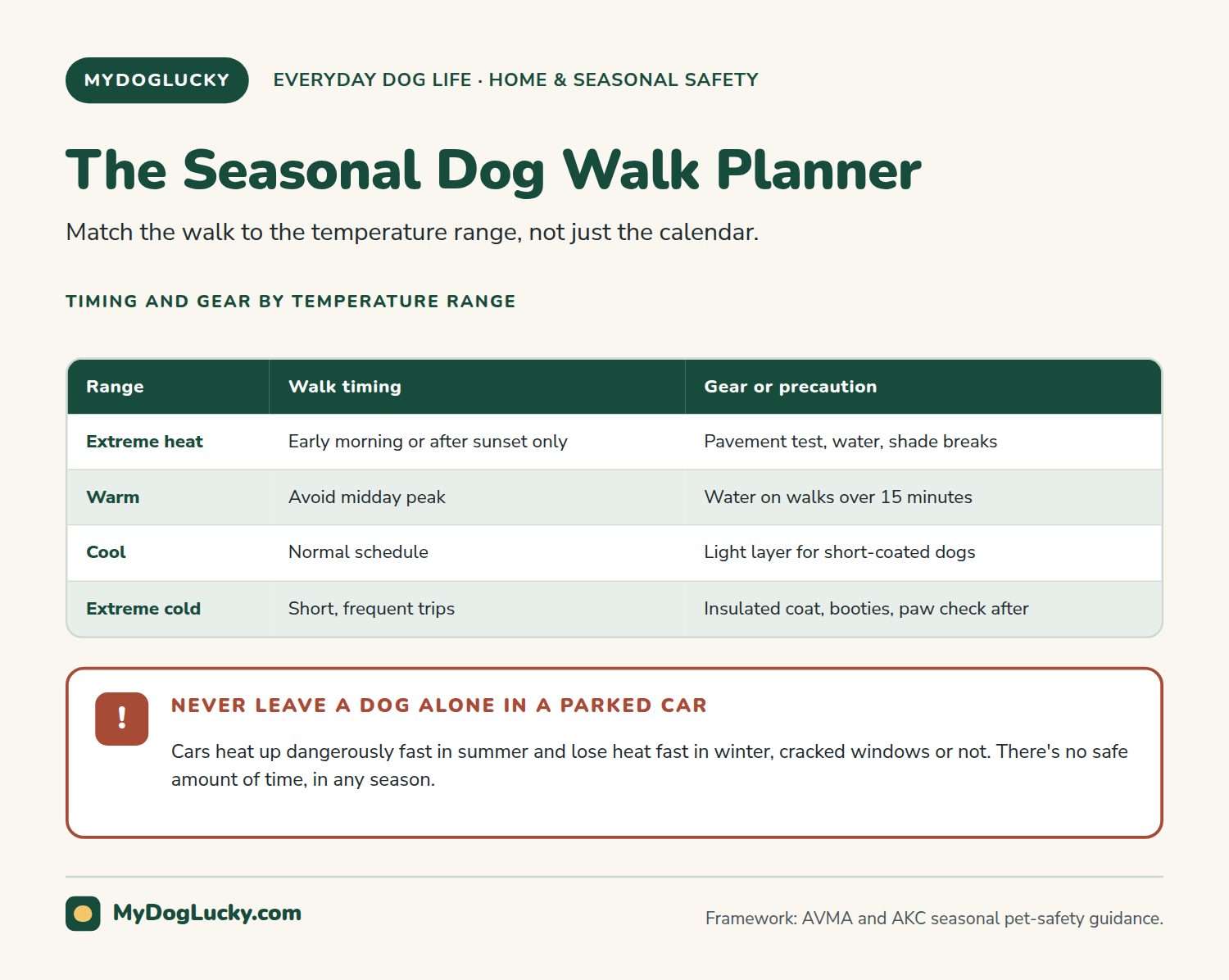
- Walk during the coolest hours, early morning or after sunset, rather than midday.
- Bring water on any walk longer than fifteen minutes in warm weather, and offer it before your dog seems desperate for it.
- Shorten the walk rather than pushing through discomfort. A shorter walk that ends before your dog is struggling beats a longer one that doesn’t.
- Watch for slowing down, seeking shade, or lying down mid-walk as your dog’s own signal that he’s had enough.
- Skip the midday walk entirely on extreme-heat days and substitute indoor enrichment instead.
The pavement test
Asphalt and dark pavement can run far hotter than the air temperature on a sunny day, and a dog’s paw pads burn on contact well before the surface feels unbearable to a shoe-wearing person.
The five-second rule
Press the back of your hand firmly against the pavement. If you can’t hold it there comfortably for five seconds, it’s too hot for your dog’s paws. Walk on grass, dirt, or in shade instead, or wait until the surface cools later in the day.
Humidity and the heat index
A dog cools himself primarily through panting, which relies on evaporation off the tongue and airway. High humidity slows that evaporation down significantly, so a “moderate” 85°F day with high humidity can actually be more dangerous for a dog than a drier 95°F day would be. The heat index, a combined measure of temperature and humidity, is a better guide to real risk than the thermometer reading by itself.
A rough guide to heat index risk
Above roughly a 90°F heat index, shorten outdoor activity noticeably for any dog. Above about a 105°F heat index, limit outdoor time to brief bathroom breaks only, especially for brachycephalic, senior, overweight, or heavy-coated dogs, who lose the most ground once humidity climbs.
Check a local heat-index forecast, not just the air temperature, before planning exercise on a humid day. Many weather apps show both figures side by side, and the heat index is consistently the more useful one for deciding whether a given walk is actually safe.
Keeping the home cool
- Never leave a dog in a room without airflow during a heat wave, even briefly, including a garage or sunroom that traps heat.
- Provide constant access to fresh, cool water in more than one spot around the house.
- Use fans and closed blinds during peak sun hours to keep a room from becoming a heat trap.
- A cooling mat or a damp towel to lie on gives an overheated dog a place to actively cool down between activity bursts.
Recognizing hypothermia and frostbite
Mild hypothermia begins around 99°F, with moderate hypothermia in the 90–99°F range and severe hypothermia below 90°F requiring emergency veterinary rewarming, according to AKC guidance. Frostbite most often affects the ears, tail, and paws, the extremities with the least insulation and blood flow.
| Severity | Signs |
|---|---|
| Mild | Shivering, curling up for warmth, seeking shelter |
| Moderate | Sluggishness, pale gums, rising then slowing heart rate |
| Severe | Stiff muscles, dilated pupils, collapse, loss of consciousness |
Frostbitten skin may look pale, gray, or bluish, and can feel cold and hard to the touch. It’s often not obvious until the area starts to thaw, which is when it may become red, swollen, and painful.
Cold-exposure first aid
Warm gradually, and call your vet for anything beyond mild shivering
- Bring your dog to a warm, dry space right away.
- Dry him off completely if he’s wet, since wet fur accelerates heat loss.
- Wrap him in warm, dry blankets or towels.
- For mild shivering, warming at home and monitoring is usually enough. For anything beyond that, sluggishness, confusion, pale gums, or a suspected frostbite area, call your vet right away.
- Don’t rub or massage a suspected frostbite area, and don’t use direct high heat like a hair dryer or heating pad against bare skin. Both can cause additional tissue damage.
Planning cold-weather walks
- Shorten walks in genuinely cold conditions, especially for small, short-coated, senior, or young dogs.
- Check paws for ice buildup between toes during and after snowy walks, which can be painful and cause limping.
- Wipe paws after walks on treated sidewalks to remove ice-melt residue before your dog licks it off.
- Watch for lifting a paw, whining, or reluctance to keep walking as signs he’s had enough cold exposure.
- Keep a coat on short-coated or small dogs for anything beyond a quick bathroom trip in genuinely cold weather.
Wind chill and cold-weather risk
Wind strips heat away from skin and fur far faster than still air at the same temperature, which is why a 20°F day with a stiff wind can be more dangerous than a calm 10°F day. Wind chill reflects how the cold actually acts on exposed skin, ears, and paws, not the plain air temperature alone.
Wind exposure matters most in open areas, near water, or on elevated ground with nothing to block it. A walk that seems reasonable by temperature alone can turn risky quickly once wind chill is factored in, particularly for small, thin-coated, or short-legged dogs whose bodies sit closer to the cold ground and get less benefit from whatever insulation their coat provides.
Adjust for wind, not just the thermometer
Check the wind chill, not just the air temperature, before a cold-weather walk, and choose a more sheltered route on windy days even if the plain temperature looks acceptable on its own.
Keeping the home warm
- Block drafts near a dog’s regular resting spot, especially for senior dogs or those with arthritis, since cold floors worsen joint stiffness.
- Provide a raised bed away from cold floors and windows rather than a spot directly on tile or concrete.
- Never rely on an unsupervised space heater near bedding a dog could chew or knock over.
- A dog who’s mostly indoors should stay mostly indoors during extreme cold, with only brief outdoor trips for bathroom breaks.
Gear that actually helps
| Gear | Helps with | Notes |
|---|---|---|
| Insulated coat or sweater | Cold, especially for short-coated or small dogs | Should cover chest to base of tail, not restrict movement |
| Dog booties | Hot pavement, ice, and ice-melt chemicals | Needs a practice period indoors before relying on them outside |
| Cooling vest or mat | Heat, especially for heavier or short-nosed dogs | Works through evaporation; needs re-wetting to stay effective |
| Reflective gear | Earlier evening or dawn walks in any season | A safety add-on, not a temperature solution |
Building tolerance gradually
A dog’s tolerance for heat or cold isn’t fixed. It shifts with fitness, coat condition, and how gradually he’s been exposed to a seasonal extreme, the same way a person acclimates to a hot climate after a week or two rather than being fully comfortable on day one.
Building summer heat tolerance
Start the exercise season with shorter, cooler-hour sessions and gradually extend duration over several weeks as your dog’s fitness builds, rather than jumping straight into a full-length summer routine on the first warm day. This matters most for working and sporting dogs whose owners want to resume intense activity as soon as the weather turns warm.
Building winter cold tolerance
Similarly, a dog who spent the summer as a mostly indoor pet benefits from a gradual ramp-up in cold-weather exposure each fall rather than a sudden plunge into long winter walks. Coat growth plays a role too; many dogs’ winter coats take several weeks to fully come in, so early-season cold exposure deserves extra caution regardless of how well the same dog handled it by January last year.
The first week of any season deserves extra caution
The first genuinely hot or cold week of a season is consistently when the most weather-related incidents happen, in part because both dogs and owners haven’t yet recalibrated from the previous season’s routine.
Cars: hot and cold, both dangerous
Never leave a dog alone in a parked car
On a warm day, a car’s internal temperature climbs far faster than most people expect, reaching dangerous levels within minutes, even with windows cracked. In genuinely cold weather, a parked car loses heat quickly too and offers no real insulation from freezing temperatures. There’s no safe amount of time to leave a dog alone in a car in either extreme. If a dog needs to come along, plan errands that don’t require leaving him in the vehicle at all.
If you see a dog alone in a hot or cold car and there’s visible distress, most U.S. states have some form of legal protection for a bystander who intervenes in good faith, though the specific requirements, like calling authorities first or documenting the situation, vary by state. Check your state’s current law, or default to calling local animal control or 911 first and staying nearby if you’re not certain intervention is appropriate.
Breeds and individual dogs at higher risk
- Brachycephalic breeds (Bulldogs, Pugs, Boston Terriers, Boxers) overheat faster due to less efficient panting, and need extra caution in heat specifically.
- Thick double-coated breeds (Huskies, Malamutes, Newfoundlands) tolerate cold well but overheat easily in summer if over-exercised.
- Short-coated, lean breeds (Greyhounds, Whippets, Chihuahuas) lose body heat quickly and need extra layers in cold weather.
- Heavier or less fit dogs of any breed struggle more in heat, since extra weight makes heat dissipation harder.
Altitude, travel, and sudden climate changes
A dog who’s well-adjusted to his home climate can struggle when travel introduces a sudden, unfamiliar combination of temperature, humidity, or altitude, even if the destination doesn’t sound extreme on paper.
Higher elevations
Thinner air at higher elevations means more effort for the same activity level, and UV exposure is stronger too, which raises sunburn risk for light-coated or thin-furred dogs. Give a dog a day or two to adjust before resuming a normal exercise routine at a significantly higher elevation than home.
Sudden climate shifts
Flying or driving from a cold climate into a hot one, or the reverse, over the course of a single day doesn’t give a dog’s body the gradual adjustment period described above. Plan extra caution and shorter activity for the first few days in a meaningfully different climate, the same way you might expect to need for yourself after a long trip.
A dog with an existing heart, lung, or other chronic condition deserves a specific travel conversation with your vet before a trip that changes either altitude or climate significantly.
Puppies, seniors, and medically vulnerable dogs
Puppies haven’t fully developed the ability to regulate body temperature and lose heat especially fast in cold weather. Senior dogs, particularly those with arthritis or reduced mobility, are more vulnerable to both extremes and benefit from shorter, more frequent outings rather than one long walk regardless of season. Any dog with a diagnosed heart, lung, or thyroid condition should have a specific plan from your vet for both hot and cold exposure, since these conditions change the safe range significantly.
Seasonal grooming adjustments
Coat maintenance shifts meaningfully with the seasons, and getting it right supports your dog’s own temperature regulation rather than working against it.
Shedding seasons (“blowing coat”)
Double-coated breeds typically shed their undercoat heavily in spring and, to a lesser degree, in fall, as the coat adjusts for the coming season. Regular brushing during these periods removes loose undercoat and actually improves the coat’s ability to insulate and regulate temperature, which is part of why shaving a double coat isn’t usually recommended.
Paw and nail care
Trim excess hair between paw pads before winter, since matted fur there collects ice and snow more easily and can be genuinely painful. In summer, keep an eye on nail length, since a dog spending more time on soft grass rather than wearing nails down naturally on pavement can need more frequent trims.
Skin checks
Both hot and cold weather can dry out skin. Ask your vet or groomer about a suitable moisturizing shampoo or paw balm if you notice flaking, cracking, or excessive scratching that seems to track with the season.
Recovery and monitoring after a heat or cold incident
Getting a dog’s temperature back into a safe range is the first step, not the last one. Even after first aid resolves the immediate emergency, organ systems can take time to show the full effect of a heatstroke or severe hypothermia episode.
Always follow up with a vet visit, even after apparent recovery
A dog who seemed to bounce back quickly after heatstroke or significant hypothermia can still have underlying kidney, clotting, or organ damage that isn’t visible without bloodwork. A follow-up vet visit, even a day or two later, is worth it after any moderate-to-severe temperature emergency.
At home, watch for reduced appetite, unusual lethargy, vomiting, or changes in urination over the following few days, and report any of those to your vet promptly rather than assuming the episode is fully behind you. Dogs who’ve had one heat or cold emergency also tend to be more vulnerable to a repeat episode, so revisit your prevention routine specifically for that individual dog going forward.
Hydration and electrolytes in extreme weather
Water intake changes with temperature more than most owners track closely, and getting it right supports a dog’s own cooling and circulation systems in both directions.
Hot weather hydration
Offer water proactively, before your dog seems obviously thirsty, and refresh bowls more often in heat, since warm standing water is less appealing and dogs may drink less of it as a result. For long, intense outdoor sessions, an electrolyte supplement made specifically for dogs can help, though it’s not necessary for a typical walk and isn’t a substitute for shade and rest breaks.
Cold weather hydration
Dogs sometimes drink less in cold weather simply because they’re less active and less inclined to seek out a water bowl, which can quietly lead to mild dehydration over a winter week. Keep water accessible and check that outdoor bowls haven’t frozen over if your dog spends meaningful time outside.
A simple hydration check
Gently lift the skin at the back of your dog’s neck and let go. It should snap back quickly. Skin that stays tented briefly, along with dry gums, can be an early sign of dehydration worth mentioning to your vet, especially alongside other symptoms.
Common seasonal safety mistakes
Judging heat or cold by human comfort alone
A temperature that feels fine to a person in shoes and light clothing can be genuinely dangerous at paw level or for a dog in a heavy coat. Check the pavement and consider your dog’s specific coat and body type, not just the general forecast.
Assuming a short walk means low risk
Heatstroke and hypothermia can both develop faster than expected, especially in high-risk dogs. A “quick” walk in extreme conditions still carries real risk.
Waiting for obvious distress before intervening
By the time a dog is clearly struggling, the situation has often already progressed further than it needed to. Early signs, heavy panting that won’t settle, or the first signs of shivering, deserve action right away rather than a wait-and-see approach.
Treating gear as optional rather than part of the plan
A coat, booties, or a cooling mat left in a closet does nothing. Building gear into the actual routine, keeping it by the leash and using it consistently once conditions call for it, matters more than owning the right equipment in the first place.
Skipping gear because a dog “seems fine” without it
Some dogs mask discomfort well, especially working and sporting breeds bred for stamina. Comfort with an activity isn’t the same as safety from the temperature itself.
Skipping the follow-up vet visit after a scare resolves at home
A dog who perks back up after mild first aid can still have internal effects that only bloodwork catches. Treat a genuine heat or cold scare as worth a vet check even once he seems fine again.
Not adjusting the routine for the first week of a new season
Last September’s fitness and coat condition don’t automatically carry over to this September. Ease back into seasonal extremes each year rather than assuming your dog’s tolerance picked up right where it left off.
Common myths about weather and dogs
“A thick coat means a dog can’t overheat”
A heavy coat traps body heat just as effectively as it insulates against cold, which is exactly why double-coated breeds need careful summer management, not none at all.
“Dogs can just tell when it’s too hot or cold and won’t overdo it”
Many dogs, especially high-drive or food- and play-motivated ones, will keep going well past a safe point. Owners need to set the limit, not assume the dog will self-regulate.
“A few minutes in a parked car is fine if the windows are cracked”
Cracked windows barely slow the temperature climb inside a parked car. There’s no length of time that’s genuinely safe in extreme heat or cold.
“Cold weather isn’t a real risk for most dogs”
Hypothermia and frostbite are less commonly discussed than heatstroke, but they’re just as real a risk for small, thin-coated, young, or senior dogs in genuinely cold conditions.
“Temperature alone tells you whether it’s safe to go out”
Humidity and wind chill both change the real risk substantially at the same air temperature. Checking the heat index or wind chill, not just the number on the thermometer, gives a much more accurate picture.
“A dog who did fine last winter will automatically do fine again this winter”
Fitness, weight, and coat condition can all shift year to year, and the first cold snap of a new season is consistently a higher-risk window regardless of how last year went.
“Panting is always just a normal way for dogs to cool off”
Ordinary panting after exercise or in mild heat is normal. Panting that’s heavy, doesn’t settle with rest, or is paired with bright red gums, drooling, or wobbliness has crossed into an early heatstroke sign rather than routine cooling, and deserves prompt action rather than a shrug.
Your seasonal safety checklist
- Check the forecast, including pavement and wind chill, before any walk in extreme weather.
- Pavement test done by hand before a hot-weather walk.
- Water brought on any walk over fifteen minutes in heat.
- Appropriate gear on hand: coat, booties, or a cooling mat, depending on season.
- Never left alone in a parked car, any season.
- Vet or emergency clinic number saved and ready.
Build a seasonal routine, not a one-time fix
Revisit this checklist at the start of each summer and winter, since gear wears out, your dog’s fitness and age change, and last year’s routine may not fit this year’s dog.
Common questions about dog care in extreme weather
What temperature is too hot to walk a dog?
There’s no single universal number, since coat, fitness, and breed all matter. Use the pavement test and watch your specific dog’s early signs rather than relying on air temperature alone.
What temperature is too cold to walk a dog?
Again, it depends on the dog. A thick-coated Husky and a thin-coated Chihuahua have very different thresholds. Shorten walks and add gear well before your dog shows real distress.
Can dogs get sunburned?
Yes, particularly dogs with light or thin coats, pink skin, or areas with less fur, like the nose and ear tips. Pet-safe sunscreen exists for high-risk dogs on long outdoor days.
Is it safe to shave a double-coated dog in summer?
Generally not recommended. A double coat actually helps regulate temperature in both directions, and shaving it can interfere with that and increase sunburn risk. Ask a groomer familiar with your specific breed before deciding.
How much water does a dog need in hot weather?
More than usual, and available at all times, not just during walks. Bring extra on any outing and offer water breaks proactively rather than waiting for obvious thirst.
Are ice-melt products safe for dogs?
Some are formulated to be gentler on paws and safer if licked, but it’s still worth wiping paws after any walk on treated surfaces and choosing pet-safe formulations for your own property when possible.
Do senior dogs need a completely different weather routine?
Often, yes. Arthritis and reduced mobility make both heat and cold harder to manage, and shorter, more frequent outings usually work better than fewer long ones.
Can heatstroke happen without intense exercise?
Yes. Being left in a hot car, a sunroom, or an unventilated space can cause heatstroke with no exercise at all, sometimes within minutes.
Is it ever okay to leave a dog in the car with the AC running?
This carries real risk of its own, since an AC unit can fail or a car can shut off unexpectedly, and it’s generally not recommended. The safest choice is not leaving a dog alone in a parked vehicle at all.
What should I do if my dog’s paw pads look cracked or burned after a walk?
Keep him off the affected surface, rinse the area gently with cool water, and call your vet, especially if you see blistering, redness, or limping. Paw pad burns can be more serious than they first appear.
Do puppies need a different temperature approach than adult dogs?
Yes, in both directions. Puppies overheat and lose body heat faster than adult dogs, and shouldn’t be held to the same duration or intensity guidelines until they’re more developed.
What’s the difference between heat index and air temperature?
Air temperature is just the thermometer reading. Heat index factors in humidity too, and it’s the better predictor of how hard it actually is for a dog to cool himself through panting on a given day.
Does wind chill actually affect a dog the way it affects a person?
Yes, in a similar way. Wind strips heat from exposed skin and thin fur faster than still air at the same temperature, which is why a windy, moderately cold day can be riskier than a calmer, colder one.
Should I change my dog’s food or portions seasonally?
Some dogs who are notably more or less active by season may need a portion adjustment to avoid gaining or losing weight. Talk to your vet about your specific dog’s activity level and body condition rather than changing food seasonally by default.
Can altitude changes affect my dog on a road trip or flight?
They can, mainly through increased exertion and stronger UV exposure at higher elevations. Give your dog a day or two to adjust before resuming a full activity level at a significantly higher elevation than home.
How long does it take a dog’s winter coat to fully grow in?
It varies by breed and individual dog, but several weeks is typical for many double-coated breeds. That’s part of why early-season cold exposure deserves extra caution even for a dog who handled deep winter well the year before.
Is a cooling vest actually effective, or is it more of a marketing product?
Evaporative cooling vests can genuinely help when kept properly wet, since they work by the same evaporation principle as panting. They lose effectiveness once they dry out, so re-wetting on a schedule matters more than the product itself.
What should I watch for in the days after a mild heat or cold scare?
Reduced appetite, unusual lethargy, vomiting, or changes in urination over the following few days are all worth a call to your vet, even if your dog seemed to recover quickly at home.
Are working or sporting dogs at higher or lower risk in extreme weather?
Often higher, somewhat counterintuitively, since their drive and stamina can mask early warning signs of both heatstroke and cold stress. Owners of these breeds need to set the stopping point rather than relying on the dog to self-limit.
Do I need an electrolyte supplement for my dog in hot weather?
Not for typical daily activity. It can be a useful addition for a working or sporting dog doing long, intense outdoor sessions in heat, but shade, rest breaks, and plain water do most of the work for the average pet dog.
My dog seems to drink less water in winter. Is that a problem?
It’s common, mostly because lower activity means less thirst, but it’s still worth keeping water accessible and appealing, since mild winter dehydration can build up quietly over time without an obvious single trigger.
Sources
- PetMD. Heatstroke in Dogs: Signs, Treatment, and Prevention (Veronica Higgs, DVM; reviewed by Michael Kearley, DVM)
- American Kennel Club. Hypothermia in Dogs: How Cold Is Too Cold?
- American Veterinary Medical Association. Cold Weather Animal Safety
This article is general education for U.S. dog owners. It is not individualized veterinary advice. Ask your veterinarian about anything specific to your dog.



Trackbacks/Pingbacks