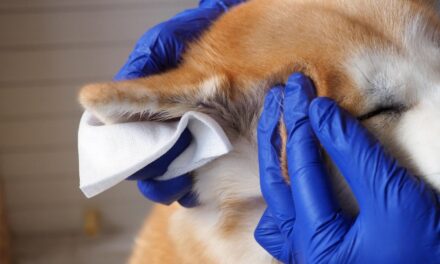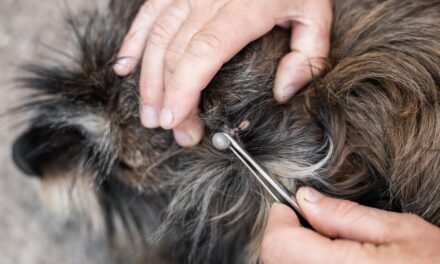

“Why is my dog itching?” is one of the most common questions veterinarians hear. The honest first answer is that itching — the medical term is pruritus — is a sign, not a diagnosis. In U.S. dogs, the usual drivers are fleas and flea-allergy dermatitis, environmental (atopic) allergy, secondary skin infections with yeast or bacteria, mites, food allergy, contact irritants, and plain dry skin. Two or three of these can be going on in the same dog at the same time. That overlap is a big part of why itchy dogs are so frustrating to sort out.
What matters more than guessing the cause is the order a vet works through the list. Parasites get ruled out or treated first, because that step is cheap, fast, and often diagnostic on its own. Skin infections get treated next, because they make every other cause itchier. Only after those two steps does the allergy workup really begin. This guide follows that same order, so you can walk into the appointment understanding why your vet starts where she starts.
If you’re reading this at 1 a.m. because the licking sound from the foot of the bed will not stop, you’re in good company. Skin problems sit near the top of the list of reasons dogs visit a veterinarian every year. Most itchy dogs get meaningfully better once the cause is identified. The job in front of you isn’t to name the cause yourself. It’s to notice the right details, avoid the handful of things that make itching worse, and know which signs mean “call today” versus “watch and record.”
One scope note before we start. This article covers itching as a whole-body sign. Food allergies in dogs have their own dedicated MyDogLucky article, and so do dog ear infections, so both get a plain-language summary here rather than a full treatment. Nothing below names a specific product or medication brand; your veterinarian is the right person to pick those for your dog.
What’s in this guide
- Why is my dog itching? The short answer
- Red flags: when itching needs a same-day call
- What itching can mean, by category (not a diagnosis)
- Why vets say “flea control first” even when you see no fleas
- Secondary infections: why an itchy dog keeps getting itchier
- The diagnostic ladder a vet may follow
- What to observe and record at home
- What not to do when your dog is itching
- Home support most vets agree on
- Living with a chronically itchy dog
- Monitor, call today, or go now: the clear breakdown
- Common mistakes and misunderstandings
- Frequently asked questions about itchy dogs
- Sources
Why Is My Dog Itching? The Short Answer
Every dog scratches sometimes. A quick session behind the ear, a good roll on the carpet, a nibble at a paw after a walk — that’s normal grooming and it stops on its own. Abnormal itching is different. It’s persistent. It interrupts sleep or play. It comes with visible changes like redness, thinning hair, scabs, or a smell, and it tends to focus on particular parts of the body. When owners ask “why is my dog itching,” they’re almost always describing this second kind.
The Merck Veterinary Manual sorts the causes into three broad buckets: parasites, infections, and allergies. VCA Animal Hospitals narrows the everyday list to flea-allergy dermatitis, environmental allergy, food allergy, contact dermatitis, and sarcoptic mange. Dry skin, hormonal disease, and pain-related licking make up most of the remainder. None of those is something you can confirm from the couch, and that’s fine. Where the itch lives, when it shows up, how old your dog is, and what parasite prevention he’s actually on will point your vet in the right direction. Those four facts beat any home guess.
Here’s the practical version of the answer. If your dog is itchy and you can’t see anything obviously wrong, the two most likely explanations in the United States are fleas and allergy. That includes fleas you never spot. If he’s itchy and the skin looks angry, smells off, or has bumps and crusts, there’s very likely a secondary infection layered on top of whatever started it. Both of those situations are worth a veterinary visit within days, not weeks, because itching that goes untreated tends to snowball.
Red Flags: When Itching Needs a Same-Day Call
Most itching is not an emergency. A smaller group of situations needs attention today, and a few need it right now. Read this list once, calmly, so you recognize the signs if they show up.
Call your veterinarian today, or seek urgent care, if you see:
- Swelling of the face, muzzle, or eyelids, or hives appearing over the body — especially with any drooling, vomiting, or trouble breathing. That combination can be an acute allergic reaction and belongs in emergency care now.
- A hot spot that is visibly enlarging within hours — a wet, red, oozing patch that was coin-sized this morning and palm-sized tonight.
- Open, spreading, or bleeding sores, or areas your dog has chewed raw.
- Hair loss with scabs or crusts, particularly on the ear edges, elbows, or hocks, in a dog who is scratching intensely.
- Ear involvement with a head tilt, loss of balance, circling, or a dog crying out when the ear is touched.
- Lethargy, fever, or loss of appetite alongside the itching. Skin trouble plus a dog who seems sick is a different problem than skin trouble alone.
- Intense itching in a young puppy, who has less skin to spare and more contagious causes on the list.
- Itching in several pets, or in the people of the house — a possible sign of a contagious mite or a heavy flea problem that needs a whole-household plan.
Any single item is reason enough to call. You don’t need three of them stacked together before it counts.
Why Hot Spots Earn Their Own Line on the List
A hot spot — vets call it acute moist dermatitis or pyotraumatic dermatitis — is a patch of skin a dog has licked, chewed, or scratched into an open, oozing wound. It often happens within a single day. VCA Animal Hospitals describes owners leaving for work with a small red area on the dog and coming home to something the size of a pancake.
Hot spots usually need the hair clipped back and the area cleaned at the clinic. They also need treatment for whatever triggered the frenzy in the first place: fleas, an ear infection, allergies, a matted coat, even a painful joint the dog keeps licking. Trying to trim the fur yourself with scissors is a genuinely common way a hot spot ends up needing stitches. Leave the clippers to the vet.
Why the “Several Pets or People Itching” Sign Matters
Some causes of itching stay with one dog. Others move. Sarcoptic mange — scabies — is one of the most contagious skin diseases dogs get. According to Cornell’s Riney Canine Health Center, it’s very contagious to people too. People develop itchy rashes that persist until every dog in the house is treated. A flea problem that has settled into the carpet also tends to reach the cat, the other dog, and sometimes your ankles. If more than one body in the household is scratching, say so when you call. It changes what the vet looks for first and whether the whole house needs a plan.
What Itching Can Mean, by Category (Not a Diagnosis)
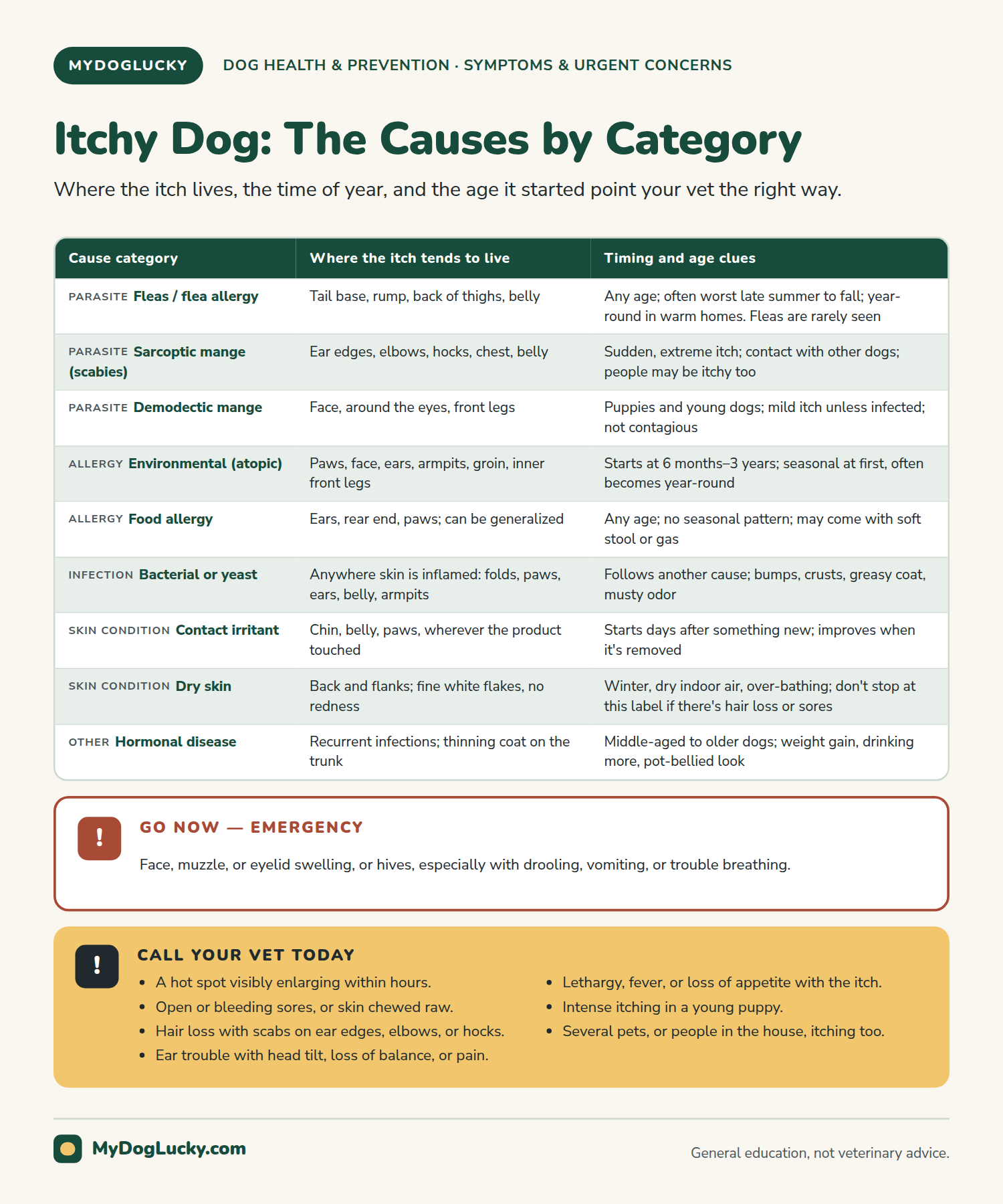
Itching is a shared sign for dozens of different problems, so this section describes broad categories and what each one tends to look like. It is orientation for the question “why is my dog itching,” not a diagnosis of your dog. The details that help most are where on the body the itch lives, when it shows up across the year, and how old your dog was when it started. Keep those three in mind as you read.
Fleas and Flea-Allergy Dermatitis
This is the first thing every vet thinks about, and for good reason. Some dogs tolerate a few fleas with mild irritation. Others are allergic to proteins in flea saliva, and in those dogs, VCA notes that a single bite can trigger itching intense enough to cause hair loss and wounds. The classic pattern is the back half of the dog: the base of the tail, the rump, the back of the thighs, and sometimes the belly. Cornell describes the same “redness, hairlessness or itching on the back near the tail and the back of thighs.”
Two facts trip owners up. First, you usually won’t see fleas on an allergic dog. He’s grooming them off as fast as they arrive, and it only takes an occasional bite to keep the reaction going. Second, “he’s on flea prevention” isn’t always the end of the conversation. A missed dose, a product that has lapsed, or an untreated cat in the house can all leave a gap. Flea allergy often flares in late summer and fall in much of the U.S., but in warm regions and heated homes it can run year-round.
Environmental (Atopic) Allergy
Atopic dermatitis is the dog version of hay fever, except the reaction shows up in the skin rather than the nose. The dog’s immune system overreacts to things like pollens, molds, dust mites, and dander. Cornell’s Riney Canine Health Center estimates it affects roughly 10 to 15 percent of dogs. Both Cornell and Merck put the typical age of onset between six months and three years. It runs in families. Certain breeds — retrievers, several terrier types, bulldogs and boxers, shar-peis, and shih tzus among them — show up more often, though any dog including mixed breeds can be affected.
The distribution is the tell. Atopic dogs lick and chew their paws, rub their faces, scratch their armpits and groin, and get recurrent ear infections. The belly and the inside of the front legs often turn pink. Over time you may notice brown saliva staining on light-colored paws. Cornell notes that 40 to 75 percent of cases start out seasonal, worse in spring, summer, or fall depending on what the dog reacts to. Many progress to year-round over the years. Atopic dermatitis is managed for life rather than fixed once. That sounds discouraging, but most dogs do well with a long-term plan.
Skin Infections: Bacteria and Yeast
Bacterial skin infection (pyoderma) and yeast overgrowth (Malassezia dermatitis) almost never start on their own. They move into skin that’s already inflamed by allergy, parasites, moisture, or hormonal disease, and then they add their own itch on top. Infected skin looks and smells different from allergic skin. Watch for small bumps and pimples, crusts, circular flaky patches, a greasy coat, and a musty or “corn chip” odor. In long-standing cases the skin thickens and darkens into what vets sometimes call elephant skin. These infections have their own section below, because they’re the reason many itchy dogs seem to get worse fast.
Mites: Sarcoptic and Demodectic Mange
Two very different mites share the word “mange.” Sarcoptic mange is caused by a burrowing mite. Cornell describes the itch as extreme, because dogs react to both the mites and their droppings. It favors thin-haired areas: the edges of the ears, the elbows, the hocks (ankles), and sometimes the belly and chest, with crusting and hair loss. It spreads dog-to-dog through direct contact and shared spaces like kennels and dog parks, and it spreads to people. Frustratingly, skin scrapings often come back negative even when mites are present, which is why vets frequently treat for it on suspicion and use the response as the diagnosis.
Demodectic mange is nearly the opposite. Demodex mites live in the hair follicles of every healthy dog. Trouble starts when a puppy’s immature immune system, or a sick adult’s suppressed one, lets them multiply. VCA notes it’s the most common mange in dogs and usually shows up as patchy hair loss around the eyes, face, and front legs. It is not contagious to people or other pets. And it typically isn’t very itchy at all unless a secondary bacterial infection sets in. So a puppy with bald patches but little scratching, and a puppy scratching himself raw at the ear edges, are two different conversations with the vet.
Food Allergy
A true food allergy is less common than environmental allergy, but it deserves a place on the list because it looks so similar. The Merck Veterinary Manual points out the one detail that helps separate them: food-allergic itching shows little seasonal variation. It’s roughly the same in January and July. It can start at any age, including in dogs under a year and in seniors who have eaten the same food for years. Ears and the rear end are commonly involved, some dogs have soft stool or gassiness alongside the itch, and many food-allergic dogs are also atopic.
The only reliable way to confirm it is a strict elimination diet trial of about eight to twelve weeks under veterinary guidance, followed by a deliberate re-challenge. Merck is direct that blood and skin tests are not reliable for diagnosing food allergy. Food allergies in dogs have a dedicated MyDogLucky article that walks through the diet trial in detail, so this article keeps it to that summary.
Contact Irritants and Allergens
Some itching comes from something that touched the skin. VCA lists soaps and perfumes among common contact triggers. The same goes for shampoos, scented sprays, a new detergent on the bedding, a plastic bowl, or a cleaner used on the floor the dog sleeps on. The pattern is the giveaway. Irritation shows up where the contact happened — chin, belly, paws, the parts of the body that lie on the floor — and often starts within days of something new arriving in the house. This is the category where your own timeline of “what changed recently” does the most diagnostic work.
Dry Skin and Environmental Factors
Dry, flaky skin with mild itching is common in winter, when indoor heat drops the humidity, and after too-frequent bathing or a harsh shampoo strips the coat’s natural oils. Dry skin usually looks like fine white dandruff over the back with no redness, no smell, and no bumps. It’s the least worrying category on this list. It’s also the one people most often assume when the real cause is something else. If “dry skin” comes with hair loss, sores, or a dog who can’t settle, don’t stop at that label.
Less Common Causes Worth Knowing Exist
A few other things can drive itching or licking, and a vet keeps them in mind for dogs whose pattern doesn’t fit the usual suspects.
- Hormonal disease. An underactive thyroid or an overactive adrenal gland (Cushing’s disease) changes the skin’s defenses. Merck lists both among the underlying causes of recurrent pyoderma, and these dogs often show other changes too: weight gain, a thin coat, drinking more, a pot-bellied look.
- Ringworm. Despite the name, it’s a fungal infection, not a worm. It’s often only mildly itchy and tends to cause round patches of hair loss and scale. It can spread to people, which is why a fungal culture sits on the diagnostic ladder.
- Immune-mediated skin disease. Uncommon, but crusting on the nose, ear flaps, and footpads that doesn’t respond to the usual steps may prompt a biopsy.
- Pain and behavior. A dog who licks one spot over a joint may be responding to arthritis rather than skin trouble. VCA lists arthritis and boredom-related licking among hot-spot triggers. Licking that started after a routine change, or that targets one leg only, is worth mentioning.
| Cause category | Where the itch tends to live | Timing and age clues | What a vet checks first |
|---|---|---|---|
| Fleas / flea-allergy dermatitis | Tail base, rump, back of thighs, belly | Any age; often worst late summer to fall; year-round in warm homes | Flea comb, flea dirt check, prevention history for every pet |
| Environmental (atopic) allergy | Paws, face, ears, armpits, groin, inner front legs | Starts at 6 months–3 years; seasonal at first, often becomes year-round | Rule out parasites and infection; history of seasonality |
| Bacterial or yeast infection | Anywhere skin is inflamed; folds, paws, ears, belly, armpits | Follows another cause; worsens over days to weeks; odor and bumps | Skin cytology (tape or impression smear) |
| Sarcoptic mange (scabies) | Ear edges, elbows, hocks, chest, belly | Sudden, extreme itch; contact with other dogs; people itchy too | Skin scrapings; often a treatment trial |
| Demodectic mange | Face, around eyes, front legs; paws if generalized | Puppies and young dogs; mild itch unless infected | Deep skin scrapings |
| Food allergy | Ears, rear end, paws; can be generalized | Any age; no seasonal pattern; may include soft stool | 8–12 week elimination diet trial after parasites and infection are handled |
| Contact irritant | Chin, belly, paws, wherever the product touched | Starts days after something new; improves when it’s removed | Timeline of new products at home |
| Dry skin | Back and flanks; flaky, no redness | Winter, dry indoor air, over-bathing | Rule out everything above first |
| Hormonal disease | Recurrent infections; thinning coat on trunk | Middle-aged to older dogs; other body changes | Bloodwork |
Why Vets Say “Flea Control First” Even When You See No Fleas
This is the part of the visit that surprises owners most. You’ve combed your dog, you’ve looked, you’ve seen nothing, and the vet still wants to talk about fleas. There’s a reason, and it isn’t that she doubts you. When the question is “why is my dog itching,” fleas are where the answer starts more often than any other single cause.
Most of a Flea Problem Isn’t on the Dog
The Companion Animal Parasite Council explains that flea eggs fall off the dog into the environment within hours. Most of a flea population lives off the host: in carpet, furniture, baseboards, and bedding rather than on the animal. Pupae can sit dormant in their cocoons for up to 30 weeks in cool conditions, then emerge when a warm body walks by. So the adult fleas you’d find on your dog at any moment are a tiny, shifting fraction of what’s actually in the house. An allergic dog, meanwhile, is grooming those few adults off before you ever get a look.
A Few Bites Are Enough
For a flea-allergic dog, the number of fleas is almost beside the point. CAPC notes that flea-allergy dermatitis can develop from exposure to very small flea populations. VCA puts it more bluntly: one bite can be enough to set off intense itching in a sensitive dog. That means “I only found one flea, so that can’t be it” is backwards. One flea, found, means there are more, unfound, and one is plenty.
Treating for Parasites Is a Diagnostic Step, Not Just a Treatment
The 2023 AAHA guidelines on allergic skin disease make a point that’s worth quoting in spirit. Treating an itchy pet for fleas and mites is both a therapeutic measure and a key diagnostic step on the way to finding the real cause. Suppose your dog goes on reliable, vet-chosen parasite prevention, every pet in the household is covered, and the home is managed. If the itch fades over the following weeks, you have your answer without a single expensive test. If the itch stays put after fleas and mites are properly off the table, the allergy workup can proceed with one big variable removed.
What “Properly Off the Table” Means in Practice
Ask your vet which product class suits your dog and household, and follow the schedule without gaps. CAPC and Cornell both recommend year-round prevention for all pets in the home, cats included. An untreated cat is a flea nursery no matter how well the dog is covered. Vacuum floors and furniture and wash the dog’s bedding in hot water. Expect the environment to take several months to clear, because new adults keep emerging from the carpet even after the pets are protected. That slow tail is normal. It doesn’t mean the product failed.
The paper-towel flea-dirt check
Stand your dog on a white towel or paper and comb the rump and tail base with a fine-toothed flea comb. Tap the comb’s debris onto a damp white paper towel. Ordinary dirt stays brown or gray. Flea droppings — digested blood — dissolve into reddish-brown streaks. A positive check confirms fleas even when you never see one. A negative check does not rule them out in an allergic dog, so don’t use it to talk yourself out of prevention.

Secondary Infections: Why an Itchy Dog Keeps Getting Itchier
If there’s one concept that explains why itching tends to spiral, it’s this one. Allergy or parasites inflame the skin. Scratching breaks the skin’s surface. Bacteria and yeast that live on every dog’s skin move into the damaged areas and multiply. The infection is itchy in its own right, the dog scratches more, and the cycle tightens. Merck notes that secondary infections can persist even after the original trigger has resolved. This is why a dog can seem to “get allergies” in April and be dramatically worse by June.
Bacterial Skin Infection (Pyoderma)
Merck describes pyoderma as, literally, pus in the skin, and says most cases are secondary to allergies, parasites, hormonal disease, or grooming problems. Superficial infections show up as scaling, small red bumps, pimples, crusts, and bald patches. A common sign is a circular, flaky patch with a rim of peeling skin, which vets call an epidermal collarette. Deeper infections bring pain, swelling, odor, and discharge, often on the muzzle, chin, elbows, hocks, and between the toes. Treatment courses run long. Merck advises at least three weeks and preferably four for superficial cases, and eight to twelve weeks or more for deep or recurrent ones. Stopping early lets the bacteria bounce back.
Yeast Overgrowth (Malassezia Dermatitis)
Malassezia is a yeast that normally lives on dog skin in small numbers. VCA explains it becomes a problem when allergies, oily skin, or trapped moisture let it overgrow. The signs are distinctive once you’ve seen them. A musty smell. A greasy or waxy feel. Redness in skin folds and between the toes, dark thickened skin in chronic cases, and recurring ear infections. Some breeds with oily coats or heavy folds are more prone. Yeast is also the classic reason a dog’s paws smell like corn chips and get licked around the clock.
Why Your Vet Reaches for the Microscope
Cytology is the fast, inexpensive test that tells these two apart. The vet presses a piece of clear tape or a glass slide against the affected skin, stains it, and looks for bacteria, yeast, and inflammatory cells. It takes minutes. It also matters, because bacterial and yeast infections need different medications. Treating an allergic dog for allergy while ignoring a raging yeast infection leaves him nearly as itchy as before. If the ears are involved, expect ear cytology too; the AAHA guidelines list it as part of the basic workup for any itchy dog with ear disease.
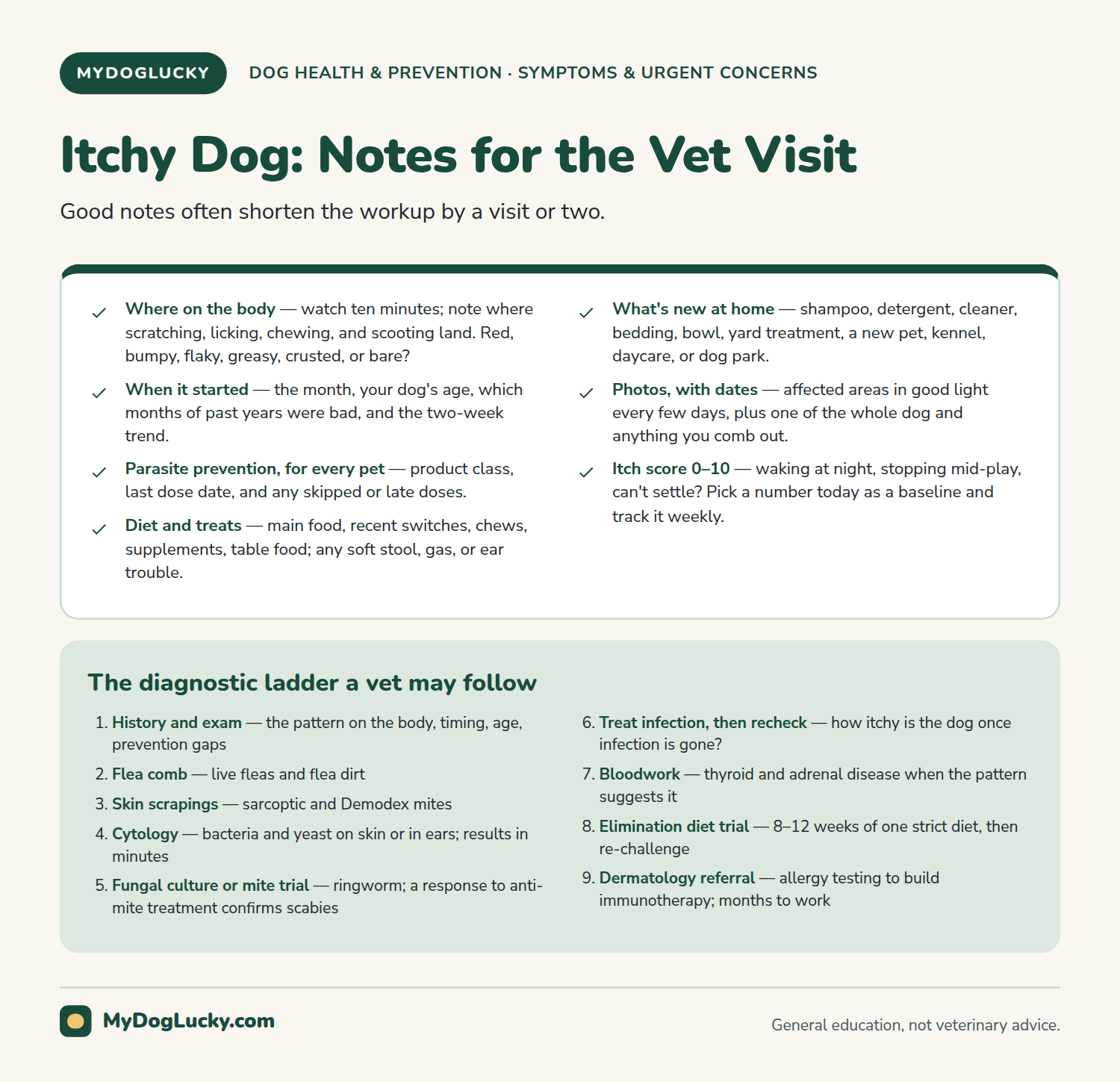
The Diagnostic Ladder a Vet May Follow
Knowing the sequence helps in two ways. It sets realistic expectations about how many visits a chronic itch might take, and it explains why a vet may not start with the test you expected. The AAHA guidelines lay out the first rungs plainly. First, a detailed history and a full physical exam. Then a “minimum dermatologic database” of skin cytology, flea combing, skin scrapings, and ear cytology when the ears are involved.
Rung One: History and the Pattern on the Body
Expect questions. When did the itching start, and how old was your dog? Does it change with the seasons? What parasite prevention is every pet on, and when was the last dose? What does your dog eat, treats and table food included? What’s new in the house? Is anyone else itchy? What has helped, or not helped, before? Then the vet maps the itch on the body. Rear end says fleas. Paws, face, and armpits say atopy. Ear edges and elbows say scabies. That map, combined with your timeline, is often the most informative “test” of the visit.
Rung Two: The Minimum Database
- Flea combing for live fleas and flea dirt.
- Superficial and deep skin scrapings — a blade scraped along the skin to collect material for the microscope — looking for sarcoptic and demodectic mites. Deep scrapes are needed for Demodex; Merck notes multiple deep scrapings are required to exclude parasites in a dog with pyoderma.
- Skin cytology by tape or impression smear for bacteria and yeast.
- Ear cytology if the ears are red, smelly, or painful.
These are same-visit, in-house tests. Many itchy dogs never need to go further.
Rung Three: Fungal Culture and Treatment Trials
If the pattern suggests ringworm, or a puppy has patchy hair loss, the vet may pluck hairs for a fungal culture. Cultures can take a couple of weeks to grow. Sarcoptic mites also hide well. A negative scraping in a dog with the right pattern often leads to a treatment trial with an appropriate anti-mite product. Cornell notes most dogs improve within two weeks and clear fully in six to eight. If the itch disappears, the trial was the diagnosis.
Rung Four: Treat Infection, Then Reassess
Once cytology shows bacteria or yeast, those get treated first, for the full course. At the recheck, the vet asks the key question: how itchy is the dog now that the infection is gone? A dog who’s comfortable was mostly infection-driven. A dog who’s still itchy has an underlying allergy or another cause that still needs work. Skipping this recheck is where many workups stall.
Rung Five: Bloodwork When the Pattern Suggests It
For a middle-aged or older dog with recurrent infections, a thinning coat, weight change, or increased thirst, blood tests for thyroid and adrenal function may come next. Hormonal disease isn’t a common cause of itching on its own, but it’s a common reason infections keep coming back.
Rung Six: The Elimination Diet Trial
Food allergy and atopic dermatitis look alike, and blood tests can’t separate them. So the vet may recommend an eight- to twelve-week trial on a diet built from either a protein your dog has never eaten or a hydrolyzed protein. It’s fed with nothing else — no treats, no flavored chews, no table food, no flavored medications without checking. It’s tedious. It’s also the only reliable food-allergy test there is. The MyDogLucky article on food allergies in dogs covers how to run one without accidentally breaking it, which is the most common way trials fail.
Rung Seven: Referral to a Veterinary Dermatologist
A board-certified veterinary dermatologist is the specialist for itchy dogs that stump general practice. That’s a veterinarian who completed a residency in skin, ear, and allergic disease and passed the American College of Veterinary Dermatology’s exams. This is where intradermal (skin) allergy testing or serum allergy testing usually happens. An important nuance that both AAHA and Merck stress: these tests don’t diagnose atopic dermatitis. The diagnosis comes from the pattern and from ruling everything else out.
Allergy testing identifies which environmental allergens to include in allergen-specific immunotherapy — the “allergy shots” or oral drops that gradually retrain the immune system. Merck reports that roughly 70 percent of dogs respond, and that it can take three to twelve months to see the benefit. The ACVD maintains a public directory for finding a dermatologist near you.
| Step | What it looks for | What it’s like for your dog |
|---|---|---|
| History and exam | Distribution, timing, age of onset, prevention gaps, new products | Hands-on exam; you do most of the talking |
| Flea comb | Live fleas, flea dirt | Painless, a minute or two |
| Skin scrapings | Sarcoptic and Demodex mites | Brief scraping; deep scrapes may cause a little pinpoint bleeding |
| Cytology (skin and ear) | Bacteria, yeast, inflammatory cells | Tape or slide pressed to the skin; results in minutes |
| Fungal culture | Ringworm | Hairs plucked; results in days to weeks |
| Treatment trial for mites | Response confirms scabies when scrapes are negative | Vet-chosen anti-mite product; reassess in 2–4 weeks |
| Bloodwork | Thyroid and adrenal disease, general health | Blood draw |
| Elimination diet trial | Food allergy | 8–12 weeks of one strict diet, then re-challenge |
| Dermatology referral and allergy testing | Which allergens to put in immunotherapy | Sedated skin test or blood test; immunotherapy takes months to work |

What to Observe and Record at Home
You don’t need to diagnose anything. You need to be a good witness, because the details you bring to a “why is my dog itching” appointment often shorten the workup by a visit or two. Here’s what’s genuinely useful.
Where on the Body
Be specific. “Everywhere” is rarely accurate; watch for ten minutes and note where the scratching, licking, chewing, rubbing, and scooting actually land. Paws and face mean something different from tail base, and ear edges mean something different from both. If the skin looks changed, note whether it’s red, bumpy, flaky, greasy, crusted, thickened, or bare.
When It Started and How It Has Changed
Note the month it began and your dog’s age at the time. If this is a repeat, write down which months of past years were bad. Itching that arrives every August and eases by December tells a different story than itching that has been steady since February. Also note the trend over the last two weeks: better, worse, or the same.
Your Dog’s Current Parasite Prevention, Honestly
Write down the product class, the date of the last dose, and whether you’ve skipped or delayed any. Do the same for every other pet in the house. Vets ask this without judgment, and an honest gap is far more useful than a vague “he’s on something.”
Diet, Treats, and Everything Else That Goes in His Mouth
List the main food, any recent switch, treats, chews, dental products, supplements, and table food. If your dog has had soft stool, gas, or ear trouble alongside the itch, say so; the combination can nudge the vet toward considering food.
What’s New at Home
New shampoo, detergent, carpet cleaner, air freshener, bedding, bowl, yard treatment, or a new pet. Also new people: a visiting dog, a stay at a kennel or daycare, a trip to a dog park. Contact irritants and contagious mites both start with “what changed.”
Photos, With Dates
Take a few clear photos of the affected areas in good light every few days, and one of the whole dog. Skin changes faster than memory, and photos let your vet see what a hot spot looked like before you got there, or how a rash has moved. Photos of anything you comb out — flea dirt on a wet towel, for instance — are useful too.
How Much It’s Affecting His Life
Is he waking at night to scratch? Stopping mid-play? Refusing to settle? Many dermatologists ask owners to rate the itch on a simple 0-to-10 scale. Tracking that number week to week is the cleanest way to tell whether a treatment is working. Pick a number today so you have a baseline.
The one-page itch log
On your phone or a sheet of paper, keep a running note. Date, itch score 0–10, body areas, skin changes, anything new (product, food, place, pet), and any medication or bath given that day. Two weeks of this before a visit turns “he’s been itchy for a while” into something your vet can act on. It’s also the only reliable way to judge whether a treatment or diet trial is actually helping, because day-to-day itching swings enough to fool anyone’s memory.
What Not to Do When Your Dog Is Itching
Most of these come from a good place. Owners searching “why is my dog itching” at midnight want to do something tonight, and the instinct is understandable. These particular somethings still tend to make the visit harder, the dog itchier, or both.
Don’t Give Human Antihistamines, Pain Relievers, or Steroid Creams Without Asking First
Some human antihistamines are used in dogs, at doses a vet chooses, and Merck notes their effect on canine itch is variable at best. Others are dangerous, and combination cold-and-allergy products can contain ingredients that are toxic to dogs. Human pain relievers are a separate hazard entirely. Over-the-counter steroid creams get licked off, can thin the skin, and can mask the very signs your vet needs to see. A quick phone call before you open the medicine cabinet costs nothing.
Don’t Use Tea-Tree Oil or Other Home Remedies on Broken Skin
Concentrated tea-tree oil is toxic to dogs when absorbed or licked. “Natural” remedies from the internet — apple cider vinegar on raw skin, essential oil blends, coconut oil on a yeast-prone belly — often sting, trap moisture, or feed the problem. If your vet recommends a specific topical product for your dog, use that one. Skip everything else until you’ve asked.
Don’t Bathe Daily or Use Harsh Shampoos
Bathing can be a genuinely useful part of managing an itchy dog, but with the right product at the right frequency. Daily baths in dish soap or a scented human shampoo strip the skin, dry it out, and can turn mild itching into a real problem. Ask your vet whether a medicated or soothing shampoo makes sense, how often, and how long to leave it on. Many medicated shampoos need ten minutes of contact time to do anything.
Don’t Stop Prescribed Treatment Early Because He Looks Better
This one is common and costly. Skin infections improve on the surface well before they’re actually cleared, which is why Merck’s antibiotic guidance runs three to four weeks minimum for superficial pyoderma. Stopping at day ten because the redness faded is the most reliable way to get a recurrence, and each recurrence is harder to treat. The same logic applies to anti-mite treatment and diet trials: finish the course, then let the vet decide.
Don’t Switch Foods Every Two Weeks Hoping to Hit the Right One
Bouncing between commercial foods rarely proves anything, because most share common protein sources and because a real elimination trial needs eight to twelve weeks of one strict diet. Rapid switching also upsets the gut and muddies the timeline. If you suspect food, ask your vet to design a proper trial rather than improvising one.
Don’t Use Scissors on a Hot Spot or Matted Area
Covered above and worth repeating: the skin under a hot spot is fragile, the dog is uncomfortable, and scissors slip. Let the clinic clip it.
Don’t Wait Months on “Dry Skin”
Dry skin is real, but it doesn’t cause hair loss, sores, odor, or a dog who can’t sleep. If any of those are present, the label has expired.
Home Support Most Vets Agree On
None of this replaces the diagnostic ladder. All of it makes an itchy dog more comfortable while the workup runs, and most of it is low-cost.
Year-Round Parasite Prevention, as Prescribed, for Every Pet
Already covered, and it’s the single most effective thing you can do at home. Set a phone reminder for each dose. Cover the cat. Don’t let it lapse over winter; CAPC’s recommendation is year-round, lifelong, for a reason.
Gentle Bathing on Your Vet’s Schedule
For allergic dogs, a bath with a vet-recommended shampoo can physically rinse pollens and dander off the coat and calm the skin. For dogs with yeast or bacterial infection, a medicated shampoo is often part of the treatment plan. The details should come from your vet: which product class, how often, how long to leave it on, whether to follow with a conditioner or leave-on spray. The wrong shampoo does the opposite of what you want. Dry thoroughly afterward, especially folds, armpits, and between the toes.
Wipe Paws and Belly After Walks During Allergy Season
For dogs with environmental allergies, a damp cloth or a vet-approved wipe across the paws, lower legs, and belly after time outside removes a meaningful share of the pollen they’d otherwise lick off. It takes thirty seconds. Many owners of atopic dogs consider it the highest-return habit they’ve adopted.
Keep Nails Short and Consider Protecting the Skin
Long nails turn ordinary scratching into wounds. Keep them trimmed. For a dog who’s damaging himself, a recovery cone, a soft inflatable collar, a lightweight T-shirt, or a bodysuit can protect the skin for the few days it takes treatment to start working. Ask the vet which option suits the location of the damage. Bored dogs lick more, so add sniff walks, food puzzles, and chews during a flare.
Manage the Home Environment
Wash bedding weekly in hot water, vacuum regularly, and run a humidifier in dry winter months if dry skin is part of the picture. If a contact irritant is suspected, remove the newest product and see what happens over a week or two. During high-pollen weeks, keeping windows closed and wiping the dog down after outdoor time helps.
Ask About Omega-3 Fatty Acids
Merck lists essential fatty acids among the supportive options for itchy dogs. They’re mild on their own and take weeks to show any effect, but they’re a common part of a multimodal plan. Dose and product should come from your vet rather than the supplement aisle, since strengths vary widely.

Living With a Chronically Itchy Dog
For a meaningful share of dogs, the answer to “why is my dog itching” turns out to be a lifelong allergy. That deserves realistic framing, because the owners who struggle most are usually the ones who expected a single fix.
Management, Not a One-Time Fix
Atopic dermatitis and food allergy don’t go away. They get controlled. Cornell and Merck both describe atopy as a lifelong condition that responds well to management. The 2023 AAHA guidelines are explicit that treating an allergic patient isn’t one-size-fits-all and that a multimodal approach usually works best. Expect a combination: parasite prevention, skin barrier care, prompt treatment of flare-ups and infections, and one or more longer-term anti-itch strategies chosen by your vet. Expect adjustments over time. A plan that works beautifully in year one may need tuning in year three.
The “Itch Threshold” Idea
Many veterinarians explain chronic itching with a threshold picture. Each contributing factor — pollen, a few flea bites, a bit of yeast, dry winter skin — adds to the load. Below a certain point the dog is comfortable; above it, he itches. You rarely remove every factor, but if you knock out the ones you can control, the remaining allergen exposure may sit under the line. That’s why flea prevention and infection control matter even when “the real problem” is pollen. Every factor you remove is headroom.
The Treatment Classes Your Vet May Discuss
This article doesn’t name products, and the choice belongs to your veterinarian. But it helps to know the general categories so the conversation makes sense.
- Short courses of steroids to break a bad flare quickly; effective, with well-known side effects that make them a poor long-term default for most dogs.
- Oral immunomodulating medications that quiet the itch signal or the immune response and are designed for longer-term use.
- An injectable antibody-based medication that targets a specific itch messenger and is given every few weeks.
- Antihistamines, inexpensive but, per Merck, variably effective in dogs.
- Topical therapy: medicated shampoos, sprays, mousses, and wipes that treat infection and support the skin barrier.
- Allergen-specific immunotherapy, the only option that addresses the underlying allergy rather than the symptom, typically arranged through a dermatologist.
- Diet, either a therapeutic diet for confirmed food allergy or one formulated to support skin.
Each has tradeoffs in cost, monitoring, and side effects, and the right mix depends on your dog’s severity, age, other conditions, and your budget.
Planning for the Cost
Chronic skin disease is one of the more expensive ongoing conditions to manage. No single step is huge, but the steps recur: prevention every month, rechecks, cytology at each flare, medication refills, a special diet, and possibly immunotherapy. A few practical moves help.
- Ask your clinic for a written estimate of a typical year’s management once the diagnosis settles, so nothing is a surprise.
- Ask which parts of the plan do the most work for the least money. Prevention and prompt infection control usually top that list.
- If you have pet insurance, check how it handles chronic and pre-existing conditions before you assume coverage. If you’re shopping for a policy, know that a diagnosed allergy will usually be excluded going forward.
- Ask whether a dermatology referral would actually reduce long-term cost by getting the dog stable sooner. For some dogs it does.
- Consistent home care — baths, wipes, nails, bedding — is the cheapest lever you own. Use it fully before adding expense.
What “Good” Looks Like
A well-managed allergic dog still scratches sometimes. The goal isn’t zero. It’s a dog who sleeps through the night, plays without stopping to chew a paw, has skin that looks and smells normal most of the year, and has infections rarely rather than constantly. If you’re keeping an itch log, “good” usually means a score that stays low with occasional bumps you can explain.
Monitor, Call Today, or Go Now: The Clear Breakdown
Here’s the same information organized by what to actually do next.
Monitor at home and book a routine visit
- Mild, occasional scratching with no visible skin changes.
- Fine dandruff over the back in winter with no redness or hair loss.
- A dog who’s eating, sleeping, and playing normally.
- You’ve just started or corrected parasite prevention and are giving it time to work.
Start the itch log, check the flea-dirt test, and book a routine appointment if it hasn’t improved in one to two weeks. If any sign below appears, move to that tier.
Call your vet today or within a day or two
- Itching that’s persistent, worsening, or interrupting sleep or play.
- Visible skin changes: redness, bumps, crusts, greasy coat, odor, thinning hair, dark thickened skin.
- Recurrent ear infections or paw licking alongside the itch.
- A small hot spot that isn’t growing quickly.
- Itching in more than one pet, or a person in the house with an itchy rash.
- Any itchy puppy, senior, or dog with another medical condition.
Not an emergency-room situation, but not a wait-it-out one either. Bring the log, the photos, and every pet’s prevention dates.
Seek emergency care now
- Facial swelling, hives, drooling, vomiting, or any difficulty breathing.
- A hot spot enlarging by the hour, or an area chewed open and bleeding.
- Head tilt, loss of balance, or circling with ear involvement.
- Fever, marked lethargy, or refusal to eat alongside skin disease.
- Widespread crusting or sores with a dog who seems painful or unwell.
Call ahead if you can, then go. Don’t wait to see if it settles overnight.
Common Mistakes and Misunderstandings
“I Don’t See Fleas, So It Isn’t Fleas”
The most common misunderstanding in the whole topic. Allergic dogs groom fleas off, most of the population is in the house, and a few bites are enough. Absence of visible fleas doesn’t rule them out. Consistent prevention does far more to rule them out than looking does.
Treating the Itch Without Treating the Infection
An anti-itch medication given to a dog with untreated yeast or bacteria in the skin usually disappoints, because the infection keeps feeding the itch. Cytology first, infection treated, then reassess. This is the sequence vets use and the one home efforts skip most often.
Assuming Allergy Testing Will “Find the Cause”
Intradermal and serum allergy tests identify which environmental allergens to use in immunotherapy. They don’t diagnose atopic dermatitis. They don’t diagnose food allergy. And a positive result in a dog whose real problem is fleas or mites leads straight to expensive treatment for the wrong thing. This is why testing sits near the top of the ladder, not the bottom.
Buying a “Hypoallergenic” or “Limited Ingredient” Food and Calling It a Trial
A real elimination trial uses a diet chosen with your vet, fed strictly, for eight to twelve weeks, followed by a re-challenge. Over-the-counter foods labeled for sensitivities often aren’t strict enough to prove anything, and adding treats or flavored chews during the trial resets the clock.
Stopping Once the Skin Looks Better
Superficial improvement comes weeks before the infection is actually gone. Finish the course. Go to the recheck.
Blaming the Food When the Itch Is Seasonal
Food allergy shows little seasonal variation, per Merck. An itch that reliably shows up in late summer and settles in winter is pointing away from the food bowl and toward pollens, molds, or fleas.
Over-Bathing With the Wrong Product
More baths feel like more help. With a harsh or scented shampoo, they’re the opposite. Frequency and product should come from the vet.
Treating One Pet When the House Has Three
Fleas and sarcoptic mites don’t respect the boundary between the itchy dog and the ones who seem fine. Prevention for every pet, and treatment for every dog when scabies is suspected, is standard advice from Cornell and CAPC.
Frequently Asked Questions About Itchy Dogs
Why is my dog itching but has no fleas?
Flea-allergic dogs groom fleas off before you see them, and most of a flea population lives in the home rather than on the dog. So “no fleas seen” doesn’t mean no fleas. It also may genuinely not be fleas: environmental allergy, a skin infection, mites, food allergy, or a contact irritant are the next most likely explanations. Reliable prevention for every pet, followed by a vet visit if the itch continues, is the standard path.
Why is my dog itching more at night?
Nighttime itching is common for several reasons. The house is quiet and there’s nothing to distract from the itch. The dog’s body warms up on bedding, and dust mites live in bedding. Scabies is also known for intense night itching. Note the pattern for your vet rather than treating it as a separate problem.
Why is my dog itching after a bath?
Often the shampoo — a scented or human product, residue that wasn’t rinsed out, or water left in folds and between the toes. Sometimes the bath simply stripped dry skin further. Rinse thoroughly, dry completely, and ask your vet which product class suits your dog before the next one.
Why is my dog itching only in the fall?
A strictly seasonal pattern usually points toward environmental allergens that peak at that time, such as weed pollens and molds. It can also point toward fleas, which peak in late summer and fall in much of the U.S. Cornell notes that many atopic dogs start seasonal and become year-round over time, so tracking which months are bad each year is worth doing.
Why is my dog itching his ears and paws but nowhere else?
Paws, face, ears, and armpits are the classic distribution for atopic dermatitis, and ears plus paws also shows up with food allergy and with yeast overgrowth. Your vet will likely start with ear and paw cytology to check for infection, then work through the allergy ladder.
Why is my dog itching and losing hair?
Hair loss with itching usually means the skin is being damaged — by scratching, by infection, or by mites — rather than just irritated. Where the hair is missing helps. Rump and tail base suggests fleas. Ear edges, elbows, and hocks suggest sarcoptic mange. Face and front legs in a puppy suggests Demodex, and patches with a flaky rim suggest bacterial infection. This combination is a call-today sign, not a monitor sign.
Can I give my dog an over-the-counter antihistamine for itching?
Not without asking your vet first. Some are used in dogs at vet-chosen doses and help a little; others, and especially combination products, can be harmful. Merck describes antihistamines as variably effective for canine itch, so even a safe one may do less than you hope. A phone call answers the question for your specific dog.
How do vets figure out what a dog is allergic to?
For environmental allergy, by first ruling out parasites, infection, and food, then, if immunotherapy is planned, running intradermal or serum allergy testing to select allergens for the treatment. For food allergy, only an elimination diet trial and re-challenge works; blood and saliva tests aren’t reliable for it.
Is dog itching contagious to humans?
The itching itself isn’t, but a few causes are. Sarcoptic mange readily causes itchy rashes in people, ringworm can spread to people, and a home flea infestation bites everyone. Environmental allergy, food allergy, yeast, and Demodex do not spread to humans. If someone in the house is itchy too, mention it at the visit.
How long does it take to find out why a dog is itching?
Sometimes one visit: fleas found, infection seen on cytology, plan started. For allergic dogs, realistically a few months, because parasites need time to clear, infections need three to four weeks of treatment, and a diet trial takes eight to twelve weeks on its own. Knowing that going in makes the process much less discouraging.
Should I change my dog’s food if he’s itchy?
Not on your own, and not repeatedly. Random switching rarely proves anything and can upset his stomach. If your vet suspects food, she’ll design a proper elimination trial. If the itch is seasonal, food is less likely to be the driver.
Can stress or boredom make a dog itch or lick?
Licking that focuses on one spot, especially a leg, can be behavioral or pain-related rather than allergic, and VCA lists boredom-related licking among hot-spot triggers. It’s still worth ruling out skin causes first, since a dog who licks from itch and a dog who licks from habit look the same from across the room. More enrichment helps either way.
Do puppies get itchy for different reasons than adult dogs?
Mostly the same list, with a shift in emphasis. Puppies are more prone to Demodex, more likely to have picked up contagious mites or fleas from a litter or shelter, and can develop food or environmental allergy young. VCA’s puppy guidance sums it up: excessive itchiness in puppies usually comes down to fleas, allergies, or both. An intensely itchy puppy belongs on the call-today list.
Will my dog grow out of allergies?
Usually not. Atopic dermatitis tends to persist and often broadens over time, which is why management plans are built for the long haul. Some dogs do become easier to manage as the right combination is found, and immunotherapy can reduce how much medication a dog needs.
What does a veterinary dermatologist do that my regular vet can’t?
Everything your regular vet does, plus intradermal allergy testing, formulation and management of immunotherapy, biopsies and workups for unusual skin disease, and experience with the hardest cases. Many dogs never need one. Dogs who keep relapsing despite a solid plan, or whose diagnosis is unclear after the basic ladder, often benefit. The ACVD directory lists board-certified dermatologists by location.
Is a little bit of scratching normal?
Yes. Occasional scratching, a roll on the rug, a quick paw nibble after a walk — that’s grooming. It stops on its own and leaves no mark. The line is crossed when scratching is persistent, interrupts sleep or play, or leaves visible changes on the skin.
Where This Leaves You
The question “why is my dog itching” rarely has a one-word answer, but it does have a reliable order of operations. Parasites first, even when you see none, because prevention is cheap and often diagnostic. Infections next, because they make every other cause worse and they’re easy to find under a microscope. Then the allergy work, patiently, with a diet trial or a dermatology referral if the pattern calls for it. Your part is smaller than it feels: keep prevention current for every pet, keep an honest log with dated photos, avoid the medicine-cabinet shortcuts, and bring what you’ve noticed to the visit.
If anything on the red-flag list is present, make the call today. That means facial swelling, a hot spot growing by the hour, a head tilt, a dog who seems sick, or a household where more than one body is scratching. For everything else, a week or two of good observation followed by a scheduled visit is a calm, responsible way to handle one of the most common problems in dog ownership. Most itchy dogs get better. The ones who get better fastest are usually the ones whose owners started in the right order.
Sources
- Merck Veterinary Manual (Dog Owners). Itching (Pruritus) in Dogs. Karen A. Moriello, DVM, DACVD. Last updated May 2025.
- Merck Veterinary Manual (Dog Owners). Allergies in Dogs. Stephen D. White, DVM, DACVD, and Karen A. Moriello, DVM, DACVD. Last updated September 2024.
- Merck Veterinary Manual (Professional). Atopic Dermatitis in Dogs. Last updated May 2026.
- Merck Veterinary Manual (Dog Owners). Pyoderma in Dogs. Karen A. Moriello, DVM, DACVD. Last updated September 2024.
- American Animal Hospital Association. 2023 AAHA Management of Allergic Skin Diseases in Dogs and Cats Guidelines. Published October 2023.
- VCA Animal Hospitals. Pruritus (Itching and Scratching) in Dogs. Malcolm Weir, DVM; Ryan Llera, DVM; Tammy Hunter, DVM; Ernest Ward, DVM. Last updated May 29, 2026.
- VCA Animal Hospitals. Allergies in Dogs. Courtney Barnes, DVM; Malcolm Weir, DVM; Catherine Barnette, DVM; Ernest Ward, DVM. Last updated April 24, 2026.
- VCA Animal Hospitals. Hot Spots in Dogs. Malcolm Weir, DVM, MSc, MPH, et al. Last updated July 10, 2026.
- VCA Animal Hospitals. Yeast Dermatitis in Dogs. Last updated September 4, 2026.
- VCA Animal Hospitals. Demodectic Mange in Dogs. Last updated June 12, 2026.
- VCA Animal Hospitals (Pediatric). What to Do if Your Puppy Is Itchy.
- Cornell University College of Veterinary Medicine, Riney Canine Health Center. Atopic Dermatitis (Atopy). Updated October 21, 2025.
- Cornell University College of Veterinary Medicine, Riney Canine Health Center. Sarcoptic Mange (Scabies).
- Cornell University College of Veterinary Medicine, Riney Canine Health Center. Fleas.
- Cornell University College of Veterinary Medicine, Riney Canine Health Center. Allergy Testing and Immunotherapy. Updated October 21, 2025.
- Companion Animal Parasite Council. CAPC Guidelines: Fleas. Last updated September 19, 2017.
- American College of Veterinary Dermatology. Find a Board-Certified Veterinary Dermatologist.
This article is general education for U.S. dog owners. It is not individualized veterinary advice, a diagnosis, or a substitute for an in-person veterinary exam. Itching has many overlapping causes that can only be separated by examination and testing. Nothing here should be used to choose or dose a medication, shampoo, supplement, or home remedy on your own. If your dog shows facial swelling or hives, a rapidly enlarging hot spot, open or bleeding sores, a head tilt or loss of balance, fever or lethargy, or if several pets or people in the household are itching, seek veterinary care right away rather than waiting.