Learning how to get dog smell out of your house starts with a slightly humbling step: finding out where the smell actually lives. It’s rarely one thing. It’s your dog’s coat, the bed, the couch cushion your dog claims every afternoon, the rug by the door, and the air that circulates past all of it.
The good news is that most dog smell responds to ordinary housekeeping done in the right order: find the source, clean the fabrics and surfaces, then deal with the air. Reaching for a scented spray first is the classic detour. It’s the one that keeps you cleaning the same room every weekend.
This guide walks the whole chain. You’ll get a source-finding method, surface-by-surface instructions, an accident plan, honest notes on air filters, and a section on cleaning safely around your dog. You’ll also get a daily, weekly, and monthly routine, plus a 10-minute version for weeks when life eats your Saturday.
One boundary before we start. A strong or sudden change in how your dog smells can be a medical signal, not a housekeeping problem. Cleaning can’t fix that, and covering it up can delay help. We’ll come back to it in its own section.
What’s in this guide
- How to Get Dog Smell Out of Your House: The Short Answer
- Step one: find the source before you buy anything
- Where dog smell comes from and where it hides
- Start with your dog: brushing, bathing, and drying
- Washable fabrics: dog beds, blankets, crate pads, and covers
- Rugs, carpet, and upholstery
- Hard floors, walls, and baseboards
- Urine, vomit, and other accidents
- Air, vents, filters, and airing out
- Bowls, toys, and everything else that goes in your dog’s mouth
- The entryway, the car, and the mud
- Cleaning safely around your dog: chemicals, scents, and diffusers
- A cleaning routine that fits real life
- A weekend reset when the smell has gotten ahead of you
- When the smell is a health signal, not a housekeeping problem
- Allergies, asthma, and the other people in your home
- Renters, apartments, and small spaces
- When to call a professional cleaner
- Common mistakes when you’re fighting dog smell
- Common questions about dog smell
- Sources
How to Get Dog Smell Out of Your House: The Short Answer
Work in this order: your dog, then the things your dog touches, then floors and surfaces, then the air. Most homes need a mix of washing, vacuuming, drying, and fresh air. Almost none need a stronger fragrance.
Dog smell tends to come from several places at once. Skin oils, damp fur, drool, and dirt settle into bedding, upholstery, carpet, and vents. Cleaning only one of those often leaves the smell right where it was. Cleaning the whole chain, in order, is what shifts it.
The quick map
| Where it hides | First move | Then |
|---|---|---|
| Your dog’s coat and skin | Brush, then bathe with a shampoo made for dogs when a bath is due | Dry the coat well. Call your vet if the smell changes. |
| Bedding and blankets | Shake out the hair, then wash by the care label | Dry fully. Keep a spare set. |
| Rugs, carpet, and upholstery | Vacuum slowly and often | Deep-clean by the manufacturer’s directions |
| Hard floors and baseboards | Sweep or vacuum, then mop with a floor-safe cleaner | Wipe the lower walls where your dog rubs |
| Accidents | Blot first, then use a cleaner made for pet accidents | Follow the label and recheck the spot |
| Air and vents | Open windows when weather allows and replace filters on schedule | Treat an air cleaner as a modest add-on |
| Entryway and car | Wipe paws and dry your dog at the door | Use washable seat covers and wash them regularly |
Treat that table as a map, not a to-do list for today. The rest of this guide explains each row.
One rule before you clean anything
A changed smell is information. If your dog suddenly smells stronger or different, or the smell comes with head shaking, scratching, licking, redness, crusts, hair loss, leaking urine, or a change in appetite or energy, call your veterinarian. Don’t cover it up with perfume, sprays, or home remedies.
Step one: find the source before you buy anything
The honest answer to how to get dog smell out of your house is that you can’t clean what you haven’t located. A home can smell like dog for at least three different reasons. Sorting out which one you’re dealing with saves hours.
The three big buckets
- The dog. The smell travels with your dog from room to room. It’s strongest right after a wet walk or when you pet your dog. That points to the coat, skin, ears, or mouth.
- The house. The smell stays put when your dog leaves the room. It clings to beds, rugs, couches, and vents. That points to fabrics, floors, or air.
- An accident. The smell is strongest in one spot, usually low to the ground. That points to urine, vomit, or another spill that soaked in.
Most homes have a little of all three. The order you tackle them in matters more than the products you use.
What you notice, and what it often points to
| What you notice | What it often points to | First thing to try |
|---|---|---|
| The smell follows your dog around | Coat, skin, ears, or mouth | Brush, check ears and skin, bathe if it’s due. Call your vet if the smell is new or strong. |
| It’s strongest at the bed or couch | Fabrics holding hair, skin oils, and drool | Wash or cover them |
| It’s strongest in one floor or carpet spot | An old accident or spill | Treat the spot with a pet-accident cleaner |
| It peaks after wet walks | A damp coat and damp towels | Towel-dry well and wash the towels |
| It shows up when the heat or air conditioning starts | Dust and hair in the filter or vents | Check the filter and vacuum the vent covers |
| It greets you at the car door | Seat fabric, blankets, and floor mats | Vacuum, wash covers, and air the car out |
| A musty smell that stays when your dog is away | Something other than your dog, such as moisture | Look for damp spots. Call a professional if it persists. |
A three-day nose log
Many owners stop noticing the smell of their own home. Your nose adapts, so a visitor’s wrinkled nose is often more accurate than yours. (It isn’t a personal insult. Usually.) A short log lets you check yourself.
- Day 1: Walk through your home and write down the strongest spots. Ask a friend who doesn’t live there to rank the rooms, too.
- Day 2: Change one thing. Wash one bed, or treat one spot. Note what shifts.
- Day 3: Compare notes. Which change made a difference? That’s your starting point.
Change one thing at a time. If you wash the bed, shampoo the rug, and replace the filter on the same day, you’ll never learn which one mattered. If the smell seems to sit on your dog rather than in the house, skip ahead to the coat and skin section, and read the health section too.
Where dog smell comes from and where it hides
Six places account for most of it. Figure 1 shows them side by side.
- The dog. Skin oils, damp fur, ears, and mouth. Dogs also pick up smells from their surroundings. One AKC guide notes that dogs with yards often smell like grass, and that smaller dogs may smell like their owners’ detergents or perfumes.
- Bedding and blankets. They hold hair, skin oils, drool, and moisture close to where your dog spends the most time.
- Fabrics. Couches, curtains, throws, and car seats soak up whatever is on your dog.
- Floors. Carpet, rugs, and the seams between hard-floor boards trap hair, dirt, and accident residue.
- Air. Vents, filters, and stale indoor air recirculate what’s already there.
- The entryway and the car. Mud, damp towels, and small closed spaces concentrate smell.
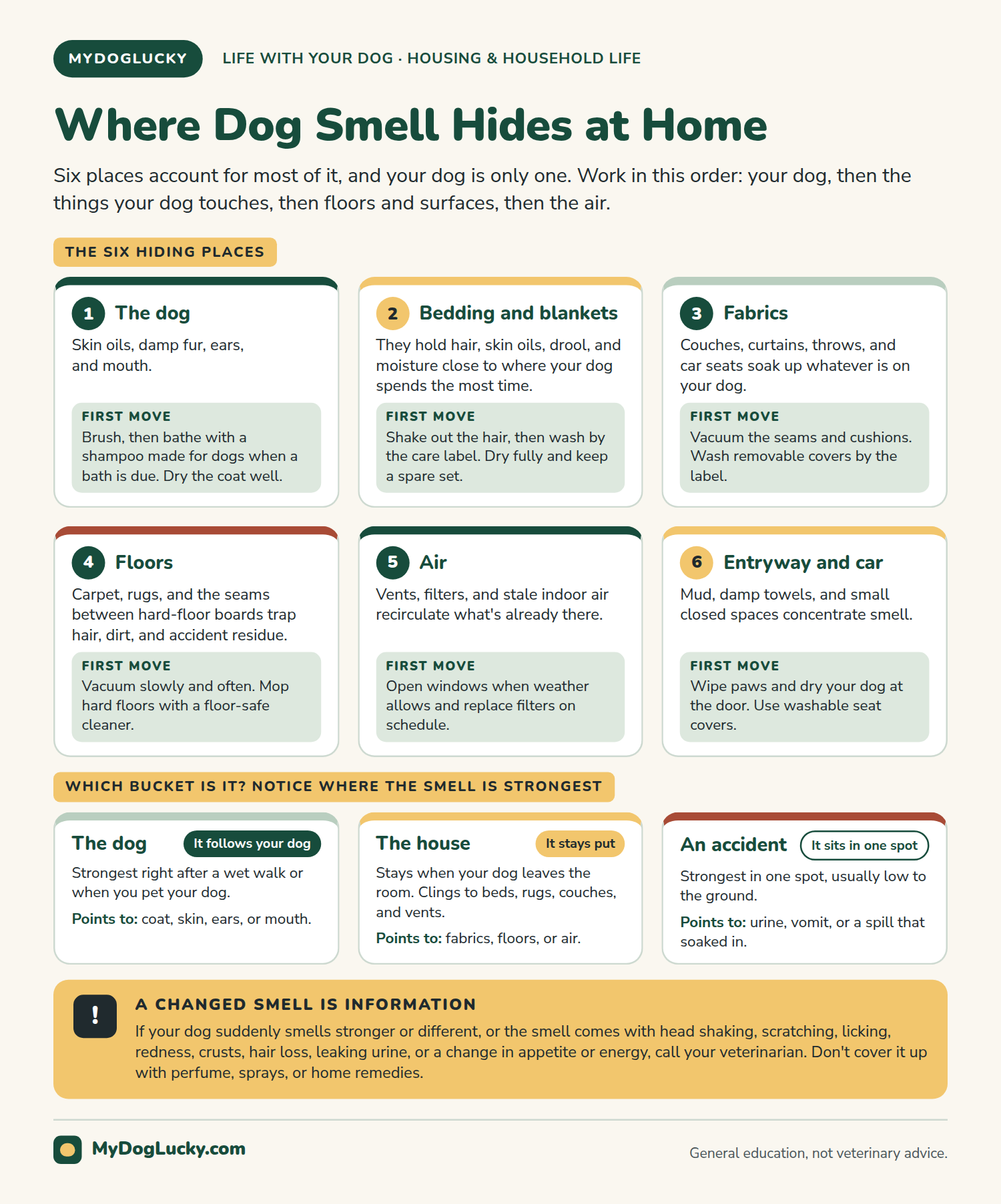
Notice that your dog is one source out of six. That’s why a bath alone often isn’t enough.
Start with your dog: brushing, bathing, and drying
Your dog’s coat is the source that follows you into every other room, so it makes sense to start there.
Brushing
Brushing pulls loose hair and debris out of the coat before they land on the couch. Many owners find a few minutes a day works better than a long session once a week. Pick a brush that suits your coat type, and ask your groomer or vet if you’re not sure which one that is. Go gently around sensitive spots, and stop if your dog seems uncomfortable.
Bathing
One AKC guide, updated in March 2026 and informed by two board-certified veterinary dermatologists, says it’s a good idea to bathe your dog monthly. Treat that as a starting point. Coat type, skin conditions, activity level, and your vet’s advice all change the answer. Our guide, how often should you bathe your dog, goes through the details.
Use a shampoo made for dogs. The same AKC guide notes that modern dog shampoos contain lipids and ceramides that can help protect the skin. If your dog has skin trouble, ask your vet about a medicated shampoo instead of guessing.
What to leave off your dog
The AKC guide advises against home remedies such as borax, hydrogen peroxide (especially in the ears), vinegar, bleach, and coal tar. It also says not to mask odors with fragrances or perfumes, because they can cause more skin irritation. If a smell needs masking, it needs investigating.
Drying and wet-dog smell
Wet-dog smell has a reputation, and it has earned it. Many owners notice the odor is strongest while the coat is damp. So dry your dog well after baths, swims, and rainy walks. Start with towels.
If you also use a dryer, keep the setting cool, keep it moving, and stop if your dog is uncomfortable. A groomer can show you a safe technique for your dog’s coat. Dense or double coats can stay damp underneath long after the surface feels dry, so feel down to the skin before you call it done.
Mud and paws
Paws bring in most of the outdoor smell. A towel or a shallow tub of lukewarm water by the door handles most days. Some owners let heavy mud dry and brush it off, while others rinse it right away. Either works, as long as the mud stays off your bed.
When a groomer helps
A professional groomer can handle thick coats, mats, and thorough drying. Ask what products they use. If your dog has sensitive skin, ask whether they can skip fragrance finishing sprays.
Washable fabrics: dog beds, blankets, crate pads, and covers
Fabric is where dog smell settles in and stays. It’s also the easiest thing to fix, because you can wash it.
The basic wash sequence
- Shake or vacuum off loose hair before the item goes in the machine. Do it outside or over a hard floor.
- Read the care label, and wash and dry the way it says. If there’s no label, look up the maker’s instructions.
- Wash dog fabrics on their own when you can, so hair doesn’t end up on the rest of the laundry.
- Dry the item fully. Damp fabric can turn musty, which swaps one smell for another.
- Put it back only when it’s completely dry.
| Item | What to check | Common trap |
|---|---|---|
| Dog bed with a removable cover | Wash the cover by the label, and check the inner pad | Washing the cover but never the inside |
| Crate pad and liner | Wash both layers and dry fully | Putting a damp pad back into a closed crate |
| Blankets and throws | Shake out hair, then wash by the label | Hair clogging the machine |
| Couch covers and slipcovers | Follow the care label | Shrinking from the wrong setting |
| Curtains | Wash or vacuum by the label | Forgetting the bottom edge where your dog rubs |
| Your own bedding | Wash on the same schedule if your dog sleeps on it | Clean dog bed, dog-scented sheets |
Two sets beat one
Keep a spare set of bedding. Swap them at wash time so your dog never has to sleep on a bare floor while the bed dries. It also means you can wash on a schedule instead of waiting for a free afternoon.
Crate pads and waterproof liners
Crate pads take a lot of nose, drool, and paw traffic. If your dog has accidents in the crate, check whether liquid soaked through to the layer below. Our crate training a puppy guide covers the training side. Here, the goal is simple: a dry, washable crate.
When to retire a bed
A bed that still smells after a proper wash may be past its useful life. Torn covers and exposed stuffing are also a good reason to replace it, because dogs can chew and swallow what comes loose.
Your own bed, the couch, and laundry scents
If your dog shares your bed or couch, wash your linens on the same schedule. A washable throw over the favorite spots is a cheap sacrificial layer. You wash the throw, not the sofa.
Laundry scents build up on fabrics too. If your dog has sensitive skin, ask your vet whether fragrance-free laundry products make sense for the fabrics your dog lies on.
Rugs, carpet, and upholstery
Every couch has a dog corner. You know where it is, and so does the smell.
Vacuum slowly, then often
Vacuuming does more than lift hair. It removes the dirt and skin flakes that carry smell. Go slowly, because fast passes miss what’s tucked into the fibers. Use a crevice or upholstery tool on sofa seams and cushion edges, and empty the canister or replace the bag before it’s full.
Deep-cleaning
When vacuuming isn’t enough, deep-clean by the manufacturer’s instructions. Test any cleaner in a hidden spot first. Ventilate the room, keep your dog out until the area is dry, and let the fabric dry fully, because damp carpet holds smell too.
Rental machines can work for a small area. For a whole room or a stubborn smell, a professional may do a more thorough job. We’ll cover when that’s worth it later.
When the smell is below the surface
Liquid can move below the top layer of carpet. If a smell keeps coming back after you treat the surface, the source may be deeper, in the padding or the floor underneath. That’s a good moment to ask a professional what they can do.
Upholstery
Check the cleaning tag on the furniture before you use any cleaner. Cushions with removable covers are easiest, so wash the covers by the label. Rotate cushions when you can, so one spot doesn’t take all the wear.
Hard floors, walls, and baseboards
Hard floors look clean faster than they are. Hair and dust collect along the edges and in the seams, and dog smell collects with them.
Floors
Vacuum or sweep first, so you’re not pushing wet hair around. Then mop with a cleaner meant for your floor type, and follow the label. Use one product at a time. If your floors are unsealed wood or natural stone, ask the manufacturer or installer what’s safe.
Baseboards, lower walls, and door frames
Dogs rub, shake, and lean. The lower part of your walls and door frames pick up oils and dirt. Wipe them with a damp cloth, and test any cleaner on a hidden spot first.
Windows and glass
Nose art on the patio door is a sign of a happy dog. It’s also a small source of smell. A quick wipe with a glass cleaner used as directed keeps it in check.
Urine, vomit, and other accidents
Accidents happen in every dog household: puppies, seniors, upset stomachs, thunderstorms. Fast, thorough cleanup helps. Scolding your dog afterward doesn’t.
The five-step cleanup
- Remove solids. Use paper towels or a bag. Wear gloves if you like.
- Blot the liquid. Press paper towels or a clean cloth into the spot and lift. Repeat with fresh ones. Don’t rub, which can spread the mess and push it deeper.
- Treat the spot. Use a cleaner made for pet accidents. Enzymatic (enzyme-based) cleaners are a product category designed for this. Read the label for the surfaces it suits, how much to use, and how long to leave it wet.
- Let it dry. Follow the label, and keep your dog away until it’s dry.
- Recheck. Sniff the spot the next day. Old or deep spots may need a second round.
Why covering it up fails
A scented spray puts a second smell on top of the first. The residue underneath is still there when the fragrance fades. Removing the source is the only route that lasts.
What to do on different surfaces
| Situation | First move | Watch out for |
|---|---|---|
| Fresh urine on carpet | Blot with fresh towels, then use a pet-accident cleaner | Rubbing, or soaking the area with water |
| Old, dried spot | Use a cleaner whose label covers set-in spots | Expecting one pass to be enough |
| Urine on a hard floor | Wipe up, clean with a floor-safe cleaner, and check the seams | Liquid running under baseboards |
| Urine on a couch or dog bed | Blot, treat by the fabric’s label, and dry fully | Soaked cushions that need professional attention |
| Vomit on fabric | Remove solids, blot, and treat by the label | Skipping a look at what came up. Note it for your vet if it repeats. |
| Diarrhea on any surface | Remove solids, blot, and treat by the label. Wash your hands afterward. | Repeated episodes are a reason to call your vet |
When accidents are a signal
A housetrained dog who starts having accidents is telling you something. Medical causes are possible, so call your veterinarian before you assume it’s a behavior problem. For puppies still learning, see our guide on how to potty train a puppy.
Repeated vomiting or diarrhea is a vet topic too. Our guides on why your dog is throwing up and dog diarrhea explain what to watch for.
Air, vents, filters, and airing out
The EPA’s guide to air cleaners (updated February 2026) makes one point clearly: filtration doesn’t replace controlling the source and ventilating. For how to get dog smell out of your house, that means air is the last step, not the first.
Fresh air first
Open windows on opposite sides of your home when weather and outdoor air allow. Even a short cross-breeze moves stale air out. Keep screens intact, and keep your dog away from open windows and balconies you can’t secure. Our living with a dog in an apartment guide covers window and balcony safety.
Furnace and air conditioner filters
The EPA says all filters need regular replacement, and that a dirty, overloaded filter won’t work well. It notes that manufacturers typically recommend replacing them every 60 to 90 days. A dog who sheds a lot may load a filter faster, so check it sooner rather than later. Confirm the size and type your system takes, and ask an HVAC technician if you’re unsure.
Vacuum the vent and register covers while you’re at it. Hair and dust collect there.
Portable air cleaners: an honest look
The evidence here is modest, and the EPA is candid about the limits. Most portable air cleaners and furnace filters can filter particles from the air. For gases and odors, the EPA suggests an air cleaner with an activated carbon filter or another filter designed for gases, and says these can be effective when the filter contains a large amount of material. It also says no air cleaner or filter will eliminate all of the pollutants in a home, and that most filters target either particles or gases, not both.
| Option | What it can do | Honest limits |
|---|---|---|
| Furnace or air conditioner filter | Filters particles from air passing through the system | Needs regular replacement. Doesn’t clean smell off surfaces. |
| Portable air cleaner for particles | Filters particles from the air in the room it sits in | Doesn’t eliminate all pollutants. Doesn’t replace cleaning and ventilation. |
| Air cleaner with an activated carbon filter | Designed for gases and odors. Can work when the filter holds a large amount of material. | Most filters handle particles or gases, not both |
| Ozone-producing devices | Marketed for odor removal | The EPA advises avoiding them. Ozone is a lung irritant. |
Skip the ozone gadgets
The EPA says to avoid portable air cleaners and furnace filters that intentionally produce ozone. It calls ozone a lung irritant and notes that no federal agency has approved these devices for use in occupied spaces. That includes a home where a dog and people breathe the same air.
So think of an air cleaner as a supporting player. It can help while you do the real work of washing, vacuuming, and airing out. It can’t stand in for them.
Bowls, toys, and everything else that goes in your dog’s mouth
Bowls
Wash food and water bowls daily with soap and water, or in the dishwasher if the bowl is dishwasher-safe. A slimy film inside is your cue that the wash is overdue. Rinse well so no soap remains. Replace bowls that are cracked or deeply scratched, since they’re harder to clean.
Toys
Wash toys on a regular schedule. Plush toys can go in the washing machine if the label allows, and hard toys can be scrubbed with soap and warm water. Rinse and dry everything well, because dogs put toys in their mouths and you don’t want leftover cleaner there. Throw out anything torn, crumbling, or coming apart.
Food storage
Follow the storage directions on the food package, and wash the storage container between bags. Wipe up crumbs and spills around the feeding area, too.
The entryway, the car, and the mud
Build a landing zone
The goal is simple: the smell stops at the door. Set up a small station with a towel, a mat, a hook for the leash, and dog-safe paw wipes. A boot tray catches muddy paw prints. Wash the towel weekly, and keep a spare so you always have a dry one.
The car
The car is where the wet-dog smell goes to retire. It’s small, closed, and often warm, so it holds smell well.
Use a washable seat cover or blanket, and wash it on the same schedule as your dog’s bedding. Vacuum the seats and floor mats. Wipe the hard surfaces. Air the car out with the windows open when you can.
Keep scents light in the car. The ASPCA notes that a dog’s sense of smell is superior to ours, so even a light scent may overwhelm. If the smell won’t budge, a professional auto cleaner may be able to help.
Cleaning safely around your dog: chemicals, scents, and diffusers
Anything you try for how to get dog smell out of your house has to pass one test first. Is it safe for a dog who lives at floor level, licks paws, and breathes the same air?
Never mix cleaning products
The CDC’s bleach guidance is direct. It says never to mix household bleach, or any disinfectants, with any other cleaners or disinfectants, because doing so can release vapors that may be very dangerous to breathe in. The page is about bleach, but the habit is worth keeping for every product in your cabinet. Use one product at a time, follow the label, and let the room air out between products.
The CDC also says to make sure you have good ventilation when you use bleach products indoors, for example by opening windows and doors. It adds that you should check the label to see whether you need gloves or eye protection.
Ventilate, and keep your dog out until it’s dry
Follow each product’s label for ventilation and drying time. As a cautious default, keep your dog in another room, or out of the house with a helper, until floors and fabrics are dry and the room has aired out. A dog can walk through a wet floor and lick it off their paws.
Store products out of reach
Put products away after each use, and close the containers. A cabinet your dog can nose open isn’t storage. Wipe up spills right away.
Fragrance, essential oils, and diffusers
The ASPCA’s article on essential oils and pets (published June 2022) is the clearest source we found. It says using an oil diffuser for a short time in a secured area your dog can’t get into isn’t likely to be an issue. It also says dogs with breathing problems should avoid diffuser exposure entirely, and that a dog’s superior sense of smell means even light scents may overwhelm.
Concentrated oils are the bigger worry. The ASPCA says 100 percent essential oils can be dangerous if a dog walks through them, gets them on the coat, or has them applied directly. If a dog swallows concentrated oil, you may see vomiting, diarrhea, and depression. The article also lists unsteadiness on the feet, depression, and, in severe cases, low body temperature as signs of poisoning.
It gives one example: concentrated tea tree oil (melaleuca oil) may cause problems for pets with only seven or eight drops. Its advice is to keep oils up and out of paws’ reach, and to make sure a diffuser can’t be knocked over.
What we couldn’t source
That ASPCA article doesn’t address candles, plug-in scents, sprays, or wax melts, and we didn’t find a source we could cite for them. For those, read the product label, ask your veterinarian, and keep them out of your dog’s reach. Skipping strong fragrance around a dog with breathing problems is a sensible extension of the diffuser advice.
Plants are the same story. The ASPCA keeps a searchable list of plants that are toxic and non-toxic to dogs. Check any plant against it before you bring it home to freshen a room.
Natural doesn’t mean safe
Essential oils come from plants, and the ASPCA still flags concentrated oils as a poisoning risk for dogs. “Natural” on a label tells you where something came from. It doesn’t tell you whether it’s safe for your dog.
If your dog may have been exposed to a cleaner, oil, or other product
- Move your dog away from the product and into fresh air.
- Call your veterinarian or the ASPCA Animal Poison Control Center at (888) 426-4435 right away, even if your dog seems fine. That’s the number the ASPCA article lists as of September 2026. Confirm it on aspca.org.
- Have the product label ready.
- Do not try to make your dog vomit unless a veterinary professional tells you to.
- Signs the ASPCA describes after essential oil exposure include unsteadiness, depression, vomiting, and diarrhea, and low body temperature in severe cases. Go to an emergency clinic if your vet or poison control tells you to.
A cleaning routine that fits real life
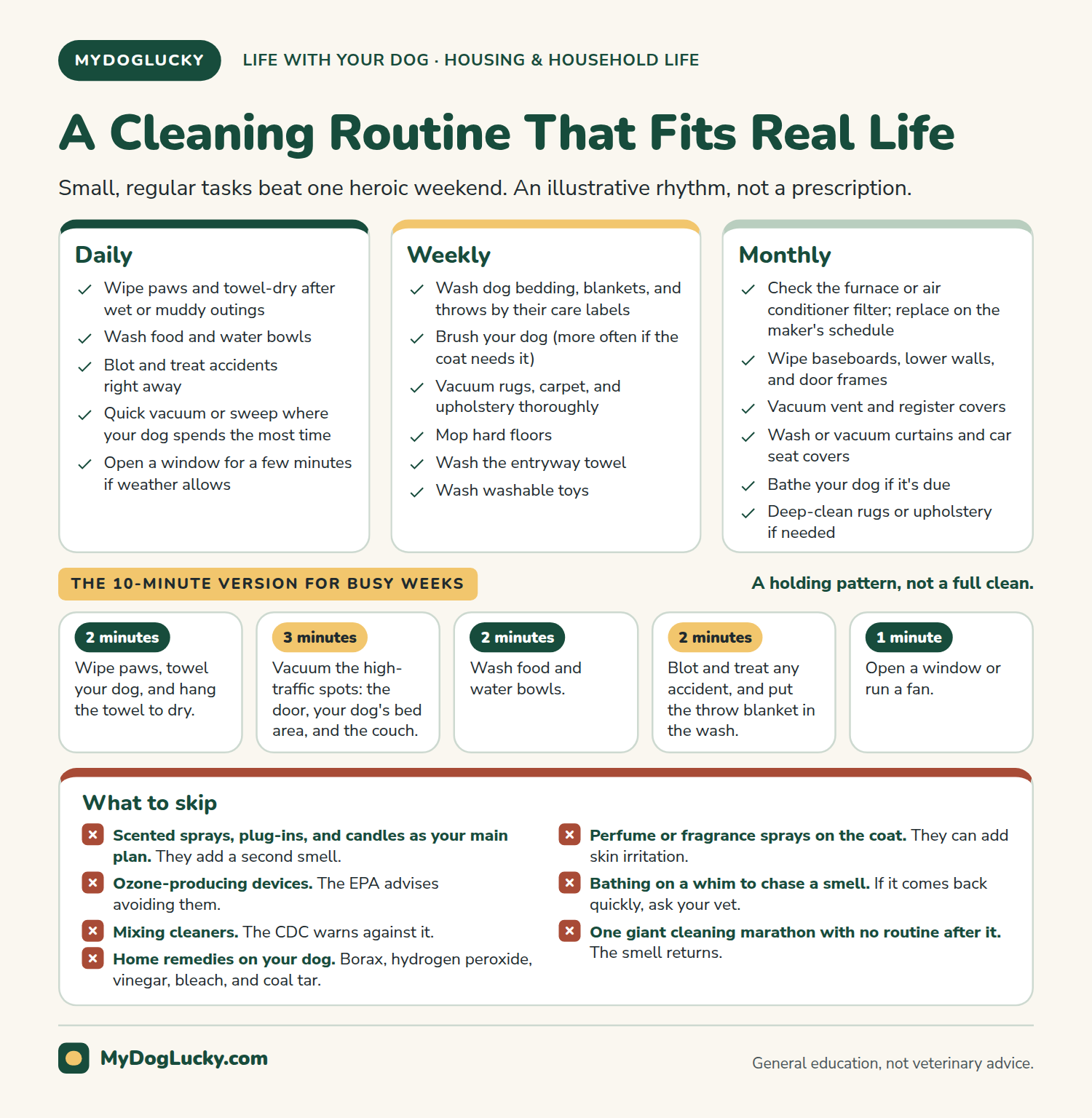
The routine that works for how to get dog smell out of your house is boring on purpose. Small, regular tasks beat one heroic weekend. The tables below are an illustrative rhythm, not a prescription. Shorten or stretch them to fit your dog, your coat type, your floors, and your energy.
Daily
| Task | Why it helps |
|---|---|
| Wipe paws and towel-dry after wet or muddy outings | Stops mud and damp-coat smell at the door |
| Wash food and water bowls | Prevents slimy film and food smell |
| Blot and treat accidents right away | Fresh liquid is easier to remove than dried residue |
| Quick vacuum or sweep where your dog spends the most time | Picks up hair before it works into fabric |
| Open a window for a few minutes if weather allows | Moves stale air out |
Weekly
| Task | Why it helps |
|---|---|
| Wash dog bedding, blankets, and throws by their care labels | Removes hair, skin oils, and drool |
| Brush your dog (more often if the coat needs it) | Lifts loose hair before it lands on the furniture |
| Vacuum rugs, carpet, and upholstery thoroughly | Reaches what the daily pass misses |
| Mop hard floors | Cleans edges and seams |
| Wash the entryway towel | Damp towels hold smell |
| Wash washable toys | Toys get chewed, wet, and dropped on the floor |
Monthly
| Task | Why it helps |
|---|---|
| Check the furnace or air conditioner filter and replace it on the maker’s schedule | The EPA says a dirty, overloaded filter won’t work well |
| Wipe baseboards, lower walls, and door frames | That’s where dogs rub and lean |
| Vacuum vent and register covers | Hair and dust collect there |
| Wash or vacuum curtains and car seat covers | Fabrics that miss the weekly round |
| Bathe your dog if it’s due | Removes oils and dirt at the source. The AKC guide calls monthly a good starting point. |
| Deep-clean rugs or upholstery if needed | Only when vacuuming stops being enough |
The 10-minute version
Some weeks you get ten minutes and a dog who needs a walk. This is the version for those weeks.
- Two minutes: wipe paws, towel your dog, and hang the towel to dry.
- Three minutes: vacuum the high-traffic spots: the door, your dog’s bed area, and the couch.
- Two minutes: wash food and water bowls.
- Two minutes: blot and treat any accident, and put the throw blanket in the wash.
- One minute: open a window or run a fan.
That isn’t a full clean. It’s a holding pattern that keeps a busy week from turning into a smelly one.
What to skip
- Scented sprays, plug-ins, and candles as your main plan. They add a second smell without removing the first. The ASPCA also notes that even light scents can overwhelm a dog.
- Ozone-producing devices. The EPA advises avoiding them.
- Mixing cleaners. The CDC warns against it.
- Home remedies on your dog. The AKC guide advises against borax, hydrogen peroxide, vinegar, bleach, and coal tar.
- Perfume or fragrance sprays on the coat. They can add skin irritation.
- Bathing on a whim to chase a smell. If the smell comes back quickly, ask your vet.
- One giant cleaning marathon with no routine after it. The smell returns.
A weekend reset when the smell has gotten ahead of you
Sometimes the routine slips and the smell wins. If you want to know how to get dog smell out of your house in one focused weekend, this is the order to work in. It won’t hold without a routine afterward, so plan to start one the week after.
This plan is illustrative. Adjust it to your home. Arrange for your dog to be out with a helper, or in a closed-off room with a comfortable bed, while you use cleaners and while floors are wet.
- Saturday morning: Strip and wash every washable fabric: beds, blankets, covers, and towels. Start the first load, then keep them rolling.
- Saturday midday: Brush your dog, and bathe if it’s due. A clean coat doesn’t re-dirty the clean bedding.
- Saturday afternoon: Vacuum everything, floors and sofa included. Then treat known accident spots by the cleaner’s label.
- Sunday morning: Mop hard floors, wipe baseboards and lower walls, and replace the furnace filter if it’s due.
- Sunday afternoon: Deep-clean rugs or upholstery by the maker’s directions if you need to. Open windows, and let everything dry.
- Sunday evening: Put clean bedding back only when it’s dry. Do a nose check, and write down what still smells.
If a smell survives the reset, you’ve learned something. It may be a deeper source, a health signal, or a job for a professional. Any of those beats a fourth bottle of spray.
When the smell is a health signal, not a housekeeping problem
Cleaning is only half of how to get dog smell out of your house. The other half is knowing when the smell isn’t really about the house.
The AKC guide, informed by two board-certified veterinary dermatologists, says secondary yeast or bacterial infections on the skin or inside the ears remain the most common medical reasons dogs have an unpleasant smell. It adds that allergies often start the process, because scratching and licking can open the door to infections.
Cleaning your home won’t fix any of that, and masking it delays care. The key word is change. A dog who has always had a mild dog smell isn’t the concern. A stronger or different smell than usual is worth a call.
What to watch for
The AKC guide lists these signs as reasons to see a veterinarian:
- Head shaking, licking, or rubbing the body or head on furniture, people, or walls
- Skin changes, including red to black discoloration or hair loss
- A smell that gets worse over time
- Crusting and redness on the skin, or bright red ears
Vets also commonly ask about other changes. Mention them if you notice them: leaking urine, a change in breath, or a change in appetite, energy, or drinking.
Broad categories a vet may look at
This table doesn’t diagnose your dog. It shows the kinds of places a vet may look when a smell seems to come from your dog.
| Where the smell seems to come from | Broad category a vet may look at | What to do |
|---|---|---|
| The ears | Ear problems (see our dog ear infection guide) | Call your vet. Don’t put anything in the ears unless your vet says to. |
| The skin and coat | Skin problems, sometimes tied to allergies (see why is my dog itching) | Call your vet |
| The mouth | Dental and mouth problems (see dog dental disease) | Call your vet |
| The rear end | Problems with the anal sacs or the area around them | Call your vet |
| Urine on the fur or bedding, or leaking while resting | Urinary or continence problems | Call your vet |
| The whole dog, with other changes | General illness | Call your vet the same day |
What a vet may do
A vet may look at your dog’s skin, ears, mouth, and rear end, ask how long you’ve noticed the smell, and sometimes take samples or run tests. Bring notes. Your three-day nose log helps. Add when the smell started, where it’s strongest, what you’ve been washing with, and any itching, licking, or diet changes.
What not to do
- Don’t mask the smell with perfume, sprays, or fragranced products.
- Don’t use the home remedies the AKC guide advises against: borax, hydrogen peroxide, vinegar, bleach, and coal tar.
- Don’t use human medicated products or leftover pet medication unless your vet tells you to.
- Don’t keep bathing more often to fight the smell. Ask your vet.
- Don’t wait it out if your dog seems unwell.
Call your vet today, or go to an emergency clinic, if the smell comes with
- Trouble breathing or collapse
- A swollen or very painful area
- Bleeding or discharge
- Repeated vomiting
- Refusing food or water
If your dog seems suddenly much worse, don’t wait for regular office hours.
Allergies, asthma, and the other people in your home
If someone in your home has allergies or asthma, their own doctor should guide the plan. We can describe the cleaning. We can’t say what will help a particular person, and we didn’t find a source that supports a promise.
Questions to bring to their doctor
- Should the dog stay out of certain rooms, and does that actually help this person?
- Should this person be out of the room while you vacuum, dust, or use cleaning products?
- Are scented or strongly fragranced products a concern for this person?
- Would a filter or air cleaner be worth trying, and what should it be rated for?
What we can say about air
The EPA says most portable air cleaners and furnace filters can filter particles from the air, and that some can filter the small particles of greatest health concern. It also says filtration doesn’t replace controlling pollutants and ventilating. So washing, vacuuming, and fresh air stay on the list, with or without a filter.
Low-scent is a reasonable default
Strong scents and cleaning fumes may bother some people with breathing conditions. Ventilating and picking low-scent routines costs little. That’s also consistent with the ASPCA’s advice for dogs with breathing problems, who should avoid diffuser exposure.
Renters, apartments, and small spaces
In a smaller home, smell has fewer places to spread out, so it tends to get noticed sooner. Our living with a dog in an apartment guide covers noise, neighbors, and lease questions. Here are the smell-specific tips.
- Use washable layers. A washable runner rug or furniture throw protects surfaces you can’t replace.
- Take move-in photos. Record the condition of carpet and floors before your dog settles in.
- Keep the filter fresh, and ventilate where the lease allows. A portable air cleaner fits a small room well.
- Check your lease before hiring anyone. Cleaning and deposit rules vary by lease and locality. This guide isn’t legal advice.
- Plan a reset before move-out. The weekend reset earlier in this guide works well for that.
When to call a professional cleaner
You can handle most of how to get dog smell out of your house yourself. A professional makes sense in a few situations.
- The same spot keeps smelling after you’ve treated it properly.
- Urine has likely soaked through carpet into the padding or flooring.
- A rug or upholstery piece is too large or delicate for you to clean safely.
- The whole house smells even with clean fabrics and floors. That may be a moisture or heating and cooling system problem, so an HVAC or moisture professional may fit better than a carpet cleaner.
- You’re preparing for a move-out or a sale.
A groomer or your vet, not a cleaner, is who to call about the dog’s own smell.
Questions to ask before you book
- What methods and products do you use?
- Are they safe around dogs, and how long should my dog stay away?
- How long will the area take to dry?
- Can you treat the padding underneath, not only the surface?
- What happens if the smell returns?
- Can I have the estimate in writing?
Be cautious of any promise that sounds absolute. Good providers explain what they can and can’t do.
Common mistakes when you’re fighting dog smell
Masking instead of removing
The most common mistake in how to get dog smell out of your house is adding fragrance to it. Scent on top of a source is two smells, and the ASPCA notes that even light scents may overwhelm a dog.
Cleaning everything except the source
Mopping the floor while the dog bed sits untouched is a classic. Use the three-day nose log to find the source before you clean.
Mixing products
The CDC says never to mix household bleach or any disinfectants with other cleaners or disinfectants. Use one product at a time.
Putting damp fabric back
Damp bedding and towels can turn musty. Dry everything fully before it goes back.
Bathing more and more to chase a smell
If a smell returns soon after a bath, the coat may not be the whole story. Ask your vet before you bathe more often.
Treating a medical smell like a laundry problem
A new, strong, or different smell from your dog’s ears, skin, mouth, or rear end needs a vet, not another wash cycle.
Forgetting the filter
A dirty furnace filter works poorly, according to the EPA. Put a date on the calendar.
One heroic weekend, then nothing
A reset helps, but a small routine holds the result. Even the 10-minute version beats waiting until the smell returns.
Common questions about dog smell
How to get dog smell out of your house quickly before guests arrive?
Open windows, wash or cover the bed and throws, vacuum the main rooms and the sofa, and wipe the entryway and baseboards by the door. Wash the bowls and empty the trash. Skip heavy fragrance, which can bother guests and your dog. A short reset isn’t a substitute for the routine.
Why does my dog smell even right after a bath?
A damp coat, dirty bedding, or a health issue could each be the reason. Dry your dog well, wash the bed, and check the ears and skin for redness or discharge. If the smell is strong or returns quickly, ask your vet.
Does baking soda work?
Many owners sprinkle it on dry carpet and vacuum it up later. We didn’t find a reliable source showing how much it helps, so treat it as optional. Keep your dog out of the room until it’s vacuumed up.
Are air purifiers worth it?
They can help with airborne particles, and some carbon-filter models are designed for gases and odors. The EPA is clear that no air cleaner eliminates all pollutants and that filtration doesn’t replace source control and ventilation. So consider it a modest add-on.
Is it safe to use a diffuser around my dog?
The ASPCA says using a diffuser for a short time in a secured area your dog can’t access isn’t likely to be an issue. It says dogs with breathing problems should avoid diffuser exposure, and that concentrated oils are dangerous if a dog gets them on the coat or swallows them. Ask your vet if you’re unsure.
Can I clean with vinegar?
The AKC advises against vinegar as a home remedy on your dog. For surfaces, follow the surface’s care instructions. And remember the CDC’s advice never to mix bleach or disinfectants with other cleaners, which includes vinegar.
How often should I wash my dog’s bed?
We didn’t find a source-backed number. The routine above suggests weekly as an illustrative default. Wash it sooner after an accident, an illness, or a muddy week.
How do I get dog smell out of a couch?
Vacuum the seams and cushions, wash removable covers by the label, and check the furniture’s cleaning tag before using any cleaner. Test in a hidden spot. If the smell is deep in the cushions, a professional may help.
Why does my house still smell like dog when I clean?
Common reasons include a source you haven’t found, damp fabrics, a dirty filter, or smell in the padding under carpet. The three-day nose log helps. If the smell is on your dog, read the health section.
Does a strong smell mean my dog is unhealthy?
Not necessarily. But according to the AKC guide, skin and ear infections are the most common medical reasons dogs smell unpleasant. A sudden change or a worsening smell is worth a call to your vet.
Is wet-dog smell normal?
Many dogs smell stronger when wet. A strong smell that lingers after your dog is fully dry, or that comes with itching or redness, deserves a vet’s look.
Should I keep my dog out of some rooms?
A gate or closed door can limit hair and smell to one area. Make sure your dog still has comfortable company and a bed. If allergies are the reason, ask the affected person’s doctor whether it helps.
What about my dog’s breath?
A change in breath can be a signal, not a cleaning problem. Our dog dental disease guide explains what vets look at. Call your vet if the breath changes.
Do groomers help?
Often, yes. A groomer can handle thick coats, mats, and full-body drying. Ask what products they use, and mention any skin trouble.
So here’s how to get dog smell out of your house without turning every weekend into a cleaning marathon: find the source, wash what you can, keep the air moving, and keep the routine small. And if your dog’s own smell ever changes, call your vet before you buy another cleaner.
Sources
- CDC. Cleaning and Disinfecting with Bleach (Water, Sanitation, and Environmentally Related Hygiene). Last reviewed April 24, 2024. Accessed September 2026. Used for the never-mix guidance and ventilation.
- U.S. Environmental Protection Agency. Guide to Air Cleaners in the Home. Last updated February 17, 2026. Accessed September 2026. Used for filters, carbon filters, ozone, and the limits of air cleaning.
- ASPCA. The Essentials of Essential Oils Around Pets. Published June 23, 2022. Accessed September 2026. Used for diffuser and essential oil cautions and the poison control number.
- American Kennel Club. Why Does My Dog Smell? How to Help a Stinky Dog. Roxanne Hawn, with input from Ashley Bourgeois, DVM, DACVD, and Jackie Campbell, DVM, DACVD. Updated March 12, 2026. Accessed September 2026. Used for medical causes of dog odor, warning signs, bathing, and home remedies to avoid.
This article is general education for U.S. dog owners. It is not individualized veterinary, medical, or legal advice. Ask your veterinarian about any change in your dog’s smell, skin, ears, mouth, or bathroom habits, and ask your own doctor about allergies or asthma in your home. Always follow the label on any cleaning product. Call your veterinarian or the ASPCA Animal Poison Control Center right away if your dog may have swallowed or been exposed to a cleaner, oil, or other product.