A dog ear infection is one of the most common reasons dogs end up at the vet, and the classic signs are hard to miss once you know them: head shaking, scratching at one ear, a sour or yeasty smell, dark or yellowish discharge, and a dog who flinches when you touch the ear flap.
Most are infections of the outer ear canal, and most respond well to treatment. The catch is that the right treatment depends on two things you cannot see from the outside — what’s actually growing in the ear, and whether the eardrum is intact. That’s why an ear infection needs a veterinary exam rather than a guess, a leftover bottle of drops, or a home remedy.
This guide walks through the red flags that suggest an infection has moved deeper than the outer ear, the three types in plain language, the signs you can check at home, why ear infections start in the first place, what a vet actually does during the visit, how treatment usually works, how to care for your dog’s ears afterward, and the questions worth asking when infections keep coming back.
One scope note. If your dog is holding his head tilted to one side, stumbling, or walking in circles, skip straight to the red-flag panel below. Those signs change the urgency. For everyone else — the dog who’s been shaking his head for two days and smells faintly like a bakery gone wrong — read in order. The sections build on each other.
What’s in this guide
- Ear infection red flags: when it’s more than an outer-ear problem
- The three types of ear infection in plain language
- Dog ear infection signs you can check at home
- Why ear infections happen: the underlying causes
- What a vet does at an ear-infection visit
- Treatment: what the plan usually looks like
- Ongoing ear care at home
- Recurrent ear infections: the questions to ask
- Cost and time realities
- Monitor, call today, or go now: the clear breakdown
- Common mistakes and misunderstandings
- Frequently asked questions about dog ear infections
- Sources
Ear Infection Red Flags: When It’s More Than an Outer-Ear Problem
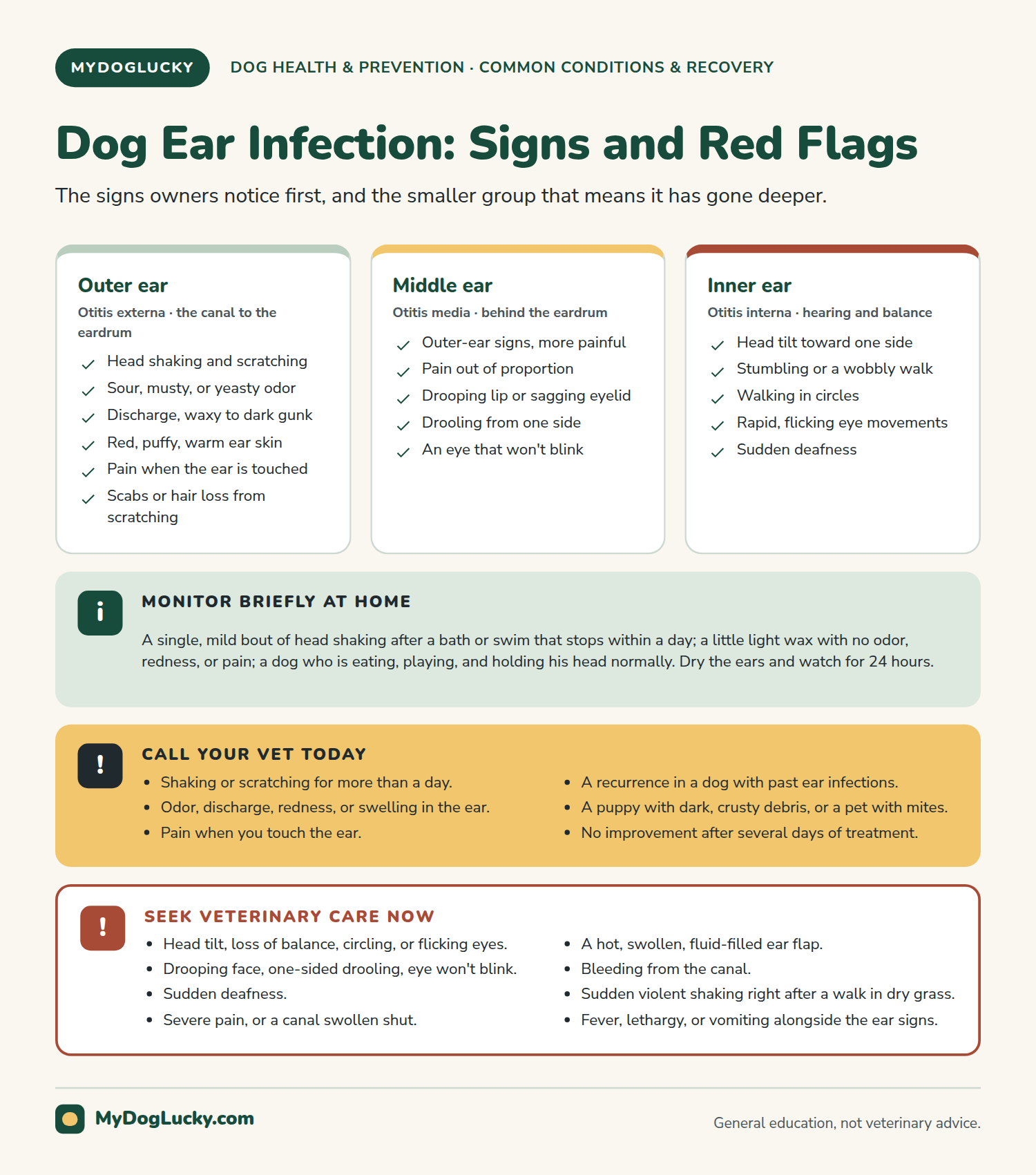
Most ear infections stay in the outer canal, where they’re painful and smelly but not dangerous. A smaller number spread through the eardrum into the middle ear, and a smaller number still reach the inner ear, where the organs of balance and hearing live. The Merck Veterinary Manual notes that more than half of dogs with recurrent outer-ear inflammation also have a middle-ear infection, so this isn’t a rare complication in dogs who’ve had ear trouble before. The signs below are the ones that suggest the infection has gone deeper, or that something else entirely is going on.
Seek veterinary care right away if you see:
- A head tilt — your dog holds his head cocked to one side and can’t seem to straighten it.
- Loss of balance — stumbling, leaning, falling to one side, or a wobbly, drunken-looking walk.
- Walking in circles, usually toward the same side.
- A drooping face — one side of the lip or eyelid sagging, drooling from one corner, or an eye that won’t blink.
- Rapid, flicking eye movements that your dog can’t control.
- Sudden deafness — a dog who stops responding to his name, the food bowl, or the door.
- Severe pain — crying out, snapping when you approach his head, or refusing food because chewing hurts.
- Swelling that has closed the ear canal, or a hot, puffy, fluid-filled ear flap.
- Bleeding from the ear canal.
- Fever, lethargy, or vomiting alongside the ear signs.
- Sudden, violent head shaking that started right after a walk through dry grass or brush — a foreign body may be lodged in the canal.
Any single sign on this list is reason enough to call. You don’t need several of them stacked together before it counts.
Why a Head Tilt or Wobbly Walk Changes the Urgency
The inner ear does two jobs: it hears, and it tells the brain which way is up. When infection reaches it, the balance system misfires. The Merck Veterinary Manual describes the result as a “head tilt toward the affected side,” severe coordination problems, difficulty rising and walking, and uncontrollable eye movements. Deafness is possible. So is spread toward the brain if the infection is left alone.
A middle-ear infection can also press on the facial nerve, which runs right past the middle ear on its way to the muscles of the face. That’s why a drooping lip, a sagging eyelid, or an eye that won’t blink belongs on the go-now list even though it doesn’t look like an “ear” problem at all. None of these signs prove the ear is the cause — several other conditions produce the same picture — but they all need an exam today, not a wait-and-see week.
Sudden Violent Head Shaking After a Walk
A dog who was fine at breakfast and is now shaking his head so hard his ears slap, pawing at one side, and holding his head low is telling you something got in there. Grass awns — the barbed seed heads often called foxtails — are the classic culprit in dry regions, but a tick, a burr, or an insect can do the same thing. Cornell’s Riney Canine Health Center lists insects, ticks, foxtails, and plant material among the foreign bodies that lodge in the canal.
Don’t go digging. The dog’s ear canal bends at a sharp angle, and anything you push deeper can end up against the eardrum. A vet can look with an otoscope, sedate a painful dog if needed, and remove the object with the right tools. The sooner that happens, the less damage the object does on its way in.
When Pain Alone Is the Red Flag
Some dogs with a bad outer-ear infection are in enough pain that they won’t let anyone near their head. They cry when the ear flap moves, guard the side of their face, or stop eating because the jaw movement hurts. That level of pain isn’t something to manage at home for a few days to see whether it improves. It usually means the canal is severely inflamed, possibly swollen shut, and the vet will likely need sedation to examine and clean it. Call the same day.
The Three Types of Ear Infection in Plain Language
Vets sort ear infections by depth, and the names come straight from Latin: otitis externa (outer ear), otitis media (middle ear), and otitis interna (inner ear). “Otitis” just means inflammation of the ear. The depth matters because it changes the signs, the diagnostic steps, the treatment, and how long everything takes.
A Quick Tour of the Dog’s Ear
A dog’s ear canal is shaped like the letter L. It runs down from the ear opening, turns a sharp corner, then runs horizontally inward to the eardrum. That design keeps most owner-applied cleaner well away from the eardrum, which is reassuring. It also means moisture, wax, and debris settle at the bottom of the vertical section and don’t drain easily, which is part of why dogs get so many more ear infections than people do.
Behind the eardrum sits the middle ear, a small air-filled chamber inside the skull. Deeper still is the inner ear, where hearing and balance are processed. Infection usually starts in the outer canal and works inward, though a foreign body can rupture the eardrum and skip a step.
Otitis Externa: The Outer Ear Canal
This is the ear infection almost every owner is picturing. VCA Animal Hospitals calls it “one of the most common infections in dogs,” and the Merck Veterinary Manual describes it as inflammation of the lining of the ear canal, the tube that carries sound to the eardrum. Signs are the familiar ones: head shaking, scratching, odor, discharge, redness, and pain. It can involve one ear or both, and it can be a sudden one-off or a long-running problem.
Otitis Media: Behind the Eardrum
Otitis media is inflammation of the middle ear. According to Merck, it usually develops when an outer-ear infection spreads through the eardrum, or when a foreign object punctures it. The signs overlap heavily with an outer-ear infection — head shaking, scratching, rubbing the ear on the floor, turning the head toward the sore side — which is exactly why it’s easy to miss. The added clues are pain that seems out of proportion, and the facial-nerve signs covered above.
Otitis Interna: The Inner Ear
Otitis interna is the deepest and least common of the three, and it usually follows an untreated or poorly controlled middle-ear infection. This is the one that produces the head tilt, the loss of balance, the circling, and the flicking eye movements. Merck notes that early treatment improves the outcome, but some nerve-related problems can be permanent when treatment starts late. That’s the plain reason this article puts red flags before everything else.
| Type | Where it is | Typical signs | How a vet usually confirms it |
|---|---|---|---|
| Otitis externa | Outer ear canal, from the opening to the eardrum | Head shaking, scratching, odor, discharge, redness, pain when the ear is touched | Otoscope exam plus cytology of the discharge |
| Otitis media | Middle ear, behind the eardrum | Same as above, often more painful; possible drooping face, drooling, an eye that won’t blink | Otoscope exam of the eardrum, often imaging (x-rays, CT, or MRI), sometimes sampling fluid from the middle ear |
| Otitis interna | Inner ear, where hearing and balance live | Head tilt, stumbling, circling, flicking eye movements, deafness | Neurological exam plus imaging; sometimes referral to a specialist |
Dog Ear Infection Signs You Can Check at Home
You can’t diagnose the infection from the couch, but you can be an accurate observer, and that matters more than most owners realize. The details you notice help your vet decide how urgently to see your dog and what to look for first. Here’s what a dog ear infection tends to look like, sign by sign.
Head Shaking and Scratching
This is usually the first thing you notice. A dog with an itchy or painful ear shakes his head, scratches at the ear with a back foot, rubs the side of his face along the carpet or the sofa, or tilts his head slightly toward the sore side while he’s otherwise acting normal. Some dogs cry or grumble when they scratch. VCA notes that head shaking and scratching are the typical first signs, and that they come from pain and discomfort, not habit. A dog who shakes his head once after a bath is normal. A dog who does it ten times an hour is not.
Odor
Healthy dog ears smell like, well, dog. An infected ear has a distinct smell that owners describe in surprisingly consistent ways: sour, musty, sweet-yeasty, or frankly foul. Odor is one of the more reliable early clues because it often shows up before visible discharge. If you catch a whiff when your dog leans in for a scratch, lift the ear flap and take a look.
Discharge and What the Color Suggests
Discharge ranges from a light waxy film to thick, dark gunk. Owners often want to know what the color means, and the honest answer is “something, but not enough.” Dark brown, coffee-ground-looking debris is a classic description for ear mites, according to Cornell, and it’s also common with yeast overgrowth. Creamy, yellow, or greenish discharge leans bacterial. The American College of Veterinary Surgeons notes that a white discharge often points to bacterial infection.
The problem is that color alone can’t tell you which organism is involved, whether more than one is present, or whether the eardrum is intact. Only a microscope can. So note the color, take a photo in good light, and let the vet’s cytology do the actual identifying.
Redness, Swelling, and Heat
Lift the ear flap and look at the skin on the inside and at the canal opening. Healthy tissue is pale pink. An infected ear is often bright red, puffy, and warm to the touch. In a long-standing infection, the canal opening can look thickened, bumpy, or narrowed, and the skin can turn dark and leathery. VCA describes chronic cases as having a “crusty or thickened appearance with narrowed ear canals.” Those changes are worth mentioning specifically, because they tell your vet the problem has been going on longer than the current flare.
Pain When the Ear Is Touched
Gently touch the base of your dog’s ear where it meets the skull. A dog with a painful ear pulls away, flinches, yelps, or tenses. Some dogs lean into the touch and groan because it also itches, which is confusing but still counts. Pain that stops you from lifting the ear flap at all is a same-day call.
Crusting, Scabs, and Hair Loss
Scratching does damage. Look for scabs on the ear flap, raw patches behind the ear, thinning hair around the base, or scaly skin on the inside of the flap. Merck lists scaly skin among the signs of an outer-ear infection. These are secondary signs — the dog caused them by scratching — but they help your vet gauge how uncomfortable he’s been.
A Swollen, Squishy Ear Flap
Violent head shaking can rupture a blood vessel inside the ear flap. Blood pools between the layers of the flap, and the ear turns into a thick, warm, fluid-filled pillow that your dog holds oddly. VCA calls this an aural hematoma and describes the flap as “very thick and spongy.” It’s painful, it doesn’t drain on its own in a helpful way, and if it’s left untreated the flap can scar into a permanently crumpled “cauliflower ear.” A hematoma needs a vet visit, and the infection that caused the shaking needs treating at the same time.
One Ear or Both?
Make a note of whether the signs are in one ear or both. Both ears at once often points toward a whole-body driver like allergies. One ear, especially the same ear over and over, raises the odds of something local — a foreign body, a polyp, a mass, or chronic damage to that canal. Merck specifically lists one-sided or chronic cases as reasons a vet may go further with testing. Your vet will want to know, so keep track.
What to record before you call
- Which ear, or both, and when you first noticed it.
- The main sign: shaking, scratching, odor, discharge, pain, or a combination.
- Discharge color and amount, plus a photo in daylight if your dog will tolerate it.
- Whether your dog swims, was bathed recently, or walked through tall dry grass.
- Any previous ear infections, and what was used last time.
- Other itch: paws, belly, armpits, face rubbing, or recurring skin problems.
- Any of the red flags above — head tilt, balance loss, facial droop, severe pain.
That’s a two-minute note on your phone, and it turns “his ear is bothering him” into something a vet can act on.
Why Ear Infections Happen: The Underlying Causes
Here’s the idea that changes how you think about ear infections: bacteria and yeast are usually the second problem, not the first. The Morris Animal Foundation puts it plainly: “Almost all ear infections are secondary to inflammation in the outer ear — not the other way around.” Something irritates or inflames the canal, the environment inside changes, and the normal residents of the ear — yeast and bacteria that live there harmlessly most of the time — overgrow.
Veterinary dermatologists organize this with a framework the Merck Veterinary Manual describes in detail. In plain terms: something starts the inflammation (a primary cause), something makes the ear easier to infect (a predisposing factor), the infection itself is the secondary problem, and chronic changes in the canal keep it going (perpetuating factors). If treatment only addresses the second layer, the infection comes back. That’s the whole logic behind everything in the recurrence section later.
Allergies: The Most Common Recurring Driver
When a veterinarian at Cornell’s Riney Canine Health Center was asked what causes most itchy ears, her answer was, “Allergies. Allergies. Allergies!” Her explanation: most dogs scratch their ears because there’s a little allergic inflammation first, and then infection develops as a secondary problem. VCA reports that allergies are involved in roughly 43 percent of ear infection cases, particularly chronic or recurrent ones, and that ear infections occur in a large majority of dogs with food allergies.
The allergies in question are usually environmental (pollens, dust mites, molds) or food-related, and the ears are often the first or only place the allergy shows. A dog with allergic ears may or may not have itchy paws, a red belly, or recurring skin infections elsewhere. If ear infections keep returning, especially in both ears, allergy moves to the top of the list of things to discuss.
Moisture: Swimming, Bathing, and Humid Weather
Water that gets into the canal and stays there softens the skin and creates the warm, damp conditions that yeast and bacteria love. Cornell flags this specifically for drop-eared breeds, and the AKC lists moisture exposure as a primary cause. The dogs who show up with an ear infection a few days after every lake trip aren’t unlucky. Their ears simply aren’t drying out. The good news is that this one is among the most manageable causes, and the ear-care section below covers how.
Ear Conformation: Floppy Ears, Narrow Canals, Heavy Hair
Ear shape doesn’t cause infection on its own, but it stacks the deck. Heavy, pendulous ear flaps trap heat and moisture and reduce airflow. Narrow canals, common in some small and wrinkled breeds, clog more easily. Thick hair growing inside the canal holds debris and moisture. VCA names breeds with large, floppy, or hairy ears as particularly susceptible, and the Morris Animal Foundation summarizes research showing higher risk with pendulous ear carriage. Any dog can get an ear infection, but these dogs need a more deliberate care routine.
Foreign Bodies: Grass Awns, Seeds, Ticks, and Insects
A foreign body irritates the canal, damages the skin, and can puncture the eardrum, and infection follows. This cause tends to be one-sided and sudden. If your dog was fine yesterday and is frantic today, particularly after time in dry grass, brush, or a field, tell your vet that history up front. It changes what they look for and how quickly they look.
Ear Mites: Mostly a Puppy Problem
Ear mites are tiny parasites that live in the canal and feed on skin debris. VCA describes infestations as “a common problem in puppies and kittens” and notes that mites are highly contagious between animals through direct contact. The classic signs are intense scratching and dark, crusty, coffee-ground debris. Mites are far less common in adult dogs than owners assume; many “mite” cases in adults turn out to be yeast. A vet can tell the difference under the microscope in a couple of minutes, which matters because the treatments are different. If your puppy has mites, other pets in the house may need checking too.
Endocrine Disease in Older Dogs
Hormonal conditions, especially an underactive thyroid, change the skin and its defenses. VCA lists hypothyroidism as a trigger for repeated infections, and the American College of Veterinary Surgeons includes thyroid testing among the workup steps for chronic cases. A middle-aged or senior dog whose ear infections started recently, alongside weight gain, a thinning coat, or lower energy, is worth a blood panel. Treating the ear without treating the hormone problem tends to be a losing game.
Polyps, Masses, and Other Growths
These are uncommon, but they’re the reason a persistent one-sided infection in an older dog deserves a closer look rather than a fourth round of the same drops. A growth in the canal blocks drainage, traps debris, and causes infection behind it. The ACVS notes that tumors become a more likely cause in older animals. Sometimes a vet sees the growth on a routine otoscope exam; sometimes it takes sedation, imaging, or a biopsy.
Irritation From Over-Cleaning or the Wrong Products
This one surprises people. The AKC lists excessive ear cleaning among the causes of ear infection, and VCA warns that “over-cleaning may cause irritation in the ear canal, which can lead to infection.” Harsh products do the same thing. Alcohol, hydrogen peroxide, diluted vinegar, and powders all appear on the do-not-use lists from Cornell, VCA, and Merck. An ear that’s cleaned too often or with the wrong thing is an ear with damaged skin, and damaged skin is where infection starts.
| Underlying cause | Who it tends to affect | Clues to mention | What a vet may check |
|---|---|---|---|
| Allergies (environmental or food) | Any age; often starts in young adulthood | Both ears, repeated flares, seasonal pattern, itchy paws or skin | Skin exam, allergy history, elimination diet trial, allergy testing |
| Moisture | Swimmers, frequently bathed dogs, floppy-eared dogs in humid climates | Flare a few days after water exposure | History; drying and cleaning routine |
| Ear conformation | Heavy-flapped, narrow-canaled, or hairy-eared dogs | Lifelong pattern, both ears | Canal exam; maintenance plan |
| Foreign body | Dogs who walk in dry grass, fields, or brush | Sudden, one-sided, violent head shaking | Otoscope exam, often under sedation; removal |
| Ear mites | Mostly puppies; multi-pet homes | Dark, crusty, coffee-ground debris; intense itch | Microscope exam of debris; check other pets |
| Endocrine disease | Middle-aged and senior dogs | New infections plus weight gain, coat changes, low energy | Bloodwork, including thyroid |
| Polyp or mass | Older dogs, though not exclusively | One ear, never fully clears, sometimes bleeding | Deep otoscope exam, imaging, biopsy |
| Over-cleaning or harsh products | Dogs of diligent owners | Frequent cleaning, use of peroxide, alcohol, or vinegar | Product review; adjusted routine |
What a Vet Does at an Ear-Infection Visit
Knowing what happens in the exam room takes some of the anxiety out of it, and it also explains why the visit costs what it does. A good ear exam is more than a glance.
History First
Expect questions: which ear, how long, previous infections, what was used before and whether it worked, swimming and bathing habits, diet and any recent changes, other itching, and whether other pets are affected. This is where the notes you took earn their keep. A clear timeline can point a vet toward allergies, moisture, or a foreign body before any instrument comes out.
The Otoscope Exam
The vet uses an otoscope, a lighted, magnifying cone, to look down the canal. They’re checking the amount and type of debris, how swollen and red the canal is, whether it’s narrowed, whether there’s a foreign body or a growth, and — the important one — whether the eardrum is intact. VCA describes this exam as the way to “assess eardrum integrity and identify foreign material.” If the canal is too swollen, too full of debris, or too painful to see the eardrum, the vet can’t answer that question yet, which affects what they can safely put in the ear.
Cytology: The Two-Minute Test That Guides Everything
The vet rolls a swab of discharge onto a glass slide, stains it, and looks at it under a microscope. This is called cytology, and it tells them whether yeast, bacteria, mites, or a mix is present, and roughly how much. VCA calls it “essential for selecting appropriate medication,” and Merck notes that cytology gives immediate guidance. This is the single biggest reason a dog ear infection can’t be treated by guesswork: yeast and bacteria need different drugs, and a wrong guess wastes weeks.
Culture and Sensitivity When It’s Needed
For severe, long-running, or repeatedly failed infections, the vet may send a sample to a lab to grow the bacteria and test which antibiotics still work against them. Merck recommends culture when a hard-to-treat, resistant type of bacteria is suspected. This isn’t needed for every straightforward infection, but it becomes important when the same drops have stopped working or when the middle ear is involved.
Checking the Eardrum, and Why It Matters So Much
Whether the eardrum is intact decides what can go into the ear. Some cleaners and medications can damage hearing or balance if they reach the middle ear through a ruptured eardrum. Merck’s professional guidance singles out certain cleaner ingredients as unsafe when the eardrum is ruptured and advises milder options in those cases. That’s why your vet checks before prescribing, and why the advice not to put anything into an ear before it’s been examined isn’t overcaution.
Sedation for Painful or Deep Cleaning
Some ears are too painful, too swollen, or too packed with debris to examine and clean awake. VCA notes that sedation or anesthesia “may be necessary if examination is hindered by debris, inflammation, or pain.” Sedation lets the vet flush the canal thoroughly, get a clear look at the eardrum, remove a foreign body, or sample the middle ear. It adds cost, and it’s not needed for most mild cases, but for a bad ear it’s often the difference between a treatment that works and one that doesn’t.
Imaging and Further Testing for Deeper or Recurrent Cases
If middle- or inner-ear infection is suspected, the vet may recommend x-rays, CT, or MRI to look for fluid in the middle ear or changes in the surrounding bone. For recurrent cases, the workup can extend to bloodwork including thyroid testing, allergy testing, and occasionally a skin or canal biopsy. Merck lists allergy tests, ringworm tests, skin biopsies, and x-rays as options for chronic or one-sided cases. None of this is routine for a first, simple infection. It’s the toolkit for the ones that keep coming back.
Bring to the appointment
- Any ear product you’ve used, or a photo of the label, including leftover drops from a previous infection.
- Your dog’s current diet and treats, since a food trial may come up.
- Dates of previous ear infections, if you have them.
- A note of any red-flag signs, even if they seemed to pass.
- A hungry dog, if it’s safe for him to skip breakfast — ask when you book, in case sedation is likely.

Treatment: What the Plan Usually Looks Like
This section describes categories, not prescriptions. What your dog actually gets depends on the cytology, the eardrum, the severity, and your dog’s history. Your vet chooses the specific product; this is a map of what the choices usually involve.
Step One: A Thorough Cleaning
Medication can’t reach infected skin through a layer of wax and pus, so treatment usually starts with a cleaning, done at the clinic for a heavily loaded ear and continued at home with a vet-prescribed cleaner. Merck’s guidance describes cleaning frequency that starts higher during active infection and tapers down as the ear improves. Your vet will tell you how often for your dog. Don’t assume more is better; that’s the over-cleaning trap described above.
Topical Medication
Most outer-ear infections are treated with medication applied directly into the canal. VCA and Merck both describe the common products as combinations that pair an antibacterial and antifungal with an anti-inflammatory to calm swelling and itch. Some are applied at home daily for a set number of days. Others are long-acting formulas placed by the vet in the clinic that stay in the canal for weeks, which suits dogs who won’t tolerate drops. Which one your vet reaches for depends on what cytology showed and whether the eardrum is intact.
Oral Medication, Sometimes
For severe infections, middle-ear involvement, or a dog whose canal is too swollen for drops to reach anything, the vet may add oral medication: antibiotics, antifungals, anti-inflammatories, or pain relief. Merck notes that middle- and inner-ear infections often need a longer course, in the range of three to six weeks. Oral medication is a vet’s call based on the specific situation, never a swap for topical treatment on your own.
Treating the Cause Underneath
Merck says it directly: treatment “requires finding and correcting underlying causes and relieving pain.” For a foreign body, that means removal. For mites, a parasite treatment. For allergies, an allergy plan. For hormonal disease, hormone management. The AAHA’s 2023 allergic skin disease guidelines make the same point from the other direction: secondary infections and otitis “must be treated concurrently” with controlling the itch and diagnosing the underlying allergy. Treating the infection alone is like mopping the floor while the tap is still running.
How Long It Takes
VCA and the AKC describe uncomplicated infections resolving in one to two weeks of treatment, with vets often monitoring for two to four weeks. Chronic cases take months, and Merck is candid that “some dogs need lifelong treatment.” That range isn’t a sign anyone did anything wrong; it reflects how different a first-time yeast flare is from a fifth-round infection in a scarred canal.
Why Finishing the Course and the Recheck Matter
Ears look and smell better long before they’re actually clear. If you stop medication when the shaking stops, the surviving organisms regrow, and the AKC warns that stopping early “can lead to additional problems, such as resistant infections.” Your vet will usually schedule a recheck near the end of the course to repeat cytology and confirm the ear is genuinely clear, not just quiet. Merck’s professional guidance recommends repeat cytology every one to two weeks until there’s no evidence of infection. Skipping that recheck is the single most common reason an infection “comes back” three weeks later — it never left.
Never put anything into an ear that hasn’t been examined
Not leftover drops from last time. Not a cleaner from the pet-store shelf. Not a home remedy. The eardrum may be ruptured, and some products can cause permanent hearing or balance damage if they reach the middle ear. You can’t see the eardrum from outside. Your vet can. Get the ear checked first, then use exactly what’s prescribed, exactly as directed.
Ongoing Ear Care at Home
Once the infection is cleared, or if your dog is prone to them, a sensible routine keeps the odds down. The words “per your vet’s instructions” apply to everything here, because the right frequency and product for a swimmer with floppy ears is different from the right plan for a short-eared dog who has never had an ear problem in his life.
How to Apply an Ear Cleaner Correctly
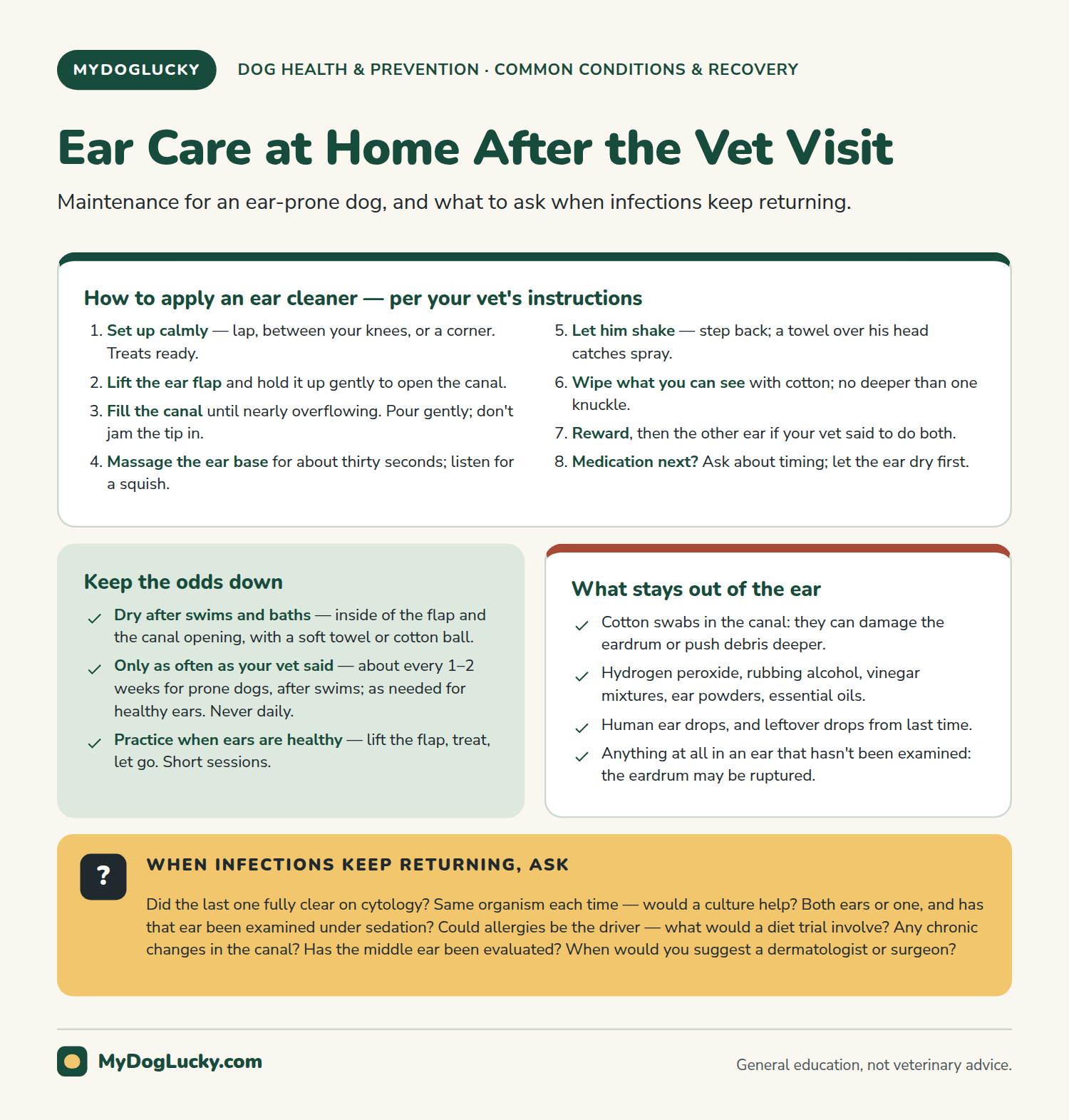
The general technique is consistent across VCA and Cornell, and it’s simpler than most people expect:
- Set up calmly. A small dog on your lap, a medium dog between your knees, a large dog with his back to a corner so he can’t reverse out of the situation. Have treats ready.
- Lift the ear flap and hold it up gently to open the canal.
- Fill the canal with the cleaner until it’s nearly overflowing. Don’t jam the bottle tip into the ear, and don’t squeeze forcefully; a gentle pour is enough.
- Massage the base of the ear, down where it meets the skull, for about thirty seconds. VCA says you’re listening for a squishing sound.
- Let him shake. Step back. Shaking brings loosened debris up and out. A towel over his head catches the spray if you’re doing this indoors.
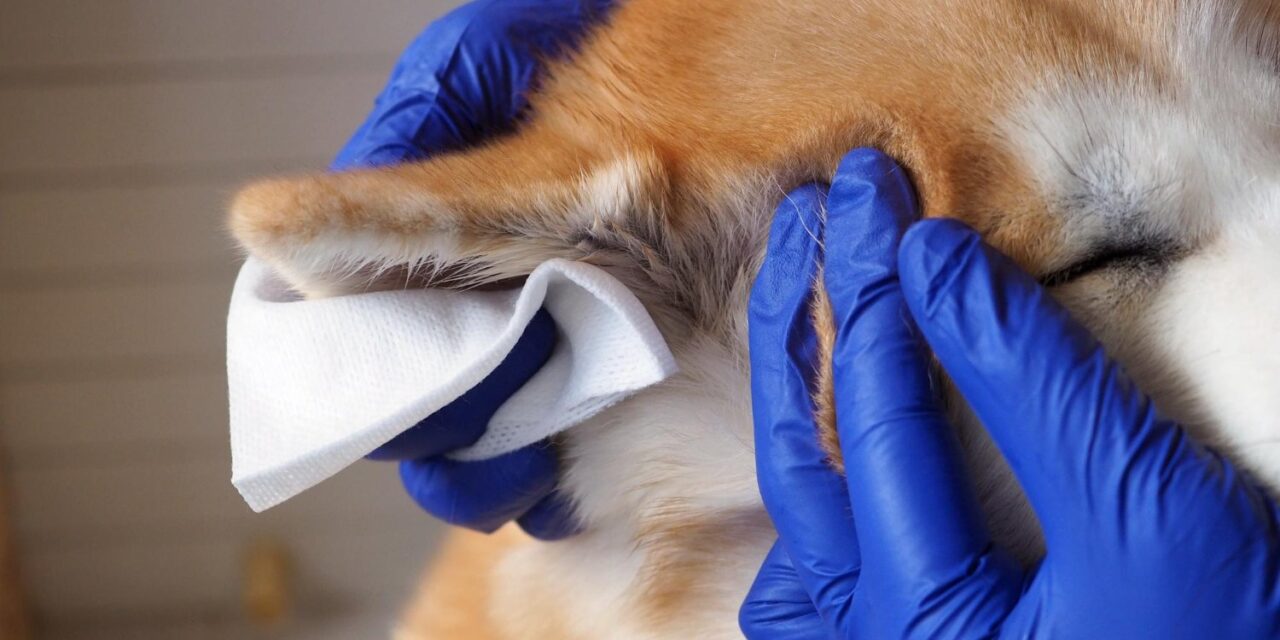
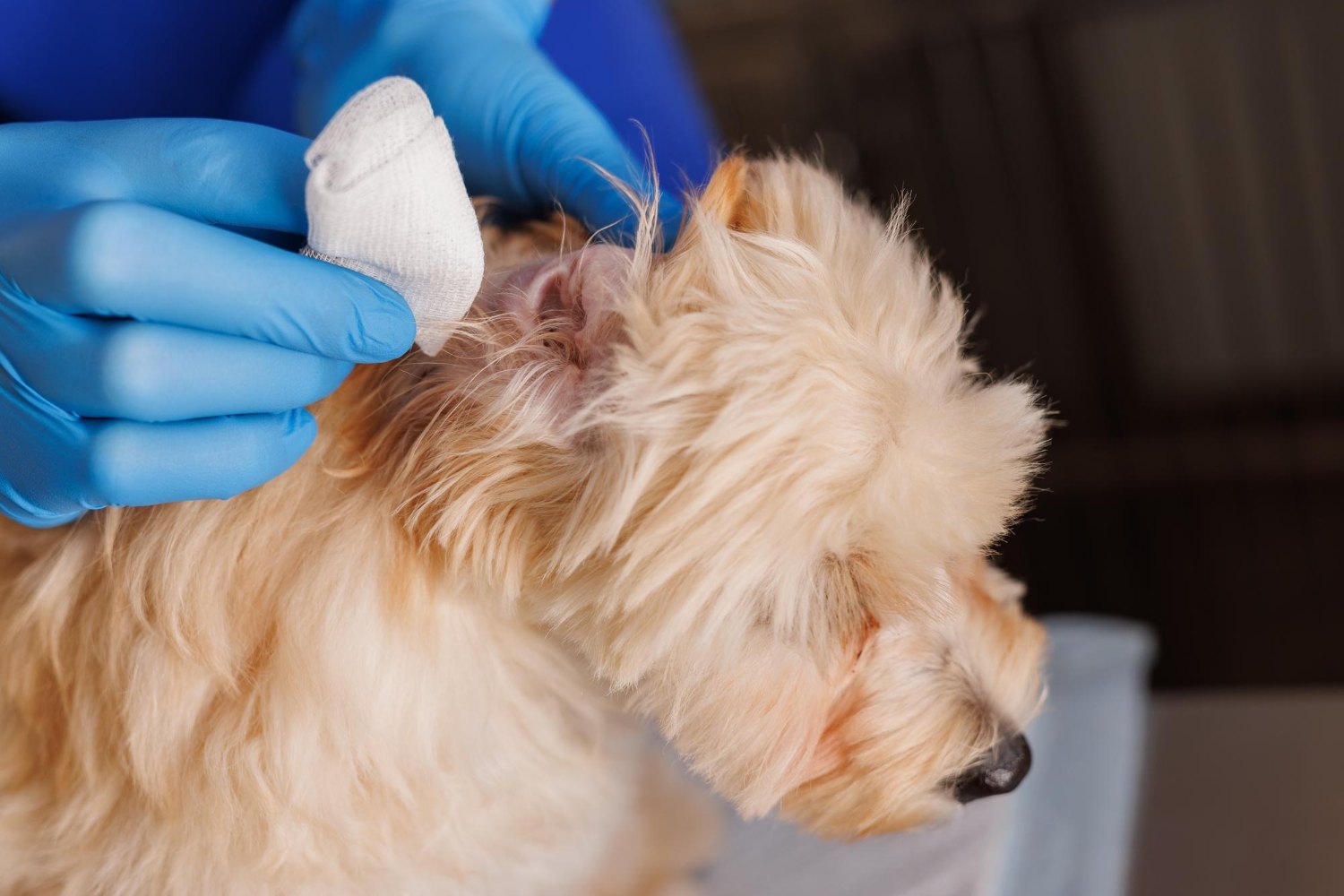
- Wipe what you can see. Use a cotton ball or gauze on the inside of the flap and the opening of the canal, no deeper than one knuckle.
- Reward, then repeat on the other ear if your vet said to do both.
Cotton swabs stay in the bathroom cabinet. VCA warns they “can damage the ear canal and/or ear drum or push debris further into the ear canal,” and Cornell says the same. The L-shape of the canal protects the eardrum from a fingertip, but a swab can round the corner.
If Medication Follows Cleaning
When your vet has prescribed both a cleaner and a medication, ask about timing. A common instruction is to clean, let the ear dry for a while, then apply the medication so it isn’t diluted or washed out. Your vet’s specific directions override anything general, including this paragraph.
Drying After Swimming and Baths
For water-loving dogs, this is the highest-value habit on the list. After a swim or bath, gently dry the inside of the ear flap and the opening of the canal with a soft towel or cotton ball. Cornell’s advice is to dry the ears and wipe the canals with cotton after swimming. Some vets recommend a drying-type ear cleaner after water exposure for dogs with a history of moisture-related infections; ask before you buy one. Keep water out of the ears during baths by placing a cotton ball loosely in each ear opening, and remember to take it out afterward.
How Often Is Too Often?
More than your vet recommended is too often. VCA’s guidance is that not every dog needs routine cleaning at all, and that cleaning is warranted when discharge or odor is present or on a vet-set schedule. Cornell suggests every one to two weeks as maintenance for dogs who are prone to trouble, routine cleaning after swimming or bathing, and only as-needed cleaning for healthy ears. Merck’s professional guidance lands in a similar place, tapering to once or twice weekly for prevention. Daily cleaning of a healthy ear is a good way to create the irritation you were trying to prevent.
Plucking Ear Hair: The Evidence Is Mixed
Groomers have plucked hair from the canals of curly-coated and hairy-eared dogs for generations. The research doesn’t clearly support doing it routinely. Merck’s professional text calls hair plucking “controversial,” notes it “may be needed to adequately resolve ear infection in some cases,” and warns that plucking hair that didn’t need removing can trigger an acute inflammatory reaction. The practical answer is to ask your vet whether your dog’s canals are hairy enough for it to matter, and if so, whether plucking, trimming, or leaving it alone is the better choice for him. Reasonable vets land in different places, and that’s fine.
What Not to Use
The lists from Cornell, VCA, and Merck agree remarkably closely. Skip hydrogen peroxide, rubbing alcohol, vinegar and water mixtures, ear powders, and any product that stings on your own skin. Skip human ear drops. Skip essential oils. If a product isn’t a vet-approved ear cleaner or a prescribed medication, it doesn’t go in the ear.
Making It Something Your Dog Tolerates
A dog who has learned that hands near his ears mean a struggle will fight, and a fighting dog gets a worse cleaning. Start with brief, pleasant handling when the ears are healthy: lift the flap, treat, let go. Build up to touching the base, then to the bottle. Keep sessions short. If your dog’s ear is currently painful, this is not the week to train; do what your vet directed, gently and quickly, and save the practice for later. A certified trainer who works with cooperative-care techniques can help if handling has become a real battle.
Recurrent Ear Infections: The Questions to Ask
Two ear infections in a year is bad luck. Four in a year, or one that never quite clears, is a pattern, and patterns have causes. This is the section for owners who are tired of the cycle: drops, recheck, three good weeks, and then the head shaking starts again.
Is This Actually a New Infection?
Ask first whether the last infection ever fully cleared. If the recheck was skipped, or if the course was stopped when things looked better, what feels like a recurrence may be a relapse of the original infection. A repeat cytology at the end of every course, and a culture when the same organism keeps showing up, answers this question.
Could Allergies Be Driving It?
For a dog with repeated infections in both ears, this is the central question. Ask your vet whether an allergy workup makes sense. That conversation usually splits into two branches. Environmental allergy is often managed through the itch itself, sometimes with allergy testing and immunotherapy for dogs whose problems are year-round, as Cornell notes.
Food allergy is investigated with an elimination diet trial: your dog eats only a prescribed novel or hydrolyzed diet, with nothing else, long enough to see whether the ears calm down. The AAHA guidelines describe diet trials running four to twelve weeks, followed by a food challenge to confirm the diagnosis if the trial helps. The trial only works if it’s strict, so the whole household needs to be on board.
Has the Canal Itself Changed?
Chronic inflammation reshapes the ear. The lining thickens, glands enlarge, the canal narrows, and over years the cartilage can even calcify. Merck lists these as perpetuating factors: they aren’t the original cause, but they keep the ear infected by trapping debris and preventing medication from working. Ask your vet whether they see chronic changes in the canal, and whether imaging would help show how far those changes go. This affects what’s realistic to expect from medical treatment.
Is the Middle Ear Involved?
Remember the figure from Merck: more than half of dogs with recurrent outer-ear inflammation also have otitis media. A middle-ear infection can keep reseeding the outer canal no matter how well the outer ear is treated. If your dog’s infections keep returning, ask whether the middle ear has been evaluated and whether imaging or a deep flush under anesthesia would help.
Is It Always the Same Ear?
One-sided recurrence is a different problem from two-sided recurrence. It raises the odds of something physical in that ear: a foreign body that was never found, a polyp, a mass, or chronic damage limited to that canal. Ask specifically whether that ear has been examined all the way to the eardrum under sedation, and whether a biopsy or imaging would be worth it.
Should We See a Specialist?
A veterinary dermatologist manages ears for a living, and video otoscopy, deep ear flushing under anesthesia, and complex allergy management are their everyday tools. Asking for a referral isn’t a criticism of your regular vet. Many general practitioners suggest it themselves once an ear has failed a couple of well-run treatment courses.
When Surgery Enters the Conversation
For an ear that has been inflamed for so long that the canal is scarred, narrowed, or closed, and medical treatment no longer helps, surgery can be discussed. The main options, as the American College of Veterinary Surgeons describes them, range from opening up part of the canal to removing the entire ear canal together with cleaning out the middle ear, a procedure called total ear canal ablation with bulla osteotomy.
VCA notes the full-canal removal can leave a dog with reduced hearing on that side, though many of these dogs already hear poorly through a blocked canal. It’s a serious surgery with real complications, and it’s also, in the right case, the thing that finally ends a dog’s years of pain. That decision belongs with a surgeon, your vet, and you, with all the imaging on the table.
Questions to bring when infections keep returning
- Did the last infection fully clear on cytology before we stopped treatment?
- Is it the same organism each time? Would a culture help?
- Both ears or one? If one, has that ear been examined fully under sedation?
- Could allergies be the driver? What would an elimination diet trial involve?
- Are there chronic changes in the canal, and how far along are they?
- Has the middle ear been evaluated?
- Would bloodwork, including thyroid, be reasonable for a dog his age?
- At what point would you suggest a dermatologist or a surgeon?
Cost and Time Realities
Ear infections sit near the top of the list of conditions that bring dogs to the vet, and the Morris Animal Foundation notes that ear problems account for roughly seven to ten percent of cases seen in primary-care practice. That makes them a budget line worth planning for if your dog has had one before.
What You’re Paying For
A straightforward first infection usually involves an exam fee, cytology, a cleaning, a topical medication, and a recheck visit. In many U.S. clinics that adds up to a bill in the low to mid hundreds of dollars, though prices vary widely by region and clinic type. The add-ons are what push the cost up: sedation for a painful ear, a culture sent to a lab, oral medication, imaging if the middle ear is suspected, bloodwork or allergy testing for a recurrent case, and specialist referral. Surgery for an end-stage ear runs into the thousands. Ask for a written estimate before any of the bigger steps, and ask what each one would change about the plan.
Ways to Keep the Cost Down Honestly
The cheapest ear infection is the one that’s treated fully the first time. Finishing the course and attending the recheck cost less than a second round of everything. For dogs with a known trigger, a preventive routine — drying after swims, a vet-set cleaning schedule, an allergy plan — is far cheaper than repeated flares. Some clinics offer wellness plans that fold in rechecks. Pet insurance can help with recurrent cases, but most policies exclude conditions that existed before enrollment, so it’s a tool for the future rather than the current flare.
The Time It Takes
Plan on daily treatment for one to two weeks for a simple infection, with a recheck near the end, and be ready for two to four weeks of monitoring. Recurrent or chronic cases run on a longer clock: an elimination diet trial alone takes up to three months, and allergy management is ongoing. That’s discouraging to read, so here’s the useful frame. The goal for a chronic ear isn’t a cure that ends the story. It’s fewer flares, milder flares, and a dog who’s comfortable most of the year.
Monitor, Call Today, or Go Now: The Clear Breakdown
Here’s the same information from the sections above, organized by what to actually do next.
Monitor briefly at home
- A single, mild episode of head shaking after a bath or swim that stops within a day.
- A small amount of light wax with no odor, redness, or pain.
- Your dog is eating, playing, and holding his head normally.
Dry the ears, watch for 24 hours, and call if anything appears from the next tier. An ear that smells, oozes, or hurts has already moved past this box.
Call your vet today
- Head shaking or scratching that has continued for more than a day.
- Any odor, discharge, redness, or swelling inside the ear.
- Pain when you touch the ear.
- A recurrence in a dog who’s had ear infections before.
- A puppy with dark, crusty debris, or a household where another pet has mites.
- Any infection that isn’t improving after several days of prescribed treatment.
This isn’t an emergency-room situation, but a dog ear infection doesn’t resolve by waiting, and every day of delay is a day of pain. Call and describe what you see.
Seek veterinary care now
- Head tilt, loss of balance, circling, or flicking eye movements.
- A drooping face, drooling from one side, or an eye that won’t blink.
- Sudden deafness.
- Severe pain, or a canal swollen shut.
- A hot, swollen, fluid-filled ear flap.
- Bleeding from the canal, or sudden violent shaking after a walk in dry grass.
- Fever, lethargy, or vomiting alongside the ear signs.
Call ahead if you can, then go. Don’t wait to see if it passes.
Common Mistakes and Misunderstandings
Stopping the Medication When the Ear Looks Better
The most common mistake, and the one that turns a two-week problem into a two-month one. Ears look and smell normal well before the infection is gone. Finish the full course and go to the recheck.
Reaching for Leftover Drops From Last Time
Last time’s infection may have been yeast; this time may be bacteria, or a ruptured eardrum, or a foxtail. The medication that worked before can be useless or harmful now. Old drops also lose potency and can be contaminated. Get the ear looked at.
Using Human Ear Drops or Home Remedies
Human products aren’t formulated for a dog’s canal or the organisms that infect it, and several popular home remedies — peroxide, alcohol, vinegar — are on veterinary do-not-use lists because they irritate the skin. Some can cause harm if the eardrum is ruptured. None of them can tell you what’s growing in the ear.
Cotton Swabs Deep in the Canal
The swab compacts debris at the bottom of the canal and can reach the eardrum around the bend. Clean only what you can see, with a cotton ball or gauze, no deeper than a knuckle.
Cleaning a Red, Painful Ear Before the Vet Visit
It feels helpful. It isn’t. VCA advises against cleaning ears that are red, inflamed, or painful before a vet has examined them, because an infection or ruptured eardrum may be present. Cleaning also washes away the discharge your vet needs to see and sample. Leave it alone until after the exam.
Ignoring a One-Sided Recurrence
The same ear, over and over, is a signal. It suggests something local — a foreign body, a growth, chronic damage — rather than a whole-body cause. Ask for a full examination of that ear under sedation rather than another course of the same drops.
Treating the Infection and Ignoring the Reason
If the ears keep getting infected, the infection isn’t the real problem. It’s the allergy, the moisture, the hormone imbalance, or the canal changes underneath. Each round of drops that skips that conversation is a round you’ll likely repeat.
Letting the Dog Swim Mid-Treatment
Water in a healing ear dilutes medication and keeps the canal damp. Unless your vet has said otherwise, keep the ears dry until the recheck confirms the infection has cleared.
Assuming “No Skin Itch” Rules Out Allergies
For many dogs, the ears are the only place allergies show up. A dog can have allergic ears and a perfectly calm belly. Recurrent ear infections on their own are enough reason to discuss allergy.
Skipping the Recheck Because the Ear Seems Fine
The recheck exists because “seems fine” and “clear on cytology” are different things. It’s the cheapest appointment in the whole process and the one that prevents the expensive relapse.
Frequently Asked Questions About Dog Ear Infections
How can I tell the difference between a dog ear infection and just dirty ears?
Dirty ears have a bit of wax, no smell, no redness, and a dog who doesn’t care. An infected ear usually smells, looks red or swollen inside, has more discharge than usual, and bothers the dog: shaking, scratching, flinching when touched. If you’re unsure, a quick cytology at the vet settles it. Guessing wrong in the “just dirty” direction costs your dog days of discomfort.
Can a dog ear infection go away on its own?
Rarely, and not reliably. Once yeast or bacteria have overgrown in an inflamed canal, they tend to stay until treated, and the inflammation causes pain the whole time. Untreated infections can also lead to an ear hematoma, a ruptured eardrum, spread to the middle ear, and hearing loss, according to VCA. Waiting it out is a poor bet.
Is a dog ear infection contagious to other dogs or to people?
Most aren’t. The yeast and bacteria involved are normal residents of dog skin that have overgrown, not something caught from another animal. Ear mites are the exception: they spread readily between pets through direct contact, so if your puppy has mites, other pets in the home should be checked. Ear infections aren’t a meaningful risk to people.
Can I use drops left over from my dog’s last ear infection?
No. The organism may be different this time, the eardrum may be ruptured, and old medication may be expired or contaminated. Every new episode needs a fresh look. Bring the old bottle to the appointment so your vet knows what was used before, though.
How long does a dog ear infection take to clear up?
Simple infections often improve within a few days and clear within one to two weeks of treatment, with a recheck near the end to confirm. Middle-ear infections usually need three to six weeks. Chronic cases take months, and some dogs need ongoing maintenance to keep flares at bay.
Why does my dog keep getting ear infections in the same ear?
Repeated infection in one ear suggests a local cause: a foreign body that was never found, a polyp or mass, chronic changes in that canal, or a middle-ear infection reseeding the outer ear. Ask your vet to examine that ear all the way to the eardrum, under sedation if needed, and whether imaging or a biopsy is warranted.
Can food cause ear infections in dogs?
Food allergy can. VCA reports ear infections in a large majority of dogs with food allergies, and for some dogs the ears are the only sign. The way to find out is a strict elimination diet trial of four to twelve weeks under your vet’s direction, not a switch to a “sensitive” food from the shelf. Over-the-counter foods aren’t formulated or manufactured tightly enough for a diagnostic trial.
Should I clean my dog’s ears before the vet visit?
No. Your vet needs to see and sample the discharge, and cleaning a painful, inflamed ear can hurt your dog and, if the eardrum is damaged, cause harm. Leave the ear as it is and let the clinic handle the cleaning.
Can I use hydrogen peroxide or vinegar to clean my dog’s ears?
No. Both appear on do-not-use lists from Cornell, VCA, and Merck because they irritate the canal lining, and irritated skin is where infections start. Use only a vet-approved ear cleaner, and only as often as your vet recommends.
How often should I clean my dog’s ears?
It depends on the dog. Many dogs with healthy, short ears never need routine cleaning. Dogs prone to infections may do well with cleaning every one to two weeks and after swimming. During an active infection, your vet sets the schedule. Cleaning more often than needed causes irritation.
Will my dog need sedation for an ear infection?
Most mild cases don’t. Sedation comes into play when the ear is too painful, swollen, or full of debris to examine and clean properly awake, when a foreign body needs removing, or when the vet needs to check or sample the middle ear. It adds cost but often makes the difference for a bad ear.
Can an ear infection make my dog deaf?
It can. Merck lists chronic outer-ear inflammation and wax buildup among the causes of acquired deafness, and hearing often improves once those are treated. Infection that reaches the inner ear can cause more lasting hearing loss. Certain medications can also damage hearing if they reach the middle ear through a ruptured eardrum, which is one more reason nothing goes in an unexamined ear.
What does an ear hematoma look like, and is it an emergency?
The ear flap becomes thick, warm, and puffy, like a small water balloon, and the dog holds it oddly. It’s not a middle-of-the-night emergency, but it needs a vet within a day or so. Untreated, the flap can scar into a permanently crumpled shape, and the underlying infection keeps driving the head shaking that caused it.
How do I know if it’s ear mites or an ear infection?
You can’t tell reliably from the outside. Both cause scratching, head shaking, and dark debris. Mites are far more common in puppies than adult dogs, and a vet can see them under the microscope in minutes. The treatments are different, so the distinction matters.
Why does my vet want a recheck when the ear already looks fine?
Because “looks fine” happens before “is clear.” A recheck with repeat cytology confirms the organisms are actually gone. Stopping at “looks fine” is the most common reason infections seem to come back a few weeks later.
Is a head tilt from an ear infection permanent?
Not always. Merck notes that early treatment improves the outlook, and many dogs recover fully or nearly so. When inner-ear infection has gone on for a long time, especially with a ruptured eardrum, some nerve-related signs can persist. That’s the case for treating a head tilt as a go-now sign rather than waiting.
Do floppy ears mean my dog will get more ear infections?
They raise the odds by trapping heat and moisture and reducing airflow, but they don’t guarantee anything. Plenty of floppy-eared dogs never have a problem, and plenty of upright-eared dogs get infections from allergies. What floppy ears do mean is that drying after water and a vet-set cleaning routine pay off more for your dog than for others.
Should I have my groomer pluck the hair from my dog’s ears?
Ask your vet first. The evidence is mixed: plucking may help in some hairy-eared dogs and may cause inflammation in others where it wasn’t needed. Trimming the hair at the canal opening is a gentler middle option some vets prefer.
Can I give my dog something for the pain while I wait for the appointment?
Don’t give human pain relievers; several common ones are toxic to dogs. If your dog is in significant pain, say so when you call, because that changes how quickly the clinic will want to see him and what pain relief they’ll prescribe. In the meantime, keep him from scratching if you can, and keep the ear dry.
Where This Leaves You
A dog ear infection is common, treatable, and miserable for the dog in the meantime. The signs are easy to recognize once you know them. What you can’t do from outside is identify what’s growing in the ear or see whether the eardrum is intact, and those two facts decide the treatment. That’s the whole case for the vet visit.
If any red flag is present — a head tilt, a wobbly walk, a drooping face, severe pain — go today. For everything else, call, describe what you see, finish the course you’re given, and keep the recheck. If the infections keep coming back, stop treating each one as a fresh surprise and ask the recurrence questions above. The answer is usually sitting underneath the infection, and finding it is what finally gives your dog a quiet, comfortable set of ears.
Sources
- VCA Animal Hospitals. Ear Infections in Dogs (Otitis Externa). Updated April 10, 2026.
- VCA Animal Hospitals. Ear Cleaning in Dogs. Reviewed August 20, 2025.
- VCA Animal Hospitals. Hematoma of the Ear in Dogs. Updated April 10, 2026.
- VCA Animal Hospitals. Ear Mites (Otodectes) in Cats and Dogs. Reviewed March 28, 2025.
- Merck Veterinary Manual (Dog Owners). Ear Infections and Otitis Externa in Dogs. Reviewed April 2026.
- Merck Veterinary Manual (Dog Owners). Otitis Media and Interna (Middle and Inner Ear Infections) in Dogs. Reviewed April 2026.
- Merck Veterinary Manual (Professional). Otitis Externa in Animals. Reviewed September 2025.
- Merck Veterinary Manual (Dog Owners). Deafness in Dogs. Reviewed April 2026.
- Cornell University College of Veterinary Medicine, Riney Canine Health Center. Itchy Ear Problems.
- Cornell University College of Veterinary Medicine, Riney Canine Health Center. How to Clean Your Dog’s Ears. Updated October 21, 2025.
- American Kennel Club. Dog Ear Infections: Symptoms, Causes, Treatment, and Prevention. Updated August 18, 2026.
- American Animal Hospital Association. 2023 AAHA Management of Allergic Skin Diseases in Dogs and Cats Guidelines. Published October 2023.
- American College of Veterinary Surgeons. Otitis Externa. June 20, 2023.
- Morris Animal Foundation. The Science Behind Ear Problems in Dogs and How Owners Can Help. May 18, 2023.
This article is general education for U.S. dog owners. It is not individualized veterinary advice, a diagnosis, or a substitute for an in-person veterinary exam. Ear infections require a veterinarian to identify the organisms involved and check whether the eardrum is intact before any product is placed in the ear; nothing in this article should be used to select or apply a cleaner or medication on your own. If your dog shows a head tilt, loss of balance, circling, a drooping face, sudden deafness, severe pain, a swollen ear flap, bleeding from the ear, or fever and lethargy alongside ear signs, seek veterinary care right away rather than waiting.