
Fleas and ticks on dogs are a year-round problem in most of the United States, not a summer one. The reliable fix isn’t a spray you reach for after you spot something crawling. It’s a veterinarian-recommended preventive, given on schedule every month of the year, plus two skills you can learn tonight: how to check a dog properly and how to remove a tick without making things worse.
That’s the whole strategy in one paragraph. The rest of this guide fills in the details you’ll actually need: what an emergency looks like, how to confirm fleas with a wet paper towel, where ticks hide on a dog’s body, which diseases each parasite can carry, how vets choose between chewables, spot-ons, and collars, and what to do about your house once fleas have moved in.
If you found a tick five minutes ago and want the removal steps first, jump to that section from the table of contents and come back for the rest. If your dog is a puppy or a very small dog with a heavy flea load and seems weak or has pale gums, skip everything and call a vet now. That’s the one situation where fleas themselves, not the diseases they carry, can become dangerous within days.
What’s in this guide
- Fleas and ticks on dogs: the short answer
- Red flags: when fleas or ticks become an emergency
- How to tell if your dog has fleas
- How to find ticks on your dog: the full-body check
- What fleas and ticks can transmit to dogs (and people)
- How regional risk works, and where to look up your county
- Prevention: how vets choose a flea and tick preventive
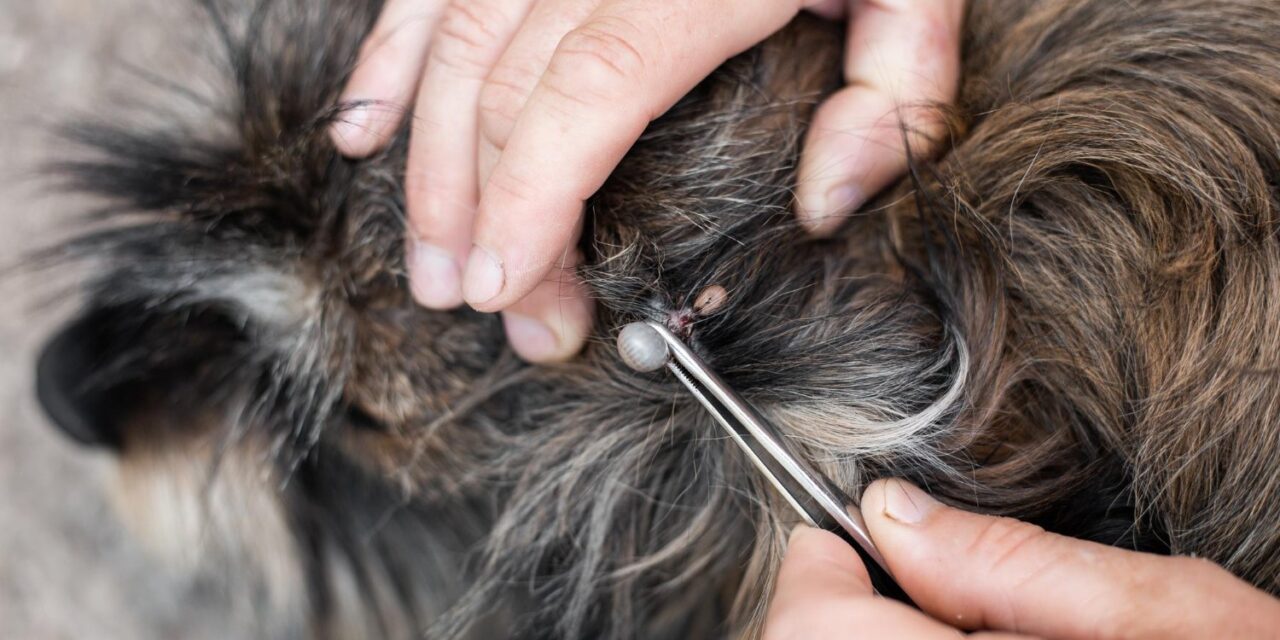
- How to remove a tick from a dog, step by step
- Treating the home and yard when fleas are present
- What to observe, record, and bring to the vet
- What a vet may evaluate
- What not to do about fleas and ticks
- Travel, boarding, and multi-pet households
- Monitor, call today, or go now
- Common mistakes and misunderstandings
- Frequently asked questions about fleas and ticks on dogs
- Sources
Fleas and Ticks on Dogs: The Short Answer
Here’s the version to keep in your head. Fleas are tiny, fast, wingless insects that live on your dog, bite repeatedly, and lay eggs that fall off into your carpet and bedding. Ticks are slow, eight-legged arachnids that climb on from grass or brush, attach with their mouthparts, and feed for days. Both are more than an itch. Fleas can cause allergic skin disease, transmit tapeworm, and in heavy loads drain enough blood to make a puppy anemic. Ticks can transmit Lyme disease, anaplasmosis, ehrlichiosis, and Rocky Mountain spotted fever, and in some cases cause paralysis directly.
The Companion Animal Parasite Council (CAPC), the body that writes U.S. parasite-control guidelines for veterinarians, is blunt about the fix. Its flea guideline says “all dogs should be treated year-round and throughout their life with flea control products,” and its tick guideline uses almost identical wording. That recommendation isn’t a sales pitch. It reflects how these parasites actually behave: fleas thrive indoors in January, and the CDC notes that adult blacklegged ticks “may be out searching for a host any time winter temperatures are above freezing.”
So the plan has three parts, and none of them is optional:
- A preventive your vet picks for your specific dog, given on time, every month of the year.
- A quick tick check after outdoor time, especially in grass, leaf litter, woods, or tall weeds.
- Knowing what an emergency looks like, so you don’t wait on the handful of situations that can’t wait.
Everything below is built to help you carry out those three parts well. We’ll stay out of product names on purpose. The right choice depends on your dog’s age, weight, health history, the other animals in your home, and where you live, and that’s a conversation with your veterinarian, not a blog.
Red Flags: When Fleas or Ticks Become an Emergency
Most cases of fleas and ticks on dogs are a nuisance you handle over days and weeks. A small number of situations need a vet today or tonight. Read this list once now, calmly, so you recognize it later.
Seek veterinary care right away if you see:
- Pale or white gums, weakness, or collapse in a puppy or small dog with heavy fleas. Fleas feed on blood, and CAPC notes that heavy infestations can cause “iron deficiency anemia and death, particularly in young animals.” A limp, cold, pale puppy crawling with fleas is an emergency, not a bath.
- Sudden hind-leg weakness, wobbling, or paralysis, especially with a tick attached. Tick paralysis starts in the back legs and climbs. The Merck Veterinary Manual lists “change or loss of voice, lack of coordination of the hind legs, change in breathing rate and effort, gagging or coughing” among early signs. Breathing muscles can be affected. Go now.
- Fever, lameness, swollen or painful joints, lethargy, or loss of appetite days to weeks after a tick bite or after time in tick habitat. These are the classic signs of Lyme disease, ehrlichiosis, anaplasmosis, and Rocky Mountain spotted fever. Same-day call at minimum.
- Unexplained bruising, nosebleeds, tiny purple-red spots on the gums or the whites of the eyes, or blood in urine or stool. Several tick-borne infections lower platelet counts. Merck describes “small purplish-red spots” on the lining of the eyes and mouth in Rocky Mountain spotted fever. Emergency evaluation.
- Swelling of the face or legs, trouble breathing, or a dog who suddenly can’t get comfortable after tick exposure. Go now.
- Vomiting, tremors, drooling, or unsteadiness after a flea or tick product was applied or given, particularly if a cat product was used on a dog, a dog product on a cat, or more than one product was combined. Call your vet or a pet poison line immediately with the packaging in hand.
- A rash, an expanding “bullseye” or target-shaped lesion, fever, or flu-like illness in a person in the household within several weeks of a tick bite. That’s a doctor visit for the person, today. The CDC advises contacting a physician if you develop “a rash or fever within several weeks of removing a tick.”
Any one of these is enough to make the call. You don’t need two.
Why Puppies and Small Dogs Are the Exception to “Fleas Are Just Annoying”
An adult Labrador with a few dozen fleas is itchy and unhappy. A six-week-old puppy or a three-pound toy breed with the same number of fleas is losing a meaningful share of a tiny blood volume, every day, with no reserve to spare. The Merck Veterinary Manual puts it plainly: “in heavy infestations (or in young puppies), anemia may develop due to the loss of blood.”
The signs are subtle at first. The puppy sleeps more, plays less, and seems a bit flat. Then the gums go from pink to pale. Lift the lip and look, because gum color is the fastest check you can do at home. If they look pale, white, or grayish, or if the puppy is cold and weak, this is a same-hour problem. Don’t bathe first. Call first.
Tick Paralysis: Rare, Fast, and Reversible if You Act
Tick paralysis isn’t an infection. It’s a reaction to a toxin in the saliva of certain feeding female ticks. In North America, Merck names ticks from the Ixodes, Dermacentor, and Amblyomma groups as capable of causing it, with signs appearing “3–5 or 5–9 days after the tick attaches, depending on the type of tick involved.”
What owners usually notice first is a dog whose back end seems drunk. She sways, then sits down mid-walk, then can’t rise. Her bark may sound different. Over hours to a day or two, the weakness climbs toward the front legs and, in severe cases, the muscles that control breathing.
The good news is real: Merck notes that in North America “the animal usually improves greatly within 24 hours of the tick being removed.” The catch is that someone has to find the tick, which may be buried in an ear or between toes, and the dog needs veterinary support while the toxin clears. About 5% of affected animals die even with treatment, especially when breathing is already impaired. Don’t wait to see if it passes.
Tick-Borne Illness Can Show Up Weeks After the Tick Is Gone
This one trips people up. You removed a tick in April, checked the spot, and moved on. In May, your dog starts limping on one leg, then a different leg, runs a fever, and skips dinner. Because the tick is long gone, it doesn’t occur to anyone to mention it. Merck describes Lyme disease in dogs as producing “fever, loss of appetite, swollen or painful joints, lameness that shifts from one leg to another, swollen lymph nodes, and lack of energy.” Ehrlichiosis and anaplasmosis look similar early on, with fever, swollen lymph nodes, and stiffness or reluctance to walk.
The timing matters for your vet. A note on your phone that says “tick removed April 12, right ear, engorged” turns a vague lameness workup into a focused one. We’ll come back to what to record in the observation section below.
How to Tell If Your Dog Has Fleas
Fleas are small, dark brown, and quick. You may see one dart through the fur on a light-colored dog and never see it again. On a thick-coated or dark dog, you can have a real infestation and never see a live flea at all. That’s why the test below, not a visual search, is the reliable method.
The Flea-Dirt Test on a Wet Paper Towel
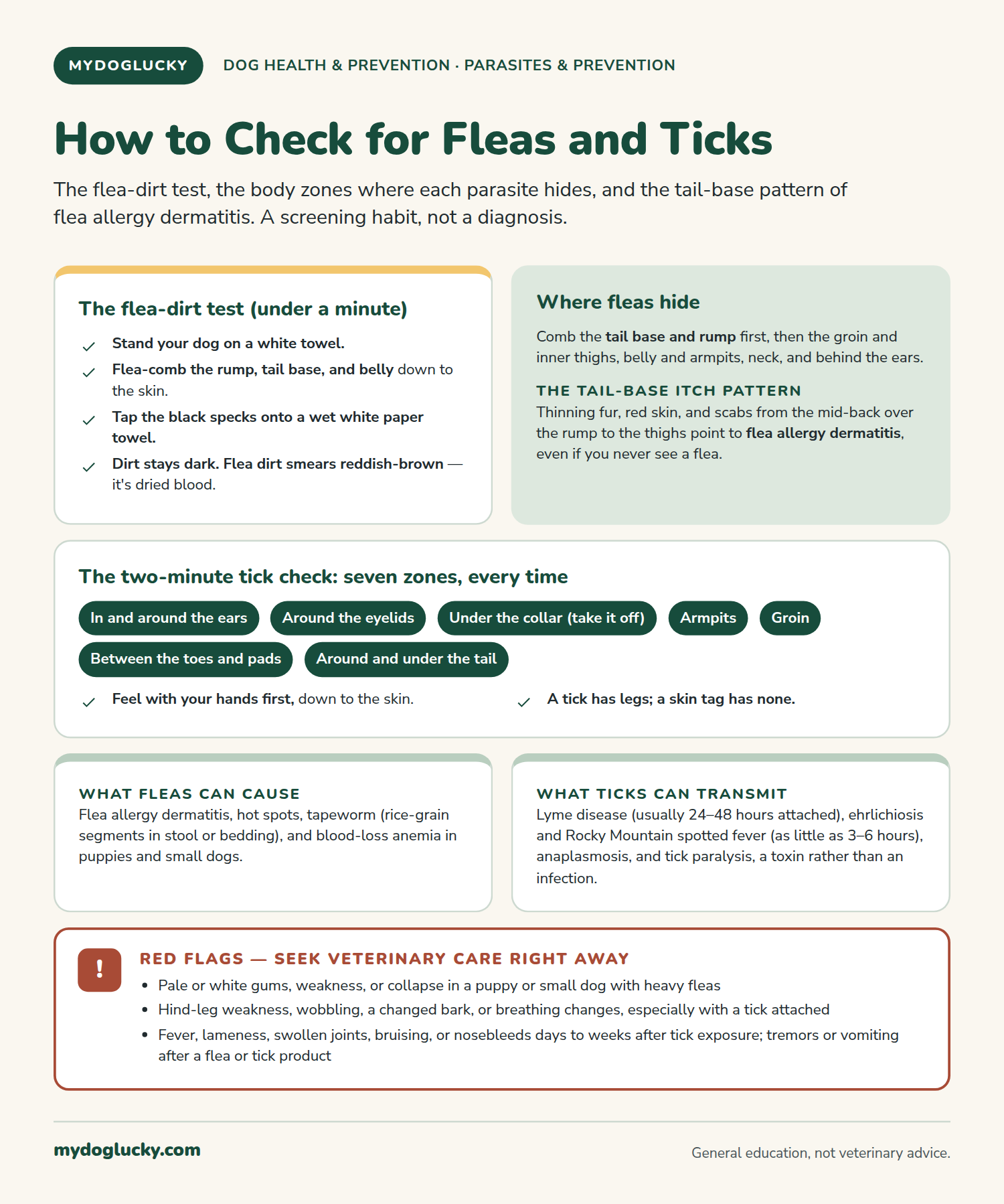
“Flea dirt” is flea feces: digested blood, dried into tiny black or reddish-black specks that look like coarse pepper or fine coffee grounds. It’s far easier to find than the fleas themselves. Here’s the check, which takes under a minute:
- Stand your dog on a white towel, a white sheet, or a light bathroom floor.
- Part the fur over the rump, the base of the tail, and the lower back, or run a fine-toothed flea comb through those areas and the belly.
- Tap any black specks you collect onto a white paper towel and add a drop or two of water.
- Wait a few seconds and look. Ordinary dirt stays dark and sits there. Flea dirt dissolves and spreads into a reddish-brown smear, because it’s dried blood.
Merck describes the result the same way: placed “in water or on a damp paper towel, the excrement dissolves, producing a reddish brown color.” A positive test means fleas are feeding on your dog, whether or not you ever spot a live one. A negative test on a dog who’s scratching doesn’t rule fleas out completely, so combine it with a comb pass and a look at the skin.
Where Fleas Hide on a Dog
Fleas favor warm, protected spots where the dog can’t easily reach them. Check these first:
- The base of the tail and the rump, which is the single most productive place to comb.
- The groin and the inside of the thighs, where the fur is thin and the skin is warm.
- The belly and armpits, especially on a dog who’s just been lying down.
- The neck, under the collar, and behind the ears.
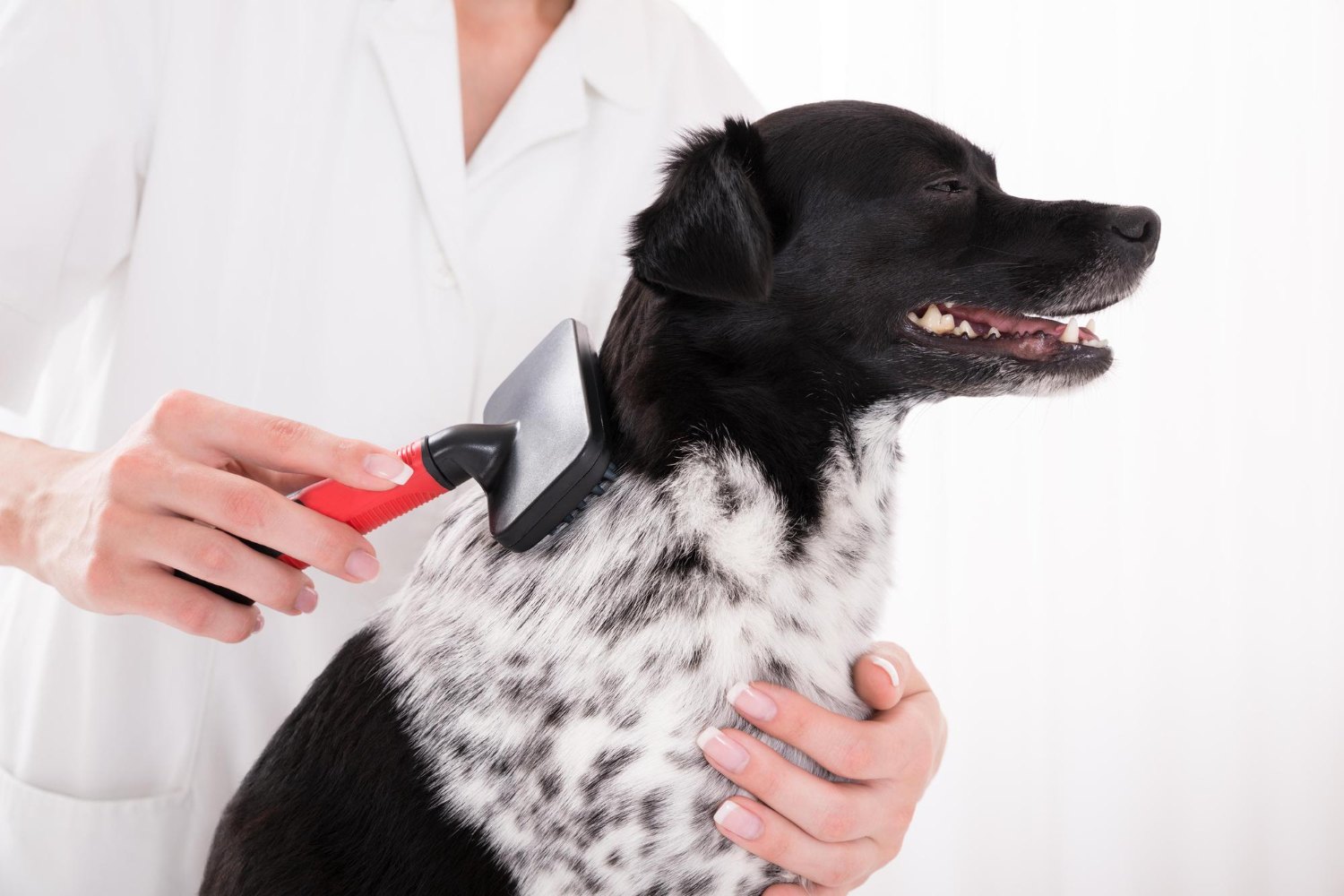
A flea comb, the kind with teeth set very close together, is a worthwhile few dollars. Drag it slowly through the fur down to the skin, then wipe it on a white paper towel and inspect. Keep a small bowl of soapy water nearby for anything that comes off alive.
Flea Allergy Dermatitis: The Tail-Base Pattern
Some dogs are allergic to proteins in flea saliva. For these dogs, one or two bites can trigger days of intense itching, which is why an owner can honestly say “I’ve never seen a flea” and still be looking at flea allergy dermatitis (FAD). The AVMA notes that some pets “develop allergic reactions to flea saliva, becoming severely itchy from just one or two bites.”
The pattern is distinctive. Merck describes “crusted, itchy skin over the hips, base of the tail, and thighs,” which often leads to “hair loss, scabbing, and secondary infections.” Picture a triangle drawn from the middle of the back down over the rump to the backs of the thighs. Thinning fur, red or darkened skin, small scabs, and a dog who chews at that area are the classic signs. Ear infections and paw licking can happen with other allergies. Rump and tail-base chewing points at fleas until proven otherwise.
Flea allergy dermatitis needs a vet, not just a flea product, because the skin itself often needs treatment and the itch can be miserable. The bigger lesson for FAD dogs is that prevention has to be airtight. A “mostly on schedule” preventive that lets one flea bite every few weeks is enough to keep an allergic dog scratching all year.
Other Signs That Point Toward Fleas
Beyond scratching and flea dirt, watch for:
- Sudden restlessness: a dog who can’t settle, jumps up to bite at a spot, or twitches skin along the back.
- Hot spots: moist, red, painful patches of skin that appear almost overnight from licking and chewing.
- Tapeworm segments: small, white, rice-grain-shaped pieces around the anus, on the bedding, or in fresh stool. Dogs pick up the common flea tapeworm by swallowing infected fleas while grooming, so segments are a strong hint that fleas are present.
- Fleas or bites on people: small itchy red bumps around ankles are a common household clue.
How to Find Ticks on Your Dog: The Full-Body Check
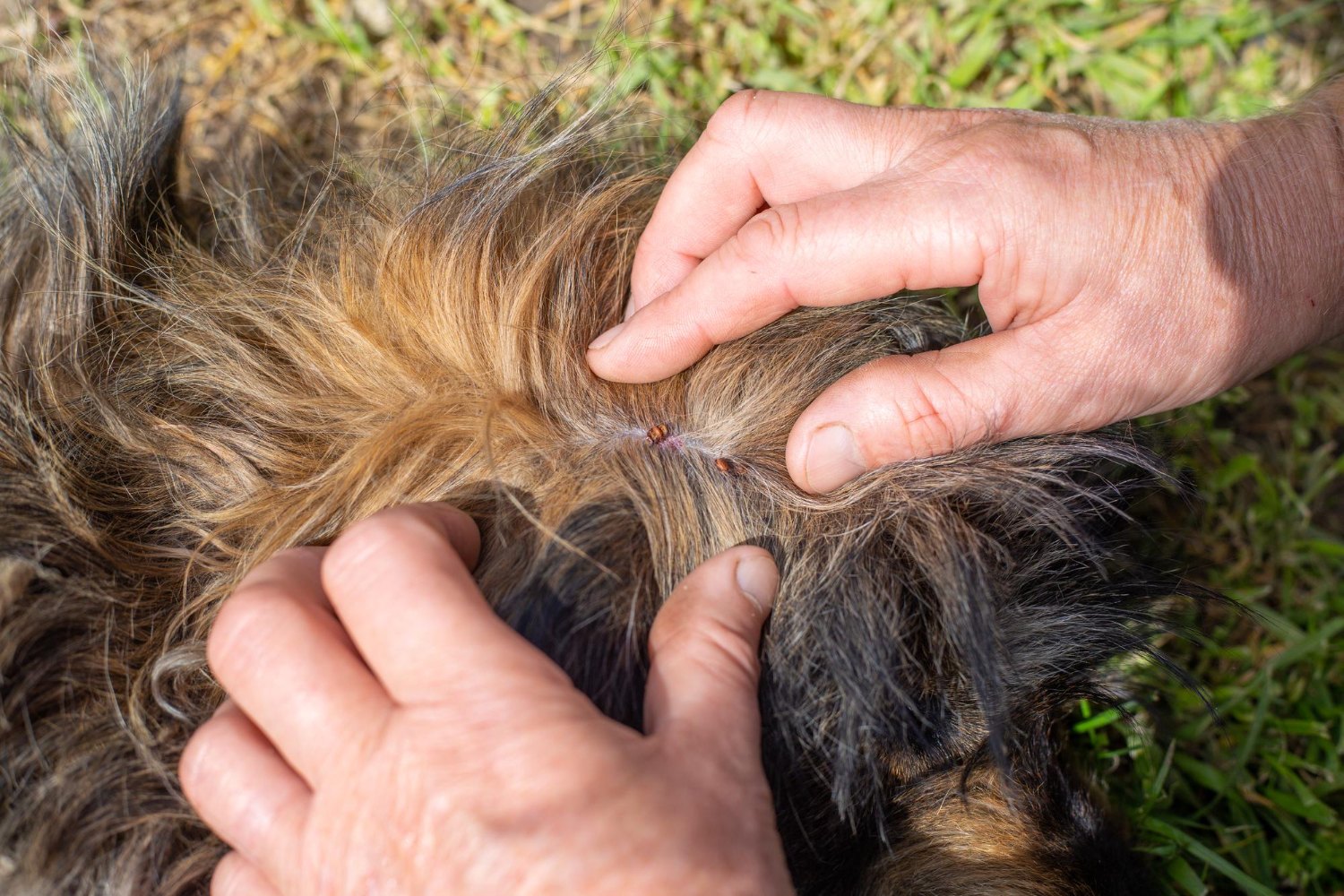
Ticks don’t jump or fly. They wait on grass and low brush with their front legs out, grab a passing dog, and crawl to a spot they like. Unfed ticks can be as small as a poppy seed. An engorged female can swell to the size of a grape and, according to the AVMA, “consume up to 100 times her weight in blood.” Because ticks attach and feed for days, the check you do after a walk is a real chance to interrupt disease transmission.
Where Ticks Attach
The CDC and VCA Animal Hospitals both publish nearly the same short list of hiding places. Check these every time:
- In and around the ears, including inside the ear canal opening and the little pocket of skin at the base of the ear flap.
- Around the eyelids, where VCA notes a tick “can be mistaken for a skin tag or eye discharge.”
- Under the collar. Take the collar off for the check. A tick under a collar can go unnoticed for a week.
- Under the front legs (armpits) and in the folds where the legs meet the body.
- Between the back legs (groin), a dark, warm spot ticks favor.
- Between the toes, both the top of the foot and the pads underneath.
- Around and under the tail, including the fold where the tail meets the body.
The AVMA adds the neck generally. Long-coated dogs also deserve a check along the belly and down the chest, where a crawling tick that hasn’t attached yet may still be moving.
How to Do the Check in Two Minutes
Make this a routine after outdoor time in tick habitat, and the CDC recommends a daily check for pets who go outdoors. A practical version looks like this:
- Start with your hands, not your eyes. Run your fingers slowly through the coat, pressing gently to the skin, feeling for small bumps. On a dark or thick coat, touch finds ticks that sight misses.
- Work head to tail in the same order every time: muzzle and eyelids, ears inside and out, under the chin, neck and collar line, chest, each front leg and armpit, belly, groin, each back leg, tail base, tail, and finally each foot, spreading the toes.
- Investigate every bump. Part the fur. A tick looks like a small, smooth, grayish or brownish oval with legs near the skin. A skin tag or nipple has no legs and doesn’t move when you gently touch it.
- If you find one, remove it now using the steps in the tick-removal section, then keep checking. Where there’s one, there are often more.
Pair the check with something your dog enjoys, like a few treats or a rubdown, and most dogs come to see it as a bonus massage. On days you can’t do a full pass, prioritize ears, collar line, armpits, groin, and toes.
Why Speed Matters: Transmission Times
A tick has to feed for a while before it can pass most infections, which is exactly why prompt removal works. CAPC notes that “Ehrlichia spp. and Rickettsia spp. can be transmitted within 3–6 hours of tick attachment, while Borrelia burgdorferi transmission can require 24–48 hours.” Borrelia is the Lyme bacterium. Rickettsia includes the agent of Rocky Mountain spotted fever.
Read that carefully. It means a same-day check meaningfully lowers Lyme risk, but it doesn’t reliably beat ehrlichiosis or spotted fever. Those can move in a few hours. That’s the strongest argument for a preventive that kills ticks quickly, backed up by checks, rather than checks alone.
What Fleas and Ticks Can Transmit to Dogs (and People)
The itching is the visible part of fleas and ticks on dogs. The diseases are the reason veterinarians push year-round prevention so hard. This section describes broad categories so you understand what your vet is thinking about. It isn’t a tool for diagnosing your own dog, and most of these conditions are confirmed only with blood tests.
What Fleas Carry
- Flea allergy dermatitis, covered above. Not an infection, but the most common medical consequence of fleas in dogs.
- Tapeworm (Dipylidium caninum). Flea larvae eat tapeworm eggs in the environment. A dog swallows an infected adult flea while chewing an itchy spot, and the tapeworm matures in the intestine. You see rice-grain segments; the dog usually seems fine. CAPC adds a detail parents should know: “ingestion of infected fleas by children has resulted in development of adult D. caninum,” so a flea problem is a household problem.
- Blood-loss anemia in puppies, small dogs, and debilitated seniors with heavy loads.
- Bartonella, the bacterium behind “cat scratch disease” in people, moves between cats via fleas. It’s mainly a cat-and-human concern, but it’s one more reason the cats in a household need their own vet-chosen prevention.
What Ticks Carry
Different ticks carry different diseases, and different regions have different ticks. Here are the four your vet is most likely to test for, plus the one that isn’t an infection at all.
| Disease | Main tick in the U.S. | Common signs in dogs | Transmission time |
|---|---|---|---|
| Lyme disease | Blacklegged (deer) tick; western blacklegged tick on the Pacific coast | Shifting-leg lameness, fever, swollen joints, low energy, appetite loss; many dogs show no signs; rare kidney form is severe | Usually 24–48 hours of attachment |
| Anaplasmosis | Blacklegged tick | Fever, lethargy, stiffness or reluctance to walk, appetite loss; sometimes bleeding tendencies | Hours to a day or more |
| Ehrlichiosis | Brown dog tick; lone star tick | Fever, swollen lymph nodes, appetite loss, low energy; later nosebleeds, bruising, weight loss | Can be within 3–6 hours |
| Rocky Mountain spotted fever | American dog tick; Rocky Mountain wood tick; brown dog tick in some areas | High fever, appetite loss, swollen joints and lymph nodes, swelling of face or legs, purplish spots on gums or eyes, neurologic signs | Can be within 3–6 hours |
| Tick paralysis (toxin, not infection) | Certain Dermacentor, Ixodes, and Amblyomma ticks | Hind-leg weakness climbing forward, voice change, breathing changes, gagging | Signs 3–9 days after attachment; improves within about 24 hours of removal |
A few details worth knowing about each:
Lyme disease is the one owners have heard of, and the one with a vaccine. The CDC notes that “except for Lyme disease in dogs, pets cannot be vaccinated against tickborne diseases.” Whether your dog should get it depends on where you live and how much time she spends in tick habitat; that’s a vet conversation. Merck notes that “many infected animals show no signs,” which is why routine annual screening blood tests are common in high-risk areas. The kidney form of Lyme disease is uncommon but “often fatal,” so a Lyme-positive dog with changes in thirst, urination, or appetite needs prompt attention.
Ehrlichiosis and anaplasmosis are caused by related bacteria that infect blood cells. Early signs look like a vague flu. In chronic ehrlichiosis, platelet counts can drop low enough to cause nosebleeds and bleeding under the skin. Both are diagnosed with blood tests and usually treated with antibiotics your vet prescribes.
Rocky Mountain spotted fever is the fastest-moving of the group. Merck is direct: “because early treatment is critical, veterinarians often begin antibiotics immediately if Rocky Mountain spotted fever is suspected, without waiting for test results.” Up to 10% of infected dogs die. Fever plus swelling plus tiny purple spots after tick exposure is a go-now combination.
What This Means for the People in Your House
Dogs don’t give people Lyme disease directly. But the same yard that exposes your dog exposes you, a dog can carry an unattached tick onto your bed, fleas bite people, and children can swallow fleas. Check yourself and your kids after the same outings. If anyone in the household develops a rash, an expanding target-shaped lesion, fever, or unexplained aches within a few weeks of a tick bite, see a doctor and mention the bite.
How Regional Risk Works, and Where to Look Up Your County
Fleas are everywhere. Tick species and their diseases are regional, and the map keeps changing, which is why the risk from fleas and ticks on dogs looks different in Maine, Missouri, and Arizona. The CDC’s current tick distribution descriptions put the blacklegged tick “widely distributed across the eastern United States,” the lone star tick across the “Northeast, South, and Midwest,” and the American dog tick “east of the Rocky Mountains” with limited pockets west of it.
The western blacklegged tick works the Pacific coast, “particularly northern California.” The brown dog tick is listed simply as “worldwide,” and it’s the one that can complete its whole life cycle indoors, in a kennel, a shelter, or your living room.
Two honest complications. First, CAPC’s annual forecasts have described Lyme disease, ehrlichiosis, and anaplasmosis spreading into counties that were low-risk a decade ago, driven partly by climate and partly by wildlife and dog movement. The county you grew up in may not have the tick risk it had then. Second, “low risk” is never “no risk.” A dog can pick up a tick in a city park.
Two Places to Check Your Own County
- CAPC Parasite Prevalence Maps (capcvet.org/maps). These show, county by county, the share of dogs tested at participating veterinary labs who tested positive for Lyme disease, ehrlichiosis, anaplasmosis, and heartworm, updated as new test results come in. CAPC notes the numbers are “influenced by a number of factors, including the number of pets tested,” so read them as a risk signal rather than an exact infection rate. Still, a county where 1 in 10 tested dogs is Lyme-positive tells you something.
- CDC tick pages (cdc.gov/ticks). The “Where Ticks Live” section describes each species’ range and links to surveillance maps for the blacklegged and lone star ticks. The CDC’s human Lyme disease case maps are also a decent proxy for where infected blacklegged ticks are common.
Bring what you find to your vet. A preventive that’s ideal for a dog in Arizona, where the brown dog tick and spotted fever dominate, may not be the best pick for a dog hiking in Connecticut, where Lyme and anaplasmosis lead. Regional risk is one of the main inputs into the product decision, which is the next section.
Prevention: How Vets Choose a Flea and Tick Preventive
This is the part where most owners searching for fleas and ticks on dogs want a product name, and it’s the part where we’re going to hold the line and explain categories instead. The reason isn’t caution for its own sake. It’s that the “best” preventive genuinely differs from dog to dog, and the person who knows your dog’s weight, seizure history, kidney values, swimming habits, and the cat asleep on the couch is your veterinarian.
The Main Categories
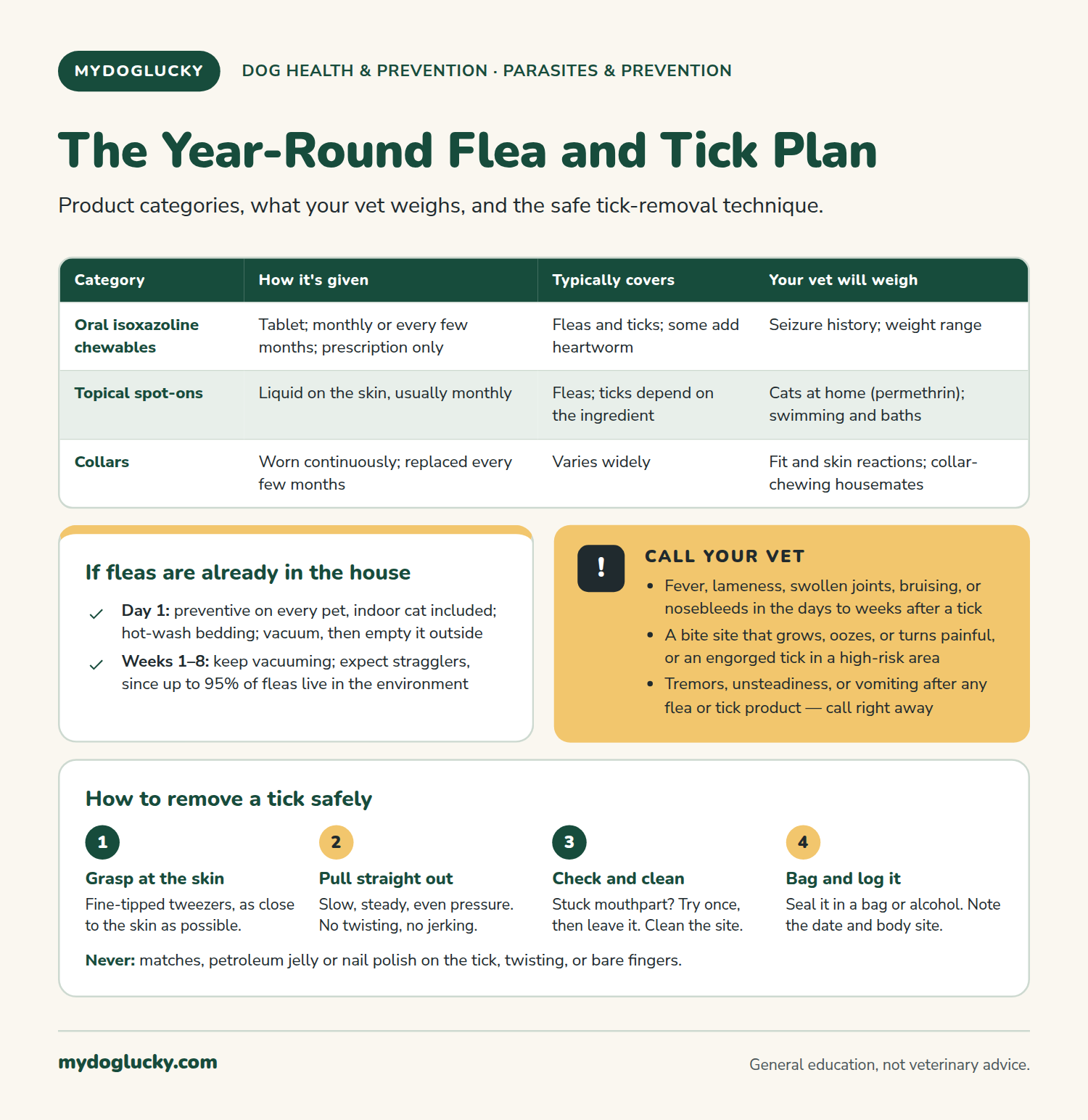
| Category | How it’s given | What it typically covers | What to discuss with your vet |
|---|---|---|---|
| Oral chewables (isoxazoline class) | A flavored tablet by mouth, monthly or every few months depending on the product; prescription only | Fleas and ticks; some formulations are combined with heartworm and intestinal-worm prevention | Seizure or neurologic history; whether a combined product simplifies your routine; weight range |
| Topical spot-ons | Liquid applied to the skin between the shoulder blades, usually monthly; some prescription, some over the counter | Fleas, and depending on the active ingredient, ticks and other parasites | Cats in the home (some dog spot-ons contain permethrin, which can be fatal to cats); bathing and swimming frequency; children who handle the dog |
| Collars | A medicated collar worn continuously, replaced every several months; mostly over the counter, some vet-dispensed | Varies widely; some prescription-strength collars cover fleas and ticks for months, some cheap collars cover very little | Fit and skin reactions; dogs who chew each other’s collars; small children; whether the specific collar has real tick data |
| Fast-acting oral adulticides | A short-acting tablet that kills adult fleas on the dog within hours; not a monthly preventive | Adult fleas only, briefly; used to knock down a heavy load while a long-acting product takes over | Whether it’s needed at all; how it fits with the preventive you’re starting |
| Sprays, shampoos, and powders | Applied to the coat; short-lasting | Kills what’s on the dog at that moment; little or no lasting protection | Whether it’s worth using at all alongside a real preventive; never stack with a spot-on or collar without asking |
Prescription vs. Over the Counter
In the U.S., the isoxazoline chewables and most of the combined flea-tick-heartworm products are prescription only, meaning your vet needs to have examined your dog and have a current relationship with you. Many spot-ons and collars are sold over the counter. “Over the counter” doesn’t mean weaker in every case, and “prescription” doesn’t mean risk-free. It means the prescription products are dosed to a specific weight range and are reviewed against your dog’s health record before they’re dispensed. For a dog with any health complication, that review is the whole point.
One more reason to buy through a veterinary channel: counterfeit and mislabeled flea and tick products turn up in online marketplaces, and a fake may contain the wrong ingredient at the wrong dose.
Why the Vet’s Choice Depends on Your Specific Dog
Expect your vet to ask about most of these, and bring the answers ready:
- Age and weight. Every product has a minimum age and a weight range. A puppy under a certain age or weight may need a different category than an adult.
- Health history. A history of seizures or other neurologic problems changes how the isoxazoline class is discussed (more on that below). Skin disease may make a topical a poor fit. Some conditions affect how a dog processes oral medications.
- Lifestyle. A dog who swims daily or gets bathed weekly may wash off some topicals faster. A dog who hikes in leaf litter needs stronger tick coverage than an apartment dog whose “outdoors” is a sidewalk.
- Other pets. Cats in the home rule out some dog topicals entirely. Dogs who groom or mouth each other can ingest a topical from a housemate. Every animal in the home needs its own species-appropriate product on the same schedule.
- Region and travel. Your county’s tick species, plus anywhere you’ll take the dog this year.
- Your real life. A monthly chewable you’ll remember beats a “better” product you forget. Some products last longer between doses, which some households find easier. Say honestly what you’ll keep up with.
Species Matters: Never Cross Cat and Dog Products
Use only a product labeled for your dog’s species and weight range. The AVMA’s rule is simple: “Never use a dog flea product for cats.” Some dog spot-ons contain permethrin, which is well tolerated by dogs and can kill a cat. The reverse direction, a cat product on a dog, is the wrong dose designed for a different animal, and there’s no reason to guess. The CDC adds: “Do not apply any tick prevention products to your cats without first asking your veterinarian!” If you have both species, tell your vet, and ask how long to keep the cat away from a freshly treated dog.
The FDA’s Note on Isoxazolines: A Discussion Point, Not a Reason to Skip Prevention
You may have seen alarmed social-media posts about the chewable flea and tick class. Here’s what the regulator actually says. In 2018 the FDA issued an alert, updated in a fact sheet dated August 8, 2023, about “the potential for neurologic adverse events in dogs and cats” treated with isoxazoline-class products. The events reported include “muscle tremors, ataxia, and seizures in some dogs and cats.” The same fact sheet states that most treated animals have not had these reactions and that the FDA considers these products “safe and effective for dogs and cats.”
The practical guidance from the FDA is exactly what a good vet does anyway: review the dog’s medical history before choosing, with extra care for dogs that have had seizures. The FDA also notes that “seizures may occur in animals without a prior history,” which is worth knowing without turning it into a reason to leave your dog unprotected. Fleas and ticks on dogs carry known, common, sometimes fatal risks. The isoxazoline signal is rare and worth a conversation. Have that conversation, then pick a product together, whether that ends up being an isoxazoline or something from another category.
If your dog ever shows tremors, unsteadiness, or a seizure after any flea or tick product, call your vet right away, keep the packaging, and ask your vet about reporting the event to the FDA and the manufacturer. Those reports are how the safety picture gets clearer.
The five questions to bring to your vet
- Which tick species and tick-borne diseases are common in our county, and does that change your recommendation?
- Given my dog’s age, weight, and history (including any seizures), which category do you recommend, and why?
- We have [cats / other dogs / small children]. Does that rule anything out, and how do we handle a freshly treated dog around them?
- Should this be combined with heartworm prevention in one product, or kept separate?
- Should my dog get a Lyme vaccine, and should we run a yearly tick-borne disease screening test?
Write the answers down. The plan will change as your dog ages, gains or loses weight, or moves.
How to Remove a Tick From a Dog, Step by Step
You found one. Take a breath; you have time to do this correctly, and correctly matters. The goal is to get the whole tick out with steady pressure and without squeezing its body, which can push tick fluids back into the bite. The CDC, CAPC, and the AVMA describe the same basic technique, and it works on dogs exactly as it does on people.
What You Need
- Fine-tipped tweezers or a purpose-made tick-removal tool. Blunt household tweezers crush the body.
- Rubbing alcohol or soap and water for the bite site, your hands, and the tweezers afterward.
- A small sealable bag or jar if you want to keep the tick for your vet.
- A helper and something lickable, if your dog is wiggly. A second person holding a spoonful of food in front of the dog’s nose turns a two-minute struggle into a thirty-second job.
The Steps
- Part the fur and get a clear view of where the tick meets the skin. Good light helps. A phone flashlight is fine.
- Grasp the tick as close to the skin as possible with the fine tips of the tweezers, around the head and mouthparts, not the swollen body. The CDC’s wording: “grasp the tick as close to the skin’s surface as possible.”
- Pull straight out with slow, steady, even pressure. Don’t twist, don’t jerk, don’t yank. CAPC describes it as “slow, steady, rearward pressure.” It may take several seconds of firm, boring pull before the tick releases. That’s normal.
- Check that the tick came out whole. If a bit of mouthpart is left in the skin, try once to lift it out with the tweezers. If it won’t come easily, leave it; the skin will usually push it out like a splinter. Don’t dig.
- Clean the bite site, your hands, and the tweezers with rubbing alcohol or soap and water.
- Deal with the tick. Either drop it into a sealed bag or a small jar of rubbing alcohol labeled with the date and where on the dog it was, or dispose of it by sealing it in tape or flushing it. Never crush it between your fingers.
- Write down the date and location on the body, and keep checking the rest of the dog.
What Not to Do During Removal
Every one of these is folk advice that still circulates, and every one makes things worse:
- No matches, lighters, or hot needles. You’ll burn your dog and won’t reliably make the tick release.
- No petroleum jelly, nail polish, dish soap, or alcohol on the attached tick to “smother” it. The CDC warns these “may agitate the tick and force infected fluid from the tick into the skin.”
- No twisting. Mouthparts break off.
- No bare-finger removal. Squeezing the body pushes fluid into the bite and gets tick fluid on you.
After the Tick Is Out
A small red bump at the site is common and usually fades within a week or two. It’s a local reaction to the bite, not a sign of infection on its own. What earns a call to your vet:
- The bump grows, oozes, becomes hot or painful, or the dog keeps chewing it.
- In the following days to weeks: fever, lameness, stiffness, swollen joints, lethargy, appetite loss, bruising, or nosebleeds.
- The tick was engorged, meaning it had likely been attached a day or more, and you live in or visited a high-risk area. Ask your vet whether a screening blood test a few weeks out makes sense. Merck notes Lyme antibody tests “become helpful about 4–6 weeks after infection starts,” so testing the day after a bite doesn’t tell you much.
Should you save the tick? It doesn’t hurt. Some vets like to see the species, which narrows down which diseases to consider. What the CDC advises against is sending ticks off for testing to guide a person’s treatment, because a positive tick doesn’t mean transmission happened. Symptoms and exposure history matter more.
Treating the Home and Yard When Fleas Are Present
Here’s the fact that reframes everything about fleas on dogs. The adult fleas you see on your dog are a small fraction of the population. The rest, as eggs, larvae, and pupae, are in your carpet, the couch cushions, the cracks in the floorboards, and the dog bed. Veterinary parasitologist Dr. Lora Ballweber, writing for dvm360, puts it at “as much as 95% of a flea population at any given time is thought to be in the environment.” Treat only the dog and you’ll keep seeing “new” fleas for weeks. They aren’t new. They were already there, waiting.
The Flea Life Cycle in One Paragraph
A female flea starts laying eggs within a day or two of her first blood meal and, per Merck, “can produce up to 50 eggs per day and about 2,000 in her lifetime.” The eggs fall off the dog and hatch in 1 to 6 days. Larvae crawl away from light, deep into carpet and cracks, feeding on flea dirt and debris. Then they spin a cocoon and pupate.
The pupa is developed in a week or two, but the adult can sit inside that cocoon for weeks or months, waiting for the vibration, warmth, and carbon dioxide of a passing animal before it emerges. Under most household conditions, Merck notes, “fleas complete their life cycle in 3 to 8 weeks.”
That cocoon stage is why a flea problem seems to come back after you thought you’d won. VCA calls it the “pupal window,” and CAPC notes pupae “can remain dormant up to 30 weeks in cool conditions.”
Step 1: Treat Every Animal in the House, Today
CAPC’s guideline says every pet in the household must be treated at the same time, and VCA says the same: “it is important that all pets in your home are on a flea preventive program.” That means the cat who “never goes outside,” the other dog, and the rabbit if your vet has a product for rabbits. A single untreated animal keeps feeding the population. Use species-appropriate products only; see the section above.
If the dog is carrying a heavy load, your vet may suggest a fast-acting product to kill adults today, followed by a long-acting preventive that keeps working. Follow that plan rather than layering products on your own.
Step 2: Wash, Vacuum, Repeat
- Wash the dog’s bedding, blankets, throw rugs, and washable covers in hot water, and dry on high heat. VCA suggests replacing bedding that can’t be washed.
- Vacuum everything the dog touches: carpets, rugs, under furniture cushions, along baseboards, under beds, and the car if the dog rides in it. A vacuum with a beater bar does double duty; Dr. Ballweber notes the vibration “stimulates adult emergence” from cocoons so the preventive on the dog can kill them.
- Empty the vacuum outside into a sealed bag each time. Otherwise you’ve built a flea nursery in the canister.
- Repeat every day or two for the first couple of weeks, then a few times a week for a couple of months. It’s tedious. It also works.
Step 3: Decide Whether the Environment Needs Treating
For a light infestation caught early, treating all pets plus aggressive washing and vacuuming is often enough. For a moderate or heavy one, your vet may recommend an environmental product for carpets and furniture, or a professional pest service. If you go that route, use products designed for the purpose, follow the label to the letter, keep pets and kids out for the stated time, and never spray a pet product on carpet or a carpet product on a pet.
The yard is usually a smaller factor than people think, but shaded, damp, protected spots where the dog lies down, such as under a deck or in a doghouse, can harbor larvae. Keep those areas dry and sunny where possible, mow, and limit wildlife access to under-deck spaces, since stray cats, raccoons, and opossums can seed a yard with fleas.
Step 4: Expect a Timeline, Not a Switch
This is where owners lose faith in a product that’s working fine. Merck notes that “typically, control of an infestation can take 6 weeks to 3 months.” CAPC says “moderate to severe infestations may take several months to bring under control.” VCA recommends continuing flea control on all pets “for 3–6 months following an infestation” to let the remaining stages mature and die. Seeing a few fleas in week three doesn’t mean the preventive failed. It means the pupal window is emptying out. Keep going.
The household flea plan at a glance
- Day 1: vet-chosen preventive on every pet; strip and hot-wash all bedding; vacuum everything; empty the vacuum outside.
- Weeks 1–2: vacuum daily or every other day; comb the dog and do the wet-towel test every few days to track progress.
- Weeks 3–8: keep vacuuming several times a week; expect stragglers; don’t switch products in frustration without calling your vet.
- Months 3–6: stay on the preventive without gaps. Then keep going, because the guideline is year-round anyway.
What to Observe, Record, and Bring to the Vet
You don’t need to diagnose anything. You do need to be an accurate reporter, because your notes shape how your vet approaches the visit. A few lines on your phone is plenty.
For a Flea Problem
- When you first noticed scratching, flea dirt, or live fleas, and how bad it seems (a few specks vs. the paper towel turning red).
- Where on the body the itching or hair loss is concentrated. Rump and tail base vs. ears and paws is a meaningful distinction.
- Every animal in the household, their species, and what preventive each is on, including the last date it was given. Bring the boxes or take photos of the labels.
- Skin changes: redness, scabs, moist sores, odor, dark or thickened skin.
- Tapeworm segments seen, and roughly when.
- Gum color and energy in a puppy or small dog. Take a photo of the gums in good light if you’re unsure.
- Any recent product you applied, including “natural” sprays, shampoos, or anything from a hardware store, and whether the dog reacted.
For a Tick Bite or Possible Tick Exposure
- Date of removal, where on the body, and whether the tick was flat or engorged. Engorged suggests it fed for a day or more.
- The tick itself, in a sealed bag or a jar of alcohol, if you kept it.
- Where the dog has been in the past few weeks: hikes, dog parks, camping, travel to another state, boarding.
- The preventive your dog is on and the exact date of the last dose. Late by a week? Say so. Nobody’s grading you; it changes the risk math.
- A daily one-line log for the next few weeks: appetite, energy, any limping and which leg, any stiffness getting up, temperature if you know how to take it, any bruising or nosebleeds.
- Video of any lameness or wobbliness. Dogs famously walk perfectly in the exam room. A ten-second clip from the hallway at home is worth a lot.
What a Vet May Evaluate
Knowing what a visit can involve helps you know what to expect and what to ask.
For Fleas and Skin Changes
Expect a thorough coat and skin exam, a flea comb pass, and a look at the pattern of hair loss. If the skin is inflamed, your vet may take a skin scraping or a tape sample to check for secondary bacterial or yeast infection and to rule out mites, which can cause similar itching. Flea allergy dermatitis is often diagnosed from the pattern plus evidence of fleas, and treatment usually addresses both the fleas and the skin.
If tapeworm segments were seen, your vet may treat for tapeworm; the flea tapeworm often doesn’t show up on a routine fecal test, so your history matters. A puppy or small dog with pale gums will likely get a quick blood count to assess anemia.
For Tick Exposure or Suspected Tick-Borne Disease
- Physical exam: temperature, lymph nodes, joint palpation, gait, gum color, and a look for any small bruises or bleeding spots.
- Screening blood test: many practices use an in-clinic test that checks for antibodies to Lyme, ehrlichiosis, and anaplasmosis (often combined with heartworm). A positive antibody result means exposure and often prompts further testing; it doesn’t by itself mean the dog is sick.
- Complete blood count and chemistry panel: to look for low platelets, anemia, changes in white cells, and kidney or liver values. Merck notes that in Lyme disease “routine blood tests often show normal results,” which is why antibody tests are used.
- Urinalysis: especially in Lyme-positive dogs, to check for protein loss that can signal the kidney form.
- Follow-up or send-out testing, sometimes a few weeks later, since antibodies take time to develop.
Treatment for the bacterial tick-borne diseases is typically a course of antibiotics your vet prescribes, with supportive care when needed. For suspected Rocky Mountain spotted fever, your vet may start treatment before results are back because delay is dangerous. Tick paralysis is treated by finding and removing every tick and supporting the dog while the toxin clears.
What Not to Do About Fleas and Ticks
Don’t Rely on Essential Oils, Garlic, or “Natural” Remedies With No Evidence
This is the section we most wish we didn’t have to write, because the intention behind these remedies is kind. The outcomes aren’t. Garlic, sold in some “natural flea” supplements, is a member of the Allium family. Pet Poison Helpline states that “poisonous doses of Alliums damage red blood cells leading to anemia.” VCA notes that dried and powdered forms are more concentrated, and that “one teaspoon of garlic powder is equivalent to eight cloves of fresh garlic.” Signs of poisoning include weakness, pale gums, and red-colored urine, which is a cruel irony when the whole reason for the supplement was to protect a dog’s blood from fleas.
Essential oils are a similar story. VCA Animal Hospitals lists tea tree, pennyroyal, pine, wintergreen, cinnamon, and citrus oils among those poisonous to dogs, with signs including drooling, vomiting, muscle tremors, an uncoordinated gait, weakness, and difficulty breathing, and its instruction is blunt: “Never apply a concentrated essential oil on your pet.” Cats are even more sensitive. Diatomaceous earth, brewer’s yeast, apple cider vinegar, and dryer sheets have no reliable evidence of preventing tick attachment or controlling an established flea infestation. If a remedy claims to “repel” parasites, ask what happens to the tick that attaches anyway.
If you want fewer chemicals, that’s a legitimate goal to bring to your vet. The answer may be choosing a single well-studied product rather than several weak ones, not replacing it with something untested.
Don’t Double Up Products
Applying a spot-on and putting on a collar and giving a chewable, because you’re worried, is how dogs end up with tremors and vomiting. Products in different categories can share or overlap active ingredients, and even when they don’t, nobody has tested most of the combinations. One vet-chosen product, given exactly as labeled, plus environmental cleanup, is the plan. If it seems not to be working, call and describe what you’re seeing rather than adding a second product.
Don’t Skip Winter Months
“It’s cold, the fleas are dead” is a reasonable-sounding thought and a wrong one. Your house is 70°F in January, which is ideal flea weather, and pupae have been waiting in the carpet since October. Ticks aren’t reliably dormant either. Adult blacklegged ticks look for hosts on any winter day above freezing, and the brown dog tick lives indoors year-round. CAPC’s year-round recommendation exists because a gap of one or two months is enough for an infestation to re-establish, and because “flea and tick ‘seasonality’ also is changing.” The winter dose is the easy one to forget. Put it on the calendar.
Don’t Wait on a Puppy With Pale Gums or a Dog With Hind-Leg Weakness
Neither of these improves with a bath and a night’s sleep. Both are in the red-flag panel at the top for a reason.

Travel, Boarding, and Multi-Pet Households
Traveling With Your Dog
Fleas and ticks on dogs who travel follow the destination’s rules, not home’s. The tick species where you’re going may not be the ones at home, and neither may the diseases. A dog from the Pacific Northwest visiting family in Missouri walks into lone star and American dog tick territory. Before a trip, check the CAPC maps for the destination county, and ask your vet whether your current product covers the ticks there. Start the preventive well before you leave so it’s fully active on arrival. Pack the tweezers. Do a full tick check every evening of the trip and once more when you get home, before the dog gets on the couch.
Dogs adopted from abroad add another layer, since some parasites common elsewhere are rare here. Tell your vet where the dog has been.
Boarding, Daycare, and Dog Parks
Any place where many dogs share space is a place fleas can move between them. Most reputable boarding facilities and daycares require proof of flea and tick prevention for exactly that reason; if a facility doesn’t ask, ask them what their policy is. The brown dog tick in particular can set up housekeeping in kennels and shelters, so a dog who comes home from boarding with ticks isn’t a mystery. Do a flea comb pass and a tick check the evening your dog comes home from any group setting.
Multi-Pet Households
The rules here are short and inflexible:
- Every animal is treated, every month, with its own species-appropriate product. The indoor cat included.
- Doses go on the same day each month so nobody gets forgotten. Some households pick the first of the month; some tie it to a recurring phone alert.
- Separate pets briefly after a topical is applied, per your vet’s guidance, so nobody licks it off a housemate. This matters most with dog products and cats in the home.
- New animals get checked and treated before they mingle. A new puppy or a foster dog is the classic way fleas arrive in a household that hasn’t had them in years.
- Weigh the dogs periodically. A dog who’s grown out of a weight range is quietly underdosed.
The indoor cat on nothing because “she never goes outside” is the classic hidden reservoir. Fleas come in on the dog, on shoes, and through the screen door. Treating everyone is cheaper than treating the house twice.
Monitor, Call Today, or Go Now
Here’s the same information from the sections above, sorted by what to do next when you find fleas and ticks on dogs in your care.
Monitor at home
- You found and removed a tick, the dog is bright and eating, and no signs have appeared. Log the date and site, watch for the next few weeks.
- A small red bump at a tick-bite site that’s fading over a week.
- A few fleas or a little flea dirt on a healthy adult dog who’s already on a vet-recommended preventive; start the household cleanup and confirm the dose is current.
- Mild scratching with no skin damage while a new preventive takes effect.
Watch and log. Move up a tier if anything on the lists below appears.
Call your vet today
- Fleas confirmed on any dog not currently on prevention, or on a puppy, senior, or medically fragile dog even if they seem fine.
- Hair loss, scabs, red or thickened skin, or a hot spot, especially over the rump and tail base.
- Tapeworm segments seen.
- A tick bite in a high-risk area, or an engorged tick, to ask about screening and timing.
- Any fever, limping, stiffness, swollen joints, low energy, or appetite loss in the days to weeks after tick exposure.
- A tick-bite site that’s growing, oozing, or painful.
- The preventive seems to be failing after several weeks of consistent use and cleanup.
- You’ve been giving a “natural” remedy and want to switch to something that works.
Not an emergency-room situation, but not a wait-and-see one either. Call and describe exactly what you’re seeing.
Seek emergency care now
- Pale or white gums, weakness, or collapse in a puppy or small dog with fleas.
- Hind-leg weakness, wobbling, or paralysis, a changed bark, or labored breathing, especially with a tick found or suspected.
- High fever plus swelling of the face or legs, purplish spots on the gums or eyes, nosebleeds, or bruising after tick exposure.
- Tremors, drooling, vomiting, or unsteadiness after a flea or tick product was applied or given, or after a cat product was used on a dog or a dog product on a cat.
- Any dog who is suddenly unable to stand.
Call ahead if you can, then go. Bring the product packaging or the tick if you have them.
Common Mistakes and Misunderstandings
“I Don’t See Any Fleas, So It Can’t Be Fleas”
Most owners of flea-allergic dogs never see a flea. The wet-paper-towel test and the tail-base itch pattern tell you more than a visual search on a thick or dark coat. And the flea you’d need to see may already be dead, having done its damage with one bite.
Treating the Dog but Not the House, Then Blaming the Product
When as much as 95% of the fleas are in the environment as eggs, larvae, and pupae, a preventive that’s working exactly as designed will still be met by newly emerging adults for weeks. Seeing fleas in week three of a plan is expected. Seeing them in month four with no cleanup means the environment is still seeding the dog.
Using a Product for the Wrong Weight Range
Splitting a large-dog spot-on across two small dogs, or using last year’s dose on a puppy who’s doubled in size, means the wrong amount for the wrong dog. Weigh, then dose per label, and re-check the weight range when a puppy grows.
Applying a Topical, Then Bathing the Dog the Same Day
Many spot-ons need time to spread through the skin oils, and bathing or swimming right before or after application can reduce how well they work. Ask your vet how long to wait for the specific product, and plan bath day accordingly.
Digging for Leftover Mouthparts
A tiny piece of tick left in the skin is a minor irritant, not a transmission risk, and the skin will usually push it out. Excavating it with a needle causes more damage and infection risk than leaving it alone. Clean the site and keep an eye on it.
Assuming a Tick Found Today Means Disease Today, or That a Next-Day Test Clears It
Finding a tick is a reason for a good removal and a note on the calendar, not a reason to panic. Most tick bites don’t transmit disease, especially when the tick comes off within hours. What matters is watching for signs over the following weeks. And since antibody tests take about 4 to 6 weeks to turn positive after infection, a blood test the next day mostly tells you about exposures from months ago, not this one.
Frequently Asked Questions About Fleas and Ticks on Dogs
How can I tell whether the black specks on my dog are flea dirt or just dirt?
Put a few on a damp white paper towel and wait a few seconds. Flea dirt is digested blood, so it dissolves into a reddish-brown smear. Ordinary dirt stays dark and gritty. That one-minute check is more reliable than trying to spot a live flea in a thick coat.
Do dogs really need flea and tick prevention in winter?
Yes, according to CAPC’s guidelines, which call for year-round, lifelong protection. Fleas complete their life cycle comfortably in a heated house, pupae can wait months in carpet, and adult blacklegged ticks search for hosts whenever winter temperatures rise above freezing. The brown dog tick lives indoors year-round. A one- or two-month gap is enough for a problem to restart.
What’s the safest flea and tick preventive for dogs?
There isn’t a single safest product for every dog, which is why this article describes categories instead of brands. Oral isoxazoline chewables, topical spot-ons, and medicated collars each have tradeoffs that depend on your dog’s age, weight, health history, the other animals in your home, and your region. Your veterinarian is the right person to match a product to your dog, and the FDA’s guidance on the chewable class is to review the dog’s medical history first, particularly for dogs with a seizure history.
Are the isoxazoline chewables dangerous?
The FDA has reported neurologic adverse events, including muscle tremors, ataxia, and seizures, in some dogs and cats treated with isoxazoline-class products. The same FDA fact sheet notes that most treated animals haven’t had these reactions and that the agency considers the products safe and effective for dogs and cats. It’s a real signal worth discussing with your vet, especially for a dog with a seizure history, and not a reason to leave a dog unprotected against parasites that carry well-documented, sometimes fatal diseases.
How do I remove a tick from my dog without leaving the head in?
Use fine-tipped tweezers, grasp the tick as close to the skin as possible around the mouthparts, and pull straight out with slow, steady pressure without twisting. It may take several seconds. If a small piece of mouthpart stays behind, try once to lift it out; if it won’t come easily, leave it, clean the site, and let the skin push it out. Don’t dig.
How long after a tick bite would my dog show signs of Lyme disease or another tick-borne illness?
Usually days to weeks, and sometimes longer. Lyme disease signs in dogs, when they appear at all, often show up weeks to months after the bite, and antibody tests become useful about 4 to 6 weeks after infection. Rocky Mountain spotted fever tends to move faster. Watch for fever, lameness that may shift between legs, swollen joints, low energy, appetite loss, bruising, or nosebleeds, and call your vet if any appear.
Can my dog get Lyme disease if the tick was only attached for a few hours?
It’s unlikely. Both CAPC and Merck indicate the Lyme bacterium typically needs 24 to 48 hours of attachment to transmit. Other infections can move faster: CAPC notes ehrlichiosis and spotted fever agents “can be transmitted within 3–6 hours.” That’s why a quick-acting preventive plus prompt checks beats checks alone.
Why do I keep seeing fleas on my dog even though I’m using a preventive?
Most likely because the house is still producing them. Up to 95% of a flea population lives in the environment as eggs, larvae, and pupae, and cocooned fleas can emerge for weeks or months after you start treatment. Merck notes control typically takes 6 weeks to 3 months. Keep every pet on prevention, keep vacuuming and washing, and call your vet if fleas persist beyond that window or if any pet in the home isn’t treated.
Can I use my dog’s flea product on my cat, or my cat’s product on my dog?
No, in either direction. The AVMA is explicit: never use a dog flea product on a cat, because some contain permethrin, which is toxic to cats. A cat product on a dog is the wrong dose designed for a different animal. Use only products labeled for the species and weight range, and ask your vet how to manage a cat and a freshly treated dog in the same home.
Do natural remedies like garlic, essential oils, or apple cider vinegar prevent fleas and ticks?
There’s no reliable evidence they do, and some are actively harmful. Garlic can damage a dog’s red blood cells and cause anemia. Several essential oils, including tea tree, have caused tremors and weakness in dogs and are more dangerous to cats. If you want to minimize chemicals, tell your vet; the answer is usually one well-studied product rather than an untested substitute.
Where can I find out how common Lyme disease or other tick-borne diseases are in my county?
CAPC’s Parasite Prevalence Maps at capcvet.org/maps show, by county, the share of tested dogs positive for Lyme disease, ehrlichiosis, anaplasmosis, and heartworm. The CDC’s tick pages describe where each tick species lives and link to surveillance maps. Bring what you find to your vet; it’s one of the main inputs into choosing a preventive.
Should my dog get the Lyme vaccine?
It depends on where you live and how much time your dog spends in tick habitat. The CDC notes that Lyme disease is the only tick-borne disease dogs can be vaccinated against, and Merck says the vaccine “might be recommended in areas where Lyme disease is common.” The vaccine doesn’t replace tick prevention, since it doesn’t cover the other diseases ticks carry. Ask your vet.
Is it safe to give my dog a flea bath at home?
A bath with a mild dog shampoo can wash off some adult fleas and is fine for a dog who’s dirty or uncomfortable, but it gives no lasting protection and doesn’t touch the fleas developing in your house. Medicated shampoos and dips are short-acting and shouldn’t be stacked with other products without asking your vet. Think of a bath as comfort, not control.
Where This Leaves You
Fleas and ticks on dogs aren’t a seasonal chore or a bad-luck event. They’re a year-round, mostly preventable part of living with a dog in the United States, and the tools work when they’re used consistently. A preventive your vet chose for your dog, given on schedule every month; a two-minute tick check after outdoor time; the wet-paper-towel test when something itches; and a pair of fine-tipped tweezers in the drawer. That covers the large majority of what will ever come up.
For the rest, the red flags at the top are your guide. Pale gums in a flea-covered puppy, a wobbly back end with a tick attached, fever and lameness weeks after a bite, or a bad reaction to a product: those are calls to make now, not tomorrow. The next useful step for most readers is a simple one. Check the date of your dog’s last preventive dose, put the next twelve on the calendar, and bring the five questions from the prevention section to your next vet visit.
Sources
- Companion Animal Parasite Council. Fleas: CAPC Guidelines for Dogs (last reviewed September 19, 2017)
- Companion Animal Parasite Council. Ticks: CAPC Guidelines for Dogs (updated March 30, 2023)
- Companion Animal Parasite Council. The Parasite Prevalence Maps and CAPC Maps
- Companion Animal Parasite Council. The Case for Year-Round Flea and Tick Control
- Centers for Disease Control and Prevention. What to Do After a Tick Bite (updated June 9, 2026)
- Centers for Disease Control and Prevention. Preventing Ticks on Pets (updated May 15, 2024)
- Centers for Disease Control and Prevention. Where Ticks Live (updated July 30, 2025)
- U.S. Food and Drug Administration. Fact Sheet for Pet Owners and Veterinarians About Potential Adverse Events Associated with Isoxazoline Flea and Tick Products (August 8, 2023)
- American Veterinary Medical Association. External Parasites
- Merck Veterinary Manual. Fleas of Dogs
- Merck Veterinary Manual. Tick Paralysis in Dogs
- Merck Veterinary Manual. Lyme Disease (Lyme Borreliosis) in Dogs
- Merck Veterinary Manual. Ehrlichiosis and Related Infections in Dogs
- Merck Veterinary Manual. Rocky Mountain Spotted Fever (Tick Fever) in Dogs
- VCA Animal Hospitals. Flea Control in Dogs
- VCA Animal Hospitals. Seven Sneaky Places to Check Pets for Ticks
- VCA Animal Hospitals. Onion, Garlic, Chive, and Leek Toxicity in Dogs
- VCA Animal Hospitals. Essential Oil and Liquid Potpourri Poisoning in Dogs
- Pet Poison Helpline. Garlic Is Toxic to Dogs
- Ballweber, L. R. Flea Control: Does the Environment Really Matter? (Proceedings), dvm360
- American Kennel Club. How to Remove a Tick From a Dog
This article is general education for U.S. dog owners. It is not individualized veterinary advice, a diagnosis, or a substitute for an in-person veterinary exam. Home checks like the flea-dirt test and the tick check are screening habits, not diagnostic tests, and cannot rule out an infestation or a tick-borne infection. Product categories are described for education only; the choice of a specific preventive, its dose, and its timing belong with your veterinarian. If your dog shows pale gums or weakness with fleas, hind-leg weakness or paralysis, fever with lameness or swelling after tick exposure, bleeding or bruising, or a reaction to any parasite product, seek veterinary care right away rather than waiting.