

Preventive dog care is the set of habits that keep small problems small: regular wellness visits, current vaccines, year-round parasite protection, dental care, a healthy weight, and the habit of noticing when something changes. None of it requires a perfect owner. It requires a plan you can actually keep, and a veterinary team that knows your dog before something goes wrong.
This guide is the entry point to preventive dog care on MyDogLucky and to our entire Dog Health & Prevention library. You’ll get the direct answers first, then the reasoning, then a yearly routine, a troubleshooting section, and two tools you can print tonight. Each section also names the subcategory where that topic gets its deeper treatment.
If your dog is struggling to breathe, has pale, blue, gray, or white gums, collapses or can’t stand, has a seizure that won’t stop, has a swollen, hard belly with unproductive retching, or has eaten something you believe is toxic, seek emergency veterinary care now. Call the clinic while you’re on the way. The full list is in the symptoms section, but you don’t need to read it first.
The short version of preventive dog care
If you only read one section, make it this one. A workable preventive dog care plan for a healthy adult dog usually looks like this:
- A wellness exam every 6 to 12 months, and at least every 6 months once your dog is a senior. Puppies visit far more often during the vaccine series.
- Core vaccines kept current (distemper-parvo combination, leptospirosis, rabies), plus the lifestyle vaccines that match where your dog actually goes.
- Parasite prevention 12 months a year, with a heartworm test every year and stool checks at least twice a year.
- Teeth, weight, and body condition checked at every visit, with daily brushing at home if you can build the habit.
- A simple record of what your dog eats, takes, and does, plus dated notes on anything new.
- A three-level habit for anything odd: monitor and record, call your vet today, or go to an emergency clinic now.
That’s the skeleton. The rest of this guide puts muscle on it and adapts it to your dog’s age, size, health history, and your household’s real constraints.
Choose your path
Different readers arrive here with different problems. Jump to the part that matches yours.
- What preventive dog care means (and what it doesn’t)
- Foundations: life stages, baselines, and the triage ladder
- The six areas of preventive dog care
- Adapting the plan to your dog and your household
- A yearly preventive dog care routine you can run
- Troubleshooting: when the plan meets real life
- Two tools: the vet-visit organizer and the observation log
- Working with your veterinary team
- Reader questions
- Where to go next
Just noticed something new tonight? Go to Symptoms & Urgent Concerns. Bringing home a puppy? Start with vaccines, then parasites. Living with an older dog or a diagnosed condition? The chronic health section and the observation log will do the most for you. Just want a plan? Skip ahead to the yearly routine.
What preventive dog care means, and what it doesn’t
Veterinarians use “preventive care” to describe everything that happens before a dog is sick: examinations, vaccines, parasite control, dental care, nutrition and weight management, behavior conversations, and screening tests that look for problems early. The goal is not to avoid every illness. Dogs get sick anyway. The goal is to catch changes while they’re cheaper, simpler, and less painful to manage.
That definition matters because a lot of online health content skips it. Symptom articles jump straight to worst-case diagnoses. Product pages promise that a supplement replaces a checkup. Neither helps you on a Tuesday night when your dog skipped dinner and you’re deciding whether to worry.
It’s also worth saying what preventive dog care is not. It isn’t a guarantee. Dogs with perfect records still get sick, and an illness is not proof that an owner failed. Preventive dog care is a way of stacking the odds: fewer preventable diseases, earlier detection of the rest, and a veterinary team that already knows your dog when a hard decision arrives.
A few terms you’ll see throughout this guide
We keep the jargon light, but a handful of words come up often enough to define once.
| Term | What it means in plain language |
|---|---|
| Wellness exam | A scheduled checkup when your dog is well. It establishes what “normal” looks like for your dog and catches slow changes. |
| Core vs. noncore vaccines | Core vaccines are recommended for every dog. Noncore (we call them “lifestyle”) vaccines depend on exposure: boarding, hiking, region, travel. |
| Baseline | Your dog’s usual weight, appetite, energy, stool, sleep, and lab values. Changes only mean something when you know the starting point. |
| Body condition score (BCS) | A hands-on 9-point scale for body fat. A 4 or 5 is ideal: ribs easy to feel, a visible waist from above. |
| Screening test | Bloodwork, urinalysis, or imaging done without a specific symptom, to find problems early. |
| Triage | Sorting a concern into monitor, call today, or go now. It’s the most useful preventive dog care habit you’ll build. |
| Zoonotic | A disease that can pass between animals and people. Some parasites and leptospirosis fall in this group, which is why prevention protects the whole household. |
The MyDogLucky approach to preventive dog care
Three ideas shape how we write about preventive dog care, and they’re worth stating plainly.
Your veterinarian is the plan; we’re the preparation. Professional guidelines from groups like the American Animal Hospital Association (AAHA) and the Companion Animal Parasite Council (CAPC) give a framework. Your vet applies that framework to one dog, in one region, with one history. This guide helps you understand the framework, ask better questions, and follow through at home. It doesn’t replace an exam.
Observation beats diagnosis. You will never be asked to figure out what’s wrong with your dog from a checklist. You’ll be asked to notice, record, and describe. “She’s been drinking more since Sunday and had two accidents overnight” is more useful to a clinician than any guess about kidneys or diabetes.
Real life counts. Some readers have a fenced yard and a clinic ten minutes away. Others rent, work shifts, share a car, or live an hour from the nearest emergency hospital. Some are managing a tight budget. We write for all of you. Where a recommendation has a lower-cost or lower-effort version, we say so.
What this guide covers and what it leaves to other pages
This cornerstone explains the whole preventive dog care system and how its parts connect. It doesn’t try to cover every detail of every topic. For example, the vaccines section below explains which vaccines are core and why the plan varies. Individual diseases, reaction management, and record-keeping are the kind of detail the Vaccines & Infectious Disease subcategory is reserved for.
A few things are deliberately out of scope here. We don’t provide medication doses, home treatments for specific diseases, or a way to diagnose your own dog. Puppy-specific health questions belong to the Puppies & Young Dogs category, and senior home-comfort setups to Senior Dog Care. The clinical side of both stays here.
One more boundary. Prices, product availability, guideline versions, and local disease risks change. We note guideline versions and dates where they matter, and this page is reviewed on a six-month cycle. Verify anything time-sensitive with your clinic before acting on it.
Foundations: life stages, baselines, and the triage ladder
Every decision in preventive dog care rests on a small number of ideas. Understand these and the rest of the guide reads like common sense instead of a list of rules.
Preventive dog care changes with your dog’s life stage
AAHA’s 2019 Canine Life Stage Guidelines describe five stages: puppy, young adult, mature adult, senior, and end of life. The boundaries aren’t birthdays. A puppy is a puppy until rapid growth ends, somewhere around 6 to 9 months depending on size. Young adulthood runs to physical and social maturity, often 3 to 4 years. Mature adulthood covers the middle years. The senior stage is defined as the last 25% of a dog’s expected lifespan. That arrives much earlier for a Great Dane than for a Chihuahua.
Why does this matter? Because the same framework recommends different visit frequencies and different screening at each stage. Puppies see the vet every 3 to 4 weeks during the vaccine series. Young and mature adults are seen every 6 to 12 months. Seniors are recommended at least every 6 months, with age-appropriate lab work. The adaptations section covers what each stage adds to the plan.
Your dog’s baseline is the most valuable thing you own
Clinicians read change, not snapshots. A resting breathing rate of 28 breaths a minute is unremarkable on its own. It’s meaningful if your dog usually rests at 16. The same is true for weight, water intake, stool, sleep, and mood.
Building a baseline is not complicated. Weigh your dog at every visit and write the number down. Note how much food goes in the bowl and how much water disappears in a day. Learn what a normal stool looks like for your dog. Count resting breaths once in a while when your dog is asleep. You’ll be surprised how often “he seems off” becomes “he’s breathing faster than usual” once you have a number.
Typical ranges worth knowing
| Measure | Typical range for a healthy dog | How to check at home |
|---|---|---|
| Body temperature | 99.5–102.5°F (37.5–39.2°C) | Rectal thermometer with lubricant; many owners skip this and let the clinic check. |
| Breathing at rest | About 10–30 breaths per minute while resting or asleep (panting doesn’t count) | Count chest rises for 30 seconds and double it. Do it when your dog is sound asleep. |
| Heart rate | Roughly 60–100 beats per minute for medium and large dogs; small dogs and puppies run faster | Feel the inside of the thigh where the leg meets the body, or the chest behind the left elbow. |
| Gum color | Pink; pressing turns it white, then pink returns within about 2 seconds | Lift the lip in good light. Some dogs have naturally pigmented gums, so learn what yours look like. |
| Body condition | BCS 4–5 of 9: ribs easy to feel with light pressure, waist visible from above, belly tucks up from the side | Run flat hands along the ribs. If you have to press to find them, ask your vet about weight. |
These ranges come from the American Red Cross pet first-aid materials and standard veterinary references. Individual dogs vary, and your veterinarian may set different targets for your dog. Treat the table as a reference for noticing change, not a pass/fail test.
The triage ladder: monitor, call today, or go now
Most health worry happens in a gray zone. Your dog vomited once. Your dog is limping a little. Your dog drank a lot after a hot walk. The triage ladder gives that gray zone a structure, and it appears throughout this site.
Monitor and record. A mild, isolated, short-lived sign in a dog who is otherwise eating, drinking, and acting normally. You write down what you saw and when, and you decide in advance what change would trigger a call.
Call your vet today. Anything persistent, repeating, or worsening. Pain. Repeated vomiting or diarrhea. A real change in appetite, thirst, or behavior. And almost anything in a very young, very old, pregnant, or medically fragile dog.
Seek emergency care now. Trouble breathing, abnormal gum color, collapse, ongoing seizures, a swollen hard belly, major bleeding or trauma, suspected poisoning, or inability to urinate. No waiting, no online search first.
Two rules make the ladder work. First, when you can’t decide between two levels, choose the more urgent one. Clinics would much rather answer a phone call about a dog who turns out to be fine. Second, context moves things up the ladder. A single soft stool in a healthy adult is a monitor. The same stool in an 8-week-old puppy or a dog on chemotherapy is a call.
Guidelines give the framework; your vet individualizes it
Most of the preventive dog care recommendations in this guide trace back to a few published frameworks. AAHA covers vaccination, life stages, and senior care. CAPC covers parasites. The American Heartworm Society covers heartworm prevention and testing. We name them because you should be able to check us, and because your vet uses the same sources.
Guidelines are written for populations, though. Your dog is one animal with one exposure pattern. A city apartment dog and a farm dog who swims in ponds both need core vaccines. Only one of them has a strong case for Lyme vaccination. Rabies rules are set by state and local law, not by preference. When your vet’s plan differs from a table on this page, the plan wins. It’s fair to ask why, so you understand the reasoning.
Screening tests: what they look for and why they’re offered
Preventive dog care includes a short list of tests that are run on healthy dogs. It helps to know what each one is for, so a recommendation doesn’t feel like an upsell.
- Heartworm test: a small blood sample, yearly, to confirm prevention is working.
- Fecal exam: a stool sample checked under a microscope for parasite eggs, at least twice a year for adults.
- Tick-borne disease screen: often bundled with the heartworm test in regions where Lyme and related infections are common.
- Complete blood count and chemistry panel: red and white cells, organ values, blood sugar, and protein. A baseline in adulthood makes later changes easier to read. Seniors are typically screened once or twice a year.
- Urinalysis: concentration, protein, sugar, blood, and signs of infection. It often reveals kidney or bladder problems before bloodwork does.
One question makes every screening decision clearer: “If this comes back abnormal, what would we do differently?” If the answer is “nothing right now,” you can reasonably ask whether the test can wait. If the answer is “start treatment months earlier,” the test has earned its place.
Records turn good intentions into a plan
Preventive dog care fails most often on logistics, not knowledge. The heartworm dose is forgotten in a busy month. The rabies certificate is somewhere in a drawer. Nobody remembers when the last stool test happened. A single place for records fixes most of this: a folder, a notes app, or the clinic’s client portal. The organizer later in this guide gives you the fields to fill in.
The six areas of preventive dog care
Our Dog Health & Prevention library is organized into six subcategories. Each one answers a different question you’ll face as an owner, and each has its own infographic below that you can save or print. Together they cover the full arc: staying well, noticing change, preventing disease, recovering from the ordinary stuff, and living comfortably with conditions that don’t go away.
| Area | The question it answers | Start here when |
|---|---|---|
| Wellness & Vet Visits | How often should we go, and how do I make the visit count? | You’re booking a checkup, or you feel rushed and unheard at appointments. |
| Symptoms & Urgent Concerns | Is this a wait, a call, or an emergency? | Something is off right now. |
| Vaccines & Infectious Disease | Which vaccines does my dog need, and why does the plan vary? | You have a puppy, a new adult dog, or a boarding form to fill in. |
| Parasites & Prevention | What are we protecting against, and how do we keep it up all year? | You’re choosing prevention or wondering whether you can skip winter. |
| Common Conditions & Recovery | We have a diagnosis. Now what do I do at home? | You’ve just left the clinic with a bag of instructions. |
| Chronic Health & Comfort | How do we live well with a long-term condition? | Your dog has arthritis, heart, kidney, or endocrine disease, or is simply getting older. |
Wellness & Vet Visits: the appointment that anchors everything
A wellness visit is a checkup when nothing is obviously wrong. It’s easy to postpone for exactly that reason. Yet it’s the single most productive hour in preventive dog care, because it’s the only time a clinician examines your dog without a problem pulling attention in one direction.
How often a healthy dog should see the vet
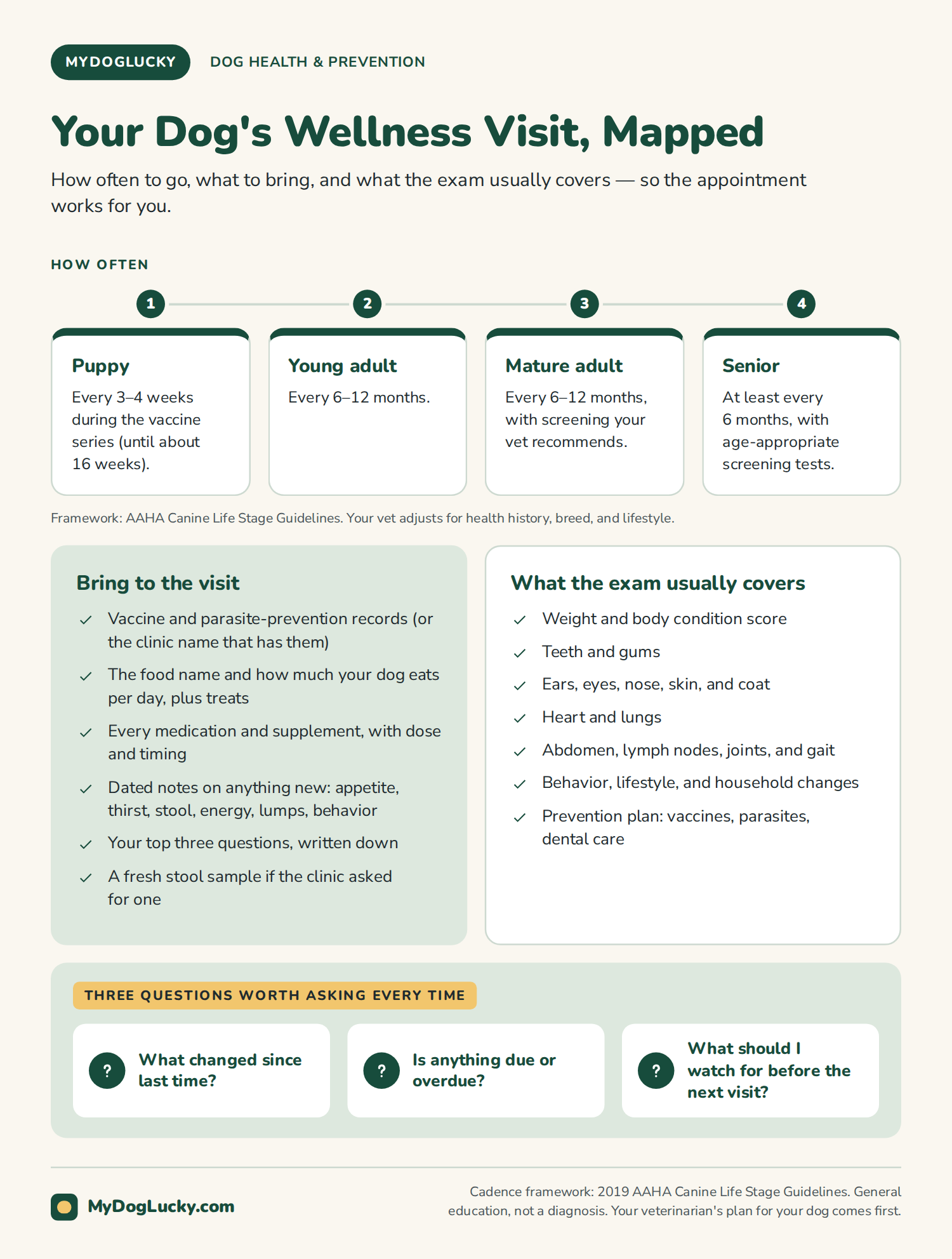
For adult dogs, AAHA’s life-stage framework recommends an exam every 6 to 12 months. Seniors move to at least every 6 months. Puppies come in every 3 to 4 weeks while they finish their vaccine series, which usually wraps up around 16 weeks. Your vet may recommend more frequent visits for a dog with a known condition, a breed-related risk, or a history that needs watching.
If yearly is what your budget or schedule allows, yearly is far better than “when something’s wrong.” Tell the clinic that. Ask them to prioritize what matters most for your dog at that one visit. Preventive dog care that actually happens beats an ideal schedule that doesn’t.
What a wellness exam usually covers
A thorough exam is hands-on from nose to tail. Expect weight and a body condition score. Expect a look at teeth and gums, ears, eyes, skin, and coat. Your vet will listen to the heart and lungs, feel the abdomen and lymph nodes, and watch how your dog moves. The conversation matters as much as the exam: diet, activity, behavior, household changes, travel, and anything you’ve noticed. Then the plan: what’s due, what’s recommended, and what to watch for.
Depending on age and history, your vet may suggest screening: a heartworm test, a stool check, bloodwork, or a urinalysis. Ask what each test is looking for and what would change if the result came back abnormal. A good clinician is glad to explain.
How to prepare so the visit works for you
Most appointments are short. Preparation is how you get the most out of fifteen minutes.
- Bring your records, or know which clinic has them. Vaccine certificates and prevention history save time and avoid repeat shots.
- Know the food and the amount. Brand, formula, cups or grams per day, and the treats. “A scoop” is not a unit.
- List every medication and supplement, including flea and tick products and the joint chew from the pet store.
- Write down your observations with dates. “Drinking more since about the 3rd” beats “maybe drinking more.”
- Bring three questions. Write them on your phone. Ask the most important one first, in case you run out of time.
- Bring a stool sample if asked, fresh and in a sealed bag or container.
After the visit: turn the conversation into dates
The visit isn’t finished when you pay. Before you leave, make sure you know three things: what was done today, what’s due next and when, and what you should watch for at home. Write the next date into your calendar in the parking lot. If lab work was sent out, ask how you’ll get the results and whether “no news” means normal. Small habits like these are what keep preventive dog care from resetting to zero every year.
If your dog finds the clinic stressful, say so when you book. Many practices can schedule a quieter time, let you wait in the car, or suggest a pre-visit calming plan. Some dogs do better with a few happy visits that involve nothing but treats at the front desk. That’s not spoiling anyone. It’s making the next real exam possible.
That’s the ground the Wellness & Vet Visits subcategory is set aside for: preparation, records, what exams and lab work involve, and how the plan gets personalized to your dog.
Symptoms & Urgent Concerns: deciding what to do tonight
This is the section people find at 11 p.m. So we’ll keep it direct. The job here is not to diagnose your dog. It’s to sort what you’re seeing into one of three actions and to give your veterinary team useful information when you call. Triage is the part of preventive dog care that happens after the clinic closes.
Signs that mean emergency care now
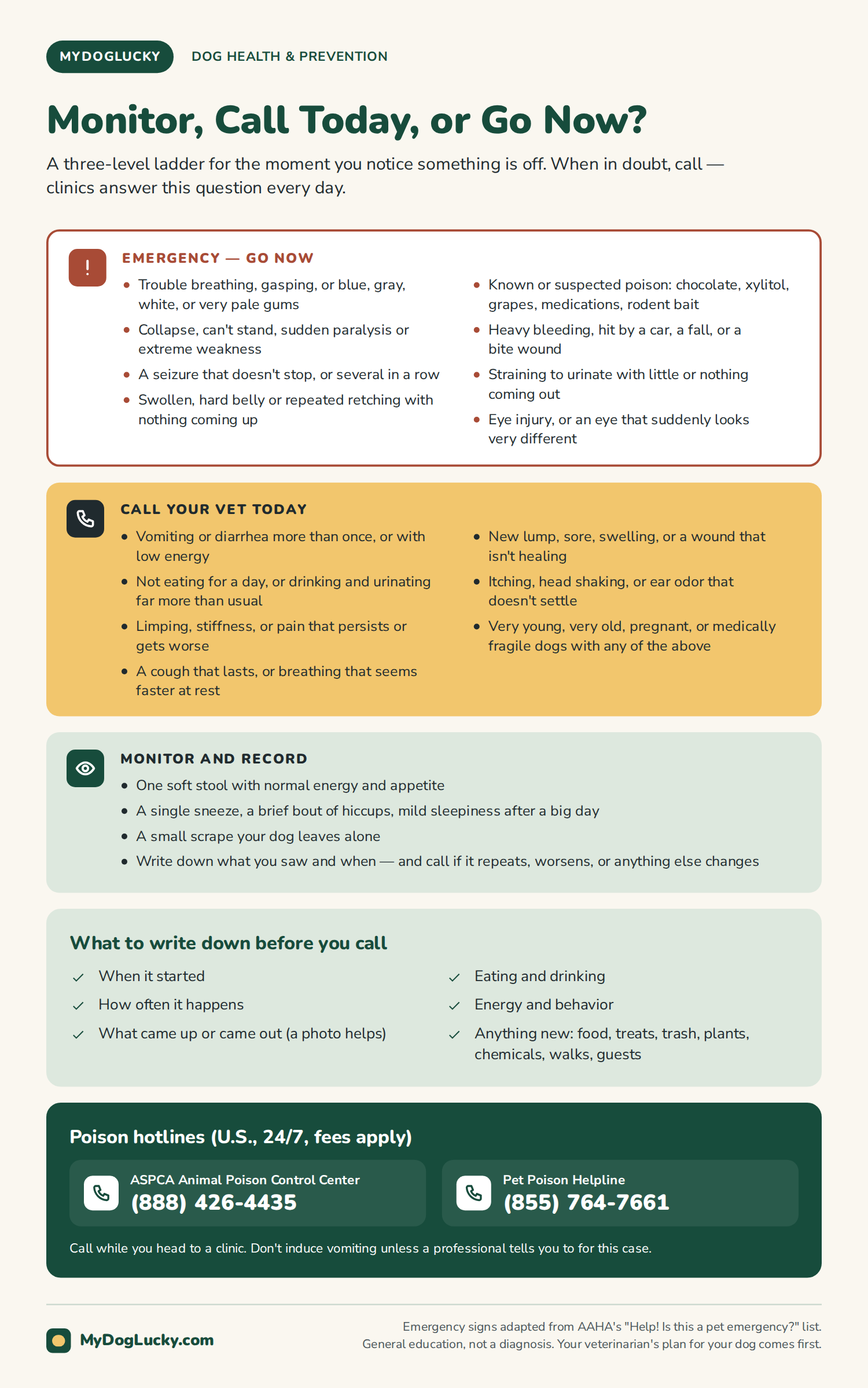
AAHA’s list of pet emergencies is a good anchor. Go to an emergency clinic now, and call on the way, if you see any of these:
- Difficulty breathing, gasping, or gums that look blue, gray, white, or very pale.
- Collapse, inability to stand, or sudden weakness or paralysis.
- A seizure that doesn’t stop, or several seizures close together.
- A swollen, hard belly, especially with retching that produces nothing. In deep-chested dogs this can be bloat, and minutes matter.
- Known or suspected poisoning: chocolate, xylitol (in sugar-free gum and some peanut butters), grapes and raisins, human medications, rodent bait, antifreeze.
- Heavy bleeding, being hit by a car, a serious fall, or a bite wound.
- Straining to urinate with little or nothing coming out.
- An eye injury, or an eye that suddenly looks very different from the other.
Two U.S. hotlines take poisoning calls around the clock, and both charge a consultation fee: the ASPCA Animal Poison Control Center at (888) 426-4435, and the Pet Poison Helpline at (855) 764-7661. Have the packaging in your hand when you call. Do not try to make your dog vomit unless a professional tells you to for this specific case; some substances cause more damage coming back up.
Signs that mean call your vet today
These aren’t sirens, but they aren’t “wait and see for a week,” either. Call the clinic during business hours, describe what you’ve observed, and let them decide on timing.
- Vomiting or diarrhea more than once, or paired with low energy.
- Not eating for a full day, or drinking and urinating noticeably more than usual.
- Limping, stiffness, or signs of pain that persist or get worse.
- A cough that hangs around, or breathing that seems faster at rest.
- A new lump, sore, or swelling, or a wound that isn’t healing.
- Itching, head shaking, or an ear odor that doesn’t settle.
- Any of the above in a puppy, a senior, a pregnant dog, or a dog with a known medical condition.
What you can reasonably monitor at home
A single soft stool in a dog with normal energy and appetite. One sneeze. Sleeping more after a big day at the park. A small scrape your dog leaves alone. In a healthy adult dog, these can be watched. The rule is to decide now what would change your mind: a repeat, a new sign, or 24 hours without improvement. Write it down. Memory is unreliable when you’re worried.
What to record before you call
Clinics triage by phone constantly. You’ll get a faster, better answer if you can describe a few specifics. When it started. How often it’s happening. What came up or came out; a photo of vomit or stool helps more than you’d think. Whether your dog is eating and drinking. How the energy level compares to normal. And anything new in the last few days: new food, new treats, a raid on the trash, a chewed plant, a cleaning product, guests, a boarding stay.
Mention the things that move a dog up the ladder, too. Age at either extreme, pregnancy, a known condition, current medications, and whether your dog is a breed with specific risks. The person on the phone can only weigh what they know.
What not to do
Don’t give human pain relievers. Several are dangerous for dogs, and the ones that aren’t still need veterinary dosing. Don’t use leftover antibiotics from a previous problem. Don’t wait for a red-flag sign to “see if it passes.” And don’t let an internet forum talk you out of a phone call. Your clinic answers this question every day and would rather hear from you early.
That order is the rule for everything filed under Symptoms & Urgent Concerns: what to do first, what a sign can broadly mean, what to observe and record, and what a vet may evaluate. Never a diagnosis from a checklist.
Vaccines & Infectious Disease: core, lifestyle, and why plans differ
Vaccines are the part of preventive dog care with the clearest evidence and the most confusing internet. The confusion usually comes from mixing up two categories. Core vaccines are recommended for every dog because the diseases are severe, widespread, or a risk to people. Lifestyle (noncore) vaccines are recommended based on exposure. Once you separate the two, most of the debate disappears.
The core vaccines every dog needs
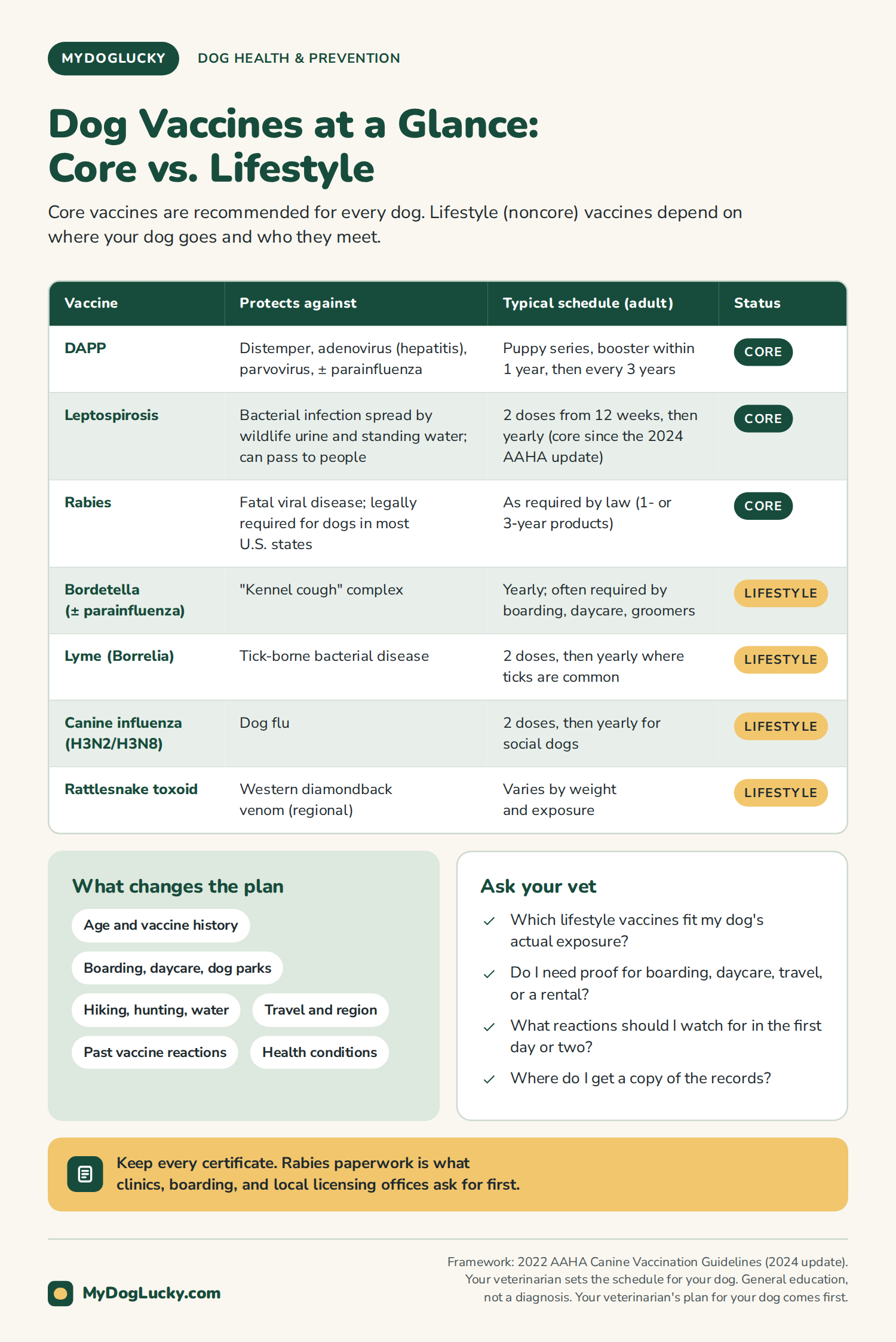
Under the 2022 AAHA Canine Vaccination Guidelines, updated in 2024, three vaccines are core for dogs in the United States.
| Vaccine | Protects against | Typical adult schedule |
|---|---|---|
| DAPP (sometimes DA2PP or DHPP) | Distemper, adenovirus (infectious hepatitis), parvovirus, and usually parainfluenza | Puppy series, a booster within a year of the last puppy dose, then every 3 years |
| Leptospirosis | A bacterial infection carried in wildlife urine and standing water; it can cause kidney and liver failure and can infect people | Two doses starting at 12 weeks, then every year. Reclassified as core in the 2024 update |
| Rabies | A fatal viral disease that also threatens people; vaccination is legally required for dogs in most states | As required by law, with 1-year or 3-year products depending on the product and your state |
The leptospirosis change surprises some owners who were told for years that it was optional. The reasoning behind the update is simple: any dog that goes outdoors, in a city or in the country, can be exposed through puddles, wet grass, and wildlife. Ask your vet how the change applies to your dog.
Lifestyle vaccines depend on where your dog goes
Noncore vaccines are recommended when exposure justifies them. Bordetella, often combined with parainfluenza, protects against the “kennel cough” complex and is commonly required by boarding facilities, daycares, and groomers. Lyme vaccination makes sense where ticks carry the disease and your dog spends time in grass and woods. Canine influenza is a consideration for social dogs in areas with outbreaks. A rattlesnake toxoid exists for dogs with real exposure to western diamondbacks, which is a regional question.
The right answer for your dog isn’t “all of them” or “none of them.” It’s a short conversation about daycare, dog parks, hiking, hunting, water, travel, and the diseases your region actually sees. That conversation is also where past vaccine reactions and current health problems get factored in.
Why not just vaccinate for everything?
Because every vaccine carries a small risk, a cost, and a visit, and a vaccine against a disease your dog will never meet buys nothing. Good preventive dog care matches protection to exposure. That’s also why DAPP boosters moved to a three-year interval for adults: duration-of-immunity studies showed protection lasts well beyond a year for those diseases. Leptospirosis and Bordetella protection is shorter-lived, which is why those stay annual. The schedule isn’t arbitrary. It follows the evidence for each disease.
The puppy series, briefly
Puppies receive a series of DAPP doses between about 6 and 16 weeks, spaced 2 to 4 weeks apart. The series is needed because antibodies from the mother fade at unpredictable times. Leptospirosis starts at 12 weeks. Rabies timing follows state law, commonly around 12 to 16 weeks. Until the series is complete, puppies are vulnerable to parvovirus, so socialization needs planning rather than avoidance. Ask your vet what’s reasonable in your area; the adaptations section below has the short version.
What to expect after a vaccine
Mild soreness, a small lump at the injection site, or a sleepy day are common and usually resolve on their own. Serious reactions are uncommon but real. Facial swelling, hives, repeated vomiting, difficulty breathing, or collapse in the hours after a vaccine is an emergency. Call the clinic or an emergency hospital right away. Tell your vet about any past reaction before the next dose; they may adjust timing, split vaccines across visits, or premedicate.
Records are part of the vaccine
In preventive dog care, a vaccine nobody can prove is a vaccine you’ll be asked to repeat. Keep every certificate, especially rabies, which licensing offices, boarding facilities, and clinics ask for first. A photo in your phone works. So does the clinic portal. If you adopt a dog with an unclear history, your vet may recommend restarting core vaccines. For some diseases, a titer test can check existing immunity instead. Titers can inform DAPP decisions in some cases; they don’t replace rabies vaccination where the law requires it.
Individual vaccines and diseases, such as parvovirus, kennel cough, leptospirosis, and Lyme disease, along with what to ask before boarding or travel, are the territory of the Vaccines & Infectious Disease subcategory.
Parasites & Prevention: a year-round habit, not a summer project
Four groups of parasites drive most of the prevention conversation: heartworms, fleas, ticks, and intestinal worms. Each has a different route into your dog, a different test, and a slightly different home habit. What they share is the recommendation from CAPC and the American Heartworm Society to protect year-round rather than seasonally. Year-round protection is the backbone of preventive dog care against parasites.
Heartworm: prevented monthly, tested yearly
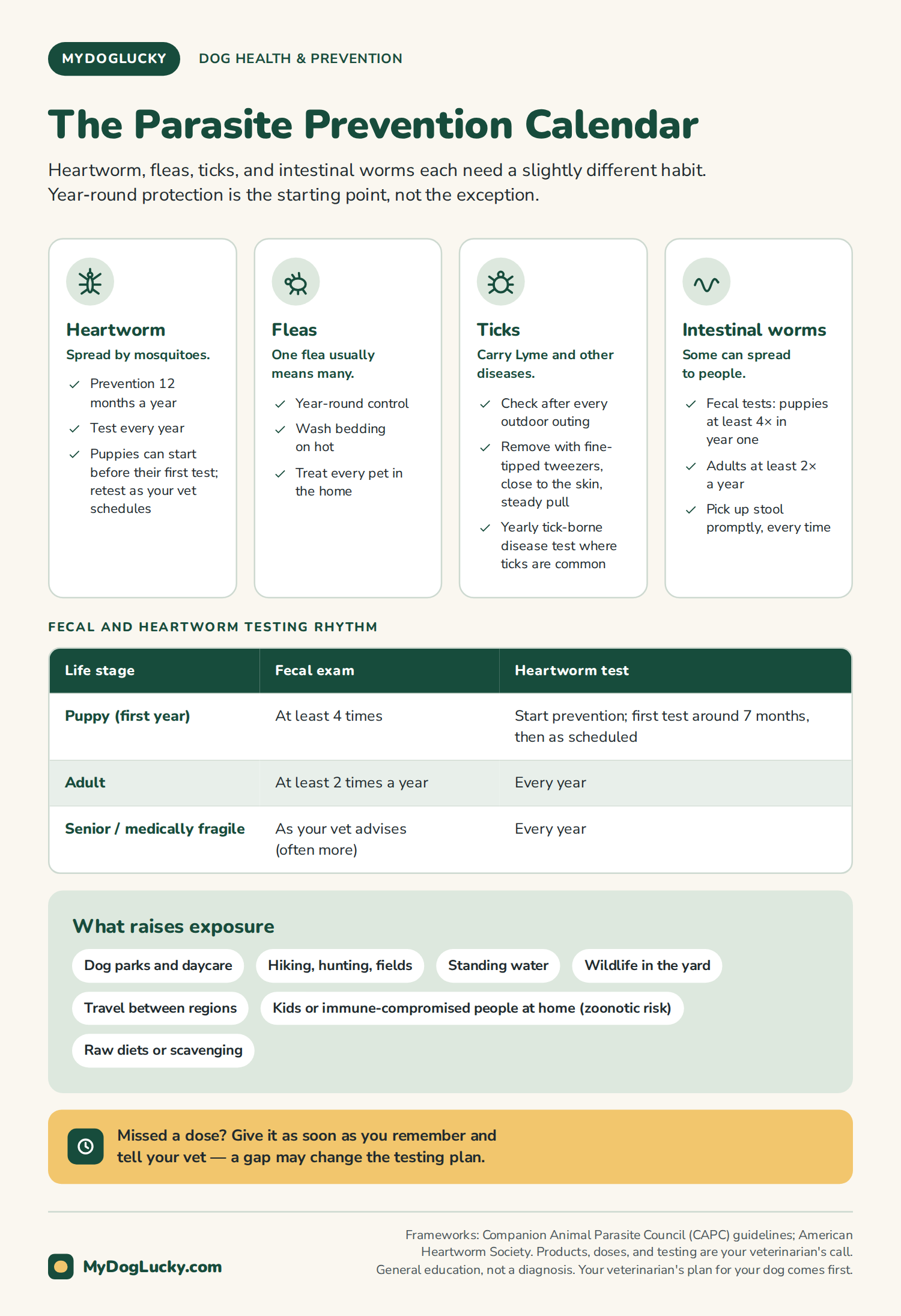
Heartworm is spread by mosquitoes, which is why it isn’t limited to rural dogs or warm states. The American Heartworm Society’s advice fits on a sticky note: think 12. Prevention every month of the year, and a test every year. Puppies can start prevention before their first test because the infection takes about six months to become detectable. Your vet will schedule the first test and the follow-ups from there.
Why test if you’re preventing? Because doses get missed, dogs spit out chews, and no product is perfect. An annual test catches a problem while treatment is still an option and before the disease damages the heart and lungs. In preventive dog care, the test and the prevention are a pair, not alternatives.
Fleas: the whole home, every pet
One flea on your dog usually means many more in the environment. Most of the population lives as eggs and larvae in bedding, carpet, and floor cracks. Year-round control on every pet in the home, plus hot-washing bedding, is what breaks the cycle. Skipping winter is how spring infestations begin, especially in heated homes.
“I never see fleas” isn’t proof of anything. Fleas are small, fast, and good at hiding in a thick coat. Black specks that turn reddish on a damp paper towel are flea dirt, and they’re the usual first sign. Scratching, hair loss over the rump, and a cat who suddenly grooms constantly are others. Preventive dog care for fleas is easier than treating an infestation, which typically takes months of consistent effort.
Ticks: check, remove, and test where it matters
Ticks transmit Lyme disease, anaplasmosis, ehrlichiosis, and others, and their range keeps expanding. After outdoor time, run your hands over your dog with attention to ears, neck, armpits, groin, and between the toes. To remove a tick, use fine-tipped tweezers, grasp it as close to the skin as possible, and pull straight out with steady pressure. Then clean the spot and note the date. CAPC recommends annual testing for tick-borne diseases in regions where they are established or emerging. Ask your clinic whether that includes yours.
Intestinal worms: the test you don’t see
Roundworms, hookworms, whipworms, and tapeworms are common, mostly invisible, and in some cases transmissible to people, particularly children. CAPC recommends fecal testing at least four times in a puppy’s first year and at least twice a year for adults, adjusted for lifestyle and exposure. The unglamorous home habit is picking up stool promptly, every time, including in your own yard.
Choosing products is your veterinarian’s call
Prevention comes as monthly chews, topical liquids, longer-acting injections, and combination products that cover several parasites at once. Which one fits depends on your dog’s weight, health, other medications, your region, and what your household can reliably keep up. We don’t recommend specific products in this guide. We do recommend one question. “Which combination covers what my dog is actually exposed to, and what is the simplest schedule for us to keep?”
A note on buying prevention outside the clinic. Some products are prescription-only because they need a current heartworm test or a weight check first. Online pharmacies that ask for a prescription are working as intended. Sellers that don’t ask are a reason to be careful; counterfeit and mislabeled parasite products exist. When in doubt, ask your clinic which sources they trust.
What raises exposure
Dog parks and daycare. Hiking, hunting, fields, and standing water. Wildlife in the yard. Travel between regions. Scavenging or raw diets. Young children or immune-compromised people at home, which raises the stakes on the parasites that can spread to people. None of these mean your dog can’t live that life. They mean the prevention plan should match it.
Missed a dose? Give it as soon as you remember and tell your clinic. Depending on the gap and the product, they may adjust the next test. Product choices, testing, travel, and local exposure are the questions the Parasites & Prevention subcategory is built to answer.
Common Conditions & Recovery: following the plan at home
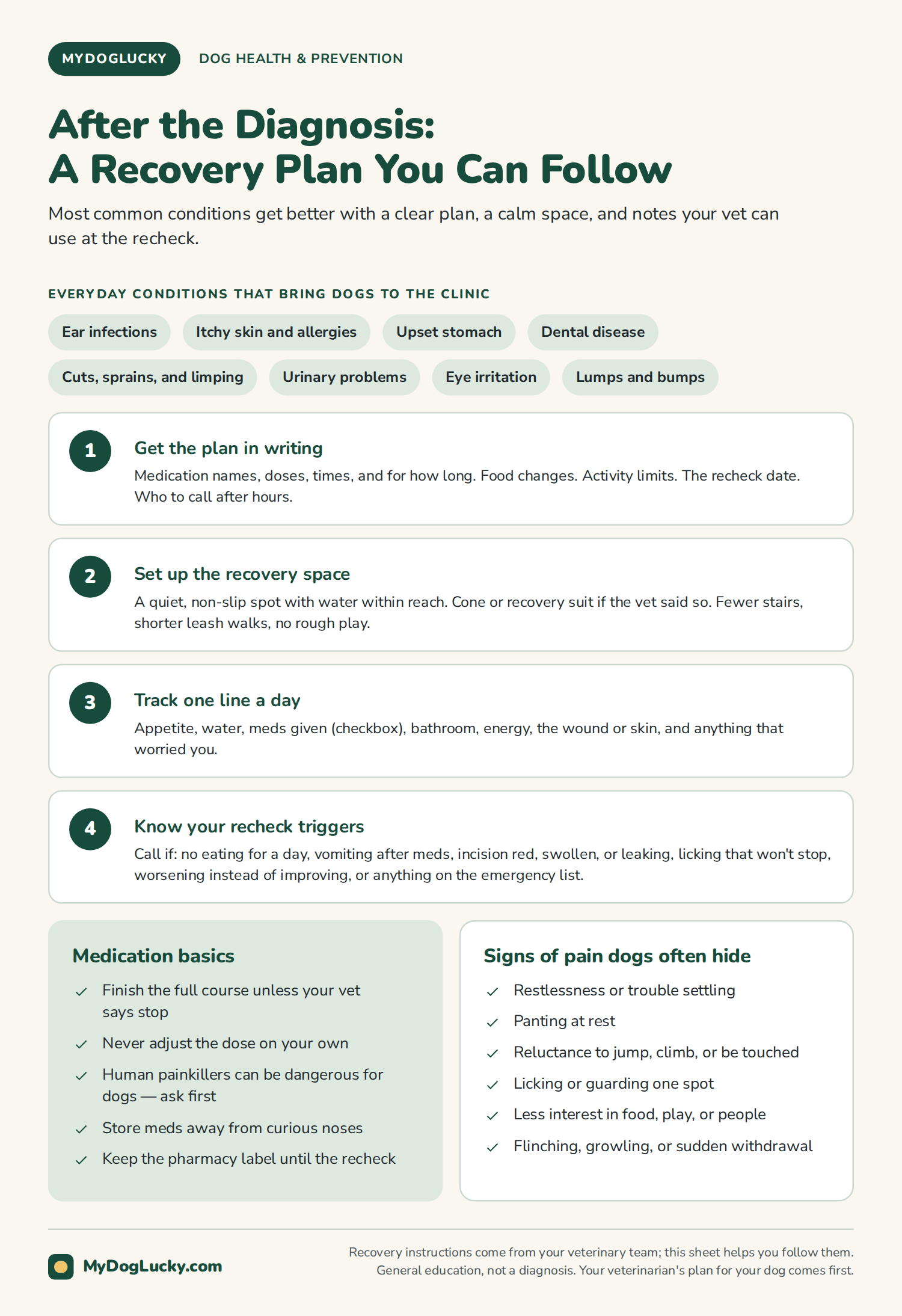
Even with good preventive dog care, most dogs will see the clinic for something ordinary. An ear infection. Itchy skin. An upset stomach, a sprain, a cracked tooth, a urinary issue, a lump that needs a look. The diagnosis is the vet’s job. The recovery mostly happens in your living room, and that’s where plans quietly fall apart.
Recovery is preventive dog care in miniature. There’s a plan, a log, and a recheck. The same habits that keep a healthy dog healthy are the ones that get a sick dog better faster.
Two conditions preventive dog care can actually prevent
Most common conditions are hard to prevent outright. Two aren’t, and both are worth naming because they’re so widespread.
Dental disease. Cornell’s veterinary college puts it plainly: 80 to 90% of dogs over age 3 have some degree of periodontal disease, and it’s worse in small breeds. The mainstay of prevention is daily brushing with a pet toothpaste, plus professional cleanings under anesthesia when your vet recommends them. Products carrying the Veterinary Oral Health Council (VOHC) seal have evidence behind them; most others don’t. If daily brushing isn’t realistic in your household, tell your vet and build the best routine you can. Three times a week beats zero.
Excess weight. The Association for Pet Obesity Prevention’s 2022 survey classified 59% of U.S. dogs as overweight or obese. Extra weight loads joints, worsens arthritis, and complicates anesthesia and many chronic diseases. Prevention is a body condition check at every visit, measured meals, and treats that count toward the daily total. There’s no shame in a dog who has gained weight. There’s a lot of value in noticing early.
The four-step recovery plan
Whatever the diagnosis, the same four steps make recovery smoother.
- Get the plan in writing before you leave. Medication names, doses, times, and duration. Food changes. Activity limits. The recheck date. Who to call after hours. If the discharge sheet doesn’t say, ask.
- Set up the space. A quiet, non-slip spot with water within reach. The cone or recovery suit if the vet said so, for as long as they said so. Fewer stairs, shorter leash walks, no rough play with other pets.
- Track one line a day. Appetite, water, meds given (a checkbox), bathroom, energy, the wound or skin, and anything that worried you. It takes thirty seconds and it’s what the recheck is built on.
- Know your recheck triggers. Call if your dog won’t eat for a day, vomits after medication, the incision looks red, swollen, or leaks, the licking won’t stop, or things get worse instead of better. Anything on the emergency list still means go now.
Medication basics that prevent second visits
Finish the full course unless your vet tells you to stop, even when your dog looks better halfway through. Never change a dose on your own. Never give human pain relievers without asking; some are dangerous for dogs. Keep medications well away from curious noses, and keep the pharmacy label until the recheck so you can answer “what exactly is she taking?” without guessing.
Pain signs dogs hide
Dogs rarely cry out. They get restless and struggle to settle. They pant at rest. They hesitate before jumping, climbing, or being touched. They lick or guard one spot. They lose interest in food, play, or people, or flinch and withdraw. If you see these during recovery, call. Pain that isn’t controlled slows healing and is worth a conversation, not a wait.
Ears, skin, and stomachs: what to note for the recheck
Three of the most common reasons for a visit come with a recognizable pattern, and your notes can shorten the road to a diagnosis. For ears, note which ear, whether there’s odor or discharge, how much head shaking, and whether it follows swimming or baths. For skin, note where the itching is, whether it’s seasonal, what the diet and treats are, and whether anyone else in the home is itchy.
For digestive upsets, note the timing relative to meals, what the stool looks like, and any dietary change or scavenging. Recurring problems in any of these areas are a preventive dog care conversation in themselves. Ask your vet whether there’s an underlying cause worth chasing, rather than treating the same thing four times a year.
Individual conditions and the practical side of recovery, from cones and confinement to medication routines and coordinating several caregivers, are what the Common Conditions & Recovery subcategory is for.
Chronic Health & Comfort: living well with what doesn’t go away
Some conditions are managed rather than cured. Arthritis, heart disease, kidney disease, diabetes, Cushing’s disease, hypothyroidism, epilepsy, chronic allergies. Preventive dog care doesn’t stop at diagnosis. It changes shape. The focus shifts from avoiding disease to protecting comfort, catching the next change early, and keeping the plan sustainable for you as well as your dog.
Track the pattern, not the bad day
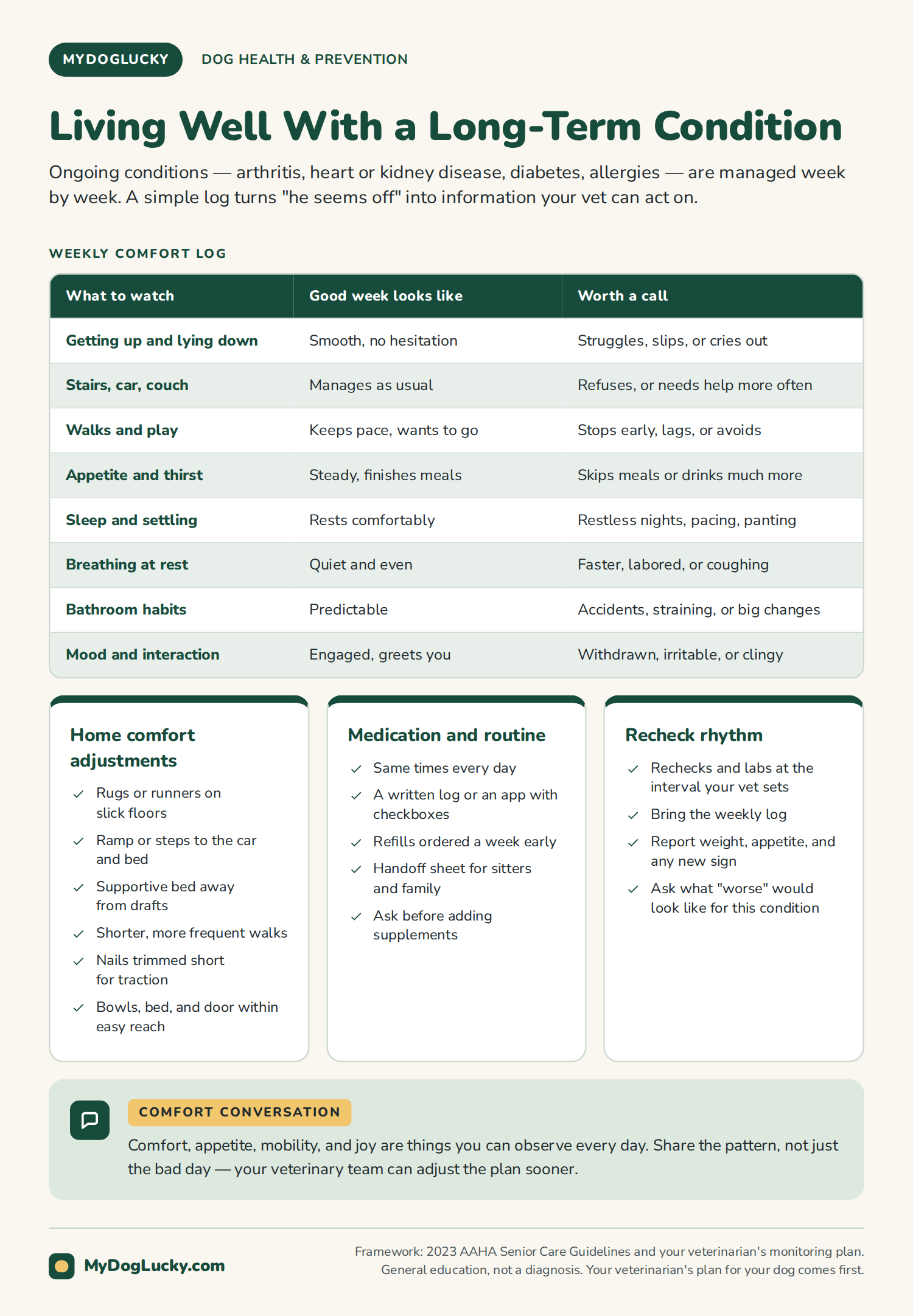
With a chronic condition, the most useful thing you can bring to a recheck is a pattern. Was this a hard week or a hard Tuesday? Is the morning stiffness lasting longer than it did in the spring? A weekly comfort log answers those questions with observations instead of impressions.
Watch a short list: getting up and lying down, stairs and the car, walks and play, appetite and thirst, sleep and settling, breathing at rest, bathroom habits, and mood. For each, know what a good week looks like for your dog and what’s worth a call. For a dog with heart disease, many veterinarians ask owners to count breaths while the dog sleeps and to call if the number climbs above a threshold they set. For a dog with kidney disease, water intake and appetite carry the story. Your vet will tell you which two or three items matter most for your dog’s condition.
Home adjustments that make a real difference
Rugs or runners on slick floors. A ramp or steps to the car and the bed. A supportive bed away from drafts. Shorter, more frequent walks instead of one long one. Nails trimmed short for traction. Bowls, bed, and door within easy reach. None of this is expensive, and most of it helps immediately. Room-by-room home setups belong to the Senior Dog Care category; the clinical side of mobility and pain stays here in Health.
A medication routine you can keep
Chronic medication fails on logistics. Give doses at the same times every day and tie them to something that already happens, like breakfast and the evening news. Use a written log or a pill organizer with checkboxes so two caregivers don’t double a dose. Order refills a week early. Write a handoff sheet for sitters and family. And ask before adding any supplement, because “natural” doesn’t mean it can’t interact with a prescription.
Rechecks, labs, and the questions to ask
Your vet will set a recheck interval and a lab schedule for the condition. Keep them, even in stable stretches; stability is what the labs confirm. In chronic disease, rechecks are the wellness visits of preventive dog care. Bring the comfort log, the medication log, and a current weight. Ask what “worse” would look like for this condition, so you know what to call about between visits. Ask what the next decision point is likely to be, and what would trigger it.
Weight and pain: the two levers you can always pull
Two things improve nearly every chronic condition. The first is a healthy weight, because extra pounds load arthritic joints, strain the heart, and complicate diabetes. The second is pain control that’s actually reviewed, because pain changes appetite, sleep, mobility, and mood, and it hides well. Ask at every recheck whether your dog’s weight is where it should be and whether the pain plan still fits. Preventive dog care for a dog with a chronic condition often comes down to those two questions, asked regularly.
Comfort conversations and the caregiver
Comfort, appetite, mobility, and joy are things you can observe every day. Share the pattern with your veterinary team and they can adjust the plan sooner. When a condition progresses, ask for a quality-of-life conversation before you feel you need one. It’s easier to think clearly early, and it gives you and your vet shared language for later.
Caring for a dog with a chronic condition is work, and the emotional part of it is real. You can love your dog completely and still need a break, a second caregiver, or a plan that fits the life you actually have. That’s what the Owner Well-Being & Support subcategory, under Life With Your Dog, is for. On the health side, individual conditions, pain conversations, and coordinated care with specialists are the scope of Chronic Health & Comfort.
Adapting preventive dog care to your dog and your household
The plan in the short version is a template for a healthy adult dog in an average home. Very few dogs are average, and no home is. This section covers the adjustments that come up most.
Puppies: frequent visits and a careful social calendar
Puppyhood is the most visit-dense stage of preventive dog care. Expect an appointment every 3 to 4 weeks until about 16 weeks. Those visits cover the DAPP series, leptospirosis from 12 weeks, rabies per state law, deworming, and the start of heartworm and flea-tick prevention. CAPC recommends at least four stool tests in the first year. Puppies pick up intestinal parasites easily and often arrive with them.
The hard balance is socialization versus parvovirus. Puppies need positive exposure to people, sounds, surfaces, and calm dogs during a window that closes before the vaccine series does. The answer isn’t isolation. It’s choosing low-risk settings: known vaccinated dogs, your own yard, puppy classes that require vaccination, carrying your puppy in busier places. Ask your vet what’s reasonable in your area.
Spay, neuter, and intact dogs
Spay and neuter timing used to have one default answer. It doesn’t anymore. Recommendations now vary by breed, size, and sex, because the timing can affect joint development and some cancer risks in larger dogs. Ask your vet what the current evidence suggests for a dog like yours, and expect a discussion rather than a rule.
If your dog stays intact, preventive dog care has a few extra items. Intact females can develop pyometra, a uterine infection that is an emergency, so any lethargy, vomiting, or discharge after a heat cycle is a call-today sign. Intact males benefit from prostate and testicular checks at wellness visits. And both need a plan for preventing accidental litters, which is a welfare issue as much as a household one.
Young and mature adults: the years it’s easy to coast
Between roughly 1 and 7 years, most dogs are healthy and visits can feel like formalities. They aren’t. This is when weight creeps up and dental disease takes hold. It’s when the lifestyle vaccine list should be revisited as your dog’s social life changes. It’s also the best time to establish baseline bloodwork, so the numbers at 8 or 9 have something to be compared to. Preventive dog care in these years is mostly about weight, teeth, and a baseline. Ask your vet when a baseline panel makes sense for your dog.
Seniors: twice a year, and a lower threshold to call
AAHA’s 2023 Senior Care Guidelines recommend a medical workup once or twice a year for senior pets. That workup may include a complete blood count, a chemistry panel, and a urinalysis, alongside a full exam. The point is to catch kidney disease, endocrine disease, and other age-related conditions while they’re manageable. Between visits, the threshold for a call drops. A senior dog who skips a meal, drinks more, slows on walks, or seems confused at night deserves a phone call, not a wait. The appointment itself, and how to prepare for it, is Senior Dog Care territory.
Size and breed change the risks, not the rules
Giant breeds reach the senior stage years earlier than small breeds, so their “twice a year” starts sooner. Small breeds carry more dental disease and often need earlier, more frequent cleanings. Deep-chested dogs have a higher risk of bloat, which is why the emergency list flags a swollen, hard belly. Flat-faced breeds overheat and struggle to breathe more easily. For them, heat, exercise, and anesthesia conversations matter more. Many breeds have known screening recommendations for eyes, hips, heart, or specific inherited conditions. You don’t need to memorize them. Ask your vet: “Is there any breed-related screening you’d recommend for a dog like mine?”
Multi-dog and multi-species homes
Parasite control only works if every animal in the home is covered. The untreated cat is where the fleas live. Kennel cough and canine influenza move quickly between dogs, so a coughing dog should be separated while you call the clinic. Keep each animal’s records separate, and label medications clearly. It’s easier than you’d think to give the big dog’s heartworm chew to the small one.
Households with children or immune-compromised people
Some dog parasites and leptospirosis can affect people. In homes with young children, pregnant people, older adults, or anyone with a weakened immune system, prevention carries extra weight. Keep deworming and fecal testing on schedule, pick up stool promptly, keep sandboxes covered, and make handwashing after play a routine. Tell your vet about the household; it can shift which tests and products they recommend.
When money is the constraint
Preventive dog care costs money, and pretending otherwise helps no one. If the full plan isn’t possible right now, prioritize with your vet’s input. Rabies comes first, because it’s legally required and protects people. Then the other core vaccines. Then heartworm prevention and testing, and an annual exam. Lifestyle vaccines and broader screening come after that. Ask the clinic about wellness plans that spread costs monthly. Ask about low-cost vaccine clinics run by shelters or humane societies, and about veterinary teaching hospitals if one is nearby. Ask for an estimate before any procedure. Most clinics respect a client who says “here’s what I can do this year; help me spend it well.”
When the nearest clinic is far away
Rural owners and people without a car face a different problem: access. Preventive dog care at a distance is mostly about planning ahead. Plan the emergency route before you need it. Know which hospital is open overnight and how long the drive takes. Save the poison hotline numbers. Ask your regular vet whether they offer telehealth for follow-ups and triage. It can’t replace an exam, but it can help you decide whether a drive is needed. Keep a small home kit: gauze, a muzzle your dog is comfortable with, your dog’s records, and a carrier or blanket for lifting an injured dog.
The dog who hates the clinic
Fear of the vet is common, and it undermines preventive dog care because scared owners postpone visits. Tell the clinic in advance. Ask about a quieter appointment slot, waiting in the car, and treats during the exam. Ask whether a short pre-visit medication might help your dog. Practice at home: gentle handling of paws, ears, and mouth, paired with something good. Some practices follow low-stress handling approaches and will tell you so if you ask. A dog who can be examined is a dog who gets examined.
A yearly preventive dog care routine you can actually run
Knowledge doesn’t protect dogs. Routines do. This section turns preventive dog care into a calendar with a small number of repeating habits. Adjust it with your vet, then put the recurring items in whatever reminder system you already trust. A chew forgotten in a drawer protects no one.
The routine at a glance
| How often | What to do | Why it matters |
|---|---|---|
| Daily | Measured meals and counted treats. Fresh water. A glance at appetite, energy, stool, and behavior. Tooth brushing if you can. Tick check after outdoor time in tick season. | Daily glances build the baseline. Brushing is the home habit with the strongest evidence against dental disease. |
| Weekly | Hands over the whole body: lumps, skin, ears, paws, nails. Quick look at teeth and gums. Weigh small dogs on a bathroom scale (hold dog, subtract yourself). Note anything new in your log. | Most lumps, ear problems, and skin issues are found by owners. Weekly beats “eventually.” |
| Monthly | Heartworm and flea-tick prevention on the same day each month, or as your product’s schedule requires. Check food supply and refills. Count resting breaths once. | Year-round protection is the CAPC and American Heartworm Society baseline. Same-day dosing is the easiest habit to keep. |
| Every 6 months | Wellness exam for seniors and for any dog your vet wants seen more often. Stool test for adults. Review the medication list and the comfort log if you keep one. | Seniors change quickly. Two stool tests a year is the CAPC adult minimum. |
| Yearly | Wellness exam for adults. Heartworm test. Tick-borne disease test where recommended. Vaccines due this year. Bloodwork and urinalysis if recommended. Update records, license, and microchip contact info. | The annual visit is where the plan is reviewed and the screening happens. |
| Every 3 years | DAPP booster for adults; rabies according to the product and your state’s law. | Follows the AAHA schedule after the initial series and first booster. |
| As needed | Dental cleaning when your vet recommends it. Lifestyle vaccines before boarding, daycare, or travel. Extra fecal tests after travel or a new pet. A recheck after any illness. | Event-triggered, not calendar-triggered, and easy to forget without a note. |
The five-minute home check
Once a week, when your dog is relaxed, do a quick, unhurried once-over. Start at the head: eyes clear, no discharge; ears clean, no odor or redness; lips lifted, gums pink, no broken teeth or heavy tartar. Run your hands down the neck, back, and sides, feeling for lumps, scabs, or tender spots. Check each paw, between the toes, and the nail length. Lift the tail and look. Finish by watching your dog stand up and walk a few steps. Anything new goes in the log with the date.
This isn’t a medical exam, and it doesn’t replace one. It’s how owners find the things that get mentioned at the next visit. It’s how a small lump gets checked at pea size instead of walnut size. It’s also the preventive dog care habit most owners skip and most vets wish they’d keep.
Reminders that survive a busy month
The routine only works if it fires on its own. A few approaches that owners report keeping for years: give prevention on the first of the month, or on the day a recurring bill arrives, so the date has a built-in cue. Put the yearly and six-month items in a calendar with a two-week warning, not a same-day alert. Ask the clinic to send reminders and to tell you what’s due when you call for anything else. And keep prevention where you’ll see it, not in the cabinet with the sunscreen you also forget. Preventive dog care runs on cues, not willpower.
Seasonal notes for U.S. households
Preventive dog care is year-round, but the risks shift with the calendar.
- Spring: tick season begins in earnest, and standing water raises leptospirosis exposure. Confirm that prevention never lapsed over winter. Allergies often flare; itching and ear problems climb.
- Summer: heat is the emergency risk, especially for flat-faced, overweight, and senior dogs. Walk early or late, never leave a dog in a parked car, and know the signs of overheating: heavy panting, drooling, bright red gums, stumbling. Mosquito season means heartworm season; keep dosing on schedule.
- Fall: wild mushrooms, antifreeze, and rodent baits appear. Ticks stay active until hard frost in many areas. Shorter days mean more walks in the dark, so a reflective collar or light earns its place.
- Winter: ice-melt salt burns paws and can be toxic if licked off; rinse feet after walks. Arthritic dogs stiffen in the cold. Fleas move indoors and thrive in heated homes. Holidays bring chocolate, xylitol, fatty leftovers, and guests who leave doors open.
A worked example: one year for a healthy adult dog
This is a hypothetical example, not a prescription. Imagine a 4-year-old, 50-pound mixed-breed dog in a suburb with real tick exposure and occasional daycare. In January, the annual wellness exam happens. Full physical, weight and body condition, heartworm and tick-borne disease test, stool test, rabies booster due this year, and a leptospirosis booster. The vet notes early tartar and suggests a cleaning in the next six months. Bordetella is updated because daycare requires it. The owner leaves with the plan written on the discharge sheet and the next fecal test scheduled for July.
Monthly, on the same date, heartworm and flea-tick prevention go in with breakfast. Weekly, the five-minute home check. In April, the owner finds a tick behind the ear, removes it with tweezers, and notes the date. In May, the dental cleaning happens, and the owner starts brushing three nights a week. In July, the stool test comes back clear. In October, the dog eats something in the yard and vomits twice with low energy. The owner calls the clinic, brings the dog in the same day, and it resolves with supportive care. Everything goes into the log. In January the cycle starts again, with one useful difference: the vet now has a full year of notes to compare against.
That’s the whole system. Nothing in it is heroic. It’s the accumulation of small, boring, repeated actions that makes preventive dog care work.
Troubleshooting: when the plan meets real life
Every preventive dog care plan gets tested by something the plan didn’t anticipate. These are the situations owners write to us about most, with the practical next step for each.
“My dog spits out the chew” or “the topical rubbed off”
Watch the whole swallow, and check the mouth if you’re unsure. If a chew comes back up within an hour or two, call the clinic before re-dosing; the answer depends on the product. Topicals need to reach skin, not just coat, and most shouldn’t be followed by a bath for a set number of days. If your dog defeats every format, tell your vet. Longer-acting injectable options exist for some parasites, and a product that gets given beats a better one that doesn’t.
“I missed a month of heartworm prevention”
Give the dose as soon as you remember and restart the monthly rhythm. Then call the clinic and tell them the length of the gap. Because heartworm infection isn’t detectable for about six months, your vet may want to test again later than usual. Don’t hide the gap out of embarrassment. It’s common, and it changes the testing plan, not your standing as an owner.
“I adopted a dog with no history”
Assume nothing is current. Your vet will likely recommend a full exam, a heartworm test, a stool test, and a restart of core vaccines. Titer testing may be a reasonable option for some of them. Rabies will be given because the law requires proof. Start parasite prevention right away. Ask the shelter or rescue for whatever paperwork exists, even partial; a single dated vaccine record can save a repeat.
“My vet says one thing and the internet says another”
Ask your vet to explain the reasoning. Most disagreements dissolve once you hear the “why”: your region, your dog’s history, a newer guideline, or a product’s label. If the explanation doesn’t satisfy you, a second opinion from another veterinarian is reasonable and normal. A forum post is not a second opinion. Neither is this page.
“Appointments feel rushed and I leave without answers”
Book a longer slot and say why when you call. Bring your three questions and ask the most important one first. Ask for the plan in writing before you leave. If it keeps happening, it’s fair to try another practice. The relationship with your veterinary team is part of preventive dog care, and it’s allowed to matter.
“I can’t get an appointment for weeks”
Many areas have veterinary staffing shortages. Get on the schedule for the wellness visit anyway, then ask about a cancellation list. For anything on the “call today” list, say so plainly; clinics triage, and describing what you see helps them fit you in or refer you to an urgent-care practice. For emergencies, don’t wait for your regular clinic. Go.
“The clinic keeps recommending tests I didn’t ask for”
Ask two questions about each one: “What is this looking for?” and “What would change if it’s abnormal?” Good recommendations have clear answers. Then ask what it costs and whether it can be staged. You’re allowed to decline a test, and you’re allowed to say you’ll do it next visit. What you want to avoid is declining without understanding, because some screening in preventive dog care is exactly what catches a treatable problem early. If the answers never feel clear, that’s information about the clinic, not about you.
“Boarding requires a vaccine my vet didn’t recommend”
Facilities set their own rules, and they’re allowed to. Bordetella and canine influenza are the usual ones. Ask your vet whether the vaccine is reasonable for your dog given the stay, and give the facility enough lead time; some vaccines need two doses weeks apart before they count. If your dog has a medical reason not to receive a vaccine, ask your vet for a written note and ask the facility whether they accept it.
“My dog had a vaccine reaction and I’m nervous about the next one”
Tell the clinic exactly what happened and when. Mild reactions often don’t change the plan; more significant ones might lead to splitting vaccines across visits, premedication, a different product, or a longer observation period after the injection. Skipping core vaccines entirely is rarely the safer choice, but the decision belongs in a conversation with your vet, not in a worry you carry alone.
“Two of us share care and doses get doubled or missed”
One log, visible to everyone: a whiteboard on the fridge, a shared note, or a pill organizer with the days marked. Whoever gives a dose initials it. Set one monthly prevention date the household knows, like the first of the month. For dogs on chronic medication, a doubled dose can be an emergency, so the log isn’t optional.
“We’re moving to a different part of the country”
Parasite and disease risks are regional. Heartworm pressure, tick species, leptospirosis exposure, and even rattlesnake risk vary by state. Before the move, get a copy of the full record. After the move, book a visit with the new clinic and ask what changes for a dog in this area. Travel between regions is also a reason for an extra stool test.
“Is this just old age?”
Slowing down, drinking more, stiffness, confusion at night, and new accidents are often blamed on age. Many have treatable causes: arthritis pain, kidney or endocrine disease, dental pain, cognitive decline that responds to management. Record specific examples with dates and bring them to a senior visit. “He’s just old” is a conclusion your vet can reach after an exam. It shouldn’t be your starting assumption.
“There’s too much to keep track of”
Then keep track of less. The preventive dog care minimum that protects most dogs is short: a yearly exam, core vaccines, monthly prevention, and a phone call when something changes. Everything else in this guide is a way to do that minimum well. Start there, use the organizer to hold the dates, and add habits only as they fit.
Two tools: the vet-visit organizer and the observation log
These two worksheets are the original asset of this cornerstone and the working end of preventive dog care. They’re deliberately plain. Copy them into a notes app, print them, or screenshot them. The value is in filling them out, not in the format. Both were built to match what clinicians commonly say they wish owners brought to appointments.
Tool 1: the vet-visit organizer
Fill in the top half once and update it after each visit. Fill in the bottom half before each appointment.
| Part A — Your dog’s standing record (update after each visit) | |
|---|---|
| Dog, age, weight, body condition score | Name · date of birth or estimated age · last recorded weight and date · last BCS |
| Clinic and emergency contacts | Regular clinic phone · nearest 24-hour hospital and drive time · poison hotline: ASPCA (888) 426-4435, Pet Poison Helpline (855) 764-7661 |
| Vaccines | DAPP: last date, next due · Leptospirosis: last, next · Rabies: last, next, certificate location · Lifestyle vaccines: which, last, next |
| Parasite prevention | Heartworm product and monthly date · Flea-tick product and date · Last heartworm test and result · Last stool test and result · Last tick-borne disease test |
| Food | Brand and formula · amount per day (cups or grams) · treats and roughly how many · any supplements |
| Medications | Name · dose · times per day · started · prescribed for · refills remaining |
| History | Past conditions, surgeries, reactions to vaccines or medications, allergies · breed-related screening done or recommended |
| Lifestyle | Daycare or boarding · dog parks · hiking, hunting, water · travel in the last year · other pets · children or immune-compromised people at home |
| Part B — This appointment (fill in the night before) | |
|---|---|
| Reason for the visit | Wellness · recheck · new concern (which) |
| What’s changed since the last visit | Appetite · thirst · weight · energy · stool or urine · behavior · lumps · anything else, each with an approximate start date |
| What’s due or possibly overdue | Check Part A; list anything with a passed or unknown date |
| My three questions, most important first | 1. · 2. · 3. |
| Constraints the clinic should know | Budget for this visit · schedule limits · dog’s stress at the clinic · who else gives care at home |
| Before I leave, I will have | The plan in writing · next appointment date · what to watch for · who to call after hours |
Tool 2: the observation log
Use the log any time something changes, during recovery from an illness, or weekly for a dog with a chronic condition. One line per day is enough. The goal is to turn “she’s seemed off lately” into a dated sequence a clinician can act on.
| Column | What to write | Example entry |
|---|---|---|
| Date and time | When you observed it, not when you wrote it down | Tue 3/12, 7:40 a.m. |
| What I saw | Observable facts, not interpretations | Vomited once, yellow liquid, no food in it |
| Appetite and water | Ate all, some, none · drank normal, more, less | Ate half of breakfast; drank normally |
| Bathroom | Stool: normal, soft, liquid, blood, mucus · urine: normal, more, straining, accidents | Soft stool at 6 a.m., normal color |
| Energy and behavior | Compared to normal for this dog | Slower on walk, went back to bed after |
| Medications given | Name, dose, time, initials of who gave it | Antibiotic 8 a.m. — Z. |
| Anything new | Food, treats, trash, plants, chemicals, guests, boarding, new pet | Got into the compost Monday evening |
| Action taken | Monitor · called clinic (what they said) · visit · emergency | Called clinic 9 a.m.; advised bland diet and recheck by phone tomorrow |
A question bank for the appointment
If you’re not sure what to put in the “three questions” field, borrow from this list. They’re ordered by the six areas of preventive dog care, and any one of them can start a useful conversation.
- Wellness: “Is my dog’s weight and body condition where you’d want it?” “Is there any screening you’d recommend at this age that we haven’t done?”
- Symptoms: “What signs would you want a call about between now and the next visit?” “For a dog like mine, what counts as an emergency?”
- Vaccines: “Which vaccines are due this year, and which lifestyle vaccines fit what my dog actually does?” “Do I need any proof for boarding or travel?”
- Parasites: “Does our prevention cover what’s common here?” “When is the next heartworm and stool test?”
- Conditions: “This keeps coming back. Is there an underlying cause worth investigating?” “What’s the plan if this treatment doesn’t work?”
- Chronic: “What would ‘worse’ look like for this condition?” “Is the pain plan still right, and is the weight helping or hurting?”
Two worked examples (hypothetical)
Example 1: the skipped dinner. A 6-year-old Labrador mix skips dinner on Sunday. The owner logs it: ate nothing at 6 p.m., drank normally, played in the evening, no stool since morning. Monday breakfast: ate half. Monday evening: ate all, one soft stool. Tuesday: normal. Because energy stayed normal and the pattern improved within 24 hours, this stayed at “monitor.” The log gets mentioned at the next wellness visit, where the vet asks whether it has recurred. It hasn’t. Nothing more is needed, but the record exists if it happens again.
Example 2: the senior who’s “just slowing down.” An 11-year-old Beagle has been drinking more for a couple of weeks, according to the owner’s vague sense. The owner starts the log: Tuesday, refilled the bowl three times instead of the usual once; Wednesday, an overnight accident, first in years; Thursday, drank three bowls again and ate less. That’s a “call today” pattern in a senior, and the dated entries make the phone call concrete. The clinic books an appointment and asks for a urine sample. The owner arrives with Part B of the organizer filled in and the log in hand. Whatever the diagnosis turns out to be, the visit starts from information instead of impressions.
Neither example tells you what the dog had. That’s intentional. The tools don’t diagnose. They make your veterinarian’s diagnosis faster, cheaper, and more likely to be right.
Working with your veterinary team: limits, second opinions, and money
This guide explains the framework of preventive dog care. It can’t examine your dog, and it doesn’t try to. A few boundaries are worth stating clearly, along with the parts of the vet relationship that owners often don’t realize they’re allowed to ask for.
What this site will never do
We won’t diagnose your dog from a symptom. We won’t give medication doses or tell you to adjust a prescription. We won’t suggest a home remedy as a substitute for a visit when a red flag is present. And we won’t recommend waiting when the triage ladder says call or go. Any page on this site that seems to do one of those things is a page we’d want to hear about.
Second opinions and specialists
Asking for a second opinion is normal, and good veterinarians expect it for serious or expensive decisions. Ask for your dog’s records and test results to be sent ahead so the second clinic starts with information. For complex conditions, your vet may refer you to a specialist: an internist, cardiologist, oncologist, surgeon, dermatologist, or veterinary behaviorist. Referral isn’t a sign your vet is out of their depth. It’s how the system works.
What telehealth can and can’t do
Video or phone consultations can help with triage, follow-up questions, medication logistics, and deciding whether a drive is needed. Rules about prescribing without an in-person exam vary by state. Telehealth can’t feel a belly, listen to a heart, or run a test. For a new problem, use it to decide the next step, not to replace it.
Talking about money without apologizing
Cost is a legitimate medical variable, and clinics know it. Ask for an estimate before procedures and diagnostics. Ask which items are essential now and which could wait or be staged. Ask about payment plans, third-party financing, wellness plans, and any charitable funds the clinic works with. If you have pet insurance, know what it covers before you need it. Most policies exclude pre-existing conditions and have waiting periods, so enrolling a healthy young dog is different from enrolling a sick older one. We don’t recommend specific insurers here.
Emergency preparation is preventive dog care too
Know the nearest 24-hour hospital and how long it takes to get there at night. Save its number and the poison hotline numbers in your phone. Keep a copy of your dog’s records where you can find them in a hurry. Keep a leash, a blanket, and a basic first-aid kit in the car if you drive. If your dog is large, practice lifting with a second person or a blanket sling before you ever have to do it for real. None of this takes long, and all of it is easier to do on a calm Saturday.
Being a good client without being a pushover
Arrive prepared. Describe what you observe, not what you’ve concluded. Ask why. Say what you can afford. Follow the plan you agreed to, and call when you can’t. If you disagree, say so and ask for alternatives. Veterinary teams do difficult work under real pressure, and the owners they can help most are the ones who bring information, honesty, and a willingness to work together. That’s a fair description of what preventive dog care asks of you, too.
Reader questions about preventive dog care
These are the questions that come up after people read the sections above. They’re answered here so you don’t have to hunt through the guide again.
How much does preventive dog care cost per year?
It varies too much by region, dog size, clinic, and product for a single number to be useful, and we’d rather not invent one. The costs that recur are the exam, vaccines due that year, heartworm and stool testing, twelve months of parasite prevention, and any screening bloodwork. Ask your clinic for an itemized annual estimate; most will provide one. Building a dated, local budget that separates essentials from extras is a Costs & Budgeting topic under Life With Your Dog.
My dog is mostly indoors. Do we really need prevention in winter?
Yes. Fleas thrive in heated homes year-round. Ticks are active on any day above freezing in many regions. Heartworm-carrying mosquitoes appear earlier and disappear later than most people expect, and a single missed month leaves a gap. Both CAPC and the American Heartworm Society recommend year-round prevention regardless of lifestyle, and most veterinarians in the U.S. follow that advice.
Can a titer test replace a vaccine?
Sometimes, for some vaccines. A titer measures antibodies in the blood. It can help decide whether a DAPP booster is needed, particularly for a dog with a history of reactions or an unclear record. It doesn’t replace rabies vaccination where the law requires it, and it isn’t useful for leptospirosis or Bordetella, whose protection is shorter-lived. Ask your vet whether titers make sense for your dog, and expect the answer to depend on the disease.
Is it safe to give vaccines and parasite prevention at the same visit?
It’s routinely done, and for most dogs it’s fine. If your dog has had a vaccine reaction, is very small, or is receiving several vaccines at once, your vet may suggest spacing them across visits. It’s a reasonable question to ask, and there’s no wrong answer to want fewer things happening on one day.
When does my dog become a senior?
AAHA defines the senior stage as the last 25% of a dog’s expected lifespan, which depends heavily on size. A giant breed may be senior around 6 or 7; a small dog may not be until 10 or later. Rather than watching the calendar, watch your dog and ask your vet at each visit whether it’s time to shift to a senior schedule with twice-yearly exams and screening labs.
Do I really need to brush my dog’s teeth every day?
Daily brushing is the standard because plaque hardens into tartar within days. If daily isn’t realistic, brushing several times a week still helps, and VOHC-accepted chews, diets, or water additives can add to it. What doesn’t work is relying on hard bones or chews alone; they can break teeth. Tell your vet what you can manage, and let the professional cleaning schedule fill the gap.
Can I test for heartworm or intestinal parasites at home?
There’s no reliable at-home heartworm test, and a stool “looks fine” check misses most parasites, which are microscopic or shed intermittently. Both tests are inexpensive at the clinic compared to the diseases they catch. Bring a fresh stool sample in a sealed bag to the wellness visit and let the lab do the looking.
Does pet insurance cover preventive dog care?
Usually not by default. Most accident-and-illness policies cover unexpected problems, not routine exams, vaccines, or parasite prevention. Some insurers sell a wellness add-on that reimburses part of those costs, and many clinics offer their own wellness plans that bundle preventive dog care into a monthly fee. Read what’s included, what the annual caps are, and whether the math works for your dog’s likely needs. For some households a plan is worth it for the budgeting alone; for others, paying as you go costs less.
How do I switch clinics without losing my dog’s history?
Ask your current clinic to send the complete record, including vaccine certificates, lab results, and notes, to the new practice. Clinics do this routinely, and you can also request a copy for yourself. Bring the organizer filled in, so the first visit at the new clinic starts from what’s been done rather than from scratch. Preventive dog care depends on continuity; a gap in records often turns into repeated vaccines and repeated tests.
My dog ate something that might be toxic but seems fine. Do I still need to call?
Yes. Many toxins, including grapes, xylitol, some medications, and rodent baits, cause damage before any sign appears, and early treatment depends on the substance and the dose. Call your vet, an emergency clinic, or a poison hotline with the packaging in hand. If they tell you to watch and wait, you’ll have a plan. If they tell you to come in, you’ll be glad you called early.
Where to go next in the Dog Health & Prevention library
This cornerstone is the map of preventive dog care on MyDogLucky. The six subcategories below are where the deeper questions it only introduces get their own space, in the same voice and under the same review standard.
| Subcategory | What it’s for | Go there when |
|---|---|---|
| Wellness & Vet Visits | Preparing for appointments, records, what exams and lab work cover, personalized plans | You’re booking a checkup or want more from the ones you have |
| Symptoms & Urgent Concerns | Individual signs explained in triage order: act, observe, record, escalate | Something is off and you need to decide what to do |
| Vaccines & Infectious Disease | Each vaccine and disease, schedules, reactions, records for boarding and travel | A puppy, a new adult dog, or a boarding form |
| Parasites & Prevention | Heartworm, fleas, ticks, intestinal worms, testing, travel and exposure | Choosing prevention or wondering whether winter counts |
| Common Conditions & Recovery | Ears, skin, digestion, dental disease, injuries, and organizing care after a diagnosis | You’ve just left the clinic with instructions |
| Chronic Health & Comfort | Mobility, pain conversations, ongoing conditions, monitoring, coordinated care | A long-term diagnosis, or a dog who is getting older |
Three other categories overlap with this one. Puppies & Young Dogs holds the first-year health plan. Senior Dog Care holds home comfort and caregiver support. Dog Food & Nutrition holds the weight and feeding questions that run alongside preventive dog care.
Pick one thing this week. Fill in Part A of the vet-visit organizer with the dates you know. Set a monthly reminder for parasite prevention. Or book the wellness visit you’ve been meaning to schedule. Preventive dog care doesn’t start with a perfect plan. It starts with one dated entry and a phone call.
Sources and review notes
Frameworks and facts in this preventive dog care guide were checked against the following sources on September 18, 2026. Guidelines change; this page is scheduled for review every six months.
- American Animal Hospital Association. 2022 AAHA Canine Vaccination Guidelines and the 2024 update designating leptospirosis as core.
- American Animal Hospital Association. 2019 AAHA Canine Life Stage Guidelines and life-stage checklists (exam frequency by stage).
- American Animal Hospital Association. 2023 AAHA Senior Care Guidelines for Dogs and Cats.
- American Animal Hospital Association. Help! Is this a pet emergency?
- Companion Animal Parasite Council. General Guidelines for Dogs and Cats.
- American Heartworm Society. Heartworm Basics.
- ASPCA Animal Poison Control Center, (888) 426-4435; Pet Poison Helpline, (855) 764-7661. Both charge a consultation fee.
- Cornell University College of Veterinary Medicine. Periodontal disease in dogs (prevalence and prevention).
- Association for Pet Obesity Prevention. 2022 Pet Obesity Prevalence Survey.
- American Red Cross. Normal temperature, heart, and breathing rate for dogs.
This article is general education for U.S. dog owners. It is not veterinary advice for an individual dog and does not replace an examination. If you’re worried about your dog right now, call your veterinarian or an emergency clinic.




Trackbacks/Pingbacks