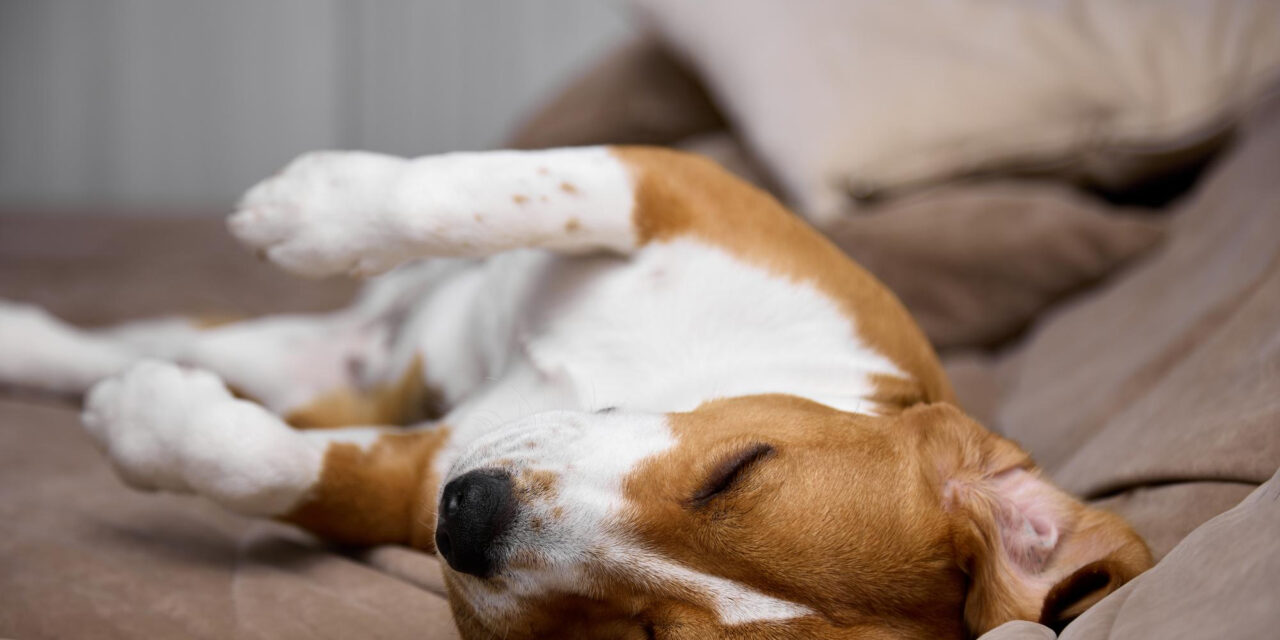
Why do dogs sleep so much? Because it’s normal. Most healthy adult dogs sleep 12 to 14 hours a day. Puppies and senior dogs often sleep closer to 18 to 20 hours. That’s not laziness, and it’s not a sign something’s wrong. It’s just a dog’s biology.
What actually matters is the shape of that sleep, not just the total. A dog who naps in short stretches is doing fine. So is one who wakes for meals and walks. He still gets excited for his favorite things — even at 16 hours a day. A dog whose sleep changes suddenly is telling you something different. So is one who can’t be roused for something he normally loves.
This guide covers how much sleep is normal by life stage. It walks through what a typical dog’s day actually looks like, and the changes worth watching for. It closes with a simple sleep journal you can start tonight.
None of this replaces your veterinarian’s judgment about your individual dog. But most 2 a.m. searches for “why do dogs sleep so much” end the same way. It’s a healthy dog doing exactly what healthy dogs do.
What’s in this guide
- Why do dogs sleep so much? Normal hours by life stage
- Why dogs sleep so much in the first place
- What a normal day of dog sleep looks like
- Sleep stages: what’s happening while your dog dreams
- Twitching, “running,” and whether it’s safe to wake him
- Common sleeping positions and what they can mean
- Helping your dog sleep well
- Common myths about dog sleep
- How poor sleep shows up during the day
- What can disrupt your dog’s sleep
- Changes worth watching — and what they can mean
- Senior dogs and restless nights
- Common questions about dog sleep
- Build a simple sleep journal
- Sources
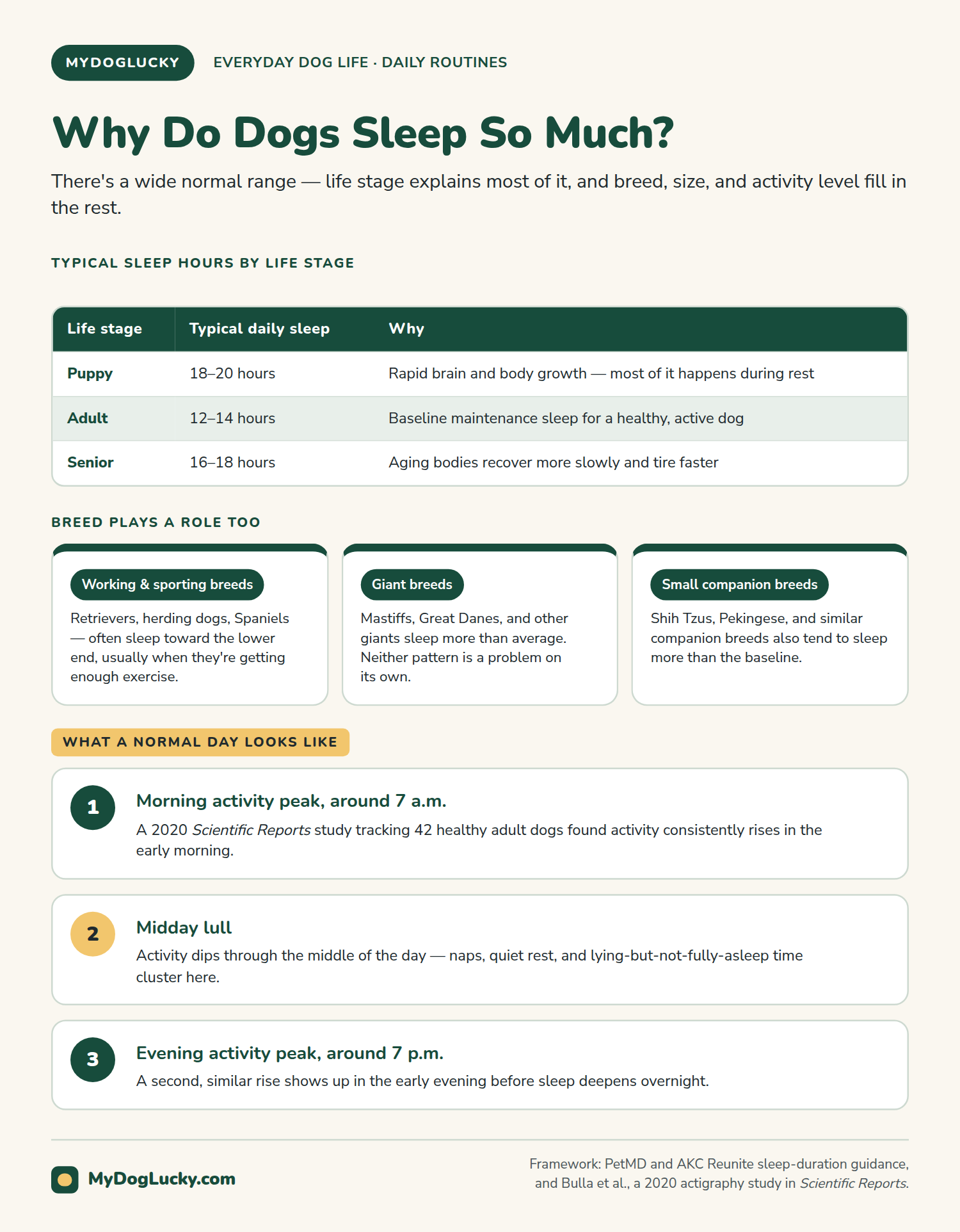
Why do dogs sleep so much? Normal hours by life stage
There’s a wide normal range, and life stage explains most of it. Breed, size, and activity level explain the rest.
| Life stage | Typical daily sleep | Why |
|---|---|---|
| Puppy | 18–20 hours | Rapid brain and body growth. Most of it happens during rest, not while awake. |
| Adult | 12–14 hours | Baseline maintenance sleep for a healthy, active dog. |
| Senior | 16–18 hours | Aging bodies recover more slowly and tire faster. |
Breed plays a real role too, on top of the life-stage baseline above.
| Breed group | Typical pattern |
|---|---|
| Working & sporting (Retrievers, Spaniels, herding breeds) | Often toward the lower end of their range — usually when they’re getting enough exercise and mental work. |
| Giant breeds (Mastiffs, Great Danes, Newfoundlands) | Sleep more than average across every life stage. Bigger bodies mean more downtime. |
| Small companion breeds (Shih Tzus, Pekingese, Chihuahuas) | Also tend to run above the baseline, even as healthy adults. |
| Flat-faced breeds (Bulldogs, Pugs, French Bulldogs) | Often nap more and tire faster — breathing takes more effort, especially in heat or humidity. |
| Terriers & high-drive lines | Sometimes sleep less than their breed group “should,” especially with a job to do or a person to watch. |
None of these patterns is a problem on its own. They’re context for reading your own dog’s number, not a target to hit.
When does a puppy’s sleep start looking like an adult’s?
Gradually, not overnight. Most puppies begin sleeping closer to adult hours somewhere around their first birthday. The exact timing shifts a few months either way, depending on breed size. Larger breeds mature more slowly overall. They often take a little longer to settle into an adult-like pattern than smaller ones do. Expect a slow taper, not a sudden switch.
A note on puppies specifically
This guide covers sleep needs across a dog’s life. Crate setup, a first-night routine, and getting a new puppy settled are a more detailed topic of their own. This page sticks to the sleep numbers and the patterns behind them.
Why dogs sleep so much in the first place
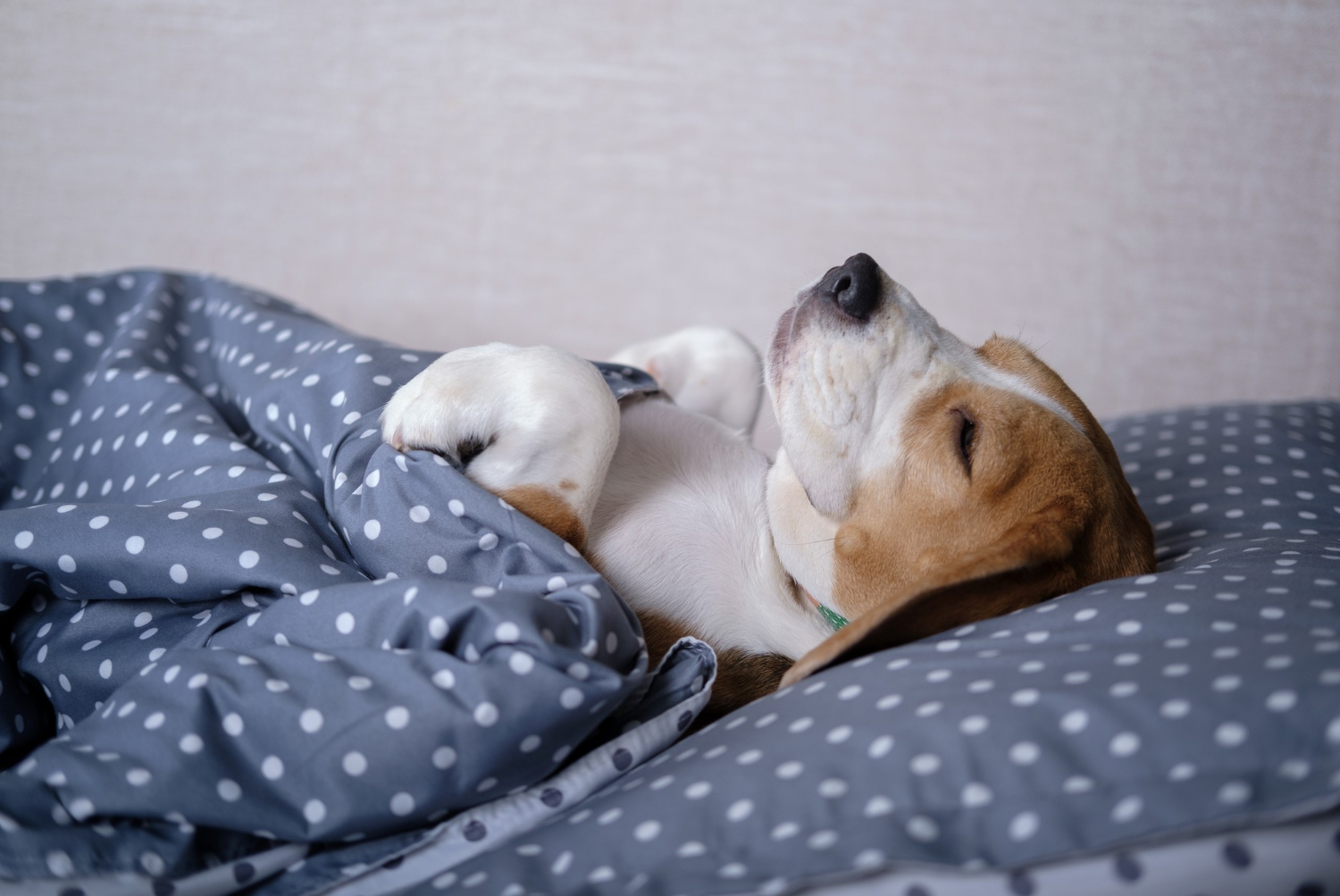
Two things are happening during all those hours. First, restoration. Growth, tissue repair, and memory consolidation all lean heavily on sleep — in puppies especially, where the workload is highest. Much of a puppy’s growth hormone release happens during deep sleep. That’s part of why a growing puppy needs so much more sleep than an adult does. Second, energy conservation. Dogs are opportunistic resters by design. Wild canids sleep between hunts, and the instinct never really left the couch-bound descendants.
A few everyday factors shift the number up or down:
- Activity level. A dog who had a big hike yesterday often sleeps more today, recovering.
- Mental stimulation. Too little enrichment can look like “sleeping a lot” when it’s really boredom filling the hours.
- Household pace. A quiet, low-traffic home naturally produces more resting time than a busy one.
- Weather. Many dogs nap more on hot afternoons or gray, rainy days.
None of these need fixing. They’re just why your dog’s number moves around week to week.
What a normal day of dog sleep looks like
Dogs don’t sleep the way people do — one long block overnight. Most of their sleep is spread across many shorter naps, day and night.
A 2020 study in Scientific Reports tracked 42 healthy adult dogs for two weeks using activity monitors. It found a consistent bimodal pattern. Activity peaked around 7 a.m. and again around 7 p.m., with a clear lull around midday. Younger dogs in the study were more active during those peak windows than older dogs. That difference showed up even within a healthy adult population — before any dog reached senior age.
A lot of what looks like “just resting” isn’t full sleep at all. Dogs spend real time lying quietly, eyes open or half-open. Alert but not asleep — watching the window, listening to the house. That counts as rest, not as one of the sleep hours in the table above.
Some owners like tracking this more precisely with an activity-monitoring collar instead of relying on memory alone. That’s entirely optional. A simple journal, like the one later in this guide, captures the pattern just as well for most households.
Sleep stages: what’s happening while your dog dreams
A dog’s sleep isn’t one uniform state. Like people, dogs cycle through drowsiness, light sleep, and deep slow-wave sleep. Then comes REM sleep, the stage most closely tied to dreaming.
A full cycle runs about 20 minutes, and roughly 6 of those minutes are spent in REM. That’s much faster than a person’s roughly 90-minute rhythm. A napping dog moves through more complete cycles in the same stretch of time. PetMD notes that dog and human sleep cycles are otherwise remarkably similar. Both species pass through the same broad stages, in the same order.
REM is where the visible signs show up: eyes moving beneath closed lids, quick and irregular breathing. Twitching paws and an occasional muffled bark or whine round it out. Researchers see similar brain activity during REM sleep in both dogs and people. That’s one reason many veterinarians believe dogs experience something like dreaming.
Sleep may help your dog remember what you taught him
Hungarian researchers led by Anna Kis tested this directly. They taught dogs a new command, then let some sleep while others stayed busy with something else. A week later, the dogs who’d slept remembered the command better. A tired training session followed by a good night’s sleep may do more for a new skill. Sometimes that beats another five minutes of repetition.
Why do dogs sleep so much more than people? A quick comparison
| Dogs | People | |
|---|---|---|
| Daily total | 12–20 hours, life-stage dependent | 7–9 hours for most adults |
| Sleep pattern | Polyphasic — many naps across day and night | Mostly monophasic — one main nightly block |
| Full sleep cycle | About 20 minutes | About 90 minutes |
| Time in REM per cycle | Roughly 6 minutes | Roughly 20 minutes |
Twitching, “running,” and whether it’s safe to wake him
The paws that twitch mid-nap, the muffled bark, the leg that runs in place — that’s REM sleep in action, described above. It’s normal.
Let it happen. Waking a dog mid-twitch doesn’t do him any favors. A dog startled awake can occasionally snap before he’s fully oriented — not out of aggression, just confusion. If you need to wake a sleeping dog, use your voice from a small distance first. Save the hands-on approach for once he’s alert.
Common sleeping positions and what they can mean
Dogs don’t usually choose an uncomfortable position on purpose. How your dog arranges himself for a nap is mostly about temperature, security, and what feels good on his particular joints. Still, some patterns do line up with comfort and trust level.
The donut (curled in a tight ball)
Nose to tail, paws tucked in. This is an efficient way to conserve body heat and protect the belly. It’s common in dogs who are a little more reserved around strangers. It’s also just a cozy way to nap on a cool floor.
Side sleeper
Stretched out on one side, fully relaxed. Veterinarian Dr. Patrik Holmboe describes this as a sign of a calm, content dog who feels safe enough to sleep deeply. Dogs often settle into it once they’re truly out, rather than lightly dozing.
Belly-up, legs in the air
Exposing the belly is a vulnerable position for any animal. A dog sleeping this way is usually a comfortable, trusting one. It also helps him cool down — less fur coverage on the belly means more heat escapes.
Superman (stretched flat on his stomach)
Front legs forward, back legs trailing behind. This one shows up often in naps rather than deep sleep. It’s a position a dog can spring up from quickly. Flat-faced breeds like French Bulldogs and Pugs land here a lot, partly because it can ease breathing.
Back-to-back or curled against you
A dog who sleeps touching you, another pet, or the edge of the couch is usually looking for warmth. Closeness matters too. This one’s about bonding as much as comfort.
A position that’s new for your dog is worth a second look, not a shrug. That’s especially true if it looks stiff, awkward, or paired with obvious discomfort getting there. The change itself matters more than the specific position.
Helping your dog sleep well
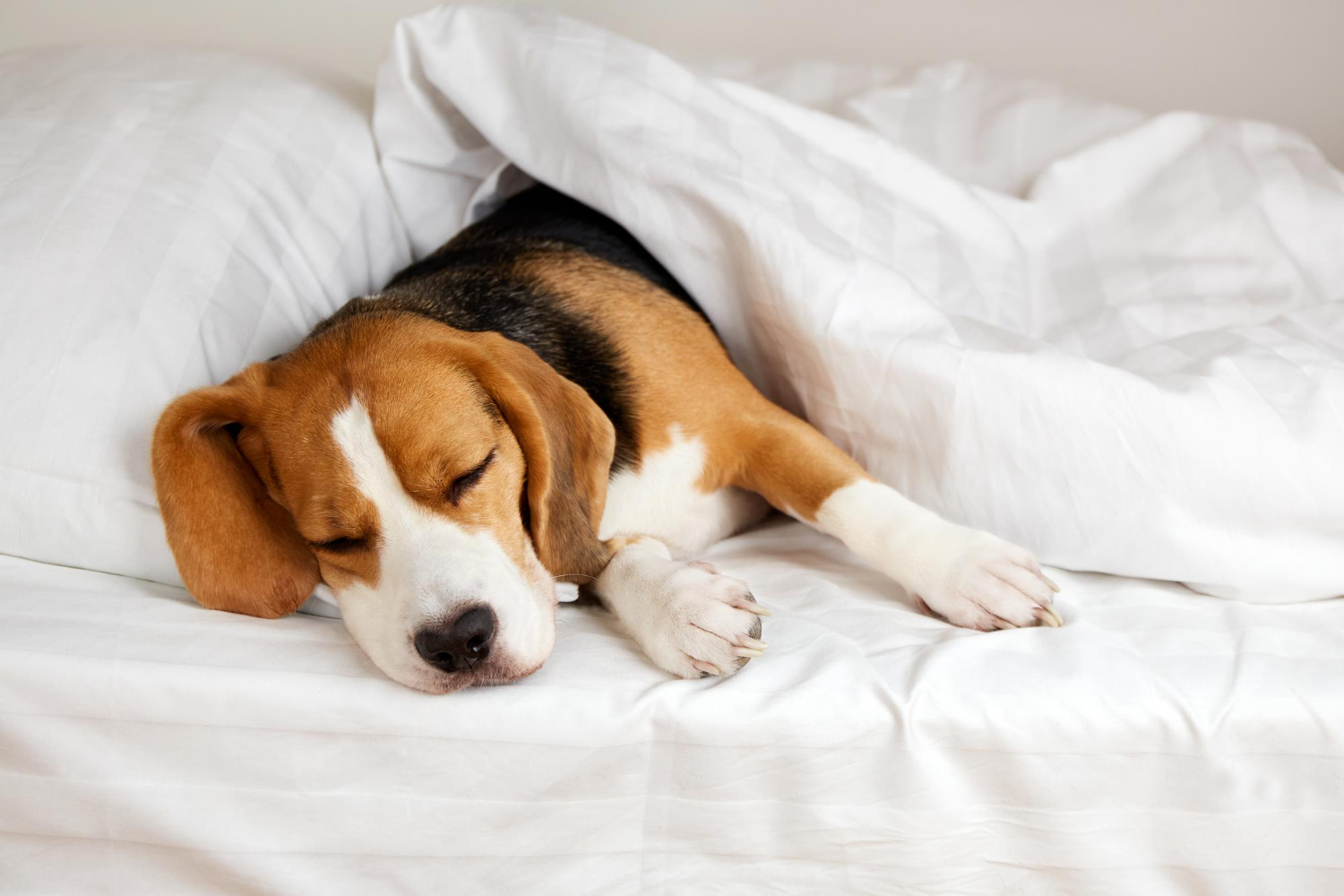
Good sleep needs less engineering than you’d think. A few basics cover most of it.
A consistent, comfortable spot
A bed, crate, or mat your dog returns to on his own works better than moving things around nightly. Older dogs and larger breeds often do better on supportive, orthopedic-style bedding. It takes pressure off joints during those long hours down. You don’t need the fanciest option on the shelf. You need one your dog actually uses.
Temperature, light, and noise
Dark and quiet helps, at least for the main sleep block. A crate cover or a room away from household traffic helps a light sleeper settle faster. Dogs overheat more easily than people. A room that’s comfortable for you is usually comfortable for him too — just check for panting or restlessness if it runs warm.
A wind-down window before bed
A short walk or a calm activity before bed burns off the last bit of energy. It beats going from full play straight to lights-out. Fifteen or twenty quiet minutes gives your dog’s system a chance to downshift. A slow sniff around the yard, a chew, or some time near you all work.
Exercise earlier in the day, not right before bed
Daily activity genuinely improves sleep quality, not just sleep quantity. A dog who’s had real physical and mental exercise tends to settle faster and sleep more soundly. Timing matters, though. A high-energy play session right at bedtime can backfire, leaving your dog too keyed up to settle.
Feeding timing
A dog fed right before bed may be more prone to restlessness or an upset stomach overnight. That’s especially true after a large or rich meal. Most dogs do better with dinner at least a couple of hours before lights-out. Plan the final bathroom break after eating, not before.
Overtired looks like wired, not sleepy
A dog who’s overstimulated late in the day often gets zoomier, not sleepier. If bedtime keeps turning into a wrestling match, move the day’s big activity earlier. Save the last hour for something low-key — a chew, a slow sniff around the yard, quiet time near you.
Common myths about dog sleep
A few ideas about why dogs sleep so much — or don’t — stick around because they sound reasonable. Most don’t hold up.
Myth: a dog who sleeps a lot is bored or lazy
Sleeping 12 to 20 hours a day is the baseline for a healthy dog, not a sign something’s missing. Boredom can add extra sleep on top of that baseline — but the baseline itself is just biology.
Myth: you should never wake a sleeping dog
The old warning is really about being careful, not about avoiding it entirely. A dog genuinely does need waking sometimes — a vet appointment, a fire alarm, a long overdue bathroom break. The real rule is how you wake him: voice first, from a small distance, hands-on only once he’s alert.
Myth: twitching during sleep means something’s wrong
Paw twitches, muffled barks, and a leg that “runs” in place are REM sleep, not a seizure and not pain. A true seizure during sleep looks different — rigid, prolonged, often with the whole body affected. The dog doesn’t wake up normally afterward. If you’re ever unsure which one you’re seeing, describe it to your vet.
Myth: dogs should sleep exactly the same amount every day
Day-to-day sleep naturally moves around with activity, weather, stress, and age. A single long-sleep day after a big hike isn’t a red flag. A real pattern shift over days to weeks is the thing worth tracking. That’s exactly what the sleep journal below is for.
Myth: a dog sleeping in your bed is a behavior problem
Co-sleeping is a household preference, not a training failure. It works fine for plenty of dogs and owners, as long as everyone involved is actually sleeping well.
Myth: older dogs need less activity, so more sleep is automatically fine
More rest is normal for seniors, but “automatically fine” isn’t the same as “never worth a second look.” A senior dog’s increased sleep is usually ordinary aging. Watch for it becoming paired with the restlessness, disorientation, or other changes covered in the senior section below. Age explains a lot. It doesn’t explain everything.
How poor sleep shows up during the day
A dog who isn’t sleeping well doesn’t usually announce it directly. Instead, it shows up sideways, in daytime behavior that can look like a training problem instead of a rest problem.
More irritability or reactivity
A sleep-deprived dog often has a shorter fuse than usual. Snapping at a housemate over a toy, or reacting more strongly than normal to an everyday trigger, can be tiredness talking. It’s not always a real behavior regression. It’s worth asking what his sleep looked like the last day or two before assuming the worst.
Trouble settling or learning something new
Training sessions tend to go worse on too little sleep. It’s much the same reason a tired student struggles to focus in class. If a normally quick learner suddenly can’t pick up a familiar cue, or keeps losing focus mid-session, check his rest. Don’t assume the method stopped working.
More mouthy or hyperactive behavior
An overtired dog often looks wired instead of sleepy — the same pattern covered above under bedtime routines. Extra zoomies, more jumping, more nipping at hands or sleeves can all mean the same thing. It’s an overtired dog asking for a nap he’s actively fighting off.
None of this replaces an actual behavior evaluation for a dog with a persistent problem. But ruling out simple sleep debt first is fast, free, and sometimes solves the whole thing on its own.
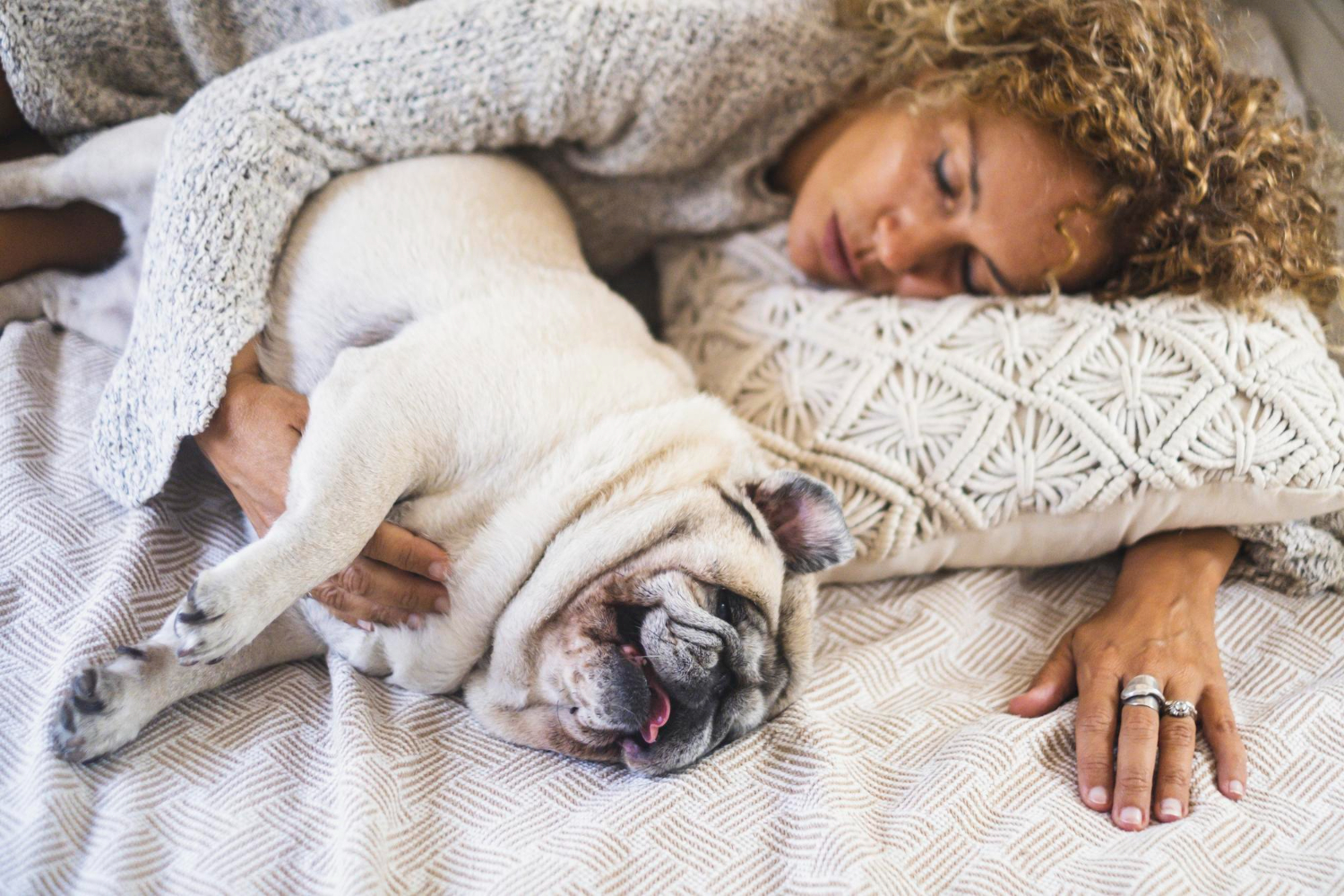
What can disrupt your dog’s sleep
Even a dog with a solid routine has off nights sometimes. A few common culprits are worth knowing, mostly because the fix is usually about the cause, not the sleep itself.
Noise and storms
Thunder, fireworks, construction, a smoke alarm chirping at 3 a.m. — noise-sensitive dogs can lose real sleep to sound alone. A safe, enclosed space, some background white noise, and staying calm yourself all help. A dog with a genuine noise phobia — shaking, drooling, trying to escape — needs more than a quiet room. That’s worth a conversation with your vet about more structured support.
Separation-related distress
A dog who paces, whines, or can’t settle when you leave the room is telling you something. That’s different from a dog who’s simply not thrilled to be alone in the house. True separation-related distress usually shows up alongside other signs, like destruction near exits, drooling, or vocalizing. It’s a training and management issue worth addressing with a qualified professional, not just a sleep-setup fix.
Pain, itching, or discomfort
A dog who can’t get comfortable — shifting, restless, unable to settle through the night — may be dealing with something more. Pain, itching, or an upset stomach are common causes. It’s not always a behavior problem. Consider this especially in a dog whose sleep changed recently without an obvious explanation, like a hard hike or a hot week. The changes-worth-watching table above is a good next stop.
A new environment or schedule change
Moving, travel, a new work schedule, or a new household member can all throw off a dog’s sleep. It’s usually temporary. Most dogs adjust within a week or two once the new routine settles into something predictable. Keeping mealtimes, walks, and bedtime as consistent as you can during the transition speeds that up.
Other pets or household chaos
A noisy housemate, a cat who treats 2 a.m. as prime time, or kids with an unpredictable bedtime can all chip away at a dog’s rest. Nothing has to actually be wrong with him. If your dog seems tired and cranky rather than sick, look at what’s happening around him first. It might not be about him at all.
Changes worth watching — and what they can mean
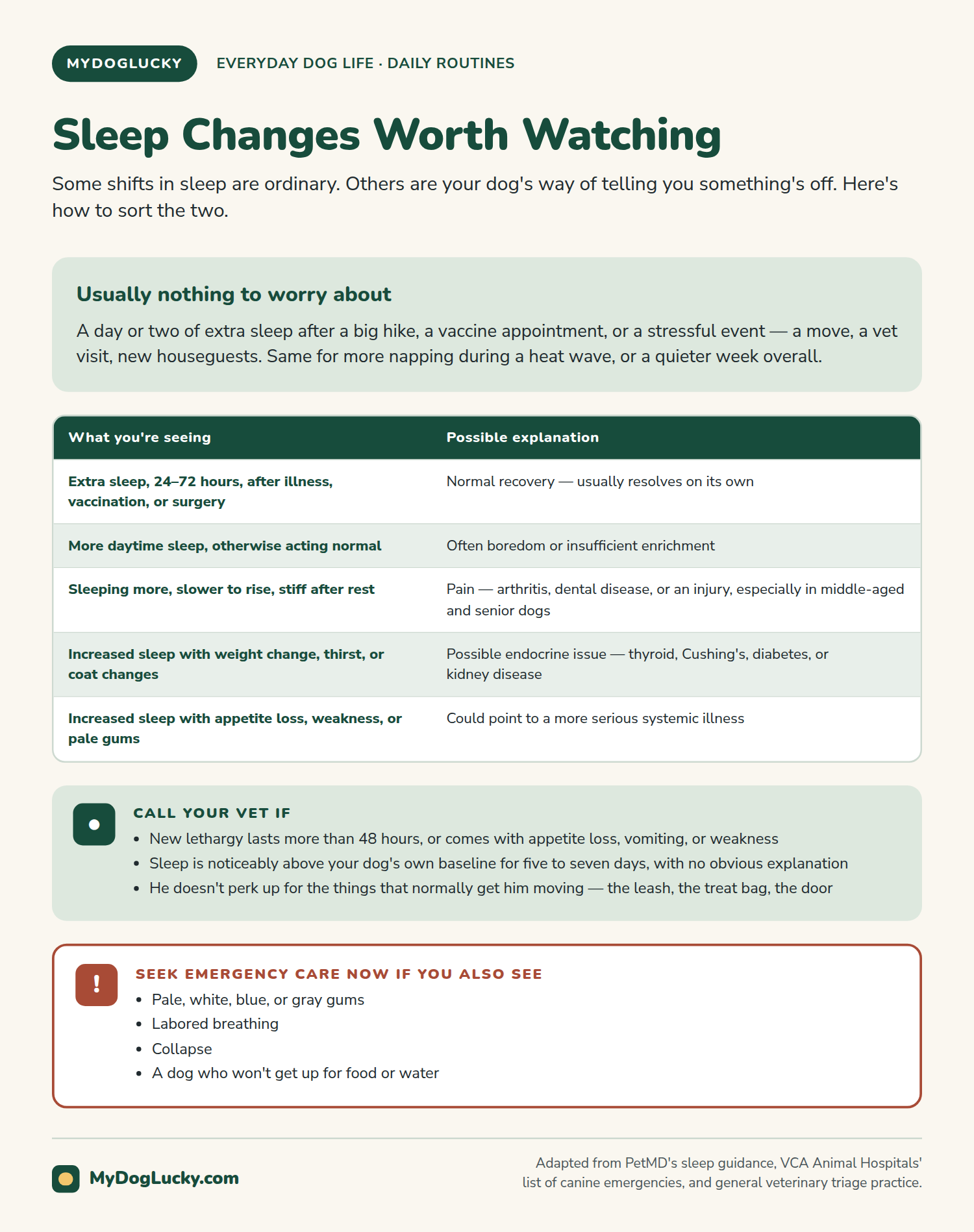
Some sleep changes are ordinary. Others are your dog’s best way of telling you something’s off. Sorting the two starts with one question: is anything else different, too?
Usually nothing to worry about
A day or two of extra sleep after a big hike is typical. Same after a vaccine appointment, or a stressful event — a move, a vet visit, new houseguests. So is more napping during a heat wave, or a quieter week when the household’s own routine has slowed down.
| What you’re seeing | Possible explanation |
|---|---|
| Extra sleep, 24–72 hours, after illness, vaccination, or surgery | Normal recovery — expected, and usually resolves on its own |
| More daytime sleep, otherwise acting normal | Often boredom or insufficient enrichment — worth an activity boost before anything else |
| Sleeping more, plus slower to rise, stiff after rest | Pain — arthritis, dental disease, or an injury are common and often overlooked, especially in middle-aged and senior dogs |
| Increased sleep with weight change, thirst, or coat changes | Possible endocrine issue — thyroid, Cushing’s, diabetes, or kidney disease are all worth ruling out |
| Increased sleep with appetite loss, weakness, or pale gums | Could point to a more serious systemic illness — anemia, infection, or organ involvement |
Call your vet if
- New lethargy lasts more than 48 hours, or comes with appetite loss, vomiting, or weakness
- Your dog is sleeping noticeably more than his own baseline for five to seven days, with no obvious explanation
- He doesn’t perk up for the things that normally get him moving — the leash, the treat bag, the door
Seek emergency care now if you also see pale, white, blue, or gray gums. Same for labored breathing, collapse, or a dog who won’t get up for food or water. VCA Animal Hospitals lists collapse and breathing difficulty among its core canine emergencies.
If you do call, your vet will likely ask what’s changed beyond sleep — appetite, thirst, weight, mobility, bathroom habits. Bloodwork or a physical exam often follows, to rule out the possibilities in the table above. Bringing a few days of notes from the sleep journal below often speeds that conversation up.
Senior dogs and restless nights
Older dogs sometimes flip the pattern most owners expect: more daytime napping, paired with new nighttime pacing, panting, or wandering. When that combination shows up, it’s worth mentioning to your veterinarian rather than assuming it’s simply old age.
One possible cause is canine cognitive dysfunction — a dog version of age-related cognitive decline. PetMD notes that it can disrupt the brain’s internal clock. That leads to confusion after dark, with wandering that’s often worse in the evening. A veterinarian can help sort this from other causes. Simple changes sometimes help too, alongside whatever your vet recommends. A bit more daytime activity, or a night light for a dog who startles in the dark, can both make a difference.
Sleep-wake reversal is just one piece of a bigger picture. Veterinary behavior specialists group cognitive-decline signs into a few categories worth watching together, not in isolation:
- Disorientation. Getting “lost” in familiar rooms, staring at walls, or struggling to find the door.
- Social changes. Suddenly clingier, or more withdrawn than usual.
- Sleep-wake changes. More daytime sleep, more nighttime pacing or restlessness — the pattern above.
- House-training lapses. Accidents from a dog who’s been reliably house-trained for years.
- Activity changes. Less interest in play, or aimless wandering and pacing.
One or two of these on their own can have plenty of other explanations. Several showing up together, especially alongside the nighttime restlessness above, is worth a dedicated conversation with your vet. Cognitive decline is progressive, and earlier support tends to help more than waiting it out.
Common questions about dog sleep
Do dogs dream?
Almost certainly, at least in some form. The twitching and light vocalizing described above line up with a dreaming-associated sleep phase, similar to what happens in people. Nobody can say what a dog dreams about. But the physiology behind it looks a lot like ours.
Can a dog sleep too little?
Yes. A dog who seems wired, can’t settle, or wakes repeatedly through the night isn’t getting quality rest. That’s true even if the raw hours look fine on paper. Pain, anxiety, an uncomfortable sleep space, or too little daytime activity can all be behind it. Ongoing restlessness is worth mentioning to your vet, the same as too much sleep would be.
Should my dog sleep in my bed, or in a crate?
Either is fine, and it comes down to what works for your household. A crate offers a dog his own predictable space and can help with house-training. Co-sleeping works well for a lot of families. Just make sure it doesn’t disrupt anyone’s actual rest — yours or his. There’s no version that’s inherently healthier for a well-adjusted adult dog.
Why does my dog sleep more in winter?
Shorter days and colder weather both play a role. Less daylight can shift activity patterns, and cold weather often means shorter walks and more time curled up indoors. A dog who’s mostly a fair-weather exerciser will naturally bank more rest hours in January than in June.
Is it normal for my dog to sleep all day while I’m at work?
For most adult dogs, yes. A dog left alone for a typical workday often sleeps through a large part of it. That’s especially true if he got activity and attention before you left. Destructive behavior, house-soiling, or obvious distress on camera or when you get home are different signals. They point more toward boredom or separation-related distress than ordinary daytime sleep.
Do dogs need one long, unbroken night of sleep like people do?
Not really. Dogs are naturally polyphasic sleepers, built for multiple sleep periods across the day and night rather than one long block. A dog who naps on and off all day and sleeps soundly at night is following a completely normal pattern. It just looks different from how most people sleep.
Do dogs sleep better with another pet in the house?
It depends on the dogs. Many companion animals genuinely rest easier with a bonded housemate nearby. Body warmth, a sense of safety in numbers, and less time spent alert and listening all play a part. Others sleep better solo, especially if the relationship has any tension. Watch your own dog’s actual behavior rather than assuming either answer.
Can diet affect how well my dog sleeps?
Meal timing matters more than any specific food. A dog fed too close to bedtime is more likely to be restless or need a middle-of-the-night bathroom trip. A large meal makes that more likely still. Persistent sleep problems alongside appetite changes, weight changes, or digestive symptoms are worth raising with your vet. Diet is one piece of a bigger picture, not a fix on its own.
How long should my dog sleep extra after surgery or sedation?
A day or two of noticeably more sleep after anesthesia, sedation, or a procedure is typical and expected. Most dogs are close to normal within 24 to 48 hours. Sleeping much longer than that is worth a follow-up call. So is seeming unusually groggy, weak, or uninterested in food beyond what your vet told you to expect.
Can medications affect my dog’s sleep?
Yes. Certain pain relievers, allergy medications, and behavioral medications can make a dog sleepier or more restless as a side effect. If your dog’s sleep changed noticeably after starting something new, mention it at his next check-up. Never stop or adjust a prescribed medication on your own.
Does spaying or neutering change how much my dog sleeps?
Not directly, beyond the short recovery window after the procedure itself. Some owners notice a longer-term shift in energy or sleep afterward. That more often ties to age, activity level, or a slower metabolism than to the surgery itself. Talk to your vet if you notice a bigger or more persistent change than that.
Should I worry if my dog snores?
Occasional snoring, especially in flat-faced breeds, is usually just anatomy at work and nothing to worry about. New snoring in a dog who never used to is worth mentioning to your vet. So is snoring paired with visible breathing effort while awake, or snoring that seems to worsen over time. It can sometimes point to weight gain, allergies, or an airway issue worth checking.
What if my dog and I are on different schedules?
Shift work, late nights, or an unpredictable schedule don’t have to mean a miserable dog. Dogs adapt to irregular human schedules better than most people expect. The basics just need to stay covered: enough total sleep, a safe space to rest while you’re out. A consistent bathroom and feeding rhythm helps too, even if the clock times shift around. A second caregiver on your hardest nights, or a midday dog walker, can fill gaps a single irregular schedule leaves.
Can weather changes affect my dog’s sleep?
Many owners notice their dog sleeping more on hot, humid, or stormy days. The opposite happens too, with less sleep during a cool, clear stretch with plenty of outdoor time. Some dogs also seem sensitive to shifts in barometric pressure before a storm. They get restless or clingy hours before the weather actually turns. Neither pattern needs fixing on its own.
Can a dog have something like insomnia?
It’s uncommon, but real. A dog who consistently struggles to settle, wakes frequently, or seems chronically under-rested despite a good routine may have an underlying cause. It’s usually medical or anxiety-related rather than true insomnia in the human sense. This is a good one to bring to your vet directly, rather than troubleshoot alone. Persistent poor sleep in dogs is usually a symptom of something else, not a standalone sleep disorder.
Build a simple sleep journal
Most sleep concerns get easier to judge once they’re written down. “He seems tired” is hard to act on. “He’s slept until 10 a.m. three days running, and didn’t want his usual walk” — that’s something a vet can work with.
You don’t need anything fancy. A notebook, a notes app, or the table below all work. The goal is a few seconds a day, not a project.
| Date | Rough sleep hours | Energy for favorite activity? | Anything else different? |
|---|---|---|---|
A week of entries gives you a real baseline. It also gives your vet something more useful than a guess, if a change ever shows up. Keep it running even when nothing’s wrong. That’s what makes it useful the one time something is.
If you ever do bring this to your vet, the pattern matters more than any single day. A week or two showing “more tired than usual, still eating fine, still excited for walks” tells a story. It’s a very different one than “won’t get up, skipped breakfast twice.”
Where to start tonight
If your dog is sleeping a lot and otherwise seems like himself, he’s very likely fine. Eating, greeting you, excited for the leash — those are the signs that matter most. Most of what reads as “sleeping too much” is just a healthy dog being a dog.
Start the sleep journal above tonight, even with a rough guess. And if something already feels off, skip the journal. A dog who won’t get up for dinner, or gums that don’t look right, means call your vet instead. That’s what the emergency guidance above is for.
Why do dogs sleep so much, in the end? Because it’s how their bodies grow, recover, and process the day, not because something’s broken. Once you know your dog’s normal, the occasional long nap stops being a question mark and starts being just Tuesday.
Sources
- PetMD. Why Do Dogs Sleep So Much?
- AKC Reunite. Understanding Your Dog’s Sleeping Patterns.
- Bulla, C., et al. A Functional Linear Modeling Approach to Sleep-Wake Cycles in Dogs. Scientific Reports (2020).
- PetMD. Do Dogs Dream? What Do Dogs Dream About?
- PetMD. 6 Dog Sleeping Positions and What They Mean.
- Kis, A., et al. The Interrelated Effect of Sleep and Learning in Dogs (Canis familiaris); An EEG and Behavioural Study. Scientific Reports (2017).
- VCA Animal Hospitals. Common Emergencies in Dogs.
- PetMD. What Is Dog Dementia? Signs of Canine Dementia and How to Help Your Dog.
- VCA Animal Hospitals. Behavior Counseling: Senior Pet Cognitive Dysfunction.
This article is general education for U.S. dog owners. It is not veterinary advice for an individual dog. If your dog shows pale or blue gums, labored breathing, collapse, or won’t get up for food or water, contact your veterinarian or an emergency animal hospital immediately.