
Indoor dog enrichment means giving your dog’s brain real work to do, inside your actual home. That means activities matched to your space, your schedule, and how much supervision you can realistically offer. It’s not about buying every toy on a shelf. It’s about a handful of activities that genuinely fit your life.
This guide sorts indoor enrichment by what it actually costs you. That means how much room an activity needs and how closely you need to watch it. It also covers how hard something is to set up, and how much mess it leaves behind. That’s the real question most owners are asking. Even if they’d phrase it as “what should I do with my dog on a rainy day.”
You’ll get the science behind why enrichment matters and a full activity matrix to match ideas to your actual home. You’ll also get a sample weekly routine to make it stick.
What’s in this guide
- What is indoor dog enrichment? The quick answer
- Why indoor enrichment matters
- The five types of enrichment
- The indoor enrichment activity matrix
- Finding what your dog actually enjoys
- Scent work and sniffing games
- Puzzle feeders and food puzzles
- Chewing and licking activities
- Introducing a new activity without overwhelming your dog
- Interactive play indoors
- Training as enrichment
- No-cost DIY enrichment ideas
- Enrichment for small spaces and apartments
- Enrichment for specific situations
- Enrichment on a budget
- Enrichment during recovery or restricted activity
- Supervision guidelines by activity type
- Safety notes
- Building a rotation so nothing goes stale
- A sample weekly indoor enrichment routine
- Signs your dog needs more enrichment
- Common enrichment mistakes
- Common questions about indoor dog enrichment
- Sources
What is indoor dog enrichment? The quick answer
Indoor dog enrichment is any activity that gives your dog’s brain and senses something real to work on. It happens inside your home. It covers sniffing games, puzzle feeders, chew and lick activities, short training sessions, and structured play. The goal isn’t to fill time. It’s to meet a genuine mental need, the same way a walk meets a physical one.
Most dogs need some indoor enrichment every single day, not just on days you can’t get outside. A ten-minute puzzle-feeder breakfast or a five-minute training session counts as real enrichment. That’s true even on a day with a full walk already checked off.
Why indoor enrichment matters
A bored dog and an under-exercised dog can look identical from the outside. Pacing, chewing on furniture, excessive barking, and digging all show up in both cases. Physical exercise alone doesn’t always fix it, because the underlying need is mental, not physical.
The numbers back this up. Roughly 16% of dogs show repetitive behaviors often triggered by frustration, stress, or boredom. In one study, dogs kept in a sterile, under-stimulating environment slept about 20% more than dogs with regular enrichment. That’s a sign of understimulation rather than rest.
Mental work and physical work are different budgets
A dog can get plenty of physical exercise and still be understimulated mentally. Fifteen minutes of real problem-solving can tire a smart dog out fast. It can work faster than a much longer walk with no mental component at all.
Indoor enrichment matters even more on the days a full walk isn’t possible. Bad weather, a busy schedule, an injury recovery, or a limited-access apartment can all get in the way. It’s not a lesser substitute. It’s a genuinely different kind of need, worth meeting on its own terms.
Indoor dog enrichment and physical exercise cover different needs, so neither one replaces the other. If you’re also working out how much walking or physical activity your dog needs, that’s a separate question. It’s covered in this site’s dedicated exercise and walk-frequency guides. This article stays focused on the mental side of the equation.
The five types of enrichment
Purdue University’s Canine Welfare Science program frames enrichment as five distinct categories. A well-rounded routine touches more than one of them across a week, rather than leaning on just one type.
Social enrichment
Time with people and other dogs. Supervised play with a compatible dog counts, and so does a training session with you. Simply working through a puzzle feeder together counts too.
Nutritional enrichment
Activities that encourage natural feeding behaviors instead of a bowl set down and finished in seconds. Puzzle feeders, frozen lick mats, and scattered kibble all fall here.
Occupational enrichment
Giving your dog a job. Trick training, food puzzles, and structured games like fetch all provide physical and mental stimulation through purposeful activity.
Sensory enrichment
Engaging the senses directly. Calm background music, a window perch with a view, or a new scent to investigate all count as sensory enrichment.
Physical enrichment
Changes to the environment itself. Rotating toys, adding a box or tunnel to explore, or rearranging furniture occasionally all add complexity. It’s a space your dog otherwise knows by heart.
None of these categories require special equipment. The rest of this guide translates each one into specific indoor activities, matched to your actual space and schedule.
Most single activities actually touch more than one category at once. A puzzle feeder is nutritional and occupational together; a shared training session is occupational and social. You don’t need to check off all five separately every day. A varied week naturally covers most of them.
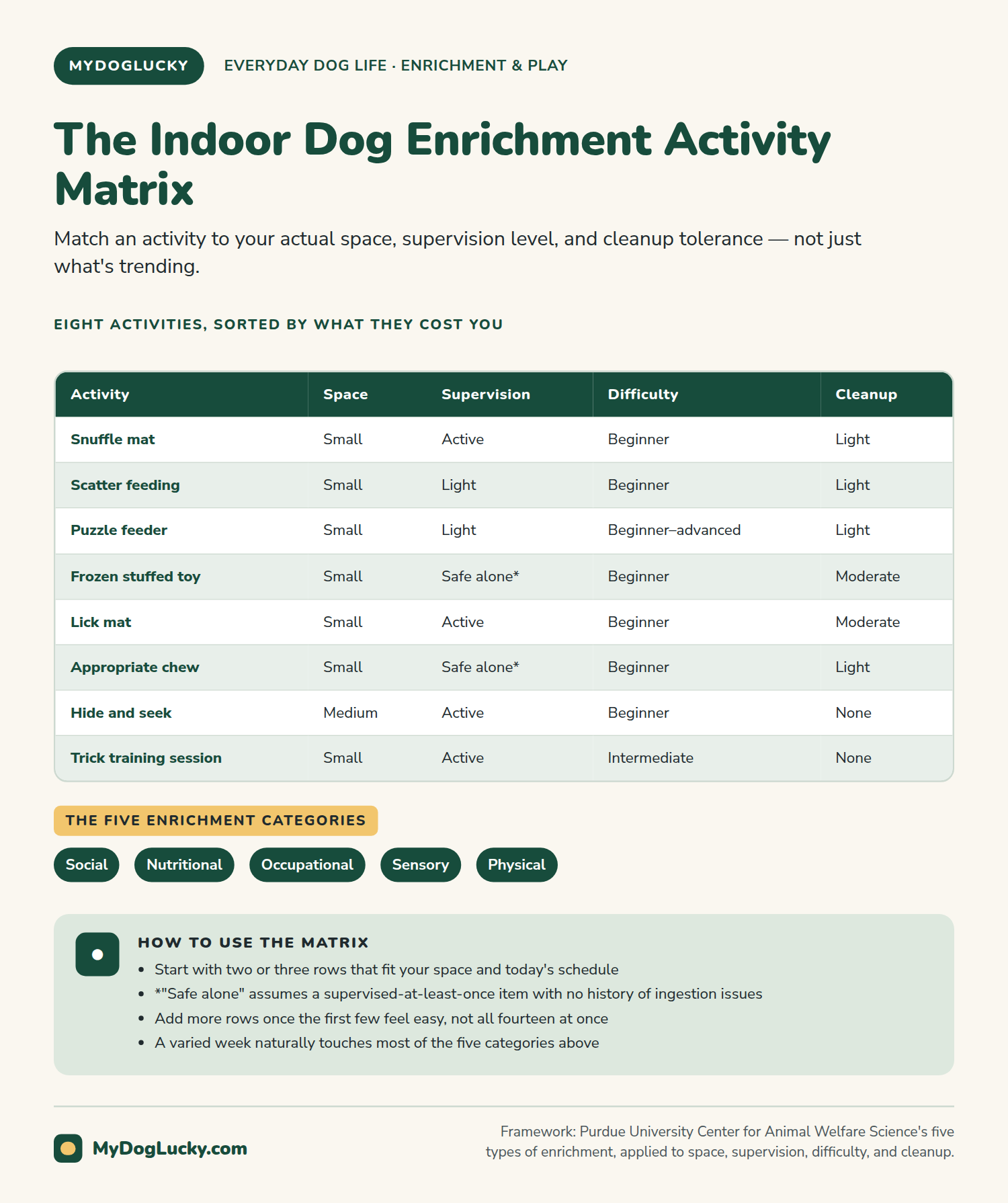
The indoor enrichment activity matrix
Here’s the real question behind most enrichment searches. What can I actually do, given my space, my schedule, and how much I can supervise right now? This table answers that directly.
| Activity | Space needed | Supervision | Difficulty | Cleanup |
|---|---|---|---|---|
| Snuffle mat | Small | Active | Beginner | Light |
| Scatter feeding | Small | Light | Beginner | Light |
| Find-it game | Small–medium | Active | Beginner | None |
| Puzzle feeder | Small | Light | Beginner–advanced | Light |
| Frozen stuffed toy | Small | Safe alone* | Beginner | Moderate |
| Lick mat | Small | Active | Beginner | Moderate |
| Appropriate chew | Small | Safe alone* | Beginner | Light |
| Indoor fetch (hallway) | Medium | Active | Beginner | None |
| Tug | Small | Active | Beginner | None |
| Hide and seek | Medium | Active | Beginner | None |
| Trick training session | Small | Active | Intermediate | None |
| Cardboard box search | Small–medium | Active | Beginner | Moderate |
| Muffin tin game | Small | Active | Beginner | Light |
| Towel roll game | Small | Light | Beginner | Light |
*”Safe alone” assumes an appropriately sized, supervised-at-least-once item with no history of ingestion issues. See the safety section below before leaving any chew unattended.
Use the matrix as a starting menu, not a checklist to complete in order. Pick whichever row matches how much time and attention you actually have today, and swap in a different row tomorrow.
Start with two or three rows that fit your space and your current schedule. Add more once those feel easy, rather than trying the whole table in one week.
Finding what your dog actually enjoys
Not every dog likes every kind of indoor dog enrichment. A scent hound might ignore a puzzle feeder and light up for a snuffle mat. A retriever might do the opposite. Guessing wastes time and money. A short experiment tells you directly.
A one-week experiment
Pick one activity from each of the five categories above. Offer each one on its own day, and just watch. No pressure to make every activity a hit.
- Days 1–2: try the first two categories. Note whether your dog engages immediately, needs coaxing, or ignores it entirely.
- Days 3–4: try the next two. Watch for the same signals: sustained focus, tail carriage, and whether he returns to it on his own.
- Day 5: try the last category. By now you’ll likely already see a pattern forming.
- Days 6–7: repeat the clear winners. Confirm the early read was real, not a one-off.
What genuine engagement looks like
Sustained attention, a relaxed body, and a dog who returns to the activity without being prompted. Genuine disinterest looks like walking away quickly, with no real investigation. It can also look like obvious preference for anything else happening in the room.
Build your regular rotation around the two or three categories that clearly land. Then use the rest of this guide’s activities within those categories for variety. A personalized routine holds a dog’s interest far longer than a generic list ever will.
Scent work and sniffing games
Sniffing is one of the easiest, lowest-cost ways to tire a dog’s brain out. It works in a small apartment just as well as a large house. It needs nothing more than a few minutes and some treats already in your kitchen.
Snuffle mats
A snuffle mat is a fabric pad with folds and pockets where you hide kibble or treats. Your dog noses through the fabric to find each piece, turning a meal into a genuine sniffing workout. Start by sprinkling treats on top so your dog succeeds immediately, then hide them deeper as he gets the idea. Supervise use, and put the mat away between sessions so it stays interesting.
Scatter feeding
The simplest version of scent work: toss a meal’s worth of kibble across a towel or carpet. Let your dog forage for it there, on a low-pile rug or open floor. No equipment required, and it slows down a fast eater as a side benefit.
Find-it games
Teach a simple “find it” cue, then hide a few treats around one room while your dog waits. Release him to search. Increase the difficulty gradually by hiding treats higher up, behind objects, or across more rooms as he improves.
Puzzle feeders and food puzzles
Puzzle feeders turn mealtime into mental work instead of a thirty-second event. They range from simple treat-dispensing balls to multi-step wooden puzzles. Most dogs move through several difficulty levels over their lifetime rather than staying on one forever.
Starting at the right level
Begin with the easiest setting on any puzzle, even if the packaging suggests your dog can handle more. Frustration isn’t the goal. A dog who succeeds quickly and confidently is more likely to stay engaged than one who gives up.
Building difficulty over time
Once a puzzle feels too easy, that’s your cue to increase the challenge, not before. Watch for calm, persistent effort as the sign your dog is ready for more. Back off instead if you see mounting frustration.
Rotating puzzles
Keep two or three puzzle feeders in rotation rather than leaving one out permanently. A puzzle that’s always available stops feeling like a puzzle at all.
Chewing and licking activities
Chewing and licking are calming behaviors for most dogs, not just a way to pass time. Both deserve a regular place in an indoor routine.
Frozen stuffed toys
A hollow rubber toy stuffed with food and frozen extends a simple chew into a much longer project. Freezing slows down a fast eater and stretches ten minutes of engagement into thirty or more.
Lick mats
A textured mat spread with something soft, like plain yogurt or a smear of wet food, works well. It gives your dog a sustained licking activity. Many owners find it genuinely calming for an anxious dog during a stressful event like a thunderstorm. Always supervise a lick mat in use, check it’s labeled food-grade, and wash it thoroughly after each session.
Appropriate chews
Size and firmness matter more than brand. A chew that’s too hard can crack a tooth. One that’s too soft disappears in minutes and can pose a swallowing risk. Match the chew to your specific dog’s size and chewing style. Supervise anything new until you know how it holds up.
Introducing a new activity without overwhelming your dog
A new indoor dog enrichment activity works best when it’s introduced in stages. It shouldn’t be dropped on your dog all at once. Going slow the first time saves you a wasted toy and a frustrated dog.
- Pick a calm moment. Skip introducing anything new right before a busy or stressful event, like guests arriving. Your dog should be relaxed and a little hungry, not already keyed up.
- Demonstrate first. Show your dog how the activity works before handing it over, especially for a puzzle feeder. Move a piece yourself so he sees a treat appear.
- Set it up for an easy win. Use the lowest difficulty setting, extra-smelly treats, or a partially pre-solved puzzle so the first attempt succeeds quickly.
- Stay close, but don’t hover. Watch from a few feet away rather than looming over your dog. Step in only if he seems genuinely stuck or frustrated, not just working slowly.
- End on success. Wrap up the first session while your dog is still interested, even if that means finishing early by hand. A short win beats a long slog toward boredom.
Once your dog handles the easy version confidently, usually within two or three sessions, you’re ready to move on. Raise the difficulty a little at a time.
Interactive play indoors
Interactive play builds your relationship with your dog, not just his muscles. It doesn’t need much space to work.
- Hallway fetch. A short, straight hallway is plenty of room for a soft toy and a satisfying retrieve.
- Tug. A focused few minutes of tug is genuine exercise and bonding in a tiny footprint. Letting your dog “win” occasionally doesn’t cause aggression, despite the old myth.
- Hide and seek. Hide yourself, then call your dog to find you. Simple, free, and surprisingly tiring for a dog who takes the search seriously.
- Flirt pole. A compact version works in a single room, letting a high-drive dog chase and catch without needing a yard.
- Two-cup shell game. Hide a treat under one of two cups, shuffle them slowly, and let your dog pick. It’s a quick, low-space way to add a little problem-solving to any play session.
End any play session while your dog still wants more, not after he’s already bored of it. That keeps the next session’s enthusiasm intact.
Training as enrichment
A short training session is genuine mental work, not just obedience practice. Five to ten focused minutes can be more tiring than an hour of unstructured time.
Trick training in particular works well indoors. Spin, shake, roll over, or a simple hand-target all fit in a living room. New tricks challenge a dog more than well-worn ones. Rotate in something new every week or two once the basics feel easy.
Short sessions beat long ones
Three five-minute sessions across a day generally work better than one thirty-minute session. Attention spans are short, especially for a young or easily distracted dog. Ending on success matters more than covering a lot of ground.
No-cost DIY enrichment ideas
Enrichment doesn’t require a shopping trip. Household items already sitting in a recycling bin work just as well as anything purchased.
- Cardboard box search. Hide treats inside a few cardboard boxes, lightly taped shut, and let your dog work to open them. Supervise closely, since cardboard itself shouldn’t be eaten.
- Muffin tin game. Drop treats into a few cups of a muffin tin, then cover each with a tennis ball. Your dog has to move the balls to get the treats.
- Towel roll. Roll treats or kibble into a towel, then let your dog unroll it to find them. Reusable, washable, and effectively free.
- Water bottle shake. A few treats in an empty plastic bottle, cap removed, gives a satisfying rattle-and-forage activity. Supervise for any cap or label pieces.
- Paper bag search. Drop a few treats into an open paper grocery bag with the handles removed, then let your dog investigate. Supervise closely so the bag gets explored, not shredded and swallowed.
- Living-room obstacle course. A broom laid across two low stacks of books becomes a jump; a kitchen chair becomes something to weave around. Five minutes of an improvised course adds novelty for free.
None of these need to look polished. A slightly chewed-up cardboard box doing real mental work beats an untouched toy still in its packaging.
Enrichment for small spaces and apartments
A small home doesn’t mean fewer options. Most of the activities above already work in a single room.
No yard access
Lean harder on scent work and puzzle feeders, since neither needs open floor space. A single hallway is enough for a short, satisfying game of fetch.
Shared or thin-walled buildings
Choose quieter activities, like snuffle mats, lick mats, and puzzle feeders. Skip anything that involves excited barking or a bouncing ball against a shared wall. Save vocal games like hide and seek for times that suit your neighbors too.
Multiple pets in a small space
Separate feeding-based enrichment, like puzzle feeders and lick mats, to avoid resource guarding between pets. Interactive games can often be shared, but watch both animals closely the first few times.
Square footage caps how much room an activity needs, not how much genuine mental work it can offer. A studio apartment can run a full week of varied indoor dog enrichment. It works just as effectively as a house with a yard.
Enrichment for specific situations
A generic routine is a fine starting point. Some situations benefit from a more specific approach.
Senior dogs
Scent work holds up well even as mobility declines, since it needs very little movement. Keep puzzles easy and rewarding rather than frustrating. Favor low-effort options like lick mats and snuffle mats over anything requiring a lot of standing or bending.
Anxious or easily overstimulated dogs
Calming activities, lick mats especially, can help settle a dog before or during a stressful event. Keep sessions short and predictable, and avoid introducing a brand-new, potentially frustrating puzzle during an already anxious moment.
High-drive or working breeds
These dogs often need more occupational enrichment than the average routine provides. Trick training, advanced puzzles, and structured games like tug can absorb real mental energy that a casual routine won’t touch.
Multi-dog households
Give each dog his own enrichment activity when food is involved, even if they play well together otherwise. Shared scent games and training sessions can work well. Always supervise the first few attempts to check for any tension.
Puppies
Keep sessions short, since a young puppy’s attention span is naturally brief. Basic scatter feeding, a soft chew toy, and a couple of tricks are plenty of indoor dog enrichment at first. Advanced puzzles can wait until later, once your puppy is older.
Newly adopted or rescue dogs
Give a new dog time to settle before introducing much novelty at all. A predictable routine matters more than variety in the first few weeks. A stressed or unsettled dog often can’t engage with a puzzle the way a comfortable one can.
Enrichment on a budget
Indoor dog enrichment doesn’t require a big investment. Most of what matters is consistency, not cost.
| Budget tier | What it looks like |
|---|---|
| Free | Scatter feeding, towel rolls, cardboard boxes, hide and seek, training with kibble |
| Low-cost | A snuffle mat, a lick mat, a muffin tin repurposed from the kitchen |
| Worth investing in | A few well-made puzzle feeders in different difficulty levels, rotated rather than replaced often |
A full guide to choosing and testing dog toys lives in its own dedicated article. It covers how to evaluate durability and value too. This section is just the budget-planning piece: you don’t need every tier to build a genuinely effective routine.
Enrichment during recovery or restricted activity
Indoor dog enrichment earns its keep most clearly when a dog can’t move around much. Post-surgery recovery, an injury, or a chronic condition can all mean weeks of restricted activity. A bored dog on crate rest is a harder dog to manage than a mentally satisfied one.
What still works with limited movement
Lick mats, frozen stuffed toys, and appropriate chews need almost no motion at all. That makes them the backbone of a recovery routine. Gentle scent games, like hiding a treat within easy reach rather than across the room, still work well. They give a genuine mental workout without asking for real movement.
What to hold off on
Skip anything involving jumping, running, or repeated standing and bending. That rules out most puzzle feeders that need to be nosed or pawed around the floor. Save trick training for cues that don’t strain the specific area healing. Check with your vet about which movements are off-limits.
Always confirm with your vet first
Recovery instructions vary enormously by procedure and individual dog. Before adding any new activity during a recovery period, confirm it’s compatible with your vet’s specific restrictions. General guidance like this isn’t enough on its own. A vet who has already reviewed post-op or injury care would be the same one to ask.
A restricted-activity period is temporary, even when it doesn’t feel that way in week two. Keeping your dog mentally engaged during it can make the return to a normal routine noticeably smoother.
Supervision guidelines by activity type
Not every activity needs your full attention the whole time, but some genuinely do. Sorting activities into these three tiers up front saves you from guessing mid-session.
- Always supervise: lick mats, cardboard-based games, anything with small removable parts, and any brand-new chew or toy.
- Check in periodically: puzzle feeders your dog has used safely before, scatter feeding, towel rolls.
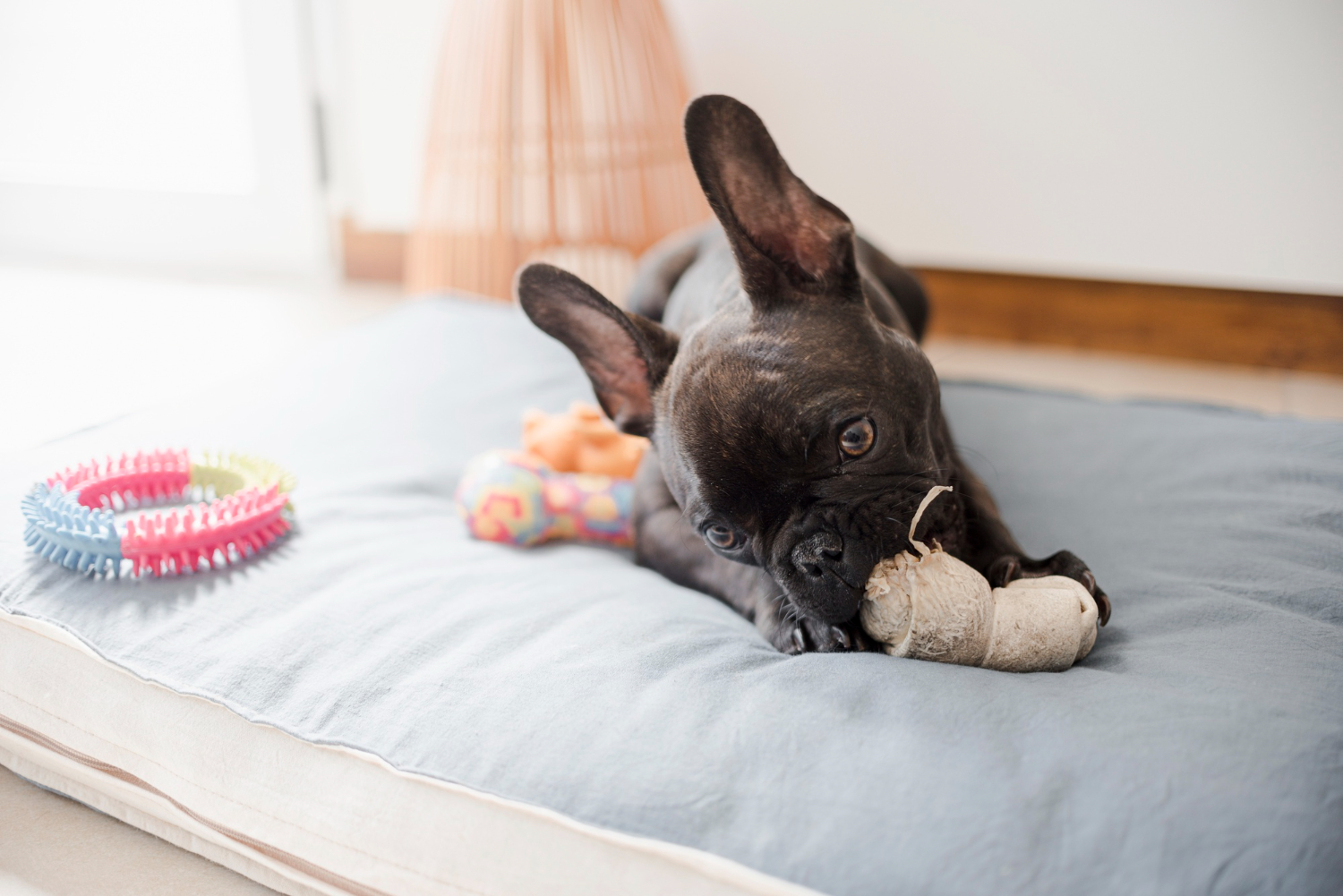
- Generally safe alone, once tested: a frozen stuffed toy your dog has had before without issue. Appropriately sized chews with no history of aggressive gulping count too.
“Safe alone” always means safe for your specific dog, based on his own history. It’s not a general rule that applies to every dog with that toy.
Safety notes
A few precautions apply across almost every activity in this guide.
- Size matters. Anything small enough to swallow whole is a choking risk. That’s true regardless of what the packaging claims about your dog’s size category.
- Watch for aggressive chewers. A dog who chews through toys quickly needs sturdier options and closer supervision than one who chews gently.
- Check for wear. Cracks, punctures, or frayed edges on any toy mean it’s time to replace it, not keep stretching its life.
- Mind the ingredients. Anything edible used in a puzzle or lick mat should fit your dog’s actual diet, including any known sensitivities.
- Stop if something seems off. Excessive drooling, gagging, or reluctance to drop an item are all reasons to intervene immediately, not wait and see.
- Keep a first attempt supervised, always. Even a product marketed as durable deserves a first supervised session before you trust it unattended, regardless of the reviews.
When in doubt about a specific product or chew type, ask your vet. This guide covers general categories, not a verdict on any particular brand.
Building a rotation so nothing goes stale
Even a great activity loses its power if it’s always available. Rotation is what keeps enrichment actually enriching.
The rule of thirds
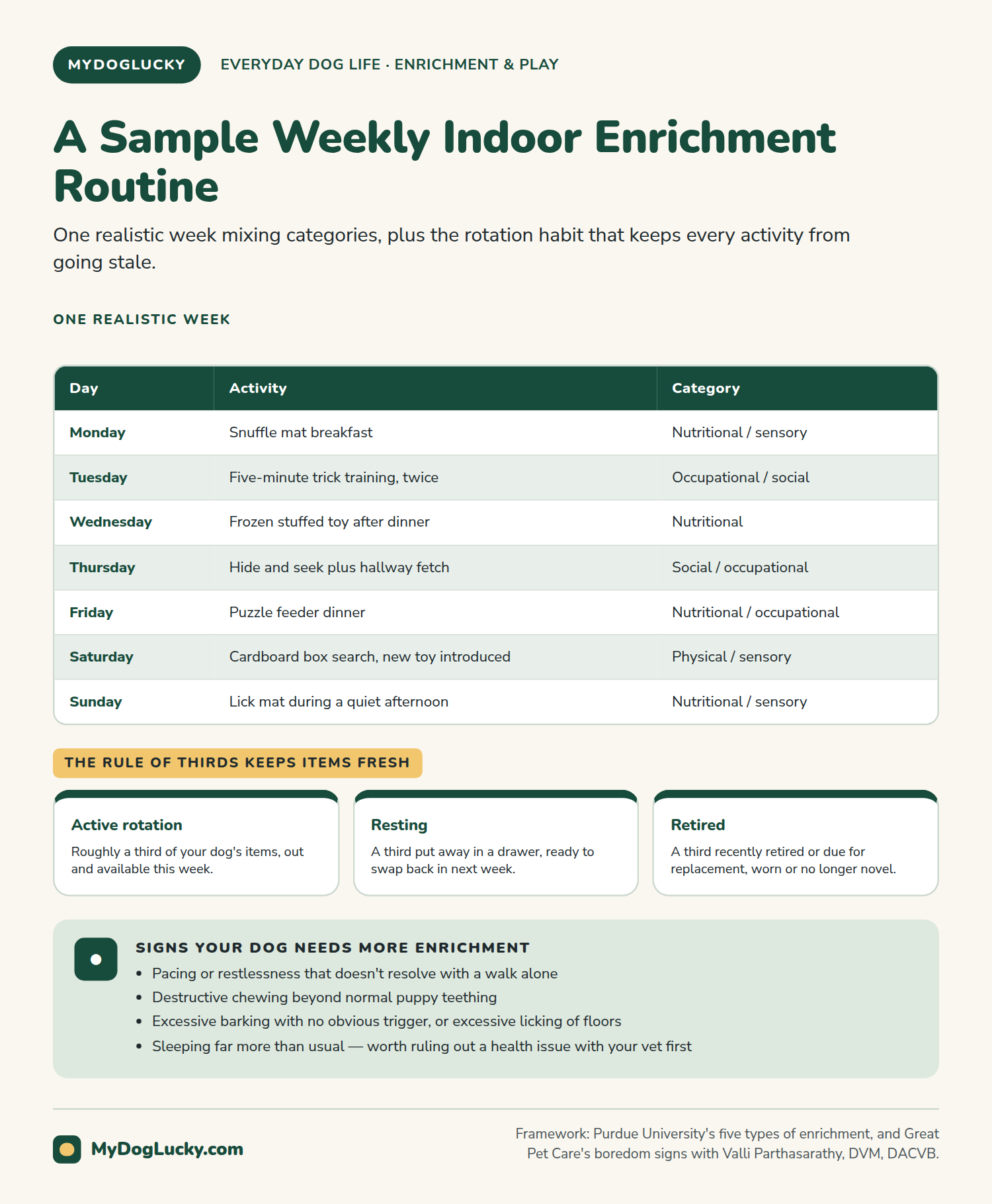
Keep roughly a third of your dog’s enrichment items in active rotation and a third put away and resting. Keep the last third recently retired or due for replacement. Swap the resting third back in every week or two.
Novelty matters more than variety for its own sake. Reintroducing a “retired” toy after a few weeks away often gets nearly the same excited response as something brand new.
What this looks like in practice
Say your dog owns six enrichment items. Two puzzle feeders and a snuffle mat stay out this week. A lick mat and a chew toy go into a drawer to rest. A worn rope toy gets retired for good. Next week, swap the resting pair back in and pick a different pair to rest. Nothing new has to be bought for the rotation to feel fresh.
A sample weekly indoor enrichment routine
A worked example beats another abstract list. Here’s one realistic week, mixing categories rather than repeating the same type daily.
| Day | Activity | Category |
|---|---|---|
| Monday | Snuffle mat breakfast | Nutritional / sensory |
| Tuesday | Five-minute trick training, twice | Occupational / social |
| Wednesday | Frozen stuffed toy after dinner | Nutritional |
| Thursday | Hide and seek plus hallway fetch | Social / occupational |
| Friday | Puzzle feeder dinner | Nutritional / occupational |
| Saturday | Cardboard box search, new toy introduced | Physical / sensory |
| Sunday | Lick mat during a quiet afternoon | Nutritional / sensory |
Swap any row for whatever fits your actual week. The pattern matters more than the specific days: something every day, and more than one category across the week.
A busier week can lean on the lowest-effort rows, like a frozen stuffed toy or a lick mat. Save those for the days a full session isn’t realistic. Even a scaled-down week of indoor dog enrichment beats skipping it entirely until things calm down.
Signs your dog needs more enrichment
A cluster of these, especially a sudden change, is worth paying attention to.
- Pacing or restlessness that doesn’t resolve with a walk alone.
- Destructive chewing beyond normal puppy teething, especially targeting new objects.
- Excessive barking with no obvious trigger.
- Excessive licking of floors or surfaces lasting more than a few minutes at a time.
- Digging indoors, beyond what’s typical for your dog’s breed.
- Stealing or rummaging through belongings, especially if it seems to be seeking a reaction from you.
- Sleeping far more than usual rather than resting normally.
Board-certified veterinary behaviorist Dr. Valli Parthasarathy notes that before assuming boredom, it’s worth ruling out a health issue with your vet first. Several medical conditions can mimic these same behaviors.
Keep a short log
Jot down which signs you’re seeing and when, for a week. A pattern tied to a specific time of day, like right before you leave for work, is a useful clue. It points toward a specific fix far faster than a vague sense that something’s off.
Common enrichment mistakes
Starting too hard
An advanced puzzle on day one usually leads to frustration, not engagement. Start easy, and let success build your dog’s confidence before raising the difficulty.
Leaving everything out all the time
A toy that’s always available stops functioning as enrichment. Rotation, not accumulation, is what keeps interest alive.
Treating enrichment as a full substitute for exercise
Mental work and physical exercise meet different needs. A high-energy dog still needs real physical activity, covered in this site’s guide to exercise needs, alongside indoor enrichment.
Skipping supervision on new items
The first few uses of any new chew, puzzle, or toy deserve full attention. That’s true even for an item marketed as “safe alone.” Establish the track record before stepping away.
Giving up after one failed attempt
A dog who ignores a snuffle mat on day one hasn’t necessarily rejected the concept. Try an easier version, better treats, or a shorter first session before concluding it’s not for him.
Leaning on just one category
A dog fed exclusively through puzzle feeders still misses out on social and sensory enrichment. Rotate across the five categories over a week rather than relying on whichever one happened to work first.

Common questions about indoor dog enrichment
How much indoor enrichment does my dog actually need each day?
There’s no universal number. Fifteen to thirty minutes of varied activity is a reasonable starting target for most dogs. Adjust it up for a high-drive breed, or down for a dog who tires quickly.
Can indoor enrichment replace walks entirely?
No. It meets a different, genuinely important need, but most dogs still benefit from regular physical activity too. Think of the two as complementary, not interchangeable.
My dog loses interest in puzzle toys within a minute. What’s wrong?
Often the difficulty is mismatched, in either direction. Too easy and there’s nothing to solve; too hard and he gives up fast. Try an easier setting first, and build from there.
Is it okay to use my dog’s regular kibble for enrichment instead of treats?
Generally yes, and it’s an easy way to avoid extra calories. A puzzle-fed breakfast is still a full meal, just one that takes longer and works his brain along the way.
How do I know if a chew toy is safe for my specific dog?
Match firmness and size to your dog’s jaw strength and chewing style, and supervise the first several uses. Stop immediately if you see cracking, splintering, or rapid wear.
My apartment doesn’t allow much noise. What enrichment works best?
Snuffle mats, lick mats, and puzzle feeders are all quiet by nature. Save fetch and excited chase games for times that won’t disturb neighbors, or move them to a carpeted room.
Should enrichment happen before or after meals?
Either can work, and many food-based activities are the meal itself. A calming activity like a lick mat can also help settle a dog before a nap or a stressful event.
How often should I introduce something new?
Roughly every one to two weeks keeps most dogs genuinely engaged. A food-motivated dog may need novelty more often than a dog who’s satisfied with a familiar favorite.
What indoor dog enrichment works best for a rainy day with no walk at all?
Lean on the beginner row of the activity matrix. That means a snuffle mat at breakfast, a short trick session at midday, and a lick mat in the evening. Together, those three cover most of a dog’s daily need on their own.
How long does it take to see a difference from adding indoor dog enrichment?
Many owners notice calmer behavior within a week or two of a consistent routine. A dog with a longer history of understimulation may take a bit longer to settle into it.
Can indoor dog enrichment help with separation-related distress?
A well-timed chew or puzzle offered right before you leave can help some dogs settle faster. It’s not a fix for genuine separation anxiety on its own, though. Talk to your vet or a qualified trainer if your dog shows real distress when left alone.
Is store-bought indoor dog enrichment better than DIY versions?
Not necessarily. A well-made puzzle feeder offers more graduated difficulty levels than most DIY options. Still, a towel roll or muffin tin game provides genuinely comparable mental work for free.
Do I need any special equipment to get started with indoor dog enrichment?
No. A towel, a few minutes, and your dog’s regular kibble are enough for a first session. Equipment like puzzle feeders and snuffle mats just adds variety once you know what your dog enjoys.
My dog solves every puzzle in under thirty seconds. Now what?
Move up a difficulty tier rather than sticking with something too easy. A puzzle solved instantly isn’t providing much mental work anymore. That’s true even if your dog still enjoys the treats at the end.
Indoor dog enrichment doesn’t have to be complicated or expensive to work. Start with two or three activities that fit your space and your schedule. Watch what your dog actually enjoys, and build the rest of your routine from there.
Sources
- Purdue University Center for Animal Welfare Science. 5 Types of Enrichment for Dogs.
- AKC. How Snuffle Mats Can Help Your Dogs Keep Their Brains Active.
- AKC. Lick Mats for Dogs: Everything You Need to Know to Choose One.
- Great Pet Care. Do Dogs Get Bored? 7 Signs and How to Help (Valli Parthasarathy, DVM, DACVB).
This article is general education for U.S. dog owners. It is not individualized veterinary or behavioral advice. Ask your veterinarian or a qualified trainer about anything specific to your dog.


Trackbacks/Pingbacks