

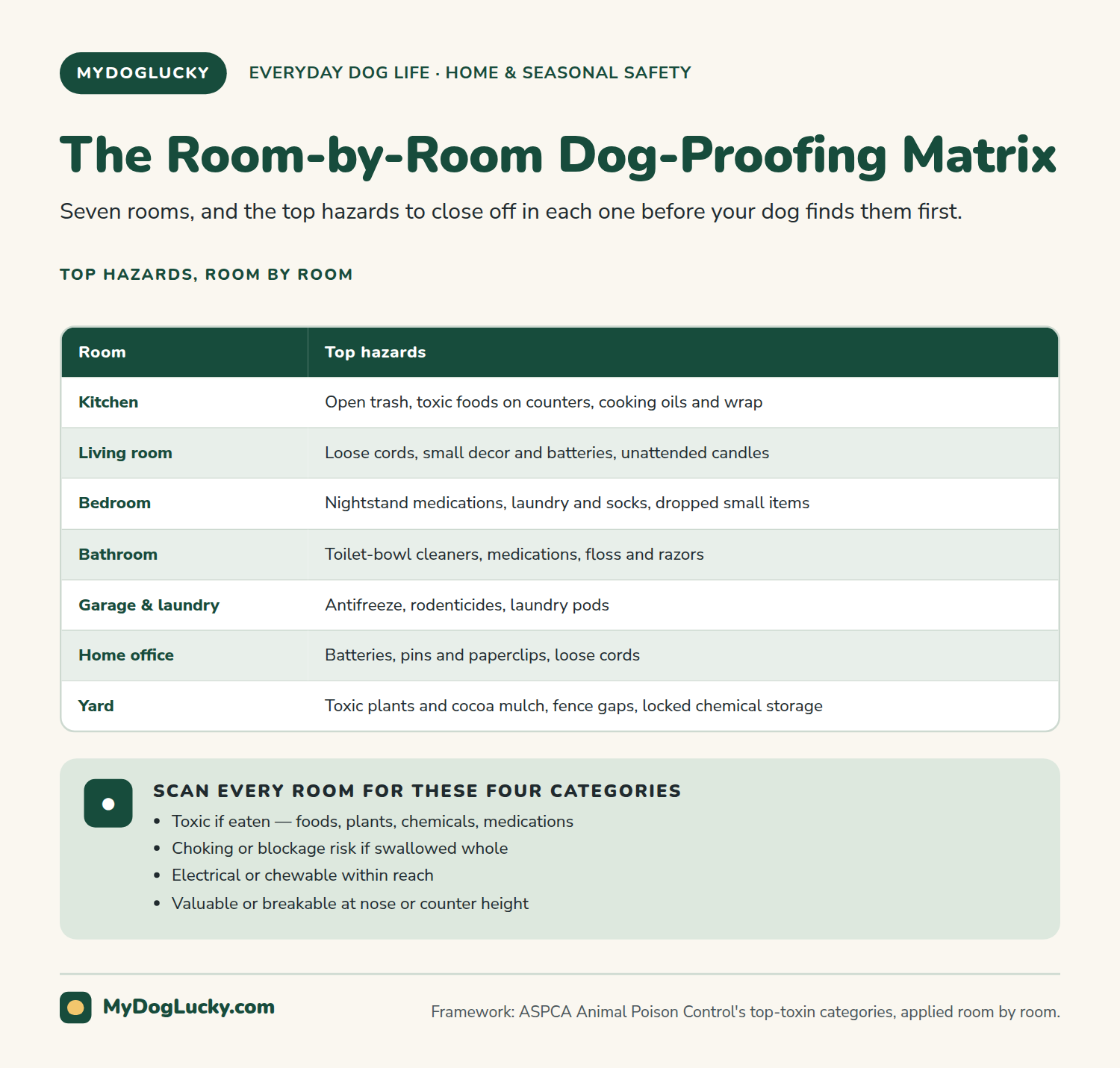
Dog-proofing your home doesn’t mean stripping every room down to bare walls and a water bowl. It means walking through your house at roughly dog height, once a room at a time, and closing the specific gaps your specific dog is likely to find. A Great Dane and a Jack Russell terrier get into completely different kinds of trouble, and a dog-proofing list built for one will miss half the risks for the other.
This guide goes room by room: kitchen, living areas, bedrooms, bathroom, garage and laundry, home office, and yard. Along the way you’ll get the specific plants, foods, and products that send the most dogs to the vet, plus a plan for the moment you catch your dog mid-chew on something he shouldn’t have.
None of this requires a renovation. Most of it is storage height, cord management, and closed cabinet doors, done consistently rather than perfectly.
Think of dog-proofing less as a single weekend project and more as an ongoing habit that adjusts as your dog does. A cautious, low-energy puppy who mostly sleeps needs a lighter pass than the same dog at eight months old, testing every new object with his mouth. Building the habit of scanning a room before you relax in it pays off for years, well past the puppy stage that usually prompts the first serious walk-through.
What’s in this guide
- Dog-proofing your home: the quick answer
- What changes your dog-proofing priorities
- Kitchen
- Living room and common areas
- Bedrooms
- Bathroom
- Garage, laundry room, and storage areas
- Home office and craft or hobby spaces
- Yard and outdoor space
- Decks, pools, and outdoor structures
- Toxic plants worth removing or relocating
- Cords, cables, and chew hazards
- Baby gates, pens, and managing access
- Dog-proofing a rental or small space
- If your dog eats something he shouldn’t
- Seasonal and holiday hazards
- Extra caution for a new dog or puppy
- Dog-proofing with multiple pets in the house
- Common dog-proofing mistakes
- Common myths about dog-proofing
- Your room-by-room checklist
- Common questions about dog-proofing a home
- Sources
Dog-proofing your home: the quick answer
Work room by room, and focus on four categories in each one: anything toxic if eaten (foods, plants, chemicals, medications), anything that’s a choking or blockage risk if swallowed, anything electrical a chewing dog could reach, and anything valuable or dangerous within nose height of the floor or a counter-surfing dog. Store the first three up high or behind a closed door. Manage the fourth with training, baby gates, or both.
Most household poisonings and chewing injuries aren’t exotic. They’re everyday items left at dog height: a bottle of ibuprofen on a nightstand, a bar of dark chocolate on a low counter, a phone charger cable draped across the floor. Fixing the height and the door, not buying special “dog-proof” products, does most of the actual work.
The four things to scan for in every room
Toxic if eaten. A choking or blockage risk if swallowed whole. Electrical or chewable within reach. Valuable or breakable at nose or paw height. Most dog-proofing mistakes come from missing one of these categories in a room you’d otherwise consider “safe,” like a home office or a guest bedroom nobody thinks to check.
What changes your dog-proofing priorities
A dog-proofing checklist isn’t one-size-fits-all. A few real factors about your own dog should shape how far you go in each room.
- Age. Puppies and adolescent dogs explore heavily with their mouths and have far less impulse control than a settled adult. A new puppy justifies a stricter version of every rule below.
- Size and reach. A large or tall dog can reach counters, tables, and shelves a small dog never could. “Out of reach” means something different for a Chihuahua than a Labrador.
- Chewing and mouthing tendency. Some individual dogs are simply more oral than others, regardless of breed. A dog who chews everything new needs a stricter cord and object policy than one who mostly ignores novel items.
- Counter-surfing history. If your dog has ever pulled food off a counter or table, treat every counter as reachable until you’ve actively trained and managed otherwise.
- Known sensitivities. A dog with a history of dietary indiscretion, food allergies, or a sensitive stomach needs stricter food-storage habits than one who’s never shown interest in the trash.
Reassess these factors as your dog changes. A cautious ten-year-old who suddenly develops separation-related chewing, or a puppy who outgrows his baby teeth and moves on to furniture legs, both need an updated pass through this list.
Household layout matters too, not just the dog. An open-concept home with few interior doors offers fewer natural access-management points than an older home with distinct closed rooms, which usually means leaning more heavily on gates and pens to recreate the separation a door would otherwise provide.
Kitchen
The kitchen combines the highest concentration of toxic foods with the easiest counter access in the house, which makes it the room worth dog-proofing most carefully.
- Store chocolate, coffee grounds, and anything containing xylitol (sugar-free gum, some peanut butters, baked goods) in a closed cabinet, never on an open counter.
- Keep onions, garlic, grapes, and raisins off counters and out of an easily nosed-open trash can. All four are toxic to dogs even in fairly small amounts.
- Use a trash can with a locking or step-pedal lid, or keep it inside a closed cabinet. A counter-height open bin is one of the single biggest sources of dog emergency-room visits.
- Store cooking oils, foil, and food wrap out of reach. Foil and wrap can cause blockages, and the residual grease is exactly the smell that draws a dog in.
- Secure cleaning products under the sink with a childproof latch if your dog can open cabinet doors with his nose or paw, which more dogs can do than most owners expect.
- Keep the dish sponge and steel wool out of paw reach. Both are common, underrated chew and swallow risks.
The counter-surfing habit is worth training, not just managing
Storage solves the immediate risk, but a dog who’s learned counters are worth checking will keep testing every unattended surface for the rest of his life. Pair storage with basic “leave it” and “off” training, and avoid leaving food unattended on a counter during the training window, since even one successful counter raid reinforces the habit.
Living room and common areas
Common areas tend to feel more “dog-safe” than they actually are, mostly because owners spend the most time there and assume they’d notice a problem.
- Remote controls, phone chargers, and game controllers left on a coffee table are frequent choking and blockage culprits, and batteries inside them add a chemical-burn risk if punctured.
- Secure bookshelves and any furniture a climbing or jumping dog could tip, particularly with a young, heavy-bodied breed still growing into his coordination.
- Check for small decorative objects at coffee-table height: coasters, small figurines, candle holders. Anything that fits in a dog’s mouth is a candidate to be swallowed.
- Keep candles, diffusers, and potpourri out of nose and tail range. A wagging tail near an open flame is a more common household fire risk than people expect.
- Store sewing kits, craft supplies, and small hardware somewhere other than an open basket on the floor.
Bedrooms
Bedrooms hold two categories that don’t show up much elsewhere in the house: medications and small personal items, both usually at nightstand height, which is exactly dog height for a medium or large breed.
- Move all medications, vitamins, and supplements off nightstands and dressers into a closed drawer or cabinet. Bottles that rattle are genuinely appealing chew toys to a curious dog, and a spilled bottle of even one pill can be an emergency.
- Store hearing aids, earbuds, and their charging cases somewhere closed. Small electronics with batteries are a frequent, expensive casualty.
- Keep laundry, especially socks and used tissues, off the floor. Both are common causes of intestinal blockages requiring surgery, and they smell like their owner, which makes them more attractive, not less.
- Check under the bed for anything that’s rolled out of sight: dropped pills, hair ties, small change. Dogs find things owners forget exist.
Guest rooms need the same pass
A guest bedroom that sits unused most of the year is easy to skip during a dog-proofing sweep, and it’s also where visitors’ luggage, medication bags, and travel-size toiletries tend to land unsupervised. Walk it the same way you’d walk your own bedroom, especially before hosting.
Bathroom
Bathrooms concentrate several serious hazards in a small space: medications, cleaning chemicals, and standing water are all here.
- Keep the toilet lid down, particularly if you use an automatic bowl cleaner or drop-in tablet, since those products are toxic if a dog drinks the water.
- Store all medications in a closed cabinet, including ones you consider “safe,” like over-the-counter pain relievers. Common human pain relievers are toxic to dogs even at doses that seem small to a person.
- Secure razors, dental floss, and cotton swabs. Floss in particular can cause serious intestinal damage if swallowed, since it doesn’t break down and can bunch tissue as it passes.
- Keep drain cleaners and other caustic products locked away, not just closed. These cause chemical burns on contact, not just if swallowed.
- Wipe up standing bathwater with essential oils or bath products added, since some common oils are toxic to dogs in concentrated form.
Garage, laundry room, and storage areas
This is where some of the most dangerous substances in an ordinary home tend to live, often within a dog’s easy reach on a low shelf.
- Antifreeze is one of the most dangerous common household chemicals for dogs. It has a sweet taste that attracts them, and a small amount can cause fatal kidney failure. Store it sealed, high up, and clean up any driveway drips immediately.
- Rodenticides and insecticides need to be completely inaccessible, not just “up high” on an open shelf a jumping or climbing dog could reach.
- Laundry pods and concentrated detergent look and smell appealing to some dogs and cause serious chemical injury if punctured in the mouth.
- Fertilizers and lawn chemicals stored in the garage should be sealed in their original, closed containers, away from any area your dog has unsupervised access to.
- Keep the garage door closed when your dog has house access, since garages combine chemical storage with tools, nails, and a door to the street.
Never assume “up high” is enough on its own
Athletic and food-motivated dogs are more capable climbers and jumpers than most owners expect, especially when something smells interesting. A closed cabinet door beats an open shelf every time, regardless of height.
Home office and craft or hobby spaces
These rooms often get skipped during a dog-proofing pass because they don’t feel like “dog rooms,” which is exactly why they’re worth a dedicated look.
- Batteries, paperclips, rubber bands, and pushpins are all common blockage and injury risks left in open desk drawers or trays.
- Keep cords for chargers, monitors, and shredders managed the same way you would in any other room (see the cord section below).
- Store glue, paint, and craft chemicals closed, not just out on a desk between projects.
- Sewing needles and pins deserve particular care, since they’re easy to lose track of and cause serious internal injury if swallowed.
Yard and outdoor space
Outdoor dog-proofing covers different ground than indoor rooms, but the same four-category scan still applies.
- Walk the fence line for gaps, loose boards, or dig-out spots, especially after storms or seasonal ground shifts.
- Check for toxic plants and mulch. Cocoa mulch smells like chocolate to dogs and contains some of the same toxic compounds. Many common garden plants and shrubs are toxic too (see the plant list below).
- Store fertilizers, pesticides, and pool chemicals in a locked shed rather than an accessible garage shelf or an open patio storage bin.
- Secure trash and recycling bins outdoors the same way you would indoors.
- Check for standing water in buckets, unused kiddie pools, or clogged gutters, which can attract mosquitoes and become a drowning risk for a small or unsteady dog.
- Look at grills and firepits from your dog’s perspective. Grease trays, skewers, and hot coals are all within nose range of an interested dog.
Decks, pools, and outdoor structures
Decks, pools, and sheds add their own specific hazards on top of the general yard scan above, and they’re easy to overlook since they don’t feel like “hazard zones” the way a garage or kitchen does.
- Check deck boards and railings for gaps a small dog could slip through or get a paw or head caught in, especially on an older deck.
- Fence off an in-ground or above-ground pool separately from the rest of the yard if your dog isn’t a confident, supervised swimmer, since an unattended fall in is a genuine drowning risk.
- Store pool chemicals in a locked area, never on an open pool-deck shelf, and check that any automatic chemical dispenser is dog-inaccessible.
- Secure shed doors the same way you would a garage, since sheds often hold the same fertilizers, pesticides, and tools in a less frequently checked space.
- Look at splinters and loose nails or screws on any older wooden structure, which can cause paw injuries a dog won’t necessarily limp obviously from right away.
Toxic plants worth removing or relocating
Plants are a genuinely common source of poisoning calls, and the seriousness varies enormously by species. Some cause mild stomach upset; a few are medical emergencies.
| Plant | Where it’s commonly found | What it can cause |
|---|---|---|
| Sago palm | Houseplant, landscaping in warm climates | Severe liver failure; every part of the plant is toxic |
| Lilies (several species) | Bouquets, gardens | More dangerous for cats, but still a vet call for dogs |
| Oleander | Landscaping, especially in warm regions | Cardiac effects; considered highly toxic |
| Azalea and rhododendron | Landscaping, gift plants | Vomiting, weakness, potential cardiac effects |
| Autumn crocus | Fall garden bulbs | Severe GI signs; can affect organs with larger ingestions |
| Foxglove | Ornamental gardens | Cardiac glycosides; serious heart effects |
| Yew | Landscaping hedges | Highly toxic; can be fatal even in small amounts |
| Dieffenbachia and philodendron | Common houseplants | Oral irritation, drooling, swelling from oxalate crystals |
| Daffodil and other bulb plants | Spring gardens | Bulbs are most toxic; GI upset, potential cardiac effects |
This is a starting list, not the complete one. Before bringing a new plant into a dog-accessible space, check it against the ASPCA’s full toxic and non-toxic plant list, since new plants show up in nurseries and gift arrangements more often than most people check for.
You don’t have to remove every plant in the house
Relocating a toxic plant out of dog reach, onto a high shelf or into a room your dog doesn’t access, solves the problem just as well as throwing it out. A hanging planter or a closed sunroom door both work.
Cords, cables, and chew hazards
Electrical cords combine two risks at once: a choking or blockage risk from swallowed plastic and rubber, and a genuine electrocution or burn risk from a chewed-through live wire.
- Use cord covers or cable sleeves on any cord running along the floor in a room your dog spends time in.
- Unplug chargers when they’re not actively charging something. A dead cord is a far lower risk than a live one, and it removes the temptation entirely when you’re not around to supervise.
- Route cords behind furniture rather than across open floor space whenever the layout allows it.
- Offer an appropriate chew alternative nearby if your dog is going through a heavy chewing phase. Redirecting to a suitable chew toy works better long-term than cord covers alone.
Baby gates, pens, and managing access
Not every room needs to be fully dog-proofed if you can simply manage access to it instead. This is often the more realistic solution for rooms that are hard to fully secure, like a home office full of small parts or a kitchen mid-renovation.
- Baby gates work well for keeping a dog out of a specific room while people move freely in and out.
- Exercise pens (x-pens) create a contained, dog-safe zone within a larger room, useful for a new puppy or a dog who isn’t yet trustworthy unsupervised.
- Closed doors are the simplest option and shouldn’t be overlooked in favor of more elaborate setups. If a room is hard to dog-proof, closing the door often solves the problem entirely.
- Crate training gives your dog a safe, contained space during the specific windows you can’t supervise, like when you’re stepping out or asleep.
Access management and dog-proofing work best together, not as alternatives to each other. A dog-proofed kitchen with an open door still needs supervision during unattended cooking; a gated-off room barely needs to be dog-proofed at all.
Dog-proofing a rental or small space
Renting, or living in a smaller home or apartment, changes the toolkit without changing the underlying goal. The same four hazard categories apply; the methods just lean more portable and lease-friendly.
Deposit-safe solutions
Pressure-mounted baby gates, freestanding exercise pens, and over-the-door storage solve most of the access-management problem without any drilling or permanent modification. Removable, adhesive-backed cord covers handle most cord-management needs the same way a screwed-down version would.
Small-space specific challenges
A studio or one-bedroom apartment often means every room is functionally a “common area,” with no low-traffic guest room to relax the rules in. Vertical storage, closed cabinets, and a designated closed-door space, even a bathroom, for anything you can’t fully dog-proof become more important when square footage is limited.
Check your lease for pet-related storage rules
Some leases restrict what can be stored on balconies or in shared hallways, which matters if you were planning to keep chemicals or trash there instead of inside. A quick lease check avoids a second problem on top of the dog-proofing one.
If your dog eats something he shouldn’t
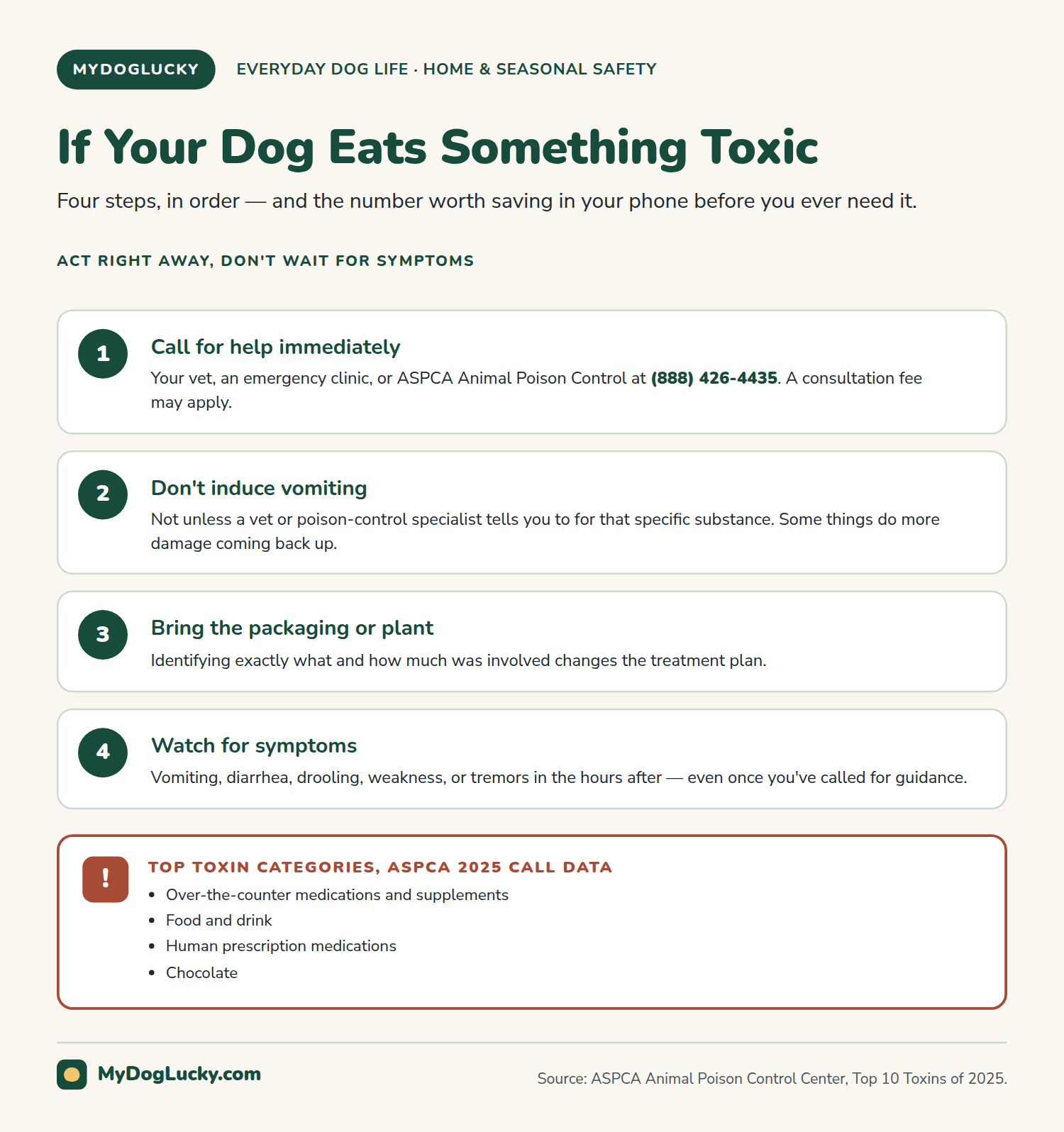
Call for help immediately if your dog swallows something toxic or something that could cause a blockage
Don’t wait to see if symptoms develop. Call your veterinarian, an emergency vet clinic, or the ASPCA Animal Poison Control Center at (888) 426-4435 (a consultation fee may apply). Have the product packaging or plant name on hand, along with your dog’s weight and roughly how much time has passed, since all three affect what the vet or poison-control team recommends.
- Don’t induce vomiting unless a veterinarian or poison-control specialist specifically tells you to for that substance. Some things cause more damage coming back up than staying down.
- Bring the packaging or a photo of the plant with you if you head to the vet. Identifying exactly what and how much was involved changes the treatment plan.
- Watch for vomiting, diarrhea, drooling, weakness, tremors, or unusual behavior in the hours after a known or suspected ingestion, even if you’ve already called for guidance.
- When in doubt, call. A poison-control consultation that turns out to be unnecessary costs far less than a delayed one that wasn’t.
Seasonal and holiday hazards
A handful of seasonal items are common enough to call out specifically, since they arrive in the house for a few weeks a year and catch even careful owners off guard.
- Holiday chocolate and sugar-free treats are a predictable spike in poison-control calls every winter holiday season.
- Tinsel, ribbon, and string lights combine a choking risk with, for tinsel and ribbon specifically, a serious intestinal blockage risk if swallowed.
- Holiday plants like poinsettias are milder than their reputation, usually causing only mild stomach upset, but mistletoe and holly are more concerning and worth keeping well out of reach.
- Fall and spring fertilizer and pesticide applications on lawns deserve a check of the product’s pet-safety guidance and a wait period before your dog is back on the grass.
- Ice melt and salt products in winter can irritate paws and cause stomach upset if licked off. Pet-safe formulations exist and are worth the switch.
Extra caution for a new dog or puppy
A brand-new dog, whether a puppy or a newly adopted adult, deserves a stricter version of every rule above for at least the first few weeks. You don’t yet know his specific habits, and he doesn’t yet know your house’s specific rules.
Do a full room-by-room pass before he arrives rather than reactively, room by room, after something goes wrong. Supervise closely in any newly accessed room for the first several visits, and loosen the restrictions gradually as you learn what he actually goes for.
Dog-proofing with multiple pets in the house
A household with more than one animal adds a layer most single-pet checklists skip, since each species and each individual can create risk for the others.
- Store one pet’s food and treats where another pet can’t reach them. Cat food, in particular, is a common target for dogs and isn’t formulated for canine nutrition or portion needs.
- Litter boxes are a genuine hazard for many dogs, both as a choking risk from litter itself and because some dogs eat cat waste. A baby gate a cat can hop but a dog can’t clear works well here.
- Small pets in cages or tanks (birds, rodents, reptiles) need placement well out of paw and nose reach, and a secure, dog-proof latch on any enclosure.
- Medications for one pet should never be accessible to another, since dosing and drug safety differ meaningfully between species.
Common dog-proofing mistakes
Dog-proofing once and never rechecking
A house that was safe for a six-month-old puppy may not be safe for the same dog at eighteen months, once he’s taller, stronger, and more confident about jumping or climbing. Revisit the checklist as your dog grows and changes.
Assuming a trained “leave it” replaces storage
Training reduces risk; it doesn’t eliminate it, especially with something as rewarding as food or as novel as a dropped pill. Use both together rather than relying on training alone.
Underestimating a determined dog’s problem-solving
Some dogs treat a closed cabinet or a zipped bag as a puzzle rather than a stop sign, working at a latch or a zipper pull until it gives. If your dog has shown this kind of persistence before, budget for sturdier hardware than the standard version.
Overlooking guest bags and visitor belongings
Purses, luggage, and gift bags brought in by visitors often contain medications, gum, or small items that bypass your usual dog-proofing entirely. A quick request to keep bags off the floor solves this.
Forgetting rooms that feel “off limits” to the dog already
A home office or craft room that your dog doesn’t normally enter can still matter if the door gets left open occasionally, which is exactly when accidents happen.
Assuming a small dog can’t reach what a large dog could
Small dogs are often surprisingly capable jumpers and climbers relative to their size, using furniture as stepping stones to reach counters and shelves a large, less agile dog might not bother trying for.
Relying entirely on memory instead of a written checklist
A mental list is easy to shortcut under time pressure, especially room by room during a busy week. A written or saved checklist, revisited on a schedule, catches gaps memory alone tends to skip.
Common myths about dog-proofing
“My dog has never chewed anything, so I don’t need to bother”
Chewing tendencies can appear or intensify with stress, boredom, teething, or simply a new and interesting object. A dog with no history isn’t the same as a dog with no risk.
“Small amounts of toxic food are fine as an occasional treat”
Toxicity in foods like chocolate, grapes, and xylitol isn’t about taste tolerance. It’s dose-dependent poisoning, and “small amount” still means real risk relative to your dog’s size.
“Dogs instinctively know what’s safe to eat”
Dogs explore the world with their mouths and don’t have a reliable internal sense of what’s toxic. Curiosity and smell drive their choices far more than any built-in caution.
“If a plant is fine for humans, it’s fine for dogs”
Several plants that are harmless or even edible for people, including some alliums like onions and garlic, are toxic to dogs. Species matters more than how “natural” or “edible” something sounds.
“Renters can’t really dog-proof, so there’s no point trying”
Nearly every solution on this list, storage height, closed doors, gates, and pens, works without any permanent modification. A rental just shifts the toolkit toward portable options rather than removing the need for them.
“A dog-proofed house once is dog-proofed for good”
New products, new plants, visiting relatives’ luggage, and your own dog’s growth and changing habits all shift the picture over time. Treat it as a routine to revisit, not a one-time project to check off.
Your room-by-room checklist
Bookmark this section and run through it room by room, checking off each one as you go.
- Kitchen: trash secured, counters clear, toxic foods stored closed.
- Living areas: cords managed, small objects up high, candles out of tail range.
- Bedrooms: medications closed away, laundry off the floor, nightstands checked.
- Bathroom: toilet lid down, medications and chemicals locked, floss and razors secured.
- Garage and laundry: antifreeze and chemicals sealed and high, pods stored closed.
- Home office: small hardware and batteries in closed drawers, cords managed.
- Yard: fence line checked, toxic plants and mulch identified, chemicals locked in a shed.
- ASPCA Animal Poison Control number saved in your phone: (888) 426-4435.
Redo the walk-through seasonally
A quick pass every few months, or after any household change, like a new plant, a renovation, or a visiting relative’s medication bag, catches new risks before your dog does.
Common questions about dog-proofing a home
Do I really need to dog-proof if my dog is well-trained?
Yes, at a lighter level. Training reduces risk but doesn’t remove it, especially around food, novel objects, or a moment you’re not watching closely.
Is it safe to use standard childproofing products for a dog?
Many childproofing products, like cabinet latches and outlet covers, work fine for dogs too. Just check that a determined nose or paw, not just small hands, can’t defeat them.
What’s the single highest-risk room in most homes?
The kitchen, by a wide margin, because it combines the most toxic substances with the easiest counter and trash access.
How do I dog-proof a house I don’t own or can’t renovate?
Focus on storage height, closed doors, and portable solutions like baby gates and x-pens rather than structural changes. Nearly everything on this list works in a rental.
My dog only got into something once. Do I still need to change anything?
One incident is exactly the signal to fix that specific gap, since dogs who’ve successfully gotten into something once tend to check the same spot again.
Are essential oil diffusers safe to run around dogs?
Some essential oils are toxic to dogs in concentrated form, especially with prolonged exposure in a small space. If you use a diffuser, keep it in a room your dog doesn’t spend extended time in, and ask your vet about specific oils if you’re unsure.
Do I need to remove all houseplants if I have a dog?
No. Relocating toxic ones out of reach, or choosing dog-safe species going forward, solves the problem without giving up plants entirely.
What should I keep in a small “dog emergency kit” at home?
The ASPCA Animal Poison Control number, your vet’s number and the nearest emergency clinic’s number, your dog’s weight, and a way to safely transport him if needed. None of it replaces calling for guidance first.
How often should I redo a full dog-proofing walk-through?
Every few months is reasonable for a settled household, and immediately after any household change: a new puppy, a move, a renovation, or a long visit from relatives.
Is cocoa mulch actually dangerous, or is that overstated?
It’s a genuine risk. Cocoa mulch contains some of the same compounds as chocolate and smells appealing to dogs, which is an unusual combination worth avoiding in a yard your dog has access to.
My dog is small. Does that mean fewer rooms are actually reachable?
Reach matters less than you’d think. Small dogs are often excellent climbers and jumpers relative to their size, and they’re also more sensitive to smaller doses of anything toxic. Don’t skip the higher shelves just because your dog is little.
How do I dog-proof a pool area if my dog loves to swim?
Fencing and chemical storage still matter even for a confident swimmer, since unsupervised access, especially for a puppy or senior dog, carries risk regardless of swimming skill. Supervision remains the deciding factor, not ability alone.
Are pressure-mounted baby gates strong enough for a large or determined dog?
For a persistent pusher, a hardware-mounted gate is more reliable than a pressure-mounted one, which can be dislodged by sustained pressure. Check the manufacturer’s weight and strength rating against your specific dog before relying on the pressure-mounted version.
What should I do differently if I have a cat as well as a dog?
Litter box placement and food-storage separation are the two biggest additions. A gate or elevated spot a cat can access but a dog can’t handles most of the shared-space friction.
Is it necessary to dog-proof a balcony?
Yes, if your dog has access to it. Check railing gaps, secure any stored chemicals or plants, and treat an unsecured balcony edge as seriously as an unfenced yard drop-off.
How long does a full room-by-room dog-proofing pass usually take?
A couple of hours for most homes, done at a reasonable pace room by room. It’s faster on a repeat pass, since you already know where your household’s specific risk spots tend to be.
Should I dog-proof differently for a foster dog than a permanent one?
Treat a foster dog with the same caution as a brand-new dog or puppy, since you likely know even less about his specific habits and history than you would with your own dog.
Sources
- ASPCA. Top 10 Toxins of 2025
- ASPCA. Toxic and Non-Toxic Plant List — Dogs
- ASPCA Animal Poison Control Center. Animal Poison Control — (888) 426-4435
This article is general education for U.S. dog owners. It is not individualized veterinary advice. Ask your veterinarian about anything specific to your dog.


Trackbacks/Pingbacks