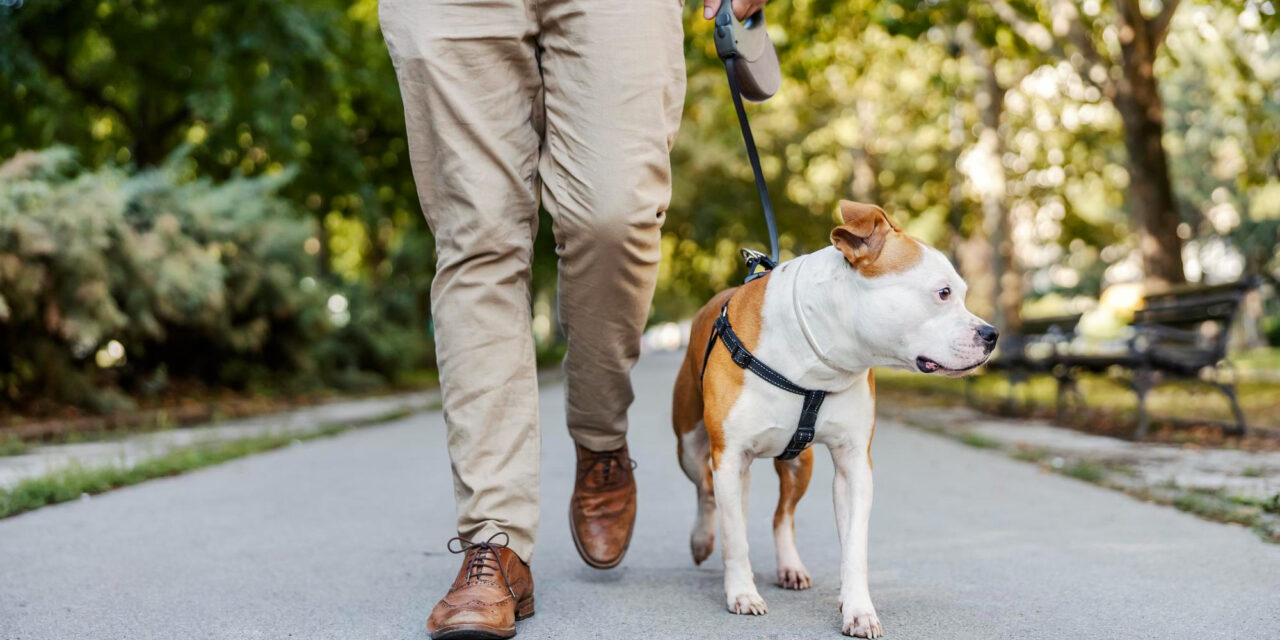
How often should you walk your dog? Most healthy adult dogs do well with two to three walks a day, spaced a few hours apart. Puppies need far more frequent, much shorter trips outside. Senior dogs often do best split into several gentler outings instead of one long one.
That’s a different question from how much total exercise your dog needs. This guide is about frequency and timing instead. It covers how often to go out, and how to space walks across your day. It also covers what to do when your schedule doesn’t cooperate.
You’ll get age-by-age frequency guidance, and a look at why sniffing walks deserve a place on the schedule. You’ll also get sample weekly routines for different lifestyles, and a plan for the days your usual schedule falls apart.
What’s in this guide
- How often should you walk your dog? The quick answer
- Why frequency matters as much as total minutes
- Potty breaks and walks for puppies
- How often adult dogs need to go out
- Walk frequency for senior dogs
- Walk frequency and specific health conditions
- Why a sniffing walk counts as a real walk
- Spacing walks across the day
- Finding your dog’s real gap: a simple tracking method
- Building a weekly schedule that actually fits your life
- Sample weekly schedules
- Backup and substitute care
- Tools that make scheduling easier
- When you can’t keep the usual schedule
- Signs your walk schedule needs adjusting
- Common scheduling mistakes
- Changing your dog’s schedule without causing stress
- Common questions about walk frequency and scheduling
- Sources
How often should you walk your dog? The quick answer
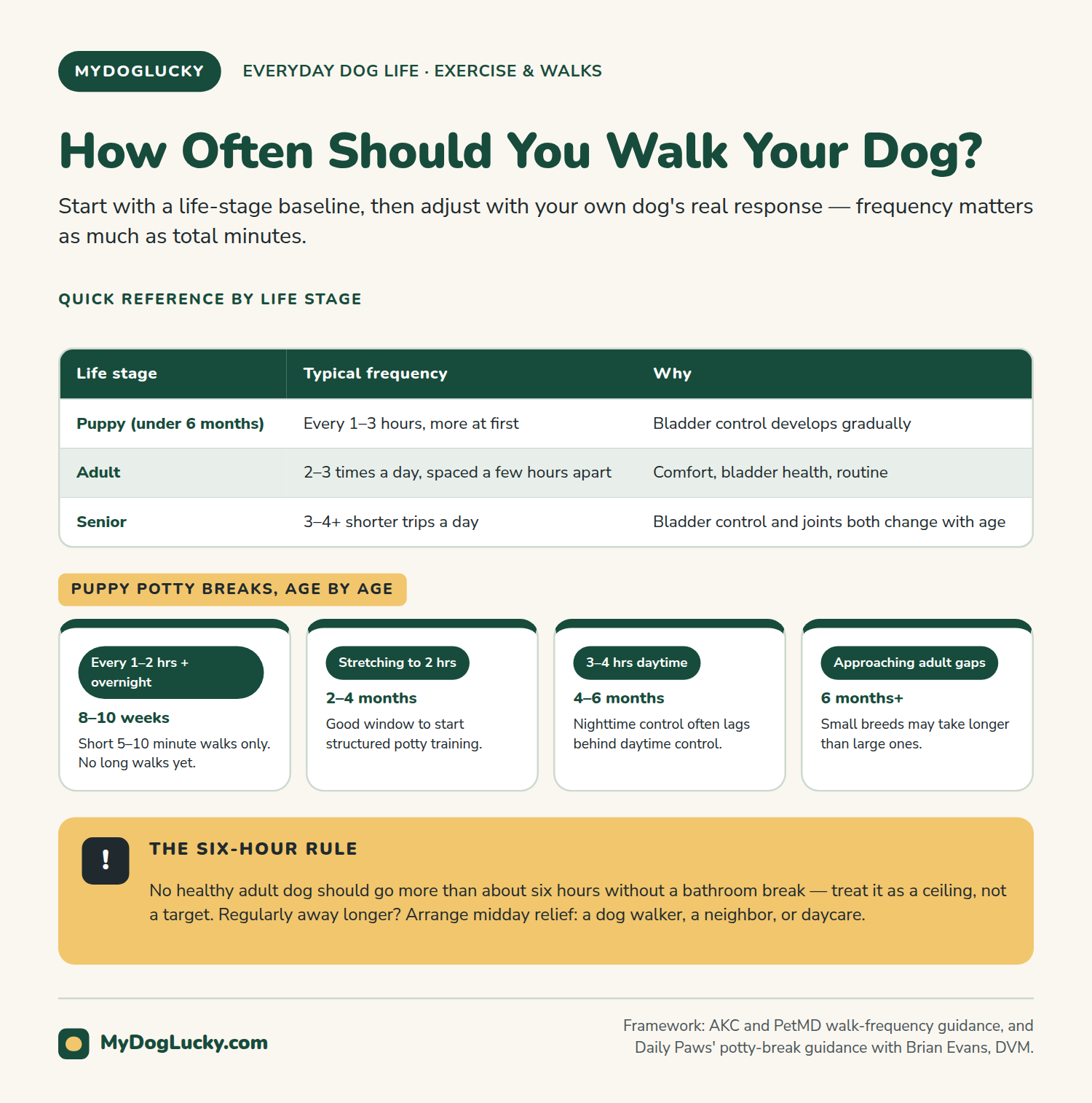
Start here, then adjust for your own dog and your own week. Most healthy adults do well with two to three walks a day. Puppies need many more, much shorter outings. Seniors often do best with smaller, more frequent trips rather than one long walk.
| Life stage | Typical frequency | Why |
|---|---|---|
| Puppy (under 6 months) | Every 1–3 hours, more at first | Bladder control develops gradually |
| Adult | 2–3 times a day, spaced a few hours apart | Comfort, bladder health, routine |
| Senior | 3–4+ shorter trips a day | Bladder control and joints both change with age |
Treat this table as a starting frame, not a fixed schedule. The rest of this guide helps you build the actual routine around your real week.
Why frequency matters as much as total minutes
How much total exercise your dog needs is a different question, and it deserves its own dedicated answer elsewhere. This guide is about spacing instead: how often you go out, and how evenly those trips land across your day.
Frequency matters for a few real reasons. A dog’s bladder has a limit, and that limit is smaller than most owners assume. Long gaps between trips outside are uncomfortable at best. At worst, they can contribute to accidents or urinary tract problems.
Routine matters too, separate from bladder health entirely. Dogs are creatures of habit. Knowing roughly when the next walk is coming is genuinely calming for many dogs, especially anxious ones.
Decompression matters as well. A quick, purposeful walk gets the job done. It doesn’t always give a dog room to just be a dog. That’s a separate need, and this guide covers it later on.
Total exercise amount and walk frequency solve different problems, even though they get lumped together in casual conversation. A dog can get plenty of total minutes in one long weekend hike and still spend the rest of the week uncomfortably under-scheduled. The reverse happens too: frequent, well-spaced short trips without much total distance still leave a high-energy dog under-exercised overall.
Both questions matter. How often should you walk your dog is the scheduling half of the answer. How much total exercise your dog needs is the other half. Both are worth getting right, rather than treating one as a substitute for the other.
Potty breaks and walks for puppies
Puppies need far more frequent trips outside than adult dogs. That gap shrinks even further in the first few months. A commonly used rule of thumb: a puppy can typically hold it for about one hour per month of age. Individual puppies vary quite a bit around that average.
| Age | Typical gap between breaks | Notes |
|---|---|---|
| 8–10 weeks | Every 1–2 hours, plus overnight | Short 5–10 minute walks only |
| 2–4 months | Stretching toward 2 hours | Good window to start potty training |
| 4–6 months | 3–4 hours during the day | Nighttime control often lags behind |
| 6 months+ | Approaching adult gaps | Small breeds may take longer than large ones |
8 to 10 weeks
Expect to go out every one to two hours during the day, plus at least once overnight. Short walks, five to ten minutes, are plenty at this age. Long walks aren’t appropriate yet, for joint and vaccination reasons covered in this site’s puppy care guides.
2 to 4 months
Gaps can stretch toward two hours as bladder control slowly improves. This is also a common window for starting structured potty training, which benefits from consistent, frequent trips to the same outdoor spot.
4 to 6 months
Many puppies can start holding it three to four hours during the day. Nighttime control often lags behind daytime control, even in puppies doing well otherwise. Keep breaks frequent even once your puppy seems to be managing longer daytime gaps.
6 months and up
Most puppies approach adult-level bladder control by six months, though this varies by size and individual. Small breeds sometimes take longer than large ones. Keep breaks frequent until your puppy is reliably going a full adult-length gap without accidents.
Overnight breaks for a new puppy
Most young puppies need at least one overnight trip outside, sometimes two. A puppy who wakes and whines is usually telling you something real, not just testing limits. Take that puppy out rather than waiting it out.
Keep the overnight trip low-key. Dim lights, a quiet tone, straight outside and back to bed. Save play and excitement for daytime hours. That helps your puppy learn the difference between a nighttime bathroom trip and the start of the day.
Overnight trips usually shrink faster than daytime gaps do. Many puppies drop the overnight break entirely somewhere between four and six months, though this varies by individual and by size.
Full housetraining strategy, including daytime schedules and accident troubleshooting, deserves its own dedicated guide. This section focuses on frequency alone: how often, not how to train the behavior itself.
A few signs suggest your puppy is ready for a slightly longer gap. Going a full stretch without an accident several times in a row is one. Calmly waiting near the door instead of whining is another, along with settling down for a nap rather than pacing. Stretch the gap by fifteen minutes at a time, not by an hour all at once.
How often adult dogs need to go out
A widely used minimum: no adult dog should go more than about six hours without a bathroom break. Many dogs do noticeably better with shorter gaps than that.
A common starting pattern: first thing in the morning, once more midday, and again before bed. Adjust upward if your dog seems uncomfortable, drinks a lot of water, or is a smaller breed with a smaller bladder.
Six hours is a ceiling, not a target
Treat it as the outer limit for an otherwise healthy adult dog, not a number to aim for every day. A dog who’s comfortable at four hours doesn’t benefit from being stretched to six just because six is technically allowed.
If your schedule keeps you away longer than six hours regularly, that’s a sign to arrange midday relief. It isn’t a sign to just push through it. A dog walker, a neighbor, or doggy daycare are all reasonable ways to close that gap, covered later in this guide.
Three shorter trips and two longer ones can add up to a similar total, but they don’t feel the same to your dog. More, shorter breaks generally beat fewer, longer ones when bladder comfort is the main concern. Save the longer single outing for when total exercise, not bathroom access, is the goal.
Walk frequency for senior dogs
Bladder control often loosens with age, sometimes gradually and sometimes more suddenly. Many senior dogs do better on a three-to-four-hour rhythm instead of the six-hour adult standard.
Joint changes play a role too. Several shorter, gentler outings are often easier on an arthritic dog than one longer walk. That’s true even when the total distance ends up roughly the same.
A sudden change is worth a vet visit
More accidents, more urgency, or more nighttime trips outside are worth a call to your vet. Don’t just assume it’s simply old age. Several treatable conditions can cause exactly this pattern, and catching them early matters.
Mobility aids can help too. A ramp instead of stairs, a non-slip mat by the door, or a shorter route to the yard all help. Small changes like these make frequent trips easier on a senior dog’s joints.
Tracking changes over time
Senior dogs change gradually, which makes shifts easy to miss day to day. A simple note on your phone works well: a date, and what you noticed. It turns a vague feeling into something concrete to bring to your vet.
Look back at that note every month or two. A pattern that’s invisible day to day often becomes obvious once you see a few weeks of it side by side.
Walk frequency and specific health conditions
Some health conditions change the schedule itself, not just the amount of exercise involved. A few of the most common ones are worth knowing about.
- Diabetes. Consistent meal and walk timing can matter for insulin management. Ask your vet how tightly your dog’s schedule needs to line up with injections.
- Kidney disease. Increased thirst often means increased urination, which usually means more frequent trips outside, not fewer.
- Incontinence. More frequent breaks help, alongside protective measures like washable pads. This isn’t a training failure, and treating it like one rarely helps.
- Cognitive decline. Predictable timing matters even more for a senior dog whose sense of routine is already slipping. Consistency itself can be genuinely supportive here.
- Recent surgery. Follow your vet’s specific bathroom-break and activity timeline, not a general guide like this one.
None of these conditions mean the schedule is out of your control. They mean building it around your dog’s specific situation, ideally with your veterinarian’s input.
Why a sniffing walk counts as a real walk
Not every walk needs a destination or a pace. A decompression walk, sometimes called a sniffari, lets your dog choose the direction and set the speed. You come along more as a passenger than a driver.
Sniffing itself has a calming effect on many dogs. Letting your dog investigate one patch of grass for two full minutes isn’t wasted time. It’s genuine enrichment, and it’s often more mentally tiring than a brisk walk with no stops at all.
These walks matter even more for anxious, reactive, or easily overwhelmed dogs. Choosing a quiet route and letting your dog set the pace can lower stress in a way a fast, structured walk usually doesn’t.
Aim to work at least one unhurried, sniff-heavy walk into most days, even if it’s short. It doesn’t have to replace your dog’s other exercise. It just has to exist on the schedule at all.
For a reactive, fearful, or easily overstimulated dog, consider making every walk a sniffing walk for a while. Not just one among several. Structured, brisk walking can wait until your dog’s stress levels come down. There’s no rule that says exercise has to look a particular way every single day.
A sniffing walk isn’t a lazy walk
It can look unproductive from the outside: a slow lap around the block, lots of pausing, not much ground covered. For your dog’s nose and nervous system, it’s doing real work the whole time.
Spacing walks across the day
Even, predictable gaps beat clustering everything into a narrow window. A dog let out twice within one hour, then left alone for the next ten, isn’t actually getting good coverage. The number “two” looks fine on paper, but the spacing tells the real story.
Two walks close together isn’t the same as two walks spread out
What matters is the longest single gap your dog faces, not just the total count for the day. A schedule with three trips outside can still leave one uncomfortable nine-hour stretch if they’re not spaced well.
A simple target for most adult dogs: roughly four to six hours between trips outside during the day. Tighten that up for puppies, seniors, and dogs with health conditions that affect bladder control.
Morning and evening tend to anchor themselves naturally around your own schedule. The midday gap is where most schedules actually break down, which is exactly why backup coverage matters so much on a typical workday.
Weekends can throw the pattern off just as much as workdays. A dog used to a certain rhythm can get thrown off easily. A lazy Saturday morning that pushes the first walk two hours later than usual is enough.
Travel disrupts spacing more than most owners expect, especially across time zones. Shift the schedule gradually over a couple of days when you can, rather than snapping straight to the new local time. A dog’s internal clock adjusts, but not instantly.
Finding your dog’s real gap: a simple tracking method
The age-based tables above are a starting frame. They’re not your dog’s actual number. The most reliable way to answer how often should you walk your dog is a short trial. A generic rule only gets you so far.
Two dogs the same age and size can have genuinely different bladder tolerance. Water intake, individual anatomy, and even nerves all play a role no table can capture. A week of honest tracking beats a guess every time.
A one-week log you can run at home
Pick a starting gap from the tables earlier in this guide. Then track your dog’s response for about a week, rather than assuming the number is automatically right.
- Days 1–3: hold the baseline. Stick to the suggested gap for your dog’s age and life stage. Note any accidents, whining, or pacing near the door.
- Days 4–5: look for a pattern. Is your dog comfortable and relaxed near the end of each gap, or clearly uncomfortable? Any accidents at a consistent time of day?
- Days 6–7: adjust once. If your dog seems fine, you likely have some room to stretch the gap slightly. If not, tighten it and hold there for another week.
What to watch for during the trial
- Whining, circling, or pacing near the door before the usual time
- Any accidents, and roughly when they happen relative to the last trip outside
- How quickly your dog settles after coming back in
Revisit this trial whenever something changes: a new job, a move, aging, or a new puppy joining the household. The right gap today isn’t necessarily the right gap in six months.
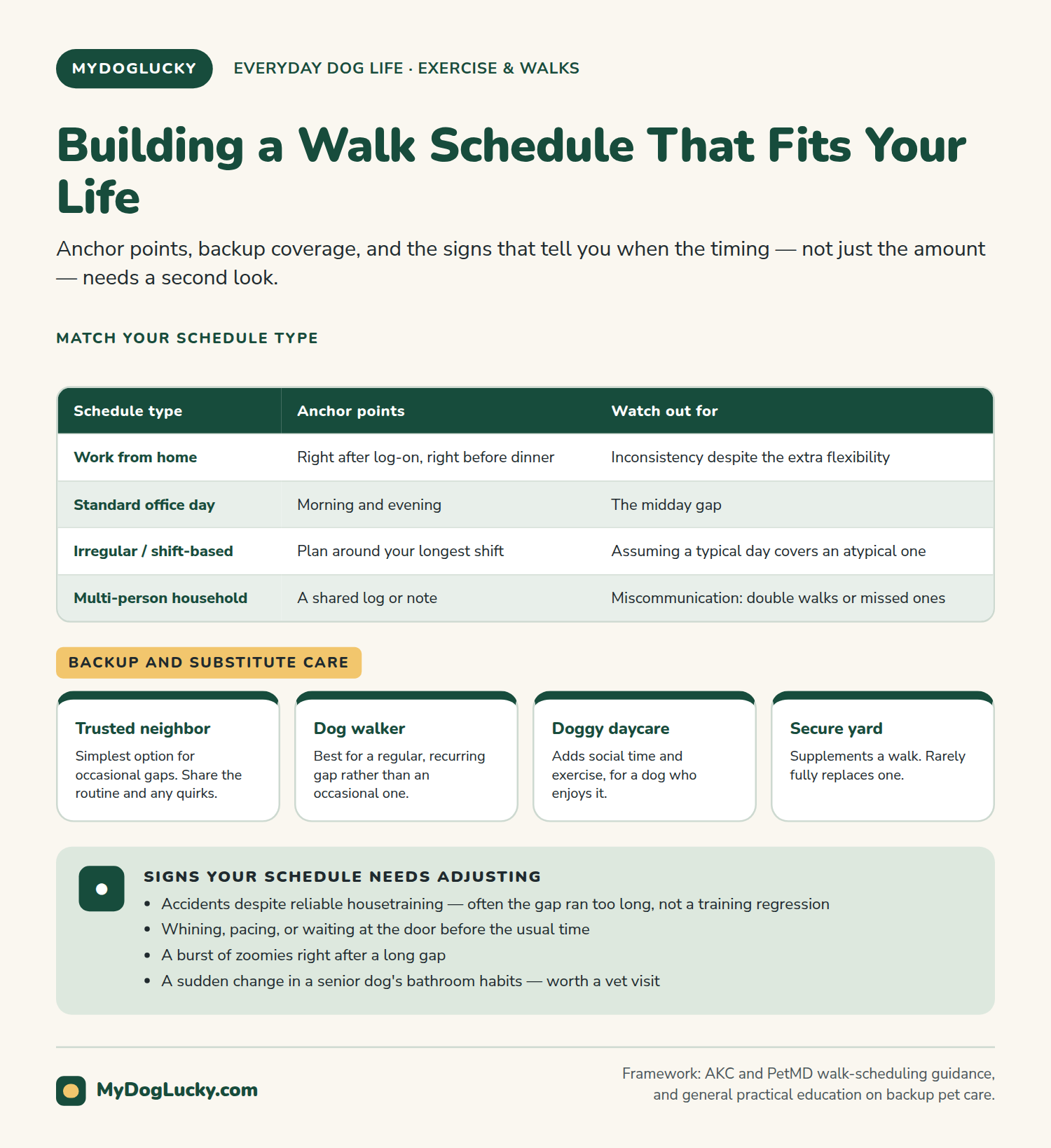
Building a weekly schedule that actually fits your life
The best schedule is the one you’ll actually keep, not the theoretically perfect one you’ll abandon by Wednesday. Build it around your real week, not an idealized version of it.
| Schedule type | Anchor points | Watch out for |
|---|---|---|
| Work from home | Right after log-on, right before dinner | Inconsistency despite the extra flexibility |
| Standard office day | Morning and evening | The midday gap |
| Irregular or shift-based | Plan around your longest shift | Assuming a typical day covers an atypical one |
| Multi-person household | A shared log or note | Miscommunication: double walks or missed ones |
If you work from home
You likely have more flexibility, but that can quietly backfire into inconsistency. Anchor at least two walks to fixed points in your day, like right after you log on and right before dinner. That way your dog isn’t left guessing.
If you work a standard office day
Morning and evening are usually the easy part. The gap in between is the real planning problem. It’s exactly where a dog walker, a neighbor, or daycare earns their keep for a puppy, senior, or small-bladdered dog.
If your schedule is irregular or shift-based
Consistency in exact timing may not be realistic for you, but consistency in maximum gap length still is. Build a specific backup plan for your longest shifts, rather than hoping a typical day’s routine will cover an atypical one.
If more than one person shares the care
Miscommunication is the real risk here, not lack of willingness. A shared note, a whiteboard, or a simple phone app all work. Logging who walked the dog and when prevents both the double walk and the missed one.
Sample weekly schedules
A worked example often lands better than another abstract rule. Here are four realistic weekly patterns, built from everything covered so far.
New puppy, owner working from home
Weekdays: potty breaks every one to two hours during work, anchored around video calls. Add a short walk at lunch, and another before bed. Weekends: the same rhythm, just easier to keep since there’s no work schedule competing for attention.
Healthy adult dog, standard 9-to-5 office job
Weekdays: a walk before work, a midday visit from a dog walker or neighbor, and a longer walk after work. Weekends: two walks a day is usually plenty, with one of them a relaxed, sniff-heavy outing instead of a brisk one.
Two adults with staggered shifts, no outside help needed
Weekdays: whoever’s home in the morning handles the first walk, and the other person covers the evening one. The schedule shifts week to week. The key is a shared log so both people know what’s already been done.
Senior dog, retired owner mostly home
Days: four or five shorter outings instead of two long ones, timed around the dog’s own comfort more than the clock. One of them is usually an easy, unhurried sniffing walk rather than anything brisk.
Multi-dog household, a puppy and a senior together
Weekdays: the puppy gets frequent short trips on his own tighter schedule. The senior joins for one or two of them and skips the rest. Walking them separately for some trips, and together for others, respects both dogs’ real needs. It beats averaging them into one compromise.
None of these are rigid scripts. Swap pieces around, shorten sessions on a rough day, and adjust as your own week changes.
Backup and substitute care
Even a solid routine needs a backup plan for the days it can’t hold. A meeting that runs over, a doctor’s appointment, unexpected travel. Building that plan before you need it beats scrambling in the moment.
Think of backup care as part of the schedule itself, not an emergency measure reserved for rare disasters. A household that leans on it every Tuesday for a recurring long meeting is using it exactly as intended.
A trusted neighbor or friend
Often the simplest option, especially for occasional gaps rather than a daily need. Share your dog’s routine, any quirks, and clear instructions, the same way you would for a sitter.
A professional dog walker
Worth considering for a regular, recurring gap rather than an occasional one. Choosing and vetting a walker deserves its own dedicated guide. This is simply the point in your schedule where that option belongs.
Doggy daycare
Solves the coverage problem, and adds social time and exercise on top of it. That’s true for a dog who genuinely enjoys that kind of environment. Not every dog is a good fit, though. That’s worth an honest assessment before committing to it regularly.
A secure, supervised yard
Can supplement, but rarely fully replaces, a walk. A dog left alone in a yard often just patrols the fence line. That’s not the same as the mental engagement a real walk or sniff session provides.
Logistics worth sorting out in advance
A written instruction sheet saves real trouble later. Feeding notes, any medical quirks, your vet’s contact information, and exactly where the leash lives. Whoever’s helping shouldn’t have to guess or call you mid-walk.
Key access matters too. A lockbox, a spare with a trusted neighbor, or a simple code all work. Test it before the day you actually need it, not during an emergency.
Introduce a new walker or sitter gradually when you can. A short trial visit while you’re home lets your dog meet them first. That avoids the added stress of also being left alone with someone new.
Most households end up mixing two or three options
Which one you lean on can shift by day, by season, or by what’s actually happening that week. There’s no single right combination, only the one that reliably closes your actual gaps.
Tools that make scheduling easier
None of these are required. A few can genuinely take friction out of a busy week. That’s especially true in a multi-person household, or one leaning on outside help.
- A shared calendar or app. Even a basic shared note works. The goal is one place everyone checks, not memory alone.
- A walk-tracking app. Many dog walker services log the time, route, and even a photo automatically. That log doubles as a record for your own tracking trial.
- A pet camera. Useful for checking in on a long gap. Also good for confirming a walker or sitter actually showed up when they said they would.
- A smart lock or lockbox. Removes the key-copying headache and lets you grant or revoke access without a locksmith.
- A simple paper log by the door. Low-tech, but it works just as well as an app for a smaller household. Time out, time back, done.
Pick one or two, not all five. The point is removing friction from your actual routine, not adding a new chore on top of it.
When you can’t keep the usual schedule
Bad weather, illness, a schedule that falls apart: these things happen. A single disrupted day rarely causes lasting harm. A repeated pattern of it is what’s actually worth addressing.
On a day you genuinely can’t get outside as often as usual, indoor enrichment helps. A bit of extra patience with potty timing can bridge the rest of the gap. That’s its own deep topic, worth exploring separately in detail.
What matters most on an off day: don’t punish accidents that happen because a gap ran too long. That’s a scheduling problem, not a training one, and treating it as a training failure usually backfires.
Pee pads or an indoor grass patch are reasonable bridges. They work well for a puppy, a senior, or any dog facing a genuinely unavoidable long gap. They’re a backup tool, not a replacement for a real schedule once your circumstances allow one again.
Signs your walk schedule needs adjusting
A few patterns suggest the timing, not just the total amount of exercise, needs a second look.
- Accidents despite reliable housetraining. Often a sign the gap between trips has gotten too long, not a training regression.
- Whining, pacing, or waiting at the door before the usual time. Your dog is telling you the rhythm has shifted.
- A burst of zoomies right after a long gap. Sometimes that’s pent-up energy from being cooped up longer than usual, not a behavior problem on its own.
- Restlessness that clusters around a specific time of day. Often points to one particular gap in the schedule rather than the whole day being off.
- A sudden change in a senior dog’s bathroom habits. Worth a vet visit, not just a schedule tweak, as covered earlier in this guide.
- Increased marking or scent-marking indoors. Sometimes about spacing rather than a training lapse, especially in a dog who was previously reliable.
None of these are emergencies on their own. They’re useful information about exactly where the current schedule is straining. Cross-check them against the one-week tracking method above before assuming a bigger problem is at play.
Common scheduling mistakes
Skipping the midday gap without a backup plan
Hoping a long day will somehow work itself out is how six-hour gaps quietly become nine-hour gaps. Build the backup plan before the long day arrives, not during it.
Inconsistent timing
Walking at wildly different times each day makes it harder for your dog to predict and settle. Some flexibility is fine. Total unpredictability isn’t especially comforting for most dogs.
Treating a weekend hike as a substitute for the week’s routine
One long outing doesn’t make up for five days of rushed, infrequent trips. Frequency and total distance solve two different problems, even though they can feel interchangeable.
Not adjusting for the season
Shorter daylight hours and colder mornings often quietly shrink a walk schedule without anyone deciding to change it. Revisit the plan each season, not just once a year.
Assuming every dog in the house needs an identical schedule
A small-bladdered senior and a healthy young adult in the same house may need genuinely different frequencies. One household schedule doesn’t have to mean one single dog schedule.
Confusing more walks with more exercise
Adding a fourth short trip outside doesn’t automatically satisfy a high-energy dog’s activity needs. Frequency and total exercise amount answer different questions, and it’s worth checking both rather than assuming one fixes the other.
Changing your dog’s schedule without causing stress
Sometimes the schedule itself needs to shift: a new job, a move, a new baby, a change in who’s home during the day. A few steps make the transition easier on your dog.
- Shift gradually when you can. Move meal and walk times by fifteen to thirty minutes every few days, rather than jumping straight to the new schedule overnight.
- Keep the order familiar, even if the clock time changes. A dog used to a walk right after breakfast adjusts faster if that sequence stays intact.
- Expect a rough week. A few accidents or some extra whining during the transition is normal, not a sign the new schedule is wrong.
- Watch for the signs covered earlier in this guide. They’ll tell you whether the new schedule needs a further tweak, or just more time to settle in.
Most dogs adapt faster than owners expect, especially with a consistent new routine to hold onto instead of constant further changes.
Common questions about walk frequency and scheduling
Can a healthy adult dog really hold it for a full 8-hour workday?
Some can, many struggle. Six hours is the commonly cited outer limit, and even that’s uncomfortable for some dogs. An 8-hour gap is usually a sign to arrange midday coverage rather than something to rely on regularly.
Is it safe to walk my dog in the dark?
Often yes, with precautions. Reflective gear, a well-lit route, and extra attention to traffic and other dogs all matter more once the sun’s down. Stick to familiar routes when visibility is limited.
Should I walk before or after my dog eats?
Light activity before a meal is generally fine. Vigorous exercise right after eating raises bloat risk in some dogs, particularly large, deep-chested breeds. Leave an hour or so after a big meal before anything strenuous.
Do multiple dogs in one household need separate walks?
Not necessarily, if they walk well together and both get real attention rather than one being an afterthought behind the other. Some pairs genuinely do better with occasional solo time too.
Does the walk need to happen at the exact same time every day?
No, but rough consistency helps. A predictable window, morning and evening for example, works just as well as an exact clock time for most dogs.
What if my puppy’s schedule doesn’t match my work hours yet?
This is one of the most common reasons new puppy owners lean on backup care in the first few months. A midday visit from a walker, a neighbor, or a family member can bridge the gap until your puppy’s bladder control catches up.
Do apartment dogs need more frequent walks than dogs with yards?
Often yes, since they don’t have casual outdoor access between structured trips. Frequency, more than total time, tends to matter most for apartment dogs specifically.
How do I know if I’m overdoing the number of walks?
This is rarely a real problem on its own. If your dog seems exhausted, reluctant, or physically sore, that’s about total exercise load rather than frequency. It’s worth revisiting through that different lens instead.
My schedule changed recently. How long does it take a dog to adjust to a new routine?
Most dogs settle into a new rhythm within one to two weeks of consistent repetition. A few accidents or some restlessness during that adjustment window is normal, not a sign something’s gone wrong.
Should I wake my dog up for a nighttime bathroom break?
For most healthy adults, no. A young puppy, an aging senior, or a dog with a known medical condition is different. A set overnight trip can genuinely help there. When in doubt, ask your vet what’s appropriate for your specific dog.
How do I transition a newly adopted dog to a walk schedule?
Start gentler and more frequent than you think you’ll need, then adjust once you understand your new dog’s actual tolerance. A dog adjusting to a new home is also learning an entirely new routine, and that takes a little patience.
Is a dog door a substitute for scheduled walks?
It solves part of the bathroom-access problem for a dog with a secure yard, but it isn’t a full substitute. A dog door doesn’t provide a change of scenery, new smells, or the mental engagement a real walk offers.
What order should I walk multiple dogs in?
There’s no fixed rule. Some owners rotate who goes first to keep things fair; others always start with whichever dog struggles more with waiting. Either approach works, as long as every dog is actually getting walked, not just tagging along.
My dog seems nervous around a new dog walker or sitter. Is that normal?
Very common, especially early on. A short trial visit while you’re still home helps. So does a consistent greeting routine the sitter repeats each time. Most nervous dogs settle in within a few visits.
So, how often should you walk your dog? Start from your dog’s life stage, and tighten the gaps for a puppy or senior. Build in at least one unhurried sniffing walk, and have a backup plan ready before you need it. The right frequency is the one your own dog’s response confirms, not just the one a table suggests.
Sources
- AKC. How Often Should You Walk Your Dog?
- PetMD. How Often Should You Walk Your Dog?
- Daily Paws. How Often Do Dogs Need to Pee? Here’s What a Vet Wants You to Know (Brian Evans, DVM).
- Wisconsin Humane Society. Decompression Walks.
This article is general education for U.S. dog owners. It is not individualized veterinary or behavioral advice. Ask your veterinarian about anything specific to your dog’s bladder health, mobility, or medical history.