

Standing in the pet food aisle comparing two bags that both claim to be “premium” and “complete” is its own particular kind of overwhelm. Learning how to read dog food labels doesn’t take a nutrition degree — it takes knowing where to look. Four things on that bag actually carry legal weight: the AAFCO nutritional adequacy statement, the guaranteed analysis, the ingredient list, and the calorie content. Everything else, including the photos and the taglines in extra-large font, is marketing, and marketing isn’t regulated the way those four elements are.
You don’t need a rulebook to get through the next ten minutes in aisle six. This guide walks through exactly what those four label elements mean, why the ingredient list is more misleading than most owners assume, and what the Association of American Feed Control Officials (AAFCO) actually does — spoiler: it doesn’t “approve” individual products. We’ll also cover the marketing words that sound meaningful but aren’t, and how to check a product’s recall history before it lands in your cart.
One note on scope: this article won’t tell you which specific commercial food to buy. We don’t name or rank brands here, partly because your dog’s needs, budget, and life stage are specific to your dog, and partly because a label’s real story lives in the details rather than the front-of-bag branding. A related MyDogLucky guide, “How Much Should I Feed My Dog,” picks up where this one leaves off; “How to Switch Dog Food” and “Best Dog Food for Your Dog” cover the decisions that usually come next.
What’s in this guide
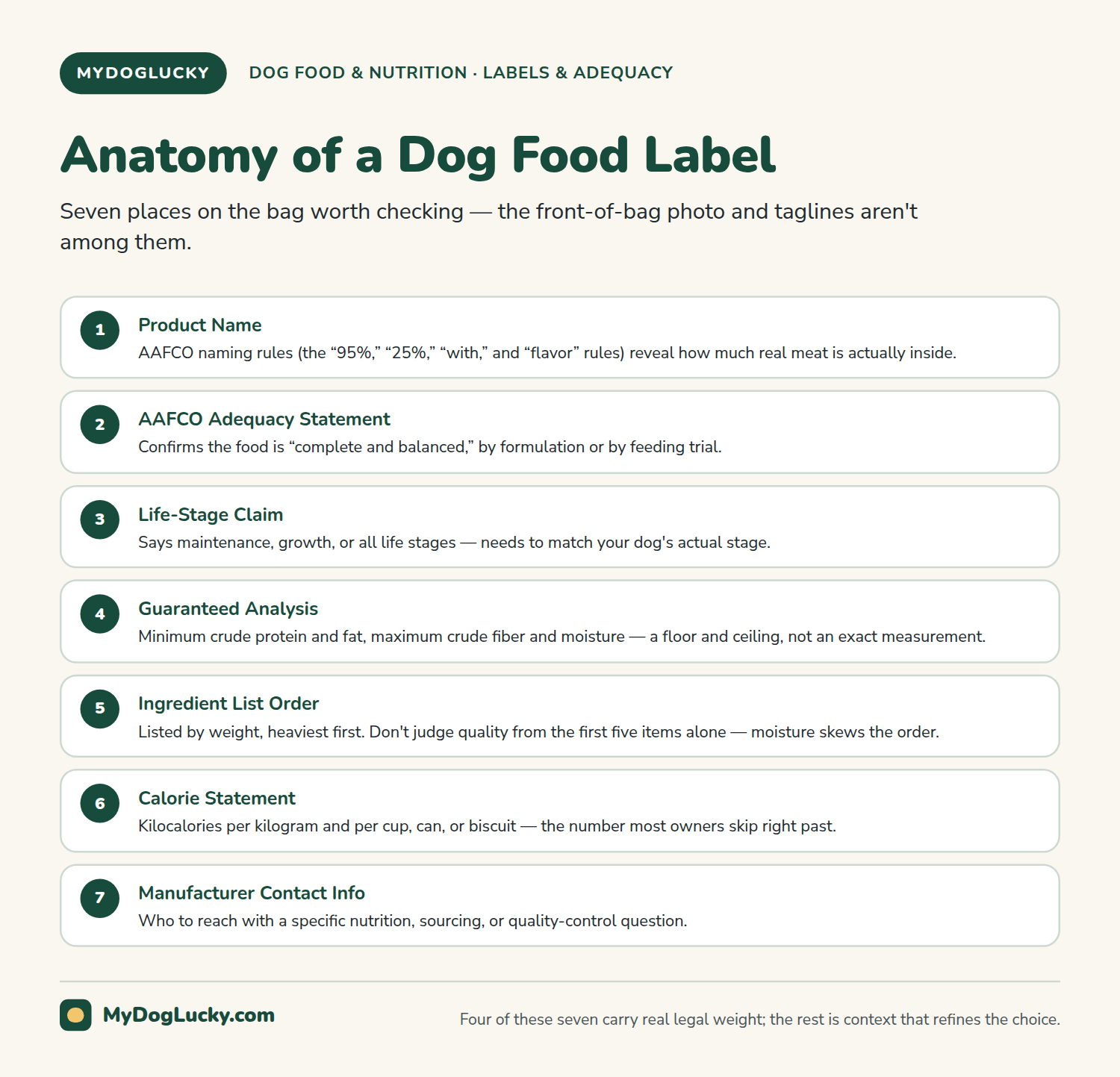
- How to read dog food labels: the four things that actually matter
- The AAFCO nutritional adequacy statement, decoded
- The guaranteed analysis: what those percentages really tell you
- Calorie content: the number that’s easy to miss
- Reading the ingredient list without falling for the “first five” myth
- What AAFCO actually does (and doesn’t do)
- Gauging manufacturer quality: questions worth asking
- “Natural,” “premium,” “holistic,” and other words that sound regulated but aren’t
- Checking recall history and reading best-by dates
- A label literacy checklist for the pet food aisle
- Common label-reading mistakes
- Frequently asked questions about dog food labels
- Sources
How to Read Dog Food Labels: The Four Things That Actually Matter
Most of a dog food bag is marketing copy, and marketing copy isn’t required to be true in any specific, measurable way. Four elements on that same package carry real legal weight, though, and finding them is most of what “how to read dog food labels” actually means in practice.
- The AAFCO nutritional adequacy statement. Usually one small-print sentence on the back or side panel. It tells you whether the food is meant to be a complete diet, and for which life stage.
- The guaranteed analysis. A short table, also on the back panel, listing minimum crude protein and fat, plus maximum crude fiber and moisture.
- The ingredient list. Everything the food contains, listed by weight, heaviest first — usually right next to the guaranteed analysis.
- The calorie content. A statement under a “Calorie Content” heading, given in kilocalories per kilogram and per cup, can, or biscuit.
Notice what’s missing from that list: the product name, the happy-dog photo on the front, and any word like “premium” or “holistic.” Those live on the front of the bag because they’re designed to catch your eye first, not because they carry the same legal weight as the four items above. Keep that distinction in mind as a general rule — the more impressive the front of a bag tries to look, the more useful it is to flip it over.
Where Each Element Lives on the Package
| Element | Typical location | What it actually tells you |
|---|---|---|
| Product name | Front panel | Hints at meat content through naming rules (see the ingredient section below) |
| Nutritional adequacy statement | Back or side panel, small print | Whether it’s complete and balanced, and for which life stage |
| Guaranteed analysis | Back panel | Minimum and maximum nutrient percentages |
| Ingredient list | Back panel, next to guaranteed analysis | What’s in the food, ordered by weight |
| Calorie content | Back or side panel, under “Calorie Content” | Energy density, which drives portion size |
| Feeding directions | Back panel | A starting point for daily amount, by body weight |
| Manufacturer info | Back panel | Who to contact with specific questions |
What the Product Name Itself Reveals: AAFCO’s Naming Rules
The product name on the front of the bag isn’t just branding. AAFCO ties specific naming patterns to specific percentage thresholds, so a careful reader can learn something real from the name alone, before ever flipping the bag over.
- The 95% rule covers names like “Chicken Dog Food” or “Beef for Dogs.” A product using this style of name must contain the named ingredient at 70% or more of the total product by weight, and at least 95% once added water is excluded from the count.
- The 25% rule, sometimes called the “dinner rule,” covers names like “Chicken Dinner” or “Beef Entrée.” Here, the named ingredient only needs to make up 25% of the product by weight excluding water, and 10% of the total product including water. Two named ingredients, as in “Chicken & Rice Dinner,” must together meet that threshold, with the first-listed ingredient present in the larger amount.
- The “with” rule covers names like “Dog Food with Chicken.” This is the lowest bar of the group: the named ingredient needs to make up only 3% of the product.
- The flavor rule covers names like “Chicken Flavor Dog Food.” There’s no required percentage here at all, only a requirement that some detectable amount of a chicken-derived ingredient is present, and that the word “flavor” appears in text as prominent as “chicken” itself.
| Naming pattern | Example | Minimum named-ingredient content |
|---|---|---|
| “___ Dog Food” (95% rule) | Chicken Dog Food | 70% of total weight; 95% excluding water |
| “___ Dinner/Entrée” (25% rule) | Chicken Dinner | 10% of total weight; 25% excluding water |
| “Dog Food with ___” (“with” rule) | Dog Food with Chicken | 3% of total weight |
| “___ Flavor Dog Food” (flavor rule) | Chicken Flavor Dog Food | No set minimum — just a detectable amount |
Put plainly: “Chicken Dog Food,” “Chicken Dinner,” “Dog Food with Chicken,” and “Chicken Flavor Dog Food” are four different legal claims, not four ways of saying the same thing. A product named under the 95% rule genuinely is mostly chicken. A product named under the flavor rule might contain barely enough chicken to detect. Neither is automatically the wrong choice for your dog, but knowing which naming rule applies tells you something concrete about what’s actually inside, before you’ve read a single line of the ingredient list.
The AAFCO Nutritional Adequacy Statement, Decoded
If you read only one thing on a dog food label, make it this one. The nutritional adequacy statement is a single sentence, usually in small print near the guaranteed analysis, and it does more to tell you whether a food can serve as your dog’s entire diet than the ingredient list, the front-of-bag photography, and the price tag combined.
What “Complete and Balanced” Legally Means
“Complete” means the food contains every nutrient a dog needs at that life stage, in at least the minimum required amount. “Balanced” means those nutrients sit in the right proportions relative to each other — enough calcium relative to phosphorus, for instance, not just enough of each measured in isolation. A food can’t legally claim to be complete and balanced unless it satisfies one of the paths set out by AAFCO.
The first path is formulation: the recipe is calculated to meet AAFCO’s published nutrient profiles for dogs. The second is feeding trials: the finished product is actually fed to a group of dogs over a set period, following AAFCO’s testing protocol, to confirm the dogs maintained normal health on that diet alone. A third, less common statement says a product is nutritionally comparable to a food that has already passed feeding trials, according to AAFCO’s own guidance on reading labels.
Feeding-trial testing is generally considered a somewhat stronger form of evidence than formulation alone, because it demonstrates that real dogs did fine on the finished food rather than only confirming the recipe adds up on paper. Neither path guarantees a food is a perfect fit for your specific dog. Both mean the product meets a defined, external nutrient standard rather than an internal marketing claim.
“For All Life Stages,” “For Growth,” and “For Maintenance”
Right after the “complete and balanced” language, the statement names a life stage. That phrase isn’t decoration — it changes which nutrient profile the food had to meet, based on FDA guidance on pet food labeling.
- “For maintenance” (adult dogs) foods meet the lower nutrient minimums appropriate for a healthy, non-reproducing adult. They aren’t required to meet the higher protein, fat, calcium, and phosphorus minimums a growing puppy needs.
- “For growth” or “for gestation/lactation” foods meet higher minimums, built for puppies or nursing mothers with substantially greater nutrient demands.
- “For all life stages” foods are formulated to meet the highest minimums across the board — essentially, puppy-level requirements — so they’re legally allowed to be fed to puppies, adults, and nursing dogs alike.
That last category surprises a lot of owners. An “all life stages” food isn’t a gentler, one-size-fits-all middle ground. It’s formulated at growth-level nutrient density, since that’s the highest bar any life stage requires. Feeding an all life stages product to a sedentary adult dog isn’t dangerous by itself, but it does mean a richer diet than a maintenance-only formula, which is worth factoring into portion size and weight tracking over time.
A quick translation
“For maintenance” means built for adult dogs at rest. “For growth” means built for puppies, or nursing mothers. “For all life stages” means built to the growth standard, legally allowed for everyone. None of the three statements says anything about ingredient quality — they only describe which nutrient minimums the food was built to meet.
Why This One Line Outweighs the Ingredient List
Here’s the part that tends to surprise people: the ingredient list can look completely different between two products carrying the same nutritional adequacy statement, and both can still be legitimately complete and balanced for the same life stage. On the flip side, a food with an impressive-sounding ingredient list can be missing the nutritional adequacy statement altogether. That usually means it’s intended as a treat, a topper, or a supplement rather than a full diet, even when nothing on the front of the bag makes that obvious.
For most buying decisions, the practical takeaway is this: check the nutritional adequacy statement first, confirm it matches your dog’s life stage, and treat everything else on the label as detail that refines the choice rather than the decision itself.
The Guaranteed Analysis: What Those Percentages Really Tell You
The guaranteed analysis is the small table next to the ingredient list, and it’s probably the most-glanced-at, least-understood part of any dog food label. It lists four required numbers: minimum crude protein, minimum crude fat, maximum crude fiber, and maximum moisture. Some labels add extra guarantees, like minimum omega-6 fatty acids or maximum ash, but those four form the baseline every product must show.
Crude Protein, Fat, Fiber, and Moisture: What the Numbers Mean
Each guarantee is a floor or a ceiling, not an exact measurement. “Minimum 24% crude protein” means the food contains at least that much; the actual amount could run higher, and often does. “Maximum 4% crude fiber” means no more than that amount, though the real figure could sit lower. That’s a deliberate design choice in the regulation: it guards against a manufacturer falling short of a nutrient a dog needs, without requiring pinpoint precision on every single batch.
| Nutrient | Guarantee type | What it means in practice |
|---|---|---|
| Crude protein | Minimum | At least this percentage is present, measured by testing nitrogen content |
| Crude fat | Minimum | At least this percentage is present |
| Crude fiber | Maximum | No more than this percentage is present |
| Moisture | Maximum | No more than this percentage is water content |
Moisture matters more than most owners assume, because it swings the other three numbers dramatically. Dry kibble typically runs around 10 to 12% moisture, while canned or wet food often sits closer to 75 to 78% moisture, per FDA guidance on comparing pet food labels. That single difference is why a wet food’s protein percentage can look much lower than a dry food’s on paper, even when the wet food delivers more protein per calorie once water weight is factored out.
Why “Crude” Is a Lab-Testing Term, Not a Quality Judgment
“Crude” trips up a lot of first-time label readers, and it’s an easy word to misread as a knock against the ingredient. It isn’t. In this context, “crude” refers to the specific laboratory method used to measure a nutrient, not its purity, digestibility, or quality. Crude protein, for example, is measured by testing the nitrogen content of the food and calculating protein from that figure, rather than by identifying exactly which proteins are present or how well a dog’s body can use them.
That means two foods with an identical “24% crude protein” guarantee can differ in how much of that protein a dog’s body actually absorbs and puts to use. The guaranteed analysis is a useful, standardized starting point for comparing products. It just isn’t a complete picture of protein quality or digestibility on its own, which is one reason label reading alone can’t replace an actual conversation with your veterinarian about how your dog’s body handles a specific diet.
Comparing Wet and Dry Food Fairly: As-Fed vs. Dry Matter
Because moisture skews the raw percentages so much, comparing a canned food’s guaranteed analysis directly against a dry food’s is misleading unless you adjust for water content first. The fix is a conversion to a “dry matter basis”: recalculating each nutrient as a percentage of the food with moisture removed from the equation, so both products are measured on the same footing.
The math is simple, even if it’s not something most owners do routinely. Divide the “as-fed” nutrient percentage by the percentage of dry matter (100 minus the moisture percentage), then multiply by 100. A canned food listing 8% crude protein “as fed,” with 78% moisture, works out to roughly 36% protein on a dry matter basis — a very different number from the one printed on the can. Most owners won’t run this calculation for every purchase, but it’s worth knowing it exists the next time someone claims a canned food is “lower protein” than a kibble just because the label says 8%.
Calorie Content: The Number That’s Easy to Miss
Calorie content sits under its own heading, separate from the guaranteed analysis, and it’s easy to skim right past. Since 2014, AAFCO’s model regulations have required a calorie statement on pet food labels, expressed both as kilocalories per kilogram of food “as fed” and in a familiar serving unit, like per cup, per can, or per biscuit. Compliance phased in gradually across the industry, so it’s still possible, though increasingly rare, to encounter an older label or a smaller manufacturer’s product that hasn’t caught up.
Why It Matters More Than Most Owners Assume
Two foods with nearly identical ingredient lists and guaranteed analyses can still have meaningfully different calorie density — one running around 300 kilocalories per cup, another closer to 450. Feed the same measuring cup of each without checking, and you could be over- or under-feeding by close to 50%, with no visible red flag besides that one small heading most people skip past.
That gap matters most for weight management. Feeding directions on the bag are a starting point calculated for an average dog at that weight, not a personalized number. A genuinely useful feeding amount depends on your dog’s actual body condition, activity level, spay or neuter status, and metabolism — details a bag of food has no way to know. A related MyDogLucky guide, “How Much Should I Feed My Dog,” walks through translating calorie content into an actual daily amount.
If the Calorie Content Isn’t Printed on the Bag
If a product’s calorie statement genuinely isn’t anywhere on the packaging, the manufacturer is still expected to provide it on request. Check the company’s website first, since most now list it there, or contact them directly using the address or phone number required elsewhere on the label. Treat a hard-to-find calorie statement as a small but real data point about how transparent that manufacturer is willing to be, not just an inconvenience to shrug off.
Measuring by Weight Beats Measuring by Scoop
Once you know a food’s calorie density, how you measure it day to day still affects the outcome. A “cup” of kibble can vary by 10% or more depending on how firmly it’s packed and how level the scoop is, and that variation compounds over a month of daily meals. A kitchen scale, measuring by grams against the calorie-per-kilogram figure on the label, removes most of that guesswork and tends to produce a more consistent portion from one meal to the next. It’s a small habit change, not a requirement, and it matters most for dogs who are actively gaining, losing, or being watched closely for weight.
Reading the Ingredient List Without Falling for the “First Five” Myth
Ingredients are listed by weight, heaviest first, using standardized names AAFCO sets — no brand names, no vague collective terms, no built-in “quality” descriptors. That much is straightforward. What trips owners up is a popular shortcut: judging a food by scanning only its first five ingredients, as if that alone settles the question of quality.
The “First Five Ingredients” Myth
Here’s the problem with that shortcut: weight includes water weight, and fresh meat is mostly water. A named meat listed first might weigh more than a dry ingredient, like a grain or a legume, purely because of moisture content, even if that dry ingredient would outweigh the meat once both are compared on a dry basis. Manufacturers can also split a single ingredient category, several types of one grain, for instance, into separate line items, each weighing less individually than a single named meat. That pushes the meat higher up the list even though the combined weight of that split category might actually be larger overall.
None of this makes the ingredient list useless. It means a quick glance at the first five items tells you less than it appears to, and a food shouldn’t be judged inferior purely because a specific ingredient sits sixth or seventh instead of first. Read alongside the guaranteed analysis and the nutritional adequacy statement, the full list is far more informative than any five-item snapshot.
Named Meat vs. Meat Meal vs. By-Product Meal
These three terms cause more anxiety in the pet food aisle than almost anything else on the label, and the actual differences are more mundane than the anxiety suggests.
- Named meat (like “chicken” or “beef”) refers mainly to the animal’s skeletal muscle, along with the fat, skin, and connective tissue that naturally comes with it, not bone. Under AAFCO’s naming rules, the word “meat” by itself can only mean cattle, pigs, sheep, or goats; any other species has to be named specifically.
- Meat meal is a rendered ingredient: the same category of tissue, cooked down to remove water and fat, leaving a concentrated, dry source of protein and minerals. Rendering concentrates nutrient content, which is part of why a “meal” ingredient can rank lower by weight than fresh meat on the list, while still contributing a comparable or larger share of actual protein once moisture is factored out.
- By-product meal is also rendered, but drawn from a wider range of non-muscle tissue, including organs and other parts of the animal not typically found in a cut of meat sold for people, rather than primarily skeletal muscle.
None of these three categories is automatically a red flag. Organ meat, specifically, is often more nutrient-dense than muscle meat, and rendered meals are a concentrated, shelf-stable protein source used across a wide range of reputable products. The more useful question isn’t whether a food contains by-product meal — it’s whether the manufacturer can tell you specifically what’s in that ingredient and back it up with a real quality-control process, a question worth aiming at the company directly, covered later in this guide.
Why Ingredient Order Alone Doesn’t Determine Quality
Put together, the moisture-splitting effect and the meat-versus-meal distinction point toward the same conclusion: ingredient order is a starting point for comparison, not a verdict. A food with water-heavy named meat listed first isn’t automatically better than one that lists a rendered meal first, and a longer, more complicated ingredient list isn’t automatically worse than a short one. What actually determines whether a food meets your dog’s nutrient needs is the guaranteed analysis and the nutritional adequacy statement. The ingredient list mainly tells you the sourcing and format behind those nutrients.
What AAFCO Actually Does (and Doesn’t Do)
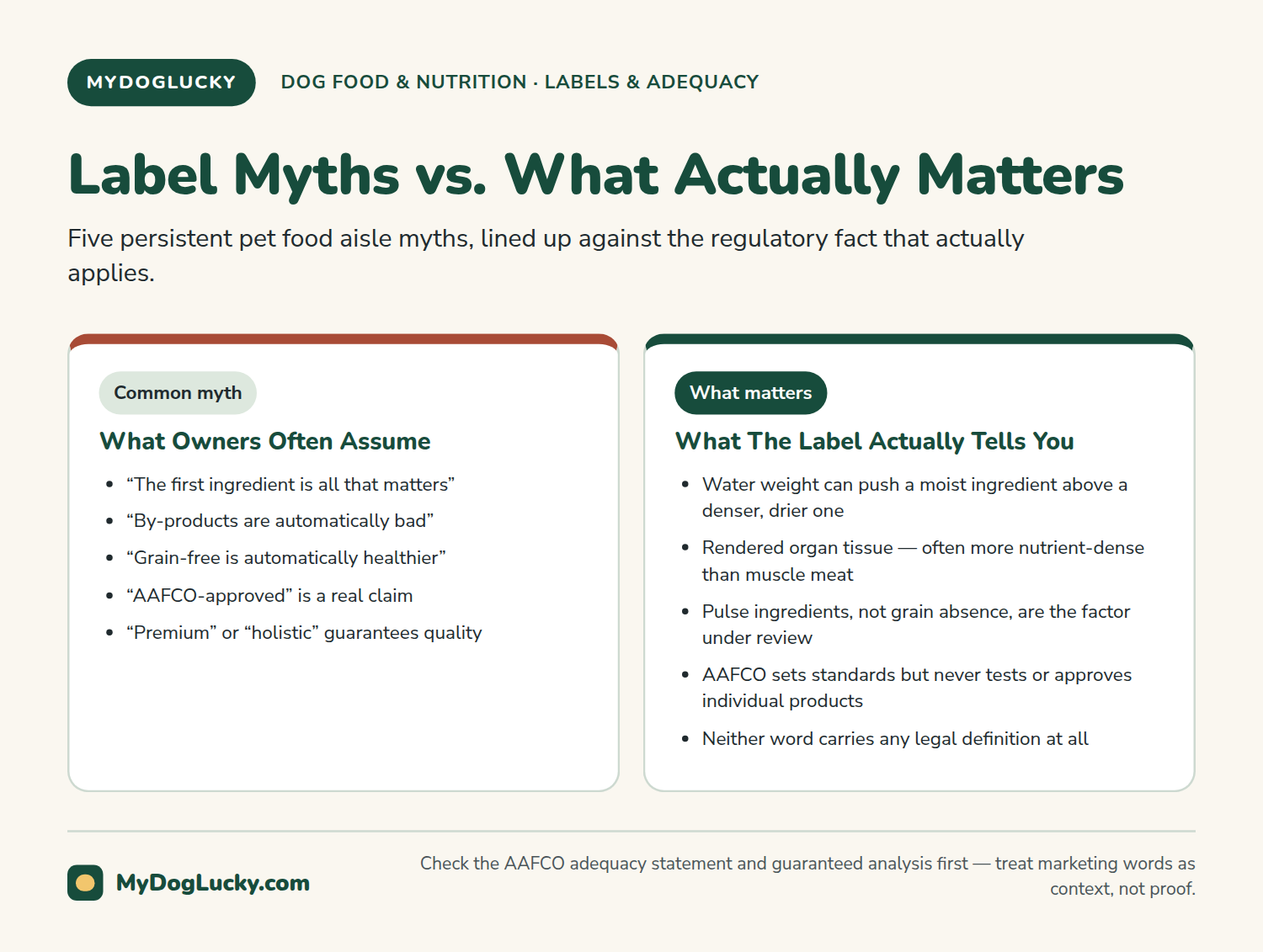
This might be the single most common misunderstanding in the pet food aisle: dog food is never “AAFCO-approved,” because AAFCO doesn’t approve, test, or certify individual products at all. If you see that phrase on packaging or in marketing copy, it’s a sign the company isn’t describing the regulatory landscape accurately, not necessarily a sign the food itself is bad, but a small flag worth noticing about how carefully that company handles other claims.
What AAFCO Does
The Association of American Feed Control Officials is a voluntary organization of state and federal feed control officials. It develops model regulations, nutrient profiles, ingredient definitions, and feeding-trial protocols that individual states then choose to adopt into their own laws. In practical terms, AAFCO sets the standard a food has to meet to legally call itself “complete and balanced,” and it defines what terms like “chicken meal” or “human-grade” are allowed to mean on a label.
What AAFCO Doesn’t Do
AAFCO does not test finished products, inspect manufacturing facilities, or grant any kind of seal of approval, according to guidance from Tufts University’s Cummings School Clinical Nutrition Service. Product testing and label enforcement actually happen at the state level, through individual feed control officials, and at the federal level through the FDA’s Center for Veterinary Medicine, which oversees pet food safety broadly. A product can fully comply with every AAFCO standard and still never have been reviewed, tested, or approved by AAFCO itself, because that kind of review simply isn’t part of what the organization does.
The phrase to watch for
“AAFCO-approved” or “AAFCO-certified” on a label or in marketing copy isn’t accurate; no such designation exists. The accurate phrasing is that a food is “formulated to meet AAFCO nutrient profiles” or has passed “AAFCO feeding trial protocols,” which is a meaningfully more specific claim.
That distinction isn’t just pedantic. Since no single body inspects or endorses individual products, the burden of gauging quality shifts more heavily onto the manufacturer’s own practices — its formulation expertise, its testing, its transparency — which is exactly what the next section covers.
Gauging Manufacturer Quality: Questions Worth Asking
Because no regulatory body tests or endorses individual products, the most useful quality signals live with the manufacturer, not the label. The World Small Animal Veterinary Association’s Global Nutrition Toolkit outlines a set of questions veterinary professionals recommend asking any pet food company, regardless of price point or category.
Is There a Board-Certified Veterinary Nutritionist Involved?
Ask whether the company employs, or regularly consults, a nutritionist with a PhD in animal nutrition or board certification through the American College of Veterinary Nutrition or the European College of Veterinary and Comparative Nutrition. A formulator with that specific background is different from a general veterinarian or a food scientist without dedicated nutrition credentials. Both can be knowledgeable, but the credential itself is a useful, checkable signal.
Does the Company Run Feeding Trials, or Only Formulate on Paper?
As covered earlier, a food can be legally complete and balanced through formulation alone, without ever being fed to a live dog during development. Ask whether a specific product has undergone AAFCO feeding trials, and whether the company has published any of its nutrition research in peer-reviewed journals. Neither answer determines quality by itself, but a company willing to describe its testing approach in detail is telling you something useful about how it actually operates.
Is There a Documented Quality-Control Program?
Ask what happens to an ingredient batch before it enters production. Is it tested for nutrient content and contamination, and is the finished product tested again afterward? A company with a specific answer to this question, rather than a vague reassurance, is generally one that has invested in the unglamorous infrastructure that actually prevents recalls, not just the marketing that talks around them.
Will the Company Answer a Specific Nutrition Question?
This is the simplest test, and in practice, one of the most revealing. Call or email with a specific question — the calorie content per cup, the complete nutrient analysis, whether a given batch was tested for a particular contaminant — and see what comes back. A company that offers a clear, specific answer, ideally from someone with a nutrition background, is demonstrating exactly the kind of transparency WSAVA’s guidance points to as a meaningful quality signal. A company that deflects to a generic customer-service script is telling you something too.
Four questions, one email
- Do you have a board-certified veterinary nutritionist on staff or on retainer?
- Has this specific product passed AAFCO feeding trials, or is it formulated to meet nutrient profiles?
- What does your quality-control testing look like, from raw ingredient through finished product?
- Can you send me the complete nutrient analysis for this product, beyond what’s on the guaranteed analysis panel?
“Natural,” “Premium,” “Holistic,” and Other Words That Sound Regulated but Aren’t
The front of a dog food bag is where the persuasive language lives, and most of it sits entirely outside AAFCO’s regulatory framework. Some terms do have real definitions behind them. Most don’t. Telling the two apart is a genuinely useful skill for the aisle.
Which Words Have a Real Definition, and Which Don’t
| Term | Regulatory status | What it actually means |
|---|---|---|
| Natural | Loosely defined by AAFCO | Generally no artificial flavors, colors, or preservatives — but synthetic vitamins and minerals are still allowed even on a “natural” product |
| Organic | Formal regulatory pathway | Products claiming this must meet USDA National Organic Program standards for qualifying ingredients |
| Human-grade | Specific AAFCO definition | Every ingredient must be edible for humans, and the product must be made in a human-food-licensed facility — a high bar few products meet |
| Premium | Not regulated at all | No legal requirement whatsoever; any product can use this word regardless of sourcing or cost |
| Holistic | Not regulated at all | Same as “premium” — no defined standard a manufacturer has to meet |
| Grain-free | Descriptive, not a quality claim | Accurately describes the absence of grain; doesn’t by itself imply better quality (see below) |
“Human-Grade”: A High Bar Most Products Don’t Actually Meet
“Human-grade” sounds like a simple claim, but AAFCO’s definition sets a genuinely demanding standard. Every ingredient has to be edible for human consumption, and, this is the part manufacturers most often fall short of, the finished product has to be manufactured, packed, and held in a facility that’s licensed and regulated as a human food facility, not a standard pet food plant. A company that sources entirely human-edible ingredients but produces them in a conventional pet food facility can’t legally call the result “human-grade,” even though the ingredients themselves would qualify.
That distinction is worth knowing, because “human-grade” gets used loosely in casual conversation and in some marketing copy that doesn’t actually meet the technical bar. If the claim matters to you, it’s reasonable to ask the manufacturer directly whether the product and its facility are certified to the human-grade standard, rather than assuming the word on the bag settles it.
The Grain-Free Halo Effect
“Grain-free” became one of the most persuasive words in the pet food aisle over the past decade or so, often carrying an implied promise of being healthier, more natural, or more premium. That implication isn’t supported by the ingredient itself. Grains aren’t a common cause of food allergies in dogs, and a grain-free formula isn’t inherently more digestible, less processed, or more appropriate for the average healthy dog than a grain-inclusive one.
There’s also a more specific reason for caution here. The FDA opened an investigation in 2018 into a potential link between certain diets and non-hereditary dilated cardiomyopathy, a serious heart condition, in dogs. The agency stopped issuing routine public updates in December 2022, citing insufficient data from adverse event reports alone to establish direct cause and effect. More recent veterinary nutrition research, summarized by Tufts’ Clinical Nutrition Service, points to diets high in peas, lentils, chickpeas, and other pulse ingredients, whether or not the diet also happens to be grain-free, as the more relevant factor under investigation, rather than the absence of grain itself.
The practical takeaway isn’t that grain-free food is dangerous, and it isn’t that every dog eating a pulse-heavy diet will develop heart problems. It’s that “grain-free” alone isn’t a meaningful quality signal in either direction, and a dog with any history of heart issues, or one eating a diet heavy in legume ingredients, is a good reason for a specific conversation with your veterinarian rather than a decision based on packaging language.
When to loop in your veterinarian specifically
- Your dog has any history of a heart murmur, arrhythmia, or diagnosed heart disease.
- You’re feeding a diet where peas, lentils, chickpeas, or other legumes appear among the first several ingredients.
- You’ve noticed reduced energy, coughing, or labored breathing in a dog eating a grain-free or legume-heavy diet.
None of these signs diagnose diet-associated heart disease on their own. They’re reasons to bring the specific diet and your observations to your veterinarian, who can assess your dog directly.
Checking Recall History and Reading Best-By Dates
How to Check a Product’s Recall History
Before committing to a specific product, it’s worth a two-minute check of its recall history. The FDA maintains a searchable recalls and safety alerts page covering pet food, updated as new actions are announced, and it’s free to search by product type, brand, or date. The American Veterinary Medical Association also maintains its own recall and safety alert tracker, drawn from FDA and manufacturer announcements, which can be a faster way to scan recent history by species.
One past recall isn’t automatically disqualifying. Companies of every size have issued recalls, and a prompt, transparent recall response is arguably a better sign than a company that’s never had one, simply because every manufacturer eventually deals with an ingredient or contamination issue somewhere in a long supply chain. What’s worth paying attention to is the pattern: repeated recalls for the same underlying issue, or a slow, evasive response when problems surface, says more than a single isolated incident.
Reading Best-By Dates and Storage Guidance
Every bag or can carries a best-by or “use by” date, usually stamped near the manufacturer information. That date reflects the manufacturer’s estimate of how long the food keeps its full nutrient profile and freshness under proper storage, not a hard safety cutoff, but not something to ignore either, since nutrient degradation and fat rancidity both increase meaningfully past that point.
Storage guidance printed on the bag matters more than owners often assume. Dry food generally keeps best in its original bag, sealed and stored in a cool, dry place, rather than dumped loose into a bin, since the bag’s inner lining is designed to slow oxidation better than most storage containers do. Once opened, most dry foods are best used within a matter of weeks, not months. Check the specific guidance on your product, since formulas with more natural preservatives can have a shorter practical shelf life once opened than others.
A Label Literacy Checklist for the Pet Food Aisle
Here’s a condensed version of everything above, built to actually use while standing in aisle six with a bag in each hand.
Before you buy, check for:
- The nutritional adequacy statement. Confirm it says “complete and balanced” and matches your dog’s life stage — maintenance, growth, or all life stages.
- Whether it’s formulation-based or feeding-trial-tested. Both are legitimate; feeding-trial testing is a somewhat stronger form of evidence.
- The guaranteed analysis. Note the crude protein, fat, fiber, and moisture minimums and maximums, and remember that “crude” describes the test method, not quality.
- The calorie content. Look for kilocalories per kilogram and per cup or can. If it’s missing, check the manufacturer’s website or contact them directly.
- The full ingredient list. Don’t judge quality from the first five items alone; moisture content and ingredient splitting distort that shortcut.
- Marketing words in context. Treat “natural,” “premium,” “holistic,” and “grain-free” as descriptive, not as proof of quality, and verify “human-grade” claims if they matter to your decision.
- Recall history. A quick search on the FDA’s recall page or the AVMA’s tracker takes under two minutes.
- The best-by date and storage instructions. Check that there’s enough shelf life left for how quickly your household goes through a bag.
None of this replaces an actual conversation with your veterinarian about your specific dog. This checklist gets you to an informed short list, not a final answer. For help narrowing that list further, “Best Dog Food for Your Dog” walks through matching a specific product category to your dog’s individual needs.
Common Label-Reading Mistakes
Judging a Food by the First Five Ingredients Alone
Covered in detail above. Moisture content and ingredient splitting can make this popular shortcut actively misleading rather than just incomplete.
Assuming “AAFCO-Approved” Means Something It Doesn’t
AAFCO doesn’t approve individual products. A manufacturer using that exact phrase is making an inaccurate claim, regardless of how the rest of the product holds up.
Comparing Wet and Dry Guaranteed Analyses Without Adjusting for Moisture
A canned food’s raw protein percentage will almost always look lower than a dry food’s, unless you convert both to a dry matter basis first, as covered earlier in this guide.
Treating “Grain-Free” as a Health Upgrade
The word describes an absence of grain, not an improvement in quality, digestibility, or safety. Current veterinary nutrition guidance points toward the proportion of pulse ingredients, not grain content, as the more relevant factor for dogs with any heart-health concerns.
Skipping the Calorie Content and Guessing at Portions
Feeding by the scoop instead of checking calorie density is one of the more common, avoidable contributors to gradual weight gain over months, since calorie density varies more between products than most owners expect.
Never Checking Recall History
A two-minute search costs almost nothing and can surface a pattern worth knowing about before committing to a bag your dog will eat for weeks.
Comparing Price Per Bag Instead of Price Per Calorie
A cheaper bag isn’t automatically a cheaper diet once calorie density and bag size are factored in. A smaller, more calorie-dense bag can cost less per day of feeding than a larger, less dense one that looks like the better deal on the shelf. Dividing total calories in the bag by its price gives a fairer cost comparison than the sticker price alone.
Frequently Asked Questions About Dog Food Labels
What’s the single most important thing to check on a dog food label?
If you’re learning how to read dog food labels for the first time, start with the AAFCO nutritional adequacy statement. It’s the one line that tells you whether a food is meant to be a complete diet, and which life stage it’s built for — information the ingredient list and front-of-bag marketing can’t reliably give you on their own.
Does a higher-listed meat ingredient always mean a higher-quality food?
Not reliably. Ingredients are listed by weight, and fresh meat’s water content can push it higher on the list than a more nutrient-dense, dry ingredient listed further down. A fair quality assessment needs the full ingredient list plus the guaranteed analysis, not just a glance at what’s listed first.
Is “AAFCO-approved” dog food better than food without that claim?
The claim itself isn’t accurate for any product, since AAFCO doesn’t approve individual foods. If you see that exact phrase, it’s worth treating as a sign the company’s marketing copy isn’t precise about how pet food is regulated, rather than as proof of quality one way or the other.
What’s the difference between “formulated to meet” and “feeding trials substantiate” on the adequacy statement?
“Formulated to meet” means the recipe is calculated on paper to hit AAFCO’s nutrient minimums. “Feeding trials substantiate” means the finished product was actually fed to dogs under AAFCO’s testing protocol, and those dogs maintained normal health. Both are legitimate paths to a legal “complete and balanced” claim, though feeding-trial testing is generally considered somewhat stronger evidence.
Is grain-free dog food bad for my dog’s heart?
The evidence doesn’t point to grain-free formulas themselves as the cause of diet-associated dilated cardiomyopathy. Current veterinary nutrition research suggests diets heavy in pulse ingredients like peas, lentils, and chickpeas are the more relevant factor under investigation, regardless of whether the diet also happens to be grain-free. If your dog has any history of heart issues, talk with your veterinarian about the specific diet before making a change.
What does “human-grade” actually require, and is it worth paying more for?
By AAFCO’s definition, every ingredient has to be edible for humans, and the product has to be made in a facility licensed for human food production — a genuinely demanding standard most pet food products don’t meet. Whether it’s worth paying more for is a personal decision; the claim itself doesn’t guarantee better nutrition, just a different manufacturing standard.
How do I find a food’s calorie content if it’s not on the bag?
Check the manufacturer’s website first, since most companies list it there even when the packaging doesn’t. If it’s still not available, contact the manufacturer directly using the address or phone number required elsewhere on the label — they’re expected to provide it on request.
Should I avoid by-product meal in my dog’s food?
Not automatically. By-product meal is a rendered, concentrated source of organ tissue and other non-muscle parts, and it isn’t inherently lower quality than named meat — organ meat, specifically, is often more nutrient-dense than muscle. The more useful question is whether the manufacturer can describe its sourcing and quality-control process specifically, not whether the ingredient category itself appears on the list.
How often should I check a product’s recall history?
Once before you first buy a product is the minimum, and it’s worth a quick repeat check every few months for any food you feed regularly, since new recalls happen throughout the year across every price tier.
Can I trust “natural” or “holistic” on the label?
“Natural” has a loose AAFCO definition, generally meaning no artificial flavors, colors, or preservatives, though synthetic vitamins and minerals are still allowed. “Holistic” has no regulatory definition at all and can legally appear on any product regardless of ingredients. Neither word is a substitute for checking the nutritional adequacy statement and guaranteed analysis.
What’s the difference between “Chicken Dog Food” and “Chicken Flavor Dog Food”?
That naming difference reflects a real difference in content, not just marketing style. “Chicken Dog Food” has to be built mostly from chicken under AAFCO’s 95% rule. “Chicken Flavor Dog Food” only needs a detectable amount of a chicken-derived ingredient, with no minimum percentage required. Reading the exact wording in a product’s name is a fast, useful way to gauge how much of the named ingredient is actually inside before you check anything else.
The Short Version
Knowing how to read dog food labels comes down to four things that actually carry legal weight: the AAFCO nutritional adequacy statement, the guaranteed analysis, the ingredient list, and the calorie content. Check those first, and treat everything else on the bag as context rather than a verdict.
The nutritional adequacy statement tells you whether a food is complete and for which life stage — read it before you read anything else. The guaranteed analysis gives you a standardized, if imperfect, way to compare nutrient minimums and maximums across products. The ingredient list is far more useful read in full than judged by its first five items. And the calorie content, easy to skip, is often the number that matters most for keeping your dog at a healthy weight over the long run.
None of this replaces your veterinarian, and it isn’t meant to. What it does is put you in a position to ask better questions, of a manufacturer, of your vet, of yourself, instead of choosing a bag because it has the most convincing photo on the front. That’s a genuinely useful skill to carry into every trip down the pet food aisle from here on.
Sources
- Association of American Feed Control Officials (AAFCO). Reading Labels
- Association of American Feed Control Officials (AAFCO). Selecting the Right Pet Food
- Association of American Feed Control Officials (AAFCO). What’s in the Ingredients List?
- Association of American Feed Control Officials (AAFCO). Frequently Asked Questions
- Association of American Feed Control Officials (AAFCO). Calories
- World Small Animal Veterinary Association (WSAVA) Global Nutrition Committee. Selecting a Pet Food for Your Pet (Global Nutrition Toolkit, 2021)
- U.S. Food and Drug Administration. “Complete and Balanced” Pet Food
- U.S. Food and Drug Administration. Recalls & Withdrawals
- U.S. Food and Drug Administration. Investigation into the Potential Link Between Certain Diets and Canine Dilated Cardiomyopathy
- Tufts University Cummings School of Veterinary Medicine, Clinical Nutrition Service. Did You Know? AAFCO Doesn’t Approve Pet Foods
- Tufts University Cummings School of Veterinary Medicine, Clinical Nutrition Service. Update on Diet-Associated Dilated Cardiomyopathy: June 2026
This article is general education for U.S. dog owners about how commercial dog food labels work. It is not individualized nutrition or veterinary advice for your dog. Body condition, medical history, allergies, and activity level all affect what a specific dog should eat, and those questions belong with your veterinarian or a board-certified veterinary nutritionist, not a label. If your dog has a diagnosed health condition, is on a prescription diet, or you’re considering a significant diet change, talk with your veterinary team before switching foods.





Trackbacks/Pingbacks