Working full time with a dog is very doable. Plenty of people do it every day, and their dogs do fine. It just takes a plan for the long stretch in the middle of your workday, plus a backup for the days that plan wobbles.
Here’s the honest math. A 9-to-5 job with a half-hour commute each way keeps you away about ten hours. The American Kennel Club’s guidance, reviewed by a board-certified veterinary behaviorist, says dogs shouldn’t go more than six to eight hours without a chance to relieve themselves. So most office schedules need one extra person or service in the middle. That’s a logistics puzzle, not a character flaw.
This guide walks through it step by step. You’ll get sample workdays for office, hybrid, remote, and shift schedules, plus notes for puppies, adults, and seniors. You’ll also find backup-care layers, a one-page handoff sheet you can copy, a look at costs, and the signs that a plan needs changing. No guilt included. Long hours are a fact of life, and your dog’s care can be built around them.
What’s in this guide
- Working Full Time With a Dog: The Short Answer
- What a full-time job changes for your dog
- Five things that shape your plan
- Puppy, adult, or senior: how the workday changes
- Sample workdays for office, hybrid, remote, and shift schedules
- Gig work, travel days, and unpredictable hours
- The midday break: your options
- Mornings and evenings that work
- Teaching your dog to be comfortable alone
- Backup care layers: build them before the bad day
- The one-page handoff sheet
- Sharing care with a partner, family, or roommates
- What it costs, without the guilt
- Your first two weeks: a starter plan
- When the plan is not working
- Common mistakes
- Common questions about working full time with a dog
- Sources
Working Full Time With a Dog: The Short Answer
Most healthy adult dogs can live happily with an owner who works full time, as long as someone covers the middle of the day. Puppies, seniors, and dogs with medical needs usually need more coverage. Nobody’s dog needs you home all day. Your dog needs bathroom access, company, exercise, and a routine he can predict. That’s the whole job description for working full time with a dog: cover those four things, on purpose.
The sourced numbers
Here are the sourced numbers that anchor the rest of this guide.
- Adult dogs. The AKC article (updated January 31, 2024, with veterinary behaviorist Dr. Vint Virga) says dogs shouldn’t spend more than six to eight hours alone without a chance to relieve themselves.
- Social time. The same article says dogs need at least two hours of dedicated social time with people or other dogs each day. That time can be split into chunks.
- Puppies. The AKC’s puppy guidance (updated October 29, 2025) lists about one hour for puppies under 10 weeks and two hours at 10 to 12 weeks. From three months, it’s roughly one hour per month of age, topping out at six to eight hours after six months.
Treat those numbers as ceilings, not goals. A dog who’s comfortable at five hours gains nothing from being stretched to eight.
Count your own day
Now count your own day. Nine hours on the clock plus a half-hour commute each way is ten hours away from home. That sits above the top of the range, which is why the middle of the day is where most plans succeed or fail.
| Work pattern | The main risk | What usually helps |
|---|---|---|
| Office, away 9–10 hours | One long, unbroken gap | A midday visit, plus solid mornings and evenings |
| Hybrid | Office days drifting away from the routine | The same anchor walks on every workday |
| Remote | Meetings swallowing the walks | Calendar-blocked breaks and a fixed start-of-day walk |
| Shift work or 12-hour days | Planning for the average shift instead of the longest | A backup built around your longest day |
| Puppy | Very short safe gaps in the early months | Someone available most of the day at first |
| Senior or health needs | Needs that shift over time | A schedule set with your veterinarian |
The three-question test
Before anything else, answer these three questions.
- Who covers the middle of an ordinary workday?
- Who covers the day that goes wrong, like a late meeting, a sick kid, or a flat tire?
- Does everyone involved know the routine without having to text you?
If all three have an answer, you have a plan. If one doesn’t, that’s your first project.
What a full-time job changes for your dog
Dogs don’t know what a deadline is. They notice patterns: who leaves, when food appears, when the door opens. A full-time job changes three things from your dog’s point of view.
The long gap
The first change is the bathroom gap. Dogs can’t wait indefinitely, and puppies can wait even less. The AKC’s six-to-eight-hour ceiling for adults is the number most people bump into first.
It’s about physical comfort, not obedience. A dog who has an accident after a ten-hour day isn’t misbehaving. He ran out of time. Scolding him doesn’t fix the schedule.
The social gap
The second change is company. Dogs live with us partly because they like being with us. The AKC’s two-hour daily social minimum can come in pieces: a morning walk, an evening game, a lunchtime visit, a weekend outing.
It doesn’t require you to be home. It requires you to be present when you are. A walk, a game, a training session, or a long evening on the couch with a hand on his back all count.
The routine gap
The third change is predictability. Many dogs settle more easily when the day has a shape: potty, walk, breakfast, quiet time, someone arrives, walk, dinner.
Honestly, a steady work schedule can help here. A predictable 8-to-5 gives your dog a rhythm to lean on. Irregular days are often harder to plan around than long ones, which is why the shift-work section below focuses on structure instead of clock times.
What doesn’t change
Your dog still needs food, fresh water, veterinary care, exercise, a safe place to rest, and a person who notices when something’s off. You can supply all of that while working full time with a dog. You just have to schedule the things a stay-at-home household gets by accident.
Five things that shape your plan
Two households can both be working full time with a dog and still need very different plans. These five factors explain why. Run through them once before you build anything.
1. Age and life stage
A twelve-week-old puppy and a healthy four-year-old sit at opposite ends of the spectrum. Puppy schedules are built around hours. Adult schedules are built around a ceiling. Senior schedules are built around your veterinarian’s advice.
2. Health and bathroom needs
Some dogs need meals or medication at set times. Some need more frequent bathroom access. Your veterinarian sets those needs, and your work plan bends around them, not the other way around.
If you’re not sure what your dog needs, ask at the next visit: “How long can my dog comfortably go between bathroom breaks, and does anything about his health change that?”
3. Comfort being alone
Some dogs nap through the workday. Others pace, chew, or bark. Which one you have shapes how much you rely on midday company. If your dog seems distressed when you leave, skip ahead to the section on when the plan isn’t working.
4. Your home setup
Does your dog have a comfortable, safe space and fresh water? Is there an easy place to go potty? Do you live on the fourth floor with a slow elevator?
Apartments, houses with yards, and shared-wall buildings each change the logistics. A yard doesn’t replace a walk, but it can shorten the trip a midday visitor needs to make.
5. Your real work pattern
Hours, commute, flexibility, and predictability all count. A steady 8-to-5 is easier than “ten hours, maybe twelve, we’ll see.” Write down your longest realistic day, not your average one, and plan for that. Average days take care of themselves.
Quick self-audit
- How many hours am I away on my longest normal day, door to door?
- How old is my dog, and does he have any health needs that set his schedule?
- Who could help on short notice, even once a month?
- What does my dog do when I leave? Do I actually know?
- What can I afford in time and money, honestly?
Puppy, adult, or senior: how the workday changes
Life stage changes the plan more than any other factor. Here’s how each stage tends to look.
Puppies
Puppies can’t hold it long, and they’re still learning what “alone” means. The AKC’s puppy guidance (updated October 29, 2025) gives these starting points.
| Puppy age | Typical time alone (AKC) | What it means for a workday |
|---|---|---|
| Under 10 weeks | About 1 hour | Someone needs to be with the puppy most of the day |
| 10–12 weeks | About 2 hours | Several breaks, or a person on site, through the day |
| 3 months | About 3 hours | A midday visit becomes essential |
| 4 months | About 4 hours | Two visits on a long day |
| 5 months | About 5 hours | One reliable midday break |
| 6 months | About 6 hours | One reliable midday break, timed carefully |
| Over 6 months | Up to 6–8 hours at most | Adult-style planning, with a break on longer days |
The AKC notes that the hour-per-month rule applies once a puppy reaches three months. Younger puppies can’t hold it that long. Individual puppies vary, so use the table as a starting point, not a promise.
If you’re bringing home a puppy under 12 weeks, working full time with a dog gets harder, and coverage matters most in these first weeks. Many households line up time off, staggered shifts, or a family member or puppy-savvy sitter for the middle of the day. Those are logistics choices, not luxuries. Timing the puppy’s arrival for a stretch when you have days off can also help. Our puppy guides cover housetraining and crate routines in more depth.
Adult dogs
For a healthy adult, the AKC’s six-to-eight-hour ceiling is the frame. Many adults do better with shorter gaps, so let your own dog’s behavior guide you. If he’s relaxed at the end of a long gap, you’re probably in a good range. If he’s pacing at the door or having accidents, the gap is too long for him.
Adults also need enough activity to settle. A dog who gets a real walk before work and real attention after it tends to have an easier day than one who gets neither. Our guide on how much exercise a dog needs covers the amounts in detail.
Senior dogs
Older dogs vary a lot. We didn’t find a single sourced number for seniors, so we’re not going to invent one. Ask your veterinarian how long your dog can comfortably go, and ask again at each checkup, because the answer can change.
Changes in bathroom habits, appetite, or mobility are worth mentioning to your veterinarian rather than putting them down to age. Meanwhile, make the day easier where you can: a soft, non-slip place to rest, water within easy reach, and short, low-effort trips outside.
Dogs with health conditions
Some conditions come with schedules for meals, medication, or bathroom access. Your veterinarian sets those, and the plan has to fit them. Write the routine on your handoff sheet (more on that below) exactly as your vet gave it to you, so a sitter or family member doesn’t have to guess.
Sample workdays for office, hybrid, remote, and shift schedules
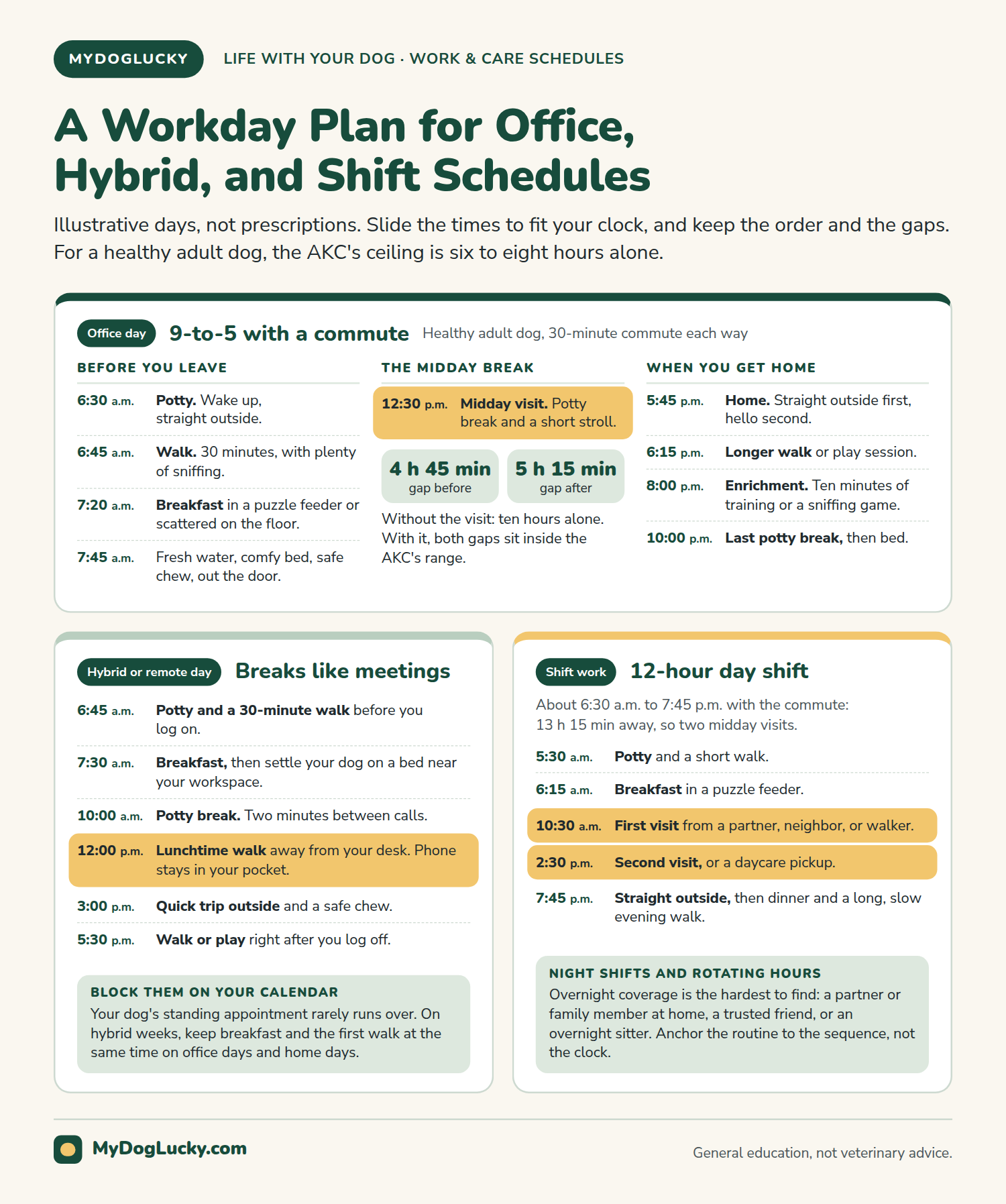
These sample days show how working full time with a dog can look in a few common households. They’re illustrative, not prescriptions. Slide the times around to fit your own clock, and keep the order and the gaps.
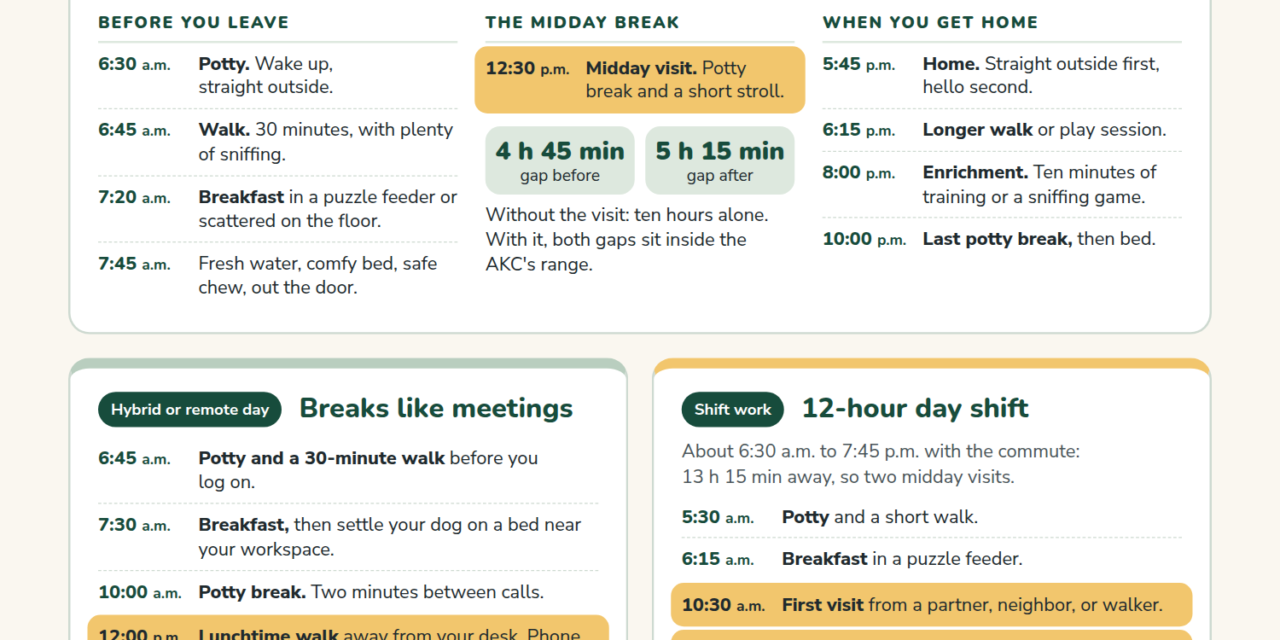
The office day (illustrative)
This example assumes a healthy adult dog, a 9-to-5 job, and a 30-minute commute each way.
| Time | What happens | Why it’s there |
|---|---|---|
| 6:30 a.m. | Wake up, straight outside for a potty break | Ends the longest overnight gap |
| 6:45 a.m. | 30-minute walk with plenty of sniffing | Exercise and company before a long day |
| 7:20 a.m. | Breakfast in a puzzle feeder or scattered on the floor | Turns a two-minute meal into an activity |
| 7:45 a.m. | Fresh water, comfortable bed, safe chew, out the door | A calm, predictable exit |
| 12:30 p.m. | Midday visit: potty break and a short stroll | Splits ten hours into two gaps of about five |
| 5:45 p.m. | Home. Straight outside first, hello second | Bathroom needs come before greetings |
| 6:15 p.m. | Longer walk or play session | Real social time, no phone required |
| 8:00 p.m. | Ten minutes of training or a sniffing game | Evening enrichment that tires the brain |
| 10:00 p.m. | Last potty break, then bed | Sets up a comfortable night |
The math is simple. Without the 12:30 visit, your dog faces ten hours alone. With it, he faces gaps of four hours and forty-five minutes, then five hours and fifteen minutes. Both sit inside the AKC’s range.
The hybrid or remote day (illustrative)
Working from home feels like the easy version. Many owners find it isn’t, because the day fills up with calls and the walks quietly disappear. The fix is to treat the dog’s breaks like meetings.
- 6:45 a.m.: Potty and a 30-minute walk before you log on.
- 7:30 a.m.: Breakfast, then settle your dog on a bed near your workspace.
- 10:00 a.m.: A two-minute potty break between calls.
- 12:00 p.m.: A lunchtime walk away from your desk. Phone stays in your pocket.
- 3:00 p.m.: Another quick trip outside and a safe chew.
- 5:30 p.m.: A walk or play session right after you log off.
Block those slots on your calendar. Your dog’s standing appointment rarely runs over, and it’s the one meeting that never needs an agenda.
On hybrid weeks, keep the same anchors on office days and home days. Breakfast and the first walk happen at the same time either way. That way, the office days don’t feel like a brand-new schedule dropped on your dog. It also helps to practice short absences on home days, which the section on being comfortable alone covers.
Shift work and 12-hour days (illustrative)
Shift work breaks the “same time every day” idea, so hold onto something else: the longest gap. Pick a maximum gap your dog can handle, and build every shift around it.
Here’s one version for a 12-hour day shift with a commute, roughly 6:30 a.m. to 7:45 p.m. The away time is thirteen hours and fifteen minutes, so you need two midday visits.
- 5:30 a.m.: Potty and a short walk.
- 6:15 a.m.: Breakfast in a puzzle feeder.
- 10:30 a.m.: First visit from a partner, neighbor, or walker.
- 2:30 p.m.: Second visit, or a daycare pickup.
- 7:45 p.m.: Straight outside, then dinner and a long, slow evening walk.
Night shifts add a twist, because overnight coverage is the hardest kind to find. Some owners arrange for a partner or family member to be home overnight. Others have the dog stay with a trusted friend or hire an overnight sitter on shift nights. Be honest with yourself early about which one you can sustain.
Whichever pattern you work, anchor the routine to the sequence, not the clock. Potty, walk, breakfast, then out the door works at 6 a.m. or 6 p.m.
What every good sample day has in common
- A potty break the moment you wake and the moment you return.
- A real walk or play session on both ends of the day.
- A midday break whenever you’re away longer than your dog’s comfortable gap.
- Something to do while you’re gone, like a puzzle feeder or a safe chew.
- A backup for the day it all falls apart.
Gig work, travel days, and unpredictable hours
Some jobs don’t come with a schedule. You might work by app, by roster, or by whatever the day throws at you. Planning still works. You just plan for the worst day instead of the average one.
Gig work and on-call schedules
If your hours change weekly or hourly, plan for the longest day the roster could hand you. Keep one long-day arrangement warm: a walker or neighbor who has already said yes to short-notice requests. If you might use daycare, ask whether your local facility requires an evaluation before the first visit, and get that done before you need it.
A useful habit is a tripwire rule. For example: “If I’m not home by 5:30, I text my backup.” Deciding in advance takes the panic out of the moment.
Business trips and overnight days
For overnight travel, the usual options are a sitter at your home, boarding, or a friend or family member. Whichever you pick, run a trial first. A single practice night while you’re only across town shows you how your dog handles it, and shows the caregiver what your routine looks like.
Leave the handoff sheet (below) with whoever’s in charge, and confirm the emergency contact is reachable while you’re traveling. Time zones matter. A backup who can’t reach you at 2 a.m. isn’t much of a backup.
Taking your dog along
Some jobs allow dogs on site or in a vehicle. Decide beforehand where your dog will wait, who’s responsible for him, and what happens if the plan changes. A parked vehicle isn’t a waiting room. If there’s no safe, comfortable place for him to be, the plan needs a different layer.
The midday break: your options
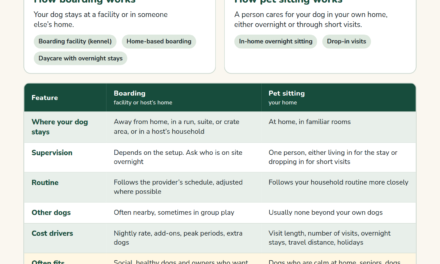
The midday break is the single most useful piece of any plan for working full time with a dog. It cuts a long gap in two. The AKC’s own advice for working owners is short: “Come home for lunch or hire someone to do it for you.” Here are the ways households cover it.
| Option | Works well for | Trade-offs |
|---|---|---|
| You come home at lunch | Short commutes, flexible bosses | Eats your own break, and traffic can wreck the timing |
| A partner or household member | Staggered schedules | Needs a clear shared routine so nobody assumes |
| A neighbor or friend | Occasional or low-cost coverage | Depends on goodwill and availability |
| A professional walker or sitter | Reliable, recurring coverage | A recurring cost, plus time spent vetting and trialing |
| Daycare | Dogs who enjoy other dogs and busy places | Not every dog enjoys it, and it needs transport at both ends |
| A swap with another dog owner | Coworkers or neighbors on different schedules | Needs fairness and a written routine for each dog |
A camera can show you how your dog spends the day, and that’s useful information. It doesn’t take him outside, though, so treat it as a check-in tool, not a break.
How to choose
Start with these questions.
- How comfortable is my dog with strangers coming into the house?
- How predictable is my day?
- What can I afford every week, not just this week?
- Which option can I still keep up in a bad month?
Start with the free layers and add paid ones where they fill a real gap. A dog who has a friendly neighbor on Tuesdays and Thursdays and a walker on the other three days is well covered. Nobody says you need one solution for the whole week.
A short break still counts
For bathroom purposes, a quick trip outside covers the essentials. A longer stroll adds social time and movement on top. If your midday visitor only has fifteen minutes, that’s still a real help.
Mornings and evenings that work
Your mornings and evenings are the bookends of your dog’s day. They’re the two stretches you fully control, so they carry a lot of weight in any plan for working full time with a dog. They also don’t need to be long. They need to be consistent and real.
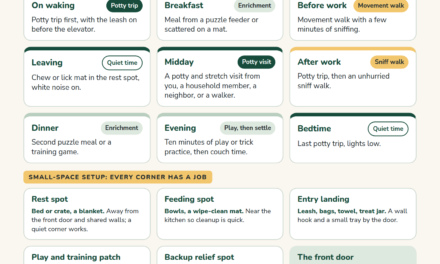
The realistic morning
Most people can’t manage a ninety-minute dawn hike. A realistic morning looks like this.
- Potty first. Straight outside, before coffee, before your phone.
- A 20-to-30-minute walk. Let your dog sniff for a good part of the walk.
- Breakfast as an activity. A puzzle feeder, a scatter feed, or a stuffed chew turns eating into something to do.
- A calm exit. Skip the big goodbye. A quiet “see you later” and a treat on the mat works better than a dramatic farewell.
The AKC article specifically recommends activity puzzles before you head out the door, as a way to occupy a dog for a few hours. That tip is easy to add and doesn’t cost extra minutes if you fold it into breakfast.
If mornings are chaos, protect the potty break and the puzzle, and trim the walk. Ten minutes of fresh air beats zero minutes of grand intentions.
The realistic evening
When you get home, you’re tired and your dog is thrilled. Meet in the middle.
- Out first. Potty right away, before hellos and before you take off your coat.
- Decompress together. A sniffy walk, a game in the yard, or a quiet cuddle. Let your dog choose the pace for a few minutes.
- Dinner and a puzzle. Same idea as breakfast.
- Ten minutes of training or play. A few easy cues for treats, or a game of tug or hide-and-seek. It counts as social time, and it tires the brain.
- A late potty break. Then bed.
Some evenings you’ll have energy for all of it. Some evenings you’ll do the potty break and a slow lap of the block. Both are fine. Our guide to indoor dog enrichment has ideas for rainy nights and low-energy days.
Weekends
Weekends are where many owners make up for a busy week. That’s great, but keep the basics steady. If your dog eats and goes out at wildly different times on Saturday, Monday morning can be a shock. A longer hike or a dog-friendly outing adds to the routine. It doesn’t replace the weekday walks.
Teaching your dog to be comfortable alone
Being alone is a skill. Some dogs pick it up easily, and some need practice. This section is a light version, aimed at everyday workdays. It isn’t a treatment plan for a dog who panics.
Start small and boring
The AKC’s puppy guidance suggests starting while you’re home. Leave your puppy in a confined, comfortable space and step out of the room for a short time. Then build up gradually. It also suggests safe toys and, for some dogs, a white noise machine for calming background sound.
The same idea works for adults who are new to your household or your schedule. Practice short absences first: a few minutes, then a few more. Keep arrivals and departures low-key, so being alone doesn’t become a big event.
Set up the space
Give your dog a comfortable resting spot, fresh water, and something safe to do. The AKC suggests making a crate “a safe and relaxing place for them, instead of punishment,” and mentions exercise pens as another containment option. Some dogs do better in a dog-proofed room than in a crate. If you’re unsure, a certified trainer can help you match the setup to your dog.
Whatever you use, don’t treat a crate or pen as a substitute for the midday break. Confinement shortens a dog’s world without shortening how long he needs to go.
What this section isn’t
If your dog shows real distress when you leave, that’s a different situation. It calls for support, not just practice. The section on when the plan isn’t working explains what to look for and who to call.
Backup care layers: build them before the bad day
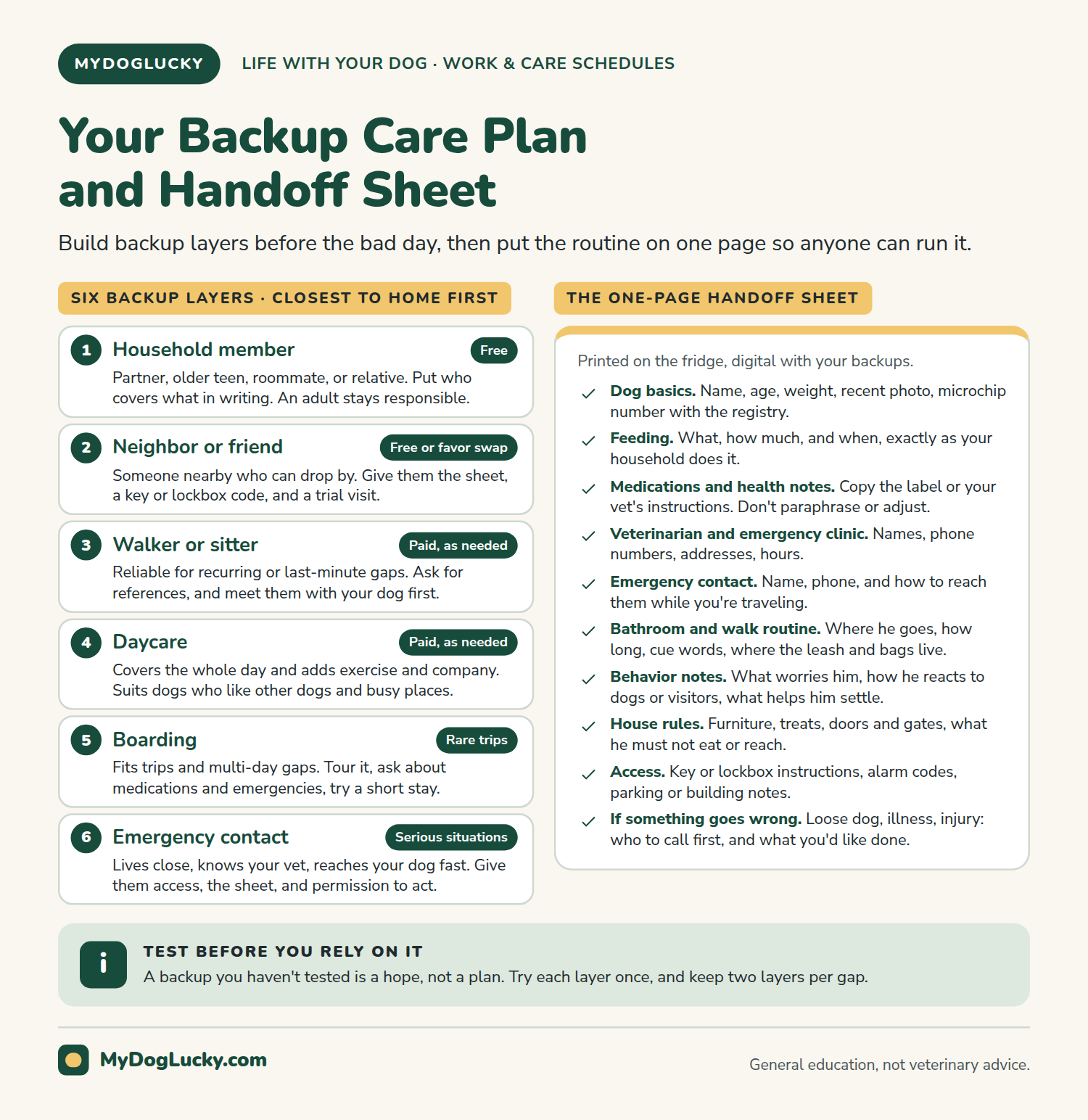
A good plan covers the normal day. A great plan covers the day everything goes sideways. Anyone working full time with a dog benefits from at least two layers. Think of backup care as layers, like a jacket you can add or remove depending on the weather.
The order matters. Start with the layer closest to home and move outward as needed.
Layer 1: A household member
The easiest backup is someone who already lives there. It might be a partner, an older teen, a roommate, or a relative. Agree ahead of time who covers what on a bad day, and put the routine in writing so it doesn’t depend on memory. An adult should stay responsible for the dog’s care, even when kids help.
Layer 2: A neighbor or friend
The next layer is a person nearby who’s willing to help. The AKC lists having a neighbor, friend, or loved one drop by as a way to break up a long day.
Give this person the handoff sheet, a key or lockbox code, and a short trial visit while you’re still home. Return the favor when you can. Goodwill works best when it flows both ways.
Layer 3: A walker or sitter
A professional walker or sitter is a reliable option for recurring gaps or last-minute needs. Ask about experience, references, how they handle emergencies, whether they carry insurance, and how they communicate with you. Meet them once, with your dog, before the first real visit. Our guide to choosing a dog sitter or walker goes into detail.
Layer 4: Daycare
Daycare covers the whole day and adds exercise and company. It suits dogs who enjoy other dogs and busy places. It doesn’t suit every dog, and there’s no shame in that.
Ask about staff-to-dog ratios, how dogs are assessed and grouped, rest breaks, emergency procedures, and vaccine requirements. Watch how your dog acts at drop-off and pick-up. His behavior is the best review you’ll get.
Layer 5: Boarding
Boarding fits overnight trips and multi-day gaps. Tour the facility, ask what a typical day looks like, and find out how they handle medications and medical emergencies. If you can, book a short trial stay before you need a longer one.
Layer 6: An emergency contact
This is the person who can step in when something serious happens and you can’t. Choose someone who lives close, can reach your dog quickly, and knows who your veterinarian is. Give them a key or access, the handoff sheet, and permission to act.
It’s also wise to tell your vet’s office who your emergency contact is. Ask what the clinic needs from you, if anything, for that person to arrange care in your absence.
How to build layers on a tight budget
You don’t need every layer paid for. Many households build a stack like this.
- Household member as layer one, free.
- Two neighbors or friends as layer two, free or a favor swap.
- One walker or daycare on the days when nobody else is free, paid only when needed.
- Boarding on the rare occasion of a trip.
Test each layer at least once before you rely on it. A backup you haven’t tested is a hope, not a plan.
The one-page handoff sheet
A handoff sheet is a single page that tells anyone caring for your dog what they need to know. It saves you from frantic texts and saves the caregiver from guessing. Keep a printed copy on the fridge and a digital copy on your phone and with your backups.
Aim for one page. If it takes two, trim it.
| Field | What to write |
|---|---|
| Dog basics | Name, age, weight, a recent photo, and microchip number with the registry |
| Feeding | What he eats, how much, and when, exactly as your household does it |
| Medications and health notes | Copy what’s on the label or your vet’s instructions. Don’t paraphrase or adjust |
| Veterinarian and emergency clinic | Names, phone numbers, addresses, and hours |
| Emergency contact | Name, phone number, and how to reach them when you’re traveling |
| Bathroom and walk routine | Where he goes, how long, the cue words he knows, and where the leash and bags live |
| Behavior notes | What worries him, how he reacts to other dogs or visitors, and what helps him settle |
| House rules | Furniture, treats, doors and gates, and anything he must not eat or reach |
| Access | Key or lockbox instructions, alarm codes, and parking or building notes |
| If something goes wrong | Loose dog, illness, injury: who to call first, and what you’d like done |
Keep it useful
Write it like you’re briefing a smart stranger. Skip the life story. Include the details that matter at 3 p.m. on a Tuesday: which door sticks, which cabinet holds the food, whether the dog bolts when the gate opens.
Update it whenever something changes, and check it every few months. A new medication, a new address, or a new emergency phone number all belong on the page.
A note about veterinary care while you’re away
Some owners write down whether a caregiver may consent to veterinary care and how to reach them first. Ask your veterinary clinic what they need to see, so there’s no confusion in a crisis. This is a practical planning question, not legal advice, and your own clinic can tell you how they handle it.
Sharing care with a partner, family, or roommates
When more than one person cares for a dog, miscommunication is the biggest risk. It’s rarely a lack of willingness. It’s the double dinner or the missed walk.
Use one shared log
Pick one place everyone checks. It could be a whiteboard by the door, a shared note, or a family chat thread. Log who walked, fed, and gave medication, and when. Even a checkmark helps. A shared log prevents both doubled dinners and forgotten ones.
Divide tasks openly
Split the work by schedule and strengths, not by assumption. One person might own mornings, another evenings, and a third the weekend long walk. Rotate the least popular jobs, like the late-night potty break or the vet appointment. A weekly ten-minute check-in keeps things fair and catches problems before they grow.
Decide who covers the bad day
Agree in advance who steps in when someone’s stuck at work. “Whoever’s free” sounds flexible and often means nobody. Name a first and second person, and share that plan with your backup layers.
Involving kids
Children can help with age-appropriate tasks, like filling a water bowl or scattering a puzzle feeder. An adult should remain responsible for the dog’s care, and for supervising kids and dogs together.
What it costs, without the guilt
Support costs money, and the bill for working full time with a dog can add up. Money is tight for a lot of households. That’s a real constraint, not a moral failing. This section lays out published price ranges so you can plan honestly. It isn’t financial advice, and your local prices will differ.
Published price ranges (as of June 2025)
HomeGuide, a home-services cost site that tracks contractor estimates, published these U.S. figures on June 25, 2025. It’s a general cost guide, not a survey of every provider, so treat the numbers as rough.
| Service | Published figure | Notes |
|---|---|---|
| Doggy daycare, full day | About $18–$30 per day | Half days listed at about $15–$16 for four hours |
| Boarding, per night | $30–$50, with most owners spending around $40 | Overall range listed at $25–$85 per night |
| Boarding, per week | From about $150 | Standard range listed at $140–$175 |
| Boarding, per month | About $500 on average | Standard range listed at $460–$720 |
| Dog walker or sitter visit | No sourced figure | Prices vary by city and visit length. Ask two or three local providers for quotes |
We’re leaving out a walker price because we couldn’t source a reliable one. Please don’t budget from a guess. A quick round of local quotes gives you a better number than any national average.
Two illustrative examples, not quotes
These use the published ranges above. Your real costs will depend on where you live.
- Daycare two days a week: At $18 to $30 a day, that’s roughly $36 to $60 a week, before any tips, transport, or extra fees.
- A three-night work trip, boarded: At about $40 a night, that’s around $120 for the stay, plus any add-ons a facility charges.
Ways to spend less without cutting safety
- Use free layers first. Household members, neighbors, and swaps cost nothing but goodwill.
- Pay only for the gaps. Use daycare or a walker on your longest days, not every day.
- Stagger your schedule. If you or a partner can shift start times, one person may cover the middle of the day at no cost.
- Ask about flexibility. Some workplaces allow a lunchtime dash home or occasional remote days. It never hurts to ask.
- Ask providers about packages. Some offer multi-visit or multi-day rates. Ask how they work and what they include.
Money stress is real, and nobody should feel judged for it. If the numbers truly don’t stretch, talk with your veterinarian, a local shelter or humane society, or a trusted friend about options in your area. Early conversations are easier than crisis ones.
Your first two weeks: a starter plan
Setting up a plan for working full time with a dog doesn’t mean building the whole system at once. Here’s a two-week path that works for most households.
- Day 1: Write down your longest day. Door to door, how many hours is your dog alone? Compare that with your dog’s comfortable gap.
- Day 2: Pick the midday layer. Choose one option from the midday table. Contact one provider or ask one neighbor.
- Day 3: Draft the handoff sheet. Use the table above. Print it, then share it.
- Day 4: Set up the space. Water, a comfortable bed, safe chews, a puzzle feeder, and anything you need to dog-proof.
- Day 5: Do a trial run. Have your helper come by while you’re home, so your dog meets them first.
- Days 6 to 10: Track. Note accidents, restlessness, chewing, how he greets you, and how long he takes to settle.
- Days 11 to 14: Adjust once. If your dog looks relaxed, hold the plan. If he doesn’t, tighten the gaps or add a layer.
Then set a reminder to review the plan every few months, or any time your schedule, your dog’s age, or your household changes.
When the plan is not working
Even a good plan needs tuning. Here’s how to tell when something’s off, and what to do about it. Your dog can’t tell you in words, but he gives you plenty of information.
| What you notice | What it could point to | What to try |
|---|---|---|
| Accidents in a dog who was reliable | A gap that’s too long, a schedule change, or a health issue | Shorten the gap and mention it to your veterinarian |
| Chewing or scratching at doors when you’re gone | Boredom, too little activity, or distress | Add activity before you leave, use a puzzle feeder, and check what happens on video |
| Barking or howling that neighbors mention | Boredom, noise triggers, or distress | Record what happens and talk with a trainer if it continues |
| Restlessness near your usual departure time | He’s learned the pattern and it worries him | Make departures calm, and vary the cues that tell him you’re leaving |
| A zoomie explosion the moment you arrive | Pent-up energy after a long gap | Add a midday break or more activity before work |
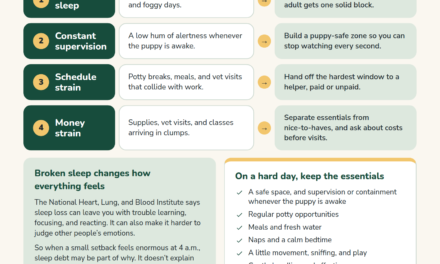
| You feel constant guilt or exhaustion | The plan is too heavy for your real life | Lighten it with another layer, or drop a piece that isn’t earning its keep |
How to check what happens while you’re gone
Record video on a phone or use a pet camera for a few days. Watch for the first ten minutes after you leave and for any pacing, whining, or destruction. What you see is more useful than what you imagine. If your dog is sleeping in a sunbeam, you can relax. If he’s pacing the door, you have a new problem to solve.
When it’s more than a schedule problem
If your dog seems distressed when left alone, don’t just push through. The ASPCA (page accessed September 2026) lists signs that can go with separation anxiety in dogs, including destructive chewing, house-soiling when left alone, persistent barking or howling, escape attempts, drooling, panting, and pacing in a fixed pattern.
The ASPCA advises talking with your veterinarian first, to rule out medical issues, and then a Certified Applied Animal Behaviorist or a board-certified veterinary behaviorist for support. A qualified professional can tell the difference between boredom, incomplete house training, and real distress, and can help you plan what comes next.
Anything that looks medical is a call to your veterinarian or an emergency clinic, not a schedule tweak. That includes straining to urinate, blood in urine or stool, repeated vomiting, or collapse.
What to change first
Try one change at a time so you can tell what helped. Shorten the longest gap. Add a midday break. Move exercise to right before you leave. Change the puzzle feeder. Give it a week, then check again.
If a real adjustment doesn’t help, that’s information, not failure. Ask your veterinarian, a certified trainer, and people you trust what could change. It’s a tough conversation, and having it early is kinder to everyone than having it in a crisis.
Common mistakes
Most people working full time with a dog trip over the same few things. Knowing them ahead of time saves you a rough week.
Hoping the long day works itself out
A ten-hour gap doesn’t shrink because you wish it would. Build the midday break before the first long day, not after the first accident.
Relying on a single point of failure
One neighbor, one walker, one partner. Any of them can get sick, travel, or move away. Two layers per gap is a sturdy minimum.
Planning only for average days
Late meetings, traffic, and overtime happen. Plan for your longest realistic day, and the average ones will feel easy.
Skipping the trial run
Handing your key to a new walker without a meet-and-greet is a gamble. Introduce them while you’re home, and watch how your dog responds.
Treating exercise as a substitute for the midday break
A long morning walk helps your dog settle. It doesn’t extend how long he can wait. Both matter, and one doesn’t stand in for the other.
Keeping the plan in your head
If the routine only exists in your memory, nobody else can run it. Write it down, share it, and update it.
Scolding accidents
An accident after a gap that was too long is a scheduling problem, not a character flaw. Clean it up calmly, shorten the gap, and move on.
Forgetting to update
A new commute, a new puppy, a move, or an aging dog can all break a plan that used to work. Revisit it whenever something changes.
Common questions about working full time with a dog
Can I own a dog if I work full time?
Yes, many people do. The plan matters more than the schedule. Cover the middle of the day, build backup layers, and keep the routine steady. If you’ve got those pieces, your dog can thrive.
Is eight hours alone too long?
The AKC’s guidance sets six to eight hours as the most a dog should spend alone without a chance to relieve himself. That’s a ceiling, not a target, and many dogs do better with shorter gaps. Puppies, seniors, and dogs with health needs need shorter ones.
Can I get a puppy if I work full time?
It’s possible, but puppies need frequent breaks and company in the early months. Many households plan for time off, staggered shifts, or a dependable sitter at first. If you can’t arrange that coverage, waiting for a better moment, or considering an adult dog whose needs are already known, is a reasonable choice.
What’s the best dog for a full-time worker?
Individual dogs matter more than breed labels. Talk to shelter staff or the breeder about a dog’s energy, comfort being alone, and history. An adult dog with a known track record can be easier to plan around than a puppy, but every dog is different.
Should I crate my dog while I’m at work?
Some dogs are comfortable in a crate, some do better in an exercise pen or a dog-proofed room. Introduce it gradually and make it a positive place. Whichever you choose, it doesn’t replace the midday break. A certified trainer can help you pick the right setup.
What if I work 12-hour shifts?
Plan two midday visits, or one visit plus daycare. Build the schedule around the longest gap your dog can manage, and keep a backup for overtime. Anchoring the routine to a sequence rather than the clock helps when shifts rotate.
Do I need a camera?
No, but many owners find one helpful, especially when they’re starting out. It shows you how your dog spends the day. It doesn’t take him outside, so it’s a check-in tool, not a substitute for a break.
Is daycare every day too much?
Some dogs love it. Others find it tiring or overwhelming. Watch how your dog acts at drop-off, at pick-up, and in the evening. If he’s happy and settles easily, it’s working. If he seems stressed or wrung out, try fewer days or a different option. Ask any facility about rest breaks too.
How do I exercise my dog before work when I’m exhausted?
Shrink the goal. A fifteen-to-twenty-minute sniffing walk plus a puzzle feeder is a solid start. Fold the walk into your commute prep, and use the evening for the longer session. Some mornings you’ll only manage a quick lap. That’s fine.
What should I leave out for my dog while I’m gone?
Fresh water, a comfortable place to rest, and one or two safe things to do, like a puzzle feeder or a sturdy chew. Pick up anything he shouldn’t chew or swallow, and check that gates and doors are secure. If you’re not sure a toy is safe unsupervised, ask your veterinarian.
What if my backup cancels at the last minute?
That’s why you build more than one layer. Keep a short list of second-choice options, and set a tripwire rule, like “if my first choice hasn’t confirmed by noon, I call the second.” Deciding in advance takes the panic out of it.
How do I know if my dog is lonely or just bored?
It can be hard to tell from the outside. Video helps. Boredom often shows up as chewing or digging without much visible worry. Distress looks more like pacing, panting, drooling, or frantic barking. If you see distress, follow the steps in the section on when the plan isn’t working.
What if my dog doesn’t like the walker?
Very common early on. Do a short trial visit while you’re home, and ask the walker to use the same greeting each time. Most dogs warm up within a few visits. If your dog still seems uneasy after that, it’s fine to try someone else.
How do I handle late meetings and overtime?
Set a tripwire time and a backup you can text. For example, “If I’m not out by 5:30, my neighbor takes him out.” Keeping a standing arrangement means you’re not scrambling from a conference room.
So, is working full time with a dog realistic? Yes, when you plan for the middle of the day, line up a few layers of backup, and write the routine down so anyone can run it. Start with your longest day, add one layer at a time, and adjust based on what your dog shows you. Long hours don’t make you a bad owner. A plan that works makes you a good one.
Sources
- American Kennel Club. Alone Time for Dogs: How Much Is Too Much? Reviewed by Dr. Vint Virga, board-certified in veterinary behavior. Page dated January 31, 2024.
- American Kennel Club. How Long Can You Leave a Puppy Alone? Page updated October 29, 2025.
- ASPCA. Separation Anxiety. Page accessed September 2026; no publication date shown.
- HomeGuide. Dog Boarding Costs. Page dated June 25, 2025; figures based on contractor-estimate data.
This article is general education for U.S. dog owners. It is not individualized veterinary, behavioral, financial, or legal advice. Ask your veterinarian about your dog’s bathroom needs, health conditions, and how long your dog can comfortably be left alone, and ask a certified trainer or veterinary behaviorist about a dog who seems distressed when alone. Prices and policies vary by location and change over time, so confirm current details with local providers.