Living with a dog in an apartment works well for many dogs and many households. It works best when you plan for four things up front: bathroom logistics, daily exercise, noise, and the building’s rules. Square footage matters less than most people expect.
A small space isn’t a problem for a dog who gets regular outings, sniffing time, and something interesting to do at home. The trouble shows up in the gaps. The slow elevator when your puppy needs to go now. The neighbor who hears every bark through the shared wall. The lease clause nobody read.
This guide covers the practical side. You’ll get a sample apartment day, potty options for different floors and dogs, indoor enrichment ideas, a noise plan for shared walls, neighbor and elevator etiquette, lease questions worth asking, and balcony and window safety. It also gets honest about dogs and households that struggle in apartments. Some do, and there’s no shame in saying so.
What’s in this guide
- Living With a Dog in an Apartment: The Short Answer
- What actually decides whether an apartment works for your dog
- Potty logistics: elevators, stairs, balconies, and pads
- Exercise planning when there’s no backyard
- A sample apartment day, from wake-up to lights-out
- Indoor enrichment that fits a small space
- Small-space setup: rest spots, gates, floors, and the front door
- Noise, barking, and shared walls
- Neighbor communication and building etiquette
- Lease and pet-policy questions to ask
- Balcony and window safety, plus heat and cold
- Cleaning, odor, and dog smell basics
- When an apartment is a hard fit
- Common apartment-dog mistakes
- Moving in: the first two weeks
- Common questions about apartment life with a dog
- Sources
Living With a Dog in an Apartment: The Short Answer
Most dogs can live comfortably in an apartment when four needs are covered reliably. Reliably is the key word. A plan that works on a calm Saturday but falls apart on a stormy Tuesday isn’t a plan yet.
- Bathroom access on a schedule that fits your dog’s age and health, plus a backup for storms, elevator outages, and late nights.
- Real exercise and sniffing time outside the building, not just laps around the living room.
- Something interesting to do at home, so your dog isn’t entertaining themselves with every footstep in the hallway.
- A plan for sound and neighbors, made before the first complaint instead of after it.
Notice what isn’t on that list: your dog’s size or breed. Some large dogs are calm couch companions. Some small dogs are energetic, alert, and vocal. Age, health, temperament, history, and energy level tell you far more than a weight or a breed label.
| Factor | What to look at | Why it matters |
|---|---|---|
| The dog | Age, health, energy, and how they react to sounds and strangers | A puppy, a senior, and a noise-sensitive adult need different setups |
| The building | Floor, elevator or stairs, wall thickness, hallway traffic, distance to grass | Every extra minute between your door and the grass changes potty planning |
| Your schedule | Work hours, commute, who else is home, backup help | Gaps in the day are where apartment plans tend to break |
| Your neighbors | Shared walls, quiet hours, people who fear or dislike dogs | Sound and shared spaces are where small problems grow |
| The lease | Pet policy, fees, size or breed limits, balcony rules | The rules decide what you’re allowed to change |
The honest version
Apartments aren’t unkind to dogs by nature. Unmet needs are, and those can happen in a house with a yard too. Still, a few dogs and a few households do struggle in apartments. We say so plainly later in this guide, without blame.
Use this guide as a set of options, not a checklist you must finish. Pick the pieces that fit your dog, your building, and your week.
What actually decides whether an apartment works for your dog
People often ask whether their dog is the “right type” for an apartment. A better question is whether this dog, in this building, on this schedule, has what they need. Three things do most of the work.
The dog
Start with the individual. Puppies need frequent bathroom trips and a lot of guidance. Seniors may need easier access to the outdoors and gentler surfaces. Some adult dogs settle easily indoors. Others watch, listen, and react to every sound.
Health matters too. A dog with sore joints, a heart condition, or a breathing problem has different stair, heat, and exercise needs. Your veterinarian can help you plan around those.
History counts as well. A dog with an unknown background may react to shared-wall sounds in ways that don’t show up until you’re living there. That’s normal. It just means you watch and adjust.
The building
Walk your route before you commit. How far is it from the door to a place your dog can sniff and relieve themselves? Is there an elevator, and does it break down? Do hallways echo? Does your wall face a busy corridor, a stairwell, or another dog’s home?
A quieter unit can make life easier for a noise-sensitive dog. Ask about units away from the elevator, stairwell, and trash chute when you tour. Ask about the elevator’s reliability, too.
Your schedule and support
Dogs need company and bathroom access across the day. Long workdays don’t rule out apartment life, but they make your backup plan the main event. Who’s the midday helper? What happens when you’re stuck late? Our guides on how long you can leave a dog alone and working full time with a dog go deeper on this.
Here’s the apartment-specific point. With no yard to open the door to, every outing needs a person. Build the plan around your hardest day, not your easiest one.
Potty logistics: elevators, stairs, balconies, and pads
For many households, the bathroom routine is the hardest part of living with a dog in an apartment. There’s no back door to open. Every trip means a leash, shoes, a hallway, and sometimes an elevator.
How often your dog needs to go out depends on age, health, diet, and individual habits. Puppies need many more trips than adults. Our guide on how often you should walk your dog covers timing, and your veterinarian can tailor it to your dog. This section covers the logistics: getting from your door to the grass without a mishap.
Plan the trip from your door to the grass
Time the route once when you’re not in a hurry. Include the wait for the elevator, the walk through the lobby, and the stroll to your dog’s usual spot. That total is your real lead time when your dog gives the signal.
Then set up a go-bag by the door:
- A leash, plus a spare in case one gets wet or chewed
- Waste bags, and a few extras for the day you need them
- A few small treats for rewarding good outdoor bathroom trips
- A towel or paw wipes for wet days
- A light for dark mornings and evenings
- A coat or umbrella for your dog or you, depending on the season
For a young puppy, don’t wait for signals. Take them out after waking, after meals, after play, and on a steady schedule. Carry a small puppy through the lobby and elevator if that gets you outside faster. Ask your veterinarian which shared areas are fine before vaccinations are complete.
Decide which route you’ll use for urgent trips. Elevators can stall, fill up, or stop at every floor. Stairs are faster on lower floors and harder on tiny legs and older joints. Choose for the dog and the situation.
Pads, turf, and balconies: honest pros and cons
Some households add an indoor or balcony relief spot. That’s a legitimate tool for puppies, small dogs, seniors, dogs with mobility limits, and people whose schedules are long or unpredictable. It also comes with tradeoffs.
| Option | Can help when | Watch for |
|---|---|---|
| Outdoor trips only | Your dog is healthy and the gaps between trips are short | Storms, late nights, elevator outages, and sick days |
| Absorbent pads indoors | Puppies, seniors, or long gaps you can’t avoid | Dogs may treat similar soft surfaces, like bath mats and rugs, the same way |
| Artificial turf tray or patch | Dogs who prefer grass-like footing | Needs regular rinsing and replacing, and it can smell |
| Balcony relief spot | Patios or balconies that are allowed, secure, and comfortable in the weather | Lease rules, runoff onto neighbors below, heat, cold, and fall risk |
| Property relief area | Buildings with a designated dog area | Waste pickup rules, crowding, and other dogs |
Many owners notice that a dog who learns to use an absorbent surface indoors may also use other similar surfaces. If you want to phase pads out later, ask a certified trainer for a gradual plan. A common approach moves the pad toward the door, then outside, in small steps.
If you use a balcony spot, keep liquid from draining onto the balcony below. Nobody wants to explain that to the person downstairs.
Bad weather, late nights, and elevator outages
Every apartment plan needs a worst-night version. Rain, thunderstorms, ice, and heat waves all change outings.
- Keep a short, well-lit route ready for quick trips.
- Use a coat or umbrella for rain, and keep a towel for paws.
- After winter walks, wash and dry your dog’s feet and belly to remove ice, salt, and chemicals, as the ASPCA advises (page accessed September 2026).
- In hot weather, go out earlier or later. The ASPCA warns that hot asphalt can burn paw pads.
- If the elevator is out, decide in advance who carries the small dog, which stairs you’ll use, and who can help.
If you have a large senior dog and a high floor, elevator reliability belongs near the top of your tour questions.
Puppies, seniors, and dogs with health needs
Frequent trips are part of the deal for puppies and many seniors. Stairs and long waits are the tough part. A senior dog with sore joints may struggle with a fifth-floor walk-up. A puppy with a full bladder can’t wait out a slow elevator.
A sudden change in bathroom habits deserves a call to your veterinarian. That includes more accidents, more urgency, or more frequent trips. Don’t assume it’s a training problem or just aging.
Exercise planning when there’s no backyard
With no yard, every minute outdoors is a decision. That’s where living with a dog in an apartment differs most from life with a backyard, and it’s useful. You notice what your dog actually gets instead of assuming the yard covers it. Plenty of dogs with yards mostly stand in them, waiting for someone to come outside.
Exercise needs vary with age, health, and individual energy. Our guide on how much exercise a dog needs covers amounts. Here’s how to organize outings so an apartment dog gets a full mix.
Three kinds of outings
| Outing | What it’s for | What it looks like |
|---|---|---|
| Potty trip | Bathroom relief | Short, on schedule, straight out and back |
| Movement walk | Physical activity | A steady pace on a route your dog can handle |
| Sniff walk | Mental work and winding down | Slow and dog-led, with long stops to investigate one patch of grass |
Many owners notice their dogs settle after a slow, sniff-heavy outing, sometimes more than after a fast lap. Try to include one unhurried sniff outing on most days, even a short one. It doesn’t replace movement. It just deserves a spot on the schedule.
Enough for your dog: signs to watch
There’s no single number, so watch your dog. A good balance often looks like this: your dog settles after outings, sleeps well, eats with interest, and stays fairly calm at home.
Other signs suggest more physical or mental work may help:
- Pacing or restlessness in the evening
- Chewing on furniture or door frames
- Frantic bursts of play indoors
- Barking at nearly every sound
Those signs can have other causes, including pain or anxiety. If they’re new or intense, talk to your veterinarian. The ASPCA does recommend increasing exercise, mental stimulation, and social contact for dogs who bark compulsively (page accessed September 2026).
Where to go when the nearest grass is small
Rotate routes. Many dogs seem more engaged on a walk with new smells than on the same three trees every day. Try quiet side streets, wide paths, a quiet park, or a fenced area you have permission to use.
Dog parks aren’t right for every dog, so consider your dog’s comfort before you go. Daycare or a walker who runs small-group outings can supplement your own walks if your dog enjoys company.
Some owners use building stairs as a workout. Ask your veterinarian first if your dog is a puppy, a senior, or has joint problems.
Weather days
Heat and cold change the plan. The ASPCA advises keeping walks to a minimum during very high temperatures, offering fresh water and shade, and remembering that hot pavement can burn paw pads. In cold weather, its advice is simple: if it’s too cold for you, it’s probably too cold for your pet.
Rainy or extreme days call for shorter, more frequent outings and more mental work indoors. Keep three ten-minute indoor games on your list for those days: a scent search, a short training session, and a puzzle meal.
A sample apartment day, from wake-up to lights-out
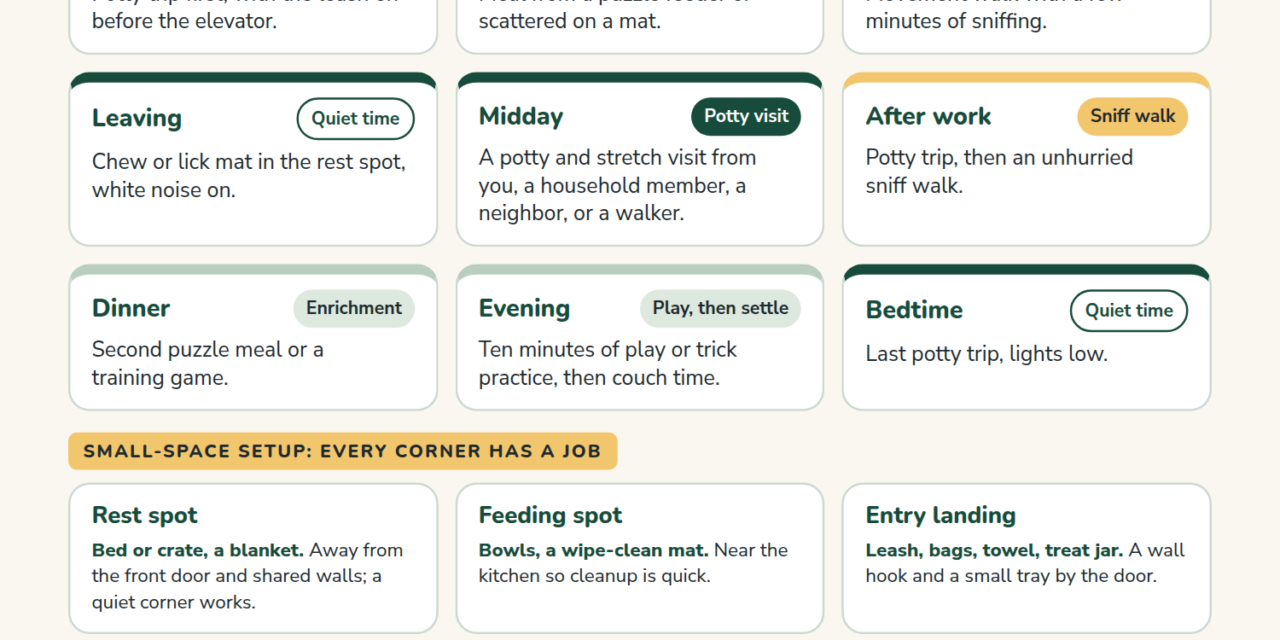
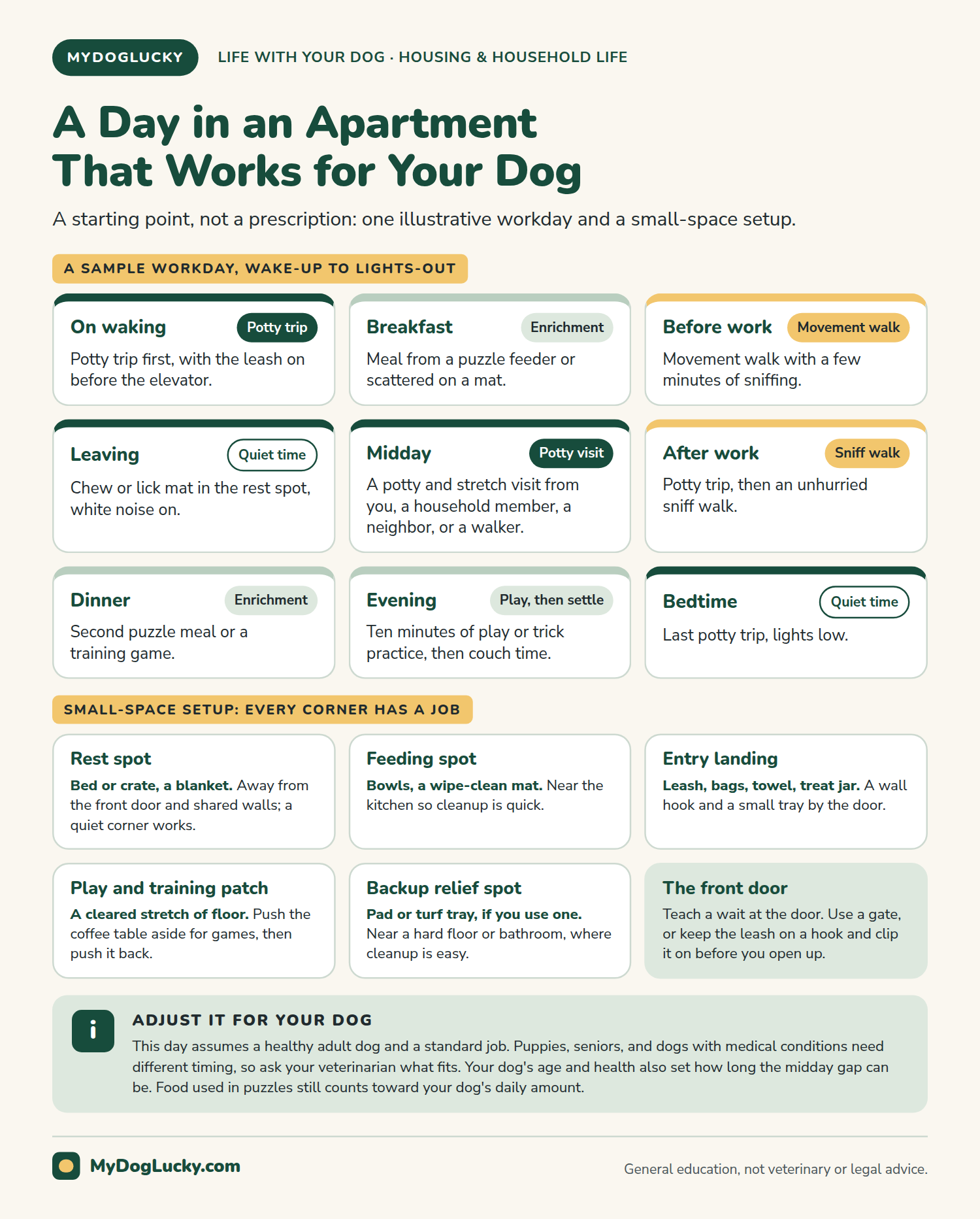
Here’s one illustrative workday. It isn’t a prescription. It assumes a healthy adult dog and a person with a standard job. Puppies, seniors, and dogs with medical conditions need different timing, so ask your veterinarian what fits your dog.
| When | What happens | Why it helps |
|---|---|---|
| On waking | Potty trip first, with the leash on before the elevator | Bathroom comes before the excitement of the hallway |
| Breakfast | Meal from a puzzle feeder or scattered on a mat | Turns a two-minute meal into a real task |
| Before work | Movement walk with a few minutes of sniffing | Uses some energy before a quiet stretch |
| Leaving | Chew or lick mat in the rest spot, white noise on | A calm handoff to quiet time |
| Midday | Potty and stretch visit from you, a household member, a neighbor, or a walker | Breaks up the gap. Your dog’s age and health set how long that gap can be. |
| After work | Potty trip, then an unhurried sniff walk | Time to decompress together |
| Dinner | Second puzzle meal or a training game | Mental work while you cook |
| Evening | Ten minutes of play or trick practice, then couch time | Winds down toward bedtime |
| Bedtime | Last potty trip, lights low | A predictable close to the day |
Food used in puzzles still counts toward your dog’s daily amount. Ask your veterinarian how much to feed, especially if weight is a concern.
Adjusting the sample day
If you work from home, anchor a few trips to fixed points, such as right after log-on and right before dinner. Otherwise the day tends to dissolve. If you work shifts, plan around your longest shift, and keep the longest gap your dog faces as short as you can.
With a puppy, add more frequent trips and more rest, because puppies sleep a lot between activities. With a senior, use shorter outings, softer footing, and easy access to a bathroom spot.
Indoor enrichment that fits a small space
Enrichment means giving your dog something worth doing. When you’re living with a dog in an apartment, it fills the hours between outings. This section covers the basics. Our guide to indoor dog enrichment has a longer menu of ideas.
One apartment-specific twist: favor activities that calm your dog rather than wind them up. A dog who has raced around the living room may be louder, not more tired.
Make meals do double duty
Puzzle feeders, snuffle mats, and scatter feeding on a towel turn dinner into a search. Start easy so your dog succeeds. If a “level three” puzzle falls apart in one minute, that’s useful information, not a failure.
Count food used in puzzles toward the day’s total. Wash puzzle toys regularly. Ask your veterinarian about amounts, especially for dogs who need to watch their weight.
Sniff games
Hide a few small treats around one room and let your dog search. Roll treats up in a towel. Cover treats with tennis balls in a muffin tin, or tuck them into cardboard boxes. Supervise, keep it simple, and raise the difficulty slowly.
Short training sessions
Five minutes, a few times a day, beats one long session. Teach skills that make apartment life easier: a go-to-your-mat cue, a hand target for elevator manners, a wait at the door, and a settle. Use small, tasty rewards and stop while your dog is still keen. Our dog training basics guide covers the fundamentals.
Chews and licking
Licking and chewing calm many dogs. Choose items sized for your dog and their chewing style, and supervise anything new. Ask your veterinarian which chews suit your dog, because the wrong one can be a hazard.
Window time, with rules
A window perch gives some dogs something to watch. It gives others a reason to bark at every passerby. If yours is the second kind, block the lower view with frosted film or a curtain. Keep any perch away from windows with loose screens (see the safety section below).
Rotate, don’t pile up
Rotate toys weekly so old ones feel new, and retire any that are damaged. A small apartment can’t hold a toy chest, and your dog doesn’t need one.
Small-space setup: rest spots, gates, floors, and the front door
A small home works better when each corner has a job. You don’t need extra square footage. You need a layout that makes the calm choices easy.
| Zone | What goes there | Small-space tip |
|---|---|---|
| Rest spot | Bed or crate, a blanket | Place it away from the front door and shared walls; a quiet corner works |
| Feeding spot | Bowls, a wipe-clean mat | Keep it near the kitchen so cleanup is quick |
| Entry landing | Leash, bags, towel, treat jar | A wall hook and a small tray by the door |
| Play and training patch | A cleared stretch of floor | Push the coffee table aside for games, then push it back |
| Backup relief spot | Pad or turf tray, if you use one | Near a hard floor or bathroom, where cleanup is easy |
Floors
Hard, slick floors are tough on puppies, seniors, and dogs with sore joints. Rugs with non-slip backing help. Check your lease before using anything adhesive on the floor.
Gates and pens
A baby gate can keep your dog out of the kitchen or away from the front door. A pen or crate can give your dog a safe rest spot if you introduce it gradually. Our guide on crate training a puppy walks through the steps.
The front door
Apartment doors open onto hallways, stairwells, and elevators. Those are the worst places for a dog to bolt. Teach a wait at the door. Use a gate, keep the leash on a hook by the door, or clip it on before you open up.
Sightlines and sound
If your dog patrols the entry, move their rest spot out of view. A curtain, a freestanding shelf, or a low fabric screen can block the sightline. A bed against a shared wall puts your dog closest to the neighbor’s noise, so try a different wall.
Cords, cabinets, and plants
Small spaces put everything within reach. Tuck cords out of the way. Store cleaning supplies and medications high up or in latched cabinets. Check houseplants against a reliable toxic-plant list before you bring them home.
Storage
Use vertical space. Wall hooks hold leashes. A lidded bin holds food. A basket holds toys. A washable cover protects the couch. Then you’ll have room to live.
Noise, barking, and shared walls
Noise is where living with a dog in an apartment feels most different, because your dog’s sounds travel and so do everyone else’s. Some barking is normal communication. The goal is to understand it, reduce the triggers, and give your dog something better to do.
Our guide on how to stop dog barking has step-by-step training. This section focuses on the apartment-specific part.
Why dogs bark in apartments
The ASPCA lists seven types of barking: territorial, alarm, attention-seeking, greeting, compulsive, socially facilitated, and frustration-induced (page accessed September 2026). Socially facilitated barking is barking that starts because another dog is barking. Apartments pack many of these triggers into a small space.
| Trigger | Often looks like | First step |
|---|---|---|
| Footsteps or voices in the hallway | Alarm or territorial barking | Move the rest spot away from the door, add white noise, and reward quiet |
| Door knocks and deliveries | Alarm, greeting, or excitement | Teach a go-to-your-mat cue and practice it with a friend |
| A neighbor’s dog barking | Socially facilitated barking | Mask the sound, reward calm, and move away from the shared wall |
| Street view from the window | Alarm or territorial barking | Block the lower view with film or a curtain |
| Waiting for a walk or meal | Frustration or attention-seeking | Keep a predictable routine and reward quiet waiting |
| Being alone | Could be several things | Check a video for patterns, then read the distress section below |
What to avoid
The ASPCA says anti-bark collars are punishment devices and are not recommended as a first choice. It also warns that punishing a dog who barks from fear or anxiety can make them feel worse. Yelling can backfire too, because some dogs seem to hear it as joining in.
Instead, reward calm moments, reduce triggers, and meet the needs behind the barking.
Log it before you fix it
Record what happens. A phone or camera you already own can capture times and triggers. Note what happened just before, how long it lasted, and what your dog did afterward.
Patterns show up quickly: mornings when a neighbor leaves, late deliveries, or barking only when you’re gone. The log also helps if a neighbor complains, because you can compare notes on times.
Small changes that lower the volume
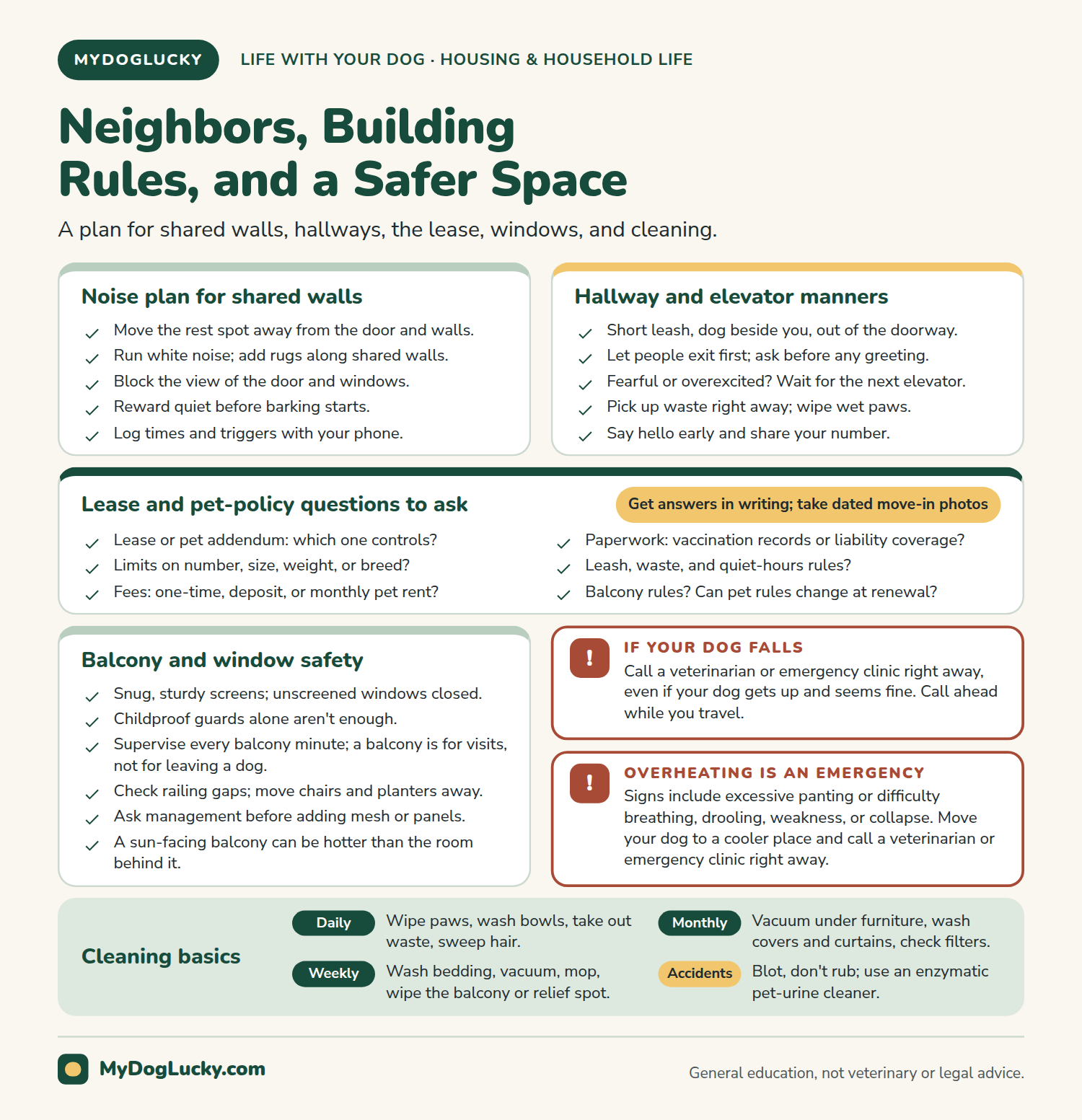
- Put rugs, bookcases, or heavy curtains along shared walls.
- Run a fan or white noise machine near the rest spot during predictable noise.
- Offer a chew or lick mat just before a known noisy time.
- Exercise your dog before the loudest part of your neighbors’ day, when you can.
- Block the view of the door and windows.
- Reward quiet with treats before the barking starts, not after.
When it might be more than noise
Barking that comes with panic
If your dog panics when you leave, the pattern may be more than a noise problem. Signs include nonstop barking or howling, drooling, pacing, destruction near doors or windows, house-soiling, or attempts to escape. That pattern can reflect real distress, and it’s what people mean by separation anxiety in dogs.
More exercise alone won’t fix it, and punishment can make it worse. Talk to your veterinarian, who can look for medical contributors. Then ask about a board-certified veterinary behaviorist or a qualified trainer who uses reward-based methods.
Neighbor communication and building etiquette
Neighbors don’t have to love your dog. They just need to feel that the shared spaces are predictable and that you’re paying attention. A few habits make living with a dog in an apartment go much more smoothly.
Say hello before there’s a problem
A short introduction helps. Most people are more patient with a barking dog when they know the person behind the door. Here’s a sample note you can adapt.
Sample note to neighbors
Hi, I’m [your name] in [unit]. I’ve just moved in with my dog. If you ever hear barking or noise that bothers you, please text me at [number]. I’d rather hear about it early and fix it than have it build up. Thanks for your patience while we settle in.
Offer your number. Ask for theirs. If you know a loud week is coming, such as a new puppy or a training project, give a quick heads-up.
Elevator, hallway, and lobby manners
- Keep the leash short and your dog beside you, out of the doorway, when the elevator opens.
- Let people exit first, and ask before letting your dog greet anyone.
- If a neighbor seems nervous, give space. “He’s friendly” doesn’t help someone who’s afraid.
- Wait for the next elevator if your dog is fearful, reactive, or overexcited. Our reactive dog training guide covers that topic further.
- Pick up waste right away, including in hallways and on the elevator floor.
- Wipe wet paws before you step into the hallway.
- Follow the building’s leash rules for hallways, lobbies, and grounds.
- Avoid tight passes with other dogs. Step aside and let them go by, since narrow spaces make greetings harder for many dogs.
If a neighbor complains
Try to hear it as information. Thank them, ask when it happens, and ask what they hear. Check your log. Fix what you can, and tell them what you changed.
Keep the conversation friendly and short, and avoid arguing in the hallway. If complaints go through management, reply in writing with what you’re doing. If things escalate or your lease is at issue, read your lease and check local tenant resources. This guide can’t give legal advice.
Neighbors with fears, allergies, or dogs of their own
Some people are afraid of dogs. Some have allergies. Some have a nervous dog of their own. You don’t need to justify your dog. You do need to make shared spaces predictable, and that’s easier than it sounds.
Lease and pet-policy questions to ask
Rules vary widely by building, city, and state. This section is general education, not legal advice. Read your own lease and any pet addendum, check local and state law, and ask a housing counselor or attorney if you have a legal question.
Before you commit to living with a dog in an apartment, or before you bring a dog home to one you already rent, ask these questions.
| Question | Why it matters |
|---|---|
| Do the lease or a pet addendum cover dogs, and which document controls? | Rules can sit in more than one place |
| Are there limits on number, size, weight, or breed? | Some buildings set limits and others don’t. Get the exact wording. |
| What fees apply: one-time fee, refundable deposit, monthly pet rent? | Costs vary by building. Ask which parts are refundable. |
| Is paperwork required, such as vaccination records or proof of renter’s liability coverage? | Some buildings ask for documents before move-in |
| Where can dogs go on the property, and what are the leash rules? | Covers relief areas, elevators, lobbies, and grounds |
| What are the waste rules and penalties? | Missed pickup can trigger fines in some buildings |
| What does the lease say about noise and quiet hours? | Sets expectations if a neighbor complains about barking |
| What are the balcony and patio rules? | Some buildings limit items, railing changes, or relief spots |
| Can pet rules change at renewal? | A policy shift can affect you mid-stay |
| How do maintenance and inspection visits work with a pet at home? | Lets you plan a safe room and give your dog notice |
| What is charged at move-out for cleaning or flooring? | Helps you protect floors and document condition |
Get answers in writing
Ask for the pet policy in writing and keep a copy of anything management sends you. If a manager makes a verbal promise, ask them to confirm it by email. Take dated photos of the unit’s condition at move-in. That record can help later.
Assistance animals are handled differently
Assistance animals, a category that includes service animals and support animals, fall under federal fair housing rules and are generally treated differently from pets. The U.S. Department of Housing and Urban Development publishes guidance on how those rules work. If this applies to you, start there and consider talking to a housing counselor or attorney. This guide doesn’t cover the details.
If your dog isn’t allowed
Some buildings don’t allow dogs at all or restrict certain sizes or breeds. Keeping a dog against a lease can carry consequences, so talk with management before you make a plan.
Some owners share a short pet resume with vet records, vaccination and spay or neuter status, training history, and references from past landlords. Whether that helps depends on the building. If a limit is a dealbreaker, it’s better to know before you sign than after your dog has moved in.
Balcony and window safety, plus heat and cold
If your dog falls from a window or balcony
Call a veterinarian or emergency clinic right away, even if your dog gets up and seems fine. Injuries from a fall aren’t always visible. Call ahead while you travel so the clinic can prepare.
Why falls happen
Veterinarians call these falls “high-rise syndrome.” In an April 10, 2013 release, the ASPCA said the problem mostly involves cats but that dogs and other pets are also susceptible. It said its animal hospital saw more than 100 cases in the previous year, and three to five cases a week on average in warmer months. Treat those numbers as a dated snapshot, not a current rate.
An ASPCA veterinarian quoted in the release called these falls preventable, and the ASPCA urged snug, sturdy screens. The release also warned that childproof window guards aren’t enough, because cats and small dogs can slip through them. The ASPCA’s hot-weather page adds a simple rule: keep unscreened windows and doors closed.
Window checklist
- Check that screens are snug and sturdy, not loose or torn.
- Keep unscreened windows closed.
- Don’t rely on childproof guards alone.
- Move furniture away from windows if your dog climbs on it.
- Ask maintenance to repair loose screens.
Balcony checklist
- Supervise every balcony minute. A balcony is a place to visit, not a place to leave a dog.
- Look at railing gaps and the space beneath the rail. Small dogs can slip through wide gaps.
- Ask management before adding mesh or panels, and check the lease before altering anything.
- Keep chairs, tables, and planters away from the railing so they can’t become steps.
- Keep hazards off the balcony, such as plants that may be toxic, cigarette butts, fertilizer, chemicals, and small objects.
- If your dog gets excited about birds or people below, keep them on a leash you hold.
Heat on the balcony
The ASPCA’s hot-weather guidance (page accessed September 2026) says to provide fresh water and shade, avoid over-exercising, and keep pets indoors during extreme heat. It notes that flat-faced dogs need air-conditioned environments. It doesn’t single out balconies, but the same logic applies. A sun-facing balcony can be hotter than the room behind it, so a short visit in mild weather is very different from an afternoon out there.
Signs of overheating are an emergency
The ASPCA lists excessive panting or difficulty breathing, increased heart and respiratory rate, drooling, mild weakness, stupor, or collapse. It also lists seizures and a body temperature above 104°F. If you see these signs, move your dog to a cooler place and call a veterinarian or emergency clinic right away.
Cold on the balcony
The ASPCA’s cold-weather guidance (page accessed September 2026) puts it plainly: if it’s too cold for you, it’s probably too cold for your pet, so keep your animals inside. Short-coated dogs may need a coat or sweater for outings. A balcony isn’t shelter from wind or wet weather, so treat it like any other outdoor space.
After winter walks, wash and dry feet and belly to remove ice, salt, and chemicals. The ASPCA also suggests pet-friendly ice melts where you can choose them, and notes that antifreeze is lethal to dogs, so spills in garages or parking areas need thorough cleanup.
Cleaning, odor, and dog smell basics
Small spaces hold on to smells. That’s not a comment on you or your dog. It’s how air works in fewer cubic feet.
Where dog smell comes from
Dog smell usually comes from several sources at once: damp fur, skin oils, bedding, accidents, food bowls, drool, and stale air when the windows stay shut. Fixing one source often isn’t enough. Cleaning the whole chain does.
If a strong odor comes from your dog’s ears, skin, or breath, mention it to your veterinarian. Persistent smells can point to something worth checking.
A simple cleaning rhythm
| How often | What to do | Notes |
|---|---|---|
| Daily | Wipe paws at the door, wash food and water bowls, take out waste, sweep or vacuum hair | Keep a towel by the door |
| Weekly | Wash bedding and throws, vacuum, mop hard floors, wipe the balcony or relief spot | Follow the care labels on bedding |
| Monthly | Vacuum under furniture, wash removable covers and curtains, check filters and vents | A recurring phone reminder helps |
| As needed | Clean accidents right away | See the next section |
Treat this as a starting rhythm. Adjust it for your dog’s coat, your space, and your energy.
Cleaning up accidents
Blot, don’t rub. Soak up as much as you can with paper towels, working from the outside in. Then use a cleaner made for pet urine, often called an enzymatic cleaner, and follow the label.
Test it on a hidden spot first. Keep your dog out of the room until the area is dry. Never mix cleaning products, because some combinations release harmful fumes. Store every cleaner where your dog can’t reach it.
Hair, nails, and floors
Regular brushing cuts hair at the source. Brush outdoors or in the bathroom if you can. Trimmed nails reduce scratches on floors, and our guide on how to trim dog nails covers the basics. Use rugs in high-traffic spots, and photograph your floors at move-in.
Air and trash
Open windows when the weather and the screens allow. Use a lidded bin for waste bags, and take them out daily. A small air purifier with a filter may help with dander and hair, but it’s no substitute for cleaning.
When an apartment is a hard fit
Living with a dog in an apartment is a good fit for many dogs and a hard fit for some. Both can be true in the same building. Saying so isn’t blaming your dog, and it isn’t blaming you.
Signs the current setup isn’t working
On the dog’s side:
- Barking or vocalizing that doesn’t settle even when triggers are reduced and needs are met
- Signs of panic when left alone, such as pacing, drooling, destruction near doors, house-soiling, or escape attempts
- Fear, lunging, or freezing in hallways, elevators, or lobbies
- Restlessness that doesn’t ease with more exercise and enrichment
- New physical limits, such as a senior dog who can no longer manage stairs
On the household’s side:
- Long gaps in the day without a reliable backup
- Repeated neighbor complaints or lease warnings
- A schedule that changed after you got the dog
- Feeling exhausted from managing every outing and every sound
That last one counts. Your well-being is part of the plan.
A step-by-step ladder
- Rule out medical contributors. Talk to your veterinarian, especially if the signs are new.
- Tighten the basics: exercise, sniffing, enrichment, and routine.
- Adjust the space: sound, sightlines, the rest spot, and the front door.
- Add help, such as a walker, sitter, daycare, trainer, or veterinary behaviorist.
- Consider a different unit, such as a ground floor, a quieter side, an end unit, or a place closer to green space.
- If the fit still isn’t working, talk with your veterinarian, a behavior professional, and local shelter or rescue staff about next steps. It’s a hard conversation, and it deserves calm, professional support, not guilt.
Changing the setup, or sometimes the address, isn’t a failure. It can be the kindest fix.
Skip the breed stereotypes
It’s tempting to sort dogs by breed or size. That misleads. Two dogs of the same breed can differ in energy, noise, and confidence. Focus on the individual instead. How does your dog respond to sound, being alone, crowds, and confinement? How much activity do they need to settle?
The ASPCA points readers toward a certified applied animal behaviorist, a board-certified veterinary behaviorist, or a certified professional dog trainer for compulsive or fear-based barking. Those are good places to start when a problem feels bigger than a tweak.
Common apartment-dog mistakes
Treating the balcony as a yard
A balcony isn’t a yard. It has fall risk, weather exposure, and neighbors below. Use it for supervised visits, not exercise or unsupervised bathroom time.
Planning around your best day
A routine that works only when the elevator runs, the weather is kind, and you’re home on time isn’t a routine yet. Add a worst-night version.
Waiting for a complaint before meeting neighbors
A friendly introduction costs little. A first conversation that starts with a complaint costs more.
Assuming size sets the noise or exercise level
Size tells you less than you’d think. Watch your dog’s energy, alertness, and confidence, and plan from there.
Punishing barking
The ASPCA cautions that punishment can make a fearful or anxious dog feel worse. Address triggers and needs instead.
Skipping the lease details
Fees, limits, and rules are easier to handle before move-in than after a notice arrives. Ask the questions and get the answers in writing.
Leaving screens and railing gaps for later
Later is when a dog finds the gap. Fix loose screens and check railings now.
Letting cleaning slide until it’s a smell
Small spaces reward small, regular cleaning. Ten minutes a day beats a two-hour rescue mission on Sunday.
Moving in: the first two weeks
A new place is a big change for a dog, and living with a dog in an apartment starts before the boxes arrive. Familiar routines help.
- Before the move. Read the pet rules, ask about elevator reliability, and scout relief areas. Ask your veterinarian for local clinic and emergency options.
- Day one. Set up the rest spot first. Keep meals and potty trips on your usual schedule, and add extra trips.
- Days one to three. Take short, calm tours of the building. Use the same route to the same patch of grass and let your dog sniff.
- Week one. Introduce yourselves to nearby neighbors, keep a noise log, and add white noise near the rest spot.
- Week two. Review what worked, adjust the schedule, and update ID tags and your dog’s microchip registry with your new address.
Expect a wobble. Extra barking, accidents, or restlessness in the first days can be part of settling in. If the signs are intense or last, talk to your veterinarian.
Common questions about apartment life with a dog
Is living with a dog in an apartment unfair to the dog?
Not by itself. Dogs need bathroom access, activity, company, rest, and things to do. An apartment can meet those needs, and a house with a yard can fail to. What matters is whether your dog’s needs are met, day after day.
What size dog is best for an apartment?
There isn’t one. Size is a weak predictor of how a dog will do indoors. Energy, noise sensitivity, health, age, and your schedule matter more. A calm large dog and an energetic small dog can both exist in the same building.
Can I work a full-time job and keep a dog in an apartment?
Many people do, with a plan for midday relief and backup. How long a dog can be left depends on age, health, and temperament. Our guides on how long you can leave a dog alone and working full time with a dog cover this in depth.
Do apartment dogs need more walks than dogs with yards?
They often need more planning, because there’s no casual outdoor access. The number of trips depends on age, health, and energy. Our guide on how often you should walk your dog has more.
Are pee pads a good idea in an apartment?
They can be a useful backup for puppies, seniors, and long gaps. They also carry tradeoffs, such as dogs treating other soft surfaces the same way. If you use them, ask a certified trainer how to phase them out when you’re ready.
Is a balcony a safe place for my dog?
Only with supervision, secure railings, comfortable weather, and no hazards within reach. Even then, it’s a place to visit, not a place to leave your dog. Check the fall-risk checklist above.
How do I stop my dog from barking at hallway noises?
Move the rest spot away from the door, add white noise, and reward quiet before the barking starts. Teach a go-to-your-mat cue. If the barking is intense or comes with panic, talk to your veterinarian and a qualified trainer.
Should I get a dog if my building has thin walls?
Thin walls make noise planning more important, not impossible. Ask about quieter units, use sound-dampening furniture and rugs, and tell neighbors early. If your dog is very noise-sensitive, be honest about whether the setup fits.
Can a landlord charge extra for a dog?
Many buildings charge pet fees, deposits, or monthly pet rent. Rules vary by building, city, and state, and assistance animals are handled differently. Read your lease and check local law. This isn’t legal advice.
How do I keep my apartment from smelling like a dog?
Clean the sources: bedding, floors, bowls, and accidents. Air out the space when you can. If a strong smell comes from your dog’s ears, skin, or breath, mention it to your veterinarian.
What if my neighbor complains about barking?
Listen, ask for specifics, and check your log. Fix what you can and tell them what you changed. If it’s a pattern, work on the causes with a certified trainer or veterinary behaviorist.
Can a dog live in a studio apartment?
Yes, with a clear layout. Give your dog a rest spot away from the door, a cleared stretch of floor for play, and a routine that keeps outings regular. Small spaces work when needs are met.
Is a high-rise a problem for dogs?
Height isn’t a problem in itself. Falls, elevator waits, and hallway sounds are the practical concerns. Secure screens, supervised balcony time, and a plan for the elevator go a long way.
What if my dog is reactive in the hallway?
Give yourself distance and timing. Wait for the elevator to clear, pass others with space, and reward calm. A certified trainer who uses reward-based methods can help. Our reactive dog training guide covers this topic.
So, is living with a dog in an apartment a good idea? For many dogs, yes, when the basics are covered. Plan the bathroom routine, protect exercise and sniffing time, give your dog something to do at home, and tell your neighbors hello. Read the lease, secure the windows and balcony, and give yourself a worst-night plan. If it’s still not working, adjust the setup, ask for help, and don’t carry the blame alone.
Sources
- ASPCA. Barking. Page undated; accessed September 2026. Used for the seven types of barking, the caution about anti-bark collars and punishment, exercise and enrichment for compulsive barking, and referrals to behavior professionals.
- ASPCA. Hot Weather Safety Tips. Page undated; accessed September 2026. Used for signs of overheating, shade and water, hot pavement, and keeping unscreened windows closed.
- ASPCA. Cold Weather Safety Tips. Page undated; accessed September 2026. Used for keeping dogs inside in the cold, coats for short-coated dogs, paw care, de-icers, and antifreeze.
- ASPCA. ASPCA Urges Pet Owners to Install and Secure Window Screens to Prevent “High-Rise Syndrome”. Press release, April 10, 2013. Used for the description of high-rise syndrome, screens, and childproof guards.
- U.S. Department of Housing and Urban Development, Office of Fair Housing and Equal Opportunity. Assistance Animals. Accessed September 2026. Pointer for readers who need federal fair housing guidance on assistance animals.
This article is general education for U.S. dog owners. It is not individualized veterinary or behavioral advice, and it is not legal advice. Lease and pet-policy rules vary by building, city, and state, so read your own lease and check local law. Ask your veterinarian about anything specific to your dog’s health, mobility, bathroom habits, or behavior. Seek veterinary care right away if your dog shows signs of overheating, has fallen from a height, or seems to be in distress.