Dog boarding vs pet sitting comes down to three things: where your dog sleeps, who is watching, and how many other dogs are around. Boarding means your dog stays at a facility or in someone else’s home. Pet sitting means a person cares for your dog in your own home, either overnight or through short visits.
Neither option is right for every dog. A social adult who loves a busy day may thrive at a facility. A senior who needs his own bed and a quiet evening may do better with a sitter. A dog who panics when you leave may struggle with both, and that’s useful information too.
This guide gives you decision criteria instead of a verdict. You’ll get plain definitions of five care options, a fit-by-situation table, and a fill-in cost worksheet. You’ll also get question lists for facilities and sitters, a one-page care handoff sheet, red flags, and a plan for dogs who struggle either way.
What’s in this guide
- Dog boarding vs pet sitting: the short answer
- The five care options, defined
- Six factors that change the answer
- Fit by situation: which setup matches your dog?
- A five-question decision path
- What drives the cost, plus a fill-in worksheet
- Health requirements and vaccines
- Questions to ask a boarding facility
- Questions to ask a pet sitter or home-based host
- Meet-and-greet and trial stay
- Written agreement and veterinary authorization
- The one-page care handoff sheet
- Red flags to watch for
- When your dog struggles with either option
- Last-minute plans
- The week before, drop-off, and pickup
- Common mistakes
- Common questions about boarding and sitting
- Sources
Dog Boarding vs Pet Sitting: The Short Answer
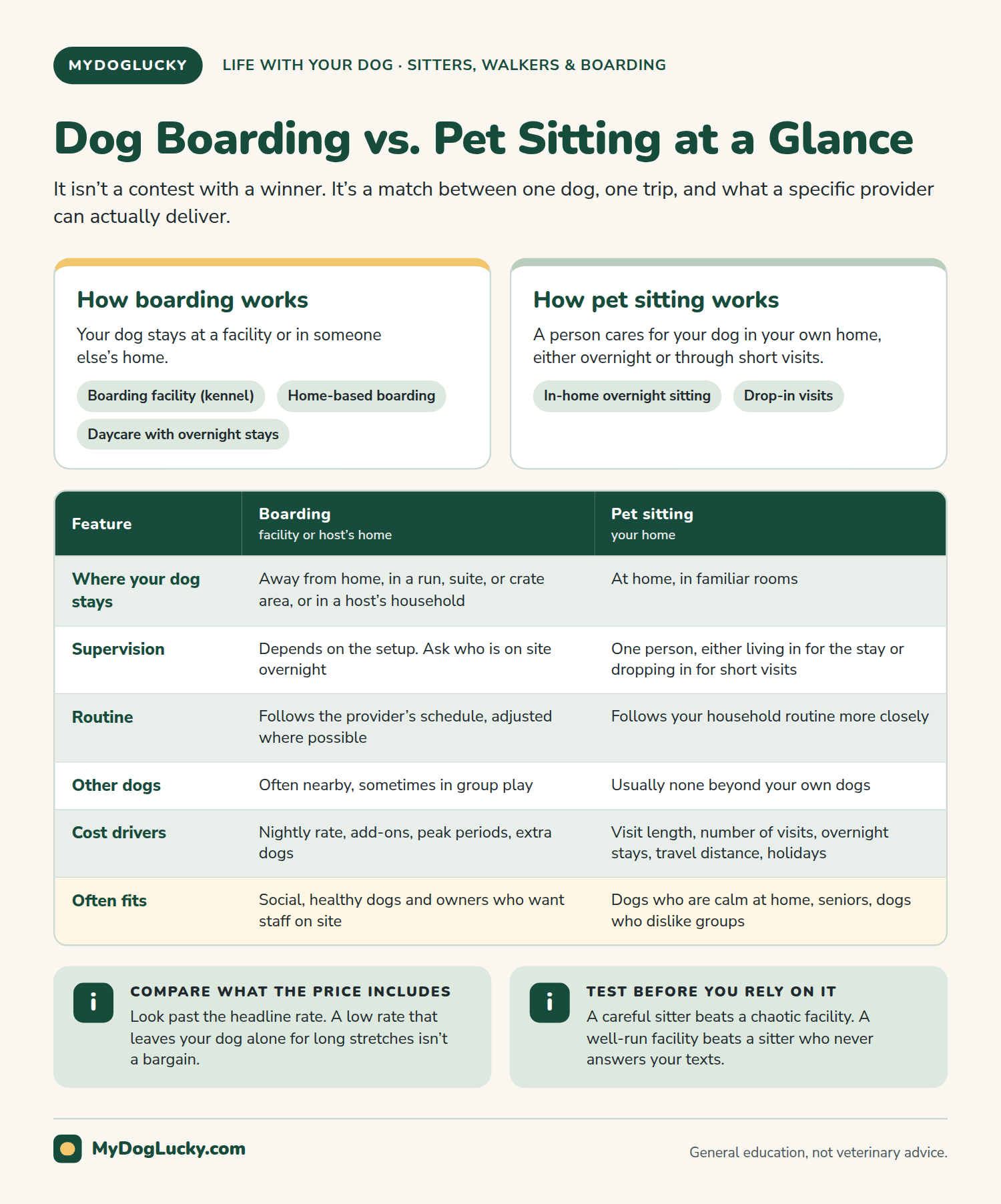
Start with the tradeoff. Boarding gives your dog a place built for dogs, a structured day, and staff who may be on site around the clock. Pet sitting gives your dog familiar rooms, a familiar routine, and little or no exposure to other dogs. Each option trades something for something else.
Dog boarding vs pet sitting isn’t a contest with a winner. It’s a match between one dog, one trip, and what a specific provider can actually deliver. A careful sitter beats a chaotic facility. A well-run facility beats a sitter who never answers your texts.
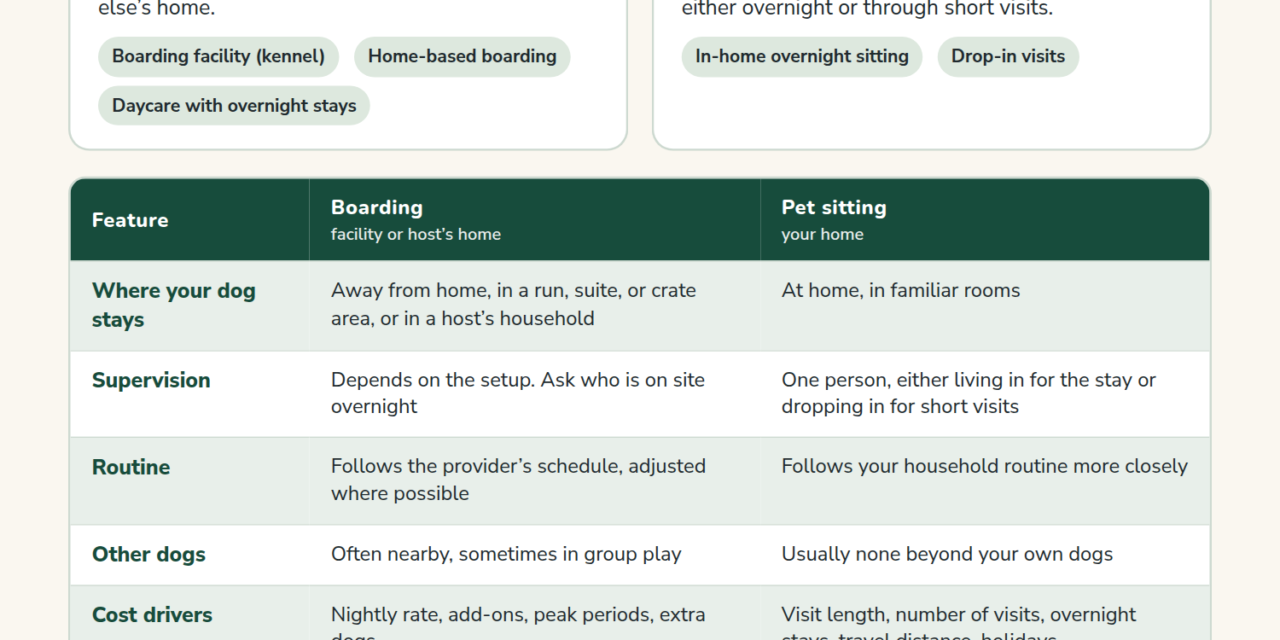
Side by side at a glance
| Feature | Boarding (facility or host’s home) | Pet sitting (your home) |
|---|---|---|
| Where your dog stays | Away from home, in a run, suite, or crate area, or in a host’s household | At home, in familiar rooms |
| Supervision | Depends on the setup. Ask who is on site overnight | One person, either living in for the stay or dropping in for short visits |
| Routine | Follows the provider’s schedule, adjusted where possible | Follows your household routine more closely |
| Other dogs | Often nearby, sometimes in group play | Usually none beyond your own dogs |
| Cost drivers | Nightly rate, add-ons, peak periods, extra dogs | Visit length, number of visits, overnight stays, travel distance, holidays |
| Often fits | Social, healthy dogs and owners who want staff on site | Dogs who are calm at home, seniors, dogs who dislike groups |
Treat this table as a starting frame. The rest of the guide helps you test each option against your own dog, your own trip, and your own budget.
The Five Care Options, Defined
People use these terms loosely, so here’s how we use them. Providers vary a lot inside each category. Ask what a provider actually does instead of trusting the label.
Boarding facility (kennel)
Your dog stays at a commercial facility. Dogs typically have their own run, suite, or crate space, with scheduled meals, potty breaks, and playtime. Some facilities have a veterinarian on staff, and others partner with a local clinic. AKC describes reputable kennels as places that let you see the runs, meal-prep areas, and play spaces.
Home-based boarding
Your dog stays in the provider’s own home, usually with a small number of dogs living alongside the household. It can feel calmer than a busy facility. It also varies more.
A fenced yard, other pets, children, stairs, and visitors all become part of your dog’s stay. Ask who’s home during the day, where your dog sleeps, and what happens if a dog slips out the door.
Daycare with overnight stays
Some daycares offer overnight boarding. Your dog spends the day in supervised group play, then sleeps in a suite or shared room.
This can suit a dog who loves other dogs. It can wear out a dog who doesn’t. AKC says good facilities group dogs by compatibility, age, and energy level, so ask how yours does it.
In-home overnight sitting
A sitter stays at your house while you’re away. Your dog keeps his bed, his yard, and his usual schedule.
AKC notes that many dogs are less stressed at home and avoid exposure to other dogs. The tradeoff is that you depend on one person. Ask what happens if that person gets sick, and whether the sitter leaves the house during the day.
Drop-in visits
A sitter or walker stops by a few times a day for meals, potty breaks, play, and a check-in. Between visits, your dog is on his own.
That can work for some healthy adult dogs on shorter trips. It can be a poor match for puppies, dogs with medical needs, or dogs who struggle alone. The gaps matter as much as the visits, so see our guide on how long you can leave a dog alone.
Hybrids and blends
Many providers mix formats. A sitter may take dogs into her own home. A facility may send staff to yours.
If you find someone through an online marketplace, the same questions apply. Ask what the marketplace itself does and doesn’t cover, and get the answers in writing.
Six Factors That Change the Answer
The dog boarding vs pet sitting decision shifts on six factors. Look at these before you compare a single provider.
1. Where your dog sleeps and spends the day
Some dogs treat a new place as an adventure. Others treat it as a problem to solve at high volume. Your dog won’t read the brochure, so judge by history.
How does he handle the vet, car rides, new rooms, and strangers? A calm, adaptable dog may be fine anywhere. A dog who startles at every new sound may need familiar rooms.
2. Who is watching, and when
Supervision means different things in each setup. A facility may have several staff, but each covers many dogs, and overnight coverage varies. A live-in sitter offers one pair of eyes, close to your dog, all night.
A drop-in sitter offers attention only during visits. Ask exactly who is awake, where they are, and how they would hear a problem.
3. Routine
Dogs run on rhythms: breakfast, potty, nap, walk. A sitter in your home can copy your routine closely. A facility runs its own schedule, though many will follow your feeding times and medication instructions.
Ask what is flexible. Ask what happens when your dog usually wants out at dawn.
4. Other dogs
Group settings add social time for dogs who enjoy it. They add stress for dogs who don’t, and more exposure to infectious illness. VCA notes that vaccines lower the severity of disease but don’t give complete protection. In-home sitting removes most of that exposure, which AKC lists as one of its advantages.
5. Your dog’s health and special needs
Medications, mobility limits, incontinence, seizure history, and special diets all change the question. So does age at either end of life. Ask your veterinarian whether your dog is a good candidate for a group setting at all. Then ask each provider how they would handle your dog’s specific needs, and get the answer in writing.
6. Cost and what the price includes
Boarding and sitting price things differently. We cover the drivers and a worksheet later in this guide. For now, hold one idea: compare what each price includes, not just the headline rate.
Fit by Situation: Which Setup Matches Your Dog?
Real dogs rarely match one row of a table. Use this as a prompt for questions, not a ruling. In dog boarding vs pet sitting, the situation often matters more than the marketing.
Age and health
| Situation | What to weigh | Setups worth exploring | Watch for |
|---|---|---|---|
| Puppy | Vaccination status, frequent potty breaks, need for calm rest | In-home sitting or a trusted person who can stay. A group setting only if your vet says your puppy is ready | Group exposure before vaccines are complete. Long gaps between visits |
| Senior dog | Mobility, bladder control, sleep comfort, medications | In-home sitting, or a calm home-based host. A facility with supportive bedding and non-slip floors | Stairs, slick floors, noisy halls, missed medication |
| Medical needs | Medication timing, monitoring, how fast vet care is available | A provider with relevant experience and written vet authorization. A facility with a veterinarian on staff or a close partner clinic | A quick “no problem” with no follow-up questions |
Temperament and energy
| Situation | What to weigh | Setups worth exploring | Watch for |
|---|---|---|---|
| Anxious or clingy dog | What triggers stress, how he copes alone, how he handles other dogs | A live-in sitter or a trusted friend. A quiet, small-scale host, after a trial | Long alone gaps between drop-ins. Loud group settings |
| High-energy dog | Exercise, mental work, staff willingness to go the distance | A daycare-style stay with supervised play. An active sitter who confirms they can handle your dog | A sitter who only checks in. A facility with little time out of the run |
Household and trip
| Situation | What to weigh | Setups worth exploring | Watch for |
|---|---|---|---|
| Multi-dog home | Whether your dogs stay together, how they relate, per-dog fees | In-home sitting keeps the group in place. A facility where dogs can share a suite | Splitting bonded dogs. One dog getting far less attention |
| First time away | Unknown reactions, need for practice | A practice run before the real trip. A short stay or a single day first | Making a long trip the first test |
| Short trip | Your dog’s tolerance for alone time, routine disruption | Drop-ins can work for some healthy adults. Overnight sitting or a familiar facility for others | Assuming a short trip needs less planning |
| Long trip | Provider fatigue, backup coverage, mid-trip changes | A setup with a named backup. A facility where staff rotate | One sitter with no backup plan. A stay with no mid-trip updates |
Three illustrative scenarios
These examples are illustrative, not prescriptions. They show how the same criteria point in different directions.
- A senior retriever mix with stiff hips, away for a weekend. Stairs, slick floors, and a noisy kennel hall could all be hard on her. A sitter who stays at your home keeps her bed and her medication routine intact. If you prefer a facility, ask about floors, bedding, and whether staff can help her up and out.
- A young herding mix who adores other dogs, away for a week. He may love a daycare-style stay with structured play. The risks are overexcitement and exhaustion, so ask about breaks and quiet time. A sitter can also work if that person can truly exercise him, but one who pops in twice a day would leave him bored.
- Two dogs, one bold and one shy, away for a long trip. Keeping them together at home with a sitter preserves the bond and the routine. A facility may offer a shared suite. Ask whether the shy dog gets a quiet retreat during group play, and check per-dog fees on the worksheet below.
If your dog has a medical condition
A health condition doesn’t rule out either option. It does raise the bar for planning. Work through these steps in order.
- Ask your vet whether your dog is fit for a group setting or a change of routine.
- Ask for a short written summary of his condition, his medications, and what a caregiver should watch for.
- Ask each provider about relevant experience, and let them ask you questions in return.
- Send medications in their original containers, with written instructions that match the label.
- Agree on when the provider should call you and when they should call the vet directly.
Providers who ask detailed questions about your dog’s condition are usually a better sign than providers who say it’s no problem.
A Five-Question Decision Path
Here’s a quick path through the dog boarding vs pet sitting choice. Answer honestly, even when the honest answer is inconvenient.
- Can your dog be comfortable in an unfamiliar place with unfamiliar people? If yes, both options stay open. If he’s nervous, lean toward familiar surroundings and a longer meet-and-greet.
- Does your dog enjoy other dogs, or just tolerate them? Enthusiastic dogs may enjoy group play. Tolerant or selective dogs may do better with limited, optional group play or with in-home sitting.
- Does your dog need skilled or frequent care? Medication, mobility help, incontinence, or seizure history point toward a provider with relevant experience and fast vet access, in either format.
- What does the trip look like? Short and long trips strain different weak points. Long trips deserve a backup plan and mid-trip updates.
- What can you verify? References, a tour, records, a written agreement. If you can’t verify a provider, that’s an answer.
Tally what you found. Where the answers pull in different directions, you’ve found a real tradeoff. A trial stay earns its keep right there.
What Drives the Cost, Plus a Fill-In Worksheet
Money shapes the dog boarding vs pet sitting choice, so let’s be clear about numbers. We’re leaving dollar figures out on purpose. Prices swing by region, season, and provider.
We didn’t find a current, dated, non-commercial source for national numbers, and quoting a cost-guide website would hand you a figure that looks solid and isn’t. Use real quotes and the worksheet below instead.
The main cost drivers
- Length of stay. Nights for boarding and overnight sitting. Visits for drop-ins.
- Format. Suite or run, staff hours, one-on-one time, group play sessions.
- Your dog. Size, age, number of dogs, medications, special diets, mobility help.
- Timing. Holidays and peak travel periods may carry surcharges or minimum stays. Ask.
- Add-ons. Extra walks, play sessions, baths, pickup, drop-off.
- Terms. Deposits, cancellation fees, late-pickup charges. AKC lists rates and cancellation fees among the questions to ask a sitter.
Humane World for Animals advises against choosing on the lowest rate alone. A low rate that leaves your dog alone for long stretches isn’t a bargain. Neither is a high rate that buys things you didn’t need.
A fill-in worksheet
Use one column per provider, with the same trip dates for each. Ask for a written estimate.
| Line item | Provider A | Provider B | Provider C |
|---|---|---|---|
| Base rate per night or per visit | $____ | $____ | $____ |
| Number of nights or visits | ____ | ____ | ____ |
| Extra dog, puppy, or senior fees | $____ | $____ | $____ |
| Medication or special-diet handling | $____ | $____ | $____ |
| Add-ons (walks, play, bath) | $____ | $____ | $____ |
| Holiday or peak-period surcharge | $____ | $____ | $____ |
| Pickup, drop-off, or travel fees | $____ | $____ | $____ |
| Deposit and cancellation terms | ____ | ____ | ____ |
| Vet visits or vaccines you must update first | $____ | $____ | $____ |
| Total (rate times nights or visits, plus everything else) | $____ | $____ | $____ |
| Hours of human attention per day | ____ | ____ | ____ |
How to use the worksheet
Compare the totals and the attention hours, not the headline rate. If a quote skips a row, ask why. Ask what the base rate includes, and when payment is due. For the wider budget picture, see our guide on the cost of owning a dog.
Health Requirements and Vaccines
Health rules matter in dog boarding vs pet sitting, and they matter most in group settings. Group settings and health records go together. Providers set their own requirements, so ask each one, ideally in writing. Then check with your veterinarian.
Core vaccines and records
AKC’s boarding guide says reputable facilities ask for proof of vaccination, and it names parvovirus, rabies, and distemper. It lists a facility that doesn’t require immunization records among its red flags. That can feel like paperwork. It’s the facility protecting your dog and the others.
Get current records from your vet before you book. Records that are up to date and easy to send save you a last-minute scramble. For the general picture, see our adult dog vaccination schedule guide.
Kennel cough
Many boarding and daycare providers also ask about the kennel cough (Bordetella) vaccine. VCA lists it as a non-core vaccine, meaning it’s recommended based on “the exposure risk of an individual dog.” Group settings raise that exposure.
Ask each provider what they require, and ask your vet what they recommend for your dog. Our guide on kennel cough in dogs explains the illness itself.
VCA also notes that a vaccinated dog may still get sick, though the disease is generally milder. That’s why good providers do more than check paperwork. AKC lists quarantining dogs with concerning symptoms and regularly cleaning shared spaces among good practices.
Timing, parasites, and other rules
Providers often want vaccines completed before a stay begins. Ask each one for their deadline. Ask your vet how far ahead your dog should be vaccinated. We’re not stating a number, because the sources we reviewed didn’t give one.
Also ask about flea, tick, and heartworm prevention, age minimums, and policies for dogs in heat or recently ill. Policies differ, and it’s easier to learn them before the drop-off.
What to ask your vet before you book
Your vet knows your dog’s history. A short call before you book can save you a lot of trouble. Bring these questions.
- Is my dog a good candidate for a group setting, or would in-home care suit him better?
- Which vaccines does he need for boarding or daycare, and how far ahead should he have them?
- Does his age, weight, or health condition change the plan?
- What should a provider watch for, and when should they call you?
- Can you send his records straight to the provider?
- If he takes medication, what should we do about a missed dose while I’m away?
If your dog seems unwell before the trip
Don’t drop off a dog who’s coughing, vomiting, or has diarrhea at any group setting. Call your vet first, and tell the provider what’s going on. A sitter in your home is a caregiver, not a substitute for a veterinary exam.
Call your vet if your dog seems off after a stay
A new cough, vomiting, diarrhea, or poor appetite after boarding is worth a call. Mention where your dog stayed, and keep him away from other dogs until you hear back. Seek emergency veterinary care now for trouble breathing, collapse, or a dog who can’t be woken normally.
Questions to Ask a Boarding Facility
A good facility welcomes questions. AKC says a well-run boarding service “would be eager to show you everything.” Take this table with you on a tour, and write down the answers.
Questions, and what a good answer sounds like
| Topic | Ask | Listen for |
|---|---|---|
| Tour | Can I see where my dog will sleep, eat, and play? | A quick yes. AKC lists refusing tours as a red flag |
| Cleaning | How do you clean runs, crates, and play areas between dogs? | Specific steps. AKC mentions regular crate cleaning and sprayed play areas |
| Sick dogs | What happens when a dog shows signs of illness? | Separation from other dogs, a call to the owner, a vet plan |
| Air and temperature | How do you keep the building comfortable? What if power or cooling fails? | A specific backup plan, not “that never happens” |
| Fire and emergencies | Are there alarms and a written plan to get every dog out? | A plan the staff know by heart |
| Overnight staff | Is someone awake on site all night? How often are dogs checked? | A clear answer that separates “on site” from “on call” |
| Group play | How do you screen dogs and form groups? Can mine skip group play? | Screening, groups by compatibility, age, and energy, plus breaks |
| Veterinary care | Is there a vet on staff or a partner clinic? Which emergency clinic? | Named relationships and a clear route to reach you |
| Special needs | Have you cared for a dog like mine? Who gives medications? | Experience, a written medication log, and questions back to you |
| Updates and terms | How will I hear from you? What are the pickup hours, late fees, and cancellation rules? | Written policies and set update times |
Heat, air, fire, and emergency plans
We don’t have a national standard to quote here, so treat these as questions, not pass-fail tests. You’re listening for specifics and calm confidence.
Ask how the building handles hot days, cold nights, poor air flow, and power failures. Ask about smoke detection, alarms, and a written evacuation plan. A provider who has thought about it can answer in a minute. Hesitation is information.
Overnight staffing
Ask, “Is someone awake on site all night?” Then ask what “on site” means. Awake in the building, sleeping nearby, and on call from home are three different things. None is automatically wrong, but you should know which one you’re getting.
Group play and screening
Group play isn’t required for a good stay. Ask whether your dog can have individual play or walks instead. If the facility uses groups, ask how staff step in when play gets rough, and how they spot a dog who’s had enough.
Vet care and emergencies
AKC prefers a veterinarian on staff, or partnerships with local veterinary services, and it says facilities should explain how they handle health emergencies. Ask which clinic they use. Ask whether they call you first, and how they reach you if you’re in the air.
Questions to Ask a Pet Sitter or Home-Based Host
The same idea applies here, with one difference. At a facility, you’re judging a building and a team. With a sitter, you’re judging one person, so references and backup plans matter even more.
Questions, and what to listen for
| Topic | Ask | Listen for |
|---|---|---|
| Experience | How long have you done this, and with dogs like mine? | Concrete examples with similar ages, sizes, or needs |
| References | Can I contact recent clients? | Easy agreement. AKC calls checking references “very important” |
| Training | Do you have pet first aid or CPR training? | A clear answer, and what they would do first in an emergency |
| Insurance and bonding | Are you insured and bonded? What does the coverage actually cover? | Documents you can see, and plain explanations |
| Background | Are you comfortable with a background check? | Comfort, not defensiveness |
| Backup | Who covers if you’re sick or stuck? | A named alternate you can meet |
| Keys and access | Where will my keys be stored, and who else can reach them? | Secure storage and a short access list |
| Emergencies | What would you do if my dog vomits, gets loose, or the air conditioning breaks? | A calm sequence that includes calling you and the vet |
| Medication | Have you given medications like this before? | Experience, or willingness to be shown and to keep a log |
| Exercise and size | Can you handle a large or high-energy dog? | A realistic answer about your dog |
| Updates | How will you update me while I’m away? | A set schedule, with notes or photos |
| Terms | What are your rates, cancellation rules, and bad-weather policy? | Written terms with no surprises |
Insurance and bonding: ask what it covers
Humane World for Animals suggests asking about bonding and insurance and requesting copies of the documents. AKC asks whether a sitter has a business license and is insured and bonded. Ask what the coverage actually covers, and who it protects. Words like “insured” and “bonded” can mean different things, so don’t accept the label alone.
Key security
Your sitter will hold the keys to your home. Ask where they’ll be kept and who else can reach them. Avoid tags with your address on them. Test any lockbox or code before the day you need it.
Medication skills
Giving pills, drops, or injections is a skill. Humane World lists medication administration among the services to ask about. If your dog takes medication, ask your vet to show you and your sitter the method. Then leave written instructions that match the label.
Backup plan
Both AKC and Humane World ask about backups. AKC says a sitter should have “an alternate or business partner who can fill in if there’s an emergency.” Meet the backup if you can. A backup you’ve never heard of isn’t a plan.
Extra questions for home-based hosts
If your dog will stay at someone’s home, add a few more questions.
- Is the yard fully fenced, and how is it checked?
- Are there other pets, children, or regular visitors?
- Where does each dog sleep, and are dogs ever left alone in the house?
- What happens if a dog gets loose?
Ask to see every space your dog will use.
If you have more than one dog
Say so up front, and ask how the provider handles it. Can your dogs stay together? Does the provider walk them together or separately? What if one dog needs medication or a different feeding routine?
Give the provider a short note on how your dogs get along, including any tension around food, toys, or doorways. Ask how each dog will get individual attention.
Meet-and-Greet and Trial Stay
Whichever side of dog boarding vs pet sitting you lean toward, test it before you rely on it. Your dog gets a vote, and it counts.
- Book the meet-and-greet. AKC suggests an in-home consultation with a sitter so you can watch the sitter and your dog together, and show where supplies live. It says a sitter unwilling to meet beforehand deserves a second look.
- Watch both parties. Humane World suggests discussing special instructions and observing how the sitter interacts with your pets. Does the sitter let your dog approach at his pace? Do they ask questions about him?
- Try a small run first. Humane World suggests a trial walk. AKC suggests hiring the sitter for one day, going out, and seeing how your dog is when you return.
- Tour the facility. AKC says to check the runs, meal preparation area, and play spaces. Do a short first stay if you can.
- Debrief. Ask what happened. Ask what your dog ate, how he slept, and what surprised them.
Scripts you can borrow
Some owners find these conversations awkward. A few ready-made lines can help.
- Describing your dog honestly: “He’s friendly, but he gets pushy with other dogs’ toys, and he bolts if a door is open.”
- Asking for a trial: “Before I book the whole trip, can we try a single day or a short stay?”
- Asking a hard question: “Can you walk me through what happens if a dog gets sick overnight?”
- Asking for it in writing: “Could you email me those policies so I have them in one place?”
A good provider will take these questions in stride.
What AKC says to look for at pickup
AKC lists several good signs at pickup.
- Your dog appears tired from activity.
- He shows no signs of distress, such as excessive panting, drooling, or a stiff body.
- He has no bruises, cuts, or scratches.
- He seems happy to see you, not just relieved.
Written Agreement and Veterinary Authorization
Put the plan in writing. It protects your dog, the provider, and your relationship with both. AKC lists the pieces a sitter agreement should include: terms of payment, cancellation and inclement-weather policies, a veterinarian release form, and an emergency contact or guardianship form.
Veterinary authorization
Decide in advance what happens if your dog needs care while you’re unreachable. Name your vet and an emergency clinic. State who may approve treatment, and what amount you authorize before the provider must reach you.
Give a backup contact who can decide. Write all of it down.
Licensing and rules differ by place
Rules for boarding facilities, home-based hosts, and sitters differ by state and locality. Some places license or inspect certain businesses. Others leave more to local rules. We’re not summarizing any of them, and this guide isn’t legal advice.
Ask each provider which licenses, permits, or inspections apply to them. Check with your city, county, or state if you want to verify.
Read before you sign
Ask for a copy. Read the parts about illness, injury, pickup deadlines, and what happens if you don’t return on time. If something is unclear, ask before you sign, not after.
The One-Page Care Handoff Sheet
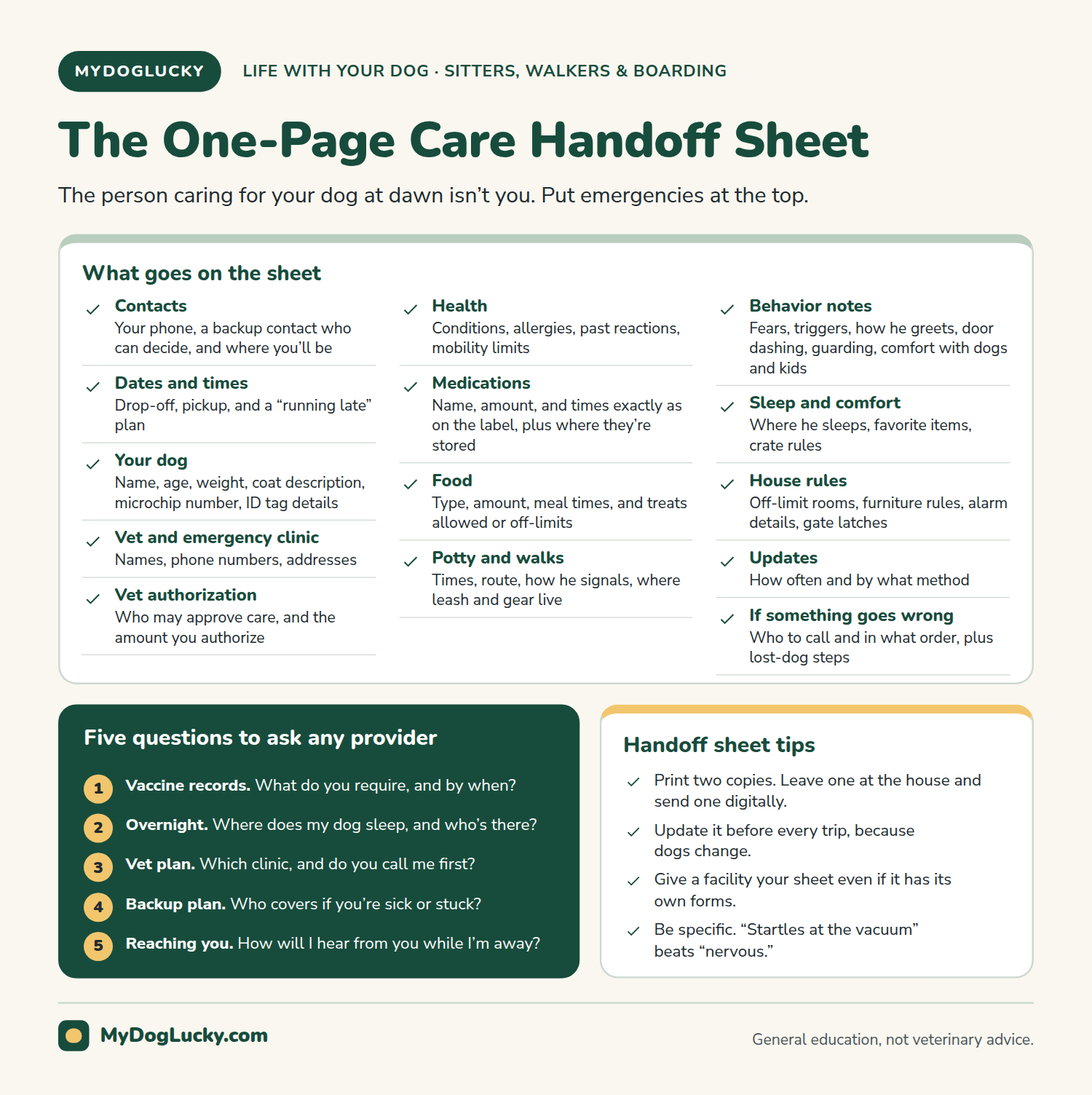
The person caring for your dog at dawn isn’t you. A one-page sheet is the easiest gift you can leave. Keep it short and put emergencies at the top.
| Field | What to write | Why it helps |
|---|---|---|
| Contacts | Your phone, a backup contact who can decide, and where you’ll be | Someone can always reach a decision-maker |
| Dates and times | Drop-off, pickup, and a “running late” plan | Delays don’t become emergencies |
| Your dog | Name, age, weight, coat description, microchip number, ID tag details | Speeds up vet and lost-dog steps |
| Vet and emergency clinic | Names, phone numbers, addresses | Fast calls in a stressful moment |
| Vet authorization | Who may approve care, and the amount you authorize | Matches the vet release form |
| Health | Conditions, allergies, past reactions, mobility limits | Prevents guesswork |
| Medications | Name, amount, and times exactly as on the label, plus where they’re stored | Prevents missed or doubled doses |
| Food | Type, amount, meal times, and treats allowed or off-limits | Protects a sensitive stomach |
| Potty and walks | Times, route, how he signals, where leash and gear live | Keeps the routine intact |
| Behavior notes | Fears, triggers, how he greets, door dashing, guarding, comfort with dogs and kids | Prevents incidents |
| Sleep and comfort | Where he sleeps, favorite items, crate rules | Helps him settle faster |
| House rules | Off-limit rooms, furniture rules, alarm details, gate latches | Avoids surprises |
| Updates | How often and by what method | Builds trust |
| If something goes wrong | Who to call and in what order, plus lost-dog steps | Removes hesitation |
Handoff sheet tips
Print two copies. Leave one at the house and send one digitally. Update it before every trip, because dogs change.
Give a facility your sheet even if it has its own forms. A specific note like “startles at the vacuum” beats a general “nervous.”
Red Flags to Watch For
A single flag isn’t always a dealbreaker. A pattern is. These come from AKC and Humane World for Animals unless marked as our own suggestions.
Boarding facilities
- The facility refuses to let you tour (AKC).
- It doesn’t require immunization records (AKC).
- It seems overbooked, or staff seem disinterested in your dog (AKC).
- Dogs show distress at pickup (AKC).
- Our suggestion: vague answers about overnight staffing, emergencies, or how dogs are screened.
- Our suggestion: dirty, strong-smelling, or very loud spaces.
Sitters and home-based hosts
- The sitter won’t meet you beforehand (AKC).
- You come home to accidents, or treats and toys untouched (Humane World).
- You get no detailed reports about your dog’s behavior (Humane World).
- Our suggestion: no named backup, or vague answers about coverage.
- Our suggestion: pressure to pay or book immediately, or reluctance to put terms in writing.
When Your Dog Struggles With Either Option
Sometimes dog boarding vs pet sitting is the wrong question. Some dogs find both hard, and that isn’t a training failure or a character flaw.
Signs your dog may be struggling
Owners commonly report pacing, whining, refusing food, hiding, drooling, and trying to escape. AKC mentions excessive panting, drooling, and a stiff body as signs of distress at pickup. See our guide on dog body language for how to read the signals. If your dog seemed relieved rather than happy to see you, take that seriously.
What to try first
Shorten the stay, or start with a single day. AKC suggests bringing a favorite toy, your dog’s regular food, and a piece of clothing with your scent. Tell the provider exactly what your dog finds hard. Avoid changing food, routine, and setting all at once.
When it looks like separation distress
If your dog panics whenever he’s left, extra practice with a provider won’t fix it. See our guide on separation anxiety in dogs. Talk with your veterinarian, who can check for medical contributors and refer you to a veterinary behaviorist or certified trainer.
Alternatives to boarding and sitting
- A trusted friend or relative. Give them the same handoff sheet and the same questions you would give a professional. Familiar people aren’t automatically skilled at dog care, and skilled people aren’t automatically familiar.
- Your dog stays with someone he knows. A friend’s home he already visits may feel less strange than a new setting.
- A staycation. Stay home and take day trips without your dog, or shift your plans so he needs less coverage.
- Travel with your dog. Check lodging policies and fees, carry his records, plan potty breaks, and find an emergency vet at your destination. Don’t leave him in a parked car.
- A split plan. A sitter for daytime visits and a familiar person for the night, or the other way around.
Last-Minute Plans
Sometimes the trip appears before the plan does. A rushed dog boarding vs pet sitting decision can still be a sound one. Work down this ladder.
- Start with people who already know your dog. A friend, neighbor, or relative who has met him beats a stranger with a nice website.
- Ask your vet’s office. AKC suggests asking friends, family, neighbors, and your vet for recommendations.
- Screen fast, but don’t skip. Ask five questions: vaccine and records rules, where the dog sleeps and who’s there overnight, the vet and emergency plan, the backup plan, and how to reach you.
- Keep the first stay short. If you can adjust dates, do it.
- Fill out a quick handoff sheet. Even a half-page beats none.
AKC advises starting your search early to widen your options. That’s the one thing a last-minute plan can’t do. Use this stress test as a reason to line up a backup provider once the trip is over.
Holidays and peak periods
Popular travel times can fill facilities and sitters’ calendars, and some providers add surcharges or minimum stays. Ask early. If your first choice is full, ask whether they keep a waitlist or can recommend a colleague they trust. A referral from a provider who knows your dog’s needs is worth more than a random search result.
The Week Before, Drop-Off, and Pickup
A planning timeline
Work backward from your travel dates. This table shows the order, not a set schedule.
| Stage | Tasks |
|---|---|
| As soon as you have dates | Start your search early, as AKC advises. Ask your vet, friends, family, and neighbors for recommendations |
| Soon after | Tour facilities or meet sitters. Ask for written policies and estimates. Check vaccine deadlines |
| Before you book | Fill in the worksheet, choose a provider, and schedule a trial day or short stay |
| Before you travel | Finish the handoff sheet, sign the agreement and vet authorization, pack familiar items |
| During the trip | Keep your phone on. Read the updates. Answer calls from the provider promptly |
| After pickup | Watch appetite, stool, and any cough. Debrief with the provider and update your notes |
Before the trip
- Confirm vaccine records and any deadlines.
- Check that your dog’s ID tag and microchip contact details are current.
- Pack familiar items. AKC lists a favorite toy, your dog’s regular food, a piece of clothing with your scent, and optionally his bed.
- Measure meals into labeled bags, with extra in case you’re delayed.
- Send medications in their original containers with written instructions.
- Finish the handoff sheet and confirm the vet authorization.
Drop-off
Keep goodbyes calm and short. Many owners find that hard. A brisk, matter-of-fact handoff may give your dog less to worry about.
Confirm the emergency contact, the update plan, and the pickup time before you go.
During the stay
Ask for updates on the schedule you agreed on. Humane World suggests asking a sitter to leave notes or share photos. Constant check-in calls can pull a provider away from your dog, so agree on a rhythm up front.
When plans change mid-trip
Trips don’t always go as scheduled. If your flight is delayed, call the provider before the pickup time, not after. Ask whether they can extend the stay, and use your backup contact if they can’t.
If the provider cancels or falls ill, activate your backup plan and share the handoff sheet at once. If your dog gets sick, the vet authorization does its job. Answer the provider’s call, and stay in touch with the vet.
Pickup and the days after
Look at your dog the way AKC describes. Watch how he moves, eats, and greets you. At home, expect a long nap.
Watch appetite, stool, and any cough over the next few days. Call your vet if something seems off, and mention the stay.
Debrief and keep a provider file
Ask the provider how the stay went. Ask what your dog did well and what he found hard. Write down what you learned, along with the provider’s contact details, policies, and rates.
Next time, you’ll have a head start on planning. You’ll also spot whether a pattern is forming.
Common Mistakes
The most common dog boarding vs pet sitting mistake is choosing before testing. These are the rest.
Choosing on price alone
Humane World for Animals says not to just go with the cheapest rate. Compare what each quote includes, using the worksheet above.
Skipping the meet-and-greet
A sitter or facility that looks great online may not suit your dog in person. A short visit shows you things a listing can’t.
Making the first stay the long one
A week away is a hard first test. Try a day or a night first, when you can.
Changing everything at once
New place, new food, new people, new schedule. Keep as much as possible familiar, especially food.
Leaving a vague handoff
“He’s easy” isn’t information. Fears, quirks, and medical details are what a caregiver needs at 6 a.m.
Leaving vaccines to the last minute
Providers may set deadlines, and your vet may need time. Check records well before your trip.
Assuming familiar means skilled
A friend who adores your dog may still not know how to handle a dog fight or a medication schedule. Give them the same sheet and the same questions.
Ignoring your dog’s reaction
If your dog returns stressed, take it seriously. Change the plan, not just the excuse.
Not having a plan B
Sitters get sick. Facilities fill up. Storms and flight delays happen. Line up a backup before you need one.
Common Questions About Boarding and Sitting
Which is easier on dogs, dog boarding vs pet sitting?
It depends on the dog. AKC notes that many dogs are less stressed at home with their usual routine. Some dogs enjoy a busy facility. Watch how your own dog responds to a trial before deciding.
Which costs less?
It depends on your region, trip length, and dog, so we don’t quote prices. Use the worksheet above and get written estimates. Compare what each includes.
Do sitters need to be insured and bonded?
AKC and Humane World both suggest asking. Requirements vary by place, and this isn’t legal advice. Ask what the coverage covers and request copies of the documents.
How far ahead should I book?
AKC advises starting your search early. Holiday and peak travel times may fill quickly, and you’ll want time for a meet-and-greet or tour. We don’t have a sourced number of days.
Can I board a puppy?
Ask your vet first. Puppies may be unprotected against infectious diseases until vaccinations are complete, and many providers have their own age and vaccine rules. In-home sitting is one option to discuss with your vet.
What if my dog has a health condition?
Tell your vet about the trip, and ask the provider how they’d handle your dog’s needs. Get medication instructions and vet authorization in writing.
Is dog daycare the same as boarding?
Not exactly. Daycare covers daytime supervision and group play. Boarding covers overnight stays. Some facilities offer both, which is the daycare-with-overnight format described above.
Can I use cameras to check on my dog?
Humane World mentions doorbell cameras to confirm arrival times, and GPS collars to confirm walks. Tell your sitter about any camera you use. Cameras help you check, but they don’t replace good references.
What if my dog gets sick while I’m away?
That’s what the vet authorization and emergency contacts are for. A good provider calls you and the vet quickly. Ask in advance who makes the call and who pays.
Is a friend or relative better than a professional?
Neither is automatically better. What matters is experience, reliability, and a clear plan. A familiar person still needs the handoff sheet and a backup.
How do I know my dog did okay?
Use AKC’s signs. Look for tiredness from activity, no stress signs, no injuries, and real happiness to see you. Keep watching appetite and stool for a few days.
What if my dog has bitten or is reactive?
Be honest with every provider. A facility may decline, and that’s a safety decision. A certified trainer or veterinary behaviorist can advise you on options for a dog with a bite history or intense fear.
Should I tell providers about my dog’s quirks?
Yes. Tell them about fears, escape habits, guarding, and what makes your dog happy. Specific quirks help providers succeed.
So, dog boarding vs pet sitting? Start with your dog’s health, temperament, and routine, then match those to what a provider can prove. Fill in the worksheet, test with a meet-and-greet and a short stay, and finish the handoff sheet. The right choice is the one your own dog’s reaction confirms.
Sources
- American Kennel Club. Dodd, C. What to Know When Boarding Your Dog and Finding a Kennel. Last updated November 11, 2025. Used for facility tours, cleanliness, group play, vet care, vaccination records, red flags, pickup signs, and what to pack.
- American Kennel Club. Meyers, H. How to Find and Choose a Pet Sitter. Last updated November 13, 2025. Used for sitter questions, insurance and bonding, references, agreement contents, meet-and-greet, trial day, and backup plans.
- Humane World for Animals. How to choose and prepare for a pet sitter. Page undated; accessed September 2026. Used for interview questions, documents, background checks, trial walks, written instructions, updates, and red flags.
- VCA Animal Hospitals. Weir, M., Williams, K., Gollakner, R., and Ward, E. Vaccines for Dogs. Last updated January 15, 2026. Used for the non-core status of the Bordetella (kennel cough) vaccine, exposure-based recommendations, and the note that vaccines do not give complete protection.
This article is general education for U.S. dog owners, not individualized veterinary, behavioral, or legal advice. Licensing, inspection, and insurance rules for boarding facilities, home-based hosts, and sitters differ by state and locality, so ask each provider what applies to them. Ask your veterinarian about anything specific to your dog’s health, vaccines, medications, or behavior, and seek emergency veterinary care right away if your dog has trouble breathing, collapses, or cannot be woken normally. We do not recommend any specific provider or service, and we don’t quote prices.