How long can you leave a dog alone? For a healthy adult dog, one commonly cited starting point is about four to six hours at a time. Puppies need far less, and some senior dogs do too. Some dogs can’t manage even a short absence without distress. So the honest answer is a range, and your own dog sets the final number.
That range comes with a catch. A dog’s limit isn’t only about the bladder. It’s also about age, health, how comfortable your dog feels being alone, the weather, and what your home offers while you’re gone. A dog who’s fine for five hours in a cool, quiet house can struggle after two in a hot, noisy one.
This guide is the everyday planning version. You’ll get sourced starting points by life stage, the factors that move those numbers, a before-you-leave checklist, care options for longer stretches, and the signs a plan isn’t working. It isn’t a training protocol. If your dog panics when you leave, jump to that section first, because that situation needs a professional.
What’s in this guide
- How long can you leave a dog alone? The short answer
- Why one number never fits every dog
- Six things that change your dog’s number
- What the published starting points say
- Finding your own dog’s number with a two-week trial
- Before you leave: a checklist you can actually use
- Leaving and coming home without a fuss
- Checking in while you’re gone
- Care options when the gap is longer than your dog’s number
- How to tell it isn’t working
- If your dog panics when left alone
- Situations that change the plan
- Three sample days
- Common mistakes when planning alone time
- Common questions about leaving a dog alone
- Sources
How long can you leave a dog alone? The short answer
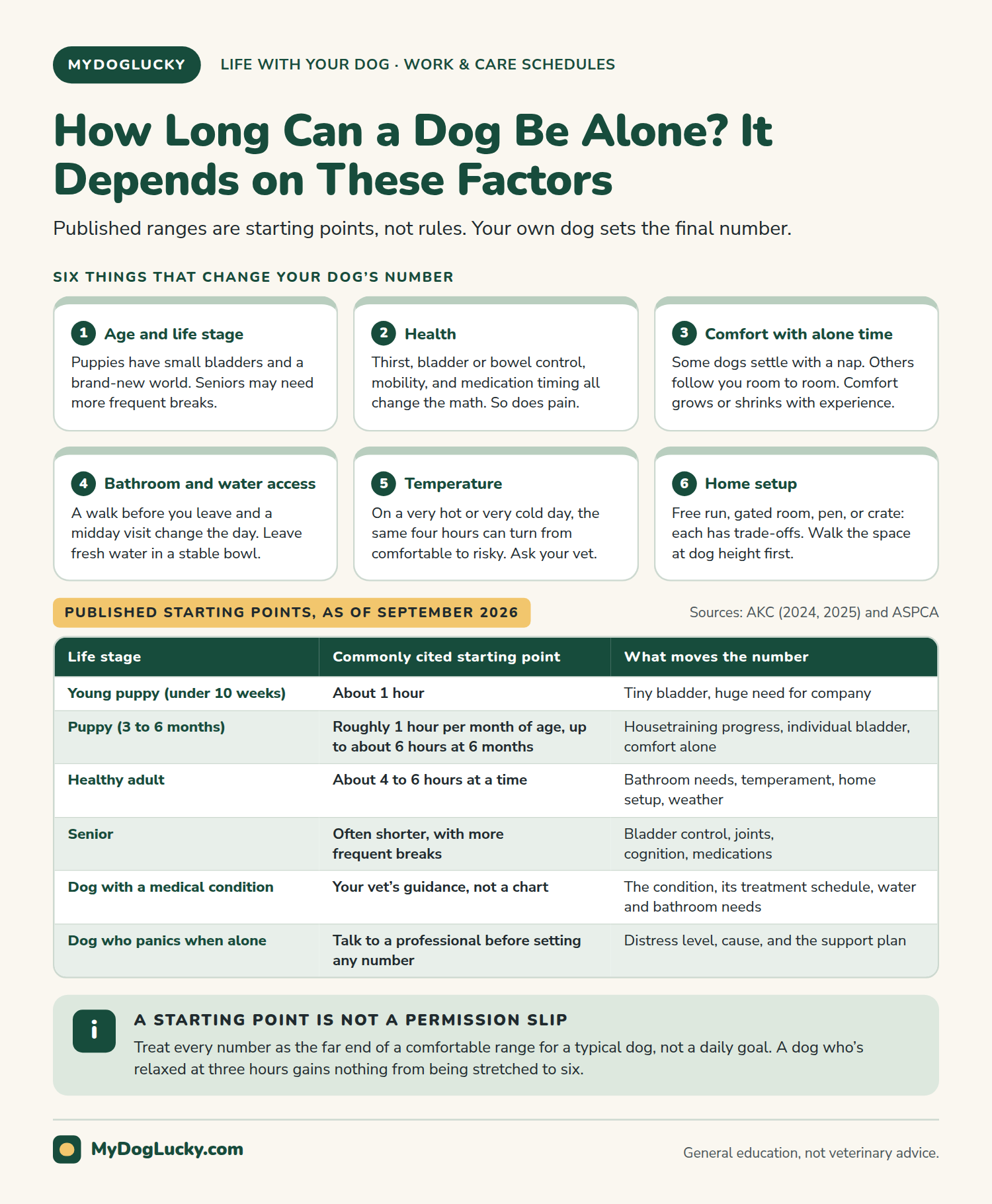
Start with your dog’s life stage, then adjust for the individual. The table below shows the starting points that published sources give, as of September 2026. Read the third column carefully, because it explains why the first two never tell the whole story.
| Life stage | Commonly cited starting point | What moves the number |
|---|---|---|
| Young puppy (under 10 weeks) | About 1 hour | Tiny bladder, huge need for company |
| Puppy (3 to 6 months) | Roughly 1 hour per month of age, up to about 6 hours at 6 months | Housetraining progress, individual bladder, comfort alone |
| Healthy adult | About 4 to 6 hours at a time | Bathroom needs, temperament, home setup, weather |
| Senior | Often shorter, with more frequent breaks | Bladder control, joints, cognition, medications |
| Dog with a medical condition | Your vet’s guidance, not a chart | The condition, its treatment schedule, water and bathroom needs |
| Dog who panics when alone | Talk to a professional before setting any number | Distress level, cause, and the support plan |
The puppy and adult figures come from the American Kennel Club (AKC), which updated its puppy guidance in October 2025 and published its full-time-work guidance, reviewed with a veterinarian, in November 2024. The senior row reflects the AKC’s note that older dogs may need more frequent breaks. The medical row is our own caution to ask your vet. The last row reflects the ASPCA’s advice to seek a veterinary behaviorist or applied animal behaviorist for moderate to severe separation-related distress.
A starting point is not a permission slip
Treat every number here as the far end of a comfortable range for a typical dog. It isn’t a daily goal. A dog who’s relaxed at three hours doesn’t gain anything from being stretched to six just because six shows up in an article.
Here’s the awkward part. A standard office day with a commute often runs eight to ten hours away from home. That’s longer than every starting point above. It’s not a character flaw. It’s a scheduling problem, and it has practical solutions, which we’ll cover in the care options section.
Why one number never fits every dog
Ask three trusted sources how long can you leave a dog alone and you’ll get three flavors of answer. That’s not because anyone is wrong. It’s because the question hides several smaller questions.
Bathroom limits and comfort limits are different things
The first small question is about the bladder and bowels. How long can this dog go without a chance to relieve themselves? The AKC’s puppy guidance says dogs shouldn’t stay unattended much longer than six to eight hours without a bathroom break. Many owners read that as the number.
The second small question is about emotions. How long can this dog be alone before feeling distress? The ASPCA doesn’t give a fixed limit for that. It says that once a dog can be alone for 90 minutes without getting upset or anxious, the dog can probably handle four to eight hours. Notice the condition. The dog has to be calm first.
Even one organization frames it two ways
Two AKC pages illustrate the point nicely. One lists puppy alone time month by month, up to about six hours at six months. Another, about working full time, says puppies may need to relieve themselves every one to two hours. Same organization, different framing, because one page is about tolerance by age and the other is about bathroom needs on a working day.
The RSPCA, a UK charity, gives no hour count on its dog-company page at all. Its guidance is simply to never leave your dog alone long enough for them to become distressed. That sentence is worth keeping in your back pocket. It puts the dog’s experience, not the clock, in charge.
What “alone” means matters too
Alone at home with a quiet afternoon and a comfortable spot is one thing. Alone in a hot room with a barking neighbor, a loud delivery truck, and a squeaky gate is another. Hours on a clock look identical. The experience isn’t.
So use the published ranges as a map, not a verdict. The rest of this guide shows you how to turn the map into a plan for one specific dog, using observation instead of guesses.
Six things that change your dog’s number
When you ask how long can you leave a dog alone, six factors do most of the work. You won’t need to master all six at once. Read through them, then note which ones apply to your dog, because those are the levers you can actually pull.
1. Age and life stage
Puppies sit at one end of the range. Their bladders are small and their world is brand new. The AKC’s guidance, updated in October 2025, lists roughly one hour for a puppy under ten weeks, two hours at ten to twelve weeks, and then about one hour per month of age. That works out to three hours at three months, four at four months, five at five, and six at six months.
After six months, the AKC’s puppy page puts the maximum at about six to eight hours. Individual puppies vary quite a bit around those averages. A puppy who’s had three accidents this week hasn’t “failed.” That puppy is telling you the gap is too long.
Adult dogs sit in the middle. The AKC’s full-time-work guidance says adult dogs can be left alone for about four to six hours at a time without significant distress. Seniors sit at the other end, which we’ll get to in a moment.
2. Health
A dog with a medical condition doesn’t fit a general chart. Anything that affects thirst, bladder or bowel control, mobility, or the timing of medication changes the math. So does pain, which isn’t always obvious.
Senior dogs deserve their own attention here. The AKC notes that senior dogs may need more frequent bathroom breaks because of age or health issues that affect bladder control. AAHA’s senior care guidelines, published online in December 2022, include dedicated sections on cognitive dysfunction and behavioral anxiety and on pain management. Those topics matter for alone time because a dog with sore joints or confusion may cope with an empty house very differently than a younger dog.
If your dog has a health condition, ask your vet three questions. How long can my dog go between bathroom breaks? Does anything need to happen on a schedule, like medication or meals? What signs should make me call you if they show up while I’m out?
3. Comfort with alone time
Some dogs settle with a sigh and a nap the moment the door closes. Others follow you room to room and start scanning for you the second you touch your keys. Most fall somewhere between.
The ASPCA separates two very different situations. Some dogs are disruptive when left alone because they’re bored, and those dogs usually don’t appear anxious. Others show real distress, which is a separate problem with a separate solution. We’ll return to the difference later.
Comfort with alone time also grows or shrinks with experience. A dog who’s never been alone for more than twenty minutes hasn’t yet shown you what a four-hour stretch feels like. That’s why the trial later in this guide starts small.
4. Bathroom and water access
This factor is the one owners can change fastest. A dog who gets a walk right before you leave and a visit at midday has a completely different day than a dog who’s held for the whole stretch.
Water matters just as much. Leave fresh water in a stable bowl your dog can’t tip, and consider a second bowl in another spot. If your dog drinks a lot or has a medical condition that affects thirst, ask your vet how that changes the plan.
Also think about the surface. If a puppy or senior might have an accident, put them in a space with a floor you can clean easily and a way to reach water without wading through the mess. Kindness and practicality overlap here.
5. Temperature
Weather changes what’s safe. On a very hot or very cold day, the same four hours can turn from comfortable to risky, especially in a home where the air conditioning or heating might fail.
This guide doesn’t give temperature thresholds, because they depend on the dog. Age, coat, breed, weight, and health all matter. Ask your veterinarian what applies to your dog, and check the forecast before you leave for a long stretch.
One rule needs no adjusting. A parked car isn’t a waiting room. Plan errands so your dog stays home in a comfortable spot rather than waiting in a vehicle, and don’t treat “just a few minutes” as a reason to skip that rule.
6. Home setup
Where your dog spends the time matters as much as how long. Some owners give their dog the run of the house. Others use a gated room, an exercise pen, or a crate. Each choice has trade-offs, and the right one depends on your dog.
A crate can be a comfortable den for a dog who likes one. The AKC suggests making the crate a safe and relaxing place, never a punishment, with meals inside and special toys that only appear there. Long stretches in a crate are a question to raise with your vet or a trainer, not a default.
Whatever you choose, walk the space at dog height before you leave. Look for anything to chew, swallow, knock over, or get stuck behind. Dogs have a gift for finding the one sock you missed. It’s a two-minute habit that heads off a lot of stressful phone calls.
What the published starting points say
Here’s how the sources we consulted line up, side by side. Notice how much of the difference comes from what each source is actually measuring.
| Source and date | What it says | What it’s really measuring |
|---|---|---|
| AKC, puppy alone time (updated October 29, 2025) | About 1 hour under 10 weeks, then roughly 1 hour per month of age; up to 6 to 8 hours after 6 months | Puppy tolerance by age, including bathroom capacity |
| AKC, working a full-time job (published November 27, 2024; veterinarian consulted) | Adults can be alone about 4 to 6 hours without significant distress; puppies may need breaks every 1 to 2 hours; seniors may need more frequent breaks | Comfort and bathroom needs on a working day |
| ASPCA, separation anxiety guidance (no review date shown; accessed September 2026) | Once a dog can be alone 90 minutes without upset, four to eight hours is probably manageable | Emotional readiness, not bladder |
| RSPCA (UK charity), dog company guidance (no date shown; accessed September 2026) | No hour count; never leave a dog alone long enough to become distressed | The dog’s experience, not the clock |
Two lessons stand out. First, the numbers cluster around four to six hours for adults and shrink for puppies. Second, every source ties the limit to something else: bathroom access, comfort, distress, or health. Nobody hands out a single hour count without a condition attached.
What we couldn’t source
In the sources we reviewed, we didn’t find a single veterinary standard that sets one maximum for every dog. That’s why this guide treats every range as a starting point, and why the two-week trial below matters more than any table.
Finding your own dog’s number with a two-week trial
Charts describe averages. Your dog isn’t an average. The best answer to how long can you leave a dog alone comes from a short, honest trial with your own dog, and it doubles as a way to spot problems before they grow.
Treat this as a planning exercise, not a treatment plan. It works for dogs who seem comfortable alone. It isn’t the right tool for a dog who panics.
Set the ground rules
Pick a starting gap that’s comfortably below your dog’s published range. If the range for your dog is four to six hours, try two or three. Choose a normal day, not a stressful one.
Then define what success looks like before you begin. For most owners, a successful gap means your dog settled or dozed, had no accidents, showed no signs of distress, and greeted you calmly afterward. Write those four points down.
Run the trial
Follow these steps for about two weeks, adjusting the timing to your dog.
- Days 1 to 3: hold the baseline. Use the same gap each day. Watch your dog on video if you can, and note when they settle, what they do, and how they greet you.
- Days 4 to 7: look for patterns. Check whether trouble clusters at a certain time, such as the first fifteen minutes or the last hour before you return.
- Days 8 to 10: extend by a small step. If the baseline met all four success points, add fifteen to thirty minutes. Hold that new length for a few days.
- Days 11 to 14: review. Look at your notes. Where did things go smoothly? Where did your dog struggle? That’s your dog’s real number for now.
Extend only after the last gap was a success. If any success point slipped, shorten the gap for a few days, then try again. There’s no prize for speed.
What to note each day
- How long you were gone
- What happened right before you left (walk, meal, play)
- What you saw or heard on video, or what you found when you got home
- Any accidents, and roughly when they may have happened
- How your dog greeted you
Repeat the trial when something changes: a new job, a move, a new family member, or a birthday that pushes your dog into a new life stage. A number that worked last spring may not hold this fall.
Before you leave: a checklist you can actually use
A good departure takes ten minutes. The point isn’t to add chores. It’s to make the same small checks automatic, so a rushed Tuesday morning doesn’t skip the important ones.
The essential checklist
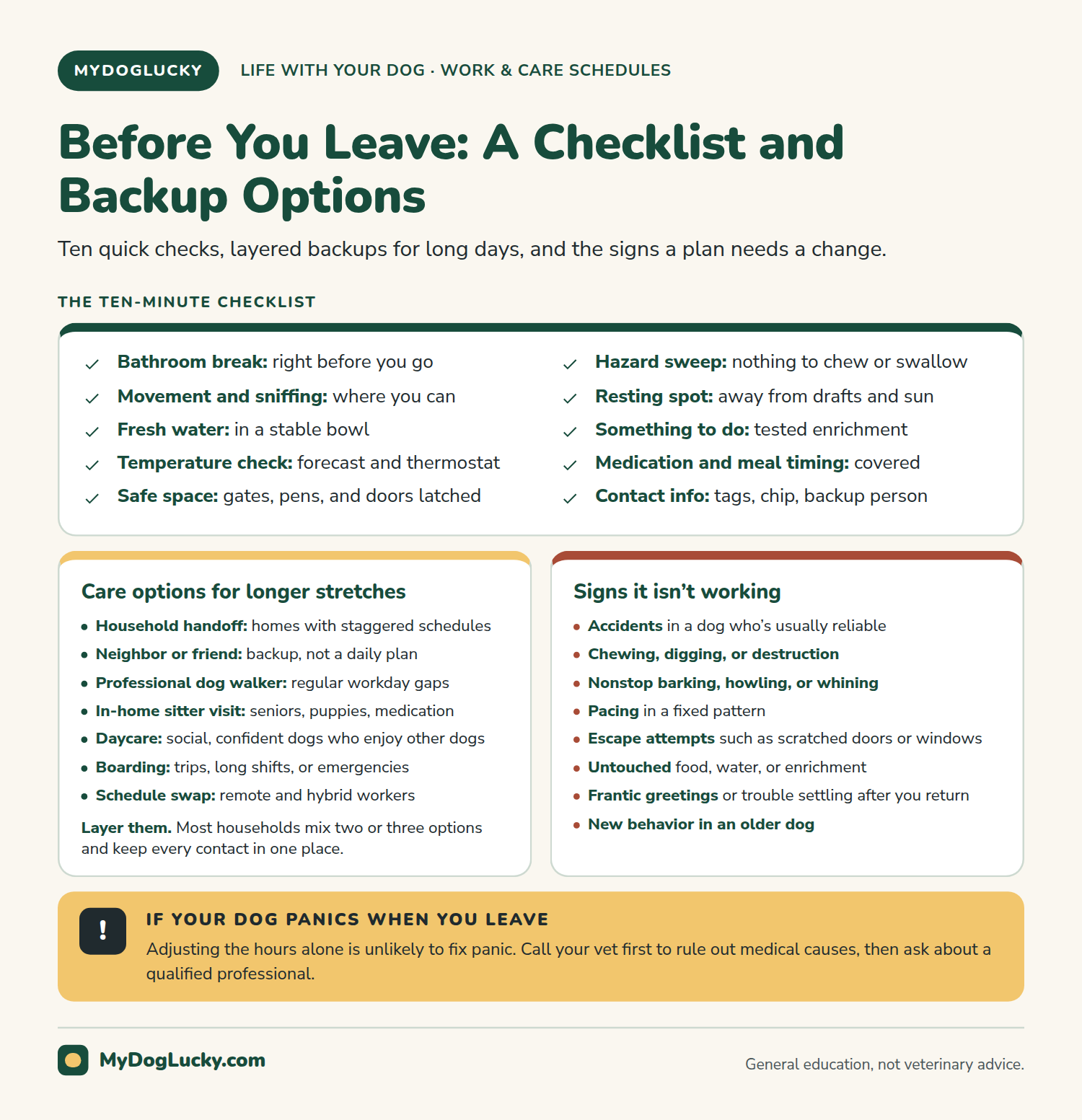
- Bathroom break. Take your dog out right before you go, even if it’s brief.
- Movement and sniffing. Where you can, add a walk or play session. Many owners find a dog who’s had a chance to move and sniff is calmer at home.
- Fresh water. Fill a stable bowl, and add a second if your dog goes through a lot.
- Temperature check. Look at the forecast and your thermostat. Think about what happens if the power goes out.
- Safe space. Close doors to rooms with hazards. Check that gates, pens, and doors latch.
- Hazard sweep. Pick up anything your dog could chew or swallow: socks, wrappers, cords, medications, and food on the counter.
- Comfortable resting spot. Put a bed in a spot your dog likes, away from drafts and direct sun.
- Something to do. Leave one or two enrichment options that you’ve already tested while you were home.
- Medication and meal timing. If your dog needs something on a schedule, arrange it before you leave or ask someone to cover it.
- Contact info. Make sure your dog’s ID tags and microchip details are current, and that a backup person can reach you.
None of these steps requires special equipment. Most take under a minute once they become habits.
Test enrichment while you’re home first
A food puzzle, chew, or stuffed toy can be a nice way to spend a gap. It can also be a choking or swallowing hazard for the wrong dog. Try any new item while you’re home and watching. Look for gulping, pieces breaking off, or a dog who guards it.
If your dog handles it safely, save the special item for departures only. That makes it a small event your dog looks forward to. Ask your vet or a trainer about items that suit your dog’s chewing style and health.
A note on doors, windows, and gates
Dogs are creative, and a house that worked fine while you were home can look different when you’re not. Close balcony doors. Check that window screens are secure. Look at gate latches. If your dog has ever escaped a space, assume they’ll try again, and add a second layer of protection.
Make the checklist visible
Put a printed copy on the inside of the door or in your phone’s notes. It’s easy to skip a step when you’re running late. It’s much harder to skip one that’s staring at you.
Leaving and coming home without a fuss
How you leave and return sets the tone for the whole gap. There’s no magic script, but a steady, boring routine helps many dogs relax. The goal isn’t to be cold. It’s to keep the drama level low.
Departures
Keep goodbyes short and matter-of-fact. A calm pat, a phrase you use every time, and out the door works for many dogs. Long, emotional farewells can turn leaving into an event.
Use the same sequence each time when you can: exercise, bathroom, water, enrichment, calm exit. Dogs are good at recognizing patterns. A predictable routine turns your leaving into a familiar moment instead of a surprise.
Watch for cues your dog has learned. Some dogs start pacing at the sight of keys, shoes, or a work bag. If you notice this, don’t panic. Mention it to your vet or a qualified trainer, who can suggest what to do about it.
Returns
When you come home, take a breath before opening the door. Many owners keep the reunion low-key, then take their dog straight outside for a bathroom break. Save the big party for a few minutes later, once everyone has settled.
This also gives you a chance to look around. Check the space for accidents, chewed items, or spilled water. Note what you find. That information is your best clue about how the gap went.
Skip the scolding
Please skip the scolding when you find an accident or a chewed item. It doesn’t teach your dog what to do instead, and it can add stress to your comings and goings. Clean up, note what happened, and use it to adjust the plan.
Background sound
Some owners leave a radio, a TV, or a white noise machine on. The AKC’s puppy guidance suggests considering a white noise machine for its calming effect. No sound works for every dog. Try it and see what your video shows.
Checking in while you’re gone
Video can be a wonderful learning tool. It shows what your dog actually does when you leave, and that’s often different from what you’d guess. The AKC’s full-time-work guidance mentions a pet camera as one way to observe your dog while you’re out.
What to look for
Watch the first fifteen minutes, the middle, and the last hour, so you see how the gap goes from start to finish. Look for these signs.
- Settled behavior. Lying down, dozing, chewing a toy, wandering and sniffing
- Mixed behavior. Pacing off and on, checking windows, occasional whining, then settling
- Concerning behavior. Continuous pacing, nonstop barking or howling, scratching at doors or windows, or frantic attempts to escape
Save a short clip of anything concerning. Your vet or trainer can learn more from thirty seconds of video than from ten minutes of your description.
Keep the camera in perspective
A camera is a tool, not a plan. It can’t open a door, refill water, or take a dog outside. Watching your dog struggle when you can’t get home is miserable. Decide in advance who you’ll call, and set up that backup before you rely on video.
Also, you don’t need to watch all day. Checking constantly can turn a normal workday into an anxious one for you. Use video during your trial, then check in only as much as it helps.
Privacy matters
Cameras record your home and sometimes your voice. Think about where you place them, who can access them, and whether a sitter or neighbor needs to know one is there. Tell anyone who enters your home if you’re recording.
Care options when the gap is longer than your dog’s number
Sooner or later, most owners find the honest answer to how long can you leave a dog alone is shorter than their workday. That’s normal, and it has good solutions. The AKC’s guidance points to options like coming home for lunch or hiring someone to do it, and to daycare or a dog walker for working days. The RSPCA adds a simple rule: if you’re away, enlist someone responsible to look after your dog.
The options at a glance
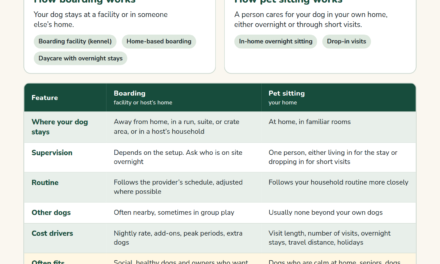
| Option | What it solves | Watch-outs | Often a good fit for |
|---|---|---|---|
| Household member handoff | A midday break or a shorter total gap | Miscommunication about who did what | Homes with staggered schedules |
| Neighbor or friend | Occasional gaps and emergency backup | Reliability, and the strain of frequent favors | Backup, not a daily plan |
| Professional dog walker | A regular midday bathroom break and movement | Vetting, key access, consistency of who shows up | Regular workday gaps |
| In-home sitter visit | Breaks, feeding, medication, and company | Length of the gap between visits | Seniors, puppies, and dogs needing medication |
| Daycare | Coverage plus company and activity | Not every dog enjoys group settings; assessment and rules vary | Social, confident dogs who enjoy other dogs |
| Boarding | Multi-day absences and travel | A new environment can be stressful for some dogs | Trips, long shifts, or emergencies |
| Schedule swap or hybrid days | Cuts the alone time itself | Depends on your employer and your week | Remote and hybrid workers |
Prices vary widely by region and by provider, and we didn’t find a reliable national figure for these services, so we’ve left out dollar amounts. Ask for written pricing before you commit.
Household handoffs and schedule swaps
The lowest-cost option is often inside your own home. If two adults work different hours, one may be able to shift a walk or come home for a break. If you work a hybrid schedule, try to put your longest alone days on the days when someone can check in midday.
Ask your employer whether flexible start times, a longer lunch on set days, or a dog-friendly day is possible. Some workplaces say yes more often than people expect. Some don’t, and that’s fine. You’ll have other options.
A neighbor or friend
A trusted neighbor can be a great backup. Share your dog’s routine, any quirks, and your vet’s number. Give clear written instructions. Offer something in return. Coffee, cookies, or a dog-sitting swap all count as currency.
Don’t lean on one person for daily coverage without an honest conversation. A kind favor can start to feel like an unpaid job. If you need regular help, a paid option is fairer for everyone.
A professional dog walker or sitter
A regular midday visit can shrink a long gap into two manageable ones. It also gives your dog a bathroom break and some movement. Look for someone who treats it as a job, not a favor.
Before you hire anyone, ask these questions.
- Can I meet you first, and can my dog meet you while I’m home?
- Do you have references from other dog owners?
- Are you insured, and what happens if my dog is injured or gets loose?
- How many dogs do you handle at one time?
- How will you handle keys and home access?
- Will you send updates after each visit?
- What’s your plan if you’re sick or can’t make a visit?
- Are you comfortable with my dog’s age, size, and health needs?
Introduce a new walker gradually. A short visit while you’re home lets your dog meet them first. That avoids the double stress of a new person and an empty house.
Daycare
Daycare can be a great fit for social, energetic dogs. It isn’t right for every dog. Some dogs find groups overwhelming, and a dog who’s stressed all day isn’t getting the benefit you paid for.
Ask about how they assess new dogs, group sizes, the staff-to-dog ratio, how they rest and separate dogs, their vaccination requirements, and how they handle a dog who’s struggling. If you can, visit first. Watch how staff interact with the dogs.
Boarding
Boarding suits multi-day trips or an emergency when you can’t be home. The same questions apply, plus a few more. Ask how they handle medications, what emergency veterinary arrangements they have, and whether your dog will have contact with other dogs.
Do a short trial stay before you need the longer one. A one-night test tells you a lot about how your dog handles a new place.
Layer your backups
Most households end up mixing two or three options. A walker on weekdays, a neighbor for emergencies, and a boarding facility for trips is a common combination. Build the layers before you need them, and write down every contact in one place.
Your backup contact list
- Primary walker or sitter, with a backup
- A neighbor or friend with a key
- Your regular vet and the nearest emergency clinic
- An emergency contact who can reach your home if you’re stuck
- Your own number and the best times to reach you
How to tell it isn’t working
Your dog can’t tell you the plan is failing. So you look for signs. Some are obvious, like a chewed door frame. Others are subtle, like a dog who’s a little more clingy in the evenings.
What the ASPCA lists
In its separation anxiety guidance, the ASPCA lists behaviors that occur when a dog is alone and typically stop when guardians are present. These include urinating or defecating, barking and howling, chewing, digging and destruction, escape attempts, pacing in fixed patterns, and eating feces. The ASPCA also notes that some dogs who are disruptive when left alone are bored, and those dogs usually don’t appear anxious.
That distinction matters. Chewing a pillow could mean a bored dog with too much energy. It could also mean a dog in distress. You can’t tell from the pillow alone. Video, timing, and your dog’s body language give you better clues.
Signs your plan needs adjusting
- Accidents in a dog who’s usually reliable. The gap may be too long. But the ASPCA also advises consulting a veterinarian to rule out medical causes, so mention it to your vet.
- Chewing, digging, or destruction. Note when it happens and what your dog looks like on video, because bored and distressed dogs look different.
- Nonstop barking, howling, or whining. Neighbors may tell you before your camera does.
- Pacing in a fixed pattern. Repetitive pacing is on the ASPCA’s list.
- Escape attempts. Scratched doors, damaged windows, or a dog found somewhere unexpected.
- Untouched food, water, or enrichment. Note it, and tell your vet or trainer.
- Frantic greetings or difficulty settling after you return. Your dog may have had a tough gap.
- New behavior in an older dog. Changes in a senior dog can have medical causes, so a vet visit comes first.
Boredom, distress, a too-long gap, or something medical?
Most of these signs have more than one possible cause, and you can’t sort them out from the mess alone. What you can do is collect clues to share with a professional.
- When does it happen? Soon after you leave, late in the gap, or all the way through? Your notes and video will show it.
- Does your dog look relaxed or worried? The ASPCA says dogs who are disruptive from boredom usually don’t appear anxious.
- Does it stop when you’re home? The ASPCA describes separation-related signs as typically ceasing when guardians are present.
- Has anything changed medically or in the routine? New accidents, changes in thirst or bathroom habits, or out-of-character behavior call for your vet first.
That’s not a diagnosis. It’s a way to describe what you see. If you can’t tell which category fits, that’s a good reason to ask your vet.
If your dog panics when left alone
Everything above assumes a dog who’s basically okay alone. Some dogs aren’t. If your dog shows signs of real distress each time you leave, the question changes from how long can you leave a dog alone to how do you help this particular dog.
Panic isn’t a scheduling problem
If your dog seems frantic or distressed when you leave, adjusting the hours alone is unlikely to fix it. Call your veterinarian first, to rule out medical causes. Then ask about a qualified professional. The ASPCA recommends a Certified Applied Animal Behaviorist or a board-certified veterinary behaviorist for moderate to severe cases. A qualified trainer who uses reward-based methods can also help with milder problems.
What to do in the meantime
Until you have guidance, try to avoid leaving your dog alone in the situations that trigger the distress. That may mean arranging company, using daycare, or asking a trusted person to stay. It isn’t always possible, and you’re not failing if it isn’t. Do what you can.
Please don’t punish a dog who’s distressed. Distress isn’t misbehavior. Keep video clips of what you see, and bring them to your vet or behaviorist.
Where to read more
Separation-related distress deserves its own careful guide, and this article isn’t it. When you’re ready to dig deeper, look for material on separation anxiety in dogs from a veterinary or behavior source. The ASPCA page listed in our sources is a good place to start.
Situations that change the plan
Life doesn’t hold still. A few common changes deserve a fresh look at your plan.
A newly adopted or newly arrived dog
A new dog is still learning your home, your routine, and you. You don’t yet know your dog’s real number. Plan to be around more at first if you can, and start the trial gently. Many owners find it helpful to take a few days off work, though that’s not possible for everyone.
A change in your schedule
A new job, a longer commute, or a shift change can quietly stretch the gap. Do the math when something changes. Add commute time to your workday, and compare the total to your dog’s range.
A move or a new household
A new place can unsettle a dog. Consider shorter gaps and more company for the first few weeks. Rerun the trial in the new home.
Multiple dogs
A second dog can offer company, but it isn’t a reliable fix. One dog’s comfort doesn’t always transfer to the other, and each dog still needs their own bathroom access and water. Assess each dog separately.
A power or air-conditioning failure
Think ahead about what happens if the power goes out or the temperature control fails while you’re away. A neighbor with a key, a plan to shift your dog to a safer spot, and a way to reach you quickly all help. This is a “just in case” plan, and you’ll be glad to have it if you ever need it.
Travel and overnight absences
If you’re away overnight or longer, the RSPCA’s advice is to enlist someone responsible to look after your dog. Someone should be able to feed, walk, and check on your dog, and reach a vet if needed. Give them written instructions and your contact information. This guide focuses on shorter daily gaps, so ask your sitter or boarding provider about their schedule.
Three sample days
These examples are illustrative, not prescriptions. They show how the answer to how long can you leave a dog alone plays out in a real week. Adjust them to your dog, your household, and your vet’s advice.
The standard office day with a walker
Imagine a healthy adult dog and an owner who’s away nine hours including the commute. The owner takes the dog out and does a short sniff walk at 7:15. They leave at 8:00. A professional walker visits around 12:30 for a bathroom break and a short outing. The owner is home by 5:30 and walks the dog again.
The longest single gap is now about five hours, which falls inside the commonly cited four-to-six-hour range. The plan works because the walker splits the day, not because the dog “toughens up.”
The hybrid week
Picture a dog and an owner who works from home three days and goes into the office two. On home days, the owner takes two walks and lets the dog rest. On office days, the owner arranges a walker, or swaps with a neighbor who also works from home.
The lesson here is to match your care to the days when it’s needed. Don’t build the whole week around your worst day.
The senior dog with a long shift
Consider a senior dog whose owner works a ten-hour shift twice a week. The owner talks with the vet about bladder habits, mobility, and medication timing. Then they arrange two visits during the shift, one midday and one late afternoon. A family member covers the second visit when possible. A soft bed near the door, an easy-to-reach water bowl, and non-slip flooring make the stretches more comfortable.
The takeaway is that a senior dog’s plan is built around comfort and vet guidance. The clock is just one input.
Common mistakes when planning alone time
Most mistakes in answering how long can you leave a dog alone come from trusting a chart over the dog in front of you. Here are the ones we see most often, and what to do instead.
Treating the top of a range as the target
A dog who’s comfortable at four hours isn’t helped by being stretched to six. Use the upper number as a boundary, not a goal.
Assuming a quiet dog is a comfortable one
Silence can mean comfort, or it can mean nothing at all. Use video during your trial to see what quiet looks like in your home.
Leaving without a bathroom break
A dog who needs to go the moment you walk out the door has a harder gap ahead. Even a short trip outside helps.
Skipping the trial for a new dog or a new schedule
Guessing works until it doesn’t. A two-week trial takes little effort and cuts down on surprises.
Scolding after the fact
Scolding adds stress and doesn’t show your dog what to do instead. Clean up, note it, and adjust the plan.
Relying on one backup person
Even the kindest neighbor has a bad week. Build layers so no single person carries the whole plan.
Ignoring changes in a senior dog
New accidents or behavior changes in an older dog can have medical causes. Don’t write them off as age. Call your vet.
Waiting to build the plan until you need it
Finding a walker, a daycare, or a sitter during a crisis is stressful. Do the research now, when you have time to compare options.
Treating panic as a scheduling problem
If your dog is truly distressed when you leave, more midday visits won’t solve it alone. Get professional help.
Common questions about leaving a dog alone
Is eight hours too long to leave a dog alone?
For many dogs, yes, at least without a midday break. The AKC’s full-time-work guidance puts comfortable alone time for adults at about four to six hours. Its puppy page treats six to eight hours as about the most a dog should go without a bathroom break, and the ASPCA’s four-to-eight-hour figure assumes a dog who’s already calm alone. Adding a midday visit is usually the kinder plan.
Can I leave my dog alone all day while I work?
A full workday plus commute usually runs longer than the published starting points. Many owners solve this with a walker, a sitter, daycare, a household handoff, or a flexible schedule. If none of those are possible, talk to your vet before settling on a plan.
How long can you leave a dog alone overnight?
If you’re away overnight or longer, the RSPCA advises enlisting someone responsible to look after your dog. Your dog needs food, water, bathroom breaks, and company. Plan for someone to check in on a regular schedule, not just once.
How long can I leave a puppy alone?
The AKC’s guidance, updated in October 2025, lists about one hour for a puppy under ten weeks and roughly one hour per month of age after that. Puppies also need frequent bathroom breaks, so plan help for any longer stretch. Ask your vet what fits your puppy.
How long can a senior dog stay home alone?
Often less than a healthy adult, and it depends on health. The AKC notes that seniors may need more frequent breaks because of bladder changes and health issues. Ask your vet to set your dog’s limit, and mention any new accidents or behavior changes.
Does a second dog make alone time easier?
Sometimes, but it isn’t a reliable fix. Some dogs like company, and some are just as upset with a companion in the house. Each dog still needs bathroom access and water. If one dog panics, get professional help rather than counting on the other dog.
Should I leave the TV or music on?
Some owners do, and some dogs seem to like it. The AKC’s puppy guidance suggests considering a white noise machine for its calming effect. Try it, watch what your dog does on video, and keep it if it helps.
Should I crate my dog when I’m out?
It depends on your dog. Some dogs like a crate and use it as a den. Others hate it. The AKC suggests making the crate a positive place for a puppy. If your dog is crated, ask your vet or a trainer how long is reasonable.
Do I need a pet camera?
No. The AKC mentions a camera as one way to check on your dog, and many owners find it useful during a trial. It’s optional. A trusted person who can visit is worth more in an emergency.
How do I know if my dog is bored or anxious?
The ASPCA says bored dogs may be disruptive but usually don’t appear anxious. The ASPCA lists pacing, escape attempts, and barking or howling among the signs of separation-related distress. Video helps, and so does a professional opinion if you’re unsure.
My dog has accidents when I’m gone. What should I do?
Start with your vet, because accidents can have medical causes. Then look at the gap length and bathroom access. If the accidents come with signs of distress, ask about a veterinary behaviorist or qualified trainer. Don’t scold.
Can I teach my dog to be alone?
Many owners build alone time gradually. The ASPCA notes that once a dog can be alone for 90 minutes without getting upset, four to eight hours is probably manageable. If your dog is distressed, though, don’t go it alone. Work with a professional.
Is a yard a substitute for care?
Not by itself. A yard adds bathroom access, but weather, escape risk, and boredom come along with it. Your dog still needs water, shelter, and a plan for the whole day.
What if I work long shifts?
Build layers. A household handoff, a walker or sitter, daycare, and a backup contact together can cover most long shifts. Rerun the trial whenever your schedule changes.
Does daycare fix everything?
It solves the coverage problem for social dogs who enjoy it. It isn’t right for every dog, and some dogs find it stressful. Watch how your dog acts when they come home, and ask the staff how the day went.
When should I call a professional?
Call your vet if you see new accidents, changes in thirst or bathroom habits, or out-of-character behavior. Ask about a veterinary behaviorist or qualified trainer if your dog shows distress, panic, or escape attempts when you leave.
So, how long can you leave a dog alone? Start with your dog’s age and health. Use the published ranges as starting points, build a routine you’ll actually keep, and test it with a short trial. Then layer in backup care for the days that run long. The right number is the one your own dog confirms, and you’ll see it in how they settle, rest, and greet you.
Sources
- American Kennel Club. How Long Can You Leave a Puppy Alone? By Saige Driver. Updated October 29, 2025.
- American Kennel Club. Can You Have a Dog While Working a Full Time Job? By Nandini Maharaj, with veterinary input from Bethany Hsia, DVM. Published November 27, 2024.
- ASPCA. Separation Anxiety. No review date shown on the page; accessed September 2026.
- RSPCA (UK charity). Dogs: Company. No date shown; accessed September 2026. Cited as a non-U.S. perspective on the “distress, not the clock” principle.
- American Animal Hospital Association. 2023 AAHA Senior Care Guidelines for Dogs and Cats. Page dated December 12, 2022; cited only for the guidelines’ sections on cognitive dysfunction, behavioral anxiety, and pain management.
This article is general education for U.S. dog owners. It is not individualized veterinary or behavioral advice. Every time range here is a published starting point, not a rule or a promise for your dog. Ask your veterinarian about your dog’s bladder health, mobility, medications, and temperature tolerance. If your dog panics or shows signs of severe distress when left alone, or if you notice new accidents, changes in thirst, or out-of-character behavior, contact your veterinarian, and ask about a veterinary behaviorist or qualified trainer.