
A good puppy sleep schedule is mostly a loop that repeats all day: a short stretch awake, a potty break, a nap, then around again. The American Kennel Club (AKC) says puppies typically sleep 18 to 20 hours a day, though other sources put the number lower. Either way, naps aren’t a reward for good behavior. They’re part of how a young puppy grows.
This guide keeps the loop simple. You’ll get sleep-hour ranges from named sources, awake-and-nap rhythms you can adjust, three illustrative sample days, and a plain plan for night waking and early mornings. You’ll also get a short list of sleep changes that deserve a call to your vet.
One honest note before we start. The sources we checked disagree on how many hours puppies sleep, and none of them hands you a clock. So every time in this article is a starting point, not a rule. Your puppy’s age, breed, size, and household will move the numbers.
Scope matters, too. This isn’t a crate-training manual or a separation-anxiety guide, and those topics have their own articles. If you’re still on night one, our puppy first night home guide covers that evening in detail.
What’s in this guide
- Puppy sleep schedule: the short answer
- How much sleep does a puppy need?
- Why puppies sleep so much
- Naps and awake time: the loop that repeats
- Signs your puppy is overtired
- A safe, boring nap spot
- Exercise, play, and sleep: timing beats volume
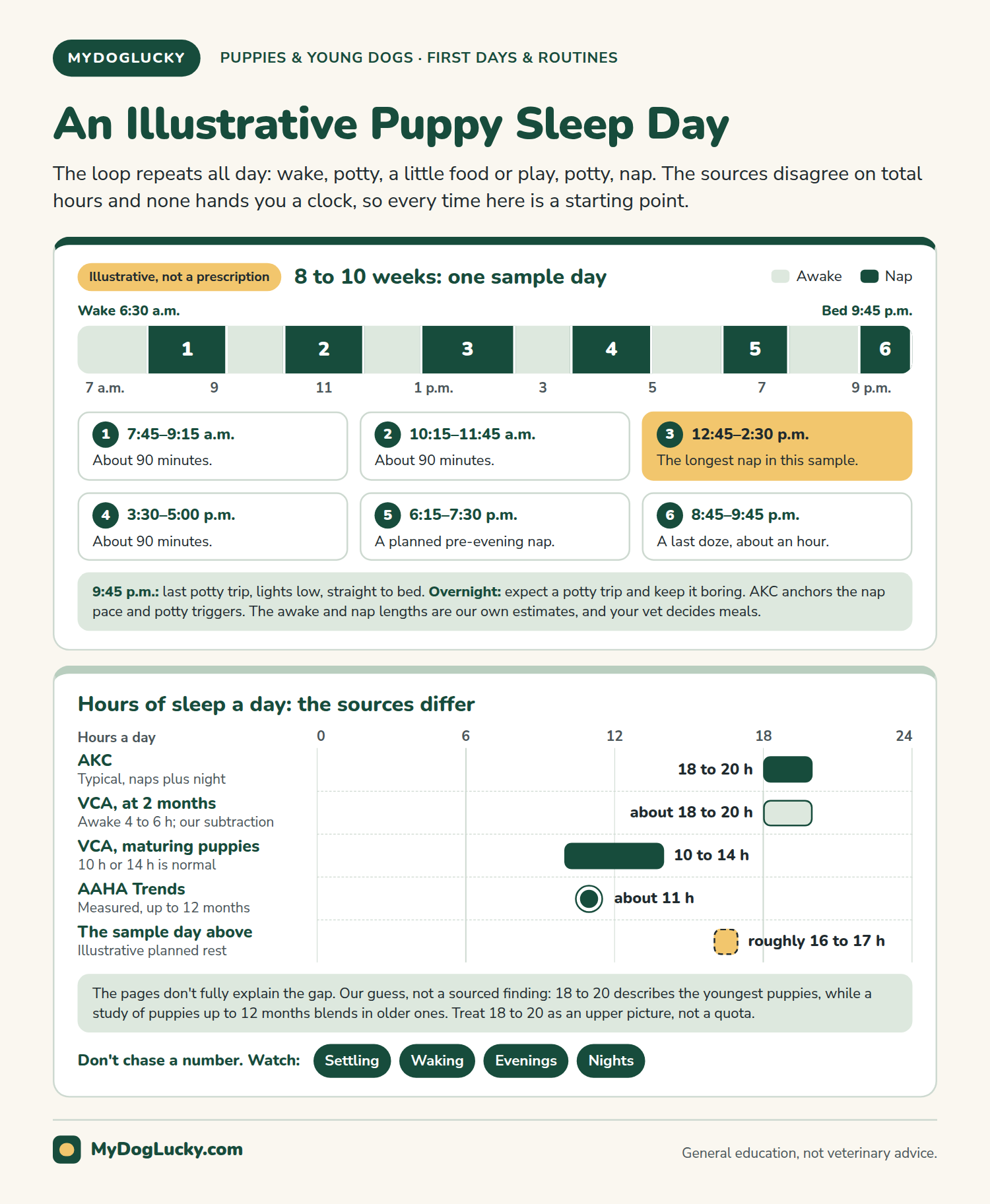
- Illustrative puppy sleep schedule: 8 to 10 weeks
- Illustrative day: 3 to 4 months
- Illustrative day: 5 to 6 months
- When do naps consolidate?
- Night waking by age: what the rules of thumb say
- Why puppies wake at night, and what to try in order
- Early-morning waking: what to check and try
- Teething, growth spurts, and new-home stress
- Kids, other pets, and sleeping puppies
- Simple tools: white noise, covers, and chews
- Fitting naps into a busy day
- Sleep changes worth a call to your vet
- Troubleshooting: five common sleep snags
- Common puppy sleep mistakes
- A one-week trial to start tonight
- Common questions about puppy sleep
- Sources
Puppy Sleep Schedule: The Short Answer
Young puppies sleep a lot, and they do it in pieces. AKC describes puppies napping roughly every hour, with naps lasting anywhere from 30 minutes to two hours (AKC, updated August 11, 2026). Add a night’s sleep on top, and you can see how the 18-to-20-hour figure gets quoted.
A workable puppy sleep schedule follows that rhythm instead of fighting it. Your puppy wakes, goes out, eats or plays for a short while, goes out again, and settles back down. As puppies grow, the awake stretches get longer and the naps get fewer. No source we checked ties those changes to an exact age, so we’ll describe patterns and let you watch your own puppy.
Five things move the numbers: age, breed and size, how active the day was, how noisy your home is, and your puppy’s health. That’s why sleep varies by age, breed, and activity, and why a friend’s puppy can look very different from yours.
The three-line version
- Nap before the meltdown, not after it. Catch the yawns, not the zoomies.
- Give naps a quiet, boring spot and let sleeping puppies sleep.
- Night sleep grows over weeks. A potty trip at night is common for young puppies and isn’t a training failure.
How Much Sleep Does a Puppy Need?
Here’s where the sources part ways. It helps to see them side by side.
| Source | What it says | How to read it |
|---|---|---|
| AKC (updated August 11, 2026) | Puppies typically sleep 18 to 20 hours a day. | The widely quoted figure. It counts naps and night sleep together. |
| VCA Animal Hospitals (undated page, accessed September 2026) | At 2 months old, energetic awake time often takes up only about 4 to 6 hours of the day. As puppies mature, one might sleep 10 hours a day or 14 hours a day, and that variation is normal. | Subtracting 4 to 6 awake hours from 24 leaves about 18 to 20 hours of rest. That subtraction is our arithmetic, and it lines up with AKC. The 10-to-14 range describes maturing puppies. |
| AAHA Trends magazine (July 17, 2026) | Measured data, including a 2020 study of puppies up to 12 months old, points to about 11 hours a day. The article calls that well below the 18 to 20 hours often quoted. | Real puppies may sleep less than the popular figure. One way to read it: treat 18 to 20 as an upper picture of the youngest puppies, not a quota. |
Why the numbers don’t match
The pages don’t fully explain the gap. A plausible reading is that the 18-to-20-hour figure describes very young puppies, while a study of puppies up to 12 months blends in older ones. That’s our guess, not a sourced finding, so hold it loosely.
For your puppy sleep schedule, the useful takeaway is simple. Sleep needs vary with age, breed, and activity, and VCA calls that variation normal. Don’t chase a number. Watch outcomes.
What to watch instead of counting hours
- Settling. Does your puppy fall asleep within a few minutes once she’s in a quiet spot?
- Waking. Does she wake up bright, curious, and ready to go out?
- Evenings. Is the late-day chaos manageable most days?
- Nights. Is sleep mostly unbroken apart from potty trips?
Night hours deserve extra protection. The AAHA article describes research in which puppies who slept less than 8 hours during normal household sleeping hours had higher problem-behavior scores. That’s an association, not proof that lost sleep causes trouble. Still, it’s a good reason to keep the nights quiet.
Why Puppies Sleep So Much
Sleep is a growth tool. AKC says it supports growth and the development of a puppy’s nervous system, brain, immune system, and muscles. It also helps puppies rest up during growth spurts.
The brain side gets less attention. AAHA’s Trends article says puppies spend proportionally more time in REM sleep than adult dogs, because their busy brains are consolidating new learning. In plain terms, a puppy who spent the morning meeting the vacuum, the stairs, and your neighbor’s laugh has a lot to file.
That has a practical upside. Many owners find that a well-rested puppy is easier to teach, easier to settle, and gentler with his mouth. It’s an owner observation rather than a guarantee, but it fits what AAHA and AKC describe about tired puppies acting out.
Adult dogs sleep a lot, too, although the pattern looks different. Our general article on why do dogs sleep so much covers the grown-up version. Here, we’ll stay with the puppy years.
Naps and Awake Time: The Loop That Repeats
A puppy sleep schedule works best as a loop rather than a timetable. The loop runs: wake, potty, a little food or play, potty, nap. Everything else is decoration.
Why potty breaks sit on both sides of the nap
AKC lists the moments when puppies typically need to go out. They include right after waking, within about 5 to 30 minutes after a meal (sooner for younger puppies), after drinking, after a nap, and after play (AKC, updated August 11, 2026).
Almost all of those moments cluster around naps, so the loop builds them in. A puppy who wakes and goes straight outside has fewer accidents to apologize for.
How long is the awake stretch?
Here’s the honest answer: it depends, and we didn’t find a source that gives ages and minutes. AKC’s picture of napping roughly every hour suggests that very young puppies can’t stay up long. Many owners find that an hour to an hour and a half awake is a reasonable first guess for the youngest pups. Older puppies often stretch longer.
Treat that as a guess to test. If your puppy melts down before the hour is up, shorten the stretch. If she’s calm and bright at ninety minutes, lengthen it.
Nap before the meltdown
Sleepy signs are easy to spot once you know them. Owners commonly report yawning, slower play, lying down in the middle of a game, and wandering away from the fun. Catching those early beats waiting for the wild-eyed sprint that comes later.
Miss the window? That’s fine. Another one shows up in an hour or so.
Start the clock when your puppy wakes
Here’s a simple trick. Note the time your puppy wakes, then set a phone timer for the awake stretch you’re guessing at. When it rings, wind things down and head to the nap spot.
If your puppy is already yawning, go early. If he’s still bouncing when the timer rings, give him ten more minutes and watch. Adjust over a few days, not a few minutes.
What a good nap looks like
A good nap starts within a few minutes of settling and lasts somewhere between about 30 minutes and two hours, the range AKC describes. Shorter naps happen. A potty trip beforehand, a quiet space, and a calmer wind-down usually help, and the troubleshooting section below covers naps that keep ending early.
Signs Your Puppy Is Overtired
Overtired puppies don’t look tired. They look wired. AAHA’s article compares the evening chaos to an overtired toddler: mouthing, stealing things, and being unable to settle. AKC adds that too much stimulation and exhaustion can lead to unfortunate behavior.
Owners often call this the puppy witching hour. That’s an informal term, not a diagnosis. It tends to show up in the evening, when the household is busiest and your puppy has been up on and off since dawn.
By 6:45 p.m., you may be living with a tiny tornado who has a sock in her mouth and no interest in your opinion. Before you decide she’s being naughty, run this quick check.
| What you see | Often means | What to try first |
|---|---|---|
| Zoomies that won’t stop, harder mouthing, grabbing socks or laundry | A common overtired pattern, as owners report it | Move to a quiet room, offer a chew, and dim the lights |
| Circling, sniffing the floor, a sudden stop in play | A likely potty need | Go out now, calmly |
| Bouncy even after a good nap and a sniff walk, chewing everything in reach | Possibly under-stimulated | Add a short sniff walk or a food puzzle earlier in the day |
| Hard to rouse, won’t play, won’t eat, or unusually limp | Not a scheduling issue | Call your vet (see the vet section below) |
Five steps for an overtired puppy
- Change the room. A quiet room, crate, or pen removes some of the input your puppy is struggling to process.
- Offer a calm activity. AAHA suggests low-arousal options such as chews and snuffle mats as evening approaches.
- Lower the lights and noise. AAHA also recommends minimizing noise and bright white lighting where puppies sleep.
- Let her protest for a few minutes. Some puppies fuss before they crash. If she’s still frantic after 15 minutes, take her out for a potty check and try again.
- Skip the extra play. It’s the step most owners resist. More play rarely fixes an overtired puppy, and a nap usually does.
A Safe, Boring Nap Spot
A good nap spot is the cheapest upgrade to any puppy sleep schedule. AKC suggests a crate, a dog bed, or a quiet place in the house where puppies can nap undisturbed. “Undisturbed” carries most of the weight in that sentence. The AAHA article cites a 2022 survey of 1,330 dog owners in which how easily a dog was disturbed mattered more than how long the dog slept.
Dogs startled awake by footsteps or passing cars scored worse on the behavior measures in that survey, according to AAHA. That doesn’t make your hallway a crime scene. It does mean the nap spot’s location matters.
Where to put it
- Away from the traffic lane. Skip the spot beside the front door, the kitchen doorway, or the hallway your kids sprint down.
- Somewhere you can hear and check on your puppy. A corner of the living room or your bedroom works for many households.
- Consistent. Same crate, same pen, same corner. Familiar places make settling easier.
- Dimmer and quieter than the rest of the house. AAHA recommends minimizing noise and bright white lighting where puppies sleep.
What to put in it
AAHA suggests rectangular beds that let a puppy stretch out fully. Soft, flat bedding you can wash is a sensible choice. Skip anything your puppy shreds and swallows, and check the bedding daily.
Keep the space boring. A calm chew is fine for winding down. A squeaky toy is an invitation to a party.
Temperature and airflow matter too. Aim for comfortable, out of direct sun, and free of drafts. Our puppy first night home guide covers the overnight version of this setup, and our crate training a puppy guide covers teaching a puppy to like the crate.
Small homes and shared spaces
No spare room? A pen in a bedroom corner works. So does a crate in a quiet spot with a baby gate across the door. In an apartment, the walls between you and the neighbors carry noise, so a spot away from the shared wall can help.
Some puppies nap best on your feet or lap. That’s lovely while you’re on the couch. Mix in some independent naps in the pen or crate, so your puppy can sleep when you’re in the shower or on a call. If your puppy panics whenever she’s alone, that’s a different problem, and separation anxiety in dogs deserves its own plan with your vet or a qualified trainer.
Exercise, Play, and Sleep: Timing Beats Volume
AAHA’s advice on timing is straightforward: schedule walks and active play earlier in the day, shift to low-arousal activities as evening approaches, and avoid intense exercise right before bed. That pattern fits what many owners see. A puppy who gets her big burst after breakfast usually handles dinnertime better.
A day shaped like a wave
Your puppy sleep schedule and your exercise plan are really one plan. Picture the day as a wave. Activity rises after the first nap, peaks in late morning or early afternoon, then tapers. By evening, the menu is chews, snuffle mats, gentle training, and cuddles.
None of this means evenings are for doing nothing. Sniffing games and short training bits count as activity. Just keep them calm and short.
How much exercise is too much?
We didn’t find a fetched source with a reliable per-age exercise rule, so we won’t print one. Exercise needs depend on age, breed, and size, and growing puppies can be more fragile than they look. Ask your vet what suits your puppy.
Here are signs a session was too much, in a practical sense. Your puppy flops and won’t get back up, loses interest in food, or seems sore or limps afterward. A limp or soreness is a reason to call your vet.
Outings, vaccines, and naps
New places are exciting, and excitement is tiring. AKC’s warning about stimulation and exhaustion applies to outings, too. Ask your vet when public outings are safe for your puppy, and see our puppy vaccination schedule article for the bigger picture.
After a big outing, plan a quiet stretch. Many owners find that a puppy who saw ten new things in an hour needs a longer nap than the schedule says.
Illustrative Puppy Sleep Schedule: 8 to 10 Weeks
The three sample days of this puppy sleep schedule are illustrative, not a prescription. They rest on a few sourced anchors: AKC’s nap pace of roughly every hour, AKC’s list of potty triggers, and AKC’s advice to avoid feeding within 2 hours of bedtime. The awake and nap lengths are our own estimates.
Your vet decides meal counts, portions, and timing. The tables mark meals only to show where they fit in the loop. Use the tables as a template and slide the times to match your household.
This first day suits many puppies in their first weeks at home. Expect the naps to be the longest part of the day.
The 8-to-10-week day, hour by hour
| Time | What’s happening | Notes |
|---|---|---|
| 6:30 a.m. | Wake, straight outside | Potty right after waking |
| 6:45 a.m. | Meal, then outside again | Younger puppies often need to go sooner after eating |
| 7:15–7:45 a.m. | Awake: gentle play, sniffing, one tiny training game | Short and low-key |
| 7:45–9:15 a.m. | Nap 1 in the crate or pen | About 90 minutes |
| 9:15 a.m. | Outside, then awake time | Potty after every nap |
| 10:15–11:45 a.m. | Nap 2 | About 90 minutes |
| 11:45 a.m. | Outside, meal, outside again | A calm wake-up beats a rushed one |
| 12:45–2:30 p.m. | Nap 3 | The longest nap in this sample |
| 2:30 p.m. | Outside, then quiet play with one person | Keep visitors short |
| 3:30–5:00 p.m. | Nap 4 | About 90 minutes |
| 5:00 p.m. | Outside, meal, outside again, family time | The household gets busy here |
| 6:15–7:30 p.m. | Nap 5: a planned pre-evening nap | Aimed at the witching hour |
| 7:30 p.m. | Outside, then calm play or a chew | Low-arousal activities |
| 8:45–9:45 p.m. | Nap 6: a last doze | About an hour |
| 9:45 p.m. | Last potty trip, lights low, straight to bed | The 5:00 p.m. meal leaves well over 2 hours before bed |
| Overnight | Expect a potty trip, and keep it boring | AKC says puppies may need a night potty break |
How this day adds up
This sample adds up to roughly 16 to 17 hours of planned rest. That sits below the 18 to 20 hours AKC quotes and well above AAHA’s 11. It’s a plan for opportunities to sleep, and real puppies doze in between.
If your puppy won’t sleep for 90 minutes, shorten the nap window and try again after a potty trip. If he sleeps much longer, that’s usually fine. AKC’s 30-minute-to-two-hour range is a description, not a limit, and you don’t need to wake him for the sake of the chart.
Illustrative Day: 3 to 4 Months
By this stage, many puppies stretch their awake time and drop a nap or two. Sources don’t pin that to a date, so let your puppy lead. The AKC rule of thumb for bladder holding (age in months plus one hour, as the maximum between breaks) puts a 3-month-old at about 4 hours and a 4-month-old at about 5, but many owners find their puppies need breaks sooner.
This day is illustrative. It shows fewer, longer awake stretches than the first table.
The 3-to-4-month day
| Time | What’s happening | Notes |
|---|---|---|
| 6:30 a.m. | Wake, outside | Potty right after waking |
| 6:45 a.m. | Meal, outside again | Potty after meals |
| 7:15–8:00 a.m. | Awake: play, training, a short outing if your vet says it’s okay | Active play early in the day |
| 8:00–9:30 a.m. | Nap 1 | About 90 minutes |
| 9:30 a.m. | Outside, then enrichment: sniffing, a food puzzle, a chew | Awake about 90 minutes |
| 11:00 a.m.–12:30 p.m. | Nap 2 | About 90 minutes |
| 12:30 p.m. | Outside, meal, outside again | Potty after the nap and after the meal |
| 1:00–2:00 p.m. | Awake: training and play | Short sessions |
| 2:00–3:30 p.m. | Nap 3 | About 90 minutes |
| 3:30 p.m. | Outside, then play or a sniff walk if your vet says it’s okay | The last active block |
| 5:00–6:00 p.m. | Nap 4: a pre-evening rest | Heads off the witching hour |
| 6:00 p.m. | Outside, meal, outside again, family time | Keep it calm |
| 8:00–9:00 p.m. | Wind-down: a quiet chew, then a doze in the pen | Low-arousal only |
| 9:30 p.m. | Last potty trip, then bed by 10:00 | The 6:00 p.m. meal is 4 hours before bed |
How this day adds up
This day adds up to about 15 hours of rest. Some puppies still need a night potty trip here, and some don’t. Neither pattern is wrong.
Illustrative Day: 5 to 6 Months
Older puppies often want longer active blocks and fewer naps. They also start testing boundaries, which owners sometimes misread as a schedule problem. If evenings fall apart, check the naps first.
AKC’s Chief Veterinarian, Dr. Jerry Klein, says a 6-month-old puppy is usually dependable about going outside most of the time when house training started early (AKC, updated August 11, 2026). That’s about house training rather than sleeping, but it helps set expectations for the night.
The 5-to-6-month day
| Time | What’s happening | Notes |
|---|---|---|
| 7:00 a.m. | Wake, outside | Potty right after waking |
| 7:15 a.m. | Meal, outside again | Your vet sets meal count and timing |
| 7:45–8:45 a.m. | Awake: a walk, training, or active play as your vet approves | The main activity block |
| 8:45–10:30 a.m. | Nap 1 | About 105 minutes |
| 10:30 a.m. | Outside, then enrichment, training, and a chew | Awake about 2 hours |
| 12:30 p.m. | Outside, meal | Potty after the meal |
| 1:00–3:00 p.m. | Nap 2 | The main midday sleep |
| 3:00 p.m. | Outside, then training, play, or a sniff walk | Second active block |
| 5:00–6:00 p.m. | Nap 3: short pre-evening rest, or quiet time if he refuses | Some puppies begin skipping this one |
| 6:00 p.m. | Outside, meal, outside again, family time | Calm activities |
| 8:30 p.m. | Wind-down: quiet chew, settle practice | No intense exercise this close to bed |
| 10:00 p.m. | Last potty trip | Then lights low |
| 10:30 p.m. | Bed | Most nights, sleep through |
How this day adds up
This day adds up to a little over 13 hours of planned rest, plus whatever dozing your puppy squeezes in. That’s lower than the first table, and it’s still within VCA’s 10-to-14-hour picture for maturing puppies. The downward step is our own extrapolation, so check it against your puppy.
When Do Naps Consolidate?
Here’s the honest answer for your puppy sleep schedule: nobody can give you a date. The sources we checked don’t tie nap changes to a specific age, and any chart that does is guessing. What you can do is watch for the pattern.
Owners commonly notice these shifts, in roughly this order:
- Awake stretches lengthen. The puppy who needed a nap every hour now goes an hour and a half or two.
- The evening nap gets harder to sell. Your puppy starts refusing it but may still fall apart later.
- Two solid naps hold the day together. A late-morning nap and an early-afternoon nap do the heavy lifting.
How to test a change safely
Change one thing at a time. If your puppy refuses the pre-evening nap for three or four days but stays cheerful, try dropping it. If the evening turns wild, add the nap back for a week and try again.
Give any change a few days before you judge it. A single rough evening tells you very little.
Night Waking by Age: What the Rules of Thumb Say
Night waking is the part of a puppy sleep schedule that tests new owners most. AKC says puppies sometimes aren’t ready to sleep through the night and may need a potty break. That fits what most new owners find, usually at an hour they’d rather not know about. It’s not a sign you’re doing anything wrong.
AKC also offers a rule of thumb for holding it. Take your puppy’s age in months, add one, and that’s the maximum number of hours he should be able to hold it between potty breaks. AKC notes that puppies hold longer while asleep, but it doesn’t list overnight numbers.
| Age | Rule-of-thumb maximum between breaks | Notes |
|---|---|---|
| 2 months | About 3 hours | Our arithmetic from AKC’s rule |
| 3 months | About 4 hours | The example AKC gives |
| 4 months | About 5 hours | Our arithmetic |
| 5 months | About 6 hours | Our arithmetic |
| 6 months | About 7 hours | Our arithmetic |
How to use a rule of thumb
Treat the table as a ceiling for planning, not a target to hit. Many owners find that individual puppies need breaks sooner. AKC says puppies usually hold it longer when they’re asleep and not active, but no source we checked gives a dependable overnight number by age.
That’s why a single-line answer to “when will my puppy sleep through the night?” would be made up. Watch your puppy’s own pattern over a week, then make a small change.
Set up the evening to help
AKC recommends avoiding feeding within 2 hours of bedtime, and it suggests keeping the crate near your bedroom so you can hear when your puppy needs out. Ask your vet whether and when to pick up the water bowl, since that depends on your puppy’s size, age, and health.
Make the last potty trip a real one. Walk to the spot, wait, and go back in without a party.
Why Puppies Wake at Night, and What to Try in Order
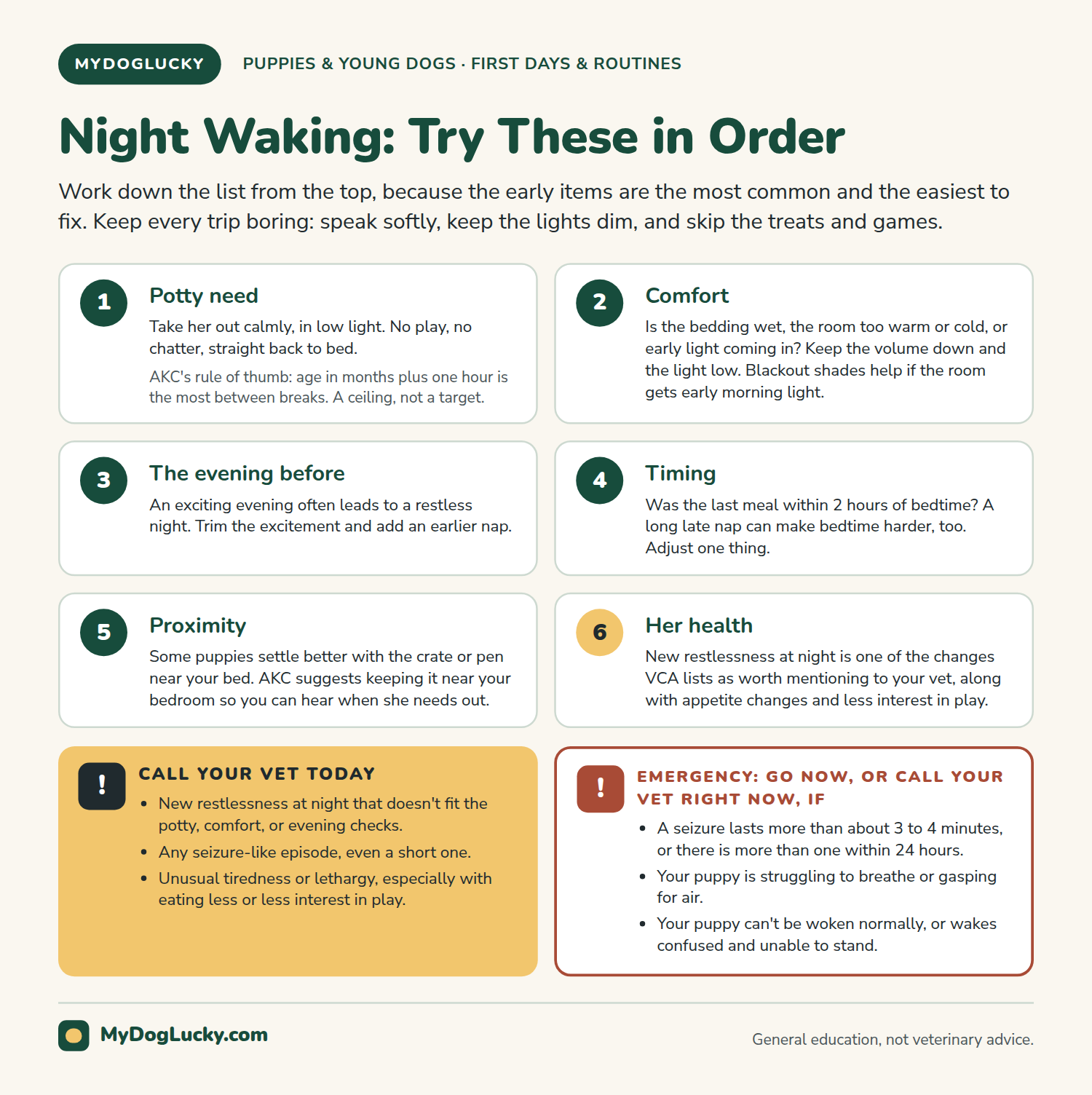
When your puppy wakes at 2 a.m., resist the urge to solve everything at once. Work down this list from the top, because the early items are the most common and the easiest to fix.
- Check for a potty need. Take her out calmly, in low light. No play, no chatter, straight back to bed.
- Check comfort. Is the bedding wet, the room too warm or cold, or the light coming in early? AKC suggests keeping the volume down and the light low at night, with blackout shades if the room gets early morning light.
- Check the evening. Many owners find that an exciting evening leads to a restless night, and AKC warns that too much stimulation and exhaustion can lead to unfortunate behavior. Trim the excitement and add an earlier nap.
- Check timing. Was the last meal within 2 hours of bedtime? Owners often report that a long late nap makes bedtime harder, so check that too. Adjust one thing.
- Check proximity. Some puppies settle better with the crate or pen near your bed. AKC suggests keeping the crate near your bedroom so you can hear when your puppy needs out.
- Check her health. New restlessness at night is one of the changes VCA lists as worth mentioning to your vet, along with appetite changes and less interest in play.
Keep the trip boring
A boring trip is the whole strategy. Speak softly, keep the lights dim, and skip the treats and games. If a middle-of-the-night trip turns into a party, your puppy may start asking for the party.
Comfort isn’t spoiling
A quiet word or a hand through the bars won’t ruin your puppy. Young puppies are new to being alone in the dark, and it’s kind to notice that. The goal isn’t silence at any cost. It’s a calm, repeatable routine.
Early-Morning Waking: What to Check and Try
A puppy who wakes at 5 a.m. is usually not being rude. The house is quiet, she’s rested, and the day looks fun. Work through these checks before you decide it’s a behavior problem.
Rule out the potty need first
Take her out calmly. AKC lists waking as one of the moments puppies typically need to go. Keep the trip dull, then back to the pen.
Block the light
AKC suggests blackout shades if the room gets early morning light. If shades aren’t an option, move the crate or pen to a darker corner. Even a dimmer room can help.
Soften the noise
Garbage trucks, birds, and early commuters can pull a light sleeper out of a nap. The AAHA survey finding about how easily dogs are disturbed makes this worth checking. A low white-noise machine or a fan in the next room helps some households, though we didn’t find a fetched source on it, so treat it as a trial.
Adjust the evening clock
Move the last potty trip as late as your household comfortably allows. Keep the last meal at least 2 hours before bed, per AKC, and ask your vet about water and meal timing. Shift bedtime by 10 to 15 minutes over several days rather than an hour at once. That step size is an owner tactic, not a sourced rule.
Fill the boredom gap
A puppy who’s had a quiet, boring evening may wake with energy to burn. Add a sniff walk or a food puzzle earlier in the day, per AAHA’s earlier-activity timing. Then keep the late-day tone calm so bedtime isn’t a rebound from excitement.
Don’t reward the early alarm
It’s easy for 5 a.m. to become party time. Keep it dull: potty, quiet, back to bed, then a chew. Pick a wake-up time you can live with and, when you can, get up at that time consistently.
Teething, Growth Spurts, and New-Home Stress
Even a smooth puppy sleep schedule wobbles now and then. These are the usual culprits.
Growth spurts
AKC says sleep helps puppies rest up during growth spurts. So a sudden run of extra naps can be normal. Give your puppy the sleep, and check in with your vet if the extra sleep comes with a drop in appetite or play.
Teething
Some owners notice restless naps and extra chewing during teething. If your puppy seems sore, drools more than usual, or avoids her food, mention it to your vet. Our puppy teething article covers the timeline and comfort options.
New-home stress
The first weeks in a new home are a lot. Unfamiliar sounds, smells, and people can make sleep patchy. AAHA’s finding about disturbance suggests that a quiet, predictable nap spot is worth more than a bigger bed.
Big days
After a vet visit, a busy weekend, or a first car ride, many puppies sleep harder or wake more restless. Plan a quiet day afterward. Lower the bar, add a nap, and skip the exciting stuff.
Kids, Other Pets, and Sleeping Puppies
Kids and puppies are a joyful, chaotic combination, and sleep is often the casualty. Both need help from the adults in the house.
A sleeping puppy is off-limits
The AVMA advises never disturbing a dog that’s caring for puppies, sleeping, or eating. It also says to supervise young children around dogs and never leave a baby or small child alone with one. A puppy is a dog, and that guidance applies from day one.
Give kids a simple rule: if the puppy is in the pen, the puppy is off duty.
Matching nap time to the school schedule
Kids coming home from school is a predictable spike of noise. Time a nap for the hour before they arrive, and give your puppy a calm hello after the excitement dies down. Then use the evening for play with adult supervision.
Sleeping in a child’s room
This one is a trade-off rather than a rule. A puppy in a child’s room may sleep well, but a young child can’t supervise a puppy, respond to a potty need, or spot trouble. Many families keep the sleeping spot in an adult’s room. Ask your vet if you’re unsure.
Other pets
A resident dog or cat may love your puppy or merely tolerate him. Give the puppy his own nap space and keep the older pet’s retreat puppy-free. In the spirit of the AVMA’s advice to leave a dog alone when he’s avoiding you, respect a resident pet who turns away.
Simple Tools: White Noise, Covers, and Chews
You don’t need much gear. We describe categories here, not products, and we can’t recommend specific items. Your vet or a certified trainer can help you choose.
- Blackout shades. AKC suggests them when early morning light is a problem.
- Dim, warm lighting. AAHA recommends minimizing bright white lighting where puppies sleep.
- A rectangular bed. AAHA says these allow a puppy to stretch out fully.
- A calm chew or snuffle mat. AAHA lists both as low-arousal evening options. Supervise, and swap out anything that’s getting shredded.
- White noise. Many owners use a low machine or fan to mask hallway sounds. We didn’t find a fetched source, so try it and see.
- A lightweight crate cover. Some puppies settle in a dimmer den. Keep airflow open, keep the cover out of reach of chewing teeth, and remove it if your puppy pulls it in.
Fitting Naps Into a Busy Day
Nobody’s day is as tidy as a sample table. Work meetings, school runs, and late deliveries break up the loop. The trick is to protect the anchors and let the rest flex.
Pick three anchors
Choose the parts that matter most: the first potty and meal after waking, one solid midday nap, and a calm pre-bed routine. Everything else can slide by half an hour without wrecking the day.
Hand off the routine
If a walker, family member, or neighbor helps, write down the wake time, last potty, meal times, and nap spot. A caregiver who knows the loop keeps it going. Our working full time with a dog guide covers building coverage around a job, and how long can you leave a dog alone covers the limits.
Sleep Changes Worth a Call to Your Vet
Most puppy sleep schedule questions are ordinary. A few aren’t. This section is plain on purpose.
Go to an emergency clinic, or call your vet right now, if:
- Your puppy has a seizure that lasts more than about 3 to 4 minutes, or has more than one within 24 hours (AKC, Dr. Jerry Klein, updated March 10, 2026).
- Your puppy is struggling to breathe or gasping for air.
- Your puppy can’t be woken normally, or wakes confused and unable to stand.
Record video if it’s easy, but never delay care to do it. Call ahead so the clinic can prepare.
Call your vet today if you notice
- Any seizure-like episode, even a short one. AKC says to contact your vet for any seizure.
- Unusual tiredness or lethargy. VCA says excessive tiredness or lethargy can be a sign of a medical condition. Worry more if your puppy also eats less or shows less interest in play.
- New noisy breathing or heavy snoring. VCA lists excessive snoring among the warning signs, and it says flat-faced breeds with snoring or gasping should be checked.
- New restlessness at night that doesn’t fit potty, comfort, or evening checks.
- A cough or breathing that looks like work when your puppy is resting. Describe what you see, and let your vet decide the next step.
Normal REM twitching or something else?
Puppies twitch, paddle, and mutter in their sleep. AKC’s Dr. Jerry Klein describes REM twitching as often brief (under 30 seconds) and intermittent, and says a dreaming dog is easy to wake. AKC recommends calling the dog’s name loudly rather than touching, since a startled dog may bite without meaning to.
| Feature | REM twitching (normal sleep) | Seizure (call your vet) |
|---|---|---|
| Movement | Twitching, paddling, or kicking; often brief and on-and-off | Limbs rigid and stiff, with more violent movement |
| Waking | Wakes easily to a loud voice | Can’t easily be woken |
| Other signs | Usually none | Drooling, panting, urinating or defecating without control |
| Afterward | Wakes normally | Disoriented |
What to record, and what not to do
Write down the date, the time, how long it lasted, and what your puppy was doing before and after. Video helps your vet more than a description does. Note changes in sleep, appetite, and play across several days.
Don’t give any sleep aid, calming product, or medication unless your vet tells you to. Don’t try to diagnose the cause from the internet. And don’t wait for a “better sign” if something looks wrong.
Troubleshooting: Five Common Sleep Snags
Most trouble with a puppy sleep schedule traces back to one of these five snags. Start with the one that sounds most like your house.
1. My puppy won’t settle for naps
First, check the basics: potty, a quiet spot, low light. Then check timing. A puppy who’s overtired may fight sleep, and one who isn’t tired enough may just play.
Try a slightly shorter awake stretch, a calm chew to wind down, and a different room. Some puppies protest for a few minutes and then crash. If nothing works after several days, mention it to your vet or a qualified trainer.
2. Naps keep ending after 20 minutes
Short naps often mean something woke her: noise, footsteps, a kid, or the need to go out. AAHA’s point about disturbance applies here. Move the spot, add white noise, and take her out after each nap.
If naps stay short and she’s cranky every evening, try trimming the excitement earlier in the day.
3. The evenings are wild
That’s the classic witching-hour pattern. Add a short nap in the late afternoon, move active play earlier, and switch to chews and calm training after dinner. Skip the extra play, since AAHA’s timing advice points the other way.
4. She sleeps all day and is up at 3 a.m.
This is a common day-night flip. A long, late nap can make bedtime harder for some puppies. Wake her gently from very late naps, keep the evening calm, and check that she gets enough activity earlier in the day. Adjust one thing at a time.
5. He wakes at every sound
Some puppies are light sleepers. Move the nap spot away from doors and shared walls, add low white noise, and cover the crate if he settles better in a dimmer den. If he seems anxious rather than just alert, talk to your vet or a qualified trainer.
Common Puppy Sleep Mistakes
Waiting for your puppy to tell you
Young puppies rarely announce that they’re tired. They get wilder. Nap by the clock and the yawns, not by the puppy’s own request.
Napping in the living room
A puppy on the rug during a busy afternoon isn’t napping. She’s guarding against missing something. Move naps to the quiet spot.
Fixing evening chaos with more play
It feels logical, but overtired puppies rarely need more stimulation. Choose a nap or a chew instead.
Changing everything at once
New nap spot, new bedtime, new food time, and new rules can turn a small problem into a mystery. Change one thing, wait a few days, and judge the result.
Treating the chart as a law
A schedule is a tool. If your puppy is clearly tired at the “scheduled” wake-up time, let her sleep. If she’s hungry early, feed her early.
Punishing night waking
A puppy who wakes at night usually needs something: to go out, to be comfortable, or to know you’re near. Scolding won’t answer any of those. Meet the need calmly and keep the trip short.
A One-Week Trial to Start Tonight
You don’t need an elaborate plan. You need a week of notes and one small change.
- Days 1 and 2: Watch. Write down wake times, naps, meals, potty trips, and the time evening trouble starts.
- Day 3: Choose a nap spot. Pick one quiet location and use it for every nap.
- Day 4: Add a wind-down. A calm chew and dim lights before each nap.
- Day 5: Change one thing. Shorten the awake stretch, add a pre-evening nap, or shift the last potty trip.
- Days 6 and 7: Review. Did evenings improve? Did naps get longer? Keep what helped.
Here’s a simple log you can copy.
| Day | Wake time | Naps (start–end) | Evening trouble time | Night potty trips | Notes |
|---|---|---|---|---|---|
| 1 | |||||
| 2 | |||||
| 3 | |||||
| 4 | |||||
| 5 | |||||
| 6 | |||||
| 7 |
Bring the log to your next vet visit if anything worries you. Our puppy first vet visit article covers what to bring, and our how to potty train a puppy and how to stop puppy biting articles cover the two problems tired puppies tend to make worse.
Common Questions About Puppy Sleep
How many hours should a puppy sleep at 8 weeks?
AKC says puppies typically sleep 18 to 20 hours a day, and VCA’s 2-month numbers point the same way. AAHA cites measured data closer to 11 hours across puppies up to a year old. Watch how your puppy acts rather than counting.
How long should a puppy nap?
AKC describes naps from 30 minutes to two hours. Shorter naps happen, especially with noise. Longer ones are usually fine.
Should I wake a sleeping puppy for meals or potty breaks?
Many owners let naps run and use the nap’s end as the cue for potty and food. AAHA’s disturbance finding suggests not waking a puppy without a reason. If a nap stretches deep into the evening, gently rouse her so bedtime stays workable.
How long can a puppy go without a potty trip at night?
AKC’s rule of thumb is age in months plus one hour as a maximum between breaks, and puppies hold longer when asleep. It doesn’t give overnight numbers, so watch your puppy and ask your vet.
Is it normal for my puppy to sleep all day?
For a young puppy, a lot of sleep is normal. VCA says a maturing puppy might sleep 10 or 14 hours a day and that variation is normal. Call your vet if the sleepiness comes with lethargy, poor appetite, or less interest in play.
Why does my puppy get so wild in the evening?
The puppy witching hour is common, and AAHA describes it as similar to an overtired toddler. Add an earlier nap, move active play earlier, and use chews and calm activities as the evening approaches.
Can my puppy sleep in my bed?
It depends on your household and your puppy. AAHA says to consider co-sleeping when appropriate, and safety trade-offs (falls, a puppy who can’t wait for a potty trip) matter. Our puppy first night home guide covers the choice.
What if my puppy twitches or barks in her sleep?
That’s often REM sleep. AKC says REM twitching is usually brief and easy to wake her from, unlike a seizure. Call her name from a distance instead of touching her, and if you’re unsure, record a video and call your vet.
When can I stop the middle-of-the-night potty trip?
There’s no dependable date. Many puppies drop it over weeks. If you keep the last potty trip late and the last meal early, you give your puppy the best shot.
Do small and large breeds sleep differently?
The sources we checked don’t give breed-specific sleep numbers. VCA says variation among puppies is normal. Ask your vet about your puppy’s size and breed.
Does the schedule change on weekends?
Keep the anchors steady: wake time, first potty, and bedtime. A weekend that starts an hour later is usually easier on a puppy than a schedule that swings wildly.
Sources
- American Kennel Club (AKC), Jan Reisen. How Much Do Puppies Sleep? Updated August 11, 2026; accessed September 2026. Used for the 18-to-20-hour figure, why sleep matters for growth, nap length, the nap spot, and night lighting and noise.
- American Kennel Club (AKC), Harriet Meyers. Puppy Potty Training Schedule: A Timeline for Housebreaking Your Puppy. Updated August 11, 2026; accessed September 2026. Used for the age-plus-one-hour rule, potty timing, the 2-hour pre-bed feeding advice, and Dr. Jerry Klein’s comment on 6-month-olds.
- American Animal Hospital Association (AAHA) Trends, Colette Kase. How Sleep Shapes Canine Behavior. July 17, 2026; accessed September 2026. Used for the measured sleep figure, REM sleep in puppies, the witching hour, activity timing, and the 2022 survey on disturbed sleep.
- VCA Animal Hospitals. How Much Sleep Do Puppies Need? Page undated; accessed September 2026. Used for awake time at 2 months, the 10-to-14-hour range for maturing puppies, and the warning signs listed.
- American Kennel Club (AKC), Dr. Jerry Klein. Is My Dog Dreaming or Having a Seizure? How to Tell the Difference. Updated March 10, 2026; accessed September 2026. Used for REM twitching versus seizure signs and the emergency thresholds.
- American Veterinary Medical Association (AVMA). Dog Bite Prevention. Page undated; accessed September 2026. Used for supervising children and not disturbing a sleeping dog.
This article is general education for U.S. dog owners. It is not individualized veterinary advice, and it is not a diagnosis. Sleep needs vary by puppy, and the sample schedules are illustrative, not prescriptions. If your puppy has a seizure, struggles to breathe, or can’t be woken normally, go to an emergency animal hospital or call your veterinarian right away. Ask your veterinarian about anything specific to your puppy’s health, feeding, or exercise.