
Crate training a puppy works because you build it in layers: the door stays open before it ever closes, the crate pays off in food and comfort before it asks for anything, and duration grows only once your puppy is actually relaxed in there, not just quiet. Rushed crate training is the version that fails — the one where a brand-new puppy gets shut in for a four-hour errand run on day two and spends the whole time screaming. Done in order, most puppies settle into the crate within one to three weeks, though plenty take longer, and that’s normal too.
How fast it goes depends on your puppy’s age, how confident she already is being alone, whether she was ever crated with littermates, and how consistent your household can be with the schedule. A laid-back ten-week-old who naps easily is a different project than an anxious rescue puppy who’s never spent five minutes unsupervised. Both can get there. The plan just needs to match the puppy in front of you.
This guide walks through the whole thing: picking a crate that actually fits, a step-by-step introduction protocol with a clear rule for when to move faster, how to make the crate a place your puppy chooses on her own, building toward overnight use, and — this is the part most crate guides skip — how to tell an ordinary settling-in protest from something that needs a different plan altogether.
What’s in this guide
- Crate training a puppy: the quick answer
- Why crate train at all (and when a pen or a room works just as well)
- Choosing crate size and type
- The step-by-step introduction protocol
- Making the crate genuinely rewarding
- Building overnight crating
- Troubleshooting: normal protest vs. real distress
- When to stop relying on the crate
- Common crate-training mistakes
- Common myths about crate training a puppy
- Frequently asked questions
- Sources
Crate training a puppy: the quick answer
Crate training a puppy means teaching her, gradually, that a crate is a good place to be — not a box she gets stuffed into and endured. You do that by introducing the crate with the door open, feeding meals inside it, and building the time she spends in there in small steps, always stopping to reward at a point where she’s still comfortable rather than pushing until she cracks. You only extend the next session once she’s relaxed at the current one for a couple of sessions running.
Most healthy puppies can start short daytime crate sessions from the day they come home, and can typically work up to being crated for a few hours at a stretch by three to four months old, with individual variation being the rule rather than the exception. Overnight duration usually stretches out faster than daytime duration, because a sleeping puppy isn’t actively bored the way an awake one left alone during the day can be.
The one rule that matters most
Move up in duration only when your puppy is relaxed at the current length — loose body, maybe asleep, not just tolerating it with her nose pressed to the door. “Quiet” and “relaxed” aren’t the same thing, and mixing them up is the single most common reason crate training a puppy goes sideways.
Why crate train at all (and when a pen or a room works just as well)
A crate isn’t a requirement for raising a well-adjusted dog. It’s one tool among several, and it earns its place for a specific, practical reason: it prevents your puppy from rehearsing the behaviors you’re trying to build alternatives for, during the exact window when she can’t yet be trusted loose in the house.
A puppy who counter-surfs successfully even once is more likely to try again — the behavior just got paid. A puppy who chews through a phone charger while you’re in the shower learns nothing except that chargers are interesting and available. Every one of those unsupervised repetitions makes the habit a little stickier and your actual training a little slower. A crate (or an equivalent contained space) removes the opportunity for the mistake to happen at all, while you’re building the skills — settling, chew-toy preference, bladder control — that eventually make supervision less necessary.
The other reasons owners crate train a puppy
- A default safe space. Most dogs benefit from having one place in the house that’s unambiguously theirs, where nobody bothers them and nothing is expected of them.
- Housetraining support. Puppies generally avoid soiling the space they sleep in, which makes a properly sized crate a useful piece of a bathroom schedule — never a substitute for one.
- Travel and vet stays. A dog who’s relaxed in a crate travels more easily by car, tolerates a boarding kennel better, and recovers from a stressful vet hospitalization with one less unfamiliar thing to cope with. This payoff shows up years after the puppy stage is over.
- A landing spot during chaos. Movers in the house, a toddler having a meltdown, a dinner party with twelve unfamiliar shoes to sniff — a crate-trained dog has somewhere to opt out to instead of being stuck in the middle of it.
None of that makes a crate mandatory. Plenty of households raise perfectly well-adjusted dogs using an exercise pen or a puppy-proofed room instead, and if that setup is already working for your family, there’s no rule requiring you to switch. The underlying goal — a contained, supervised-adjacent space that prevents rehearsal of unwanted behavior while your puppy is still learning house manners — matters more than the specific hardware.
Crate, pen, or puppy-proofed room?
A crate is the most portable and travels best. An exercise pen gives more room to move and often suits a puppy who finds full enclosure stressful, but takes up more floor space and is easier for an agile puppy to climb or knock over as she grows. A gated, puppy-proofed room (a laundry room or a section of kitchen) gives the most space of all and needs the least behavioral buy-in, but doesn’t travel and doesn’t double as a housetraining aid the way a properly sized crate does. Many households end up using two of the three at different ages, or a crate inside a pen for a young, escape-curious puppy.
One more honest note before moving on: a crate only delivers any of these benefits if your puppy actually likes being in it. A puppy shoved into a crate she dreads doesn’t get a safe space — she gets a source of daily stress that happens to also be furniture. Everything from here forward is about building that genuine preference, not skipping straight to closing the door and hoping for the best.
Choosing crate size and type
Size is the detail owners get wrong most often, usually by erring too big out of kindness, which quietly backfires. Type matters less than most product marketing suggests, and it mostly comes down to your home, your travel needs, and your puppy’s individual preferences.
How big should the crate actually be
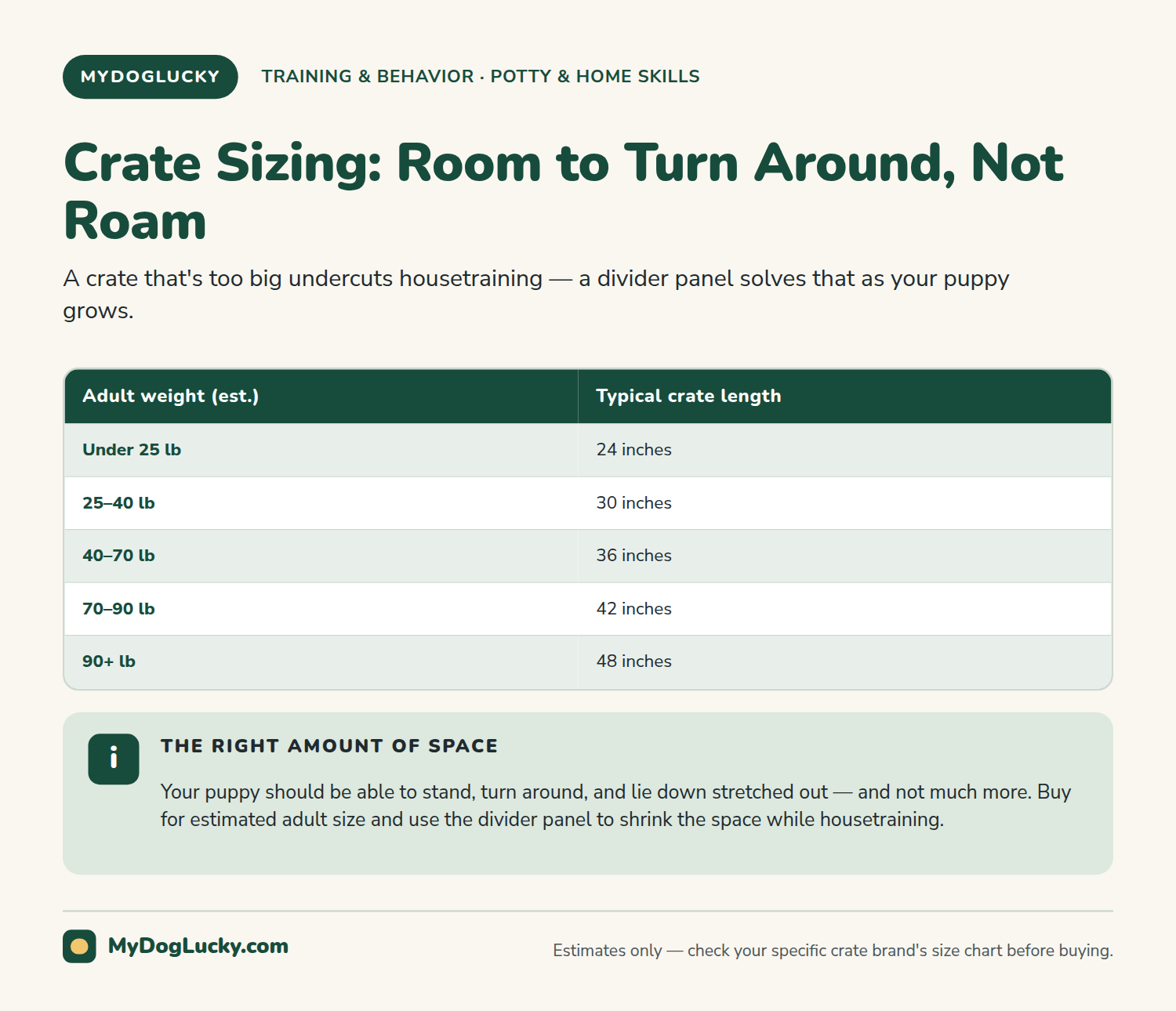
The target is simple: your puppy should be able to stand up without ducking her head, turn around comfortably, and lie down fully stretched out. That’s it. A crate that’s meaningfully bigger than that doesn’t feel more luxurious to a puppy — it removes the housetraining benefit, because a large enough crate gives her room to sleep at one end and eliminate at the other without the natural discomfort that normally motivates a puppy to hold it.
Because puppies grow quickly and unevenly, sizing for an eight-week-old and sizing for the twelve-month-old she’ll become are two different exercises. Most manufacturers solve this with a divider panel: you buy the adult-sized crate once and slide the panel to shrink the usable space down to puppy proportions, moving it back as she grows. That’s usually cheaper and less wasteful than buying two or three crates in sequence, and it means you’re not re-starting the introduction process in an unfamiliar new box every few months.
| Approximate adult weight | Typical crate length | Example breeds/mixes |
|---|---|---|
| Under 25 lb | 18–22 in | Chihuahua, small terrier mixes, toy breeds |
| Under 30 lb | 24 in | Dachshund, small spaniel mixes |
| Under 40 lb | 30 in | Beagle, Cocker Spaniel, many terrier mixes |
| Under 70 lb | 36 in | Standard Poodle, Border Collie, medium retriever mixes |
| Under 90 lb | 42 in | Labrador Retriever, German Shepherd |
| 90–150 lb | 48–72 in | Great Dane, Mastiff, giant-breed mixes |
Treat that table as a starting point, not a guarantee — measure your actual puppy (or a reasonable adult-size estimate for a mixed breed) rather than sizing purely off the breed name, since individual dogs vary a fair amount within any category.
How to actually measure a puppy for a crate
Skip the guesswork and take three quick measurements. With your puppy standing normally, measure from the tip of her nose to the base of her tail (not including the tail itself) for length, and from the top of her head or ears — whichever is taller — down to the floor for height. Add two to four inches to each number for growing room, then compare the result to the crate’s interior dimensions, not the exterior box measurement printed on the packaging, since the two can differ by a couple of inches once you account for wall thickness and door hardware.
For a puppy who’s still visibly growing, measure again every few weeks and compare against her estimated adult size rather than her current one, so you know roughly when the divider panel will need to move. A quick call to your veterinarian at a routine puppy visit can also give you a reasonable adult-weight estimate based on her breed, paw size, and growth curve if you’re working with a mixed breed and genuinely unsure where she’ll land.
Wire, plastic, or soft-sided: the real tradeoffs
- Wire crates fold flat for storage, offer the most airflow, and let you see your puppy from every angle, which some owners and some puppies both prefer. They’re heavier and bulkier to move than the alternatives, and their open sides mean a puppy who’s easily overstimulated may need a cover to feel settled.
- Plastic (travel-style) crates feel more den-like — enclosed on three sides, less visual stimulation, generally the required style for airline travel. They’re sturdier for car travel and vet stays, but don’t fold down, so they take up more storage space when not in use.
- Soft-sided crates are the lightest and most portable, useful for an already crate-comfortable dog at a hotel or a relative’s house. They’re a poor choice for initial training, since a teething or anxious puppy can chew or claw through the fabric walls, and they offer little containment if she’s determined to get out.
For the introduction period specifically, wire and plastic both work well; soft-sided is worth saving for later, once the habit is already solid. Whichever you choose, a washable crate pad or mat and a low-mess water option (a clip-on bowl beats a bowl she can tip) make daily use noticeably easier on you.
The step-by-step introduction protocol
This is the part that actually determines whether crate training a puppy goes smoothly or turns into months of fighting the crate door. The whole protocol runs on one principle, borrowed from how we’d teach any other skill: raise the difficulty only after your puppy has shown she’s ready for it, not on a schedule that’s convenient for you.
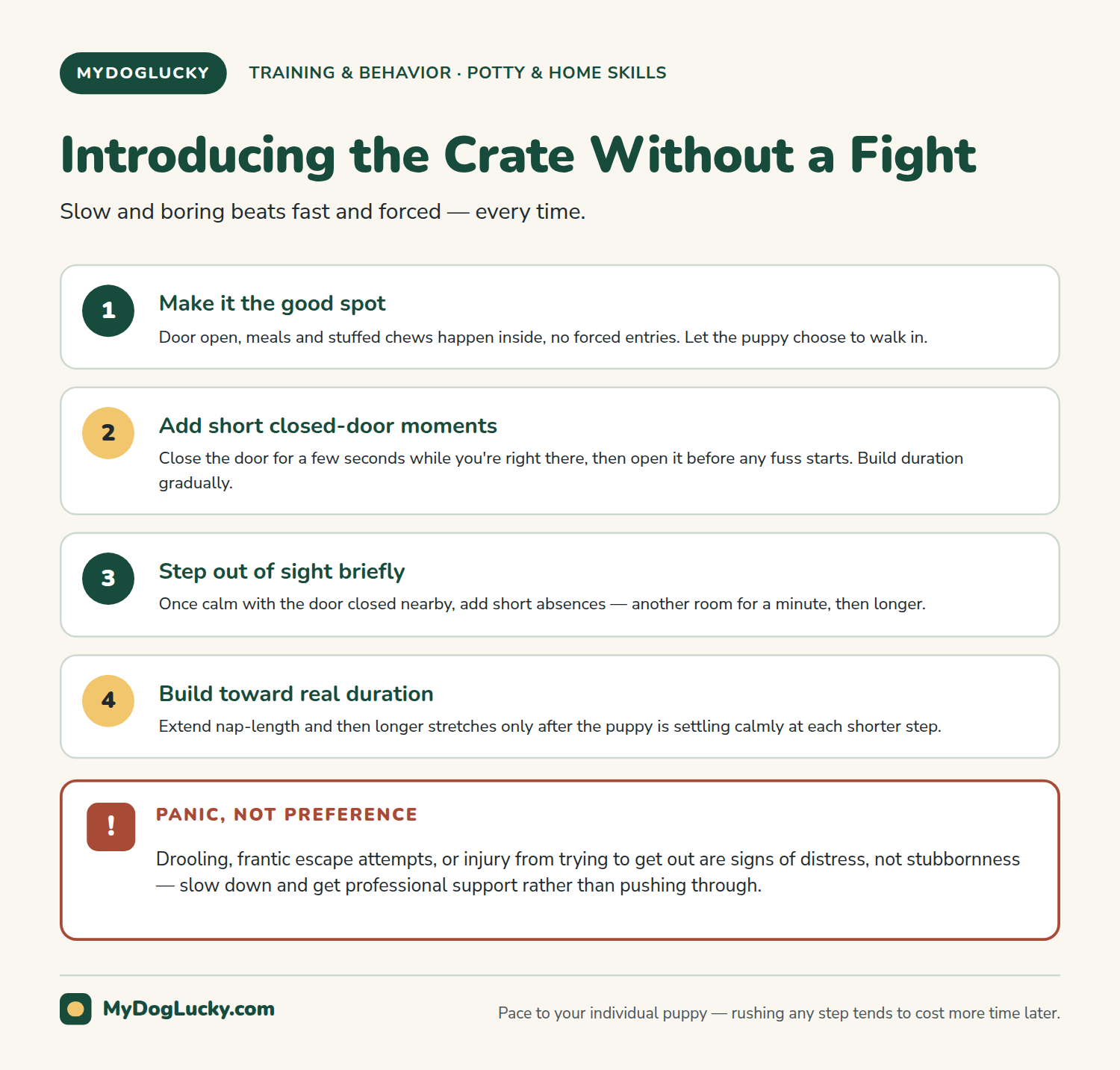
Five phases, roughly in order. Some puppies move through phases one and two in the same afternoon; others need several days on each. Both are fine. What matters is the direction of travel, not the speed.
Phase 1: Door open, no pressure
Set the crate up in a household space your puppy already spends time in, door propped open, with soft bedding and a couple of chew-safe toys inside. Scatter a few treats just inside the doorway a handful of times a day and let her investigate on her own terms. Don’t lure her in with your hand and don’t close the door yet — the entire goal of this phase is that walking into the crate is her idea.
Success criterion: she walks in and out freely, on her own, to get treats or just to explore, without hesitation at the doorway. Most puppies clear this phase within a day or two.
Phase 2: Meals inside, door still open (then briefly closed)
Start feeding regular meals inside the crate, bowl placed toward the back so she has to fully step in. Once she’s eating full meals calmly with the door open, close the door while she eats and open it again the moment she finishes — no delay, no drama, just door closed during the meal and door open right after.
Success criterion: she eats a full meal with the door closed and shows no urgency to get out the second the bowl is empty — a few seconds of relaxed sniffing around before you open the door is a good sign she’s not just tolerating it.
Phase 3: Short in-room absences (you stay close)
With the door closed after a meal or a stuffed chew, sit in the same room and go about something quiet — reading, folding laundry — for a minute or two before letting her out. Build the duration in small increments: a minute, then three, then five, then ten, always while you’re still visible or audible nearby. Reward calm settling, not the moment she’s let out.
Success criterion: she settles into a relaxed down or falls asleep at the current duration, for at least two sessions in a row, before you add more time.
Phase 4: You leave the room
Now the harder step: close the crate door, then leave the room entirely for short stretches — thirty seconds, then a couple of minutes, then five or ten — while staying in the house. This is where most puppies first vocalize a little, and it’s also exactly why this phase exists: better to learn that you leaving the room isn’t a crisis in five-second doses than to learn it for the first time during a thirty-minute departure.
What “brief fussing” should look like here
A little whining or a bark or two as you first walk out, settling within a minute on its own, is a normal part of this phase for a lot of puppies. Don’t rush back in the instant she makes a sound — that teaches her that noise gets you to return, which is the opposite of what you want. Do go back in calmly once she’s had a brief quiet moment, even a short one, so the door opens because she settled, not because she complained.
Success criterion: she settles within roughly a minute of you leaving the room, for two or three sessions running, before you stretch the absence longer.
Phase 5: You leave the house
The final phase: actual departures, starting absurdly short. Put on your shoes, pick up your keys, step outside, and come back in thirty seconds later — sometimes without even fully closing the door behind you. The point isn’t the errand, it’s proving that the departure routine doesn’t always mean a long, scary absence. Extend gradually from there: a few minutes, then ten, then thirty, then an hour, working up toward the length of time your schedule actually needs, over days to weeks rather than one giant leap.
Success criterion: at each new length, she’s relaxed by the time you return — not mid-bark, not frantic at the door — for a couple of sessions before you go longer. If a session goes badly, that’s useful information, not a setback to panic about: drop back to the last length that worked and rebuild from there.
A realistic weekly pace
For a puppy with no prior crate experience and no particular anxiety, a workable pace looks like: phases 1 and 2 in the first two or three days, phase 3 building across the first week, phase 4 across the second week, and phase 5 starting in week two or three and continuing to stretch for a month or more after that. That’s a general shape, not a countdown — a puppy who’s further along than this by day five doesn’t need to be held back, and one who’s still on phase 3 after two weeks isn’t behind, she just needs more reps at that length before moving on.
Adjusting the pace for your actual puppy
A confident, food-motivated puppy who’s never shown much concern about being alone can often move through several phases in a single week, and holding her back purely to match a generic timeline wastes training opportunities without adding any benefit. Watch her behavior, not the calendar — if she’s consistently relaxed at the current step, there’s no reason to sit on it.
A naturally cautious puppy, one who came from a shelter or a chaotic early environment, or one who’s already shown some anxiety about being left alone needs the opposite adjustment: smaller jumps between sessions, more repetitions at each length before moving on, and more tolerance for spending extra time on phases 1 and 2 before ever closing the door. Rushing a naturally anxious puppy through the protocol to “catch up” to some expected pace tends to produce exactly the kind of escalating distress covered in the troubleshooting section below — slower and steadier gets her to a comfortable crate faster than pushing does, even though it doesn’t feel that way in the moment.
A puppy who arrived already crate-familiar, from a breeder who introduced crates with the litter or a foster home that used one, may skip straight to phase 3 or 4 with only a quick check that phases 1 and 2 are solid first. Confirm rather than assume: a puppy who tolerated a crate around littermates doesn’t automatically generalize that comfort to a new crate, in a new house, completely alone.
Making the crate genuinely rewarding
Everything in the protocol above works faster, and holds up better long-term, when the crate itself has a strong track record of good things happening in it. This is less a separate step and more a habit that runs underneath the whole process.
What actually makes a crate rewarding
- Stuffed chews and long-lasting treats. A food-stuffed toy that takes fifteen or twenty minutes to work through gives your puppy something to do besides notice she’s confined, and it builds a direct association between “crate” and “good thing happening right now.” Freeze it beforehand for a longer-lasting version.
- Puzzle feeders that dispense kibble as she noses or paws them add mental effort to an otherwise idle stretch of time, which tends to tire a puppy out faster than the same amount of time spent simply waiting.
- A predictable location. Moving the crate around the house repeatedly undercuts the sense of a stable “home base.” Pick a spot and keep it there for the bulk of training, even if you eventually add a second crate elsewhere.
- Consistent bedding and scent. A blanket or bed that stays in the crate, rather than getting swapped or washed constantly, lets a familiar smell do some of the reassuring for you.
Never a punishment location
Don’t send your puppy to the crate as a consequence for chewing the rug or having an accident, and don’t use “go to your crate” in an angry or frustrated tone. A crate that sometimes means “you’re in trouble” stops being a reliable safe space, and that association is hard to undo once it’s built. If you need a moment to reset your own patience during a rough training day, that’s a fair reason to use the crate — just do it calmly, with a treat going in, not as a scolding.
Worth saying plainly, because it’s easy to miss in a training guide full of steps: a crate that only ever gets used for confinement, and never for anything your puppy actively wants, will always be a harder sell than one that occasionally shows up with cheese in it for no particular reason at all.
Building overnight crating
Overnight crating usually comes together faster than daytime crating, mostly because a tired puppy who’s ready for sleep isn’t fighting boredom the way she might during a bright, active afternoon. That said, the first several nights are commonly the roughest part of the whole process for a lot of households, mainly because of one thing: a very young puppy’s bladder genuinely can’t hold through a full night yet, so the crying you hear at 2 a.m. is often a real, physical need rather than a settling protest.
Where to put the crate at first
For a very young puppy, placing the overnight crate in or near your own bedroom is common practice, and it solves two problems at once: your puppy isn’t sleeping totally alone for the first time in her life, away from the warmth and sound of littermates she’s used to, and you’re close enough to hear her wake up and need a bathroom trip rather than finding an accident in the morning. Many households move the crate to a more permanent location, like a laundry room or a corner of the kitchen, once nighttime bathroom needs have mostly resolved, typically somewhere around three to four months of age, though this varies by individual puppy.
If a nearby crate isn’t practical in your household, a baby monitor or a pet camera in the room where she sleeps is a reasonable substitute for proximity — the goal is hearing her wake up promptly, not necessarily being in the same room.
How overnight duration typically stretches
As bladder control develops, the stretch between necessary nighttime bathroom breaks tends to lengthen. These are commonly cited approximate ranges, not a guarantee for any individual puppy — some hold longer, some need more frequent breaks well past the ages listed, particularly smaller breeds with proportionally smaller bladders:
| Approximate age | Typical overnight stretch | What to expect |
|---|---|---|
| 8–10 weeks | 2–3 hours | One or two wake-ups most nights is normal |
| 2–3 months | ~3–4 hours | Usually one wake-up for most puppies |
| 3–4 months | ~4–5 hours | Some puppies sleep through; many still need one break |
| 16 weeks and older | ~6–7 hours | Many puppies can sleep through a normal night |
A practical way to stay ahead of an accident, rather than being woken by one: set an alarm to take her out slightly before she’d typically wake on her own, so the bathroom trip happens on your schedule instead of hers. Keep the trip itself boring — quiet voice, minimal play, straight back to the crate afterward — so 3 a.m. doesn’t start feeling like a fun, engaging part of the day.
Tiring her out matters as much as the schedule does
A puppy who’s had a reasonable amount of activity, a full meal, and a final bathroom trip in the hour before bedtime settles into an overnight crate far more easily than one who’s still wound up from a late burst of zoomies. If nighttime crying is a consistent problem, look at the hour before bed before assuming the crate itself is the issue.
One small piece of dry humor that turns out to be true for a lot of households: the crate you spent forty minutes researching for maximum comfort will, at some point, lose out to a cardboard box that used to hold paper towels. Puppies have opinions. Keep the good crate habit going anyway — the box phase usually passes.
Troubleshooting: normal protest vs. real distress
This is the part most crate-training advice glosses over, and it’s arguably the most important section in this whole guide. Not every whine means the same thing, and responding to an attention-seeking whimper the same way you’d respond to genuine panic gets both situations wrong.
Whining that stops when you approach
If your puppy whines, you take a step toward the crate, and the whining stops or shifts to an excited, hopeful tone — that’s very often attention-seeking. She’s learned, or is in the process of learning, that noise brings you closer. It’s an understandable thing for a puppy to try, and it needs a measured response: don’t rush in and open the door the instant she makes a sound, since that directly rewards the behavior you’re trying to reduce. Wait for even a few seconds of quiet, then let her out or come over — the release needs to follow calm, not follow noise.
Whining that escalates and doesn’t stop
This is a different animal entirely. If the vocalizing gets louder and more frantic the longer it continues, rather than settling, and especially if it’s paired with heavy panting, drooling, frantic scratching or digging at the door, or her not calming down even once you’re right there next to the crate — that’s not a puppy angling for attention. That’s a puppy who’s genuinely distressed, and it calls for a slower plan, not a wait-it-out approach.
Don’t wait out real distress
A puppy panicking in a crate isn’t settling down on her own timeline — she’s rehearsing panic, and letting that continue unaddressed can make the association worse, not better. If you’re seeing escalating distress rather than a brief settling protest, go back several steps in the introduction protocol: shorter durations, you staying visibly present again, and rebuilding from a length she can actually handle. If it continues despite a slower, more careful plan, that’s a reasonable point to loop in your veterinarian or a qualified trainer, since ongoing panic at confinement can be an early sign of separation-related distress that benefits from a tailored plan.
Accidents in the crate
An accident in an otherwise clean, appropriately sized crate almost always points to one of two things: you asked for more time than her current bladder control can manage, or the crate is larger than it should be, giving her enough room to eliminate at one end and rest at the other without the discomfort that would normally motivate holding it. Before assuming a training failure, double-check the size against the guidance above, and drop the duration back to a length that matches her actual bladder-control stage rather than the stage you’d like her to be at.
A puppy who was previously reliable and suddenly starts having crate accidents is worth a call to your veterinarian before you assume it’s behavioral — a urinary tract infection or other medical issue can look exactly like a training regression.
Destructive chewing at the door or bars specifically
Ordinary teething chewing tends to happen on whatever’s convenient — bedding, a corner of a mat, a toy left inside. Chewing that’s specifically focused on the door, the bars, or the seams where the crate could conceivably be broken out of is a different pattern worth taking seriously. That kind of targeted, exit-focused chewing — especially alongside broken nails, bleeding gums, or a worn patch on the door — points more toward escape-driven distress than ordinary mouthiness, and it’s a signal to slow the plan down and, if it persists, bring in professional support rather than pushing through it.
A quick-reference comparison
| Normal settling protest | Possible real distress |
|---|---|
| Brief whining or a bark or two, then settles within a minute or so | Whining or barking that escalates and doesn’t taper off |
| Stops when you approach or speak calmly nearby | Doesn’t calm even with you right there |
| Mild fussing mainly during the first few sessions of a new duration | Heavy panting, drooling, or trembling |
| Chews toys or bedding placed inside | Chewing or scratching focused on the door, bars, or seams |
| Settles into sleep once the fuss passes | Ongoing pacing, digging, or attempts to force the door |
When to stop relying on the crate
Crate training a puppy isn’t meant to be forever, at least not in the intensive, door-closed-every-time sense. For most dogs, the crate becomes less of a daily necessity and more of an occasional tool — travel, storms, a chaotic afternoon — somewhere between eight months and two years old, though the honest answer is “when she’s earned it,” not a specific birthday.
Signs a puppy is ready for more freedom
- Reliable housetraining for a period of weeks, with no accidents even when left unsupervised for a normal stretch of the day.
- No destructive chewing on furniture, cords, or household items during short supervised trial periods without the crate.
- Calm behavior alone — able to settle without pacing, barking, or distress when left loose in a puppy-proofed room or gated area.
- An established chew-toy preference strong enough that she reaches for her own toys over your shoes or the coffee table leg by default.
The transition itself should follow the same graduated logic as the introduction protocol did: start with short, supervised loose time in one puppy-proofed room while you’re home, extend it while you’re out on a brief errand, and only widen access to more of the house once each stage has gone well for a solid stretch. A dog who’s ready for the living room isn’t automatically ready for the whole house at once — treat it as one more skill built in layers, not a single graduation day.
Plenty of dogs continue choosing to sleep or nap in an open crate for years after they no longer need the door closed, simply because it’s become a genuinely comfortable, familiar spot. That’s a good outcome, not a sign training didn’t finish — keeping the crate available with the door open, as a permanent option rather than a requirement, tends to be the version that lasts.
Common crate-training mistakes
Buying a crate that’s too big “to be kind”
Extra room feels generous, but it removes the natural discomfort that helps a puppy learn to hold her bladder, and it can leave enough space to pace instead of settle. Size for her current stage, using a divider if the crate is sized for her adult weight.
Going straight to long absences
Skipping phases 1 through 4 and closing the door for a full workday on day one is one of the most common ways crate training a puppy goes wrong. It doesn’t save time — it usually costs more time later, rebuilding trust in a crate that’s now associated with a scary, too-long absence.
Using the crate as punishment
Sending a puppy to the crate in anger, or as a consequence for a chewed shoe found twenty minutes after the fact, teaches her the crate is where bad things happen, not that the shoe was off-limits. It undoes a lot of the trust-building the rest of this guide is built around.
Ignoring escalating distress signals
Treating genuine panic the same as ordinary settling-in fussing, and simply waiting it out, is the mistake most likely to create a lasting negative association with confinement. If the whining is escalating rather than settling, that’s information to act on, not noise to tune out.
Inconsistent household rules
If one family member lets a puppy out the instant she whines and another holds the line, she learns that persistence eventually works — it just takes longer with some people than others. A shared, simple household rule (quiet first, then the door opens) makes faster, less confusing progress for everyone, including the puppy.
Skipping exercise and a bathroom trip before crate time
A puppy who’s full of pent-up energy or who needs to eliminate is set up to struggle with confinement regardless of how well the introduction protocol was run. Cover the basics first, every time, and the crate itself gets an easier job to do.
Common myths about crate training a puppy
“Dogs are den animals, so they naturally love small enclosed spaces”
This gets repeated often enough to sound settled, but it’s more folklore than established fact — wild canids use dens mainly for whelping and raising very young pups, not as a lifelong preferred living space, and domestic dogs vary widely in how they feel about confinement. Some puppies do seem to gravitate toward a cozy, enclosed spot; plenty of others need the whole gradual introduction process precisely because a small enclosed box isn’t automatically appealing to them. Treat “den instinct” as a possible starting advantage, not a guarantee that skips the training.
“If she cries, she just needs to cry it out”
Sometimes brief fussing does pass on its own, which is why phase 4 of the protocol above includes some tolerance for a normal settling protest. But “cry it out” as a blanket strategy ignores the difference this guide spends a whole section on: ordinary protest that settles is very different from escalating distress that doesn’t. Applying the same “ignore it” approach to both gets the harder case wrong.
“A bigger crate is always kinder”
It feels generous, but more space removes the built-in incentive to keep the sleeping area clean, which is a meaningful part of how crates support housetraining in the first place. Sized correctly, with a divider adjusting as she grows, is kinder in practice than oversized from the start.
“Crate training means the dog will always need to be crated”
For most dogs, intensive daily crate use is a puppyhood and adolescence tool, not a lifelong requirement. Plenty of adult dogs graduate to loose access to a room or the whole house, with the crate staying available, door open, purely by choice. The training builds a habit and a safe association — it doesn’t lock a dog into permanent confinement.
“A puppy who hates the crate at first will always hate it”
Early resistance is common and usually just means the introduction moved faster than that particular puppy needed, not that she has a fixed, permanent aversion. Slowing down and rebuilding from the earliest phases turns this around for the great majority of puppies. Real, lasting difficulty despite a careful, patient approach is the exception worth getting professional input on, not the expected outcome.
Frequently asked questions
How long can a puppy stay in a crate?
It depends heavily on age. As a rough daytime guideline, many trainers use “age in months plus one” as the maximum number of waking hours between bathroom breaks, so a two-month-old puppy might manage roughly three hours, a three-month-old around four. Overnight stretches tend to run a bit longer than daytime ones, since a sleeping puppy isn’t producing urine at the same rate. These are starting estimates, not hard limits — your individual puppy’s bladder control, activity level, and stress level all shift the real number, and no puppy under about six months should be expected to hold it for a full eight-hour workday without a midday break from a sitter, doggy daycare, or a family member.
Is it cruel to crate a puppy overnight?
Not when it’s introduced gradually and the puppy is genuinely comfortable there — for a lot of dogs, an overnight crate functions like a cozy den and becomes a preferred sleeping spot. It becomes a welfare concern when the crate is oversized enough to allow soiling, when a young puppy is left far longer than her bladder can manage, or when she shows ongoing distress rather than settling. The crate itself isn’t the problem or the solution — how it’s introduced and used is what determines the outcome.
My puppy screams the second the door closes — what now?
Stop, open the door, and go back several phases in the introduction protocol rather than pushing through it. Screaming immediately on door-closing, rather than after a stretch of settling-in time, usually means the jump in difficulty was too big for where she currently is. Rebuild from a duration so short it feels almost pointless — a few seconds with the door closed while you’re standing right there — and work back up more gradually than you did the first time. If it continues even at very short durations, that’s a good point to talk with your veterinarian or a qualified trainer.
Do I need to crate train if I have a puppy-proofed room instead?
No. A well-managed, puppy-proofed room behind a secure gate accomplishes the same core goal — preventing unsupervised access to things she could damage or that could hurt her — without requiring a crate specifically. The main tradeoffs are that a room doesn’t travel with you the way a crate does, and it offers less housetraining support, since there’s more room to eliminate away from the resting area. If your setup is already working, there’s no requirement to add a crate on top of it.
What size crate does my puppy need, and do I need to buy a bigger one as she grows?
Size for standing, turning around, and lying down comfortably — not much more. Many owners buy the crate sized for their puppy’s estimated adult weight and use a divider panel to shrink the usable space while she’s small, sliding it back as she grows, which avoids buying multiple crates over the course of her first year.
Should I cover the crate with a blanket?
Many puppies find a partial cover calming, especially in a wire crate, since it reduces visual stimulation and creates more of a den-like feel. Leave at least one side uncovered for airflow, and watch for overheating in warm rooms or during summer months. If your puppy seems more anxious with a cover on, rather than more settled, skip it — this is genuinely one of those individual-preference details.
Is it okay to use the crate during the day while I work?
Only once she’s built up to it gradually and only for a duration her age and bladder control can reasonably support. For most puppies under about six months, a full workday without a midday break is longer than she should be expected to hold, regardless of how well crate training has gone otherwise. A midday visit from a sitter, a neighbor, doggy daycare, or a trusted family member fills that gap for a lot of working households.
What if my puppy poops or pees in the crate?
Clean it thoroughly with an enzymatic cleaner rather than a standard household product, since ordinary cleaners can leave a scent trace that invites a repeat. Then look at the likely cause: too much time asked for too soon, or a crate that’s larger than it should be. Adjust the duration or the size rather than treating the accident itself as something to correct or punish — punishment after the fact doesn’t connect to the original behavior in a puppy’s mind and can create a fear of eliminating in front of you, which tends to make housetraining harder, not easier.
Can an older puppy or adult dog still be crate trained?
Yes. The same phased approach works at any age — it’s simply common for an older puppy or adult dog to move through the early phases faster, since she already has more impulse control and a longer attention span than a very young puppy does. A dog with a genuinely negative history with crates (a shelter stay, a bad prior experience) may need a slower, more patient version of the same protocol rather than a different one.
Should two puppies from the same litter share a crate?
It’s generally better to crate littermates or same-household puppies separately, even if they currently sleep together without issue. Separate crating supports each puppy’s individual confidence being alone, avoids one puppy’s crying escalating the other’s, and makes it much easier to track bathroom habits, appetite, and overall wellbeing for each dog individually.
My puppy hates the crate no matter what I try. What now?
Go back to the very first phase — door open, no closing it at all, just positive associations building for several days longer than you think you need. Rushing a puppy who’s already showing strong resistance tends to deepen it rather than fix it. If a slow, careful restart over one to two weeks still isn’t moving in the right direction, that’s a reasonable point to bring in a qualified trainer or talk with your veterinarian, since a puppy who can’t tolerate even a very brief, calm crate session may be showing an early sign of a broader anxiety pattern worth addressing directly.
Is a playpen (x-pen) a good alternative to a crate?
Yes, for many puppies. An exercise pen offers more room to move, which can suit a puppy who finds full enclosure stressful, and it’s easy to set up temporarily in a room that isn’t otherwise dog-proofed. The tradeoffs: it takes up more floor space, offers less housetraining benefit since there’s room to eliminate away from the sleeping area, and a determined, athletic puppy can sometimes climb or tip a lightweight pen as she grows. Many households use a small crate inside a larger pen for a young or especially wiggly puppy, getting some benefit of both setups at once.
Does crate training help with car rides or vet visits later on?
Often, yes. A dog who’s genuinely comfortable in a crate tends to travel more calmly in a car-secured crate and settles more easily during a stressful boarding or hospital stay, since one variable — an unfamiliar enclosed space — is already familiar rather than being one more new thing to cope with on top of everything else. It’s not a guarantee against travel anxiety, which can have other causes, but it removes one common source of it.
What if my work schedule genuinely doesn’t allow for a gradual introduction?
Be honest about this rather than skipping straight to long absences and hoping for the best. If you need full-day coverage before the protocol above has had time to build up duration, arrange a midday visit from a sitter, a neighbor, or doggy daycare for the transition period, even temporarily. Asking a puppy to tolerate a duration she hasn’t been built up to yet is one of the more common ways crate training a puppy goes wrong, and it’s usually avoidable with a bit of advance planning around the schedule you actually have.
Sources
- VCA Animal Hospitals. How to Crate Train Your Dog.
- VCA Animal Hospitals. Crate Training Your Dog: An Overview.
- VCA Animal Hospitals. Reasons to Crate Train Your Dog.
- VCA Animal Hospitals. House Training Your Puppy.
- ASPCA. Separation Anxiety.
- American Veterinary Society of Animal Behavior. Humane Dog Training Position Statement (2021).
- Hill’s Pet Nutrition. How to Choose the Right Size & Type of Dog Crate.
- PetMD. Puppy Crying in His Crate? Here’s What to Do.
- Preventive Vet. Crate Training Your Puppy at Night.
This article is general education for U.S. dog owners. It is not individualized training or veterinary advice for your dog. A puppy who shows ongoing panic, self-injury, or escalating distress around confinement should be evaluated by a veterinarian or a qualified professional trainer rather than worked through with online guidance alone.



Trackbacks/Pingbacks