
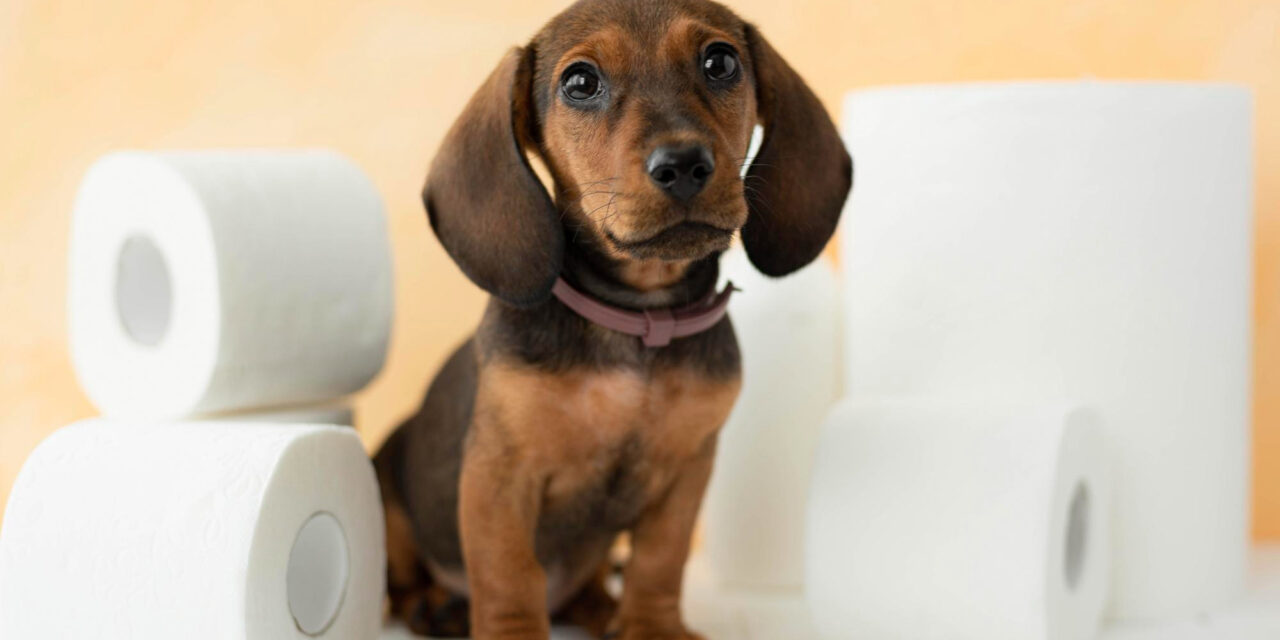
Potty training a puppy comes down to a fairly simple trade: you control where and when your puppy gets the chance to go, and you make going outside pay better than going inside. Most puppies get there through frequent, predictable trips outdoors — roughly every one to two hours while they’re awake, plus right after meals, naps, and play — with you standing out there to reward the moment it actually happens. That’s the whole engine. Everything else in potty training puppy routines is detail stacked on top of it: what you do in an apartment with no yard, how you handle the accident that already happened, and how you tell a normal setback from something your vet should see.
If you’re searching “potty training puppy” advice at midnight after the third accident this week, here’s the short version: there’s no fixed number of weeks where every puppy graduates. A confident Labrador puppy with a fenced yard and a nervous rescue mix on the eighth floor of a walk-up are solving two different versions of the same problem, and both are still on track. Progress here is individual, not a countdown.
This guide walks through the schedule that does most of the work, how to adapt it to a house, an apartment, or a high-rise, what a real accident protocol looks like, and when accidents stop being a training question and start being a veterinary one.
What’s in this guide
- How to potty train a puppy: the core method
- What changes your puppy’s potty training timeline
- A potty training schedule by age
- Potty training by housing type: yard, apartment, and high-rise
- Crate-assisted potty training
- The accident protocol: what to actually do
- Keeping an accident log
- Nighttime: bladder control and overnight breaks by age
- When house soiling is medical, not behavioral
- Multi-dog households and picking up cues
- Regression: when a trained puppy starts having accidents again
- Common potty training mistakes
- Frequently asked questions
- Sources
How to potty train a puppy: the core method
Potty training a puppy works because dogs repeat what pays off. A puppy who empties his bladder outside and gets rewarded for it learns that outside is the profitable option. A puppy who’s never given the chance to succeed outside, or who gets rewarded after wandering back indoors, learns something else entirely — usually by accident.
The method itself has three moving parts, and none of them are complicated on their own.
- Take your puppy out often, on a predictable schedule. VCA Animal Hospitals’ housetraining guidance recommends outings roughly every one to two hours while your puppy is awake, plus every 30 minutes during high-energy play, immediately after meals or a big drink of water, right after waking from a nap, and at least every four hours even during quiet rest. That sounds relentless in week one. It gets easier fast, because most of those trips end in nothing more dramatic than a quick sniff and a walk back inside.
- Go outside with your puppy — don’t just open the door. This is the step people skip when they’re tired, and it’s the one that matters most. If you send your puppy into the yard alone, you have no idea whether he actually went, and you’ve lost your chance to reward the moment it happens.
- Reward immediately, outdoors, before you go back inside. Praise or a small treat within a couple of seconds of your puppy finishing, while you’re both still standing on the grass or the sidewalk. Reward him after you’re back in the kitchen and you’ve just rewarded coming inside, which is a real behavior but not the one you’re after.
The one sentence version
Go out together, wait for it, reward it outside, immediately. Everything else in this guide is a variation on making that sequence possible in your specific home, with your specific puppy, on your specific schedule.
What you actually need to get started
The supply list is shorter than most starter kits suggest. A leash and a well-fitted harness or collar, small soft treats your puppy will work for reliably, poop bags staged somewhere you won’t forget them, and an enzymatic cleaner bought before you need it rather than after. A specific “good dog” marker word, said the instant he finishes, helps him connect the exact moment to the reward that follows a second or two later.
Everything past that — bells, pads, litter boxes, long lines — is a housing-specific add-on covered in the sections below, not a requirement for every household.
Most of what looks like a stubborn puppy is actually a scheduling gap. He wasn’t given the chance to succeed outside at the moment his body needed to go, so he found somewhere closer. That’s not defiance. It’s plumbing.
Why timing beats correction every time
A puppy connects a reward, or a correction, to whatever he’s doing in roughly that same second. Reward him the moment he finishes outside and he links “this” to “that felt good.” Scold him for a puddle you found ten minutes later, and there’s nothing for him to connect it to — he wasn’t mid-elimination when you got upset, so the lesson doesn’t land where you want it. What he does learn is that you sometimes get tense around puddles, which is a very different and much less useful lesson.
This is the single biggest reason potty training puppy plans stall out: owners expect the correction to do the teaching, when it’s actually the reward’s job, delivered at the right second, in the right place.
Teaching your puppy to signal: bells and other cues
Once the basic outside-and-reward pattern is fairly solid, many owners add a signal — a bell hung at nose height by the door, a specific bark cue, or simply standing at the door — so the puppy has a way to ask rather than you guessing off a schedule alone. Hang the bell where he can reach it with his nose or a paw, then help him ring it on purpose every time you’re about to head out together: nudge his nose toward it, mark the ring, open the door immediately. Repetition builds the connection between ringing and going outside far faster than waiting for him to discover it on his own.
Two honest caveats worth knowing before you set this up. Some puppies turn the bell into a fun toy rather than a genuine signal, ringing it out of boredom or to get attention rather than because they need to go — if that happens, still take him out calmly every time, but don’t reward extra attention for ringing without following through outside. And a bell doesn’t replace your schedule; it supplements it, especially useful once your puppy has more reliable control and genuinely needs to communicate an off-schedule urge rather than being taken out on a fixed clock.
What changes your puppy’s potty training timeline
A handful of real factors shift how long this takes and how it should look in your house. None of them are excuses to skip the basics — they just tell you where to put your effort.
- Age. A very young puppy has less physical bladder capacity and less voluntary control, full stop. You’re not fighting bad habits in an 8-week-old; you’re working around biology that hasn’t finished developing.
- Size. Small-breed puppies generally have smaller bladders relative to how much they eat and drink, which often means more frequent trips than a big-breed puppy needs at the same age.
- Housing type. A yard three steps from the back door is a different logistical puzzle than a fourth-floor walk-up with no elevator. Both are solvable; they’re just solved differently, which is most of what this guide covers.
- History before you got him. A puppy who spent his first weeks in a crowded pet store cage or a crate too small to avoid his own waste may have a weaker instinct to keep his sleeping area clean, and often needs a slower, more deliberate rebuild of that habit.
- Household consistency. Multiple people, different schedules, different rules about the couch and the yard — every inconsistency slows things down. A puppy who gets three different sets of expectations from three different people takes longer to find the pattern in any of them.
- Health. Parasites, a urinary tract infection, or a sensitive stomach can make a puppy who’s doing everything right still have accidents. That’s covered in detail later in this guide.
None of these factors changes the core method. They change your patience budget, your schedule’s tightness, and how much you lean on the housing-specific adaptations below.
A potty training schedule by age
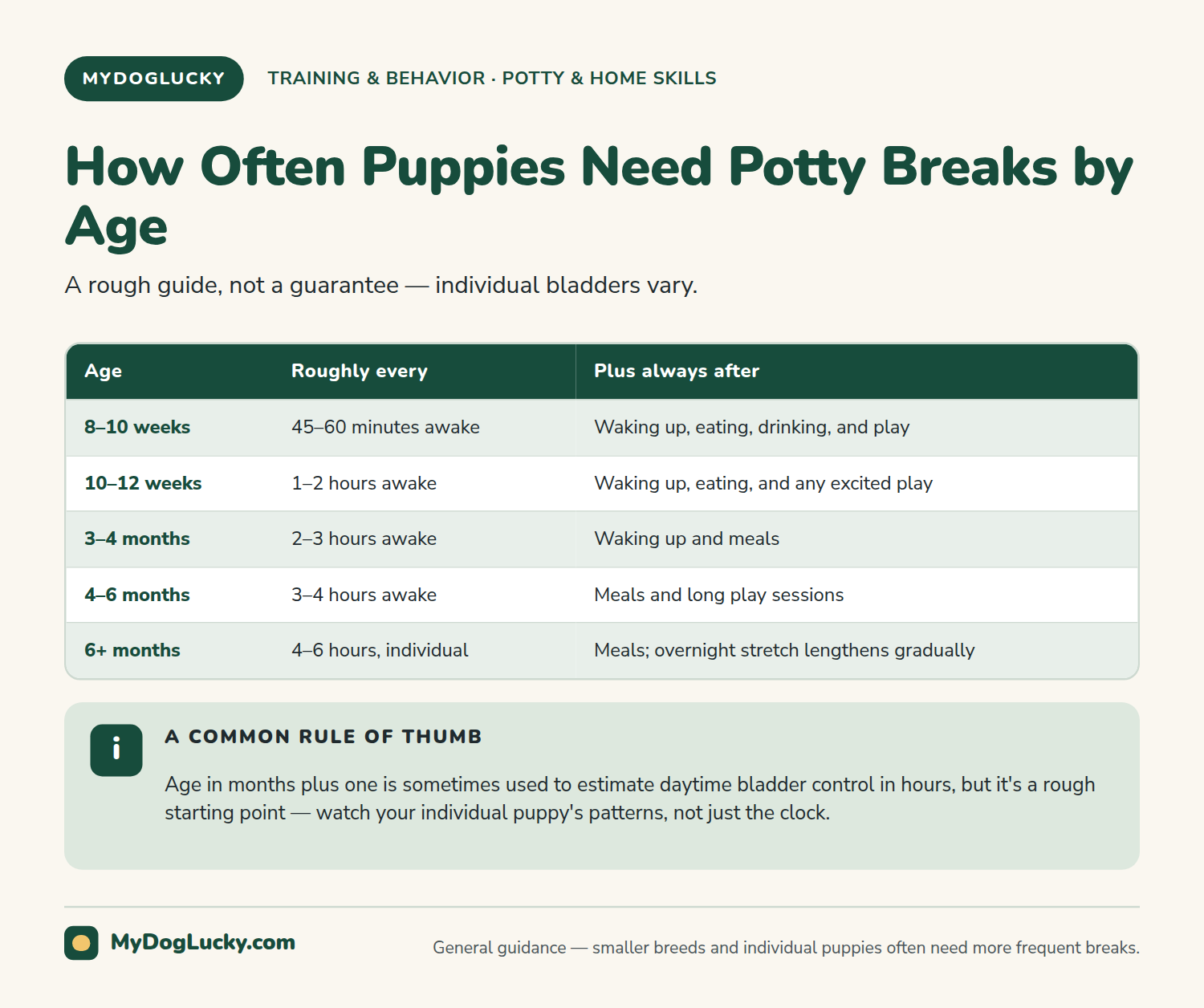
AKC’s rough rule of thumb: take your puppy’s age in months, add one, and that’s roughly the maximum number of hours he can comfortably hold it between breaks during the day. A 3-month-old puppy, by that math, tops out around four hours — and that’s a ceiling for daytime waking hours, not a target to aim for. In practice, younger puppies need breaks well inside that ceiling, especially around meals, naps, and play.
This table is a starting point, not a guarantee. Individual puppies vary, and the “every 1–2 hours while awake” baseline from VCA applies underneath all of it.
| Age | Daytime breaks | What’s typical at this stage |
|---|---|---|
| 8–10 weeks | Every 30–60 minutes while awake, plus after every meal, nap, and play session | Very little bladder control; accidents are the norm, not a sign anything’s wrong |
| 10–12 weeks | Roughly every 1–2 hours | Starting to show early signs before going — sniffing, circling, heading toward the door |
| 3–4 months | Every 2–3 hours | Can hold it longer between scheduled breaks; still needs the after-meal and after-nap rule |
| 4–6 months | Every 3–4 hours | Most puppies are becoming reliable with a consistent schedule; overnight breaks often still needed |
| 6 months and up | Every 4–6 hours | AKC notes most puppies who started early are usually dependable outside by around 6 months — with individual variation still normal |
Treat “6 months” as a general marker, not a deadline. Plenty of puppies take longer, especially small breeds, puppies from rougher starts, or households where the schedule wasn’t consistent early on. A slower timeline isn’t a sign you’re doing it wrong.
Potty training by housing type: yard, apartment, and high-rise
The core method doesn’t change based on where you live. How you execute it does — a lot. This is the piece most generic potty training puppy advice skips, and it’s usually the actual sticking point for anyone who isn’t working with a fenced yard right outside the back door.
House with a yard
This is the easiest version logistically, and it still has a few common failure points worth naming. The biggest one: sending your puppy out alone because the yard is fenced and “he’ll be fine.” He might be fine, but you won’t know whether he actually went, and you’ll miss the two-second window to reward it. Go out with him even when it would be more convenient not to, at least until his habit is solid.
Pick one or two consistent spots in the yard for potty breaks, at least at first. A consistent location builds a scent cue that speeds up the whole process — your puppy learns that spot means business, the same way a consistent bedtime routine tells a kid it’s time to wind down. Once the habit is solid, most owners loosen this up without any trouble.
Weather isn’t a reason to skip the trip
A puppy who’s never asked to potty in the rain, snow, or summer heat can develop a real aversion to it later, which becomes its own problem on the first genuinely miserable weather day. Keep taking him out in ordinary bad weather from the start, with appropriate gear if needed, so foul weather isn’t a novel and upsetting experience down the line.
Apartment or high-rise with no immediate outdoor access
This is where the standard advice starts to strain, and where a lot of owners feel like they’re failing a system that was never built for their building. It wasn’t. Adjust the system instead.
The math is the constraint: a puppy who needs to go every 30–90 minutes and a building with a five-minute elevator-and-lobby trip each way don’t mix well, especially in the early weeks. A few adjustments make this workable:
- Keep a leash, poop bags, and shoes staged by the door so a potty run doesn’t cost you three extra minutes of searching for things while your puppy’s window closes.
- Learn your puppy’s specific warning signs — sniffing, circling, sudden stillness, heading for a particular corner — and treat them as a hard stop, not a “let me finish this email” moment.
- Use an indoor bridge option (covered below) for the gap between “needs to go now” and “can physically get outside in time,” rather than gambling on speed every single time.
- Time your elevator trips around your puppy’s actual schedule, not the building’s quiet hours. A 2 a.m. elevator ride with a puppy is nobody’s favorite errand, but it beats the alternative.
For a puppy with no ground-floor door and a demanding schedule, a rooftop or balcony patch of artificial turf can work as a supplement — but check your lease first, since some buildings restrict what can be kept on a balcony or in shared spaces.
Multi-story townhouse or building with stairs
This one gets less attention than apartments, but it’s a genuinely different puzzle: you may have an actual yard or ground-floor door, just not on the same level your puppy spends most of his time on. Stairs add both a physical and a timing obstacle a single-story home doesn’t have.
- Carry very young puppies down stairs rather than letting them navigate a full flight during an urgent potty run — it’s faster, and it avoids the fall risk of a small, uncoordinated puppy trying to hurry down steps built for adult human legs.
- Set up your puppy’s daytime base on the level closest to the door he’ll use most, at least during the first few months, so the trip out is as short as physically possible.
- Puppy stairs or a ramp can help a small or short-legged breed manage stairs independently sooner, once he’s old enough that a vet has cleared him for that kind of repeated joint stress.
- Watch older, larger dogs on stairs too — a big puppy going through an awkward growth spurt can be surprisingly clumsy on stairs he normally handles fine, especially when he’s in a hurry.
If stairs are a genuine bottleneck no matter how you arrange things, the indoor bridge option below often carries more of the daytime load here than it would in a single-story home, simply because the physical trip takes longer no matter how quickly you move.
Litter box and pee-pad transitional options
Indoor options — pee pads, puppy litter boxes filled with absorbent pellets, or turf patches — aren’t a lesser version of potty training. They’re a legitimate bridge for very young puppies, small-bladdered breeds, high-rise living, or any household where “outside within 90 seconds” simply isn’t realistic every single time.
The setup mirrors the outdoor method almost exactly: pick one consistent indoor spot, away from food and water and away from where your puppy sleeps, and take him there the same way you’d take him outside — on the same schedule, with the same reward the moment he goes. AKC’s guidance on indoor training notes that puppies develop real preferences for the surface under their feet, so if the first pad or litter type doesn’t click, trying a different texture is a reasonable next move before assuming the method has failed.
One location at a time
If you’re running both an indoor spot and outdoor trips from day one, teach them somewhat sequentially rather than expecting your puppy to generalize both immediately — AKC’s trainers specifically flag this as a common stumbling block. Get the indoor spot solid first if that’s your primary plan for now, or lean harder on outdoor trips if that’s the long-term goal, and treat the other as backup rather than co-equal from week one.
Phasing out pads when the long-term goal is outdoor-only
A lot of apartment owners start with pads out of necessity and want off them eventually. That transition goes more smoothly with a plan than without one.
- Move the pad gradually closer to the door over a week or two, a few feet at a time, so the association shifts from “this room” to “near the exit.”
- Take a used, lightly soiled pad or a bit of the litter outside with you and place it at the new outdoor spot. AKC specifically recommends this: the familiar scent helps your puppy connect the new location to the established habit, rather than starting from zero.
- Reduce pad availability as outdoor success increases — down to one pad, then none, tracking your puppy’s actual success rate rather than a fixed calendar date.
- Expect a few accidents during the switch. This is a genuine change in the rules from your puppy’s point of view, and a short bumpy patch during the transition isn’t a sign it’s failing.
Some households keep one pad or litter box permanently as a backup for bad weather, illness, or a senior dog’s aging bladder later in life — and that’s a completely reasonable long-term setup, not a failure to “finish” potty training.
Crate-assisted potty training
A crate is one tool inside a potty training plan, not the plan itself. It works because most puppies have a strong instinct not to soil the area they sleep in — so a properly sized, properly introduced crate limits a puppy’s access to the rest of the house during the hours you can’t watch him directly, which is exactly when accidents tend to happen.
The crate has to be the right size: big enough to stand, turn around, and lie down comfortably, but not so large that your puppy can sleep in one corner and eliminate in the other, which defeats the entire purpose. A crate with a divider panel lets you size it up as he grows instead of buying three crates over a year.
A crate is management, not a fix on its own
A puppy who’s crated for hours beyond what his bladder can handle will have an accident in there, and that’s on the schedule, not the puppy. Crate time still has to respect the same age-based limits covered in the schedule section above — it doesn’t buy you extra hours.
How to introduce the crate itself, build positive associations, and handle a puppy who protests being confined is its own topic with enough depth to deserve separate treatment — MyDogLucky’s guide to crate training your puppy covers that groundwork in full. For potty training purposes, the short version: once your puppy accepts the crate calmly, use it for short stretches when you can’t supervise directly, and go straight outside the moment he comes out, every time, before anything else happens.
Tethering: a crate alternative for supervised time
Some owners prefer, or add, a tether method during waking hours: a short leash clipped to your belt or a nearby piece of furniture keeps your puppy within arm’s reach while you’re home and moving around the house. It’s not a substitute for crate time when you’re out or asleep, but it solves a different problem — the puppy who wanders off into another room for thirty seconds and has an accident nobody saw coming. If he’s always within your sightline, the early warning signs (sniffing, circling, sudden stillness) are much harder to miss.
A tether works best alongside the crate and the schedule, not instead of either one. Think of it as one more way to prevent an unsupervised accident from happening in the first place, which is most of what potty training actually is in the early weeks.
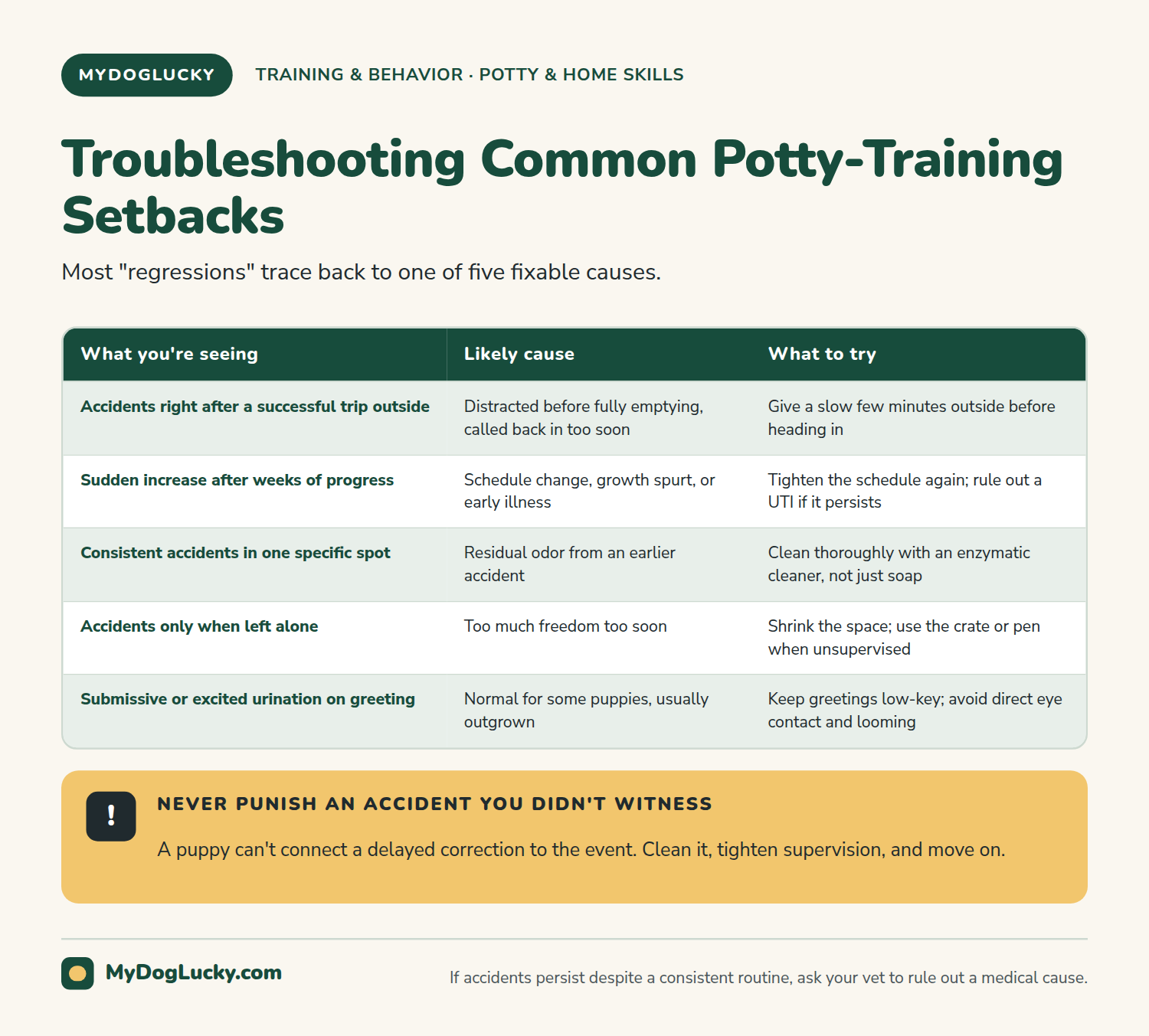
The accident protocol: what to actually do
Accidents are part of potty training a puppy. They’re not a sign the method is broken, and how you handle the next sixty seconds matters more than how frustrated you feel about it.
If you catch him mid-accident
Interrupt gently — a light clap, a cheerful “outside!,” anything that breaks his focus without frightening him — then scoop him up or walk him quickly to the right spot to finish. VCA’s guidance is specific on the tone here: the goal is to interrupt without scaring, since a startled puppy just learns that going to the bathroom around you is unpredictable and a little scary, which makes the whole process harder, not easier.
If you find it after the fact
There’s genuinely nothing useful to do here except clean it up. Not a stern voice, not pointing at the spot, not walking him over to look at it. He can’t connect a consequence delivered minutes or hours later to something he did earlier — that link simply isn’t how his brain works in the moment, no matter how deliberate the pause between the act and your reaction feels to you.
Never punish an accident, found or caught
Rubbing a puppy’s nose in it, scolding him, or any physical correction doesn’t teach him where to go. What it reliably teaches is that eliminating near you is dangerous — and the common result is a puppy who starts sneaking behind furniture or into back rooms to go, which is a harder problem to solve than the one you started with. Both ASPCA and VCA’s housetraining guidance are blunt about this: punishment after the fact doesn’t work, and it can make things measurably worse.
Why an enzymatic cleaner matters more than it seems like it should
Ordinary household cleaners lift the visible mess, but they don’t fully break down the proteins in urine that give it its scent signature to a dog’s nose — which is vastly more sensitive than a human’s. That residual scent acts as an invitation to use the same spot again. Enzymatic cleaners are formulated specifically to break those compounds down at a molecular level rather than just masking them with fragrance, which is the actual reason they outperform a general-purpose spray for this job. It’s a small product swap that removes one of the most common reasons the same corner keeps getting used.
Skip ammonia-based cleaners on pet accidents
Ammonia is a natural breakdown product of urine, so an ammonia-scented cleaner can actually smell more like “go here” than “go elsewhere” to a dog’s nose, working against you rather than for you. Stick with a cleaner labeled specifically for pet urine and enzymatic breakdown, follow the label’s soak or dwell time, and blot rather than scrub on carpet or upholstery so you’re not just spreading the residue deeper into the fibers.
That “guilty look” isn’t what it seems
Plenty of owners describe a puppy who looks “guilty” the moment they walk in and spot an accident — ears back, tail low, maybe slinking away. It’s tempting to read that as an admission. Research on this specific behavior, notably Alexandra Horowitz’s 2009 study published in Behavioural Processes, found that the “guilty look” tracks with an owner’s scolding behavior in the moment, not with whether the dog had actually done anything wrong — dogs displayed the same appeasement posture whether or not they’d had an accident, based purely on how the owner reacted.
In plain terms: your puppy is reading your face, posture, and tone right now, not reconstructing what he did an hour ago and feeling bad about it. He’s very good at the first thing and not equipped to do the second. That distinction matters because it removes the last bit of justification for after-the-fact correction — there’s no guilt being confirmed, just a puppy responding to your mood in real time.
Keeping an accident log
Three days of accidents can feel like total chaos from the inside. On paper, they usually reveal a pattern almost immediately — a specific gap in the schedule, a specific room, or a specific trigger you hadn’t connected before.
Log three things per incident: the time, the location, and what happened in the twenty minutes before it. That third column is where the useful information usually hides.
| Time | Location | What happened in the 20 minutes before |
|---|---|---|
| 7:40 a.m. | Kitchen, by the back door | Woke up, ate breakfast at 7:20, was playing with a toy — no potty break offered after the meal |
| 2:15 p.m. | Living room rug | Napped from 1:00–2:10, nobody noticed he’d woken up yet |
| 6:05 p.m. | Hallway near guest room | Left alone in a new room for the first time while visitors unpacked; no scheduled break in over 2 hours |
Look at that log for a week and patterns tend to jump out fast: every accident clusters right after meals, or right after naps, or in a specific room he hasn’t been supervised in yet, or on days a particular family member’s schedule shifted. Once you can see the gap, you can close it — add a break after breakfast, put a bell on the nap timer, restrict access to the new room until it’s been through a few supervised visits.
The log isn’t just for you
If accidents keep happening despite a genuinely consistent schedule, this log is exactly what a trainer or your veterinarian needs to see. It turns “he’s just not getting it” into specific, useful data — a much faster starting point for anyone trying to help you troubleshoot from the outside.
Nighttime: bladder control and overnight breaks by age
Overnight is where a lot of otherwise-consistent daytime schedules fall apart, mostly because nobody wants to set a 2 a.m. alarm more than once. VCA’s guidance puts the overnight-outing window at up to around five months of age for many puppies, though this varies by individual and by size.
A workable overnight approach:
- Pick up water roughly 2 hours before bedtime for young puppies, and take a final potty break right before lights out — not just “on the way to bed,” but the actual last thing before settling in for the night.
- Set an alarm for a middle-of-the-night break for puppies under around 4 months, rather than waiting for crying to wake you. A puppy who’s learned that crying gets him let out is a puppy who’ll keep crying strategically, not just out of genuine need.
- Keep the overnight break boring. Minimal lights, minimal talking, minimal play — straight out, straight back to bed. An overnight trip that turns into a 20-minute play session teaches your puppy that waking up is worth doing on purpose.
- Stretch the overnight interval gradually as your puppy shows consistent dry nights, rather than dropping the middle-of-the-night break all at once. Add 30–60 minutes to the gap every several nights of success, and back off if accidents return.
A rough overnight guide by age
Under 3 months: often needs at least one overnight break, sometimes two for very young or small-breed puppies. 3–4 months: many puppies can stretch to one middle-of-the-night break, or occasionally none with a late final trip. 4–6 months: many puppies start sleeping through, though this varies meaningfully by individual and shouldn’t be treated as a hard deadline. This is general guidance, not a fixed schedule — some puppies need longer, and that’s still within normal range.
When house soiling is medical, not behavioral
A previously reliable puppy who suddenly starts having accidents again deserves a veterinary visit before a revised training plan. This is the single most important troubleshooting rule in this entire guide, and it’s the one most often skipped because a training explanation feels more within our control than a medical one.
VCA’s behavior resources list a range of medical contributors worth ruling out, described here in general terms rather than as a self-diagnosis checklist:
- Urinary tract issues — infections, cystitis, or bladder stones can create urgency and frequency a puppy simply can’t out-schedule, no matter how well-trained he otherwise is.
- Intestinal parasites — common in young puppies and can cause diarrhea and urgency that overwhelm normal bladder-and-bowel timing.
- Digestive issues — inflammatory bowel disease, food sensitivities, or general digestive upset can all increase frequency and urgency beyond what a schedule can accommodate.
- Incontinence — inadequate bladder or bowel sphincter control, which looks different from a normal accident because it often happens without the puppy seeming aware it occurred, sometimes during sleep or rest.
- Other systemic conditions — several broader illnesses can increase thirst, urination frequency, or urgency as a secondary effect.
None of this is a diagnosis you can make from a blog post, and it isn’t meant to be. The point is narrower: if a puppy who was doing fine suddenly isn’t, don’t assume you loosened the schedule too fast or he “forgot.” Rule out the medical side first, because training a medical problem wastes real time and doesn’t work.
| What you might notice | Behavioral gap or medical, in general terms |
|---|---|
| Accidents cluster right after meals or naps, mostly in one room | Usually points to a schedule gap — see the accident log section above |
| Frequent small dribbles, straining, or visiting the spot repeatedly with little output | Worth a vet visit — can suggest a urinary tract issue rather than a training gap |
| Accidents happen minutes after a successful, complete outdoor trip | Worth a vet visit, especially if new — can point to urgency the schedule alone can’t fix |
| A previously reliable puppy regresses gradually alongside a household change | Often behavioral — see the regression section below |
| A previously reliable puppy regresses suddenly with no clear household change | Worth a vet visit before assuming it’s behavioral |
This table is a general sorting tool, not a diagnosis. When in doubt, a phone call to your vet’s office costs little and rules a lot out.
What tends to point toward “get this checked”
Straining to urinate, blood in urine or stool, drinking noticeably more water than usual, accidents that happen very soon after a successful outdoor trip, sudden onset in a previously reliable puppy, or accidents alongside other changes like lethargy or appetite shifts. Any of these is worth a call to your vet rather than a wait-and-see approach.
Multi-dog households and picking up cues
A new, untrained puppy joining a household with an existing dog is learning from two teachers at once — you, and the resident dog, whether or not you intended the second one.
This cuts both ways. A calm, reliably housetrained resident dog can genuinely speed up the process: puppies are social learners, and a puppy who watches an older dog head straight for the door and get rewarded outside often picks up the pattern faster than one working it out alone. Some of that is imitation, and some of it is simpler — the resident dog’s confident, low-key behavior around potty breaks tends to lower a nervous puppy’s stress about the whole routine.
It also means bad habits transfer. A resident dog who marks indoors, sneaks accidents in a specific low-traffic room, or has developed his own workarounds can pass those along just as easily as good habits. If your older dog has a known habit like this, address it in parallel rather than assuming the new puppy will somehow avoid picking it up.
- Take both dogs out together when practical, especially early on — it reinforces the pattern for the puppy without doubling your own workload.
- Reward each dog individually at the moment of success, rather than a single general “good dogs” for the pair, so the puppy clearly connects his own behavior to his own reward.
- Watch for resource competition around the door or the yard itself, which can create rushed, incomplete potty breaks for whichever dog backs off first.
- Supervise the puppy separately, too, at least for a while — an older dog’s presence is a helpful cue, not a substitute for your own eyes during the early weeks.
Regression: when a trained puppy starts having accidents again
A dog who was doing fine and suddenly isn’t hasn’t erased weeks of progress — something in his world usually changed, and the accidents are a symptom of that change rather than a step backward in the relationship. Common triggers include a household move, a new pet or family member, a shift in someone’s work schedule that changed the potty routine, a change in food or water access, or any stretch where the consistent schedule quietly slipped for a week or two without anyone noticing.
Adolescence adds its own wrinkle. Many dogs go through a stretch in the second half of their first year — often somewhere between 6 and 18 months, and it varies a lot by individual and breed — where previously solid skills get sloppy across the board, not just potty training. That’s not the training failing; it’s a developmental stretch that most dogs grow through with continued consistency, not a signal to start over from scratch.
Reset without treating it as a setback
Go back to the tighter version of the schedule that worked before — more frequent breaks, going outside together every time, rewarding immediately — for a couple of weeks, and loosen it again gradually once accidents stop. This is a reset in the schedule, not a reset in your relationship with your dog, and it doesn’t need to feel like starting over from puppyhood.
And, worth repeating from the section above: rule out a medical cause first if the regression is sudden and the schedule genuinely hasn’t changed. A dog who was reliable for months and abruptly isn’t is telling you something, and “he got lazy” is rarely the actual answer.
Common potty training mistakes
Inconsistent schedule
A schedule that’s tight on weekdays and loose on weekends sends mixed signals a puppy can’t sort out on his own. Pick a schedule the whole household can actually maintain seven days a week, even if it’s a slightly looser one, rather than an ambitious plan that only survives Monday through Friday.
Punishing accidents
Covered in detail above, and worth repeating here because it’s the single most common mistake this guide sees: punishment after the fact doesn’t teach location, it teaches your puppy to hide the behavior from you. That trade is never worth it.
Giving too much freedom too soon
A puppy who’s had a good week or two of success doesn’t automatically get full run of the house. Freedom should expand gradually — one room at a time, tracked against a real success rate, not a feeling that things are going well. Unsupervised access to a new room is exactly when a comfortable puppy has his next accident. A reasonable pace: after roughly two consecutive weeks without an indoor accident in the rooms he already has access to, add one additional room, supervised at first, and hold there before adding the next.
Skipping the reward-outside step
Rushing back inside the moment your puppy finishes, without pausing to reward him on the spot, is an easy habit to fall into on a cold morning. It’s also one of the most common reasons progress stalls despite an otherwise solid schedule. The reward has to land outside, in the moment, every time, until the habit is genuinely fluent.
Treating pads and outdoor trips as interchangeable from day one
Running both systems at once without a clear primary location confuses the pattern your puppy is trying to build. Pick a primary approach for right now, use the other as deliberate backup, and follow the phase-out plan above when you’re ready to consolidate.
Assuming an accident-free week means the job is done
A single good week is a promising sign, not a finish line. Puppies regress, adolescence happens, and routines change — keep the schedule reasonably tight for longer than feels necessary before assuming the habit is fully locked in.
Frequently asked questions
How long does potty training usually take?
There’s genuinely no universal number. Many puppies are largely reliable by around 4 to 6 months with a consistent schedule, but plenty take longer, especially small breeds, puppies with a rough start, or households where the routine wasn’t consistent early on. Think in terms of trend, not deadline — are accidents getting rarer over weeks, not days.
My puppy is trained outside but has accidents indoors when excited — why?
Excitement urination is a different mechanism from a scheduling gap, and it’s common in young puppies, especially around greetings and high-energy play. It usually fades with maturity and calmer greeting routines — keeping arrivals low-key, greeting at ground level rather than looming over him, and giving him a moment to settle before intense play — rather than through the same schedule-based fixes covered above.
Do pee pads slow down outdoor training?
Not inherently, though running both systems without a clear primary can create genuine confusion, since your puppy is essentially learning two acceptable locations at once. A deliberate phase-out plan, like the one covered above, tends to work better than an indefinite hybrid approach if outdoor-only is your actual goal.
What if I live on the 10th floor?
Lean harder on an indoor bridge option for the early weeks — a pad or litter box near the door — while you build toward outdoor trips at a pace your building’s logistics can actually support. Staging leash and shoes by the door, learning your puppy’s specific warning signs early, and timing elevator trips around his real schedule rather than your convenience all matter more in a high-rise than they do at ground level.
Should I limit water before bed?
Picking up water roughly 2 hours before bedtime for young puppies is a reasonable, commonly recommended practice — not restricting water during the day, just managing the timing heading into an overnight stretch where breaks are less frequent.
Is a doggy door a shortcut around all of this?
It can help once your puppy already understands that outside is where potty happens, but it doesn’t teach that concept on its own. A puppy given free access to a doggy door before the core habit is built often just wanders in and out without connecting the door to the behavior you actually want.
My puppy goes potty almost immediately after coming back inside — what’s happening?
This is often a sign the outdoor trip ended too soon, before he was actually finished, or that he didn’t fully relax enough outside to go. Try extending the outdoor time a bit, especially in a new or distracting environment, and make sure you’re genuinely waiting him out rather than treating the trip as done the moment he seems interested in heading back.
Do male and female puppies potty train differently?
The core mechanics are the same. Male dogs often begin leg-lifting and marking behavior around adolescence, which is a separate behavior from house soiling and usually responds to the same consistent supervision and management rather than a different training approach.
What if my puppy has an accident in the crate?
Check the schedule first — a crate stretch longer than your puppy’s current bladder capacity is the most common cause, not a training failure. Clean it thoroughly with an enzymatic cleaner, and shorten crate intervals to match his actual current capacity rather than the interval you’re hoping to reach.
Is it normal for an older puppy to regress during adolescence?
Yes — many dogs go through a sloppier stretch somewhere in their first year where previously solid skills, potty training included, get less reliable for a while. It’s a developmental phase for most dogs, not evidence the original training didn’t work, and it typically improves with continued consistency.
How do I clean an accident on carpet versus hardwood?
Both need an enzymatic cleaner rather than a general-purpose spray, since the goal is breaking down the scent compounds a dog can detect, not just visible cleanup. On carpet, blot rather than rub to avoid pushing the accident deeper into the padding, and follow the product’s soak time rather than wiping it off immediately.
When can I trust my puppy loose in the house unsupervised?
Gradually, and based on a genuine track record — commonly after several consecutive weeks without an indoor accident, expanded one room and one unsupervised stretch at a time, rather than all at once. If accidents return after expanding freedom, scale back rather than pushing through.
Does having another dog in the house make potty training easier or harder?
Often easier, since puppies learn a lot by watching a calm, reliably trained resident dog head outside on cue. It’s not automatic, though — supervise the puppy individually too, and address any of the resident dog’s own bad habits in parallel so they don’t transfer along with the good ones.
Do some breeds take longer to potty train than others?
Small-breed puppies are commonly reported as slower, largely because a smaller bladder needs more frequent trips and any schedule gap shows up faster. Individual variation within a breed usually matters more than the breed label itself — a laid-back, food-motivated puppy of almost any breed tends to pick this up faster than an easily distracted one.
What if I adopted an older dog who was never reliably potty trained?
The same core method applies at any age — frequent scheduled outings, going out together, rewarding immediately outside. Start with the tighter end of the schedule regardless of his age, since you’re establishing a new habit rather than refreshing an old one, and rule out medical causes early given that an adult dog with no house-training history sometimes has an untreated medical contributor rather than a pure training gap.
Sources
- VCA Animal Hospitals. House Training Your Puppy
- VCA Animal Hospitals. Dog Behavior Problems: House Soiling
- American Kennel Club. Puppy Potty Training Schedule: A Timeline for Housebreaking Your Puppy
- American Kennel Club. How to Potty Train a Dog When You Live in an Apartment
- American Kennel Club. How to Potty Train a Puppy on Pads: Indoor House Training for Puppies
- American Kennel Club. Housetraining Dogs: Puppy Potty Pad and Paper Training
- ASPCA. House Training Your Dog or Puppy
- American Veterinary Society of Animal Behavior. Humane Dog Training Position Statement (2021)
- Horowitz, A. Disambiguating the “guilty look”: salient prompts to a familiar dog behaviour. Behavioural Processes (2009).
This article is general education for U.S. dog owners. It is not individualized training or veterinary advice for your puppy. A sudden change in a previously reliable dog’s bathroom habits, or accidents alongside other symptoms, is a reason to contact your veterinarian rather than adjust the schedule further.


Trackbacks/Pingbacks