
Your puppy first night home will probably be short on sleep and long on opinions. That’s normal. Your puppy just left the people, smells, and sounds he knew, and now he’s in a quiet room that smells like strangers. A few whimpers at midnight don’t mean you made a mistake.
The short version of a good plan is simple. Give him a small, safe sleep spot close enough that he can hear you. Take him out right before bed.
Answer night cries by checking needs first, then keeping everything calm and dull. Expect at least one potty trip after lights out, because young puppies can’t hold it all night yet.
This guide walks through the whole evening, from arrival day to the 2 a.m. trip. You’ll find a sleep-spot checklist, a routine you can copy, two illustrative sample nights, a “why is he crying” decision guide, and a clear list of warning signs that mean you should call your vet.
It won’t teach the full crate method. That lives in a separate topic on crate training a puppy.
What’s in this guide
- Puppy first night home: the short answer
- Why the first night feels so big to a puppy
- Arrival day: quiet, short, and a little boring
- Where your puppy should sleep
- Bedding, temperature, and what stays out
- Your set-up checklist before bedtime
- The evening routine: play, potty, calm, bed
- Last meal and last water
- Night potty trips: how often and how to keep them boring
- What to do when your puppy cries
- Should your puppy sleep in your bed?
- Two illustrative sample nights
- Who takes the 2 a.m. trip?
- What to expect on nights 1 to 7
- Normal fussing vs. real stress
- Call your vet now: warning signs on any night
- Vaccination status and where your puppy can go
- When your setup isn’t the standard one
- Common mistakes on the first night
- Your puppy first night home checklist
- Common questions about the first night
- Where to start tonight
- Sources
Puppy First Night Home: The Short Answer
A workable first night has five parts. A quiet evening, a last potty trip right before bed, a snug sleep spot near you, one or two calm night trips, and a plan for the cries. That’s the whole recipe. Everything else in this guide is detail and troubleshooting.
The American Kennel Club (AKC) suggests putting the crate in your bedroom, because a puppy often feels more secure with you nearby. It also suggests a blanket or stuffed toy that smells like his mother. If he whines, you can rest a hand inside the crate to reassure him. Meanwhile, AKC notes that young puppies usually can’t hold their bladders through the night until around 4 to 5 months old.
So the real question isn’t “how do I get him to sleep through?” It’s “how do I make the wake-ups short, safe, and boring?” You’ll answer that question again and again over the first week.
Before anything else: know the warning signs
A puppy who is limp, hard to wake, refusing food and water, vomiting repeatedly, having repeated diarrhea, breathing with effort, or showing pale gums needs a veterinarian now, not a bedtime tip. Don’t wait for morning. The full list and the “call today” list are in the vet section below.
What most first nights actually look like
A common real-life version goes like this. Your puppy naps through the evening, wakes up wired around bedtime, settles for a while, then cries once or twice in the night. You take him out.
He pees. You both go back to sleep. Many owners find that the first night is harder for the human than for the puppy.
That’s not a promise. Some puppies sleep like tiny stones. Others complain for an hour. Both patterns are within the range of normal, and neither predicts how your dog will turn out.
Why the First Night Feels So Big to a Puppy
It helps to picture your puppy first night home from his side. Until now, he probably slept in a pile, with warm bodies and familiar smells. Tonight, the pile is gone.
The room echoes. The floor smells like new people and new soap. Nothing in the last day matched anything he knew.
You don’t need to read his mind to plan around that. You just need to make the night a little more predictable than the day was.
What a young puppy’s body can and can’t do yet
Very young puppies sleep a lot. VCA Animal Hospitals notes that at 2 months old, a puppy may spend only about 4 to 6 hours a day in active play and engagement. The rest is rest.
That’s why a puppy who seems fine at 8 p.m. can be fully melted by 8:30 and fully awake again at 2 a.m.
His bladder is small, too. AKC describes a rule of thumb: take his age in months, add one, and that’s roughly the longest he should comfortably hold it between potty breaks. AKC adds that puppies usually hold longer while asleep and not active.
Treat that as a rough ceiling, not a promise. It’s a guide, and plenty of puppies need to go sooner.
Why proximity often helps
Many puppies settle more easily when they can hear, smell, and sense a person nearby. That’s the logic behind putting the sleep spot in your bedroom for the first nights. It also makes your job easier. You’ll hear the “I need to go out” whine, which is different from the “I’m bored” whine, and you won’t have to stumble down a hallway to find out.
Proximity isn’t a magic cure for crying. It’s just a helpful starting point. If your setup can’t include the bedroom, there are workable alternatives, covered later.
Arrival Day: Quiet, Short, and a Little Boring
Your puppy first night home starts long before bedtime. How the day goes shapes how the night goes. AKC’s advice for the first day is blunt: minimize stress and excitement, and don’t invite friends and neighbors over to meet the puppy yet. It also suggests introducing family members one at a time and avoiding contact with unfamiliar dogs.
That advice can feel a little cruel when everyone you know wants a puppy cuddle. Still, a crowd of new faces is a lot for a small brain. A puppy who has met eleven people since lunch will often be more wound up at bedtime, not less.
A simple shape for the day
- Go straight to the potty spot. Carry him or walk him there before you go inside, and reward him if he goes.
- Explore in small doses. Let him sniff one room, then another. Keep the tour short.
- Nap early and often. Put him in the sleep spot for naps too, so it’s a familiar place before it’s the night place.
- Keep meals and water on a predictable clock. Note when he eats and drinks. You’ll use that information tonight.
- Save the visitors for later. A week from now is a fine time for the neighborhood parade.
Naps are practice for bedtime
Every nap in the sleep spot is a rehearsal. He learns that the crate or pen is where sleep happens, and that you stay nearby. Short, calm naps there also mean the sleep spot isn’t a mystery on night one.
If he cries during a daytime nap, use the same rules you’ll use at night: check the basics, take him out if he might need to go, then keep it boring. You’re gathering data. Which sounds mean “I need to pee”?
Which mean “I’m overtired”? The answers help at 2 a.m.
Make the vet appointment early
AKC recommends scheduling a veterinary check-up within the first few days. You can do that tomorrow morning. If your puppy comes with paperwork from a breeder, shelter, or rescue, have it on hand.
Your vet will also tell you when he can safely meet other dogs and visit public places. We’ll come back to that in the vaccination section.

Where Your Puppy Should Sleep
Most guidance for a puppy first night home points to one of two setups. A crate or a playpen, placed in your bedroom, close to your bed. Both keep the puppy contained, safe, and near you.
Neither one is a moral choice. Pick the one that fits your space and your puppy’s size.
Here’s how they compare.
| Option | Good for | Watch for |
|---|---|---|
| Crate beside your bed | Small footprint, easy to move, feels den-like, simple to carry out for potty trips | A crate that’s far too big, a puppy who panics when confined, crates placed by a vent or window |
| Playpen beside your bed | More room to stretch, room for a bed on one side and a pee pad or potty area on the other | Climbers who might scale the walls, more mess to clean, more space to explore than some puppies want at night |
| Crate in another room | Households where the bedroom is off limits, or a light sleeper who can’t share a room | Missing the early “I need to go” signals, a puppy who feels more alone, a longer walk at 2 a.m. |
| Bed with you | Some households choose it deliberately, and it can feel comforting | Falls, being rolled on, unsupervised sleep, and harder habits to change later. More on this below. |
Why beside your bed and not across the house
AKC’s first-night advice is to keep the crate in your bedroom, since your puppy will likely feel more secure with you close. It also suggests that if he cries, you can move the crate right next to your bed and put a hand inside. That’s a practical middle ground. He gets contact without getting the whole mattress.
If you can reach down and touch the crate, you can also hear breathing changes, retching, or sudden thrashing. That’s a safety benefit, and it’s easy to overlook.
Size matters more than you’d think
A crate that’s slightly too large can turn into a bathroom with a separate bedroom. A crate that’s too small feels like a trap. Ask your vet or a certified trainer how to size a crate for your puppy’s expected adult size, and use a divider if the model comes with one. Sizing details belong in a full crate-training guide, so this article won’t try to cover them.
If your puppy hates the crate
Some puppies protest a crate loudly, even with a good introduction. That doesn’t automatically mean the crate is wrong. It might mean he needs more daytime practice, a different location, or a playpen instead.
It’s also fine to switch setups if the first one clearly isn’t working. If the distress looks like panic, with frantic scrabbling, drooling, or injured paws, stop and call your vet or a qualified trainer.
Bedding, Temperature, and What Stays Out
Think soft, flat, and supervised. A puppy will spend a lot of the night with his face pressed into whatever you give him. That makes the bedding choice a safety choice, not just a comfort choice.
What to put in
- A flat, washable bed or blanket. Something you can toss in the laundry after the first accident, because there will probably be one.
- A familiar-smelling item. AKC suggests a blanket or stuffed toy that smells like his mother. If your breeder or rescue can send one, ask.
- One sturdy, size-appropriate toy or chew you’ve inspected. Some owners skip toys at night for the first few nights. That’s reasonable, too.
What to leave out
- Loose small items. Anything that could be chewed off, swallowed, or wedged in his throat.
- Frayed or shredding fabric. Puppies pull threads. Threads can become swallowed threads.
- Collars with dangling tags inside a crate. Ask your vet or trainer what they recommend for your setup.
- Anything you haven’t watched him chew for a few minutes. Test items during the day, not at midnight.
That list is practical common sense rather than a standard from a named source. If you’re unsure about a specific item, ask your vet.
Temperature and drafts
Put the sleep spot away from cold drafts, direct sunlight, and vents that blow hot or cold air. A room that feels comfortable to you in a T-shirt is usually a fine starting point. Then check on him.
A puppy who is panting, restless, or lying stretched out on bare floor may be too warm. One who is shivering and curled tight may be too cool.
We aren’t giving numeric temperature targets, because we didn’t find a reliable source with one for this article. Your vet can tell you what’s right for your puppy’s size, coat, and age. Small and very young puppies may be more sensitive to temperature swings, so it’s worth asking.
Skip the improvised heat sources
Some sites suggest hot water bottles or heating pads. We’re leaving those out. Heat sources can burn a puppy or overheat a small space, and we didn’t find a source we could cite for safe use. If your puppy seems cold, add a blanket layer he can move away from, and ask your vet.
Your Set-Up Checklist Before Bedtime
Do this in the late afternoon, not at 10 p.m. when everyone is tired and the puppy is loud. A ten-minute setup now saves you a half hour of fumbling later.
- Place the sleep spot. Bedroom, near your bed, away from drafts and vents.
- Add flat bedding and one familiar-smelling item. Check for loose threads and small parts.
- Set a potty route. Know which door you’ll use and where the leash, shoes, and light are. You’ll do this half asleep.
- Leave a light or flashlight ready. A dim light means you don’t have to blast the room and wake everyone.
- Have cleanup supplies handy. Paper towels, a bag, and an enzymatic-style cleaner, described by category. Ask your vet if you’re unsure what suits your floors.
- Charge your phone and set a quiet alarm. If you plan a scheduled night trip, an alarm beats guessing.
- Write down times. Last meal, last water, last potty. A sticky note works fine.
- Agree on roles. If two adults live here, decide who takes which trip. See the household roles section.
A small note on your own gear
You’ll want a sweatshirt by the bed, slip-on shoes by the door, and a very low bar for what counts as a good night. Nobody has ever won a prize for a well-styled 2 a.m. potty trip.
The Evening Routine: Play, Potty, Calm, Bed
An evening routine tells your puppy what’s coming. Dogs read patterns well. A repeated sequence before bed becomes a signal, and signals help settling. You’ll build this over several nights, but you can start tonight.
Here’s a simple sequence for your puppy first night home: play, potty, calm down, bed.
Play: use up a little energy, not all of it
An hour or two before bed, offer a short, easy play session. Gentle tug, a soft toy, a slow walk around the yard if your vet has cleared it. AKC also suggests using an evening walk to help with exercise. Check with your vet about what’s appropriate for a puppy who hasn’t finished his vaccines.
Don’t try to exhaust him. An overtired puppy is often a wired puppy. He may get mouthy, zoomy, and impossible to settle. If the play starts to look frantic, end it and switch to calm.
Potty: right before bed, every night
AKC is direct on this one: the last thing you do before bed is take your puppy out for one more potty break. Go to the same spot. Use the same quiet words.
Wait, even if it takes a few minutes. Reward him calmly when he goes.
If he doesn’t go, don’t skip ahead. Bring him inside, keep him in a boring, contained space for a few minutes, then try again. A puppy who plays instead of peeing at 10 p.m. is often the puppy who needs to go at 11:30.
Calm down: lower everything
After the last potty trip, turn the volume down. Dim the lights. Stop the games.
Speak softly. A short massage, a slow stroke along his back, or just quiet time on your lap can help. A chew or a lick mat, if he has one and you’ve checked it’s safe for his age and size, gives him something calm to do.
This is a good moment for a tiny bit of house humor. Puppies don’t understand “it’s late.” They understand “the fun stopped, and the lights went down.” Be the person who makes that easy.
Bed: into the sleep spot, calmly
Carry him or lead him to the crate or pen. AKC suggests giving a small treat when he enters the crate willingly. Say a short, quiet phrase.
Close the door or gate. Sit near for a minute if that helps. Then settle in yourself.
If he cries right away, that’s normal. Check the basics from the crying section below, then wait. Most puppies protest a bit, and many drift off within a short time. Don’t turn the lights on and start a party.
Last Meal and Last Water
Feeding and drinking times affect the night, and they’re also where advice gets slippery. Here’s what we can source, and where the honest answer is “ask your vet.”
The last meal
AKC suggests choosing a puppy food that digests well and avoiding feeding within about two hours of bedtime. That gives his stomach time to work and gives you time for a final potty trip after digestion gets moving. So if bedtime is 10:30 p.m., a last meal around 8:30 p.m. or earlier fits the guideline.
Very young puppies often eat several small meals a day, and the exact schedule depends on age, size, and breed. Don’t shrink or skip a meal to reduce night trips without talking to your vet. Toy and very small puppies can be more sensitive to long gaps between meals, so it’s a question worth asking at your first appointment.
The last water
Many owners pick up the water bowl an hour or two before bed, hoping for fewer accidents. We didn’t find a reliable veterinary source that gives a specific cutoff, so we won’t invent one. Practices vary, so ask yours what suits your puppy’s age, size, and health.
Here’s a middle path many households use. Let him drink freely through the day. Offer a normal drink with the evening meal.
Then take him out for the last potty trip. If your vet says to limit water at night, follow that advice.
A word on thirst
Never take away food or water in a way that leaves a puppy hungry or thirsty for long stretches. If your puppy seems very thirsty, is drinking far more than usual, or is refusing to drink, that’s worth a call to your vet. See the warning-signs section for details.
Keep a simple log
For the first few nights, jot down meal time, last water, last potty, and each night trip. It sounds fussy. It’s also the fastest way to see patterns, and it gives your vet clean information if something seems off. A note on your phone works fine.
Night Potty Trips: How Often and How to Keep Them Boring
For a puppy first night home, plan on at least one trip. That’s the honest answer. AKC’s first-night guidance says young puppies typically can’t hold their bladders through the night until they’re around 4 to 5 months old.
Some do earlier. Many don’t.
The rule of thumb from AKC is age in months plus one hour, as a rough maximum for comfortable holding between breaks. It’s a ceiling and not a target. It also tends to be more generous for sleeping puppies than for active ones.
| Puppy’s age | Rough holding ceiling (AKC rule of thumb) | What that can mean at night |
|---|---|---|
| 8 weeks (2 months) | About 3 hours | Often one or two trips, and sometimes more on the first nights |
| 12 weeks (3 months) | About 4 hours | Often one trip, sometimes none |
| 16 weeks (4 months) | About 5 hours | Some sleep most of the night, some still need a trip |
This table applies the AKC rule to three ages. Individual puppies differ, and small breeds may need more frequent trips. It’s a planning tool, not a promise. AKC updated its potty-timeline page on August 11, 2026.
Should you set an alarm?
It depends on your puppy and on how the first night goes. If he’s very young, or he had a big drink late, an alarm can prevent an accident and a panicked wake-up. If he’s older and sleeping well, a scheduled wake-up might just wake a puppy who would have slept.
A middle approach: on the first nights, set an alarm a few hours after bedtime. Then follow his cues. If he sleeps through it peacefully, you can adjust. Ask your vet about the right interval for his age and size, since no rule fits every puppy.
The boring-trip formula
AKC’s wording is worth borrowing: when he whines, quietly carry him out for a quick, boring potty break, then put him back in the crate. That’s the whole formula. Here’s how it plays out in practice.
- Move quietly. Low light, low voice. No party.
- Carry him if you can. Small puppies often can’t make it down the hall in time, and carrying prevents accidents on the way.
- Go to the same potty spot. Say your cue word once, then wait.
- Reward calmly. A quiet “good” and a tiny treat if you use them. No play.
- Straight back to bed. No cuddle party, no toy tour, no snack bar.
If he doesn’t go within a few minutes, bring him back to the sleep spot and try again later. Don’t turn a dud trip into a game.
Why boring matters
Puppies learn what pays off. If a 2 a.m. trip turns into play, snacks, and attention, some puppies start asking for it.
A dull trip has a different lesson: nights are for sleeping, and the trip is just the bathroom. That’s what you want him to remember.
It’s also kinder to your own sleep. A calm trip means you’ll be back in bed in ten minutes instead of forty.
What to Do When Your Puppy Cries
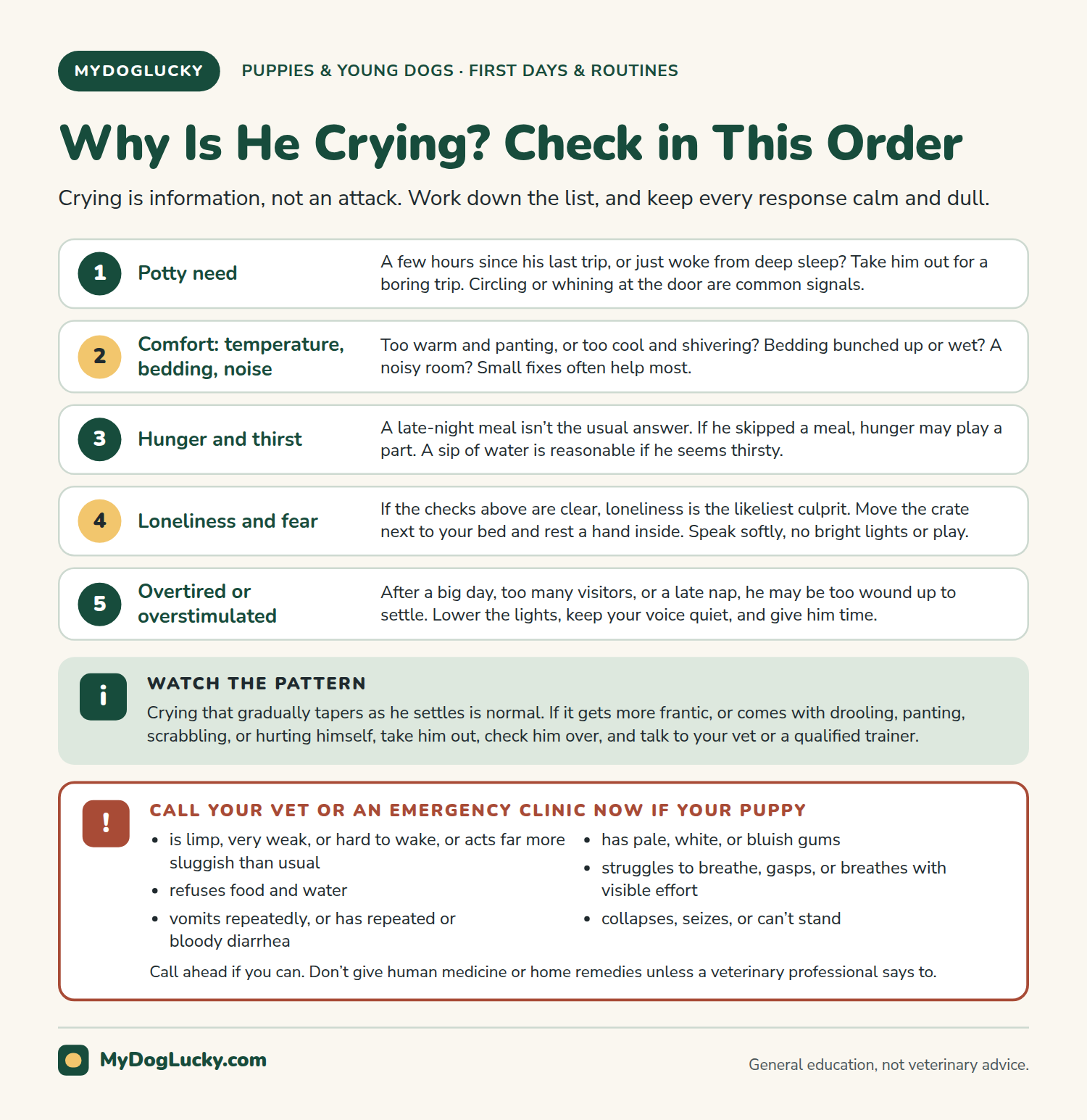
Crying on a puppy first night home is information, not an attack. It might mean “I need to pee,” “I’m cold,” “I’m lonely,” or “I’m bored and awake.” Your job is to work through the possibilities in a sensible order.
We’ll walk through the order below. The infographic after this section puts it into a single decision guide you can save on your phone.
Step 1: Check the potty need first
If it’s been a few hours since his last trip, or he just woke from deep sleep, assume he might need to go. Take him out using the boring-trip formula. If he goes, you’ve solved it. If he doesn’t, you’ve ruled it out, and he goes back to bed.
Some puppies cry the moment they wake up, before they have a chance to settle. Watch for circling, sniffing, or whining at the door. Those are common signals that he needs to go.
Step 2: Check comfort: temperature, bedding, and noise
Is he too warm, panting, or stretched out on bare floor? Too cool, shivering, curled tight? Is the bedding bunched up or wet?
Is the room suddenly noisy, with a heater kicking on or a car alarm outside? Small fixes here often help more than anything else.
Step 3: Consider hunger and thirst
A late-night meal isn’t the usual answer, and you shouldn’t reward crying with snacks. But if he skipped a meal, or your vet has told you to feed smaller, more frequent meals, hunger might be a real factor. A sip of water is reasonable if he seems thirsty. When in doubt, ask your vet.
Step 4: Loneliness and fear
If the potty and comfort checks are clear, loneliness is the likeliest culprit. AKC suggests moving the crate right next to your bed and putting your hand inside so he knows you’re there. That’s a gentle, low-drama option.
Speak softly if it helps. Skip the bright lights and the play.
AKC also says not to put the puppy in your bed unless that’s where you want him to sleep. If you’re fine with it, that’s your call. If you’re not, don’t do it just because he’s loud.
Step 5: Overtired and overstimulated
A puppy who had a big day, too many visitors, or a late nap can be too wound up to settle. He might cry, bark, and seem more awake than he should be. Lower the lights, keep your voice quiet, and give him time. Next day, shorten the awake windows.
Is comfort “spoiling” him?
Short answer: a scared puppy isn’t being manipulative. We didn’t find a source showing that quietly comforting a frightened puppy in the first nights causes lasting problems. AKC itself suggests reassuring him with a hand in the crate.
What tends to create habits is a big reward for crying, like play, snacks, or a long party. Quiet reassurance is different.
What not to do
- Don’t punish crying. A frightened puppy who gets scolded learns that the night is scarier, not that it’s quiet time.
- Don’t use the crate as punishment. You want him to associate it with safety and rest.
- Don’t ignore signs of illness. If crying comes with vomiting, diarrhea, weakness, or refusing food and water, call your vet.
- Don’t turn every cry into a play session. Boring is the goal.
How long should you wait?
We couldn’t find a reliable source with an exact number of minutes, so we won’t make one up. Instead, watch the pattern. Crying that gradually tapers as he settles is one thing.
Crying that gets more frantic, or comes with drooling, panting, scrabbling, or hurting himself, is another. In the second case, take him out, check him over, and talk to your vet or a qualified trainer about the setup.
Should Your Puppy Sleep in Your Bed?
There’s no moral rule here. Some families love a puppy in the bed. Others would rather keep a firm line. Both are fine, as long as you’ve thought through the trade-offs and the puppy is safe.
Trade-offs to weigh
- Falls. A small puppy can fall from a bed and get hurt. A bed with no rail is a long drop for a tiny body.
- Being rolled on or smothered. This is a practical concern with very small puppies, heavy sleepers, or crowded beds.
- Potty control. In a crate or pen you have some containment. In a bed, an accident is more likely, and you may not notice the signs in time.
- Habit. A puppy who sleeps in your bed at 8 weeks may expect it at 8 months. If you’re fine with that, no problem. If not, decide now.
- Health and hygiene. Ask your vet about parasites, allergies, and immune concerns for anyone in the household, especially young children or anyone with a weakened immune system.
Those points are practical reasoning, not findings from a named study. Weigh them for your home.
A middle path
AKC’s suggestion works for many households. Keep the crate right beside the bed and put a hand inside. He gets closeness without the mattress. Later, if you decide to let him up, you can do it on purpose, when he’s older, house-trained, and safe on the furniture.
If you do choose to share the bed
Only do it when you can supervise. Use a bed with a low drop or a barrier. Keep bedding safe.
Stay alert to his potty signs. And be prepared for a rough transition if you change your mind later.
Two Illustrative Sample Nights
These sample plans for a puppy first night home are illustrative, not a prescription. Real puppies wake on their own schedules. Use the samples to see the shape of a night, then adjust for your household and your vet’s advice.
Sample night: an 8-week-old puppy (illustrative)
| Time | What’s happening |
|---|---|
| 6:00 p.m. | Dinner, then a potty trip after eating |
| 6:30-8:30 p.m. | Short play, a nap, and another short play block. Potty after each nap. |
| 8:30 p.m. | Last small drink, then quiet time and a slow, calm cuddle |
| 10:00 p.m. | Last potty trip, a small treat, bed in the crate beside yours |
| 1:00 a.m. | Whining. Quiet carry to the potty spot, a boring trip, back to bed. |
| 4:00 a.m. | Possible second trip. Same routine. |
| 6:30 a.m. | Wake-up potty trip, then breakfast and a new day |
That’s roughly two night trips. Some 8-week-old puppies need more, and some need fewer. If yours does something different, that isn’t a failure.
Sample night: a 12-week-old puppy (illustrative)
| Time | What’s happening |
|---|---|
| 6:00 p.m. | Dinner, then a potty trip after eating |
| 7:00-9:30 p.m. | Training, play, and one nap. Wind down about an hour before bed. |
| 9:45 p.m. | Last potty trip, then bed in the crate or pen |
| 3:00 a.m. | Possible wake-up. Quick, boring potty trip if he asks. |
| 6:30 a.m. | Wake-up potty trip, breakfast, and play |
Many 12-week-old puppies manage one trip or none. Others still need two. Both patterns fit AKC’s rough guidance that young puppies typically need trips until around 4 to 5 months.
What to change first when a night goes sideways
Change one thing at a time. If he cried at midnight, try an earlier potty trip or a quieter evening before you redesign the whole setup. If he woke at 4 a.m., look at the last drink and the last potty trip. Small, single changes show you what worked.
Who Takes the 2 a.m. Trip?
In a shared household, the night shift can quietly become one person’s job. That’s how you get a very tired person and a very resentful spreadsheet. A little planning helps.
| Task | Who | Notes |
|---|---|---|
| Last potty trip before bed | Whoever goes to bed last | Keep it consistent, same spot, same words |
| First night trip | Adult A | Alternate nights so nobody burns out |
| Second night trip | Adult B | Or the same person, if you want one long block of sleep for the other |
| Wake-up potty trip | Early riser | Then breakfast, then a hand-off |
If you live alone, the roles are simple, but the support isn’t. Plan a nap for the next afternoon. Ask a friend to take a daytime shift. Decide in advance what counts as a good enough night.
Kids and the night shift
Children shouldn’t handle night trips on their own. A sleepy child and a squirming puppy is a tricky mix. Let kids help in the daytime, with supervision, and keep nights to adults.
What to Expect on Nights 1 to 7
No source we found gives a reliable timeline for how quickly puppies settle, so treat this as observation rather than a schedule. Many owners notice a rough arc. Your puppy may be different, and that’s fine.
| Night | What many owners notice | What to focus on |
|---|---|---|
| Night 1 | Unfamiliar room, some crying, at least one potty trip | Safety, the last potty trip, and boring night trips |
| Nights 2-3 | Slightly more settled, or a second-night slump once the novelty wears off | Repeat the same evening routine, keep notes, keep visitors minimal |
| Nights 4-5 | Patterns start to show: when he wakes, how long he cries, what soothes him | Adjust one variable, such as the last potty time or the wind-down |
| Nights 6-7 | Often shorter protests, though setbacks are common | Keep the routine steady, and book time for your own rest |
Setbacks don’t mean you did anything wrong. A big day, a new visitor, teething, or a late meal can throw a good night off. Go back to the routine and give it a few days.
What “progress” actually looks like
Progress rarely means a full night’s sleep by day seven. More often it looks like shorter crying, easier settling after a trip, or one fewer wake-up. Notice those small wins. They add up, and they’re easier to spot with a written log.
Normal Fussing vs. Real Stress
Fussing is common and usually short. Real distress looks different. Knowing the difference keeps you from overreacting to ordinary whining and from ignoring something serious.
| Usually normal fussing | Worth a closer look |
|---|---|
| Whining or yipping that comes in waves and tapers off | Nonstop, escalating panic with drooling, heavy panting, or frantic scrabbling |
| Settles after a potty trip or a quiet hand in the crate | Injuring himself on the crate, or soiling in a panicked way repeatedly |
| Eats and drinks and plays during the day | Loss of interest in food, water, or play |
| Sleeps deeply once tired | Restless, unable to settle, or hard to wake |
VCA Animal Hospitals lists restlessness at night, changes in appetite or potty habits, and reduced interest in play as signs worth raising with your veterinarian. If you see a pattern, don’t wait it out. Call.
Extreme, ongoing distress when confined or alone is a different problem from ordinary first-night fussing. If that’s what you’re seeing, talk to your vet or a qualified trainer. A separate MyDogLucky topic covers separation anxiety in dogs.
Call Your Vet Now: Warning Signs on Any Night
No humor here. Young puppies can get sick fast, and nights are when owners are most tempted to wait until morning. If any of the signs below show up, call your veterinarian or an emergency clinic right away.
Call your vet or an emergency clinic now if your puppy
- is limp, very weak, or hard to wake, or acts far more sluggish than usual.
- refuses food and water.
- vomits repeatedly, or has repeated or bloody diarrhea.
- has pale, white, or bluish gums.
- struggles to breathe, gasps, or breathes with visible effort.
- collapses, seizes, or can’t stand.
Call ahead if you can, so the clinic is ready. Don’t give human medicine or home remedies unless a veterinary professional tells you to.
This is a general triage list drawn from standard veterinary practice, and it isn’t a complete list. When you’re unsure, call. A phone call costs less than a delay.
Call your vet today, not necessarily tonight
- Restlessness at night that keeps up over several nights, or a change in appetite or potty habits (VCA lists both as worth raising).
- Frequent snoring or gasping in sleep. VCA notes that flat-faced breeds may be at risk of sleep apnea and suggests contacting a veterinarian if a puppy snores often or gasps at night.
- A single bout of vomiting or loose stool in a very young puppy. Puppies are small, so it’s safer to ask than to guess.
- Reduced interest in play.
Never diagnose your puppy from a list. You’re gathering observations to give to a professional.
What to tell the clinic
Have these ready: his age, breed, and weight if you know it, when he last ate and drank, when he last peed and pooped, what changed, any vaccine paperwork, and anything he might have chewed or swallowed. Your night log makes this easy.
Vaccination Status and Where Your Puppy Can Go
On a puppy first night home, this may feel like a daytime question. It isn’t. It shapes your potty trips, your visitors, and the first few weeks.
Keep your puppy away from unvaccinated dogs and public ground until your vet says otherwise. AKC’s first-day advice includes avoiding contact with unfamiliar dogs. The American Veterinary Society of Animal Behavior (AVSAB, 2008 statement) says visits to dog parks and other areas heavily trafficked by dogs of unknown vaccination or disease status should be avoided.
AVSAB also describes controlled settings, such as puppy classes on easily cleaned surfaces, where puppies should have vaccinations and be free of disease and parasites. In that statement, the minimum vaccination comes at least 7 days before the first class. Your vet will know current guidance for your area and your puppy.
Practical questions to ask your vet
- When can he meet other dogs, and which dogs?
- Where can he safely go potty, especially in shared spaces like apartment lawns?
- What does his puppy vaccination schedule look like?
- When should we start a puppy class?
Plan for those at his first vet visit, which is best booked in the first few days. A separate MyDogLucky topic covers the puppy first vet visit, and another covers the puppy vaccination schedule.
When Your Setup Isn’t the Standard One
Plenty of homes don’t match the “bedroom with a crate” picture. Here’s how to adapt.
Apartments and thin walls
Cries carry. A quieter option is to keep the crate right beside your bed, which allows soft reassurance, and to carry him down for potty trips so he doesn’t have time to have an accident in the elevator. Give neighbors a friendly heads-up for the first few nights. It costs you one text.
Small and toy breeds
Very small puppies may need more frequent trips and meals. Talk to your vet about the schedule for your puppy’s size. Watch bedding closely, because small bodies can get lost in bulky blankets.
Flat-faced breeds
VCA specifically notes that flat-faced breeds may be at risk of sleep apnea. If your puppy snores loudly, gasps, or seems to struggle when sleeping, call your vet.
Other pets at home
Give the puppy his own sleep spot, away from resident pets, for the first nights. Introduce animals slowly and separately, in line with AKC’s advice about limiting contact with unfamiliar dogs on the first day. A resident dog or cat needs a break from puppy energy too.
You work tomorrow
It happens. Get the evening routine done early. Ask for help from another adult if you can.
Plan an easy day tomorrow, and be honest with your team if you had a rough night. Your puppy will nap during the day, and you might be able to as well.
Common Mistakes on the First Night
Most problems on a puppy first night home come from a handful of repeat mistakes. Here are the usual ones.
Skipping the last potty trip
It’s the easiest step to forget when everyone’s tired. AKC calls it the last thing to do before bed for a reason.
Turning night trips into playtime
Bright lights, treats, and a game teach him that 2 a.m. is exciting. Keep it boring.
Overstimulating him all evening
More play doesn’t always mean better sleep. A wired puppy is harder to settle.
Using unsafe bedding or toys
Loose threads, small parts, and bulky items are the usual culprits. Keep it flat and simple.
Changing the plan every ten minutes
Crying at 11 p.m. and moving him to your bed, then back to the crate, then to the couch, sends mixed signals. Pick a plan for the night and stick to it, unless safety says otherwise.
Assuming crying always means “let him cry”
Sometimes it means he needs to pee. Sometimes it means he’s sick. Check first.
Your Puppy First Night Home Checklist
A quick reference for tonight.
- Sleep spot in your bedroom, away from drafts and vents.
- Flat bedding, a familiar-smelling item, and no loose small items.
- Last meal at least about two hours before bed, per AKC.
- Water plan agreed with your vet.
- Last potty trip right before bed, with a calm reward.
- Light, leash, and shoes ready for night trips.
- Roles for night trips agreed.
- Log started: meals, water, potty, crying.
- Vet appointment booked for the next few days.
- Warning signs saved on your phone.
Lower the bar on purpose
Tonight’s goal isn’t a perfect night. It’s a safe one. If everyone survives and the puppy pees outside at least once, you’ve done the job.
Common Questions About the First Night
How long will my puppy cry on the first night?
It varies a lot. Some puppies protest for a few minutes, others longer. We didn’t find a reliable number. Watch the pattern: tapering is normal, escalating panic is a reason to check him and call for advice.
Is it okay to let my puppy cry it out?
It depends on why he’s crying. Rule out potty, comfort, and illness first. Once those are covered, brief, calm fussing is common. Extreme or escalating distress isn’t something to wait out.
Should I put a clock or a radio near him?
Some owners try quiet background sound. We didn’t find a source on it, so it’s an experiment, not a rule. Keep the volume low and see how he responds.
What if he won’t go into the crate?
Don’t force him. Use short, positive daytime practice with treats and let him enter on his own. A playpen may work better for some puppies.
Can I comfort him without spoiling him?
Yes. AKC suggests reassuring him with a hand inside the crate. What builds habits is a big reward for crying, like play or a party.
Should I wake him to pee?
It depends on his age and how the night goes. An alarm can help on early nights. Ask your vet about the right interval for your puppy.
How many times will I get up?
Many young puppies need at least one trip. AKC says most can’t hold it through the night until around 4 to 5 months.
Should I take away water before bed?
Ask your vet. We didn’t find a fetched source with a specific cutoff.
What if he has an accident in the crate?
Clean it calmly. No scolding. Then check the timing: was the last potty too early, or the gap too long?
Can I leave a puppy alone at night in another room?
Some households do it. Young puppies often do better with you nearby at first, and night trips are easier to catch. If you can’t share a room, consider a monitor and short, frequent checks.
When can he meet other dogs?
Ask your vet. Until then, keep him away from unvaccinated dogs and public dog areas.
What if he seems sick in the night?
Use the warning list above. When in doubt, call your vet or an emergency clinic. Don’t wait until morning if a red flag shows up.
Where to Start Tonight
Pick three things. Set up the sleep spot beside your bed. Do the last potty trip right before bed.
Decide who takes the first night trip. That’s enough for a good start.
Your puppy first night home won’t be perfect, and it doesn’t have to be. Keep it calm, keep it safe, and keep notes. If something looks wrong, call your vet. By the end of the week, you’ll both know the routine much better than you do tonight.
Sources
- American Kennel Club (AKC). Your First Day at Home With a New Puppy: Tips for Day One (last updated March 10, 2026; accessed September 2026)
- American Kennel Club (AKC). Puppy Potty Training Schedule: A Timeline for Housebreaking Your Puppy (updated August 11, 2026; accessed September 2026)
- VCA Animal Hospitals. How Much Sleep Do Puppies Need (no publication date shown; accessed September 2026)
- American Veterinary Society of Animal Behavior (AVSAB). Position Statement on Puppy Socialization (2008; accessed September 2026)
This article is general education for U.S. dog owners. It is not individualized veterinary advice. Ask your veterinarian about anything specific to your puppy, including feeding, water, bedding, temperature, and vaccine timing.