
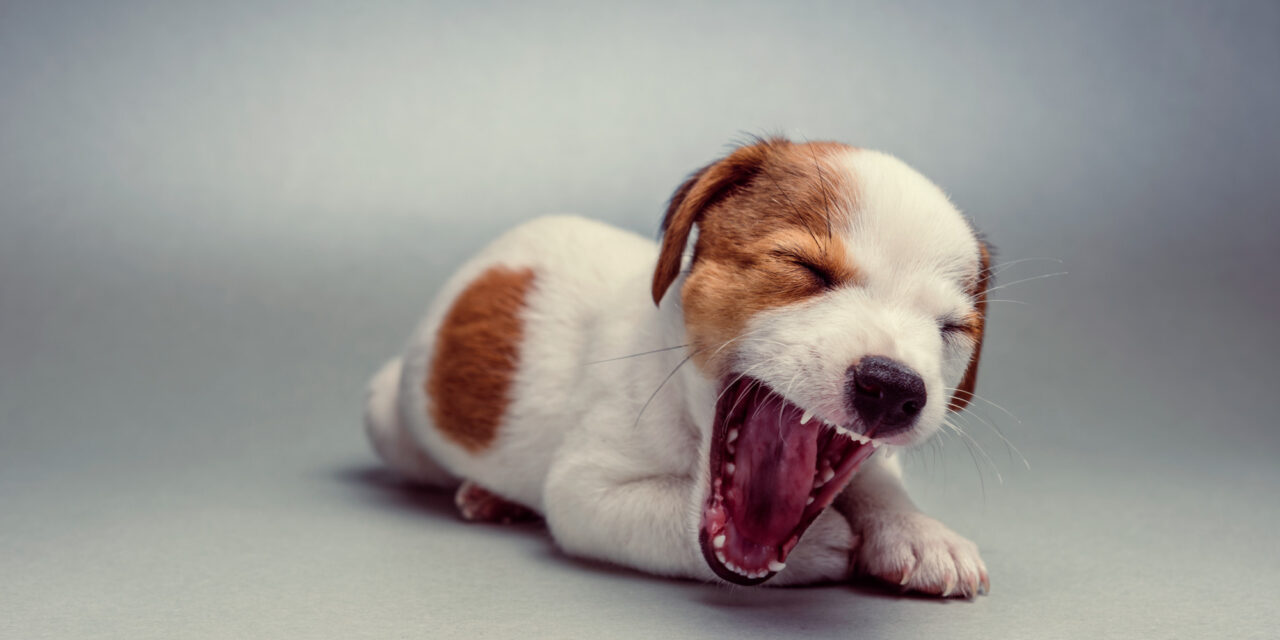
Puppy teething is the process of a puppy losing 28 baby teeth and growing in 42 permanent ones, and it runs from around two weeks of age through roughly six to seven months. If your puppy has suddenly turned into a chewing machine, is drooling more than usual, or left a tiny tooth on the living room rug, you’re watching a completely normal stage play out, not a problem to solve.
It’s still a real stage, with real discomfort for your puppy and real wear and tear on your furniture, shoes, and patience. This guide walks through the full puppy teething timeline, what counts as normal gum irritation versus a reason to call the vet, which chews are worth keeping around and which ones carry real risk, and how to build simple daily habits that get your puppy through this window with less damage on both sides.
One scope note before we get going: this article covers the biology of puppy teething, not the behavior side of a mouthy puppy. If bite pressure and hand-mouthing are your main concern right now, MyDogLucky has a separate article specifically on stopping puppy biting and mouthing that digs into redirection and training. Here, the focus stays on teeth — when they come in, when they should fall out, and what to do about the chewing in between.
What’s in this guide
- What is puppy teething, exactly?
- The puppy teething timeline, week by week
- Signs your puppy is teething
- Safe chews vs. risky chews during teething
- Managing a teething puppy day to day
- Puppy teething chewing vs. other kinds of mouthy behavior
- Retained baby teeth: when one doesn’t fall out on its own
- Normal teething discomfort vs. signs that need a vet
- Starting gentle dental care habits now
- Common mistakes during the teething stage
- A practical teething checklist by age
- Frequently asked questions about puppy teething
- Sources
What Is Puppy Teething, Exactly?
Puppy teething describes two separate rounds of tooth growth packed into a puppy’s first seven months. First, a full set of 28 tiny, needle-sharp baby teeth — the deciduous teeth — erupts through the gums starting around two weeks of age, usually before a puppy ever leaves the breeder or shelter. Then, starting around three months old, those baby teeth begin loosening and falling out one by one, replaced by 42 larger, stronger adult teeth that should all be in place by roughly six to seven months.
That’s the short version. The longer, more useful version is that puppy teething isn’t one event with a single start and end date — it’s a rolling process with distinct phases, and knowing which phase your puppy is in tells you what to actually expect this week versus next month.
Why Puppies Even Have Two Sets of Teeth
A newborn puppy’s jaw and skull are far too small to hold 42 adult-sized teeth. Baby teeth are a smaller, temporary placeholder set, sized to a tiny developing skull and built to do one job: let a puppy start chewing solid food and exploring the world with his mouth. As the jaw grows, it needs bigger teeth with deeper roots to match, so the baby set gets pushed out and replaced. It’s the same basic mechanism behind a human child losing baby teeth, just compressed into a much shorter timeline.
Because that timeline is short, a lot happens in a small window. A four-month-old puppy can be actively shedding baby incisors and cutting adult canines in the very same week — which is part of why teething discomfort can flare unevenly instead of following one smooth curve.
How Long Does Puppy Teething Last, Overall?
Start to finish, puppy teething runs from around two weeks old, when the first baby teeth break through, to somewhere around six to seven months old, when the last adult molars finish coming in. That’s the full arc. The stretch most owners actually notice — the heavy-chewing, drooly, everything-is-a-chew-toy phase — usually runs from around twelve weeks to six months, since that’s when the switch from baby to adult teeth is actively happening.
Individual puppies vary. Some finish teething closer to five months; others, especially in smaller breeds, are still working on a last tooth or two that takes its time, past seven months. A wider range doesn’t automatically signal a problem, but a retained baby tooth still hanging on well past that window is worth a veterinary look, which the retained-teeth section below covers in detail.
The Puppy Teething Timeline, Week by Week
Here’s the full puppy teething timeline broken into its four real phases, from those first baby teeth to a complete adult smile. Knowing roughly where your puppy sits on this timeline makes the chewing, drooling, and occasional grumpiness a lot easier to read as normal instead of alarming.
Weeks 2 to 4: Baby Teeth Arrive Before Most Puppies Go Home
The very first baby teeth — usually the tiny front incisors, followed by the canines — begin breaking through the gums starting around two to three weeks of age, according to the Merck Veterinary Manual’s overview of canine dental development. This happens while puppies are still nursing, still with their mother, and almost always before a family brings one home. If you’re picking up a puppy at the standard eight-week mark, this entire phase has already happened somewhere else.
It’s worth knowing about anyway, because it explains why an eight-week-old puppy already has a mouthful of sharp little teeth on day one home — there’s no “before teeth” stage you missed. He arrived with a working set already installed.
Weeks 5 to 8: All 28 Baby Teeth Are In
By around five to six weeks old, all of a puppy’s baby teeth have typically finished coming in, according to the American Kennel Club’s puppy teething timeline — a full set of 28 deciduous teeth, smaller and sharper than what’s coming later. This lines up closely with weaning, since a puppy with a working set of teeth can start managing softened solid food alongside nursing.
Most puppies go home somewhere in this window or shortly after, meaning a new owner’s first weeks are usually spent with a puppy who already has a complete, functional, extremely sharp baby smile. Twenty-eight teeth sounds like a lot for a mouth that small, and honestly, it is — ask anyone who has been on the receiving end of an enthusiastic eight-week-old play session.
Around 12 Weeks: The Switch to Adult Teeth Begins
Somewhere around twelve weeks old, sometimes stretching into the fourth month, baby teeth start loosening and falling out, and permanent adult teeth begin pushing up to replace them. This is the phase most owners associate with “real” teething, since it’s when the classic signs — heavier chewing, drooling, occasional irritability, a tiny tooth turning up on the floor — tend to show up in force.
The order usually mirrors how baby teeth came in: incisors first, then canines, then premolars, with molars arriving later since puppies don’t have baby molars to replace — those are new additions entirely. Don’t be surprised if you never actually find a shed tooth. Puppies commonly swallow them without any trouble, tucked into whatever they were chewing on at the time.
4 to 7 Months: All 42 Adult Teeth Finish Coming In
By around four to five months, permanent teeth are erupting steadily, and by six to seven months, a puppy should have a complete adult mouth: 42 teeth in total, up from the 28 he started with, per both AKC and Merck Veterinary Manual guidance. That’s six more teeth than the baby set, which is one reason the back of a young dog’s mouth can look and feel crowded for a stretch as those new molars settle into place.
Some puppies wrap up a little earlier, some take until closer to eight months, and breed and individual variation both play a role. What matters most isn’t hitting an exact date — it’s noticing whether things are generally progressing, and flagging anything that looks stalled, which the retained-teeth section covers next.
Does Breed Size Change the Puppy Teething Timeline?
The broad strokes of the puppy teething timeline — 28 baby teeth by around eight weeks, 42 adult teeth by around six to seven months — hold true across breeds, but size can shift the details a little. Smaller and toy breeds sometimes run a bit later on the tail end, with a last tooth or two finishing closer to seven or eight months rather than six. Larger breeds, who are also growing a bigger jaw and skull faster overall during this same window, tend to track closer to the earlier end of the range.
None of this is a strict rule your particular puppy has to follow. Genetics, individual development, and even which teeth erupt in what order all add some natural variation. What’s worth tracking isn’t whether your puppy hits some exact midpoint date, but whether things are generally moving forward — and flagging it if a tooth looks stuck well past the point it should have moved on, which the retained-teeth section below covers.
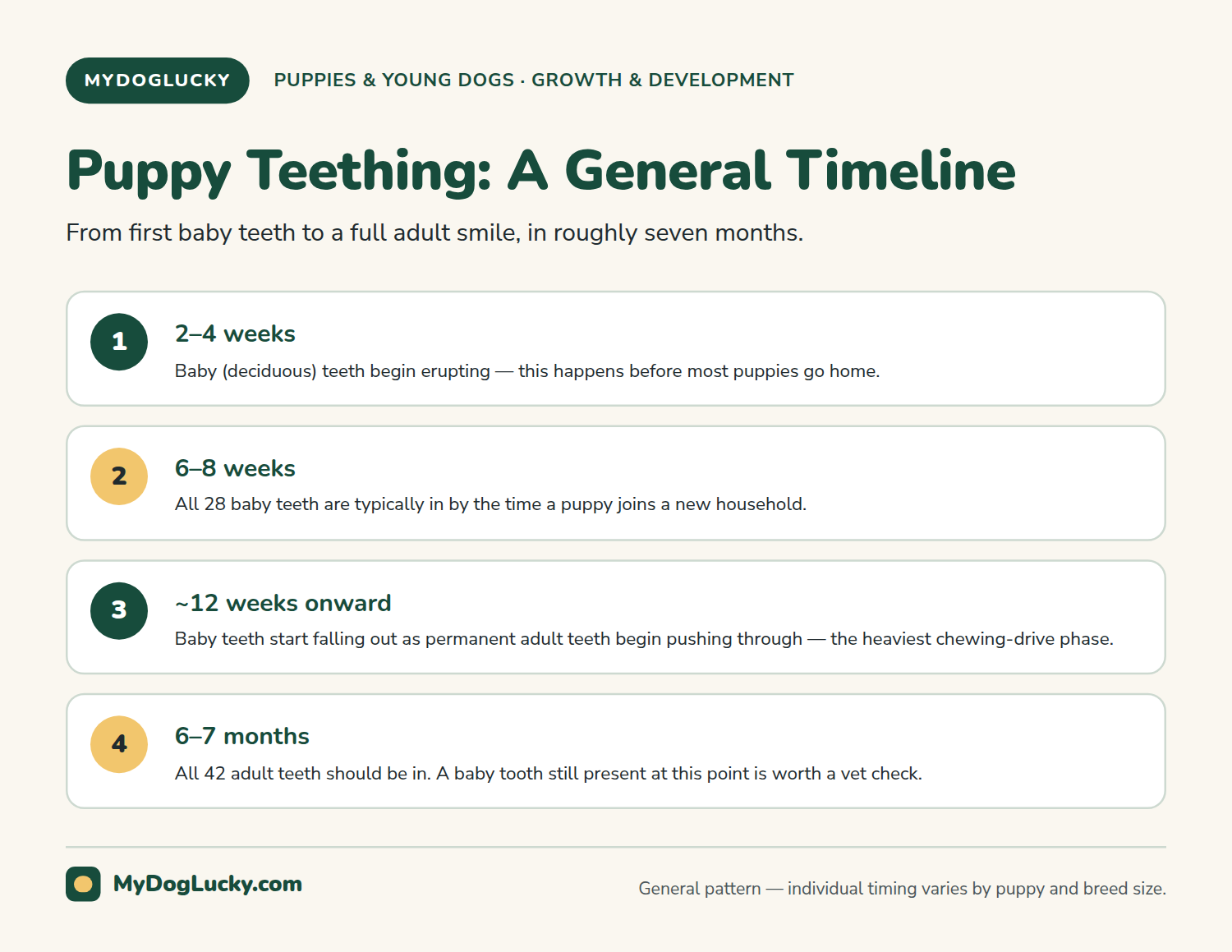
A quick reference table for the whole stretch, useful for pinning to the fridge or bookmarking for the next few months:
| Age | What’s happening | Tooth count |
|---|---|---|
| 2–4 weeks | First baby teeth erupt (incisors, then canines) | Building toward 28 |
| 5–8 weeks | All baby teeth finished coming in; most puppies go home now | 28 baby teeth |
| ~12–16 weeks | Baby teeth loosen and fall out; adult teeth begin erupting | Mixed baby/adult |
| 4–5 months | Adult premolars and molars continue erupting | Mostly adult |
| 6–7 months | Full adult set typically complete | 42 adult teeth |
Signs Your Puppy Is Teething
Teething doesn’t come with a calendar alert, so most owners figure it out from a cluster of everyday signs rather than any one obvious event. None of these individually confirms puppy teething, but together they paint a pretty reliable picture.
- A sudden jump in chewing drive. A puppy who was content with occasional chewing suddenly wants to gnaw on everything — table legs, remote controls, your knuckles — because chewing puts counter-pressure on sore gums and genuinely feels better.
- More drooling than usual. Inflamed gums during active tooth movement often produce extra saliva. A damp spot on your puppy’s bed or a wetter-than-normal chin isn’t unusual during heavier teething weeks.
- Mild gum irritation. Gums along the tooth line can look a little pink or slightly puffy right where a tooth is pushing through or a baby tooth is loosening. Mild, localized redness during active eruption is a normal part of the process.
- Occasional reluctance around hard kibble. Sore gums can make crunching dry kibble briefly less appealing. Some puppies slow down, chew more carefully, or prefer softened food for a few days during a rough patch.
- Small blood-tinged spots on a toy. A faint pink tinge on a chew toy, from a loosening tooth or a minor gum nick, can happen during normal shedding. This is different from active, ongoing bleeding, covered in the warning-signs section below.
- A short stretch of general crankiness. Sore gums plus poor sleep from all that chewing and mouthing can add up to a puppy who’s a little more irritable or clingy than his usual self for a few days at a time.
- A tiny shed tooth turning up somewhere. Occasionally you’ll actually find one — a tiny, rice-grain-sized tooth on the floor or caught in a blanket. Most of the time, puppies swallow them without any issue at all.
These signs tend to cluster loosely around the two active eruption windows — early on, around weeks two through six, and more noticeably from about twelve weeks through six months, when the switch to adult teeth is underway. A puppy who’s mildly uncomfortable and chewing more during those stretches is doing exactly what puppy teething looks like. A puppy who won’t eat at all, seems painful rather than just fussy, or has a mouth that looks visibly wrong is a different situation, and that distinction gets its own section further down.
Safe Chews vs. Risky Chews During Teething
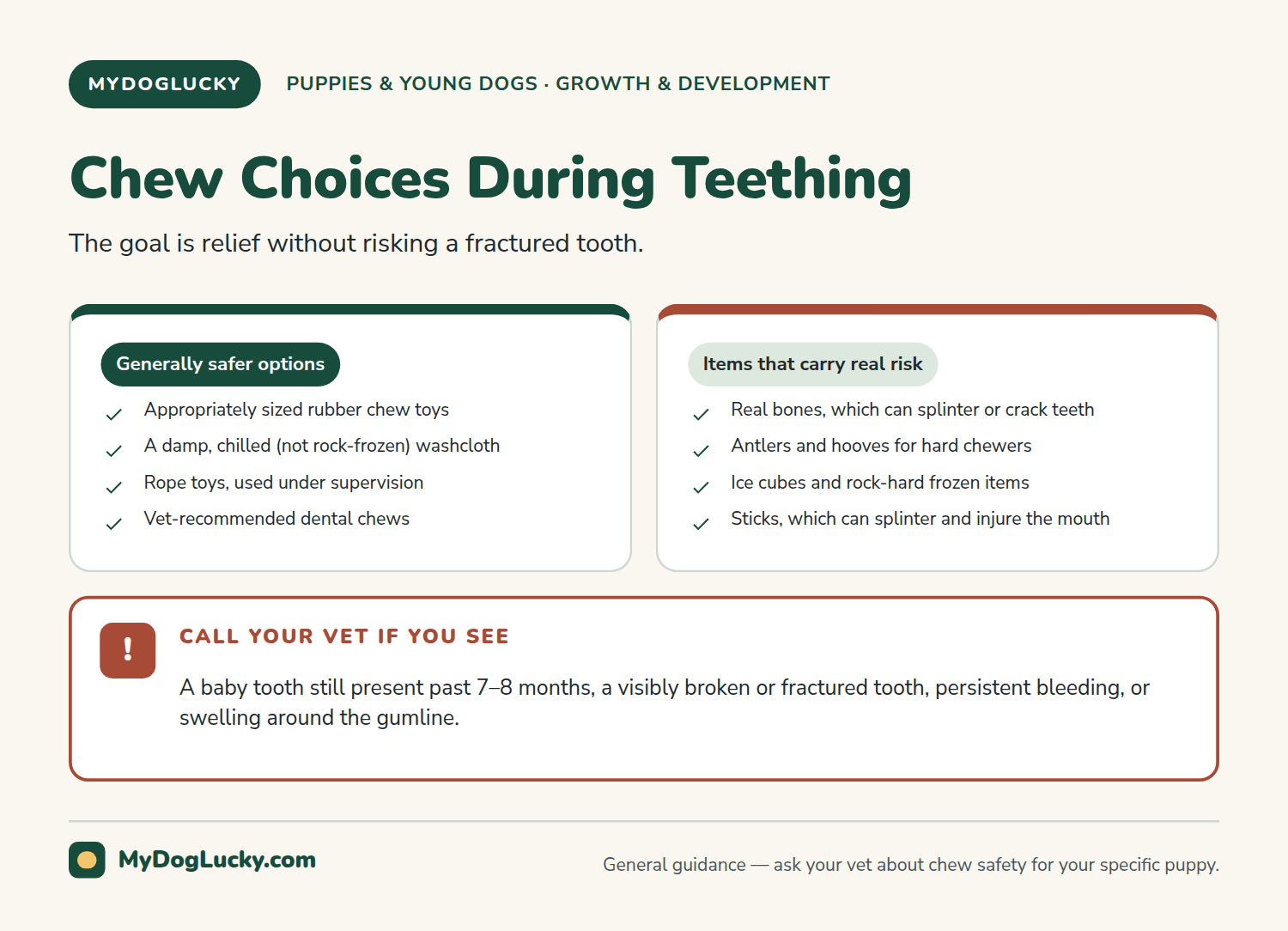
The single most useful thing you can do during puppy teething is put the right chew items in easy reach, consistently. A teething puppy is going to chew something. Your job is making sure the “something” is appropriately sized, appropriately soft, and not a tooth-fracture risk waiting to happen.
What Makes a Chew Safe for a Teething Puppy
A useful, low-effort test comes from veterinary dentistry: if you can’t dent an item with your own fingernail, it’s likely too hard for a puppy’s teeth — particularly for developing adult teeth still settling into the jaw, according to guidance summarized by Cornell University’s Riney Canine Health Center. Items that pass that simple check, plus a few other qualities, tend to be genuinely safe options during this stage:
- Some give under pressure. The item should flex or dent slightly rather than staying perfectly rigid against a determined bite.
- Sized for your puppy’s current mouth. Too small is a choking or swallowing risk; too large just isn’t satisfying to gnaw on and gets ignored.
- Durable enough not to shred into swallowable chunks within a single short chewing session, but not so hard it fights back against a puppy’s jaw.
- Puppy-specific when possible. Softer rubber chews made for developing teeth, rather than the extra-firm versions marketed for powerful adult chewers.
Rubber chews designed with some flex, textured teething rings, and puppy-safe nylon chews sized appropriately for your puppy’s current weight generally fit this description well. Supervise any new chew the first several times your puppy uses it, and retire anything once it starts breaking into pieces small enough to swallow.
Chews Worth Skipping (and Why)
Some popular chew items carry real, well-documented risk of fracturing teeth or splintering into sharp pieces, and it’s worth understanding why rather than just memorizing a “never” list. Hard, rigid items don’t flex when a puppy bites down at full force — so instead of the item giving, the tooth does. Cornell’s veterinary dental guidance and VCA Animal Hospitals both point to the same category of culprits.
- Antlers. Extremely hard and completely rigid, antlers are a well-known cause of fractured premolars and molars in dogs of any age, including puppies.
- Real bones (cooked or raw). Cooked bones can splinter into sharp fragments; raw bones, while less prone to splintering, are still hard enough to crack teeth and can pose a choking or intestinal risk.
- Hooves. Similar story to antlers — very hard, very rigid, and a common source of slab fractures along the back teeth.
- Ice cubes chewed vigorously. Licking ice is generally fine; crunching down hard on a solid ice cube is a different force entirely, and it can crack a tooth the same way any other hard, unyielding object can.
- Hard nylon bones with no flex. Not all nylon chews are equal — some are specifically formulated softer for puppies, while others are built rigid for adult power-chewers. Read the packaging for an age or size recommendation rather than assuming any nylon chew is automatically puppy-safe.
- Rocks, sticks, and furniture. Not marketed as chews at all, but puppies don’t know that, and all three show up regularly in fractured-tooth cases for exactly this reason.
The fingernail test, in practice
Press your thumbnail firmly into the surface of a chew item. If it leaves a visible dent, the item has enough give to be a reasonable choice. If your nail just slides across a completely rigid surface with no mark at all, treat that as a signal to skip it — especially for a puppy whose adult teeth are still erupting and settling into the jaw.
A Note on “Chilled” vs. “Frozen Solid”
Cold can genuinely help sore gums, and a chilled textured chew — think a rubber teething toy that’s spent an hour in the refrigerator, not the freezer — is a reasonable option during a heavy teething stretch. A chew frozen rock-solid overnight is a different story: it turns a normally flexible item into something closer to the antlers and hooves described above, hard enough to risk the exact tooth fractures you’re trying to avoid. If you like the frozen-chew idea, a damp washcloth loosely knotted and refrigerated (not frozen solid) or a stuffable rubber chew given a short chill, rather than a deep freeze, keeps the benefit without the added hardness.
Managing a Teething Puppy Day to Day
Knowing what’s happening biologically is only half the picture. The other half is the practical, repetitive work of getting through several months of heavy chewing without losing every shoe you own. A few habits do most of the heavy lifting.
Puppy-Proofing for the Chewing Stage
A teething puppy doesn’t distinguish between “approved chew toy” and “expensive leather boot” on his own — that distinction is something you have to build through management, not something he arrives already knowing. Walk through your main living spaces at puppy height, literally getting down to his eye level if you can, and move anything chewable, swallowable, or electrical out of easy reach. Shoes go in a closed closet instead of by the door. Phone chargers get tucked out of sight. Low shelves get a temporary clear-out.
Baby gates or a puppy pen in one or two rooms make this far more manageable than trying to puppy-proof an entire house at once. Fewer accessible rooms means fewer things to watch, which means you’re not spending your whole day on high alert.
Rotate, Don’t Just Replace
Puppies, like most young animals, get bored of a chew toy that never changes. Keeping four or five appropriate chews in circulation and swapping which ones are out every few days keeps things genuinely interesting, instead of leaving your puppy staring at the same tired rope toy and deciding the couch cushion looks more exciting by comparison. A toy that’s been “away” for a week often gets treated like something brand new the moment it reappears.
The Redirect-and-Swap Habit
When you catch your puppy mid-chew on something off-limits, the move is simple and worth doing calmly, every single time: swap in an appropriate chew right as you remove the off-limits item, rather than just taking something away and leaving empty-handed. A puppy who only ever has things taken from him, with nothing offered instead, tends to get more possessive over objects generally — not less. Offering the swap consistently teaches “this is what I get to chew” rather than just “that got taken away again.”
Keep a couple of appropriate chews within arm’s reach in whatever room you spend the most time in, so the swap can happen in the moment it’s needed rather than after a scramble to find something in another room.
Chilled Chews for Sore Gums, Used Right
During an especially heavy puppy teething stretch, a chilled textured chew can genuinely take the edge off sore gums — the cool temperature has a mildly numbing effect, similar to how a cold compress helps human inflammation. Keep it chilled, not frozen solid, for the reasons covered in the chew-safety section above, and offer it as one option in the rotation rather than the only thing on hand.
A simple daily rhythm that works for most households
- Morning: a fresh chew from the rotation, offered during a calm moment.
- Midday: a quick puppy-proofing scan of whatever room you’re about to spend time in.
- Afternoon or evening: a chilled option if gums seem extra sore that day.
- Anytime: redirect-and-swap the instant you catch an off-limits item in his mouth, calmly and consistently.
None of this needs to be elaborate. The puppies who get through puppy teething with the least furniture damage tend to belong to households running a boring, consistent routine — not a household with one spectacular toy that solves everything. If a specific toy claims to be “guaranteed” to stop destructive chewing entirely, that claim is doing more work than any single toy actually can.
Puppy Teething Chewing vs. Other Kinds of Mouthy Behavior
Chewing, mouthing, and biting can look similar from across the room, but they come from different places and call for slightly different responses. Sorting out which one you’re seeing helps you pick the right fix instead of applying one solution to three different situations.
Teething Chewing vs. Destructive or Exploratory Chewing
Teething-driven chewing is specifically about gum relief and tooth movement, and it tracks fairly closely with the eruption windows described earlier — heavier around weeks two through six, and again from about twelve weeks through six months. Exploratory chewing, by contrast, continues well past the point all 42 adult teeth are in, because it’s driven by curiosity, boredom, or simply needing something to do with a young dog’s abundant energy, not sore gums.
In practice, the two overlap constantly during the teething months, and you don’t need to diagnose which one is driving any single chewing session. The management strategies are largely the same either way: appropriate chews within reach, consistent puppy-proofing, and enough physical and mental activity that chewing furniture isn’t the most interesting option available. If heavy chewing continues unchanged well past seven or eight months, once teething itself should be finished, that’s a sign the driver has shifted toward boredom, insufficient enrichment, or simple habit — worth addressing with more structured activity and training rather than assuming it’s still about sore gums.
Teething and Play-Biting Are Related, But Not the Same
Teething discomfort can absolutely make a puppy’s mouth more active overall, which sometimes shows up as extra nipping at hands and ankles during the same stretch. But play-biting and mouthing at people is fundamentally a behavior and social-learning issue — how a puppy learns bite pressure and where mouthing is and isn’t welcome — not purely a dental one. A puppy can be done teething entirely and still mouth hands during excited play, because that’s a separate skill he’s still developing.
Because that behavioral side deserves its own deep coverage rather than a quick paragraph here, MyDogLucky has kept it in a separate, dedicated article on stopping puppy biting and mouthing. This article stays focused on the dental piece: what’s happening in your puppy’s mouth, when, and how to support it safely. If hand-mouthing is your bigger day-to-day concern, that companion piece covers redirection technique, bite inhibition, and household consistency in real depth.
Retained Baby Teeth: When One Doesn’t Fall Out on Its Own
Most baby teeth fall out on their own, right on schedule, as the adult tooth beneath pushes them loose. Sometimes, though, a baby tooth’s root doesn’t fully resorb, and the tooth stays firmly anchored even after the permanent tooth has already erupted right alongside it. That’s called a retained, or persistent, deciduous tooth, and it’s common enough in certain small and toy breeds that it’s worth knowing what to watch for.
What a Retained Tooth Actually Looks Like
The telltale sign is two teeth of the same type sitting side by side in the same spot — a small, sharp baby canine still fully in place, with a larger adult canine already erupted right next to or just behind it. Canines are the teeth most commonly retained, though it can happen with incisors too. If you spot what looks like a double set of teeth anywhere in your puppy’s mouth, that’s a retained tooth until a vet says otherwise.
Why Retained Teeth Matter
A retained baby tooth isn’t just a cosmetic quirk. It can crowd the adult tooth trying to grow in next to it, pushing that adult tooth out of its normal position and affecting how the bite lines up over the dog’s lifetime. The tight gap between a retained baby tooth and its adult neighbor also traps food debris and plaque more easily than normal spacing does, which raises the risk of earlier periodontal disease and decay right in that spot. None of this happens overnight, but it compounds over months, which is exactly why catching it early matters.
When to Get a Retained Tooth Checked
Two clear triggers are worth bringing to your veterinarian:
- Any baby tooth still present once the same adult tooth has already erupted nearby — that side-by-side, double-tooth pattern described above.
- Any baby tooth still present past roughly seven to eight months old, even if there’s no adult tooth visibly crowding it yet.
A retained tooth doesn’t usually resolve on its own once the adult tooth has already erupted next to it — at that point, the standard approach is a straightforward veterinary extraction, often performed under the same anesthesia as a routine spay or neuter if the timing lines up well. Left alone, a retained tooth tends to stay retained, and the crowding and decay risk it creates only continues.
Which Puppies Are More Prone to Retained Teeth?
Retained baby teeth can happen in any puppy, but veterinary dental sources consistently note they show up more often in small and toy breeds — think Yorkshire Terriers, Chihuahuas, Pomeranians, and toy Poodles, among others. The likely reason comes down to proportions: these breeds have been bred toward smaller jaws and smaller adult teeth, and a smaller adult tooth pushing up against a baby tooth’s root doesn’t always generate quite enough pressure to fully dissolve that root and nudge the tooth loose the way it typically does in larger dogs.
That doesn’t mean owners of small and toy breeds need to do anything differently during the teething months. It just means it’s worth being a little extra attentive when checking your puppy’s mouth for that double-tooth look described above, especially as he approaches the three-to-six-month stretch when most of the switching happens.
Worth a call to your veterinarian
- A baby tooth still in place with the matching adult tooth already erupted beside it.
- Any baby tooth still present past about 7–8 months old.
- Teeth that look crowded, crooked, or oddly angled as adult teeth come in.
- A bite that looks visibly off, such as the lower jaw’s canines pressing into the roof of the mouth.
This is a routine finding for a veterinarian to evaluate, not an emergency — but it’s also not something that fixes itself with time, so it’s worth mentioning at your puppy’s next scheduled visit rather than waiting to see.
Bring it up during a routine wellness visit rather than treating it as an urgent, same-day concern — retained teeth are a “mention it at the next appointment” issue, not a middle-of-the-night one, unless it’s paired with any of the true warning signs covered next.
Normal Teething Discomfort vs. Signs That Need a Vet
Most of what happens during puppy teething is uncomfortable but ordinary. A smaller set of signs points toward something that actually needs a veterinarian’s attention, and it’s worth being able to tell the two apart without guessing.
| What you’re seeing | Usually normal teething | Worth a vet visit |
|---|---|---|
| Gum color near a tooth | Mild, localized pink or slight puffiness | Visible swelling, deep red, or an open sore |
| Blood | A faint pink tinge on a toy occasionally | Active, persistent, or repeated bleeding |
| Tooth appearance | A gap where a tooth loosened and fell out | A visibly broken, cracked, or fractured tooth |
| Appetite | Briefly slower with hard kibble for a day | Reluctance to eat anything for more than a day |
| Breath and gums together | Ordinary puppy breath | Noticeably bad breath paired with visible gum inflammation |
| Face | No visible change | Facial swelling, especially under one eye or along the jaw |
What a Fractured Tooth Actually Looks Like
A visibly broken or fractured tooth is one of the clearer signals to act on. It might show as a jagged edge, a visible chip, a tooth that looks shorter than its neighbors, or a small pink or dark spot in the center of the tooth where the inner pulp is exposed.
Dogs are also genuinely good at hiding dental pain, according to VCA Animal Hospitals’ guidance on fractured teeth, so a puppy might still eat and play normally even with a broken tooth — the absence of obvious discomfort doesn’t rule it out. Watch instead for chewing only on one side, dropping food while eating, pawing at the mouth, or a general reluctance to let you touch that side of the face.
An exposed pulp isn’t just a cosmetic issue. It’s effectively an open doorway into the tooth’s nerve and blood supply, and left alone it becomes a painful, hidden infection that antibiotics alone can’t reach, according to Cornell’s Riney Canine Health Center. Any suspected fracture warrants a veterinary exam, and treatment decisions — whether that means monitoring, specialized care, or extraction — get made with dental X-rays under anesthesia, not guesswork from a home inspection.
Call Your Veterinarian Today If You See Any of These
- A visibly broken, chipped, or fractured tooth, even if your puppy seems otherwise fine.
- Bleeding from the gums or mouth that’s ongoing rather than a brief, faint tinge.
- Swelling anywhere on the face, especially under one eye or along the jawline.
- Bad breath that’s noticeably worse than usual, paired with visibly inflamed or red gums.
- Refusing food entirely, or nearly entirely, for more than a day.
- Obvious pain when the mouth area is touched, or a puppy who won’t let you near his face at all.
None of these signs mean you need to self-diagnose the exact problem at home — that’s what the veterinary exam is for. What matters is recognizing that the pattern has shifted from “ordinary puppy teething discomfort” to “something a professional needs to look at,” and making the call rather than waiting to see if it resolves on its own.
Starting Gentle Dental Care Habits Now
The puppy teething months are, somewhat conveniently, also the ideal window to start building the dental habits that’ll matter for the rest of your dog’s life. A puppy’s mouth is already getting a lot of attention during this stage — from you, checking for loose teeth, and from him, chewing on everything in sight — so folding in a little positive mouth-handling practice tends to go over better now than trying to introduce it cold with an adult dog later.
Getting Your Puppy Comfortable With Mouth Handling
Start small and separate from anything about brushing. Gently touch your puppy’s muzzle, lift a lip for a second or two, and touch a tooth or gum lightly with a clean finger, pairing each step with a small treat and a calm, upbeat tone. Keep sessions short — well under a minute at first — and stop before your puppy gets fidgety or tries to pull away, so the experience ends on an easy note rather than a struggle.
This groundwork matters more than it might seem. A puppy who’s comfortable having his mouth handled calmly is easier for your veterinary team to examine at wellness visits, easier for you to check for retained teeth or gum issues at home, and considerably easier to eventually brush without a wrestling match.
Introducing a Toothbrush and Puppy-Safe Toothpaste
Once mouth-handling itself feels routine, introduce a soft, puppy-sized toothbrush or a finger brush the same gradual way: touch it to the lips and gums briefly, reward, and build up duration slowly over days rather than diving straight into a full brushing session. Use toothpaste made specifically for dogs, according to American Kennel Club guidance on brushing — it comes in flavors like poultry or peanut butter that make the process more appealing, and it’s formulated to be safely swallowed, since dogs don’t spit and rinse. Never substitute human toothpaste; it commonly contains xylitol and fluoride, both of which can cause real harm to a dog even in small amounts.
You don’t need a full, thorough brushing routine locked in by the time teething wraps up. The goal during this stage is simpler: a puppy who tolerates a toothbrush near his mouth without a fight, so that daily brushing later on is a minor routine task instead of a monthly battle you keep putting off.
Fold This Into Other Early Vet Visits
Your puppy’s mouth naturally comes up during early wellness exams, vaccination appointments, and the general first vet visit conversations most new owners are already having. Use those built-in check-ins to ask about anything you’ve noticed — a retained tooth, unusually persistent drooling, gums that look off to you — rather than saving dental questions for a separate appointment. It’s also a reasonable moment to ask your veterinary team to do a quick mouth check as part of routine handling, especially if your puppy is one of the smaller breeds more prone to retained teeth and crowding.
Common Mistakes During the Teething Stage
Reaching for the Hardest Chew You Can Find
It’s a common instinct: a puppy is chewing on everything, so surely the toughest, most indestructible chew on the shelf is the answer. That instinct is exactly backwards during puppy teething. The hardest items on the market — antlers, real bones, hooves — are precisely the ones most likely to fracture a tooth that’s still erupting or newly in place. Durable is good; rigid and unyielding is a risk, not a feature, at this stage.
Leaving Only One Toy Out, Indefinitely
One chew toy, left out permanently with nothing rotated in, tends to stop being interesting within days. A bored puppy doesn’t stop needing to chew; he just finds a less appropriate outlet instead, usually the nearest shoe or table leg.
Freezing Chews Solid Instead of Just Chilling Them
Cold genuinely helps sore gums, but rock-solid frozen turns a flexible rubber chew into something with the hardness profile of the exact hard items worth avoiding. A short chill in the refrigerator delivers the soothing effect without the added risk.
Assuming Every Sign of Discomfort Is “Just Teething”
Most chewing, drooling, and mild fussiness during this window really is ordinary puppy teething. But that assumption can quietly become a habit of writing off anything mouth-related, including a genuinely broken tooth or persistent bleeding, as more of the same. A quick gum check when something feels different — not a full diagnosis, just a look — helps catch the cases that need real attention.
Skipping the Vet Mention on a Retained Tooth
A single retained baby tooth doesn’t look urgent, and it’s easy to mentally file it under “probably fine” and forget to bring it up. Left unaddressed, though, it doesn’t resolve itself once the adult tooth has already erupted beside it — it just keeps crowding that tooth and collecting debris in the meantime. It only takes a sentence at your next scheduled visit to get it on your veterinarian’s radar.
Punishing a Puppy for Chewing Instead of Redirecting
A teething puppy chewing on the wrong object is acting on a physical need for gum relief, not misbehaving on purpose. Scolding without offering an appropriate alternative doesn’t reduce the underlying drive to chew; it just makes a puppy less predictable about when and where he does it, and can add unnecessary stress to an already uncomfortable stretch.
A Practical Teething Checklist by Age
If you’d rather have a simple by-age reference than reread the whole guide each time something changes, here’s the condensed version.
8 to 12 weeks: settling in with a full baby-tooth smile
- Puppy-proof your main living spaces at puppy eye level.
- Stock two or three appropriately soft chews in every room he spends time in.
- Start brief, positive mouth-handling sessions — touching lips, gums, and teeth for a few seconds at a time.
- Mention any concerns about his mouth at early wellness and vaccination visits.
3 to 5 months: the heaviest active puppy teething stretch
- Expect the most drooling, chewing, and occasional gum sensitivity during this window.
- Watch for retained teeth — any baby tooth still in place once its adult replacement has erupted nearby.
- Rotate chews every few days and keep a chilled (not frozen) option available for sore-gum days.
- Introduce a puppy-safe toothbrush and toothpaste if you haven’t already.
6 to 8 months: finishing up the adult set
- Confirm all 42 adult teeth have come in, and flag anything that still looks like a baby tooth.
- Any baby tooth still present past roughly 7–8 months is a reason to call your veterinarian.
- Chewing that hasn’t eased up at all by this point may be shifting from puppy teething to boredom or habit — worth addressing with more structured enrichment and training.
- Settle into your longer-term dental routine: regular brushing, appropriate chews, and dental checks at wellness visits.
Frequently Asked Questions About Puppy Teething
At what age does puppy teething start?
The very first baby teeth erupt around two to three weeks old, though that happens before most puppies go home. For a puppy already in your household, the puppy teething process you’ll actually notice — heavier chewing, drooling, a loosening tooth here and there — usually kicks into gear starting around twelve weeks old, when baby teeth begin giving way to adult ones.
When does puppy teething end?
Most puppies have all 42 adult teeth in place by around six to seven months old. Some finish a little earlier, and some, especially smaller breeds, take closer to eight months for the last tooth or two. A baby tooth still present past roughly seven to eight months is worth a veterinary check rather than more waiting.
Is it normal for my puppy’s gums to bleed a little during teething?
A faint, occasional pink tinge on a chew toy from a loosening tooth or minor gum irritation can happen during normal shedding. Active, ongoing, or repeated bleeding is different and is a reason to have your veterinarian take a look rather than assuming it’s routine.
Can I give my teething puppy a frozen washcloth?
A damp washcloth loosely knotted and chilled in the refrigerator can feel soothing on sore gums. Skip freezing it solid, since that turns a flexible, soft item into something hard enough to risk fracturing a developing tooth — the same concern that applies to antlers, bones, and hooves.
Are antlers and bully sticks safe chews for a teething puppy?
Antlers are one of the harder, more rigid chew options and carry a real, documented risk of fracturing teeth, so they’re generally worth skipping during teething. Bully sticks are softer and more digestible than antlers or bones, though size still matters — choose a thickness and length appropriate for your puppy, supervise the session, and retire a piece once it gets small enough to be a swallowing risk.
My puppy has what looks like two canine teeth on one side. What’s happening?
That’s the classic look of a retained baby tooth: the adult canine has erupted, but the baby canine next to it hasn’t fallen out on its own. It’s a common finding, particularly in small and toy breeds, and it’s worth mentioning to your veterinarian, since a retained tooth generally needs an extraction rather than resolving by itself once the adult tooth is already in.
Why does my puppy seem extra chewy in the evenings?
Teething discomfort can genuinely spike when a puppy is also tired or overstimulated, which often lands in the evening for a lot of households. If the chewing looks more like frantic, wound-up energy than calm gnawing on a toy, a quiet rest break may help as much as any chew item does.
Should I brush my puppy’s teeth while he’s still teething?
You can start the groundwork now, even if a full brushing routine isn’t realistic yet. Get your puppy comfortable with gentle mouth handling first, then introduce a soft puppy toothbrush and dog-specific toothpaste gradually. Building this habit during the teething months tends to make lifelong dental care much easier than starting cold with an older dog.
Does teething explain why my puppy is mouthing my hands so much?
Sore gums can contribute to a generally more mouth-driven puppy, but hand-mouthing and play-biting are mostly a separate behavioral skill your puppy is still learning, not purely a teething symptom. MyDogLucky covers that side — redirection, bite inhibition, household consistency — in a separate article dedicated to stopping puppy biting and mouthing.
My puppy stopped eating hard kibble for a day. Should I worry?
A brief, single-day dip in enthusiasm for hard kibble during an active teething stretch is common and usually resolves on its own; softening the kibble with a little warm water for a day or two is a reasonable, low-stakes adjustment. Reluctance to eat that stretches past a full day, or that’s paired with visible mouth pain, swelling, or a broken tooth, is different and warrants a call to your veterinarian.
Do all puppies get retained baby teeth?
No — most puppies’ baby teeth fall out on their own, right on the normal timeline, with no issue at all. Retained teeth happen often enough to be a routine finding at veterinary visits, and they show up more frequently in small and toy breeds, but they’re far from universal.
Can I pull a loose baby tooth out myself?
It’s best to leave a loose tooth alone and let it come out on its own. A tooth that’s genuinely ready to fall out usually does so with minimal effort during normal chewing, and pulling at one that isn’t quite ready risks pain or a partially broken root left behind. If a tooth looks loose but stays in place for more than a week or two, that’s a better question for your veterinarian than a home extraction attempt.
Is it normal for teething to seem to pause and then start back up again?
Yes. Because different teeth erupt on their own separate timelines — incisors, then canines, then premolars and molars — it’s common for a puppy to have a quieter week or two between rounds, followed by another noticeable stretch of chewing and drooling once the next set of teeth starts moving. That start-stop pattern is a normal feature of the process, not a sign anything has gone wrong.
What to Remember About Puppy Teething
Puppy teething is a predictable, temporary stage: 28 baby teeth arrive early, then get replaced by 42 adult teeth over a stretch that typically wraps up by six to seven months. The chewing, drooling, and occasional fussiness that come with it are normal and manageable with the right chews, a little puppy-proofing, and a consistent redirect-and-swap habit.
Keep the fingernail test in mind when you’re choosing chews, skip the truly hard items like antlers, bones, and hooves, and use cold thoughtfully rather than freezing things solid. Watch for the handful of signs that go beyond ordinary discomfort — a broken tooth, persistent bleeding, facial swelling, or a baby tooth that’s overstayed its welcome — and loop in your veterinarian when you see them rather than waiting it out. Everything else is just time, patience, and a well-stocked toy basket.
Sources
- American Kennel Club. Puppy Teething Timeline: How Long Does Puppy Teething Last?
- American Kennel Club. When Will My Dog’s Permanent Teeth Come In?
- American Kennel Club. How to Brush Your Dog’s Teeth and Why It’s So Important
- Merck Veterinary Manual. Dental Development of Dogs
- Cornell University College of Veterinary Medicine, Riney Canine Health Center. Risks From a Fractured Tooth
- VCA Animal Hospitals. Fractured Teeth in Dogs
- VCA Animal Hospitals. Teeth, Teething and Chewing in Puppies
- VCA Animal Hospitals. Persistent Deciduous Teeth (Baby Teeth) in Dogs
⚠️ Needs review before publishing
- Teething timeline and retained-tooth guidance — needs veterinary reviewer sign-off
- Chew-safety claims — verify against current veterinary guidance before publishing
This article is general education for U.S. dog owners. It is not individualized veterinary advice for your puppy. A visibly broken tooth, persistent bleeding, facial swelling, or reluctance to eat for more than a day should be evaluated by your veterinarian. A retained baby tooth found alongside its erupted adult tooth, or any baby tooth still present past about seven to eight months, should also be checked at your next veterinary visit.





Trackbacks/Pingbacks