
So, when do puppies stop growing? The short answer is a range, not a date. Small dogs usually stop getting taller somewhere around 6 to 8 months, medium dogs closer to 12 months, and large or giant dogs anywhere from about 12 to 24 months, according to the American Kennel Club (AKC) and VCA Animal Hospitals.
Those numbers describe height. Your puppy’s weight, muscle, and maturity keep developing on their own clocks. That’s why a dog can look grown at nine months and still act like a puppy.
This guide sorts out the layers, explains how adult size gets estimated, and shows you what to track and what to ask your veterinarian. One promise up front: this isn’t an adult-size calculator, and no chart can tell you exactly how big your puppy will get. What it can give you is honest ranges, a simple way to watch your own puppy, and a clear list of signs that mean it’s time to call your vet.
What’s in this guide
- When do puppies stop growing? The short answer
- Growth has layers: four clocks running at once
- What to expect in each size group
- How adult size gets estimated
- What shapes how your puppy grows
- Exercise and growing joints
- Body condition beats the number on the scale
- Growth myths worth retiring
- How to track your puppy’s growth at home
- A month-by-month watch plan
- What to do if your puppy doesn’t match the chart
- Questions to ask your vet, breeder, or rescue
- Signs worth a call to your vet
- Planning around a puppy who’s still growing
- Three real-life versions of this question
- Common mistakes while watching a puppy grow
- Questions about puppy growth
- Where to start this week
- Sources
When Do Puppies Stop Growing? The Short Answer
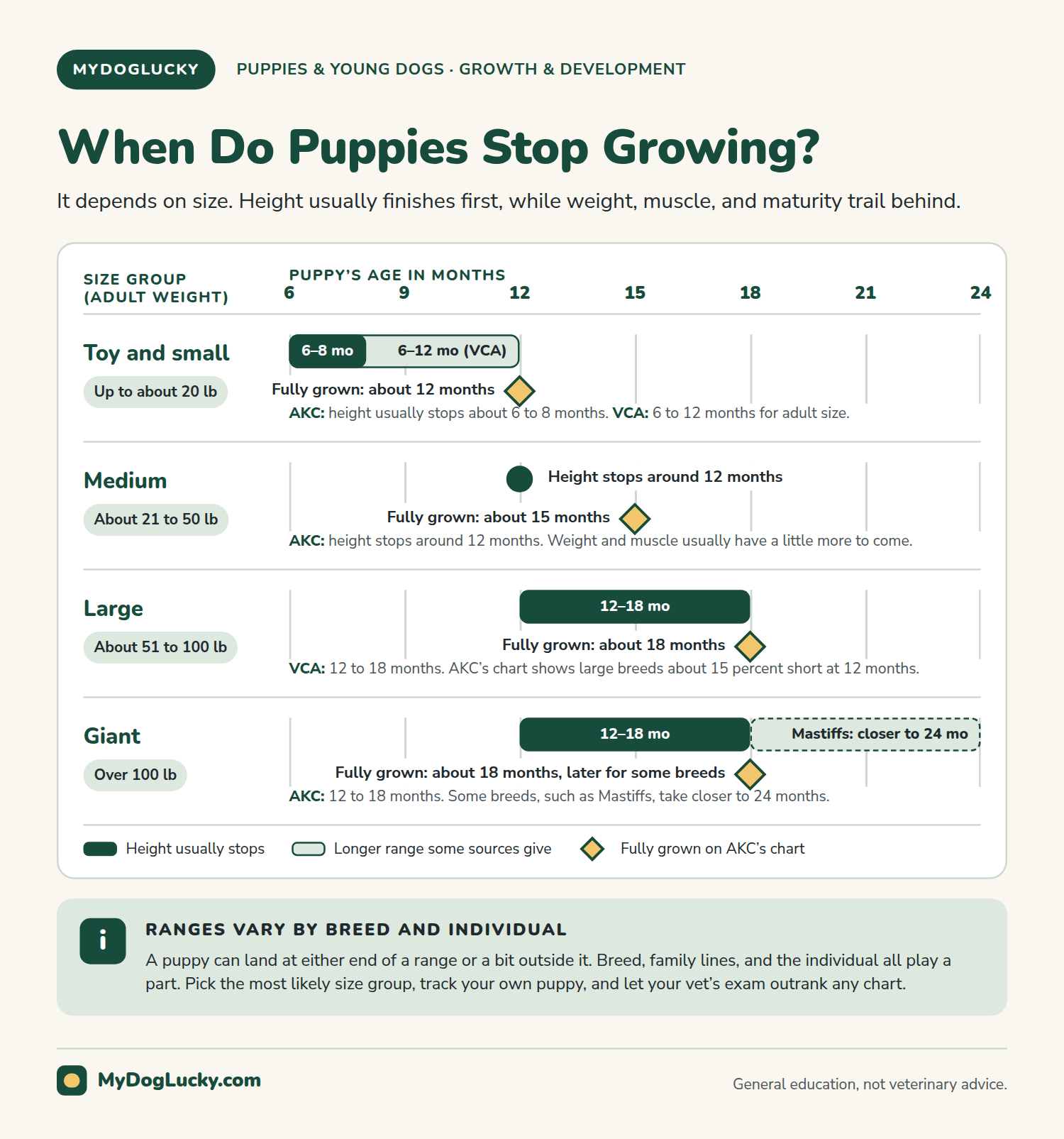
Most puppies finish getting taller before they finish growing up. Height comes first. Weight, muscle, and maturity trail behind. The table below shows how AKC and VCA describe the timing for four size groups.
| Size group | Adult weight (AKC’s grouping) | Height usually stops | “Fully grown” on AKC’s chart |
|---|---|---|---|
| Toy and small | Up to about 20 lb | About 6 to 8 months (AKC); 6 to 12 months for adult size (VCA) | About 12 months |
| Medium | About 21 to 50 lb | Around 12 months (AKC) | About 15 months |
| Large | About 51 to 100 lb | 12 to 18 months (VCA) | About 18 months |
| Giant | Over 100 lb | 12 to 18 months (AKC); some breeds, such as Mastiffs, closer to 24 months | About 18 months, later for some breeds |
Read the table as a rough map, not a schedule. The two sources don’t agree to the month. VCA also says there’s no precise cutoff for when a puppy counts as an adult, because it varies with size.
Why height and “fully grown” don’t match
AKC’s text says small dogs stop growing at 6 to 8 months. Its chart, though, shows small dogs reaching 100 percent at 12 months. Our reading is that height finishes first and the body keeps filling out afterward. That’s our interpretation, not a line from either source.
The same pattern shows up in every size group. Bigger dogs just run it more slowly.
What “ranges vary” means for your puppy
A puppy can land at either end of a range or a bit outside it. Breed, family lines, and the individual all play a part. A mixed-breed puppy adds another layer of uncertainty, because you may not know which size group he belongs to.
That’s normal, and it’s workable. The plan is the same either way. Pick the most likely size group, track your own puppy, and let your vet’s exam outrank any chart.
Three things to do today
- Write down your puppy’s age and today’s weight.
- Pencil in the size group that looks most likely. Pencil, not pen.
- Put your next vet visit on the calendar, and bring a list of growth questions.
Growth Has Layers: Four Clocks Running at Once
Asking when do puppies stop growing sounds simple. It’s really four questions in one, because bones, body weight, muscle, and behavior each keep their own time.
Clock one: bones and height
AKC explains that the long bones in a puppy’s legs grow from two areas called growth plates. Once a plate stops making new tissue and hardens, it “closes.” That bone has reached its final length. Until then, the plates are the soft spot in the system.
VCA describes growth plates as flexible cartilage that strenuous exercise can injure. It also gives a sense of timing. In small dogs, growth plates close a little after 6 months. In giant breeds, closure comes closer to 1½ years.
Clock two: weight and filling out
Height isn’t the whole story. AKC notes that puppies keep building muscle and body fat as they move into adulthood, even after they stop getting taller. That’s why its chart still shows a medium-breed puppy at 95 percent at 12 months, though its text says medium dogs stop growing around that age.
Many owners notice a lanky, long-legged stage. A few months later, the same puppy seems to broaden and deepen. That’s an observation, not a rule, and no age is attached to it.
Clock three: muscle and coordination
Muscle keeps developing after the frame is done. Owners often describe a stretch where legs, feet, and body don’t quite line up, and the puppy trips over his own paws. It can be funny to watch. It’s also a reminder that a bigger body doesn’t come with better coordination.
Clock four: behavior and social maturity
None of the sources we used gives a reliable age for behavioral maturity, so we won’t invent one. What many owners notice is a gap. The body looks grown, but the brain is still a puppy’s.
That gap matters more with size. A 60-pound adolescent who hasn’t learned to greet politely is a bigger household problem than the same habit in a 12-pound puppy. Training doesn’t wait for the growth chart to finish, so puppy training classes and everyday dog training basics are worth starting whatever your puppy weighs.
Why the layers matter
On AKC’s chart, a large-breed puppy at 9 months is about 75 percent of the way to fully grown. A giant-breed puppy is at about 65 percent. VCA says growth plates in giant breeds stay open until closer to 1½ years.
So a puppy can look nearly grown while his skeleton is still under construction. That gap is the reason the exercise advice later in this guide matters.
What to Expect in Each Size Group
The answer to when do puppies stop growing changes with adult size, so here’s each group in more detail. The percentages come from AKC’s chart. They describe how close to fully grown a puppy is at each age, on average, and the groups follow the adult weights AKC lists.
| Size group | 6 months | 9 months | 12 months | 15 months | 18 months |
|---|---|---|---|---|---|
| Small | 75% | 90% | 100% | — | — |
| Medium | 66% | 85% | 95% | 100% | — |
| Large | 60% | 75% | 85% | 95% | 100% |
| Giant | 50% | 65% | 80% | 90% | 100% |
A dash means the chart already shows 100 percent at an earlier age. These are averages from one source (AKC, updated June 2026), and individual puppies vary.
Toy and small breeds
AKC puts small dogs at 75 percent grown at 6 months, 90 percent at 9 months, and 100 percent at 12 months. VCA says small breeds usually reach adult size between 6 and 12 months. Very small breeds, such as Chihuahuas, land toward the early end.
The practical takeaway is that the tiny-puppy phase is short. Gear, weigh-ins, and vet questions all come around sooner than you might expect.
Medium breeds
AKC shows medium breeds at 66 percent at 6 months, 85 percent at 9 months, 95 percent at 12 months, and 100 percent at 15 months. Its text says height stops around 12 months.
Many owners treat the first birthday as the finish line. For height, that’s close. For weight and muscle, there’s usually a little more to come.
Large breeds
On AKC’s chart, large breeds reach 100 percent at 18 months. VCA says most large breeds reach adult size between 12 and 18 months. At his first birthday, a large-breed puppy is still about 15 percent short on the chart.
That’s a long stretch of “nearly there.” It’s also the stretch where a puppy looks like an adult and acts like a teenager, so patience helps.
Giant breeds
AKC shows giant breeds at 50 percent at 6 months and 100 percent at 18 months. Some breeds, such as Mastiffs, take until about 24 months, according to AKC. VCA also puts Mastiffs at around 2 years.
Half grown at 6 months means the second half takes a year or more. Food choices and exercise limits matter for a long time with these puppies, and your vet is the right partner for both.
If you don’t know your puppy’s group
Mixed-breed puppies, rescues, and puppies with unknown parents are common. Here’s a sensible way to handle the uncertainty.
- Ask the rescue or breeder what they know about the parents, and how they know it.
- Have your vet weigh and examine your puppy at each visit, and ask for a best guess.
- Ask your vet about the hands-on growth check AKC describes for dogs of unknown heritage.
- For joint-sensitive decisions, plan for the longer timeline until your vet says otherwise.
The last step is our editorial suggestion, not a rule from a source. It costs you little if your puppy turns out smaller, and it protects him if he turns out bigger.
How Adult Size Gets Estimated
Every owner who asks when do puppies stop growing is really asking a second question: how big will he get? Here’s how estimates get made, and where each one wobbles.
Start with breed and family
AKC says overall size is primarily determined by breed, genetics, and nutrition. So the most useful clues are about family. How big were the parents? How big were their earlier litters?
A breeder can often tell you. A rescue may not know, and that’s okay.
The percent-of-adult chart as a sanity check
If you know your puppy’s weight and your best guess at his size group, you can do rough arithmetic with AKC’s chart. Divide his weight by the group’s percentage. The table shows four worked examples. They’re illustrative, they’re our arithmetic rather than AKC’s, and they’re not predictions.
| Size group | Puppy’s weight at 6 months (illustrative) | AKC chart at 6 months | Rough arithmetic | Rough result (illustrative) |
|---|---|---|---|---|
| Small | 10 lb | 75% | 10 ÷ 0.75 | About 13 lb |
| Medium | 30 lb | 66% | 30 ÷ 0.66 | About 45 lb |
| Large | 48 lb | 60% | 48 ÷ 0.60 | About 80 lb |
| Giant | 60 lb | 50% | 60 ÷ 0.50 | About 120 lb |
This method has three weak spots.
- It’s circular. The groups are defined by adult weight, so you need to know where your puppy will land before you can use the chart.
- It treats every puppy as average. Real puppies can sit above or below the chart.
- Body condition skews it. A puppy carrying extra weight makes the answer overshoot. A lean, lanky puppy makes it undershoot.
Use the arithmetic to catch a big mismatch, not to order a crate. If your puppy’s numbers and the chart disagree, bring the difference to your vet instead of deciding for yourself.
Mixed breeds and the rib check
For dogs of unknown heritage, AKC describes a hands-on check. It involves feeling for small “knobs” along the ribs. If you can still feel them, AKC says the dog will probably keep growing taller.
That’s a description of what a source says, not a home test we’d trust alone. Ask your vet to show you what to feel for and what it means for your puppy.
DNA estimates
Some owners use a canine DNA test that reports breed mix and an adult-weight estimate. Treat it as one more estimate. Compare it with your puppy’s actual growth over the coming months, and ask your vet how much weight to give it.
We didn’t find a veterinary source that gives an accuracy figure for these tests, so we won’t quote one.
Formulas you’ll see online
You’ll run into rules like “double his weight at a certain age.” We couldn’t confirm any of them in the sources we used, so we won’t repeat them. If you try one anyway, call it a rough guide and let your vet’s read override it.
What your vet adds
AAHA’s puppy life-stage guidance stresses frequent veterinary visits early in life, and each visit produces a weight. A series of weights tells a vet far more than one number does. Ask whether your vet looks at the pattern over time, and whether your puppy’s pattern looks steady.
What Shapes How Your Puppy Grows
Several things push on growth at once. Some you can’t change. Others you can influence with your vet’s guidance.
Breed and genetics
These set the range. A puppy from a line of big dogs is likely to be big, and a puppy from a line of small dogs is likely to stay small. You can’t change this, but you can plan around it.
Nutrition
AKC says puppy-specific formulas are typically used until around 11 to 14 months, and that large-breed puppies need formulas designed for large-breed growth. It also says large and giant breeds are more sensitive to too much or too little calcium.
In practice, that means choosing a complete puppy or large-breed puppy food with your vet, and following your vet on amounts. It also means skipping extra calcium or other supplements unless your vet recommends them. Our guides to the best puppy food and large-breed puppy food cover the choosing. This guide doesn’t give a feeding plan or amounts.
Weight and body condition
AKC warns that obesity in puppies can lead to a predisposition to future orthopedic issues. So faster isn’t better. A puppy who grows steadily and stays lean is doing what you want.
Health
A puppy who’s unwell may not grow the way he should. That’s one reason a long stall deserves a call instead of a wait-and-see.
Sex
We didn’t find a source we could cite on how much sex changes adult size in a given breed. Ask your breeder or vet what’s typical for males and females in your puppy’s lines.
Spay and neuter timing
AKC says spaying or neutering can influence growth timing slightly, while overall size is primarily set by breed, genetics, and nutrition. AAHA says the right timing depends on factors such as sex and how much your dog is expected to weigh as an adult, and it points owners to their veterinarian.
So this is a conversation, not a rule. Bring your size-group guess, your puppy’s weights, and your household’s situation to that appointment.
Exercise and Growing Joints
Growth plates are the reason exercise advice changes for bigger puppies. VCA calls them sensitive and says strenuous exercise can injure them, leading to developmental abnormalities and pain.
That sounds alarming, but the everyday version is calmer. Because the answer to when do puppies stop growing depends on size, the exercise timeline does too.
What’s fine
VCA says walks are a great way to exercise together. It also says puppies should be allowed to run and play as they want and to regulate their own activity. So free play, sniffy walks, and short training games aren’t the problem. Let your puppy stop when he wants to stop.
What to hold off on
VCA recommends against long jogs or hikes, jump hurdles, and competitive agility until maturity. AKC warns that excessive, prolonged activity such as jogging can be extremely hard on the bones and joints of growing puppies. It says road work and jogging aren’t recommended before 14 to 18 months, especially for large and giant breeds.
| Activity | What our sources say | Question for your vet |
|---|---|---|
| Free play and walks | VCA: fine; let puppies regulate their own activity | How long is too long for my puppy’s size and age? |
| Jogging and road work | AKC: not recommended before 14 to 18 months, especially for large and giant breeds | When would you clear us to start, and how should we build up? |
| Long hikes | VCA: hold off until maturity | What distance is reasonable for now? |
| Jump hurdles and competitive agility | VCA: hold off until maturity | Are there foundation games we can do without jumping? |
| Stairs and couch jumping | Not covered by our sources | Any limits for my puppy’s size and age? |
Small breeds have a shorter wait
VCA says growth plates in small dogs close a little after 6 months, so the waiting period is shorter. It’s still worth asking your vet before you start anything strenuous.
Watch how he moves
VCA tells owners to watch for limping or other changes in how a puppy walks, sits, or moves. Some puppies keep playing through discomfort, so don’t count on him to tell you. If you notice a change, stop the activity and call your vet.
If you have big plans
Maybe you dream of trail runs, long hikes, or agility. Ask your vet early how they’d decide when your puppy is ready. Then build up gradually once you have the green light. The plan will still be there in a few months.
Body Condition Beats the Number on the Scale
Two puppies can weigh the same and look nothing alike. One is lean and long. The other is stocky and padded. The scale can’t tell them apart, but your eyes, your hands, and your vet can.
What body condition means
Body condition describes how lean or padded a body is under the coat. Ask your vet at the next visit to show you how to check by touch and by eye. Ask what “lean but not thin” looks like for your puppy’s frame.
Why bother? AKC links obesity in puppies to a higher chance of orthopedic problems later. Growing joints carry every extra pound.
How to keep watch
Photos help, and so do your hands. Compare your puppy’s shape from the side and from above, and notice how it changes over weeks. Fluffy coats can hide a lot, which is one more reason to let your vet’s exam back up your impressions.
If your puppy is carrying extra
Extra pounds happen, and treats add up fast. Count treats as part of the daily food. Ask your vet before changing how much your puppy eats, and don’t cut food on your own.
If your puppy looks thin
Many owners notice a lanky stage, and it can look thin next to a chunkier neighbor’s puppy. A vet exam is the way to tell whether he’s on track. Comparing him with another dog isn’t.
Growth Myths Worth Retiring
The biggest myth about when do puppies stop growing is that there’s a single date. A few smaller ones travel with it.
| Myth | What our sources say |
|---|---|
| Big paws mean a big dog. | None of the veterinary sources we used treat paw size as a way to predict adult size. Enjoy the big paws as a curiosity, not a plan. |
| Every dog is fully grown at one year. | Only some are. AKC and VCA put large and giant breeds at 12 to 24 months, and AKC’s chart shows medium breeds still at 95 percent at 12 months. |
| Puppyhood lasts 12 months for every dog. | VCA notes that many dog foods treat puppyhood as birth to 12 months, which doesn’t capture the variation between breeds. |
| Once he stops getting taller, he’s done. | AKC says puppies keep building muscle and body fat as they move into adulthood. |
| Faster growth means a healthier puppy. | AKC warns that obesity in puppies can predispose them to orthopedic problems later. |
| Neutering decides how big he’ll get. | AKC says it can influence growth timing slightly, but size is primarily set by breed, genetics, and nutrition. |
The comparison trap
Your neighbor’s puppy looks bigger. The puppy at daycare looks smaller. Comparisons feel natural, but they don’t tell you much.
You don’t know their breeds, their ages, or their body condition. If something about your puppy’s size worries you, take that worry to your vet with your growth log in hand.
How to Track Your Puppy’s Growth at Home
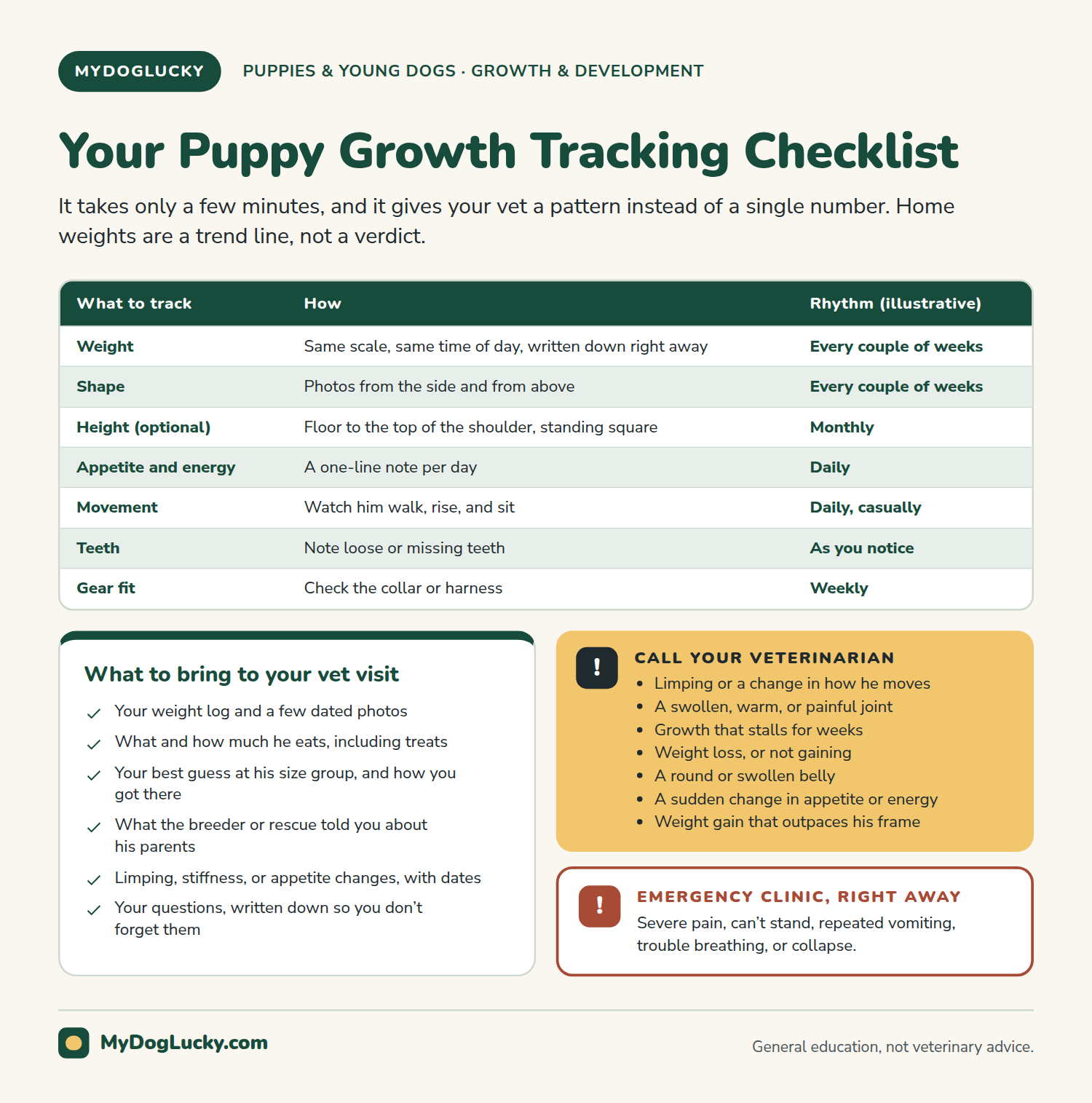
Tracking turns when do puppies stop growing from a guess into a pattern you can see. It takes only a few minutes, and it gives your vet something concrete to work with. The rhythms in the table are illustrative suggestions, not prescriptions, so ask your vet how often they’d like weights.
| What to track | How | Rhythm (illustrative) | What it tells you |
|---|---|---|---|
| Weight | Same scale, same time of day, written down right away | Every couple of weeks | The trend over time |
| Shape | Photos from the side and from above | Every couple of weeks | Body condition and proportions |
| Height (optional) | Floor to the top of the shoulder, standing square | Monthly | Whether height is still climbing |
| Appetite and energy | A one-line note per day | Daily | Changes worth mentioning |
| Movement | Watch him walk, rise, and sit | Daily, casually | Limping or stiffness |
| Teeth | Note loose or missing teeth | As you notice | Another timeline running alongside growth (our puppy teething article covers it) |
| Gear fit | Check the collar or harness | Weekly | When it’s time to size up |
Weighing at home
Small puppies can go on a kitchen or baby scale, in a box or basket if that helps. For bigger puppies, use a bathroom scale. Weigh yourself first, then weigh yourself holding your puppy, and subtract.
Use the same scale and the same time of day, ideally before a meal. Write the number down right away. Your vet’s scale is more accurate than yours, so treat home numbers as a trend line rather than a verdict.
Photos that tell you something
Pick one spot with steady light and a level floor. Take a side view and a top-down view.
Include something familiar for scale, like a door frame or a chair leg. Keep the distance the same every time. A photo taken casually beside your knee can’t be compared with one taken standing over him.
Measuring height
Height is optional, and it works best if your puppy stands still. Use a wall, a flat book, and a tape measure. Measure from the floor to the top of the shoulder.
If it turns into a wrestling match, skip it. Weight and photos do most of the work.
A one-page log
The example below shows the idea. The numbers are made up to show the layout, so don’t treat them as a benchmark for your puppy.
| Date | Age | Weight (illustrative) | Shape and movement | Appetite and energy | Question for vet |
|---|---|---|---|---|---|
| Example 1 | 4 months | 22 lb | Lanky, moves easily | Eats well, naps hard | Which size group fits best? |
| Example 2 | 5 months | 29 lb | Longer legs, bit clumsy | Hungrier than usual | When do we switch foods? |
| Example 3 | 6 months | 36 lb | Slightly stiff after a long nap | Normal | Is the stiffness worth a look? |
What to bring to the vet
Your vet has seen many puppies, but not yours over the past few weeks. You have. Bring:
- Your weight log and a few dated photos.
- A note on what and how much he eats, including treats.
- Your best guess at his size group and how you arrived at it.
- Any details from the breeder or rescue about his parents.
- Any limping, stiffness, or appetite changes you noticed, with dates.
- Your questions, written down so you don’t forget them.
If it’s his first visit, our puppy first vet visit guide has more on what to expect. Your puppy vaccination schedule also runs alongside growth checks, so ask the clinic how they’d like to combine them.
A Month-by-Month Watch Plan
Tracking works better when you know what to look for at each stage. This plan pairs AKC’s chart with exercise and food notes from our sources. It guides your attention. It isn’t a schedule your puppy has to keep.
The plan by age
| Age | What the sources show | What to focus on |
|---|---|---|
| Under 6 months | By 6 months, AKC’s chart has small puppies at about 75 percent and giant puppies at 50. AAHA stresses frequent early vet visits. | First weights and photos, a size-group guess in pencil, adjustable gear, and your first list of vet questions. |
| 6 to 9 months | Small puppies reach about 90 percent by 9 months, large 75, and giant 65. VCA says small-dog growth plates close a little after 6 months. | Keep the log going. Check gear fit often. Ask your vet how the weight trend looks. |
| 9 to 12 months | At 12 months, small dogs hit 100 percent, large 85, and giant 80. AKC says puppy formulas are typically used until about 11 to 14 months. | Ask your vet when to change foods. Keep exercise gentle for large and giant puppies. Don’t assume he’s done. |
| 12 to 18 months | Medium breeds finish around 15 months on AKC’s chart. Large and giant breeds reach 100 percent at 18. AKC says jogging isn’t recommended before 14 to 18 months, especially for large and giant breeds. | Ask when strenuous exercise is appropriate. Watch body condition as growth slows, and ask your vet to recheck food amounts. |
| 18 to 24 months | Some giant breeds, such as Mastiffs, are still finishing at around 24 months. | Keep tracking weight and shape. Celebrate the finish line, then move to your vet’s adult wellness schedule. |
What to Do If Your Puppy Doesn’t Match the Chart
Sooner or later, most puppies drift away from the chart. Here’s how to think through the common versions.
He seems to have stopped growing early
First, check the size group. AKC says small dogs stop growing at about 6 to 8 months, so a small puppy who’s leveling off may simply be finishing. Look at your log. Is his weight steady, or has it dropped?
If he’s well below the age when you expected him to finish and he isn’t gaining, call your vet. Bring the log and photos.
He’s still growing after the chart says he’s done
The chart is an average. AKC says some giant breeds take up to 24 months, and its own table shows medium breeds still at 95 percent at 12 months. Keep tracking. If weight is climbing faster than his frame, ask your vet about body condition.
He’s bigger than the breeder predicted
Estimates are estimates. Redo the arithmetic with a more realistic size group, and update your gear and exercise plans for a larger frame. Keep the joint-friendly limits in mind, since a bigger puppy may need the longer timeline. Then mention it to your vet, so they can re-check their own estimate.
He’s smaller than expected
Compare him with his own log, not with other puppies. Steady gains, good energy, and a normal vet exam are reassuring signs, though your vet is the one to say whether they’re enough. Ask what they look for in a puppy who’s small for the chart.
His littermates look different
Littermates can end up at different sizes. That’s another reason your own puppy’s log matters more than anyone else’s puppy. If a gap between littermates worries you, ask your vet or the breeder what they see.
Questions to Ask Your Vet, Breeder, or Rescue
Good questions save time and make a visit more useful. Copy any of these into your phone before your appointment.
For your veterinarian
- Which size group does my puppy look like, and how confident are you?
- How does his weight trend look so far?
- Is his body condition where you’d like it?
- How much should I feed, and when should we reassess?
- When should we switch from puppy food?
- What exercise is right for him now, and when could we add running or hiking?
- Should I set limits on stairs, couch jumping, or car ramps?
- When should we talk about spay or neuter timing?
- What signs should make me call between visits?
- How often would you like me to record his weight?
For a breeder
- How big were the parents and grandparents as adults?
- How big did dogs from earlier litters get?
- Have you seen any joint or growth problems in these lines, and what do you screen for?
- What did this puppy’s littermates weigh at the same age?
- Would you like to hear how he turns out?
For a rescue or shelter
- What do you know about his parents, and how do you know it?
- How was his age estimated?
- Are there vet notes on his weight or any past injuries?
- Who can I contact if I have questions later?
A simple script
Try this with your vet: “I’ve been keeping a weight log and taking photos. Could you help me sanity-check how he’s growing and tell me what to watch for?” That kind of question shows you’re paying attention, and it gives your vet something to work with.
Signs Worth a Call to Your Vet
Most growth questions are ordinary. A few signs deserve a phone call, and it’s fine to call even if you’re unsure. We can’t tell you what any of these means for your puppy. That’s your vet’s job.
Call your veterinarian if you notice
- Limping, or a change in how your puppy walks, sits, or moves.
- A joint that looks swollen, or feels warm or painful.
- Growth that seems to stall for weeks, well before the age you expected him to finish.
- Weight loss, or a puppy who isn’t gaining when you expect him to.
- A round or swollen belly, especially if the rest of him looks thin.
- A sudden change in appetite, such as refusing meals or an unusual surge in hunger.
- Unusual tiredness, or a puppy who seems to be losing energy.
- Weight gain that’s outpacing his frame.
If your puppy is in severe pain, can’t stand, has repeated vomiting, has trouble breathing, or collapses, call an emergency veterinary clinic right away.
What your vet may do
Your vet will likely examine your puppy, weigh him, and look at how he moves. They may ask about food, treats, and activity, and review the growth history you brought. Depending on what they find, they may suggest further tests. Your log makes that conversation easier.
What not to do
Try not to cut his food, add supplements, or restrict activity dramatically without your vet’s input. Don’t push through a limp, and don’t rely on internet forums to decide whether a change is normal. A quick call beats a long guess.
Planning Around a Puppy Who’s Still Growing
Once you have a rough answer to when do puppies stop growing for your puppy, you can plan ahead. Planning saves money and stress.
Gear that keeps up
Collars and harnesses that fit today may not fit next month. Check the fit weekly, and ask your vet or a certified trainer to show you a good fit. For crates, consider one sized for the adult range with an adjustable divider, so your puppy has a snug space now and room later. Beds work the same way.
Your home
Non-slip surfaces help young joints and clumsy paws. If you have stairs, ask your vet whether limits make sense for your puppy’s size and age. Watch for slippery floors during zoomies, when he’s moving fast and still learning where his legs are.
Costs as variables
Prices depend on your area, your providers, and your puppy’s size, so we don’t quote any. Ask providers how they price for a dog of your puppy’s expected adult size. That includes food, boarding, grooming, and training. It’s easier to plan for a larger dog when you’re not surprised later.
Rentals and shared spaces
If you rent, check the pet policy against your puppy’s expected adult range, not his current weight. Living with a dog in an apartment is very doable at many sizes. It’s the surprises that cause trouble.
People and manners
A puppy who jumps up is cute at 12 pounds and a lot at 70. Teach greetings early, while your puppy’s still small enough that the lesson feels easy. Guests and children need coaching too, especially with large-breed puppies who don’t yet know their own strength.
Enjoy the small phase
It’s okay to feel a little wistful about the size he’s outgrowing. Take the photos. Snap the one on your lap while he still fits.
Three Real-Life Versions of This Question
These are illustrative composites, not case studies. They show how the same advice plays out in different households.
The apartment household with a mixed-breed rescue
A common real-life version looks like this. You adopted a puppy with unknown parents, and your lease has a weight limit. You can’t know his adult weight, so you plan for a range. Ask the rescue what they know, ask your vet for a best estimate at each visit, and read your lease against the top of the range.
Keep the log, so the conversation with your landlord is based on real numbers if it comes up.
The family with a large-breed puppy and young kids
Another version: a big-breed puppy joins a family with small children. He’s 5 months old and already knocks toddlers over. His body is outrunning his manners, and his joints are still developing. Supervise interactions, teach greetings early, and keep exercise gentle and self-paced.
Ask your vet for exercise limits, and don’t let anyone take him jogging until the vet agrees.
The would-be runner
A third version: you adopted a puppy hoping for a running partner. AKC says jogging isn’t recommended before 14 to 18 months, especially for large and giant breeds, so the honest plan is to wait.
In the meantime, build the habits you’ll need. Practice loose-leash walking, teach him to settle, and keep his weight lean. When your vet gives the go-ahead, ease in slowly.
Common Mistakes While Watching a Puppy Grow
- Treating a chart as a deadline. Ranges are averages. A puppy who’s a month “late” isn’t automatically a problem, and one who’s “early” isn’t automatically finished.
- Comparing him with another dog. Different breeds, ages, and body conditions make the comparison meaningless. Compare him with his own log.
- Feeding for size. AKC’s warning about obesity applies. Bigger faster isn’t the goal.
- Adding supplements on a hunch. AKC notes large and giant breeds are sensitive to calcium excess or shortage. Ask your vet first.
- Starting runs or hikes early. The sources we used advise waiting on strenuous activity. A puppy who looks like an adult may not be ready.
- Skipping weigh-ins. One number tells you little. A series tells you a lot.
- Assuming looks equal maturity. A big puppy is still a puppy in his head.
- Ignoring a limp because he still plays. Some puppies play through discomfort. Call your vet.
Questions About Puppy Growth
When do puppies stop growing taller?
It depends on size. AKC says small dogs stop growing at about 6 to 8 months, medium dogs around 12 months, and giant dogs somewhere between 12 and 18 months, with some breeds taking up to 24. VCA gives 12 to 18 months for most large breeds.
Do dogs still grow after one year?
Many do. On AKC’s chart, medium breeds are at 95 percent at 12 months, large breeds at 85 percent, and giant breeds at 80 percent. In medium dogs, much of it is filling out. In large and giant breeds, height can keep climbing too, since VCA puts most large breeds at 12 to 18 months.
How big will my mixed-breed puppy get?
Nobody can say exactly. Ask what’s known about the parents, keep a growth log, and ask your vet for their best estimate and the reasoning behind it. Treat DNA results as one more estimate.
Is my puppy too small or too big for his age?
A chart can’t answer that. Comparing with other dogs won’t either. Bring your log and photos to your vet, who can examine him and consider his breed, body condition, and history.
Can I predict adult size from paw size?
None of the veterinary sources we used treat paw size as a reliable predictor, so we wouldn’t plan around it.
Does spaying or neutering stop growth?
AKC says it may influence growth timing slightly, and that overall size is primarily determined by breed, genetics, and nutrition. When to schedule it is a conversation with your vet.
When can my large-breed puppy start running or hiking with me?
AKC says jogging and road work aren’t recommended before 14 to 18 months, especially for large and giant breeds, and VCA advises holding off on long jogs and hikes until maturity. Ask your vet when your puppy is ready and how to build up.
Should I feed less to slow growth?
Don’t change amounts or food on your own. AKC says large-breed puppies need formulas designed for their growth, and it warns about obesity. Ask your vet whether your puppy’s amounts and body condition look right.
When should I switch to adult food?
AKC says puppy formulas are typically used until around 11 to 14 months. The right timing depends on your puppy’s size, so ask your vet. Our best puppy food guide covers the choosing.
Is it normal for my puppy to look lanky or awkward?
Many owners report a long-legged, gangly stage. It often looks like the puppy has outgrown his own body. If he’s eating well, moving comfortably, and your vet is happy with his weights, owners generally treat it as a passing phase. If he’s stiff, limping, or off his food, call.
Do puppies grow in spurts?
Many owners describe weeks when a puppy seems to grow overnight and weeks when little changes. Charts smooth all that out. A log shows you your own puppy’s pattern. A stall that lasts for weeks deserves a call.
Can a DNA test tell me his adult weight?
Some report an estimate. We couldn’t find an accuracy figure from a veterinary source, so treat it like any other estimate and compare it with your puppy’s growth. Ask your vet how to weigh the result.
When does a puppy stop acting like a puppy?
The sources we used don’t give a reliable age for behavioral maturity, so we won’t guess. Many owners notice that the body finishes before the manners do. Keep training, and consider puppy training classes if you haven’t started.
How often should I weigh my puppy?
Ask your vet. Many owners find that every couple of weeks is easy to keep up, and that’s our illustrative suggestion, not a rule. The habit matters more than the exact schedule.
My rescue puppy’s age is a guess. Now what?
Age estimates come with a margin of error, so use the size group and body condition as your guide. Ask your vet to estimate age and likely adult size, and revisit the estimate at each visit.
Do I need bigger everything all the time?
Not always. Check collar and harness fit weekly, and size up when the fit changes. A crate with an adjustable divider can cover the whole growth period, so you don’t have to replace it.
Are “growing pains” real in puppies?
We couldn’t find a source that defines growing pains in puppies, so we won’t call anything by that name. Limping, stiffness, or a change in how your puppy moves is worth a call to your vet, as VCA advises. Don’t wait for it to pass.
How do I know when my puppy is officially an adult?
There’s no single moment. VCA says there’s no precise cutoff for when puppies count as adults, because it varies with size. Height, weight, muscle, and maturity finish at different times, so your vet’s judgment matters more than a birthday.
Is it a problem if my puppy is smaller than his littermates?
It might not be, but that’s a question for your vet. Littermates can differ. Bring your weight log and photos so your vet can see his pattern, not just a single number.
Where to Start This Week
You now know roughly when do puppies stop growing for each size group. Here’s what to do about it.
- Weigh your puppy today. Write down the weight, the date, and his age.
- Take two photos. One from the side and one from above, in the same spot each time.
- Pencil in a size group. Use what you know about the parents, and hold it loosely.
- Write three questions for your vet. Size group, exercise limits, and food timing are good starters.
- Check his gear. If the collar or harness is snug, size up.
Then let your puppy be a puppy. Keep the log going and enjoy the growing. The finish line is a range, and you’ll see him approach it in your own photos. If anything worries you along the way, call your vet.
Sources
- American Kennel Club (AKC). When Do Dogs Stop Growing? When Are Puppies Fully Grown? By Susan Paretts; veterinary review by Jerry Klein, DVM. Updated June 23, 2026.
- VCA Animal Hospitals. Puppy Growth and Maturity. Undated page, accessed September 2026.
- VCA Animal Hospitals. How Exercise Can Damage Puppy Growth Plates. Undated page, accessed September 2026.
- American Animal Hospital Association (AAHA). Canine Life Stage: Puppy. Published October 22, 2019; last modified May 14, 2024.
This article is general education for U.S. dog owners. It is not individualized veterinary advice, and it is not an adult-size calculator or a promise about how big your puppy will get. Growth ranges are averages from the sources listed and vary by breed and by individual dog. Ask your veterinarian about your puppy’s size, weight, exercise, food, and spay or neuter timing. Limping, swollen joints, stalled growth, weight loss, or a sudden change in appetite or energy is a reason to call your veterinarian.