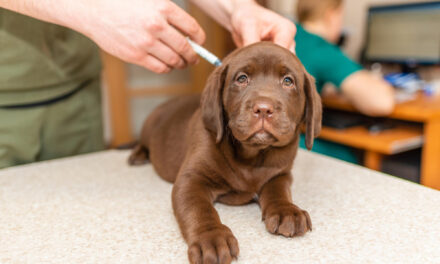
Puppy training classes do three jobs at once. They give your puppy safe practice around other puppies and new people. They teach basic skills, like coming when called and settling on a mat. And they teach you how to teach, which is the part most owners underestimate.
Here’s the catch. In the United States, dog training is an unregulated field, so the quality of a class depends on who runs it. A great class feels like a calm, well-organized playgroup with a coach. A poor one can leave a sensitive puppy more nervous than when he walked in.
This guide helps you tell the difference. We’ll cover when to start, how to pick an instructor, what a healthy room looks like, what to ask, what to bring, and what to do if your puppy would rather hide behind your legs. We’ll also flag when a private behavior consult beats a group. Your veterinarian knows your puppy’s vaccine and health status, so timing questions go to them.
What’s in this guide
- Puppy training classes: the short answer
- What a puppy class actually is (and what it isn’t)
- When to start puppy classes
- How to choose a puppy class instructor
- What a well-run class looks like
- The trial visit: what to watch before you enroll
- Red flags: when to walk out
- Questions to ask and a scoring worksheet
- What your first class will look like
- Homework that makes class work
- When your puppy is shy or overwhelmed
- Shy, fearful, or bitey: group class or private consult?
- Virtual vs. in-person classes
- What classes cost: the variables, not the prices
- What comes after puppy class
- Common mistakes with puppy training classes
- Frequently asked questions about puppy classes
- Where to start this week
- Sources
Puppy Training Classes: The Short Answer
A good puppy class is a small, clean, supervised group. Puppies of similar age and size practice simple skills and calm social contact, and the instructor pays them with treats, toys, and praise. You get coaching, too. Good programs ask for proof of vaccines and deworming before your puppy comes through the door.
On timing, the American Veterinary Society of Animal Behavior (AVSAB) says puppies can start socialization classes as early as 7 to 8 weeks old. The condition: at least one set of vaccines, given at least 7 days before the first class, plus a first deworming. Whether that fits your puppy is a question for your veterinarian.
The one-minute version
- Start: as early as 7 to 8 weeks, if your vet agrees and the vaccine and deworming timing is met.
- Pick: a reward-based instructor, a small group, similar ages and sizes, a clean space, and written health rules.
- Watch first: sit in on a class without your puppy before you pay.
- Walk away from: choke, prong, or shock tools, “alpha” talk, forced contact, punishment, and promises of results.
- Go at his pace: stepping back from the action is allowed. It still counts as participating.
- Keep going: class is a start. Skills grow with practice at home and out in the world.
What a Puppy Class Actually Is (and What It Isn’t)
Say “puppy class” and people picture a dozen wiggly puppies learning to sit in unison. The real thing is messier and more useful. Good puppy training classes are structured settings where three lessons run side by side.
The Three Jobs a Good Class Does
- Socialization. Your puppy meets other puppies and unfamiliar people in a controlled space. AVSAB describes well-run classes as a safe, organized way to socialize puppies.
- Foundation skills. Name response, sit, down, hand target, settling, walking a few steps beside you, and calm handling. These are short, easy exercises, not competition obedience.
- Owner education. You practice timing, reward delivery, and reading your puppy’s body language while someone watches and adjusts your technique.
That third job is the big advantage of a live class. A person can see that you’re rewarding late, and fix it in one sentence.
Puppy Class vs. Other Options
Several formats sound alike. They aren’t. This table shows where each one fits, and where it doesn’t.
| Format | Mainly for | Often a fit when | Keep in mind |
|---|---|---|---|
| Puppy class | Socialization, first skills, and owner coaching in a group | Your puppy is healthy and your vet agrees on timing | Quality varies a lot. You choose the room. |
| Adult obedience class | Skills for older dogs who can focus longer | Your dog has aged out of puppy class | Usually not built around early social experiences |
| Private lessons | One-on-one coaching for your puppy’s specific issues | Your puppy is shy, very mouthy, or your schedule is tight | No group practice unless you add it |
| Group daycare | Supervised care and play while you’re away | You work long hours and want a safe place for your puppy | Care isn’t training. Ask what “training” includes, if anything. |
| Board-and-train | Your puppy stays with a trainer to learn skills | You’ve checked methods and tools in detail | You still have to learn the skills at home |
None of these replaces the others. Many families combine a group class with a private session or two for one stubborn issue, and that’s a reasonable plan.
What a Puppy Class Can and Can’t Do
Set your expectations before you enroll. A class can start good habits, give your puppy safe social practice, and give you a coach. It can’t finish the job in one series, and it can’t rewrite a puppy’s temperament.
Some puppies are naturally bold. Others need more time. Both belong in class.
Think of it as a weekly checkpoint. The real work happens in your kitchen, on your walks, and in the ordinary moments between sessions. Treating puppy training classes as a starting line, not a finish line, takes a lot of pressure off both of you.
When to Start Puppy Classes
The honest answer has two clocks. One says start early, while a young puppy is still open to new things. The other says protect a puppy whose vaccine series isn’t finished. A well-run class manages both.
What the Sources Say About Timing
Three reliable sources shape the conversation, and they line up more than you might expect.
- AVSAB (2008) says puppies can begin classes at 7 to 8 weeks. It asks for at least one set of vaccines at least 7 days before the first class, plus a first deworming. It also recommends indoor spaces that are easy to clean and disinfect.
- Ohio State and Gigi’s (Herron and Stull, November 2024) describe classes starting at 7 weeks. Their minimum: at least one distemper, parvovirus, adenovirus, and parainfluenza vaccine, plus one dose of ascarid dewormer, at least 7 days before class. They also want a clean bill of health from a veterinarian.
- AAHA (2022) covers the vaccine series itself: boosters every 2 to 4 weeks until a puppy is older than 16 weeks, with 18 to 20 weeks possibly preferred in areas of high distemper risk. It doesn’t set class rules.
Timing at a Glance
Here’s the same information in one place.
| Question | What the sources say | Who decides |
|---|---|---|
| Earliest age | 7 to 8 weeks (AVSAB, 2008); 7 weeks (Ohio State, 2024) | Your veterinarian |
| Vaccines before class one | At least one set, given at least 7 days earlier | Your veterinarian |
| Deworming | A first deworming before class; one ascarid dose at least 7 days earlier (Ohio State) | Your veterinarian |
| Finishing the series | Boosters every 2 to 4 weeks until older than 16 weeks; 18 to 20 weeks may be preferred in high-risk areas (AAHA, 2022) | Your veterinarian |
| “Puppy” age cutoff | Ohio State describes puppy classes as reserved for puppies under 4 months. Programs set their own limits. | The class. Ask. |
Our puppy vaccination schedule guide explains how the shot series works in more detail.
Why Waiting for the Last Shot Has a Cost
It’s tempting to keep a puppy home until every vaccine is done. The trouble is that the early weeks matter for social learning. The Ohio State authors write that failing to adequately socialize puppies is arguably the most common reason for major behavioral concerns in adult dogs. They also say puppies who wait until 16 to 20 weeks are far past the window when socialization has its best effect.
AVSAB’s statement goes further. It says behavioral issues, not infectious disease, are the number one cause of death for dogs under three. That statement dates to 2008, and local disease risk varies. Treat it as context, not a green light.
Nobody here is saying disease risk is imaginary. The Ohio State authors put it plainly: “the key is finding a balance that takes BOTH risks into consideration.” A good class balances them with health rules, cleaning, and a small, screened group.
Why You Still Ask Your Vet First
Your veterinarian knows what’s circulating in your area, how your puppy’s series is going, and whether anything about his health changes the plan. AVSAB also advises avoiding dog parks and other spots that many dogs of unknown vaccine or disease status use. The Ohio State guidance suggests sticking to sidewalks and using a stroller or sling to keep a young puppy off unknown ground.
Ask your veterinarian before you book
- Has my puppy had enough vaccines and dewormer to start a class?
- Is there any local disease concern that changes the plan?
- What should the class require from the other puppies?
- Where can my puppy walk right now, and where should he stay off the ground?
- Does anything about his health or breed change what he should do in class?
For ideas on what to practice between now and class, see our puppy socialization checklist.
A Worked Example (Illustrative, Not a Prescription)
Say your puppy comes home at 9 weeks. He had his first combination vaccine and a first deworming at the vet ten days ago. You ask about puppy training classes, and your vet says he’s healthy and the local picture looks fine. Under the minimums in the AVSAB and Ohio State guidance, he could start a class now, because the vaccine and dewormer went in more than 7 days ago.
Now say the vaccine went in three days ago instead. The 7-day gap hasn’t passed. You’d wait a few days, keep him off unknown ground, and use the time to shortlist programs and book trial visits for yourself. Your vet decides the details, and yours may set stricter timing.
If Your Puppy Is Older Than the Class Allows
It happens. You brought him home at 14 weeks, or life got busy, and the “puppy” class caps out sooner than you’d like. Don’t panic.
AVSAB says socialization should continue through the first year and beyond. Ask programs whether they run classes for older puppies or adolescents, or book a private session to fill the gap.
How to Choose a Puppy Class Instructor
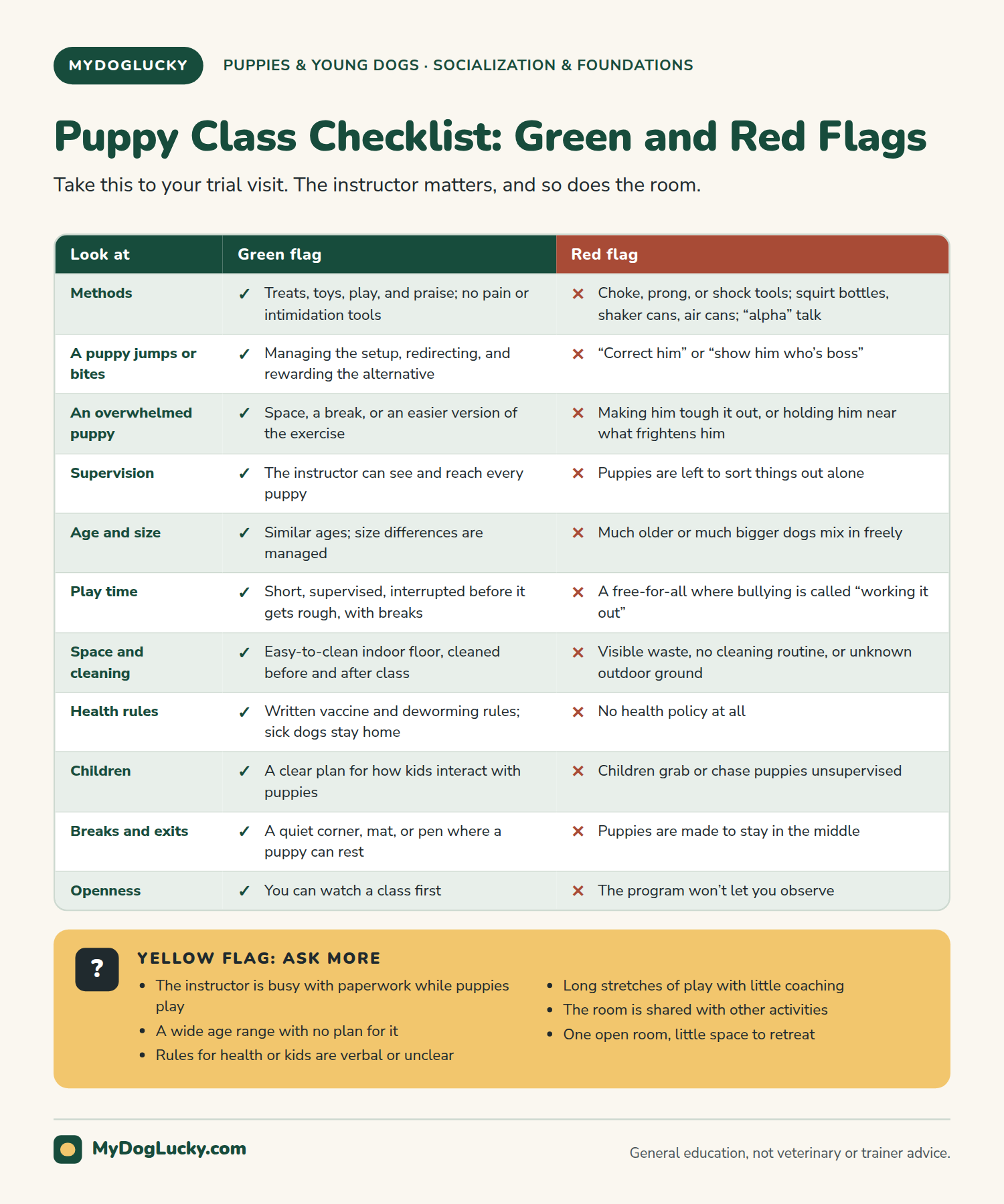
When you compare puppy training classes side by side, the instructor matters more than the building. The infographic below puts the whole checklist on one page. Save it to your phone and take it to your trial visit. The next few sections unpack every line.
Credentials Are Voluntary in the United States
The AKC puts it bluntly: “Dog training is an unregulated industry.” Anybody can print business cards and charge for classes, whatever their background. So a class sign doesn’t tell you much. What the instructor actually does with puppies tells you a lot.
What Credentials Can and Can’t Tell You
Independent certifying bodies exist, such as CCPDT and IAABC. The AKC says certification isn’t mandatory, but it shows dedication to the profession. That’s useful. It tells you the person studied, kept records, and answers to a standard.
It doesn’t tell you how they handle a scared eight-week-old. So treat credentials as one data point. Ask what they’ve completed, whether they keep learning, and how much of their work is with puppies specifically. AVSAB’s guidance on choosing a trainer also looks for someone who keeps up with current training science.
Methods: Reward-Based, in Plain Language
AVSAB’s 2021 position statement recommends reward-based methods for all dog training. That means paying your puppy, with treats, toys, play, or praise, for what you like. It also means arranging the room so mistakes are rare.
The same statement advises avoiding tools that involve pain or intimidation. It names choke chains, prong collars, electronic shock collars, squirt bottles, shaker cans, compressed air cans, shouting, staring, and forceful moves like “alpha rolls.” It links those methods to stress, fear, anxiety, and in some cases aggression. That’s a lot of risk to accept in a room full of eight-week-olds.
Ask What Happens When Things Go Wrong
A quick test tells you plenty. Ask, “What do you do when a puppy jumps, bites, or ignores a cue?” A good answer sounds like managing the setup, redirecting, and rewarding the alternative. A worrying answer sounds like “correct him,” “show him who’s boss,” or “he needs to respect you.”
Follow up with, “What happens when a puppy gets overwhelmed?” The right answer includes giving him space. The wrong one includes making him tough it out.
Look for Teamwork With Your Vet
AVSAB’s guidance on choosing a trainer says a good trainer works with veterinarians on problem behaviors and recognizes when a medical issue may sit behind a behavior. That matters for puppies. A sudden change in behavior can be a health signal, and an instructor who says “call your vet” is showing good judgment, not passing the buck.
Match the Instructor to Your Puppy
Puppies differ. A tiny toy-breed puppy, a leggy giant-breed puppy, and a nervous rescue puppy each need slightly different handling.
Ask the instructor how they’d adapt an exercise for your puppy. A thoughtful answer names size, energy, and comfort level. A stock answer, like “everybody does the same thing,” suggests the class runs on autopilot.
Read the class description, too. Look for the age range, the health requirements, what the class covers, and what to bring. Clear writing is a good sign. Vague or hype-heavy copy is a reason to ask more questions.
What a Well-Run Class Looks Like
A great instructor can still run a poor room. Group size, age mix, floor cleaning, and health rules all shape your puppy’s experience. Use this table on your trial visit.
| Feature | Green flag | Yellow flag: ask more | Red flag |
|---|---|---|---|
| Group size and supervision | The instructor can see and reach every puppy; helpers join larger groups | The instructor is busy with paperwork while puppies play | Puppies are left to sort things out alone |
| Age and size | Similar ages; size differences are managed | A wide age range with no plan for it | Much older or much bigger dogs mix in freely |
| Play time | Short, supervised, interrupted before it gets rough, with breaks | Long stretches with little coaching | A free-for-all where bullying is called “working it out” |
| Space and cleaning | Easy-to-clean indoor floor; cleaned before and after class | Shared with other activities | Visible waste, no cleaning routine, or unknown outdoor ground |
| Health rules | Written vaccine and deworming rules; sick dogs stay home | Rules are verbal or vague | No health policy at all |
| Children | A clear plan for how kids interact with puppies | Kids welcome, rules unclear | Children grab or chase puppies unsupervised |
| Breaks and exits | A quiet corner, mat, or pen where a puppy can rest | One open room, little space to retreat | Puppies are made to stay in the middle |
Small Groups, Similar Ages, Matched Sizes
The Ohio State guidance asks programs to account for size differences, because a big puppy can frighten a small one. It also expects a solid plan for how attendees, and their children, interact with other puppies. We couldn’t find a verified source that gives an ideal number of puppies per instructor, so we won’t invent one. Ask this instead: “Can you see and reach every puppy from where you stand?”
Structured Play, Not Chaos
Supervised play is where puppies practice manners with other dogs. It works when someone watches body language, pauses the game when it tips into bullying or panic, and lets puppies swap partners or rest. Free play with no referee can teach puppies to rush, pile on, or get mobbed. The Ohio State authors say classes should focus on creating positive emotional connections, and a good referee is how that happens.
A Tale of Two Play Sessions (Illustrative)
Picture the good version first. Four puppies of similar size get a few minutes of play. The instructor watches, calls a pause when the game gets intense, and lets the puppies rest on their mats. One puppy hangs back, so the instructor steers a calm, friendly partner his way, and everyone earns a treat for checking back in with their owner.
Now the other version. A crowd of puppies in mixed sizes races around while owners chat, and a big puppy pins a small one. Someone says, “They’ll work it out.” The small puppy yelps, then hides under a chair and won’t come out.
Same evening, same price, very different lessons. That’s why the trial visit matters.
A Clean Room With Written Rules
Both AVSAB and the Ohio State guidance point to cleaning and disinfection, indoor surfaces that clean easily, and inclusion rules that keep sick or recently exposed dogs out. Ask to see the policy in writing. A confident program hands it over without a fuss.
The Trial Visit: What to Watch Before You Enroll
The AKC advises trying to observe a class and watching the dogs and students as much as the trainer. AVSAB’s trainer guidance lists refusing to let you observe as a red flag.
So plan a visit, ideally without your own puppy. Sit in on one of the puppy training classes on your shortlist. It costs one evening, and it can save you weeks of regret.
What to Look For
- Puppy body language. Look for loose, wiggly bodies and tails at a natural height. Watch for puppies that freeze, tuck their tails, or hide.
- The instructor’s voice. Encouraging and calm is good. Scolding and sharp is not.
- The owners. Are they smiling, rewarding, and asking questions? Or are they visibly anxious?
- Handling of a rough moment. Sooner or later, one puppy will bowl over another. Watch what happens next.
- The gear. Flat collars and harnesses are ordinary. Choke, prong, and shock tools are not.
- The cleanup. Do accidents get cleaned quickly, and is the floor easy to wipe?
Keep a Short Scorecard
Take notes while you watch, then use the scoring worksheet later in this guide. One visit is a snapshot, not a verdict. Even a good instructor has an off night. What matters is how they respond when things go sideways.
Red Flags: When to Walk Out
Most of the checklist involves judgment calls. These don’t. If you see any of them, leave. Puppy training classes that rely on fear or force put your puppy’s welfare at risk, and no discount makes up for that.
Pain or Intimidation Tools
Choke chains, prong collars, electronic shock collars, squirt bottles, shaker cans, and air cans have no place in a puppy room. AVSAB’s 2021 statement advises against all of them. It also links aversive methods to fear, anxiety, and aggressive behavior. A class that uses them isn’t a socialization class, no matter what the brochure says.
“Alpha,” “Dominance,” and “Pack Leader” Talk
Puppies aren’t plotting to take over your household. They’re young animals learning what works. AVSAB specifically names alpha rolls and dominance downs as intimidation. If the instructor frames every puppy problem as a rank problem, expect punishment-based advice to follow.
Flooding a Scared Puppy
Flooding means holding a frightened puppy near whatever frightens him until he stops reacting. Some people call it “letting him work through it.”
A puppy who stops reacting often hasn’t relaxed. He may just have run out of options. AVSAB doesn’t use the word flooding in the statements we read, but its welfare reasoning points the same way: methods that raise fear risk creating more fear. A good instructor lets the puppy retreat and rebuilds from a lower intensity.
Punishing a Puppy
Yelling, leash pops, hitting, muzzle grabs, and shaming a puppy for being loud or scared are all red flags. AVSAB advises against physical force such as hanging dogs by their collars or hitting them.
Promises of Specific Results
“Your puppy will be fully trained in six weeks” is a sales line. AVSAB’s guidance says a conscientious trainer cannot and will not promise results, because every dog and household differs. Look for honest language about progress and effort.
Other Deal-Breakers
- The program won’t let you watch a class first.
- There’s no vaccine or health policy, or sick puppies are allowed in.
- The instructor makes owners feel inadequate about progress.
- Play is a free-for-all and nobody interrupts bullying.
You can leave mid-class
If something feels wrong while you’re there, you can pick up your puppy, step out, and go home. You don’t owe anyone an explanation. A good instructor will understand. If they push back, that answers your question about the program.
Questions to Ask and a Scoring Worksheet
Good programs love informed owners. These questions make a phone call or a trial visit go faster. Use them with every one of the puppy training classes on your shortlist, so you compare like with like.
Ten Questions Worth Asking
| Question to ask | What a good answer sounds like | Why it matters |
|---|---|---|
| What methods and tools do you use? | Treats, toys, play, and praise; no pain or intimidation tools | AVSAB recommends reward-based methods only |
| What happens if a puppy gets overwhelmed? | Space, a break, or an easier version of the exercise | Forcing contact can deepen fear |
| What vaccines and deworming do you require, and how do you check? | A written policy, and records reviewed before class | Health rules protect the whole group |
| How many puppies per class, and what ages and sizes? | A clear limit, a narrow age range, and a plan for size differences | Big age or size gaps can scare smaller puppies |
| How do you run play time? | Short, supervised, and interrupted when it gets rough, with breaks | Unsupervised play can go wrong |
| What credentials or ongoing education do you have? | Named certifications or continuing education, plus honesty about limits | Training is unregulated in the U.S. |
| Can I watch a class first? | “Of course.” | Refusing observation is a red flag |
| What if we miss a session or my puppy isn’t ready? | A written make-up, pause, or refund policy | Puppies get sick or have off weeks |
| How do children take part? | A clear plan, with adult supervision and simple rules for kids | Kids and puppies both need protection |
| Who do you refer to if a puppy needs more than class? | A veterinarian, a certified behavior consultant, or a veterinary behaviorist | Good instructors know their limits |
A Scoring Worksheet You Can Copy
Score each area from 0 to 2. Give 0 if it’s missing or worrying, 1 if it’s partly there, and 2 if it’s clearly there. This is our own planning tool, not a validated scale.
| Area | What you’re checking | Score (0 to 2) |
|---|---|---|
| Methods | Reward-based; no pain or intimidation tools | ____ |
| Tone with owners | Respectful, clear, no shaming | ____ |
| Supervision | Instructor can see and reach every puppy | ____ |
| Age and size match | Similar ages; size differences managed | ____ |
| Play structure | Short, supervised, with breaks | ____ |
| Cleaning and health rules | Written policy; easy-to-clean floor | ____ |
| Handling an overwhelmed puppy | Space and a slower pace, never force | ____ |
| Openness | Lets you observe; policies in writing | ____ |
| Credentials and learning | Named certifications or ongoing education | ____ |
| Vet teamwork and referrals | Knows when to send you to a vet or behaviorist | ____ |
How to Read Your Total
Any red flag from the last section overrides the total. Otherwise, use these bands as a nudge, not a rule.
- 16 to 20: a strong candidate. Book the trial visit or the first session.
- 11 to 15: promising, but ask follow-up questions about the low scores.
- 10 or below: keep looking, or ask whether they’ll change what worries you.
Score two or three programs side by side. The differences show up fast.
What Your First Class Will Look Like
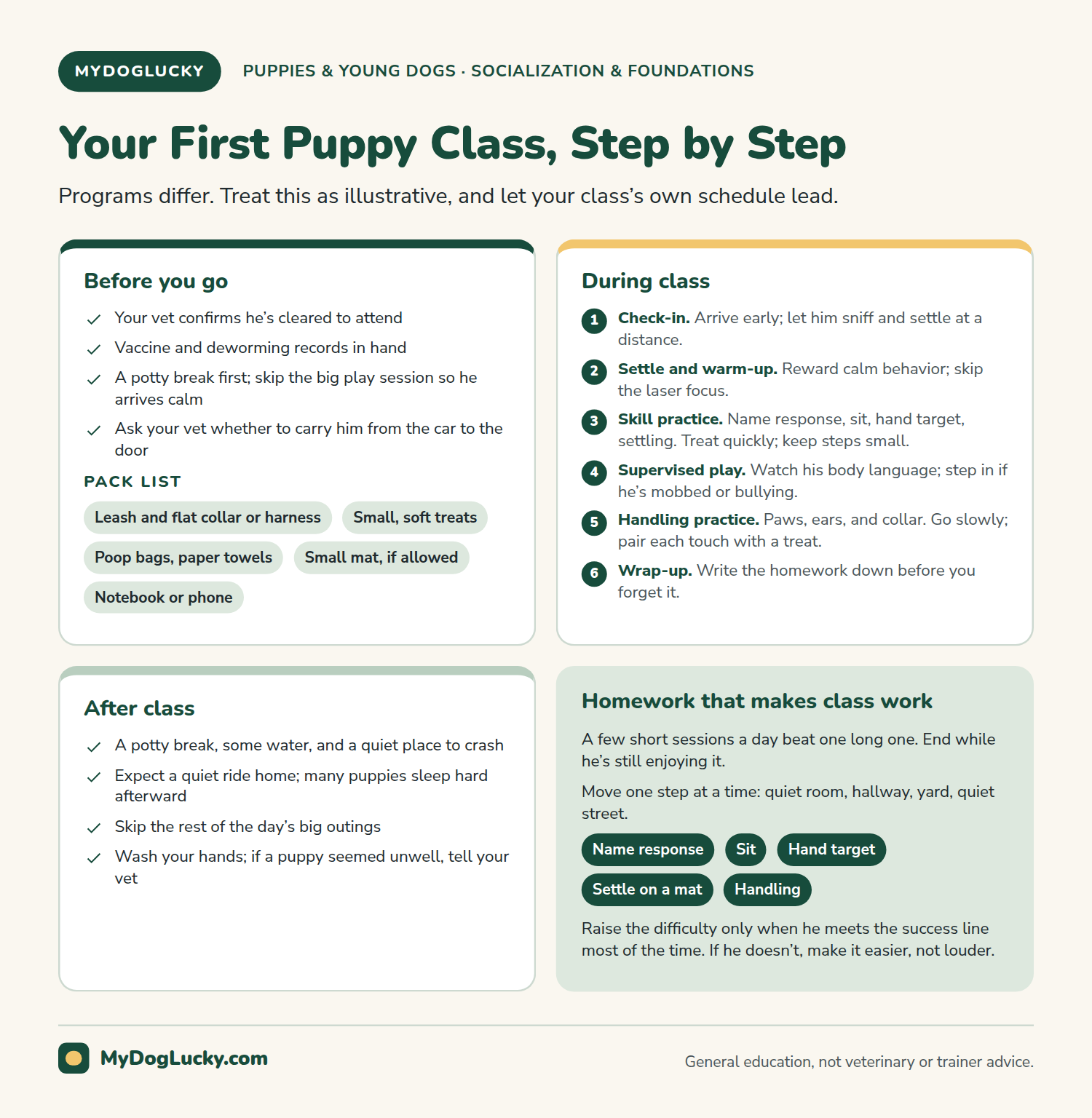
Every program runs a little differently. The first session of your puppy training classes may not match this exactly, but a common real-life version looks like the table below. Treat it as illustrative, not a prescription, and let your class’s own schedule lead.
Before You Go
Check with your veterinarian that your puppy is cleared to attend. Gather his vaccine and deworming records, since a well-run program will ask to see them. Give him a potty break shortly before you leave, and skip the big play session so he arrives calm.
Here’s a sensible pack list:
- A leash and a flat collar or harness that fits snugly and safely.
- Small, soft treats, counted out of his daily food plan. Ask your vet how much of the daily ration can go to training.
- Poop bags and a few paper towels.
- His vaccine and deworming records.
- A small mat or blanket, if the class allows one.
- A notebook or phone for homework.
Getting There and Settling In
Ask your vet whether your puppy should be carried from the car to the door. The Ohio State guidance suggests a stroller or sling to keep a young puppy off ground where dog traffic is unknown. Parking lots and the pavement by busy doors are exactly that kind of ground.
Arrive a few minutes early. Let your puppy take in the entryway from your arms, then find a spot near the edge of the room with space around it. A calm arrival sets the tone for the whole session.
During Class
| Segment | What usually happens | Your job |
|---|---|---|
| Check-in | Records are reviewed; you find a spot with some space around it | Arrive early and let your puppy sniff and settle at a distance |
| Settle and warm-up | Puppies rest or nibble treats while the instructor explains the plan | Reward calm behavior; don’t worry about laser focus |
| Skill practice | Short exercises: name response, sit, hand target, settling | Deliver treats quickly and keep your steps small |
| Supervised play | Puppies meet in small groups, with breaks and interruptions | Watch his body language; step in if he’s mobbed or bullying |
| Handling practice | Gentle touching of paws, ears, and collar | Go slowly and pair each touch with a treat |
| Wrap-up | Questions and homework for the week | Write the homework down before you forget it |
After Class
Give your puppy a potty break, some water, and a quiet place to crash. Class is a lot of new sights, smells, and puppies, and many puppies sleep hard afterward. Expect a quiet ride home, since a snoring puppy is a sign the lesson landed. Our puppy sleep schedule guide covers how much rest young puppies tend to need.
Skip the rest of the day’s big outings. Wash your hands, and if a puppy in class seemed unwell, tell your vet next time you talk.
Homework That Makes Class Work
Classes give you the plan. The real learning happens on your kitchen floor. Here’s a small, sturdy approach.
Keep Sessions Short and Easy
Aim for a few short sessions a day rather than one long one. That’s illustrative, not a prescription. Puppies tire quickly, and a quick win beats a long slog. End while your puppy is still enjoying it.
Count the treats in his daily food plan, and use part of his regular meals as reward material on busy training days. Ask your vet how much to set aside.
Practice in Easy Places First
A skill that works in the kitchen may vanish in the yard. That isn’t stubbornness. It’s normal learning. Move one step at a time: quiet room, hallway, yard, quiet street.
A Simple Homework Tracker
| Skill | Start here | Success looks like | Then try |
|---|---|---|---|
| Name response | Kitchen, no distractions | He looks at you within a second, most tries | Another room, then the yard |
| Sit | Living room, treat in hand | He sits on the first request, most tries | Sit before meals, then before doors |
| Hand target | Your palm near his nose | He touches it with his nose right away | Move your hand farther away |
| Settle on a mat | Mat on the floor near you | He lies down and stays relaxed for a few breaths | Longer stretches, then more distractions |
| Handling | Touch a paw, treat, stop | He stays loose while you touch | Ears, collar, then a gentle brush |
Raise the difficulty only after your puppy meets the success line most of the time. If he doesn’t, make the task easier, not louder.
When a Practice Day Goes Badly
Some days your puppy will act as if he’s never heard the word “sit.” That’s normal, especially after a big day or a short nap. Drop the difficulty, do one easy rep he can win, and stop. Try again tomorrow.
If bad days stack up for a week, check in with your instructor and your vet. Tiredness, teething, and discomfort can all get in the way of learning.
When Your Puppy Is Shy or Overwhelmed
Some puppies bounce into class like they own the place. Others cling to your ankles. Both are normal, and shy puppies often thrive when the room moves at their speed.
Signs He’s Had Enough
AVSAB’s 2021 statement lists behaviors that signal stress in a dog: a tense body, a lowered body posture, lip licking, a lowered tail, lifting a front leg, panting, yawning, and yelping. Add freezing, hiding behind you, refusing treats, and trying to leave. Our dog body language guide helps you read the rest.
What to Do in the Moment
- Add distance. Move to the edge of the room, away from the action.
- Lower the intensity. Watch from a spot where he can eat treats calmly.
- Take a break. Step outside or into a quiet corner for a few minutes.
- Ask the instructor to adjust. A good one will offer an easier version.
- Stop when he’s done. Ending early beats forcing a bad experience.
Watching from the edge still counts as learning. It lets him take in the room at a pace he can handle, and stepping back often builds the confidence to step in later.
What Not to Do
Don’t carry him into the middle of the group to “get it over with.” Don’t scold him for shaking or hiding. Don’t hold him near a puppy that scares him. Each of those adds pressure to a puppy who already feels overloaded.
A Sample Plan for a Shy Puppy (Illustrative)
Every puppy differs, so treat this as a sketch, not a schedule.
- Visit the room without your puppy to see the setup.
- At the first class, sit near the edge, feed treats for glancing at the room, and leave when he’s done.
- At the next class, move a little closer to the action, still feeding treats, and let him watch other puppies.
- Later, invite one calm, friendly puppy to say hello at a distance, only if your puppy leans in.
- Celebrate small wins, like a relaxed tail or a curious sniff.
Skip a step if your puppy needs more time. The pace is his, not the calendar’s.
When to call your veterinarian
AVSAB says owners of puppies who show fear should seek veterinary guidance. Call if the fear isn’t easing across sessions, if your puppy shakes or refuses food in every class, or if a normally social puppy suddenly changes. Pain and illness can look like fear or grumpiness.
Shy, Fearful, or Bitey: Group Class or Private Consult?
A group class is a great tool for many puppies. It isn’t the right first step for every puppy. This table helps you pick a starting point.
| Situation | Group class often fits when | Consider a private consult when |
|---|---|---|
| Shy puppy | He warms up with distance and treats, and enjoys watching | He stays frozen or panics in every session |
| Mouthy or bitey puppy | Mouthing is playful and softens with redirection | Bites are hard, keep breaking skin, or come with stiffness or growling |
| Overexcited puppy | He recovers after short breaks | He can’t settle at all, even at a distance |
| Afraid of people or dogs | Fear is mild and eases when you add space | Fear is strong or spreading to new situations |
| Guarding food or toys | It’s rare, mild, and quickly managed | He stiffens, freezes, or growls near food or objects |
Order of Operations
Start with your veterinarian, because pain and illness can drive behavior. From there, a certified trainer with puppy experience suits most everyday problems. For fear, guarding, or aggression, a veterinary behaviorist, or a certified behavior consultant working with your vet, is the safer call.
What a Private Consult Typically Covers
Formats differ. Many consults start with your puppy’s history and your goals, then some observation of how he responds, and end with a written plan you can practice. Ask whether the person works with your vet and which tools and methods they use. Ask for the plan in plain language.
If the plan involves pain or intimidation tools, walk away, exactly as you would from a class. And ask about follow-up. A plan you can’t get help with isn’t much use on day ten.
Where to Read More
Our guide on how to stop puppy biting covers everyday mouthing in detail. If your puppy is already lunging or barking at other dogs, our reactive dog training guide is the better fit. A class can support progress, but it won’t fix fear on its own.
Virtual vs. In-Person Puppy Classes
Virtual puppy training classes have grown popular, and they work well for some households. We couldn’t find a fetched, independent source comparing outcomes, so this section rests on how each format works. Treat it as reasoning, not research.
| Question | Virtual | In-person |
|---|---|---|
| Social practice with other puppies | None; a screen can’t stand in | Yes, when the room is well run |
| Coaching on your timing and technique | Good, though the camera angle limits what the instructor sees | Good, with hands-on adjustments |
| Disease exposure | None from other dogs | Managed through health rules and cleaning |
| Realistic distractions | Only what’s in your home | Real puppies, real noises, real smells |
| Convenience | High; no travel | Lower; you commute and schedule around it |
Virtual classes suit owners with tight schedules or limited mobility, and puppies still waiting on vaccines. In-person classes suit puppies who need social practice. Many households mix them: video lessons for mechanics, plus a small supervised in-person session for social time.
What Puppy Classes Cost: The Variables, Not the Prices
We’re not printing dollar figures here. We didn’t find a dated, non-commercial source for the price of puppy training classes, and prices shift by region and format. Instead, here’s what drives cost and what to ask.
What Changes the Price
- The number of sessions and how long each runs.
- Group versus private instruction.
- The facility, including indoor space, cleaning, and staffing.
- The instructor’s experience and credentials.
- What’s included, such as handouts, make-up sessions, or a follow-up class.
- Your region and local demand.
A Fill-In Cost Worksheet
| Item | Ask | Your notes |
|---|---|---|
| Enrollment fee | Is it per session or for the whole series? | ____ |
| Length | How many sessions, and how long is each? | ____ |
| Make-ups and refunds | What happens if we miss a week or my puppy is sick? | ____ |
| Extras | Are there fees for records checks, gear, or add-ons? | ____ |
| Follow-up | Is there a next-level class, and how do I enroll? | ____ |
Price isn’t quality. The cheapest program isn’t automatically worse, and the priciest isn’t automatically better. Use your score sheet. And if money is tight, it’s fair to ask about payment plans or reduced-fee options.
What Comes After Puppy Class
Puppy training classes give you a launch pad, not a finished dog. It’s the start of a longer project. AVSAB says socialization should continue through the first year and beyond, so keep adding calm, positive experiences after the last session.
Practical Next Steps
- Repeat or level up. Ask whether the program runs a second-level class for older puppies.
- Practice in the real world. Try calm, low-pressure outings your vet approves.
- Book a private session. Use it for one specific problem, like pulling or jumping.
- Keep social contact planned. Set up meetings with healthy, vaccinated dogs your vet is comfortable with.
For the next stage, see our dog training basics guide.
Some Checkpoints to Aim For
These are our suggestions, not a standard. By the end of a puppy class, many owners hope their puppy can respond to his name, settle on a mat, tolerate gentle handling, and walk a few steps beside them in an easy place. If he isn’t there yet, that’s fine. Keep practicing.
Expect Adolescent Blips
Many owners notice skills seem to vanish as puppies grow into adolescence. That’s a normal wobble, not a failure. Go back one step, make the task easier, and rebuild. A refresher class or a private session can help you through it.
Common Mistakes With Puppy Training Classes
Choosing by Price or Convenience Alone
A close, cheap class with a rough instructor costs more in the long run. Use the scoring worksheet before you commit.
Skipping the Trial Visit
A single visit tells you more than a website ever will. If they won’t let you watch, that’s an answer.
Confusing Class With a Dog Park
A puppy class isn’t free play. Its value comes from structure, supervision, and short, positive contact. If it turns into a free-for-all, you’re paying for chaos.
Pushing a Shy Puppy Into the Middle
It feels helpful. It usually backfires. Let him watch, then take small steps toward the group at his own pace.
Skipping Homework
Skills you don’t practice fade fast. Even a few tiny sessions a day help. A class is one small part of the week, and homework is the rest.
Over-Treating Without Counting
Class involves a lot of treats. Count them in your puppy’s daily food plan and ask your vet about a sensible amount. Our healthy dog treats guide helps you choose what to use.
Treating the Certificate as the Finish Line
A certificate is nice for the fridge. It doesn’t mean your puppy is finished learning. Keep practicing and keep socializing.
Frequently Asked Questions About Puppy Classes
How old should a puppy be to start puppy training classes?
AVSAB says puppies can start socialization classes as early as 7 to 8 weeks. Ohio State’s guidance puts the start at 7 weeks. Your vet makes the final call based on your puppy’s vaccines, deworming, health, and your area.
Can my puppy go to class before finishing all his vaccines?
Often, yes, if your vet agrees. AVSAB and Ohio State both describe minimums: at least one set of vaccines and a deworming at least 7 days before the first class. The class should also have health rules and cleaning routines. Your vet knows your local risks.
Do I really need a class if I train at home?
You don’t need one. But a class gives you two things that are hard to reproduce at home: safe practice around other puppies and people, and live coaching on your timing. If a class isn’t an option, work through our puppy socialization checklist with your vet’s input.
What if my puppy is too old for a puppy class?
Ask programs about classes for older puppies or adolescents. A private session can also fill the gap. AVSAB says socialization should continue through the first year and beyond.
How many classes will my puppy need?
We couldn’t find a verified number, and it varies. Ask each program how many sessions it runs and what a next-level class covers. Plan on practicing between sessions and afterward.
Does my puppy have to join the play time?
No. Watching from a distance is participation. A good instructor lets a puppy sit out, or offers a calmer version.
Is a certified trainer required?
Not by law in the U.S. The AKC says certification is voluntary but shows dedication. Ask about training methods and experience with puppies as well as credentials.
My puppy was scared in the first class. Should I quit?
Not automatically. Talk with the instructor about a slower pace, more distance, or a different session. If fear doesn’t ease over a couple of sessions, or it’s getting stronger, check in with your vet and consider a private consult.
Are online classes as good as in-person ones?
They teach mechanics well, but they can’t give your puppy practice around other puppies. Some households combine both formats.
Should I skip class if my puppy seems sick?
Yes. Stay home, and call your vet if your puppy has vomiting, diarrhea, low energy, or a poor appetite. Sick dogs shouldn’t attend, and puppies can get worse quickly.
Should my kids come to class?
Ask the program. The Ohio State guidance calls for a solid plan for how attendees, and their children, interact with other puppies. If kids come, an adult should supervise closely, and the kids should follow simple rules: calm voices, gentle hands, and letting the puppy come to them. Some classes limit children’s roles, and that’s fine.
Do small-breed puppies need a special class?
Not necessarily. Size matching and supervision matter more. The Ohio State guidance notes that size differences can frighten smaller puppies. Ask how the class pairs partners by size and whether smaller puppies can take breaks.
Can a puppy class fix my puppy’s biting?
It can help, mostly through coaching and management ideas. Mouthing is normal puppy behavior, and our guide on how to stop puppy biting covers everyday cases. If bites are hard or come with stiffness, growling, or guarding, book a private consult instead of waiting for class to solve it.
What if the instructor uses a tool or method I don’t recognize?
Ask what it is, how it works, and how the puppy is likely to feel. If the answer involves pain, startle, or intimidation, treat it as a red flag under AVSAB’s guidance. You can say no to any method used on your puppy.
Where to Start This Week
Pick three small steps. First, call your veterinarian and ask the vaccine and timing questions from the gold panel above. Second, shortlist two or three programs and send them your questions.
Third, book a trial visit without your puppy, and bring the scoring worksheet. Choose among puppy training classes only after you’ve seen one in action.
Then pack the bag, count the treats, and keep expectations low. The first class isn’t a test. It’s a chance for your puppy to see the world go well, one calm moment at a time. If he’d rather sit on your feet than say hello, he’s learning too.
Sources
- American Veterinary Society of Animal Behavior. Position Statement on Puppy Socialization (2008)
- American Veterinary Society of Animal Behavior. Humane Dog Training Position Statement (2021)
- American Veterinary Society of Animal Behavior. How to Choose a Trainer (undated; read September 2026)
- American Kennel Club. How to Find and Choose a Dog Trainer (March 23, 2026)
- Herron, M.E., and Stull, J. Balancing Puppy Socialization with Infectious Disease Prevention. Gigi’s and The Ohio State University College of Veterinary Medicine (November 2024)
- American Animal Hospital Association. 2022 AAHA Canine Vaccination Guidelines. Journal of the American Animal Hospital Association (2022)
This article is general education for U.S. dog owners. It is not individualized training or veterinary advice for your puppy. Ask your veterinarian about vaccine timing, deworming, and where your puppy can safely go before you enroll in a class. Fear that isn’t easing, guarding, growling, or bites that keep breaking skin call for a qualified trainer, certified behavior consultant, or veterinary behaviorist. Training regulations and class rules vary by program. Details in this article were checked as of September 2026 and can change.