
If you’re standing in the pet food aisle trying to pick large breed puppy food for a dog who’s already outgrowing his collar every few weeks, here’s the short version: the ingredient panel matters less than you’d think, and the calcium content matters more. Large and giant-breed puppies don’t just need “more” food. They need a growth rate that’s deliberately held back, not maximized, because their skeletons mature on a longer, more fragile timeline than a small dog’s do.
That idea trips up a lot of first-time owners, understandably. Everything else about raising a puppy points toward growth as a good thing — more weight, more height, more dog. With large and giant breeds, unchecked growth is exactly what raises the risk of joint and bone problems later in life. This guide walks through why that’s true, what the calcium and phosphorus science actually says (and doesn’t say), how to read the AAFCO large-breed growth statement on a bag of food, and what else — beyond diet — shapes a growing dog’s skeletal health.
One thing this article won’t do: tell you a specific brand or formula is “the best.” Individual product comparisons depend on your dog’s estimated adult size, activity level, and any health history your veterinarian already knows. What follows is the framework for making that decision well, not a shortcut around it.
What’s in this guide
- Why large-breed puppies need a different approach to food
- Controlled growth, not maximized growth: the core idea
- Calcium, phosphorus, and why too much calcium is the real risk
- The protein myth: what actually affects growth rate
- Reading the AAFCO large-breed growth statement on a label
- Developmental orthopedic disease: risk factors beyond the food bowl
- Exercise, growth plates, and what to avoid while your puppy is growing
- How long “puppy food” actually lasts for a large-breed dog
- Portions and feeding frequency for a large-breed puppy
- Weight and body condition: keeping a large-breed puppy lean on purpose
- Choosing and comparing a large-breed puppy food
- Common mistakes that undermine controlled growth
- Building a vet-conversation framework
- Frequently asked questions about large-breed puppy food
- Sources
Why Large-Breed Puppies Need a Different Approach to Food
A 9-pound Chihuahua puppy and a 9-pound Great Dane puppy are, nutritionally, in completely different situations, even though they weigh the same on a given Tuesday. The Chihuahua is close to her adult size already. The Dane puppy has roughly 100 more pounds of frame, muscle, and skeleton still ahead of him, and how fast he adds that mass matters enormously to how his joints turn out.
It’s About Skeleton, Not Just Size
Large and giant-breed dogs build an enormous amount of bone and cartilage in a relatively short window, and that tissue is more vulnerable to nutritional missteps than a small dog’s smaller, more slowly developing frame. The Merck Veterinary Manual groups several skeletal conditions — hip dysplasia, elbow dysplasia, osteochondrosis, and related developmental osteopathies — under a category that disproportionately affects “young, rapidly growing large- and giant-breed dogs.” Small-breed puppies aren’t immune to skeletal problems, but the specific risks tied to growth rate and calcium load are concentrated in the big dogs.
Where the AAFCO Threshold Comes From
The Association of American Feed Control Officials (AAFCO), which sets the nutrient standards pet food makers use to formulate and label their products, draws the “large-size” line at dogs expected to weigh 70 pounds or more as adults. That’s the official cutoff behind the large-breed growth statement you’ll see on some bags of food. Plenty of veterinary sources use a more cautious 50-pound guideline in everyday conversation, partly because estimating an eight-week-old puppy’s eventual adult weight — especially a mixed-breed puppy’s — is inexact. If your puppy’s parentage or breed standard puts him anywhere near that range, this article is written for you.
The Stakes Are Real, Not Theoretical
This isn’t a nice-to-know distinction. Developmental orthopedic disease covers a real cluster of painful, sometimes permanent conditions — hip dysplasia, elbow dysplasia, osteochondrosis, and others — and diet is one of the few risk factors an owner can actually influence during the growth window. Genetics matters too, and we’ll get to that. But the calcium level and growth rate of a large-breed puppy’s food is squarely within your control, which is exactly why it’s worth understanding properly instead of trusting a bag’s marketing copy to have already worked it out for you.
Controlled Growth, Not Maximized Growth: The Core Idea
Here’s the concept that reframes everything else in this article: for a large or giant-breed puppy, the goal isn’t the fastest possible growth. It’s slow, steady, controlled growth — getting to full adult size on a longer timeline, without spikes in weight or growth velocity along the way.
Why Faster Isn’t Better Here
A large-breed puppy fed to grow as quickly as his genetics allow doesn’t end up a bigger, healthier adult. He ends up a puppy whose skeleton had to keep pace with a body that was adding weight faster than bone, cartilage, and connective tissue could safely mature. According to VCA’s veterinary nutrition guidance, if a large or giant-breed puppy is overfed during growth, he may not necessarily become visibly overweight — but he’s still likely to grow faster than his skeleton can comfortably support, which raises the odds of skeletal problems regardless of how he looks on a scale.
What “Controlled” Actually Means in Practice
In practical terms, controlled growth means three things working together: a food formulated specifically for large-breed growth (lower calorie density and a tighter calcium ceiling than an all-purpose puppy food), measured portions instead of free access to food, and a body condition kept on the leaner side of ideal throughout the growth period. None of those three pieces does the whole job alone. A large-breed formula fed without portion control, for instance, still allows overly fast growth — the food’s design only helps if the amount fed respects it too.
This Isn’t About Restricting Nutrition
It’s worth being clear about what controlled growth is not. It isn’t underfeeding, and it isn’t withholding calories a growing puppy actually needs. A large-breed puppy still needs a complete and balanced diet with enough protein, fat, calories, vitamins, and minerals to develop properly — just delivered at a pace and calcium level appropriate to his size, instead of the fastest rate his appetite would choose on its own.
Calcium, Phosphorus, and Why Too Much Calcium Is the Real Risk
This is the section worth reading slowly, because it corrects a misconception a lot of owners carry into the pet food aisle: the biggest nutritional risk for a large-breed puppy isn’t too little of something. It’s too much calcium.
Why Growing Puppies Handle Calcium Differently Than Adult Dogs
Puppies, and large-breed puppies especially, don’t regulate calcium absorption from food as tightly as adult dogs do. An adult dog’s gut adjusts how much dietary calcium it absorbs based on what the body actually needs. A growing puppy’s gut is less able to make that adjustment, which means calcium fed in excess of what his skeleton needs doesn’t just pass through harmlessly — a meaningful share of it gets absorbed anyway, whether the puppy’s bones need it in that moment or not. That’s the mechanism behind why calcium intake, specifically, has such an outsized effect on skeletal development in large-breed puppies compared with smaller dogs.
What Excess Calcium Does
Excess dietary calcium during the growth window is linked to abnormal bone remodeling and a higher risk of developmental orthopedic conditions, according to veterinary nutrition guidance summarized by Tufts’ Clinical Nutrition Service and reflected in AAFCO’s own revised nutrient profiles for large-breed growth. The Merck Veterinary Manual’s treatment guidance for several developmental osteopathies — including hypertrophic osteodystrophy and retained ulnar cartilage cores — centers on stopping dietary supplementation beyond a balanced, age-appropriate commercial diet, which is a strong practical signal about where excess calcium tends to come from and what resolving it looks like.
What AAFCO Actually Requires
In 2016, AAFCO revised its nutrient profiles specifically to address this. For puppy food generally, the minimum calcium requirement rose to 1.2% on a dry-matter basis, with a maximum of 2.5%. For food formulated for large-size growth — that 70-pound-and-up adult weight category — the calcium ceiling is considerably tighter: a maximum of roughly 1.8% dry matter, with the same 1.2% minimum.
The gap between those two maximums, 2.5% versus roughly 1.8%, is the entire point of a dedicated large-breed formula. A food built for small and medium dogs, or an unlabeled “all life stages” formula, can legally sit anywhere in that wider 2.5% range — which may be considerably more calcium than is appropriate for a puppy who’s going to weigh 80 or 100 pounds.
The Calcium-to-Phosphorus Ratio, Simplified
Calcium and phosphorus work together in bone formation, and their ratio matters alongside the raw calcium amount. Veterinary guidance from VCA describes a calcium-to-phosphorus ratio of roughly 1.1:1 to 1.4:1 as a safe range for a large-breed puppy who isn’t being overfed, while a board-certified veterinary nutritionist quoted by dvm360 notes that in practice, calcium content itself matters more than the exact ratio for young, rapidly growing dogs — and that erring toward a ratio closer to 1:1 than 2:1 is the safer direction.
You don’t need to calculate this yourself. A food carrying the correct AAFCO large-breed growth statement has already been formulated to fall within an appropriate range; the statement is effectively AAFCO’s confirmation that the math has been done.
A simple way to think about the calcium math
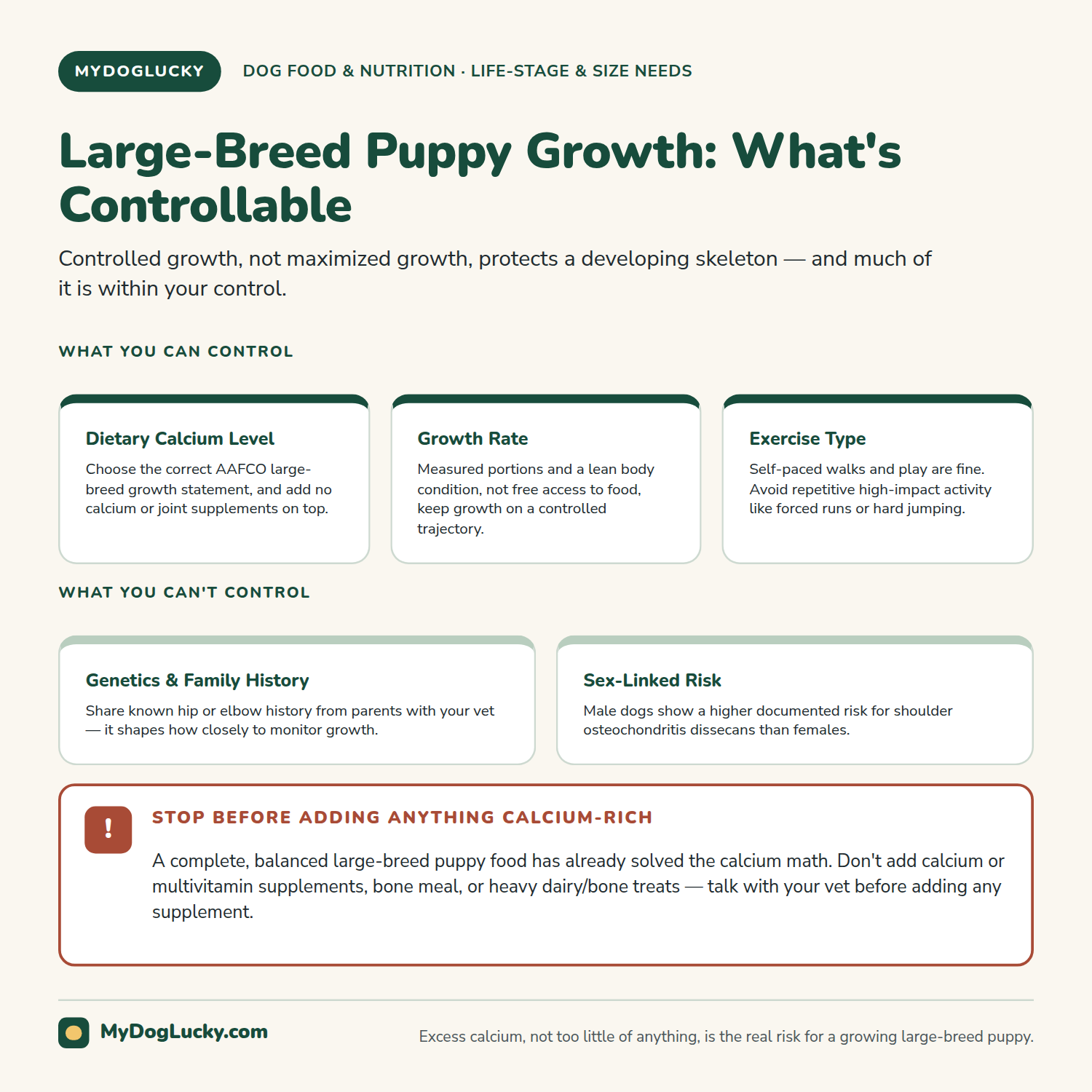
You don’t need to become a pet food chemist to get this right. The practical version: check that the bag carries a large-breed growth statement (covered in detail below), feed the amount recommended for your puppy’s current weight and expected adult size, and don’t add anything calcium-rich on top — no calcium supplements, no bone meal, and no “extra” dairy or bone treats as a regular addition. A complete and balanced large-breed puppy food has already solved the calcium equation. Your job is mainly not to un-solve it.
| Nutrient (dry-matter basis) | Regular growth puppy food | Large-size growth puppy food (70+ lb adult weight) |
|---|---|---|
| Minimum calcium | 1.2% | 1.2% |
| Maximum calcium | 2.5% | ~1.8% |
| Minimum phosphorus | 1.0% | 1.0% |
| Recommended calcium:phosphorus ratio | Roughly 1:1 to 2:1 | Closer to 1:1, generally under 1.4:1 |
Notice that the minimums are identical. The difference that matters for a large-breed puppy is entirely on the maximum end — and that’s exactly why a food that only meets the general puppy profile, without the large-breed statement, can still be legally “complete and balanced” while carrying more calcium than is ideal for a dog headed toward 80, 100, or more pounds.
Stop before you add anything calcium-rich
If your large-breed puppy is already eating a complete and balanced large-breed growth food, don’t add a calcium or multivitamin supplement, bone meal, or a heavy rotation of dairy or bone-based treats on top of it — even with good intentions about “strong bones.” Talk with your veterinarian before adding any supplement to a growing large-breed puppy’s diet. This is one of the more common, and more avoidable, ways owners accidentally push calcium intake above what’s safe for a developing skeleton.
The Protein Myth: What Actually Affects Growth Rate
Here’s a piece of advice that circulates a lot among owners of large-breed puppies, and it’s worth correcting directly: the idea that high protein “stunts growth” or should be avoided in large-breed puppy food. Current veterinary nutrition guidance doesn’t support that claim.
Where the Confusion Comes From
The confusion likely traces back to older research and outdated advice that conflated protein with overall calorie excess. Decades ago, some early studies on rapid growth in large-breed dogs used diets that were simultaneously high in protein, high in calories, and high in calcium, which made it hard to isolate which nutrient was actually driving the skeletal problems researchers observed. Later, more targeted research has pointed toward energy intake (calories) and calcium as the primary dietary drivers of excessive growth rate and developmental orthopedic disease risk — not protein consumed within the range a complete, AAFCO-compliant puppy food provides.
What the Evidence Actually Supports
A veterinary nutritionist quoted in dvm360’s coverage of developmental orthopedic disease frames the primary dietary risk factors plainly: overnutrition, rapid growth driven by weight gain outpacing height and frame development, excess calcium, and genetics — protein isn’t named among them. Feeding a complete and balanced large-breed puppy food at an appropriate portion, with a protein level that meets AAFCO’s growth requirements, isn’t the concern. The concern is total calories and calcium delivered in excess of what a specific puppy’s growth rate needs.
What This Means for Your Shopping List
In practice, this means you don’t need to hunt for a “lower protein” large-breed formula out of concern that protein itself will overgrow your puppy’s skeleton. What you do need is a food formulated to the large-breed growth calcium ceiling, fed in a measured portion appropriate to your puppy’s weight and expected adult size — which is a calorie and calcium conversation, not a protein one.
Reading the AAFCO Large-Breed Growth Statement on a Label
Once you know what to look for, checking a bag of food for the right large-breed growth statement takes about ten seconds. Here’s exactly where to find it and what the wording means.
Where the Statement Lives on the Bag
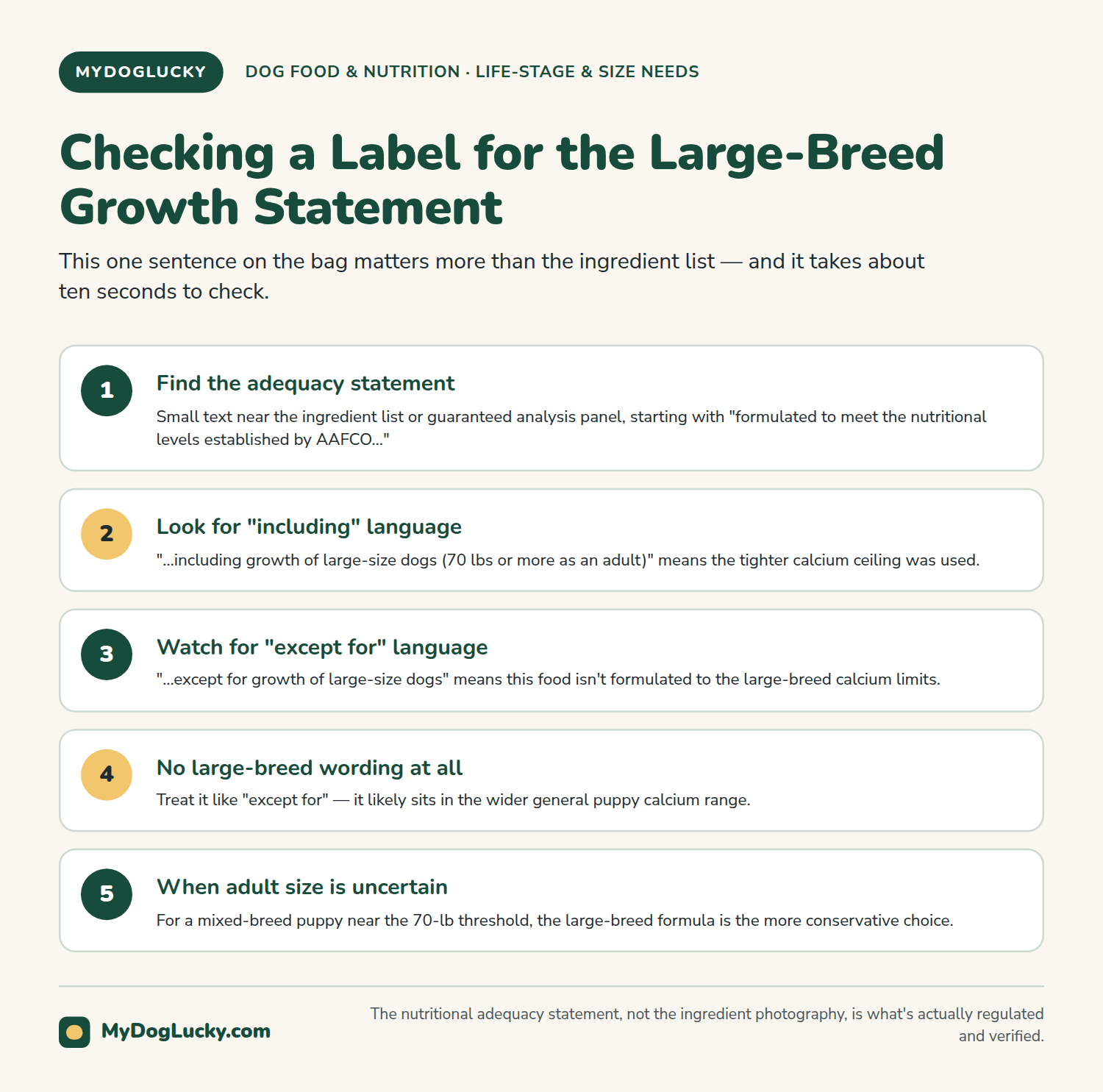
Look for the nutritional adequacy statement, usually printed in small text near the ingredient list or guaranteed analysis panel. It’s the sentence that starts with something like “[Product name] is formulated to meet the nutritional levels established by the AAFCO Dog Food Nutrient Profiles for…” That sentence is where the large-breed language shows up, if it’s present at all. AAFCO’s own consumer guidance on reading pet food labels walks through exactly where to find this statement and what each required element means.
What the Wording Tells You
You’re looking for one of two possible phrasings, and the difference between them matters:
- “…including growth of large-size dogs (70 lbs or more as an adult)” means the food meets the tighter calcium ceiling appropriate for large and giant-breed puppies. This is the phrasing you want if your puppy is expected to reach 70 pounds or more.
- “…except for growth of large-size dogs (70 lbs or more as an adult)” means the opposite: this food has not been formulated to the large-breed calcium limits, and AAFCO’s own labeling rule says it isn’t appropriate for a puppy expected to reach that size.
A food with no large-breed language at all, just a general “growth” or “all life stages” statement, falls into the same category as the “except for” wording in practice: it was formulated to the wider, general puppy calcium range, which may carry more calcium than is ideal for a large or giant-breed puppy’s skeleton.
Why This One Sentence Matters More Than the Ingredient List
It’s tempting to judge a puppy food by its ingredient list — named meat first, recognizable vegetables, no fillers. For a large-breed puppy specifically, the nutritional adequacy statement carries more decision-relevant information than the ingredient order does, because it’s the part of the label that’s actually regulated and verified against a nutrient profile, calcium ceiling included. An attractive ingredient list on a food that lacks the large-breed growth statement doesn’t tell you anything about whether the calcium level is appropriate for your puppy’s expected size.
A Note on Mixed-Breed and Uncertain-Size Puppies
If you adopted a puppy of unknown or mixed heritage and you’re not sure whether he’ll land above or below the 70-pound threshold, ask your veterinarian for an estimate based on paw size, current growth trajectory, and any breed-mix information available. When there’s real uncertainty and your puppy’s estimated adult weight is anywhere near that line, choosing a large-breed formula is the more conservative, generally lower-risk choice — the tighter calcium ceiling isn’t harmful to a dog who ends up smaller than expected, while the wider general calcium range can be a real problem for a dog who ends up larger.
Developmental Orthopedic Disease: Risk Factors Beyond the Food Bowl
Diet is a genuinely important, controllable piece of developmental orthopedic disease risk. It is not the only piece, and it helps to know what else is in play — partly so you don’t carry all the responsibility for outcomes that also depend on genetics, and partly because some of the other factors are just as actionable as the food bowl.
Genetics and Family History
Some developmental orthopedic conditions have a documented genetic or familial component. The Merck Veterinary Manual notes breed-specific patterns — certain conditions are overrepresented in specific breeds, and some, like panosteitis, are suspected to have a genetic component within particular breed lines. If you know anything about a puppy’s parents or grandparents — hip or elbow scores, any orthopedic history — that information is worth sharing with your veterinarian, because it shapes how closely growth and gait should be monitored, even when diet is managed well.
Growth Rate: Weight Outpacing Frame
A veterinary nutritionist’s framing, cited by dvm360, is useful here: the core risk isn’t simply “growing fast.” It’s weight increasing faster than height and skeletal frame can comfortably support — a puppy adding mass more quickly than his bones and joints are maturing to carry it. This is one reason body condition monitoring (covered later in this guide) matters as much as the food itself: a puppy tracking heavier than expected for his frame is a growth-rate flag worth mentioning to your vet, independent of what food he’s eating.
Sex-Linked Differences
Some developmental orthopedic conditions show sex-linked patterns. Male dogs, for example, show a higher documented risk for osteochondritis dissecans of the shoulder compared with females, according to veterinary orthopedic literature. This isn’t something you can change, but it’s useful context if your veterinarian recommends closer monitoring for a male large-breed puppy than you might have expected.
Exercise Type and Intensity
How a large-breed puppy moves during growth affects his joints just as concretely as what he eats. We’ll cover this in more depth in the next section, but it belongs on this risk-factor list because it’s genuinely as controllable as diet is — and just as often overlooked by well-meaning owners who assume “more exercise is always good for a growing dog.”
What’s Controllable and What Isn’t
Sorting these factors into what you can influence and what you can’t tends to make the whole picture less overwhelming, not more:
| Risk factor | How controllable | What helps |
|---|---|---|
| Dietary calcium level | Highly controllable | Correct AAFCO large-breed growth statement; no added supplements |
| Growth rate / overnutrition | Highly controllable | Measured portions; lean body condition; no free-feeding |
| Exercise type and intensity | Highly controllable | Self-paced play and leash walks; avoid repetitive high-impact activity |
| Genetics / family history | Not controllable | Share known family history with your vet; adjust monitoring accordingly |
| Sex-linked risk patterns | Not controllable | Awareness; may inform monitoring frequency for at-risk joints |
Exercise, Growth Plates, and What to Avoid While Your Puppy Is Growing
A growing puppy’s bones aren’t just smaller versions of an adult dog’s bones. Near each end of a long bone sits a growth plate — a band of cartilage where new bone is actively forming. That cartilage is softer and more vulnerable to injury than mature bone, and it stays that way until the plate closes and hardens, which happens on its own schedule for each individual dog.
When Growth Plates Close
Timing varies by size, and it’s one more reason large and giant-breed dogs need a longer runway of careful handling than small dogs do. According to VCA’s veterinary guidance, small-breed dogs’ growth plates typically close around 6 months of age, while giant-breed dogs’ growth plates may not fully close until closer to 18 months. Large breeds generally fall somewhere between those two points, meaning a large-breed puppy’s skeleton stays in that more vulnerable, still-developing state for considerably longer than a small dog’s does.
Activities Worth Postponing
Until a large-breed puppy is closer to full skeletal maturity, veterinary guidance points toward avoiding certain categories of exercise, not because movement itself is bad, but because specific kinds of repetitive, high-impact stress on immature growth plates raise injury risk:
- Forced, repetitive jumping — free-jumping drills, repeatedly jumping on and off furniture, or jumping in and out of a vehicle over and over.
- Long-distance jogging or forced runs alongside a bike, a runner, or on a treadmill, especially on hard surfaces.
- Competitive agility or structured hurdle work, which combines jumping with sharp, forced turns.
- Any exercise your puppy didn’t choose the pace or duration of — essentially, anything that pushes past what he’d naturally do if left to self-regulate.
What’s Fine, and Usually Beneficial
None of this means confining a growing puppy or skipping exercise altogether — that carries its own downsides for muscle development, mental health, and weight management. Leash walks, free play in a securely fenced area at your puppy’s own pace, and normal exploring and sniffing are generally fine and genuinely good for a developing dog. The distinguishing feature of appropriate puppy exercise is that your puppy sets the pace and duration, rather than a structured routine imposed on him.
Overtraining Adds Up Quietly
One easy trap: a single long hike doesn’t necessarily cause a problem, but a pattern of repeated overexertion — every weekend, for months, during the exact window when growth plates are most vulnerable — can add up to meaningful cumulative stress on developing joints. If you’re an active household with hiking or running as a regular habit, it’s worth having an honest conversation with your veterinarian about how to scale that activity down and back up as your specific large-breed puppy grows, rather than assuming “he seems fine” is sufficient information on its own.
How Long “Puppy Food” Actually Lasts for a Large-Breed Dog
One of the more common questions large-breed puppy owners ask is simply: when do I switch him to adult food? The honest answer is later than most small-breed owners expect, and the exact timing depends on your individual dog.
Why Large Breeds Take Longer to Mature
Small-breed dogs typically reach their adult size relatively quickly, often somewhere around 8 to 10 months of age, according to AKC’s feeding guidance. Large breeds take considerably longer — commonly cited around 15 months for dogs over roughly 50 pounds, and giant breeds expected to exceed 100 pounds may not finish growing until 18 to 24 months. That’s not a minor difference; it roughly doubles or triples the length of time a large-breed puppy needs a growth-appropriate diet compared with a small-breed puppy.
| Size category | Approximate adult weight | Typical time to skeletal maturity |
|---|---|---|
| Small breeds | Under ~20 lbs | About 8–10 months |
| Medium breeds | ~20–50 lbs | About 10–14 months |
| Large breeds | ~50–70+ lbs | About 15–18 months |
| Giant breeds | ~90–100+ lbs | About 18–24 months |
These are approximate ranges, not fixed deadlines. Individual dogs, and individual breeds within the “large” and “giant” categories, vary. Treat this table as a starting expectation to discuss with your veterinarian, not a countdown to circle on the calendar.
What “Ready for Adult Food” Actually Means
A veterinary nutritionist’s guidance, cited by dvm360, frames the switch in terms of growth completion rather than a specific birthday: continuing a large-breed growth formula until a puppy is roughly 90 to 99% grown is a reasonable practical target. That’s necessarily an estimate your veterinarian is better positioned to make than a chart is, based on your individual dog’s growth curve, breed, and current body condition.
Risks of Switching at the Wrong Time
Switching to adult food too early removes the protective, tighter calcium ceiling during a window when your puppy’s skeleton may still be actively developing — effectively undoing the reason you chose a large-breed formula in the first place. Switching much later than necessary isn’t associated with the same orthopedic risk, but it does mean your dog continues eating a more calorie-dense growth formula longer than his adult metabolism needs, which can contribute to unwanted weight gain once his growth has actually leveled off. Neither extreme is ideal; the useful move is asking your veterinarian to help pinpoint the transition window for your specific dog rather than guessing at either end.
Portions and Feeding Frequency for a Large-Breed Puppy
Even the right food, chosen carefully, can’t do its job if portions aren’t measured and feeding frequency isn’t appropriate for a growing large-breed puppy’s needs.
Measure, Don’t Eyeball
Scoop-based portioning is surprisingly inaccurate, and the margin of error matters more for a large-breed puppy than it would for a smaller dog, simply because the calorie totals involved are bigger. Veterinary nutrition guidance recommends weighing food on a digital kitchen scale rather than relying on a measuring cup, which can vary meal to meal depending on how tightly kibble is packed. If your puppy’s current food doesn’t come with weight-based feeding guidelines, your veterinarian or veterinary technician can help translate the bag’s volume-based chart into a more precise starting point.
How Many Meals a Day
Puppies generally do better on multiple smaller meals than one or two large ones, and this holds especially true for large and giant breeds. Veterinary guidance suggests at least three to four measured meals a day for puppies, tapering to fewer, larger meals as they approach adulthood. Frequent smaller meals help avoid the kind of rapid, large intake swings that can contribute to a faster-than-ideal growth rate, and they’re generally gentler on a young digestive system.
Why Free-Feeding Is a Poor Fit for This Group
Free-feeding — leaving a full bowl available around the clock — is genuinely risky for a large or giant-breed puppy specifically, even if it’s a reasonable approach for some adult dogs. A puppy given unrestricted access to food tends to eat more than a controlled feeding schedule would provide, which translates directly into faster growth, faster weight gain, and exactly the growth-rate risk this article has been building toward avoiding. Measured, scheduled meals aren’t a punishment or an arbitrary rule; they’re one of the more effective levers you have for keeping growth on a controlled, healthy trajectory.
Adjusting Portions as Your Puppy Grows
Portions aren’t a set-it-and-forget-it number. A large-breed puppy’s calorie needs change as he grows, and the feeding guide on a bag is a starting point, not a fixed prescription. Weigh your puppy regularly (weekly is reasonable for young, fast-growing puppies), track the trend, and adjust portions gradually based on his actual growth curve and body condition rather than sticking rigidly to a chart that was never customized to your individual dog.
Weight and Body Condition: Keeping a Large-Breed Puppy Lean on Purpose
Of everything covered in this guide, this is the piece most owners underestimate: keeping a large-breed puppy lean during growth isn’t a cosmetic preference. It’s one of the more protective things you can do for his joints, and the evidence behind it extends well beyond puppyhood.
Lean Isn’t the Same as Thin or Underfed
It helps to say plainly what “lean” does and doesn’t mean here, because this is an area where owners sometimes worry they’re depriving a growing puppy. Lean means you can easily feel his ribs under a slight layer of fat without pressing hard, he has a visible waist when viewed from above, and his belly tucks up somewhat behind his ribcage when viewed from the side. It does not mean visible ribs, a sunken abdomen, or a puppy who seems hungry between meals. There’s a wide, healthy range between “too heavy” and “too thin,” and the goal is comfortably inside it, on the leaner side.
Why Leaner Specifically Protects a Growing Skeleton
A large-breed puppy carrying extra weight during the growth window puts more mechanical load on joints and growth plates that are still developing, at exactly the time they’re least equipped to handle it. Veterinary nutrition guidance recommends targeting a body condition on the leaner end of ideal specifically during growth — not “chunky and cute,” which is a common but genuinely risky framing for a growing large-breed puppy. A puppy who’s a little lean is growing at a pace his skeleton can comfortably support. A puppy who’s a little heavy is often growing faster than that, even if the difference isn’t dramatic on a scale.
The 9-Point Scale, in Plain Terms
Most U.S. veterinary practices use a standardized 9-point body condition scoring system, where 4 to 5 represents an ideal body condition for most adult dogs, and many veterinary nutritionists recommend a growing large-breed puppy sit at the leaner portion of that same range — comfortably feeling ribs, a visible waist, and a modest abdominal tuck — rather than the fuller end some owners assume is healthier for a “big dog.” Your veterinarian can walk you through a hands-on body condition check at any wellness visit, and it takes about a minute once you know what to feel for.
A rough body-condition check you can do at home
Run your hands gently along your puppy’s ribcage with light pressure. You should be able to feel each rib without needing to press hard, similar to running your fingers across the back of your own hand. Look at him from above: there should be a visible narrowing at the waist behind the ribs. From the side, his belly should tuck up somewhat rather than hanging level with his chest. If you’re not finding a rib outline easily, or there’s no visible waist, mention it at your next veterinary visit rather than waiting for the next scheduled weigh-in.
The Longer-Term Evidence for Staying Lean
The case for lean body condition isn’t limited to puppyhood or to orthopedic health alone. A landmark 14-year study published in the Journal of the American Veterinary Medical Association followed a group of dogs maintained in lean versus moderately heavier body condition throughout life and found that the leaner-fed dogs lived a meaningfully longer median lifespan and showed delayed onset of several chronic conditions. It’s a different life stage than puppy growth specifically, but the broader pattern — that lean body condition tends to support better long-term health outcomes — reinforces why the habit is worth building early rather than treating body condition as something to worry about only once a dog is already an adult.
Choosing and Comparing a Large-Breed Puppy Food
With the calcium science and label-reading skills covered, here’s how to actually narrow down options without getting lost in marketing claims.
Start With the Statement, Not the Bag Design
Confirm the food carries the correct AAFCO large-breed growth statement before evaluating anything else about it — price, ingredient list, packaging, reviews. A food that fails this first check isn’t a good candidate for a puppy expected to weigh 70 pounds or more, regardless of how appealing everything else about it looks.
Questions Worth Asking About the Manufacturer
The World Small Animal Veterinary Association’s nutrition guidelines suggest evaluating pet food companies on factors that go beyond the label itself: Does the company employ a nutritionist with a graduate degree in animal nutrition or board certification through the American College of Veterinary Nutrition? Does it publish nutrient analysis and quality control information, and answer detailed questions about formulation when asked? These questions apply just as well to a large-breed puppy formula as to any other category, and a company willing to answer them directly is generally a more reassuring sign than an impressive-sounding ingredient list on its own.
Fit Matters as Much as the Formula
Beyond the calcium and calorie profile, consider practical fit: does the kibble size and texture suit your puppy’s current mouth and eventual adult jaw size? Does the recommended feeding amount fit realistically into your household’s budget once your puppy reaches full adult size and full adult portions? A large-breed puppy eventually eats a large-breed adult’s worth of food, and it’s worth planning for that ongoing cost rather than being surprised by it later.
When a Veterinary Recommendation Overrides General Guidance
If your puppy has a known health condition, a breed with documented orthopedic risk, or growth that your veterinarian is already monitoring closely, a veterinary-prescribed or veterinary-recommended diet may take priority over the general guidance in this article. This guide covers healthy large-breed puppies without diagnosed conditions; anything more individualized belongs in a direct conversation with your vet, not a general web article.
Common Mistakes That Undermine Controlled Growth
Supplementing Calcium “Just in Case”
This is the single most avoidable mistake covered in this guide. A complete and balanced large-breed puppy food has already been formulated to meet your puppy’s calcium needs. Adding a calcium supplement, bone meal, or a multivitamin on top — even with the best intentions about strong bones — risks pushing total calcium intake above the range that’s actually protective, and can contribute to the very developmental problems you’re trying to prevent.
Switching to Adult Food Too Early
Moving to adult food before your puppy is close to skeletal maturity removes the tighter calcium ceiling during a window when his skeleton may still need it. If you’re unsure whether your puppy is ready, ask your veterinarian rather than switching based on age alone or because a bag’s chart suggested a specific birthday.
Switching to Adult Food Too Late
The opposite mistake carries a different risk: continuing a calorie-dense growth formula well past the point your puppy has actually finished growing tends to contribute to unwanted adult weight gain. Neither extreme is the goal — the aim is a transition timed to your individual dog’s actual growth curve.
Free-Feeding or Inconsistent Portions
Unrestricted access to food, or portions that vary meal to meal based on a scoop rather than a scale, both work against controlled growth. This is especially risky for large and giant breeds, where the margin between appropriate growth and overly fast growth is narrower than owners often assume.
Choosing a Regular or All-Life-Stages Formula for a Dog Expected to Exceed 70 Pounds
A food without the large-breed growth statement may sit anywhere in the wider general calcium range, which can be more calcium than is ideal for a large or giant-breed puppy’s developing skeleton. This mistake is easy to make with a mixed-breed puppy whose eventual size isn’t obvious yet.
Treating “He Looks Healthy” as Sufficient Monitoring
A puppy can look robust and energetic while still growing faster than ideal for his frame. Regular weigh-ins, hands-on body condition checks, and veterinary growth monitoring catch trends that a quick visual assessment tends to miss.
Building a Vet-Conversation Framework
A lot of the guidance in this article works best as a starting point for a conversation with your veterinarian, not a substitute for one. Here’s a practical framework for that conversation.
Bring Data, Not Just Impressions
If you’ve been weighing your puppy regularly, bring those numbers, even as a rough list on your phone. A weight trend over several weeks or months tells your veterinarian more than a single number on the day of the visit, and it’s the clearest way to catch a growth rate that’s drifting faster than expected before it becomes a bigger problem.
Ask for a Hands-On Body Condition Assessment
Request that your veterinarian specifically assess and tell you your puppy’s body condition score at each visit, not just his weight in pounds. A number on a scale doesn’t distinguish between a heavier dog who’s simply large-framed and one who’s carrying extra weight his skeleton doesn’t need yet — a hands-on assessment does.
Confirm the Food and the Growth Statement
Bring the bag, or at least a photo of the nutritional adequacy statement, to a visit. Ask your veterinarian to confirm it’s appropriate for your puppy’s estimated adult size, and whether the calcium level and feeding amount line up with his current growth trajectory.
Ask About the Switch-to-Adult Timeline for This Specific Dog
Rather than relying on a general age range, ask your veterinarian to estimate a transition window based on your puppy’s individual growth curve, breed or breed mix, and current body condition — and to revisit that estimate at future visits as more growth data comes in.
Ask Directly About Supplements
If you’re considering any supplement — joint support, calcium, a multivitamin, or anything else — ask your veterinarian before adding it, rather than assuming “extra support” can’t hurt. For a puppy already eating a complete and balanced large-breed growth food, the honest answer is very often that no additional supplement is needed, and some can actively work against the diet’s careful calcium balance.
A short list to bring to your puppy’s next check-up
- Recent weights, even a rough list from home, showing the trend over time.
- A photo of your food’s nutritional adequacy statement, including the large-breed wording if present.
- Any known family history of hip, elbow, or joint issues in your puppy’s parents or littermates.
- Your current feeding amount and schedule, in case it needs adjusting.
- Any supplement you’re considering, before you start it.
Frequently Asked Questions About Large-Breed Puppy Food
What officially counts as a “large breed” puppy?
Under AAFCO’s nutrient profiles, “large-size” refers to dogs expected to weigh 70 pounds or more as adults. Many veterinary sources use a more cautious 50-pound guideline in everyday conversation, since estimating a young puppy’s eventual adult weight is inexact, especially for mixed-breed dogs. If your puppy’s estimated adult weight is anywhere near that range, large-breed guidance generally applies.
Is high protein actually dangerous for a large-breed puppy?
No, not within the range provided by a complete and balanced, AAFCO-compliant puppy food. Older advice sometimes blamed protein for overly fast growth, but current veterinary nutrition guidance points to excess calories and excess calcium as the primary dietary drivers of that risk, not protein consumed at normal dietary levels.
How do I know if my puppy’s food has the right calcium level?
Check the nutritional adequacy statement on the bag for language specifically mentioning “large-size dogs (70 lbs or more)” and confirming the food is formulated to include their growth. That statement is your confirmation the calcium level has been formulated to the tighter large-breed range, without needing to calculate anything yourself.
Should I add a calcium or joint supplement to support my large-breed puppy’s growth?
Generally, no, not without your veterinarian’s direction. A complete and balanced large-breed puppy food is already formulated to provide appropriate calcium levels, and adding more can push total intake above what’s protective for a developing skeleton. Talk with your veterinarian before adding any supplement.
When should I switch my large-breed puppy to adult food?
Later than for a small-breed dog — often somewhere between 15 and 24 months, depending on your dog’s expected adult size, with giant breeds typically on the longer end of that range. Your veterinarian can give you a more precise estimate based on your puppy’s individual growth curve rather than age alone.
Is it true that keeping my puppy a little underweight will prevent hip dysplasia?
Not underweight — lean. There’s an important difference. The goal is a body condition on the leaner side of ideal, where ribs are easily felt and a waist is visible, not a puppy who appears thin or seems hungry. Genuine underfeeding isn’t protective and carries its own risks; deliberately controlled, lean growth is a different thing entirely.
My large-breed puppy seems to be growing very fast. Is that automatically a problem?
Not automatically, but it’s worth mentioning at your next veterinary visit, especially if his weight seems to be increasing faster than his height and frame. Bring whatever weight history you have so your veterinarian can look at the trend, not just a single measurement.
Can I exercise my large-breed puppy normally, or does everything need to be restricted?
Normal, self-paced activity — leash walks and free play in a safe area — is generally fine and beneficial. What’s worth avoiding until closer to skeletal maturity is repetitive high-impact activity your puppy didn’t choose the intensity of: forced long-distance runs, repeated hard jumping, and structured agility or hurdle work.
Do giant breeds need an even more restricted diet than large breeds?
Giant breeds fall under the same AAFCO large-size growth category as large breeds (70 pounds or more), so the calcium guidance is the same. What differs mainly is the timeline: giant breeds typically need a growth-appropriate diet for longer, often until 18 to 24 months, compared with roughly 15 to 18 months for many large breeds.
What if my large-breed puppy’s food doesn’t have a specific “large breed” label at all?
Check the nutritional adequacy statement carefully. If it doesn’t specifically mention large-size dogs, it was likely formulated to the wider general puppy calcium range, which may carry more calcium than is ideal for your puppy’s developing skeleton. A large-breed-specific formula is the more cautious choice in that situation.
Does the calcium concern apply to homemade or raw diets too?
Yes, and arguably it deserves even more attention there, since homemade and raw diets aren’t automatically formulated against AAFCO’s nutrient profiles the way a commercial complete-and-balanced food is. If you’re feeding a homemade or raw diet to a large-breed puppy, work with a board-certified veterinary nutritionist to verify the calcium and phosphorus levels specifically, rather than relying on a general recipe.
Where to Start This Week
If you take one thing from this guide, make it this: check the bag. Confirm your large-breed puppy food carries the AAFCO growth statement specifically covering dogs 70 pounds or more, measure portions instead of eyeballing them, and skip the calcium supplements — a complete and balanced diet has already done that math. Keep him lean rather than chunky, let him set the pace during play and walks rather than pushing structured exercise, and bring a weight trend, not just a single number, to your next veterinary visit.
None of this requires perfection, and none of it is about restricting a growing puppy’s needs. It’s about matching his food and activity to the longer, more careful timeline his skeleton is actually working on — which, with a little attention now, sets him up for a more comfortable adulthood than fast growth ever would.
Sources
- Association of American Feed Control Officials (AAFCO). Reading Labels
- Tufts Cummings School of Veterinary Medicine, Clinical Nutrition Service (Petfoodology). Confused About What to Feed Your Large Breed Puppy? New Rules May Help! (2017)
- PetfoodIndustry.com. The Revised AAFCO Dog and Cat Food Nutrient Profiles
- Merck Veterinary Manual. Developmental Osteopathies in Dogs and Cats
- VCA Animal Hospitals. Nutritional Considerations for Large and Giant Breed Dogs
- VCA Animal Hospitals. How Exercise Can Damage Puppy Growth Plates
- dvm360. Developmental Orthopedic Disease in Large-Breed Puppies
- American Kennel Club. Feeding Puppies, Large and Small
- World Small Animal Veterinary Association (WSAVA) Global Nutrition Committee. Guidelines on Selecting Pet Foods (updated 2021)
- Kealy, R.D., Lawler, D.F., Ballam, J.M., et al. Effects of Diet Restriction on Life Span and Age-Related Changes in Dogs. Journal of the American Veterinary Medical Association 220(9), 2002.
This article is general education for U.S. dog owners about large-breed puppy nutrition. It is not an individualized feeding plan, diagnosis, or veterinary advice for your puppy. Calcium and growth-rate management have real orthopedic-health stakes, so any supplement, diet change, or concern about your specific puppy’s growth should be discussed directly with your veterinarian rather than decided from this article alone.


Trackbacks/Pingbacks