
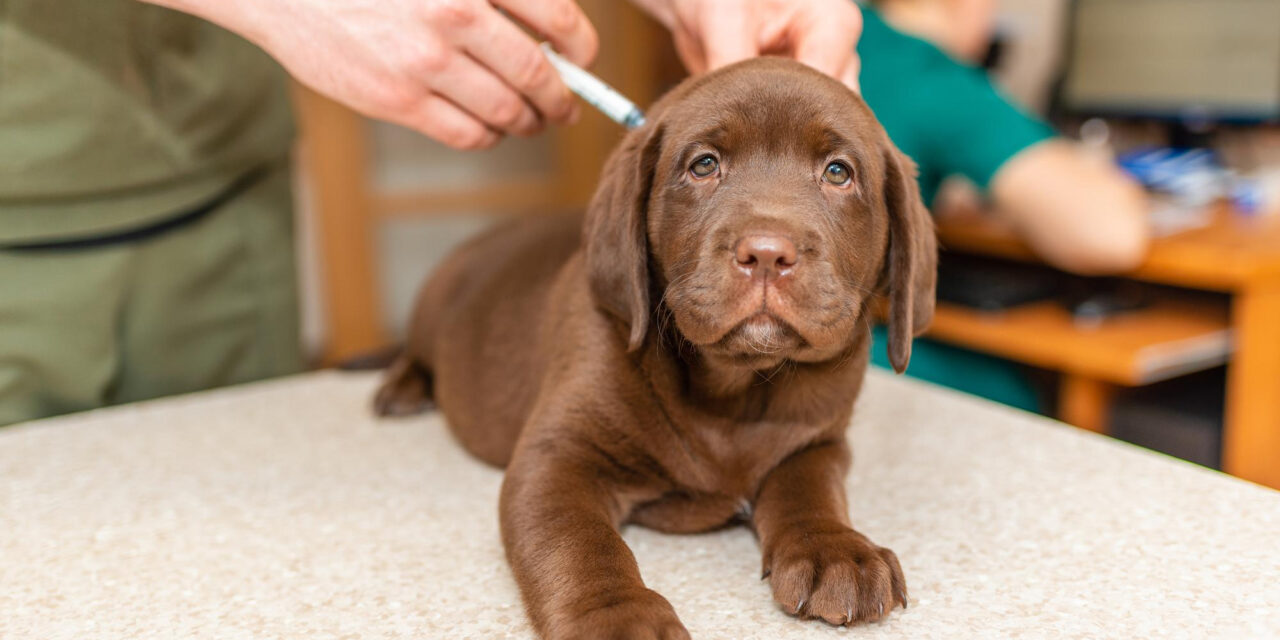
A typical puppy vaccination schedule starts with a core vaccine somewhere around 6 to 8 weeks old, then repeats every 3 to 4 weeks until your puppy is close to 16 weeks. Rabies gets added into that window too, timed to your state or local law, often somewhere between 12 and 16 weeks.
After that first series wraps up, most dogs get a booster around the one-year mark and then settle into a less frequent adult schedule. That’s the general shape nearly every U.S. veterinarian follows — and it’s worth saying plainly, right up front: it’s a pattern, not a prescription. Your vet sets the actual schedule for your puppy, based on his breed, health history, where you live, and what his day-to-day life looks like.
If you’re holding a reminder card wondering why your eight-week-old already needs another appointment, you’re not imagining things, and nobody’s padding the bill. Puppies need several doses spaced weeks apart because of how their immune systems actually work in those first few months, not because of a sales tactic. We’ll walk through why that spacing matters, what each round of shots is protecting against, what a normal day-after reaction looks like versus one that needs a same-day call, and what to do if an appointment gets missed.
One note on scope before we get into it: this article covers the general shape of core and non-core puppy vaccines, the reasoning behind the multi-dose series, and what to watch for afterward. It doesn’t walk through deworming or parasite-prevention timing in detail — MyDogLucky has a separate article on a puppy’s first vet visit that covers that alongside the rest of a first appointment. And nothing here replaces the specific vaccination schedule your own veterinarian writes for your puppy after an actual exam.
What’s in this guide
- Core vs. non-core vaccines: what your puppy actually needs
- Why puppies need a vaccine series, not just one shot
- A general puppy vaccination schedule (education, not a prescription)
- Rabies law, records, and why proof of vaccination matters
- What about titer testing?
- Normal vaccine reactions vs. emergency red flags
- What puppy vaccinations cost, and why finishing the series matters
- What to do if a dose is delayed or missed
- Vaccines and socialization: why vets don’t say “wait until fully vaccinated”
- How vaccines fit into your puppy’s bigger health picture
- Common mistakes and misunderstandings
- Frequently asked questions about the puppy vaccination schedule
- Sources
Core vs. Non-Core Vaccines: What Your Puppy Actually Needs
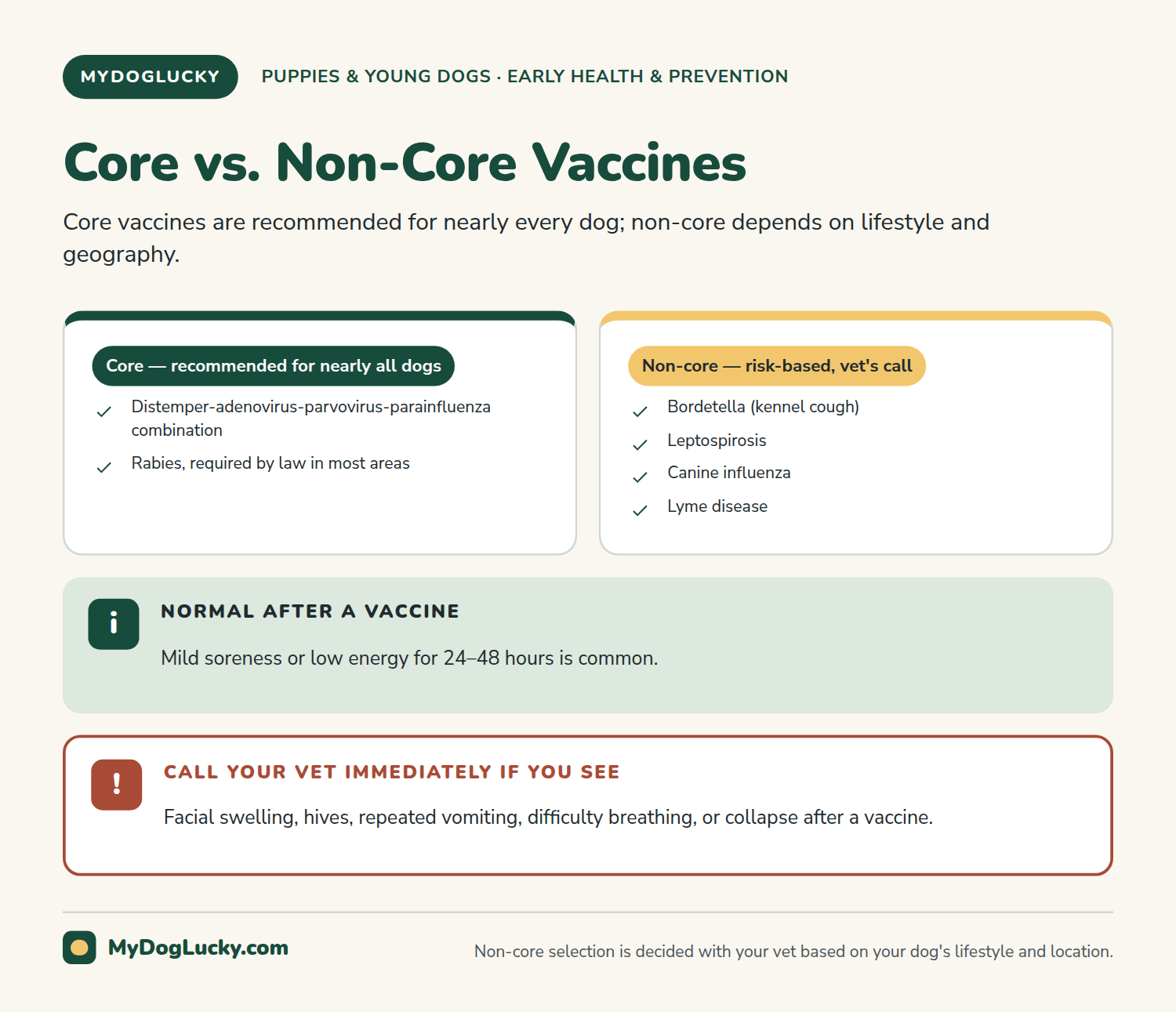
Every conversation about a puppy vaccination schedule starts with the same split: core vaccines that nearly every dog needs, and non-core vaccines that depend on how and where your puppy actually lives. Understanding the difference makes the rest of the schedule much easier to follow.
The Core Vaccines Almost Every Puppy Gets
According to the American Animal Hospital Association’s 2022 Canine Vaccination Guidelines, core vaccines are the ones recommended for essentially every dog, regardless of lifestyle, because the diseases they prevent are severe, widespread, and genuinely dangerous. For puppies, that means a combination vaccine covering distemper, adenovirus, and parvovirus, usually with parainfluenza included, often shortened to DAPP or DHPP on your paperwork. Rabies is the other universal core vaccine, required by law in some form across the United States.
Distemper and parvovirus are the two that tend to worry owners most, and for good reason. Both spread easily between dogs, both can be severe in young puppies specifically, and both are largely preventable with a completed vaccine series. That’s the actual point of the early, tightly spaced schedule: getting protection in place before exposure becomes likely.
What Distemper, Adenovirus, and Parvovirus Actually Are
It helps to know what’s actually behind those names on your puppy’s chart. Canine distemper is a virus that attacks the respiratory, gastrointestinal, and nervous systems, and it spreads through airborne exposure and contact with infected fluids — historically one of the more devastating diseases in unvaccinated dog populations. Canine adenovirus causes infectious hepatitis, affecting the liver and other organs. Parvovirus attacks rapidly dividing cells, especially in the intestinal lining, and is notorious for how severe and fast-moving it can be in puppies specifically, who have less natural resistance than adult dogs. Parainfluenza, often bundled into the same combination vaccine, is one of several viruses behind kennel cough.
None of these are diseases you want to learn about firsthand. That’s the entire reason the core series exists, and why finishing it on schedule matters more than almost any other early puppy task on your list.
Leptospirosis: Now Treated as Core for Most Dogs
Here’s a detail worth knowing, because it’s changed recently and your vet’s recommendation might not match older articles you find online. AAHA’s guidelines were updated to designate the leptospirosis vaccine as core for most dogs, a shift from its earlier non-core classification. Three things drove that change: leptospirosis has spread well beyond its historically “rural” reputation and now turns up in unexpected places, modern leptospirosis vaccines don’t appear to carry a higher reaction rate than other core vaccines, and research pointed to vaccination status — not breed or lifestyle — as the strongest predictor of which dogs actually get infected.
Practically, that means most puppies today start a two-dose leptospirosis series, generally beginning around 12 weeks, alongside the rest of the core schedule. Your vet will confirm whether that applies to your puppy specifically.
Non-Core Vaccines Depend on Your Puppy’s Life, Not a Formula
Non-core vaccines are the ones decided case by case, based on where you live and what your puppy’s routine actually looks like. Bordetella, often bundled with parainfluenza, tends to come up for puppies headed toward daycare, boarding, group training classes, or the groomer, since those are exactly the settings where kennel cough spreads. Canine influenza follows similar logic — more relevant in dog-dense environments than in a household with one dog and a quiet yard. Lyme disease vaccination gets considered in regions where ticks that carry it are common, and it’s a conversation worth having if you hike, camp, or live somewhere wooded.
None of these are automatically “extra” or unnecessary. They’re simply matched to risk instead of applied universally, which is exactly how a good vaccination plan should work.
Who Actually Decides Which Vaccines Your Puppy Gets
Your veterinarian weighs several things when building your puppy’s actual plan: his breed and any known health issues, how common certain diseases are in your specific region, and what his planned lifestyle looks like — hiking trails, dog parks, boarding stays, interstate travel, or none of the above. Two puppies in the same litter can reasonably end up with slightly different non-core recommendations once they go to different households. That’s not inconsistency. That’s the system working as intended.
| Vaccine | Category | Who typically needs it |
|---|---|---|
| Distemper-adenovirus-parvovirus (± parainfluenza) | Core | Every puppy |
| Rabies | Core | Every puppy, timed per state/local law |
| Leptospirosis | Core for most dogs (2024 AAHA update) | Most puppies; confirm with your vet |
| Bordetella / canine parainfluenza | Non-core | Daycare, boarding, grooming, group classes |
| Canine influenza | Non-core | Dog-dense environments, boarding, shows |
| Lyme disease | Non-core | Tick-endemic regions, frequent outdoor time |
Why Puppies Need a Vaccine Series, Not Just One Shot
It’s a fair question: why can’t one strong dose at eight weeks just cover it? The answer comes down to something your puppy inherited from his mother, and it’s the single biggest reason the schedule looks the way it does.
Maternal Antibodies: A Head Start That Also Gets in the Way
Puppies who nurse in the first day or two of life absorb antibodies from their mother’s milk, called maternal antibodies. That’s genuinely protective early on — it’s a newborn puppy’s only real defense before his own immune system has caught up. The problem is timing. According to the AVMA, that maternal protection fades gradually over the following weeks, and while it’s present, it can also neutralize a vaccine before your puppy’s own immune system gets a chance to respond to it and build its own memory.
The tricky part is that maternal antibody levels don’t fade on the same calendar for every puppy. One puppy might lose enough protection to respond well to a vaccine at nine weeks; his littermate might still be covered until closer to eleven. Nobody can look at a puppy and know exactly which week that happens.
The “Window of Susceptibility”
That uncertainty is exactly why the schedule uses repeated doses spread across weeks instead of a single well-timed shot. Vets sometimes call the stretch where maternal antibodies are too low to protect a puppy but still high enough to block a vaccine’s effect the “window of susceptibility.” Giving several doses across that whole stretch — roughly 6 to 16 weeks — means at least one of them lands after maternal antibodies have faded enough for your puppy’s own immune system to respond and build lasting protection.
Think of it less like a single lock-and-key moment and more like casting a wide net across the exact weeks when timing is genuinely unpredictable. That’s not overengineering. It’s the most reliable way researchers have found to close the gap.
How Long Full Protection Actually Takes
Even after a dose lands at the right moment, your puppy’s immune system needs time to respond — it’s not immediate, the way flipping a switch would be. Full protective immunity generally builds over roughly one to two weeks after a dose that successfully “took.” That’s part of why a puppy isn’t considered reliably protected until a week or two after the final dose in the core series, not the day of the appointment itself, and why vets are often cautious about high-exposure situations right up until that point.
Why the Series Isn’t Padding the Bill
It’s an understandable suspicion, especially with vet costs on people’s minds these days. But the multi-dose structure isn’t a scheduling quirk designed to multiply visits — it’s the mechanism that actually works, backed by decades of immunology research and reflected in veterinary consensus guidelines rather than any single clinic’s preference. A puppy who gets only one dose, timed wrong relative to his own maternal antibody fade-out, can end up with a false sense of protection that isn’t really there yet.
A General Puppy Vaccination Schedule (Education, Not a Prescription)
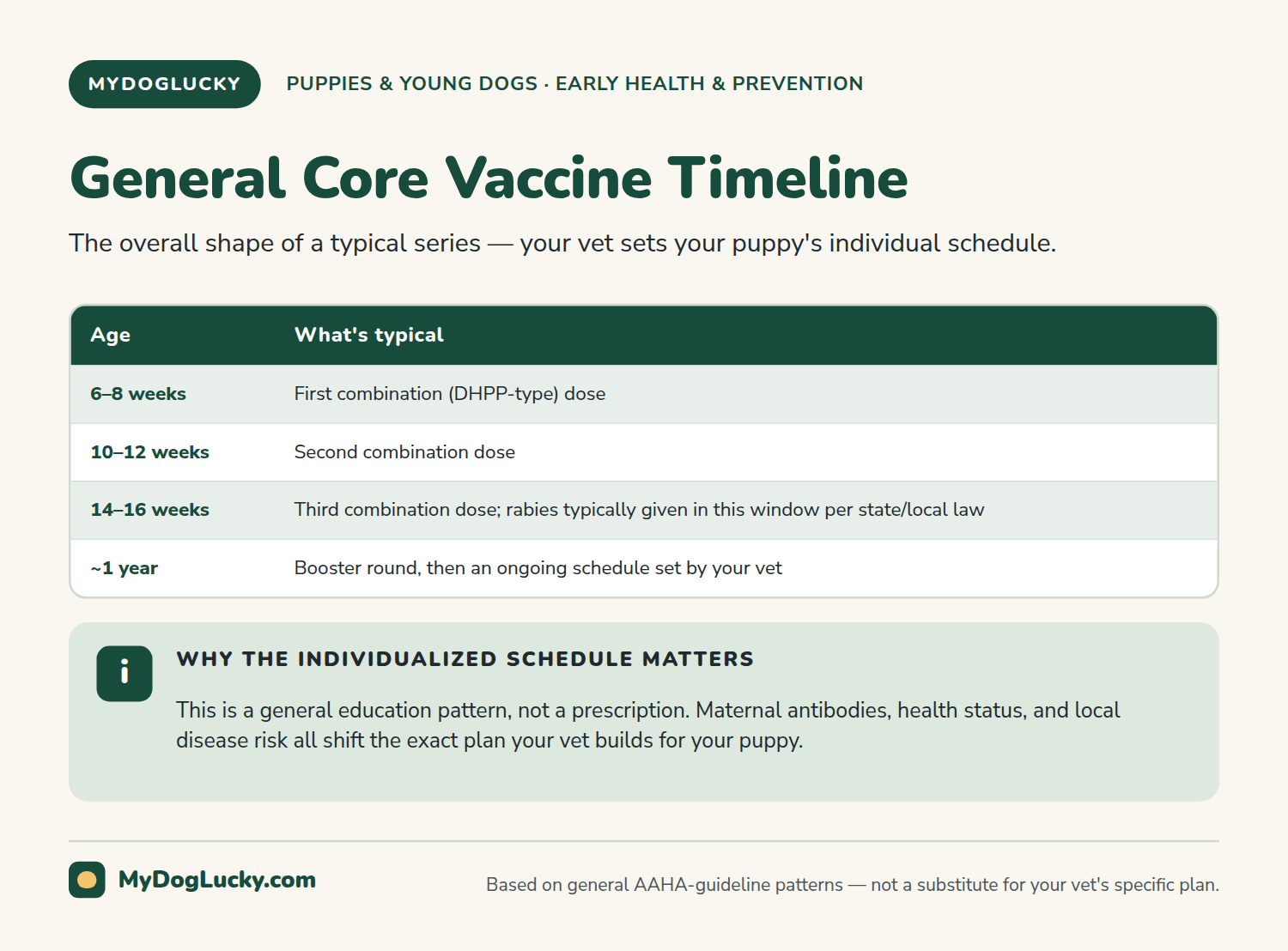
Here’s the general pattern most U.S. veterinarians follow for the core puppy vaccine series, drawn from AAHA’s 2022 Canine Vaccination Guidelines. Read it as a map of the territory, not turn-by-turn directions for your specific puppy.
This table is general education, not your puppy’s schedule
Your veterinarian sets the actual dates, doses, and vaccine choices for your puppy, based on his age at the first visit, breed, health history, and where you live. If your puppy started the series later than 8 weeks, has a health condition, or came from a shelter with an unclear vaccine history, the real plan will likely differ from the general pattern below — and that’s expected, not a sign anything went wrong.
How to Read This Table
The age windows below describe when a dose is commonly given, not a strict deadline. Vets build in flexibility for scheduling, health status on the day, and how a puppy responded to the previous dose.
| Age window | What typically happens | Notes |
|---|---|---|
| 6–8 weeks | First combination vaccine (distemper-adenovirus-parvovirus, often with parainfluenza) | Some vets start slightly earlier or later depending on the puppy’s situation |
| 10–12 weeks | Second combination dose; leptospirosis series often begins around 12 weeks | Non-core vaccines may be discussed based on lifestyle |
| 14–16 weeks | Third (sometimes final) combination dose | AAHA guidelines call for at least 3 doses between 6 and 16 weeks, spaced 2–4 weeks apart |
| Rabies | Single dose, timed per state/local law | Commonly given somewhere between 12 and 16 weeks, but the exact age and any grace period vary by where you live |
| Around 1 year | Booster for core vaccines, including rabies per local law | Marks the end of the “puppy series” and the start of the adult schedule |
| Ongoing (adult) | Boosters spaced out, often every 1–3 years depending on the vaccine | Set by your vet based on vaccine type, local law, and your dog’s risk |
Rabies Timing Depends on Where You Live
Rabies is the one core vaccine where “just follow the standard schedule” doesn’t quite apply, because rabies vaccination is a matter of law, and that law varies by state and sometimes by county or city. Some jurisdictions set a minimum age of 12 weeks; others use 16 weeks or a different threshold entirely, and requirements around timing of the follow-up dose vary too. Your vet’s office will know the specific rule where you live — it’s genuinely not something to try to look up and calculate yourself.
What Happens After the Puppy Series Ends
Once the initial series wraps up, most dogs get a one-year booster for their core vaccines, then move to a less frequent adult schedule — often every three years for the combination vaccine, annually for leptospirosis, and per local law for rabies. Non-core vaccines your puppy started, if any, typically continue on their own booster schedule too. None of that is something to track from memory; it’s exactly what a vet’s reminder system and your puppy’s written record are for.
Rabies Law, Records, and Why Proof of Vaccination Matters
Rabies sits in a slightly different category than the rest of the puppy vaccination schedule, because it isn’t just a medical recommendation. It’s public health law, and it comes with paperwork that follows your dog around for years.
Why Rabies Law Varies So Much by Location
Rabies is zoonotic, meaning it can pass from animals to people, and it’s nearly always fatal once symptoms appear in either. Because of that risk, rabies vaccination requirements are set at the state and local level rather than nationally, which is why the minimum age, the interval for the first booster, and even which vaccine products are approved can differ depending on where you live. A table maintained by the Animal Legal & Historical Center at Michigan State University’s College of Law documents just how much that variation exists across the country. The practical takeaway: don’t assume your cousin’s state’s timeline applies to your puppy. Ask your own vet.
Moving between states adds another wrinkle. A rabies vaccine that was current and compliant in one state doesn’t automatically reset to that state’s grace period if you relocate somewhere with different rules. If a move, a long trip, or a change of address is coming up, it’s worth mentioning to your vet ahead of time so they can flag anything that needs to happen before or after the move, rather than finding out about a mismatch at a licensing office months later.
Proof of Vaccination for Daycare, Boarding, and Travel
Once your puppy is vaccinated, the paperwork starts mattering almost as much as the shots themselves. Daycare facilities, boarding kennels, grooming salons, and many group training classes require current proof of core vaccines — usually rabies at minimum, often the combination vaccine and bordetella too — before they’ll accept a new dog. That’s not bureaucratic overreach. It’s how a facility protects every other dog in the building from something one unvaccinated dog could bring in.
Travel raises the stakes further. Airlines, some state lines, and international destinations can require an official rabies certificate, sometimes issued by an accredited veterinarian within a specific window before travel. If a trip is anywhere on your horizon, it’s worth asking your vet about documentation requirements well before you book anything, since some paperwork takes weeks to process correctly.
Keeping Your Puppy’s Vaccine Record
Every vaccine visit should end with an updated written record — the specific vaccine given, the date, the lot number, and when the next dose is due. Keep a copy somewhere you’ll actually find it: a folder at home, a photo on your phone, or a saved PDF from your vet’s client portal. A rabies certificate specifically is worth keeping as its own document, since it’s often what a boarding facility, groomer, or local licensing office will ask to see first.
A simple habit worth building
Take a photo of your puppy’s vaccine record on your phone after every visit, and add a calendar reminder a few days before the next dose is due. It costs almost nothing and saves a scramble later, whether that’s a last-minute boarding reservation or a mix-up over what’s already been given.
What About Titer Testing?
Titer testing comes up often once owners start reading about vaccine schedules, usually framed as an alternative to routine boosters. It’s worth understanding what a titer actually is before deciding whether to ask your vet about one.
What a Titer Actually Measures
A titer test is a blood test that measures the level of specific antibodies circulating in your dog’s system, which can indicate whether he still has protective immunity from a past vaccine. AAHA’s guidelines describe titer testing as most useful for the core combination vaccine components, where a well-validated correlation between antibody level and protection has been established. It’s less reliable, or not validated at all, for other vaccines, including leptospirosis and rabies.
Where Titers Fit, and Where They Don’t
Titers can be genuinely useful in specific situations: for a dog with an unknown vaccine history, for a dog who’s had a serious vaccine reaction in the past and needs a more cautious approach, or simply for an owner who wants documented evidence of continued immunity before skipping a booster. What a titer generally can’t do is legally substitute for a rabies vaccine, since rabies requirements are set by law rather than by an individual immunity measurement, and most jurisdictions don’t accept a titer result in place of a current rabies vaccine.
For puppies specifically, titer testing isn’t a substitute for completing the initial core series. A young puppy’s antibody levels are still in flux during those early months, which makes a titer drawn too early hard to interpret meaningfully. If titers interest you as your dog gets older, it’s a conversation to have directly with your vet about whether it fits your specific dog’s situation — not something to research your way into deciding alone.
There’s also a cost and logistics side worth knowing about upfront: titer testing isn’t free, and results take time to come back from a lab, which matters if you’re weighing it against a routine booster before a boarding stay or a travel deadline. Some owners assume a titer will be cheaper or faster than a booster. Depending on your clinic and the specific test, it can actually be neither. It’s a reasonable thing to ask about, but not a default assumption to plan around.
Normal Vaccine Reactions vs. Emergency Red Flags
Most puppies handle vaccines without much drama. Some don’t feel like themselves for a day or so. A much smaller number have a reaction that needs same-day veterinary attention. Knowing the difference in advance means you’re not googling symptoms in a panic at 9 p.m.
What’s Normal in the First 24 to 48 Hours
Mild, short-lived symptoms are common and expected after a vaccine visit. That can include soreness at the injection site, a mild dip in energy, less interest in food for a meal or two, or a small, soft lump at the injection site that resolves on its own within a few weeks. These reflect the immune system doing exactly what it’s supposed to do — responding to the vaccine and building protection. A puppy who’s a little quiet the evening after a vet visit, then back to normal the next day, is having a typical response, not a problem.
You can support your puppy through that window with a quiet evening, easy access to water, and his usual food offered without pressure. There’s nothing specific you need to do beyond that for a truly mild, short reaction.
Signs That Need Immediate Veterinary Attention
A genuine allergic reaction to a vaccine is uncommon, but it can happen, and it can escalate quickly. This is the one place in this article worth being direct rather than gentle about: if you see any of the following, call your vet immediately or head to the nearest emergency clinic. Don’t wait to see if it passes on its own.
Call your vet immediately or go to an emergency clinic if you see:
- Facial swelling — puffiness around the muzzle, eyes, or face, developing within minutes to a few hours of the vaccine.
- Hives — raised, itchy welts across the body, sometimes accompanied by intense scratching.
- Repeated vomiting — more than one episode, or vomiting paired with other symptoms on this list.
- Difficulty breathing — labored, rapid, or noisy breathing, or visible distress while trying to breathe.
- Collapse or extreme weakness — a puppy who can’t stand, is unresponsive, or seems suddenly, dramatically unwell.
These signs typically show up within the first few hours after a vaccine, which is part of why many vets ask owners to stick around the clinic briefly after a first vaccine visit, or to keep a close eye on a young puppy that evening.
Outside of that emergency list, a fever that lasts more than a day or two, persistent lethargy past 48 hours, or a puppy who won’t eat or drink at all is worth a same-day call to your vet’s office — not necessarily an emergency room visit, but not something to just wait out either. When in doubt about which category a symptom falls into, calling your vet’s office and describing exactly what you’re seeing is always the right move. That’s what they’re there for.
Why Some Vets Ask You to Wait at the Clinic Briefly
You may notice some clinics ask you to hang around the waiting room for 15 to 30 minutes after your puppy’s first vaccine visit, rather than heading straight out to the car. That’s a precaution, not a sign anything’s expected to go wrong. Because a true allergic reaction typically starts within minutes to a couple of hours, staying nearby for that first window means help is immediately available if something does come up, rather than you noticing symptoms while already on the highway home. Not every clinic follows this practice, and it’s a reasonable thing to ask about at your puppy’s first appointment if it matters to you.
What Puppy Vaccinations Cost, and Why Finishing the Series Matters
Vaccine costs are a real part of this conversation, even without specific dollar figures, since exact pricing varies widely by clinic, region, and which vaccines your puppy needs. What’s more useful here is understanding the shape of that spending and why the full series is worth completing rather than stretching thin.
Why the Series Spans Several Visits
Each puppy vaccine visit typically bundles more than just the shot itself: an exam, a weight check, a conversation about development and behavior, and often a parasite check alongside the vaccine. That’s part of why the cost isn’t just “vaccines times three.” You’re also paying for a veterinarian’s hands-on assessment of your puppy at each stage of a period when a lot changes fast.
Where the Cost Tends to Go
Broadly, the expenses in a puppy vaccination schedule fall into a few categories: the vaccines themselves, the office or exam fee for each visit, and sometimes bundled extras like a fecal parasite test or a microchip. Some clinics offer puppy wellness packages that bundle several visits together at a lower combined cost than paying for each separately — worth asking about directly when you book your puppy’s first appointment.
What Happens If You Stop Partway Through
This is the part worth taking seriously: a partially completed vaccine series doesn’t provide partial protection in any reliable, predictable way. A puppy who gets the first two doses of the core series but skips the third is genuinely still vulnerable, not “mostly covered.” Stopping early to save money in the short term often costs more later, both financially and in terms of your puppy’s actual risk, if he ends up exposed to something like parvovirus before the series is truly finished.
Ways to Manage the Cost Without Cutting Corners
If cost is a genuine barrier, talk to your vet’s office directly rather than quietly skipping a dose. Many clinics offer payment plans, bundled puppy wellness packages, or can point you toward local low-cost vaccine clinics run by shelters, humane societies, or community outreach programs. Some pet insurance plans offer a wellness add-on that reimburses part of routine vaccine costs, though it typically needs to be in place before the visit, not purchased after the fact. Asking your vet’s front desk about every option available, including which parts of a non-core recommendation are flexible if money is tight, tends to get a more useful answer than trying to guess your way to a cheaper plan on your own.
What to Do If a Dose Is Delayed or Missed
Life happens. A work trip, an illness, a scheduling mix-up — there are plenty of ordinary reasons a puppy vaccine appointment gets pushed past its target window. Here’s what actually matters if that happens to you.
Call Your Vet, Don’t Guess
The single most important step is also the simplest: call your vet’s office and tell them what happened. Don’t try to calculate a new schedule yourself based on something you read online, and don’t assume a delay of a few days or even a couple of weeks means starting over. Your vet’s team handles this regularly and can tell you, based on your puppy’s specific history, exactly what the next step should be.
Restarting From Scratch Isn’t Usually Necessary
A common fear is that a missed appointment means losing all the progress already made and starting the whole series over. That’s usually not how it works. In most cases, a vet will simply pick the series back up from where it left off, sometimes adjusting the remaining schedule slightly. Whether a longer gap changes that plan depends on exactly how long the delay was and which vaccine was missed — another reason this is a call-your-vet question, not a guess-it-out-yourself one.
Keeping Your Puppy Safe in the Meantime
While you’re sorting out a rescheduled appointment, it’s reasonable to be a bit more cautious about high-exposure situations — dog parks, group classes with unknown vaccine status, or boarding facilities — until the series catches back up, especially if your puppy is still young and mid-series. That’s a short-term precaution, not a reason to isolate your puppy entirely or panic about a delay that’s genuinely common and fixable.
If a dose gets missed, in order
- Call your vet’s office as soon as you realize, rather than waiting until the next scheduled visit.
- Describe exactly what happened — how many days or weeks have passed, and which specific dose was missed.
- Follow their guidance on rescheduling, rather than restarting the series based on your own assumption.
- Stay a bit more cautious around unknown dogs and high-traffic dog spaces until the series is back on track.
Vaccines and Socialization: Why Vets Don’t Say “Wait Until Fully Vaccinated”
One of the most common questions tangled up with the puppy vaccination schedule isn’t about the shots themselves — it’s about what your puppy can safely do while the series is still in progress. Older advice sometimes told owners to keep a puppy isolated until every dose was complete, somewhere around 16 weeks. Current guidance from veterinary behavior professionals pushes back on that, for good reason.
The AVSAB Position: Socialization Windows Don’t Wait for Full Vaccination
The American Veterinary Society of Animal Behavior’s position statement on puppy socialization is direct about this tension: the prime window for socialization closes around 12 to 14 weeks, well before most puppies finish their core vaccine series. Waiting until full vaccination to begin socializing means missing a developmental window that doesn’t reopen later. AVSAB’s position statement notes that behavioral issues, not infectious disease, are the leading cause of death for dogs under three years old in the United States — which reframes the risk calculation most owners start with.
Their recommendation: puppies can generally begin classes and controlled social experiences as early as 7 to 8 weeks old, about one week after the first round of vaccines and deworming, rather than waiting for the series to finish. That’s a genuinely different message than “wait until fully vaccinated,” and it’s worth knowing so you don’t accidentally under-socialize your puppy out of an abundance of caution that isn’t quite matched to the actual evidence.
Lower-Risk Ways to Socialize During the Series
None of this means treating exposure risk as irrelevant while your puppy’s series is incomplete. It means choosing lower-risk settings over higher-risk ones during that window. A well-run puppy class that screens for vaccination and health status, held on a cleaned indoor surface, carries meaningfully less risk than an off-leash dog park full of dogs with unknown vaccine histories. Visits with a healthy, fully vaccinated adult dog you know, or a friend’s puppy who’s also mid-series and screened, are reasonable middle-ground options many vets are comfortable with.
Public spaces where unfamiliar dogs relieve themselves — unfenced yards, sidewalks with heavy dog traffic, dog parks — are where it makes sense to be more cautious until your puppy’s series is further along, since parvovirus in particular can persist in the environment for a long time. Carrying your puppy in unfamiliar public places, rather than letting him walk on ground other dogs use, is a common way vets suggest splitting the difference between exposure and stimulation.
Balancing Risk With the Cost of Missing the Window
This is genuinely a balance, not a rule with one right answer for every puppy, which is exactly why it’s worth discussing directly with your vet at that first appointment. Your vet can tell you how much local disease risk actually factors into your specific decision, based on what’s circulating in your area and your puppy’s individual health. The overall message from current veterinary behavior guidance is that thoughtful, lower-risk socialization during the vaccine series tends to serve most puppies better than isolation until every dose is complete.
How Vaccines Fit Into Your Puppy’s Bigger Health Picture
Vaccines are one piece of a larger early-health puzzle, and it helps to see how the pieces connect rather than treating each vet visit as an isolated errand.
Parasite Prevention and Deworming Run on Their Own Timeline
Most puppies get dewormed on a separate, often more frequent schedule than vaccines, since intestinal parasites are extremely common in young puppies and a single treatment usually isn’t enough to clear them completely. Heartworm, flea, and tick prevention typically start around the same general age range as the vaccine series, though the exact timing depends on your region and your puppy’s individual risk. These conversations usually happen at the same appointments as vaccines, which is efficient, but the schedules themselves aren’t identical, and it’s worth asking your vet to walk through both separately so you’re not assuming one covers the other.
The First Vet Visit Sets Up Everything Else
Your puppy’s first veterinary visit is where all of this actually gets planned out — the vaccine schedule, deworming, parasite prevention, a baseline weight and body condition check, and a first real conversation about his individual risk factors. MyDogLucky has a separate article walking through what to expect at that first visit in more detail, including what to bring and what questions are worth asking. If you haven’t had that appointment yet, that’s the natural starting point before any of the specific timing in this article becomes personally relevant to your puppy.
Growth Checks Happen Alongside Every Vaccine Visit
Each vaccine appointment usually doubles as a growth check, since a puppy’s weight, body condition, and overall development can shift noticeably between visits just weeks apart. Your vet uses that running record to catch things early — a growth curve that’s flattening unexpectedly, a body condition trending too thin or too heavy, or a physical exam finding unrelated to vaccines entirely, like a heart murmur or a retained baby tooth. None of that replaces the vaccine itself as the main reason for the visit, but it’s part of why skipping a scheduled appointment costs you more than just a delayed shot.
Common Mistakes and Misunderstandings
Treating This General Schedule as Your Puppy’s Actual Plan
It bears repeating, because it’s the single most common mix-up: the timeline in this article describes a general pattern, not the specific dates and doses your vet will actually use. Bring questions about your puppy’s exact schedule to your vet, not to a general article like this one.
Assuming “The Rabies Shot” Means the Whole Series Is Done
Rabies is one core vaccine among several, not a stand-in for the entire puppy vaccination schedule. A puppy can be current on rabies and still be missing doses of the core combination vaccine or a recommended leptospirosis series.
Skipping Non-Core Vaccines Without a Real Conversation
It’s tempting to assume non-core means unnecessary, but that’s not quite right — it means risk-based. A puppy headed to daycare twice a week has a genuinely different risk profile than one who mostly stays home, and that’s worth an actual conversation with your vet rather than a blanket decision either way.
Letting a Missed Appointment Turn Into Skipping It Entirely
A missed dose is a scheduling problem, not a reason to quietly drop that vaccine from the plan. Call your vet, get it rescheduled, and close the gap rather than letting “we’ll get to it” turn into months of an incomplete series.
Avoiding Follow-Up Visits Out of Worry About Reactions
A rough evening after one vaccine dose sometimes leads owners to want to skip or delay the next one out of caution. That instinct is understandable, but it’s worth talking through with your vet rather than acting on alone — a genuinely serious reaction is uncommon, and your vet can tell you whether what your puppy experienced was typical or worth adjusting the plan around.
Assuming a Titer Test Is a Simple Shortcut
Titers are a useful tool in specific situations, not a universal substitute for the initial puppy series or for a legally required rabies vaccine. Treating a titer as an easy way to skip the schedule altogether usually isn’t the informed choice it looks like online.
Isolating a Puppy Completely Until the Series Is Finished
Waiting until every dose is complete before any socialization can do its own kind of harm, since the socialization window closes around 12 to 14 weeks regardless of vaccine timing. Lower-risk socialization during the series, discussed above, tends to serve most puppies better than isolation.
Not Mentioning a Previous Reaction at the Next Appointment
If your puppy had any reaction to an earlier dose, even a mild one, tell the vet team at the start of the next visit rather than assuming it’s already in the chart or that it wasn’t worth mentioning. That detail can change how the next vaccine is given or monitored, and it’s easy information for you to forget by the time weeks have passed.
Frequently Asked Questions About the Puppy Vaccination Schedule
What is the general puppy vaccination schedule most vets follow?
Most U.S. vets follow a similar general pattern: a core combination vaccine starting around 6 to 8 weeks, repeated every 3 to 4 weeks until roughly 16 weeks, with rabies added somewhere in that window based on state or local law. A one-year booster follows, then an adult schedule. Your vet’s actual plan for your puppy may vary from this general shape.
Why does my puppy need so many shots instead of just one?
Maternal antibodies from nursing protect a young puppy early on, but they can also block a vaccine from working, and nobody can predict exactly when that protection fades for an individual puppy. Multiple doses spread across several weeks make it far more likely that at least one dose lands after maternal protection has faded enough for your puppy’s own immune system to respond.
What vaccines are considered core for puppies?
The core vaccines are the combination vaccine covering distemper, adenovirus, and parvovirus (often with parainfluenza), rabies, and, per AAHA’s updated 2024 guidance, leptospirosis for most dogs. Non-core vaccines like bordetella, canine influenza, and Lyme disease are added based on your puppy’s individual lifestyle and location.
Is the leptospirosis vaccine really necessary for my puppy?
AAHA’s current guidelines recommend it for most dogs, reflecting how widely the bacteria that cause leptospirosis have spread and evidence that vaccination status, not breed or lifestyle, is the strongest predictor of infection risk. Your vet can confirm whether it applies to your specific puppy and region.
My puppy missed a scheduled vaccine appointment. Do we have to start the whole series over?
Usually not. Call your vet’s office and explain what happened. In most cases, they’ll simply pick the series back up from where it left off, though the exact plan depends on how long the delay was and which dose was missed. Don’t assume either way without checking.
When does my puppy get the rabies vaccine?
It depends on where you live, since rabies vaccination is governed by state and local law rather than a single national standard. Many areas allow it starting around 12 to 16 weeks, but the exact minimum age and requirements vary. Your vet’s office will know the specific rule for your location.
Is it normal for my puppy to be tired or sore after a vaccine?
Yes. Mild soreness at the injection site, a little less energy, or reduced interest in food for a meal or two are common and usually resolve within a day or two on their own. That’s a typical immune response, not a sign something’s wrong.
What symptoms after a vaccine mean I should call the vet immediately?
Facial swelling, hives, repeated vomiting, difficulty breathing, or collapse are signs of a possible allergic reaction and need immediate veterinary attention. These usually show up within a few hours of the vaccine. A milder, short-lived reaction the same evening is much more common and not typically an emergency.
Can I skip the vaccine series and just get a titer test instead?
Not for a young puppy still completing the initial core series — antibody levels are still shifting too much for a titer to be reliably interpreted at that stage. Titers can be a useful tool later in a dog’s life for certain vaccines, but they generally can’t legally substitute for a required rabies vaccine, and it’s a decision to make with your vet rather than alone.
Why do daycares and boarding facilities ask for proof of vaccination?
Because they’re protecting every dog in the building, not just yours. Requiring current core vaccines, and often bordetella specifically, reduces the chance that one unvaccinated dog introduces something contagious into a space full of other dogs. Keep a photo or PDF of your puppy’s vaccine record handy, since most facilities ask for it before your puppy’s first visit.
Do I need to wait until my puppy is fully vaccinated before puppy classes or meeting other dogs?
Current guidance from veterinary behavior professionals generally says no. The socialization window closes around 12 to 14 weeks, before most puppies finish the core series, so waiting for full vaccination risks missing it entirely. A well-run puppy class that screens attendees, and low-risk settings like a healthy, known adult dog, are reasonable ways to socialize while the series is still in progress. Higher-risk spots like dog parks are worth saving until later.
Can my puppy get several vaccines at the same visit, or does each one need its own appointment?
Vets commonly give more than one vaccine at a single visit, which is part of why a puppy appointment can include the core combination vaccine and a non-core vaccine like leptospirosis on the same day. Your vet decides which combinations make sense for your puppy at each stage, sometimes spacing certain vaccines apart rather than stacking everything into one visit, depending on his age, size, and health.
Where This Leaves You
The general shape of a puppy vaccination schedule — a core series starting around 6 to 8 weeks, repeated every few weeks until about 16 weeks, rabies timed to local law, then a yearly booster and an adult schedule after that — is worth knowing so the appointments make sense and the reminder cards don’t feel arbitrary. But it’s exactly that: a shape, not your puppy’s actual plan.
Bring questions to your vet, not just to this article. Ask what’s core versus non-core for your specific dog, what the leptospirosis conversation looks like where you live, and what to do if life gets in the way of a scheduled dose. And if you ever see facial swelling, hives, repeated vomiting, trouble breathing, or collapse after a vaccine, treat that as the one moment in this whole process that calls for immediate action rather than a wait-and-see approach.
Most of this comes down to a handful of habits: show up for the scheduled visits, keep a copy of the vaccine record somewhere you’ll actually find it, ask before you assume, and call your vet’s office first whenever something feels off schedule or off pattern. That’s a manageable list, even during a stretch of puppyhood that can otherwise feel like nonstop appointments.
Sources
- American Animal Hospital Association. 2022 AAHA Canine Vaccination Guidelines
- American Animal Hospital Association. Recommendations for Core and Noncore Canine Vaccines
- American Animal Hospital Association. Update: AAHA Guidelines Designate Leptospirosis Vaccine as Core for Most Dogs
- American Animal Hospital Association. Utilization and Interpretation of Serologic Titers
- American Animal Hospital Association. 2022 AAHA Canine Vaccination Guidelines (full document, PDF)
- American Veterinary Medical Association. Vaccinating Your Pet
- American Veterinary Medical Association. To Titer or to Revaccinate, JAVMA News
- Animal Legal & Historical Center, Michigan State University College of Law. Table of Rabies Vaccination Laws
- American Veterinary Society of Animal Behavior. Position Statement on Puppy Socialization (2008)
⚠️ Needs review before publishing:
– Full vaccination schedule/table — needs named veterinary reviewer sign-off and a review date before this goes live (per the brand’s rule that AI-drafted health content may not be treated as a source or medical reviewer)
– Confirm all interval/timing claims still match the current AAHA guidelines at time of publishing
This article is general education for U.S. dog owners. It is not individualized veterinary advice, a diagnosis, or a substitute for the vaccination schedule your own veterinarian sets for your puppy based on an actual exam. Rabies vaccination requirements vary by state and locality; confirm current rules with your vet or local animal control. If your puppy shows facial swelling, hives, repeated vomiting, difficulty breathing, or collapse after any vaccine, seek veterinary care immediately.





Trackbacks/Pingbacks