
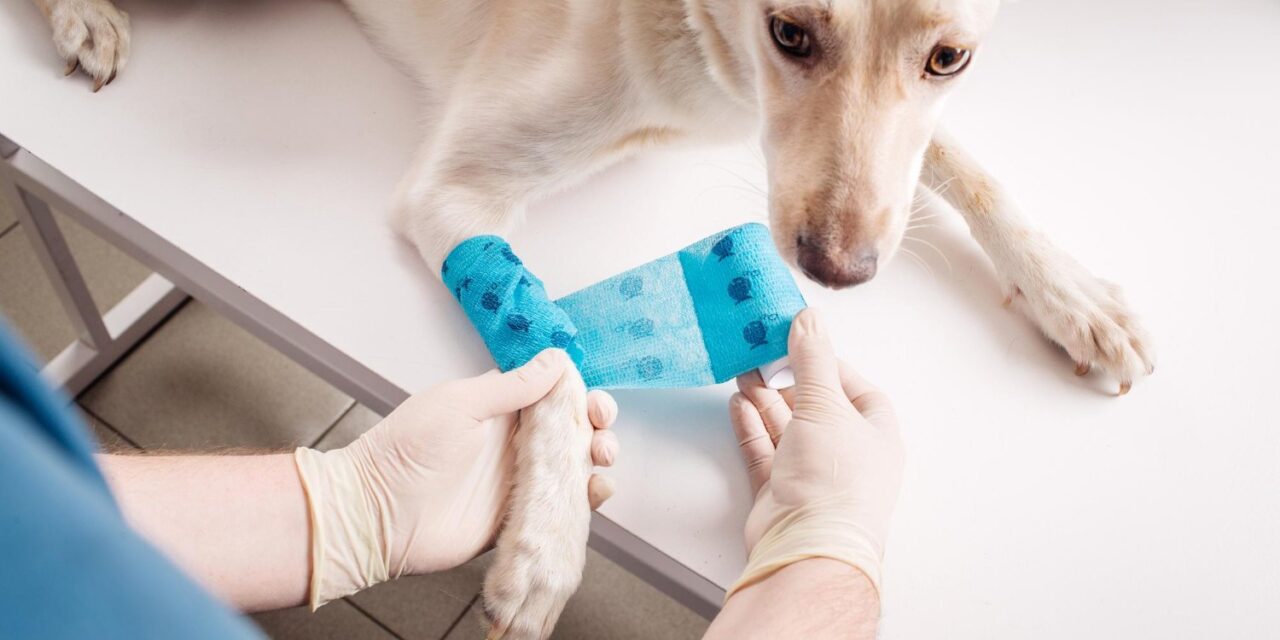
Dog first aid is what you do in the minutes between “something is wrong” and a veterinarian taking over. It is not a replacement for that veterinarian. Its job is narrow: keep your dog breathing, slow the bleeding, stop the damage from getting worse, and get to the hospital safely. Everything on this page serves that one job.
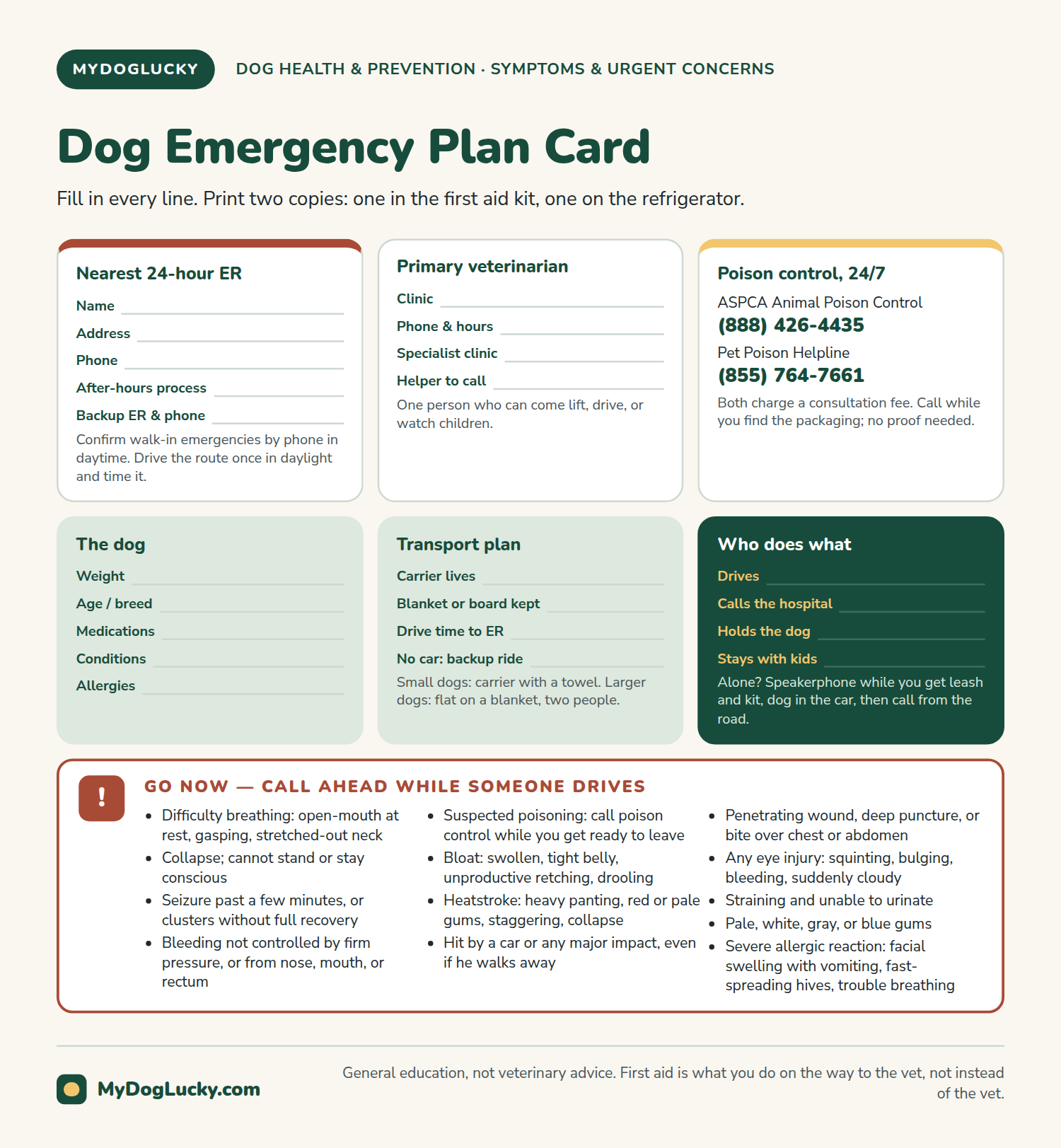
First aid is what you do on the way to the vet, not instead of the vet. Go now if you see any of these:
- Difficulty breathing — open-mouth breathing at rest, gasping, a stretched-out neck, or noisy labored breaths.
- Collapse or a dog who cannot stand or stay conscious.
- A seizure lasting more than a few minutes, or seizures coming in clusters without full recovery in between.
- Bleeding you cannot control with firm pressure, or bleeding from the nose, mouth, or rectum.
- Suspected poisoning — call a poison control line or your vet while you get ready to leave.
- Bloat signs — a swollen, tight belly with unproductive retching, drooling, and restlessness.
- Heatstroke — heavy panting, bright red or pale gums, staggering, vomiting, or collapse after heat or exertion.
- Hit by a car or any major impact, even if the dog walks away from it.
- A penetrating wound — anything embedded in the body, a deep puncture, a bite over the chest or abdomen.
- Any eye injury — a squinting, bulging, bleeding, or suddenly cloudy eye.
- Straining and unable to urinate.
- Pale, white, gray, or blue gums.
- A severe allergic reaction — facial swelling with vomiting, hives spreading fast, or trouble breathing after a sting or new food.
Call ahead while someone drives. If you are alone, use speakerphone while you get the dog into the car, then drive.
If none of those apply, you have a little more room. Use it well. This guide covers the plan to build before anything happens, the dog first aid kit worth owning, and then scenario-by-scenario instructions for the first minutes: bleeding, choking, CPR, heatstroke, seizures, poisoning, and more. Each scenario follows the same order. Immediate action first. Then what not to do. Then what to bring and tell the vet. Context comes last, because context is what you read after the crisis, not during it.
One honest limit up front. We are not veterinarians, and this page cannot see your dog. The steps below come from the American Veterinary Medical Association, the RECOVER CPR guidelines, the American Red Cross, the Merck Veterinary Manual, VCA Animal Hospitals, and the two national animal poison control lines. Where a technique carries risk or the evidence is thin, we say so plainly. Dog first aid basics are worth learning now, calmly, so that later you act instead of search.
What’s in this guide
- What dog first aid can and cannot do
- The go-now list: signs that skip every other step
- Your dog first aid kit: contents, table, and maintenance
- The emergency plan to build before anything happens
- Dog first aid by scenario: what to do in the first minutes
- How to move an injured dog safely
- How to muzzle safely, and when not to
- What to tell the emergency hospital on the phone
- After the ER: follow-up, records, and restocking
- Common dog first aid mistakes
- Frequently asked questions about dog first aid
- Sources
What Dog First Aid Can and Cannot Do
Dog first aid buys time. That is the whole promise, and it is a valuable one. A dog who is bleeding heavily can lose a dangerous amount of blood in the time it takes to reach a hospital. Firm pressure changes that math. A dog who stops breathing after a near-drowning has a real chance if someone starts rescue breaths within a minute or two. A dog with heatstroke who gets cooled at the trailhead arrives at the clinic in better shape than one who was only driven there.
What dog first aid can do
- Keep oxygen moving — clearing a visible obstruction, positioning the airway, rescue breaths, and chest compressions when the heart has stopped.
- Slow blood loss — direct pressure and a pressure bandage on external bleeding.
- Stop ongoing damage — cooling a heatstroke dog, flushing a chemical from the eye, unplugging a cord, getting a seizing dog away from the stairs.
- Prevent a second injury — muzzling a painful dog before he bites, moving a dog with a possible spinal injury on a flat surface instead of in your arms.
- Get useful information to the vet fast — what happened, when, what the dog got into, what you did, and what the gums looked like.
What dog first aid cannot do
It cannot diagnose. It cannot replace intravenous fluids, oxygen, imaging, surgery, antivenom, or a veterinarian’s hands. It cannot tell you that a dog who “seems fine now” after a car strike, a near-drowning, an electrical shock, or a heatstroke episode is actually fine. Internal bleeding, fluid in the lungs, and clotting problems can take hours to show. A dog who looked better in the driveway can crash in the evening.
First aid also cannot safely include medication decisions made from a search result. Human pain relievers are toxic to dogs. Antihistamine doses depend on the dog, the reaction, and what else is going on. Inducing vomiting helps in some poisonings and causes serious harm in others. Every one of those calls belongs to a veterinarian or a poison control veterinarian, and the phone call takes less time than the guessing.
The one rule that makes the rest of this page work
Decide to go before you decide what to do. In a real emergency, the first two actions are the same every time: someone calls the vet, and someone gets the dog toward the car. Dog first aid steps fit inside that, not ahead of it. If the steps below ever feel like they are delaying the trip, stop and drive.
The Go-Now List: Signs That Skip Every Other Step
The list in the box at the top of this page is the short version. Here is what each sign looks like in a real kitchen or backyard, so you recognize it in the moment rather than debating it. The AVMA’s list of animal emergencies that need immediate veterinary consultation covers the same ground, and it is worth reading once now, on a calm day.
Breathing trouble and abnormal gum color
A dog in respiratory distress often stands or sits with elbows out and neck stretched, breathes with an open mouth at rest, or has an abdomen that heaves with each breath. Gums are the fastest window into circulation. Lift the lip. Pink is normal. Pale, white, gray, blue, or brick red is not. Any of those, with or without other signs, is a go-now situation. Do not spend time cooling, bandaging, or searching. Drive.
Collapse, staggering, and seizures
A dog who cannot stand, keeps falling to one side, or loses consciousness needs a hospital. A single short seizure with full recovery afterward is a call-today event, and a first seizure always warrants a same-day conversation. A seizure that runs past a few minutes, or two or more seizures without a normal recovery in between, is an emergency because body temperature and brain stress climb with every minute. Time it. Note what it looked like. Go.
Bleeding and wounds
Bleeding you cannot control with firm pressure within about five minutes is an emergency. So is bleeding from the nose, mouth, or rectum, coughing blood, or blood in the urine, because those can point to internal bleeding or a clotting problem. Any penetrating wound counts. So does any bite over the chest or belly, where a small skin hole can hide a deep track underneath.
Suspected poisoning
You do not need proof. A chewed medication bottle, a missing chunk of chocolate, a licked antifreeze puddle, a sugar-free gum wrapper, a mushroom stem in the yard, or a dog who was alone with a bag of raisins is enough. Call the ASPCA Animal Poison Control Center at (888) 426-4435 or the Pet Poison Helpline at (855) 764-7661 while you find the packaging. Both charge a consultation fee. Both are open around the clock.
Bloat
A belly that looks swollen or feels tight like a drum, a dog who retches and produces nothing or only foam, drooling, pacing, and an inability to settle. This combination in a deep-chested or large dog is the picture of gastric dilatation-volvulus, and there is no home step that helps. Call ahead so the hospital is ready. Go.
Heatstroke
Heavy panting that does not ease, thick drool, bright red gums, a dog who wobbles or lies down and will not get up, vomiting or diarrhea after heat exposure, or collapse. Start cooling on the spot and keep cooling in the car. Dog first aid for heatstroke is covered step by step below. The trip to the vet is not optional, even if the dog perks up.
Trauma
A dog hit by a car, kicked by a horse, dropped, or caught in a fall from height needs an exam even if he stands up and wags. Ribs, lungs, spleen, liver, and bladder can be injured with no mark on the skin. The same goes for a large dog attack.
Eyes, urination, and allergic reactions
A squinting, bulging, cloudy, or bleeding eye can lose vision within hours. A dog who strains repeatedly and produces no urine, especially a male, can have a blockage that becomes life-threatening within a day. A sting or new food followed by a swollen face, hives, vomiting, weakness, or breathing changes is a possible anaphylaxis until a veterinarian says otherwise.
Your Dog First Aid Kit: Contents, Table, and Maintenance
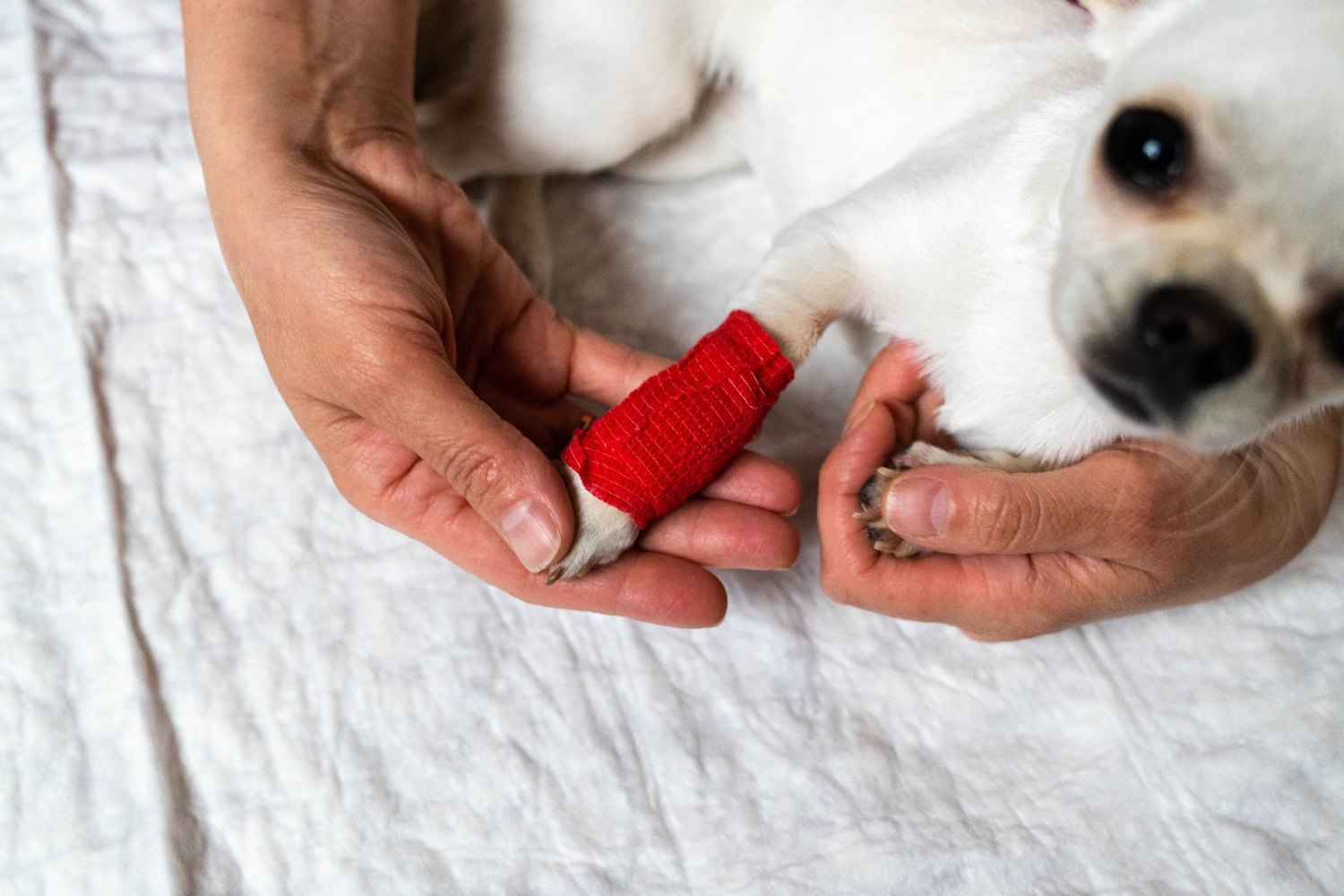
A dog first aid kit is not a shopping list of everything sold with a paw print on it. It is a small set of tools that support the actions in this guide, plus the information you will not remember under stress. Build one for home. If you hike, travel, or spend time far from a clinic, build a second one for the car. A large zippered pouch or a lidded plastic box works. Label it so a sitter, a neighbor, or a teenager can find it.
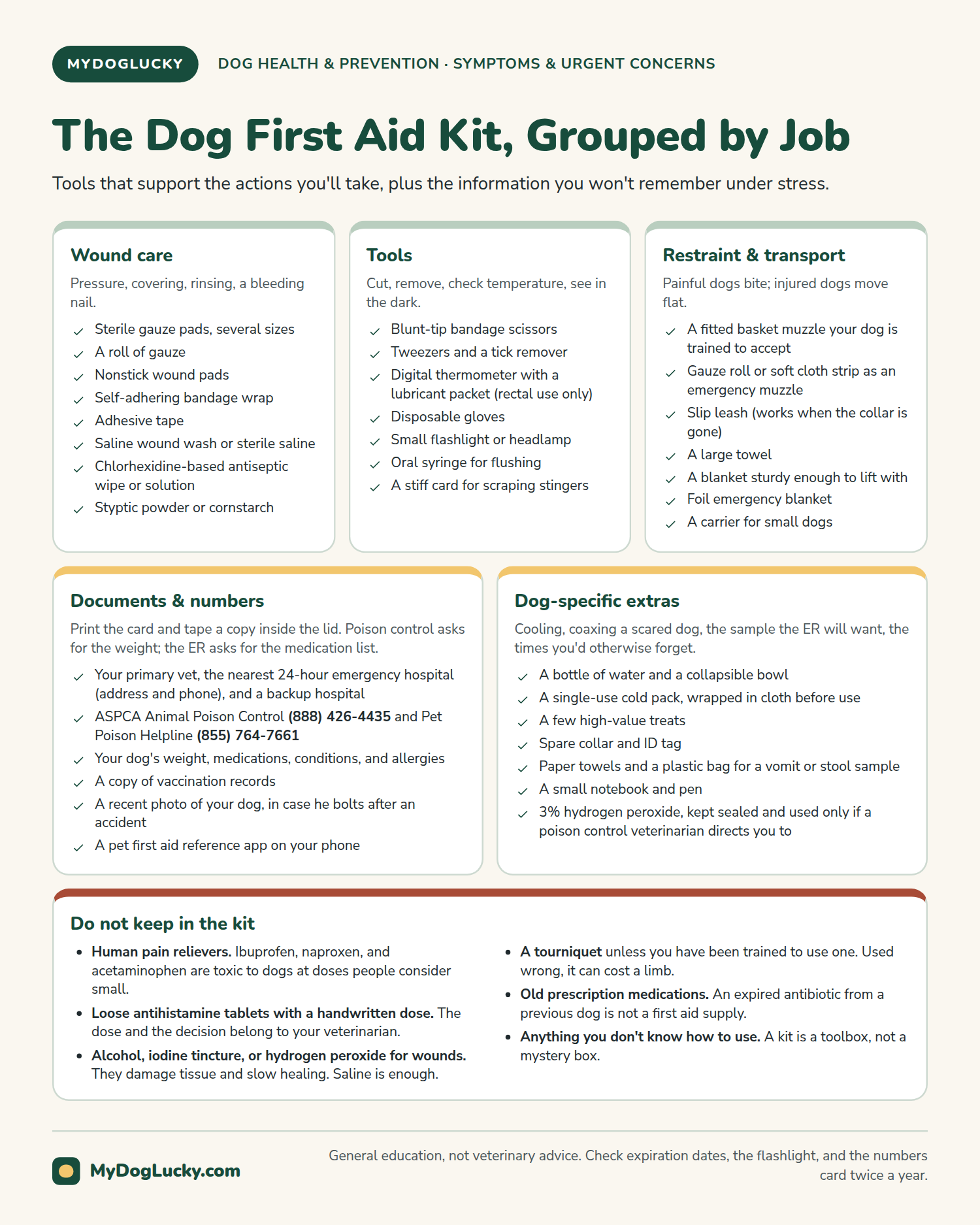
The core dog first aid kit, grouped by job
| Group | What to include | Why it is in the kit |
|---|---|---|
| Wound care | Sterile gauze pads (several sizes), a roll of gauze, nonstick wound pads, self-adhering bandage wrap, adhesive tape, saline wound wash or a bottle of sterile saline, a chlorhexidine-based antiseptic wipe or solution, styptic powder or cornstarch | Pressure on bleeding, covering wounds, rinsing debris, stopping a bleeding nail. Note what is not here: no alcohol, no hydrogen peroxide for wounds, no ointments unless your vet has told you to use one. |
| Tools | Blunt-tip bandage scissors, tweezers, a tick remover, a digital thermometer with a lubricant packet (rectal use only), disposable gloves, a small flashlight or headlamp, an oral syringe for flushing, a stiff card for scraping stingers | Cutting bandage material without stabbing the dog, removing a visible splinter or tick, checking temperature during heatstroke or hypothermia, seeing into a mouth in the dark. |
| Restraint and transport | A properly fitted basket muzzle your dog has been trained to accept, a roll of gauze or a soft strip of cloth as an emergency muzzle, a slip leash, a large towel, a blanket sturdy enough to lift with, a foil emergency blanket, a carrier for small dogs | Painful dogs bite. Injured dogs need to be moved flat. Cold and shock need warmth. A slip leash works when the collar is gone or the neck is injured. |
| Documents and numbers | A printed card with your primary vet, the nearest 24-hour emergency hospital (address and phone), a backup hospital, ASPCA Animal Poison Control (888) 426-4435 and Pet Poison Helpline (855) 764-7661, your dog’s weight, medications, conditions, and allergies; a copy of vaccination records; a recent photo of your dog; a pet first aid reference such as the American Red Cross Pet First Aid app on your phone | Poison control will ask for the weight. The ER will ask for the medication list. A sitter will not know either. A photo helps if the dog bolts after an accident. |
| Dog-specific extras | A bottle of water and a collapsible bowl, a single-use cold pack wrapped in cloth, a few high-value treats, a spare collar and ID tag, paper towels, a plastic bag for a vomit or stool sample, a small notebook and pen, a bottle of 3% hydrogen peroxide kept sealed and used only if a poison control veterinarian directs you to | Water for cooling and flushing, treats to coax a scared dog into a carrier, a bag for the sample the ER will want, a notebook for times and observations you will otherwise forget. |
What not to keep in a dog first aid kit
- Human pain relievers. Ibuprofen, naproxen, and acetaminophen are toxic to dogs at doses people consider small. Keep them out of the kit so nobody reaches for them in a panic.
- Loose antihistamine tablets with a handwritten dose. The dose and the decision belong to your veterinarian. Some dogs should not have them at all.
- Alcohol, iodine tincture, or hydrogen peroxide for wounds. They damage tissue and slow healing. Saline is enough for rinsing.
- A tourniquet unless you have been trained to use one. Used wrong, it can cost a limb.
- Old prescription medications. An expired antibiotic from a previous dog is not a first aid supply.
- Anything you do not know how to use. A kit should be a toolbox, not a mystery box.
The maintenance schedule
A kit that has been sitting in a closet for three years is a kit with a dead flashlight, dried-out wipes, an expired saline bottle, and the phone number of a vet who retired. Put a recurring reminder on your phone.
Twice a year (pair it with changing smoke-detector batteries)
- Check expiration dates on saline, wipes, cold packs, and hydrogen peroxide. Replace what is expired.
- Test the flashlight. Replace batteries.
- Reprint the numbers card if your vet, your ER, your address, or your dog’s weight or medications changed.
- Update the vaccination record copy after each visit.
- Confirm the muzzle still fits. Dogs change shape.
- Restock anything used since the last check.
Also review the kit any time you move, add a dog, or plan a trip somewhere with different hazards, like rattlesnake country or a lake.
The Emergency Plan to Build Before Anything Happens
Most dog first aid failures are planning failures. The owner knew to apply pressure. The owner did not know which hospital was open at 2 a.m., could not lift a 70-pound dog alone, and spent eleven minutes searching for a phone number. Build the plan now, on a quiet evening, and put it on one card.
Numbers and locations
Find the nearest 24-hour emergency veterinary hospital. Then find a second one, because the nearest may be full, closed for renovation, or on the wrong side of a flooded road. Call each one once during daytime hours and confirm they accept walk-in emergencies and what their after-hours process is. Some ask you to call from the parking lot. Some want you to come straight in. Save both in your phone under a name that sorts to the top, and write them on the card in the kit.
Add your primary veterinarian’s number and hours. Add both poison control lines. Add the number of one person who can come help lift, drive, or watch children. If your dog has a specialist, add that clinic.
Routes and timing
Drive to the emergency hospital once, in daylight, and note the parking and the entrance. Time it. Then check the route at night on a map. If you rely on rideshares or public transit, find out now which rideshare drivers in your area accept dogs, whether your transit system allows a large dog in a crisis, and whether a neighbor with a car would take a call. Owners without a car need this part of the plan more than anyone, and it is the part most guides skip.
Transport equipment
Small dogs travel best in a carrier with a towel inside. Medium and large dogs need a flat surface if there is any chance of a spine, pelvis, or chest injury. A sturdy blanket carried by two people works as a stretcher. A rigid board, a folded cardboard box flattened out, or even a car floor mat can work for a dog who must stay flat. Decide now where those things live. A blanket that is always in the trunk is worth more than a proper stretcher in the attic.
The money conversation
An emergency visit often starts at several hundred dollars for the exam and stabilization and can run into the thousands for surgery or a hospital stay. Have this conversation with yourself and your household before the night it happens. Options include pet insurance purchased while the dog is healthy, a dedicated emergency savings line, a credit card kept for this purpose, third-party veterinary financing that some hospitals accept, and nonprofit assistance programs in some regions. Ask your primary vet’s office which financing options local emergency hospitals take. Knowing your ceiling in advance lets you make decisions at the hospital as a person, not as a panic.
Muzzle training in advance
Painful dogs bite. Gentle dogs bite. The dog who has never growled at anyone bites the hand that touches a broken leg, and then the owner has a bleeding hand and a dog who is now also afraid of being handled. A basket muzzle that your dog has learned to accept, through short, treat-based sessions over a few weeks, is one of the most useful pieces of dog first aid equipment you can own. It also makes the ER’s job faster. Ask a certified trainer to show you cooperative muzzle training if you are unsure how to start.
Who drives, who calls, who holds
Agree on roles before you need them. In a two-adult household, one person drives and one person sits with the dog and talks to the hospital. With children at home, decide who stays with them or who gets called to come over. If you live alone, the plan is different: speakerphone in the kitchen while you get the leash and the kit, then the dog in the car, then the call from the road once you are safely moving. Put the ER on speed dial so you are not typing while driving.
Dog First Aid by Scenario: What to Do in the First Minutes
Every scenario below follows the same order: what to do right now, what not to do, what to bring or tell the vet, and then context. Read the ones that fit your dog’s life first. Water dogs need the drowning section. Hiking dogs in the Southwest need the snakebite section. Every dog needs the bleeding, choking, seizure, and poisoning sections.
Dog first aid for bleeding
Do now: Press a clean, folded cloth or gauze pad directly on the wound with the flat of your hand. Hold it there. Do not lift to look. If blood soaks through, add more layers on top and keep pressing. If the wound is on a leg and there is no sign of a fracture, raise the leg above heart level while you press. After several minutes of steady pressure, wrap gauze and self-adhering bandage over the pad, snug but not tight, and head to the vet. Check that the toes below a bandage stay warm and pink.
Do not: Do not peek every thirty seconds; each peek breaks the clot. Do not apply a tourniquet unless you have been trained and the bleeding is life-threatening and cannot be stopped by pressure; if you do, note the time you applied it and tell the vet. Do not pour hydrogen peroxide or alcohol into a bleeding wound.
Tell the vet: Where the wound is, what caused it, how long you held pressure, whether it soaked through, and the color of the gums. Bring the dog even if the bleeding stopped, because deep wounds need cleaning and sometimes closure.
Context: The AVMA lists bleeding that does not stop within five minutes as an emergency. Bleeding from a torn nail is common and usually stops with styptic powder or cornstarch pressed into the nail. Bleeding from the nose, mouth, or rectum, or blood in urine, is not an external-wound problem and goes straight to the go-now list. Pale gums with a swollen belly after trauma can mean internal bleeding; nothing at home helps, and speed does.
Wounds, lacerations, and embedded objects
Do now: Control bleeding first. Then, if the dog allows it, rinse the wound with saline or clean running water to flush out dirt and grit. Remove loose debris you can see. Cover with a nonstick pad and a light wrap. Keep the dog from licking it. Call your vet the same day for any wound that gapes, goes through the full skin thickness, is longer than about an inch, or came from a bite.
Do not: Do not pull out an embedded stick, glass, nail, or arrow. It may be plugging a blood vessel. Stabilize it with rolled cloth on either side and go now. Do not scrub a wound or use a stiff brush. Do not apply human antibiotic ointment unless your vet has told you to.
Tell the vet: What caused it, when, whether the wound is dirty, whether an animal was involved, and your dog’s rabies vaccination status.
Context: Bite wounds are punctures that seal over and trap bacteria. The small hole you see is often the least of it. Bites from unknown dogs or wildlife also raise rabies and reporting questions your vet will handle. A wound over the chest that bubbles or hisses when the dog breathes is a chest-wall breach: cover it with a clean cloth and go now.
Broken bones and severe limping
Do now: Muzzle the dog if he is not vomiting and not struggling to breathe. Keep him as still as possible. For a small dog, slide him onto a towel and lift the towel into a carrier. For a larger dog, use a blanket stretcher or a rigid surface. If a limb is obviously broken and the dog tolerates it, you can lay a rolled magazine or folded towel alongside the limb and wrap it loosely to limit movement. If the dog fights it, skip the splint. Cover any bone that is showing with a clean, damp cloth.
Do not: Do not try to straighten or set the limb. Do not push exposed bone back in. Do not let the dog walk on it to “see how bad it is.” Do not give pain medication from your own cabinet.
Tell the vet: How the injury happened, which leg, whether the dog can bear any weight, and whether there is an open wound over the break.
Context: A dog who is limping but bearing some weight, eating, and otherwise comfortable is usually a call-today case. A dog who is holding a leg up completely, has visible deformity, has a wound over the injury, or was hit by something goes now. Fractures of the spine and pelvis may show as dragging back legs or an inability to stand; those dogs must stay flat during transport.
Choking
Do now: Stay calm enough to look. A choking dog paws at the mouth, gags, struggles to breathe, and may have blue-tinged gums. Open the mouth carefully by pulling the upper jaw up and the lower jaw down. Use a flashlight. If you can see the object and can grip it easily with fingers, tweezers, or needle-nose pliers, remove it. If you cannot see it or cannot grip it, stop probing and get to the vet immediately, calling on the way.
Do not: Do not sweep blindly with a finger; you can push the object deeper or get badly bitten. Do not pull on a string, thread, or fishing line that disappears down the throat. Do not confuse coughing, retching, or reverse sneezing with choking; a dog who can cough forcefully is moving air.
Tell the vet: What the object likely is, how long the dog has been struggling, and whether you removed anything.
Context on Heimlich-style thrusts: Some veterinary schools and pet first aid courses teach an abdominal thrust for a dog who truly cannot breathe and whose obstruction cannot be reached. Texas A&M’s veterinary college describes standing or kneeling behind the dog, placing a fist just below the ribs, and pushing firmly up and forward. A small dog is held against your chest instead.
The technique carries real risk of injury to the ribs, liver, and spleen. It is not part of the RECOVER CPR guidelines. Treat it as a last resort for a dog who is not moving any air at all, never as a first step. Have the dog examined afterward even if the object comes out. If the dog collapses and stops breathing, move to CPR.
CPR basics, at the level of the RECOVER guidelines
Do now: If your dog is unresponsive and not breathing, start chest compressions and have someone call the vet. Do not spend more than a few seconds feeling for a pulse. Lay the dog on his side on a firm surface. Kneel behind his back. Lock your elbows, stack your hands, and position your shoulders over your hands. Compress hard and fast, then let the chest fully rise between compressions.
The RECOVER guidelines, updated in 2024 in the Journal of Veterinary Emergency and Critical Care, recommend 100 to 120 compressions per minute, a depth of about one-third to one-half of the chest width, full recoil between compressions, and compressions delivered in uninterrupted two-minute cycles. For a lay rescuer giving mouth-to-snout breaths, the guideline ratio is 30 compressions followed by 2 breaths. To give a breath, close the dog’s mouth, extend the neck to straighten the airway, seal your mouth over the nose, and blow until the chest visibly rises. Then go straight back to compressions. Swap compressors every two minutes if you have help. Pause only briefly at the cycle change to check for breathing.
Where to place your hands: For most medium and large dogs with a rounded chest, press over the widest part of the chest. For deep, narrow-chested dogs such as sighthounds, press directly over the heart, roughly where the elbow touches the chest when you pull the front leg back. For small dogs, wrap one hand around the chest with your thumb on one side and fingers on the other, or use one hand over the heart. Barrel-chested dogs such as bulldog types may be placed on their back with compressions over the breastbone. These placements come from RECOVER; if you take a pet CPR class, the instructor will drill them.
Do not: Do not perform CPR on a dog who is breathing or has a heartbeat. Do not stop to check every few compressions. Do not give up because the dog has not responded in the first minute; two-minute cycles are the unit of work. Do not attempt CPR in a moving car if it stops you from getting to the hospital; if two people are present, one drives while the other continues.
Tell the vet: When the dog collapsed, when you started, whether the dog ever gasped or moved, and what happened beforehand (drowning, choking, electric shock, a known heart condition).
Context: RECOVER is the only evidence-based veterinary CPR standard, developed by veterinary emergency and critical care specialists, and it is what emergency hospitals train on. Survival to discharge after cardiac arrest outside a hospital is low in dogs, and the guidelines are honest about that. Starting compressions within seconds, compressing hard enough, and not interrupting are the three things a lay rescuer controls. A hands-on pet CPR class is the single best way to make this section usable, because reading about compressions and doing them on a manikin are different experiences. The American Red Cross offers an online cat and dog first aid course that covers breathing and cardiac emergencies; local training centers and some emergency hospitals run in-person sessions.
Dog first aid for heatstroke
Do now: Get the dog out of the heat and into shade or air conditioning. Start cooling immediately with cool water, not ice water, poured or sprayed over the body and worked into the coat, with attention to the belly, armpits, groin, neck, and paw pads. Put a fan on him, open the car windows, or run the air conditioning on high; moving air over wet fur is what pulls heat out. Offer small amounts of water to drink if he is alert. Then drive, and keep the air blowing on him in the car.
If you have a thermometer and can use it safely, check the rectal temperature. VCA Animal Hospitals advises stopping active cooling once the temperature reaches about 103°F (39.4°C), because dogs can overshoot into hypothermia. If you cannot measure, stop active cooling once the panting eases and the dog seems more alert, and keep the airflow going.
Do not: Do not use ice or ice water on the whole body; it constricts surface blood vessels and can slow heat loss. Do not wrap the dog in wet towels and leave them; a soaked towel traps heat once it warms. Do not force water into the mouth of a dog who is wobbly or vomiting. Do not decide the emergency is over because the dog looks better.
Tell the vet: How long the dog was in the heat, what he was doing, the highest temperature you measured, when you started cooling, and any vomiting, diarrhea, or collapse.
Context: Heatstroke damages the gut lining, kidneys, liver, brain, and clotting system, and that damage keeps unfolding for hours after the dog cools. The dog who “recovered” in the driveway and was not examined is the dog who develops bloody diarrhea and bruising overnight. VCA describes body temperatures above about 106°F (41°C) from heat exposure as heatstroke and notes that organ failure risk rises steeply above that. Flat-faced breeds, overweight dogs, seniors, thick-coated dogs, and dogs with laryngeal or heart disease reach that point faster, and they can reach it in a car in minutes.
Hypothermia and frostbite
Do now: Get the dog somewhere dry and out of the wind. Dry him with towels if he is wet. Wrap him in dry blankets and add gentle heat: warm the car, or place bottles of warm (not hot) water wrapped in towels against the chest and belly. A foil emergency blanket over regular blankets holds heat. Check gums and breathing. Drive.
For frostbite, which shows on ear tips, tail, paws, and scrotum as pale, gray, cold, or hard skin, cover the area loosely and let it warm gradually. If you must warm it directly, use tepid water only, and only if the area will not refreeze before you reach the vet.
Do not: Do not rub or massage frostbitten tissue. Do not use a heating pad, hair dryer, or hot water; a dog who cannot feel his skin can be burned. Do not give a shivering dog a hot bath.
Tell the vet: How long the dog was cold, whether he was wet, whether he stopped shivering (a sign the body is losing the fight), and any frostbitten areas.
Context: Small, thin, short-coated, very young, and senior dogs lose heat fastest, and a wet dog in wind loses it fastest of all. Frostbitten tissue often looks worse over the following days, so a vet visit matters even when the dog seems warm and comfortable.
Dog first aid for seizures
Do now: Note the time. Move furniture, lamps, and objects away. Block the stairs. If the dog is on a couch or bed, slide him gently to the floor by the blanket beneath him, or place cushions along the edge. Dim the lights and keep the room quiet. If you can, record a short video; it helps your veterinarian more than any description. When the seizure ends, keep the dog in a quiet, confined space while he comes around, because the recovery period can include blindness, pacing, and confusion that lasts minutes to hours.
Do not: Do not restrain the dog or hold him down. Do not put your hands or any object near or in the mouth; dogs do not swallow their tongues, and a seizing dog bites without knowing it. Do not try to carry a seizing dog to the car mid-seizure unless he is in immediate danger where he is. Do not give food, water, or medication until he is fully alert and coordinated.
Tell the vet: How long the seizure lasted, what the dog looked like before and during, how many seizures in the last 24 hours, what he might have eaten, any medications he is on, and how long recovery took.
Go now if: A seizure runs past about five minutes, seizures cluster without a normal recovery between them, the dog does not regain awareness, or the seizure follows a possible poisoning or head injury. Prolonged seizures drive body temperature up, so cooling a dog who has seized for a long time, with cool water on the paws and belly, is reasonable on the way. Any first seizure is at least a same-day call.
Poisoning
Do now: Get the dog away from the source. Call the ASPCA Animal Poison Control Center at (888) 426-4435 or the Pet Poison Helpline at (855) 764-7661, or your nearest emergency hospital. Have the packaging, the plant, or a photo of whatever it was in your hand when you call. Know your dog’s approximate weight and when the exposure happened. Follow what the poison control veterinarian tells you; they will decide whether vomiting should be induced, whether you should come in, and how urgently. Both services charge a consultation fee and are staffed by veterinary toxicology experts around the clock.
Do not: Do not induce vomiting unless a veterinarian directs you to for this specific exposure. Caustic substances, petroleum products, sharp objects, and some medications cause more damage coming back up, and a drowsy or flat-faced dog can inhale vomit into the lungs. Do not give milk, salt, oil, or any home remedy. Do not wait for symptoms; many poisons act quietly for hours before the dog looks sick.
Bring: The packaging or a sample of the substance, any vomit in a bag, your dog’s weight, a list of his medications, and the case number poison control gave you so the ER can call them directly.
Context: The most common calls involve human medications, chocolate, sugar-free products containing xylitol, grapes and raisins, rodenticides, antifreeze, certain plants, and recreational substances. The time-critical part of dog first aid for poisoning is the phone call, not any action at home. If your dog has already had a seizure, collapsed, or is struggling to breathe after an exposure, skip the call and go, and call the hospital from the car so they can reach poison control themselves.
Bee stings and allergic reactions
Do now: Look for the stinger. If you see one, scrape it out sideways with the edge of a credit card; do not pinch it with tweezers, which squeezes more venom in. Apply a cold pack wrapped in a cloth for a few minutes at a time. Call your veterinarian and describe what you see. Watch the face, the gums, and the breathing for the next hour.
Do not: Do not give an antihistamine, human or otherwise, unless your veterinarian tells you to and gives you the dose for your dog. Do not assume a sting on the muzzle is minor; swelling near the airway is the concern.
Go now if: The face or throat is swelling, the dog is vomiting, has diarrhea, develops hives spreading over the body, becomes weak, has pale gums, or has any change in breathing. Also go now for multiple stings, a sting inside the mouth, or any reaction in a dog with a known previous serious reaction. Those can be anaphylaxis, and it moves fast.
Tell the vet: Where and when the sting happened, how many, what the dog looks like now, and any past reactions.
Context: Most stings cause local swelling and pain that settle within a day. The reason dog first aid for stings still means a phone call is that you cannot predict which dog will react systemically, and the medication decision depends on weight, other conditions, and current drugs. A dog who has had one serious reaction should have a written emergency plan from his veterinarian for the next one.
Burns
Do now: For a heat burn (stove, hot pavement, scalding water, a heating pad), cool the area with cool running water for ten to twenty minutes. Then cover loosely with a clean, damp cloth and go to the vet. For a chemical burn, put on gloves, brush off any dry powder, and flush the area with large amounts of running water for at least fifteen minutes. For an electrical burn in the mouth from a chewed cord, unplug the cord first; see the electrical section below.
Do not: Do not apply ice, butter, oils, or ointments. Do not break blisters. Do not try to neutralize a chemical with another chemical.
Tell the vet: What caused the burn, how large the area is, how long the contact lasted, and the name of the chemical if there was one; bring the container.
Context: Burns under fur are easy to underestimate. Pad burns from summer pavement often show up a day later as limping and peeling. Any burn larger than a coin, any burn on the face or genitals, and any chemical burn needs an exam.
Eye injuries
Do now: Stop the dog from rubbing the eye. Hold his paws, use an e-collar if you have one, or wrap him in a towel. If a chemical or irritant got in the eye, flush it with sterile saline or clean lukewarm water for ten to fifteen minutes, from the inner corner outward. For a scratched, bleeding, or swollen eye, cover it loosely with a damp, clean cloth and go. If the eyeball has been pushed forward out of its socket, which can happen to flat-faced breeds after a fall or a scuffle, keep it moist with saline-soaked gauze, do not push it back, and go now.
Do not: Do not use human eye drops or contact lens solution with additives. Do not press on the eye. Do not try to remove anything stuck in the eye.
Tell the vet: What happened, when, and whether the dog can open the eye.
Context: Squinting, tearing, pawing, a cloudy cornea, or a pupil that looks different from the other side all count as eye problems that need same-day care. Corneal ulcers and glaucoma can cost vision quickly, and the exam itself is quick.
Bloat and GDV
Do now: Call the nearest emergency hospital and tell them you suspect bloat. Get the dog into the car. Drive. There is nothing else.
Do not: Do not give anything by mouth. Do not try to walk it off. Do not wait to see if the belly goes down. Do not press on the abdomen.
Tell the vet: When the signs started, what and when the dog last ate, whether he has been retching, and whether he has had bloat before or a preventive gastropexy.
Context: In gastric dilatation-volvulus, the stomach fills with gas and twists, cutting off its own blood supply and pressing on the major veins. Large, deep-chested dogs are at highest risk, but any dog can bloat. Unproductive retching, a tight swollen belly, drooling, pacing, and an anxious posture are the classic signs. Survival depends on how fast the dog reaches surgery, which is why this scenario has no first aid step and why “call ahead” matters: the hospital can have a team ready when you pull in.
Snake bites, spider bites, and toads (regional)
Do now: Keep the dog as calm and still as you can. Carry him if that is practical. Remove the collar if the bite is on the head or neck, because swelling comes fast. Keep the bitten area at or below heart level if you can do so without a struggle. Drive to the nearest hospital that stocks antivenom; if you live in snake country, find out which one that is today and write it on the plan card.
Do not: Do not cut the bite, suck the wound, apply ice, or apply a tourniquet. Do not try to catch or kill the snake; a photo from a safe distance is enough, and even that is optional. Do not give any medication.
Tell the vet: When the bite happened, where on the body, what the snake looked like if you saw it, and how the dog has changed since.
Context: Rattlesnakes, copperheads, and cottonmouths account for most venomous bites to dogs in the United States; coral snakes are a smaller, regional concern in the Southeast and parts of Texas and Arizona. Antivenom decisions belong to the veterinarian. Black widow and brown recluse bites can also cause serious illness, and a dog who suddenly shows pain, muscle rigidity, or a spreading skin lesion should be seen. In Florida, Texas, Hawaii, and the desert Southwest, licking or mouthing a cane toad or Colorado River toad is a go-now poisoning: rinse the mouth with a gentle stream of water pointed forward and downward so it does not run down the throat, wipe the gums, and drive.
Drowning and near-drowning
Do now: Get the dog out of the water without becoming a second victim; use a pole, a float, or a leash if you can. Once on land, clear anything visible from the mouth, position the head lower than the body for a moment to let water drain, and check for breathing. If the dog is not breathing, begin rescue breaths and chest compressions as in the CPR section, and have someone call the hospital. If the dog is breathing, wrap him in dry towels or blankets and drive.
Do not: Do not assume a dog who coughs, vomits water, and walks away is out of danger. Do not delay compressions to try to drain water; a brief head-down position is enough.
Tell the vet: How long the dog was under or struggling, whether the water was cold, salt, or chlorinated, whether he lost consciousness, and whether he needed breaths.
Context: Water inhaled into the lungs can cause inflammation and pneumonia that develop over the following one to three days. A dog who seemed fine at the pool can develop a cough, fast breathing, or lethargy that night. Any dog who went under and struggled needs an exam and, often, chest imaging the same day.
Electrical shock
Do now: Do not touch the dog while he may still be in contact with a live cord or outlet. Unplug the cord or turn off the breaker first. If you cannot, use a dry wooden broom handle or a plastic object to move the cord away. Then check breathing and heartbeat. Start CPR if there is neither. If the dog is breathing, look in the mouth for burns along the lips, tongue, and gums, keep him calm, and drive.
Do not: Do not grab the dog with bare hands while the current is live. Do not treat mouth burns as the whole injury.
Tell the vet: What the dog chewed, how long ago, whether he was found unconscious, and any coughing or breathing changes since.
Context: Electrical injury can cause fluid to build in the lungs hours after the event, so even a dog with only a small lip burn needs monitoring at a clinic. Puppies chewing cords are the classic case. Cord covers and outlet caps are cheap prevention.
Scenario summary table
| Scenario | First action | Do not | Go now? |
|---|---|---|---|
| External bleeding | Firm direct pressure, add layers, elevate limb | Peek, tourniquet without training, pour peroxide | Yes if not controlled in about 5 minutes or from nose, mouth, rectum |
| Wound or laceration | Pressure, rinse with saline, cover | Remove embedded objects, scrub, apply ointment | Yes for embedded objects, chest or belly wounds; same-day for bites and gaping wounds |
| Fracture or severe limp | Muzzle, minimal handling, flat transport | Set the bone, force a splint, allow walking | Yes for non-weight-bearing, deformity, open wound, or any trauma |
| Choking | Open mouth, look, remove only what you can grip | Blind finger sweep, pull strings | Yes, always, even if the object comes out |
| Not breathing, no heartbeat | Start compressions, 100–120/min, 30:2 with breaths | Delay for a pulse check, stop every few seconds | Yes, with CPR continued en route if two people |
| Heatstroke | Shade, cool water on body, airflow, keep cooling in car | Ice baths, wet towels left on, force water | Yes, even if the dog seems better |
| Hypothermia or frostbite | Dry, blankets, gentle warmth to the trunk | Rub frostbite, heating pads, hot water | Yes if not shivering, weak, or any frostbite |
| Seizure | Time it, clear the area, protect from falls, video | Restrain, touch the mouth, give anything orally | Yes past about 5 minutes, clusters, or no recovery; same-day call for any first seizure |
| Poisoning | Call poison control with the packaging in hand | Induce vomiting without direction, give home remedies | As directed by poison control; yes immediately for seizures, collapse, breathing trouble |
| Sting or allergic reaction | Scrape stinger, cold pack, call vet, watch face and breathing | Dose an antihistamine on your own | Yes for facial swelling, hives, vomiting, weakness, breathing change |
| Burn | Cool running water 10–20 min; flush chemicals 15+ min | Ice, butter, ointments, break blisters | Yes for chemical, electrical, face, or large burns; same-day for the rest |
| Eye injury | Prevent rubbing, flush chemicals, cover loosely | Press on the eye, use human drops, remove objects | Yes for bulging, bleeding, penetrating, or chemical injuries; same-day for squinting |
| Bloat / GDV | Call ahead, drive | Give anything by mouth, wait, walk it off | Yes, minutes matter |
| Snake bite | Keep still, remove collar, carry, drive to antivenom | Cut, suck, ice, tourniquet, chase the snake | Yes |
| Near-drowning | Safe rescue, clear mouth, head down briefly, breaths/CPR if needed | Assume a coughing dog is fine | Yes, same day at minimum, for any dog who went under |
| Electrical shock | Cut the power, then check breathing, CPR if needed | Touch the dog while the current is live | Yes, lung fluid can develop hours later |
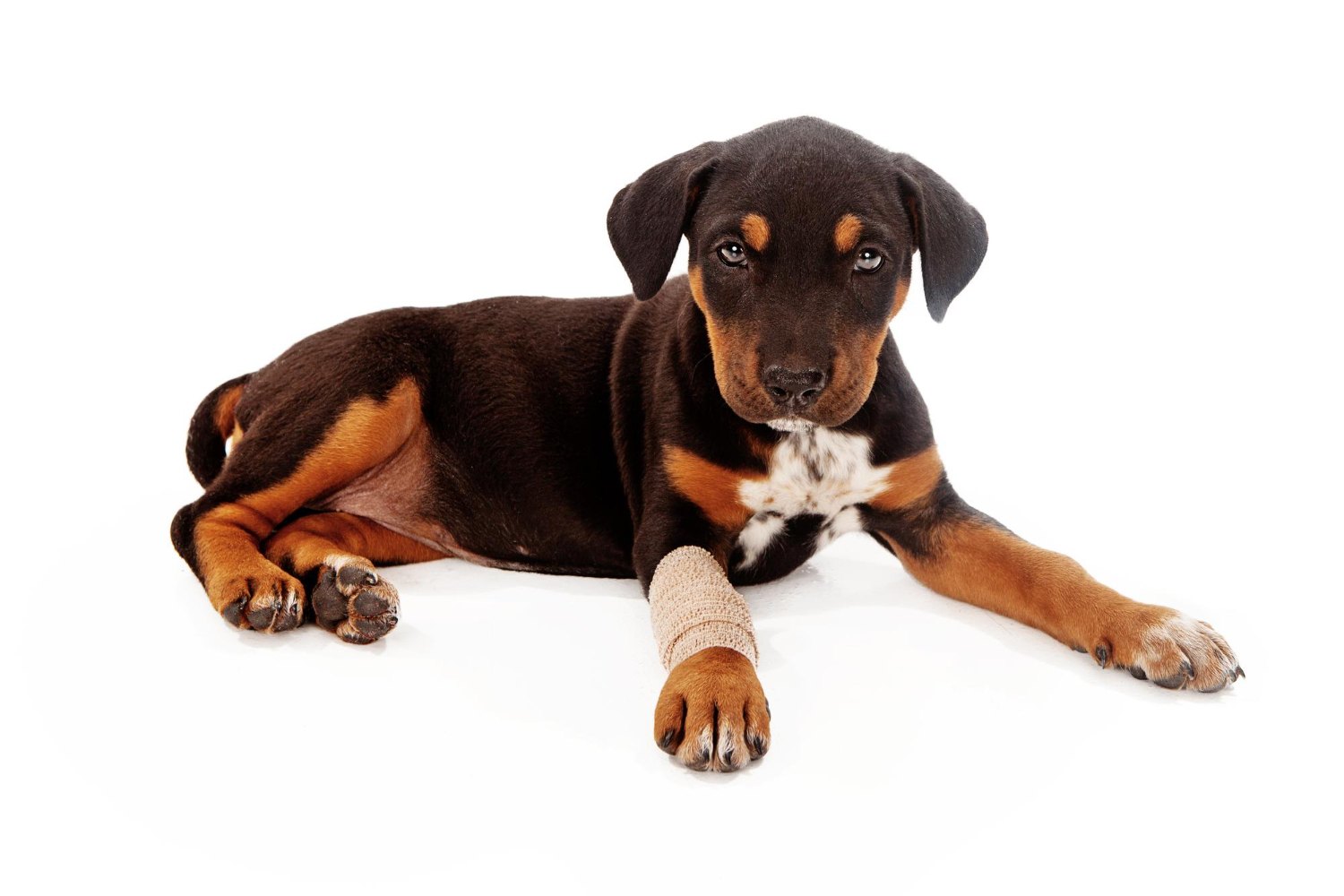
How to Move an Injured Dog Safely
Moving a hurt dog badly can turn a survivable injury into a permanent one, and it is the moment most owners get bitten. The sequence below applies to trauma, collapse, and any dog who cannot walk.
- Check the scene. Traffic, a live wire, a second animal, deep water. You cannot help a dog if you become the second casualty.
- Talk low and approach from the side. Do not loom over the head. Let the dog see you.
- Muzzle if appropriate. Not if the dog is vomiting, choking, or struggling to breathe, and not on a flat-faced dog; see the next section.
- Small dogs: slide a towel under the body, lift with the towel supporting the whole dog, and place him in a carrier or box lined with a blanket.
- Medium and large dogs: lay a blanket flat beside the dog, roll him gently onto it as one unit, keeping the spine straight, and lift with one person at each end. A rigid surface (board, door, flattened box, a car cargo shelf) is better if a spinal injury is possible: keep him flat and strap or hold him so he cannot slide.
- In the car: a crate for a dog who can be crated, or a flat surface in the back with a passenger steadying him. Never the driver’s lap. Keep him warm with a blanket; injured dogs get cold fast.
- Call ahead once you are moving so the hospital can meet you at the door with a gurney.
If you are alone with a large dog you cannot lift, do not injure your back trying. Call the emergency hospital and ask whether they can advise or whether a neighbor, a friend, or an animal-control officer can help you load him. Some hospitals will send staff to the parking lot with a stretcher; none can come to your house.
How to Muzzle Safely, and When Not To
A muzzle protects you, protects the dog from the consequences of biting you, and lets you do the rest of the first aid. A dog in pain does not decide to bite. It happens as a reflex when a hand touches the wrong spot.
When not to muzzle
- A dog who is vomiting or may vomit (poisoning, bloat, near-drowning).
- A dog who is choking, coughing, or having any trouble breathing.
- A flat-faced dog, who cannot pant well through a strip of gauze. Use a towel wrapped loosely around the neck and head instead, leaving the nose and mouth free, and control the head with the towel.
- A dog with a facial or jaw injury.
- Any dog in heatstroke, who needs to pant to cool.
An improvised muzzle in five steps
- Take a roll of gauze, a soft leash, a necktie, or a strip of cloth about three feet long.
- Make a loop with a loose half-knot in the middle.
- Slip the loop over the muzzle from the front, positioned about halfway between the nose and the eyes, and tighten it gently on top of the nose.
- Bring the ends down and cross them under the jaw, then bring them back behind the ears and tie a bow, not a knot, so you can release it fast.
- Check that the dog can breathe through the nose comfortably and remove it the moment he vomits, struggles for air, or you have finished handling him.
Practice this once on a calm day with a willing dog and a lot of treats. It is a thirty-second skill that most people fumble the first time they try it under pressure. Better still, teach your dog to accept a basket muzzle in advance. A dog who has learned the muzzle means cheese will accept it at the worst moment of his life, and a basket muzzle lets him pant, drink, and take treats, which a gauze wrap does not.
What to Tell the Emergency Hospital on the Phone
Emergency hospitals triage by phone constantly. A clear thirty-second call gets you better advice and a faster door. Say these things, in roughly this order:
- What happened and when. “Hit by a car ten minutes ago.” “Ate a bottle of ibuprofen, maybe twenty tablets, about an hour ago.” “Seizing for six minutes and counting.”
- Who the dog is. Size or weight, approximate age, breed or type, and any known condition (heart disease, diabetes, epilepsy) or current medication.
- What you see right now. Breathing normally or not, gum color, conscious or not, bleeding controlled or not, able to stand or not.
- What you have done. “Pressure bandage on the left front leg.” “Cooling with a hose since 3:10.” “Poison control case number is…”
- Your ETA and whether you need someone to meet you outside because you cannot carry the dog.
Then ask two questions: “Should I come to you, or is there somewhere closer that can handle this?” and “Is there anything I should do on the way?” Write down or remember the name of the person you spoke to. If you are alone and driving, keep the call on speakerphone and let them talk you in.
After the ER: Follow-Up, Records, and Restocking
The emergency visit ends with a discharge sheet, and the next three days are where a good outcome is secured or lost. Before you leave the hospital, make sure you understand four things: what was done, what medications go home and exactly how to give them, what signs should bring you back, and when the recheck is. Ask them to write it down. You will not remember it at 11 p.m.
In the first 72 hours
- Give medications as prescribed, on schedule, for the full course. Set phone alarms.
- Follow activity restrictions even if the dog seems bored. Stitches, fractures, and heat-damaged guts need rest.
- Watch the specific signs the ER listed and call the ER, not the internet, if you see them.
- Keep the e-collar on if one was sent home. Licking undoes surgery.
- Note appetite, water intake, urination, stool, and energy once a day in the kit notebook.
Records
Ask the ER to send the full record, including imaging and lab results, to your primary veterinarian, and ask for a copy for yourself. Emergency hospitals and primary clinics often do not share systems. Schedule the recheck with your primary vet before you forget. Add the incident, the date, and any new medication to the plan card in the kit, because the next emergency will ask about this one.
Restock and debrief
Replace what you used from the dog first aid kit within the week, while it is fresh in your mind. Then, when the adrenaline has faded, walk through what happened with everyone in the household. What did you not have? What took too long? Which phone number was wrong? Fix those things now. The emergency you just handled is the most detailed dog first aid training you will ever get, and it is a waste if the plan does not change afterward.
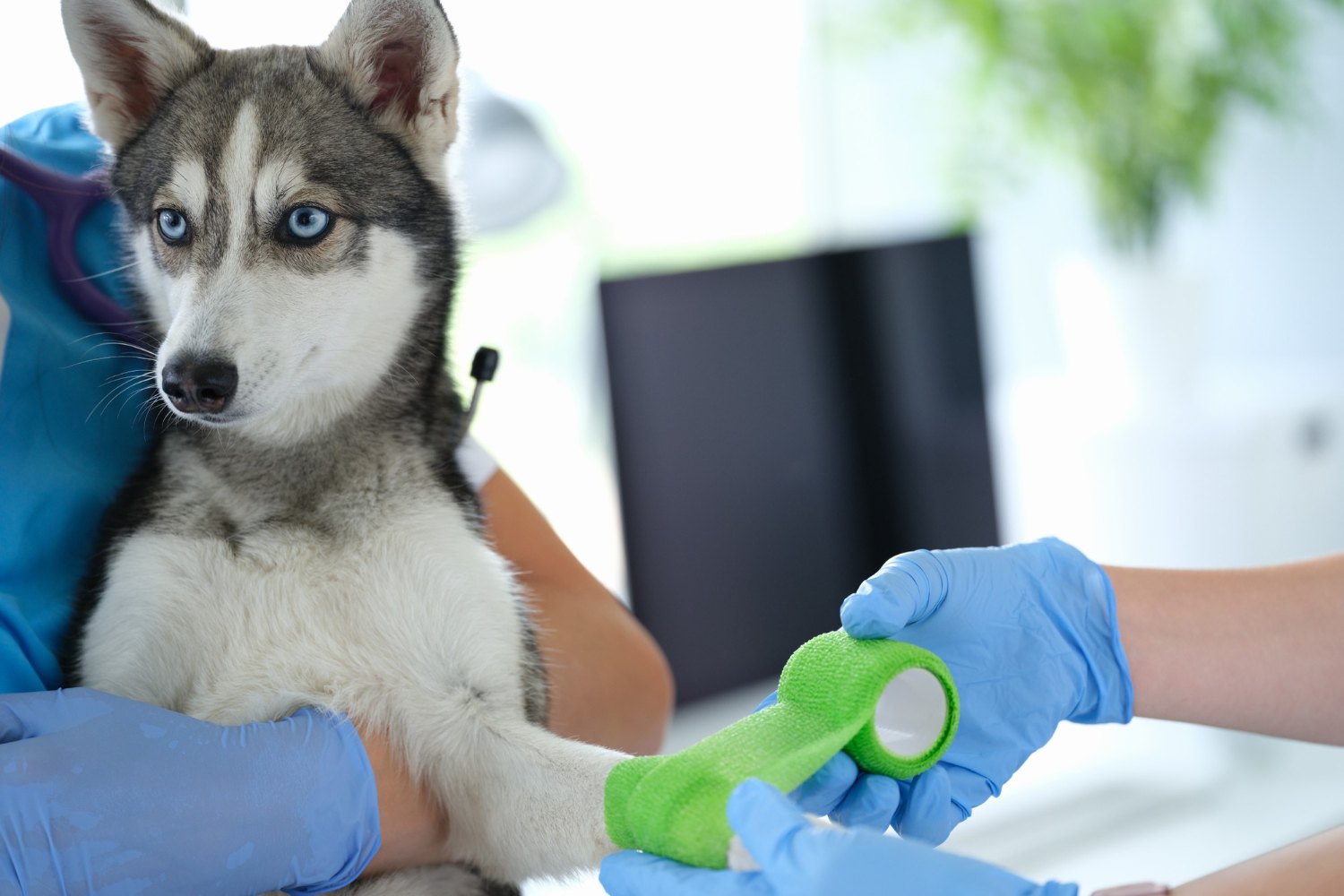
Common Dog First Aid Mistakes
Waiting to see if it gets better
This is the mistake behind most bad outcomes. Bloat, heatstroke, poisoning, and internal bleeding all have a window, and “let’s see how he is in an hour” spends it. If a sign is on the go-now list, the decision is made. The dog’s improvement on the way is a bonus, not a reason to turn around.
Driving without calling ahead
The hospital cannot prepare for what it does not know is coming. A call from the road gets a gurney to the door, oxygen ready, and sometimes a surgeon paged before you park. It also catches the case where the nearest ER is full and diverting.
Inducing vomiting on your own
Hydrogen peroxide is not harmless, and vomiting is the wrong move for a long list of poisons. Poison control decides. Every time.
Reaching for human medication
Ibuprofen, naproxen, and acetaminophen poison dogs. Aspirin has real risks. Antihistamines have a dose range and a list of dogs who should not get them. If a medication decision seems needed, that is a phone call, not a cabinet search.
Ice on a heatstroke dog
Cool water and moving air. Not ice, not an ice bath. And not stopping the trip because the dog perked up.
Hands in a seizing dog’s mouth
There is nothing to retrieve in there. Dogs do not swallow their tongues. What happens instead is a deep bite to the hand and a second patient.
Hugging, restraining, or scooping up an injured dog
Comforting a hurt dog by holding him tight is instinct. It is also how ribs get pushed into lungs and how owners get bitten in the face. Muzzle, minimal handling, flat transport.
Pulling out the thing that is stuck in him
Sticks, glass, and metal stay where they are until a veterinarian removes them under control. They may be plugging a vessel.
Applying a tourniquet because it looked right on television
Direct pressure stops most external bleeding. Tourniquets are for trained rescuers and life-or-limb situations, and even then the vet needs to know the exact time it went on.
A dog first aid kit with no phone numbers in it
Gauze is easy to find at 2 a.m. The address of the open ER is not. The card is the most important item in the kit.
Skipping the vet because the dog “seems fine now”
Near-drowning, electrical shock, heatstroke, car strikes, and near-chokes all have a delayed second act. The exam is the point.
Frequently Asked Questions About Dog First Aid
Can I really do CPR on my dog, and does it work?
Yes, you can, and the RECOVER guidelines exist so that veterinarians and trained owners do it the same way: 100 to 120 compressions a minute, one-third to one-half chest depth, 30 compressions to 2 mouth-to-snout breaths, in two-minute cycles. Survival after cardiac arrest is low in dogs, especially outside a hospital, and no guideline pretends otherwise. What CPR does is give a dog whose heart stopped from a reversible cause, such as drowning or choking, a chance to reach the hospital alive. A hands-on pet CPR class makes it far more likely you will do it correctly.
Should I keep hydrogen peroxide to make my dog vomit?
You can keep a sealed bottle of 3% hydrogen peroxide in the kit, but only use it if a poison control veterinarian or your vet tells you to for that specific exposure and gives you the amount for your dog. For many poisons, vomiting makes things worse. For some dogs, especially flat-faced breeds and any dog who is drowsy, it risks inhaling vomit. The bottle is there so you can act on instructions, not so you can decide.
How do I know if my dog’s bleeding is an emergency?
Apply firm pressure and do not peek. If the bleeding has not slowed substantially after about five minutes of steady pressure, if it soaks through several layers, if it is spurting, or if it comes from the nose, mouth, rectum, or urine, go now. Pale gums or weakness with any bleeding means go now. A torn nail or a small cut that stops with pressure is a call-today situation to have it cleaned and checked.
What do I do if my dog is choking and I am alone?
Open the mouth, look with a light, and remove the object only if you can see it and grip it. If you cannot, get the dog in the car and drive to the nearest hospital, calling on speakerphone. If the dog is not moving any air at all and collapses, an abdominal thrust is a last-resort option that some veterinary schools teach, but it carries risk of internal injury, and a collapsed dog who stops breathing needs CPR. Have the dog examined afterward even if the object comes out.
How long can a seizure last before it is an emergency?
Most sources, including the emergency hospitals that will treat your dog, use about five minutes as the line, and also treat two or more seizures in a short period without full recovery in between as an emergency. Time the seizure from the moment it starts. Any first seizure, even a short one, deserves a same-day call, because the cause matters as much as the length.
Can I give my dog an antihistamine for a bee sting?
Not without your veterinarian’s direction. Most stings need only a cold pack and observation. Whether an antihistamine is appropriate, which one, and how much depends on your dog’s weight, health, and other medications, and the serious reactions that cause facial swelling, hives, vomiting, or breathing changes need hospital treatment, not a tablet. Call, describe what you see, and follow what your vet says.
Is a dog first aid class worth taking?
Yes, if you can. The American Red Cross offers a short online cat and dog first aid course covering vital signs, breathing and cardiac emergencies, wounds, bleeding, and seizures, and its Pet First Aid app is a reasonable phone reference. In-person classes with a manikin, offered by some training centers and emergency hospitals, are better for CPR and bandaging. Even one afternoon changes how you behave when it counts.
What temperature counts as heatstroke in a dog?
A normal dog runs roughly 101 to 102.5°F (38.3 to 39.2°C). VCA Animal Hospitals describes body temperatures above about 106°F (41°C) from heat exposure as heatstroke, with organ damage risk climbing above that. You do not need a thermometer to act; heavy panting that does not ease, red or pale gums, staggering, or collapse after heat is enough to start cooling and start driving. If you do measure, stop active cooling around 103°F (39.4°C).
Do I need to muzzle a dog who has never bitten anyone?
If he is in pain and you need to handle a painful area, yes, unless he is vomiting, choking, struggling to breathe, or flat-faced. Biting during injury is a reflex, not a character flaw, and it happens in the sweetest dogs. A muzzle protects both of you and lets the first aid happen. Training him to accept a basket muzzle now, with treats, is the kindest version.
What if I cannot afford the emergency hospital?
Go anyway and say so at the desk. Ask for an estimate before treatment, ask what the stabilization-only option costs, and ask which financing programs they accept. Many hospitals can work through a plan in stages. Some regions have nonprofit assistance funds, and some veterinary schools run lower-cost emergency services. Deciding not to go because of an unknown bill is the one choice that closes every other door. Build the money plan into the emergency card so the question is answered before the night it matters.
Where This Leaves You
Dog first aid is a small set of skills that matter enormously for a few minutes and not at all for years at a time. That is exactly why it is worth setting up now. Print the plan card. Build the kit. Drive to the emergency hospital once in daylight. Teach your dog that a muzzle means cheese. Take a class if you can, and read the CPR and choking sections twice.
Then, if the night comes, do the two things first: call, and get the dog toward the car. Everything else on this page fits inside that.
Sources
- RECOVER Initiative. 2024 Veterinary CPR Guidelines (Reassessment Campaign on Veterinary Resuscitation; Basic Life Support domain paper published in the Journal of Veterinary Emergency and Critical Care, 2024).
- Burkitt-Creedon JM, et al. 2024 RECOVER Guidelines: Updated treatment recommendations for CPR in dogs and cats. Journal of Veterinary Emergency and Critical Care, 2024.
- American Veterinary Medical Association. Revised CPR guidelines in dogs, cats emphasize speed, standard techniques (AVMA News, 2024).
- American Veterinary Medical Association. Emergency care for pets, including First aid tips for pet owners and 13 animal emergencies that should receive immediate veterinary consultation and/or care (accessed September 2026).
- American Red Cross. Cat & Dog First Aid online course and Pet First Aid app (accessed September 2026).
- ASPCA Animal Poison Control Center. Animal Poison Control, (888) 426-4435 (24/7; consultation fee applies; page current as of September 2026).
- Pet Poison Helpline. Pet Poison Helpline, (855) 764-7661 (24/7; consultation fee applies; accessed September 2026).
- Merck Veterinary Manual. Cardiopulmonary Resuscitation of Small Animals (professional edition; accessed September 2026).
- VCA Animal Hospitals. Heat Stroke in Dogs (accessed September 2026).
- Texas A&M School of Veterinary Medicine & Biomedical Sciences. CPR and Heimlich Maneuver on Pets (Pet Talk; accessed September 2026).
- Cornell University College of Veterinary Medicine, Riney Canine Health Center. Heat stroke (canine health information; accessed September 2026).
- Today’s Veterinary Nurse. Advancing Veterinary CPR: Key Updates From the 2024 RECOVER Guidelines (2025).
This article is general education for U.S. dog owners. It is not individualized veterinary advice, a diagnosis, or a substitute for an in-person veterinary exam. First aid steps described here are meant for the way to a veterinarian, not instead of one, and none of them can rule out internal injury, poisoning, or organ damage.
Never give human medication, induce vomiting, or dose an antihistamine without direction from a veterinarian or a poison control veterinarian. If your dog is struggling to breathe, has pale or blue gums, has collapsed, is seizing, is bleeding uncontrollably, has bloat signs, has heatstroke, was hit by a car, or may have been poisoned, call the nearest emergency hospital and go now.