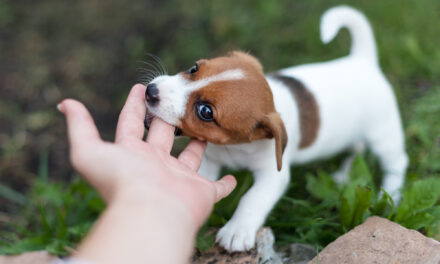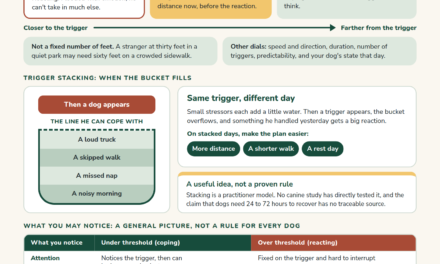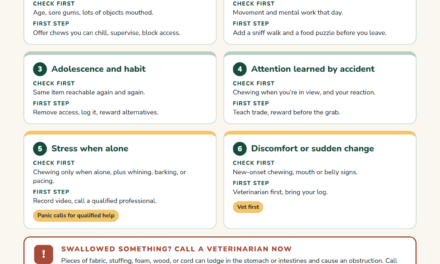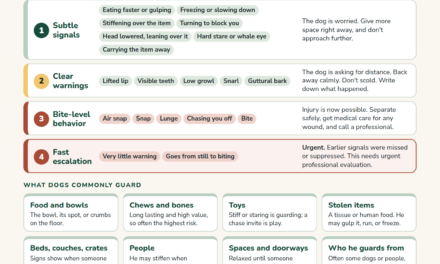
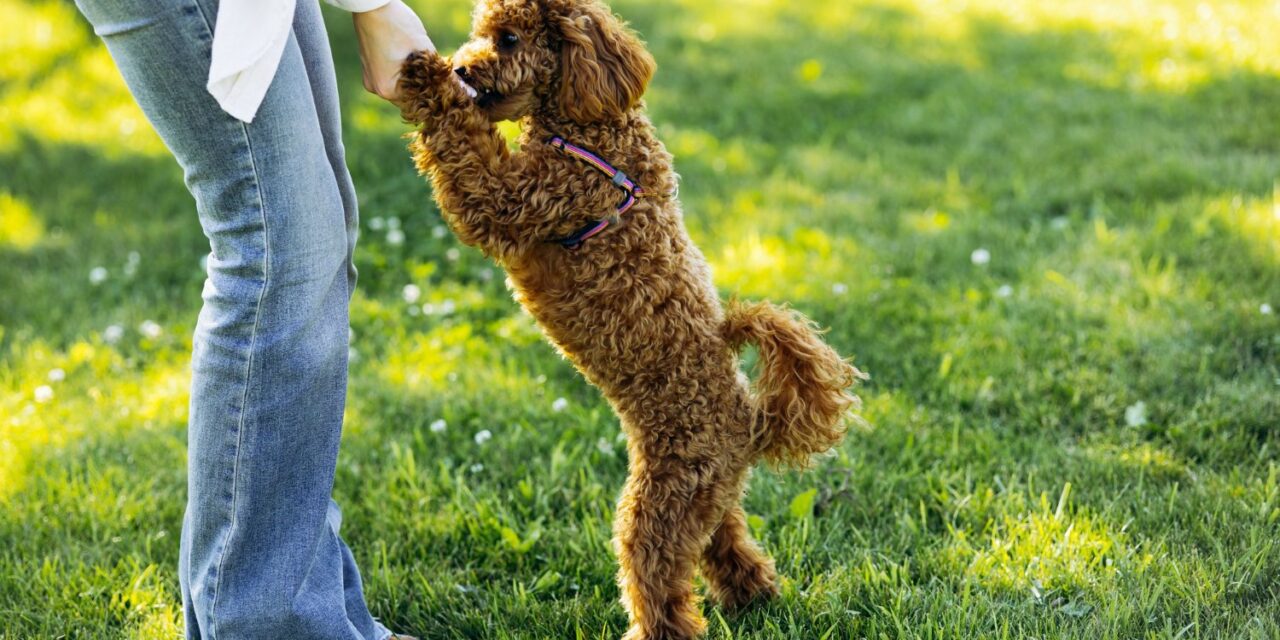
You open the front door and your dog greets your guest like a returning astronaut: full launch, paws on the chest, tongue everywhere. If you’ve searched how to stop a dog from jumping after one too many of those landings, here’s the honest version first. Jumping is a greeting behavior that has been paid for, usually by the very people it annoys. You stop it by preventing the rehearsal, teaching and heavily rewarding something else — four paws on the floor or a sit — and getting every human your dog meets to follow the same simple script.
That’s the whole plan. The rest of this guide is the detail that makes it work on an ordinary Tuesday, with a doorbell, a delivery driver, a visiting grandmother, and a dog who has been practicing this move for two years and is very good at it.
One note on method before anything else. Everything here is reward-based. We won’t suggest kneeing your dog in the chest, stepping on his back toes, popping the leash, or “showing him who’s boss.” Those ideas still circulate, so we’ll explain plainly why they backfire instead of pretending nobody has ever heard them.
What’s in this guide
- How to stop a dog from jumping: the short answer
- Why dogs jump on people: because it works
- Why kneeing, toe-stepping, and leash pops backfire
- Management first: stop the rehearsal before you train
- The core protocol: four on the floor, sit to say hi, or a mat station
- How to reinforce so the lesson sticks
- The turn-away method, done correctly (and why it fails alone)
- The one-sentence guest script
- When the dog jumps on you at the door
- Jumping on kids, seniors, and people who are afraid
- Jumping on strangers on walks
- Big dogs, small dogs, puppies, adolescents, and adults
- Realistic timelines and generalization
- Troubleshooting: five problems you’ll probably hit
- When to call a certified trainer or veterinary behaviorist
- The smallest useful practice plan
- Common mistakes that slow progress
- Frequently asked questions about dogs jumping on people
- Sources
How to Stop a Dog From Jumping: The Short Answer
Dogs jump on people because jumping has worked. It got a hand on the head, a laugh, eye contact, a “hi buddy,” or a shove and a shouted “no!” — which, to a social dog, is still a person paying attention. That’s not a theory we made up. VCA’s veterinary behaviorists describe jumping up as a greeting behavior that persists precisely because it gets rewarded with attention, and the AKC’s training guidance makes the same point in fewer words: dogs repeat what pays.
So the fix has three parts, and you need all three. Most advice on how to stop a dog from jumping covers one of them and quietly skips the other two.
The plan in five lines
- Prevent the rehearsal. A leash, tether, gate, or pen at the door means your dog physically can’t practice jumping on people while you’re teaching the alternative.
- Pick one alternative and define it. “Four paws on the floor” or “sit to say hi.” Not both, not “be calm,” and not a different rule for each family member.
- Pay that alternative heavily and early. Reward the floor before the jump happens, dozens of times a day, in boring situations first.
- Raise the difficulty one notch at a time. Mild excitement, then a familiar person, then a real guest, then strangers on walks — with a clear success criterion before each step up.
- Get every human on the same script. One sentence for guests, one rule for the household, no exceptions for the person who “doesn’t mind.”
Before you go further, describe the behavior in observable terms. Not “he’s rude” or “she’s too excited,” but: “When the door opens, he runs to the guest, puts both front paws on their torso, and stays there until they push him off.” That description tells you where the leash needs to be, which moment to reward, and what the guest has to hear before they step inside. A label like “excited” tells you nothing you can act on. Labels that assign a motive — “he’s trying to be the boss,” “she’s being difficult” — are worse, because they point you toward a standoff instead of a plan.
Why Dogs Jump on People: Because It Works
Understanding why your dog jumps isn’t academic. Each reason points to a slightly different lever, and a dog who jumps out of frustration at the end of a leash needs a different setup than one who jumps because your brother-in-law taught him it’s hilarious.
Greeting at Face Level
Dogs greet each other face to face. VCA’s behavior team notes that jumping up mimics that natural dog-to-dog greeting: your dog is trying to reach the part of you that matters socially, which happens to be about four feet above his nose. Puppies do this to adult dogs, and adult dogs tolerate it in puppies. Nobody told your dog that humans prefer the greeting to happen at knee height.
That’s why the behavior shows up so early and so reliably. It isn’t an invention. It’s a default, and the question is only whether it gets paid or replaced.
Attention That Paid Off — Even “No!”
Here’s the part that surprises most owners. The Merck Veterinary Manual’s chapter on canine behavior problems describes attention-seeking behavior as something owners often reinforce without realizing it, through both positive and negative responses. Push the dog off and you’ve touched him. Yell “off!” and you’ve looked at him and made a noise directed at him. Laugh, grab his paws, wrestle him down — all of it is contact and eye contact from the person he was trying to reach.
The AKC’s guidance says it bluntly: pushing a dog away is simply part of a wrestling game. For a social, excited dog, negative attention still counts. The only thing that doesn’t count as attention is the thing most people find hardest to do, which is nothing.
Excitement, Frustration, and Anxiety
Not every jump is a happy greeting. VCA’s behaviorists point out that some anxious dogs jump to relieve stress, and overstimulated dogs jump because their arousal has nowhere else to go. Watch for the difference. A dog who jumps and bounces and wiggles is usually excited. A dog who jumps while panting, with a tight face, or right after something startled him, may be doing something closer to “I don’t know what to do with myself.”
Frustration is a third flavor. A dog held back by a leash or a gate while a person approaches can build up pressure and release it as a lunge-jump the moment he gets access. If your dog jumps hardest right after being restrained, that’s a clue for the management section below.
A Learned Pattern, Not a Character Flaw
Put those together and you get a behavior that started as a normal greeting, got reinforced hundreds of times by well-meaning humans, and is now a fluent habit that fires the instant a door opens. That is a learning history, not a personality defect. It also means the fix is a learning problem, which is good news: learning problems have known solutions.
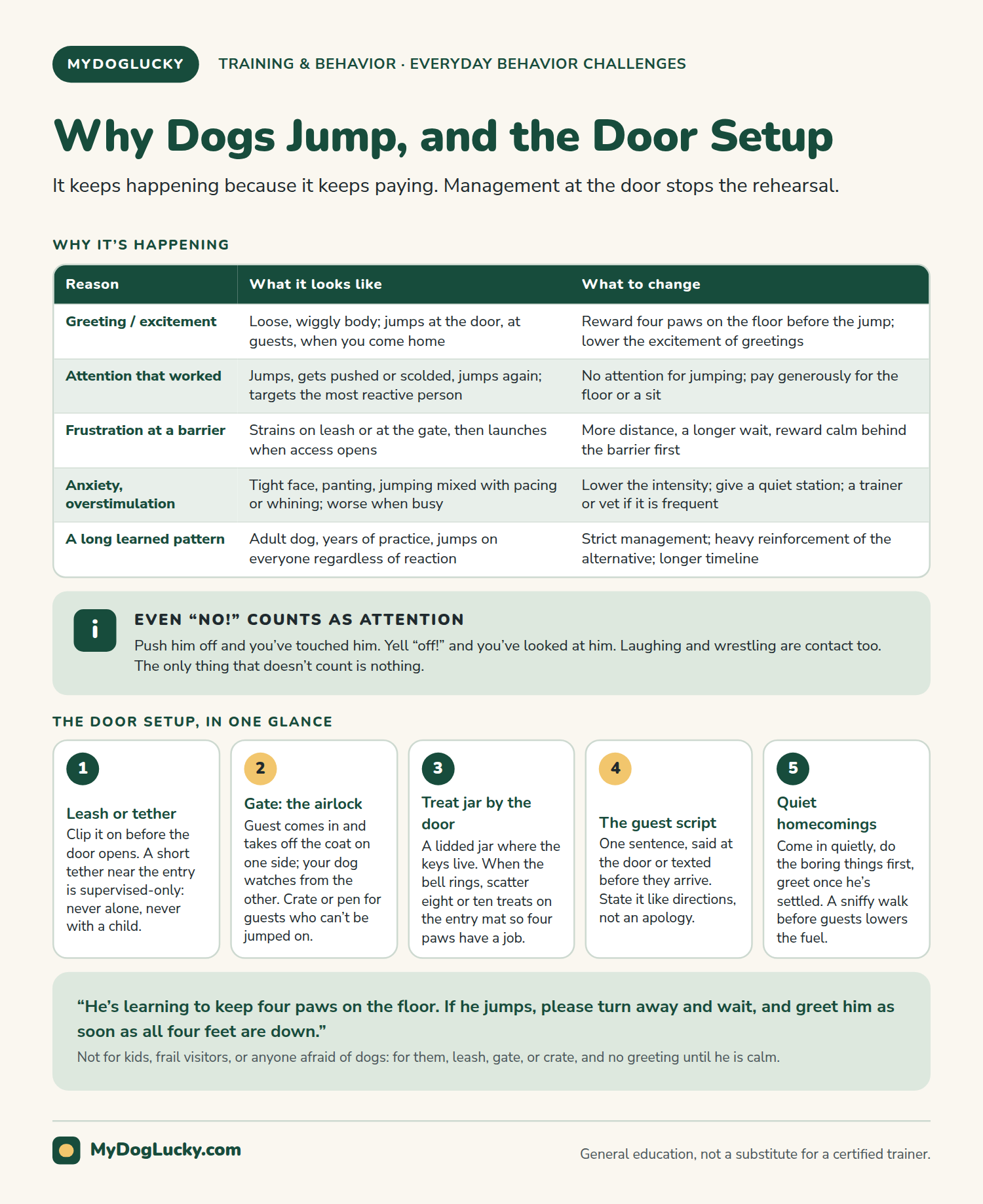
| Why it’s happening | What it looks like | What to change |
|---|---|---|
| Greeting / excitement | Loose, wiggly body; jumps at the door, at guests, when you come home | Reward four paws on the floor before the jump; lower the excitement of every greeting |
| Attention that worked before | Jumps, gets pushed or scolded, jumps again; targets the most reactive person | Remove all attention for jumping; pay attention generously for the floor or a sit |
| Frustration at a barrier | Strains on leash or at the gate, then launches the moment access opens | More distance, a longer wait before access, reward calm behind the barrier first |
| Anxiety or overstimulation | Tight face, panting, jumping mixed with pacing or whining, worse in busy settings | Reduce the intensity of the setup; give a quiet station; talk with a trainer or veterinarian if it’s frequent |
| A long learned pattern | Adult dog, years of practice, jumps on everyone regardless of reaction | Strict management to stop rehearsal; heavy reinforcement of the alternative; longer timeline |
| Reaching something in your hands | Jumps when you carry food, the leash, or a toy | Hold items out of reach without drama; reward the sit that earns the item |
Why Kneeing, Toe-Stepping, and Leash Pops Backfire
Older advice on how to stop a dog from jumping leaned on the idea that the dog needs an unpleasant consequence: a knee to the chest, a step on the back toes, a sharp leash correction, a spray bottle, a shake can. These methods keep circulating because they occasionally look like they work, for a few minutes, with a particular dog. Here’s why they’re a bad bet.
Pushing Is Part of the Game
A knee to the chest is physical contact from the person your dog was trying to reach. For a lot of dogs, especially large, bouncy, socially confident ones, that’s not a punishment. It’s a wrestling move, and they will happily come back for the next round. The AKC’s guidance notes that pushing a dog away often reinforces jumping for exactly this reason. You may feel like you’ve delivered a consequence. Your dog may feel like the game just got interesting.
Corrections Can Teach Fear of Hands and of Greetings
The other outcome is worse. VCA’s behaviorists warn that physical corrections during greetings can cause fear of people and teach the dog to associate discomfort with the greeting itself. Now you have a dog who is conflicted about visitors: still wants to reach them, has also learned that reaching them sometimes hurts. That conflict tends to show up as more frantic behavior, hand-shyness, ducking when someone reaches to pet him, or, in some dogs, defensive growling at the door.
The American Veterinary Society of Animal Behavior’s 2021 position statement on humane dog training reviews this evidence and concludes that reward-based methods should be the standard. Aversive methods carry documented risks of fear, anxiety, and aggression, and damage to the relationship, and there’s no evidence they’re necessary to change behavior. That’s a veterinary behavior organization, not a training philosophy, saying it.
The “Pack Leader” Story Doesn’t Hold Up
Some of the harsher methods come wrapped in a story: the dog jumps to assert himself over you, so you must assert yourself back. That framing has not survived contact with what we know about how dogs learn or how they actually live in groups. A dog jumping on your guest isn’t running for office. He’s doing a greeting that has paid off. Treating it as a status challenge pushes owners toward confrontation, which is the thing most likely to add fear to a problem that started out as excitement.
What a Correction Would Have to Do, and Why It Can’t
For a correction to work cleanly, it would have to happen within about a second of the jump, every single time, from every person, at an intensity high enough to outweigh the huge reward of greeting a human — and without the dog connecting it to the person, the doorway, or your hands. That’s not a realistic set of conditions in a household with kids, guests, and a delivery driver who will never read your plan. Teaching the dog what to do instead has none of those constraints, which is why VCA’s guidance says it’s always better to systematically teach the desired behavior than to try to thwart the unwanted one.
Management First: Stop the Rehearsal Before You Train
The least glamorous part of how to stop a dog from jumping is also the part that decides whether the training works. Every time your dog jumps on a person and gets any reaction at all, the habit gets stronger. You can’t out-train a behavior that’s being rehearsed and rewarded twice a day at the front door. So the first job is to make jumping physically impossible during the weeks you’re building the alternative.
Leash or Tether at the Door
Clip a leash on before you open the door. That’s it, that’s the whole trick, and it prevents about half the rehearsals in a typical household. With a leash in your hand, your dog can’t reach the guest until you decide he can. If it’s easier, mount a short tether to a sturdy anchor a few feet from the entry — far enough that the door can open and a person can step in without being in reach.
Tethers are a supervised-only tool. Use one when you’re right there and can unclip in seconds. Never leave a dog tethered alone or with a child.
Gates, Pens, and the Airlock Entry
A baby gate across the hallway turns your entry into an airlock. The guest comes in, sets down their bag, and takes off their coat on one side of the gate while your dog watches from the other. Nobody gets jumped on, nobody has to remember a script under pressure, and your dog gets a minute for the initial excitement to drop before anyone greets him. Many owners find that the first sixty seconds are the problem; a gate buys you exactly those sixty seconds.
For the doorbell moment itself, a crate or exercise pen in a nearby room works the same way. Your dog goes in with something to chew, the guest comes in, and the greeting happens later, on your schedule, with the dog on a leash. This is especially useful with guests who can’t be jumped on at all — a grandparent, a toddler, a friend who is genuinely afraid of dogs.
The Treat Jar by the Door and the Scatter
Put a lidded jar of small, dry treats by the door where you keep your keys. You’ll use it constantly once the training starts, and a treat you have to go find in the kitchen arrives too late to teach anything. The AKC’s guidance suggests tossing treats on the ground before guests arrive so all four paws are already busy when the door opens. A scatter of eight or ten treats across the entry mat gives your dog a job at nose level for the fifteen seconds that used to be the launch window.
Exercise Before Guests, and Low-Key Greetings
A dog who has just had a walk with real sniffing time and a short training game arrives at the door with less fuel. That won’t fix jumping on its own, but it lowers the starting arousal, and everything below is easier at a lower starting point. The other lever is you. If your homecomings involve high voices and a wrestling match, your dog learns that doorways mean explosions. Come in quietly, do the boring things first, and greet him once he’s settled. It feels a little cold for a day or two. It pays off for years.
The door setup, in one glance
- Leash on a hook by the door, clipped on before it opens.
- Baby gate or pen for guests who can’t be jumped on, and for the first minute with everyone else.
- Treat jar within arm’s reach of the door; a scatter on the mat when the bell rings.
- A one-sentence script you say to guests before they step in (below).
- Quiet homecomings from every household member, including the enthusiastic one.
The Core Protocol: Four on the Floor, Sit to Say Hi, or a Mat Station
With management in place, you can teach the thing you actually want. This is the center of how to stop a dog from jumping, and it works the same way whether your dog is a nine-pound terrier or a ninety-pound retriever mix: you pay a specific, observable alternative so heavily and so consistently that it becomes the default at the door.
Pick One Standard and Define It in Observable Terms
You have three good options, and you should pick one for the first several weeks.
Four on the floor. The criterion is simple: all four paws touching the ground while a person is present. Your dog can stand, wiggle, wag, and walk in circles. He just can’t have paws in the air or on a person. This is the easiest standard for most dogs because it doesn’t require a trained position, and it’s the one VCA’s and the AKC’s guidance both build around.
Sit to say hi. The criterion is a sit, held until the person reaches the dog. This works well for dogs who already have a strong sit, and it gives excitable dogs a clear “thing to do” instead of a “thing not to do.” The tradeoff is that a sit is harder to hold at high excitement, so failures are more frequent early on.
A mat station. The criterion is: on the mat, lying down, until released. This is the most work to build and the most useful once it exists, because it handles the doorbell, delivery drivers, and the dog who needs distance from the door. It suits households with a lot of foot traffic.
Whichever you choose, the rule for the humans is the same. The dog gets attention only when the criterion is met. Not “mostly met.” Met.
Step 1: Pay the Floor When Nothing Is Happening
Start in the most boring situation you can find: your living room, no guests, your dog mildly interested in you. Every time he’s standing or sitting with four paws down and looking at you, mark it with a word (“yes”) and hand him a treat at chest height — his chest, not yours. Deliver the treat low, so the reward itself pulls his head down and his weight onto his front feet. Do ten to twenty of these in a session, two or three sessions a day.
Success criterion for step 1: your dog offers four-on-the-floor (or a sit) on his own when you walk up to him, without being asked, in at least nine out of ten quiet approaches. Until you’re there, don’t add anything.
Step 2: Add Mild Excitement
Now make yourself slightly more interesting. Walk toward him a little faster. Use a higher voice. Clap once. Pick up his leash. The instant four paws stay down through the small burst of excitement, mark and reward low. If he jumps, don’t react; just stand still, wait for the paws to hit the floor, mark, and reward. Then dial the excitement back a notch, because you went up too fast.
Success criterion for step 2: four paws stay down through your own mild excitement in nine out of ten repetitions, in two or three different rooms.
Step 3: Add a Person
Bring in a household member or a patient friend, with your dog on a leash. The helper walks up calmly. You reward the floor as they approach, every step or two at first. If your dog stays down, the helper greets him with a low, calm hand on the chest while you keep paying. If he jumps, the helper backs up out of range, your dog’s paws come down, and you start the approach again from a bit farther away.
The AKC’s version of this uses the tether: the helper approaches only while the dog sits, and if the dog stands up, the helper turns and walks back to their starting point. Either way, the person is the reward, and the person arrives only for the criterion.
Success criterion for step 3: a familiar person can walk up, greet, and pet your dog with all four paws down in nine out of ten trials, on two different days.
Step 4: Add Real Guests
Real guests are a different level, because they arrive with coats, bags, a doorbell, and their own opinions about dog greetings. Keep the leash on, give the guest the one-sentence script (below), scatter treats on the mat, and let the guest come in through the gate airlock. Greet only after the first wave of excitement has passed. Early on, choose your guests: a friend who will follow the script is worth ten relatives who won’t.
Success criterion for step 4: three consecutive guest arrivals with no paws on the guest, with the leash still on. Then three more with the leash dragging. Then, and only then, try one without it.
Step 5: Add Strangers on Walks
The last step generalizes the skill to the outside world, where you have the least control. This gets its own section below, because leash handling and distance matter more than reinforcement rate out there.
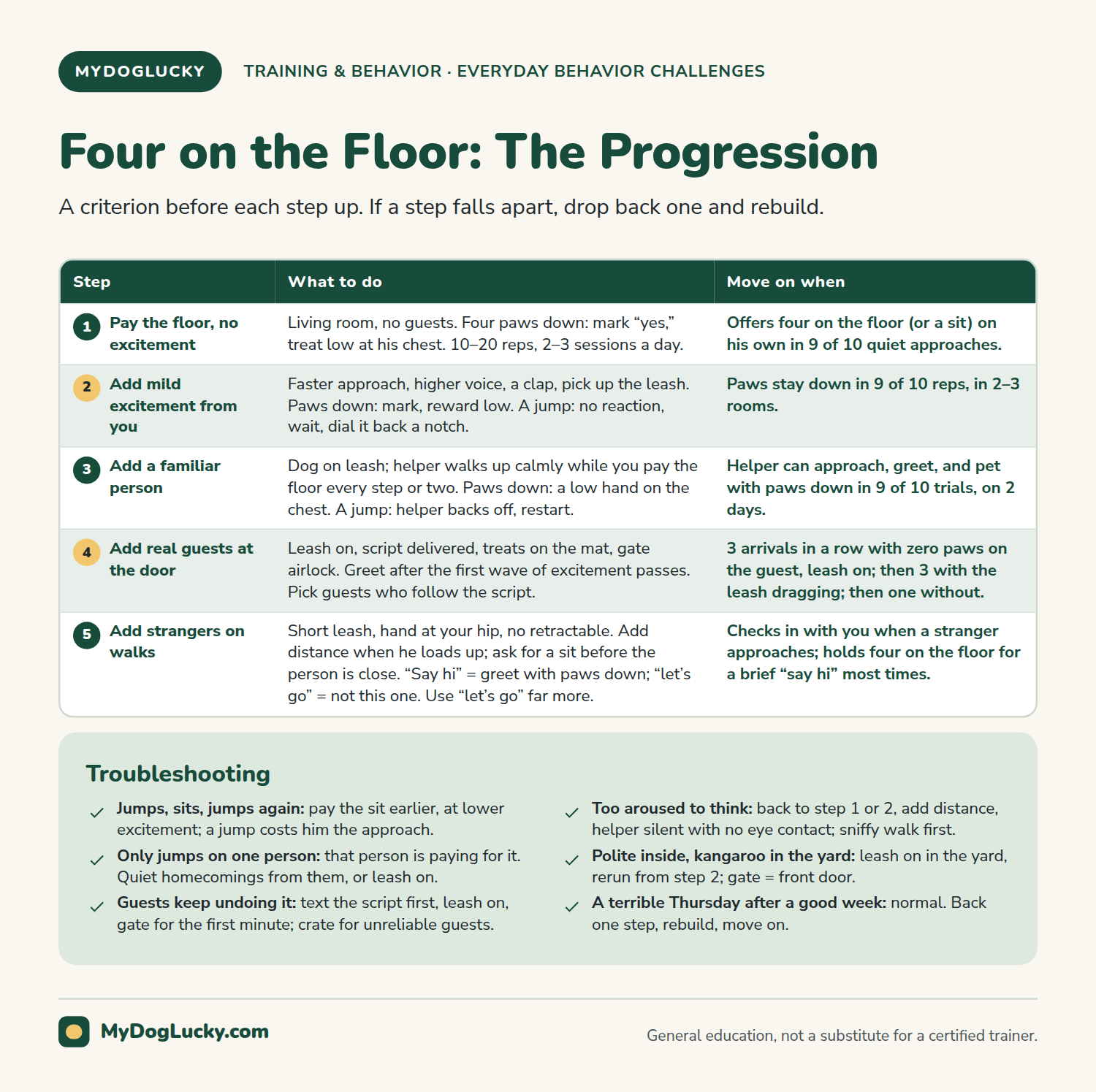
| Progression step | Success criterion before moving on | Common failure |
|---|---|---|
| 1. Reinforce the floor, no excitement | Dog offers four paws down (or a sit) on his own in 9 of 10 quiet approaches | Treats delivered high, which lifts the front end; sessions too long and the dog checks out |
| 2. Add mild excitement from you | Paws stay down through a faster approach, a clap, a high voice, in 9 of 10 reps across 2–3 rooms | Excitement raised in one big jump instead of small steps; owner reacts to the jump |
| 3. Add a familiar person | Helper can approach, greet, and pet with all four paws down in 9 of 10 trials, on 2 days | Helper greets before the paws are down; helper approaches too fast or bends over the dog |
| 4. Add real guests at the door | 3 arrivals in a row with zero paws on the guest, leash on; then 3 with leash dragging | No script given; guest says “oh I don’t mind”; greeting happens in the first 30 seconds |
| 5. Add strangers on walks | Dog checks in with you when a stranger approaches, and holds four on the floor for a brief “say hi” in most encounters | Owner lets every stranger greet; leash too long; no “let’s go” alternative when the person can’t be greeted |
Sit to Say Hi: When a Sit Fits Better
If your dog already sits reliably and tends to bounce in place rather than launch, “sit to say hi” can be cleaner than four on the floor. The protocol is identical; the criterion is just narrower. Cue the sit as the person approaches, or better, wait for it to be offered. Pay the sit as the person gets closer. If the sit breaks, the person pauses or steps back, and you start again. Over a few weeks the dog learns that a sit makes people come closer and a stand makes them stop, which is a lesson he can carry to strangers on the sidewalk.
The Mat Station: For the Doorbell Itself
A mat station is a separate skill and worth building if the doorbell is the hardest moment in your house. Teach “go to your mat” in calm sessions first: reward your dog for stepping onto a specific mat, then for lying down on it, then for staying while you walk to the door and back. Once he can hold the mat while you open and close the door with nobody there, add a knock, then a person. The mat gives the dog a job during the exact seconds that used to be chaos, and it keeps him a few feet from the entry, which lowers the jump risk to zero while it holds.
How to Reinforce So the Lesson Sticks
“Use positive reinforcement” is not an instruction. It’s a category. The details below are what separate a dog who learns four on the floor in three weeks from one who is still launching at guests in month four.
Timing and a Marker Word
Your dog can only connect a reward to what he was doing in the second or so before it arrived. A treat that shows up five seconds after the paws hit the floor is paying whatever happened in those five seconds, which might be a jump. So use a marker: a short, consistent word like “yes” (or a clicker, if you like them) that you say at the exact instant the criterion is met. The marker buys you a couple of seconds to get the treat out. Say it when the fourth paw touches down, not when you’ve finished fumbling for the jar.
Rate: Pay Often Early, Then Thin Out
Early on, the rate of reinforcement should feel almost silly. A treat every two or three seconds while a person approaches is not too much for a dog who has spent two years being paid for jumping. You’re competing with a very well-funded habit. As the floor becomes the default, stretch the gaps: every five seconds, then every ten, then a treat at the start and end of a greeting, then praise and petting most of the time with a treat now and then. The AKC’s guidance describes this same fade-out: frequent treats to establish the behavior, tapering as it holds.
If you thin out too fast and the jumping comes back, that’s not a failure. It’s information. Go back to the last rate that worked and stay there longer.
Calm Delivery, Treats vs. Praise
How you deliver the reward matters almost as much as when. Deliver treats low and slowly, at the dog’s chest height. Keep your voice quiet. A dog who gets a squealed “GOOD BOY!” and a two-handed face rub for keeping his feet down has just been paid with the exact kind of excitement that triggers jumping. Praise is a fine reward for a calm dog once the skill exists. For the first weeks at the door, food is more precise, more portable, and less likely to re-launch him. Petting can be part of the reward too, but do it on the chest or side, not over the head, and stop the moment a paw lifts.
The Turn-Away Method, Done Correctly (and Why It Fails Alone)
You’ve probably heard this one: when the dog jumps, turn your back, cross your arms, and wait. It’s real, it’s humane, and it’s incomplete. Here is how to do it well and where it breaks down.
How to Do It
The instant paws leave the floor, go boring. Turn your body sideways or away, take your hands up and in, say nothing, and don’t look at him. The moment all four paws are back on the ground, mark, turn back, and reward low. The dog learns a clean contrast: jumping makes the person disappear, four on the floor makes the person come back. The key is that second half. Turning away only removes the reward for jumping. Turning back and paying the floor is what teaches the replacement.
Why It Fails When Used Alone
Several reasons, and most owners hit at least two of them.
First, a back is still a target. Plenty of dogs will happily jump on the back of a person who has turned away, and now the person turns around to deal with it. Second, “ignore” is a fragile instruction for humans. Most people can’t hold it for the eight seconds an excited dog needs. They glance down, say “no,” or laugh, and every one of those pays the jump.
Third, the method only works after the jump has happened, which means the dog got a rehearsal. Fourth, with a very aroused dog, standing still and silent doesn’t lower the excitement enough for him to offer anything else. He cycles through jump, land, jump, land, and nobody learns much.
Used inside the full plan — leash on, floor already paid heavily in easier settings, guest prepped — the turn-away is a fine backup for the moment something slips. Used as the whole plan, it produces a lot of families standing in their entryway with their arms crossed, wondering why this isn’t working.
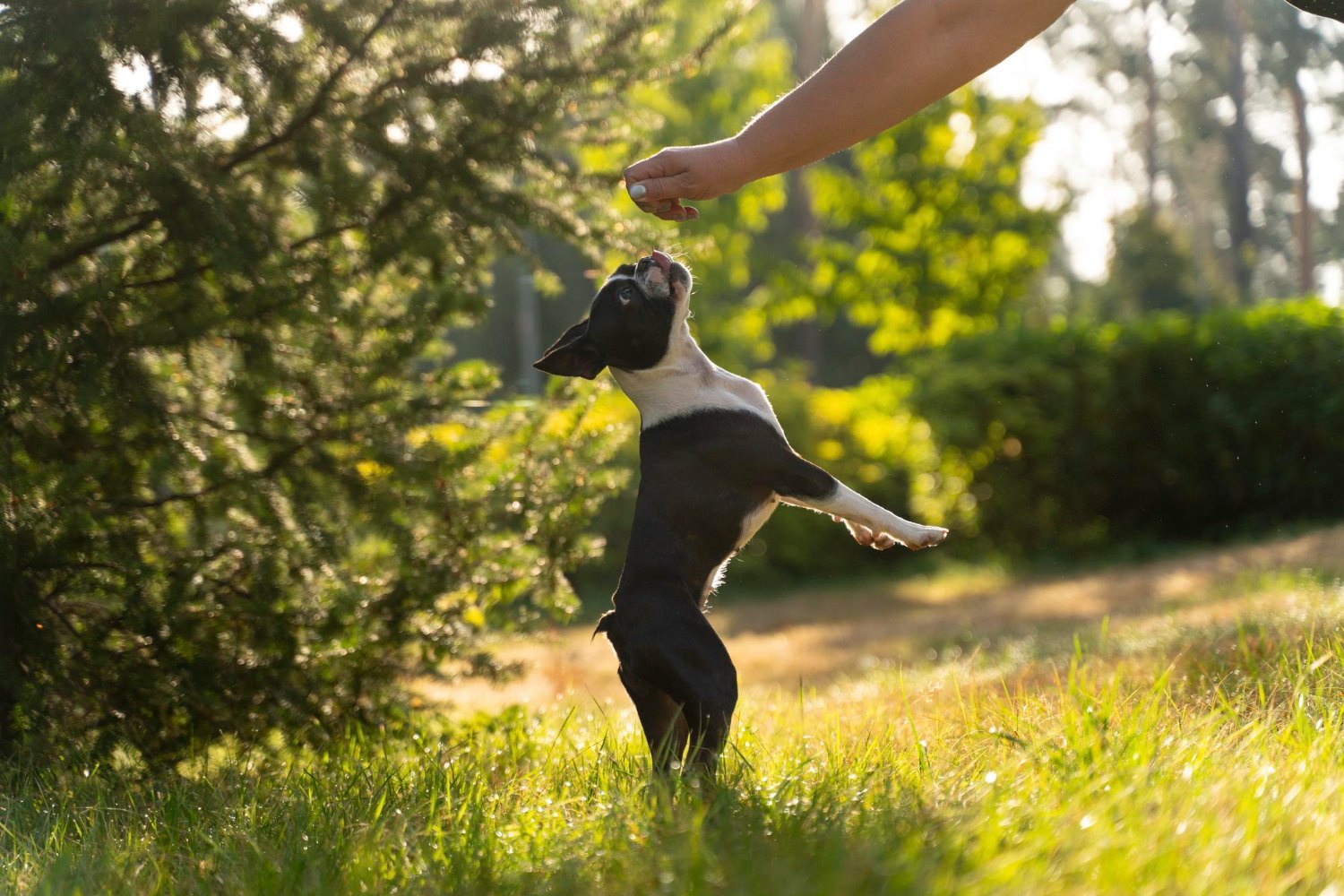
The One-Sentence Guest Script
The guest script is the part of how to stop a dog from jumping that most families skip, and it’s the part that fails most often. Your training only works if the person at the door doesn’t undo it in the first thirty seconds. That means telling them what to do before they step inside, not while the dog is already on their coat.
What to Say
Keep it to one sentence and say it at the door, or by text before they arrive:
“He’s learning to keep four paws on the floor — if he jumps, please turn away and wait, and greet him as soon as all four feet are down.”
That’s it. It names the goal, gives them one action if it goes wrong, and tells them the moment they’re allowed to say hello. Most guests are relieved to be told; nobody actually enjoys being jumped on, even the ones who say they don’t mind. Hand them two or three treats from the jar if you want to make it easy for them to pay the floor themselves.
Its Limits
The script assumes a guest who can physically turn away and wait, and a dog who reads that as “the person went away.” It does not work for a child, a frail visitor, someone carrying a baby or a casserole, a guest who is afraid of dogs, or a delivery driver you’ll never see again. For all of those, the answer isn’t a better script. It’s management: leash, gate, or crate, and no greeting until the dog is calm and on a leash in your hand.
It also doesn’t work if you deliver it as an apology. “Sorry, he’s so bad, just ignore him” tells the guest nothing useful. State the plan like a host giving directions to the bathroom.
The Guest Who “Doesn’t Mind”
Everyone has one: the friend or relative who says “oh, I love it, let him jump!” and then proceeds to wrestle him into next week. This person isn’t being difficult; they’re being kind in a way that costs you three weeks of progress. The fix is not to argue. It’s to keep the leash on and manage the greeting yourself. “He can say hi once he’s sitting — I’ll bring him over” moves the decision from the guest to you, which is where it belongs. If they’re going to be in your house regularly, have the real conversation once, in private, and ask them plainly to help. Most will.
When the Dog Jumps on You at the Door
Jumping on the owner at homecoming is its own version of the problem, and it’s the one you can fix fastest, because you control both ends. You know when you’re arriving. You can decide what the first thirty seconds look like every single time. And you’re the person your dog most wants to reach, which makes you the most powerful reward in the building.
The routine most owners find workable: come in quietly. Don’t make eye contact or talk to the dog while paws are in the air. Do something boring — set your bag down, take off your shoes — and the moment four paws are down, mark, crouch to his level, and greet him warmly but with a quiet voice. If he pops back up, stand and go boring again. Within a week or two most dogs figure out that the greeting starts the instant the feet land, and they start landing faster.
Two things make this easier. First, if you can, scatter a few treats on the floor as you walk in, so his nose has a job before his front end has a plan. Second, if your homecoming has been a nightly party for years, expect it to take longer, and expect a few days where the jumping actually gets worse before it drops. That’s a normal, well-documented bump in behavior that used to pay and suddenly doesn’t. Hold the line through it.
A small confession from the editorial side: the one nice coat in the closet has a permanent set of muddy paw prints at exactly chest height. Quiet homecomings are cheaper than dry cleaning.
Jumping on Kids, Seniors, and People Who Are Afraid
The question of how to stop a dog from jumping on kids or on an elderly parent has a different first answer than the rest of this article, and it’s worth being direct about it: the first answer is not training. It’s preventing contact until the training is done.
A jump that’s a nuisance on an adult is a fall risk for a senior and a knockdown for a small child. A frightened guest who flinches and shrieks can also frighten the dog, which is how an excited greeting turns into something more complicated. So for these people, the dog is on a leash in an adult’s hand, behind a gate, or in a crate with a chew — every time, without exception, until the dog can reliably hold four on the floor with ordinary adult guests.
Safety-first rules for high-risk greetings
- No unsupervised contact between a dog who jumps and a child, a frail adult, or anyone who is afraid — not for a moment, not “just while I grab the door.”
- The dog greets on a leash held by an adult, after the initial excitement has passed, and only while all four paws are down.
- Kids don’t run, squeal, or wave their hands near the dog; teach them to stand still like a tree and let the adult bring the dog over.
- Seated greetings work well for seniors and small kids: the person sits, the dog approaches on leash, and petting happens at chest level with no bending over.
- If the dog has knocked anyone down, treat that as a management failure to fix today, not a training goal for next month.
Children can be part of the training later, once the dog is reliable with adults, and only with an adult holding the leash. A school-age child can practice the “stand still, wait for four feet, then pet” sequence with a treat in hand and a parent two feet away. Younger children shouldn’t be asked to manage a dog’s greeting at all; that’s an adult’s job, and it stays an adult’s job even after the dog has learned the skill.
For a guest who is afraid, the kindest thing you can do is not test them. Put the dog away before they arrive, let them settle in, and ask whether they’d like to meet him on leash later or not at all. “Not at all” is a fine answer, and a dog can spend an evening in another room with a stuffed chew without any harm to his social life.
Jumping on Strangers on Walks
Once the skill is solid at home, the sidewalk is where it gets tested. Strangers appear without warning, some of them wave and coo, and your dog has a leash that lets him reach them. Working out how to stop a dog from jumping on strangers is mostly a leash-and-distance problem, with the four-on-the-floor skill layered on top.
Leash Handling and Distance
Keep the leash short enough that your dog can’t reach a passerby without you stepping forward. Hold it with your hand at your hip rather than out in front. A front-clip harness or a standard flat collar with a four- to six-foot leash gives you more control here than a retractable leash, which is almost designed to let a dog reach people.
If your dog starts to load up as someone approaches, add distance: step off the path, put a parked car between you, or turn and walk a few steps the other way. Cornell’s Riney Canine Health Center makes the same point in its guidance on reactive behavior. Distance from the trigger is what makes it possible for a dog to think, and the same rule applies to over-friendly dogs.
Before the person is close, ask for something your dog can do — a sit, a hand touch, eye contact — and pay it. The AKC’s guidance suggests redirecting your dog’s attention with a cue or a toy before a stranger gets close. That’s the walk version of step 2: create a small bit of excitement, pay the floor, and let the stranger pass while the dog is already busy.
“Say Hi” vs. “Let’s Go”
Give your dog two cues for two outcomes. “Say hi” means: this person has agreed to a greeting, you may approach on a loose leash, and the greeting happens only with four paws down. “Let’s go” means: we’re not greeting this one, turn with me, and here’s a treat for coming along. Practice both often, and use “let’s go” far more than “say hi” in the early months. A dog who is only allowed to greet roughly one person in five, and only when sitting, learns that strangers aren’t automatically a greeting opportunity. That single change removes a lot of the sidewalk lunging on its own.
When you do allow a greeting, ask the stranger to wait for the sit, and end it after a few seconds, before the excitement builds. You choose the stranger, too. The person who kneels, opens their arms, and says “come here, buddy!” is a wonderful human and a terrible training partner for a dog who jumps.
Big Dogs, Small Dogs, Puppies, Adolescents, and Adults
The Standard Is the Same; the Risk Is Different
A ten-pound dog with paws on your shin is a minor annoyance. An eighty-pound dog with paws on your grandmother’s shoulders is an injury. The behavior is identical, and the training is identical, but the management has to match the risk. Big-dog owners can’t afford a “we’re working on it” phase where guests get jumped on sometimes. The leash, the gate, and the crate carry more of the load, for longer, and the criteria for moving up a step should be stricter.
Small-dog owners have the opposite trap. Because the jump doesn’t hurt, people pick the dog up, laugh, and pay it, and the dog learns that jumping is the on-switch for being held. That’s fine if you like it. If you don’t, the standard is the same: four on the floor gets the attention, paws on shins get nothing. A small dog who has learned that jumping gets him scooped can be surprisingly persistent about it, so expect the same three-week commitment.
Puppies
Puppies jump because they’ve always greeted at face level and nobody has taught them otherwise. This is the easiest version to fix, because there’s no long history to compete with, and the hardest to stick to, because a jumping puppy is adorable and every visitor wants to encourage it.
If you start paying four on the floor the week your puppy comes home, and you brief every guest, you’ll likely never have the adult version of the problem. Keep sessions short — a minute or two — and keep the excitement low. Puppies also jump more when they’re overtired, so a puppy who’s suddenly launching at everyone after 7 p.m. may need a nap more than a training session.
Adolescents
Somewhere between roughly six months and two years, many dogs who had a nice four-on-the-floor greeting seem to forget it. That’s adolescence: bigger body, more energy, and a brain that’s temporarily worse at self-control. It’s not a sign your training failed. It’s a sign you need to go back to a step or two earlier in the progression, tighten management, and raise the reinforcement rate for a few weeks. Adolescents also generalize poorly, so the skill that’s solid in the kitchen may not exist in the yard yet. Practice in more places.
Adults With a Long History
An adult dog who has jumped on people for years has a habit with a long reinforcement history, and habits like that take longer to replace. Expect months rather than weeks for the skill to hold in every setting, and expect management to be part of the plan for most of that time.
The good news is that adult dogs learn just fine; the belief that an older dog can’t change a greeting habit doesn’t match what trainers see. If you’re wondering how to stop a dog from jumping after five years of practice, the answer is the same plan with more repetitions. What adult dogs need is more repetitions of the new thing and fewer of the old one, which is exactly what the leash-plus-reinforcement plan delivers.
Counter-Surfing Is a Different Problem
A dog who jumps up on the kitchen counter isn’t greeting anyone. He’s foraging, and the reward is whatever he found there last Tuesday. That’s a management-and-environment problem — clear counters, gates, and a legal place to put his paws and nose — not a greeting problem, and the four-on-the-floor plan above won’t fix it on its own. If your dog does both, treat them as two separate projects with two separate setups.
Realistic Timelines and Generalization
Owners asking how to stop a dog from jumping usually want a number, so here’s an honest one: with daily practice and tight management, many dogs offer four on the floor for familiar people inside two to three weeks. Real guests at the door typically take four to eight weeks to become reliable. Strangers on walks take longer, because you control less. An adult dog with years of practice, or a household where the humans are inconsistent, can take several months. None of that is a failure; it’s the difference between learning a behavior and learning it everywhere.
“Everywhere” is the part people underestimate. Dogs don’t automatically transfer a skill from the living room to the porch, from you to your neighbor, or from Tuesday-morning calm to Saturday-night party. Each new setting starts a few steps back. Plan for that by practicing in short bursts in as many places and with as many people as you can: the hallway, the yard, the car, the vet’s waiting room, your friend’s kitchen. VCA’s guidance recommends changing one variable at a time — excitement, environment, or duration — and that rule is what keeps generalization from collapsing into chaos.
You’ll also see a pattern where the dog looks solid for a week and then has a terrible Thursday. That’s normal. Regression after a run of success is part of how learning works, not evidence that the learning was fake. Go back one step, rebuild, and move on.
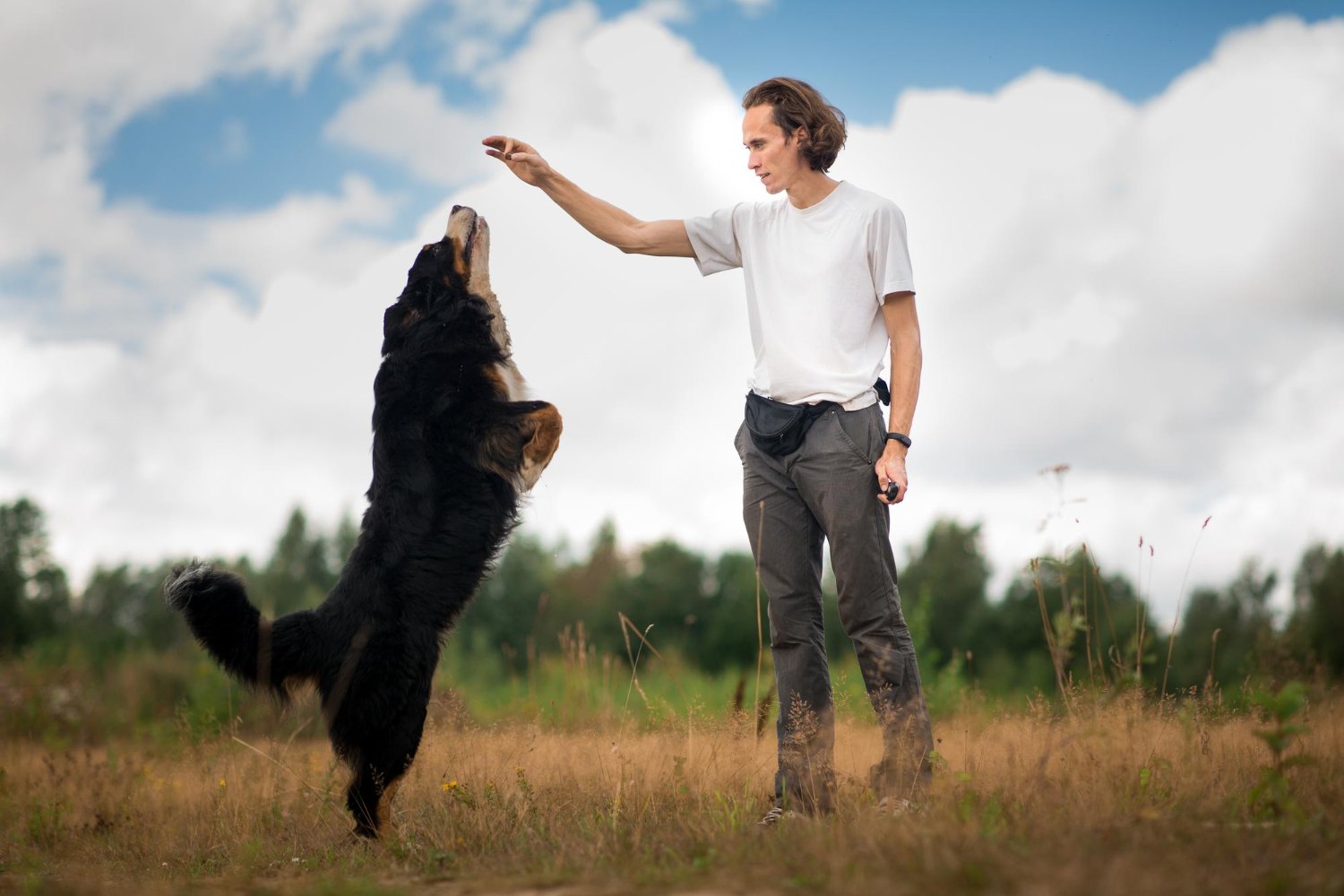
Troubleshooting: Five Problems You’ll Probably Hit
1. He Jumps, Then Sits, Then Jumps Again
Your dog has learned a chain: jump, sit, get paid. From his point of view, the jump is the first step of a behavior that ends in a treat, so he keeps offering it. The fix is to pay the sit before the jump has a chance to happen — earlier, at a lower excitement level, with a higher reinforcement rate — and to make the jump cost him the approach. If a jump happens, the person steps out of reach and the sequence restarts from farther away, so the sit that follows a jump earns less than the sit that came first. Also check your treat delivery: a treat held high invites a bounce.
2. He Only Jumps on Dad
One person in the house is paying for it. Usually not on purpose; usually with a big greeting, a wrestling session, or a laugh. Dogs are excellent at figuring out which human runs which rules, and a dog who is calm with three family members and launches at the fourth is telling you exactly whose homecoming needs to change. The fix is a conversation, not a training session. That person does the quiet homecoming, pays the floor, and holds the line for a couple of weeks. If they’re not willing, manage the dog on a leash for their arrivals and accept a slower result.
3. Guests Keep Undoing the Training
This means the guest script isn’t being delivered before the door opens, or the leash isn’t on. Both are fixable tonight. Text the script before people arrive, keep the leash on the hook, and let the gate handle the first minute. For guests you can’t rely on, don’t test them: crate or pen, greeting later on leash. One reliable friend who will come over twice a week and run the script with you is worth more than any number of unpredictable relatives.
4. He’s Too Aroused to Think
If your dog can’t hold four on the floor for even a second when a person appears, you’ve skipped steps or the setup is too intense. Drop back to step 1 or 2 and rebuild. Add distance: have the helper start farther away, or stand outside the gate. Reduce the excitement of the person: no talking, no eye contact, no bending over. Lower the general arousal before the greeting with a sniffy walk or a scatter feed. And check whether what you’re seeing is excitement or something more like distress: a dog who is panting, whining, and can’t settle even after the greeting may need a quieter setup and a conversation with a trainer.
5. He Jumps in the Yard but Not Inside
Generalization again. The yard has more space, more speed, and no doorway to create structure, so a dog who’s polite in the hallway can turn into a bouncing kangaroo on the lawn. Put a leash on in the yard and run the same progression from step 2. If people enter through a gate, treat the gate exactly like the front door: leash on before it opens, treats scattered, greeting only for the floor. Off-leash yard greetings come last, after everything else holds.
When to Call a Certified Trainer or Veterinary Behaviorist
Most jumping is an excited greeting and responds to the plan in this article over a period of weeks. A few patterns mean it’s time to bring in someone who can watch your dog in person, rather than trying harder on your own.
Get qualified help sooner rather than later if
- The jumping comes with mouthing that’s getting harder, grabbing sleeves or arms, or any contact with teeth that has broken skin.
- The dog is stiff, still, growling, or showing teeth at the door, or positions himself between guests and family members. That’s guarding, not greeting.
- The jumping looks fearful — a tight face, whale eye, tucked tail, or jumping mixed with retreating — rather than bouncy and loose.
- Someone has been knocked down or hurt, especially a child or an older adult.
- Several weeks of consistent, well-managed practice haven’t moved the needle at all.
The ASPCA’s guidance on aggression describes the warning signals that separate an excited greeting from something else: a still, rigid body, a low growl, teeth. If any of those show up at your door, this article’s plan is not the right tool, and a professional evaluation is. The Merck Veterinary Manual is direct on one more point: physical punishment can make an already aggressive dog worse, so the harsh methods are most dangerous in exactly the cases where people are most tempted to try them.
Who to call: a trainer certified through the Certification Council for Professional Dog Trainers (look for CPDT-KA or CPDT-KSA) or the International Association of Animal Behavior Consultants (CDBC) for excited jumping and household coordination. For anything involving fear, guarding, or a bite, ask your veterinarian for a referral to a veterinary behaviorist — a veterinarian board-certified in behavioral medicine — or a Certified Applied Animal Behaviorist. Ask any professional how they handle jumping before you hire them. If the answer involves a knee, a leash pop, or a shock, keep looking.
The Smallest Useful Practice Plan
If the full progression feels like a lot, here’s the version that fits into a normal week without adding a single dedicated training session.
- Tonight: Hang a leash and a treat jar by the door. Tell everyone in the house that homecomings are quiet from now on, and that four paws down is what gets a greeting.
- Days 1–3: Pay four on the floor ten times a day whenever you happen to walk up to your dog. Deliver treats low. No guests yet; if one shows up, leash on and gate closed.
- Days 4–7: Add mild excitement — a faster approach, a high voice, picking up the leash — and pay the floor through it. Practice in three rooms.
- Week 2: Recruit one patient helper for two short sessions. Leash on, helper approaches, floor gets paid, jump makes the helper back up. Text the guest script to anyone who’s coming over.
- Weeks 3–4: Run real guests with the leash on and the script delivered. Three clean arrivals in a row before the leash starts dragging. Start “let’s go” on walks.
- Ongoing: Keep the leash by the door for months. Pay the floor with praise most of the time and a treat sometimes. When a new setting breaks the skill, go back one step and rebuild.
That’s roughly five minutes a day, most of it during things you were doing anyway. Consistency across the humans matters more than the number of minutes.
Common Mistakes That Slow Progress
Training Without Managing
Running a lovely four-on-the-floor session at noon and then letting the dog jump on three guests at dinner. The rehearsal wins. Leash and gate first, always.
Rewarding Too High
Holding the treat at your waist and wondering why the dog keeps bouncing. Deliver at the dog’s chest, low and slow.
Raising Difficulty Too Fast
Going from “calm in the kitchen” straight to “Thanksgiving.” Change one variable at a time and hit the criterion before the next step.
Reacting to the Jump
Saying “off!” or “no!” or pushing. Every one of those is attention. Go boring, wait for the floor, pay the floor.
A Different Rule Per Person
One family member allows jumping “just with me.” The dog learns to test who’s home. One standard for everyone, including the fun one.
Skipping the Script
Apologizing to guests while the dog is already on them instead of giving one sentence of instruction before the door opens.
Fading Treats Too Early
Two good days, then no more treats, then “the training stopped working.” Thin the rate slowly, and go back a step if the behavior slips.
Reading Excitement as a Status Challenge
Framing an over-friendly greeting as the dog trying to run the household, and reaching for confrontation as a result. The dog is greeting. Teach a better greeting.
Frequently Asked Questions About Dogs Jumping on People
What’s the fastest way to stop a dog from jumping on guests?
Management, today: a leash clipped on before the door opens and a baby gate for the first minute. That stops the behavior immediately, while the training — paying four on the floor, one step at a time — replaces it over the following weeks. There isn’t a quicker version of how to stop a dog from jumping that also lasts.
Does turning my back actually work?
It works as one half of a plan. Turning away removes the reward for jumping, but the dog only learns what to do instead when you turn back and pay the floor the instant all four paws land. Used alone, without a leash and without heavy reinforcement of the alternative, it tends to fail, especially with big, bouncy dogs who will happily jump on a back.
Should I knee my dog in the chest when he jumps?
No. For many dogs a knee is just more contact and reads as a game. For others it teaches that greeting people can hurt, which produces hand-shyness, conflict at the door, and sometimes defensive behavior. Veterinary behavior organizations, including AVSAB in its 2021 position statement, recommend reward-based methods and describe the risks of aversive ones. Teach four on the floor instead.
Is it okay to let my small dog jump since it doesn’t hurt?
That’s your call, and plenty of small-dog owners are fine with it. Two things to consider: not every guest, child, or older relative will feel the same way, and a dog who’s allowed to jump on some people will jump on all of them. If you want a rule, the standard is the same as for a big dog; only the risk is different.
Why does my dog only jump on certain people?
Because those people pay for it — with a big greeting, a laugh, a wrestle, or even a dramatic “no!” Dogs are quick to learn which humans run which rules. The most reliable fix is to change what that person does at the door, not to train the dog harder.
My dog jumps on me when I come home but not on anyone else. Why?
You’re the most rewarding person in his world, and your homecoming has probably been a party for a long time. Come in quietly, do the boring things first, and greet him warmly only once all four paws are down. Most dogs adjust within a week or two, often after a brief stretch where the jumping gets worse before it fades.
How long does it take to stop a dog from jumping?
Familiar people, with daily practice and good management: often two to three weeks. Real guests at the door: four to eight weeks to become reliable. Strangers on walks and adult dogs with years of practice: longer, sometimes months. Expect regressions along the way; they’re part of learning, not a sign it isn’t working.
My dog jumps and mouths at the same time. Is that different?
Mouthing during an excited greeting is common, especially in adolescents, and the plan here usually reduces both. But if the mouthing is getting harder, aimed at arms or sleeves with force, or has broken skin, that’s the point to bring in a certified trainer or veterinary behaviorist rather than continuing on your own.
Will a head halter or a special harness stop jumping?
Equipment can help you manage: a front-clip harness or a head halter gives you more leverage to keep a dog from reaching a person, which prevents rehearsal. It doesn’t teach the dog what to do instead; only reinforcement of four on the floor does that. Ask a certified trainer to help you fit and introduce any equipment, and avoid anything designed to work by causing pain.
My dog jumps on the counters too. Same fix?
No. Counter-surfing is foraging, not greeting, and it’s rewarded by food rather than by attention. It’s mostly an environment problem: clear counters, gates or a closed door, and a legal alternative like a snuffle mat or a food puzzle. Treat it as a separate project.
Where to Start This Week
If you take one thing from this guide to how to stop a dog from jumping, make it this: your dog jumps because it works, and the plan is to make something else work better. Put the leash and the treat jar by the door tonight. Pay four paws on the floor ten times a day in boring situations. Tell every human who walks in what to do in one sentence. Raise the difficulty one step at a time, and go back a step whenever it falls apart.
And if what you’re seeing at the door is stiff, growly, fearful, or has already knocked someone down, treat that as useful information rather than a personal failure, and get a certified trainer or veterinary behaviorist to look at your specific dog. The astronaut greeting is fixable. It just takes a leash, a jar of treats, a little patience, and everyone in the house agreeing on the rules — the last one being, in most homes, the actual hard part.
Sources
- VCA Animal Hospitals (Lindell, E., Feyrecilde, M., Horwitz, D., Landsberg, G.). Dog Behavior Problems – Greeting Behavior – Jumping Up (updated May 2023)
- American Kennel Club (Gibeault, S.). How to Stop Your Dog From Jumping Up on People (updated November 2025)
- Merck Veterinary Manual (Landsberg, G.). Behavior Problems in Dogs (updated April 2026)
- American Veterinary Society of Animal Behavior. Humane Dog Training Position Statement (2021)
- ASPCA. Aggression (Common Dog Behavior Issues; accessed September 2026)
- Cornell University College of Veterinary Medicine, Riney Canine Health Center. Managing Reactive Behavior (accessed September 2026)
- Certification Council for Professional Dog Trainers. CCPDT: Certifications and Trainer Directory (accessed September 2026)
- International Association of Animal Behavior Consultants. IAABC: Find a Certified Behavior Consultant (accessed September 2026)
This article is general education for U.S. dog owners. It is not individualized training or veterinary advice for your dog. Jumping that involves guarding, fear, escalating mouthing, or that has knocked someone down should be evaluated by a certified trainer, a Certified Applied Animal Behaviorist, or a veterinary behaviorist. Any sudden change in a dog’s behavior is a reason to talk with your veterinarian.