Dog chewing furniture tends to announce itself the same way every time: you walk in, and the couch corner looks like a beaver’s audition tape. If that’s your living room right now, take a breath. Chewing has reasons, none of them is revenge, and most cases respond to a plan that starts with your setup instead of your dog’s character.
This guide gives you the short answer first. Then it shows you how to describe the chewing before you guess at causes. After that come the main cause categories and a plan: protect the furniture, offer better chews, teach a trade, and review what’s working.
It also covers the moments when chewing stops being a training question. Swallowed fabric, stuffing, foam, wood, or cord can block a dog’s digestive tract, and that’s an emergency.
A note on scope. Teething biology, separation distress, and full home-proofing checklists each have their own MyDogLucky guides, and we mention them here in plain text where they matter. This article stays on the everyday problem: what to do this week about the chewed chair leg.
What’s in this guide
- Dog chewing furniture: the short answer
- Describe the chewing before you guess why
- Why dogs chew furniture: causes by category
- Management first: make the furniture hard to reach
- Choosing safe chews by category
- Teach trade and drop: reward the right chew
- Exercise and enrichment before you leave
- Graduated freedom: how furniture access comes back
- When chewing happens only while you’re gone
- When a vet check comes first
- The four-step plan: manage, redirect, reinforce, review
- Troubleshooting: when the plan stalls
- What not to do about dog chewing furniture
- Renters, repairs, and the damage bill
- Common mistakes that slow progress
- Frequently asked questions about dog chewing furniture
- Where to start this week
- Sources
Dog Chewing Furniture: The Short Answer
Here’s the answer in one breath. Dogs chew furniture for a handful of ordinary reasons: teething, boredom, leftover energy, habit, stress, or discomfort. Your job is to work out which ones apply, make the furniture hard to reach, and give your dog better things to chew.
That makes this a setup problem more than a discipline problem. The ASPCA is blunt about it: a dog can’t connect a scolding to something he did hours ago, or even minutes ago. So the plan in this guide runs on prevention and rewards, not on catching your dog and correcting him after the fact.
The plan has four steps: Manage, Redirect, Reinforce, Review. We’ll build each one below. First, one safety point that can’t wait.
If your dog may have swallowed something, call a veterinarian now
Furniture isn’t food, but chewing sometimes ends in swallowing. Pieces of fabric, stuffing, foam, wood, or cord can lodge in the stomach or intestines and cause an obstruction. VCA Animal Hospitals says time is critical with an obstruction, because the blood supply to the affected tissue can be compromised. Cornell’s Riney Canine Health Center says prompt veterinary care is critical to the best outcome.
Call your veterinarian or an emergency clinic right away if you see any of these signs after your dog chews or swallows something:
- Repeated vomiting.
- Not eating, or a clear drop in appetite.
- Lethargy or unusual tiredness.
- Belly pain or tenderness, sometimes with growling when handled.
- Straining to poop, passing very little, or diarrhea.
Don’t wait to see whether it passes. VCA’s guidance on vomiting lists a suspected stuck or toxic item among the reasons to seek care. Don’t try to make your dog vomit unless a veterinary professional tells you to. Whether that’s safe depends on what was swallowed, and only someone who knows the details can judge.
Tell the clinic what your dog chewed. Mention it if the item might be toxic, such as a finish, a cleaner, or a treated material. Bring the item or a photo if you can.
Most chewing never gets that far. The rest of this guide is about keeping it from getting close.
Describe the Chewing Before You Guess Why
Before you decide why you’re dealing with dog chewing furniture, describe what’s happening in plain, boring terms. “He’s being destructive” is a verdict. “He chewed the sofa arm around dinnertime while I cooked” is data. Data points toward a fix, and verdicts point toward frustration.
This step feels slow when you’re staring at a shredded cushion. It saves time anyway. The same damaged corner can come from a teething puppy, a bored adolescent, or a stressed adult, and each needs a different plan.
Four Questions: What, When, Where, and Who’s Home
- What. Which items, and which parts of them? Wooden legs, cushion corners, remote controls, and cords tell different stories. Does your dog favor one texture: wood, fabric, foam, or leather?
- When. Note the time of day and what happened before it. Was it before or after a meal? After a walk, or after a long stretch without one? While you were on a call?
- Where. Is it one spot or many? Was the item easy to reach because of how the room is set up? Was your dog loose, gated, or in a crate?
- Who’s home. Was your dog alone, with family, or with you in the room but busy? A dog who chews only when nobody’s home gives you different information from one who chews while you watch.
A 7-Day Chewing Log
Keep it small. An index card by the door works fine. For each incident, jot down a few fields. The examples below are illustrative, not a diagnosis.
| Log field | Illustrative entry | What it can reveal |
|---|---|---|
| Date and time | Tuesday, late afternoon | Patterns by time of day, such as the hour before dinner |
| What was chewed | Sofa cushion corner, fabric | Texture preference and what was within reach |
| Where you were | Kitchen, cooking; dog in living room | Whether chewing happens when you’re near or away |
| The hour before | Short walk in the morning, nothing since | Exercise, meals, visitors, noise, or a long quiet stretch |
| Body and mood | Loose and busy, relaxed face | Relaxed chewing versus tense, restless, or panicky chewing |
| What you did | Said “uh-oh,” traded for a chew, he settled | Whether your response helped or turned into a game |
Log the quiet days too. If nothing got chewed on Wednesday, write down what Wednesday looked like. Quiet days are half your data.
Give Each Day of the Week a Job
Here’s a simple way to structure the week, so you’re not trying to notice everything at once:
| Day | Focus | Question to answer |
|---|---|---|
| Day 1 | What and where | Which items and which spots? Were they reachable? |
| Day 2 | Time of day | Which hours carry the most risk? |
| Day 3 | Who’s home | Alone, with family, or with you in the room but busy? |
| Day 4 | The hour before | What happened right before: a walk, a meal, a visitor, a long wait? |
| Day 5 | Exercise and food | How much movement and mental work did your dog get, and when did meals happen? |
| Day 6 | Body language | Was your dog relaxed, restless, tense, or panicky while chewing? |
| Day 7 | Review | What repeated on more than one day? Circle it. |
You don’t need a complete record. Even a few entries usually show a pattern.
Reading Your Log Without Jumping to Conclusions
A log gives you hints, not diagnoses. Treat each row below as a question to explore, not an answer.
| What the log shows | What it may point to | Where to go next |
|---|---|---|
| Chewing at one time of day, dog relaxed, you busy | Unmet energy, boredom, or attention learned by accident | Enrichment, trade and drop, management |
| Chewing only after you leave, with whining, barking, or pacing | Distress about being alone | The “gone” section, then a qualified professional |
| Young puppy, many objects mouthed | Teething and exploring | Chew variety, cold chews, tight management |
| Adult or senior who never chewed before | A change worth a medical look | Your veterinarian first |
| One texture, over and over | A texture preference plus easy access | Block access, offer a safe version of that texture |
| Pieces missing or swallowed | A safety problem, whatever the cause | The red-flag panel above, and your veterinarian |
If the same item keeps showing up in the log, that’s a management clue as much as a behavior clue. Ask what makes it reachable, and fix that first.
Why Dogs Chew Furniture: Causes by Category
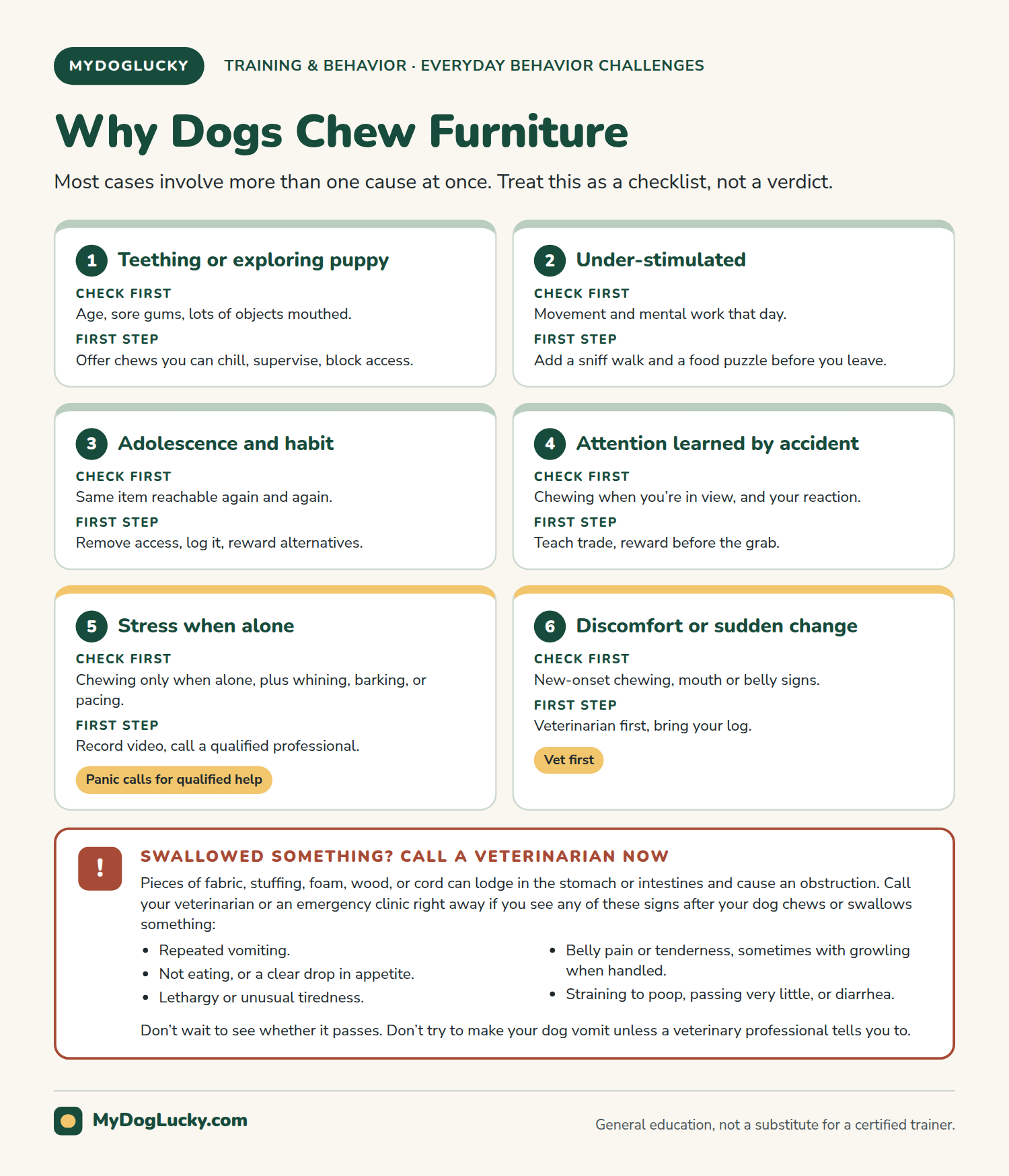
Most cases of dog chewing furniture involve more than one cause at once. A teething puppy can also be under-exercised. An anxious adult can also have learned that chewing gets a reaction. Treat the categories below as a checklist, not a verdict.
Teething and Exploring Puppies
For young dogs, chewing relieves the ache of incoming teeth, according to the ASPCA. Puppies also investigate the world with their mouths, and furniture legs sit at exactly the right height. The ASPCA says the intensified teething phase usually ends by six months of age.
That doesn’t mean you can wait it out. Every rehearsal with the sofa leg makes the habit more rewarding. Offer safe options that feel good on sore gums.
The ASPCA suggests ice cubes, freezable dog toys, or frozen wet washcloths. Supervise those, and toss a washcloth once it starts to fray. The biology of baby teeth has its own MyDogLucky guide on puppy teething.
Under-Exercised or Under-Stimulated Dogs
Chewing also combats boredom, and the ASPCA says bored dogs look for ways to entertain themselves. Chewing is one of the easiest. A dog who has had too little movement, too little mental work, or too little company may turn the living room into a to-do list.
The ASPCA’s prevention ideas include daily walks and outings, tug and fetch games, off-leash play with other dogs, classes, and dog sports. Not every household can do all of that. Apartment living, bad weather, a sore joint, or a puppy who isn’t fully vaccinated yet can all limit the options.
So swap in what fits: sniff-focused walks, food puzzles, short training games, a treat search around the room. Our guides on how much exercise a dog needs and indoor dog enrichment go deeper.
Adolescence and Habit
Many owners notice chewing hanging around after the teething phase, often as a young dog gets bigger, faster, and more confident. The ASPCA says the intensified teething chewing usually ends by six months of age. Chewing that continues past that point more often points to other needs: energy, boredom, stress, or habit.
Habit deserves more respect than it gets. If chewing the couch feels good, nothing stops it, and nobody offers a better option, your dog gets practice every day. Practice makes the behavior easier and more likely. That’s why management comes first in this guide.
Stress or Panic When Alone
The ASPCA says chewing can relieve mild anxiety or frustration. Plenty of dogs settle with a good chew when you leave. Panic is different.
According to the ASPCA, dogs with separation anxiety usually chew only when left alone, or chew most intensely then. They often show other signs too, such as whining, barking, and pacing. If your log shows chewing only when you’re gone, and any of those signs appear, skip ahead to the section on chewing while you’re gone.
Our guide on separation anxiety in dogs covers the condition in detail. Panic calls for qualified help, and this article can’t replace it.
Attention Learned by Accident
Dogs repeat what works. If grabbing a slipper makes you jump up, chase, talk, laugh, or even scold, then grabbing slippers earns attention. That’s learning, not manipulation. A dog who gets little attention any other way may find that a chewed shoe is the most reliable way to get some.
The fix isn’t ignoring your dog into submission. It’s the opposite: give attention for good choices before the shoe grab happens. The trade-and-drop section shows how. Notice, too, that a chase turns “take the shoe” into the best game in the house.
Discomfort: Teeth, Stomach, or a Sudden Change
Pain or an upset stomach can change what your dog wants to mouth, lick, or eat. A sudden change matters most. An adult or senior dog who never chewed furniture and now does has given you information. The first stop is your veterinarian, not a training plan.
Mention signs around the mouth, such as drooling, dropping food, or pulling away when you touch the face. Mention changes in appetite, vomiting, diarrhea, or eating non-food items. Our guide on dog dental disease explains why mouth trouble is easy to miss. Only an exam can sort out what’s going on.
Two more notes from the ASPCA. Dogs on restricted diets may chew looking for extra food. If your dog is on a diet plan, ask your veterinarian instead of changing portions on your own.
And some dogs suck or chew soft fabric repetitively, which some experts link to being weaned before seven or eight weeks of age. If that sounds like your dog, mention it to your veterinarian or a certified trainer.
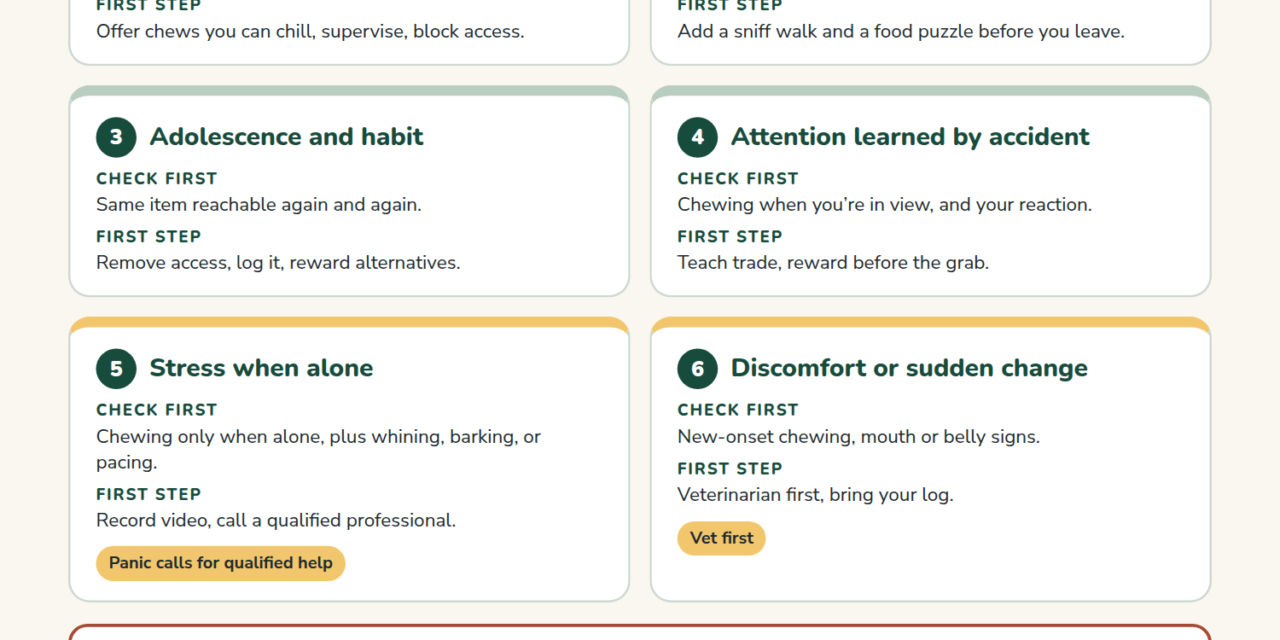
What to Check First
| Category | First things to check | First step |
|---|---|---|
| Teething or exploring puppy | Age, sore gums, lots of objects mouthed | Offer chews you can chill, supervise, block access |
| Under-stimulated | Movement and mental work that day | Add a sniff walk and a food puzzle before you leave |
| Adolescence and habit | Same item reachable again and again | Remove access, log it, reward alternatives |
| Stress when alone | Chewing only when alone, plus whining, barking, or pacing | Record video, call a qualified professional |
| Attention learned by accident | Chewing when you’re in view, and your reaction | Teach trade, reward before the grab |
| Discomfort or sudden change | New-onset chewing, mouth or belly signs | Veterinarian first, bring your log |
Management First: Make the Furniture Hard to Reach
With dog chewing furniture, management means changing the setup so your dog can’t practice the habit. It comes first because every unsupervised rehearsal strengthens the behavior. It also comes first because it works today, while training takes weeks.
Dog-Proof the Room Your Dog Uses Most
The ASPCA’s basic advice is to store valuables away. Shoes and clothing go in a closed closet, dirty laundry in a hamper, and books on shelves. If it’s on the floor, your dog reads it as a menu. Our guide on dog-proofing your home has a fuller room-by-room checklist.
Then look at what’s left. A dog who goes for remote controls, wooden legs, and cushion corners is telling you where the temptation lives. Move what you can, and block access to what you can’t.
Doors, Gates, and Playpens
When you can’t supervise, give your dog a small, safe space with nothing chewable except approved items. The ASPCA suggests a crate or a small room and says to remove anything inappropriate from it. A gated kitchen, a playpen, or a bathroom with a safe chew can all work. Check that the space itself isn’t chewable: baseboards, door frames, and blankets count.
Time limits matter. The ASPCA lists leaving a dog crated for more than six hours as something to avoid. Puppies need bathroom breaks far more often than that, so treat six hours as a ceiling you stay well under, not a goal.
Ask your veterinarian what fits your dog’s age and health. And never use the space as punishment.
Furniture Covers and Barriers
A cover, throw, or barrier can protect furniture while training catches up. Sturdy, tight-fitting options beat loose fabric. A dog who chews the cover can swallow it, so a cover helps only when you’re supervising or when it truly can’t be shredded. Sometimes the best barrier is simply pushing the chair against a wall or standing the cushions up out of reach.
Don’t wrap wooden legs in tape, foam, or fabric unless you’re confident your dog won’t chew and swallow the wrap. A fix that adds a swallowing risk is worse than the chewed leg.
Cord Protection
Cords deserve their own attention. Cornell’s Riney Canine Health Center flags long, thin items such as string and ribbon as especially dangerous if swallowed, and cords share that shape. A live cord adds an electrical risk on top.
Run cords behind heavy furniture, keep them out of reach, and unplug what you can when you’re not watching. Cord covers help only if your dog can’t chew through them. If your dog keeps going for cords, tell your veterinarian.
Taste Deterrents, Described Cautiously
Bitter-tasting deterrent sprays are popular, and results vary. Some dogs ignore them completely. The ASPCA describes a taste introduction. A dab on tissue or cotton is placed gently in the dog’s mouth, so he can taste it and spit it out.
It says to reapply every day for two to four weeks. It also says successful treatment for destructive chewing requires more than deterrents alone.
If you try one, check the ingredient list with your veterinarian first, especially for a puppy or a dog with mouth or stomach problems. Test it on a hidden patch of the furniture so it doesn’t stain. Treat it as a reminder that supports the plan, not the plan itself.
Supervision and a Tether
The ASPCA advises supervising your dog during all waking hours until you feel confident the chewing is under control. In practice, that can mean keeping your dog in the same room. Or clip a leash to your belt so your dog stays within reach while you do chores.
It’s not glamorous. It does stop the rehearsal, and it lets you reward good choices right away.
| Tool | Best for | Watch for |
|---|---|---|
| Closed doors and gates | Blocking a whole room | Dogs who chew or climb gates; choose sturdy ones |
| Playpen or exercise pen | Puppies and short absences | Chewable frames; not for long stretches |
| Crate | Rest and sleep | Time limits (ASPCA: not more than six hours); not a fix for panic |
| Furniture covers | Protecting upholstery while you supervise | Torn pieces can be swallowed |
| Moving furniture | Blocking access to chewed edges | Your dog may switch to a new target |
| Taste deterrent | A reminder on one specific item | Varies by dog; check ingredients with your vet; not enough alone |
| Leash tether to you | Keeping your dog in sight | Only while you’re awake and present |
Choosing Safe Chews by Category
Redirecting a dog to a chew only works if the chew is worth choosing and safe to have. The shopping aisle makes this feel harder than it is. Sort chews by category, size, and firmness, and skip the brand comparisons. Your veterinarian can point you toward specific products for your dog.
Three Checks: Size, Firmness, and Supervision
AAHA’s chew-safety guidance (updated October 2025) offers simple checks:
- Size. A chew should be bigger than your dog’s snout and slightly wider than his mouth.
- Firmness. Press your thumbnail into the surface. If you can’t leave a dent, it’s too hard. A good chew should also bend slightly.
- Supervision. AAHA warns that dogs can swallow broken parts or internal stuffing, which can cause an intestinal blockage. Dogs can also choke on broken pieces or on chews that are too small.
Stay nearby the first few times your dog uses a new chew, and check it over afterward.
Chew Categories at a Glance
| Category | Often chosen for | Watch for |
|---|---|---|
| Hollow, flexible rubber toys you can stuff | Longer sessions and food puzzles | Right size, cracks or tears; count the filling as part of the daily food |
| Firm but flexible chews | Everyday gnawing | The thumbnail check; retire once chunks come off |
| Rope and fabric tug toys | Tug games with you | Frayed strands are string-shaped and swallowable; retire when they fray |
| Plush toys | Gentle mouthing and carrying | Stuffing (AAHA); not for heavy chewers; remove once torn |
| Edible chews | Long chewing sessions | Sources disagree; ask your veterinarian (see below) |
| Very hard items: bones, antlers, sticks, rocks, yak milk chews | Marketed as long-lasting | AAHA says they can damage or fracture teeth |
| Frozen options | Sore puppy gums | Supervise; discard a frayed washcloth |
A Note on Edible Chews
Here the sources don’t fully agree, as of September 2026, which is a good reason to ask your veterinarian. The ASPCA lists bully sticks, pig ears, and rawhide bones among edible chew options. It also says to give only natural bones sold for chewing, and never cooked bones such as leftover t-bones or chicken wings, which can splinter.
AAHA takes a more cautious line. It lists rawhides among chews that can damage teeth. It flags pig ears and bully sticks for possible bacterial contamination, and it notes that some chews can carry germs such as Salmonella and E. coli. Your veterinarian can weigh those points against your dog’s mouth, size, and habits. Wash your hands after handling any of them.
Retire, Rotate, and Count
Check chews often. Toss anything cracked, chunked, or frayed. Rotate what’s available every couple of days, which the ASPCA recommends so your dog doesn’t get bored. Stuffed toys and edible chews add calories, so count them in your dog’s daily food plan, and ask your veterinarian if weight is a concern.
Safe-Chew Checklist
Before you hand over any chew
- Bigger than your dog’s snout and slightly wider than his mouth.
- Your thumbnail leaves a dent.
- It bends slightly.
- No loose parts, and no stuffing spilling out.
- Not a bone, antler, stick, rock, or other very hard item.
- You’re nearby the first time, and you check it afterward.
- You retire it once it cracks, chunks, or frays.
Match the Chew to the Chewer
A determined chewer and a gentle mouther need different things. A puppy with sore gums may prefer something cold and flexible. An older dog with a sensitive mouth may need something softer, and that’s a conversation for your veterinarian. If your dog destroys every chew in minutes, that’s useful information: choose supervised, size-appropriate options, and ask your veterinarian what suits a powerful chewer.
Teach Trade and Drop: Reward the Right Chew
For dog chewing furniture, trade and drop are two of the most useful cues. A dog holding something he shouldn’t won’t hand it over because you asked nicely. He hands it over because handing it over pays. Trade and drop turn your reaching hand from a threat into the start of something good.
Why Trading Beats Grabbing
Grabbing an item from a dog’s mouth can turn it into a contest. Some dogs gulp the item down. Some run. A few stiffen or growl.
A trade says something different: give me that, and something better shows up. The ASPCA’s basic move works the same way: say “uh-oh,” remove the item, offer something he can chew, and praise.
If your dog stiffens, freezes, growls, or snaps when you approach an item, stop practicing. Mention it to your veterinarian, and ask for a certified trainer or veterinary behaviorist. Our guide on resource guarding in dogs covers that pattern. Don’t push through it at home.
Teaching “Trade” in a Calm Moment
Practice with easy items, not the couch cushion. Keep small, soft treats ready and end the session while your dog is still keen.
- Let your dog hold a toy he likes but doesn’t love.
- Show a treat near his nose so he can smell it.
- The moment he opens his mouth and the toy drops, say “yes” and hand over the treat.
- Give the toy right back. That teaches him trading isn’t the end of the fun.
- After several smooth repeats, say “trade” just before you show the treat.
- Vary the items, rooms, and people, and slowly work up to things he likes more.
Success criterion before you go harder
Before you use the skill on a real temptation, your dog should trade calmly, in several rooms, with more than one person. If he hesitates or tightens his grip, go back to an easier item.
Teaching “Drop” With a Toy
“Drop” fits moments when a toy is already in his mouth during play. Use an approved toy and keep it light.
- Play a short tug game with an approved toy.
- Stop moving and stay still.
- Offer a treat near his nose.
- As the toy releases, say “drop” and give the treat.
- Restart the game as a reward for letting go.
Because the game restarts, dropping becomes part of the fun instead of the end of it.
Interrupt and Redirect in Real Time
When you catch your dog chewing something he shouldn’t, keep your voice calm. Say “uh-oh,” the ASPCA’s example, and swap the item for an approved chew. Then praise. Keep the sequence boring and the same every time.
If your dog runs off with the item, don’t chase. Chasing turns it into a game. Call him toward something more exciting, or scatter a few treats on the floor away from the item, and pick it up while he eats.
Catch Him Doing It Right
Most dogs get almost no attention for chewing the correct thing. Change that. When your dog settles down with a chew on his bed, drop a treat nearby or quietly tell him he’s doing well.
Make the approved chew the most interesting object in the room. Stuff it, rotate it, or offer it at your dog’s favorite chewing time. The ASPCA suggests identifying the times of day your dog is most likely to chew and offering a puzzle toy then. Your log tells you when those are.
Exercise and Enrichment Before You Leave
Chewing meets a need. If the need goes unmet elsewhere, the sofa may fill the gap. Meeting needs before a stretch alone doesn’t promise a quiet house, but it improves your odds.
A Simple Before-You-Leave Routine
Here’s an illustrative routine, not a prescription. Adjust it to your dog’s age, abilities, and your schedule.
- Give exercise your dog enjoys and can do: a brisk walk, fetch, a short training game, or a slow sniffing session.
- Offer a bathroom break.
- Set up a stuffed or puzzle toy using part of your dog’s daily food, as the ASPCA suggests.
- Leave calmly, with the safe space ready and the furniture protected.
The routine goes wrong when it turns into a big farewell. Keep the exit low-key, so nothing about it says “something exciting is ending.”
When Exercise Isn’t Enough
Some dogs get plenty of exercise and still chew. That’s a clue. Look at the other categories: stress, teething, or discomfort.
More exercise isn’t always the answer either. For puppies and dogs with joint problems, ask your veterinarian how much and what kind is right.
Exercise doesn’t treat panic. If your dog is frantic when alone, extra miles won’t fix it. That’s a job for the section on chewing while you’re gone.
Low-Effort Versions for Busy Days
- Scatter part of a meal across a towel or a snuffle spot and let your dog hunt for it.
- Do a short training session with a few easy cues.
- Swap the toys your dog can reach for a different set.
- Slow one walk down and let your dog sniff longer than usual.
None of these needs a yard. Our guide on indoor dog enrichment has more ideas for small spaces.
Graduated Freedom: How Furniture Access Comes Back
Furniture privileges aren’t a permanent ban. Your dog earns them back in steps, like a learner’s permit for the sofa. Each step has a success criterion, and you move up only when your dog meets it.
The ladder below is illustrative, not a prescription. Your log tells you how fast to go.
| Step | Setup | Move up when |
|---|---|---|
| 1 | Your dog stays within sight, with approved chews; furniture blocked or covered | The log shows no furniture chewing for several days in a row |
| 2 | Same room, loose, while you do other things | Same result, even when you’re distracted |
| 3 | Nearby room, door open, short absences | Your dog settles when you step out |
| 4 | Longer outings with a safe space and nothing chewable left out | The room looks untouched when you come home |
| 5 | One piece of furniture returns uncovered, while you’re home | Quiet log for several days |
| 6 | Regular household freedom, with occasional checks | Keep reviewing the log |
The ASPCA advises supervising during all waking hours until you feel confident. The ladder builds that confidence one small step at a time.
If chewing returns, step back one level, not all the way to the start. Then check the log for a cause: a skipped walk, a schedule change, teething, a visitor, or a stressful day. Sometimes the cause is the plan moving too fast.
Dogs who become distressed when you leave don’t belong on this ladder. See the next section.
When Chewing Happens Only While You’re Gone
This section is different. Chewing can be part of panic, and panic isn’t something you can manage around. Read on if your log shows damage only when you’re out, especially if you see or hear other signs of distress.
What the ASPCA Says to Look For
The ASPCA says dogs with separation anxiety usually chew only when left alone, or chew most intensely then. It lists whining, barking, and pacing among the other signs. A dog who chews briefly and then settles is in a different situation from one who stays frantic for the whole absence.
You can’t tell the difference from the damage alone. A video recording of your dog while you’re out shows body language and timing. Bring it to your veterinarian or trainer.
What Not to Do
Don’t punish. Coming home to damage and reacting in anger can add fear for a dog who may already be afraid. The ASPCA says dogs can’t connect scolding with something they did earlier. Don’t add more confinement as a fix, either.
Who to Call
Start with your veterinarian to rule out medical causes. Then look for a certified trainer with experience in separation problems, or a veterinary behaviorist (a veterinarian board-certified in behavior) for severe or complicated cases.
In the meantime, protect your dog. Set up a safe space with nothing dangerous in it, so a panicked dog can’t swallow or injure himself. Our guide on separation anxiety in dogs covers what a full plan looks like.
When a Vet Check Comes First
Some dog chewing furniture needs a veterinarian before it needs a training plan. Book a visit if any of these fit:
- An adult or senior dog who never chewed furniture and now does.
- Chewing along with mouth signs: drooling, dropping food, pulling away from face touch, or a chipped or broken tooth.
- Chewing or licking surfaces along with vomiting, diarrhea, an appetite change, or eating non-food items.
- Repeated swallowing of pieces.
- Chewing that starts around the same time as other behavior changes.
If any of the emergency signs from the red-flag panel appear, don’t book. Call now.
What Your Veterinarian May Evaluate
A veterinarian may examine the mouth and teeth, feel the belly, review diet and history, and go through your log. If swallowing is possible, VCA says vets use abdominal X-rays and sometimes contrast material to look for a blockage. VCA also says exploratory surgery is generally recommended when an obstruction is diagnosed or suspected. In some cases, hospitalization with fluids and monitoring may allow the object to pass.
Cornell adds that most obstructions require surgical removal, though some small objects can be managed conservatively. Your vet decides which path fits.
What to Bring
- Your chewing log, even a partial one.
- Photos of the chewed items and any missing pieces.
- A list of your dog’s food, treats, and chews.
- The date chewing started, and anything that changed around then.
- Video of your dog while you’re out, if you have it.
A Note on Dogs Who Keep Swallowing Things
Cornell’s prevention tips include keeping small chewable objects out of reach and supervising closely. They also mention basket muzzle training for repeat offenders. The ASPCA, on the other hand, lists muzzling to prevent chewing among things not to do.
The difference is purpose and training. Talk with your veterinarian or a certified trainer before trying anything like it. Never use a muzzle as a substitute for supervision or for fixing the cause.
The Four-Step Plan: Manage, Redirect, Reinforce, Review
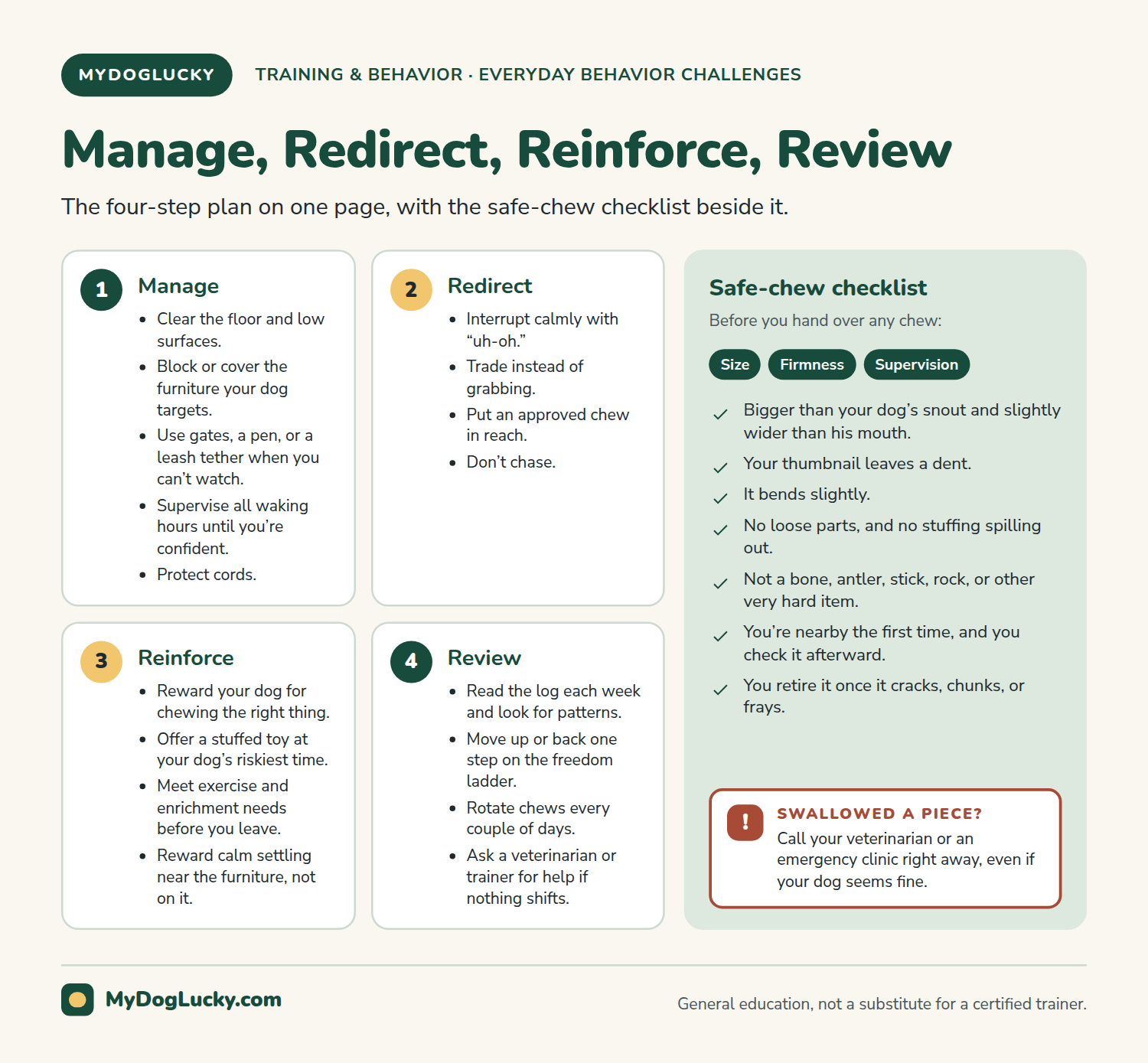
Here’s the whole approach to dog chewing furniture on one page. The steps run in order, but they overlap in real life.
Step 1: Manage
- Clear the floor and low surfaces.
- Block or cover the furniture your dog targets.
- Use gates, a pen, or a leash tether when you can’t watch.
- Supervise all waking hours until you’re confident, as the ASPCA advises.
- Protect cords.
Step 2: Redirect
- Interrupt calmly with “uh-oh.”
- Trade instead of grabbing.
- Put an approved chew in reach.
- Don’t chase.
Step 3: Reinforce
- Reward your dog for chewing the right thing.
- Offer a stuffed toy at your dog’s riskiest time.
- Meet exercise and enrichment needs before you leave.
- Reward calm settling near the furniture, not on it.
Step 4: Review
- Read the log each week and look for patterns.
- Move up or back one step on the freedom ladder.
- Rotate chews every couple of days.
- Ask a veterinarian or trainer for help if nothing shifts.
A Sample First Two Weeks
This is illustrative, not a prescription. Your dog and your schedule set the real pace.
| Days | Focus | Illustrative actions |
|---|---|---|
| 1 to 3 | Manage and log | Clear the floor, block the furniture, start the chewing log, stock a few safe chews |
| 4 to 7 | Redirect | Practice trade in calm moments, use “uh-oh,” offer a stuffed chew at the risky time |
| 8 to 10 | Reinforce | Reward settled chewing, add a before-you-leave routine |
| 11 to 14 | Review | Read the log, move one step on the ladder, call for help if the pattern hasn’t moved |
Troubleshooting: When the Plan Stalls
Something will go sideways at some point. That’s normal. Here are the seven most likely snags when you’re working on dog chewing furniture.
My Dog Ignores the Chew Toys
Check the toy first. Is it the wrong size, too hard, or stale? Rotate it, stuff it, or offer it at your dog’s risky time. If your dog ignores everything, ask your veterinarian to check his mouth.
He Only Chews When I’m Out of Sight
That may be about being alone. Look at the section on chewing while you’re gone, and consider recording a video. Panic signs mean you need a qualified professional.
The Deterrent Spray Didn’t Work
That’s common, since results vary and the ASPCA says deterrents alone aren’t enough. Skip the search for a stronger spray. Put the effort into management, chews, and rewards.
He Chews Right in Front of Me
Look at your reaction. If you chase, laugh, or scold, your dog may have found a reliable way to get you moving. Practice trade in calm moments, and give attention when he picks his own chews.
He Chews Through the Barrier or Pen
That’s a sign the setup isn’t safe. A dog who chews his way out can hurt his teeth or swallow pieces. Switch to a sturdier space, shorten the time in it, and ask your veterinarian or a trainer to review the plan. If he’s panicking, that’s a different problem.
The Chewing Came Back After a Good Stretch
Step back one level on the freedom ladder. Then check the log for a trigger: teething, a routine change, a missed walk, guests, or stress. Progress is rarely a straight line.
He Swallows Pieces
Treat this as a safety issue first. Tighten management, keep him away from the items, and talk with your veterinarian. If any red-flag signs appear, call right away.
What Not to Do About Dog Chewing Furniture
A lot of well-meant advice makes things worse. Skip these.
Don’t Punish After the Fact
The ASPCA says not to show your dog the damage and spank, scold, or punish him. He can’t connect the reaction to something he did hours or even minutes ago. What he may learn instead is that your arrival is unpredictable.
Don’t Tape, Muzzle, or Tie
The ASPCA lists three things not to do:
- Don’t use duct tape to hold a dog’s mouth closed around a chewed object. The ASPCA calls this inhumane.
- Don’t tie a damaged object to your dog.
- Don’t muzzle your dog to prevent chewing.
None of them teaches a better habit.
Don’t Hand Over Old Shoes and Socks
Your dog can’t tell an old sneaker from a new one. If you say “this one’s a toy,” you’ve also said “shoes are chewable.” Use toys that don’t look like your belongings.
Don’t Overuse the Crate
A crate protects furniture, but it isn’t a place to store your dog. The ASPCA lists more than six hours as too long, and puppies need much less.
Don’t Ignore the Signs of Swallowing
A dog who’s chewing is one thing. A dog who’s chewing and vomiting is another. If your dog swallows pieces, call the clinic instead of waiting to see how the day goes.
Renters, Repairs, and the Damage Bill
If you rent, dog chewing furniture, chewed baseboards, and gnawed door frames can turn into a landlord conversation. We won’t give legal advice, and rules vary by lease, landlord, and state. A few practical steps still help.
- Reread your lease and pet policy before you decide what to do.
- Photograph any damage and note the date.
- If you’re unsure about your obligations, ask your landlord or a local tenant resource.
- Vacuum up splinters, foam, and thread so your dog can’t eat them.
Prevention costs less than repair, and that’s true whether you own or rent. Our guide on living with a dog in an apartment covers shared-space basics.
Common Mistakes That Slow Progress
Relying on a Deterrent Alone
The ASPCA says deterrents alone aren’t enough. A spray can support the plan. It can’t be the plan.
Skipping the Log
Without notes, every guess feels equally good. A week of data usually settles the argument.
Removing Management Too Soon
A few quiet days feel like victory. They’re a signal to move up one step, not to hand back the whole sofa.
Forgetting the Vet
A new pattern in an adult or senior dog deserves a medical look. Training a dog whose mouth hurts is an uphill fight.
Inconsistent Rules in the House
If one person hands over old socks and another scolds, your dog has no clear picture. Agree on the plan, and write it down where everyone can see it.
Letting the Same Item Stay Reachable
If the same chair leg gets chewed every week, treat that as a management failure, not a moral failure. Move it, block it, or cover it.
Frequently Asked Questions About Dog Chewing Furniture
Why does my dog chew furniture but ignore his toys?
Furniture may be more interesting, easier to reach, or better for his mouth. Check the toys: size, firmness, and freshness matter. Make them the best thing in the room by stuffing them and rotating them, and make the furniture hard to reach.
Will my dog grow out of chewing furniture?
Teething chewing usually ends by six months of age, according to the ASPCA. Chewing that continues past that point is more likely tied to other needs or habit, so don’t count on time alone. Management and rewards help either way.
Do bitter sprays work?
Sometimes, and results vary. The ASPCA says deterrents alone aren’t enough. Check the ingredients with your veterinarian first, and pair the spray with better chews and management.
Is it okay to give my dog an old shoe to chew?
It’s better not to. Your dog can’t sort old shoes from new ones, so an old sneaker teaches that shoes are fair game. Pick toys that don’t resemble your belongings.
Should I crate my dog to protect the furniture?
A crate can help for short periods, but it isn’t a fix for panic or boredom. The ASPCA lists more than six hours as too long, and puppies need much less time. Ask your veterinarian what fits your dog.
How do I know if it’s boredom or anxiety?
Look at when it happens. The ASPCA says dogs with separation anxiety usually chew only when left alone, or most intensely then, with signs like whining, barking, and pacing. Chewing that happens while you’re home leans toward other categories. If you’re unsure, record video and ask a professional.
My adult dog suddenly started chewing furniture. Should I worry?
A sudden change in an adult or senior dog is worth a call to your veterinarian. Mouth pain, stomach upset, and stress can all change chewing habits. Bring your log so the visit is useful.
What if my dog swallowed part of the couch?
Call your veterinarian or an emergency clinic right away, even if your dog seems fine. VCA says time is critical with an obstruction. Don’t try to make your dog vomit unless a veterinary professional tells you to.
Are edible chews safe?
Sources differ. The ASPCA lists some edible chews as options, while AAHA flags rawhides, pig ears, and bully sticks for tooth or contamination concerns. Cooked bones can splinter, according to the ASPCA. Ask your veterinarian about your dog.
Is a muzzle a good way to stop chewing?
Not as a stand-alone fix. The ASPCA lists muzzling to prevent chewing among things not to do. Cornell mentions muzzle training for dogs that repeatedly swallow objects. That’s a question for your veterinarian or a certified trainer.
How long will this take?
It varies by dog, cause, and how consistent the household is. Management works right away, and new habits take longer. Watch the trend in your log and adjust.
Where to Start This Week
Today, take the tempting things off the floor and block the one piece of furniture your dog targets most. Start the 7-day chewing log, even if it’s a few words on an index card. Stock two or three chew categories that pass the thumbnail test, and put a stuffed one where your dog spends the risky hour.
Over the next few days, practice trade in calm moments, and reward your dog for settling with an approved chew. At the end of the week, read the log and choose one change. That could be more exercise, tighter management, a step up the ladder, or a call to your veterinarian.
If any swallowing signs show up, don’t wait for the week to end. The same goes for chewing that only happens when you’re gone, if your dog looks distressed. Make the call. Dog chewing furniture is usually a solvable problem, and a plan you’ll actually follow beats an elaborate one you won’t.
Sources
- ASPCA. Destructive Chewing (page undated; accessed September 2026)
- American Animal Hospital Association (AAHA). Don’t Chew On This! (published April 4, 2024; updated October 27, 2025)
- VCA Animal Hospitals. Ingestion of Foreign Bodies in Dogs (updated August 14, 2024)
- Cornell University Riney Canine Health Center. Gastrointestinal Foreign Body Obstruction in Dogs (updated December 2024)
- VCA Animal Hospitals. Vomiting in Dogs (updated August 14, 2026)
This article is general education for U.S. dog owners. It is not individualized training, behavior, or veterinary advice for your dog. Signs of a swallowed object, such as repeated vomiting, not eating, lethargy, belly pain, or straining, call for a veterinarian or emergency clinic right away. Chewing only while you’re gone, chewing with signs of distress, or a sudden change in an adult or senior dog should be evaluated by your veterinarian. A certified trainer or veterinary behaviorist can help where relevant.