Reactive dog training starts with a reframe that many owners find a relief: your dog is not “bad,” and you did not break him. A reactive dog reacts to certain triggers with a burst of barking, lunging, or spinning that looks out of proportion. Common triggers include other dogs, strangers, bikes, and sudden sounds. It’s loud, it’s public, and it can be embarrassing. It’s also common, and it nearly always has an understandable reason underneath.
Here is the honest version. Reactivity rarely responds to a quick fix, and in some dogs it carries a real bite risk. So the plan leans on safety, distance, and the right professional help, not on toughness or on a single technique. “Reactive” also describes what a dog does, not who he is.
This guide explains what the word means and what it doesn’t mean. It covers triggers, trigger stacking, and threshold, then safer walk planning, gear categories, and muzzle conditioning as a welfare-friendly tool. It describes counter-conditioning and engage-disengage at a high level, and it explains how to find a qualified professional who can teach the hands-on parts. Two neighboring topics, dog body language and how to stop leash pulling, have their own guides. This one stays focused on safety, management, and getting help.
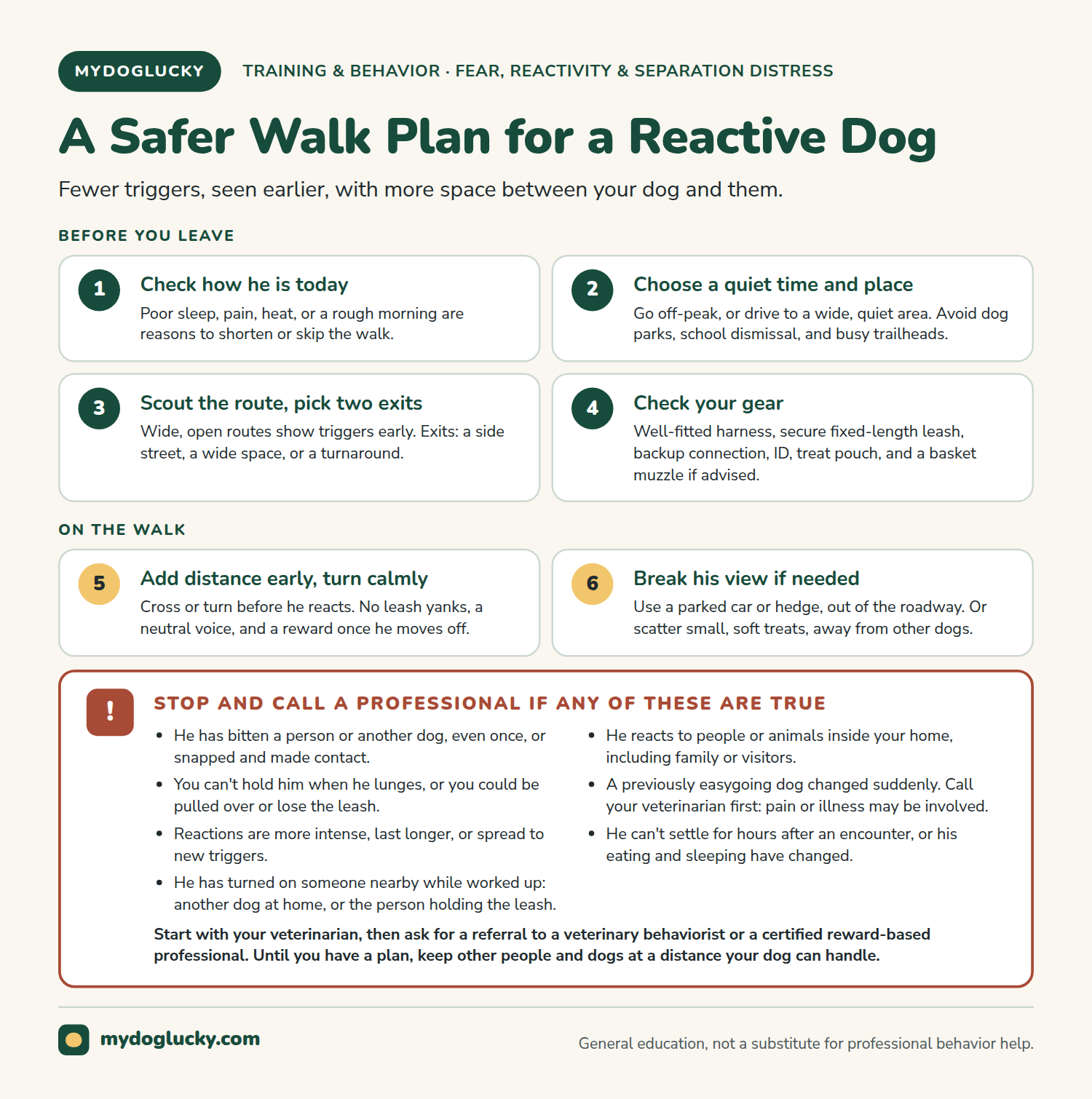
Stop and call a professional if any of these are true
- Your dog has bitten a person or another dog, even once, or has snapped and made contact.
- You can’t physically hold your dog when he lunges, or you worry you could be pulled over or lose the leash.
- Reactions are getting more intense, lasting longer, or spreading to new triggers.
- Your dog has turned on someone nearby while worked up, such as another dog in the home or the person holding the leash.
- Your dog reacts to people or animals inside your home, including family members or visitors.
- A previously easygoing dog changed suddenly. Call your veterinarian first, because pain or illness may be involved.
- Your dog can’t settle for hours after an encounter, or his eating and sleeping have changed.
Start with your veterinarian to check for medical contributors. Then ask for a referral to a veterinary behaviorist or a certified professional who uses reward-based methods. Until you have a plan, keep other people and dogs at a distance your dog can handle.
What’s in this guide
- Reactive dog training: the short answer
- What “reactive” means, and what it does not
- Why dogs react: fear, frustration, and arousal
- Start with your veterinarian: pain, illness, and medication questions
- Triggers, trigger stacking, and threshold
- Bite risk and household safety
- Manage the environment first
- Planning safer walks: time, route, distance, and exits
- Gear categories that help, and tools to skip
- Counter-conditioning and engage-disengage, at a high level
- What not to do: punishment, flooding, and “let them say hi”
- What progress looks like, and what to expect
- Finding a qualified professional for reactive dog training
- Talking with neighbors and other walkers
- Looking after the person holding the leash
- Troubleshooting: five problems owners often hit
- Common mistakes that slow progress
- A realistic first two weeks
- Frequently asked questions about reactive dog training
- Sources
Reactive Dog Training: The Short Answer
The short answer is that reactive dog training works in layers. First, you lower the intensity of your dog’s daily experience. Then, with help, you change how he feels about the things that set him off. It is not about winning a confrontation in the middle of a scary moment. It’s about making that moment smaller, rarer, and more predictable.
In practice, the layers look like this:
- Rule out pain and illness. Your veterinarian checks for medical contributors before anyone changes a training plan.
- Stop the rehearsal. Every outburst practices the outburst, so you arrange life to reduce them.
- Use distance as your main tool. Space is what lets a worried or frustrated dog think.
- Add safety you can trust. That means secure gear and, when advised, a basket muzzle your dog has been conditioned to accept.
- Bring in the right professional. A qualified, reward-based professional teaches counter-conditioning and engage-disengage and adjusts them to your dog.
- Measure progress in small steps. Expect months, not days, and expect some setbacks.
Just as important is what the plan leaves out. It has no leash corrections, no forced greetings, no “let him work it out,” and no promise of a date when it’s over. The American Veterinary Society of Animal Behavior (AVSAB) takes a clear position. It supports reward-based methods and sees no role for aversive techniques in behavior modification plans.
One more thing before we go on. If your walks feel tense, you are in very large company. Reactivity is common, and asking for help is a sign of good judgment, not failure.
What “Reactive” Means, and What It Does Not
Reactive dog training only makes sense once the word itself is clear. “Reactive” isn’t a diagnosis, and it isn’t a personality type. It’s shorthand for a pattern, and shorthand can hide a lot.
A Description, Not a Diagnosis
A reactive dog reacts faster and harder than the situation seems to call for. He may bark, lunge, growl, spin, whine, or freeze when a trigger appears. The trigger might be another dog, a person, a child, a bike, a skateboard, a delivery truck, or a noise. It might happen on leash, at a window, or along a fence.
The most useful way to describe your dog is to say what he does. “He barks and lunges when a dog appears within about thirty feet” tells a professional far more than “he’s reactive.” Specifics point toward a plan. Labels don’t.
Reactive Does Not Mean Aggressive, and It Does Not Mean Bad
Aggression describes behavior meant to threaten or harm, including bites. Reactivity describes intensity and speed. The two can overlap, but they aren’t the same thing. Some reactive dogs would never bite. Others might, particularly if they feel cornered or if the leash removes their choices.
You can’t tell which kind of dog you have from the outside. That’s the reason a professional assessment matters, and it’s the reason safety comes before training in this guide.
“Bad” doesn’t belong in the picture at all. A dog who barks and lunges isn’t stubborn, spiteful, or dominant. He’s having a strong emotional response and using the tools he has.
| Word people use | What you may see | What the word does not tell you |
|---|---|---|
| Reactive | A big, fast response to a specific trigger: barking, lunging, spinning, whining, or freezing | Why the dog is reacting, or whether he would bite |
| Fear-driven | Barking or lunging that seems aimed at making the trigger go away; some dogs also pace, tuck the tail, or lean away | That he is harmless because he looks scared. Fearful dogs can bite. |
| Frustration-driven | Whining, straining, and barking toward something the dog badly wants to reach | That he is “friendly.” Frustration can tip into snapping when contact finally happens. |
| Over-aroused | Hard-to-interrupt excitement, jumping, mouthing, or spinning | Whether the feeling underneath is positive or negative |
| Aggressive | Behavior intended to threaten or harm, which may include bites | How dangerous a specific dog is. That takes a professional assessment. |
Fear, Frustration, and Arousal on Leash
ASPCApro’s guidance on leash reactivity describes two common drivers. Some dogs are fearful, perhaps because of limited early socialization or a bad experience, and they bark and lunge to keep something away. Other dogs love greeting so much that being held back by a leash frustrates them intensely. The same guidance adds environmental factors such as head-on approaches, a tight leash that creates neck tension, and a handler’s own anxiety.
Many dogs show a blend. A dog can be worried about a stranger and frustrated by the leash at the same moment. He can also be aroused, meaning his whole system is revved up, which makes every other feeling louder.
On Leash Versus Off Leash
A leash takes away a dog’s options. He can’t circle, approach at an angle, or leave. Add tension on the line and a trigger walking straight toward him, and even a dog who’s relaxed at the park may start barking. That’s one reason some dogs look very different loose than they do tethered.
Still, “fine off leash” doesn’t prove a dog is comfortable meeting everyone. Some dogs react off leash too, and some dogs who seem fine are simply choosing to avoid. Please don’t take the leash off to test him. If you want to know how he feels, a qualified professional can help you find out safely.
Why Dogs React: Fear, Frustration, and Arousal
Reactivity has no single cause. Most dogs arrive at it through a mix of temperament, experience, learning, and how they feel physically. Understanding the mix helps you avoid blame, which does nothing for your dog or for you.
Temperament, Early Experience, and Learning History
Dogs differ in how easily they get worried or excited, and part of that difference is inherited. Early life matters too. A dog who had few positive experiences with other dogs or people during development, or who had a frightening encounter, may carry that into adulthood. Many owners never learn the full history, particularly with adopted dogs, and that is fine. You can build a good plan without knowing the origin story.
Why the Behavior Sticks
Here is the piece that surprises many owners. Barking and lunging often work. The dog barks, the trigger moves on, and relief follows. From his point of view, the behavior made the scary thing leave.
Repeat that on every walk and the habit gets stronger. That’s not manipulation. It’s simple learning. It’s also why prevention matters so much: each rehearsal makes the next reaction a little quicker.
Health, Sleep, and Age
A dog who hurts, who’s exhausted, or who can’t see or hear as well as he used to has less patience for surprises. Any of those can lower the point at which he reacts. That’s why the next section starts with your veterinarian.
The Handler’s Part, Without Blame
Dogs notice tension on the leash. A tight line, a held breath, and a quick step can all signal that something is wrong. ASPCApro lists handler anxiety among the factors that can amplify leash reactivity.
This isn’t a criticism. Anyone with a lunging dog on the other end of the leash feels tense. The goal isn’t to stay relaxed on demand. It’s to build a plan that gives you fewer surprises, so relaxing becomes easier.
Start With Your Veterinarian: Pain, Illness, and Medication Questions
Before reactive dog training begins, book a veterinary visit if your dog hasn’t had a recent exam. Pain and illness can lower a dog’s tolerance for stress, and a plan built on the wrong assumptions wastes time.
What Your Veterinarian May Look For
Your veterinarian decides which exams and tests make sense. In general, the conversation covers several broad categories:
- Pain. Joints, spine, teeth, ears, skin, and digestive discomfort can all make a dog touchier.
- Hormonal and metabolic conditions. Thyroid problems are one example that a veterinarian may consider.
- Neurological changes. These matter especially when behavior changes suddenly.
- Vision and hearing changes. A dog who startles easily may be seeing or hearing less than before.
- Age-related changes. Senior dogs can develop confusion or anxiety that looks like new reactivity.
- Current medications and supplements. Some can affect mood or arousal, so tell your veterinarian about everything your dog takes.
A medical problem doesn’t excuse or explain every reaction. It simply belongs on the list, and it’s much easier to check early than to discover later.
What to Bring to the Appointment
Short video clips of reactions are gold. So are dates, a note about when things changed, and your trigger log (there’s a template later in this guide). Also bring a list of everything your dog eats and takes, and your questions.
Good questions include: Could pain or illness be contributing? Is my dog physically comfortable wearing a harness and a muzzle? Can you refer me to a veterinary behaviorist or a qualified trainer who uses reward-based methods?
Behavior Medication Is a Veterinary Decision
Some dogs benefit from behavior medication as one part of a broader plan. That decision belongs to a veterinarian, ideally after an exam and often with a veterinary behaviorist’s input. It may help a dog stay calm enough to learn, but it doesn’t replace behavior modification, and it requires follow-up.
This article names no drugs and gives no doses on purpose. Please never give your dog human medication, leftover prescriptions, or an over-the-counter product without asking your veterinarian first. If you’re curious whether medication might help, that’s a fair question to bring to your appointment.
Triggers, Trigger Stacking, and Threshold
Three words carry most of the load in reactive dog training: trigger, threshold, and distance. Once you can see them in your own dog, the walk plan starts to make sense.
Triggers: What Sets Your Dog Off
A trigger is anything that reliably sets off a reaction. Common ones include other dogs, unfamiliar people, children, joggers, bikes, vehicles, and sounds. Triggers aren’t all equal, and the details matter. A small dog walking calmly may be easy, while a large dog charging along a fence may be much harder.
Note how your dog responds to each detail. Size, speed, direction, and sound all matter, as do whether the other dog is on or off leash and whether it stares at him. That list is gold for a professional.
Threshold: The Line Between Coping and Reacting
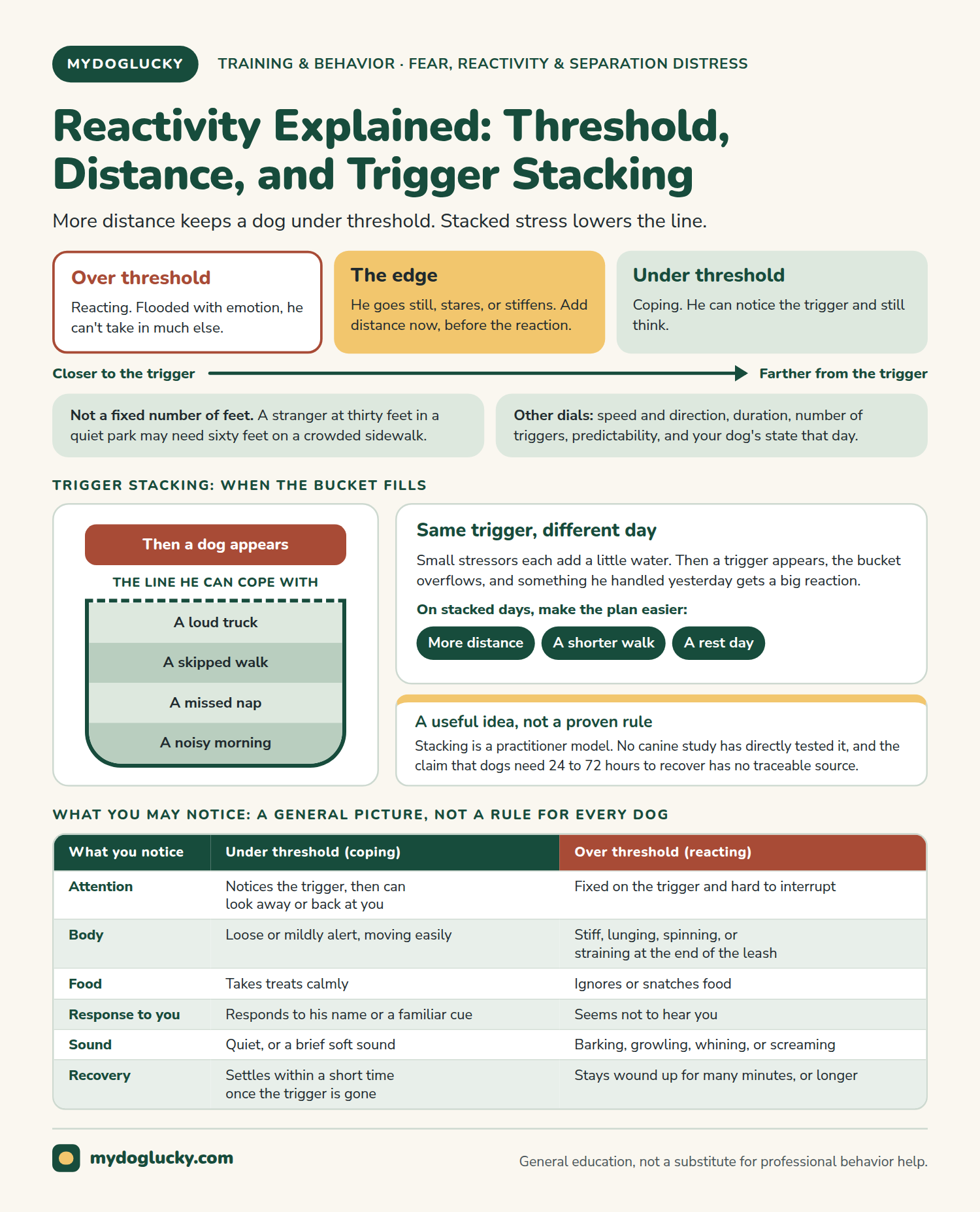
Threshold is the point where a dog goes from coping to reacting. Below it, he can notice the trigger and still think. Above it, he’s flooded with emotion and can’t take in much else. Distance is the dial that moves him from one side to the other, and it’s the one you can control most easily.
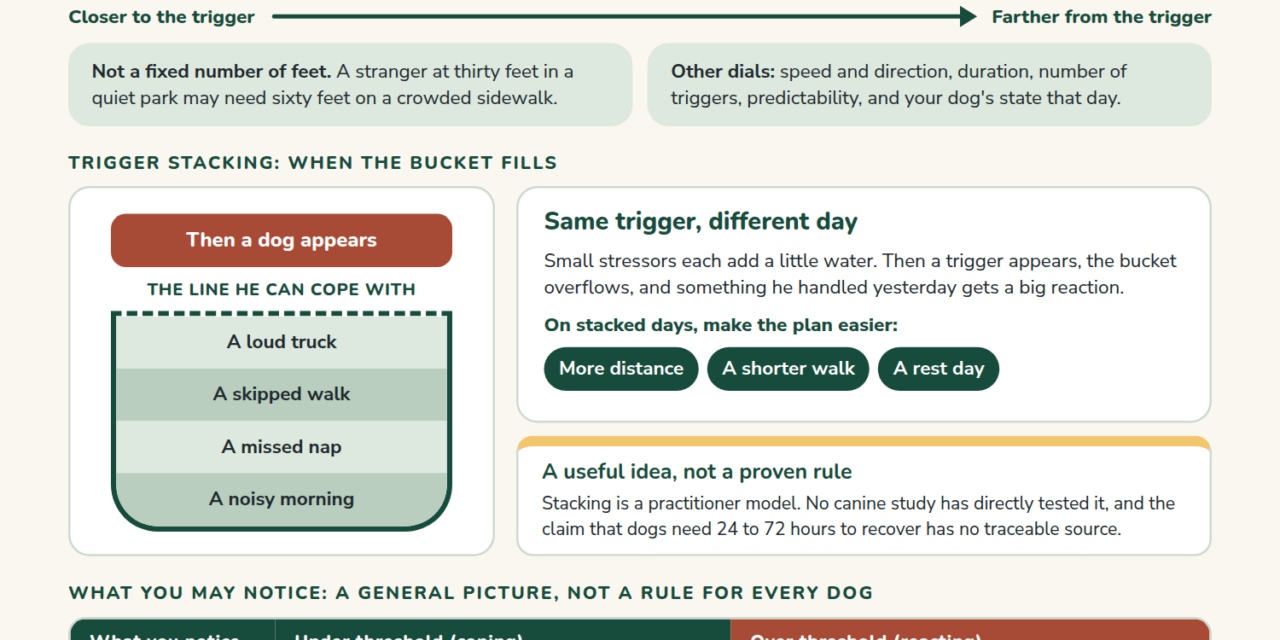
Threshold isn’t a fixed number of feet. It shifts with the trigger, the setting, and your dog’s state that day. A dog who manages a stranger at thirty feet in a quiet park may need sixty on a crowded sidewalk.
Under Threshold Versus Over Threshold
Learning to recognize both states is one of the most useful skills an owner can build. The table gives a general picture. Your dog may show different signs, so treat it as a starting point and let your professional refine it.
| What you notice | Under threshold (coping) | Over threshold (reacting) |
|---|---|---|
| Attention | Notices the trigger, then can look away or back at you | Fixed on the trigger and hard to interrupt |
| Body | Loose or mildly alert, moving easily | Stiff, lunging, spinning, or straining at the end of the leash |
| Food | Takes treats calmly | Ignores or snatches food |
| Response to you | Responds to his name or a familiar cue | Seems not to hear you |
| Sound | Quiet, or a brief soft sound | Barking, growling, whining, or screaming |
| Recovery | Settles within a short time once the trigger is gone | Stays wound up for many minutes, or longer |
Between the two sits an edge. A dog at the edge goes still, stares, or stiffens. That’s your cue to add distance now, before the reaction. It’s much easier to keep a dog under threshold than to bring him back down.
Trigger Stacking: When the Bucket Fills
Trainers often describe trigger stacking with a bucket. Small stressors, such as a noisy morning, a missed nap, a skipped walk, or a loud truck, each add a little water. Then a dog appears, and the bucket overflows, so a trigger the dog handled yesterday now gets a big reaction.
The idea matches what many owners see. A dog who’s fine on Tuesday may be much harder on Friday after a bad night and a stressful day. Treat those days as a signal to make the plan easier: more distance, a shorter walk, or a rest day.
A useful idea, not a proven rule
Trigger stacking is a practitioner model. A September 2026 discussion of the research (Sauerwein, unterHUNDs) points out that no canine study has directly tested it. It also notes that the often-repeated claim that a dog needs 24 to 72 hours to recover from stress has no traceable scientific source. We therefore treat stacking as a helpful way to plan a day, and we don’t quote a recovery timeline. If your professional gives you one for your dog, ask what it’s based on.
The Dials You Can Turn
Distance gets most of the attention, but it isn’t the only dial. Several things change how hard a trigger is:
- Distance. More space usually makes the trigger easier.
- Speed and direction. A dog moving straight toward yours is harder than one moving past at an angle.
- Duration. A trigger that passes quickly is easier than one that lingers.
- Number of triggers. Two dogs are harder than one.
- Predictability. A trigger you see coming is easier than one that appears around a corner.
- Your dog’s state. Sleep, health, heat, and earlier stress all move the line.
A one-line trigger log
Date and time · Place · Trigger and how far away · First sign I noticed · What my dog did · What I did · How long he took to settle. Two weeks of these notes will show patterns you’d never spot in the moment, and they’re exactly what a veterinarian or behavior professional wants to see.
Bite Risk and Household Safety
Safety planning isn’t pessimism, and it belongs in reactive dog training from the start. Reactive dogs live full lives, and many never bite anyone. Still, an aroused dog is less predictable, so a sensible plan assumes that something could go wrong and prepares for it.
Who Holds the Leash
Choose walkers who can physically control the dog. That usually rules out children, and it may rule out anyone with balance or strength concerns. If your dog can pull you over, the plan needs to change before the next walk, not after a fall.
Hold the leash securely, but never wrap it around your hand or wrist. A dog who lunges can tighten a wrapped leash and pull the person down with it.
Redirected Biting and Multi-Dog Homes
A dog who is highly aroused may turn and bite whatever is closest, including another dog in the home or the person holding the leash. Behavior professionals sometimes call this redirected behavior. It’s one reason to keep dogs apart during high-arousal moments, such as a fence-line reaction or a knock at the door.
Ask your professional about a plan for what you’ll do if two dogs start fighting. Reaching in with bare hands is a common way owners get bitten, so this isn’t a moment for improvising.
Children and Visitors
The AVMA’s dog bite prevention guidance stresses supervision around children, and a reactive dog raises the stakes. Never assume a reactive dog “will be fine with kids.” Keep young children and the dog separated unless an adult is actively supervising within reach. Use gates or closed doors when that isn’t possible.
Guests need a plan as well. Put the dog in a quiet room with a chew before the door opens. Let him out only if a professional has told you it’s safe. Please skip forced greetings, even if a visitor says they are “good with dogs.”
Vets, Groomers, Sitters, and Daycare
Tell every professional who handles your dog about the reactivity before they meet him. Give sitters and walkers a written plan, including triggers, gear, and what to do if something goes wrong. Some dogs shouldn’t be in group walks or daycare at all, and a good provider will appreciate the honesty.
If someone is bitten
Separate the dog and the person, and make sure everyone is safe. Wash any wound with soap and water and get medical advice for the bitten person promptly. If another dog was bitten, contact that dog’s owner and a veterinarian. Then contact your veterinarian and a qualified behavior professional. Local reporting rules vary, so ask your veterinarian or local animal control about requirements where you live.
Manage the Environment First
Management is the quiet foundation of reactive dog training. It means arranging life so your dog doesn’t keep rehearsing the reaction. It comes before any training exercise, and it never stops being useful. A dog who isn’t over threshold all day has more room to learn.
Windows, Fences, and Doors
Many dogs practice reactivity at home without anyone noticing. A dog who watches the sidewalk through a front window may bark at every passerby, day after day. Some simple changes can help:
- Apply removable film or a barrier to the lower part of the window, or close the blinds.
- Block the dog’s view of the street from his usual lookout spot.
- Use background sound to soften noises from outside.
- Walk him to the yard on leash if fence-line triggers are common, or supervise every trip.
- Keep the dog behind a closed door or gate when delivery people and visitors arrive.
Decompression and Recovery
A dog who has just reacted needs quiet time. Give him a calm space, something to chew or lick, and a chance to sniff and rest. Skip more stimulation, and skip the urge to rush him back to normal. Rest matters because a tired, overwhelmed dog is closer to threshold all day.
Exercise Without the Triggers
Exercise and mental work are good for every dog. On their own, though, they rarely resolve reactivity, and a walk that keeps pushing your dog over threshold can do more harm than good.
If neighborhood walks are hard right now, it’s reasonable to change them. Options include walking at very quiet times or driving to a quiet, low-traffic area. You can also use a secure fenced space, or replace some outings with sniffing games and food puzzles at home. Ask your professional about safe ways to use a long line, since it can create its own risks.
Skipping some walks for a while isn’t neglect. It’s a plan.
Planning Safer Walks: Time, Route, Distance, and Exits
For many owners, the walk is where everything gets hard. The aim of a safer walk is to meet fewer triggers, see them earlier, and keep more space between your dog and them. A good walk may be shorter than you’d like. That’s fine.
Choose the Time and Place
ASPCApro’s leash-reactivity guidance recommends walking at off-peak hours or in quieter places. Early morning and late evening often mean fewer dogs, but check visibility and safety. Avoid routes near dog parks, school dismissal, busy trailheads, and popular loops.
Sometimes the best option is a short drive to a wide, quiet area where you can see triggers from a distance. Weekday mid-mornings are often calmer than weekends.
Scout Your Route
Walk the route without your dog first if you can, and look for problems. Narrow sidewalks, blind corners, gates, fences, and driveways full of loose dogs all bring triggers close before you see them. Wide, open routes let you spot a trigger while it’s still far away.
On the walk, scan ahead constantly, as you would when driving. Look for other dogs, bikes, runners, and open doors. Know two or three exits: a side street, a wide public area where you can angle away, or a spot to turn around.
Distance Is Your Best Tool
There’s no magic number of feet. The right distance is one where your dog notices the trigger but stays under threshold. ASPCApro’s guidance says the same thing: work where your dog notices another dog without reacting.
Add space early. If you see another dog while it’s still far away, act early. Cross the street, turn down a side street, or head another way before your dog has reacted. Choosing more distance isn’t avoidance. It’s how the dog stays able to think.
U-Turns and Exit Strategies
A planned U-turn is one of the most valuable moves you have. Turn calmly and early, before your dog crosses threshold, and walk away at an easy pace. Don’t yank the leash. Keep your voice neutral or friendly, and reward him once he’s moved off.
A professional can teach a cue that means “we’re leaving,” practiced first in easy settings, so it’s already fluent when you need it. Decide your exits before the walk, because a plan you make in the moment is much harder to carry out.
Parked Cars, Hedges, and Visual Barriers
A parked car, hedge, or wall can block your dog’s view while you move away. ASPCApro lists parked cars as a way to create a barrier. Use them carefully. Stay out of the roadway, and watch for traffic and for dogs behind fences. Don’t treat a barrier as a place to wait beside the trigger.
Treat Scatters, at a High Level
A treat scatter means tossing several small, soft treats onto the ground in a wide area. It gives the dog something to do besides fixate. Sniffing and eating can also help him settle. Many professionals use it as an emergency tool for a surprise trigger, not as a way to bring the dog closer to the trigger.
Use it away from other dogs, because food can create guarding. A professional can show you the timing and tell you whether it’s right for your dog.
A Short Pre-Walk Checklist
- Is my dog well today? Poor sleep, pain, heat, or a rough morning are reasons to shorten or skip the walk.
- Is the harness fitted and the leash secure?
- Do I have the muzzle, if my veterinarian or professional has advised one?
- Do I have soft, small, high-value treats within reach?
- Have I picked a quiet time and route, and do I know two exits?
- Do I have my phone, and can I hold my dog if he lunges?
Gear Categories That Help, and Tools to Skip
Gear supports safety and management in reactive dog training. It doesn’t fix reactivity, and no tool replaces a plan. This section describes categories only, because the right products depend on your dog’s body and your professional’s advice.
Gear at a Glance
| Category | What it does | Cautions and questions for a professional |
|---|---|---|
| Well-fitted harness | Spreads pressure across the chest and body instead of the neck, and gives you a secure attachment | Fit matters. A dog who can back out of it is a safety problem. Ask which style suits your dog, since some restrict shoulder movement. |
| Secure, fixed-length leash | Gives you predictable control and a short, clear line to your dog | Check the clip and stitching often. Retractable leashes are a poor fit here because they let a dog build momentum and lunge farther. |
| Backup connection | A second attachment point that helps if one piece of gear fails | Ask whether it suits your dog, especially if he slips gear. |
| Current ID and microchip | Helps you get a dog back if he ever escapes | Update your contact details whenever they change. |
| Treat pouch | Keeps small, soft, high-value treats within reach | Practice reaching for treats calmly at home first, so it isn’t a scramble on the walk. |
| Basket muzzle | Prevents bites while letting the dog pant, drink, and take treats | Needs slow conditioning first. See the next section. |
| “Give space” signal | A bright vest, bandana, or ribbon that tells other walkers to keep their distance | A signal helps some people, but it won’t stop everyone. |
| Head halter | Some professionals use it to redirect a dog’s head | It requires careful introduction and fit, and it can strain the neck if a dog lunges. Ask a professional before using one. |
Hands-free waist leashes deserve a special caution. A strong dog who lunges can pull a person off balance, and a waist attachment gives you fewer ways to react. Ask your professional before trying one.
Basket Muzzle Conditioning as a Welfare-Friendly Tool
A muzzle can look like a punishment, but it doesn’t have to be one. A basket muzzle that a dog has learned to love is a safety net. It lets you relax a little on walks and keeps other dogs and people safer. It also lets your dog experience triggers at a sensible distance without anyone risking a bite.
Cornell’s Riney Canine Health Center describes basket muzzle training as a way to prevent bites and to stop dogs from eating dangerous items outdoors. Cornell recommends a basket style that lets a dog pant, drink, and accept treats, and advises against nylon muzzles that restrict the mouth.
Muzzle conditioning at a glance
- Introduce it like a treat dispenser. Let the dog approach on his own and put his nose in for food.
- Reward every voluntary nose insertion. Keep sessions brief and calm.
- Add the strap slowly. Loosely first, and only when the dog is comfortable with the nose-in step.
- Build wearing time gradually. Pair it with pleasant activities at home before walks.
- Bring it outside last. Use it on walks only after the dog is comfortable wearing it.
Cornell’s guidance suggests short sessions, often five to ten minutes, several times a week. Plan for weeks, not days. A veterinarian or trainer can check the fit, since a poorly fitted muzzle can rub and can limit panting.
A few cautions matter. Never put a muzzle on a dog as punishment, and never introduce it on a scary day. Don’t pair the introduction with a trigger. Don’t leave a dog unattended in a muzzle, and watch for heat, since panting is how dogs cool down. Remember that a muzzle doesn’t make a dog harmless, because he can still lunge and bump. It also doesn’t fix reactivity. It’s a management tool that works alongside the rest of the plan.
Some people will stare. A quick line, such as “He’s in training and we’re being careful,” usually settles it. A muzzled dog is a dog whose owner is planning ahead.
Tools to Skip
AVSAB’s humane training position names the tools and methods to avoid. They include choke chains, prong collars, and electronic shock collars, plus squirt bottles, shaker cans, compressed air, leash jerking, and physical force such as “alpha rolls.” It also lists flooding, meaning forced exposure. The statement says aversive methods are linked to stress and fear, and that they can raise aggression and anxiety. It also says there’s no role for aversive training in behavior modification plans, even for aggression.
The reasoning is practical as well as ethical. Pain or fear at the moment a trigger appears can teach a dog that the trigger predicts something worse. It can also suppress warning signals, so the dog looks calmer but may be more dangerous.
Counter-Conditioning and Engage-Disengage, at a High Level
Most reactive dog training programs built on humane methods rely on two ideas: changing how the dog feels about his triggers, and giving him a calm alternative to reacting. This section explains both so you can recognize good instruction. It deliberately doesn’t give a step-by-step recipe. Timing, distance, and criteria need to fit your dog, and someone who can watch you both should teach them.
Counter-Conditioning in One Paragraph
Counter-conditioning changes an emotional response by pairing the trigger with something the dog likes. At a distance where the dog notices the trigger but stays under threshold, the trigger appears and something good follows. Over many sessions, the trigger starts to predict good things, and the feeling changes. ASPCApro’s guidance describes this approach for leash reactivity and notes that most dogs need many sessions over days or weeks.
Desensitization goes hand in hand with it. It means exposing the dog to the trigger gradually, at an intensity he can handle. Trainers often use the two together.
Engage-Disengage, at a High Level
Engage-disengage gives a dog a choice. He notices the trigger, and then he looks back at you or away. That choice earns a reward. The dog learns that seeing a trigger doesn’t require a reaction, and that checking in with you is a useful move. Some trainers teach a version called a “look at that” game.
It isn’t obedience. It’s a way for the dog to practice noticing without exploding. A professional can show you how to set it up and when to reward.
Why a Professional Should Teach the Mechanics
Small errors can change the outcome. A treat delivered after an outburst can reward the outburst. A distance a few steps too close can push the dog over threshold and undo a session. A trainer watches your dog’s body in real time, adjusts, and coaches your handling.
There are also safety reasons. Setting up triggers on purpose, even at a distance, carries risk. A qualified person can arrange helpers, barriers, and gear so the session is safe for everyone.
What Good Instruction Looks Like From the Outside
- Sessions are short, and the dog stays under threshold on most repetitions.
- Your dog eats, moves loosely, and recovers quickly.
- The trainer uses controlled helpers, barriers, and distance, not surprise encounters.
- The trainer changes the plan when the dog struggles, instead of pushing on.
- You leave with a management plan, gear advice, and clear homework.
- Nobody uses pain, fear, or intimidation.
Change One Thing at a Time
A sound plan changes one factor at a time, such as distance, duration, or intensity. It does so only after the dog handles the current level calmly across several sessions. That success criterion protects your dog from moving too fast. Your professional sets it and tells you when to raise the difficulty.
Why “we’ll just get closer next time” often fails
Owners often want to see progress, so they close the distance after one good session. Dogs, however, don’t learn on a schedule. A dog who coped well once may still be near threshold. Wait for your professional’s go-ahead before making the exercise harder.
What Not to Do: Punishment, Flooding, and “Let Them Say Hi”
The AVSAB position is clear: reward-based methods only, with no role for aversive training in behavior modification. That applies directly to reactive dog training, because a reactive dog is already worried, frustrated, or overaroused. Adding pain or fear to that state rarely helps.
Punishment and Corrections
Leash pops, yelling, spray bottles, and pain-based collars can interrupt a reaction in the moment. They don’t teach the dog what to do instead. They can also add a new lesson: when that other dog shows up, something bad happens to me. AVSAB reports that aversive methods are associated with stress, fear, and aggression, and that stress responses can persist.
Punishment can also suppress warning signals. A dog who stops growling because growling got him in trouble hasn’t become calm. He may simply skip a warning that would have helped you.
Flooding
Flooding means keeping a dog close to a trigger until he “gets over it.” It can overwhelm him and make the fear worse. AVSAB lists forced exposure among the methods to avoid.
“Let Them Say Hi”
Well-meaning strangers say it all the time: “Oh, he just needs to meet my dog.” For a reactive dog, a forced greeting is a gamble. ASPCApro connects tight leashes and head-on approaches to leash reactivity, and a leash leaves the dog no way to walk away.
You’re allowed to say no. “We’re not able to say hi today, thank you” is a complete sentence.
Dog Parks and Daycare as “Exposure”
Dog parks and daycare can look like a practice ground, but they give you very little control. Other dogs are unpredictable, off leash, and often overexcited. A bad encounter can deepen your dog’s worries and put him in danger. Before considering any group setting, talk with your professional. Some dogs may eventually enjoy controlled play, but the decision should come from an expert who has seen your dog.
Shame, Labels, and Waiting It Out
Labels like “dominant” and “stubborn” lead people to confront the dog instead of helping him. Waiting it out and hoping he’ll grow out of it usually lets the pattern strengthen. Neither approach makes a safer dog.
What Progress Looks Like, and What to Expect
Reactive dog training rarely follows a straight line, and no honest professional promises a timeline or an outcome. Many dogs improve meaningfully. Some become much calmer, and others stay sensitive in certain settings but become easier to manage. Most owners and professionals describe progress in months, and management often continues alongside training.
What to Measure
Because a reaction is such a loud event, small gains are easy to miss. A few simple measures help you see the trend:
| Measure | How to track it | What better might look like |
|---|---|---|
| Distance | Note how far away the trigger is when your dog first reacts | He copes at a shorter distance than before |
| Intensity | Rate each reaction from mild to extreme | Fewer extreme reactions, more mild ones |
| Recovery time | Time how long he takes to settle afterward | He settles faster |
| Frequency | Count over-threshold events each week | Fewer events per week |
| Engagement | Notice whether he takes food and looks back at you | He checks in more often, on his own |
Setbacks Are Information
A bad day doesn’t erase your progress. Sleep, health, weather, and stacked stress all move the line. When something goes wrong, ease off, add distance, and tell your professional what happened. A setback shows where the plan needs adjusting.
What Success Can Look Like
Success might be a calm walk past another dog at twenty feet. It might be a reliable muzzle routine, a quiet evening route, or a dog who recovers in two minutes instead of twenty. It might simply be a walk that ends without anyone feeling frightened. Those outcomes count.
Finding a Qualified Professional for Reactive Dog Training
Reactive dog training goes best when a qualified professional guides it, and it’s essential when there’s any bite history. Dog training isn’t a licensed profession in most of the United States. Anyone may use the title “trainer” or “behaviorist,” so credentials and methods are your best filters.
Start with your veterinarian, who can check for medical factors and often knows good local providers. AVSAB advises veterinarians to recommend trainers who are certified, humane, and effective, and to avoid anyone who talks about dominance or uses aversive methods. AVSAB also publishes a guide to selecting a behavior consultant, and its trainer-selection page links to the American College of Veterinary Behaviorists’ guidance for veterinarians. Both are worth reading before you book.
Credentials You May See
| Credential | Who holds it | What to know |
|---|---|---|
| DACVB (veterinary behaviorist) | A veterinarian with specialty training, certified by the American College of Veterinary Behaviorists | Can evaluate medical contributors and prescribe medication when appropriate. Often the right first call for bites, severe fear, or complex cases. |
| CAAB (certified applied animal behaviorist) | A behavior scientist certified by the Animal Behavior Society, generally with an advanced degree | Skilled in behavior assessment and modification. Most are not veterinarians, so they work alongside your veterinarian on medical questions and medication. |
| CPDT-KA and CBCC-KA | Trainers and behavior consultants who passed exams from the Certification Council for Professional Dog Trainers | Shows tested knowledge and continuing education. Ask about experience with reactive dogs. |
| IAABC certification | Behavior consultants certified through the International Association of Animal Behavior Consultants | Members follow a code of ethics. Ask which certification they hold and about their methods. |
| KPA certification | Graduates of the Karen Pryor Academy’s professional training program | Reward-based, marker-based training. Ask about their reactive-dog experience. |
No credential guarantees a good fit. The person’s methods, experience with reactivity, and communication with you matter just as much.
Questions to Ask Before You Book
- How do you approach reactive dog training, and what methods do you use?
- Do you use any tool or technique that causes pain, fear, or discomfort?
- What credentials do you hold, and how do you keep learning?
- How many reactive dogs have you worked with, and can you share how you handled bite-risk cases?
- How will you work with my veterinarian?
- What will the first appointment involve, and will I see the plan in writing?
- How do you keep sessions safe for my dog, for helpers, and for me?
- Will you teach me the skills myself, or will someone else train my dog?
Red Flags
- A guarantee, a promised outcome, or a fixed timeline.
- Prong, choke, shock, or spray tools, or talk of “corrections” and “balanced” training that includes them.
- Dominance, “alpha,” or “pack leader” language.
- Pressure to expose your dog to other dogs or people without a safety plan.
- Reluctance to explain methods or to let you observe.
- Discouraging veterinary involvement.
- Shaming you or your dog.
Please ask carefully about board-and-train programs for reactive dogs. If the dog lives elsewhere, you can’t learn the skills or watch the methods, and you may not know what happened.
Group Classes, Private Sessions, and Virtual Help
Private sessions let a professional tailor the plan to your dog. Some trainers also run small classes designed for reactive dogs, with plenty of space, barriers, and no forced contact. Look for those safeguards. Virtual consultations can help owners in areas with few providers, particularly when your veterinarian is involved.
How to Prepare for the First Appointment
Bring video clips of reactions, your trigger log, veterinary records, and a list of what you’ve tried. Be honest about everything you’ve tried, including tools or methods you now regret. The professional isn’t there to judge you. They need the full picture to help.
Talking With Neighbors and Other Walkers
Conversations with strangers can feel harder than the training. A few ready phrases take some of the pressure off.
A Few Sentences to Keep Ready
- “We’re working on it. Thanks for giving us space.”
- “Could you please keep your dog back? Mine needs room.”
- “He’s in training, so we can’t say hi today.”
- “Please leash your dog. Mine isn’t comfortable with other dogs.”
Most people respond well to a short, polite request. A bright “give space” vest or ribbon can also help, though it won’t reach everyone.
When an Off-Leash Dog Approaches
This is one of the hardest situations, so talk it through with your professional ahead of time. In general, the aim is to create space and keep everyone safe. That may mean calling out clearly to the other owner, turning away, and putting a barrier between the dogs. Some professionals teach owners to toss treats toward an approaching dog to redirect it. Please don’t yell, kick, or grab.
Every setting is different, and no written plan can cover them all. A rehearsed plan beats an improvised one, though.
Neighbors, Landlords, and Local Rules
If your dog barks at a shared fence, a friendly note to the neighbor about your plan often goes a long way. Landlords and housing communities may have rules about dogs, so read your lease. Know your local leash laws too. If your dog has bitten someone, ask your veterinarian, local animal control, or a local attorney what rules apply where you live.
Looking After the Person Holding the Leash
Living with a reactive dog is tiring. Many owners describe dreading walks, scanning every street corner, and feeling judged. If that’s you, it doesn’t mean you love your dog any less. It means the situation is hard.
Some things help. Share the workload with a partner or friend who can walk him safely. Skip a walk when you’re depleted. Notice small wins, such as a quicker recovery or a longer stretch of calm. Tell your veterinarian and your professional how you’re doing, because a plan that wears you out won’t last.
Peer support groups can be comforting, but be wary of training advice from strangers, especially anything involving aversive tools. Your dog’s difficulty isn’t a verdict on you.
Troubleshooting: Five Problems Owners Often Hit
Even well-run reactive dog training hits rough patches. These five come up most often, and each has a calm first response.
“He Reacted at a Distance That Worked Last Week”
Threshold moves. Poor sleep, pain, heat, stacked stress, or a new type of trigger can lower it. Add distance and simplify the plan for a few days. If the change is sudden or large, call your veterinarian.
“He Won’t Take Treats Outside”
A dog who won’t eat is often over threshold or close to it. Increase the distance and try a quieter place. Some dogs also do better with a different, softer, more valuable treat. If he won’t eat even in easy settings, tell your veterinarian and your professional.
“A Surprise Encounter Went Badly”
Check that everyone is safe and uninjured, and move away. Skip the scolding. Let your dog decompress, and consider skipping the next walk. Write down what happened and share it with your professional. One bad day doesn’t undo the work.
“Progress Has Stalled”
Look for leaks first. Is the dog still rehearsing at the window? Are you moving closer too soon? Is there pain or fatigue? Bring your notes to your professional, who can adjust the plan.
“I Dread Every Walk”
Shorten the walks, choose quieter times, and use other forms of exercise for a while. Ask your professional to help you build a plan you can follow. Dread is information, and it deserves attention.
Common Mistakes That Slow Progress
Most of these come from good intentions and too little support.
Moving Closer Too Soon
One good session doesn’t mean the dog is ready for more. Wait for your professional’s criteria.
Waiting Until the Dog Reacts
Acting after the outburst means the rehearsal has already happened. Add distance at the first sign.
Treating Walks as the Only Exercise
If neighborhood walks keep pushing your dog over threshold, other outlets may help more.
Correcting the Reaction
Corrections may quiet a dog for a moment, but they add fear and can hide warnings.
Skipping the Veterinary Visit
Pain and illness are easy to miss, and a plan built without a medical check may miss the real problem.
Introducing the Muzzle on a Bad Day
A muzzle first put on in a stressful moment can turn into a scary symbol. Condition it slowly, in a calm setting.
Going It Alone With a Bite History
Any bite means a professional should be involved. That’s not optional advice.
Inconsistent Household Rules
If one person moves closer, uses corrections, or lets a dog greet, the plan falls apart. Agree on the plan together.
A Realistic First Two Weeks
This is a starting sequence for safety and information gathering, not a training program. The training mechanics are for your professional to teach.
- Days 1 to 2: Check your gear and who walks the dog. Write down your triggers. Book a veterinary visit.
- Days 3 to 4: See your veterinarian. Share your video clips and log, and ask about a referral.
- Days 5 to 7: Cut rehearsal at home with window barriers and gated doors. Pick a quiet time and route for shorter walks. Contact a professional and book a consultation.
- Days 8 to 10: Scout your route and choose two exits. If your veterinarian or professional agrees, start basket muzzle conditioning at home, slowly and calmly.
- Days 11 to 14: Keep collecting trigger-log notes. Attend your first professional appointment and agree on the plan.
Notice what’s missing: no confrontations, no forced exposure, and no pressure to fix everything at once.
Frequently Asked Questions About Reactive Dog Training
Is a reactive dog the same as an aggressive dog?
No. Reactivity describes an intense, fast response to a trigger, while aggression describes behavior meant to threaten or harm. They can overlap, and a reactive dog may bite, so a professional assessment matters.
Will my reactive dog ever get better?
Many dogs improve, and some improve a lot. Others become easier to manage without losing all their sensitivity. No professional can honestly promise an outcome, so aim for a dog who is safer and more comfortable.
How long does reactive dog training take?
It varies with the dog, the triggers, the household, and how consistently management holds up. Most owners and professionals think in months, and management often continues. Beware of anyone who names a fixed date.
Can I do reactive dog training on my own?
Some owners make good progress with guidance from reliable sources, but a qualified professional makes the process safer and more effective. If your dog has bitten or could hurt someone, please don’t go it alone.
Should I let my reactive dog meet other dogs to socialize?
Not as a fix. Forced greetings can raise fear and frustration, and they carry a real risk of a fight. If your professional decides that controlled interaction makes sense for your dog someday, they’ll set it up carefully.
Is a muzzle cruel for a reactive dog?
Not when it’s a properly fitted basket muzzle that the dog has been slowly taught to accept. Cornell’s guidance describes muzzle conditioning as useful for all dogs. It becomes unkind if it’s used as punishment or put on a dog who hasn’t been conditioned.
Can I use a prong or shock collar on a reactive dog?
No. AVSAB names these tools among the aversive methods to avoid, and it says they have no role in behavior modification plans, even for aggression.
Should I take my reactive dog to a dog park or daycare?
Please ask your professional first. Both settings offer little control, and a bad experience can worsen reactivity. Many reactive dogs do better with quiet, structured outings.
Why is my dog fine off leash but reactive on leash?
A leash limits a dog’s choices, and tension on the line can raise stress. Some dogs also feel frustrated when held back from something they want to reach. Don’t use off-leash freedom as a test.
Will medication fix my dog’s reactivity?
Medication isn’t a fix on its own. Some dogs benefit from it as part of a plan that includes behavior modification and management. That decision belongs to your veterinarian or a veterinary behaviorist.
Do I need a veterinary behaviorist, or is a trainer enough?
It depends on your dog. A veterinary behaviorist is often the right first call for bites, severe fear, or complicated cases, since they can address medical factors and medication. A certified trainer can help with many cases, and your veterinarian can advise you.
Can a reactive dog live with children?
Some can, with careful management and supervision, but there is no blanket answer. Talk with your veterinarian or a behavior professional about your specific dog and household, and never leave children and a reactive dog together unsupervised.
Where to Start This Week
Pick three things. Call your veterinarian to book a check-up and share your concerns. Write down your triggers and the distances at which your dog reacts. Then choose one quieter time and route for the next few walks, with two exits planned.
Also reach out to a qualified, reward-based professional, even if it’s only to ask about availability. Reactive dog training is easier with someone at your side. And if you’ve been feeling embarrassed or worn out, please take that seriously too. Your dog needs a plan, and you deserve support while you carry it out.
Sources
- ASPCApro. Managing and Training Leash-Reactive Dogs. Published May 11, 2020; last modified July 20, 2026.
- Cohen A, Anderson K. Cornell University College of Veterinary Medicine, Riney Canine Health Center. Basket Muzzle Training. Page updated December 23, 2025.
- American Veterinary Society of Animal Behavior. Humane Dog Training Position Statement. 2021.
- American Veterinary Society of Animal Behavior. How to Select a Dog Trainer, ACVB Guidelines. March 21, 2017.
- American Veterinary Society of Animal Behavior. Selecting a Behavior Consultant. May 2020.
- American College of Veterinary Behaviorists. Veterinary Behaviorists (DACVB).
- American Veterinary Medical Association. Dog Bite Prevention.
- Sauerwein M. unterHUNDs Research. Trigger Stacking: Model or Myth?. September 4, 2026.
- Certification Council for Professional Dog Trainers. Find a certified trainer.
- International Association of Animal Behavior Consultants. Find a behavior consultant.
- Animal Behavior Society. Certified Applied Animal Behaviorist program.
- Karen Pryor Academy. Find a certified training partner.
This article is general education for U.S. dog owners. It is not individualized training, behavior, or veterinary advice for your dog. Any bite, or a reaction that is getting worse, needs a professional evaluation. Start with your veterinarian, then a veterinary behaviorist, Certified Applied Animal Behaviorist, or certified reward-based trainer. Sudden behavior changes are a reason to talk with your veterinarian first, because pain and illness can change how a dog reacts.