How to socialize an adult dog starts with a mindset shift: you’re not trying to make him love everyone. You’re helping him feel safe enough to stop worrying about them. For most adult dogs with a limited or unknown past, the realistic goal is calm neutrality. A dog who can pass a stranger, hear a truck, and settle in a new room has learned the things that matter. He doesn’t have to be the social butterfly of the dog park.
This guide is for adopters of rescue and shelter dogs, owners of dogs who missed the puppy window, and anyone whose dog’s world quietly shrank to one house, one yard, and one person. It covers decompression, comfort distance, a slow ladder from watching to calm greetings, and practice with people, dogs, places, and sounds. It also covers what not to do, honest timelines, and when to call a professional.
A quick scope note. This isn’t a puppy checklist. Puppy socialization leans on an early sensitive period and a list of experiences to collect. Adult dogs arrive with history, learned reactions, and opinions. Reactive dog training, separation anxiety in dogs, and resource guarding in dogs are separate topics that need more than a socialization plan.
Stop and call a professional first if you see any of these
- Any bite, or a snap or lunge that comes close to connecting.
- Stiffening, staring, growling, or snapping around food, toys, a bed, or a person.
- Panic: frantic escape attempts, trembling, heavy drooling, or refusing food in a new home.
- Self-injury, or destruction that hurts the dog, such as broken teeth or torn nails.
- A dog who can’t settle when left alone for long stretches.
- A dog who goes from apparently calm to snapping with very little warning.
Start with your veterinarian, because pain and illness can drive fear and irritability. Then look for a veterinary behaviorist or a qualified, reward-based trainer, as described in the “when to get help” section below. A socialization plan alone is not the right tool for any of these.
What’s in this guide
- How to socialize an adult dog: the short answer
- Adult dogs aren’t big puppies: why the approach differs
- What “socialized” honestly means for an adult dog
- Check for pain and medical causes first
- Decompression before socializing: give the first weeks room
- Consent and choice: the idea underneath everything
- Thresholds and distance: finding your dog’s comfort zone
- The comfort ladder: what comfortable looks like at each step
- People, dogs, places, and sounds: one category at a time
- A four-week practice plan that bends
- Body-language check-ins during practice
- Neutral dogs, helper dogs, and parallel walks
- What not to do: flooding, forced greetings, and other shortcuts
- Senior, hearing-impaired, and vision-impaired adult dogs
- Household safety: kids, visitors, and management
- Realistic timelines without promises
- When fear or aggression means bringing in a professional
- Troubleshooting: when practice stalls
- Common mistakes when you socialize an adult dog
- Frequently asked questions
- Where to start this week
- Sources
How to Socialize an Adult Dog: The Short Answer
Adult socialization is a slow, choice-based process. You help your dog feel safe around people, dogs, places, and sounds by keeping each experience small enough to handle, pairing it with something good, and letting him leave when he needs to. You raise the challenge only after he handles the current level calmly. When he can’t, you drop back without guilt.
If you remember nothing else about how to socialize an adult dog, remember these six ideas:
- Decompress first. A newly adopted dog needs quiet, routine, and space before any formal practice starts.
- Choice beats coaxing. That means a slack leash, an exit, and no forced greetings.
- Distance is your main dial. Start far enough away that he can look, breathe, and eat.
- One category at a time. People, dogs, places, and sounds each get their own practice.
- Criteria before progress. Move closer only after several calm, repeatable sessions.
- Neutral is a win. Calm indifference beats forced friendliness.
Trainer guidance on dog greetings from the American Kennel Club puts the last point bluntly: “it’s far safer to teach them neutrality.” That’s the spirit of everything below. Your dog gets to be a dog who’s okay, not a dog who’s on show.
Adult Dogs Aren’t Big Puppies: Why the Approach Differs
Puppy socialization works because young puppies accept new things quickly, so owners gather good experiences during that early window. An adult dog is different. He meets every new thing with what he’s already learned, and some of that learning may have been rough, thin, or simply missing.
That changes the job. You aren’t collecting experiences. You’re building good associations at a pace he can absorb, often on top of older, less helpful ones.
Who This Approach Is For
- Rescue and shelter adoptees whose history is unknown or only partly known.
- Dogs who missed the puppy window, including dogs raised mostly in a yard, a garage, or a single home.
- Dogs whose lives shrank after an owner’s illness, a long shelter stay, or years in one room.
- Cautious dogs of any age, including dogs who were confident once and lost it.
You Don’t Need the Backstory
Many adopters spend real energy guessing what happened. Did someone hurt him? Was he just never taken out? You usually can’t know, and you don’t need to. Describe what he does today instead. He stiffens when a stranger reaches. He stares at bikes. He hides behind the sofa when the doorbell rings.
That description points to a plan. A story about his past mostly points to worry. It also keeps you away from labels like “stubborn,” “spiteful,” or “damaged,” which explain nothing and close the door on practical help.
Yes, Adult Dogs Can Learn This
Adult dogs learn new associations well. Progress is often slower than in a puppy, and some limits may stay. Some dogs are simply more cautious by nature, and that’s a personality, not a defect.
AKC’s guidance for adult dogs who feel uncomfortable around other dogs says the process should “go slow and steady,” matched to how severe the fear is. That’s the right speed to plan for.
What “Socialized” Honestly Means for an Adult Dog
Picture a dog who walks down a busy sidewalk, notices the other dogs, and keeps walking. He lets a visitor come in without hiding. He sleeps through the delivery truck. That’s a well-socialized adult dog, and he isn’t greeting anyone.
Many adopters carry a different picture in their heads: a dog who bounds into every gathering. It’s a lovely picture. It also isn’t the goal, and chasing it can push a dog far past his comfort. Here is what realistic goals look like, area by area.
| Area | A solid goal | A lovely bonus | Not required |
|---|---|---|---|
| People | Stays relaxed when visitors are around; accepts a quick, gentle vet exam | Seeks out a few familiar friends | Loving every stranger |
| Other dogs | Walks past dogs at a comfortable distance without strain | A calm greeting, or one or two dog friends | Playing with every dog he meets |
| Places | Rides in the car, walks a quiet street, settles in a waiting room | Enjoys a patio or a trail | Thriving in crowds |
| Sounds and surfaces | Recovers quickly from ordinary noise; walks on stairs and slick floors | Ignores most everyday racket | Sleeping through fireworks |
| Handling | Tolerates brushing, paw wipes, and an exam with breaks | Offers a paw on his own | Enjoying every kind of touch |
A dog who ignores the whole neighborhood in favor of one very interesting hedge? That’s a success. Take the win.
Some adult dogs prefer people to dogs. Others want exactly one dog friend and no more. Both are fine. Your job is comfort and safety, not a personality overhaul. When you’re deciding how to socialize an adult dog, “what would make his days easier?” is a better question than “what would look good at the park?”
Check for Pain and Medical Causes First
Before you start practicing, talk with your veterinarian. Pain, illness, and sensory changes can make a dog less tolerant of approach, touch, and crowding. A dog with sore hips may snap at a bump he’d once have ignored. A dog who hears poorly may startle when someone appears at his side.
Book the visit sooner if any of these apply:
- A behavior is new, or changing quickly.
- He flinches, tenses, or moves away when touched in certain places.
- He struggles with stairs, jumping, or getting comfortable.
- He startles easily, or doesn’t respond when called from behind.
- His appetite, sleep, or house habits have changed.
Bring notes and short phone videos of what worries you. Include the situation, the distance, and the time of day. Your veterinarian may check for pain and problems with the teeth, ears, eyes, and joints, and may suggest further testing or a referral to a veterinary behaviorist.
Sometimes the conversation includes medication. For a dog with significant fear or anxiety, a veterinarian or veterinary behaviorist may discuss behavior medication as one part of a broader plan alongside training and management. It isn’t a shortcut, and it isn’t a failure. It’s a decision for a professional who has examined your dog. AVSAB’s humane training statement calls veterinarians “an important part of the training or behavior team.”
Decompression Before Socializing: Give the First Weeks Room
A new dog in a new home faces new smells, new sounds, new people, and a new routine, often after a stressful stretch in a shelter or foster home. Practice on top of that is too much. Decompression means letting him settle before you ask him to learn.
The 3-3-3 Idea, and Its Limits
ASPCA Pro’s adjustment guide describes three phases: the first 3 days, the next 3 weeks, and the first 3 months. In the first days, it says, pets need time “to observe their new home and co-habitants, including giving them space and not forcing interactions.” Over the following weeks, they start to settle and show more of their personality. By about 3 months, bonds and habits are forming.
The same page says that for most pets it takes about 3 months on average to become fully comfortable. It also adds that “some pets may need longer to adjust, and some may adapt more quickly.” Treat 3-3-3 as a rough shape, not a schedule. Your dog didn’t read the guide.
What Decompression Looks Like in Practice
- One quiet home base. A gated room, pen, or corner with a comfortable bed and fresh water.
- A predictable rhythm. Meals, potty breaks, and walks at similar times each day.
- Short, calm walks. Same quiet route, sniffing allowed, no crowds.
- Few visitors. Skip the welcome party. The neighbors can wait.
- No outings “to get him out there.” No pet-store trips, cafes, or dog parks yet.
- Contact on his terms. Sit nearby, look elsewhere, and let him come to you.
Notice that your main job is to be boring. Boring is underrated.
Signs He’s Settling, and Signs to Slow Down
Settling looks like regular eating, deep sleep, wandering the house, asking for a pat, and curiosity about small things. Slow down if he hides most of the day, paces, pants heavily, trembles, or won’t engage with anything. If he stops eating or seems panicked, call your veterinarian.
One caution: some dogs respond to stress by going very still and quiet. That’s easy to mistake for calm. A dog who never asks for anything and barely moves may be overwhelmed, not relaxed.
Formal practice can start when he’s eating, sleeping, and moving around the home with reasonable ease. There’s no set date.
Consent and Choice: The Idea Underneath Everything
Consent sounds like a big word for a dog, but it describes something simple. Your dog has a way to say “not now,” and saying it works. Every step of how to socialize an adult dog in this guide rests on that.
In practice, choice looks like this:
- The leash stays slack, so he can move away.
- He can turn his head, step back, or walk off, and you follow rather than pull him back.
- Nobody reaches over him, corners him, or leans in.
- He approaches people and dogs on his own, sniffs, and leaves when he’s ready.
- Sessions end when he says so, not when the plan says so.
Why does this matter? A dog who can leave doesn’t need to escalate. When quiet signals like turning away work, he has no reason to use louder ones. When they don’t work, some dogs learn to skip straight to a growl or a snap.
AVSAB’s humane training statement points the same direction. It notes associations between aversive, forceful methods and “aggressive behavior towards people and other dogs, and anxiety-related behaviors such as avoidance and excitability.” Choice is the opposite approach.
Two Questions Before Any Interaction
The choice check
- Can he leave? Is the leash loose and the path behind him open?
- Did he pick this? Did he walk toward it, or did someone bring it to him?
If either answer is no, change the setup before you go on.
The consent test for petting is a handy version of the same idea: pet for a few seconds, pause, and see whether he leans in for more. If he doesn’t, the pause was his answer. Visitors can learn it in about ten seconds, which is a good use of ten seconds.
Thresholds and Distance: Finding Your Dog’s Comfort Zone
Every dog has a point where noticing something turns into struggling with it. Trainers call it a threshold. Below it, your dog can see the person, dog, or noise, then look away, take a treat, and respond to you. Above it, he freezes, lunges, barks, bolts, or shuts down. He isn’t learning what you hoped up there, and he isn’t choosing anything.
So you practice below threshold. Every session, that’s the whole job.
Distance Is the First Dial
Distance is the easiest dial to turn and the most powerful. Too hard? Add space. Measure it in something you can repeat, such as paces, car lengths, or parking spots. “He was fine at eight car lengths and stiffened at five” is a plan. “He got nervous around the park” isn’t.
Start farther out than feels necessary. Some owners feel silly standing half a block from a stranger. Your dog doesn’t feel silly. He feels relief, and relief is what makes learning possible.
The Other Dials
Distance isn’t the only lever. Any of these can make an experience easier or harder:
- Duration. Ten seconds of watching versus five minutes.
- Movement. A person standing still versus jogging, or a skateboard rolling by.
- Number. One calm dog versus a group.
- Noise. Quiet versus barking, shouting, or engines.
- Predictability. A helper who follows a script versus a stranger who does something unexpected.
- Your dog’s state. Tired, hungry, sore, or already worn out from a hard day.
Change one dial at a time. When a session goes badly, ask which dial jumped.
Under, At, and Over: What to Watch For
- Under threshold: He eats, glances, turns away, and recovers within a few seconds. His body looks loose.
- At threshold: It’s harder to get his attention. He grabs treats stiffly, stares, or recovers slowly. Add distance now.
- Over threshold: He freezes, lunges, barks, growls, trembles, tries to bolt or hide, or refuses food. Calmly increase distance and end the session.
Food refusal deserves a caveat. Many dogs stop eating when they’re stressed, which makes food a handy gauge. Some dogs, though, are never very food-motivated, and a few eat when anxious. Learn your dog’s normal first. If treats don’t work, use sniffing time, a toy, or a walk as the reward.
The Comfort Ladder: What Comfortable Looks Like at Each Step
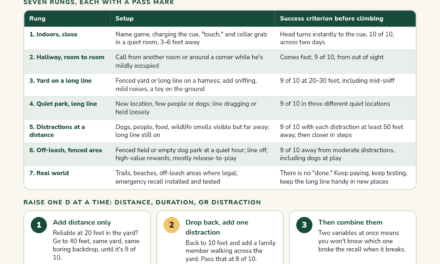
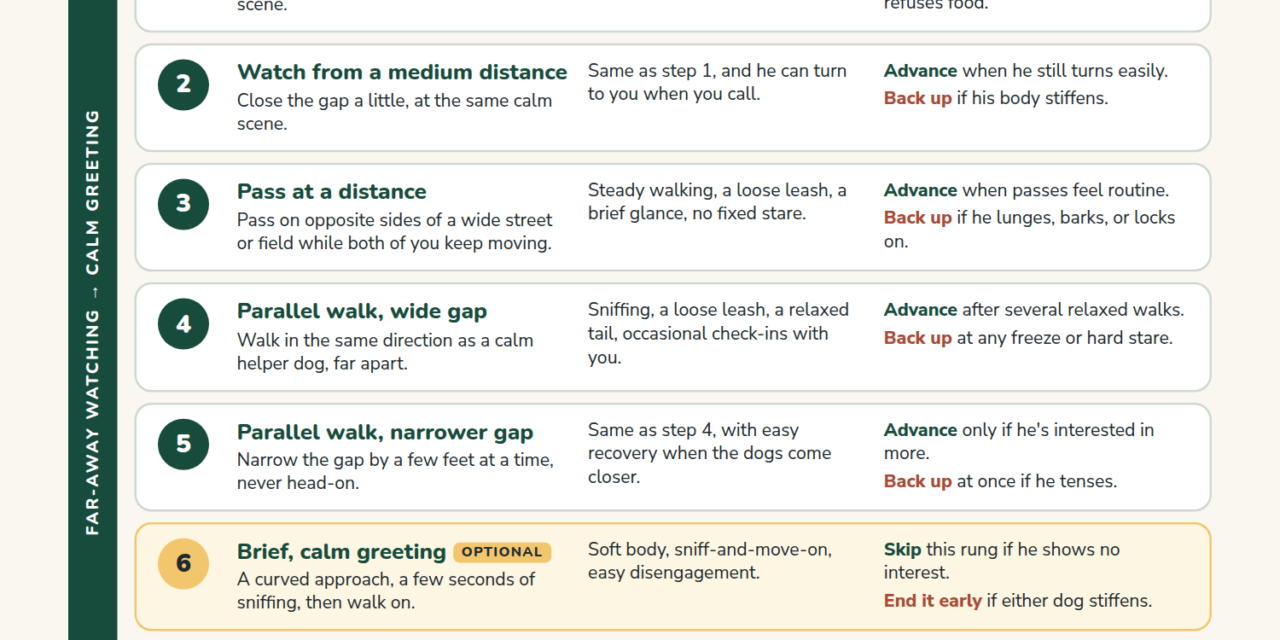
The ladder below maps a slow path from watching from far away to a calm greeting. It’s written for dogs, but it adapts to people. Swap the helper dog for a friend who sits sideways and ignores him. Every rung has an observable “comfortable” look and a rule for moving up or backing off.
| Step | What you’re doing | Comfortable looks like | Advance or back up |
|---|---|---|---|
| 1. Watch from far away | Stand where he can see a dog, person, or scene from well beyond his reaction distance | Loose body, easy breathing, sniffing the ground, glancing and looking away, taking food | Advance after three calm sessions with quick recovery. Back up if he stares, freezes, or refuses food. |
| 2. Watch from a medium distance | Close the gap a little, at the same calm scene | Same as step 1, and he can turn to you when you call | Advance when he still turns easily. Back up if his body stiffens. |
| 3. Pass at a distance | Pass on opposite sides of a wide street or field while both of you keep moving | Steady walking, a loose leash, a brief glance, no fixed stare | Advance when passes feel routine. Back up if he lunges, barks, or locks on. |
| 4. Parallel walk, wide gap | Walk in the same direction as a calm helper dog, far apart | Sniffing, a loose leash, a relaxed tail, occasional check-ins with you | Advance after several relaxed walks. Back up at any freeze or hard stare. |
| 5. Parallel walk, narrower gap | Narrow the gap by a few feet at a time, never head-on | Same as step 4, with easy recovery when the dogs come closer | Advance only if he’s interested in more. Back up at once if he tenses. |
| 6. Brief, calm greeting (optional) | A curved approach, a few seconds of sniffing, then walk on | Soft body, sniff-and-move-on, easy disengagement | Skip this rung if he shows no interest. End it early if either dog stiffens. |
| 7. Shared, low-key time | Sniff the same patch of grass or sit in the same yard on leash | Relaxed, self-directed, able to walk away | This is a fine place to stay. |
Not every dog climbs to the top. Many settle happily at rung four or five and never need a greeting. That isn’t a failure. It’s a dog who has found a life he can enjoy.
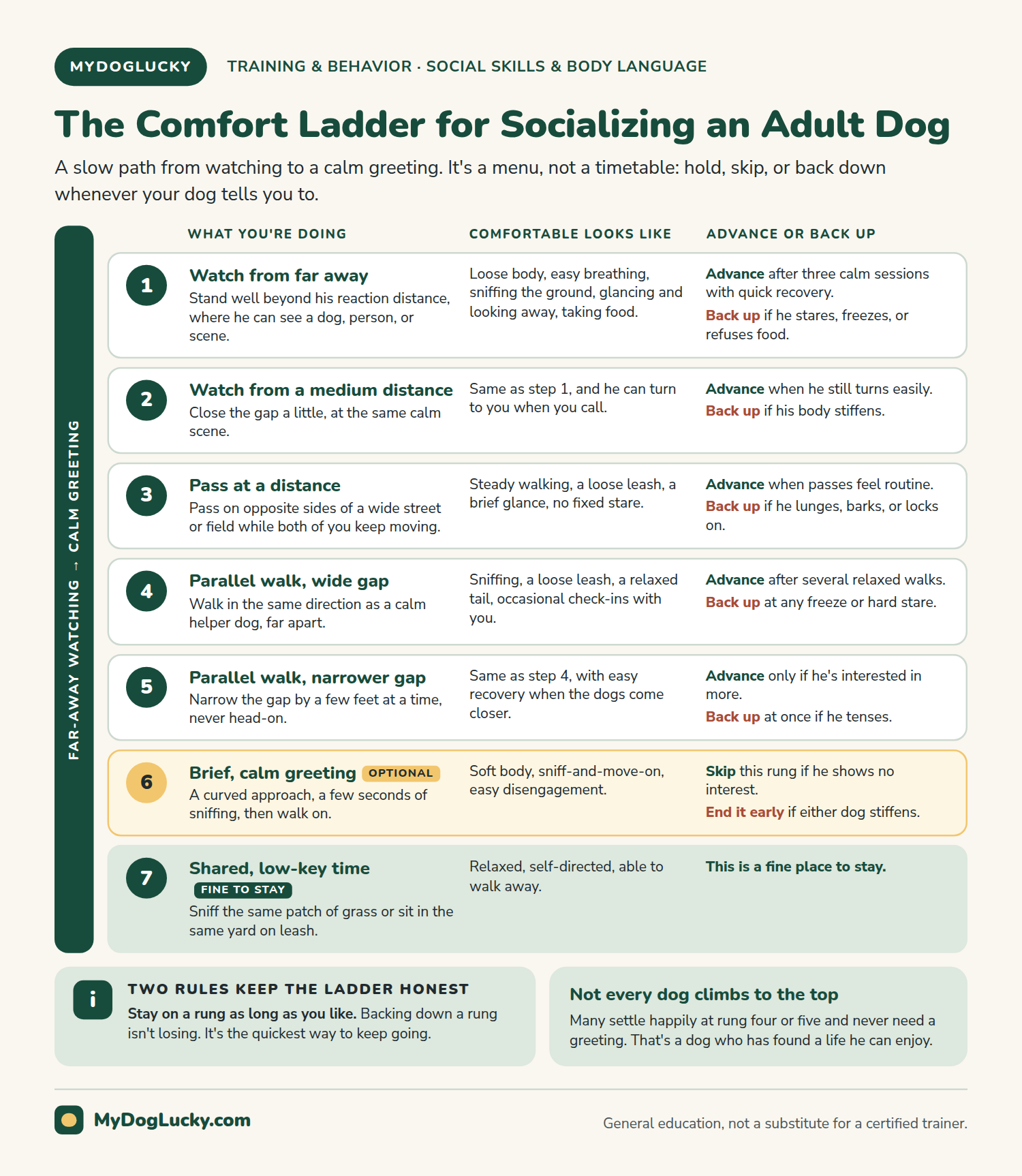
Two rules keep the ladder honest. First, you can stay on a rung as long as you like. Second, backing down a rung isn’t losing. It’s the quickest way to keep going.
People, Dogs, Places, and Sounds: One Category at a Time
A dog can be relaxed with people and worried about other dogs. He can love strangers and dislike trucks. Treat each category as its own project, and don’t stack them. A new place plus a new person plus a loud noise is three hard things at once.
How to Socialize an Adult Dog With People
Start with a few chosen helpers, not the whole neighborhood. Ask them to ignore him at first: no eye contact, no reaching, no baby talk. Have them sit sideways, or stand still and look elsewhere, while he decides whether to approach.
If he’s wary, let your helper toss a treat on the floor near their feet rather than offering one from a hand. That’s lower pressure. If he approaches, sniffs, and leaves, the visit is going well. Let him leave.
Watch for patterns. Some dogs are warier of certain kinds of people, such as men, hats, uniforms, or children, often because they’ve met few of them. Note the pattern without deciding why. Children are not helpers for this work. See the household safety section below.
How to Socialize an Adult Dog With Other Dogs
The goal is calm coexistence, not play. Start on the ladder at rung one, on leash, with plenty of room. The next section explains parallel walks and helper dogs. Skip off-leash meetings for now. They take away your control of distance, and distance is the tool that keeps a hard day from becoming a rough one.
Places
New places carry lots of little unknowns: smells, surfaces, sounds, crowds. Begin with quiet times and low-traffic spots, such as a parking lot at dawn, a side street, or a wide-open field. Let him sniff. A sniff walk is a walk where the destination is “wherever the nose says” and the average speed is roughly that of a garden slug.
Pick spots where he can put space between himself and things that worry him, and keep an exit plan. Keep visits short. Add busier places only after quiet ones feel routine. Boring first, interesting later.
Sounds and Surfaces
For everyday noises, start far from the source. Stand well back from a road and reward calm while traffic passes. Some owners play recordings of doorbells or traffic at very low volume while feeding him, then raise the volume slowly over many sessions. The rule stays the same: he should stay loose, and you should stop when he doesn’t.
Strong noise reactions, such as trembling, hiding, or panic, are their own problem and deserve veterinary and professional input. Surfaces matter too. A dog who spent his life on one type of floor may hesitate at slick tile, stairs, grates, or an elevator. Lay a trail of treats across the surface and let him choose his pace.
A Four-Week Practice Plan That Bends
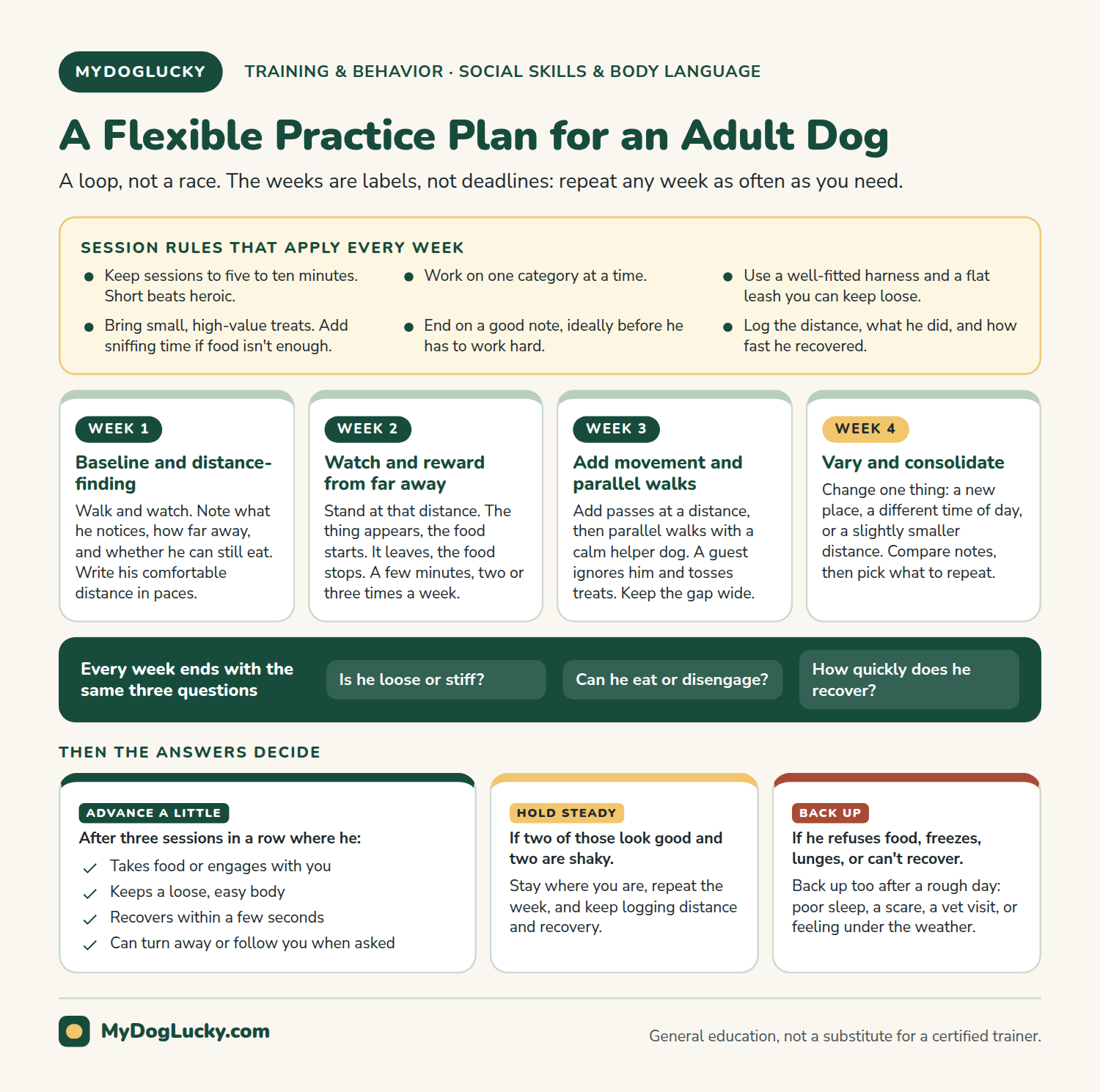
Here’s how to socialize an adult dog in four flexible weeks. The weeks are labels, not deadlines. Repeat any week as often as you need, and skip nothing that your dog hasn’t finished. The plan assumes he’s already decompressed and cleared by your veterinarian.
Session rules that apply every week
- Keep sessions to five to ten minutes. Short beats heroic.
- Work on one category at a time.
- Use a comfortable, well-fitted harness and a flat leash you can keep loose.
- Bring small, high-value treats, and use extras like sniffing time if food isn’t enough.
- End on a good note, ideally before he has to work hard.
- Log the distance, what he did, and how fast he recovered.
Week 1: Baseline and Distance-Finding
Take ordinary walks and simply watch. Note what he notices, how far away it is, and whether he can still eat. Find the distance where he can look at a person or dog and stay loose, and write it down in paces or car lengths. Keep the decompression routine going at home.
Week 2: Watch and Reward From Far Away
Stand at that comfortable distance. When he notices the person, dog, or scene, calmly reward him. The thing appears, the food starts. The thing leaves, the food stops. Do this for a few minutes, two or three times a week. Repeat at the same distance until he stays loose and turns toward you easily.
Week 3: Add Movement and Parallel Walks
Now try passes at a distance, then your first parallel walks with a calm helper dog (more on those below). For people, try a simple visitor routine: the guest comes in, ignores him, sits, and tosses treats without looking at him. The dog can approach or not. Keep the gap wide.
Week 4: Vary and Consolidate
Change one thing: a new location, a different time of day, or a slightly smaller distance. Then compare notes. Are the yellow signals fewer? Does he recover faster? Pick what to repeat. Many dogs benefit from staying on weeks two through four for a while, and that’s a good use of a month.
The Advance, Hold, or Back-Up Checklist
Advance a little after three sessions in a row where he:
- Takes food or engages with you.
- Keeps a loose, easy body.
- Recovers within a few seconds after the trigger leaves.
- Can turn away or follow you when asked.
Hold steady if two of those look good and two are shaky. Back up if he refuses food, freezes, lunges, or can’t recover. Back up too after a rough day: poor sleep, a scare, a vet visit, or feeling under the weather.
Body-Language Check-Ins During Practice
Scan your dog every thirty to sixty seconds. A separate MyDogLucky guide covers dog body language in depth. For practice sessions, you need only three questions: Is he loose or stiff? Can he eat or disengage? How quickly does he recover?
Veterinary behaviorists writing for VCA Animal Hospitals describe canine signals as working on a graduated scale. That’s why you read the cluster, not one signal, and compare it against your dog’s usual self.
| Level | What you may see | What to do |
|---|---|---|
| Green | Loose, wiggly, or relaxed body; soft eyes; sniffing the ground; easy to call away; takes food gently | Carry on, or reward and end on a high note |
| Yellow | Lip licking, yawning, turning the head away, slowing down, a lowered tail, scanning, a tight mouth, a sudden interest in the ground | Add distance, pause, and lower the difficulty |
| Red | Freezing, hard staring, a stiff body, lunging, barking, snarling, growling, trembling, panting without heat, trying to bolt or hide, refusing food | Calmly move away, end the session, don’t scold, and note what happened |
Check your own hand, too. A tight leash changes what your dog can do and how he feels, so if yours tightens, take a breath and soften it.
If Your Dog Growls
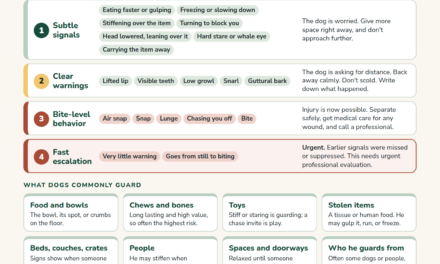
A growl is information. The ASPCA describes a progression of warning signals, such as a still, rigid body, a low guttural bark, growling, and showing teeth, that often comes before a bite. Punish the growl, and some dogs stop growling without losing the feeling behind it. That leaves you with a dog who skips the warning.
Instead, calmly increase distance, breathe, and let the situation end. Then, later, ask yourself what dial jumped. Repeated growling means it’s time for professional help.
Quiet Isn’t Always Comfortable
Watch for the dog who goes still. Soft stillness looks loose, with a relaxed mouth and easy blinking. Tense stillness looks braced, with a closed mouth, a fixed gaze, and weight held back. If you can’t tell which one you’re looking at, add distance and see what changes.
Neutral Dogs, Helper Dogs, and Parallel Walks
For a dog who struggles with other dogs, the most useful tool is a calm helper dog. The most useful skill is walking past without interacting. The AKC greetings article makes the same point: teach neutrality, and ask your dog to turn his attention to you instead.
Choosing a Helper Dog
A good helper is calm, dog-savvy, and comfortable being ignored. He’s healthy, vaccinated, and used to walking on leash. His handler agrees to your rules and will leave when you ask.
Skip the neighbor’s exuberant young dog. Skip the dog who “loves everybody” and drags his person toward every dog he sees. Friendly and pushy can look identical from where your dog is standing, and he’s the one who has to cope.
How a Parallel Walk Works
- Choose an open, quiet space with room to curve.
- Start far apart, walking the same direction, with the helper dog slightly ahead so the dogs aren’t face to face.
- Keep both leashes loose and both handlers relaxed, even chatty.
- Reward your dog for calm looks and for sniffing.
- Narrow the gap by a few feet only after several comfortable walks.
- End while both dogs are still comfortable.
Never approach head-on. A straight line toward another dog can feel like pressure. A gentle arc feels more polite.
Skills That Make It Easier
A few small skills give your dog options. A “watch me” cue asks him to look at you. A U-turn gives you a fast exit. A cued “cross the street” move, described in the AKC article, lets you make space smoothly. A treat scatter on the ground helps him disengage and sniff instead of fixate.
You also get to advocate for him. The same AKC article says it’s fine to interrupt people who approach your dog, with a simple “no” or “my dog is training.” Most strangers will accept that.
What a First Greeting Should Look Like, If It Happens at All
Greetings are optional. If your dog shows real interest and both dogs look loose, keep the first one very short. Use a loose leash and a curved approach. Let them sniff for a few seconds, then call your dog away cheerfully and walk on. If either dog stiffens or stares, move away calmly. Skip the greeting if you have any doubt.
What Not to Do: Flooding, Forced Greetings, and Other Shortcuts
A lot of popular advice on how to socialize an adult dog sounds decisive and works against the whole point. Here are the common ones.
Flooding
Flooding means putting a fearful dog in the middle of the thing he fears, at full intensity, until he “gets used to it.” Think of hauling a worried dog into a crowded street festival. He can’t leave, so he can’t learn that he can. Some dogs shut down. Some panic. Some bite.
AVSAB recommends reward-based methods and warns against intimidation and force. Forcing a scared dog to endure what scares him sits in the same territory, at least from your dog’s point of view.
Forced Greetings
“Say hi!” is not a training plan. Dragging a dog toward a stranger, letting a visitor lean over him, or letting a child hug him takes choice away. He may tolerate it once. He may also learn that people who approach are a threat.
Dog Parks as Therapy
An off-leash park is unpredictable: many dogs, little control, and no way to turn the distance dial. It isn’t a practice space for an uncertain dog. In the AKC piece on adult dogs uncomfortable around others, a trainer says “I’ve seen too many accidents” and notes that you don’t know the other dogs’ status, behavior, or health history. Whether dog parks suit any given dog is a separate question, and MyDogLucky has a separate article on it.
“Let Them Work It Out”
A frightened dog can’t work anything out. Dogs also differ in size, skill, and confidence, so a mismatch isn’t a lesson. It’s a risk. Interrupt early and calmly by moving away.
Punishment and Aversive Tools
Skip the leash pop, the prong or choke collar, and the shock collar. AVSAB advises avoiding tools that involve pain, and says there’s “no evidence that aversive training is necessary” for training or behavior modification. Don’t punish a growl, either.
Pushing One More Pass
The best session often ends one repetition before you want it to. “Just one more” is how a good day becomes a hard one.
Senior, Hearing-Impaired, and Vision-Impaired Adult Dogs
These dogs can learn just as well. The steps for how to socialize an adult dog stay the same, but the delivery has to fit how they take in the world. Everything below is practical guidance, not a research finding, so run it past your veterinarian and, when you can, a trainer with experience in the relevant need.
Senior Dogs
Aim for modest goals and short sessions. Check comfort first: pain evaluation, a warm and supportive bed, and non-slip footing on floors and paths. Choose helper dogs who are calm and gentle, because a bouncy youngster is a lot for stiff joints. Give an older dog a place to retreat, and let him nap between sessions.
New confusion, restlessness, or changes in how he responds to people are worth a veterinary visit. Age alone isn’t the explanation to assume.
Hearing Loss
Approach him where he can see you, and ask visitors to do the same. Avoid touching him from behind or waking him abruptly. Some owners use visual or touch-based markers, such as a hand signal or a gentle vibration cue, and a trainer who works with deaf dogs can help you build those gradually. Because he may not hear traffic or a recall cue, keep him on leash or in secure fencing.
Vision Loss
Keep the layout of your home predictable. Speak softly as you approach, and let him sniff your hand before you touch him. Reach from the front at nose level rather than over his head. On walks, use the same routes and familiar scent and sound cues. Add new places slowly, and go with him at his pace.
Dogs Whose Lives Shrank
A dog who spent years in one yard, one room, or one person’s company may find the ordinary world overwhelming. Start below the ladder: the front step, a short car ride, a quiet corner of a parking lot. Give him extra time and expect small wins. If he refuses to walk, trembles, or seems frightened by almost everything, bring in a veterinarian and a qualified professional early. Dogs from neglect or hoarding situations may need that help from the start.
Household Safety: Kids, Visitors, and Management
A dog who is still learning to feel comfortable can’t be assumed to be “good with kids.” No dog should be assumed that, honestly. Guidance on dog-bite prevention from the AVMA stresses supervising children around dogs, and that matters even more with an adult dog whose history you don’t know.
- Supervise actively. Stay within arm’s reach and keep your eyes on both of them.
- Separate when you can’t watch. Use a gate, a closed door, or a crate in a quiet room.
- Teach kids the rules. No hugging, kissing, cornering, or approaching him while he eats or rests. Let him come to them.
- Keep kids out of the helper role. Practice sessions are for adults.
- Brief visitors. Ask them to ignore him, and put him in a quiet room with a chew if he’s not ready.
For some dogs, a trainer may suggest a well-fitted basket muzzle, conditioned gradually with treats, as a safety and welfare tool. It is never a punishment and never a way to make a frightening situation “safe” by force. A trainer can teach that step by step. Any bite involving a child needs a professional evaluation, however minor it seemed.
Realistic Timelines Without Promises
Nobody can give you an honest timeline for how to socialize an adult dog, because dogs vary and histories differ. ASPCA Pro’s guide says most pets take about three months to become fully comfortable in a new home, and some take longer. Socialization practice sits on top of that settling period, not inside it.
Progress Isn’t a Straight Line
Expect good weeks and worse ones. Illness, a move, a scare, or a schedule change can set a dog back. That’s normal, and it doesn’t mean the earlier progress was fake. Go back a rung, then continue.
Measure the Right Things
Instead of asking, “Is he social yet?” track:
- How close he can get before he stiffens.
- How quickly he recovers after a trigger.
- How often he chooses to look at you.
- How often you see yellow signals.
A simple log works: date, category, distance, what he did, recovery time, and one thing to change next time. For serious fear or aggression, the AKC piece is frank that behavior modification “can take weeks, months, or years.” Some dogs will always prefer fewer people and dogs. A life built around that preference is still a good life.
When Fear or Aggression Means Bringing in a Professional
Most of this article is observation and management that any owner can try. Still, knowing how to socialize an adult dog also means knowing when not to do it alone. Some patterns need a qualified person looking at your dog. Bring one in if you see any bite, bite-level guarding, repeated growling at close range, panic, self-injury, a dog who can’t be touched by anyone, or a dog who moves from calm to snapping quickly. Also ask for help if your best efforts leave a child at risk.
Who to Call
Start with your veterinarian to rule out pain and medical causes. From there:
- A veterinary behaviorist (a veterinarian who is a Diplomate of the American College of Veterinary Behaviorists, DACVB) for serious fear, aggression, or when medication may be part of the plan.
- A Certified Applied Animal Behaviorist (CAAB), an animal-behavior specialist certified through the Animal Behavior Society.
- A certified, reward-based trainer or consultant, such as a CPDT-KA or CBCC-KA through CCPDT, an IAABC member consultant, or a KPA-trained professional.
How to Vet a Professional
Questions worth asking
- What methods do you use, and what happens when a dog is over threshold?
- Do you ever use pain, fear, intimidation, or leash “corrections”? (The answer should be no.)
- Do you talk about “dominance” or “alpha” theories? (AVSAB advises avoiding trainers who do.)
- Can I watch a session or class before I commit?
- Will you work with my veterinarian?
- How will we measure progress, and what happens if it stalls? (Be wary of anyone who promises results.)
Medication as One Part of a Plan
For some dogs with significant fear or anxiety, a veterinarian or veterinary behaviorist may discuss behavior medication as one part of a broader plan. It works alongside training, management, and a good routine, not instead of them. Any such decision belongs to the professional who has examined your dog.
Troubleshooting: When Practice Stalls
“He won’t take treats outside.”
The step is probably too hard. Add distance, try a quieter time of day, and offer something better. Check whether he’s hungry, tired, or unwell. If food never works, use other rewards: a sniff, a game, or simply moving away from what worries him.
“He’s fine far away, then loses it as we get closer.”
Your steps are too big. Return to the last distance where he was comfortable and shrink the gap in smaller increments. Change the angle, too, not only the distance. A curve is easier than a straight line.
“He’s fine with people at home but not outside.”
Dogs learn context by context. What he knows in your living room doesn’t automatically carry to the sidewalk. Practice the outside version at the easy end of the ladder, with more distance than you used indoors.
“He’s not scared. He’s wildly excited, and it’s just as hard.”
Some dogs are so eager to greet that they pull, bark, and spin. That kind of frustration is a real problem, too. Practice calm from a distance, reward a slack leash, and skip on-leash greetings for now. A trainer can help if this is your dog.
“He improved for two weeks and then got worse.”
That happens. Look for triggers: illness, pain, a scare, a schedule change, or a stressful visit. Go back one step, check in with your veterinarian, and give him more rest. If a slide lasts more than a week or two, ask for professional input.
Common Mistakes When You Socialize an Adult Dog
Most mistakes in how to socialize an adult dog come from good intentions and too much speed.
Chasing Quantity Over Quality
Ten stressful meetings teach less than one relaxed one. Fewer, calmer experiences win.
Skipping Decompression
Starting in week one can undo the trust you’re trying to build. Let him settle first.
Changing Too Much at Once
A new person in a new place with a new noise is a triple challenge. Change one thing at a time.
Mistaking Tolerating for Enjoying
A dog who stands very still while a stranger pets him isn’t necessarily enjoying it. Watch for signs of comfort, not just an absence of protest.
Letting One Great Day Set the Difficulty
A brilliant Tuesday doesn’t mean Wednesday should be harder. Raise the challenge only after several sessions of calm.
Going It Alone Too Long
Asking for help early isn’t giving up. It’s a way to make your effort count.
Frequently Asked Questions
Is it too late to socialize an adult dog?
No. Adult dogs can learn new associations at any age. The pace is usually slower than with a puppy, and some limits may stay, but comfort is a realistic goal for most dogs. Start with a veterinary check and go slowly.
How long does it take to socialize an adult rescue dog?
No one can promise a timeline. ASPCA Pro’s guide says most pets need about three months to feel fully at home, and some need longer, so formal practice usually starts after that first settling. Then progress is measured in weeks and months.
How to socialize an adult dog who is afraid of strangers?
Keep distance wide, let him choose whether to approach, and pair the sight of a calm person with something he likes. Ask visitors to ignore him and toss treats to the floor. Never force contact. If he growls, snaps, or panics, contact a professional.
Can I use a dog park to socialize my adult dog?
It’s rarely a good starting point. Off-leash parks are unpredictable and hard to control, and one bad encounter can set an uncertain dog back. Practice on leash with a chosen helper dog first, and talk with a trainer before trying any group setting.
What is the 3-3-3 rule for a rescue dog?
It’s a shelter-world guideline that describes roughly three days, three weeks, and three months of adjustment. ASPCA Pro’s version notes that some pets need longer and some adapt faster. Use it as a rough map, not a countdown.
What if my dog growls during practice?
Calmly add distance and end the session. Don’t scold him. The growl told you the step was too hard. If growling repeats or is directed at people close to him, contact your veterinarian and a qualified behavior professional.
Should I get a second dog to help socialize my adult dog?
Not reliably. A second dog adds a new set of needs and may not make your first dog more comfortable. A chosen helper dog for short, structured walks is a different thing, and much lower commitment.
Can a senior or deaf dog be socialized?
Yes, with modest goals and adjustments. Keep sessions short, approach where he can see you, avoid startling him, and check with your veterinarian about pain or sensory changes. Comfort matters more than the number of friends.
Does my adult dog need to like other dogs?
No. Many dogs are happiest with people, and some do best with one dog friend. Calm neutrality around other dogs is a solid, safe goal. Liking every dog is not required for a good life.
When should I call a trainer or behaviorist?
Call sooner rather than later if you see biting, guarding, repeated growling, panic, self-injury, or fast escalation. Also call if you feel stuck after several weeks of careful practice. Start with your veterinarian to rule out pain or illness.
Where to Start This Week
Week one of how to socialize an adult dog is smaller than you might expect. Pick a few things and stop there:
- Book the veterinary visit. Write down your top three worries and bring a short video.
- Find his distance. On a quiet walk, notice how far away a person or dog can be before he stops eating. Write it in paces.
- Build the home base. One quiet spot, one predictable routine, and no welcome party.
- Choose one category and one helper. People or dogs, not both.
- Set a success rule. Three calm sessions in a row before you move closer.
That’s the whole plan. No dog park, no party. If your dog can look at the world and then look back at you, you’re doing it right. Go at his pace, celebrate the boring wins, and ask for help sooner than you think you should.
Sources
- ASPCA Pro. Pet Adjustment Periods: The 3 Days – 3 Weeks – 3 Months Guide. Published September 17, 2024; last modified December 22, 2025.
- Paretts S. American Kennel Club. Why Is My Dog Uncomfortable Around Other Dogs?. Updated March 2, 2026.
- Patterdale S. American Kennel Club. Dog-to-Dog Greetings: How to Perfect Meetings With Other Dogs. Updated March 23, 2026.
- American Veterinary Society of Animal Behavior. Humane Dog Training Position Statement. 2021.
- Horwitz D, Landsberg G (with DePorter T, Joswich J). VCA Animal Hospitals. Canine Communication: Interpreting Dog Language. Reviewed July 22, 2019.
- ASPCA. Aggression. Common Dog Behavior Issues.
- American Veterinary Medical Association. Dog Bite Prevention.
- American College of Veterinary Behaviorists. Find a veterinary behaviorist.
- Animal Behavior Society. Certified Applied Animal Behaviorists.
- Certification Council for Professional Dog Trainers. Find a certified trainer.
- International Association of Animal Behavior Consultants. Find a behavior consultant.
- Karen Pryor Academy. Find a KPA-trained professional.
This article is general education for U.S. dog owners. It is not individualized training, behavior, or veterinary advice for your dog. Growling, snapping, guarding, panic, or any bite should be evaluated by a certified trainer, Certified Applied Animal Behaviorist, or veterinary behaviorist, and sudden behavior changes are a reason to talk with your veterinarian.