Dog body language is a constant, mostly silent conversation, and your dog has been holding up his end of it since the day he came home. The short answer to “how do I read what my dog is telling me” is this: don’t read one signal. Read the cluster. A tail, an ear, a lip lick, and a shift in weight mean far more together than any one of them means alone. And they only mean something once you know the context and what this particular dog looks like on an ordinary Tuesday.
That’s the whole skill, and it’s learnable. This guide walks through dog body language by body part and the stress signals that show up long before a growl. It covers how to tell play from trouble, what a consent test for petting looks like, and how to handle greetings, kids, and the vet’s exam table. The goal isn’t to become a mind reader. It’s to notice quiet discomfort early enough that your dog never has to say it louder.
What’s in this guide
- Dog body language: the short answer
- Why reading dog body language matters
- Read the whole dog: clusters, context, and baselines
- Dog body language by body part
- Calming, appeasement, and displacement signals
- Stress signals and the escalation ladder
- Relaxed and happy dog body language
- Dog body language during play: play vs. trouble
- Fearful vs. offensive body language, and why fear can bite
- Breed and body-type caveats
- The consent test for petting
- Greetings between dogs
- Dog body language around kids
- At the vet and the groomer
- Tail-wag myths, and what the research actually says
- What to do when you see stress signals
- When to get professional help
- A daily observation practice
- Common mistakes when reading dog body language
- Frequently asked questions about dog body language
- Sources
Dog Body Language: The Short Answer
Dogs communicate with their whole body, all the time. They use their eyes, ears, mouth, tail, posture, coat, breathing, and the direction they lean. Most of that communication is small and fast. Most of it happens well before anything a person would call “a problem.” Reading dog body language means learning to see the small stuff.
Three ideas carry most of the weight:
- Clusters, not single signals. A yawn can mean a dog is tired. A yawn plus a lip lick plus a turned head plus a low tail means something else entirely. Veterinary behaviorists writing for VCA Animal Hospitals describe canine signals as working on a graduated scale, and any single signal only makes sense as part of that scale.
- Context decides the meaning. The same panting mouth reads differently after a run in July than it does in a quiet vet lobby at 65°F (18°C). Ask what just happened, what is approaching, and what the dog can and cannot get away from.
- Baseline is everything. You are comparing your dog to himself. A sighthound’s tucked tail at rest is normal for that body. A beagle’s tail in the same position is news.
The payoff is practical. When you can spot the early, quiet signs of discomfort, you can change the situation while it’s still easy to change. Add distance, lower the pressure, end the greeting, or skip the hug. Your dog never has to escalate to a growl or a snap, because you heard the whisper.
Why Reading Dog Body Language Matters
Body language sounds like a nice-to-have skill until you see how many everyday problems trace back to a missed signal. Four areas stand out.
Bite Prevention Starts Long Before the Bite
Most bites are not “out of nowhere.” They are the last step in a sequence that usually included several quieter steps. All of them were visible to someone who knew what to look for. The American Veterinary Medical Association’s bite-prevention guidance and the ASPCA’s guidance on aggression both describe warning behaviors that typically precede a bite. Stillness, a hard stare, a lifted lip, a low growl. VCA’s behavior team adds a caveat worth memorizing: a dog with a low, crouched, “appeasing” posture can bite too. Fearful dogs bite. The idea that only bold dogs bite is a common and dangerous misconception.
Welfare You Can Actually Measure
A dog who spends a lot of the day lip-licking, yawning, pacing, or holding his ears pinned back is telling you something. It might be about the household, the walking route, or the dog park. You can’t fix stress you don’t see. Once you can see it, you can start asking useful questions about what’s driving it.
Faster, Kinder Training
Reward-based training runs on observation. A dog who is too stressed to take a treat isn’t ready to learn the skill you’re asking for. A dog who offers a loose, bouncy body and quick check-ins is. The American Veterinary Society of Animal Behavior’s 2021 position statement on humane training recommends reward-based methods. Aversive methods add fear and stress to the picture, which makes body language harder to read and behavior harder to change.
Safer Dogs Around Dogs, and Around Kids
Dog-dog greetings and dog-child interactions are where owners most often misread the room. A 2017 study in Frontiers in Veterinary Science surveyed caregivers of children up to age six living with a family dog. Supervision tended to become less attentive as children got older, even as interactions grew riskier. Roughly 16% of the dogs in that study had injured the child they lived with at some point. Reading dog body language around kids is not a party trick. It’s the supervision.
Read the Whole Dog: Clusters, Context, and Baselines
Before the vocabulary, a method. Owners who get good at dog body language tend to follow the same rough process, whether or not they’d describe it this way.
Step One: Establish Your Dog’s Baseline
Spend a few minutes watching your dog when nothing is happening. On the couch. Sniffing the yard. Waiting for dinner. Note where his ears sit, how his tail hangs, how his mouth looks when he’s relaxed, and how he breathes. That’s your reference image. Everything else in this article is a deviation from it.
Step Two: Scan Top to Bottom
When something is happening, run a quick scan: eyes, ears, mouth, then tail, then whole body. Ask what’s changed from baseline. One change is a note. Two or three changes in the same direction are a signal.
Step Three: Add the Context
What just happened? What’s approaching? Can the dog leave if he wants to? Is he on a leash, in a corner, on the exam table, or holding something valuable? A signal in a dog who can walk away means something different from the same signal in a dog who can’t.
Step Four: Watch the Trend
Signals move. A dog who lip-licks once and then shakes off and re-engages was probably briefly unsure and has recovered. A dog whose lip licks turn into a turned head, then a frozen body, is climbing. The direction of travel matters more than any single frame.
The three questions to ask every time
- What’s different from this dog’s baseline? Not from “a dog.” From this dog.
- What else is happening at the same time? Look for at least two or three signals pointing the same way.
- Which direction is it moving? Toward loose and easy, or toward still and tight?
Dog Body Language by Body Part
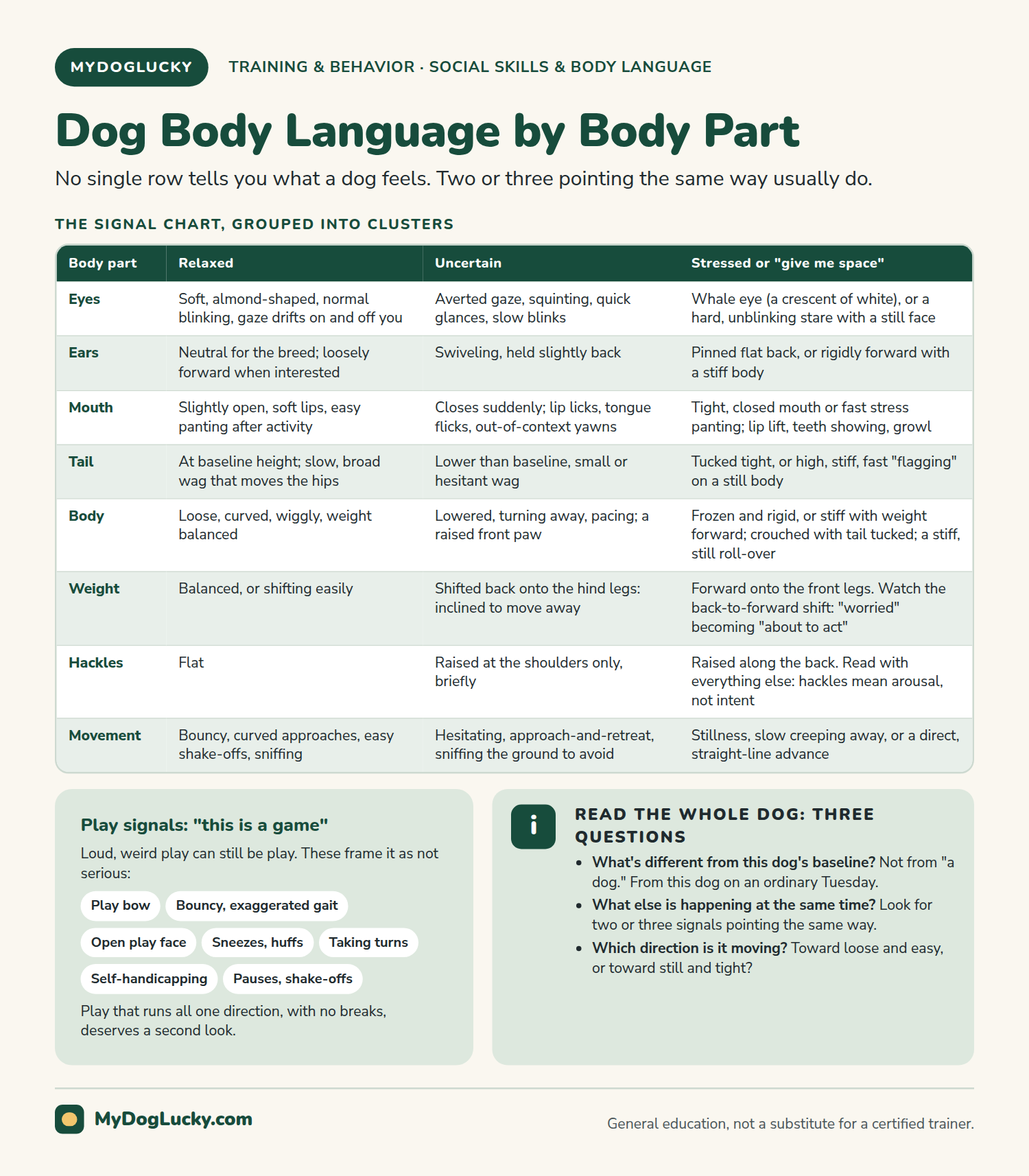
Here’s the vocabulary. Every entry comes with the same warning: a single signal is a hint, not a verdict. Read these alongside the context and the rest of the body.
Eyes
- Soft eyes. Almond-shaped, relaxed lids, frequent normal blinking, gaze that drifts on and off you. Typical of a comfortable dog.
- Whale eye. The dog turns his head slightly away while keeping his eyes on the thing that worries him, so you see a crescent of white. The AKC’s training guidance describes visible eye whites as a common sign of anxiety or stress. It often shows up when a dog is being hugged, leaned over, or approached while holding something he values.
- Hard stare. Direct, unblinking, often with a still face and forward weight. VCA’s behavior guidance describes direct staring as a threat signal, and wide-open eyes make it more intense. A hard stare is one of the clearest pre-bite signals a dog can give.
- Averted gaze. Looking away, blinking slowly, or squinting. Often an appeasing or “no conflict, please” signal. In many contexts it’s a polite request for space.
- Dilated pupils. Can appear with fear or high arousal. Hard to judge in low light or in dark-eyed dogs, so treat this as a supporting clue at most.
Ears
Ears are only as readable as the dog’s anatomy allows, which we’ll come back to. In general:
- Neutral. Wherever they sit at baseline. For a prick-eared dog, upright but not rigid. For a drop-eared dog, hanging naturally.
- Forward. Alert, interested, sometimes intent. Forward ears with a loose body say “what’s that?” Forward ears with a stiff body and a hard stare say something less friendly.
- Back and low, or pinned flat. VCA describes lowered ears as a common sign of fear or appeasement. Pinned tight against the skull, especially with a low body and a tucked tail, points toward fear.
- Constantly swiveling. Scanning the environment. Often uncertainty or vigilance rather than relaxation.
Mouth
The mouth is one of the most informative and most misread parts of dog body language.
- Relaxed, slightly open. Soft lips, tongue maybe visible, jaw loose. Comfortable.
- Closed, tight lips. A dog who was panting or loose-mouthed and suddenly closes his mouth is worth watching. Mouth closure is a common early sign that a dog has noticed something and is deciding what to do about it.
- Lip lick or nose lick (with no food around). VCA’s behavior team classifies nose-licking as an ambivalent signal seen in cautious, concerned, stressed, or anxious dogs. AKC guidance agrees that it usually signals unease rather than affection.
- Yawn (when the dog isn’t sleepy). Widely described as a stress or self-calming signal. Context separates it from an ordinary yawn: a yawn during a hug or in the vet lobby is usually not about sleep.
- Tongue flick. A quick, small flick of the tongue tip, faster and subtler than a full lick. Same family as the lip lick.
- Panting. Ordinary panting after exercise or in heat looks loose and rhythmic. Stress panting tends to be faster and shallower, and it appears when the dog hasn’t done anything to earn it. Often the lip commissure (the corner of the mouth) pulls back, which gives the face a tense, “grimacing” look.
- Lip lift or snarl. Retracting the lips to show teeth is an unmistakable warning, per VCA. It usually arrives after several quieter signals were missed.
- The “submissive grin.” Some dogs pull their lips up in a toothy grin during greetings, with a wiggly body and squinty eyes. The AKC notes this is different from a snarl. The rest of the body tells you which one you’re looking at.
Tail
Tails are the most famous piece of dog body language and the most over-interpreted. Four features matter more than the wag itself.
- Height. Compared to baseline, a tail carried higher signals arousal and, per VCA, assertiveness. Lower than baseline suggests uncertainty. Tucked between the legs points toward fear.
- Speed. Slow, broad sweeps tend to go with a relaxed dog. A fast, tight, high vibration (what VCA calls “flagging”) goes with high arousal, which can be excitement or something more tense.
- Stiffness. A loose, whole-body wag involves the hips. A stiff, high, fast wag from a dog with a still body is not a friendly signal, however much it moves.
- Direction. There is real research on left-right asymmetry in wagging, covered later. It’s interesting, and it’s not something you can reliably judge at the dog park.
Body and Posture
- Loose. Wiggly, curved, weight balanced or shifting easily. This is the posture of a dog who is comfortable in the moment.
- Curved approach. A dog who approaches another dog or person in a gentle arc, rather than straight on, is usually being polite in dog terms.
- Still. A dog who stops moving, stops sniffing, or holds a position for a beat too long has noticed something. Stillness is a pause button. What happens next depends on what you do next.
- Frozen. Rigid, breath held, no movement at all. This is a serious signal. VCA’s guidance lists stiffened limbs and a forward weight shift among the features of a threat display. A frozen dog with a hard stare is close to the top of the escalation ladder.
- Lowered. Crouching, head low, back rounded. VCA describes crouching and lowered head and neck as appeasing or “submissive” postures. We’d rather say the dog is trying to look small and non-threatening, because that describes what you see without assigning rank.
- Rolled over. Rolling onto the back can be a relaxed belly-rub invitation from a loose, wiggly dog. It can also be an appeasement posture from a stiff, still dog with a tucked tail and averted eyes. Petting the second dog’s belly is a common way to get bitten by a “sweet” dog.
- Raised paw. A front paw lifted while standing still often signals uncertainty, per the AKC. In pointing breeds it can also be a pointing posture, so watch the rest of the body.
Hackles (Piloerection)
Raised fur along the neck, shoulders, or back is one of the most misread signals there is. Both VCA and the AKC are direct on this point: raised hackles mean a dog is highly aroused, not necessarily aggressive. Dogs raise hackles when startled, excited, uncertain, or intensely interested, as well as when they’re about to escalate. Treat it as a “pay attention” sign, then read everything else.
Weight Shift
Weight forward, onto the front legs, generally means the dog is oriented toward something: interested, intent, or potentially offensive. Weight back, onto the hind legs, means the dog is inclined to move away. Watch for the moment a dog shifts from back to forward, because it often marks the transition from “worried” to “about to act.”
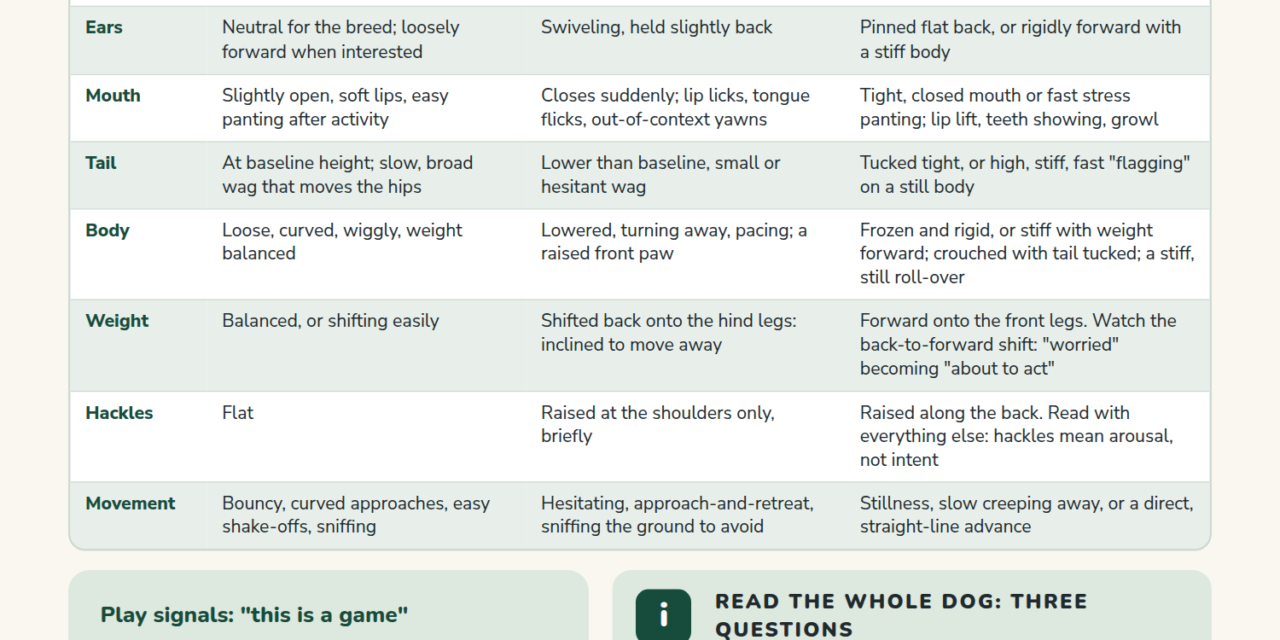
| Body part | Relaxed | Uncertain | Stressed or “give me space” |
|---|---|---|---|
| Eyes | Soft, almond-shaped, normal blinking, gaze drifts | Averted gaze, squinting, quick glances, slow blinks | Whale eye (visible whites), or a hard, unblinking stare with a still face |
| Ears | Neutral for the breed; loosely forward when interested | Swiveling, held slightly back | Pinned flat back, or rigidly forward with a stiff body |
| Mouth | Slightly open, soft lips, easy panting after activity | Closes suddenly; lip licks, tongue flicks, out-of-context yawns | Tight, closed mouth or fast stress panting; lip lift, teeth showing, growl |
| Tail | At baseline height, slow broad wag that moves the hips | Lower than baseline, small or hesitant wag | Tucked tight, or high, stiff, fast “flagging” with a still body |
| Body | Loose, curved, wiggly, weight balanced | Lowered, weight shifted back, turning away, pacing | Frozen and rigid, or stiff with weight forward; crouched with tail tucked |
| Hackles | Flat | Raised at the shoulders only, briefly | Raised along the back; read with everything else, since hackles mean arousal, not intent |
| Movement | Bouncy, curved approaches, easy shake-offs, sniffing | Hesitating, approach-and-retreat, sniffing the ground to avoid | Stillness, slow creeping away, or a direct, straight-line advance |
Calming, Appeasement, and Displacement Signals
A whole category of dog body language consists of small behaviors. They seem to appear when a dog is mildly uncomfortable, conflicted, or trying to defuse a situation. Trainers often call them “calming signals,” a term popularized by Norwegian trainer Turid Rugaas in the 1990s. Behavior scientists more often use “appeasement signals” or “displacement behaviors.” The labels differ. The behaviors are the same.
The Common Ones
- Lip licking and tongue flicks with no food in sight.
- Yawning when the dog is not tired, often during handling or when someone leans over him.
- Turning the head or body away, or offering the side of the body instead of the front.
- Sniffing the ground suddenly and intently during a tense moment, as if the grass just became fascinating.
- The shake-off. A full-body shake, like drying off after a swim, when the dog is dry. Many owners notice it right after a stressful moment ends: after a greeting, after being picked up, after the doorbell.
- Scratching out of nowhere, mid-interaction.
- Slow, curved approaches and stopping short rather than walking straight in.
- Blinking, squinting, and softening the face while looking away.
What They Probably Mean
The most defensible reading is that these are signs of low-level stress, uncertainty, or internal conflict. Some of them may also help defuse tension between dogs. A dog who lip-licks while a child reaches for his face is uncomfortable. A dog who yawns on the exam table is not sleepy. The AKC’s training guidance treats yawning and lip-licking this way, and VCA classifies nose-licking as an ambivalent, cautious signal.
Where the Evidence Is Thinner
Honest caveat: the idea that dogs deliberately send these signals to calm other dogs, as a kind of language, comes mostly from trainer observation rather than controlled research. A small 2017 pilot study in the Journal of Veterinary Behavior observed dogs meeting one another. Several of these behaviors did appear more often during interactions than when dogs were alone, and aggressive escalation was less likely after a calming signal was displayed. That’s supportive, but it’s a pilot study with a small sample. Treat “calming signals” as a useful way to notice discomfort early. Don’t treat every yawn as a deliberate diplomatic message.
The practical upshot is the same either way. If your dog is offering three or four of these in a row, something about the situation is bothering him, and it’s a good moment to change something.
Stress Signals and the Escalation Ladder
Dogs almost never go from “fine” to “bite” in one step. They climb. The clearest description of that climb is the Ladder of Aggression, developed by British veterinary behaviorist Kendal Shepherd. It was published in the BSAVA Manual of Canine and Feline Behavioural Medicine, with a client leaflet version released in 2009. It has become a standard teaching tool in veterinary behavior, and it maps closely onto what owners see at home.
The Rungs, From Bottom to Top
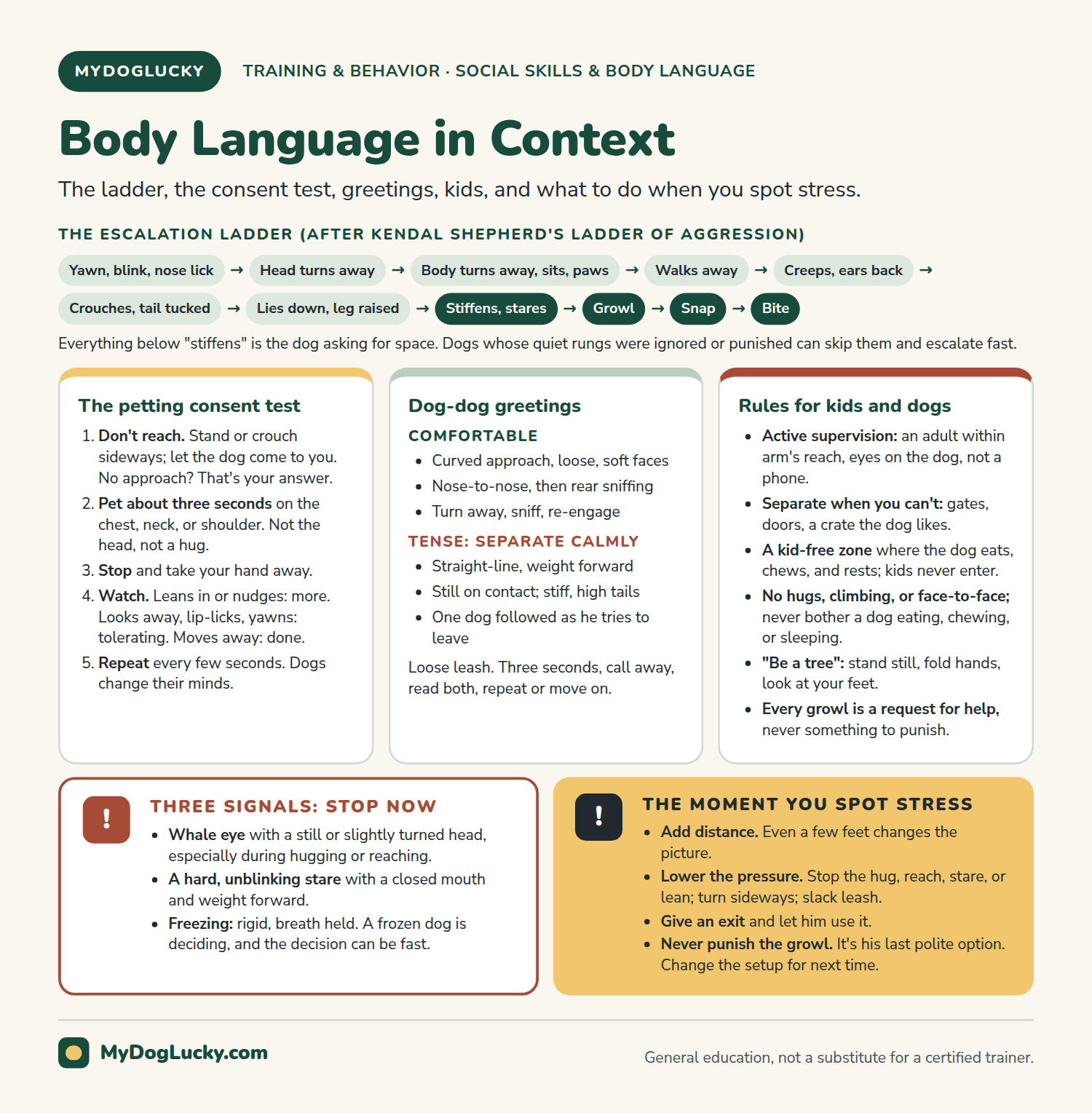
Shepherd’s ladder runs roughly like this, from the most subtle signals to the most serious:
- Yawning, blinking, nose licking
- Turning the head away
- Turning the body away, sitting, pawing
- Walking away
- Creeping, ears back
- Standing crouched, tail tucked under
- Lying down with a leg raised
- Stiffening up, staring
- Growl
- Snap
- Bite
Two things about the ladder matter more than the exact order. First, everything below “stiffening up” is the dog trying to avoid conflict. Those rungs are requests: please stop, please give me space, please let me leave. Second, the ladder isn’t a rule about pacing. VCA’s behavior team notes that signals progress on a graduated scale, but individual dogs may skip the subtle rungs and escalate extremely rapidly. That’s especially true if their history taught them the subtle rungs don’t work.
Why Punishing a Growl Removes the Warning
This is the single most important thing in this section. A growl is not the problem. A growl is information, delivered by a dog who has usually already tried several quieter signals and been ignored. If you punish the growl, you don’t change how the dog feels about the child, the hand near the bowl, or the stranger in the hallway. You teach him that growling gets him in trouble. Some dogs then stop growling and go straight from stillness to a snap, with no warning at all.
That’s why the AVSAB’s humane-training position statement and virtually every veterinary behavior source warn against punishing warning signals. When your dog growls, the right move is to stop what’s happening, create space, and then figure out what pushed him that far. Fix the cause. Keep the warning.
Three pre-bite signals that mean “stop now”
- Whale eye with a still or slightly turned head, especially during hugging, reaching, or approaching a resource.
- A hard, unblinking stare with a closed mouth and weight shifted forward.
- Freezing: the dog goes rigid and stops breathing visibly for a beat. A frozen dog is deciding, and the decision can be fast.
If you see any of these, stop the interaction calmly. Don’t reach, don’t lean in, don’t grab the collar. Step back, give the dog an exit, and lower the pressure. A dog who has shown these signals toward a family member, or around food, toys, or resting spots, needs a professional plan, not a home experiment.
Chronic Stress Looks Different From Acute Stress
The ladder describes a moment. Stress can also be a mood. A dog under ongoing stress might show shedding out of season, sweaty paw prints on a smooth floor, or loss of appetite in specific places. Pacing, excessive drinking or drooling, hypervigilance, or refusing treats he’d normally grab belong on the same list. None of those alone means much. Together, over days, they’re worth a conversation with your veterinarian, because pain and illness can produce the same picture.
Relaxed and Happy Dog Body Language
It’s easy to spend all your attention on the warning signs and forget what “good” looks like. Knowing your dog’s happy picture is just as useful, because it’s what you’re steering toward.
- The whole-body wiggle. Wag that starts at the tail and involves the hips, ribs, and sometimes the front feet. Nobody has ever needed a chart for this one.
- Soft face. Slightly open mouth, relaxed lips, soft eyes, ears neutral or loosely forward.
- Loose spine and easy weight. The dog moves freely, curves around you, leans in without stiffness.
- Bouncy, inefficient movement. Happy dogs waste energy: hopping, spinning, doing a lap of the yard for no reason.
- Willingness to disengage and come back. A comfortable dog will leave a greeting, sniff something, and return. Coming back is the part that tells you the greeting was welcome.
- Taking treats normally. A relaxed dog takes food with his usual mouth pressure. A dog who takes food hard and fast, or won’t take it at all, is telling you the setting is not relaxed.
- Rolling over with a loose body, wiggling, mouth open, maybe a leg kicking. That’s an invitation. Compare it with the stiff, still roll described earlier.
- Sleeping stretched out or on his side in the open. Dogs who feel safe sleep in vulnerable positions.
One caution: excitement isn’t the same as relaxation. A dog at the door with a high, fast tail, wide eyes, and rapid panting is aroused. Arousal can tip into jumping, mouthing, or a scuffle at the park. Reading dog body language well means noticing the difference between “happy and loose” and “happy and about to lose the plot.”
Dog Body Language During Play: Play vs. Trouble
Play is where dog body language gets loud, weird, and, to a worried owner, alarming. Play includes chasing, body slams, growling, teeth on necks, and pinning. All of it can be normal. The trick is knowing which features tell you it’s still a game.
Meta-Signals: “Everything After This Is Play”
Dogs use a handful of signals that frame what comes next as not serious. The play bow (front end down, rear end up, often with a bounce) is the famous one, and both VCA and the AKC list it as the standard invitation. The play bow also has a second job: it shows up mid-wrestle as a reset, and it shows up when your dog has your sock and would like you to know that the sock is now a game. Other meta-signals include an exaggerated, bouncy gait, a loose “play face” with an open mouth and soft eyes, and sneezing or huffing during rough moments.
Role Reversal and Self-Handicapping
In healthy play, dogs take turns. The chaser becomes the chased. The dog on top ends up on the bottom. A big dog playing with a small one will often flop onto his side, hold back his strength, or let the little one “win.” That’s self-handicapping. It’s one of the best signs that a dog is playing rather than practicing something else. Play that is all one direction, with one dog always chasing, always pinning, always on top, deserves a second look.
Pauses and Consent Checks
Good play has natural breaks. Dogs stop, shake off, sniff, then re-engage. If you’re not sure whether both dogs are enjoying it, run the simplest consent check there is. Gently separate them for a few seconds (call your dog, or hold the more intense dog by the harness or chest). Then let go. If the dog who was “losing” goes right back in, it was play. If he moves away, stays away, or goes to sniff something else, he was done, and the other dog needs a break.
| Feature | Looks like play | Looks like trouble |
|---|---|---|
| Body | Loose, bouncy, curved, inefficient movement | Stiff, efficient, straight lines, weight forward |
| Face | Open “play face,” soft eyes, relaxed lips | Closed mouth, hard stare, lip lift, whale eye in the dog being pursued |
| Roles | Take turns chasing and being chased; bigger dog self-handicaps | One dog always on top or always pursuing; no self-handicapping |
| Pauses | Frequent breaks, shake-offs, play bows to restart | No breaks; intensity climbs without resets |
| Sound | Loose, breathy play growls; huffs; sneezes | Low, sustained growl; sudden silence; a yelp followed by escalation |
| Consent check | Separated dog goes right back in | Separated dog moves away or stays away |
| Group dynamics | Two dogs, roughly matched, others ignore them | Several dogs chasing or piling on one; a dog cornered against a fence |
Interrupting Early Is Not Overreacting
Owners sometimes feel silly stepping in when “nothing happened.” Stepping in is exactly what stops something from happening. If play is getting faster, louder, and more one-sided with fewer pauses, call the dogs apart for thirty seconds, let the arousal drop, then decide whether to restart. Dog-park play with an audience of five other dogs is the setting where this matters most, because group chases can flip from game to pile-on in seconds.
Fearful vs. Offensive Body Language, and Why Fear Can Bite
Older guides sort dogs into “submissive” and “dominant.” That framing doesn’t describe what you’re seeing, and it leads to the exact mistake VCA’s behavior team warns about: assuming a low, appeasing dog won’t bite. A better split is fearful versus offensive, and both can end in teeth.
Fearful Dog Body Language
The fearful dog is trying to look small and get away. Body low, weight back, tail tucked, ears back, head turned, eyes averted or showing whale eye, maybe trembling, maybe lip-licking or yawning. He may back into a corner, hide behind a person, or roll onto his side stiffly. If he can leave, he usually will. If he can’t, because of a leash, a corner, a lap, or a hand on his collar, fear can turn into a defensive bite. It’s often fast, and often aimed at making the scary thing go away.
Offensive Dog Body Language
The offensive dog is trying to look big and move toward the problem. Weight forward, tall stance, tail high and stiff, ears forward, hard stare, closed mouth or lifted lip, hackles often up. VCA describes forward weight-shifting and stiffened limbs that enlarge the dog’s appearance as the classic threat display. This dog is more likely to advance than retreat.
Most Dogs Mix the Two
Real dogs rarely fit one column. Many “aggressive” dogs alternate: lunging forward on the leash, then retreating; barking with a high tail while their weight sits back. That ambivalence is itself a signal that the dog is conflicted, and it’s a major reason not to test the situation. Whichever column a dog leans toward, the response is the same in the moment: add distance and lower the pressure.
“Fear can bite” in one sentence
A dog who has run out of ways to leave has one option left. Reading dog body language well means never letting a fearful dog reach that point, which usually means giving him the exit before he needs it.
Breed and Body-Type Caveats
Every signal above assumes a dog with a standard-issue tail, mobile ears, an expressive face, and a coat that shows what the skin is doing. Plenty of dogs don’t have all of those, and reading dog body language on them takes extra care.
- Docked tails. A dog with a docked tail can’t show height, tuck, or wag width clearly. Some research suggests other dogs read these dogs less accurately too. A 2008 study using a life-size robotic dog model with tails of different lengths found that dogs approached the short-tailed version more cautiously and less often. Rely more on the ears, face, and whole-body posture.
- Cropped or heavy drop ears. Cropped ears can look permanently alert. Long, heavy ears on hounds and spaniels barely move. Look at the base of the ear, where the muscles are, rather than the ear flap.
- Brachycephalic (flat-faced) dogs. Bulldogs, pugs, and similar breeds have less mobile faces, prominent eyes that can look like whale eye at rest, and heavier baseline breathing that can resemble stress panting. Their baseline matters more than any general chart.
- Heavy or fluffy coats. Hackles, muscle tension, and even tail position disappear under a thick coat. Watch movement quality and the face.
- Sighthounds. Greyhounds, whippets, and their relatives carry a tucked tail and a rounded back at rest. A tuck is baseline, not fear. Look for the ears, the mouth, and whether the dog leans in or away.
- Curly or tightly carried tails. Spitz breeds and others with a tail curled over the back have a hard time lowering it. A curled tail that suddenly uncurls and drops is a bigger signal on these dogs than on others.
- Black or very dark dogs. Whale eye, pupil size, and facial tension are harder to see. Lighting matters. So does the rest of the body.
None of this means these dogs communicate less. It means you need to learn their particular dialect, which is one more argument for step one: know the baseline.
The Consent Test for Petting
Most people pet dogs by reaching for the top of the head, and most dogs would rather they didn’t. A consent test replaces guessing with asking. Fear Free-style handling guidance and most certified trainers teach some version of it.
- Don’t reach. Stand or crouch sideways, hands relaxed, and let the dog approach you. If he doesn’t approach, that’s your answer for now.
- Pet for about three seconds on a low-pressure spot: the chest, the side of the neck, the shoulder. Not the top of the head, not over the face, not a hug.
- Stop and take your hand away.
- Watch what the dog does. Leans in, nudges your hand, paws at you, moves closer: he’s asking for more. Stays put but looks away, licks his lips, yawns, or shakes off: he’s tolerating it. Moves away: he’s done.
- Repeat. Every few seconds, pause and check again. Dogs change their minds.
The dog who “tolerates” petting deserves a special mention, because tolerating is not enjoying. A dog who stands still with a closed mouth and a slightly turned head while a guest ruffles his ears is using the lower rungs of the ladder. Ending the petting there is how you keep him from needing the higher rungs. Teach visitors the pause-and-check habit. Most people find it easy once they realize the dog will tell them when to continue.
Greetings Between Dogs
On-leash greetings are one of the most common places owners misread dog body language, because everything is compressed: the space, the time, and the dogs’ options.
What a Comfortable Greeting Looks Like
Two dogs approaching on a curve rather than head-on. Loose bodies, soft faces, tails at baseline or slightly up with a loose wag. A brief nose-to-nose, then a swing around to sniff rears. Frequent small breaks: one dog turns away, sniffs the ground, then re-engages. Both dogs able to move around each other freely.
What a Tense Greeting Looks Like
A straight-line approach with weight forward. Stillness on contact. Stiff, high tails, closed mouths, direct stares. One dog rigidly standing over the other’s shoulders, or a chin resting across the other dog’s back with a still body. A dog trying to move away and being followed. Any of these, and especially any freeze, is the cue to separate calmly and move on.
Leash Tension Changes the Picture
A tight leash pulls a dog’s front end up and forward, which mimics an offensive posture whether the dog means it or not. It also removes the dog’s ability to curve, retreat, or turn away, which means the polite options on the lower ladder rungs are gone. Trainers commonly recommend keeping the leash loose during any greeting and being ready to walk away rather than letting two tight leashes tangle two stiff dogs together.
The “Three-Second Rule”
This is a widely used trainer guideline, not a scientific finding, but it’s useful. Let the dogs sniff for roughly three seconds, then cheerfully call your dog away a step or two, and read both dogs. If they’re loose and want to re-engage, let them, for another three seconds. If either has stiffened, that’s the end of the greeting, with no drama and no argument. Short greetings with resets are safer than one long greeting nobody is watching.
When to Skip the Greeting
Not every dog needs to meet every dog. If your dog is already stiff or staring at a hundred feet, or if the other owner can’t read their own dog, walk on. A polite “we’re in training, thanks” ends most conversations. Sidewalk greetings are optional. Your dog’s comfort is not.
Dog Body Language Around Kids
The photo everyone loves shows a child hugging a dog around the neck. Look at the dog in that photo. Very often you’ll see a closed mouth, a head turned away, whale eye, ears back, and a body that has gone still. The dog is “tolerating” the hug, in exactly the sense described earlier. Most of the time nothing happens. The bites that make the news frequently come from a dog who tolerated a hundred hugs and then, one day, didn’t.
What Dog Body Language Around Kids Looks Like When It’s Going Well
The dog chooses to approach the child, stays loose, and can leave whenever he wants. The child is sitting or standing, not lying on or climbing the dog. Petting happens on the dog’s side or chest with an adult’s hand guiding it. The dog’s face stays soft, the mouth stays open or relaxed, and he checks in with the adult.
What It Looks Like When It Isn’t
Lip licks, yawns, and turned heads when the child approaches. Getting up and moving away repeatedly (and being followed). Freezing during hugs or when the child leans over him. A closed mouth and a hard stare when a child comes near his bowl, his chew, or his bed. Any growl. Every one of these is a reason to end the interaction now and to change how interactions happen in your house going forward.
Supervision Rules That Actually Work
Dog-and-child safety programs such as Family Paws Parent Education and Doggone Safe teach a few consistent principles, which we’ve summarized generally here:
- Active supervision means an adult within arm’s reach, watching the dog, not a phone. “In the same room” isn’t supervision. The 2017 Frontiers study found that supervision typically drifts as kids get older and more mobile, which is exactly when interactions get riskier.
- Separate when you can’t supervise. Baby gates, a closed door, a crate the dog likes, a playpen for the toddler. Management is not a failure. It’s the plan.
- The dog gets a kid-free zone (a crate, a bed behind a gate) that children never enter, and he gets fed and given chews in it.
- No hugging, no climbing, no face-to-face, no bothering a dog who is eating, chewing, or sleeping. Teach kids to invite the dog over, pet the side, and let the dog leave.
- Teach “be a tree.” If a dog is too excited or the child feels unsure, the child stands still, folds their hands, and looks at their feet. Movement and squealing invite chasing and mouthing; stillness ends the game.
- Take every growl seriously and never punish it. A dog who growls at a child is asking for help. That household needs a professional plan, not a scolding.
At the Vet and the Groomer
Exam rooms and grooming tables are stress concentrators: strange smells, restraint, unfamiliar hands, and no exit. This is where reading dog body language pays off in very concrete ways, because it lets you help the professional help your dog.
Common Stress Signs in a Clinic or Salon
Trembling, panting when it isn’t hot, lip licking, yawning, whale eye, pinned ears, a tucked tail, sweaty paw prints on the steel table, refusing treats the dog normally loves, trying to hide behind you or under the bench, and freezing when touched. Some dogs shut down and look “good,” meaning still and quiet. Stillness is not calm. Veterinary programs such as Fear Free exist because these signs are common, measurable, and worth reducing, both for welfare and because a frightened dog is harder to examine safely.
What to Tell the Professional
Before the appointment, jot down and share:
- Your dog’s specific stress signals, in plain words (“he goes still and stops taking treats,” “she lip-licks and tries to get under my chair”).
- Which handling he tolerates and which he doesn’t (paws, ears, mouth, hindquarters, being lifted).
- Whether he’s muzzle-trained and how he feels about a muzzle.
- What he’ll work for when stressed (a specific food, a lick mat, being on the floor instead of the table).
- Any history of growling or snapping during handling, however long ago. Professionals would rather know.
If your dog’s stress at the clinic is severe, ask your veterinarian about a pre-visit plan. That conversation might include happy visits with no procedures, handling practice at home, scheduling at quiet times, or, in some cases, pre-visit medication your veterinarian prescribes. That last part is a veterinary decision. This article can’t tell you what, whether, or how much.
Tail-Wag Myths, and What the Research Actually Says
“A wagging tail means a happy dog” is the single most common misreading of dog body language, and it’s a common way children and adults get bitten by a “friendly” dog. A wag means the dog is aroused and engaged with something. What kind of arousal depends on everything else.
Speed, Height, and Stiffness Beat Direction
As covered above: slow, wide, low-to-baseline wags with a loose body tend to go with comfort. High, fast, tight wags with a stiff body go with high arousal, which can include a dog who is about to lunge. The famous “helicopter” wag, with the tail spinning in circles, is generally seen in dogs who are thrilled to see someone, per the AKC. A dog can wag while growling. A dog can wag while biting. The tail is one instrument in the orchestra.
The Left-Right Asymmetry Research
There is real, peer-reviewed research here, and it’s worth stating carefully. A 2007 study in Current Biology by Quaranta, Siniscalchi, and Vallortigara filmed dogs’ tail wags in response to different stimuli. Dogs wagged with a bias toward the right side of their body when they saw their owner. They wagged with a bias toward the left when they saw an unfamiliar, assertive dog. A 2013 follow-up by the same group found that dogs watching video of left-biased wags showed higher heart rates and more anxious behavior than dogs watching right-biased wags.
What this means for you: the asymmetry is real but subtle, measured frame by frame in a lab. Most owners can’t reliably see a few degrees of bias on a moving dog at the park. Enjoy the science. Don’t base a greeting decision on which way you think the tail is leaning.
Other Tail Myths Worth Retiring
- “A tucked tail means guilt.” There’s no evidence dogs feel guilt the way that word implies. A tucked tail when you come home to a chewed shoe is a dog reacting to your face and voice. Labeling him “guilty” leads to punishment after the fact, which teaches nothing except that your arrival is sometimes bad news.
- “A high tail means a dominant dog.” A high tail means arousal and, in some contexts, confidence or assertiveness. “Dominant” as a personality label isn’t supported by modern behavior science and tends to push owners toward confrontational methods.
- “No wag, no problem.” A still tail on a still dog is one of the most important signals in the entire article.
What to Do When You See Stress Signals
Noticing is half the skill. The other half is a calm, boring response that lowers the pressure before the dog has to raise his voice. The same few moves cover most situations.
- Add distance. Step back from the dog, or move the dog away from the trigger. Distance is the single most reliable stress reducer there is. Even a few feet often changes the picture.
- Lower the pressure. Stop the hug, the reach, the stare, the lean. Turn your body sideways. Drop your eyes. Stop talking in a high, excited voice. Let the leash go slack.
- Give the dog an exit and let him use it. Open the lap, the corner, the doorway. A dog who can leave usually will, and leaving is the goal.
- Don’t punish the growl, the lip lift, or the snap. Those are the dog’s last polite options. Suppressing them makes the next bite come with less warning.
- Change the setup before next time. Ask what pushed the dog up the ladder, and manage it. A gate, a different route, a shorter greeting, a rule about hugging, a chew given in the crate rather than in the living room.
- Write it down. Note what happened, what the dog did, and what came before. Patterns show up on paper that you’d never spot in memory.
When to Get Professional Help
Most of what’s in this article is observation and management, which any owner can do. Some situations need a qualified person looking at your specific dog, sooner rather than later:
- Growling, lip-lifting, snapping, or freezing directed at a family member, especially a child, and especially more than once.
- Resource guarding: stiffening, staring, growling, or snapping when someone approaches food, chews, toys, a bed, or a person.
- Any bite that breaks skin, and any bite involving a child regardless of severity.
- A dog who seems to skip the ladder, going from apparently calm to a snap with little warning. This is common in dogs whose warnings were punished, and it needs a professional.
- Sudden behavior changes in a previously easygoing dog. Start with your veterinarian, because pain and medical issues are common drivers of new irritability.
- Stress signals that never switch off: a dog who lip-licks, paces, and pants through most of an ordinary day.
Who to Call
Start with your veterinarian to rule out pain or illness. For training and management, look for a certified trainer, for example one holding a CPDT-KA or CPDT-KSA credential from the Certification Council for Professional Dog Trainers, or an accredited dog trainer or behavior consultant through the International Association of Animal Behavior Consultants. Ask specifically about their methods.
For fear, aggression, or bites, a veterinary behaviorist (a veterinarian board-certified by the American College of Veterinary Behaviorists) or a Certified Applied Animal Behaviorist is the right level of help. Anyone who proposes correcting the growl, “showing the dog who’s boss,” or a tool that works by causing discomfort is the wrong call for this problem, per the AVSAB’s position statement.
A Daily Observation Practice
Fluency in dog body language comes from repetition, not from memorizing a chart. Ten minutes a day is enough, and most of it can happen during things you already do.
The Five-Minute Baseline Watch
Once a day, watch your dog for a few minutes while nothing is happening. Name what you see, out loud if it helps: “ears neutral, mouth open, tail low and loose, weight even.” You’re building the reference picture. After a week you’ll notice deviations you’d never have seen before.
The Three-Moment Log
Keep a note on your phone. Each day, record three moments:
- One relaxed moment. What did his body look like? What was happening?
- One uncertain moment. What was the first signal you saw? What came right before it?
- One “what did that mean?” moment. The signal you couldn’t read. Describe it without interpreting it: “sat down suddenly on the walk, looked away, licked lips, then stood up and continued.”
Two weeks of that log will show you your dog’s individual patterns: the neighbor’s fence that always produces a lip lick, the couch cushion that triggers a freeze if someone reaches for it, the greeting style that makes him wiggle. That log is also exactly what a trainer or veterinary behaviorist wants to see if you ever need one.
A Family Version
If there are kids in the house, make it a game with real stakes: “What is the dog saying right now?” Kids who can spot a lip lick or a turned head are safer around dogs for the rest of their lives. They also enjoy being the household expert.
A one-line log template
Date · Situation (what was happening) · First signal I saw · What the dog did next · What I did · How it ended. Keep it short. Consistency beats detail.
Common Mistakes When Reading Dog Body Language
Reading One Signal in Isolation
The wagging tail, the raised hackles, the yawn. Each of them, alone, has at least two plausible meanings. Clusters and context resolve the ambiguity. Single signals create it.
Comparing Your Dog to a Generic Dog
Charts describe an average. Your greyhound, bulldog, or fluffy spitz is not an average. Learn the baseline first.
Mistaking “Tolerating” for “Enjoying”
A still dog with a closed mouth and a turned head during a hug is not having a good time. He’s being polite. Politeness runs out.
Punishing the Warning
Scolding a growl feels like addressing the problem. It removes the smoke detector and leaves the fire.
Using Labels Instead of Descriptions
“Dominant,” “guilty,” “stubborn,” “jealous.” Labels stop you from seeing what the dog is actually doing and tend to lead to confrontational responses. Describe the behavior: “he stiffened, stared, and lifted his lip when my son walked toward the bowl.” That sentence tells a professional everything. The label tells them nothing.
Letting the Leash Do the Talking
A tight leash forces a forward, upright posture and removes the dog’s polite options. Many “reactive” greetings are partly leash tension.
Assuming a Low, Rolled-Over Dog Is Safe to Touch
The stiff, still roll with a tucked tail is a request for space, not a belly-rub request. Look at the mouth, the eyes, and whether the body is loose before you reach.
Testing the Dog to See What Happens
Reaching toward the bowl “just to check,” or letting the toddler approach “to see how he does,” teaches the dog that his early signals don’t work. Manage the situation and get help instead.
Frequently Asked Questions About Dog Body Language
What is the most important dog body language signal to learn first?
Stillness. A dog who suddenly stops moving, closes his mouth, and holds a position has noticed something and is deciding what to do. Freezing sits just below growling on the escalation ladder. If you learn to spot the freeze and respond by adding distance, you’ve prevented most of the situations that end badly.
Does a wagging tail always mean my dog is happy?
No. A wag means arousal and engagement, not a specific emotion. A slow, wide wag with a loose, wiggly body usually goes with comfort. A high, fast, stiff wag on a still body can precede a lunge. Read the tail with the mouth, the eyes, and the posture.
Why does my dog yawn when I hug him?
A yawn outside of sleepy contexts is widely read as a stress or self-calming signal. Many dogs find hugs confining, since they can’t move away. Try the consent test instead: pet the chest or side for a few seconds, stop, and see whether he leans in or turns away.
What is whale eye in dog body language?
Whale eye is when a dog turns his head slightly away from something while keeping his eyes on it. You see a crescent of the white of the eye. It’s a common sign of anxiety or discomfort and often appears during hugging, leaning over a dog, or approaching something he values. On a dog with prominent eyes it can be present at baseline, so compare to that dog’s normal look.
Should I punish my dog for growling at my child?
No, and please treat this as urgent. A growl at a child is a warning that the dog has run out of quieter ways to say “I’m not okay.” Punishing it can remove the warning without changing the feeling. Separate the dog and child immediately, stop all unsupervised contact, and contact a veterinary behaviorist or a certified trainer experienced with aggression. Start with your veterinarian to rule out pain.
How can I tell if two dogs are playing or fighting?
Play is bouncy, curved, and inefficient, with role reversal, frequent pauses, play bows, and loose “play faces.” Trouble is stiff, efficient, and one-sided, with no breaks and a rising intensity. The fastest test is to separate them briefly and let go: if the dog who was “losing” goes right back in, it was play. If he leaves, it wasn’t.
Does dog body language during play include growling?
Often, yes. Play growls tend to be loose, breathy, and higher-pitched, and they come from a dog with a bouncy body and an open mouth. A low, sustained growl from a still dog with a closed mouth is different. As always, the sound only makes sense with the rest of the body.
My dog rolls onto his back when strangers approach. Is he asking for belly rubs?
Maybe. A loose, wiggly roll with an open mouth and a soft face is an invitation. A stiff, still roll with a tucked tail, averted eyes, and a closed mouth is an appeasement posture that says “please don’t.” The second dog can bite if someone reaches in. Watch the body, not just the position.
Can I read dog body language on a dog with a docked tail or cropped ears?
Yes, with more attention to the rest of the body. You lose tail height and ear position, so lean on the mouth, the eyes, the weight shift, the stiffness or looseness of the spine, and the movement quality. Other dogs may also find these dogs harder to read, so watch greetings a little more closely.
How long does it take to get good at reading dog body language?
Most owners notice a real difference within a couple of weeks of deliberate watching, especially if they keep a short log. Fluency, meaning you spot the first lip lick without trying, takes months. The good news is that the skill compounds: every signal you learn to see makes the next one easier.
Where to Start This Week
Pick one thing: the five-minute baseline watch. Sit with your dog while nothing is happening and name what you see. Tomorrow, do it again. By the weekend, run the consent test the next time you or a visitor goes to pet him, and see what he tells you.
Then start looking for the low rungs, the lip lick, the turned head, the sudden stillness, in the moments that matter: the greeting on the sidewalk, the toddler on the floor, the exam table. Every time you catch one and change the situation, your dog learns that the quiet signals work. That’s the whole point. A dog who is heard early never needs to shout.
Sources
- Horwitz D, Landsberg G (with DePorter T, Joswich J). VCA Animal Hospitals. Canine Communication: Interpreting Dog Language. Reviewed July 22, 2019.
- Gibeault S. American Kennel Club. How to Read Dog Body Language. Updated October 17, 2025.
- Shepherd K. BSAVA Library, Client Information Leaflet. Ladder of Aggression. From the BSAVA Manual of Canine and Feline Behavioural Medicine, 2nd ed. Published January 2009.
- American Veterinary Society of Animal Behavior. Humane Dog Training Position Statement. 2021.
- ASPCA. Aggression. Common Dog Behavior Issues.
- American Veterinary Medical Association. Dog Bite Prevention.
- Purdue University Canine Welfare Science / Fear Free Happy Homes. Dog Body Language 101. October 27, 2021.
- Quaranta A, Siniscalchi M, Vallortigara G. Asymmetric tail-wagging responses by dogs to different emotive stimuli. Current Biology 2007;17(6):R199–R201.
- Siniscalchi M, Lusito R, Vallortigara G, Quaranta A. Seeing left- or right-asymmetric tail wagging produces different emotional responses in dogs. Current Biology 2013;23(22):2279–2282.
- Mariti C, Falaschi C, Zilocchi M, et al. Analysis of the intraspecific visual communication in the domestic dog (Canis familiaris): A pilot study on the case of calming signals. Journal of Veterinary Behavior 2017;18:49–55.
- Arhant C, Beetz AM, Troxler J. Caregiver Reports of Interactions between Children up to 6 Years and Their Family Dog: Implications for Dog Bite Prevention. Frontiers in Veterinary Science 2017;4:130.
- Leaver SDA, Reimchen TE. Behavioural responses of Canis familiaris to different tail lengths of a remotely-controlled life-size dog replica. Behaviour 2008;145(3):377–390.
- Texas A&M University School of Veterinary Medicine & Biomedical Sciences. Understanding Your Dog’s Body Language: A Guide to Canine Communication. March 13, 2025.
- Certification Council for Professional Dog Trainers. Find a certified trainer.
- International Association of Animal Behavior Consultants. Find a behavior consultant.
- Fear Free Pets. Fear Free veterinary and handling program.
- Family Paws Parent Education. Dog and baby/toddler safety education.
- Doggone Safe. Dog bite prevention education for families.
This article is general education for U.S. dog owners. It is not individualized training, behavior, or veterinary advice for your dog. Growling, snapping, resource guarding, or any bite should be evaluated by a certified trainer, Certified Applied Animal Behaviorist, or veterinary behaviorist, and sudden behavior changes are a reason to talk with your veterinarian first, because pain and illness can change how a dog communicates.