
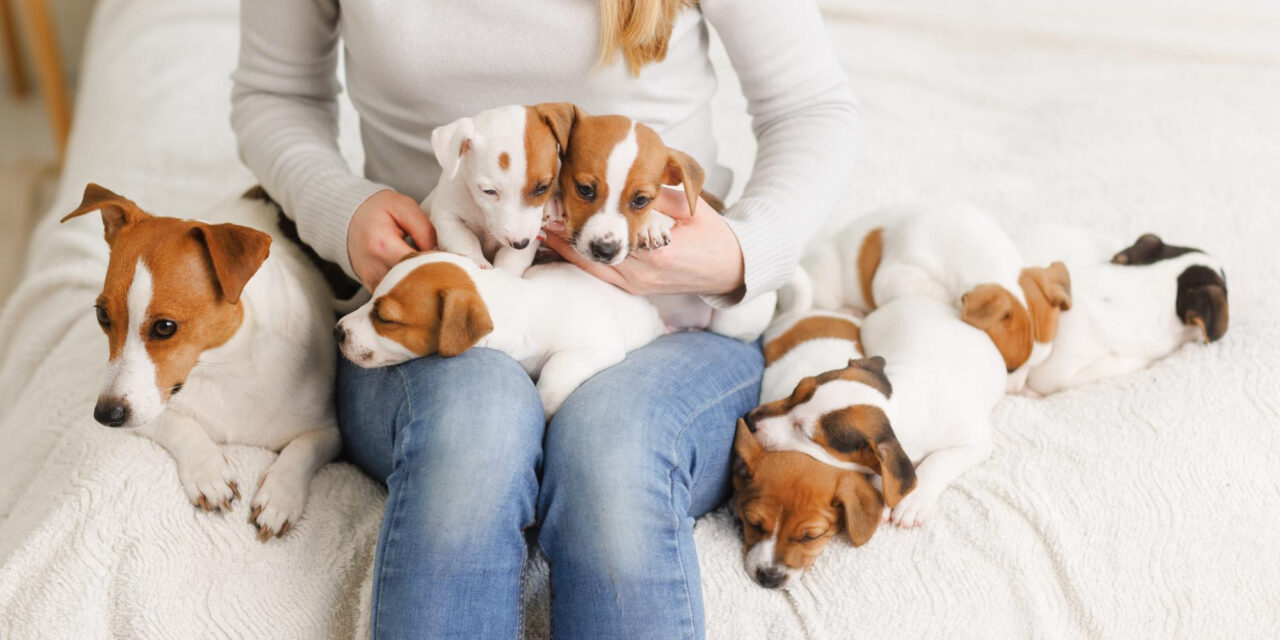
A puppy socialization checklist works best when you think of socialization as building comfort, not collecting introductions. The real goal isn’t cramming in as many new dogs and new people as possible before some invisible deadline hits. It’s giving your puppy calm, positive exposure to the sights, sounds, surfaces, and handling he’ll live with for the rest of his life, at a pace his nervous system can actually process. Done well, socialization teaches a puppy that new things are usually fine, sometimes even fun, and rarely a reason to panic. Done badly — rushed, forced, or overwhelming — it can teach the opposite lesson.
You’ve probably also run into the two pieces of advice that seem to contradict each other: get your puppy out into the world early, but don’t let him near other dogs until his vaccines are finished. Both pieces of advice are true at the same time, and this guide walks through how to hold them together — plus a full, categorized checklist you can start working through this week, how to read your puppy’s body language while you do it, and exactly where it’s safe to practice before his vaccine series wraps up.
One quick note on scope: this article focuses on exposure-based socialization — people, places, sounds, handling, and other dogs. The mechanics of your puppy’s actual vaccine schedule live in a separate MyDogLucky guide on the puppy vaccination schedule, and what happens at the appointment itself is covered in our first vet visit article. Puppy biting and teething, which often come up during handling practice, each get their own dedicated guide too. Here, the focus stays on building a puppy who takes the world in stride.
What’s in this guide
- What puppy socialization actually means
- The critical socialization window: balancing disease risk and a closing door
- The puppy socialization checklist, by category
- Reading your puppy: stress signals vs. curiosity and comfort
- Quality over quantity: why a few calm exposures beat a puppy party
- If an exposure goes badly: how to recover
- Where to socialize safely before full vaccination
- Common mistakes that undermine socialization
- A realistic plan for your first two weeks
- Frequently asked questions about puppy socialization
- Sources
What Puppy Socialization Actually Means
Ask five dog owners what socialization means and you’ll probably get five different answers, and at least two of them will mention the dog park. That’s understandable — “socializing” sounds like it should be about meeting other dogs — but the definition veterinary behaviorists actually use is broader, and more useful.
The American Veterinary Society of Animal Behavior describes socialization as the process by which a puppy develops relationships with other living beings and learns to feel comfortable in, rather than afraid of, the environments, people, and animals he’ll encounter for the rest of his life. Comfortable is the operative word. Socialization isn’t about your puppy loving every stranger who reaches for him or wanting to play with every dog on the sidewalk. It’s about him staying relaxed, or at least functional, around the ordinary stuff of daily life: a mail carrier at the door, a skateboard rolling past, a vet tech checking his ears.
Positive or Neutral, Not Just “More”
Here’s the distinction that trips people up most: a puppy who’s been dragged past twenty strangers this week hasn’t necessarily been socialized twenty times. If those encounters were overwhelming, rushed, or scary, they may have taught him the opposite lesson — that strangers are unpredictable and worth avoiding. Quantity without quality can actively work against you.
A genuinely useful exposure is one your puppy experiences as positive or, at minimum, neutral. He notices the new thing, maybe pauses, and then goes back to sniffing the sidewalk like nothing happened. That’s a win. It doesn’t have to look exciting from the outside to be doing real work on the inside.
Why This Matters More Than It Might Seem
A dog’s temperament isn’t fixed at birth. Genetics set a baseline, but early experience shapes how that baseline plays out for the rest of his life. Puppies who get a wide, gentle variety of positive exposures during their early weeks tend to grow into adult dogs who handle novelty — a new vet, a moving truck, a toddler running at them — without much drama. Puppies who miss that window, or whose early experiences were negative or overwhelming, are more likely to develop fear-based reactivity later, according to guidance summarized in AVSAB’s position statement on the topic.
That’s not a guilt trip if your puppy is already past eight or ten weeks and you’re just now reading this. It’s context for why building a puppy socialization checklist deliberately is worth the effort, instead of hoping it happens on its own during ordinary walks.
Socialization Isn’t the Same as Training
It’s easy to lump socialization in with obedience work, but they’re solving different problems. Training teaches your puppy specific behaviors on cue — sit, stay, come when called. Socialization teaches him how to feel about the world in general: whether a new sound means danger, whether a stranger’s hand is worth leaning into or leaning away from. You can have a puppy who sits beautifully and still panics at the vacuum, because sitting and feeling okay about loud appliances are unrelated skills. A genuinely useful puppy socialization checklist treats comfort-building as its own project, not a side effect of teaching commands.
The Critical Socialization Window: Balancing Disease Risk and a Closing Door
This is the section that causes the most confusion, so let’s get specific. Puppies go through what researchers call a sensitive period — sometimes called the critical socialization period — roughly between 3 and 14 weeks of age, when they’re unusually open to new experiences and unusually quick to form lasting associations with them. AVMA’s 2024 literature review on socialization in puppies and kittens describes responsiveness to unfamiliar dogs and novel environments as peaking in this window, then gradually narrowing. Puppies who don’t get positive exposure before that window closes can lose some of that flexibility — the review notes that puppies kept isolated until after 14 weeks tend to show more lasting fearfulness toward novelty than puppies socialized earlier.
Here’s the catch: that window overlaps almost entirely with the period when your puppy’s vaccine protection is still incomplete. According to the 2022 AAHA Canine Vaccination Guidelines, the core puppy vaccine series typically starts around 6 to 8 weeks old, with boosters every two to four weeks until your puppy is past 16 weeks — sometimes 18 to 20 weeks, depending on the vaccine and your puppy’s individual risk factors. Full protection generally isn’t in place until that series wraps up. Which means if you wait for “fully vaccinated” before doing any socialization at all, you’ll have missed most or all of the critical window by the time it’s safe to start under that old rule of thumb.
What AVSAB Actually Recommends
This exact tension is why the American Veterinary Society of Animal Behavior published its position statement on puppy socialization in the first place. The statement is direct about the tradeoff: it recommends that puppies begin socialization classes as early as seven to eight weeks of age, after their first round of vaccines and an initial deworming, rather than waiting for the full series to finish. AVSAB frames this as a deliberate risk-benefit call, not a shortcut — the statement notes that behavioral problems, not infectious disease, are the leading cause of death in dogs under three years old, largely because so many dogs surrendered or euthanized for behavior issues trace back to a missed socialization window.
That’s a strong claim, and it’s worth sitting with. It doesn’t mean infectious disease risk is nothing — parvovirus and distemper are genuinely dangerous, and this article isn’t telling you to ignore that risk. It means AVSAB’s professional judgment, echoed by AVMA’s more recent literature review, is that the risk of under-socialization is generally larger than the risk of a well-managed early socialization experience, provided you take sensible precautions about where and with whom.
What “Well-Managed” Looks Like
AVMA’s review and AVSAB’s statement both point toward the same practical middle ground: keep your puppy away from unvaccinated dogs of unknown health status and away from high-traffic public ground where sick animals may have been, while still allowing controlled exposure to healthy, vaccinated dogs, indoor spaces, and people. We’ll walk through exactly what that looks like, venue by venue, later in this guide.
Why the Vaccine Series Takes So Many Weeks in the First Place
It can seem strange that one shot doesn’t just handle it. The reason comes down to maternal antibodies — protective proteins a puppy gets from nursing, which fade out gradually rather than all at once. While those antibodies are still circulating, they can actually block a vaccine from working properly, which is exactly why AAHA’s guidelines call for a series of boosters spaced a few weeks apart rather than a single dose.
Maternal antibody levels typically don’t drop low enough for a vaccine to fully take hold until somewhere around 12 to 14 weeks of age, and every puppy clears them on a slightly different timeline. That’s also part of why your vet can’t just tell you an exact date your puppy becomes “safe” — it depends on biology as much as on the calendar.
The one call only your vet can make
Your veterinarian knows your puppy’s specific vaccine timeline, your local disease risk (parvovirus rates vary a lot by region and by shelter density), and your puppy’s individual health history. Bring this checklist to your next appointment and ask when it’s appropriate to start each category — most vets are glad to help you build a real timeline instead of guessing.
One more thing worth naming plainly: this is health-adjacent advice, and it’s general education, not a personalized vaccine or socialization plan for your specific puppy. Your vet’s guidance takes priority over anything in this article if the two ever disagree.
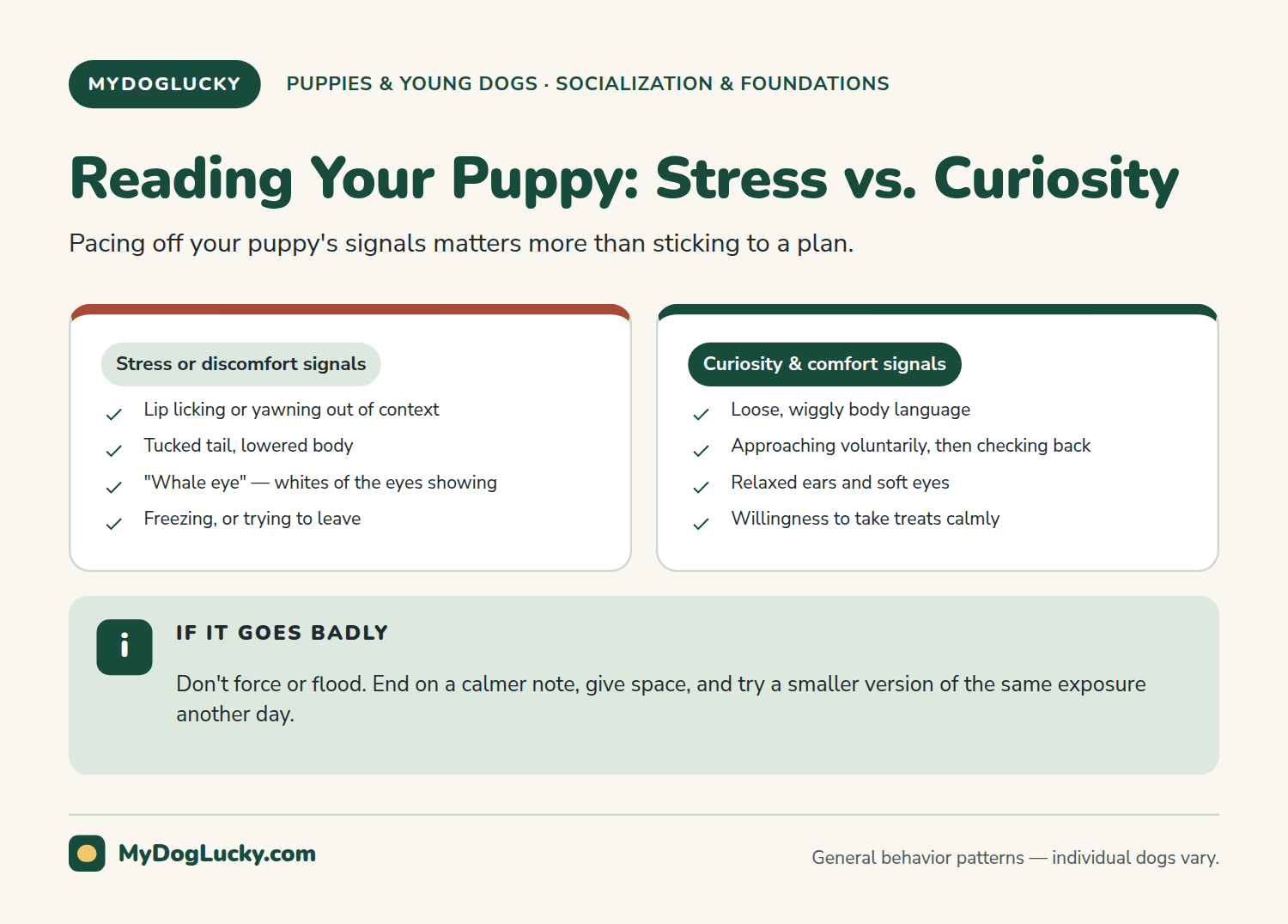
The Puppy Socialization Checklist, by Category
Here’s the actual puppy socialization checklist — organized by category, with concrete examples for each one. You don’t need to hit every single item this week, or even this month. Treat it as a menu to work through gradually, a few items at a time, always erring toward calm and positive over fast and thorough.
People: Different Ages, Appearances, and Roles
People are usually the easiest category to start with, because you don’t need a car or a plan — you just need your neighborhood. Aim for genuine variety, not just quantity. A puppy who’s met fifteen people in their thirties wearing sneakers hasn’t really met fifteen different “kinds” of person, from his perspective.
- Adults and kids of different ages, including toddlers and teenagers
- People with facial hair, glasses, and sunglasses
- People wearing hats, hoods, helmets, or uniforms — delivery drivers, mail carriers, joggers in reflective gear
- People using mobility aids: a cane, walker, wheelchair, or crutches
- People of different heights, body types, and skin tones
- People moving in unusual ways: jogging, skateboarding, pushing a stroller, carrying an umbrella
Let people toss treats near your puppy rather than reaching straight for him, especially early on. A puppy who gets to approach on his own terms, sniff, and decide the person’s fine tends to build more durable comfort than one who’s picked up and passed around a group of strangers, however well-meaning they are. Delivery drivers, in particular, deserve a permanent spot on this list — your puppy is going to meet a lot of them whether you plan for it or not.
Other Dogs: Known-Healthy, Vaccinated, and Calm
This is the category where vaccine timing matters most, so the details count. Before your puppy’s core series is finished, stick to dogs you can actually vouch for: a neighbor’s adult dog you know is current on vaccines and even-tempered, a relative’s calm senior dog, littermates from the same well-run breeder or rescue. Skip dogs of unknown vaccination status, and skip group settings where you can’t verify every dog’s health.
- One calm, fully vaccinated adult dog at a time, in a known-clean space such as your yard or a friend’s living room
- A well-run puppy socialization class that screens for vaccines and health before enrollment
- Littermates or puppies from the same litter, if you have access to them
- Dogs of different sizes and coat types, introduced one at a time and at a distance your puppy is comfortable with
Once your puppy’s fully vaccinated, the pool opens up considerably, and dog parks and larger group settings become a reasonable option if your dog enjoys that kind of setting — worth revisiting later, since not every dog does.
None of this requires special equipment or a membership fee. A neighbor with a calm, up-to-date dog is often the single most valuable resource on this whole checklist, and it costs nothing but a text message.
Environments and Surfaces
Puppies who’ve only ever walked on carpet can find a tile floor or a metal grate surprisingly unsettling later — it’s a different sound and a different feel underfoot, and nothing in their experience has prepared them for it. Building surface variety early heads off a lot of that.
- Grass, dirt, sand, and gravel
- Tile, hardwood, and linoleum
- Metal grates, storm drain covers, and manhole covers
- Stairs, both open-back and solid
- Elevators, including the movement and the door sounds
- Wobbly or uneven surfaces, like a low wobble board or a loosely stacked pile of couch cushions
- Wet pavement, puddles, and grass after rain
Introduce these one at a time, and let your puppy investigate at his own pace. Sniffing a grate for thirty seconds before deciding whether to cross it is normal information-gathering, not a problem that needs fixing.
Sounds
Sound sensitivity is one of the more common adult-dog problems that traces straight back to a socialization gap, and it’s also one of the easiest categories to practice at home.
- Vacuum cleaner and other household appliances: blender, hair dryer, washing machine
- Doorbell and knocking
- Traffic noise, sirens, and car horns
- Recorded thunder and fireworks, played at a low volume well below your puppy’s threshold and increased gradually over sessions
- Garbage trucks and other large vehicles
- Kids yelling and playing
For thunder and fireworks specifically, start quiet enough that your puppy barely reacts, and pair the sound with something good, like a meal or a favorite chew. Cranking the volume up too fast defeats the purpose; you’re not testing his limits, you’re building comfort well below them.
Handling and Husbandry
This category gets skipped constantly, and it’s arguably the one that pays off the most later. A puppy who’s comfortable having his paws, ears, and mouth handled makes every future nail trim, ear check, and vet exam dramatically easier — for him and for whoever’s holding him. Nail trims especially are the one where everyone’s dignity is on the line, yours included, so early practice pays off for both of you.
- Touching and gently holding each paw
- Looking in ears and lifting the flaps
- Opening the mouth briefly and touching teeth and gums
- Nail-trim desensitization: touching clippers to a nail without cutting, then gradually working up to a trim
- Vet-visit-style handling: being placed on a table or counter, lifted, and gently restrained the way a vet tech would
- Brushing and light grooming
- Collar and harness grabs, and being gently held by the collar
Pair every bit of handling with something your puppy likes — a lick mat, a few small treats, quiet praise — so the association builds in the right direction from the start. This is also good preparation for your puppy’s actual vet visits; our separate first vet visit guide covers what to expect once you’re in the exam room.
Keep sessions genuinely short at first — a few seconds of ear-touching, not a full-blown grooming session, especially in the beginning. You’re building a habit of “hands on my body are fine,” a few reps at a time, not trying to finish the whole list in one sitting.
Novel Objects
Puppies encounter a surprising number of strange objects in an average week, and most of the ones that spook adult dogs later — umbrellas, trash cans on the curb, balloons — are genuinely bizarre if you’ve never seen one before. To a puppy who’s never seen one open, an umbrella snapping out is basically a monster arriving out of nowhere, so a little advance warning goes a long way.
- An umbrella opening and closing
- Bicycles, skateboards, and scooters rolling past
- Trash and recycling bins, especially on collection day
- Balloons and other objects that move unpredictably
- Bags rustling, tarps flapping, and cardboard boxes
- A stroller, especially the sound of wheels on pavement
Let your puppy watch from a comfortable distance before you bring the object closer, and never force direct contact if he’d rather observe. Curiosity at a distance still counts as progress.
Car Rides
Plenty of dogs only ride in the car for a trip to the vet, which means the car itself becomes a predictor of something stressful. Short, low-stakes rides during puppyhood can prevent that association from forming in the first place.
- A few minutes in a parked, running car, just to get used to the engine noise and vibration
- Short drives around the block that end somewhere fun, not just back home
- Practice getting in and out of a secured crate or car seat
- Longer rides once short ones feel routine
Keep early rides short enough that your puppy doesn’t have time to get carsick or overwhelmed, and always secure him properly — a loose puppy in a moving car is a safety risk for everyone in it.
Brief, Calm Alone Time
This one doesn’t look like socialization in the usual sense, but comfort with being briefly alone is exactly the same kind of skill: teaching your puppy that something ordinary — in this case, you leaving the room — isn’t a reason to panic.
- A few minutes alone in a safe, puppy-proofed room with a chew
- Practicing while you’re home first, then stepping just outside the door
- Gradually increasing the duration over days and weeks, not all at once
Keep early sessions short and boring — the goal is a puppy who barely notices you left, not one who’s testing his limits at the door. If your puppy shows real distress during brief alone time, such as frantic scratching, sustained howling, drooling, or escape attempts, that’s a different conversation than ordinary socialization, and it’s worth mentioning to your vet or a trainer rather than pushing through it solo.
| Category | Example items | Where to start |
|---|---|---|
| People | Hats, uniforms, mobility aids, kids, varied ages | Your own sidewalk and driveway |
| Other dogs | Known-healthy adults, screened puppy class | A vouched-for friend’s dog, one at a time |
| Environments & surfaces | Grass, tile, grates, stairs, elevators | Rooms and surfaces already in your home |
| Sounds | Vacuum, doorbell, traffic, recorded storms | Low volume, paired with a meal |
| Handling & husbandry | Paws, ears, mouth, nail-trim practice | A few seconds at a time, daily |
| Novel objects | Umbrellas, bikes, balloons, trash bins | Watched from a comfortable distance |
| Car rides | Parked engine noise, short drives | A few minutes in the driveway |
| Calm alone time | A few minutes with a chew, door closed | While you’re still home |
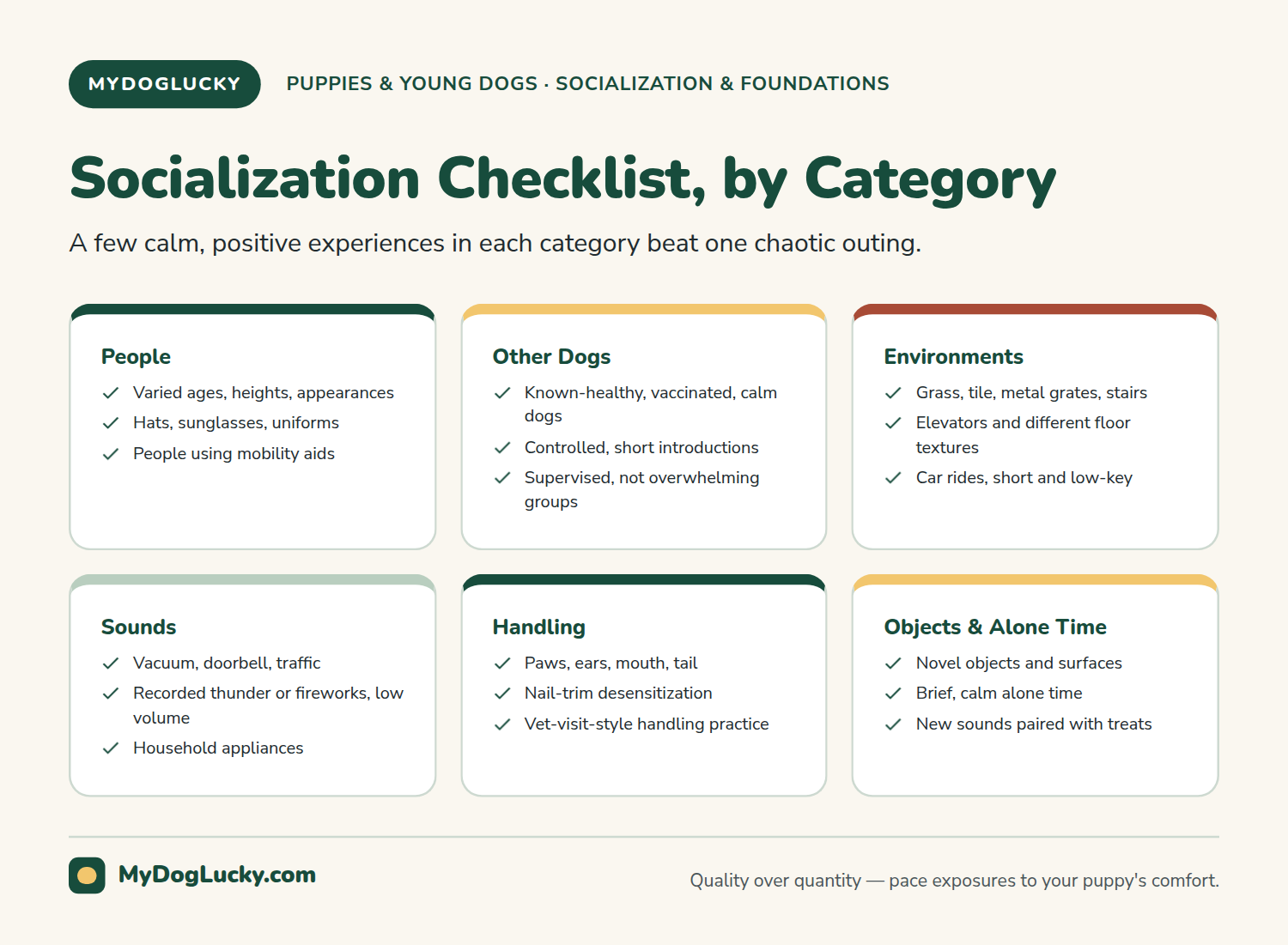
Reading Your Puppy: Stress Signals vs. Curiosity and Comfort
None of the checklist above matters much if you can’t tell whether your puppy is actually doing okay during it. Body language is the tool for that, and it’s worth learning to read before you need it, not while you’re standing on a sidewalk trying to decide whether to keep going or turn around.
Signs Your Puppy Is Stressed or Uncomfortable
- Lip licking when there’s no food around
- Yawning that’s slow and exaggerated, out of context with being tired
- A tucked or low tail, especially paired with a lowered body
- Whale eye — the whites of the eyes showing at the edges, often with the head turned slightly away
- Freezing, or going very still
- Trying to leave: pulling away, backing up, or angling his body toward an exit
- Panting without heat or exercise to explain it
- Pinned-back ears and a lowered head
- Refusing treats he’d normally take without hesitation
- Excessive shedding during the encounter itself
Any single signal here can mean plenty of ordinary things — a yawn is sometimes just a yawn. What matters is the pattern: several of these showing up together, or any of them showing up in a context that should be low-stress, like a familiar person approaching.
Signs of Curiosity and Comfort
- A loose, relaxed body, weight evenly distributed
- Soft, forward-facing ears, or ears in a neutral resting position
- Taking treats readily, without hesitation
- Sniffing at his own pace and then disengaging on his own
- A relaxed, wagging tail at a comfortable height for his breed
- Choosing to approach, rather than being coaxed or carried toward the new thing
- Playful movement: a play bow, a bouncy gait, an invitation to keep going
A curious puppy investigates, then moves on. He’s not glued to your leg, and he’s not frantically trying to escape either — he’s somewhere in the comfortable middle, taking things in at his own pace.
| Signal | Stress or discomfort | Curiosity or comfort |
|---|---|---|
| Body | Stiff, low, or tucked | Loose, weight evenly spread |
| Tail | Tucked or held low and still | Relaxed, wagging at a natural height |
| Eyes | Whale eye, wide or hard stare | Soft, blinking normally |
| Mouth | Closed tight, panting without heat | Relaxed, slightly open |
| Movement | Freezing or trying to leave | Approaching, sniffing, play bow |
Stop the exposure right away if you see
- Trembling that isn’t explained by cold
- Repeated attempts to flee or hide
- Growling, snapping, or freezing that doesn’t ease within a few seconds
- Refusing food he’d normally eat without hesitation
- Drooling or lip-licking that escalates rather than settles
None of these mean something is permanently wrong. They mean this specific exposure is too much, right now, for this puppy. Calmly create distance, let him settle, and try a smaller version another day.
A Simple Pacing Guide
Think of your puppy’s comfort as a dial, not a switch. The goal is keeping him somewhere between mildly interested and pleasantly engaged, never pushed all the way to overwhelmed. A rough way to pace any new exposure:
- Distance first. Start far enough away that your puppy notices the new thing without reacting strongly to it.
- Watch for curiosity. A loose body, sniffing, interest — that’s your cue it’s fine to move a little closer.
- Let him choose the pace. Follow his lead on how fast to close the distance, rather than a schedule you had in mind.
- End on a good note. Wrap up the session while he’s still comfortable, rather than pushing until he isn’t.
Quality Over Quantity: Why a Few Calm Exposures Beat a Puppy Party
Working through a puppy socialization checklist the right way means resisting the urge to believe more is always better. It’s tempting to think more is better here — more dogs, more people, more new places, packed into as short a window as possible before the critical period closes. Resist that instinct. A chaotic dog park visit or a backyard “puppy meet-and-greet” with a dozen strangers and a few unfamiliar dogs isn’t ambitious socialization. It’s usually just overwhelming, and overwhelming experiences can do the opposite of what you’re going for.
What “Flooding” Does
Trainers use the word flooding for exactly this scenario: exposing an animal to more stimulation than he can process, all at once, with no way to retreat. A flooded puppy isn’t learning that the world is safe. He’s often learning to shut down, or he’s practicing panic, and neither builds the comfort you’re after. A puppy who seems “fine” at a chaotic event because he’s gone still and quiet isn’t necessarily relaxed — that stillness can be closer to shutdown than calm, which is exactly why the body language checklist above matters more than how quiet he looks.
Two Genuinely Good Exposures Beat Ten Mediocre Ones
A short, calm walk where your puppy meets one new person, investigates one new surface, and hears one new sound, and stays relaxed through all of it, does more for his long-term comfort than an hour at a crowded event where he’s overstimulated by the twenty-minute mark. Fewer, better experiences build a more durable kind of confidence than a high volume of rushed ones.
The “Socialization Party” Problem
Puppy meet-and-greets and group puppy parties sound appealing, and they’re not universally a bad idea. A well-run puppy class with a trainer managing group size and reading each puppy’s comfort level is a different thing entirely from an unstructured backyard gathering. The difference is management: someone experienced needs to be watching for the signs in the last section and pulling a puppy out before he tips into overwhelmed, not after.
If you’re hosting or attending anything with multiple puppies at once, ask who’s managing pacing and group size before you go. If the honest answer is “nobody, it’s just a bunch of puppy owners hanging out,” treat it as a fun social outing for you, not a structured socialization session for your puppy, and keep your expectations, and his exposure time, accordingly modest.
Watch for Cumulative Fatigue, Not Just the Big Reaction
A puppy doesn’t need one dramatic scare to end up overwhelmed. Five small, individually manageable exposures stacked into one afternoon — a car ride, a new person, a loud truck, a strange surface, a bouncy dog — can add up to the same overwhelmed state as one big one, even though each piece looked fine in isolation. Watch your puppy’s energy across the whole outing, not just his reaction to any single new thing. A puppy who handled the first three items beautifully can still run out of coping capacity by the fourth, and that’s not a contradiction. It’s just a limited tank running low.
A practical habit: end outings a little before your puppy seems tapped out, rather than pushing until he clearly is. You’ll rarely regret quitting five minutes early. You’ll sometimes regret the extra five minutes that tips a good outing into a rough one.
If an Exposure Goes Badly: How to Recover
Sooner or later, one of these outings won’t go the way you planned. A dog barks unexpectedly, a kid runs up too fast, a garbage truck backs up right as you’re crossing the street. Your puppy startles, maybe badly. Here’s what actually helps in that moment, and afterward.
Don’t Force, Don’t Flood
The instinct to push through it so your puppy “gets used to it” usually backfires. Forcing continued contact with whatever just scared him — holding him near it, praising him while he’s clearly trying to leave, telling him he’s fine in an increasingly frustrated tone — tends to confirm that the scary thing really was worth being scared of, since he wasn’t given any way to change the outcome himself.
Create Distance and Let Him Settle
Calmly move away from whatever triggered the reaction, going far enough that your puppy’s body language starts easing back toward neutral. You’re not rewarding fear by doing this. You’re giving him information: when something’s too much, you’ll help him get space from it, not force him to tough it out.
End the Session on a Calmer Note
Rather than immediately trying again, wrap up the outing somewhere easy — a quiet stretch of sidewalk, the last few steps home, a familiar corner of the yard — so the walk doesn’t end on the scary moment. A short, calm finish resets the emotional tone of the whole outing, even if the middle of it went sideways.
Try a Smaller Version Later
Don’t avoid the trigger forever, and don’t rush back to the exact same intensity tomorrow either. If your puppy startled at a skateboard up close, try skateboards again from much farther away in a few days, and work the distance down gradually as he stays comfortable. One bad moment with a stimulus doesn’t mean it’s off-limits permanently. It means your next attempt needs a smaller, easier version.
The half-step rule
Whenever you’re reintroducing something that went badly, start at roughly half the intensity of your last successful version, not the version that scared him. Distance, volume, duration — cut it down, then build back up slowly. It feels slow. It also works, which is the part that matters.
One bad outing doesn’t undo weeks of good work, and it doesn’t mean something’s wrong with your puppy. It means his nervous system is doing exactly what nervous systems do, reacting to something unexpected, and your job is to help him recover, not to pretend it didn’t happen.
Where to Socialize Safely Before Full Vaccination
Every category on your puppy socialization checklist assumes you have somewhere safe to actually practice it. This is the practical question underneath everything else: given that your puppy’s vaccine series isn’t finished, where can you actually take him? The short answer is anywhere you can control his exposure to unknown dogs and contaminated ground, which turns out to be more places than you might think.
Carry Him, Don’t Walk Him, in High-Traffic Public Spots
You can absolutely bring your puppy into pet-friendly stores, on errands, and around town before his vaccines are complete, as long as you carry him or use a stroller rather than letting his paws touch the ground in places where unknown dogs walk. This gets him the sights, sounds, and social exposure of a busy environment while keeping him off surfaces that could carry parvovirus or other pathogens shed by sick dogs. Both AVSAB and AVMA’s literature review specifically recommend this approach for exactly the venues where risk is highest.
Well-Run Puppy Socialization Classes
A properly run class is one of the best environments available during this window, precisely because it’s designed around the same risk-benefit balance this article has been describing. Look for a class that requires proof of at least one vaccine round plus deworming before enrollment, keeps class size and puppy age capped (many good programs cut off enrollment around four months), disinfects the space between sessions, and screens out sick dogs at the door. A trainer who’s thinking about this the way AVSAB recommends will usually mention their health requirements before you even ask.
Private Yards of Known-Healthy Dogs
A friend’s or relative’s yard, with a dog you know is current on vaccines, healthy, and good with puppies, is about as safe as socialization gets. You know the dog’s history, you know the space hasn’t hosted a parade of unknown animals, and you can supervise the whole interaction directly.
Your Own Home and Yard
Don’t underestimate how much socialization work happens without leaving your property. Visitors, household sounds, different surfaces indoors, car rides that start and end in your driveway — a meaningful chunk of the checklist above doesn’t require going anywhere risky at all.
Questions Worth Asking Before You Enroll in a Class
Not every business calling itself a “puppy class” is actually managing risk the way AVSAB and AVMA describe. A quick round of questions before you sign up tells you a lot:
- Do you require proof of at least one vaccine round and a first deworming before enrollment?
- What’s the maximum age and class size, and how do you separate puppies by size?
- How and how often is the space cleaned and disinfected?
- What’s your policy if a puppy shows up sick, or a household reports a recent illness?
- Do handlers wash hands between working with different puppies?
A trainer who answers these easily, without seeming surprised you asked, is generally a good sign. A shrug in response to a health-screening question is worth taking seriously before you commit your puppy’s vaccine-incomplete weeks to that room.
Skip these until your vet clears full vaccination
- Dog parks — unknown vaccination status, high dog turnover, ground-level contact with waste from many animals
- Pet-store floors — heavy foot traffic from dogs of unknown health status
- Dog beaches and off-leash trails with unknown or unmanaged dog traffic
- Boarding and daycare facilities without a verified vaccine and health-screening policy
- Any group setting where you can’t confirm every dog’s vaccination status
These aren’t off-limits forever. Most become reasonable options once your puppy’s vaccine series is complete and your vet gives the go-ahead. Until then, the venues above cover most of what your puppy actually needs.
Common Mistakes That Undermine Socialization
Even a well-intentioned puppy socialization checklist can go sideways in a few predictable ways. Here’s what tends to trip owners up most.
Waiting for “Fully Vaccinated” Before Doing Anything
This is the single most common mistake, and it’s an understandable one — no one wants to put a puppy at risk. But waiting until the vaccine series is entirely finished, often around 16 to 20 weeks, means missing most or all of the critical socialization window described earlier. The fix isn’t ignoring vaccine risk. It’s socializing carefully within it, using the safe venues covered above.
Flooding Instead of Pacing
Cramming too much into one outing — a crowded street festival, a big family gathering, a first trip to a busy pet store, all in the same afternoon — overwhelms a nervous system that’s still learning how to process novelty. Spread exposures out, and watch the body language cues covered earlier rather than pushing through on a schedule.
Forcing Interaction With a Hesitant Puppy
Picking up a reluctant puppy and carrying him toward whatever he’s avoiding, or holding him still while a stranger pets him despite clear leave-me-alone signals, teaches him that his own signals don’t get him anywhere. Let him approach on his own terms, or don’t push the interaction that day at all.
Only Socializing With Other Puppies
Puppy playgroups are fun and useful, but a puppy who only ever practices with other puppies hasn’t practiced with calm adult dogs, unfamiliar people, new surfaces, or handling — all the categories that matter just as much for a well-rounded adult dog. Round out the checklist instead of leaning on one category because it’s the easiest or most obviously fun.
Treating Socialization as a One-Time Project
The critical window gets most of the attention, but comfort with novelty benefits from ongoing practice well past 14 weeks. AVMA’s literature review specifically points to continued reinforcement through roughly the first nine to twelve months. A puppy who was beautifully socialized at ten weeks can still get spooked by something new at seven months if that category never came up again in the meantime.
Assuming One Good Day Means You’re Finished
A single calm, successful trip to a busy sidewalk doesn’t mean the “people” category is permanently checked off. Comfort needs occasional refreshing across different contexts — a puppy relaxed around adults on your street might still need practice with kids at a park, or people in bulky winter coats. A useful puppy socialization checklist gets revisited over weeks and months, not completed once and filed away.
A Realistic Plan for Your First Two Weeks
If the full puppy socialization checklist feels like a lot to take in at once, here’s a scaled-down way to start without trying to do everything on day one.
- Days 1–2: Handling practice at home — paws, ears, mouth, a few seconds at a time, paired with treats. No pressure to go anywhere yet.
- Days 3–4: Household sounds at low volume — vacuum from another room, doorbell once or twice — paired with something good. Add a couple of visitors your puppy already knows.
- Days 5–6: A short outing carrying your puppy through a moderately busy area — a few different people, a few new sounds, from a comfortable distance.
- Days 7–8: Surface variety at home and nearby — different flooring, a few stairs, a driveway or sidewalk if your vet has cleared some ground-level exposure.
- Days 9–10: A short, calm car ride, and time with one known-healthy, vaccinated adult dog if you have access to one.
- Days 11–14: Look into a well-run puppy socialization class if one’s available near you, and start layering in novel objects — an umbrella, a stroller passing at a distance.
Expect uneven progress. Some days your puppy will breeze through something new; the next day, the same thing might get a longer look and some hesitation. That’s normal, not backsliding — puppies are learning constantly, and their reactions on any given day depend on how tired, hungry, or overstimulated they already are before you even start.
Frequently Asked Questions About Puppy Socialization
What age should I start socializing my puppy?
As early as your breeder or rescue allows, and definitely by the time he comes home around 7 to 8 weeks old. The critical window runs roughly from 3 to 14 weeks, and a meaningful chunk of it is already behind you by the time most puppies join a new family, which is exactly why waiting even longer isn’t the safer choice it might seem.
Is it really safe to socialize before my puppy’s vaccines are finished?
Safe socialization is possible, and it’s what AVSAB’s position statement and AVMA’s 2024 literature review both recommend, with real precautions. Avoid ground contact in high-traffic public areas and unknown dogs, and stick to the venues covered earlier: carrying your puppy, well-run classes, and known-healthy dogs. Confirm the specifics with your own vet, since local disease risk varies.
How many new things should I introduce per day or week?
There’s no fixed number, and chasing one can push you toward flooding rather than genuine progress. A better target is a small handful of calm, positive exposures most days, spread across different categories over the course of a week, rather than one overwhelming outing.
My puppy seems scared of everything lately. What’s going on?
Puppies sometimes go through a temporary fear period, often somewhere between 8 and 11 weeks and again around 6 to 14 months, when ordinary things can suddenly seem alarming. Keep exposures gentle and let him set the pace during this stretch. If fearfulness seems severe, constant, or isn’t easing over a couple of weeks, mention it to your vet or a qualified trainer rather than waiting it out alone.
Can I take my puppy to a dog park before he’s fully vaccinated?
Hold off. Dog parks carry unknown vaccination status, high dog turnover, and ground-level contact with waste from many animals — exactly the combination veterinary guidance recommends avoiding until your puppy’s vaccine series is complete. Once your vet clears him, a calm dog park visit can be a reasonable option, if your dog enjoys that kind of setting.
What if I adopted an older puppy who missed most of the socialization window?
Do what you can now rather than treating the window as fully closed. Dogs retain some flexibility past 14 weeks, just with more effort required, and gradual, careful exposure still helps. A trainer experienced with fearful or undersocialized dogs can help you build a plan suited to where your dog actually is, rather than where the general timeline assumes he’d be.
How is a puppy class different from just going to a dog park?
Management. A well-run class screens for vaccines and health, caps group size, keeps the space clean, and has someone experienced watching for the stress signals covered earlier so no puppy gets overwhelmed. A dog park has none of those controls, and it’s open to dogs whose vaccine and health status you can’t verify.
Does my puppy need to meet cats and other animals too?
If your household or extended family includes cats, other pets, or animals like horses your puppy might encounter later, gentle supervised exposure during this window is worth including. Keep introductions calm, give the other animal an easy way to retreat, and never force contact in either direction.
Does socialization end once my puppy turns 14 weeks old?
The most sensitive window closes gradually around then, but ongoing exposure still matters well past it. AVMA’s literature review points to continued reinforcement through roughly the first nine to twelve months as genuinely useful, not just a nice extra. Keep introducing new things at a comfortable pace throughout that first year.
What if one bad experience happens? Is the whole window ruined?
No. A single startling moment isn’t the same as chronic under-socialization, and most puppies recover fine with the approach covered in the recovery section above: create distance, end calmly, and try a smaller version later. One rough afternoon doesn’t erase weeks of good, calm exposure.
What’s the difference between socialization and habituation?
They overlap, but they’re not quite the same thing. Socialization usually refers specifically to comfort around other living beings — people, dogs, other animals. Habituation refers to getting used to inanimate stimuli, like sounds, surfaces, and objects. A thorough puppy socialization checklist really covers both processes, even though only one of them technically involves another creature. In practice, the same gentle, paced approach works for both.
Is a paid puppy class worth it if money is tight?
Not every puppy needs a formal class to get well socialized, and plenty of the checklist above costs nothing beyond your time. A class adds real value mainly through structure and expert supervision — someone experienced watching for overwhelm and managing group dynamics. If the budget isn’t there right now, you can build most of the same skills yourself using the categories, pacing guide, and safe venues covered in this article, and revisit a class later if it makes sense for your household.
Building Comfort, One Calm Exposure at a Time
If you take one thing from this guide, make it this: a puppy socialization checklist isn’t a race against a deadline, and it isn’t a scoreboard for how many new things your puppy has met. It’s a slow, deliberate build toward a dog who can handle an ordinary day — a stranger at the door, a vet visit, a thunderstorm — without much drama.
Start with what’s easiest to control: handling practice at home, a few household sounds, one visit with a dog you already trust. Watch his body language, not the calendar. And when the vaccine-timing question comes up, bring this checklist to your vet and build a real plan together, rather than guessing at what’s safe on your own.
Sources
- American Veterinary Society of Animal Behavior. Position Statement on Puppy Socialization (2008)
- American Veterinary Medical Association. Socialization of Puppies and Kittens: A Literature Review (2024)
- American Animal Hospital Association. 2022 AAHA Canine Vaccination Guidelines
- American Animal Hospital Association. 2019 AAHA Canine Life Stage Guidelines
- Ohio State University College of Veterinary Medicine. Balancing Puppy Socialization with Infectious Disease Prevention
- American Kennel Club. Puppy Socialization: Why, When, and How to Do It Right
- VCA Animal Hospitals. Puppy Behavior and Training: Socialization and Fear Prevention
- VCA Animal Hospitals. Signs Your Dog Is Stressed and How to Relieve It
- ASPCA. Tips for Socializing a Puppy
⚠️ Needs review before publishing:
– Vaccine-timing/socialization-window guidance — needs veterinary reviewer sign-off
This article is general education for U.S. dog owners. It’s not an individualized socialization or vaccination plan for your puppy. Vaccine timing depends on your puppy’s health history, local disease risk, and your veterinarian’s clinical judgment, so always confirm your puppy’s specific schedule and what’s safe before it’s complete with your vet. A puppy who seems persistently fearful, or who shows signs of resource guarding or aggression during socialization, should be evaluated by a qualified trainer or veterinary behaviorist.




Trackbacks/Pingbacks