

Food allergies in dogs get blamed for a lot of scratching that has nothing to do with food. If your dog is chewing at his paws, you’re on your third new bag of kibble this year, and nothing has really changed, you’re not alone, and there’s a real chance food isn’t the actual problem. Most itchy dogs who get labeled “food allergic” by a worried owner turn out, on closer veterinary evaluation, to be dealing with something else entirely.
That’s not a dismissal of your instincts. Something is clearly bothering your dog, and you’re right to want an answer. It’s just that food allergies in dogs are one of three lookalike conditions that all show up as itching, ear trouble, or an upset stomach, and mixing them up is exactly how owners end up cycling through six bags of food over eight months without anything actually improving.
This guide walks through how to tell a true food allergy apart from food intolerance and environmental allergy, what a real diagnostic elimination diet trial involves, why the blood and saliva “allergy tests” sold directly to pet owners aren’t considered reliable by veterinary dermatologists, and what changes once you actually have an answer. The goal is a systematic way to approach this, instead of guessing your way through the pet food aisle one bag at a time.
What’s in this guide
- Why owners confuse three different conditions
- Food allergy vs. food intolerance vs. environmental allergy
- Recognizing the symptom pattern: skin and GI signs together
- The proteins most often behind a true food allergy
- Why at-home blood and saliva allergy tests aren’t reliable
- The elimination diet trial: the actual gold standard
- Zero exceptions: treats, table food, and flavored medication
- The food challenge: confirming the diagnosis
- Why “grain-free” isn’t the same as “allergy-friendly”
- Life after diagnosis: long-term feeding and label reading
- General vet or veterinary dermatologist? When to ask for a referral
- Common mistakes that derail a diagnosis
- A systematic framework instead of randomly switching foods
- Frequently asked questions about dog food allergies
- Sources
Why Owners Confuse Three Different Conditions
Here’s the thing almost nobody explains clearly at the pet store: itching has more than one cause, and food is usually not the biggest one. A dog who scratches, licks his paws, or gets recurrent ear infections is, more often than not, dealing with an environmental allergy rather than a true dog food allergy. Veterinary dermatology guidance consistently ranks flea allergy and environmental allergy (atopic dermatitis) ahead of food allergy as causes of chronic itching in dogs, according to VCA Animal Hospitals.
That distinction matters because it changes what you should actually try first. If you assume “food” and spend two months on an expensive elimination diet while the real trigger is springtime pollen, you’ll get frustrated, your dog will stay uncomfortable, and you’ll probably conclude that diet trials “don’t work” when the truth is you were testing the wrong variable.
Three Conditions, One Set of Symptoms
Food allergy, food intolerance, and environmental allergy can all produce itchy skin, red ears, or an upset stomach. They are not the same condition, they don’t share a mechanism, and they don’t respond to the same fix. Sorting out which one (or which combination) you’re dealing with is the actual first step, before any conversation about switching foods.
Why This Gets Muddled Online
A lot of pet food marketing leans on the word “allergy” loosely, and search results tend to reinforce whatever you typed in. If you search your dog’s symptoms plus “food,” you’ll mostly get pages about food. That’s a search-engine quirk, not evidence that food is actually the cause. Working from an accurate framework first saves real time and money later.
Don’t Forget Flea Allergy
One more condition deserves a mention before we go further, even though it isn’t one of the three this guide focuses on. Flea allergy dermatitis, an allergic reaction to flea saliva from even a single bite, is generally considered the single most common cause of itchy skin in dogs overall, ahead of both environmental and food allergy, according to VCA’s guidance on inhalant allergies. If your dog isn’t on consistent flea prevention, that’s worth ruling out with your veterinarian before assuming the cause is something more complicated.
Food Allergy vs. Food Intolerance vs. Environmental Allergy
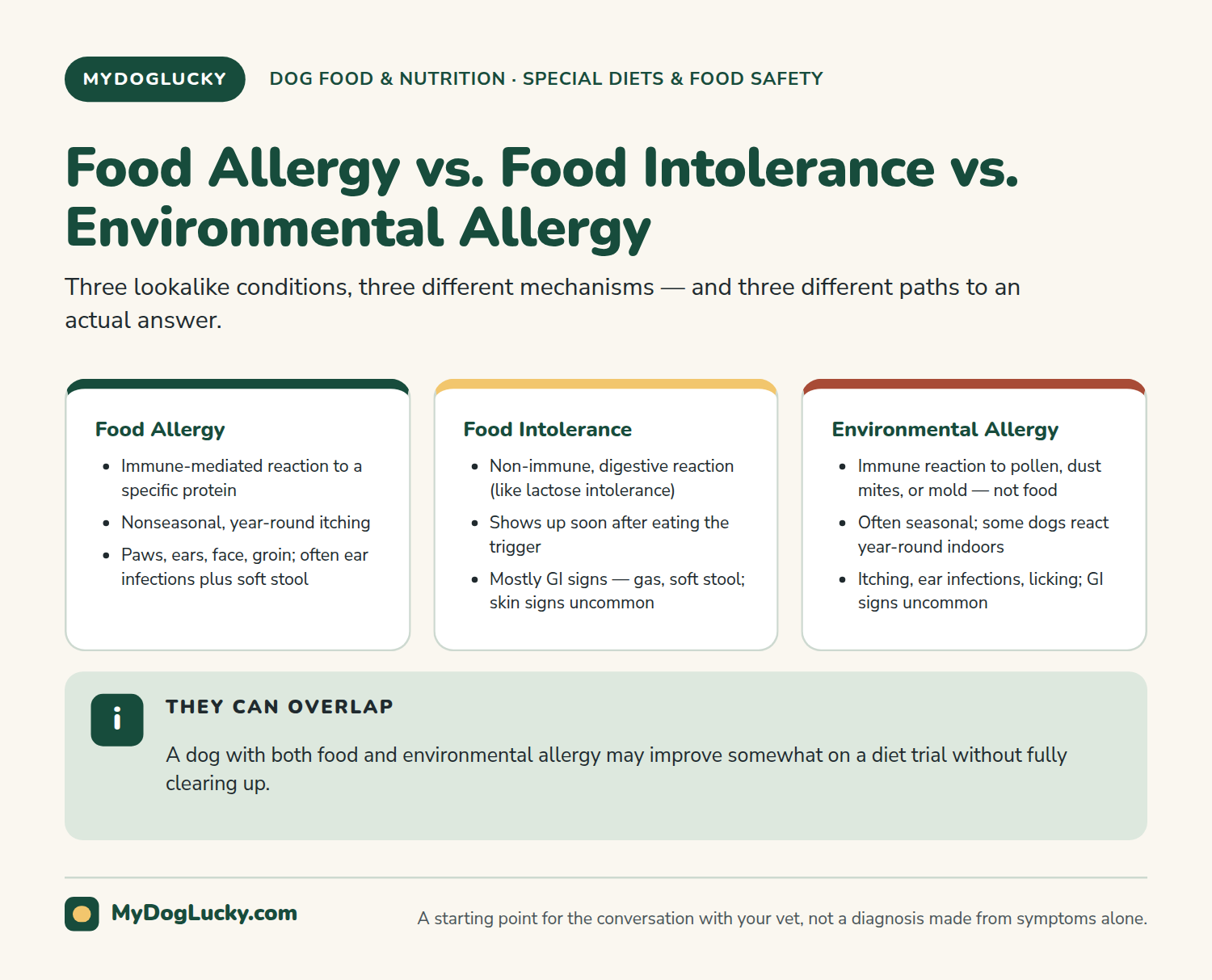
These three terms get used interchangeably by pet owners and even in casual conversation with well-meaning friends, but they describe genuinely different processes in your dog’s body.
True Food Allergy: An Immune Response
A true food allergy is an immune-mediated reaction. Your dog’s immune system misidentifies a specific protein in his food as a threat and mounts a response against it, involving IgE antibodies, other immune pathways, or a mix of both, according to a 2023 clinical review in the Journal of the American Veterinary Medical Association. That immune reaction is what produces the itching, skin inflammation, or digestive upset. It requires previous exposure to the protein, and it can develop after months or years of eating the same food without any trouble at all.
Food Intolerance: Not an Immune Problem
Food intolerance is a different animal, even though it can look similar from the outside. It’s a non-immune reaction, more like your own experience with a food that just doesn’t agree with you. Lactose intolerance is the classic example: a dog lacking enough of the enzyme to digest milk sugar gets gassy or has soft stool, but his immune system isn’t involved at all, per VCA’s guidance on adverse food reactions in dogs. Intolerance tends to show up quickly after eating a specific thing and mostly causes digestive signs rather than the itchy skin and ear pattern typical of true allergy.
Environmental (Atopic) Allergy: Not About Food At All
Environmental allergy, often called atopic dermatitis, is an immune reaction too, but the trigger isn’t food. It’s things your dog breathes in or touches: pollen, dust mites, mold spores, sometimes grass. Atopic dermatitis is actually more common than food allergy in dogs seen by veterinary dermatologists, and it often runs seasonally, though some dogs react to year-round indoor allergens like dust mites and stay itchy in every season, according to VCA’s guidance on inhalant allergies (atopy) in dogs.
Here’s the complicating part: environmental and food allergies frequently show up together in the same dog. A dog with both conditions may improve somewhat on a diet trial without fully clearing up, because the environmental component is still active. That overlap is one reason a definitive diagnosis needs a structured process rather than a guess based on symptoms alone.
| Feature | True food allergy | Food intolerance | Environmental allergy |
|---|---|---|---|
| Mechanism | Immune-mediated (IgE and/or other pathways) | Non-immune (digestive/metabolic) | Immune-mediated, triggered by inhaled/contact allergens |
| Typical onset | Any age, often after months or years of exposure | Often soon after eating the trigger food | Commonly first noticed between 1 and 3 years old |
| Seasonality | Nonseasonal, year-round | Tied to specific meals, not seasons | Often seasonal; some dogs react year-round to indoor allergens |
| Common signs | Itching, ear infections, paw licking, often with soft stool or vomiting | Vomiting, diarrhea, gas; skin signs uncommon | Itching, ear infections, licking; GI signs uncommon |
| How it’s confirmed | Strict elimination diet trial, then food challenge | Response to removing the specific food, history | Ruling out food and parasites; sometimes allergy testing to guide therapy |
A quick gut-check before you touch the food bowl
- Itching that flares in spring or fall and eases in winter? Environmental allergy is more likely than food.
- Itching plus soft stool or vomiting, no seasonal pattern, year-round? Food allergy becomes more plausible.
- Upset stomach shortly after a specific new food, skin mostly unaffected? That leans toward intolerance, not allergy.
- Some improvement on a new food but itching never fully resolves? Consider that both food and environmental allergy could be involved.
None of this replaces a veterinary work-up. It’s a starting point for the conversation, not a diagnosis you make from the couch.
Recognizing the Symptom Pattern: Skin and GI Signs Together
True food allergy in dogs has a recognizable, if not perfectly specific, symptom pattern. Knowing what it typically looks like helps you describe what you’re seeing more usefully to your veterinarian, instead of just saying “he’s itchy.”
Skin Signs
The most common presentation is nonseasonal itching, often concentrated on the paws, ears, face, armpits, groin, and the belly, according to the Merck Veterinary Manual. Many dogs develop recurrent ear infections as a primary or sole symptom, and roughly half of dogs with food allergy get ear infections at some point, per American Kennel Club veterinary guidance. Paw licking and chewing are common enough that some owners notice stained, saliva-darkened fur on the feet before they notice anything else.
Secondary Skin Infections
Persistent scratching and licking break down the skin’s normal defenses, which lets bacteria and yeast that live there harmlessly under normal conditions overgrow. Recurrent bacterial or yeast skin infections are a common secondary complication of food allergy, not a separate problem, according to the Merck Veterinary Manual. This is part of why a dog with a food allergy sometimes seems to need antibiotics or medicated shampoo over and over, without anyone addressing what’s driving the cycle in the first place.
Gastrointestinal Signs
About 30 percent of dogs with food allergy show digestive signs, most often soft stool, increased frequency of bowel movements, occasional vomiting, or excess gas, per AKC and VCA guidance. GI signs and skin signs frequently occur together in the same dog, which is actually a helpful clue: a dog with year-round itching and a sensitive stomach, and no clear seasonal pattern, fits the food allergy picture better than one with itching alone.
Location on the Body Can Be a Clue
Where the itching concentrates offers a useful, if imperfect, hint. Food allergy and environmental allergy both tend to favor the paws, ears, face, armpits, and groin. Flea allergy, by contrast, typically concentrates near the tail base, lower back, and inner thighs, since that’s where fleas most often bite. None of these patterns is airtight on its own, but describing the exact location to your veterinarian, rather than just “he’s itchy all over,” genuinely helps narrow things down faster.
What Doesn’t Fit the Food Allergy Pattern
Sudden, severe symptoms right after a specific meal, like facial swelling, hives, or vomiting within minutes, are less typical of the slow-building food allergy pattern described here and can represent a different, faster kind of reaction.
When symptoms need same-day attention, not a diet trial
Facial or muzzle swelling, hives, sudden difficulty breathing, or repeated vomiting shortly after your dog eats something new is not a “let’s start an elimination diet next week” situation. Call your veterinarian the same day, or seek emergency care if your dog is struggling to breathe or collapses. Most food allergy is a slow, chronic pattern; a fast, dramatic reaction is a different conversation.
The Proteins Most Often Behind a True Food Allergy
Owners often assume an exotic, hard-to-source ingredient is to blame. The opposite is usually true.
The Usual Suspects
According to the 2023 JAVMA clinical review, beef, dairy, chicken, and wheat are the ingredients most frequently reported as triggers in dogs with documented food allergy. The Merck Veterinary Manual lists a nearly identical group, adding lamb, with soy, corn, and eggs noted as less common but still recognized. These are ordinary, everyday ingredients, not unusual specialty items, which makes sense once you consider that a dog has to be repeatedly exposed to a protein before his immune system can develop a reaction to it. Common ingredients get more exposure, so they end up as common allergens.
Why “Novel” Depends on Your Dog’s Specific History
This is exactly why a “novel protein” diet has to be genuinely novel for your individual dog, not novel in a general sense. If your dog has been eating chicken-based treats for two years, a “new” food built around chicken isn’t novel to him at all, even if it’s a food he’s never technically eaten before. Duck, rabbit, venison, or kangaroo function as novel proteins for most pet dogs simply because they show up less often in everyday commercial diets and treats, according to VCA’s guidance on elimination-challenge diet trials.
Molecular Size Matters
Most allergenic food proteins fall in a specific size range, roughly 15 to 40 kilodaltons, that’s large enough for the immune system to recognize and small enough to survive digestion mostly intact, per the JAVMA review. That detail explains why hydrolyzed diets work as an alternative to novel proteins: breaking a protein down into much smaller fragments, generally under 5 kilodaltons, can prevent the immune system from recognizing it at all, regardless of which animal it originally came from.
GI-Only or Skin-Only Presentations Happen Too
Not every food-allergic dog shows the full combination of skin and digestive signs. Some dogs react almost entirely through the skin, with a completely normal appetite and stool. Others show mostly digestive upset with barely noticeable itching. Both patterns still fit under the same diagnostic process described later in this guide; the protein triggers involved don’t change based on which symptom shows up more, which is why the elimination trial approach works regardless of whether your dog’s main complaint is itchy paws or a sensitive stomach.
This List Points to a Process, Not a Verdict
None of this means your dog’s food necessarily contains one of these ingredients and that’s automatically your answer. It means these are the ingredients most worth accounting for when you and your veterinarian plan a diagnostic diet trial, and it’s why a full diet history, including every treat, chew, and supplement your dog has eaten, is one of the more useful things you can bring to that first appointment.
Why At-Home Blood and Saliva Allergy Tests Aren’t Reliable
This is one of the more important corrections in this whole topic, because these tests are marketed directly to pet owners and they sound scientific and convenient: mail in a cheek swab or a blood sample, get back a list of “problem” ingredients. It’s a tempting shortcut. It’s also not one veterinary dermatologists currently trust.
What the Research Actually Found
A study highlighted by Tufts University’s Cummings School of Veterinary Medicine tested blood and saliva allergy panels on dogs already confirmed, through proper diagnostic work, to either have food allergy or not. The results were striking: in one European study, 20 to 30 percent of healthy, non-allergic dogs tested positive to various foods, and saliva testing actually produced more positive reactions in healthy dogs than in allergic ones. A separate study at the Cummings School found that 60 to 100 percent of healthy dogs tested positive to one or more foods, depending on which test was used.
What That Means in Plain Terms
A test that flags healthy, non-allergic dogs as “allergic” to a majority of foods isn’t distinguishing anything useful. The 2023 JAVMA clinical review reaches the same conclusion from a different angle: serum IgE and IgG testing has been shown to be unreliable for predicting clinical food allergy, and results don’t reliably line up between different labs testing the same sample. Saliva testing has limited diagnostic value, and intradermal skin testing, useful for environmental allergies, doesn’t work for food allergy either.
The Risk of Trusting a Bad Test
Beyond wasted money, an unreliable test can actively steer you wrong. A false positive can push you toward avoiding perfectly fine, nutritionally sound ingredients for no real reason, sometimes toward expensive, less balanced “exotic” foods that don’t solve anything. A false negative can leave the actual trigger sitting in the bowl while you look elsewhere.
What Actually Works Instead
Every source in the veterinary hierarchy that examines this question, including Tufts’ Cummings School and the JAVMA review, points to the same answer: a properly run elimination diet trial followed by a food challenge remains the only diagnostic method with real evidence behind it. It’s slower and takes more discipline than mailing off a swab. It’s also the method that actually tells you something true about your specific dog.
The Elimination Diet Trial: The Actual Gold Standard
If there’s one section of this guide worth reading twice, it’s this one. A properly run elimination diet trial is the only way to actually diagnose a food allergy, and it only works if it’s done correctly, start to finish.
Choosing the Diet: Novel Protein or Hydrolyzed
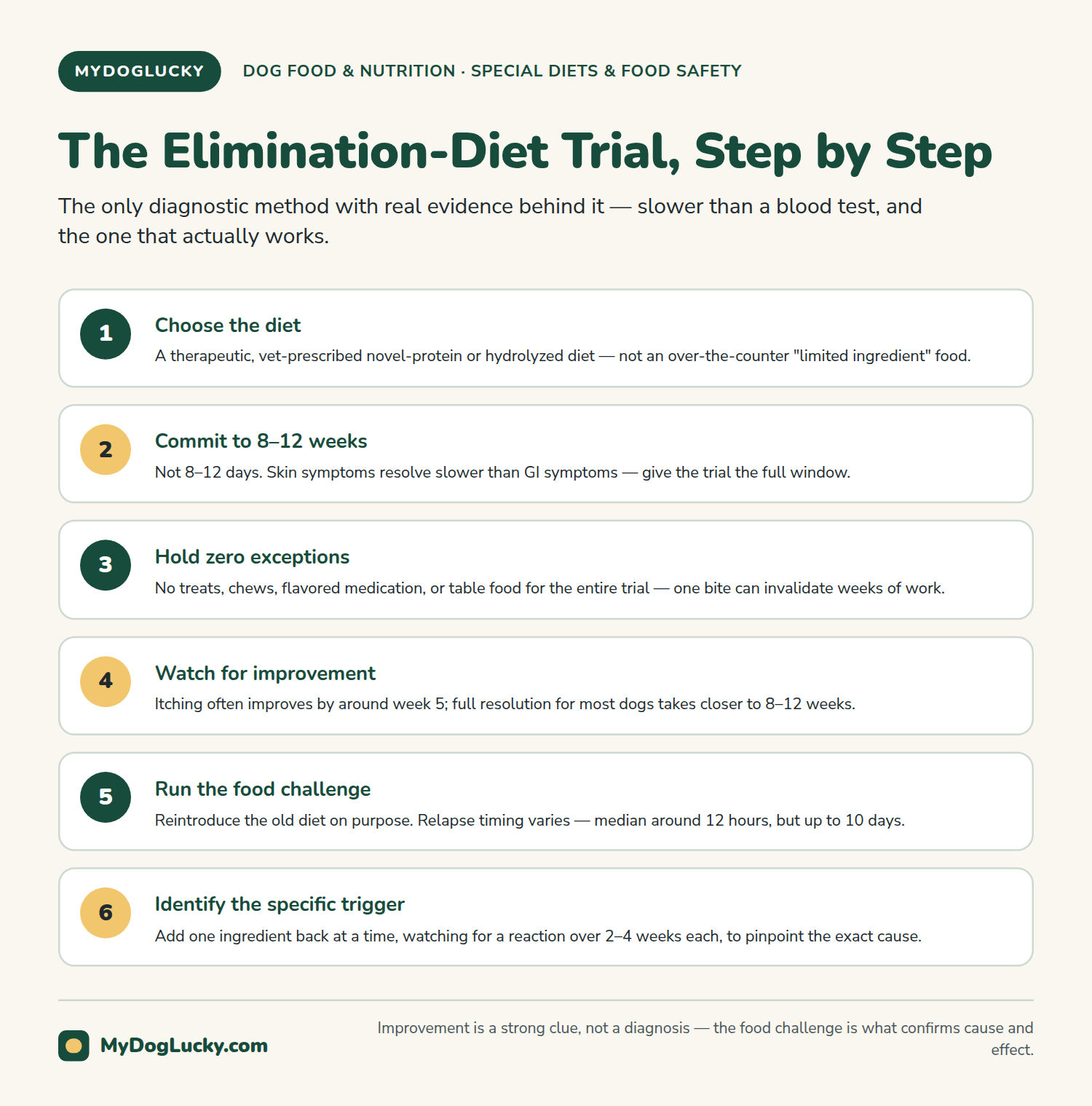
Your veterinarian will typically choose between two approaches. A novel protein diet uses one protein source and one carbohydrate source your dog has genuinely never eaten, based on a thorough diet history, according to VCA’s elimination-challenge trial guidance. A hydrolyzed protein diet uses proteins broken down into fragments small enough that the immune system generally can’t recognize them, which is useful when a complete diet history isn’t available or when finding a truly novel protein is difficult.
Therapeutic, veterinary-prescribed versions of both diet types are strongly preferred over over-the-counter “limited ingredient” foods for the trial itself. Retail limited-ingredient diets don’t carry the same manufacturing controls, and cross-contamination with other proteins during production is a documented, real problem, showing up in a meaningful share of commercial pet foods tested, per the JAVMA clinical review. A trial run on a contaminated food can produce a false negative, meaning weeks of effort with an unreliable result.
How Long a Real Trial Takes
Plan for 8 to 12 weeks, not 8 to 12 days. Skin-related symptoms resolve more slowly than digestive ones: a meaningful share of dogs with itching improve by around 5 weeks, but full resolution for the large majority takes closer to 8 to 12 weeks, according to the JAVMA review and Tufts’ Cummings School guidance. Gastrointestinal symptoms, if that’s the primary complaint, often improve faster, sometimes in as little as 3 to 4 weeks. Because you often can’t know in advance which pattern your dog will follow, committing to the full window from the start avoids the common mistake of quitting right before real improvement would have shown up.
Why “Improved” Isn’t the Same as “Diagnosed”
Improvement on the trial diet is a strong clue, not a confirmed diagnosis on its own. Plenty of things can cause a dog to look better over eight weeks that have nothing to do with which food he’s eating: a secondary skin infection clearing up with concurrent treatment, a seasonal allergy trigger fading, or simple coincidence. The next section covers the step that turns “he seems better” into an actual answer.
Zero Exceptions: Treats, Table Food, and Flavored Medication
This is where well-intentioned elimination trials fall apart most often, and it’s worth its own section because the mistake is so easy to make without realizing it.
Why “Just One Bite” Actually Matters
An elimination diet trial only works if the trial diet is genuinely the only thing entering your dog’s mouth for the full 8 to 12 weeks. A dog with a true immune-mediated allergy can react to a surprisingly small amount of the trigger protein. One bite of table food, one flavored chew, or one dose of a beef-flavored medication can reintroduce the exact allergen you’re trying to rule out, and it can invalidate weeks of otherwise careful work, according to Tufts’ Cummings School guidance on elimination diet trials.
The Full List of What Has to Stop
Sources of hidden exposure that derail a trial
- Treats and training rewards of any kind, unless made from the exact trial diet itself.
- Rawhide chews, dental chews, and bully sticks, most of which contain animal protein.
- Flavored toothpaste, which often contains poultry or malt flavoring.
- Flavored medications and supplements taken by mouth, including many heartworm and flea preventives, which frequently use a flavoring base built from a protein.
- Table food and food scraps, including anything dropped, shared, or begged for.
- Other pets’ food, if your dog has any access to a cat’s bowl or a housemate dog’s different diet.
- Flavored vitamins and joint supplements, unless specifically cleared as compatible with the trial.
Talk with your veterinarian about a flavor-free or compatible alternative for anything on this list your dog currently takes, rather than just stopping a needed medication outright.
Managing a Multi-Pet or Multi-Person Household
This part rarely gets enough attention: an elimination trial has to be a household agreement, not a solo project. Kids who slip a bite of dinner under the table, a partner who keeps the old treat jar stocked out of habit, a dog walker who wasn’t told about the trial: any of these can quietly undo weeks of progress. Write the rules down somewhere visible, and make sure everyone who feeds or handles your dog, even occasionally, knows what’s off-limits and why.
The Food Challenge: Confirming the Diagnosis
Once your dog has clearly improved on the trial diet, there’s one more step, and it’s the one people are most tempted to skip.
Why You Reintroduce the Old Food on Purpose
A food challenge means deliberately going back to your dog’s original diet and watching closely for a return of symptoms. It sounds counterintuitive, but it’s the step that actually confirms cause and effect, rather than leaving you with an improvement that could theoretically be a coincidence. If symptoms return after reintroducing the old diet, and then resolve again once you go back to the elimination diet, that pattern is what confirms a true food allergy, according to AKC and VCA veterinary guidance.
What the Timing Actually Looks Like
Relapse timing varies more than most owners expect. Research cited in the JAVMA clinical review found a median time to relapse of around 12 hours after the challenge, though the range stretched from about 1.5 days up to 10 days in some dogs, with roughly 60 percent of reactions showing up within the first half-day. A separate retrospective study found some dogs took as long as two weeks to flare. That range is exactly why a single day of “seems fine” after the challenge doesn’t rule anything out.
Identifying the Specific Ingredient
Once a true food allergy is confirmed through the challenge, many veterinarians move to a step-by-step reintroduction: adding one single ingredient back to the elimination diet at a time, watching for a reaction over roughly two to four weeks, then trying the next one, according to VCA’s elimination-challenge trial guidance. This slower process is what identifies exactly which ingredient your dog reacts to, rather than leaving you avoiding an entire diet’s worth of possible triggers indefinitely.
If You Skip This Step
Skipping the challenge is understandable; nobody wants to deliberately make their dog itchy again on purpose. But without it, you’re left managing your dog’s diet around a guess instead of a confirmed answer, which usually means avoiding more ingredients than necessary, for longer than necessary, without ever really knowing what the actual trigger was.
Why “Grain-Free” Isn’t the Same as “Allergy-Friendly”
This is one of the most persistent misconceptions in the pet food aisle, and it’s worth correcting directly: grains are not the leading cause of dog food allergies. Animal proteins are.
What the Actual Allergen List Shows
Look back at the proteins most commonly implicated in true food allergy: beef, dairy, chicken, wheat, and lamb top the list across the JAVMA clinical review, the Merck Veterinary Manual, and AKC veterinary guidance. Wheat does appear on that list, which is a grain. But the broader category of grains, corn, rice, oats, barley, doesn’t show up nearly as often as animal proteins do. Removing every grain from a diet on the assumption that “grain-free” equals “allergy-safe” usually misses the actual, much more likely culprit sitting in the same bag: the meat.
Where the Confusion Comes From
Grain-free pet food marketing took off well ahead of the science, framing grains generally as an unnecessary filler or a common allergen. Neither claim holds up well under veterinary scrutiny. Dogs are not carbohydrate-intolerant as a species, and grain-source allergies are uncommon relative to protein-source allergies in documented cases. A grain-free diet built around chicken does nothing for a dog who’s allergic to chicken.
A Separate, Important Caution About Grain-Free Diets
There’s a genuinely important reason to be thoughtful about grain-free diets, but it isn’t about allergies at all. The FDA has investigated a possible link between certain grain-free diets, particularly those high in peas, lentils, and other legumes, and a heart condition called diet-associated dilated cardiomyopathy. A 2026 update from Tufts’ Cummings School noted that current research points toward legume-heavy formulations, not grain content itself, as the likely factor, with over 30 published studies now examining the mechanism. This is a separate conversation from allergy management, and it’s a good reason to loop your veterinarian in on any decision to keep a dog grain-free long term, rather than assuming grain-free is automatically the safer or more “natural” choice.
A more useful rule of thumb
Instead of asking “grain-free or not,” ask “which specific protein does my dog react to, and is that protein anywhere in this bag?” That question actually points toward an answer. “Grain-free” on its own doesn’t.
Life After Diagnosis: Long-Term Feeding and Label Reading
Getting a confirmed diagnosis is genuinely good news, even though it can feel like the start of a more complicated feeding routine, not the end of one. Here’s what long-term management usually involves.
Reading Labels for Hidden Sources
Under AAFCO’s labeling standards, ingredients must be listed individually, by weight, in descending order, and manufacturers can’t hide a specific animal protein behind a vague collective term like “animal protein products.” That’s genuinely useful for you: once you know your dog’s trigger, you can scan an ingredient list for it by name. What the label can’t tell you is whether trace cross-contamination occurred during manufacturing, which is why sticking with brands and product lines your veterinarian trusts for consistency matters more than it might seem for a dog with a confirmed allergy.
Choosing Treats That Won’t Undo Your Progress
Treats are the most common place long-term management quietly falls apart. A dog doing well on a controlled diet can start flaring again from a well-meaning treat that contains the trigger protein, often without the owner connecting the two. Single-ingredient treats made from your dog’s safe protein, small portions of his own kibble used as training rewards, or produce your veterinarian has confirmed is fine for him are generally safer paths than assuming a treat labeled “natural” or “grain-free” is automatically compatible with his specific diagnosis.
Watching for New Triggers Over Time
True food allergy can develop to a new protein your dog is repeatedly exposed to, even one he’s eaten safely for years, since the mechanism requires prior exposure rather than being present from birth. A dog who’s been stable for a long stretch and then starts showing familiar symptoms again is worth a conversation with your veterinarian about whether a new ingredient has crept into treats, a new medication, or a recent food switch, rather than assuming the original diagnosis was wrong.
Coordinating Care Across the Household
The same household-wide consistency that matters during the trial matters just as much afterward. Anyone who feeds your dog, a sitter, a dog walker, grandkids visiting for the weekend, needs a simple, written version of what he can and can’t eat. A card in the treat drawer or a note on the fridge prevents most of the well-meaning slip-ups that undo months of stable management.
Boarding, Sitters, and Travel
A confirmed food allergy adds a step to boarding, sitters, and travel that’s easy to overlook until the week you actually need it handled. Pack enough of your dog’s exact diet and any approved treats for the full stay, plus a few extra days as a buffer, rather than assuming a boarding facility or sitter will have something suitable on hand. Write out the specific ingredient to avoid, not just the diet name, since a facility feeding multiple dogs may substitute a similar-looking food without realizing the difference matters for your dog specifically.
General Vet or Veterinary Dermatologist? When to Ask for a Referral
Your regular veterinarian is the right first call for almost every suspected food allergy, and many cases get fully diagnosed and managed at that level. Some situations genuinely call for a specialist.
What a Veterinary Dermatologist Actually Does
A board-certified veterinary dermatologist, a diplomate of the American College of Veterinary Dermatology, has completed a three-year approved residency beyond veterinary school, published original research, and passed a certifying exam specifically in skin, ear, and coat conditions, according to the ACVD. That depth of training matters for cases that don’t respond to standard approaches or that involve overlapping conditions that are hard to untangle.
Reasons Your Vet Might Refer You
A referral to a dermatologist is worth pursuing when skin issues aren’t improving despite a genuinely well-run elimination trial, when the case seems to involve both food and environmental allergy at once, when infections keep recurring despite treatment, or when the diagnosis simply isn’t becoming clear through standard steps, per ACVD guidance. None of these situations mean your regular veterinarian did anything wrong. It means the case has crossed into territory where specialized tools, like intradermal allergy testing for environmental triggers, or deeper diagnostic workups, add real value.
What to Expect From a Specialist Visit
A dermatology visit typically starts with a detailed history, including everything covered in this guide: diet history, symptom pattern, seasonality, and what’s already been tried. Expect a thorough physical exam and possibly skin scrapings, cultures, or biopsies to rule out infections and other skin diseases before circling back to allergy management specifically.
Budgeting for a Longer Workup
A referral-level workup, intradermal allergy testing, biopsies, and an extended course of a therapeutic diet, costs more than a routine wellness visit, and it’s worth asking the specialist’s office for a general estimate before you commit, since fees vary widely by clinic and region. If you have pet insurance, check what your policy covers for allergy testing and dermatology referrals before the appointment; coverage details and any pre-existing condition exclusions differ by provider and by when the policy was purchased relative to your dog’s symptoms starting.
Don’t Wait Too Long to Ask
If your dog has been through a genuinely correct elimination trial, or a full round of environmental allergy testing and treatment, without meaningful improvement, that’s a reasonable point to ask your regular veterinarian directly whether a dermatology referral makes sense, rather than trying a fourth or fifth new food on your own.
Common Mistakes That Derail a Diagnosis
Assuming Itching Automatically Means Food
Covered in detail above, and worth repeating because it’s the single most common starting error. Environmental allergy is more common than food allergy in itchy dogs overall, so ruling it out, or at least considering it seriously, belongs early in the process, not as an afterthought.
Switching Foods Every Few Weeks
Trying a new bag every three or four weeks because “it doesn’t seem to be helping” never gives any single diet the 8 to 12 weeks it actually needs to show results, especially for skin symptoms. This pattern also makes it nearly impossible to know which food, if any, actually helped.
Forgetting the Treats and Flavored Extras
The single biggest reason well-intentioned trials fail. Revisit the full list in the zero-exceptions section above before assuming a trial “didn’t work.”
Starting a Trial During an Unrelated Flare
Beginning a diet trial in the middle of flea season, a secondary skin infection, or a stretch of high environmental pollen can muddy the results in both directions. Treating any active infection first, and timing the trial start with your veterinarian, produces a cleaner read on what the diet itself is actually doing.
Stopping Early Because It “Seems to Be Working”
Improvement at week four is genuinely encouraging, but it isn’t the finish line, particularly for skin symptoms. Stopping the strict phase early and reintroducing normal food too soon is a common way to lose a clean result right before it would have become clear.
Skipping the Food Challenge
Also covered above. Without the challenge step, you’re managing around a guess, not a confirmed diagnosis, which usually means more restriction than necessary for longer than necessary.
Relying on a Commercial Allergy Test Instead of a Diet Trial
Worth restating plainly: these tests, per the research summarized above, don’t reliably separate allergic dogs from healthy ones. A test result isn’t a substitute for the elimination diet and challenge process.
Choosing a Random Store “Limited Ingredient” Food
Retail limited-ingredient diets can be a fine choice for long-term feeding once a trigger is confirmed, but they aren’t reliable for the diagnostic trial itself, due to documented cross-contamination risk during manufacturing. Use a therapeutic, veterinary-recommended diet for the actual trial.
Trusting “Hypoallergenic” on the Front of the Bag
“Hypoallergenic” is a marketing term, not a regulated claim with a fixed meaning across brands. A food labeled that way can still contain a protein your dog specifically reacts to. Check the actual ingredient list against what you know about your dog’s history, rather than trusting the word on the front of the packaging.
A Systematic Framework Instead of Randomly Switching Foods
If everything above feels like a lot at once, here’s a scaled-down sequence to actually follow, rather than trying to absorb the whole guide before doing anything.
- Track the pattern for a week or two before assuming food. Note whether itching seems seasonal or constant, whether GI signs show up alongside skin signs, and what your dog eats in a typical day, including every treat.
- Bring that record to your veterinarian first. A physical exam rules out fleas, mites, and infections that can look similar to allergy, and it’s the appropriate first step before any diet change.
- Build an honest, complete diet history together. Every treat, chew, flavored medication, and table scrap counts, since this determines which protein is genuinely novel for your specific dog.
- Commit to a real 8- to 12-week elimination trial. Choose a therapeutic novel-protein or hydrolyzed diet with your veterinarian, and hold the zero-exceptions rule for the full window, not just the first few weeks.
- Do the food challenge. Confirm the diagnosis by deliberately reintroducing the old diet and watching closely, rather than assuming improvement equals proof.
- Identify the specific trigger through one-at-a-time reintroduction, if you and your vet choose to pursue it. This step turns a broad restriction into a precise, manageable one.
- Build your long-term plan. Settle on a stable diet and treat routine, brief everyone who feeds your dog, and watch for new symptoms if a new ingredient enters the rotation later.
- Loop in a veterinary dermatologist if progress stalls. A well-run trial that still doesn’t resolve things, or a case that looks like it involves more than one condition, is a reasonable point to ask for a referral.
None of this needs to happen in a single overwhelmed weekend. Spread out, with your veterinarian involved at the key decision points, it’s a manageable process with a real answer waiting at the end of it, instead of another bag of food that may or may not help.
Frequently Asked Questions About Food Allergies in Dogs
Can a dog suddenly develop a food allergy to something he’s eaten for years?
Yes, and it surprises a lot of owners. True food allergy requires prior exposure to develop, which means a dog can eat the same protein safely for years and then start reacting to it. There’s no rule that a food has to be “new” for it to become a problem.
Is grain-free dog food hypoallergenic?
No. Grain-source allergies are uncommon compared with animal-protein allergies in documented cases, so a grain-free food built around a common protein like chicken or beef offers no protection against an allergy to that protein.
Can I run an elimination diet trial on my own without a veterinarian?
It’s not recommended. Choosing a genuinely novel protein depends on an accurate, complete diet history that’s easy to get wrong on your own, and over-the-counter foods carry a documented cross-contamination risk that can quietly invalidate a trial. A veterinarian also helps rule out other causes first and manages any medication changes needed along the way.
What if my dog has both a food allergy and an environmental allergy?
It happens more often than owners expect. In that case, a diet trial may improve things somewhat without fully resolving the itching, because the environmental component is still active. This is one of the more common reasons a case gets referred to a veterinary dermatologist for a fuller picture.
Do puppies get food allergies?
They can, though a young puppy’s itching or upset stomach is statistically more likely to trace back to parasites, a new environment, or a recent food change than to a true food allergy, since allergy typically requires a period of repeated exposure to develop. Your veterinarian can help sort out what’s actually going on.
Can I just try a few different foods at home to see what helps?
That approach usually doesn’t produce a reliable answer, because commercial foods frequently share overlapping ingredients or cross-contamination between products, and switching every few weeks doesn’t give any one diet the 8 to 12 weeks it needs to show a real result either way.
Is a raw diet safer for a dog with allergies?
Not inherently. A raw diet still contains whatever protein source it’s built around, so it offers no particular advantage for allergy management unless it happens to use a protein your dog doesn’t react to, and it introduces its own food-safety considerations worth discussing with your veterinarian.
How do I know if the elimination diet is actually working, or if it’s just coincidence?
That’s exactly what the food challenge step is for. If symptoms return after reintroducing the old food and then resolve again once you go back to the trial diet, that pattern confirms the diet is genuinely the cause, rather than a coincidence.
Can treats alone cause a flare if the rest of the diet is controlled?
Yes. A dog with a true immune-mediated allergy can react to a small amount of the trigger protein, which is exactly why treats, chews, and flavored medications have to stop completely during a trial, not just get reduced.
Will my dog need to eat a prescription diet forever?
Not necessarily. Once the specific trigger is identified through one-at-a-time reintroduction, many dogs can return to a more typical diet that simply avoids that one ingredient, rather than staying on the strict trial diet permanently. Some dogs do best staying on a therapeutic diet long term; it depends on the individual case.
What breeds are most likely to have food allergies?
Some breeds, including Boxers, Labrador Retrievers, German Shepherds, and Golden Retrievers, show up more often in reported cases, according to AKC veterinary guidance. That’s a tendency, not a guarantee or a diagnosis; plenty of dogs from these breeds never develop a food allergy, and plenty of dogs from other breeds do.
Does a positive at-home allergy test mean my dog definitely has a food allergy?
Not reliably. Research summarized above found that a majority of healthy, non-allergic dogs test positive to multiple foods on these panels, which means a positive result doesn’t confirm an actual allergy. An elimination diet trial and food challenge remain the accurate way to get an answer.
Can food allergies in dogs go away on their own over time?
Not typically. A confirmed food allergy generally needs ongoing avoidance of the trigger protein rather than resolving by itself, since the underlying immune sensitivity doesn’t usually fade with time the way a puppy might outgrow other developmental quirks. Consistent management, not waiting it out, is what keeps symptoms controlled long term.
Should I switch my dog’s food the moment I notice any itching?
Not right away. A single itchy week, especially during a seasonal pollen spike or shortly after a walk through tall grass, is more often environmental or incidental than a sign your current food has suddenly become a problem. Watching the pattern for a week or two, and mentioning it to your veterinarian, usually beats an immediate food switch based on one off day.
Where to Start This Week
If your dog is itchy, take the pressure off yourself to solve it by dinner tonight. Write down what you’re actually seeing: when it happens, whether it’s seasonal, and what your dog eats in a normal day, treats included. Bring that to your veterinarian before you buy anything new.
Food allergy is real, it’s manageable once identified, and the path to an actual answer runs through a properly structured elimination diet trial, not a blood test kit or another guess at the pet store shelf. Most of the work here is patience and consistency, not luck, and a confirmed diagnosis is worth more than a dozen bags of food you’re not sure are helping.
This article is general education for U.S. dog owners. It is not a diagnosis, an individualized feeding plan, or veterinary advice for your dog. Diagnosing and managing a suspected food allergy, including choosing an elimination diet, requires guidance from your veterinarian or a veterinary dermatologist. Facial swelling, hives, sudden difficulty breathing, or repeated vomiting after eating something new should be evaluated the same day, or as an emergency if your dog is struggling to breathe.
Sources
- Mueller, R.S., Olivry, T. Food allergy in dogs and cats; current perspectives on etiology, diagnosis, and management. Journal of the American Veterinary Medical Association, Vol. 261, Issue S1 (2023)
- MSD (Merck) Veterinary Manual. Cutaneous Food Allergy in Animals
- Tufts University Cummings School of Veterinary Medicine, Petfoodology. Think Your Pet Has a Food Allergy? Eliminating Mistakes in Elimination Diet Trials (April 4, 2022)
- Tufts University Cummings School of Veterinary Medicine, Petfoodology. Research Update: Testing for Food Allergies (March 6, 2020)
- Tufts University Cummings School of Veterinary Medicine, Petfoodology. Update on Diet-Associated Dilated Cardiomyopathy (June 22, 2026)
- VCA Animal Hospitals. Food Allergies in Dogs
- VCA Animal Hospitals. Implementing an Elimination-Challenge Diet Trial in Dogs
- VCA Animal Hospitals. Inhalant Allergies (Atopy) in Dogs
- VCA Animal Hospitals. Food Intolerance in Dogs
- American Kennel Club. Everything You Need to Know About Food Allergies in Dogs
- Association of American Feed Control Officials (AAFCO). Reading Labels
- American College of Veterinary Dermatology (ACVD). Frequently Asked Questions
- U.S. Food and Drug Administration, Center for Veterinary Medicine. FDA Investigation into the Potential Link Between Certain Diets and Canine Dilated Cardiomyopathy






Trackbacks/Pingbacks