
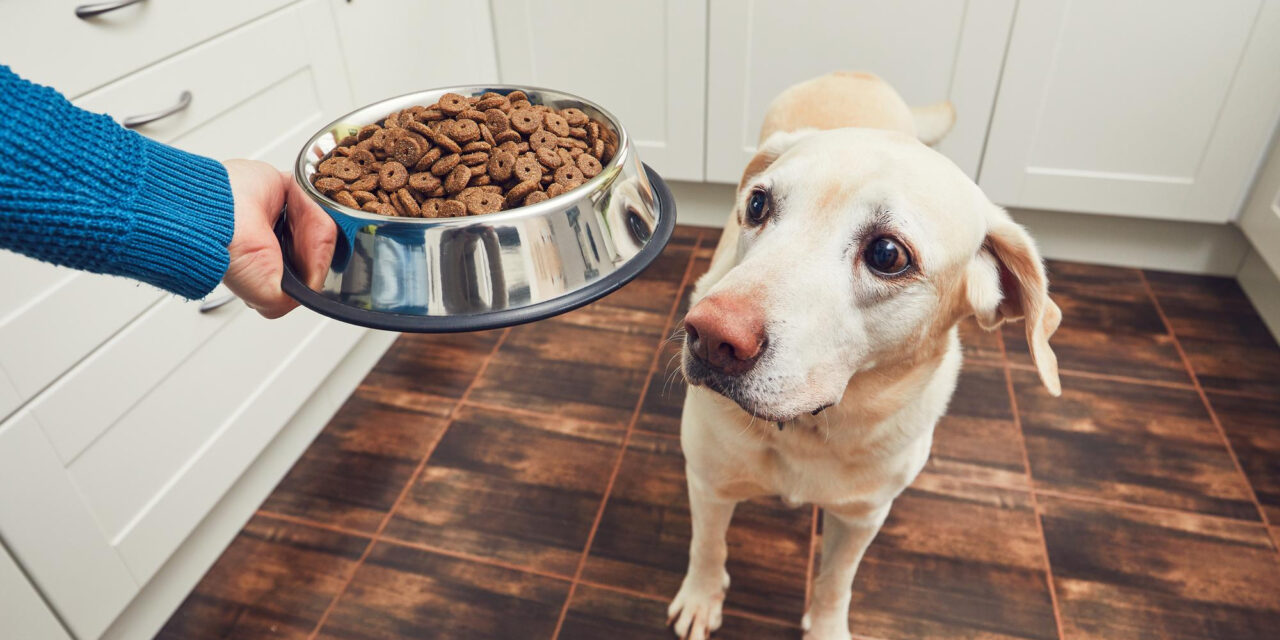
If you’re searching for the best dog food for sensitive stomachs, here’s the honest starting point: no single bag on the shelf earns that title for every dog. “Sensitive stomach” describes a pattern of signs — soft stool, occasional vomiting, gas that clears a room, a dog who turns his nose up at food he ate happily last month — not a diagnosis, and not a problem one perfect formula solves on its own.
That doesn’t mean you’re stuck guessing. Vets evaluate sensitive-stomach dogs using a fairly consistent process, and sensitive-stomach diets share a handful of structural features — protein type, fat level, fiber, digestibility — that matter more than whatever marketing language is printed on the front of the bag. This guide walks through what those signs actually mean, how a vet rules out something more serious first, what to look for structurally once diet is genuinely part of the plan, and how to pace a diet change so you don’t turn a mild problem into a bigger one.
One scope note before we start: this article focuses on general digestive sensitivity — the vomiting, loose stool, and gas that many otherwise-healthy dogs experience from time to time. True food allergies get a brief mention here, but the deeper diagnostic path belongs to a dedicated MyDogLucky article on food allergies in dogs. And if you’re mid-transition already, a separate MyDogLucky piece on how to switch dog food covers pacing in more granular detail than we’ll go into here.
What’s in this guide
- What “sensitive stomach” actually means in a dog
- A sensitive stomach vs. a diagnosable GI problem
- Food intolerance vs. true food allergy
- What your vet typically evaluates before recommending a diet change
- What to look for in a sensitive-stomach dog food
- Feeding trials and elimination diets, explained
- How to transition foods without making things worse
- Monitor, call, or go: reading your dog’s digestive signs
- Common mistakes that slow things down
- Prescription diets vs. retail formulas: the honest tradeoff
- Building your vet-conversation framework
- Frequently asked questions
- Sources
What “Sensitive Stomach” Actually Means in a Dog
“Sensitive stomach” isn’t a veterinary diagnosis. You won’t find it on a lab report or a discharge summary. It’s a description — a shorthand owners and even some product labels use for a dog whose digestive system reacts more easily than average to food, treats, or small changes in routine. That’s a real pattern worth taking seriously. It’s just not, by itself, an answer to what’s causing it.
“Sensitive Stomach” Describes a Pattern, Not a Diagnosis
Think of it the way you’d think of “bad back” in a person. It tells you something is uncomfortable and recurring. It doesn’t tell you whether the cause is a pulled muscle, a disc problem, or something else entirely, and it doesn’t tell a doctor what to prescribe. A dog labeled as having a sensitive stomach needs the same kind of follow-up question: sensitive compared to what, and for how long?
The American Kennel Club describes a sensitive stomach as ongoing digestive issues of varying types and intensities — a dog who reacts to minor dietary changes that wouldn’t faze most dogs, with symptoms that tend to persist rather than clear up in a day or two. That persistence is part of the definition. A dog who got into the trash Tuesday night and had one rough morning after isn’t necessarily a sensitive-stomach dog. A dog who reliably gets soft stool any time his food, treats, or routine shifts even slightly probably is.
The Signs Owners Usually Notice First
Four signs show up most often in the search histories that bring people to this topic, and they rarely arrive alone:
- Vomiting. Occasional, not necessarily daily — sometimes right after eating, sometimes hours later, sometimes bile on an empty stomach.
- Soft or loose stool. Not full-blown diarrhea every time, but stool that’s rarely fully formed, or that shifts texture depending on what your dog ate that week.
- Gas. The kind that’s noticeable enough to become a running household joke, and sometimes accompanied by an audibly unhappy stomach.
- Food refusal or pickiness. A dog who used to clean his bowl and now sniffs, walks away, or eats reluctantly — which can be behavioral, but can also be his body’s way of avoiding something that doesn’t sit well.
Each of these signs, alone and occasionally, happens to plenty of dogs with nothing structurally wrong. It’s the combination and the pattern that matters: how often, how long, and whether it’s getting better, worse, or staying exactly the same.
Why the Same Label Can Mean Different Things
Here’s where things get genuinely confusing for owners, and it’s worth naming directly: “sensitive stomach” gets used as an umbrella term for several different underlying situations that all happen to look similar from the outside. A dog might have a mild, low-grade intolerance to one specific ingredient. Another dog might simply have a digestive system that runs more reactive than average, full stop, without any single trigger ingredient. A third dog might be showing the earliest signs of something that will eventually need a real diagnosis — inflammatory bowel disease, exocrine pancreatic insufficiency, or a chronic parasite that keeps slipping past a single fecal test.
That range is exactly why “just try a sensitive-stomach formula and see what happens” works for some dogs and does nothing for others. You’re not treating one condition. You’re treating a symptom cluster that has more than one possible cause, and figuring out which cause applies to your dog is most of the actual work.
A Sensitive Stomach vs. a Diagnosable GI Problem
Most dogs with occasional soft stool or gas don’t have a disease. Some do. Telling the two apart from your living room is genuinely hard, and it’s not really your job to make that call alone — it’s your vet’s. What you can do is notice the pattern clearly enough to describe it well, which speeds up the whole process considerably.
What Tips the Scale Toward “Just Sensitive”
A few features tend to point toward ordinary digestive sensitivity rather than a diagnosable disease process:
- Symptoms are mild and intermittent, not daily or constant.
- Your dog’s appetite, energy, and weight stay normal between episodes.
- Symptoms track fairly clearly to something identifiable — a new treat, a table-scrap slip-up, a boarding stay, a fast food switch.
- Symptoms improve within a day or two once the trigger is removed.
- There’s no blood in the vomit or stool, no repeated straining, no visible pain.
What Tips the Scale Toward Something More Is Going On
Other patterns deserve a more serious look rather than another round of food-swapping:
- Symptoms are frequent, long-running, or worsening rather than resolving.
- Weight loss, muscle wasting, or a dulling coat shows up alongside the digestive signs.
- Vomiting or diarrhea happens even when nothing about the diet or routine has changed.
- Blood appears in vomit or stool, even occasionally.
- Your dog seems genuinely uncomfortable — a hunched posture, reluctance to move, a tucked-up abdomen.
- Multiple “sensitive stomach” formulas have all been tried, each helping briefly before symptoms return.
The Merck Veterinary Manual’s owner-facing overview of stomach and intestinal disorders notes that these conditions can stem from infectious causes — bacterial, viral, or parasitic — and from noninfectious ones, including tumors, bloat, and obstruction, alongside dietary indiscretion and inflammatory disease. That range of possible causes is exactly why a persistent pattern deserves proper evaluation rather than a guess based on symptoms alone.
When to stop diet-guessing and book a vet visit
- Digestive symptoms that have lasted more than a couple of weeks, on and off, with no clear trigger.
- Any weight loss, even gradual, alongside ongoing GI signs.
- Blood in vomit or stool, however small the amount.
- Symptoms that return every time you try a new food, regardless of the formula.
- A dog who seems painful, lethargic, or “just not right” between episodes, not only during them.
None of these automatically mean a serious diagnosis. They mean the next useful step is a veterinary workup, not another bag of food picked off a shelf.
A quick side-by-side, for the moments you’re genuinely not sure which pattern you’re looking at:
| Signal | Ordinary sensitivity | Possible diagnosable disease |
|---|---|---|
| Frequency | Occasional, tied to identifiable triggers | Frequent, chronic, or unpredictable |
| Weight and energy | Stable between episodes | Weight loss, low energy, muscle loss |
| Response to a food change | Settles within a day or two | Improves briefly, then returns regardless of formula |
| Stool or vomit appearance | No blood, no mucus in excess | Blood, black tarry stool, or repeated straining |
| Overall demeanor | Normal in between episodes | Signs of pain or discomfort even at rest |
Food Intolerance vs. True Food Allergy
Owners often use “sensitive stomach,” “food intolerance,” and “food allergy” interchangeably, and honestly, the symptoms overlap enough that it’s an easy mix-up. The mechanisms behind them are different, though, and that difference eventually matters for how a vet approaches treatment.
The Quick Version
Food intolerance doesn’t involve the immune system. It’s a digestive-level reaction — a dog’s gut struggling to process a particular ingredient, an amount of fat, or a type of fiber — and according to VCA Animal Hospitals, it can show up the very first time a dog eats the problem food, with no buildup required. A true food allergy is an immune response: the body treats a specific protein as a threat and reacts to it, and VCA notes that allergic reactions typically develop only after repeated exposure to that protein over time, not on the first bite.
Both can produce the same visible signs — vomiting, loose stool, gas, itchy skin in some cases — which is precisely why they’re so easy to confuse without a proper workup. A dog with a true food allergy will often show skin signs too, not just digestive ones: chronic ear infections, paw-licking, or generalized itchiness alongside the GI symptoms. A dog with a straightforward intolerance usually doesn’t.
Why the Distinction Matters for What You Feed
For most dogs showing up in this article’s audience — mild, intermittent digestive upset without significant skin involvement — intolerance is the more likely explanation, and it’s also the good news version. According to Tufts University’s Clinical Nutrition Service, true food allergy is actually the least likely cause among dogs presenting with chronic digestive upset, even though it gets blamed first in a lot of internet advice. That’s worth sitting with for a second: the ingredient panic that drives so much dog-food shopping is often aimed at the wrong culprit.
If your dog’s pattern includes recurring skin issues, chronic ear infections, or itching alongside the digestive signs, that combination points more toward a true allergy investigation, and it’s worth reading MyDogLucky’s dedicated article on food allergies in dogs for the deeper diagnostic path — which typically runs longer and requires stricter control than a general sensitive-stomach approach. If the pattern is digestive-only and intermittent, the more general framework in the rest of this article is the right starting point.
What Your Vet Typically Evaluates Before Recommending a Diet Change
Skipping straight to “let’s try a new food” without ruling anything else out is one of the most common and most understandable mistakes owners make, because a diet change feels like something you can do today, on your own, without an appointment. The problem is that a diet change treats a guess, and guesses miss real causes often enough that vets build a fairly standard process around ruling those out first.
Ruling Out Parasites and Infection First
Intestinal parasites are one of the most common, most overlooked causes of chronic soft stool, and they’re also one of the easiest to miss on a single test. According to the Merck Veterinary Manual’s guidance on chronic enteropathies, a fecal exam screens for parasites like intestinal worms and Giardia, but a course of a broad-spectrum dewormer is often recommended even when that test comes back negative, because Giardia sheds intermittently and a single sample can easily miss it. That’s a genuinely useful thing to know before you spend a month agonizing over ingredient panels: the actual cause might be a parasite a single stool sample didn’t catch.
Bacterial and other infectious causes get considered alongside parasites, particularly if symptoms came on suddenly or alongside other signs of illness like fever or lethargy.
Checking for Pancreatitis, IBD, and Other Diagnosable Disease
If parasites and infection don’t explain the pattern, and especially if symptoms are chronic rather than acute, your vet will typically look further. Pancreatitis — inflammation of the pancreas, often triggered by a high-fat meal but not always — is a common consideration, particularly in a dog who’s had loose stool or vomiting alongside a painful abdomen or reduced appetite. According to the Merck Veterinary Manual, pancreatitis signs range from mild (decreased appetite, lethargy, loose stools) to more severe (loss of appetite, vomiting, weakness, abdominal pain, dehydration, and diarrhea), and dietary fat is central to how it’s managed once diagnosed.
For dogs with chronic, unresolved digestive symptoms, inflammatory bowel disease and other forms of chronic enteropathy come into the picture. Diagnosing these conditions, per Merck’s guidance, relies on a combination of history, clinical signs, and — notably — response to treatment, including diet trials. If initial diet and medication trials don’t resolve things, and other causes have been ruled out, endoscopic or surgical biopsy may be recommended to confirm inflammation and exclude other diagnoses like lymphoma. That’s a meaningfully bigger step than swapping bags of food, and it’s usually reserved for cases that haven’t responded to the earlier, less invasive stages of the workup.
What You Can Bring to Make the Visit More Useful
You can speed this whole process up considerably by showing up with organized information instead of a general “he’s just been off lately.” A useful starting record includes:
- When symptoms started and how often they occur now.
- What your dog currently eats — brand, formula, and every treat, chew, and table scrap, not just the main meal.
- Any pattern you’ve noticed — worse after certain foods, worse at certain times of day, better on days he eats less.
- A description (or, honestly, a photo) of recent stool consistency, using a simple scale like “watery,” “soft but holds shape,” or “normal but frequent.”
- Any weight change, even if you’re estimating rather than working from a scale at home.
A rough rule of thumb
If you can answer “when did this start, how often does it happen now, and has anything reliably made it better or worse,” you’ve already done most of the useful groundwork a vet needs before recommending next steps. That’s more valuable than showing up having already tried three different bags of food on your own.
What to Look for in Dog Food for Sensitive Stomachs
Once a vet has ruled out or addressed anything more serious and diet genuinely becomes part of the plan, the question shifts from “what’s wrong” to “what should he eat.” This is where structure matters far more than marketing.
Is There a “Best” Dog Food for a Sensitive Stomach?
Not in any universal sense, and it’s worth saying that plainly instead of dodging the question. What works well for one dog with a mild fat sensitivity can do nothing for a dog whose issue is a specific protein, and vice versa. Rather than chasing a single “best” product, it’s more useful — and more accurate — to evaluate any candidate food against a consistent set of structural features, then let your dog’s actual response tell you whether it’s working. That approach holds up regardless of which brand or price point you’re looking at.
Limited-Ingredient Approach: What It Does and Doesn’t Guarantee
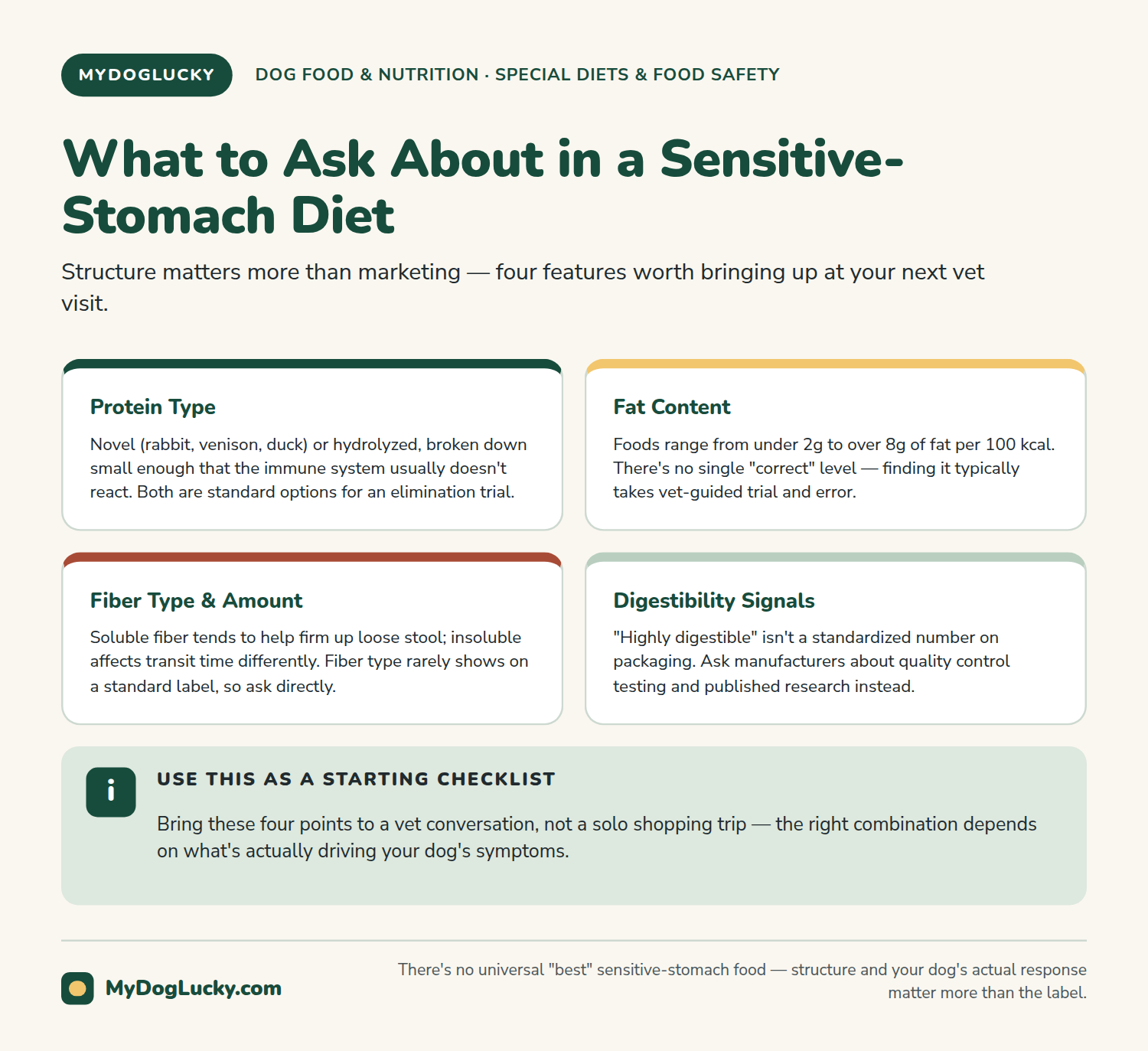
A limited-ingredient diet uses fewer total ingredients, typically one or two protein sources and a small number of carbohydrate sources, on the theory that fewer ingredients means fewer chances for something to disagree with your dog. That logic holds up reasonably well, with one important caveat: “limited ingredient” on a retail label isn’t a regulated, standardized claim the way “complete and balanced” is.
Cross-contamination during manufacturing is a real concern, particularly with over-the-counter limited-ingredient diets made in facilities that also process other proteins. VCA’s guidance on elimination diet trials specifically flags this as a reason veterinary therapeutic diets are often preferred over off-the-shelf limited-ingredient options when precision genuinely matters, since therapeutic diets are manufactured under tighter controls specifically to avoid that cross-contamination risk.
Novel or Hydrolyzed Protein
A novel protein is one your dog hasn’t eaten before — commonly rabbit, venison, duck, or a less typical fish, though “novel” depends entirely on your dog’s actual feeding history, not on how exotic an ingredient sounds. A hydrolyzed protein diet takes a familiar protein and breaks it down into pieces small enough that, per VCA’s explanation, the immune system generally doesn’t recognize them as the intact protein it might otherwise react to. Both approaches serve the same underlying goal — removing a protein your dog’s system might be reacting to — through different mechanisms, and both are considered standard options for elimination diet trials rather than one being a lesser substitute for the other.
Fat Content
Fat is one of the more overlooked variables in sensitive-stomach feeding, and it varies a lot more than most owners realize. Tufts’ Clinical Nutrition Service notes that dog foods range from less than 2 grams of fat to more than 8 grams of fat per 100 kilocalories — a substantial spread for dogs whose stomachs react specifically to higher-fat meals. There’s no single “correct” fat level across all sensitive-stomach dogs; Tufts is direct that finding the right level typically takes some individual trial and error, guided by your vet, rather than a fixed number that applies universally. For dogs with a pancreatitis history specifically, low fat matters even more, since dietary fat is central to how that condition is managed long-term.
Fiber Type and Amount
Fiber gets less attention than protein or fat on most labels, and that’s partly because label information about fiber type is genuinely limited. Tufts notes that different fiber types behave very differently in the gut, but that distinction usually isn’t visible from a standard guaranteed analysis, which is why fiber-focused adjustments are typically something to work through with veterinary guidance rather than something to diagnose from a bag’s ingredient panel alone.
Broadly speaking, soluble fiber tends to help firm up loose stool and can be particularly useful for dogs with colitis-type patterns, while insoluble fiber affects transit time differently. Getting this right is less about “more fiber” or “less fiber” and more about the right type for your dog’s specific pattern.
Digestibility Signals
“Highly digestible” is a phrase that shows up often on sensitive-stomach labels, and it has real meaning even though it isn’t always backed by a number you can compare across brands. In practice, digestibility relates to how efficiently your dog’s body can break down and absorb the nutrients in the food, leaving less undigested material to move through — and cause trouble in — the intestines. Because a formal digestibility percentage isn’t standard on retail packaging, the WSAVA Global Nutrition Toolkit recommends asking manufacturers directly about quality control testing and whether the company has published or supports peer-reviewed research, rather than relying on front-of-bag language alone.
Reading the Nutritional Adequacy Statement
Whatever food you land on, check that it carries a proper nutritional adequacy statement. According to AAFCO, this is the part of the label that confirms a food is complete and balanced for a specific life stage — either because it was formulated to meet AAFCO’s nutrient profiles, or because it was verified through an actual AAFCO feeding trial.
That statement matters even more for a dog already dealing with digestive issues, since a food that isn’t properly balanced can compound problems rather than solve them. This is also a good moment to mention, in passing, that reading the rest of the label well is its own skill; MyDogLucky covers that in more depth in a separate article on how to read dog food labels.
Feeding Trials and Elimination Diets, Explained
If your vet suspects diet is genuinely part of the problem, the next step usually isn’t “try this bag for a week and see.” It’s a structured feeding trial, and the structure is what makes it useful.
Why a Trial Has to Be Supervised
A proper elimination diet trial removes every food your dog currently eats and replaces it, entirely, with one controlled option — typically a novel or hydrolyzed protein diet, fed exclusively, with no treats, no table scraps, no flavored medication, no rawhide, and per VCA’s guidance, not even flavored toothpaste. That level of control is hard to pull off without a plan, and it’s genuinely easy to undermine by accident: a well-meaning family member sneaking a treat, a flavored heartworm chewable, a training treat used during a walk. Any of those can compromise the whole trial without you realizing it happened.
Supervision also matters because the trial needs a clear endpoint and a clear way to interpret the result. Your vet is watching for a specific pattern of improvement over a specific window, not just “seems a bit better,” and knows what to do next whether the trial succeeds, partially helps, or does nothing at all.
Why “Just Switching Brands” Without a Plan Often Fails
This is worth naming directly, because it’s an extremely common and understandable approach that usually doesn’t work the way owners hope. Grabbing a different “sensitive stomach” formula off the shelf, without ruling out other causes first and without controlling every other food source, mixes too many variables at once. If symptoms improve, you don’t actually know why — it could be the new protein, the lower fat content, the different fiber blend, or simple coincidence with symptoms that were already trending better. If symptoms don’t improve, you don’t know whether the food failed or whether something else entirely is driving the problem. Either way, you’ve spent money and time without real information to show for it.
What a Real Elimination Diet Trial Involves
According to VCA’s guidance on implementing these trials, the elimination phase typically runs at least eight weeks, and while gastrointestinal improvement can show up sooner — often by around week five — skin-related signs generally take longer to resolve than digestive ones. Merck’s guidance on chronic enteropathies notes a somewhat shorter window specifically for assessing an initial diet trial’s effect on digestive symptoms — at least two weeks — with more than half of dogs showing a marked response when the trial genuinely eliminates the trigger. If a first trial doesn’t help, a second trial with a different protein source is often worth considering before moving to more invasive diagnostics.
What strict compliance actually looks like
- One food, full stop. The trial diet is the only thing that goes in your dog’s mouth — no exceptions for “just one bite.”
- Every household member briefed. Including anyone who dog-sits, walks, or feeds your dog even occasionally.
- Medications and supplements checked. Ask whether any current medication is flavored, and whether an unflavored alternative exists during the trial.
- A symptom journal kept the whole time. Tufts specifically recommends tracking one dietary change at a time and keeping a record, so a genuine pattern is easier to see later.
VCA also flags a specific pitfall worth knowing about ahead of time: commercial allergy blood or saliva tests marketed directly to pet owners aren’t considered reliable for diagnosing food allergies, and relying on one instead of an actual diet trial is a common, avoidable misstep. A real trial — food controlled, time given, response observed — remains the standard, not a lab test you can order without your vet’s involvement.
How to Transition Foods Without Making Things Worse
Even a genuinely better-suited food can cause a rough few days if it’s introduced too fast. A dog’s gut microbiome adjusts gradually to a new set of ingredients, and a sudden full switch — especially for a dog whose stomach is already reactive — is a common way owners accidentally create the very symptoms they were trying to fix.
A Slower Pace Than the Bag Recommends
Standard transition advice usually suggests seven to ten days. For a dog with a known sensitive stomach, going slower is often worth it, even if it feels like it’s dragging on. A two-to-three-week transition, adjusting the ratio in smaller increments and pausing longer at each stage, gives a reactive gut more room to adapt without a flare-up along the way.
A Sample Transition Timeline
| Days | Old food | New food | What to watch |
|---|---|---|---|
| 1–4 | 75% | 25% | Stool consistency, appetite, energy |
| 5–8 | 50% | 50% | Any new gas, softness, or refusal |
| 9–12 | 25% | 75% | Continued improvement or a plateau |
| 13–16 | 0% | 100% | Whether symptoms have genuinely resolved, not just quieted |
If your dog handles each stage cleanly, you can move through it a little faster than this. If any stage brings symptoms back, hold at that ratio for a few extra days before advancing, rather than pushing forward on schedule regardless of how your dog is doing.
When to Pause or Slow Down Further
Mild, brief softening of stool during a transition isn’t unusual and isn’t automatically a sign the new food is wrong — guts take a little time to adjust to almost any change. Pause and go back a step if you see vomiting, stool that becomes watery rather than just soft, a clear drop in appetite, or any sign of discomfort. And if symptoms don’t settle within a few days of holding steady at a given ratio, that’s useful information for your vet, not a signal to just power through to the next stage.
Monitor, Call, or Go: Reading Your Dog’s Digestive Signs
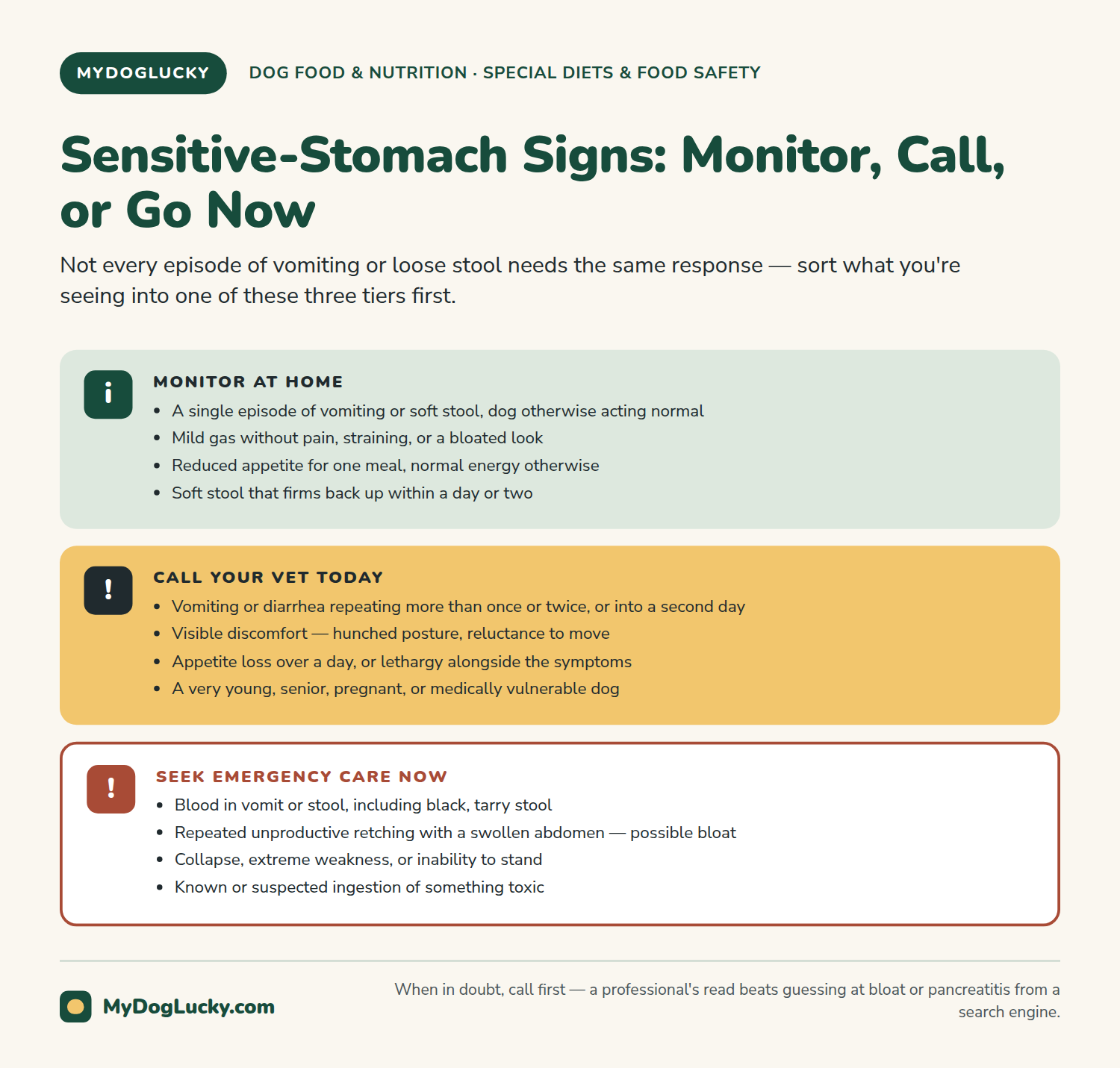
Not every episode of vomiting or loose stool needs the same response. Sorting signs into three tiers — watch it, call today, or go now — takes a lot of the guesswork and middle-of-the-night panic out of the picture.
Monitor at Home
- A single episode of vomiting or soft stool, with your dog otherwise acting completely normal.
- Mild gas without pain, straining, or a bloated appearance.
- Reduced appetite for one meal, especially after a known dietary indiscretion, with normal energy otherwise.
- Soft stool that firms back up within a day or two on its own.
Withholding a meal briefly, offering small amounts of a bland, vet-approved option, and watching for 12 to 24 hours is a reasonable response to this tier. If things haven’t improved in that window, move up a tier.
Call Your Vet Today
- Vomiting or diarrhea that repeats more than once or twice, or continues into a second day.
- Visible discomfort — a hunched posture, reluctance to move, a tucked abdomen.
- Appetite loss that lasts more than a day, or lethargy alongside the digestive symptoms.
- A very young, senior, pregnant, or medically vulnerable dog showing any of these signs, since these dogs generally have less reserve and can decline faster than a healthy adult.
- Symptoms that keep returning on a predictable schedule, even if each individual episode seems mild.
Seek Emergency Care Now
- Blood in vomit or stool, including black, tarry stool.
- Repeated, unproductive retching, especially with a visibly swollen or bloated abdomen — a possible sign of bloat, which the Merck Veterinary Manual identifies as a condition where prompt veterinary care meaningfully improves the chance of survival.
- Collapse, extreme weakness, or an inability to stand.
- Signs of significant dehydration — sunken eyes, gums that stay pale or tacky, persistent lethargy alongside ongoing vomiting or diarrhea.
- Known or suspected ingestion of something toxic, a foreign object, or a large quantity of a high-fat food.
- Severe, unrelenting abdominal pain.
When in doubt, call first
A phone call to your vet’s office or an emergency line costs you a few minutes and gives you a professional read on which tier you’re actually in. It’s a far better use of those minutes than trying to diagnose bloat or pancreatitis from a search engine at 1 a.m.
Common Mistakes That Slow Things Down
Chasing Ingredient Panic Instead of a Pattern
It’s easy to fall down a rabbit hole of ingredient lists, convinced that one specific item — a grain, a particular meat, a preservative — must be the culprit, based on something read online rather than anything your own dog’s symptoms actually point to. Tufts’ guidance is a useful counterweight here: food allergy, the scenario most ingredient panic is aimed at, is actually the least likely explanation for chronic digestive upset in dogs. Following your dog’s actual pattern gets you further than following internet anxiety about any single ingredient.
Switching Foods Too Fast
Covered in more detail above, but worth repeating here because it’s such a common setback: a rushed transition, even to a genuinely better-suited food, can produce symptoms that look exactly like “this food doesn’t work,” when the real issue is pace, not the formula itself.
Assuming It’s “Just Picky”
A dog who’s stopped finishing meals or started sniffing suspiciously at food he used to enjoy isn’t automatically being difficult. Food refusal can be a legitimate digestive signal — his body avoiding something that doesn’t sit well — and treating it purely as a behavior problem, without considering the digestive angle, can mean missing a real pattern for months.
Stacking Multiple Changes at Once
New food, new treats, and a new supplement, all started in the same week, make it nearly impossible to know what actually helped or hurt if symptoms shift. One change at a time, held steady long enough to see a real result, gives you far more useful information than several changes bundled together.
Starting a Trial Before Ruling Out Other Causes
Jumping straight to a diet trial without a basic veterinary workup first — skipping the fecal test, the parasite treatment, the physical exam — risks spending weeks controlling food for a problem that was never dietary to begin with. The workup described earlier in this article exists precisely to avoid that wasted time.
Giving Up Too Soon, or Not Soon Enough
Both directions cause real problems. Abandoning a properly run trial after four days because nothing’s changed yet skips past the window most trials actually need to show results. On the other end, staying on a food that clearly isn’t helping for months, hoping it’ll eventually click, delays a plan that might genuinely work. A trial with a defined endpoint, agreed on with your vet ahead of time, solves both problems at once.
Prescription Diets vs. Retail Formulas: The Honest Tradeoff
Cost and access are real parts of this decision, not a footnote, and it’s worth being straightforward about the tradeoff rather than pretending price doesn’t factor in.
What a Prescription GI Diet Requires
Prescription gastrointestinal diets — the therapeutic hydrolyzed-protein and specialized GI formulas discussed earlier — require a veterinarian’s authorization to purchase. That requirement exists because these diets are formulated for a specific medical purpose, often at nutrient levels or protein processing that go beyond what a general “sensitive stomach” label implies, and because using one appropriately depends on an actual diagnosis or a supervised trial, not a hunch. They also tend to cost more per bag and, in many cases, per feeding, and availability can be limited to veterinary clinics or their affiliated online pharmacies rather than a regular pet supply aisle.
What a Retail “Sensitive Stomach” Formula Offers
General retail sensitive-stomach formulas don’t require a prescription, are widely available, and are usually less expensive up front. They can genuinely help dogs whose issue is mild and general rather than tied to a specific protein needing true elimination. The tradeoff is precision: these formulas aren’t manufactured under the same controls that limit cross-contamination, and “limited ingredient” or “sensitive stomach” on a retail label isn’t independently verified the way a nutritional adequacy statement is. For a dog who genuinely needs a controlled elimination trial, a retail formula is often not precise enough to get a clean answer.
Cost-Per-Feeding, Not Just Bag Price
Comparing bag price alone is misleading, because calorie density and recommended feeding amounts vary enough between products to change the real cost significantly. A cheaper bag that requires noticeably more food per meal to meet your dog’s calorie needs can end up costing about the same, or more, than a pricier bag with a more calorie-dense formula. Working out an approximate cost per day, not just per bag, gives you a fairer comparison — and it’s a completely reasonable thing to ask your vet or their staff to help estimate if the math isn’t straightforward from the packaging.
A practical way to think about the choice
If your vet has ruled out serious disease and describes your dog’s issue as mild and general, a retail formula chosen against the structural checklist above is often a reasonable first step, with your vet’s input on which features to prioritize. If your vet has specifically recommended an elimination trial, or your dog has a diagnosed condition like pancreatitis or IBD, a prescription diet purchased through that recommendation — not swapped for a similar-sounding retail product on your own — is the appropriate next step, and the cost is part of managing an actual medical condition rather than an optional upgrade.
Building Your Vet-Conversation Framework
Everything in this article points toward one practical outcome: a more useful conversation with your veterinarian, rather than a solo guessing game. Here’s a framework to walk in with.
- Describe the pattern, not just the worst day. When did this start, how often does it happen now, and is it getting better, worse, or staying the same?
- Bring a complete food-and-treat inventory. Every brand, every treat, every chew, and any table scraps or medication flavoring — not just the main meal.
- Ask what’s being ruled out, and how. Parasites, infection, pancreatitis, and inflammatory disease are the common early checks; ask which ones apply to your dog’s situation and why.
- Ask whether a diet trial is appropriate, and what kind. Novel protein or hydrolyzed, prescription or retail, and for how long — get a specific plan rather than a general suggestion to “try something new.”
- Agree on a transition pace and a symptom-tracking method before you start. A shared plan for pace and what counts as improvement makes the trial’s results much easier to interpret later.
- Set a check-in point. Know ahead of time when you’ll report back, and what would count as “this is working,” “this needs more time,” or “this isn’t the answer.”
Bringing a written or typed version of this to your appointment — even just a few bullet points on your phone — tends to make the visit noticeably more productive than trying to recall the last three weeks from memory in the exam room.
Frequently Asked Questions
What does “sensitive stomach” actually mean in a dog?
It’s a description of a pattern — recurring or easily triggered vomiting, soft stool, gas, or food refusal — not a formal diagnosis. The underlying cause can range from mild digestive reactivity to a diagnosable condition, which is why persistent or worsening symptoms deserve a veterinary look rather than assumptions based on the label alone.
How is a sensitive stomach different from a food allergy?
A sensitive stomach or food intolerance is a digestive-level reaction that doesn’t involve the immune system and can appear the first time a dog eats a problem food. A true food allergy is an immune response to a specific protein, usually developing after repeated exposure, and often comes with skin signs like itching or ear infections alongside digestive symptoms. MyDogLucky’s dedicated article on food allergies in dogs covers that diagnostic path in more depth.
Can I just switch to a new food without talking to my vet first?
For a single mild episode with no red flags, a short trial of a well-chosen retail formula, transitioned slowly, is often a reasonable first step. For symptoms that are chronic, worsening, or paired with weight loss, pain, or blood in stool or vomit, a vet visit should come before any diet change, since a food switch can mask or delay diagnosis of something that actually needs treatment.
How long should I try a new sensitive-stomach food before deciding it isn’t working?
For a general retail formula addressing mild symptoms, two to three weeks at full transition is a reasonable window to look for real improvement. For a formal elimination diet trial run with your vet, expect a longer window — commonly a minimum of two weeks for digestive-symptom assessment and up to eight weeks or more for a full elimination-challenge trial, per veterinary guidance.
Is grain-free food better for a sensitive stomach?
Not inherently. Grain is one possible protein or carbohydrate source among many, and grain-free doesn’t mean low-allergen, low-fat, or highly digestible on its own. What matters structurally — protein type, fat content, fiber, digestibility — has little to do with whether grain is present, and choosing a food based on grain status alone skips the features that actually drive results for a sensitive-stomach dog.
Do I need a prescription diet, or will a retail “sensitive stomach” formula work?
It depends on what your vet has found. Mild, general digestive sensitivity without a diagnosed condition often responds to a well-chosen retail formula. A formal elimination trial, or a diagnosed condition like pancreatitis or inflammatory bowel disease, typically calls for a prescription therapeutic diet, both because of the tighter manufacturing controls and because using one appropriately depends on your vet’s involvement.
My dog’s stool looks fine, but he has gas all the time. Is that a sensitive stomach?
Chronic gas without other symptoms can be a mild form of digestive sensitivity, often related to a specific ingredient, a fiber type, or how quickly he eats. It’s usually lower on the urgency scale than vomiting or loose stool, but if it’s persistent and bothering your household, it’s a reasonable thing to mention at a routine vet visit rather than something you have to live with indefinitely.
Can puppies have sensitive stomachs, or is this mainly an adult-dog thing?
Puppies can absolutely show digestive sensitivity, though a young puppy’s digestive system is also just generally less mature, which can look similar from the outside. Because puppies have less physical reserve than adult dogs, persistent vomiting or diarrhea in a puppy warrants a vet visit sooner rather than later, and any diet decisions for a growing puppy should account for life-stage nutrient needs, not just digestive comfort.
What’s the difference between a limited-ingredient diet and a hydrolyzed-protein diet?
A limited-ingredient diet uses fewer total ingredients, usually one or two whole protein and carbohydrate sources, to reduce the number of possible triggers. A hydrolyzed-protein diet takes a protein and breaks it into pieces small enough that the immune system typically doesn’t recognize it, which can work even when the intact version of that same protein causes a reaction. Both are legitimate approaches; which one fits depends on your dog’s specific situation and your vet’s recommendation.
My dog does fine on one bag of a food and then has issues with the next bag. What’s going on?
This pattern is worth mentioning to your vet and, separately, to the manufacturer, since it can point to batch-to-batch variation, a slight recipe change you might not have noticed, or a storage issue affecting freshness. It’s also a reasonable prompt to check the FDA’s recall and safety alert listings, since manufacturing issues occasionally do affect specific batches or plants.
Should I add probiotics or a digestive supplement on my own?
Talk with your vet before adding anything during an active diet trial specifically, since an uncontrolled addition can muddy the results the same way an extra treat would. Outside of a formal trial, some dogs tolerate a vet-recommended probiotic well, but it’s not a substitute for identifying and addressing the underlying cause of ongoing symptoms.
How much fiber is too much fiber?
There’s no single number that applies across all dogs, since fiber type matters as much as quantity, and that information usually isn’t printed on a standard label. Too much of the wrong type can actually worsen loose stool rather than firm it up. This is one of the areas where individual, vet-guided trial and error genuinely beats trying to calculate an answer from a guaranteed analysis panel.
My dog refuses to eat the new food. Now what?
First, rule out that refusal is discomfort-driven rather than pure pickiness — a dog associating food with a recent bout of nausea can develop a genuine aversion. Warming the food slightly, adding a small amount of vet-approved plain broth, or slowing the transition further can help. If refusal persists for more than a couple of days despite those adjustments, loop your vet in rather than mixing in extra treats or table food to get him eating, since that reintroduces exactly the variables the trial or transition was trying to control.
Can stress or anxiety cause GI symptoms that look like a sensitive stomach?
Yes. Stress-related digestive upset is real in dogs and can produce the same signs — loose stool, gas, appetite changes — as a dietary trigger, particularly around travel, boarding, household changes, or a new environment. It’s worth mentioning any recent stressors to your vet alongside your dog’s diet history, since treating a stress-driven pattern purely as a food problem tends to miss the actual cause.
Where This Leaves You
A sensitive stomach is common, manageable, and rarely an emergency on its own — but it’s also not something to solve by cycling through bags of food and hoping one sticks. The more useful path runs through your vet: rule out parasites, infection, and disease first; understand the structural features — protein type, fat, fiber, digestibility — that actually drive results; run any diet change or trial with real control and a defined timeline; and pace the transition slower than the bag suggests.
Bring the framework above to your next appointment, describe the actual pattern you’re seeing rather than just the worst day, and treat your dog’s individual response as the real test — more reliable than any label, review, or ranking you’ll find online. Most sensitive-stomach dogs land on a workable plan. Getting there faster is mostly a matter of ruling things out in the right order and giving each step the time it actually needs.
Sources
- AAFCO (Association of American Feed Control Officials). Reading Labels (updated 2024)
- WSAVA Global Nutrition Committee. Selecting a Pet Food for Your Pet, WSAVA Global Nutrition Toolkit (2021)
- WSAVA. Global Nutrition Guidelines
- Merck Veterinary Manual. Vomiting in Dogs (last updated September 2024)
- Merck Veterinary Manual. Disorders of the Stomach and Intestines in Dogs (last updated June 2026)
- Merck Veterinary Manual. Chronic Enteropathies in Small Animals (last updated June 2026)
- Merck Veterinary Manual. Pancreatitis and Other Disorders of the Pancreas in Dogs (last updated December 2024)
- VCA Animal Hospitals. Food Intolerance in Dogs (last updated November 2025)
- VCA Animal Hospitals. Implementing an Elimination-Challenge Diet Trial in Dogs (last updated July 2026)
- Freeman, L. Clinical Nutrition Service at Cummings School (Tufts University). What’s the Best Diet for Dogs with Chronic Diarrhea? (March 2023)
- American Kennel Club. Diet Change for Dog’s Sensitive Stomach (updated June 2026)
- U.S. Food and Drug Administration, Center for Veterinary Medicine. Recalls & Withdrawals
- Journal of the American Veterinary Medical Association. Food Allergy in Dogs and Cats: Current Perspectives on Etiology, Diagnosis, and Management (2023)
This article is general education for U.S. dog owners. It is not an individualized feeding plan, diagnosis, or treatment recommendation for your dog. Persistent, worsening, or painful digestive symptoms, weight loss, or blood in vomit or stool should be evaluated by a veterinarian rather than managed through diet changes alone. Only a veterinarian can determine whether a prescription therapeutic diet is appropriate for your dog.




Trackbacks/Pingbacks