
If you’re wondering how to switch dog food without a mess on the kitchen floor, here’s the short version. Mix the new food into the old food gradually, over seven to ten days. Shift the ratio a little more toward the new food every couple of days. Your dog’s gut is home to a community of bacteria adapted to whatever he’s been eating. A sudden, full swap doesn’t give that community time to catch up. That mismatch — not usually a “bad” new food — is the top cause of the loose stool, gas, and picky refusal that show up after a diet change.
You’re not doing anything wrong if your dog’s stomach doesn’t love an abrupt switch. Most dogs’ digestive systems just weren’t built for one. This guide walks through a standard day-by-day transition schedule. It covers how to tell normal adjustment from something that needs a vet’s attention. And it covers what changes when a recall, a health condition, or a picky eater is driving the switch, instead of routine restocking.
One scope note before you get started. This article covers the mechanics of the switch itself — timing, ratios, and troubleshooting. Reading nutritional adequacy statements and ingredient panels is covered in a separate MyDogLucky article, How to Read Dog Food Labels. Portion sizing lives in How Much Should I Feed My Dog. Here, the focus stays on the transition week itself.
Food switches come up more often than most owners expect. A puppy ages into an adult formula. A senior dog’s bloodwork prompts a vet to suggest a different diet. A bag gets recalled. A dog just seems bored of what’s in the bowl. Whatever the reason, the same core skill applies. Mix two foods together in a way that respects how a digestive system actually works, instead of treating it like flipping a light switch.
What’s in this guide
- Why you should switch dog food gradually
- Before you start: setting up for a smooth switch
- How to switch dog food: a day-by-day transition schedule
- Dogs who need a slower transition
- Signs the switch is going well vs. signs to slow down
- Common reasons owners switch dog food
- Special considerations for different diet types
- The recall exception: when gradual isn’t the right call
- Keeping a simple switch log
- Common mistakes when switching dog food
- When to involve your veterinarian
- A practical switch plan you can start today
- Frequently asked questions about switching dog food
- Sources
Why You Should Switch Dog Food Gradually
A dog’s digestive tract isn’t just a chute that food passes through. It’s an ecosystem, populated by billions of bacteria. Those bacteria help break down whatever he’s been eating regularly. They shift in response to diet, too. That shift happens over days and weeks, not seconds. Swap the food overnight, and you’re asking that ecosystem to catch up faster than it’s built to.
That’s the biological reason behind the standard advice from veterinary nutrition sources. Transition gradually, usually over seven to ten days, by mixing increasing amounts of the new food into the old. Tufts University’s Cummings School of Veterinary Medicine, through its Petfoodology program, recommends this kind of gradual approach for a specific reason. A pet’s digestive system needs time to adjust to a new food’s ingredients, fat content, and fiber profile. The American Animal Hospital Association gives similar guidance. It describes a sudden switch as a common trigger for digestive upset, and sometimes, a learned food aversion.
It’s Not About the New Food Being “Wrong”
Here’s the part that trips up a lot of owners. Soft stool after a switch usually says more about pacing than about the food itself. A dog can do perfectly well on a given food long-term. He can still have a rough few days if it’s introduced too fast. That distinction matters. It changes what you do next. Slow down the transition, rather than assume you picked a bad food and start over with something else.
We’ll come back to that mix-up later. Jumping to “this food doesn’t agree with him,” after only a day or two of upset, is one of the most common mistakes owners make during a switch. It’s also one of the most avoidable.
What “Gastrointestinal Tolerance” Actually Means
Veterinary sources use the phrase “GI tolerance” during a diet change to mean something specific. It’s how well a dog’s stomach and intestines handle a new set of ingredients, fat levels, and fiber types. A tolerant gut doesn’t produce vomiting, diarrhea, gas, or a drop in appetite. Every food has a slightly different nutrient profile, even within the same general category. A dog’s gut needs a few days of gradual exposure to build up the right balance of digestive bacteria and enzymes for it.
That adjustment period isn’t a flaw in your dog or a flaw in the food. It’s just biology working at its normal pace. Rushing it doesn’t make the adjustment happen faster. It usually just makes the transition rougher.
How Long the Adjustment Really Takes
For most healthy adult dogs, seven to ten days is enough time for the gut to catch up to a new food. That’s not an arbitrary number. It reflects how long digestive bacteria populations typically take to shift in response to a new diet, per AAHA and Tufts’ Petfoodology program. Dogs with a more sensitive baseline often need longer. The next section covers that in more detail.
The Short Version, If You’re Short on Time
Mix a little new food into mostly old food for the first couple of days. Move toward roughly half and half by the middle of the week. Finish the week mostly on the new food, then fully switched by day seven to ten. Watch stool and appetite the whole way through. Slow down at any point your dog tells you to. The next section breaks that down day by day.
Before You Start: Setting Up for a Smooth Switch
A few minutes of preparation before day one makes the rest of the process noticeably easier. It’s the difference between a transition you manage calmly and one you’re improvising in the middle of.
Pick the New Food With Purpose
Choose the new food based on your dog’s actual needs, rather than packaging alone. Think life stage, health status, and household budget. Checking the nutritional adequacy statement on the label confirms the food is formulated for your dog’s current life stage. That matters more than it might seem. A food meant for a different stage isn’t necessarily unsafe. It just may not match what your dog needs right now. How to Read Dog Food Labels walks through what that statement means, and what else is worth checking before you buy.
Buy Enough Overlap of Both Foods
Nothing derails a gradual transition faster than running out of the old food on day four. Before you start, make sure you have enough of both foods to finish the full transition window. Keep a little buffer on hand, too, in case you extend it. This is especially worth planning for if your dog’s current food isn’t something you can grab nearby on short notice.
Time It Around a Calm Week
Where you have a choice, avoid starting a food transition during an already-stressful week. Skip the week of a move, a boarding stay, a houseful of holiday guests, or a recent vaccine appointment. Stress on its own can affect appetite and digestion. Layering a diet change on top makes it harder to tell which factor is actually behind any symptoms that show up. A calm, ordinary week gives you a cleaner read on how your dog handles the food itself.
How to Switch Dog Food: A Day-by-Day Transition Schedule
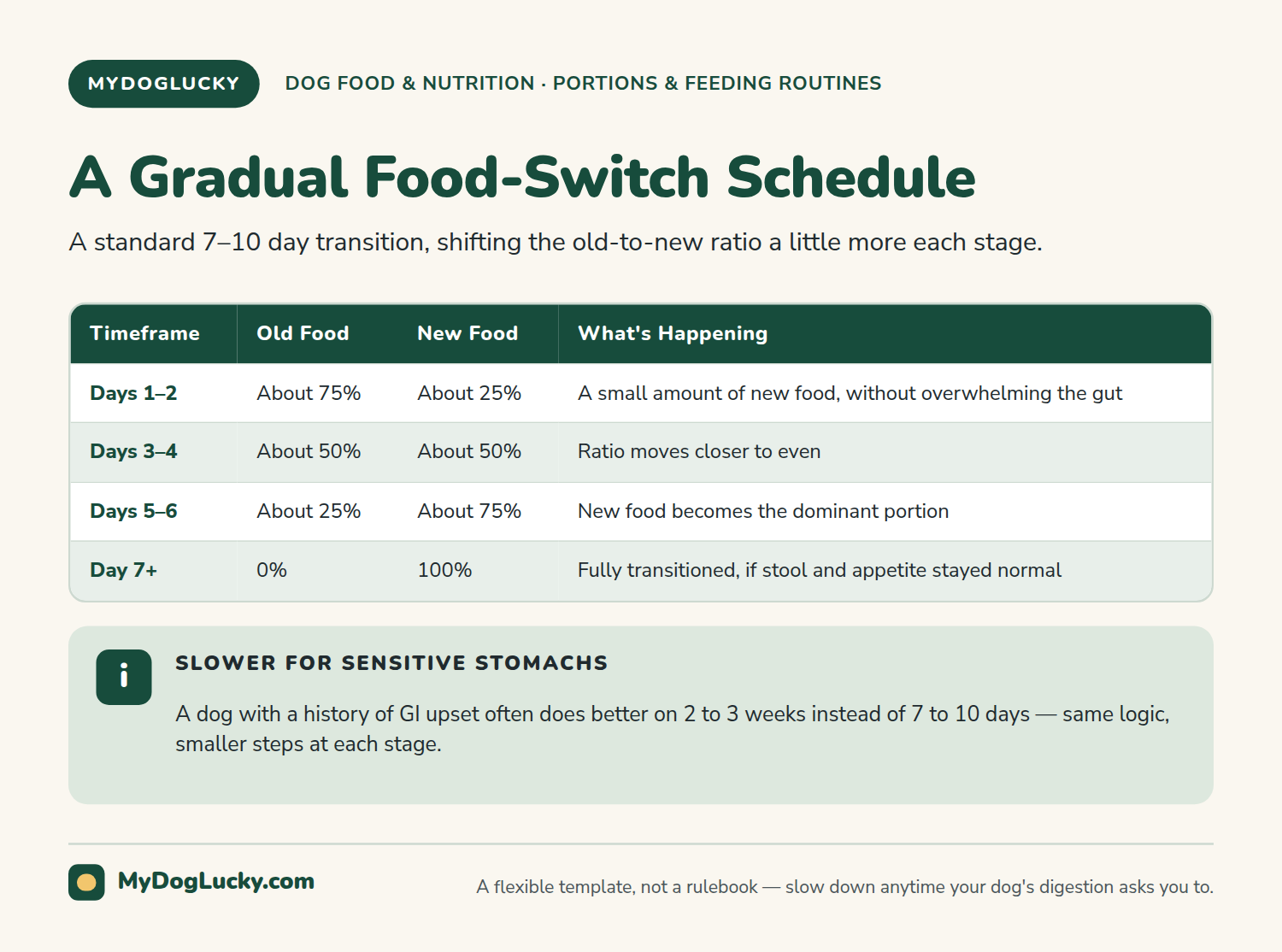
Think of the schedule below as a starting template, not a rulebook carved in stone. Every dog adjusts at a slightly different pace. The goal is a comfortable transition, not hitting an exact percentage on an exact day.
| Timeframe | Old Food | New Food | What’s Happening |
|---|---|---|---|
| Days 1–2 | About 75% | About 25% | A small amount of new food gets introduced without overwhelming the gut |
| Days 3–4 | About 50% | About 50% | Ratio moves closer to even as your dog adjusts |
| Days 5–6 | About 25% | About 75% | New food becomes the dominant portion of each meal |
| Day 7 and beyond | 0% | 100% | Fully transitioned, assuming stool and appetite have stayed normal |
Days 1 and 2: Mostly Old Food, a Little New
Start small. Roughly a quarter new food mixed into three-quarters old food gives your dog’s gut a preview. It won’t have to do much work yet. If your dog sniffs the bowl suspiciously and eats around the new kibble, that’s common early on. Most dogs settle in once the new food stops feeling “weird” in the bowl.
Days 3 and 4: Closer to Half and Half
By the middle of the week, most dogs can handle something close to an even split. This is also a good checkpoint to look back at stool from the last couple of days. Normal, formed stool at this stage is a decent sign you can keep moving forward on schedule.
Days 5 and 6: Mostly New Food
The new food should now make up the bulk of each meal. Just a small amount of the old food remains, as a buffer. Some owners drop the old food out entirely a day early, once things are clearly going well. Others prefer to stick to the full week regardless. Either approach is reasonable as long as your dog’s digestion has stayed steady.
Day 7 and Beyond: Fully on the New Food
By day seven to ten, most dogs are ready for a complete switch. Has your dog had any hiccups along the way, even minor ones? If so, hold at the last comfortable ratio for an extra day or two before finishing. Don’t push ahead on a fixed calendar.
Treat This as a Flexible Template, Not a Rigid Rule
The AKC’s nutrition guidance recommends a similar five-to-seven-day gradual transition. VCA Animal Hospitals describes a comparable window: roughly seven to fourteen days, depending on the dog. None of these sources treats the exact percentages as sacred. What matters is the direction and the pace. Less new food early, more new food later, and a willingness to slow down whenever your dog’s digestion asks you to.
A simple way to remember the shift
- First third of the transition: mostly old food, a taste of new.
- Middle third: roughly even.
- Final third: mostly new food, a trace of old.
- After that: fully switched, with stool and appetite back to normal.
How to Physically Mix the Two Foods
For dry kibble, this is simple. Measure both foods, and combine them in the same bowl at the stated ratio. For wet or canned food, layer the new food into the old at each meal. Stir well. Your dog shouldn’t be able to just pick out the familiar pieces and leave the rest. If your dog is switching formats — say, from dry-only to a wet topper — introduce that change gradually too. Texture is its own adjustment, on top of ingredients.
Keep total daily calories roughly consistent with what your dog was eating before, even as the ratio shifts. A transition is a good moment to weigh out portions, rather than eyeball them. It’s easy to accidentally overfeed while two measuring cups are in rotation.
Meal Timing and Frequency During the Switch
You don’t need to change how often your dog eats just because the food is changing. If he’s on two meals a day, keep that schedule. Simply adjust the ratio within each meal. Dogs who free-feed from a bowl left out all day can still transition gradually. Just refill with the correct ratio for that stage. Don’t top off with whichever food is closer at hand.
Dogs Who Need a Slower Transition
Seven to ten days works for a lot of dogs, but it’s not a universal number. Some dogs do better on a longer runway. Pushing them through the standard schedule anyway tends to backfire.
Sensitive Stomachs and a History of Food Intolerance
Does your dog have a known sensitive stomach? Does he get an upset gut every time something in his diet changes? If so, plan for a longer transition before you even start. A dog with that history doesn’t need a different technique. He needs the same gradual mixing, just spread over more days, with smaller jumps in ratio at each step.
“Sensitive stomach” isn’t an official diagnosis so much as a pattern you’ve noticed over time. Repeated bouts of soft stool with new treats. A history of picking up something on a walk and paying for it. A food journal (more on that below) that shows the same soft-stool pattern after past switches. If that sounds like your dog, treat every future transition as a slow one by default. Don’t wait to see if this time is different.
Breed alone doesn’t determine this. Some individual dogs run a more reactive gut than others, regardless of breed. There’s no reliable way to predict it in advance. Watching how your own dog has responded to change before is your best guide.
Recovering From a Recent GI Upset
A dog who’s just come off a bout of vomiting, diarrhea, or a bland-diet recovery period has a gut that’s already been through something. Layering a food switch on top of that recovery asks a lot of a digestive system that hasn’t fully settled yet. Give it extra time. Loop in your veterinarian about when it’s reasonable to start the transition at all.
What a 2- to 3-Week Transition Looks Like
For these dogs, stretch each stage of the schedule above from two days to three or four. Consider smaller initial ratios, too — starting at roughly 10% new food instead of 25%. The total timeline lands somewhere around two to three weeks instead of one. It’s a slower process, but the underlying logic stays the same: small, steady increases, with plenty of room to pause.
A rough rule of thumb
If your dog has a history of a sensitive stomach, doubling each stage costs you almost nothing. Two days becomes three or four. A slightly longer transition is a small trade for avoiding a week of cleanup. It also gives you more data points along the way, so you catch a problem early instead of after it’s already snowballed.
Signs the Switch Is Going Well vs. Signs to Slow Down
Most of what you need to know during a transition comes from two simple things. Your dog’s stool, and his appetite. Both are easy to track. Both tend to tell you clearly whether to keep going, hold steady, or pause.
| Category | What You’ll See | What to Do |
|---|---|---|
| On track | Normal, formed stool; steady appetite; normal energy | Continue on schedule to the next stage |
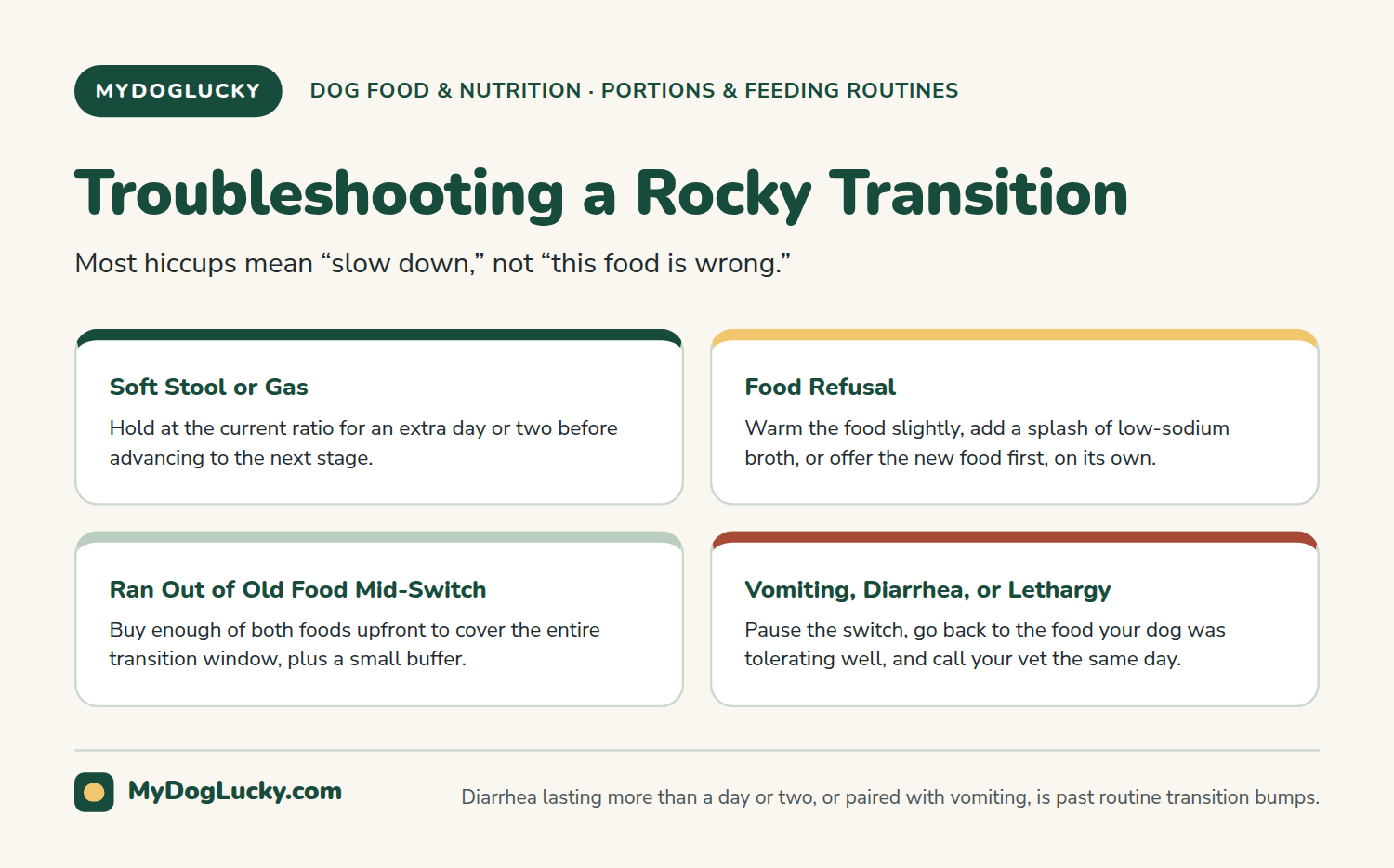
| Slow down | Soft stool, mild gas, or a slightly decreased appetite | Hold at the current ratio for an extra day or two before advancing |
| Call your vet | Vomiting, diarrhea lasting more than a day or two, or lethargy | Pause the transition and check in with your veterinarian |
A Quick Way to Read Stool Consistency
You don’t need special training to track this usefully. A simple scale works fine for a food transition log. Firm, and holds its shape easily: that’s ideal. Slightly soft but still holds together: worth watching. No defined shape, but not liquid: slow the transition down. Watery: call your vet if it lasts more than a day. Write down which of these four you’re seeing each day. Skip the vague “seemed off” — the pattern is much easier to spot with specifics.
Signs You’re on Track
Formed stool. A dog who shows up for meals with normal interest. Energy that looks like his usual self. These are all good signs. If that’s what you’re seeing, move forward through the schedule as planned. There’s no need to slow down out of caution when everything’s actually going fine. A smooth transition is the goal, not a suspicious one.
Signs to Slow the Transition Down
Soft-but-formed stool, occasional gas, or a dog who’s a little less enthusiastic about the bowl are common, minor bumps. They don’t necessarily mean anything’s wrong with the new food. They usually mean the pace needs to ease up. Hold at the current ratio for an extra day or two, and don’t advance to the next stage yet. Reassess before moving forward again.
Signs to Pause and Call Your Vet
Vomiting. Diarrhea that sticks around for more than a day or two. A dog who seems unusually lethargic. These are past the range of routine transition bumps. Pause the switch. Go back to whatever food he was tolerating well, and call your veterinarian. Don’t push through on the assumption it’ll resolve on its own.
Signs that call for same-day veterinary attention
- Vomiting more than once or twice, or vomiting that includes blood.
- Diarrhea that’s watery, contains blood, or is paired with visible discomfort.
- Refusing both food and water together.
- Extreme lethargy, weakness, or collapse.
- A hunched posture, restlessness, or whining that suggests abdominal pain.
None of these are typical “adjusting to new food” symptoms. Treat them as a reason to call your veterinarian the same day, not wait-and-see.
Common Reasons Owners Switch Dog Food
Food switches happen for a handful of recurring reasons. Knowing which one applies to you shapes how much flexibility you have with timing.
| Reason | What It Usually Looks Like | Timing Flexibility |
|---|---|---|
| Life-stage change | Puppy to adult, or adult to senior food | Fully flexible — plan the switch whenever suits you |
| New health condition | A therapeutic diet prescribed by your vet | Follow your vet’s specific transition instructions |
| Picky eating | A dog who’s lost interest in the current food | Flexible, though a slow mix can help acceptance |
| Recall | A safety-driven, often urgent switch | Limited — safety takes priority over a gradual pace |
| Cost | Moving to a more budget-friendly option | Fully flexible — plan around your household budget cycle |
A Life-Stage Change
Puppies moving to adult food, or adult dogs moving to a senior formula, is one of the most predictable reasons to switch. There’s usually no urgency. That makes it the easiest kind of switch to plan for, and pace comfortably over the full window. Many owners time it around a vet visit. That way, any questions about the new formula’s calories or protein get answered in the same conversation.
A New Health Condition
A diagnosis can mean your veterinarian recommends a therapeutic or prescription diet. Think kidney disease, a suspected food allergy, or joint issues. These switches sometimes follow a different protocol than the standard gradual mix, especially for an elimination trial. Food Allergies in Dogs, a separate MyDogLucky article, covers what an elimination diet involves in more depth. Here’s the short version: your vet’s specific instructions override the general template in this guide. Prescription diets are also often more expensive, and available only through a vet’s office. Ask about ordering ahead, so you’re not caught without food mid-transition.
Picky Eating
Some dogs simply get bored of the same bowl of food, day after day, month after month. A slow mix-in can actually help here. Introduce the new food gradually, alongside a food your dog already trusts. That often works better than a cold swap a picky eater may reject outright. Is picky eating a recurring pattern, rather than a one-time thing? It’s worth a quick vet check. Occasionally, a sudden loss of interest in food signals a health issue, not simple boredom.
A Recall
A safety recall changes the math entirely. A gradual mix means continuing to feed the recalled product for several more days. Once a safety issue is confirmed, that’s not acceptable. The next section covers how to handle this differently.
Cost
Budget-driven switches are common, and nothing to feel sheepish about. A gradual transition works the same way regardless of why you’re switching. The goal is a comfortable digestive adjustment, not a judgment about your reasons. If cost is the driver, compare nutritional adequacy statements between your current food and a more affordable option. How to Read Dog Food Labels covers how. It can help you find something that meets your dog’s needs, without assuming the priciest bag is automatically the best fit.
Special Considerations for Different Diet Types
Everything in this guide applies whether the new food is another dry kibble or something entirely different in format. A few diet-type combinations come with extra wrinkles worth knowing about first.
Kibble to Wet, Fresh, or Freeze-Dried Food
Moving from dry kibble to a wet, fresh, or freeze-dried diet usually means a bigger shift in fat, moisture, and texture than kibble-to-kibble. That’s not a reason to avoid the switch; plenty of dogs do well on these formats. It is a reason to lean toward the slower end of the window. Pay close attention to stool consistency, since richer, higher-fat foods can cause loose stool if introduced too quickly.
Introducing a Raw or Home-Cooked Diet
Raw and home-cooked diets add two layers most commercial-to-commercial switches don’t involve: food safety and nutritional balance. Raw diets carry a higher risk of bacterial contamination. That’s why the FDA recommends extra hygiene precautions, regardless of how gradually you introduce the food. Separate prep surfaces, thorough handwashing, and careful storage all matter. Home-cooked diets need a properly balanced recipe to avoid long-term nutrient gaps. An unbalanced homemade diet can look fine day to day while still falling short nutritionally over months. If you’re considering either option, loop in your veterinarian or a board-certified veterinary nutritionist before you start. That’s true for the transition itself, and for the diet plan behind it.
Grain-Free to Grain-Inclusive, or Back
Switching between grain-free and grain-inclusive formulas follows the same gradual approach as any other switch, from a digestive-tolerance standpoint. Separately, the FDA has investigated a potential link between certain grain-free diets and a heart condition called dilated cardiomyopathy in some dogs. If that’s part of what’s motivating your switch, discuss it directly with your veterinarian. Don’t make that call from a label alone.
The Recall Exception: When Gradual Isn’t the Right Call
Everything above assumes you have the luxury of time. A recall changes that. When a food is recalled for safety — contamination, a toxin, a manufacturing defect — a slow, week-long mix isn’t appropriate. It would mean continuing to feed the recalled product, in smaller and smaller amounts, for several more days.
Checking Whether Your Food Is Actually Affected
Not every recall applies to every bag on the shelf. Recalls are usually specific to certain lot numbers, production dates, or package sizes. They rarely cover a brand’s entire product line. Before pulling your dog off his current food, check the recall notice against the lot number and best-by date on your specific bag or can. You’ll find that on the FDA’s Outbreaks and Advisories page, or the manufacturer’s own notice. If your bag doesn’t match the affected lots, there’s no need to switch at all.
Why Safety Comes Before GI Comfort
Food safety takes priority over digestive comfort in this specific situation. The FDA’s recall guidance is direct about this. Stop feeding the recalled product immediately. Don’t feed it to any other animal in the household, either. Dispose of it somewhere pets, children, and wildlife can’t access it. That advice doesn’t leave room for “just use up the rest of the bag while mixing in the new food.”
How to Manage a Faster, Less Gradual Switch
Once the recalled food is out of the house, you have two options. Move faster to a new food, or use a short bridge period on a bland, vet-approved diet while you sort out a longer-term choice. Either way, the safety net a slow mix normally provides is reduced. Watch more closely for GI symptoms than you would during a routine switch. You’re compressing days of adjustment into a much shorter window.
A few practical steps make a compressed switch go more smoothly. Wash food bowls, storage containers, and scoops thoroughly. The FDA specifically recommends a bleach solution, followed by a full rinse and dry. Residue from a contaminated food can linger on equipment even after the bag is gone. Keep your dog’s log running through this period, too. With less of a gradual buffer, you’ll want an even closer record of stool and appetite.
Did your dog eat any of the recalled product before you learned about the recall? Contact your veterinarian and mention it specifically, even if he seems fine. Some contamination issues, including certain toxins, can cause internal damage before symptoms show up. A full diet history helps your vet connect the dots if something develops later.
Keeping a Simple Switch Log
A written log sounds like overkill for a one-week food switch. Then the third day of soft stool arrives. Now you’re trying to remember whether it started before or after you hit the half-and-half ratio. A few lines a day is enough to catch patterns you’d otherwise lose track of.
What to Track Each Day
Keep it simple enough that you’ll actually do it consistently:
- Date and ratio — roughly how much old food vs. new food was in that day’s meals.
- Stool consistency — normal, soft, or loose, in a word or two.
- Appetite — ate normally, hesitant, or skipped part of a meal.
- Anything else notable — gas, vomiting, unusual energy, a new treat someone snuck him.
A simple log template to copy
Day / Date: ___ Ratio (old/new): ___ Stool: ___ Appetite: ___ Notes: ___
A sticky note on the fridge or a running note on your phone both work fine. The format matters less than actually filling it in each day.
Why a Log Catches Patterns You’d Otherwise Miss
Memory is unreliable, especially across a busy week. A log lets you look back and see, in writing, exactly when soft stool started. Maybe it was the day someone gave your dog a new dental chew, not the day you bumped up the ratio. That distinction changes what you do next. It’s a lot easier to spot on paper than to reconstruct from memory three days later.
A log is also genuinely useful if you do end up calling your vet. Instead of “he’s had some diarrhea this week,” you can hand over specific dates, ratios, and stool descriptions. That gives your vet a much clearer starting point than a vague summary from memory.
Common Mistakes When Switching Dog Food
Switching Too Fast
The most common mistake is exactly the one this whole guide is built around avoiding. Owners dump the new food in all at once because the old bag ran out. Or because gradual mixing felt unnecessary for “just a food switch.” A full swap in a single meal is the single biggest predictable cause of diet-change GI upset. Running out of the old food mid-transition is avoidable. Buy a small bag or a few cans of it before you start, specifically to cover the mixing period.
Changing Too Many Variables at Once
A new food, new treats, and a new feeding schedule, all started the same week, make it nearly impossible to tell what caused a reaction. Change one thing at a time when you can. At minimum, keep a log detailed enough to separate the variables after the fact. This applies to supplements and chews, too. A new joint supplement, introduced the same week as a food switch, muddies the picture just as much as a new treat would.
Assuming Any Upset Means the New Food Is “Bad”
Soft stool on day three of a transition usually reflects the pace of the switch, not a flaw in the food itself. Switching to a third or fourth food in quick succession often makes things worse, not better. Each new switch resets the clock on gut adaptation. A dog chasing a food with zero adjustment period never gets a stable baseline to work from.
Giving Up After Three Days
Gradual transitions take the better part of a week to finish. Minor hiccups along the way are common, not a sign of failure. Backing out entirely after two or three days of mild softness is tempting. But it often means starting the whole process over later, with the same adjustment period still ahead of you. Simply holding at the current ratio a little longer usually works better.
Not Accounting for Individual Meals, Not Just Daily Totals
Some owners calculate the ratio correctly for the day, but serve it unevenly. Mostly old food in the morning, mostly new food at night. That still works out to roughly the right daily average. But each individual meal is a bigger jump than intended. Keeping the ratio consistent meal to meal, not just averaged across the day, tends to produce a smoother transition.
Restarting From Scratch After Every Setback
A day of soft stool doesn’t mean the whole transition failed. Some owners respond to any hiccup by reverting all the way back to 100% old food, then starting the entire schedule over from day one. That’s rarely necessary. Holding at the last comfortable ratio, or dropping back just one step, is usually enough to get things back on track without losing all the progress you’ve already made.
When to Involve Your Veterinarian
Most food transitions resolve on their own with a little patience and pacing. A few situations are worth a call, regardless of how mild things look on the surface.
Persistent GI Upset Past the Transition Window
Are soft stool, gas, or appetite changes still showing up well past the point where the transition should have settled? A few days beyond your planned schedule, that’s no longer a routine adjustment. It’s worth a call, to rule out something beyond simple pacing.
Your vet may ask for exactly the details your log has been tracking. When did symptoms start, relative to the ratio changes? How long have they lasted? Did anything else change at the same time? From there, a physical exam, a fecal test, or bloodwork may follow, depending on the pattern. Persistent GI symptoms can occasionally point to something unrelated to the food switch entirely.
Suspected Food Allergy or Intolerance
Recurring GI symptoms, itchy skin, or ear infections that track with a specific food suggest an intolerance or allergy, rather than a pacing issue. Diagnosing a true food allergy requires a structured elimination trial under veterinary guidance. It’s not a guess based on switching foods a few more times. Food Allergies in Dogs covers what that process typically involves.
Before Starting a Therapeutic or Prescription Diet
Does your dog have a diagnosed condition — kidney disease, a history of pancreatitis, a confirmed food sensitivity? The therapeutic diet your vet recommends may come with its own transition instructions. Those can differ from the general template in this article. Follow those instructions over the general guidance here; they’re written for your dog’s specific situation.
What to Bring to the Appointment
A GI-related visit tends to go faster when you show up with specifics instead of a general impression. Bring your switch log, if you’ve been keeping one. Bring the exact name and lot number of both the old and new food. Bring a rough timeline of when symptoms started, relative to the ratio changes. Note anything else that changed around the same time, too — new treats, a boarding stay, a medication change. That level of detail helps your vet narrow things down, faster than “he’s just had some tummy trouble lately.”
A Practical Switch Plan You Can Start Today
If all of this feels like more than you need for “just switching the food,” here’s a condensed version. Work from this instead.
- Before day 1: Confirm you have both the old and new food on hand, and set up a simple log — a sticky note works.
- Days 1–2: Mix roughly 25% new food into the old food. Log stool and appetite daily.
- Days 3–4: Move to roughly half and half, assuming things have looked normal so far.
- Days 5–6: Shift to mostly new food, with just a trace of the old remaining.
- Day 7 and beyond: Finish the switch to 100% new food, watching for another day or two even after the transition is technically done.
- Anytime along the way: If stool softens or appetite dips, hold at the current ratio for an extra day or two instead of advancing on schedule.
Does your dog have a sensitive stomach, or a recent history of GI upset? Stretch this same plan across two to three weeks instead of one. The logic at each step stays the same.
Frequently Asked Questions About Switching Dog Food
How long does it typically take to switch a dog’s food?
Most healthy adult dogs do well with a seven- to ten-day gradual transition. Dogs with sensitive stomachs, a recent GI upset, or a history of dietary intolerance often need two to three weeks instead. There’s no harm in taking longer than the standard window if your dog seems to need it. The schedule is a starting point, not a deadline.
Can I switch dog food faster than seven days?
Sometimes, especially for a dog with no history of digestive sensitivity and no signs of trouble along the way. Watch stool and appetite closely if you compress the timeline. Be ready to slow back down if anything looks off. A recall is the main situation where a faster switch becomes necessary, not optional.
What if my dog refuses to eat the new food during the transition?
A little hesitation in the first day or two is common. If refusal continues past that, try warming the food slightly, or adding a small amount of low-sodium broth. You can also hold at the current ratio a bit longer before increasing the new food further. Some dogs respond well to a smaller first portion, offered on its own before the rest of the meal, so the new food doesn’t get buried. Persistent refusal to eat anything, for more than a day, is worth a call to your vet.
Is loose stool during a food switch always something to worry about?
Not automatically. Mild, short-lived softening during the transition is common. It often resolves by holding at the current ratio for an extra day or two. Diarrhea lasting more than a day or two, or paired with vomiting or lethargy, is different. That’s past the range of a routine adjustment, and worth a call to your veterinarian.
Do I need to transition gradually if it’s the same brand, just a different flavor or formula?
Generally yes, though the adjustment tends to be milder within the same brand or product line. Ingredients, protein sources, and fiber content can still shift enough between formulas to cause a brief adjustment period. A shorter gradual mix — even just four to five days — is still a reasonable precaution.
How do I switch food after a recall if I can’t do a slow transition?
Stop feeding the recalled product right away. Follow the FDA’s disposal guidance so pets, kids, and wildlife can’t access it. Move to a new food over a shorter window than usual. Watch more closely for GI symptoms during those first few days, since you won’t have the same gradual buffer.
Can I switch straight to a prescription or therapeutic diet the same way?
Follow your veterinarian’s specific transition instructions over the general template in this article. Some prescription diets, particularly those used for an elimination trial, have different rules about mixing with other foods. Even small amounts of a previous ingredient in the bowl can undermine the whole point of the trial.
Should I switch treats at the same time as the food?
It’s better not to. Changing treats, meal toppers, and the main food all in the same week makes it much harder to identify what’s actually behind any GI upset. Hold treats steady during the transition. Introduce new ones separately, once the food switch is finished. If you’re also moving to a therapeutic diet, ask your vet whether your dog’s current treats are compatible with it; some prescription diets restrict outside treats and table food entirely during an active trial.
My dog seems totally fine after just two days. Can I speed things up?
You can move a little faster if stool and appetite have stayed completely normal. Still, resist the urge to jump straight to 100% new food. Digestive adjustment sometimes lags a day or two behind how a dog looks and acts. Finishing out the week, even at an accelerated pace, is a reasonable middle ground.
Do puppies and senior dogs need a different approach to switching food?
The same gradual-mixing logic applies at any age. Puppies and senior dogs are sometimes more prone to digestive sensitivity, though, which can mean leaning toward the slower end of the timeline. A life-stage food change — puppy to adult, or adult to senior — is a normal, planned switch. It can follow the standard schedule, unless your dog has a history of a sensitive stomach. Puppies in particular can be more sensitive to sudden changes, simply because their digestive systems are still maturing. A few extra days of overlap rarely hurts.
Does the size of my dog change how I should approach the transition?
Not the pacing itself; a seven- to ten-day window works across sizes. What does change is portion math. Smaller dogs eat smaller total amounts. A slightly uneven ratio at one meal is a bigger swing proportionally for them than for a large dog. Measuring rather than eyeballing portions matters a little more for small dogs, for exactly that reason.
What’s the difference between GI upset from a fast switch and a true food allergy?
Pacing-related upset typically shows up during the transition week, and resolves once the switch is complete or slowed down. A true food allergy or intolerance tends to be a recurring pattern instead. Symptoms show up repeatedly with a specific ingredient, sometimes alongside itchy skin or ear infections. It’s not just a one-time bout of soft stool during a switch. Confirming an allergy requires a veterinary-guided elimination trial, rather than a guess.
Can I use probiotics or a bland diet to help my dog through a switch?
Some owners find a short course of a vet-recommended probiotic helps smooth out a rocky transition. Others work in a few bland meals of plain boiled chicken and rice. Neither is a required step for a routine switch. Neither replaces the basic gradual-mixing approach, either. If you’re considering one, especially for a dog with an existing health condition, run it by your veterinarian first.
What if I have multiple dogs and only one needs to switch food?
Feed each dog separately during the transition, so the dog switching doesn’t end up eating from a housemate’s bowl instead. Watch food-motivated dogs closely at mealtime; a determined eater will happily finish someone else’s dinner given the chance. If your dogs normally share a feeding area, a short supervised separation during meals keeps the ratios accurate for the dog who’s actually transitioning.
Does travel or a change in routine affect how a food switch goes?
It can. Travel, boarding, or a disrupted routine adds its own stress, and stress alone can affect digestion. If you have any flexibility, avoid starting a transition right before a trip or a big schedule change. If the timing isn’t optional — a move, an unexpected boarding stay — just watch a little more closely than usual, and lean toward the slower end of the schedule.
Your Next Bag of Food Doesn’t Have to Be a Gamble
Switching dog food is one of those tasks that looks trivial, until you’re mid-week with a dog who won’t touch his bowl. Or stool that’s gone soft. Most of the time, the fix isn’t a different food. It’s a slower pace. A closer eye on stool and appetite. A willingness to hold steady at the current ratio, instead of pushing ahead on a fixed schedule.
Keep a simple log. Change one variable at a time. Treat the seven-to-ten-day window as a flexible template, not a countdown you have to hit exactly. If a recall forces your hand, prioritize getting the recalled food out of the house first. Then manage the faster transition with extra attention to symptoms. If GI upset sticks around past when it should have settled, or you suspect something more than pacing, your veterinarian is the right next call. Not another round of guessing.
Most switches, handled this way, end quietly. A week or two of gradual mixing. A log you barely need to glance back at. A dog who’s fully settled onto the new food without much drama at all. That’s the actual goal here. Not a perfect transition with zero hiccups — a comfortable one your dog barely notices.
Sources
- Tufts University Cummings School of Veterinary Medicine, Petfoodology. How Do I Switch My Pet’s Food?
- American Animal Hospital Association. Tips and Timelines: Transitioning Your Pet to New Food
- American Kennel Club. How to Switch Dog Foods: Transitioning Your Dog’s Diet
- VCA Animal Hospitals. Everything You Need to Know About Switching Your Pet to Adult Wellness Food
- Merck Veterinary Manual. Allergies in Dogs
- U.S. Food and Drug Administration. Outbreaks and Advisories
- U.S. Food and Drug Administration. FDA Alert: Certain Lots of Pet Food From Multiple Brands Recalled for Aflatoxin
- U.S. Food and Drug Administration. FDA Investigation into a Potential Link Between Certain Diets and Canine Dilated Cardiomyopathy
This article is general education for U.S. dog owners. It is not an individualized feeding plan or veterinary advice for your dog. A suspected food allergy, a recall situation, or GI upset that doesn’t resolve with a slower transition should be evaluated by your veterinarian. Before starting any therapeutic or prescription diet, follow your veterinarian’s specific instructions over the general guidance in this article.




Trackbacks/Pingbacks