
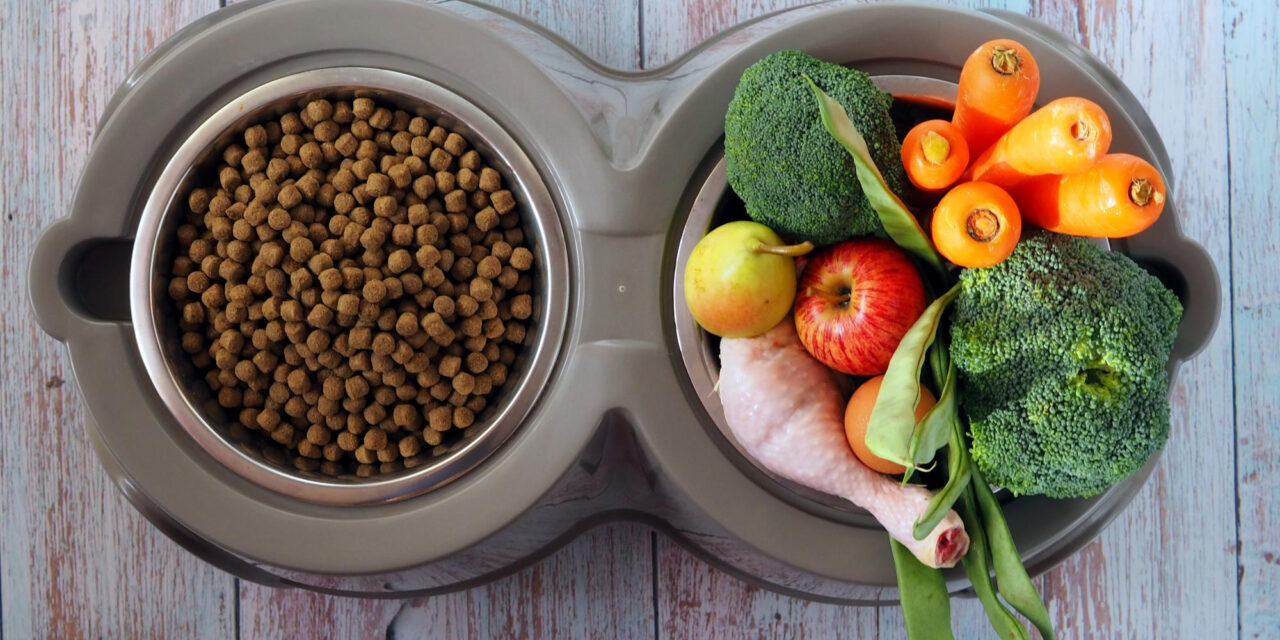
So, can dogs eat fruits and vegetables — and which ones, exactly? The honest answer is a lot of them — apples, blueberries, carrots, green beans, and a good dozen more are perfectly reasonable snacks for most healthy dogs. But the list has real edges, and a couple of the foods on the “unsafe” side sit right next to the safe ones on a produce shelf, which is exactly how a slice of cake gets more caution than a bowl of grapes even though the grapes are the one that can put a dog in kidney failure.
This guide walks through the common fruits and vegetables people actually want to share — what’s fine, what needs prep first, and what should never make it into the bowl, no matter how “natural” it looks sitting next to the safe stuff. We’ll cover the general rules first, then go food by food, then close with the short list of exceptions and what to do if your dog beats you to one of them.
One scope note before we start: this article is about whole fruits and vegetables, not commercial treats or toppers. We’re also not going to recommend or name any specific packaged treat or food brand here — that’s a separate conversation, and one worth having with your own vet based on your dog’s needs, budget, and any health conditions.
What’s in this guide
- What fruits and vegetables can dogs eat? The short answer
- How to introduce a new fruit or vegetable safely
- Portion math: where fruits and vegetables fit in the day
- Safe fruits, food by food
- Safe vegetables, food by food
- Fruits and vegetables dogs should never eat
- Common mistakes that turn a healthy snack into a vet visit
- If your dog already ate something unsafe
- Frequently asked questions
- Sources
Can Dogs Eat Fruits and Vegetables? The Short Answer
Most healthy adult dogs can eat a solid range of fruits and vegetables safely, offered in small amounts, prepared with a little care, and introduced one at a time. A short but important list — starting with grapes, raisins, and anything in the onion family — is unsafe regardless of amount, and it doesn’t matter how ripe, organic, or fresh off the vine it is. We’ll get to the full breakdown food by food below. First, the framework that makes the rest of this guide actually useful instead of just a list to memorize.
Why “Natural” Doesn’t Mean “Safe”
It’s tempting to assume that if a food is healthy for you, it’s at least neutral for your dog. Dogs process some things very differently than people do, though, and that gap is exactly where the real danger sits. Grapes are the clearest example. Dogs appear to lack the transporters that let other species clear certain organic acids out of the body efficiently, according to the Merck Veterinary Manual’s current entry on grape and raisin toxicosis. Tartaric acid — the compound now considered the likely toxic principle in grapes, raisins, and tamarind — builds up in the kidneys instead of getting cleared, and that’s what drives the acute kidney failure some dogs develop after eating them.
That’s an extreme case, and most of the fruits and vegetables in this guide don’t carry anything close to that risk. But it’s worth holding onto the underlying point: a food being fine for you tells you nothing reliable about whether it’s fine for your dog. Each food needs to be checked on its own.
The Four Ground Rules Before You Offer Anything New
Before you get to the food-by-food list, four habits will do more for your dog’s safety than memorizing every individual entry:
- Wash and prep first. Rinse produce to remove dirt and pesticide residue, and remove seeds, pits, cores, and tough rinds as needed — some are choking hazards, a few carry trace toxins.
- Start small and watch. A new food gets a test-sized taste, not a full serving, the first time. More on this in the next section.
- Keep it under 10% of the day’s calories. Fruits and vegetables are extras, not a replacement for a complete and balanced diet. We’ll walk through what that means in practice below.
- Know your own dog’s health picture. A healthy adult dog and a small senior dog managing kidney disease or pancreatitis are not working from the same rulebook. When in doubt, especially for a dog with an existing condition, ask your veterinarian before offering something new.
If you only remember one thing
Most fruits and vegetables are a genuinely fine snack for a healthy dog. A handful sit outside that entirely — not “use caution,” but don’t feed at all. Learning that short unsafe list (covered in full below) matters more than memorizing every safe food’s exact prep steps.
What Fruits and Vegetables Actually Add to a Dog’s Diet
It’s worth being clear about what these foods are, and aren’t, doing nutritionally. A healthy dog eating a complete and balanced commercial diet doesn’t need fruits or vegetables to meet his nutrient requirements — that’s what the “complete and balanced” nutritional adequacy statement on a dog food label is actually certifying, according to AAFCO, the organization that sets the model standards most U.S. pet food labels are built around. What fruits and vegetables add instead is variety, some extra fiber and water content, and a lower-calorie way to reward or bond with your dog than relying on calorie-dense commercial treats for every interaction. Think of them as a reasonable option among several, not a required upgrade to an already-complete diet.
How to Introduce a New Fruit or Vegetable Safely
Even foods that are broadly considered safe can disagree with an individual dog. Some dogs have a sensitive gut, a specific intolerance, or simply react differently than the average case a safety list is built around. That’s why the introduction step matters as much as the food itself.
A Simple Four-Step Protocol
You don’t need anything elaborate here — just a little patience and one new food at a time.
Introducing something new, one food at a time
- Pick one new food. Don’t try three new items in the same week — if something goes wrong, you won’t know which one caused it.
- Offer a small test amount. A teaspoon-sized piece for a small dog, a few bites for a large dog. Not a full serving.
- Wait roughly 24 hours. Watch for vomiting, loose stool, unusual gas, itching, or lethargy before offering more.
- If all’s well, fold it into the rotation. Still within the 10% treat ceiling covered in the next section — a food passing the test doesn’t mean unlimited amounts are fine.
This mirrors the logic behind how veterinary nutrition guidance recommends transitioning a dog’s main diet gradually rather than switching abruptly, per the American Kennel Club’s feeding guidance — the goal in both cases is giving the digestive system time to adjust instead of overwhelming it all at once.
Signs a New Food Didn’t Agree With Your Dog
Most reactions are mild and short-lived: a softer stool, a bit more gas than usual, or a little less appetite for the next meal. Those are usually a reason to skip that particular food going forward, not an emergency. Watch more closely for repeated vomiting, diarrhea that doesn’t resolve within a day, visible itching or hives, or a dog who seems unusually lethargic — those warrant a call to your veterinarian rather than a wait-and-see approach. We’ll cover the genuinely urgent situations, the ones tied to specific unsafe foods rather than ordinary intolerance, later in this guide.
Portion Math: Where Fruits and Vegetables Fit in the Day
A slice of apple looks harmless sitting next to a bowl of kibble. Whether it actually is harmless depends partly on how often it shows up and how big that slice is relative to your dog’s whole day — a question most owners never quite do the math on.
The 10% Rule
Veterinary nutrition guidance from the World Small Animal Veterinary Association puts it plainly: treats should make up no more than 10% of a dog’s daily calorie intake, according to WSAVA’s 2025 guide on feeding dogs treats. The remaining 90% should come from a complete and balanced diet formulated to meet your dog’s actual nutrient needs — the kind of food that carries a nutritional adequacy statement on the label. Fruits and vegetables offered as snacks count toward that 10%, the same as any commercial treat, training reward, or chew.
That 10% isn’t an arbitrary number. Go much beyond it regularly, and two things tend to happen: your dog takes in more total calories than his activity level burns, and the balanced 90% gets crowded out by extras that don’t carry the same complete nutrient profile. Neither shows up overnight. Both show up eventually, usually as extra weight or a diet that’s quietly less balanced than the label on the bag suggests.
What Actually Counts Toward the 10%
A common assumption trips people up here: that “healthy” extras don’t count the way a packaged treat does. They do. Anything beyond the complete and balanced meal — fruit and vegetable snacks, training treats, dental chews, a spoonful of peanut butter in a puzzle toy, table scraps — adds up against the same 10% ceiling.
| Counts toward the 10% | Common mistake |
|---|---|
| Fruit and vegetable snacks | Treated as “free” because they’re healthy |
| Training treats used during practice sessions | Not tallied because they’re small and frequent |
| Dental chews | Treated as a hygiene product, not a food |
| Food used inside puzzle toys or licking mats | Assumed to not count since it’s “enrichment” |
| Table scraps and plate licks | Not counted at all, since it wasn’t an intentional treat |
Size the Portion to Your Dog, Not to What Looks Reasonable on a Plate
A piece of fruit that reads as “just a taste” from a human perspective can be a meaningfully larger share of a 10-pound dog’s day than a 70-pound dog’s day. There’s no need to calculate exact calories for every snack, but it’s worth pausing before handing over a portion sized for a person’s sense of “small” rather than your specific dog’s actual size. When in doubt, smaller and less frequent is the safer default, and your veterinarian can help you figure out a more precise daily calorie target if you want one.
A rough rule of thumb
WSAVA’s guide illustrates the 10% rule with a couple of anchor points: roughly 14 extra calories a day for a small dog around 4–5 pounds, up to roughly 146 extra calories a day for a large dog around 100 pounds. Your own dog’s exact number depends on his size, age, and activity level — your veterinarian can give you a precise figure — but those two anchors are a useful gut check for just how small “10%” often turns out to be in practice.
Safe Fruits, Food by Food
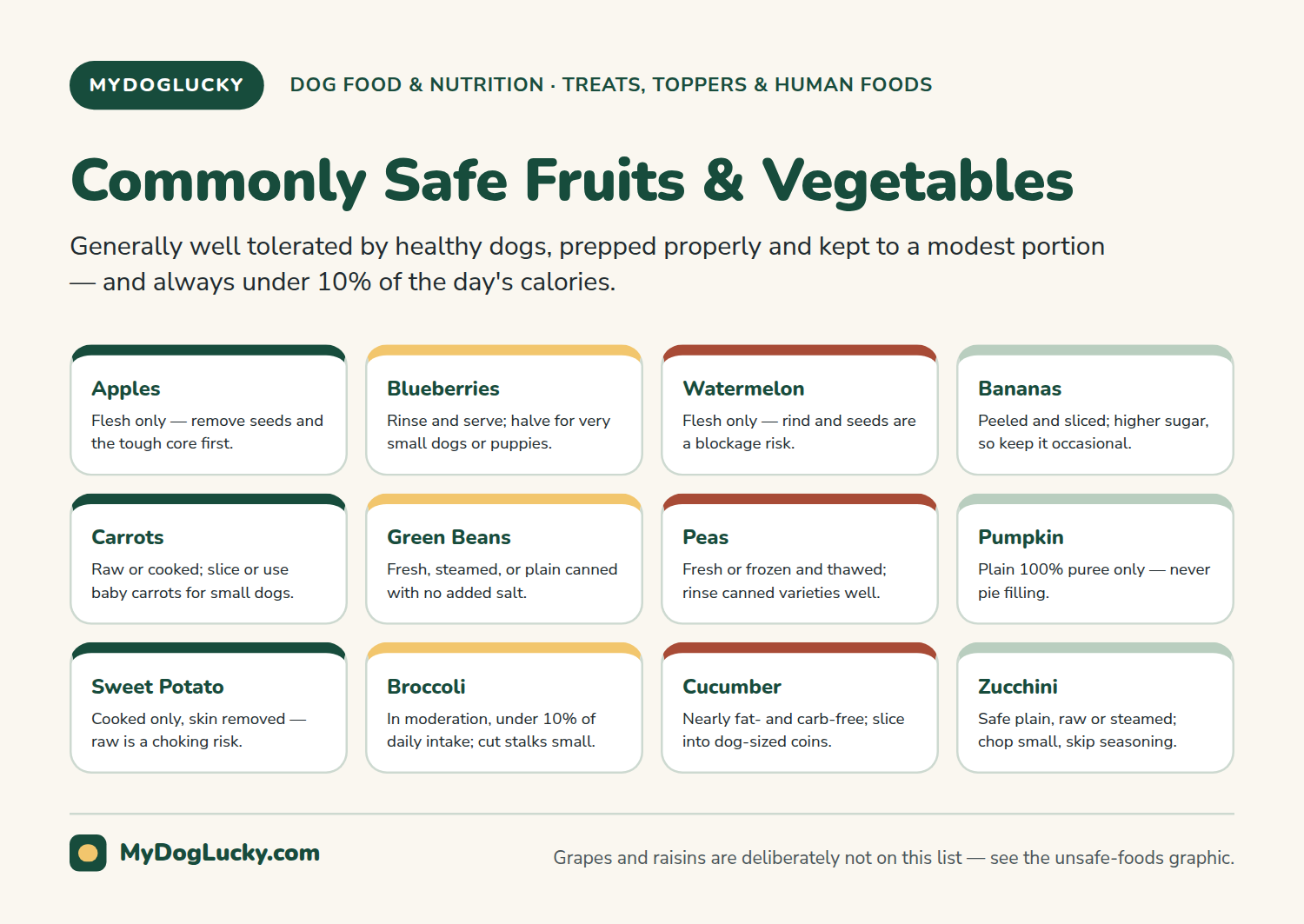
These fruits are generally well tolerated by healthy dogs when prepared properly and kept to a modest portion. None of them are nutritionally necessary — your dog’s regular food already covers that — but used thoughtfully, they make reasonable low-calorie treats or occasional toppers.
One exception sits outside this entire list and deserves a flag right here before we go any further: grapes and raisins. They look like they belong in the same conversation as blueberries and watermelon, and they emphatically don’t. Save the “unsafe” section below for the full explanation, and don’t skip it.
Apples (Flesh Only)
Apple slices are a reasonable snack for most dogs. Remove the seeds and the tough core first. Apple seeds contain a small amount of amygdalin, a compound that breaks down into cyanide-related byproducts — the same family of compounds found in the pits of cherries and peaches.
A couple of accidentally swallowed seeds from ordinary apple slices isn’t the kind of exposure that typically causes a problem, since real cyanide risk generally requires a much larger quantity of crushed or chewed seed material. Still, removing the seeds and core is simple, and it also clears out the biggest choking risk in the apple itself, so there’s no real reason to skip that step. Apples carry natural sugar, so keep portions modest, particularly for dogs managing their weight or diabetes.
Bananas
A few peeled, sliced pieces of banana make an easy occasional treat. Bananas run higher in sugar and calories relative to their size than many other fruits on this list, so they work better as a small, occasional snack than a daily habit — especially for a smaller dog, where a few slices already represent a real share of the day’s calorie budget.
Blueberries
Blueberries are one of the lower-calorie options here and need almost no prep beyond a rinse. Whole berries are fine for most dogs; very small dogs or puppies may do better with them halved to reduce any choking risk. They’re often mentioned for their antioxidant content, though that’s a nutritional detail rather than a reason to feed them in large quantities — a small handful is still the right serving size.
Strawberries
Remove the leafy green cap and slice strawberries for smaller dogs. Like most fruit on this list, they carry natural sugar, so offer them in moderation rather than as a daily staple. You may see claims that an enzyme in strawberries has a mild teeth-whitening effect; treat that as a minor side note rather than a reason to swap out actual dental care.
Watermelon (Flesh Only)
Watermelon is mostly water, which makes it a popular warm-weather snack, but the rind and seeds need to come off first — both are a genuine intestinal blockage risk, not just an inconvenience. A seedless variety simplifies prep considerably. Cut the flesh into pieces sized for your dog rather than large wedges that invite gulping.
Cantaloupe
Cantaloupe flesh, with the rind and seeds removed, is generally fine in small amounts. It’s higher in natural sugar than some other melons, so limit portions for dogs who are overweight or managing diabetes. Frozen cubes can double as a slow, cooling treat in hot weather.
Pears (Flesh Only)
Remove the core, stem, and seeds before offering pear — the seeds contain trace amounts of the same cyanogenic compounds found in apple seeds, and the core is a choking risk in its own right. Ripe pear flesh, cut into manageable pieces, is a reasonable occasional treat. As with apples and bananas, natural sugar content means moderation matters more than the fruit itself being “safe” or “unsafe.”
Oranges
Remove the peel, pith, and seeds, and offer only the flesh in small segments. Citrus can cause mild stomach upset in larger amounts, and plenty of dogs simply don’t care for the smell or taste in the first place, according to AKC nutrition guidance. A segment or two occasionally is a reasonable serving; there’s no real benefit to offering more than that.
Pineapple
Remove the tough, prickly peel and the leafy crown before offering pineapple, and stick to fresh rather than canned, which typically comes packed in sugary syrup, per AKC nutrition guidance. Small chunks of fresh pineapple make a reasonable occasional treat. Like most fruit on this list, its natural sugar content is the main reason to keep servings modest rather than daily.
Safe Vegetables, Food by Food
Vegetables tend to run even lower in calories and sugar than fruit, which makes several of the following especially useful for dogs who need to watch their weight. The same rules still apply: modest portions, appropriate prep, and no added butter, oil, salt, or seasoning meant for a human plate.
Carrots
Raw or cooked, carrots are a low-calorie staple on most safe-food lists. Wash them well, and slice or use baby carrots for small dogs and puppies to reduce choking risk on larger chunks. Some owners find the crunch of a raw carrot mildly helpful for scraping plaque during chewing, though that’s a minor bonus rather than a substitute for actual dental care.
Green Beans
Fresh, steamed, frozen, or canned green beans (plain, no added salt) all work. Chop them for small dogs to make chewing easier. They’re low in calories and high in fiber, which makes them a popular choice for dogs on a weight-management plan — just check that any canned variety doesn’t include added sodium or seasoning.
Peas
Green peas, snow peas, and sugar snap peas are all fine for dogs in small amounts, whether fresh or frozen and thawed, according to AKC nutrition guidance. They offer a reasonable amount of protein and fiber relative to their calorie count. Rinse canned peas well before offering them, or skip canned altogether — the canning liquid often carries added sodium that fresh or frozen peas don’t.
Brussels Sprouts
Cooked, plain Brussels sprouts in small amounts are generally fine for dogs and bring a decent nutrient and antioxidant profile along with them. The main downside isn’t safety — it’s gas. Brussels sprouts, like broccoli and other cruciferous vegetables, can produce noticeably more flatulence than other vegetables on this list. Start with a small amount the first time, and maybe not the night before a long car ride.
Pumpkin
Plain canned pumpkin puree — 100% pumpkin, not pie filling, which contains added sugar and spices — or cooked fresh pumpkin, mashed and unseasoned, both work. Many owners use a spoonful of plain pumpkin puree as a mild fiber source that can help firm up an occasional loose stool. That’s a reasonable home-care step for a mild, isolated case, not a substitute for a vet visit if diarrhea is persistent, worsening, or paired with other symptoms.
Sweet Potato (Cooked Only)
Sweet potato needs to be cooked before it reaches your dog’s bowl — raw sweet potato is difficult to chew and digest and carries a real intestinal blockage risk, according to AKC nutrition guidance. Remove the skin, keep it plain with no butter, sugar, or marshmallow, and serve in small pieces. Sweet potato is also relatively high in vitamin A; feeding large amounts regularly has been associated with bone and muscle issues from excess vitamin A, per AKC’s veterinary guidance, so this is a food best kept to a modest, occasional portion rather than a daily staple, particularly for smaller dogs.
Broccoli (In Moderation)
Broccoli is one of the few “safe” vegetables with a documented upper limit worth knowing. According to AKC’s chief veterinarian, broccoli is generally considered safe when it makes up less than 10% of a dog’s daily food intake, with amounts above roughly 25% considered potentially toxic. The florets contain isothiocyanates, compounds that can cause mild to occasionally severe gastric irritation in some dogs. Keep portions small, cook it lightly, and cut pieces down — the tough stalks in particular carry a choking and esophageal obstruction risk and are best skipped or cut very small.
Celery
Celery is low in calories and carries vitamins A, B, and C. Wash it and cut it crosswise into short pieces rather than long stalks — the stringy fibers can be a minor choking concern for some dogs when swallowed in long strips. Some owners offer it as a low-calorie chew; there’s nothing wrong with that in modest amounts.
Cucumber
Cucumber is close to fat-free and carb-free, which makes it one of the better options for a dog who’s watching his weight. Wash and slice it into coins sized appropriately for your dog. Skip pickled cucumbers entirely — the pickling brine typically includes salt, and often garlic, onion, or other seasonings that don’t belong in a dog’s diet, even though the base vegetable itself is fine.
Zucchini
Zucchini is safe plain, whether raw, steamed, or cooked, according to AKC nutrition guidance, and it’s genuinely low-calorie — roughly 20 calories per cup raw. Chop it into small pieces to reduce choking risk, and steam it if your dog has any difficulty chewing raw vegetables. Keep it unseasoned: no oil, salt, garlic, or onion, and skip zucchini bread or other baked goods entirely, since those add sugar, fat, and sometimes ingredients that are unsafe on their own.
Spinach (In Moderation)
Small amounts of cooked spinach are generally tolerated by healthy dogs. Spinach is relatively high in oxalic acid, a compound that can interfere with calcium absorption and, in large quantities, has been linked to kidney issues, per AKC nutrition guidance. Reaching a harmful amount generally requires eating quite a lot of spinach, which isn’t a realistic daily scenario for most dogs. Even so, dogs with existing kidney disease or a history of calcium oxalate bladder stones are better off skipping spinach entirely — check with your veterinarian if that applies to your dog.
Fruits and Vegetables Dogs Should Never Eat
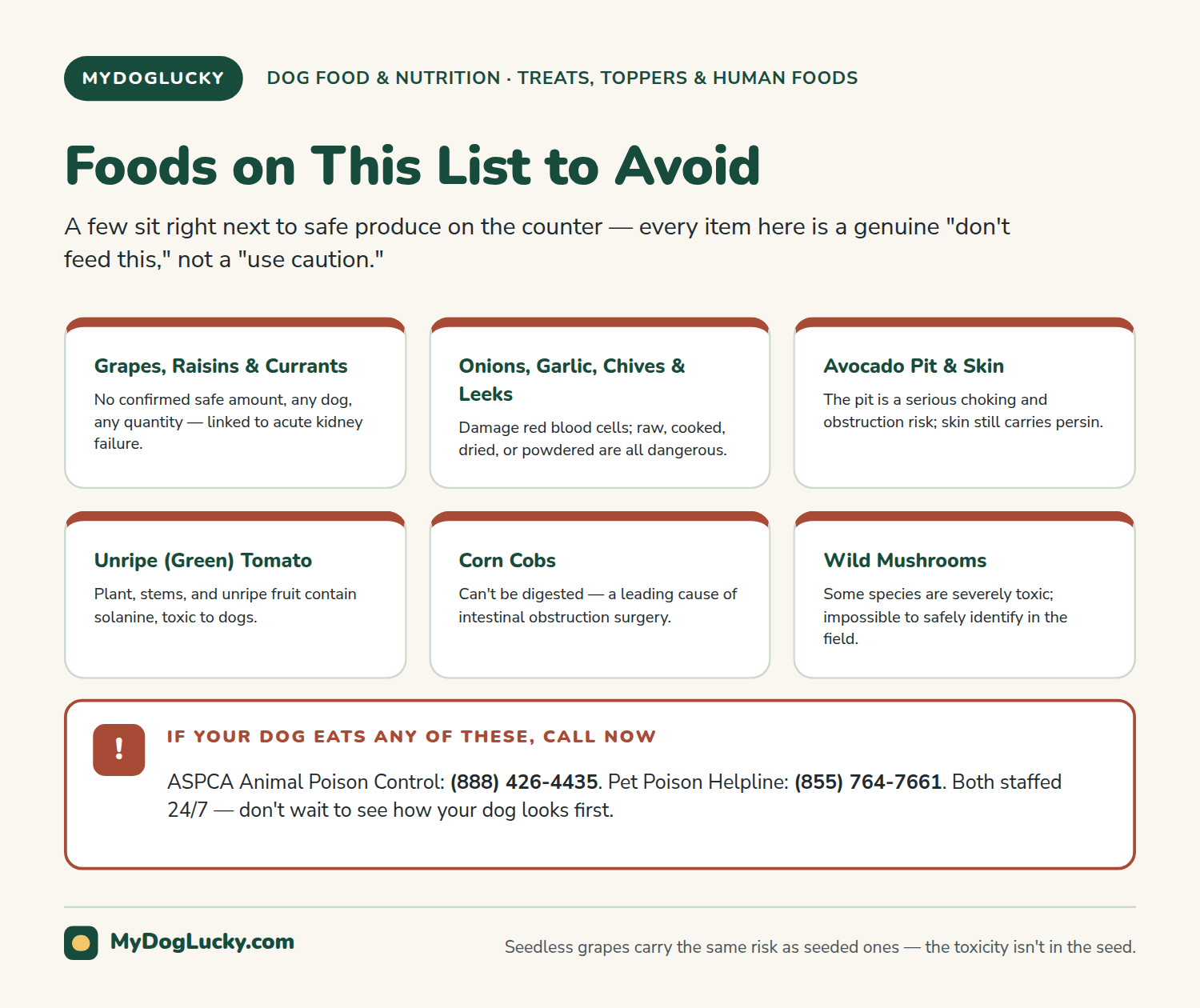
Every food in this section is a genuine “don’t feed this,” not a “use caution.” A few of them sit right next to perfectly safe produce on a kitchen counter, which is exactly why this list matters more than any single safe-food entry above.
The single most important warning in this article
Grapes, raisins, and currants are unsafe for dogs in any quantity, any preparation, and any breed. There is no confirmed safe amount. If your dog eats any of these, treat it as a reason to call your vet or a poison control line — not a wait-and-see situation.
Grapes, Raisins, and Currants
This is the exception that matters most in this entire guide. Grapes, raisins, and currants can cause acute kidney failure in dogs, and researchers still haven’t nailed down every detail of why. The current leading theory, per the Merck Veterinary Manual’s 2024 update, points to tartaric acid: dogs appear to lack the transporters that let them clear this organic acid efficiently, so it accumulates in kidney tissue and can trigger oliguric or anuric renal failure, often within about 72 hours of ingestion.
Here’s the part that makes this different from almost every other food on this list: there’s no established safe dose. Merck’s guidance notes that more than roughly one grape or raisin per 10 pounds of body weight may pose a renal risk, but VCA’s veterinary guidance is direct that tartaric acid content varies between fruits and individual dogs seem to have very different sensitivity — some dogs have developed kidney failure after eating just a few grapes. Treat any exposure, regardless of your dog’s size or how “fine” he seems afterward, as a reason to call poison control or your vet right away, not something to monitor at home.
Watch for early vomiting or diarrhea within 12 to 24 hours, followed by signs of kidney trouble 24 to 48 hours later — continued GI upset, unusually bad (“uremic”) breath, abdominal pain, excessive thirst and urination, dehydration, and progressive lethargy, according to VCA’s veterinary guidance. By the time those later signs show up, treatment is more urgent, which is exactly why calling immediately after ingestion, rather than waiting for symptoms, matters so much here.
Onions, Garlic, Chives, and Leeks
These are all members of the allium family, and they damage a dog’s red blood cells, according to VCA’s veterinary guidance — the resulting cell breakdown can lead to anemia and reduced oxygen delivery throughout the body. Every form is dangerous: raw, cooked, dried, and powdered all pose a risk. Powdered and dried forms are actually more concentrated, not less — VCA notes that one teaspoon of garlic powder is roughly equivalent to eight fresh cloves. That’s part of why this category catches people off guard: it’s not just a raw onion slipping off a cutting board, but also a seasoned soup, a garlic-butter side dish, or a stir-fry sauce that includes onion powder.
Early signs include mouth irritation, drooling, nausea, vomiting, and diarrhea. Larger exposures can progress to weakness, an elevated heart rate, increased effort breathing, pale gums, and red-tinged urine, with potential kidney involvement in severe cases. Some breeds — Akitas and Shiba Inus in particular — appear more sensitive to allium toxicity than others, according to AKC nutrition guidance, though every dog is at real risk regardless of breed.
Avocado, Especially the Pit and Skin
Avocado is a genuinely nuanced entry, and it’s worth explaining the nuance rather than just saying “toxic” and moving on. Dogs are actually fairly resistant to persin, the compound in avocado that’s seriously dangerous to birds and livestock — the Merck Veterinary Manual notes dogs seem relatively resistant compared with other species, with only a single case report of heart tissue damage in two dogs. So the avocado flesh itself isn’t the acute chemical hazard for dogs that it is for, say, a pet bird.
That’s not the same as saying avocado is a good idea. The pit is large, hard, and round — almost exactly the shape and size that gets lodged in a dog’s throat or intestines, and Merck specifically flags intact-pit ingestion as a foreign-body obstruction risk in dogs. The skin and leaves still contain persin. And the flesh itself is high in fat, which can trigger GI upset or contribute to pancreatitis risk in dogs prone to it. Add it up, and there’s very little upside and real downside, so the simplest guidance is to just skip avocado rather than try to offer flesh only and keep pits and skin perfectly contained around a curious dog.
Unripe (Green) Tomatoes and Tomato Plants
The tomato plant itself — stems, leaves, and unripe green fruit — contains solanine, a compound that’s toxic to dogs, according to ASPCA’s plant toxicity guidance. Symptoms can include hypersalivation, loss of appetite, significant gastrointestinal upset, weakness, dilated pupils, and a slowed heart rate. Fully ripe, red tomato flesh is generally considered non-toxic in small amounts. Given how easy it is to mix up a green tomato with a ripe one, or for a dog with garden access to help himself to whatever’s within reach, the simplest household approach is to fence tomato plants off from your dog and skip feeding tomato altogether unless you’re certain it’s fully ripe.
Corn Cobs
Plain corn kernels, in small amounts, aren’t the concern here — the cob is. Dogs often swallow chunks of cob without chewing them properly, and a cob can’t be digested. It has to pass through the entire digestive tract, and most dogs can’t pass one on their own, which is why corn cobs are a leading cause of intestinal obstruction requiring surgery in dogs who scavenge them off a plate or out of the trash.
Watch for vomiting, abdominal pain, lethargy, straining, or a noticeably smaller appetite in the hours and days after a suspected cob ingestion — a blockage can take time to fully develop, so a normal bowel movement the next day doesn’t rule it out. If you know or strongly suspect your dog swallowed cob material, call your vet rather than waiting to see what happens.
Wild Mushrooms
Wild or foraged mushrooms are a different risk category entirely from the plain, store-bought mushrooms people cook with. Some wild species are severely toxic to dogs, with effects ranging from GI upset to liver failure or neurological signs, and reliably telling a dangerous species from a harmless one in the field isn’t something most people — including experienced foragers — can do with confidence.
Store-bought culinary mushrooms, plain and unseasoned, are generally considered fine in small amounts for most dogs. If your dog eats a mushroom he found on a walk, treat it as a potential emergency and call poison control or your vet rather than trying to identify the species yourself. This topic deserves its own deeper coverage, which is part of why MyDogLucky has a separate, dedicated piece on foods dogs should never eat.
Common Mistakes That Turn a Healthy Snack Into a Vet Visit
Going From Zero to a Full Portion Overnight
Skipping the small test amount and handing over a full serving the first time is one of the most common ways an otherwise safe food causes trouble. Even foods considered safe can bring on GI upset in volume, especially high-fiber vegetables or high-sugar fruits a dog’s gut hasn’t adjusted to yet.
Assuming Cooked Is Automatically Safer Than Raw (or Vice Versa)
Cooking changes some risks and does nothing about others. Cooking solves the raw sweet potato problem, for instance, but a cooked dish seasoned with onion or garlic powder is still every bit as much of an allium hazard as raw onion, and a cooked corn cob is still an obstruction risk. Each food’s safety depends on its specific preparation, not a blanket raw-versus-cooked rule.
Ignoring Seeds, Pits, Cores, and Rinds
A few clean slices of apple and a whole apple with the core and seeds still attached are two different foods from a safety standpoint, even though they came from the same fruit. Treat the trimming step as part of the food, not an optional extra.
Letting “Healthy” Override the 10% Rule
It’s easy to assume fruit and vegetable snacks don’t really count toward a dog’s daily calories because they’re “healthy.” They do count, and treating them as calorie-free is a common, well-intentioned way extra weight creeps on over months without anyone noticing day to day.
Not Checking What Else Is in the Dish
Table scraps that include vegetables cooked with onion, garlic, butter, salt, or a sugary glaze carry the risk of the preparation, not just the vegetable. A green bean casserole or a seasoned stir-fry is a different food safety question than plain steamed green beans, even though “green beans” is technically the same word in both cases.
Skipping the Vet Conversation for a Dog With a Health Condition
A reasonable snack for a healthy adult dog isn’t automatically reasonable for a dog managing kidney disease, pancreatitis, diabetes, food allergies, or a prescription diet. This entire guide is written for the general case; an individual dog with a known health condition needs guidance tailored to that condition, which only your veterinarian can give.
Forgetting That “A Little” Adds Up Across a Whole Household
In a household with more than one person feeding the dog, a small piece of carrot here and a corner of toast there can quietly stack up to well over the 10% ceiling by the end of the day, with no single person aware of the full total. If more than one person in your house hands out snacks, a shared, visible tally — a note on the fridge, a running count in a shared phone app, anything that gets everyone looking at the same number — solves this faster than asking everyone to simply remember to cut back.
If Your Dog Already Ate Something Unsafe
If your dog just ate something from the unsafe list above, act first and read the rest of this article later.
Call now, don’t wait, if your dog has eaten:
- Grapes, raisins, or currants, in any amount.
- Onions, garlic, chives, or leeks, in any form or amount.
- An avocado pit, whole or in large pieces.
- A corn cob, or a large piece of one.
- A wild mushroom found outdoors.
- Any amount of an unripe tomato or tomato plant material beyond an accidental nibble.
Also seek emergency care immediately for repeated vomiting, collapse, difficulty breathing, extreme lethargy, or pale or blue gums, regardless of the cause.
Who to Call
Call the ASPCA Animal Poison Control Center at (888) 426-4435 or Pet Poison Helpline at (855) 764-7661. Both are staffed 24 hours a day, 365 days a year, by veterinary toxicology professionals rather than a general call center. A consultation fee applies to both services — ASPCA’s site notes a fee may apply without listing an exact figure, and Pet Poison Helpline currently lists an $89 incident fee that covers follow-up calls on the same case. If your own veterinarian or a 24-hour emergency animal hospital is faster to reach, call them first, or call both at once if you have the hands free to do it.
What to Have Ready
Before you call, try to have on hand: what your dog ate and roughly how much, his current weight, how long ago it happened, and any symptoms you’ve noticed so far. This lets the toxicology team give you specific guidance immediately instead of spending the first few minutes gathering basic facts.
What Not to Do
Don’t try to make your dog vomit unless a veterinarian or poison control specialist specifically tells you to do that for this exact situation — the right response depends on what was eaten, how long ago, and your dog’s individual health picture, and inducing vomiting isn’t always the correct move even after a genuinely unsafe food. And don’t wait to see how your dog seems before calling. With grapes and raisins especially, a dog can look completely normal for a day or two before kidney symptoms appear, and by then, treatment is a more urgent, more complicated situation than it would have been with an early call.
Frequently Asked Questions
What fruits and vegetables can dogs eat every day?
Low-sugar, low-calorie options like cucumber, green beans, and small amounts of carrot tend to work well as a more regular snack, since they carry less risk of tipping a dog over the 10% treat ceiling even with frequent small servings. Higher-sugar fruits like banana, cantaloupe, and pear are better kept occasional rather than daily.
Can dogs eat grapes if they’re seedless?
No. Seedless grapes carry the same risk as seeded ones. The toxicity isn’t related to the seeds — it’s connected to compounds in the fruit itself, so seedless grapes and raisins made from them are exactly as unsafe.
Is it okay to give my dog vegetables from a stir-fry or casserole?
Usually not without checking the recipe first. The vegetable itself might be fine, but stir-fries, casseroles, and sauces frequently include onion, garlic, excess salt, or oil that make the dish unsafe even though a plain version of the same vegetable wouldn’t be. When in doubt, set aside a small plain portion before seasoning, the way you would for any other dietary restriction at the table.
My dog stole a grape off the counter and seems fine. Do I still need to call?
Yes. Grape and raisin toxicity often doesn’t show visible symptoms right away — early GI signs can take 12 to 24 hours to appear, and kidney symptoms often lag another day or two behind that. “Seems fine right now” isn’t reliable information this early. Call poison control or your vet regardless of how your dog looks in the moment.
Can puppies eat the same fruits and vegetables as adult dogs?
The same unsafe list applies to puppies, with the same urgency if something on it gets eaten. For the safe list, puppies generally need smaller pieces to reduce choking risk, smaller portions relative to their smaller size and calorie needs, and closer supervision, since a curious puppy is more likely to swallow something whole rather than chew it properly. Check with your veterinarian about timing and portions specific to your puppy’s age and breed.
Are frozen fruits and vegetables okay, or does freezing change anything?
Freezing doesn’t change a food’s basic safety profile — a frozen grape is exactly as unsafe as a fresh one. Frozen cubes of dog-safe fruit like watermelon or blueberries can make a pleasant, slow-to-eat warm-weather treat. Just make sure whatever you’re freezing was safe and properly prepped (seeds, pits, and rinds removed) before it went into the freezer.
Can dogs eat the skin or peel of fruits and vegetables?
It depends on the specific food. Cucumber and zucchini skin are generally fine. Sweet potato skin should come off. Apple skin is usually fine in small amounts, though the flesh alone is easier to control for seeds. Avocado skin should never be fed. When a specific food’s entry above doesn’t mention the skin one way or the other, treat that as a reason to trim it off rather than assume it’s fine.
Is canned pumpkin the same as pumpkin pie filling?
No, and this distinction matters. Plain canned pumpkin lists pumpkin as the only ingredient. Pumpkin pie filling includes added sugar and spices, some of which (like nutmeg, in larger amounts) aren’t appropriate for dogs. Always check the label and choose 100% pumpkin puree, not pie filling.
My dog has a sensitive stomach. Should I skip fruits and vegetables entirely?
Not necessarily, but the introduction protocol matters more for a dog with a known sensitive stomach than for one without a history of GI issues. Go slower than the general 24-hour guideline suggests if needed, stick to lower-fiber, lower-fat options first, and loop in your veterinarian about which specific foods make sense for your dog’s history.
Do fruits and vegetables count as “human food” my dog shouldn’t have?
“Human food” isn’t really a useful category on its own — some human foods are fine for dogs, and some aren’t, and the distinction has nothing to do with who the food was originally intended for. It’s more useful to think in terms of the specific food and its preparation, which is the approach this whole guide takes.
Can dogs be allergic to a specific fruit or vegetable?
Yes, though true food allergies are less common than general sensitivities or intolerances. Signs can include itching, skin irritation, ear infections, or GI upset that shows up consistently after a specific food. If you notice a pattern with one particular fruit or vegetable, stop feeding it and mention the pattern to your veterinarian, who can help sort out whether it’s a true allergy or something else.
Do I need to peel every fruit or vegetable before feeding it to my dog?
Not universally — it depends on the specific food, which is why this guide covers prep item by item rather than giving one blanket rule. Tougher, less digestible skins, like sweet potato skin or citrus peel and pith, are generally better removed. Thinner skins on foods like cucumber, zucchini, or a well-washed apple are usually fine left on in small amounts. When you’re unsure about a specific food, removing the skin is the lower-risk default.
Is it better to feed fruits and vegetables raw or cooked?
It depends on the food, not on a general raw-versus-cooked rule. Sweet potato needs to be cooked. Carrots, cucumber, and zucchini are fine either way. Broccoli tends to sit easier with some dogs lightly cooked rather than raw. Check the specific food’s entry above rather than applying one blanket approach across everything you feed — that “one rule fits every food” instinct is exactly the mistake this guide flags earlier on.
Can I make my dog a fruit and vegetable topper for his regular meals?
You can, as long as the same rules from this guide still apply: only foods from the safe list, appropriately prepped, kept under the 10% treat ceiling, and introduced gradually if it’s a new combination for your dog. A spoonful of plain pumpkin or a few chopped green beans stirred into a meal is a reasonable way to add variety and a little extra fiber. It’s still an addition to a complete and balanced diet, not a replacement for one, and a homemade topper used daily in any real volume is worth mentioning to your veterinarian so it’s factored into your dog’s overall calorie picture.
What’s the most common produce-related emergency you’d want owners to know about?
Grape and raisin ingestion is the one worth burning into memory, precisely because it looks so harmless and the consequences can be so serious. Corn cobs and avocado pits cause plenty of obstruction emergencies too, but those are at least intuitive as choking hazards once you think about their shape. Grapes don’t look dangerous at all, which is exactly why they’re the one most owners underestimate.
The Bottom Line on Sharing Produce With Your Dog
Most fruits and vegetables are a genuinely fine addition to a dog’s routine — washed, prepped, introduced one at a time, and kept under that 10% ceiling alongside everything else your dog gets in a day. The list of true exceptions is short, and it’s worth knowing by heart rather than by looking it up mid-emergency: grapes, raisins, and currants; the onion family in any form; avocado pits and skin; unripe tomato and tomato plant material; corn cobs; and wild mushrooms.
If your dog gets into one of those anyway — and plenty of dogs eventually do, because a counter within reach is a counter within reach — the two numbers above are worth saving in your phone before you need them, not looking up while you’re already worried. Everything else in this guide is here to make sharing a little produce with your dog a source of routine, low-stakes fun rather than something to second-guess every time.
Sources
- Association of American Feed Control Officials (AAFCO). Reading Labels
- American Kennel Club. Fruits and Vegetables Dogs Can or Can’t Eat
- American Kennel Club. Is Broccoli Safe for Dogs?
- American Kennel Club. Can Dogs Eat Sweet Potatoes?
- American Kennel Club. Can Dogs Eat Zucchini?
- American Kennel Club. How to Switch Dog Foods: Transitioning Your Dog’s Diet
- ASPCA. People Foods to Avoid Feeding Your Pets
- ASPCA. Toxic and Non-Toxic Plants: Avocado
- ASPCA. Toxic and Non-Toxic Plants: Tomato Plant
- ASPCA. ASPCA Animal Poison Control
- VCA Animal Hospitals. Onion, Garlic, Chive, and Leek Toxicity in Dogs
- VCA Animal Hospitals. Grape, Raisin, and Currant Poisoning in Dogs
- VCA Animal Hospitals. Ingestion of Foreign Bodies in Dogs
- Merck Veterinary Manual. Grape, Raisin, and Tamarind Toxicosis in Dogs
- Merck Veterinary Manual. Avocado (Persea spp) Toxicosis in Animals
- World Small Animal Veterinary Association. Feeding Treats to Your Dog (2025)
- U.S. Food and Drug Administration. Potentially Dangerous Items for Your Pet
- Pet Poison Helpline. 24/7 Animal Poison Control Center
- VEG ER for Pets. My Dog Ate a Corn Cob – What Should I Do?
This article is general education for U.S. dog owners. It is not an individualized feeding plan or veterinary advice for your dog. Any fruit or vegetable introduced for the first time should be discussed with your veterinarian if your dog is a puppy, is pregnant or nursing, has a chronic health condition, or is on a prescription diet. If your dog has eaten something from the unsafe list above, or is showing any of the emergency signs described in this article, contact your veterinarian, a 24-hour emergency animal hospital, or a pet poison control hotline immediately.




Trackbacks/Pingbacks