

Dog nutrition sounds like it should be simple. Feed a good food, feed the right amount, done. Then you stand in the pet food aisle, or scroll a website with forty tabs open, and every bag claims to be “premium,” every site claims the opposite thing about grain, and somewhere a stranger on the internet is very confident your dog is being poisoned by kibble. None of that confidence is coming from your dog’s actual bloodwork, body condition, or life stage — and that’s the gap this guide is built to close.
This is the front door to everything MyDogLucky publishes about dog nutrition: how to read a label, how to compare two foods honestly, how much to actually feed, how nutritional needs shift across a dog’s life, when a diet decision belongs to your veterinarian instead of a search engine, and how treats and human food fit into the picture without wrecking it. Each section below gives you a real, standalone-useful overview, then names the deeper MyDogLucky article where that one topic gets the full treatment.
One thing we won’t do here: tell you which specific commercial food to buy. We don’t name or rank brands anywhere on this site, in this article or any other, for a simple reason — a label’s real story lives in its adequacy statement, its guaranteed analysis, and its calorie content, not its front-of-bag branding, and those details are things you can learn to read for yourself. That skill outlasts any specific product on the shelf.
Try This First
If you only do one thing after reading this guide, do this: pick up the bag or can you’re feeding right now, flip it over, and find the nutritional adequacy statement. It’s usually one small-print sentence near the guaranteed analysis panel. That single sentence tells you more about whether the food is actually appropriate for your dog than the entire front of the package. The Labels & Adequacy section below walks through exactly what it says and why it matters.
The Short Version: What Good Dog Nutrition Looks Like
Good dog nutrition, boiled down to its essentials, looks like this:
- Start with the AAFCO nutritional adequacy statement, not the front of the bag. It tells you whether a food is complete and for which life stage — the single most load-bearing sentence on any package.
- There’s no one universal “best” dog food. The right choice depends on your individual dog’s life stage, size, health history, and your household’s budget and routine, not a ranking on a website.
- Portion size matters more than most owners assume, and the amount printed on the bag is a starting estimate, not a prescription for your specific dog.
- Nutritional needs shift across a dog’s life — puppy, adult, senior, and large-breed growth all have different requirements worth understanding, even in general terms.
- Some diet decisions genuinely need a veterinarian, not an article: raw and homemade feeding, diagnosed food allergies, and any dog with an existing health condition all fall into that category.
- Treats and toppers add up fast. A simple calorie-budget rule keeps extras from quietly crowding out a balanced diet.
That’s the skeleton. Everything below fills it in, section by section, and points you toward a deeper MyDogLucky article wherever one exists for a topic that deserves a fuller treatment than an overview page can give it.
Choose Your Path
Different readers land here with very different questions. Jump straight to the section that matches yours.
In This Guide
- What “good nutrition” actually means for a dog
- The six areas of dog nutrition
- Labels & Adequacy
- Choosing & Comparing Food
- Portions & Feeding Routines
- Life-Stage & Size Needs
- Special Diets & Food Safety
- Treats, Toppers & Human Foods
- How to keep learning: working with your veterinary team
- Frequently asked questions about dog nutrition
- Sources
Confused by a label right now? Go to Labels & Adequacy. Comparing two bags or two brands? Read Choosing & Comparing Food. Wondering how much to actually feed? Skip to Portions & Feeding Routines. Have a puppy, a large-breed dog, or a senior? Go to Life-Stage & Size Needs. Considering raw, homemade, or managing a sensitive stomach or allergy? Read Special Diets & Food Safety carefully. Just want to know what’s safe to share from your plate? Jump to Treats, Toppers & Human Foods.
What “Good Nutrition” Actually Means for a Dog
Good dog nutrition isn’t a single product. It’s a relationship between three things that shift over a dog’s lifetime: what a food actually contains, how much of it your dog eats, and how your dog’s body responds — weight, coat, energy, stool quality, bloodwork. A food can be excellent on paper and still be the wrong amount for your dog. A food can be perfectly balanced and still be wrong for a dog with a specific health condition. Nutrition is a system you monitor, not a purchase you complete once.
That framing matters because so much dog food marketing implies the opposite: that there’s one correct answer, and finding it is a matter of reading enough reviews. There isn’t, and it isn’t. A working dog burning thousands of calories a day, a fifteen-pound senior managing kidney values, and a large-breed puppy whose skeleton needs a deliberately slower growth rate are not competing for the same “best” food. They need different things, and a label built around AAFCO’s nutrient profiles and life-stage categories is what actually tells you whether a specific product fits a specific dog — not a star rating.
Why There’s No Single “Best” Diet
Three variables drive most of the real differences between what one dog needs and what another dog needs: life stage (growth, adult maintenance, or the mature and senior years), body size and breed-related growth pattern (a Great Dane puppy and a Chihuahua puppy are on very different skeletal timelines), and individual health status (allergies, chronic conditions, and body condition all shift the picture). Layer household reality on top — budget, time to prep food, a picky eater, multiple dogs with different needs sharing one kitchen — and it becomes obvious why a single “best dog food” ranking can’t actually serve every reader clicking on it.
What can serve every reader is a consistent method: understand the label, compare foods on the same fair terms, feed a portion based on your dog’s real body condition instead of guesswork, and adjust as your dog’s life stage changes. That method is what the rest of this guide teaches, subcategory by subcategory.
A Few Terms You’ll See Throughout This Guide
A handful of words come up constantly in dog nutrition conversations. Defining them once here saves re-explaining them in every section below.
| Term | What it means in plain language |
|---|---|
| AAFCO | Association of American Feed Control Officials — sets the nutrient profiles and labeling rules U.S. pet food makers follow. It does not test, approve, or rank individual products. |
| Nutritional adequacy statement | A label sentence stating whether a food is “complete and balanced” and for which life stage. The single most useful line on the package. |
| Guaranteed analysis | A short table listing minimum crude protein and fat, plus maximum crude fiber and moisture — a standardized but limited snapshot, not a full nutrient breakdown. |
| RER / MER | Resting Energy Requirement and Maintenance Energy Requirement — the two-step math vets use to estimate a dog’s daily calorie needs from body weight. |
| Body condition score (BCS) | A hands-on, visual scoring system (usually 1 to 9) that measures whether a dog is underweight, ideal, or overweight — the real feedback loop for portion size. |
| Complete and balanced | A legal claim meaning a food is formulated to serve as a dog’s entire diet for a stated life stage, not just a snack or topper. |
| Elimination diet | A structured, vet-directed trial using a novel or hydrolyzed protein diet for several weeks to identify a suspected food allergy. |
The MyDogLucky Approach to Dog Nutrition
A few ideas shape everything we write about dog nutrition, and it’s worth stating them plainly up front. Your veterinarian is the plan; we’re the preparation. Guidelines from AAFCO, WSAVA, and the FDA give a framework that applies to dogs in general. Your vet applies that framework to one specific dog, with one health history, one activity level, and one set of lab values. This guide helps you understand that framework and ask sharper questions. It doesn’t replace an exam, bloodwork, or an individualized feeding plan.
We also try hard not to feed anxiety. Nutrition content online leans heavily on fear — scary ingredient lists, dramatic claims about “fillers,” worst-case framing of ordinary ingredients. Most commercial dog foods sold in the United States that carry a valid AAFCO adequacy statement are safe, functional diets. The goal of this guide is confidence and better questions, not a longer list of things to worry about.
The Six Areas of Dog Nutrition
Our Dog Food & Nutrition library is organized into six subcategories that cover the full arc of feeding a dog well, from reading a label for the first time through the questions that come up with a senior dog managing a chronic condition. Each has a much deeper set of dedicated articles behind it; this page is the map, not the whole territory.
| Area | The question it answers | Start here when |
|---|---|---|
| Labels & Adequacy | What does this bag actually say, and which parts of it carry legal weight? | You’re standing in the aisle or reading a product page, unsure what matters. |
| Choosing & Comparing Food | How do I fairly compare two specific foods against each other? | You’ve narrowed it to a couple of options and need a real framework. |
| Portions & Feeding Routines | How much should I actually feed, and how often? | You’re unsure if the bag’s suggested amount is right for your dog. |
| Life-Stage & Size Needs | How do nutritional needs change as a dog grows, ages, or is a specific size? | You have a puppy, a large or giant breed, or a senior dog. |
| Special Diets & Food Safety | What’s true about raw feeding, homemade diets, allergies, and food safety? | You’re considering a nonstandard diet or suspect a sensitivity. |
| Treats, Toppers & Human Foods | How do extras fit into a balanced diet without wrecking it? | You’re wondering what’s safe to share, or how many treats is too many. |
Together, these six areas cover essentially every question a dog owner asks about feeding, from the first label read to a senior dog’s changing needs. Read on for the full walk-through, section by section.
Labels & Adequacy
Most of a dog food package is marketing copy, and marketing copy isn’t required to be true in any specific, measurable way. A handful of elements on that same package carry real legal weight, and learning to find them is most of what reading a dog food label actually means in practice. This section is the fast overview; our dedicated guide on reading dog food labels goes considerably deeper into every naming rule and edge case.
The Four Elements That Actually Matter
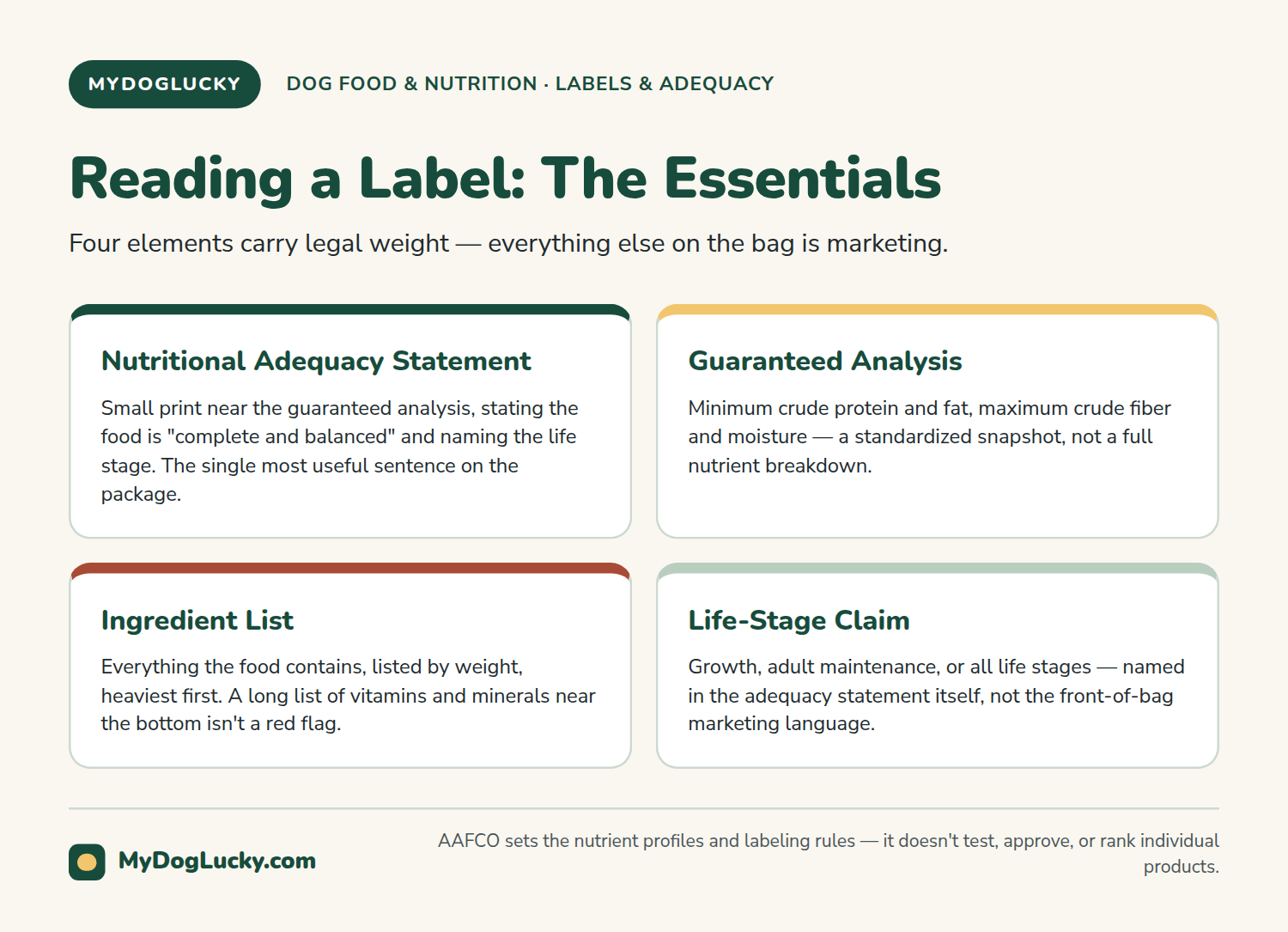
Four things on a dog food package carry genuine regulatory weight: the nutritional adequacy statement (usually small print near the guaranteed analysis), the guaranteed analysis (minimum crude protein and fat, maximum crude fiber and moisture), the ingredient list (everything the food contains, by weight, heaviest first), and the calorie content (given in kilocalories per kilogram and per cup, can, or treat). Everything else — the product name’s emotional appeal, the photography, words like “premium” or “holistic” — is marketing, and marketing isn’t held to the same standard.
AAFCO, the industry body that sets the model regulations most U.S. states adopt, is explicit that a careful reader should look past front-of-bag claims and check these four elements directly. None of the four require a nutrition degree to find. They require knowing to flip the bag over and read the small print, which most shoppers, understandably, never do.
The Nutritional Adequacy Statement, Decoded
If you read only one thing on a label, make it this sentence. AAFCO recognizes three standardized ways a food can claim to be “complete and balanced”: formulation-based (“formulated to meet AAFCO Dog Food Nutrient Profiles for [life stage]”), meaning the recipe is calculated on paper to hit nutrient minimums; feeding-trial-based (“animal feeding tests using AAFCO procedures substantiate that this product provides complete and balanced nutrition”), meaning the finished product was actually fed to dogs under a defined protocol and those dogs maintained normal health; and a comparable-based statement, used when a product is nutritionally similar to one already substantiated through feeding trials.
Both formulation-based and feeding-trial-based statements are legitimate paths to a legal “complete and balanced” claim, though many veterinary nutritionists consider feeding-trial substantiation somewhat stronger evidence, since it reflects real animals rather than a calculation alone. Either way, the life stage named in that sentence — growth, adult maintenance, gestation/lactation, or all life stages — is the part worth reading twice. A food statement built for “growth” is formulated for a developing puppy’s needs, not an adult dog’s, and feeding an adult-maintenance food to a growing large-breed puppy (or vice versa) is a genuinely different nutritional situation than the label’s front panel might suggest.
The Guaranteed Analysis, Read Correctly
The guaranteed analysis lists minimums and maximums, not exact values — a food could legally contain more protein than its label states, but not less. It’s also not directly comparable between a dry food and a wet food without adjusting for moisture content first, because a canned food’s percentages are diluted by water in a way a kibble’s aren’t. Comparing crude protein percentages between a food that’s 10% moisture and one that’s 78% moisture, without converting both to a dry-matter basis, gives you a misleading answer that looks precise and isn’t.
Treat the guaranteed analysis as a rough, standardized starting point for comparison — useful for spotting a genuinely unusual outlier, less useful for splitting hairs between two otherwise similar complete-and-balanced foods. The calorie content figure, often printed nearby, tends to matter more for day-to-day feeding decisions than the guaranteed analysis percentages do.
Reading the Ingredient List Without the Fear-Based Approach
Ingredients are listed by weight, heaviest first, which trips up a lot of otherwise careful readers. Fresh meat’s water content can push it higher on the list than a more nutrient-dense, concentrated ingredient listed further down — a “first ingredient” comparison alone doesn’t reliably tell you which food has more actual meat protein once cooking and moisture are accounted for. A long list of unfamiliar-sounding vitamins and minerals near the bottom isn’t automatically a red flag either; that’s often exactly what a complete and balanced formulation is supposed to include.
The product name itself reveals something concrete, thanks to AAFCO’s naming rules. A food called “Chicken Dog Food” must be built mostly from chicken (the 95% rule). “Chicken Dinner” or “Chicken Entrée” only needs to be 25% chicken by weight excluding water (the 25% rule). “Dog Food with Chicken” needs just 3% (the “with” rule). “Chicken Flavor Dog Food” needs only a detectable amount, no set minimum at all (the flavor rule). Those are four different legal claims, not four ways of phrasing the same thing, and reading the exact wording of a product’s name tells you something real before you’ve read a single ingredient.
| Naming pattern | Example | What it legally requires |
|---|---|---|
| “___ Dog Food” (95% rule) | Chicken Dog Food | At least 70% of total weight; 95% excluding added water |
| “___ Dinner / Entrée” (25% rule) | Chicken Dinner | At least 10% of total weight; 25% excluding added water |
| “Dog Food with ___” (“with” rule) | Dog Food with Chicken | At least 3% of total weight |
| “___ Flavor Dog Food” (flavor rule) | Chicken Flavor Dog Food | No set minimum, just a detectable amount |
Life-Stage Claims: Why the Label Matters More Than the Marketing
AAFCO recognizes four dog nutrition life stages: growth, gestation/lactation, adult maintenance, and “all life stages” (a formulation built to satisfy the more demanding growth requirements, so it also covers maintenance). A bag’s front-panel life-stage language — “puppy,” “senior,” “large breed” — is marketing and isn’t independently regulated the same way. What’s actually regulated is the nutritional adequacy statement’s life-stage claim on the back. A product marketed as “senior” with no dedicated senior nutrient profile in AAFCO’s system is, legally, usually formulated to the adult maintenance or all-life-stages profile with different marketing on the front — not necessarily a problem, but worth knowing so the word “senior” doesn’t do more persuading than it’s entitled to.
Label literacy is also a transferable skill across every format a dog eats. The same four elements — adequacy statement, guaranteed analysis, ingredient list, calorie content — apply whether you’re reading a kibble bag, a can, a fresh-food pouch, or a freeze-dried tub. Once reading a label becomes a five-minute habit instead of a chore, comparing formats and brands in the next section gets a lot faster, because you already know exactly where to look and what each part is actually telling you.
A Quick Mental Checklist for the Pet Food Aisle
- Find the nutritional adequacy statement first. Confirm the life stage matches your dog’s.
- Check the calorie content per cup or can — it drives your actual portion more than anything else on the label.
- Read the ingredient list in full, not just the first five items.
- Treat “premium,” “holistic,” and similar front-of-bag words as marketing, not regulated claims.
- If a claim matters to your decision and you can’t verify it on the label, contact the manufacturer directly — they’re expected to answer.
Choosing & Comparing Food
Once you can read a label, the next question is how to compare two specific foods against each other fairly — not by which one has the more convincing photo, but by criteria that actually predict whether a food will work for your dog. This section builds that framework; our dedicated guide on comparing dog foods, plus our separate guides on wet versus dry and fresh versus kibble, go deeper into specific formats.
A Fair Framework for Comparing Any Two Foods
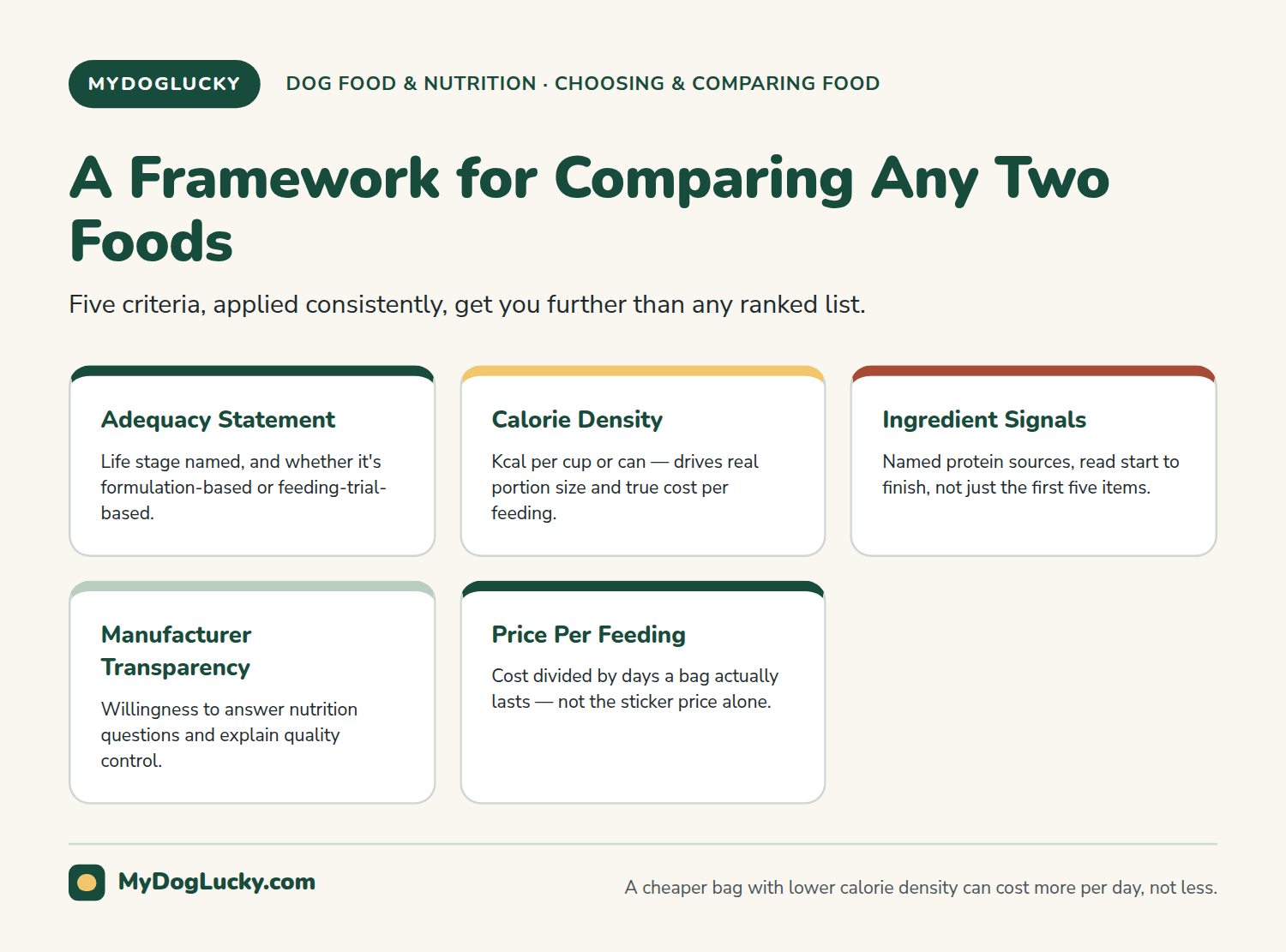
Five criteria, applied consistently, get you further than any ranked list: the nutritional adequacy statement (does each food match your dog’s actual life stage), calorie density (how many calories per cup or can — a denser food means smaller portions, which changes the real cost-per-feeding math), ingredient-quality signals (not a fear-based scan of the list, but concrete things like named protein sources and a manufacturer willing to explain their sourcing), manufacturer transparency (more below), and price per feeding rather than price per bag, since bag size and calorie density both distort a simple sticker-price comparison.
| Comparison criterion | What to check | Why it matters more than it looks |
|---|---|---|
| Adequacy statement | Life stage named, formulation vs. feeding-trial basis | Determines whether the food can serve as a sole diet for your dog’s stage at all |
| Calorie density | Kcal per cup, can, or 100g | Drives real portion size and true cost per feeding, not bag price |
| Ingredient signals | Named protein sources, full list read start to finish | More informative than “first five ingredients” folklore |
| Manufacturer transparency | Willingness to answer nutrition questions, quality control info | Correlates with how seriously a company treats formulation and safety |
| Price per feeding | Cost ÷ number of days a bag or case actually lasts your dog | A cheaper bag with lower calorie density can cost more per day, not less |
Gauging Manufacturer Transparency: Questions Worth Asking
The World Small Animal Veterinary Association’s Global Nutrition Committee publishes a widely used set of questions for exactly this purpose, aimed at helping owners and veterinarians gauge a pet food company’s rigor without needing insider industry knowledge. Worth asking, by phone, email, or the manufacturer’s own site: Does the company employ a qualified nutritionist, ideally someone with an advanced degree in animal nutrition or board certification through a recognized veterinary nutrition college? Who formulates the recipes — a nutritionist, or a product team without that specific training? What quality-control steps apply to ingredients and the finished product? Has the company published or contributed to peer-reviewed nutrition research?
None of these questions require you to become a food scientist. They require picking up the phone or sending an email, and paying attention to whether the answer is specific and confident or vague and evasive. WSAVA’s own guidance is blunt about what a non-answer means: if a manufacturer can’t or won’t provide this information, that reluctance is itself useful information, worth weighing against anything printed on the front of the bag.
One detail worth asking about specifically: whether a company manufactures its own food in its own facility, or contracts the work out to a third-party co-packer. Neither answer alone tells you whether a food is good or bad dog nutrition — plenty of well-formulated foods are made under contract, and plenty of in-house-manufactured foods are unremarkable. What matters is whether the company can speak specifically to its own quality-control process either way, rather than deflecting the question entirely.
Major Format Choices at a Glance
Beyond brand and recipe, dog food also comes in genuinely different physical formats, each with real tradeoffs rather than one obviously “best” option. This overview stays general on purpose; our dedicated wet-versus-dry and fresh-versus-kibble guides walk through the full comparison, including dental, digestive, and cost angles in more depth.
| Format | General characteristics | Common tradeoffs |
|---|---|---|
| Kibble (dry) | Calorie-dense, shelf-stable, widely available across price points | Lower moisture content; some dogs find it less palatable than wetter formats |
| Wet / canned | High moisture content, often more palatable, opened cans need refrigeration | Generally costs more per calorie than kibble; shorter shelf life once opened |
| Fresh (refrigerated or frozen) | Minimally processed, portioned, typically higher moisture | Higher cost per feeding; requires freezer or fridge space and planning ahead |
| Freeze-dried / dehydrated | Shelf-stable without refrigeration, often rehydrated before serving | Among the higher-cost formats per calorie; some raw-style versions carry the same handling considerations as raw diets |
None of these formats is inherently healthier across the board — each can carry a valid complete-and-balanced adequacy statement, and each can also be formulated poorly. The format that works best in practice is usually the one whose cost, prep time, and storage needs actually fit your household, fed at a portion that keeps your dog at a healthy body condition.
Weighing Marketing Claims Skeptically
A handful of words show up constantly on dog food packaging and carry far less regulatory weight than their tone implies. “Natural” has a loose AAFCO definition — generally no artificial flavors, colors, or preservatives — though synthetic vitamins and minerals are still allowed under that label. “Holistic” has no regulatory definition at all and can legally appear on any product regardless of ingredients. “Human-grade” is the one genuinely demanding claim in this group: by AAFCO’s definition, every ingredient must be edible for humans and made in a facility licensed for human food production, a real standard most products don’t meet, though meeting it doesn’t automatically make a food nutritionally superior for a dog.
“AAFCO-approved” is worth flagging on its own, because the phrase is inaccurate for any product — AAFCO doesn’t approve, test, or endorse individual foods; it sets the nutrient profiles and labeling rules that manufacturers self-certify against. If you see that exact phrase on packaging or a website, treat it as a sign the marketing copy isn’t precise about how pet food regulation actually works, rather than as evidence of quality one way or the other.
Portions & Feeding Routines
Choosing a food is only half the equation. How much of it your dog actually eats determines whether that food does its job. This section covers the concept behind calorie needs, practical portioning, feeding frequency across life stages, and the safe way to switch foods. Our dedicated guides on how much to feed, how often to feed, and how to switch dog food go considerably deeper into each of these.
RER and MER, Explained Plainly
Veterinary nutrition references calculate a dog’s calorie needs in two steps. First, Resting Energy Requirement (RER) — the calories a dog’s body burns at complete rest, just digesting, breathing, and keeping organs running, with zero activity factored in. The standard formula is RER = 70 × (body weight in kilograms)0.75; for dogs roughly in the 2 to 45 kilogram range (about 4.5 to 99 pounds), a simpler linear approximation, RER = (30 × body weight in kg) + 70, gets close enough for most pet dogs.
Second, Maintenance Energy Requirement (MER) takes that resting number and multiplies it by a factor reflecting real-world activity, life stage, and reproductive status — because RER alone assumes a dog that never moves, which describes no living dog.
| Dog category | Typical MER multiplier | What it reflects |
|---|---|---|
| Intact adult | ≈1.8 × RER | Hormonal status raises baseline needs |
| Neutered or spayed adult | ≈1.6 × RER | Most companion dogs in the U.S. fall in this category |
| Prone to weight gain / lower activity | ≈1.4 × RER | Dogs already trending heavier, or with a sedentary routine |
| Puppies under 4 months | ≈3.0 × RER | Rapid early growth demands a lot of extra energy |
| Puppies 4 months and older | ≈2.0 × RER | Growth continues, though at a slower rate |
A Worked Example
Take a 20 kg (about 44 lb) neutered adult dog. His RER works out to roughly 662 calories a day using the exponential formula. Multiply by the neutered-adult factor of 1.6, and his estimated maintenance need lands around 1,060 calories a day. That number is a starting estimate, not a guarantee — individual dogs of the same weight can reasonably vary by 30% or more in either direction, according to veterinary nutrition references including WSAVA’s Global Nutrition Toolkit. It’s a place to start portioning, then adjust based on what actually happens to your dog’s body condition over the following weeks.
Portioning Practically
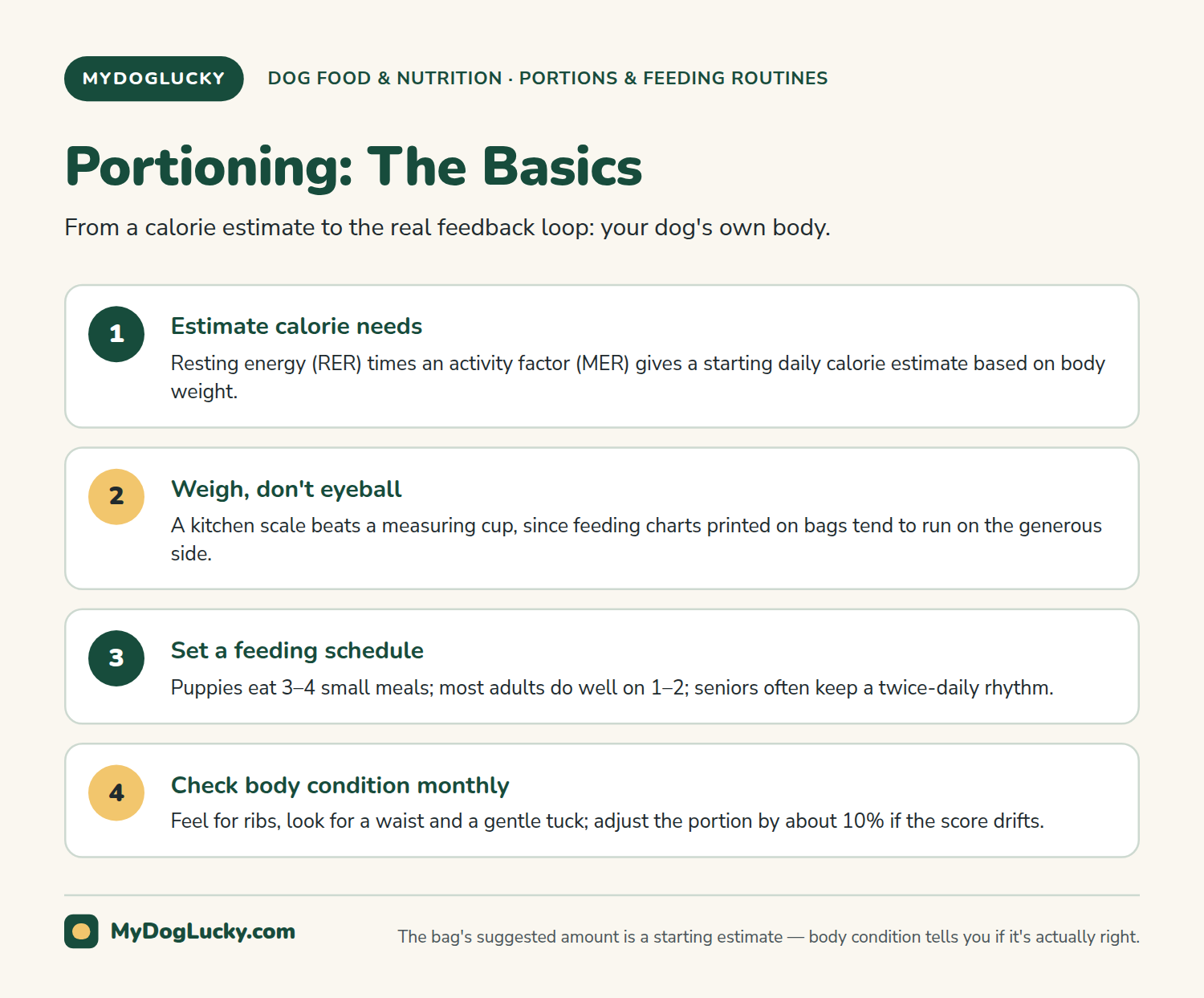
Two practical habits do more for portion accuracy than any formula: weighing food on a kitchen scale instead of eyeballing a scoop, and using the calorie content on the label rather than the feeding chart alone, since feeding charts printed on bags tend to run on the generous side and describe a population average, not your individual dog. A kitchen scale removes a surprisingly large source of error — a measuring cup is an imprecise tool for a substance whose density varies by kibble shape and size, and small daily overages compound over months into a real amount of extra weight.
If you feed multiple dogs, portion each dog’s food separately rather than free-feeding from a shared bowl; it’s the only way to know what each individual dog actually ate, and it prevents a faster or pushier eater from quietly taking more than their share.
Scheduled, portioned meals also beat free-feeding (leaving food out all day for a dog to graze) for most households, for reasons beyond weight control. A scheduled meal makes bathroom timing more predictable, makes it far easier to notice a lost appetite early — often one of the first signs something’s off — and removes the guesswork of figuring out how much a dog with all-day access actually consumed. Free-feeding can work reasonably well for a small number of lean, self-regulating dogs in a single-dog household, but it’s the exception rather than a default worth assuming will work.
Feeding Frequency by Life Stage
Very young puppies typically eat three to four small meals a day, reflecting both higher relative energy needs and a stomach too small to comfortably hold a full day’s calories at once. Most adult dogs do well on one or two meals a day, split roughly evenly if fed twice, which tends to be gentler on digestion and can help even out energy and hunger cues across the day compared to one large meal. Senior dogs often continue on a twice-daily schedule, sometimes adjusted for medication timing or a change in appetite that comes with age or a health condition.
For very large or deep-chested breeds, feeding two or more smaller meals rather than one large meal, and avoiding vigorous exercise immediately before or after eating, are commonly discussed as reasonable precautions related to gastric dilatation-volvulus (bloat) risk, though the research connecting specific feeding patterns to that risk is still evolving and not fully settled. If your dog is a breed commonly associated with bloat risk, this is a good specific question to bring to your veterinarian rather than a rule to adopt from an article alone.
Transitioning Foods Safely
A sudden full switch from one food to another is one of the most common preventable causes of a temporary upset stomach in dogs. A gradual transition over about seven to ten days — mixing in a little more of the new food and a little less of the old food each day or two — gives a dog’s gut microbiome time to adjust rather than being blindsided. A rough shape: roughly 25% new food for the first two to three days, 50% for the next two to three, 75% for the next two to three, then fully switched.
Some dogs need a slower pace than that, especially dogs with a history of sensitive digestion; others tolerate a faster switch without issue. Watch stool quality and appetite through the process, and slow down or pause a step if loose stool or reduced appetite shows up. If your dog has a diagnosed digestive condition, a slower, vet-guided transition is worth planning in advance rather than improvising.
Body-Condition Monitoring: The Real Feedback Loop
The bag’s suggested amount and the RER/MER math both give you a starting estimate. Body condition score is what tells you whether that estimate is actually right for your specific dog, and it’s the single most useful tool an owner has for judging portions, because it’s based on your dog’s actual body rather than a population average. Most veterinary references use a 9-point scale: 1 means severely underweight, 9 means severely overweight, and 4 to 5 sits in the ideal range. A simplified 5-point version exists too, with 3 out of 5 as the ideal — same idea, fewer gradations.
In practice, body condition scoring comes down to three checkpoints: can you easily feel (not see, not have to dig for) your dog’s ribs under a light layer of fat; is there a visible waist when you look down at your dog from above; and is there an abdominal tuck when you look at your dog from the side.
A dog who’s too thin shows visible ribs, spine, and hip bones with little to no waist tuck reversal; an ideal dog has easily felt ribs, a visible waist, and a gentle abdominal tuck; a dog carrying extra weight has ribs that are hard to feel under fat, little to no visible waist, and no tuck at all. Checking this monthly, and adjusting portions by roughly 10% up or down when the score drifts, catches weight trends long before they become a harder problem to reverse.
When to Recheck the Whole Portion, Not Just Tweak It
- After spay or neuter surgery, when metabolic needs commonly shift downward.
- After a significant change in activity level — a new job that means less walking, or the start of a more active season.
- At every life-stage transition — puppy to adult, adult to senior.
- Any time body condition score has drifted for two consecutive monthly checks in the same direction.
Life-Stage & Size Needs
A dog’s nutritional needs are not fixed. They shift meaningfully from the rapid growth of puppyhood through adult maintenance and into the mature and senior years, and body size adds another layer on top, especially for large and giant breeds. This section covers those shifts in general terms; our dedicated guides on large-breed puppy food, best puppy food, and senior dog food go much deeper into each stage.
How Needs Shift From Puppy Through Senior
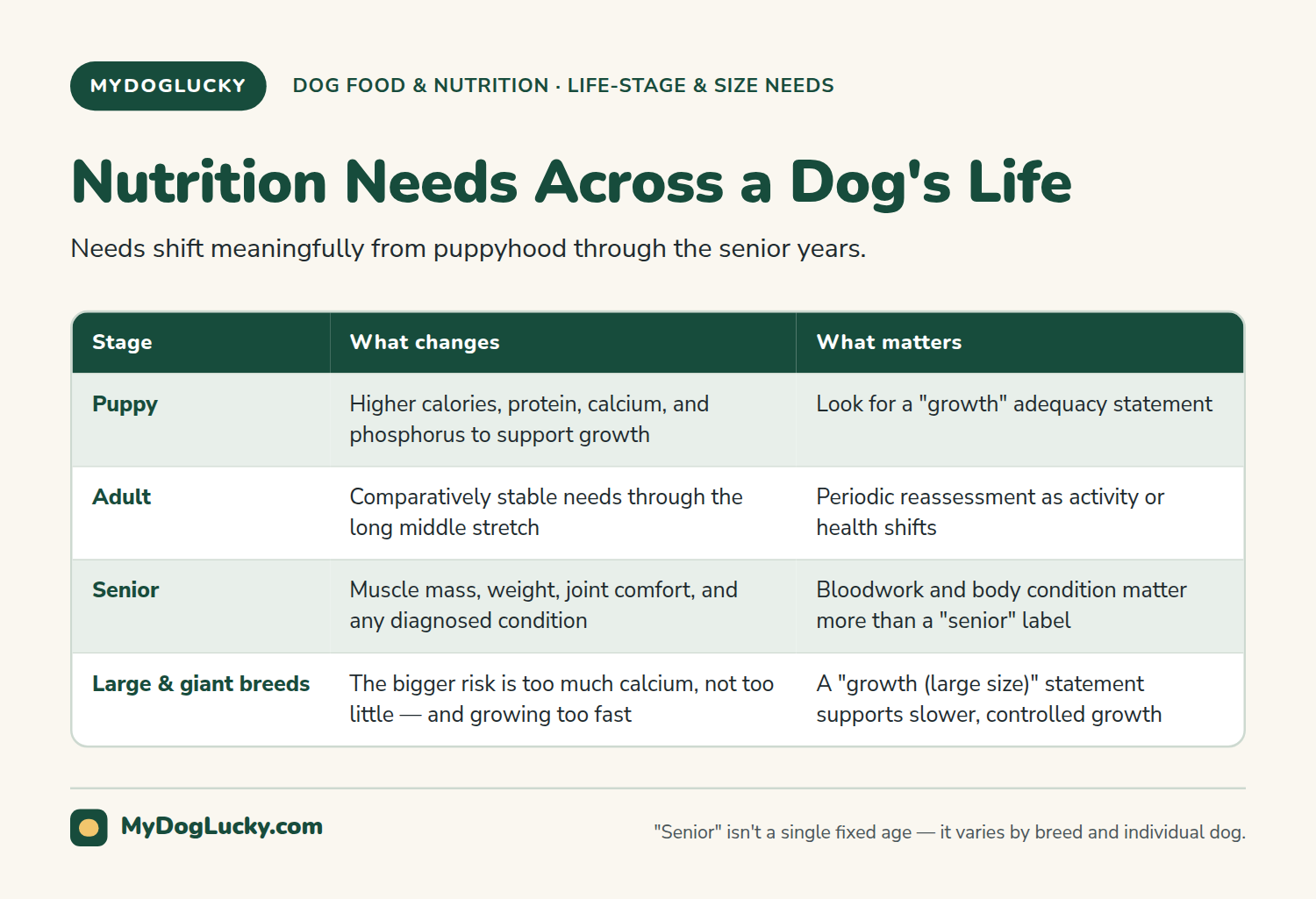
A growing puppy needs more calories relative to body weight than an adult dog of the same eventual size, along with a nutrient profile built around AAFCO’s “growth” category rather than “maintenance” — different ratios of protein, fat, calcium, and phosphorus, tuned to support development rather than simply sustain an already-formed body. Most puppies can transition to an adult-maintenance food somewhere around 12 months of age for small and medium breeds, though large and giant breeds often continue on a growth or large-breed-growth formulation considerably longer, sometimes until 18 to 24 months, reflecting their extended growth timeline.
Adult maintenance is the long middle stretch where needs are comparatively stable, though body condition, activity, and any emerging health issues still deserve periodic reassessment rather than “set it and forget it” feeding. The senior years bring another shift, though less standardized than growth is: AAHA’s canine life stage guidelines describe increased attention to body condition, muscle condition, and specialized nutritional support as dogs age, without prescribing one universal senior formula, because “senior” itself isn’t a single fixed age — it varies by breed and individual dog, with larger breeds generally reaching their senior years earlier than small ones.
Large-Breed Puppy Growth Control, in General Terms
This is the part of dog nutrition most likely to surprise a first-time large-breed owner: the biggest nutritional risk for a growing large or giant-breed puppy generally isn’t too little of something. It’s too much calcium, and by extension, growing too fast. Large and giant-breed puppies’ skeletons mature on a longer, more fragile timeline than a small breed’s, and excess calcium during that window is associated with an increased risk of developmental orthopedic problems — issues affecting how bones and joints form during growth.
This is why AAFCO’s revised nutrient profiles include a specific “growth (large size)” category with a calcium ceiling not present in the standard growth profile, and why large-breed puppy formulas are typically built around controlled, steady growth rather than the fastest rate a puppy’s appetite alone would drive. It’s worth being clear about what controlled growth is not: it isn’t underfeeding, and it isn’t withholding calories a growing puppy genuinely needs. A large-breed puppy still needs a complete and balanced diet with adequate protein, fat, and calories to develop properly — just delivered at a pace and calcium level appropriate to an eventual adult weight well above the range most nutrient profiles were originally built around.
Practically, this means checking that a large-breed puppy’s food specifically states a “growth (large size)” adequacy statement, rather than assuming any puppy formula automatically accounts for it, and avoiding unsupervised calcium or vitamin D supplementation on top of a complete diet, since AAFCO’s growth profiles already build in the calcium level current evidence supports.
One more life stage deserves a brief, honest mention even though it falls outside most readers’ day-to-day dog nutrition questions: gestation and lactation. AAFCO recognizes it as its own nutrient-profile category because a pregnant or nursing dog’s energy and nutrient needs climb well above ordinary adult maintenance, sometimes dramatically during peak lactation. This is a genuinely specialized situation best planned with a veterinarian or an experienced, responsible breeder well before it’s needed, rather than pieced together from general guidance after the fact.
Senior-Dog Nutrition Considerations
Aging dogs commonly face a cluster of overlapping nutritional questions: maintaining lean muscle mass as natural muscle loss (sarcopenia) becomes more common with age, managing weight as activity and metabolism often slow, supporting joint comfort, and adjusting for any diagnosed condition — kidney disease, dental issues limiting what a dog can comfortably chew, or a slowing digestive system. None of these are universal; a healthy, active twelve-year-old small-breed dog and a large-breed dog with early kidney changes at the same age are working from very different nutritional pictures, which is exactly why a senior-labeled food’s marketing claims matter less than a conversation with your vet about your specific dog’s bloodwork and body condition.
Regular wellness visits become more valuable during this stage precisely because nutrition-relevant changes — weight loss or gain, appetite changes, muscle loss that’s easy to miss without hands-on assessment — often show up gradually rather than all at once. Bringing specific, recent observations about appetite, weight, water intake, and energy to those visits gives your vet far more to work with than a general “he seems fine.”
Why “Life Stage” on a Label Matters More Than Breed-Specific Marketing
Breed-specific dog food marketing — formulas named for a specific breed or size category beyond the standard small/medium/large distinction — is common and not inherently misleading, but it’s still marketing layered on top of the regulated part of the label. The nutritional adequacy statement’s actual life-stage claim (growth, growth including large size, maintenance, all life stages) is what’s legally meaningful. A food’s front-panel breed branding can be a reasonable convenience signal, but it doesn’t substitute for confirming the adequacy statement matches your dog’s actual life stage and, for large and giant breeds during growth, confirming the large-size growth calcium consideration specifically.
When Life-Stage Feeding Needs a Vet, Not Just This Article
A few situations are worth a specific conversation with your veterinarian rather than a general guideline: any large or giant-breed puppy’s growth rate and food choice, a senior dog with a new or existing diagnosed condition, a puppy who seems to be growing unusually fast or slow for their projected adult size, and any dog whose weight has changed noticeably without an intentional diet change. These are exactly the situations where individual bloodwork, body condition, and health history change the right answer more than a general article can account for.
Special Diets & Food Safety
This section covers the dog nutrition questions that most often need professional guidance rather than a confident internet answer: sensitive stomachs and food allergies, raw and homemade feeding, and the practical side of food safety, storage, and recalls. Our dedicated guides on sensitive stomachs, food allergies, and raw dog food go much deeper into each of these; a separate MyDogLucky article on homemade dog food covers recipe-balancing specifics in more depth than this overview can.
Sensitive Stomachs and Food Intolerance vs. True Allergy
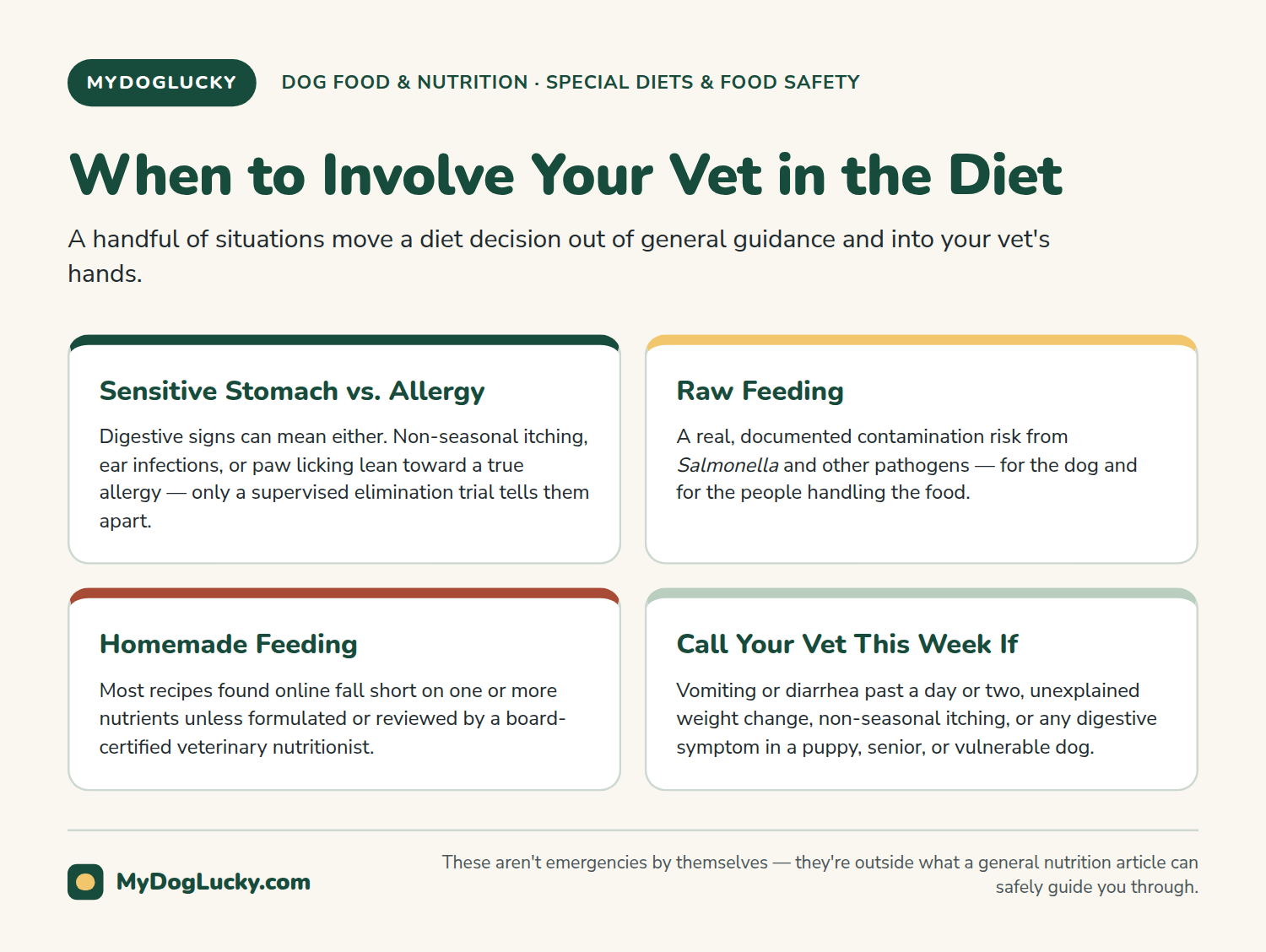
These terms get used interchangeably in casual conversation, but they describe different things. A food intolerance or sensitive stomach is a non-immune reaction — a dog’s digestive system reacts poorly to something in the diet (a sudden fat increase, a fiber change, an ingredient that’s simply hard for that individual dog to process) without the immune system being involved. A true food allergy is an immune response: the body produces antibodies against a specific food component, usually a protein like chicken, beef, dairy, egg, or wheat gluten, or occasionally a complex carbohydrate.
Symptoms overlap enough to make a home diagnosis unreliable. Digestive signs (vomiting, loose stool, gas) can point to either intolerance or allergy. Skin signs — chronic itching, ear infections, paw licking, especially when they’re not seasonal — lean more toward a true food allergy, though inhalant allergies (atopy) can look nearly identical from the outside and require a different management approach. The only reliable way to tell the difference is a structured elimination diet trial, run with your veterinarian: a novel-protein or hydrolyzed-protein diet fed exclusively (no other treats, flavored medications, or table food) for roughly eight to twelve weeks, watching for symptom resolution, then confirming with a controlled reintroduction of the original food and watching for symptoms to return.
| Signal | Leans toward intolerance | Leans toward true allergy |
|---|---|---|
| Onset | Often follows a specific diet change or a rich or unusual meal | Can develop after months or years of eating the same food without issue |
| Primary symptoms | Mostly digestive — vomiting, loose stool, gas | Often skin-focused — itching, ear infections, paw licking, plus possible digestive signs |
| Seasonality | Not seasonal; tied to what was eaten | Non-seasonal itching is a classic clue, distinguishing it from environmental allergies |
| Confirmed by | Symptom resolution after removing the specific trigger | A formal elimination diet trial supervised by a veterinarian |
Raw and Homemade Feeding: What Evidence Says
Raw and homemade diets come up constantly in dog nutrition conversations, usually framed as either obviously superior or obviously dangerous. The evidence-based picture is more specific than either extreme. On raw feeding: the American Veterinary Medical Association’s current policy states it plainly — the AVMA discourages feeding any raw or undercooked animal-source proteins (meat, poultry, fish, egg, milk) to dogs because of the risk to both animal and human health, citing potential contamination with Salmonella, Campylobacter, E. coli, and Listeria monocytogenes, among other pathogens.
FDA testing of raw pet food samples has found measurable contamination rates for these pathogens, at levels meaningfully higher than dry, semi-moist, or jerky treats tested in the same studies. Even apparently healthy pets can carry these organisms without symptoms and shed them into a household, which is part of why the risk extends to the humans handling the food, not just the dog eating it.
None of this means every dog fed a raw diet gets sick, and owners who choose this route after weighing the evidence aren’t making an unreasonable decision on its face. It does mean the risk is real and documented, not a fringe concern, and that anyone feeding raw should follow strict food-safety handling practices — washing hands thoroughly after handling, disinfecting surfaces and utensils, refrigerating unused portions immediately, and never letting a dog lick a person’s face right after eating raw food — regardless of how the diet is sourced.
Homemade diets raise a related but distinct concern: not contamination, but nutritional balance. A complete and balanced commercial diet is formulated against AAFCO’s nutrient profiles by people trained to do that math. A home-cooked recipe, even a thoughtful one built from a recipe found online, frequently falls short of one or more essential nutrients unless it was specifically formulated and reviewed by a board-certified veterinary nutritionist. This is a genuinely fixable problem — a veterinary nutritionist can build or review a recipe to close those gaps — but it’s not a problem most owners can solve by researching independently, because the deficiencies aren’t always ones that show up quickly or obviously.
When a Diet Needs to Be Vet-Directed, Not Owner-Chosen
A handful of situations move a diet decision out of general-education territory and into your veterinarian’s hands specifically: any diagnosed chronic condition where diet is part of management (kidney disease, certain heart conditions, diabetes, some forms of pancreatitis), a confirmed or strongly suspected food allergy, any homemade or raw diet plan for a puppy, senior dog, or a dog with an existing health condition, and any dog who has lost or gained weight unexpectedly. Prescription and therapeutic diets exist because some health conditions respond to a nutrient profile deliberately different from a standard complete-and-balanced formula, and substituting owner judgment for that specific formulation can undo the benefit the prescription diet was providing.
It’s worth acknowledging plainly that prescription diets and specialist referrals cost real money, and not every household can absorb that cost easily. If a recommended therapeutic diet or a veterinary nutritionist consult isn’t financially realistic right now, say so directly to your vet rather than quietly not following through — many clinics can suggest a more affordable interim approach, a payment plan, or a lower-cost path to the same goal. A vet who knows the real constraint can usually work with it; a vet left guessing why a recommendation wasn’t followed can’t.
Call Your Vet This Week If You’re Seeing
Vomiting or diarrhea that persists beyond a day or two, or keeps returning with diet changes; unexplained weight loss or gain; chronic itching, ear infections, or paw licking with no seasonal pattern; or a puppy, senior, or medically vulnerable dog showing any digestive symptom at all. These aren’t emergencies in themselves, but they’re squarely outside what a general nutrition article can safely guide you through — they need hands-on assessment.
Food Safety: Storage and Recalls
Beyond diet type, ordinary food-safety habits matter for every dog regardless of what’s in the bowl. Store dry food in its original bag (the packaging is often designed to block oxygen and light better than a generic container) inside a sealed bin, in a cool, dry place, and use it within the timeframe on the bag once opened — typically a matter of weeks, not months, for best nutrient retention. Refrigerate opened wet food promptly and use it within the timeframe on the label. Wash bowls regularly; a food bowl that’s never washed accumulates bacteria much like any other dish would.
Check a food’s recall history before a first purchase, and periodically for any food you feed regularly — the FDA’s Center for Veterinary Medicine maintains a public, searchable list of pet food recalls and safety alerts, and new recalls happen across every price tier and format throughout the year, not just among any one category of product. A single recall doesn’t necessarily mean a company or format is inherently unsafe; checking is simply part of routine dog nutrition hygiene, the same way you’d notice a recall on food in your own kitchen.
Treats, Toppers & Human Foods
Treats, toppers, and the occasional bite from your plate are a normal part of life with a dog, and none of it needs to threaten a balanced diet — as long as it stays inside a sensible calorie budget. This section covers that budget, a few standout safe and unsafe human foods, and toppers as a category. Our dedicated guides on foods dogs should never eat, fruits and vegetables dogs can eat, and dog treats and toppers cover the full, exhaustive lists this overview intentionally doesn’t try to replicate.
The 10%-Calorie-Budget Rule
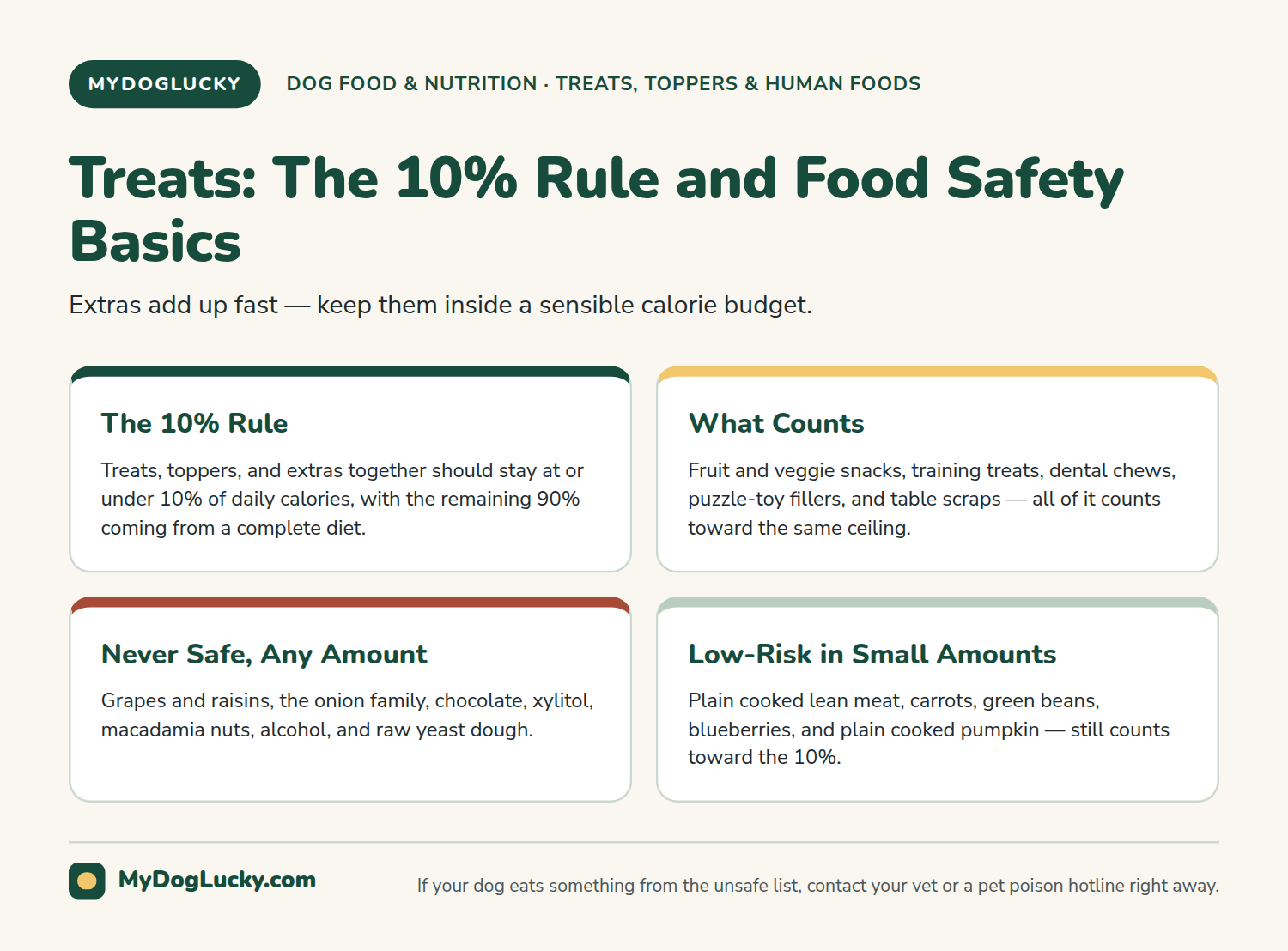
A widely used rule of thumb in veterinary nutrition guidance, including WSAVA’s published treat guidance, holds treats, toppers, and any extras to roughly 10% or less of a dog’s total daily calories, with the remaining 90% coming from a complete and balanced diet. That 10% isn’t an arbitrary number: go meaningfully beyond it on a regular basis, and two things tend to happen. Your dog takes in more total calories than his activity level burns, and the nutritionally complete 90% gets crowded out by extras that don’t carry the same balanced nutrient profile. Neither shows up overnight; both show up eventually, usually as gradual weight gain or a diet that’s quietly less balanced than the bag’s label suggests.
What actually counts toward that 10% surprises a lot of owners: fruit and vegetable snacks, training treats used during practice sessions, dental chews, a spoonful of something inside a puzzle toy, and table scraps or plate licks all count against the same ceiling, even though “healthy” extras and small, frequent treats are easy to mentally file as calorie-free. They aren’t.
To put the number in concrete terms, a small dog around 4 to 5 pounds has roughly 14 extra calories a day to work with under this rule; a large dog around 100 pounds has roughly 146. Your own dog’s precise number depends on size, age, and activity level, and your veterinarian can give you an exact figure, but those two anchor points are a useful gut check for just how small “10%” tends to be in practice.
What Counts Toward the 10%
- Fruit and vegetable snacks — often assumed to be “free” because they’re healthy. They aren’t.
- Training treats, especially during an active training phase with frequent repetitions.
- Dental chews, which are a food item nutritionally even though they’re often filed under hygiene.
- Anything used inside a puzzle toy or licking mat.
- Table scraps and plate licks — easy to undercount because they weren’t an “intentional” treat.
A Few Standout Safe and Unsafe Human Foods
This is a high-level overview, not the full list — our dedicated guides cover the complete rundown of fruits, vegetables, and everyday foods in much more depth. A few standouts worth knowing by heart either way: plain, fully cooked lean meat (no seasoning, no bones), plain cooked carrots, green beans, and small amounts of blueberries are commonly cited as reasonable, low-risk additions in modest quantities, within the 10% budget above. Plain, unsweetened, fully cooked pumpkin in small amounts is another common, generally well-tolerated addition many owners use as an occasional topper.
On the unsafe side, a short list is worth memorizing rather than looking up mid-emergency: grapes and raisins (linked to kidney injury in dogs, with no established safe dose), the onion family in any form (onions, garlic, chives, leeks — can damage red blood cells and cause anemia), chocolate and products containing caffeine (methylxanthines that can cause vomiting, abnormal heart rhythm, tremors, and seizures depending on dose and chocolate type), xylitol (an artificial sweetener found in some peanut butter, gum, and baked goods, which can cause dangerously low blood sugar and liver damage), and macadamia nuts (linked to weakness, tremors, and elevated temperature). Alcohol and raw yeast dough round out the list of foods with no safe “small amount.”
| Category | A few examples | Note |
|---|---|---|
| Generally low-risk in small amounts | Plain cooked lean meat, carrots, green beans, blueberries, plain cooked pumpkin | Still counts toward the 10% budget; introduce new items one at a time |
| Never safe, any amount | Grapes/raisins, onion family, chocolate, xylitol, macadamia nuts, alcohol, raw yeast dough | No established safe dose for most of this group; call a pet poison hotline if ingested |
| Safe for humans, risky for dogs in other ways | Cooked bones (splinter/obstruction risk), very fatty foods (pancreatitis risk), high-salt snacks | Not toxic in the same way, but still worth avoiding as regular extras |
If your dog eats something from the unsafe list, contact your veterinarian, an emergency clinic, or a dedicated pet poison hotline right away rather than waiting to see what happens — both the ASPCA Animal Poison Control Center ((888) 426-4435) and the Pet Poison Helpline ((855) 764-7661) are staffed for exactly this and can advise on next steps, though both charge a consultation fee.
Toppers as a Category
Meal toppers — a broth, a spoonful of wet food added to kibble, a sprinkle of a commercial topping product — are popular for boosting palatability, especially for a picky eater or a senior dog whose appetite has dropped. Most toppers aren’t themselves complete and balanced, which is fine as long as they’re treated as the “extra” they are and factored into the same 10% calorie budget rather than added on top of a full-sized regular meal without adjustment. A low-sodium, plain broth with no onion or garlic seasoning is a commonly reasonable choice; a heavily seasoned or high-sodium option is worth skipping regardless of how appealing the label sounds.
Training treats deserve one practical note of their own, since they’re easy to underestimate. A dog in an active training phase, working through a class or practicing a new skill at home, can easily rack up fifty or more tiny repetitions in a single session. Break treats into pea-sized pieces, use a portion of your dog’s actual meal as training currency when practical, and remember that “tiny” still counts toward the 10% ceiling covered above — enthusiasm during training is a good problem to have, and it’s simple to manage once you’re watching for it.
How to Keep Learning: Working With Your Veterinary Team
Nothing in this guide replaces an individualized conversation with your veterinarian, and that’s by design, not a disclaimer tacked on at the end. Dog nutrition guidance changes as research evolves, and your dog’s specific needs change as they age, gain or lose weight, or develop a health condition that shifts what “good nutrition” means for them specifically. The most useful thing this guide can do is prepare you to have a sharper conversation, not replace the conversation itself.
A few habits make that partnership work better over time. Bring specific observations to wellness visits — recent weight, appetite changes, stool quality, any new treats or foods introduced — rather than a general “he’s doing fine.” Ask your vet to walk through your dog’s current body condition score with you hands-on, so you learn to recognize it yourself between visits. Revisit your dog’s feeding plan at every major life-stage transition, not just when a problem shows up. And treat any specific, individualized nutrition question — a suspected allergy, a homemade diet plan, a large-breed puppy’s growth rate, a senior dog’s changing bloodwork — as a question for your veterinary team first, general dog nutrition information second.
It also helps to know when a question calls for more than a general practitioner’s input. Board-certified veterinary nutritionists exist specifically for complex dog nutrition situations — multiple overlapping health conditions, a homemade diet that needs real formulation rather than a found recipe, or a case that hasn’t responded to the usual first steps. Your regular vet can refer you to one, in person or through a growing number of remote consultation services, when your dog’s situation genuinely needs that level of specialization. Asking for that referral isn’t a sign the standard advice failed; it’s simply the right tool for a more complicated question.
Try This Next
Pick one piece of this guide and act on it this week, rather than trying to apply all six sections at once. If you’ve never checked, do a hands-on body condition score on your dog today. If you’ve never weighed a portion, get a kitchen scale out at the next meal. And if you’re feeding a large-breed puppy, a senior dog, or managing a suspected allergy right now, book that vet conversation before the next bag runs out, not after.
Dog nutrition doesn’t get “finished.” It changes shape as your dog moves through puppyhood, adulthood, and the senior years, and the six areas above will stay useful at different points over your dog’s whole life, not just once at the start. Our dedicated articles under each area — on reading dog food labels, comparing dog foods, wet versus dry, fresh versus kibble, how much to feed, how often to feed, switching food safely, large-breed puppy food, best puppy food, senior dog food, sensitive stomachs, food allergies, raw dog food, homemade dog food, fruits and vegetables dogs can eat, foods dogs should never eat, and dog treats and toppers — go much deeper into any one piece whenever you need it.
Frequently Asked Questions About Dog Nutrition
What’s the single most important thing to know about dog nutrition?
Start with the nutritional adequacy statement on whatever you’re feeding right now. It tells you whether a food is complete and balanced and for which life stage — information that matters more than the ingredient list, the front-of-bag photography, or any ranking you’ll find online.
Does AAFCO approve or test individual dog foods before they’re sold?
No. AAFCO sets the nutrient profiles and labeling rules that manufacturers self-certify against; it doesn’t test, approve, or endorse specific products. If you see the exact phrase “AAFCO-approved” on a package, treat it as imprecise marketing language rather than a mark of quality.
What’s the difference between “formulated to meet” and “feeding trials substantiate” on a label?
“Formulated to meet” means the recipe is calculated on paper to hit AAFCO’s nutrient minimums for a life stage. “Feeding trials substantiate” means the finished product was actually fed to dogs under a defined testing protocol and those dogs maintained normal health. Both are legitimate, though feeding-trial substantiation is generally considered somewhat stronger evidence.
Is more expensive dog food always better for dog nutrition?
Not automatically. Price reflects ingredient sourcing, manufacturing standards, and marketing spend in varying proportions, and none of those map perfectly onto nutritional adequacy. A fair comparison uses the framework in this guide — adequacy statement, calorie density, ingredient signals, manufacturer transparency, and price per feeding — rather than price alone as a quality signal.
How do I compare calorie density between two different foods fairly?
Check the calorie content statement on each label, usually given in kilocalories per cup, can, or 100 grams, and compare on that basis rather than by bag size or bag price. A smaller bag of a more calorie-dense food can last just as long, or longer, than a larger bag of a less dense one.
Why does my dog seem hungry all the time even though he’s fed the recommended amount?
A few common explanations: the bag’s feeding chart tends to run higher than many individual dogs actually need, the portion may not match your dog’s real activity level, or (less commonly) an underlying medical cause could be involved. Check body condition score before increasing the portion — a dog at an ideal or higher body condition who “acts hungry” usually needs behavioral management (slower feeders, split meals) more than more food. If hunger seems extreme or sudden, mention it to your vet.
How do I know if the portion I’m feeding is actually right for my dog?
Body condition score, checked hands-on monthly, is the real answer — not the bag’s suggested amount alone. If you can easily feel ribs under a light fat layer, see a waist from above, and see a gentle tuck from the side, the portion is likely about right. Adjust by roughly 10% and recheck in a few weeks if the score drifts either direction.
How fast should I switch my dog to a new food?
A gradual transition over about seven to ten days, increasing the new food’s share every two to three days, gives the gut time to adjust and lowers the odds of an upset stomach. Some dogs need a slower pace; watch stool quality and appetite and adjust the timeline accordingly.
When should a puppy switch to adult dog food?
Small and medium-breed puppies often transition around 12 months of age. Large and giant-breed puppies typically stay on a growth or large-breed-growth formulation considerably longer, sometimes to 18 to 24 months, reflecting their extended growth timeline. Your veterinarian can confirm timing based on your specific puppy’s growth trajectory.
Do senior dogs really need a different food, or is it just marketing?
“Senior” isn’t a regulated life-stage category the way “growth” is, so a senior-labeled bag’s marketing claims deserve some skepticism on their own. That said, aging dogs commonly do benefit from adjustments — supporting lean muscle, managing weight, and accounting for any diagnosed condition — which is a conversation best had with your vet around your dog’s actual bloodwork and body condition, not assumed from a bag’s front panel alone.
Is raw dog food actually risky, or is that overstated?
The risk is real and documented, not overstated. The AVMA discourages raw or undercooked animal-source proteins for dogs because of contamination risk from pathogens like Salmonella and Listeria, which can affect both the dog and the people handling the food, and FDA testing has found measurable contamination rates in raw pet food samples. Owners who choose raw feeding after weighing this should follow strict food-handling precautions regardless.
How do I know if my dog has a food allergy versus a sensitive stomach?
You generally can’t tell for certain at home. A structured elimination diet trial, run with your veterinarian using a novel or hydrolyzed protein diet for eight to twelve weeks, is the reliable way to distinguish a true food allergy from a general sensitivity or an unrelated condition like an environmental allergy.
Can I safely make my dog’s food at home?
Only with real care. A recipe found online, even a well-intentioned one, frequently falls short of one or more essential nutrients unless it’s specifically formulated or reviewed by a board-certified veterinary nutritionist. Homemade feeding can work well when it’s built that way; it’s genuinely risky when it isn’t.
How many treats is too many?
As a general rule of thumb used in veterinary nutrition guidance, keep treats, toppers, and other extras to roughly 10% or less of your dog’s total daily calories, with the remaining 90% coming from a complete and balanced diet. For a small dog, that can be as little as 14 extra calories a day; for a large dog, roughly 146.
What human foods are safe to share with my dog?
Plain, fully cooked lean meat without seasoning or bones, plain cooked carrots and green beans, small amounts of blueberries, and plain cooked pumpkin are commonly cited as reasonable low-risk additions in modest amounts, counted against the same 10% treat budget.
What foods should never be given to a dog, even a small amount?
Grapes and raisins, the onion family (onion, garlic, chive, leek), chocolate, xylitol, macadamia nuts, alcohol, and raw yeast dough have no established safe dose for dogs. If your dog eats any of these, contact your vet, an emergency clinic, or a pet poison hotline right away.
Where should I start if dog nutrition feels overwhelming right now?
Start with the label on whatever you’re already feeding, not a new purchase. Find the nutritional adequacy statement, confirm the life stage matches your dog, and check the calorie content. That single five-minute check answers more than most of what feels overwhelming about dog nutrition at first glance, and everything else in this guide builds outward from it.
Can I mix two different complete and balanced foods together long-term?
Many owners do this without issue — combining a kibble with a wet or fresh topper, for instance — as long as both are appropriate for your dog’s life stage and the total daily calories, not just the volume, stay in line with your dog’s needs. If you’re mixing to manage a health condition, confirm the combination with your vet, since some therapeutic diets are formulated to work alone rather than blended with a second product.
Sources and Review Notes
Frameworks and facts in this dog nutrition guide were checked against the following sources on September 20, 2026. Guidelines change; this page is scheduled for review every six months.
- Association of American Feed Control Officials (AAFCO). Reading Labels
- Association of American Feed Control Officials (AAFCO). Selecting the Right Pet Food
- Association of American Feed Control Officials (AAFCO). What’s in the Ingredients List?
- Association of American Feed Control Officials (AAFCO). Frequently Asked Questions
- Association of American Feed Control Officials (AAFCO). Calories
- U.S. Food and Drug Administration, Center for Veterinary Medicine. “Complete and Balanced” Pet Food
- U.S. Food and Drug Administration. Recalls & Withdrawals
- U.S. Food and Drug Administration. Get the Facts! Raw Pet Food Diets Can Be Dangerous to You and Your Pet
- U.S. Food and Drug Administration. Tips for Safe Handling of Pet Food and Treats
- Centers for Disease Control and Prevention. Raw Pet Food (Healthy Pets, Healthy People)
- World Small Animal Veterinary Association (WSAVA) Global Nutrition Committee. Selecting a Pet Food for Your Pet (Global Nutrition Toolkit, 2021)
- World Small Animal Veterinary Association (WSAVA). Global Nutrition Guidelines
- World Small Animal Veterinary Association (WSAVA). Feeding Treats to Your Dog (2025)
- World Small Animal Veterinary Association (WSAVA) Global Nutrition Committee. Statement on Risks of Raw Meat-Based Diets
- Merck Veterinary Manual. Nutritional Requirements of Small Animals (RER/MER formulas)
- Merck Veterinary Manual. Daily Maintenance Energy Requirements for Dogs and Cats (reference table)
- Merck Veterinary Manual. Developmental Osteopathies in Dogs and Cats
- MSD (Merck) Veterinary Manual. Cutaneous Food Allergy in Animals
- American Animal Hospital Association. 2019 AAHA Canine Life Stage Guidelines
- American Animal Hospital Association. 2021 AAHA Nutrition and Weight Management Guidelines: Prevention of Obesity
- American Animal Hospital Association. Canine Body Condition Score Chart
- American Animal Hospital Association. 2021 AAHA Nutrition and Weight Management Guidelines — Raw Protein Diet
- American Animal Hospital Association. 2021 AAHA Nutrition and Weight Management Guidelines — Home-Prepared Diets
- American Veterinary Medical Association. Raw or Undercooked Animal-Source Protein in Cat and Dog Diets
- Tufts University Cummings School of Veterinary Medicine, Clinical Nutrition Service (Petfoodology). How Often Should I Feed My Pet?
- Tufts University Cummings School of Veterinary Medicine, Clinical Nutrition Service (Petfoodology). Confused About What to Feed Your Large Breed Puppy? New Rules May Help!
- Tufts University Cummings School of Veterinary Medicine, Clinical Nutrition Service (Petfoodology). Think Your Pet Has a Food Allergy? Eliminating Mistakes in Elimination Diet Trials
- Tufts University Cummings School of Veterinary Medicine, Clinical Nutrition Service (Petfoodology). What Is Guaranteed about the Guaranteed Analysis?
- VCA Animal Hospitals. Nutrition – General Feeding Guidelines for Dogs
- VCA Animal Hospitals. Body Condition Scores
- VCA Animal Hospitals. Food Allergies in Dogs
- VCA Animal Hospitals. Implementing an Elimination-Challenge Diet Trial in Dogs
- VCA Animal Hospitals. Nutritional Considerations for Large and Giant Breed Dogs
- VCA Animal Hospitals. Feeding Mature and Senior Dogs
- VCA Animal Hospitals. Dry, Canned, or Semi-Moist: Food Choices for Dogs
- American Kennel Club. How to Choose the Best Dog Food
- American Kennel Club. Human Foods Dogs Can and Can’t Eat
- American Kennel Club. Everything You Need to Know About Food Allergies in Dogs
- ASPCA. People Foods to Avoid Feeding Your Pets
- ASPCA Animal Poison Control Center, (888) 426-4435; Pet Poison Helpline, (855) 764-7661. Both charge a consultation fee.
- Mueller, R.S., Olivry, T. Food allergy in dogs and cats; current perspectives on etiology, diagnosis, and management. Journal of the American Veterinary Medical Association, Vol. 261, Issue S1 (2023)
- Kealy, R.D., Lawler, D.F., Ballam, J.M., et al. Effects of Diet Restriction on Life Span and Age-Related Changes in Dogs. Journal of the American Veterinary Medical Association 220(9), 2002.
This article is general education for U.S. dog owners about dog nutrition. It is not individualized nutrition or veterinary advice for your dog. Body condition, medical history, allergies, life stage, and activity level all affect what a specific dog should eat, and those questions belong with your veterinarian or a board-certified veterinary nutritionist, not an article. If your dog has a diagnosed health condition, is on a prescription diet, has eaten something unsafe, or you’re considering a significant diet change, talk with your veterinary team before making a change.






Trackbacks/Pingbacks