

Homemade dog food sounds simple until you actually try to get it right. Meat, a starch, some vegetables — how hard can it be? Harder than it looks, it turns out. Dogs need specific amounts of protein, fat, calcium, phosphorus, and roughly a dozen vitamins and minerals in fairly exact proportions, not just “real food” in a bowl.
That gap between intention and execution is where most homemade diets go wrong. Not because owners are careless, but because balanced nutrition is a lot more technical than it looks from the outside, and most recipes circulating online were never checked by anyone qualified to check them.
This guide walks through what the research actually shows about homemade dog food, which nutrients go missing most often, why puppies and dogs with medical conditions carry higher stakes, and the real path to feeding homemade safely — including how to find a professional who can help you do it right.
What’s in this guide
- Why homemade dog food needs more precision than “meat and vegetables”
- What “complete and balanced” actually means
- The documented evidence: most homemade recipes fall short
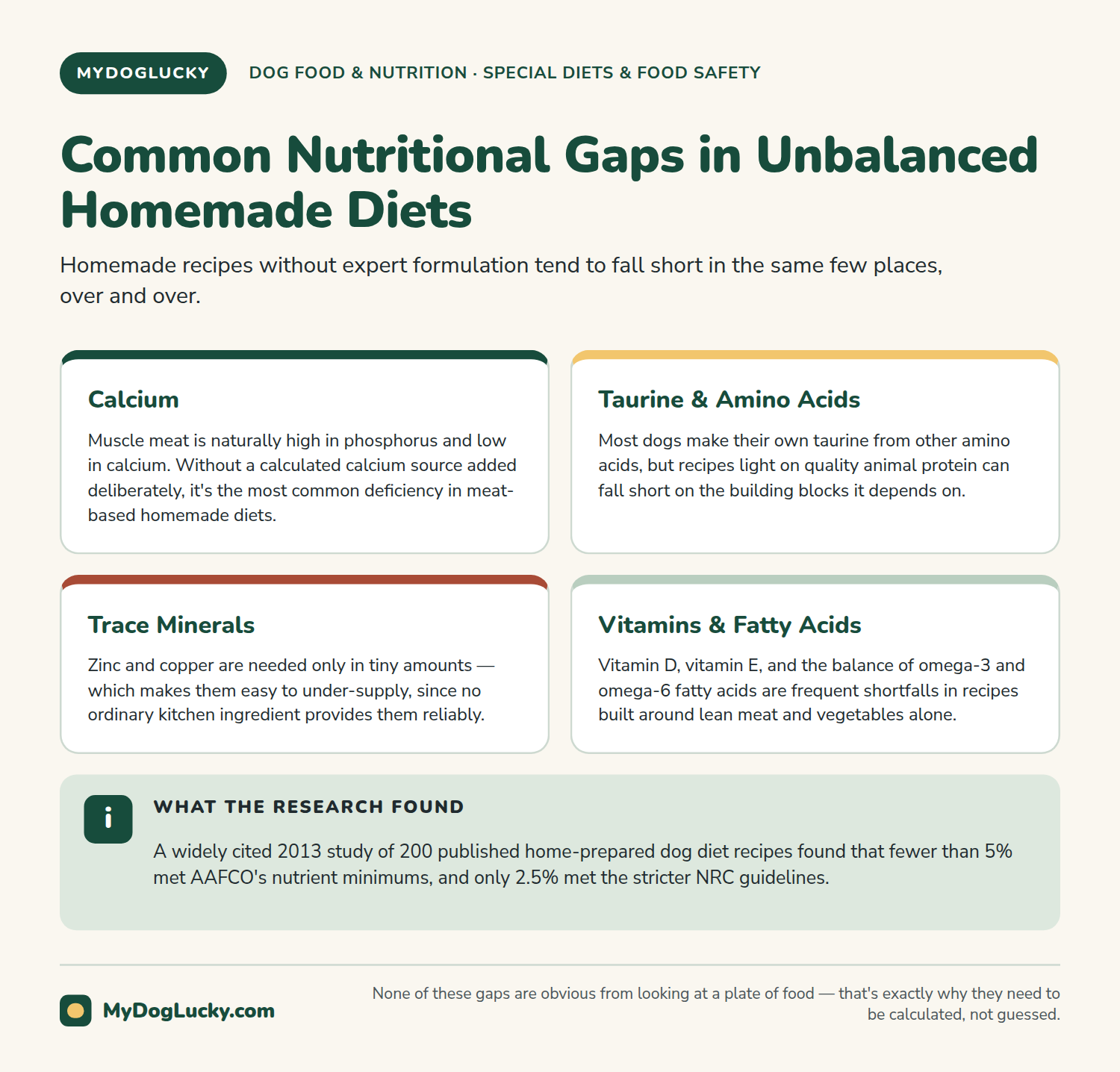
- Calcium: the most common deficiency in homemade diets
- Taurine and dilated cardiomyopathy: an evolving research area
- Trace minerals, vitamins, and other commonly missed nutrients
- Why life stage changes the stakes: puppies, adults, and medical conditions
- The legitimate path: a board-certified veterinary nutritionist
- How to find a qualified veterinary nutritionist
- Time, cost, and the practical realities of cooking for your dog
- Batch cooking and food safety at home
- The consistency problem: why “close enough” isn’t close enough
- When homemade feeding makes sense — and when a commercial therapeutic diet is easier
- A simple framework before you start
- Common mistakes that undermine an otherwise good plan
- Frequently asked questions about homemade dog food
- Sources
Why Homemade Dog Food Needs More Precision Than “Meat and Vegetables”
Here’s the thing that catches most owners off guard: a dog’s nutritional needs aren’t a rough sketch. They’re a specific list. The current AAFCO Dog Food Nutrient Profiles spell out roughly three dozen nutrients — amino acids, fatty acids, minerals, and vitamins — that a complete diet has to supply, each within a defined range. Too little causes deficiency. Too much of some of them causes its own problems.
“Meat and vegetables” describes ingredients, not a nutrient profile. A chicken-and-rice bowl might be high in protein and low in calcium. A beef-and-sweet-potato mix might skip vitamin E and zinc entirely. None of that shows up by looking at the food or watching your dog eat it happily, which is exactly why the gap stays invisible for months.
Ratios Matter More Than Ingredients
Two recipes can share almost identical ingredients and land in very different places nutritionally, because what matters is proportion, not presence. A cup of chicken thigh and a cup of chicken breast look similar on a cutting board. They behave differently once you calculate fat content, calcium, and phosphorus per serving.
This is the part that’s genuinely hard to eyeball. Getting the calcium-to-phosphorus ratio right, hitting minimum fat without overshooting calories, and supplying trace minerals like zinc and copper in the right amounts requires actual calculation — grams, milligrams, percentages of dry matter — not a general sense that the ingredients look healthy.
“Real Food” Isn’t the Same as “Complete Food”
Whole, unprocessed ingredients are genuinely good things. Quality protein, digestible carbohydrates, healthy fats — none of that is in question. What’s missing from a home kitchen, without deliberate supplementation, is usually calcium, certain vitamins, and specific trace minerals that a dog’s ancestral diet supplied through parts most owners don’t cook with: bone, organ meat, and whole prey in particular ratios.
A homemade meal can look, smell, and taste like something you’d happily eat yourself, and still leave your dog short on two or three nutrients that matter enormously over months and years. That’s not a knock on the cook. It’s a reflection of how specific canine nutrition actually is.
The Cost of Getting It Wrong Slowly
Most nutrient gaps don’t cause a dramatic, obvious reaction the week they start. A dog who’s short on calcium doesn’t refuse dinner or act sick right away. He just keeps eating a diet that’s quietly working against his skeleton, month after month, while everything on the surface looks completely fine.
That slow timeline is part of what makes homemade feeding riskier than it feels in the moment. By the time a deficiency becomes visible — in bloodwork, in an X-ray, in a limp that won’t resolve — it’s often been building for a long stretch already. Precision at the start avoids a much harder conversation later.
What “Complete and Balanced” Actually Means
You’ll see the phrase “complete and balanced” on nearly every bag of commercial dog food. It’s not marketing fluff — it’s a specific technical claim, and understanding what it means helps explain exactly what a homemade diet needs to replicate.
The AAFCO Standard
The Association of American Feed Control Officials (AAFCO) sets nutrient profiles that define minimum — and in some cases maximum — levels for 37 nutrients required in dog food, across different life stages: growth, reproduction, adult maintenance, and all life stages combined. A commercial food that meets these profiles, either through lab-verified formulation or feeding trials, can legally claim to be complete and balanced.
Homemade food isn’t required to meet any of this to be legal to feed. Nobody checks a home kitchen. That absence of a checkpoint is exactly why the responsibility for balance falls entirely on the recipe and the person following it.
Why “All Life Stages” Isn’t One Simple Target
A growing puppy and a sedentary senior dog don’t need the same diet. Growth formulas run higher in calcium, phosphorus, and calories per pound of body weight than adult maintenance formulas, because bone and tissue development demand more raw material. A recipe balanced for an adult dog can genuinely shortchange a puppy, even if it looks nutritionally solid on paper for a grown dog.
Where “complete and balanced” comes from
- AAFCO nutrient profiles set minimums (and some maximums) for 37 nutrients dogs need.
- The National Research Council (NRC) publishes the underlying science AAFCO profiles are built on, and it’s the standard board-certified nutritionists reference directly.
- A homemade recipe meets neither standard automatically — it has to be checked against one, ingredient by ingredient, the way a commercial formula is.
The Documented Evidence: Most Homemade Recipes Fall Short
This isn’t a hunch or a marketing talking point. It’s a documented, peer-reviewed finding, and it’s worth walking through in some detail because it changes how you should approach any recipe you find online, including ones that look thorough.
The 2013 JAVMA Recipe Study
A widely cited 2013 study published in the Journal of the American Veterinary Medical Association, led by researchers at UC Davis, evaluated 200 home-prepared dog diet recipes pulled from veterinary textbooks, generalist books, and websites. The results were stark: only 9 of the 200 recipes met AAFCO’s minimum nutrient standards, and just 5 met the stricter National Research Council guidelines.
Even recipes written by veterinarians — 129 of the 200 in the study — were frequently incomplete or vague about ingredient amounts, feeding instructions, or supplement details. The recipes that consistently held up were the ones written by board-certified veterinary nutritionists, all of which met adequacy standards. Everyone else’s success rate dropped off sharply.
Why Good Intentions Don’t Close the Gap
None of this means the people writing these recipes were careless or unqualified in general. Plenty were veterinarians with real clinical experience. What it shows is that general veterinary training doesn’t automatically include the specific calculations — nutrient-by-nutrient, per-kilogram-of-body-weight math — that formulating a balanced diet from scratch requires. That’s a specialized skill, not a byproduct of medical training.
It also means “written by a vet” isn’t, by itself, a reliable stamp of nutritional completeness for a homemade recipe. That’s a genuinely counterintuitive finding for a lot of owners, and it’s exactly why this guide keeps pointing toward board-certified veterinary nutritionists specifically, rather than veterinary credentials in general.
What “Incomplete” Looked Like in Practice
The study’s authors weren’t just checking a box for missing nutrients. Many of the 200 recipes reviewed gave instructions like “add a multivitamin” without naming a product or a dose, or listed a protein source without a specific quantity. That kind of vagueness makes a recipe nearly impossible to evaluate accurately, let alone follow consistently, which is its own separate problem from a recipe that’s precisely wrong.
The headline numbers, plainly stated
Of 200 published home-prepared dog diet recipes studied, fewer than 5% met AAFCO’s nutrient standards, and only 2.5% met NRC guidelines — the stricter research-based benchmark. Recipes from board-certified veterinary nutritionists were the exception, meeting adequacy standards consistently.
Rotating Recipes Doesn’t Fix It Either
A common workaround owners try: rotate several recipes so gaps in one get covered by strengths in another. The same study tested that idea directly, even when recipes were combined as their authors intended, the rotation still failed to reliably provide complete nutrition. Variety helps with palatability. It isn’t a substitute for a diet that’s balanced in the first place.
Calcium: The Most Common Deficiency in Homemade Diets
If there’s one nutrient that trips up homemade feeding more than any other, it’s calcium. This deserves its own section because the mechanism is well understood, the consequences are serious, and the fix is straightforward once you know it’s needed.
Why Meat-Heavy Recipes Run Short
Muscle meat — chicken breast, ground beef, turkey, fish fillets — is naturally high in phosphorus and very low in calcium. According to the Merck Veterinary Manual, diets built predominantly around meat, liver, fish, or poultry commonly cause calcium deficiency, because nothing in a typical home recipe supplies calcium in meaningful amounts unless it’s added deliberately.
Dogs evolved eating whole prey, bone included, which supplies calcium naturally. Strip the bone out and cook only the muscle meat, which is exactly what most home recipes do for safety and practicality, and the calcium simply isn’t there anymore.
The Calcium-to-Phosphorus Ratio
It’s not only about the raw calcium number. Calcium and phosphorus work as a pair, and the ratio between them matters as much as either amount alone. Veterinary guidance puts the ideal calcium-to-phosphorus ratio for dogs at roughly 1.2:1 to 1.4:1. A diet that’s phosphorus-heavy and calcium-light, which describes most unsupplemented meat-based homemade recipes, pushes that ratio out of range even when total calcium looks adequate on paper.
What Happens When Calcium Stays Low
Chronic calcium deficiency triggers a cascade called secondary nutritional hyperparathyroidism. The body, sensing low blood calcium, pulls calcium out of the bones to compensate. Over weeks and months, that can produce bone that’s measurably weaker than it should be, along with symptoms like reluctance to move, shifting lameness, or in more advanced cases, fractures from minimal trauma.
Growing puppies are hit hardest and fastest, because their skeletons are actively building bone during exactly the window when a calcium-deficient homemade diet does the most damage. We’ll come back to why growth stage matters so much shortly.
The practical takeaway on calcium
Meat-based homemade diets need a calcium source added deliberately — not “some bone now and then,” but a calculated amount matched to the rest of the recipe. This is exactly the kind of calculation a properly balanced recipe from a qualified source handles for you, and exactly the kind of detail that’s easy to get wrong without one.
Taurine and Dilated Cardiomyopathy: An Evolving Research Area
This section covers genuinely complicated, still-developing science, so it’s worth being precise about what’s established and what isn’t.
What Taurine Does
Taurine is an amino acid involved in heart muscle function, vision, and several other processes. Most dogs synthesize enough taurine on their own from other amino acids, mainly methionine and cysteine, which is why it isn’t classified as strictly essential in the same way it is for cats. That said, synthesis depends on having enough of those precursor amino acids and other supporting nutrients in the diet to begin with.
The FDA’s DCM Investigation
Starting in 2018, the FDA’s Center for Veterinary Medicine began investigating a rise in dilated cardiomyopathy (DCM) — a serious heart condition where the heart muscle weakens and enlarges — reported in dog breeds not typically predisposed to it. By 2019, the agency had logged hundreds of reports. Most involved commercial grain-free diets heavy in peas, lentils, or other legumes, not homemade diets specifically.
Research since then, including work summarized by Tufts University’s Clinical Nutrition Service, has found the picture more complicated than “taurine deficiency causes DCM.” Many affected dogs actually had normal taurine levels, and researchers now suspect legumes themselves, or some compound within them, may play a role that isn’t fully explained by taurine status alone. As of the most recent updates, the FDA has stated it will share further findings only when there’s meaningful new science to report.
Why This Still Matters for Homemade Feeding
Here’s the relevant connection for anyone cooking at home: taurine deficiency has, historically and separately from the grain-free investigation, been documented in dogs eating home-prepared diets low in animal protein or heavy in unusual protein sources, and in certain restricted commercial diets from decades past. A poorly balanced homemade recipe — particularly one light on quality animal protein, or one following a vegetarian or vegan approach without expert formulation — carries a real, separate risk of insufficient taurine precursors.
The honest summary: DCM research is active and evolving, the mechanism isn’t fully settled, and it would be inaccurate to claim taurine deficiency is the proven cause of diet-associated DCM. What’s not in dispute is that a diet supplying inadequate taurine or its building blocks is a real risk, and a properly formulated homemade recipe accounts for it directly rather than leaving it to chance.
Trace Minerals, Vitamins, and Other Commonly Missed Nutrients
Calcium and taurine get most of the attention, reasonably, but they’re not the only nutrients that tend to fall short in home-prepared diets. A few others show up repeatedly in nutritional analyses of homemade recipes.
Zinc and Copper
Trace minerals like zinc and copper are needed in tiny amounts, which paradoxically makes them easy to under-supply, since no ingredient in a typical home kitchen provides them reliably without a mineral supplement calculated for the purpose. Zinc deficiency can show up as skin and coat problems over time; copper deficiency is rarer but affects connective tissue and red blood cell function.
Vitamin D and Vitamin E
Vitamin D, essential for calcium regulation and bone health, isn’t reliably present in muscle meat and vegetables at the levels dogs need. Vitamin E, an antioxidant that also interacts with fat metabolism, is another frequent shortfall, particularly in recipes built around lean meats with minimal added fat sources.
Essential Fatty Acids
Omega-3 and omega-6 fatty acids support skin, coat, and inflammatory balance. Getting the ratio right — not just including some fat, but the right type and proportion — is another calculation that a general “add some oil” approach tends to miss.
Why This List Keeps Growing the More You Look
The pattern across all of these nutrients is the same: none of them are obvious from looking at a plate of food, none show symptoms right away, and all of them require either a specific ingredient most home cooks don’t use or a calculated supplement. That’s the practical argument for a properly formulated recipe rather than an intuitive one, however well-researched the intuition feels.
Why Supplements Need to Be Dog-Specific
A general “dog multivitamin” bought off a store shelf isn’t automatically the right supplement for a specific homemade recipe. The right supplement plan depends on exactly what the base ingredients already provide and exactly what’s still missing, which varies from recipe to recipe. Adding a generic supplement on top of an already-imprecise recipe can still leave gaps, or in rarer cases, push a nutrient like vitamin D too high, since more isn’t automatically safer once a nutrient reaches its upper limit.
Why Life Stage Changes the Stakes: Puppies, Adults, and Medical Conditions
A nutrient gap doesn’t affect every dog the same way. Life stage and health status change both how fast problems show up and how serious they become.
Puppies: Errors Compound Faster
Growing puppies build an enormous amount of bone and tissue in a short window, and growth-stage nutrient requirements run considerably higher than adult maintenance needs, especially for calcium, phosphorus, and calories. A calcium shortfall that a healthy adult dog might tolerate for months without visible symptoms can produce measurable skeletal problems in a growing puppy within weeks, because there’s no buffer — the deficit shows up directly in developing bone.
This is also the life stage where mistakes are hardest to fully reverse. Bone deformities that develop during rapid growth don’t always correct themselves once the diet improves. That’s the core reason homemade feeding for puppies specifically needs professional formulation from the start, not a wait-and-see approach.
Healthy Adults: More Buffer, Not No Risk
A healthy adult dog with a mature skeleton has more physiological reserve than a puppy, which is why some mild imbalances take longer to become obvious. “More buffer” doesn’t mean “no risk,” though. Chronic, low-grade deficiencies in adult dogs still accumulate over months and years, often surfacing as vague, hard-to-pin-down issues: a dull coat, low energy, or bone changes that only become apparent on an X-ray taken for an unrelated reason.
Dogs With Medical Conditions: A Different Category Entirely
Dogs with kidney disease, certain liver conditions, specific allergies, or other medical issues sometimes genuinely need a therapeutic homemade diet — one built around restricting or emphasizing specific nutrients in ways no over-the-counter commercial food covers. This is real, legitimate homemade feeding, and it belongs in a completely different category from a healthy dog’s home-cooked meals.
Therapeutic homemade diets require even tighter formulation than maintenance diets for healthy dogs, because the whole point is managing a specific medical variable — sodium for heart disease, phosphorus for kidney disease, and so on — without accidentally creating a new deficiency somewhere else. This is squarely a job for a veterinarian working alongside a board-certified veterinary nutritionist, not a general recipe adapted from the internet.
Senior Dogs and Changing Needs
An older dog who’s been eating the same homemade recipe successfully for years isn’t necessarily set for life. Calorie needs often drop as activity slows, kidney or liver function can shift, and some seniors need adjusted protein or phosphorus levels depending on what bloodwork shows. A recipe that was right at age four isn’t automatically right at age eleven.
This is less about starting over and more about treating the recipe as a living plan rather than a permanent one. A periodic check-in, especially alongside annual or twice-yearly senior bloodwork, catches the kind of gradual shift that’s easy to miss otherwise.
| Situation | What changes | What this means practically |
|---|---|---|
| Growing puppy | Higher calcium, phosphorus, and calorie needs per pound; no buffer for errors | Professional formulation from day one, reviewed as the puppy grows |
| Healthy adult | More physiological reserve; deficiencies still accumulate over time | Still needs a checked recipe, with room for periodic reassessment |
| Medical condition | Diet must manage a specific variable without creating new gaps | Requires veterinarian plus board-certified nutritionist collaboration |
| Senior, otherwise healthy | Changing calorie needs, joint and organ considerations | Recipe review as needs shift, not a “set it and forget it” plan |
The Legitimate Path: A Board-Certified Veterinary Nutritionist
Everything in this guide so far points toward the same conclusion: homemade dog food can be done safely, but it requires expert formulation. Here’s what that expertise actually looks like, and why the credential matters as much as it does.
What the Credential Actually Means
A board-certified veterinary nutritionist has completed veterinary school, then gone through several additional years of a residency focused specifically on clinical nutrition, followed by rigorous board examinations. This is meaningfully different from someone calling themselves a “pet nutritionist” or “certified nutritionist,” terms that aren’t regulated and can describe anything from a short online course to genuine expertise. Board certification in veterinary nutrition currently falls under the specialty structure recognized by veterinary specialty boards in the U.S., a credential historically associated with the American College of Veterinary Nutrition (ACVN). A veterinarian holding it has demonstrated, through supervised residency and exam, the specific skill of formulating diets that are nutritionally complete for an individual dog.
Why “Vet-Reviewed” Isn’t the Same Thing
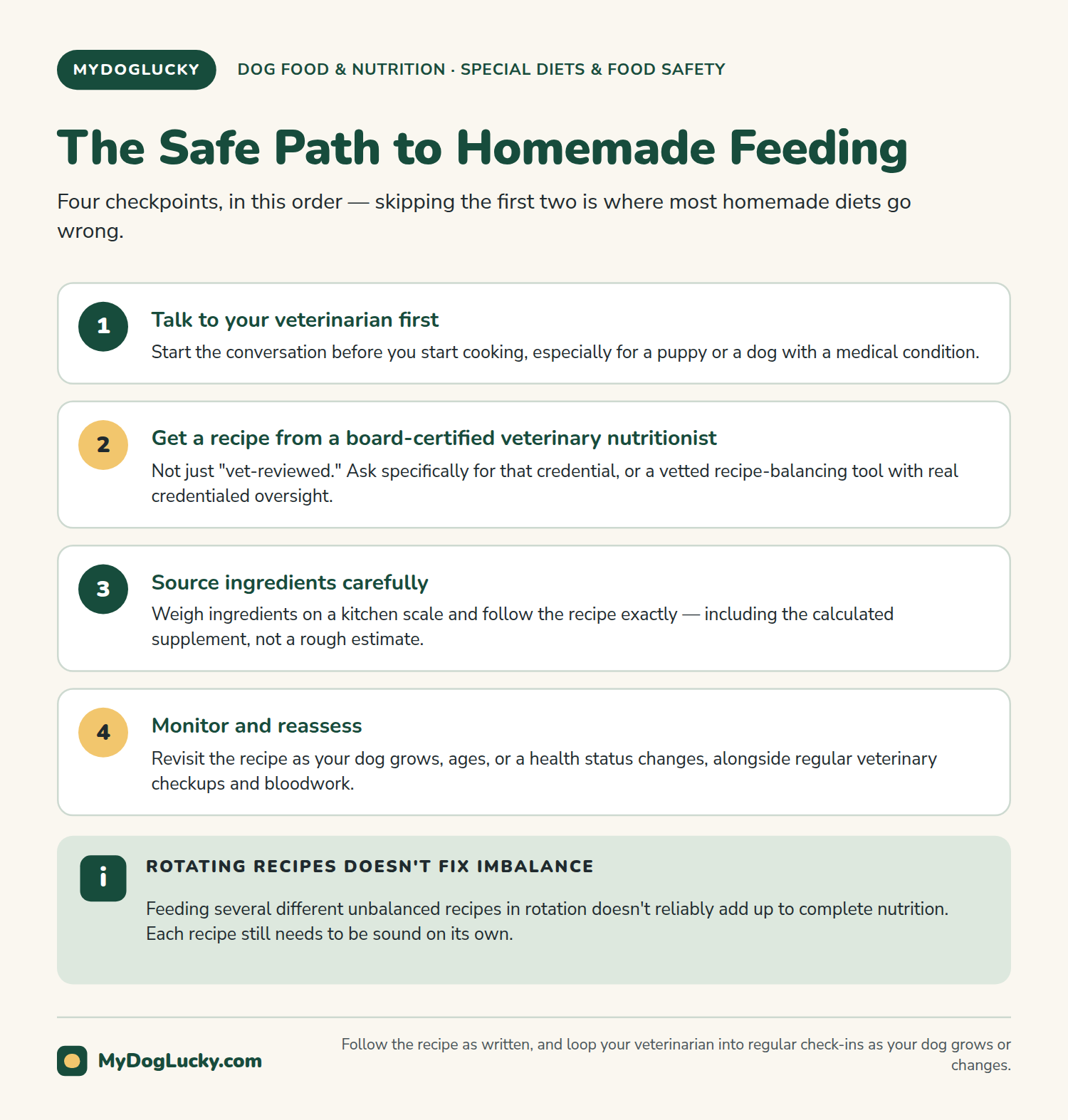
It’s worth being direct about this, since it trips up plenty of owners: a general practice veterinarian is a trusted, highly trained professional, but general veterinary training doesn’t automatically include the detailed nutrient calculations that recipe formulation requires. That’s exactly what the 2013 recipe study found — recipes from general veterinarians were often incomplete, while recipes from board-certified nutritionists consistently held up. Ask specifically for that credential, not just “a vet looked at it.”
What a properly formulated recipe includes
- Exact ingredient amounts by weight, not vague measures like “a handful” or “some.”
- A calculated supplement plan covering calcium, trace minerals, and vitamins the base ingredients don’t supply.
- Life-stage-specific targets matched to your dog’s age, size, and activity level.
- A plan to reassess as your dog grows, ages, or gains or loses weight.
What a Nutrition Consultation Typically Involves
A first consultation usually starts with a detailed history: your dog’s age, breed, weight, activity level, current diet, any diagnosed conditions, and your goals for switching to homemade food. From there, the nutritionist calculates a base recipe, matches it to your dog’s specific caloric needs, and builds in a supplement plan for whatever the base ingredients don’t cover.
Expect follow-up, not a one-and-done handoff. Good nutrition consultations include a plan for rechecking as your dog’s weight, activity, or health status changes, plus a way to ask questions if something about the recipe isn’t working in practice — your dog won’t eat a particular ingredient, say, or a supplement is hard to source locally.
How to Find a Qualified Veterinary Nutritionist
Knowing you need one is the easy part. Finding one is where a lot of owners get stuck, mostly because it’s a small specialty and access varies a lot by location.
Start With Your Own Veterinarian
Your regular veterinarian is often the fastest route to a referral, either to a nutrition service at a veterinary teaching hospital or to a remote consulting nutritionist. Several veterinary schools run clinical nutrition services that take homemade-diet consultations, sometimes remotely, for dogs that don’t live nearby.
Searchable Directories
Veterinary specialty directories, searchable by specialty and location, list board-certified veterinary nutritionists, and many offer remote or phone consultations specifically for homemade diet formulation. That remote option matters, since there are well under a couple hundred board-certified veterinary nutritionists practicing in the entire country, and most owners won’t live near one in person.
Vetted Recipe-Balancing Services
A newer option worth understanding: online recipe-balancing tools that let you build a homemade recipe from a set of approved ingredients, with the software calculating amounts against nutrient targets and a board-certified veterinary nutritionist involved in reviewing or designing the underlying system. These can be a genuinely useful, more affordable middle ground between a fully custom consultation and an unchecked internet recipe — provided the specific tool you’re using discloses that a credentialed nutritionist is actually behind the formulation, not just marketing language implying expertise.
Before trusting any recipe-balancing service, ask directly: which board-certified veterinary nutritionist designed or reviews this system, and is the recipe adjusted for your specific dog’s age, weight, and health status, or is it a generic template? A real answer to both questions is a good sign. A vague one is a reason to keep looking.
Time, Cost, and the Practical Realities of Cooking for Your Dog
Beyond the nutrition science, homemade feeding is a real, ongoing commitment, and it’s worth being honest about what it actually takes before starting.
The Time Cost
Batch cooking for a dog, even a medium-sized one, typically means several hours of shopping, prepping, cooking, cooling, and portioning every week or two. That’s on top of regular grocery shopping and meal prep for the humans in the house. For a multi-dog household, or a larger breed with a bigger appetite, the time commitment scales up accordingly.
The Real Cost Comparison
Homemade diets aren’t automatically cheaper than commercial food, and for many owners, they end up costing more once quality protein, organ meat, and required supplements are factored in. Fresh muscle meat, in particular, tends to cost more per pound than the meat meal used in many commercial formulas. Add a calcium supplement, a multivitamin, and possibly a fish oil source, and the per-meal cost can climb past what a comparable commercial diet runs.
This isn’t a reason to avoid homemade feeding if it’s the right call for your dog. It’s a reason to budget for it honestly, supplements included, rather than assuming “cooking it myself” automatically saves money.
Kitchen Setup and Equipment
A reliable kitchen scale is close to non-negotiable, since “roughly a cup” and “roughly a cup” can vary enough between people to meaningfully shift the recipe’s nutrient math. Freezer space for batch-cooked portions, a supply of airtight containers, and a system for labeling what’s in each container and when it was made round out the basic setup.
Ingredient Sourcing and Availability
A recipe that specifies a particular cut of meat or a specific organ can be harder to source consistently than it sounds, depending on where you shop and what your local grocery store or butcher regularly stocks. Organ meats especially — liver, kidney — aren’t always sitting in the standard meat case, and some owners end up ordering from a butcher or online supplier to keep the recipe consistent.
It’s worth confirming ingredient availability before committing to a specific recipe, not after. A nutritionist can often build a recipe around ingredients you can actually and reliably buy, rather than ones that look ideal on paper but require a special trip every time.
Batch Cooking and Food Safety at Home
Cooking for your dog carries the same food safety considerations as cooking for your household, plus a few specific to raw ingredient handling.
What the Research Shows About Contamination Risk
An FDA Center for Veterinary Medicine study testing pet food samples for bacterial contamination found meaningful rates of Salmonella and Listeria monocytogenes specifically in raw products, at notably higher levels than in cooked or processed pet foods. That risk applies to raw ingredients sitting in your kitchen during homemade food prep, not only to commercially sold raw diets.
Safe Handling Basics
- Wash hands thoroughly after handling raw meat, for at least 20 seconds, before touching anything else.
- Keep raw ingredients separate from any food prepared for humans, including cutting boards and utensils.
- Cook to safe internal temperatures rather than serving raw, unless a raw diet is specifically what you and your veterinary team have chosen and you understand the added contamination risk.
- Disinfect surfaces that contacted raw ingredients with a diluted bleach solution or another effective disinfectant.
- Cool food quickly before refrigerating or freezing batch-cooked portions, rather than leaving it at room temperature.
Storage Timeframes
Refrigerated homemade dog food is generally safest used within three to four days, similar to guidance for human-grade cooked meat. Frozen, individually portioned batches can typically last a few months, though quality — not just safety — tends to decline over longer storage. Label each container with the date it was made, and rotate older portions to the front so nothing sits forgotten in the back of the freezer.
A note on raw dog food
Raw dog food carries its own, separate set of food safety and nutritional-balance considerations beyond what this guide covers about cooked homemade diets. If you’re considering a raw approach specifically, that decision deserves its own conversation with your veterinarian, since the contamination risks and formulation requirements differ from a cooked homemade diet.
The Consistency Problem: Why “Close Enough” Isn’t Close Enough
Even a properly formulated recipe can drift out of balance over time, and this is one of the least discussed risks of homemade feeding.
Ingredient Substitutions Change the Math
Swapping chicken thigh for chicken breast because that’s what the store had, or using a different cut of beef, seems harmless. Nutritionally, it isn’t neutral — fat content, calcium, and phosphorus can all shift meaningfully between cuts and proteins, which means a substitution can quietly move a recipe out of the range it was originally balanced for.
Supplement Drift
Forgetting a supplement one day, eyeballing “about the right amount” instead of measuring, or switching supplement brands without checking the new label’s concentration are all easy, understandable slips. Over weeks, small drift compounds into a real gap, especially for a nutrient like calcium that has almost no margin for error in a meat-heavy recipe.
Why Reading Dog Food Labels Matters Here Too
The same skill useful for comparing commercial dog food — knowing how to read dog food labels, understand nutrient percentages, and check for a complete-and-balanced statement — carries over directly to checking supplement labels for a homemade recipe. A calcium supplement’s concentration varies by product and form, and using the wrong dose because a label wasn’t read carefully is a genuinely common, genuinely avoidable mistake.
The practical fix is straightforward, if not glamorous: follow the recipe exactly as written, measure rather than estimate, and check in with whoever formulated the recipe before making substitutions, rather than assuming small changes don’t matter.
Seasonal and Regional Ingredient Swaps
A vegetable that’s easy to find and cheap in summer can be scarce or expensive by winter, and it’s tempting to substitute whatever’s in season without checking the impact. Most produce swaps matter far less than protein or supplement swaps, since vegetables typically contribute fiber and small amounts of vitamins rather than the bulk of the nutrient math. Still, when in doubt, a quick check with your nutritionist beats guessing, especially for anything beyond a minor vegetable substitution.
When Homemade Feeding Makes Sense — and When a Commercial Therapeutic Diet Is Easier
Homemade feeding is a legitimate choice for plenty of dogs and owners. It’s not automatically the right choice for every situation, and it helps to think through both sides honestly.
When Homemade Often Makes Sense
- A dog with a diagnosed medical condition whose management genuinely benefits from a custom recipe a commercial diet can’t replicate.
- A dog with confirmed food allergies to ingredients present in most available commercial options.
- An owner with the time, budget, and consistency to follow a professionally formulated recipe precisely, long-term.
- A dog who won’t reliably eat any commercial option, when that’s confirmed rather than assumed.
When a Commercial Therapeutic Diet Might Be the Safer, Easier Choice
- A medical condition that a well-researched, veterinarian-prescribed therapeutic commercial diet already manages effectively, without the ongoing precision homemade feeding demands.
- A household where consistency — weighing ingredients, sourcing the same cuts, measuring supplements every single time — isn’t realistic given work schedules, travel, or multiple caregivers.
- A tight budget, since therapeutic commercial diets are often more affordable than a properly supplemented homemade equivalent once all the pieces are accounted for.
- A puppy or medically fragile dog where the margin for error is genuinely too small for a learning curve.
Neither path is automatically superior. A therapeutic commercial diet formulated by a veterinary nutrition team and manufactured under quality control can be every bit as good for a specific medical situation as a home-cooked equivalent — sometimes easier to get right, precisely because the formulation work is already done and consistent from bag to bag.
| Factor | Favors homemade (professionally formulated) | Favors commercial therapeutic diet |
|---|---|---|
| Time available | Several hours weekly for prep and batch cooking | Limited time, travel, or multiple caregivers |
| Consistency | Can measure and follow a recipe precisely, every time | Difficulty maintaining exact measurements long-term |
| Budget | Can absorb protein, organ meat, and supplement costs | Tighter budget, need for predictable cost |
| Medical complexity | Needs a highly individualized nutrient profile | Well-managed by an existing therapeutic formula |
A Simple Framework Before You Start
If everything above feels like a lot to hold at once, here’s the short version worth keeping in mind.
Before you start homemade feeding
- Never start from an unchecked recipe. Not one from a book, a website, or a well-meaning friend, no matter how detailed it looks.
- Get a recipe from a board-certified veterinary nutritionist or a properly vetted recipe-balancing tool with credentialed oversight, matched to your specific dog’s age, size, and health.
- Follow it precisely. Weigh ingredients, measure supplements, and avoid substitutions without checking first.
- Reassess on a schedule. Puppies especially need the recipe revisited as they grow; adult dogs benefit from periodic check-ins too.
- Loop in your veterinarian. Regular wellness visits and bloodwork can catch a drifting deficiency before it becomes a visible problem.
None of this is meant to talk anyone out of cooking for their dog. It’s meant to make sure that instinct — wanting to know exactly what’s going into your dog’s bowl — gets matched with the precision it actually requires.
Common Mistakes That Undermine an Otherwise Good Plan
Treating a Recipe as a Suggestion
Swapping ingredients, rounding measurements, or skipping the supplement on a busy day feels harmless in the moment. Over weeks, those small deviations are exactly how a properly balanced recipe stops being balanced.
Assuming “Vet-Approved” Means “Nutritionally Complete”
A veterinarian’s general approval of homemade feeding as a concept isn’t the same as a board-certified nutritionist’s calculated recipe. Ask specifically which credential formulated the recipe you’re using.
Skipping the Recheck as Your Dog Changes
A recipe balanced for a 12-week-old puppy isn’t automatically right at 6 months, and a recipe that worked for a healthy adult dog may need revisiting after a new diagnosis or significant weight change.
Underestimating the Supplement Piece
The protein and vegetables are the easy part. The calculated calcium source, multivitamin, and any other targeted supplement are what actually close the gap between “food dogs like” and “food that’s complete.” Skipping or eyeballing that piece undoes most of the value of a properly formulated recipe.
Assuming Rotation Fixes Imbalance
As the 2013 recipe study found directly, feeding several different unbalanced recipes in rotation doesn’t reliably add up to complete nutrition, even when that’s the explicit plan. Each recipe still needs to be sound on its own.
Waiting for Symptoms Before Getting Help
Nutrient deficiencies are often silent for months before anything visible shows up, particularly in adult dogs with more physiological reserve. Getting a recipe checked before starting, not after something looks off, is the more reliable order of operations.
Frequently Asked Questions About Homemade Dog Food
Is homemade dog food better than commercial dog food?
Neither is automatically better. A properly formulated homemade diet and a good-quality complete-and-balanced commercial diet can both support a healthy dog well. What matters most is whether the specific diet, homemade or commercial, actually meets your dog’s nutrient needs — which for homemade food means professional formulation, not just quality ingredients.
Can I make homemade dog food without a recipe from a nutritionist?
You can, but the documented research is clear that most recipes assembled without expert formulation end up nutritionally incomplete, sometimes in ways that take months to become visible. It’s a real risk, not a technicality, particularly for puppies and dogs with medical conditions.
How much does a veterinary nutrition consultation typically cost?
Costs vary by provider and whether the consultation happens in person or remotely, and pricing changes over time, so it’s worth confirming current rates directly with the specific service or veterinary school nutrition department you’re considering.
What’s the biggest nutrient risk in homemade dog food?
Calcium deficiency shows up most consistently across studies of home-prepared recipes, largely because muscle meat is naturally high in phosphorus and low in calcium, and nothing supplies calcium adequately unless it’s added deliberately and calculated correctly.
Is grain-free homemade dog food safer regarding dilated cardiomyopathy?
Not necessarily, and this is a common misunderstanding. The FDA’s DCM investigation centered on commercial grain-free diets heavy in legumes like peas and lentils, not on grain-free status by itself. A homemade diet’s DCM-related risk depends more on whether it supplies adequate taurine precursors and overall balanced nutrition than on whether it happens to include grain.
Do puppies need a different homemade recipe than adult dogs?
Yes. Growth-stage nutrient requirements, especially for calcium, phosphorus, and calories, run higher than adult maintenance needs, and a recipe balanced for an adult dog can fall short for a growing puppy. Puppy homemade diets need their own professional formulation, not an adult recipe fed in smaller portions.
Can I use a homemade diet for a dog with kidney disease?
Sometimes, and this is exactly the kind of situation where a therapeutic homemade diet, built by a veterinarian and board-certified nutritionist together, can genuinely help manage a specific condition. It requires tighter, more individualized formulation than a healthy dog’s maintenance diet, so this isn’t a do-it-yourself project.
How do I know if a recipe-balancing service is legitimate?
Ask directly which board-certified veterinary nutritionist designed or reviews the system, and whether the output is adjusted specifically for your dog’s age, weight, and health status rather than a generic template. A service that can’t answer clearly is a reason to look elsewhere.
Is it normal for homemade dog food to cost more than commercial food?
It’s common, once quality protein, organ meat, and required supplements are factored in. Homemade feeding doesn’t reliably save money once every ingredient is counted, and it’s worth budgeting honestly for the full recipe, supplements included, rather than comparing only the protein cost.
How often should a homemade recipe be reviewed?
Puppies benefit from review as they grow, since their needs change quickly. Healthy adult dogs generally warrant a periodic check-in, and any new diagnosis, significant weight change, or life-stage transition (like reaching senior status) is a reasonable trigger to revisit the recipe with whoever formulated it.
What should I bring to a veterinary nutrition consultation?
Your dog’s current weight, body condition, any diagnosed medical conditions, current medications, a record of what your dog currently eats, and your specific goals for switching to homemade feeding all help a nutritionist build a recipe suited to your actual situation rather than a generic one.
Is it safe to feed a mix of homemade and commercial food?
It can be, as long as the homemade portion is itself properly formulated rather than treated as a “top-up” that doesn’t need to be balanced on its own. Talk with your veterinarian about how to structure a combined feeding plan so the two components complement rather than duplicate or contradict each other.
Can I transition my dog to homemade dog food gradually?
Yes, and a gradual transition over one to two weeks, mixing increasing amounts of the new diet with decreasing amounts of the old one, tends to be easier on digestion than an abrupt switch. Watch for loose stool or appetite changes during the transition, and slow down the pace if your dog’s digestion seems unsettled.
Does my dog need bloodwork before or after starting homemade food?
Baseline bloodwork before switching gives your veterinarian something to compare against later, and it can catch an existing issue — kidney values, for instance — that should shape how the recipe gets formulated in the first place. Periodic rechecks after the switch help confirm the diet is actually working the way it was designed to.
Are there dogs who shouldn’t eat homemade food at all?
Not as a blanket rule, but dogs with certain complex or unstable medical conditions may do better, at least for now, on a well-researched commercial therapeutic diet where the formulation work and quality control are already handled. That’s a conversation for your veterinarian, based on your dog’s specific situation rather than a general preference for or against cooking at home.
The Bottom Line on Homemade Dog Food
Wanting to cook for your dog is a good instinct. It usually comes from the same place as every other decision in this house — wanting to know exactly what’s going into the bowl, and wanting to give your dog something real. That instinct deserves respect, not a lecture about giving up and buying a bag off the shelf.
What it needs is execution that matches the intention. The research is consistent and, frankly, a little sobering: most unsupervised homemade recipes fall short somewhere, usually calcium, sometimes taurine precursors or trace minerals, often in ways that stay invisible until they aren’t. That’s fixable. A board-certified veterinary nutritionist, or a properly vetted recipe-balancing tool with real credentialed oversight, closes that gap directly.
Start there, follow the recipe as written, and loop your veterinarian into regular check-ins as your dog grows or changes. Do that, and homemade dog food can be exactly what you wanted it to be from the start: real food, made with care, that actually meets your dog’s needs.
Sources
- Stockman, J., Fascetti, A.J., Kass, P.H., Larsen, J.A. Evaluation of recipes of home-prepared maintenance diets for dogs. Journal of the American Veterinary Medical Association (2013)
- Association of American Feed Control Officials (AAFCO). Understanding Pet Food: Reading Labels
- World Small Animal Veterinary Association (WSAVA). The Savvy Dog Owner’s Guide to Nutrition on the Internet
- World Small Animal Veterinary Association (WSAVA). Global Nutrition Guidelines
- Merck Veterinary Manual. Nutritional Requirements and Related Diseases of Small Animals
- U.S. Food and Drug Administration, Center for Veterinary Medicine. Investigation into Potential Link Between Certain Diets and Canine Dilated Cardiomyopathy
- U.S. Food and Drug Administration. Get the Facts! Raw Pet Food Diets Can Be Dangerous to You and Your Pet
- Tufts University Cummings School of Veterinary Medicine, Clinical Nutrition Service (Petfoodology). Diet-Associated Dilated Cardiomyopathy: The Cause Is Not Yet Known But It Hasn’t Gone Away (2023)
- Tufts University Cummings School of Veterinary Medicine, Clinical Nutrition Service (Petfoodology). What’s in a Name? What Is a Board-Certified Veterinary Nutritionist and Why Does It Matter? (2023)
- American Kennel Club. Diet-Associated Dilated Cardiomyopathy: 2023 Update
- American College of Veterinary Internal Medicine (ACVIM), Nutrition Specialty. About ACVIM
This article is general education for U.S. dog owners. It is not an individualized feeding plan or veterinary nutrition advice for your dog. Any dog with a medical condition, and any puppy, should be started on homemade feeding only with a recipe formulated or reviewed by a veterinarian and a board-certified veterinary nutritionist. Signs of nutritional deficiency, unexplained weight change, or any concern about your dog’s current diet are reasons to talk with your veterinarian directly.






Trackbacks/Pingbacks