
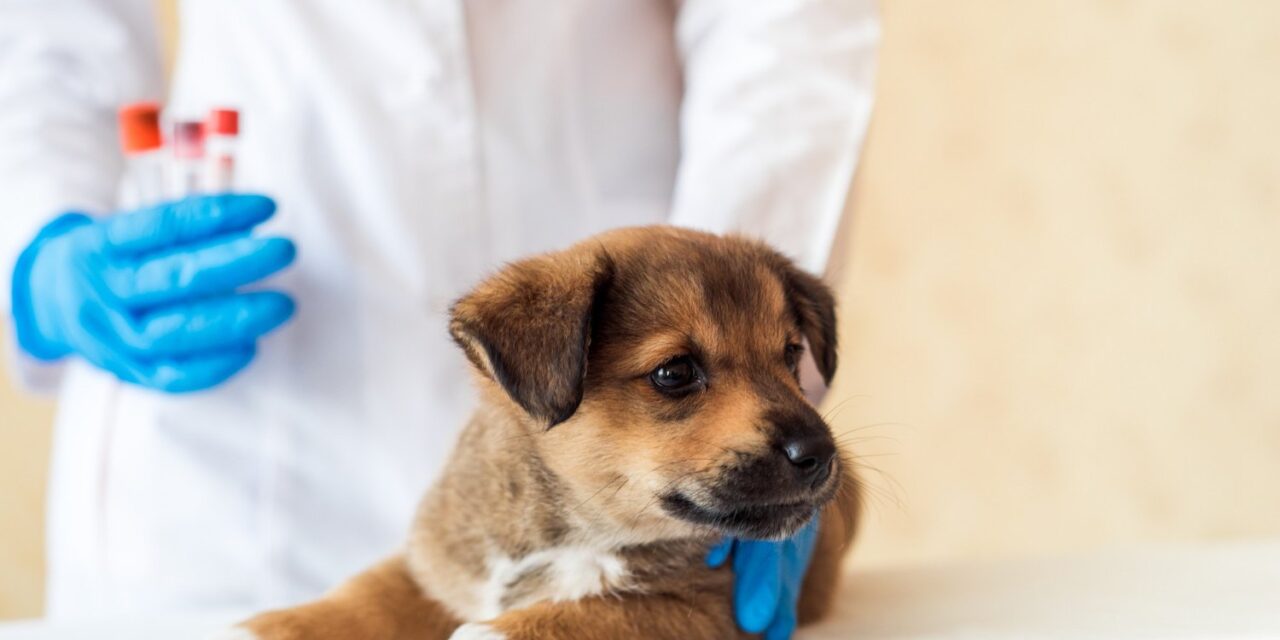
Worms in dogs are common, mostly intestinal, and usually invisible. That last part is the one that surprises people. Most infected dogs never show you a worm. They pass microscopic eggs in normal-looking stool for weeks or months. That’s exactly why veterinarians run routine fecal tests instead of waiting for someone to spot something in the yard.
When an owner does see worms, it’s almost always one of two things. Either long, pale, spaghetti-shaped roundworms in stool or vomit, or small, rice-grain tapeworm segments stuck to the fur near the tail. Hookworms and whipworms, the other two common intestinal worms, are too small to notice without a microscope. And heartworm is a different parasite entirely — it lives in the heart and lungs, spreads by mosquito, and is covered in its own MyDogLucky article.
Here’s the plan for this guide. First, the handful of signs that mean a puppy or dog needs a vet today. A heavy hookworm load can be dangerous fast in a young puppy. Then the four common worms in dogs, one at a time: how each one gets in, what it looks like, and which ones can spread to people. After that, how testing works, what to ask about treatment, and a prevention routine that fits a real household with a real budget.
You won’t find a diagnosis for your dog here, and you won’t find dosing. Deworming is prescription-level medicine that depends on which parasite is present, and that’s a question a fecal test answers far better than a guess. What you will find is enough context to make the vet call short, specific, and useful.
What’s in this guide
- Worms in dogs red flags: when it’s urgent
- The common worms in dogs, one by one
- Giardia and coccidia: often confused, not worms
- Testing: how vets find worms you can’t see
- Treatment questions to ask your vet
- Prevention: keeping worms out of your dog and your home
- What to observe, record, and bring to the appointment
- Monitor vs. call-today vs. go-now
- Common mistakes and misunderstandings
- Frequently asked questions about worms in dogs
- Sources
Worms in Dogs Red Flags: When It’s Urgent
Most worm infections in adult dogs cause mild signs or none at all, and they’re handled at a regular appointment. Puppies are the exception. A young puppy has a small body, a small blood volume, and often a heavy parasite load he was born with or picked up while nursing. Hookworms feed on blood. The Companion Animal Parasite Council (CAPC) is blunt about the consequence: the most common canine hookworm “can actually bleed a puppy to death.” The list below is worth reading calmly now so you recognize it right away later.
Seek veterinary care right away if you see:
- Pale or white gums in a puppy or any dog — lift the lip and compare to a healthy pink. Pale gums can mean anemia, and anemia from hookworms can be fatal in puppies.
- Bloody or black, tarry stool — dark, sticky stool (melena) means digested blood; bright red streaks mean fresh bleeding lower down. Either one belongs on the same-day list.
- A puppy who is losing weight, failing to grow, or has a pot belly combined with a dull coat, weakness, or diarrhea.
- Persistent vomiting, especially in a puppy, and especially if worms appear in the vomit.
- Weakness, lethargy, or collapse — a puppy who is limp, cold, or hard to rouse.
- Signs of dehydration — dry, tacky gums, sunken eyes, skin that stays tented when gently lifted.
- A distended, painful abdomen with vomiting and no stool — in rare heavy roundworm infections, a mass of worms can block a puppy’s intestine.
- Coughing or labored breathing in a young puppy — migrating roundworm or hookworm larvae pass through the lungs, and CAPC notes severe cases can cause sudden death in newborn litters.
Any single item on this list is reason enough to call. In a puppy under six months, treat the first two as go-now signs, not wait-and-see signs.
Why Puppies Are the High-Risk Group
Roundworm larvae cross the placenta before birth. Both roundworm and hookworm larvae also pass through the mother’s milk. VCA Animal Hospitals notes puppies “can be born with roundworms and can pass fertile eggs in their stools by the time they are about 11 days old.” CAPC reports that more than 30% of dogs under six months are shedding roundworm eggs. Some studies suggest nearly every puppy is born infected.
That’s not a reason to panic about a new puppy. It’s the reason every reputable puppy-care plan starts deworming at two weeks of age and repeats it every two weeks. The danger comes when that schedule was skipped, unknown, or done with the wrong product. That’s often the situation with a rescue puppy, a backyard-bred litter, or a puppy bought online with vague “vet-checked” paperwork.
Why Adult Dogs Rarely Show Dramatic Signs
Healthy adult dogs build partial immunity to roundworms and tolerate moderate hookworm and whipworm loads without obvious illness. Many carry a low-level infection for months, shedding eggs into the yard, the park, and the sandbox next door, while looking completely fine. That’s why the adult red flags are subtler: chronic soft stool, mucus or blood streaks, gradual weight loss, a dull coat, or scooting. None of those is an emergency in a bright, eating adult dog. All of them are worth a fecal test.
The Common Worms in Dogs, One by One
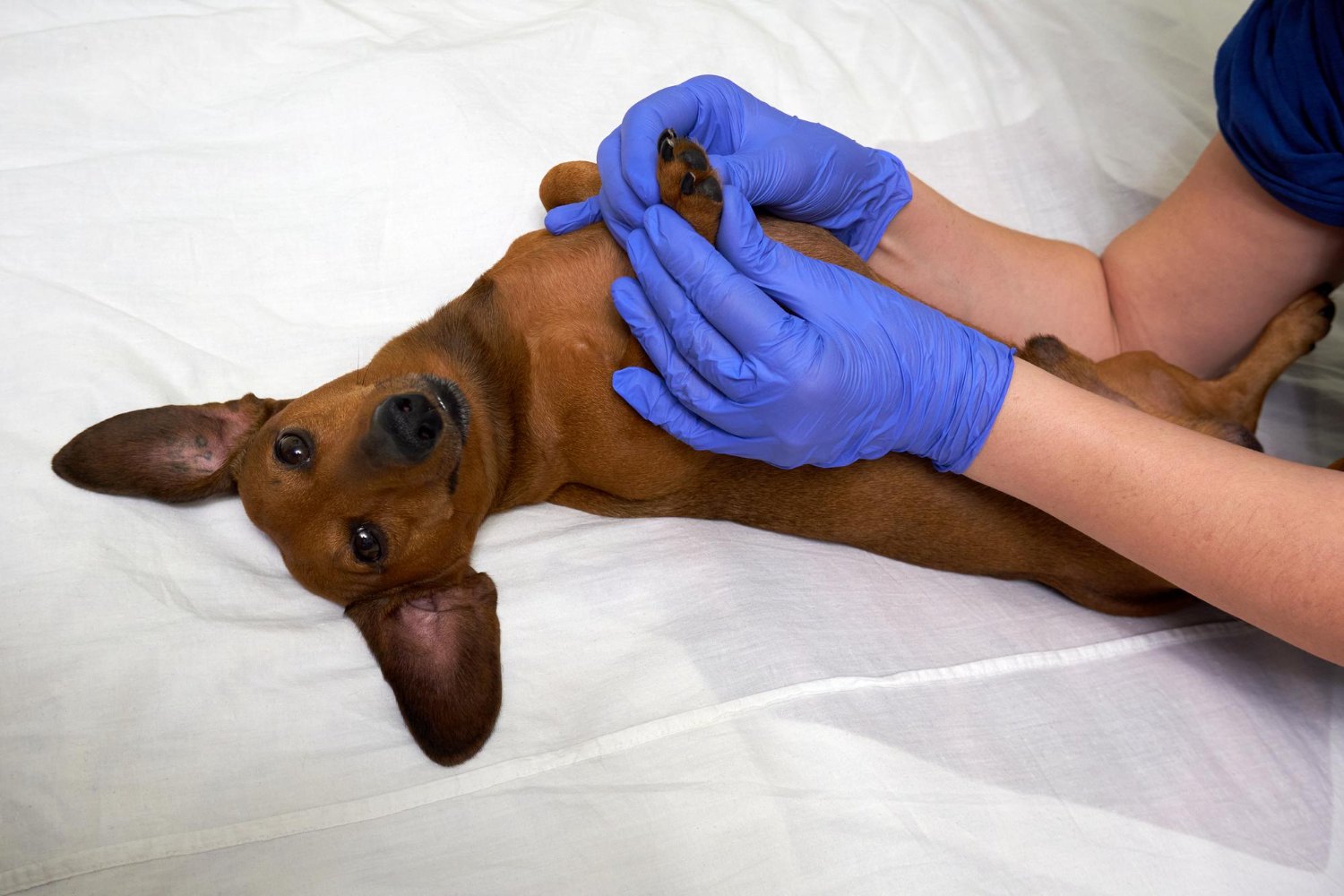
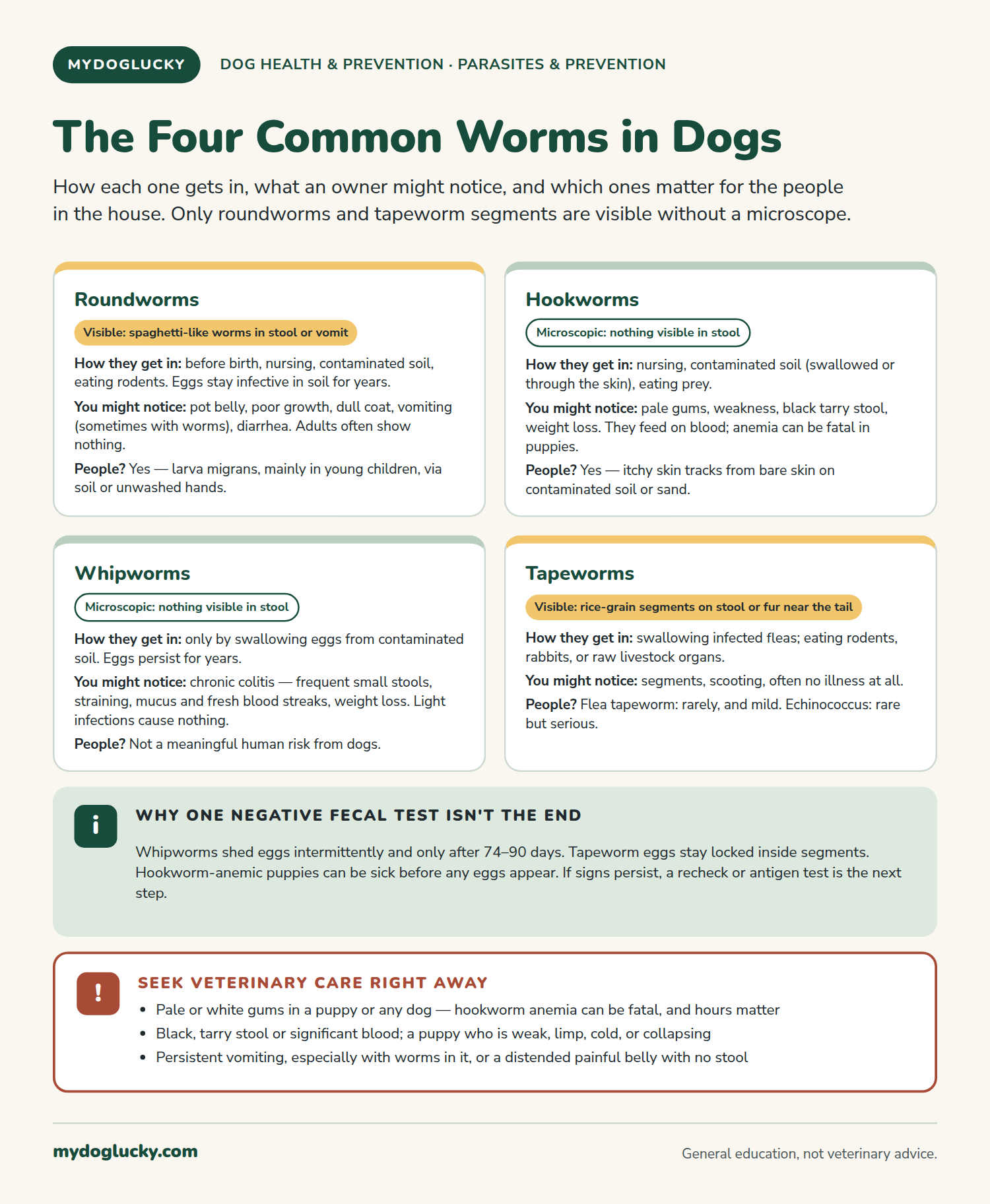
Four intestinal worms account for the vast majority of what veterinarians find in U.S. dogs: roundworms, hookworms, whipworms, and tapeworms. Each one has a different route into your dog, a different signature in the stool, and a different level of risk to the people in your house. Knowing the differences makes the fecal-test result and the treatment plan much easier to follow.
Roundworms: The Ones You Might Actually See
Roundworms (mainly Toxocara canis) are long, pale, tube-shaped worms that live free in the small intestine, feeding on partly digested food. Cornell’s Riney Canine Health Center describes them simply as “long, tube-shaped worms that infect a dog’s intestines.” When an adult worm is passed in stool or vomited up, it looks like a strand of cooked spaghetti. Some are several inches long. This is the classic “I saw a worm” moment, and it happens most often in puppies.
How dogs get them. Four routes, per CAPC: swallowing infective eggs from contaminated soil, eating an infected rodent or other small animal, transplacental transmission from mother to pups before birth, and transmammary transmission through nursing. Roundworm eggs need a couple of weeks in the environment to become infective. Once they do, CAPC says they “are hardy and can survive and remain infective for years.” Ordinary disinfectants don’t kill them.
Signs. Puppies show it most clearly: a pot-bellied look, poor growth, a dull coat, vomiting (sometimes with worms in it), diarrhea, and occasionally coughing as larvae migrate through the lungs. Merck Veterinary Manual lists “lack of growth and loss of condition” as the first signs owners tend to notice. Adult dogs often show nothing.
Risk to people. Real, and the reason pediatricians care about dog poop. When a person swallows infective eggs, usually from soil or unwashed hands, the larvae can migrate through organs (visceral larva migrans) or into the eye (ocular larva migrans). CDC says severe cases “are more likely to be in young children who have been playing in or eating contaminated dirt.” The practical defense is covered in the prevention section. Mostly, it’s about picking up stool and washing hands.
Hookworms: Small, Blood-Feeding, and Dangerous to Puppies
Hookworms (Ancylostoma and Uncinaria species) are tiny — a fraction of an inch — and you won’t see them in stool. They attach to the intestinal wall with hook-like mouthparts and feed on blood. That feeding is what makes them the most dangerous of the common worms in dogs for a young puppy.
How dogs get them. CAPC lists ingestion of larvae from a contaminated environment, “larval penetration of the skin,” and eating an infected animal. For puppies, the big route is nursing. Dormant larvae in the mother’s tissues wake up during pregnancy and “accumulate in the mammary glands,” so a litter can be infected before it ever touches grass. Skin penetration matters for adult dogs too. A dog who lies on contaminated damp soil can pick up larvae through the skin of the belly or paws.
Signs. Merck describes anemia in young puppies as “the characteristic, and often fatal, sign.” CAPC adds pale gums, failure to gain weight, poor coat, dehydration, and “dark, tarry diarrhea (melena).” Cornell notes an important trap for testing: acutely sick puppies can be severely anemic “before they pass any eggs into their stool.” That’s why a vet may check blood values, not just a fecal sample, in a pale, weak puppy. Adults typically show milder signs — soft stool, weight loss, a dull coat — or none.
A newer wrinkle. CAPC reports that hookworm populations resistant to multiple deworming drugs have been confirmed in dogs around the U.S. That’s one of the strongest arguments against buying a dewormer off a shelf and hoping. If a dog keeps testing positive after treatment, the vet needs to know, because the plan may have to change.
Risk to people. Hookworm larvae in soil or sand can burrow into human skin and cause cutaneous larva migrans: intensely itchy, raised red tracks that wander under the skin. CDC notes these infections are more common on the East Coast than the West Coast in the U.S. and usually clear within five to six weeks as the larvae die, but they’re miserable in the meantime. Bare feet on contaminated sand or soil is the typical exposure.
Whipworms: The Ones a Single Test Can Miss
Whipworms (Trichuris vulpis) live in the large intestine — the cecum and colon — and get their name from a thin, whip-like front end. Like hookworms, they’re not something you’ll spot in stool.
How dogs get them. Only one way. CAPC states dogs acquire whipworms “only by ingesting eggs containing infective larvae from the environment.” No nursing route, no skin route, no dog-to-dog contact. The eggs need weeks in soil to become infective. After that, per CAPC, they “may persist in the environment for several years.” A yard or run that has hosted a whipworm-positive dog stays a source for a long time.
Signs. Light infections cause nothing. Heavier ones cause classic large-bowel diarrhea: frequent small stools, straining, and stool “often streaked with mucus and fresh blood,” in CAPC’s words. Severe cases lead to weight loss, dehydration, and anemia. A dog with chronic, on-and-off colitis that never quite resolves is a textbook reason for a vet to think about whipworms.
Why they’re tricky to find. Two reasons. First, the prepatent period — the time from infection to egg-laying — is long, “74 to 90 days” per CAPC, so a dog can be sick before any eggs appear. Second, whipworm eggs are shed intermittently and are dense, so they can sink instead of floating in a basic flotation. CAPC specifies that centrifugation “must be used to recover them.” This is one of the clearest examples of why one negative fecal doesn’t close the case.
Risk to people. The dog whipworm is not considered a meaningful human parasite. Humans have their own species of whipworm, spread person to person.
Tapeworms: The Flea Connection and the Rice-Grain Segments
Tapeworms are flat, segmented worms that anchor to the small-intestinal wall and grow a chain of segments called proglottids. The segments break off and pass out with stool, carrying egg packets. This is the second common “I saw something” scenario: owners notice small, flat, white or cream-colored segments on fresh stool, in bedding, or moving on the fur around the anus. VCA describes them as resembling “grains of rice or cucumber seeds,” about half an inch long when fresh, drying to a golden, sesame-seed look.
How dogs get them. The most common species, Dipylidium caninum, comes from fleas. Flea larvae eat tapeworm eggs; the dog then swallows an infected adult flea while grooming or chewing at an itch. CAPC: “Dogs and cats become infected when they ingest the infected flea or louse intermediate host during normal grooming.” No fleas, no Dipylidium. Other tapeworms (Taenia and Echinococcus species) come from eating infected prey — rodents, rabbits — or raw organ meat from livestock, which makes hunting dogs, farm dogs, and enthusiastic mousers the higher-risk group.
Signs. Usually minimal. Merck says “most infections have few signs.” Some dogs scoot or lick under the tail because the passing segments irritate the skin. Very heavy loads in small puppies can occasionally cause digestive upset or, rarely, an obstruction. Mostly, tapeworms are a hygiene and flea-control problem rather than an illness.
Why the fecal test often misses them. Segments don’t spread eggs evenly through the stool, and the egg packets stay sealed inside them. CAPC’s conclusion: “fecal flotation alone is insensitive.” VCA puts it plainly: “Tapeworms are not readily diagnosed with routine fecal examinations.” That’s why a photo of a segment is genuinely useful evidence at the vet.
Risk to people. Children occasionally get Dipylidium by swallowing a flea; CAPC describes those infections as “generally mild, confined to the intestinal tract, and readily treated.” Echinococcus is the serious one. CDC describes echinococcosis as cysts that form slowly in organs like the liver. The alveolar form, carried by foxes and coyotes, “can be fatal” if untreated. It’s rare in the U.S. But it’s the reason dogs shouldn’t eat raw livestock organs or wildlife, and it’s why hands get washed after handling any dog’s stool.
| Worm | How dogs get it | What you might notice | Can people get it? |
|---|---|---|---|
| Roundworms | Before birth, nursing, contaminated soil, eating rodents | Pot belly, poor growth, vomiting, spaghetti-like worms in stool or vomit; adults often show nothing | Yes — larva migrans, mainly in young children via soil or unwashed hands |
| Hookworms | Nursing, contaminated soil (swallowed or through skin), eating prey | Pale gums, weakness, black tarry stool, weight loss; nothing visible in stool | Yes — itchy skin tracks (cutaneous larva migrans) from bare skin on contaminated soil or sand |
| Whipworms | Only by swallowing eggs from contaminated soil | Chronic colitis: mucus, fresh blood streaks, straining, weight loss; nothing visible | Not a meaningful human risk from dogs |
| Tapeworms | Swallowing infected fleas; eating rodents, rabbits, or raw livestock organs | Rice-grain segments on stool, bedding, or fur near the tail; scooting; often no illness | Flea tapeworm: rarely, mild. Echinococcus: rare but serious |
Giardia and Coccidia: Often Confused, Not Worms
Two other parasites show up constantly in “worms in dogs” conversations, and neither is a worm. Giardia and coccidia (Cystoisospora) are single-celled protozoa. They cause diarrhea, they’re found on the same fecal tests, and they’re common in puppies, shelters, and boarding kennels. But they need different medication than worms do, so a dewormer prescribed for roundworms does nothing for them. CAPC describes Giardia diarrhea as “acute, intermittent, or chronic,” sometimes with gas, vomiting, or mucus. Some dogs carry it with no signs at all.
Coccidia hits stressed young animals hardest. CAPC specifically mentions “shipment to pet stores or relocation to pet owners” as triggers. Coccidia in dogs is not a human risk. For Giardia, CAPC states that dog-to-human transmission “has not been conclusively demonstrated in North America,” though people with weakened immunity are advised to be cautious. If your vet’s report says Giardia or coccidia, you’re dealing with a real parasite, just not a worm, and the treatment plan will look different.
Testing: How Vets Find Worms You Can’t See
Because most worms in dogs are invisible, testing does the heavy lifting. Understanding what the tests can and can’t do helps you make sense of a result. That’s true whether it’s a clean report or a surprise positive in a dog who looks entirely healthy.
Fecal Flotation: The Standard Screen
A small amount of stool is mixed with a solution that makes parasite eggs float to the surface. The eggs are collected on a slide and identified under a microscope. Each worm species lays a distinctively shaped egg, so a trained eye can tell roundworm from hookworm from whipworm. The better version of this test uses a centrifuge to spin the sample, which recovers heavier eggs (whipworm especially) far more reliably than letting the sample sit. If your clinic sends samples to a reference lab, centrifugal flotation is usually what’s being run.
Fecal Antigen and PCR Tests: Catching What Flotation Misses
Newer tests look for parasite proteins (antigen) or DNA (PCR) rather than eggs. CAPC notes antigen testing can raise detection over flotation alone and “enables identification of prepatent and single sex infections.” Translated: it can find a whipworm infection during those 74 to 90 days before egg-laying starts. It can also catch a hookworm infection where only one sex of worm is present and no eggs are being made. Many clinics now run flotation and antigen together on a routine sample. Antigen tests are also the preferred way to confirm Giardia.
How Often to Test
CAPC’s current general guidelines recommend fecal testing “at least four times during the first year of life” for puppies. For adults, it’s “at least two times per year,” adjusted for health, lifestyle, and exposure. AAHA’s canine life-stage guidelines frame it as several exams in the first year and “at least annually” after that. They add that more frequent testing makes sense when a dog isn’t on year-round prevention or has a high-exposure lifestyle. In practice, many clinics pair a fecal test with each puppy vaccine visit, then once or twice a year at wellness exams.
| Life stage or situation | Fecal testing (CAPC / AAHA) | Why |
|---|---|---|
| Puppy, first year | At least four times; often at each vaccine visit | Most puppies are born infected or infected while nursing; highest risk of serious disease |
| Adult on year-round broad-spectrum prevention | At least once, ideally twice a year | Confirms the preventive is working and catches parasites it doesn’t cover (tapeworms, protozoa) |
| Adult not on prevention, or high exposure (dog parks, daycare, hunting, rural) | Twice a year or more, per your vet | More opportunities to pick up eggs and larvae; no monthly backstop |
| Newly adopted dog of any age | At the first visit, then a recheck | Unknown history; shelter and transport stress raise shedding |
| Any dog with diarrhea, weight loss, or visible worms | Now, with a fresh sample | Identifies which parasite (if any) so treatment can be specific |
Why a Single Negative Fecal Doesn’t Rule Everything Out
A negative result means no eggs were found in that teaspoon of stool that day. It does not mean the dog is parasite-free. Whipworms shed intermittently and lay eggs only after a long prepatent period. Tapeworm eggs stay locked inside segments and rarely float. Hookworm-anemic puppies can be sick before any eggs appear. The AKC’s owner guide adds a mundane factor: the parasite’s life cycle and even “consistency of a stool sample” can produce a false negative. In their words, “you may need to repeat the test.”
When signs persist after a clean fecal, the reasonable next steps are a recheck, an antigen test, or a treatment trial based on the vet’s judgment. None of those means the first test was wasted.

Treatment Questions to Ask Your Vet
Deworming is straightforward when the parasite is known and the product matches it. It goes sideways when someone treats blind. Here’s how to think about the conversation.
Deworming Is Parasite-Specific and Vet-Prescribed
No single drug kills every intestinal worm in dogs. Some dewormers handle roundworms and hookworms but not whipworms. Tapeworms need a different active ingredient again, and Giardia and coccidia need something else entirely. That’s why the fecal test comes first: it tells the vet what’s there, which decides what’s prescribed. VCA states directly that “the most effective deworming products are only available by prescription from a licensed veterinarian.” Your vet will choose the product, the dose for your dog’s weight, and the schedule. This article won’t, and any website that does is guessing about a dog it has never seen.
The Puppy Deworming Schedule Is Set by the Vet
For context only: CAPC and Merck describe a standard approach of treating puppies starting at two weeks of age and repeating every two weeks. That continues until the puppy is old enough to start a monthly broad-spectrum preventive. Puppies not yet on year-round protection are typically treated monthly until six months. Breeders and shelters usually do the early rounds; your vet picks it up from there. Ask what has already been given and when, and bring any paperwork. If the history is unknown, tell the vet that too — it changes the plan rather than delaying it.
Why Over-the-Counter “All-Wormers” and Human Dewormers Aren’t the Answer
Shelf products labeled as broad dewormers usually contain one active ingredient that covers one or two worm types and skips the rest. Give one to a dog with whipworms or tapeworms and nothing changes, except that you now believe the dog has been treated. Many also aren’t dosed for very young puppies or don’t address the larval stages that matter in a nursing litter. And with multi-drug-resistant hookworms now confirmed in the U.S., repeated under-dosing with the wrong product is exactly how a resistant population gets a foothold.
Human dewormers are a harder no. They’re formulated and dosed for people and for human parasites. The amount that’s appropriate for an adult person has no relationship to what’s safe for a 12-pound puppy. Don’t give any human medication to a dog without a veterinarian telling you to for that specific dog.
The Recheck Matters
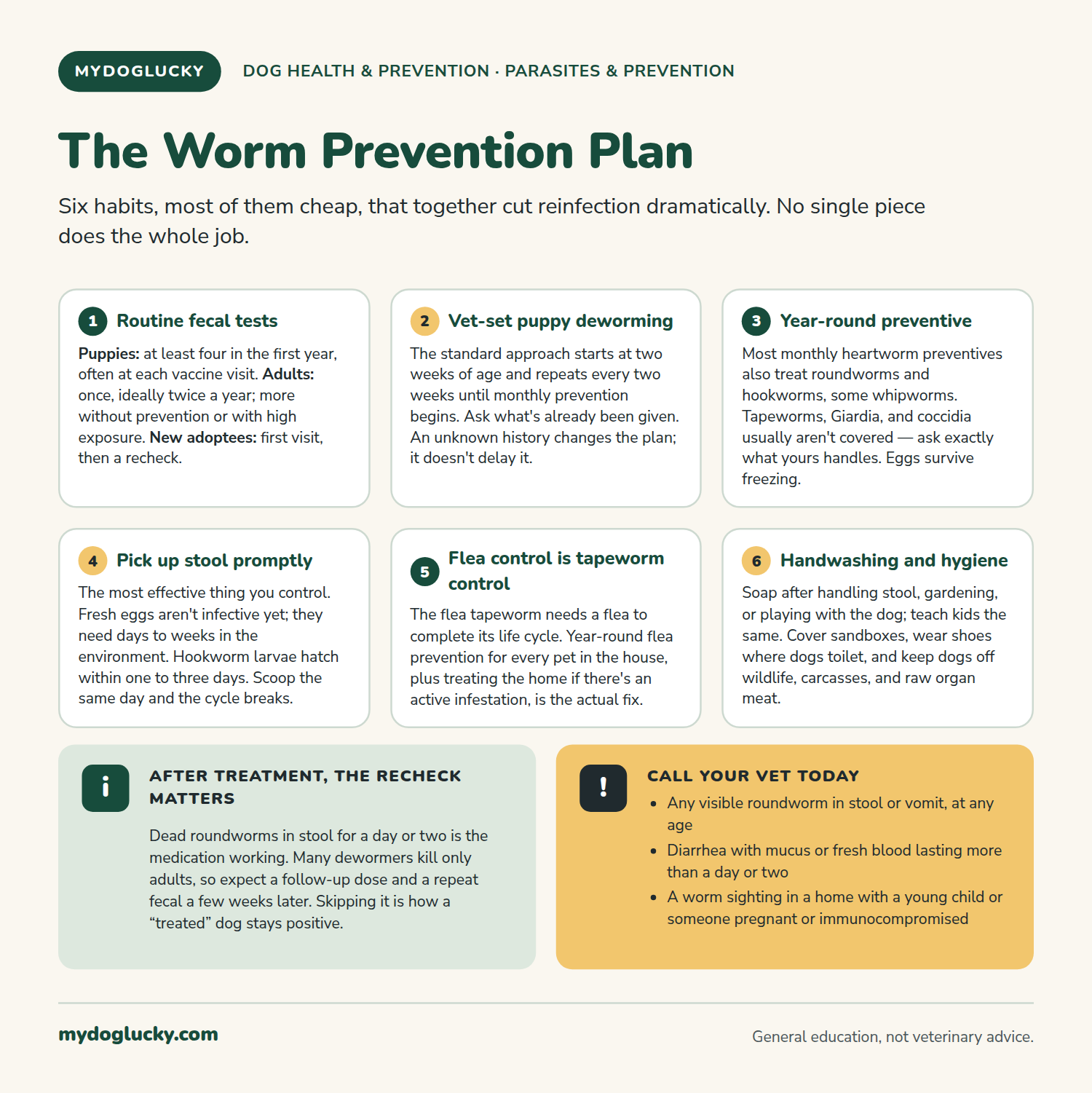
Many dewormers kill only adult worms in the gut. Larvae still migrating through tissue, or eggs your dog swallows again from the yard tomorrow, aren’t touched. VCA notes that for roundworms “at least two or three treatments are needed,” and Cornell describes repeating treatment after two weeks as “often necessary.” Expect a follow-up dose and a repeat fecal test a few weeks after treatment. Skipping the recheck is one of the most common reasons a “treated” dog is still positive at the next visit.
Questions worth asking at the appointment
- Which parasite did the test find, and does the product you’re prescribing cover it?
- How many doses, how far apart, and when should we recheck the stool?
- Does our monthly preventive already cover this worm, and should we change it?
- Are there other pets at home who need testing or treatment at the same time?
- Is this one a risk to the people in our house, and what hygiene steps matter most?
- Should we do anything about the yard, and how long do the eggs persist?
What to Expect After Treatment
It’s common, and a little alarming, to see dead or dying roundworms passed in stool for a day or two after a puppy is dewormed. That’s the medication working, not a sign it failed. Mild, brief soft stool can also follow. Vomiting worms, lethargy, or worsening diarrhea after treatment are reasons to call the clinic the same day. Keep picking up every stool promptly during this window, because it’s loaded with eggs.
Prevention: Keeping Worms Out of Your Dog and Your Home
Prevention for worms in dogs isn’t one product. It’s a short stack of habits, most of them cheap, that together cut reinfection dramatically. CAPC’s headline recommendation is “year-round broad-spectrum parasite control with efficacy against heartworm, intestinal parasites, fleas, and ticks,” and AAHA’s life-stage guidelines say the same thing. Here’s what that looks like in a real house.
Monthly Broad-Spectrum Preventives, as a Category
Most monthly heartworm preventives sold in the U.S. also treat several intestinal worms — commonly roundworms and hookworms, and in some formulations whipworms. Some combination products add flea and tick control, which matters for tapeworms. That’s why year-round heartworm prevention does double duty against intestinal parasites. What a given product covers varies, so ask your vet exactly which worms your dog’s preventive handles and which it doesn’t. Tapeworms, Giardia, and coccidia are usually not covered, and that gap is one reason fecal testing continues even for dogs on prevention. This article deliberately doesn’t name products; your vet knows what’s appropriate for your dog’s weight, age, and region.
Pick Up Stool Promptly, Every Time
This is the single most effective thing you control. Roundworm and whipworm eggs aren’t infective when freshly passed; they need days to weeks in the environment to develop. Hookworm larvae hatch on warm, moist soil within one to three days, per Merck. Scoop the same day and the cycle breaks before it starts. CDC’s toxocariasis prevention advice is the same: “Pick up your pet’s waste every time. Bury it or bag it and dispose of in the trash.” A yard where stool sits for a week is a yard that reinfects the dog who lives there.
Flea Control Is Tapeworm Control
Because the flea tapeworm needs a flea to complete its life cycle, CAPC says “stringent adherence to controlling fleas” is what prevents it. A dog treated for tapeworms and sent back into a flea-infested home will have tapeworms again within weeks. Year-round flea prevention for every pet in the house, plus treating the home environment if there’s an active infestation, is the actual fix.
Hygiene for the Humans, Especially Kids
Wash hands with soap after handling stool, gardening, or playing with the dog, and teach children the same. Cover sandboxes when not in use. Discourage bare feet in areas dogs use as a bathroom, particularly damp, shaded soil or sand. CDC’s advice for zoonotic hookworm includes wearing shoes and disposing of animal waste quickly “to keep eggs from getting into soil and hatching.” None of this treats your dog as dangerous. It treats the soil as the risk, which is where the parasites actually live.
Keep Dogs Off Wildlife, Carcasses, and Raw Organ Meat
Rodents, rabbits, and birds carry roundworm and tapeworm larvae in their tissues. Raw or undercooked livestock organs can carry Echinococcus and Taenia. Merck’s prevention note for tapeworms is “preventing access to prey animals.” A solid leave-it cue, a leash in high-wildlife areas, and not feeding raw viscera all count as parasite prevention.
Travel, Boarding, and Regional Exposure
Parasite pressure varies by region and season. Hookworm prevalence in the U.S. is highest in the warm, humid Southeast and lowest in arid western states. A dog who boards, goes to daycare, travels, or spends time at a busy dog park meets more eggs and larvae than a dog who mostly walks a quiet block. Mention travel and lifestyle at wellness visits. That way the testing cadence and preventive choice reflect your dog’s real exposure rather than a default.
Yard and Environment: Realistic Expectations
Roundworm and whipworm eggs survive for years in soil, and no consumer-safe chemical reliably kills them in a lawn. What works is removing stool before eggs mature, plus sunlight and dry conditions (whipworm eggs are susceptible to drying, per Merck). In a heavily contaminated run, removing or replacing the top layer of soil or gravel is sometimes the practical option. Keeping the dog on a monthly preventive so he stops shedding is the part that actually ends the cycle.
What to Observe, Record, and Bring to the Appointment
You don’t have to identify a worm. You do have to describe what you saw, and a little preparation makes the visit faster and the answer more accurate.
The Stool Sample
Bring a fresh sample — the AKC’s guidance is one passed within the past 12 hours, about a teaspoon, in a clean container with a lid. Refrigerate it if you can’t go right away; it stays usable for roughly 12 to 24 hours chilled. Label it with your dog’s name and the time collected. Don’t bring a dried-out sample from the yard; eggs and protozoa cysts degrade and the result gets less reliable.
If You Saw a Worm or a Segment
Take a photo before you clean it up. Note whether it was in stool, in vomit, or on the fur or bedding, and roughly how long and what shape it was. A long, pale, round-bodied worm points toward roundworms. Flat, rice-sized segments that may move point toward tapeworms. If you can safely put the worm or segment in a sealed bag or container, bring it. Vets identify tapeworms from segments far more reliably than from a fecal float.
Signs to Log
Write down what’s changed and when: stool consistency, any mucus or blood and what color, vomiting, appetite, weight (if you have a recent number), coat condition, scooting, coughing, and energy level. For a puppy, note gum color when calm. Then add the parasite-relevant history. When was the dog last dewormed, and with what? Is he on a monthly preventive, and which worms does it cover? Note flea history, any boarding, daycare, travel, or hunting, and whether he eats rodents or scavenges.
The two-minute pre-visit checklist
- Fresh stool sample in a lidded container, refrigerated if there’s a wait.
- Photo of any worm or segment, with a note on where you found it.
- Deworming and preventive history — product type, dates, and what’s been skipped.
- Exposure notes — fleas, boarding, travel, wildlife, other pets at home.
- Household notes — young children, anyone pregnant or immunocompromised, a shared yard or sandbox.
Monitor vs. Call-Today vs. Go-Now
Here’s the same information from the sections above, organized by what to do next.
Monitor and schedule a routine visit
- A healthy adult dog on a monthly preventive who’s due for a routine fecal test.
- Rice-grain tapeworm segments on the stool of a dog who is eating, drinking, and acting normally.
- Occasional scooting with no other signs.
Book a regular appointment, bring a fresh sample and a photo, and keep picking up stool in the meantime.
Call your vet today
- Any visible roundworm in stool or vomit, in a dog of any age.
- Diarrhea with mucus or streaks of fresh blood lasting more than a day or two.
- Gradual weight loss, a dull coat, or a pot-bellied look in a puppy who’s otherwise bright.
- A newly adopted puppy or dog with no deworming history.
- A positive fecal test in one pet when other pets at home haven’t been checked.
- A worm sighting in a household with a young child, a pregnant person, or someone immunocompromised.
Not an emergency, but not a wait-it-out situation either. Call, describe what you’re seeing, and ask whether they want a sample dropped off before the appointment.
Seek emergency care now
- Pale or white gums in a puppy or any dog.
- Black, tarry stool or significant amounts of blood.
- A puppy who is weak, limp, cold, or collapsing.
- Persistent vomiting, especially with worms in it, or a distended painful belly with no stool.
- Labored breathing or coughing in a young puppy with other worm signs.
- Signs of dehydration alongside any of the above.
Call ahead if you can, then go. A puppy with hookworm anemia can need a blood transfusion, and hours matter.
Common Mistakes and Misunderstandings
Assuming No Visible Worms Means No Worms
Two of the four common worms in dogs are never visible without a microscope, and the other two are only occasionally seen. Most infected dogs look completely normal. The fecal test exists because your eyes are not the right instrument for this job.
Treating With a Shelf Dewormer Before Testing
An over-the-counter product that doesn’t cover the parasite your dog actually has buys a false sense of security. It also buys a few more weeks of egg-shedding in the yard. Test first, then treat with what the vet prescribes for that result.
Skipping the Recheck
The first dose often clears adults only. The follow-up dose and repeat fecal are where the infection actually ends. Marking “dewormed” on the calendar after a single dose is how the same dog turns up positive six months later.
Treating Tapeworms Without Treating Fleas
It’s the flea that carries the tapeworm. Deworm without flea control and the cycle restarts at the next bite. Every pet in the house needs flea prevention, not just the one with segments.
Assuming a Negative Test Closes the Case
Whipworms and tapeworms are notorious for hiding from a single flotation. If signs continue, a repeat sample, an antigen test, or a treatment trial at your vet’s discretion is the next step, not a shrug.
Letting Stool Sit in the Yard
Freshly passed eggs aren’t infective yet. Eggs that have sat for a week or two are. Daily pickup is unglamorous and it’s the cheapest parasite control there is.
Giving a Human Dewormer, or a Cat Product, to a Dog
Different species, different parasites, different doses. Human anti-parasite medications and products labeled for cats are not interchangeable with a canine prescription, and some can be harmful. Ask first.
Stopping Prevention in Winter
Eggs survive freezing. Fleas survive indoors. Larvae in a dog’s tissues don’t check the calendar. CAPC and AAHA both recommend year-round prevention for a reason, and puppies and indoor dogs are not exempt.
Treating the Dog Who Has Symptoms and Ignoring the Rest
Dogs in the same household share a yard, bedding, and often a water bowl. A positive test in one is a reason to test the others, and your vet may recommend treating all of them together.
Frequently Asked Questions About Worms in Dogs
Can I get worms from my dog?
Some, yes. Roundworm eggs from contaminated soil can cause larva migrans in people, most seriously in young children. Hookworm larvae can burrow into bare skin and cause itchy tracks. The flea tapeworm occasionally infects a child who swallows a flea, and Echinococcus, though rare in the U.S., is serious. None of these spread by petting or cuddling; they spread through stool-contaminated soil, sand, and unwashed hands. Prompt stool pickup, handwashing, shoes outdoors, and keeping your dog dewormed and on prevention are the defenses CDC recommends.
How often should my dog be dewormed?
That depends on age, test results, and whether he’s on a monthly broad-spectrum preventive. Puppies are typically dewormed every two weeks starting at two weeks of age until they transition to monthly prevention, on a schedule the vet sets. Adults on a year-round preventive that covers intestinal worms are effectively dewormed monthly and get fecal tests once or twice a year to confirm. Adults not on prevention may be dewormed on a schedule tied to fecal results — CAPC describes quarterly deworming as one approach for those dogs. Ask your vet which situation applies.
Can I see worms in dog poop?
Sometimes. Roundworms are visible when passed — long, pale, spaghetti-like — most often in puppies or after deworming. Tapeworm segments show up as flat, rice- or sesame-seed-sized pieces on stool, bedding, or fur near the tail. Hookworms and whipworms are too small to see. Most infected dogs pass only microscopic eggs, so not seeing anything means very little.
What do roundworms look like in dogs?
Like strands of cooked spaghetti: pale, round-bodied, tapered at the ends, anywhere from a couple of inches to several inches long. They may be coiled and may still move. You’re most likely to see them in a puppy’s stool or vomit, or in stool a day or two after deworming.
What do tapeworms look like in dogs?
You’ll see segments, not the whole worm. Fresh segments are flat, white to cream, about the size of a grain of rice or a cucumber seed, and may stretch and move. Dried ones look like sesame seeds stuck to fur or bedding. The whole tapeworm stays inside the intestine and can be many inches long.
My dog has worms but seems fine. Do I still need to treat?
Yes. A dog who looks fine can still be losing nutrients or small amounts of blood. He’s also shedding eggs that contaminate the yard, reinfect him, and can reach people. Treatment for a healthy adult is usually simple and inexpensive relative to the alternative.
How do dogs get worms if they never leave the yard?
Puppies get roundworms and hookworms before birth or while nursing. Any dog can pick up eggs carried into a yard by wildlife, other animals’ stool, or shoes. Hookworm larvae can also enter through the skin from damp soil. Fleas carry tapeworms into apartments without a yard at all. “Indoor dog” reduces exposure; it doesn’t eliminate it.
Will a heartworm preventive treat intestinal worms too?
Many monthly heartworm preventives also treat roundworms and hookworms, and some cover whipworms. Most do not cover tapeworms, Giardia, or coccidia. Ask your vet exactly what your dog’s product covers. Heartworm itself is a separate parasite with its own testing and prevention, covered in its own MyDogLucky article.
How long after deworming will my dog pass worms?
For roundworms, dead or paralyzed worms commonly appear in stool within a day or two of treatment and may continue for a few days. That’s expected. Tapeworms are usually digested and not seen. If your dog is vomiting, very lethargic, or still passing worms a week later, call the clinic.
Can worms cause my dog to scoot?
Tapeworm segments irritating the skin under the tail are one cause of scooting. Full or impacted anal glands, allergies, and skin irritation are more common causes. Scooting is a reason for a vet visit and a fecal check, not proof of worms on its own.
Is a dog with worms contagious to my other dogs?
Indirectly. Roundworm and whipworm eggs need time in the environment to become infective, so a shared yard is the route, not direct contact. Hookworm larvae in soil can infect other dogs by ingestion or through the skin. Tapeworms spread via fleas, which move freely between pets. A positive test in one pet is a good reason to test and, if your vet recommends it, treat the others.
Can I treat worms in dogs at home with garlic, pumpkin seeds, or diatomaceous earth?
There’s no reliable veterinary evidence that these clear an intestinal worm infection, and garlic in meaningful amounts is toxic to dogs. Using a home remedy instead of a prescribed dewormer means weeks more egg-shedding and, in a puppy, real risk. Feed pumpkin if your vet likes it for stool quality, but treat worms with medication matched to the parasite.
How long can roundworm or whipworm eggs survive in my yard?
Years. CAPC describes roundworm eggs as able to “remain infective for years” and whipworm eggs as persisting “for several years.” Prompt stool pickup keeps new eggs from maturing; sunlight and dryness help; and keeping the dog on prevention stops the resupply. Total decontamination of soil isn’t realistic, so the goal is breaking the cycle, not sterilizing the lawn.
Do I need to deworm a newly adopted adult dog?
Have a fecal test run at the first visit and follow the vet’s recommendation. Many shelters deworm at intake, but records vary and stress increases shedding. Some vets treat empirically for roundworms and hookworms in a new dog with unknown history and then test; others test first. Either is reasonable — the point is not to skip it.
Are worms in dogs more common in certain seasons?
Exposure rises in warm, humid weather when hookworm larvae develop quickly and fleas are most active, but eggs survive cold and fleas live indoors year-round. CAPC and AAHA recommend year-round prevention rather than seasonal use for exactly that reason.
Can my dog get worms from eating grass or dirt?
Yes, if that grass or dirt carries infective roundworm, whipworm, or hookworm eggs or larvae from another animal’s stool. That’s the main route for adult dogs. It doesn’t mean grass itself is dangerous — it means what’s in the soil matters, and it’s why dog-park and shared-yard dogs are tested more often.
Should my kids stay away from the dog until he’s treated?
Normal contact with the dog is fine. The risk is stool and contaminated soil, not the dog’s fur or tongue. Focus on picking up stool immediately and covering the sandbox. Keep kids out of the areas the dog uses as a bathroom until a few weeks after treatment, and insist on handwashing before meals. If a child develops an itchy, tracking rash or unexplained fever or eye symptoms, mention the dog’s parasite history to the pediatrician.
Where This Leaves You
Worms in dogs are one of the most common findings in veterinary medicine and, in an adult dog, one of the most manageable. The system that keeps them in check isn’t complicated. A fecal test once or twice a year. A monthly broad-spectrum preventive chosen with your vet. Stool picked up the same day, fleas controlled, and hands washed. For a puppy, add a deworming schedule the vet sets from the start and a low threshold for calling if he looks pale, weak, or pot-bellied.
If you’re reading this because you just saw something in the yard, take a photo, bag a fresh sample, and call. If you’re reading it because your puppy’s gums looked pale tonight, stop reading and go. And if you’re reading it because you’re not sure when your dog was last tested, that’s the easiest one — book the wellness visit and bring a sample.
Sources
- Companion Animal Parasite Council. General Guidelines for Dogs and Cats (updated April 24, 2025)
- Companion Animal Parasite Council. Ascarid (Roundworm) (updated February 28, 2025)
- Companion Animal Parasite Council. Hookworms (updated February 28, 2025)
- Companion Animal Parasite Council. Trichuris vulpis (Whipworm) (updated February 28, 2025)
- Companion Animal Parasite Council. Dipylidium caninum (Flea Tapeworm) (updated February 28, 2025)
- Companion Animal Parasite Council. Giardia (updated August 3, 2026)
- Companion Animal Parasite Council. Cystoisospora (Coccidia) (updated February 7, 2025)
- Centers for Disease Control and Prevention. About Toxocariasis (reviewed September 10, 2024)
- Centers for Disease Control and Prevention. About Zoonotic Hookworm (reviewed May 4, 2026)
- Centers for Disease Control and Prevention. About Echinococcosis (reviewed September 4, 2024)
- Merck Veterinary Manual. Gastrointestinal Parasites of Dogs (revised May 2026)
- VCA Animal Hospitals. Roundworm Infection in Dogs
- VCA Animal Hospitals. Tapeworm Infection in Dogs
- Cornell University College of Veterinary Medicine, Riney Canine Health Center. Roundworms
- Cornell University College of Veterinary Medicine, Riney Canine Health Center. Hookworms in Dogs
- American Animal Hospital Association. 2019 AAHA Canine Life Stage Guidelines: Parasite Control
- American Kennel Club. What You Need to Know About Dog Fecal Tests and Collecting Samples
This article is general education for U.S. dog owners. It is not individualized veterinary advice, a diagnosis, or a substitute for an in-person veterinary exam and fecal testing. It does not recommend or dose any medication; deworming products, schedules, and preventives should be chosen by your veterinarian for your specific dog. If your dog shows pale gums, black or bloody stool, persistent vomiting, weakness, collapse, labored breathing, or is a puppy losing weight or failing to grow, seek veterinary care right away rather than waiting.