Dog dental disease is the most common medical condition veterinarians see in adult dogs, and the version most dogs get is periodontal disease: infection and inflammation of the gums, ligaments, and bone that hold the teeth in place. The American Veterinary Dental College calls it the most common clinical condition in adult dogs “despite the fact that it is almost entirely preventable.” Most sources put the figure at 80 percent or more of dogs past age three.
Here’s the part that catches owners off guard. Bad breath is usually the first sign you’ll notice, and it isn’t a normal fact of dog life. It’s the smell of bacteria at work. By the time a dog has obvious “doggy breath,” the disease is often already established under the gumline, where you can’t see it and where most of the real damage happens. White-looking teeth don’t rule it out.
The good news is that the early stage is reversible, the later stages are treatable, and the whole thing is far more manageable when you know what you’re looking at. This guide walks through what needs a call today, how dog dental disease develops stage by stage, what a proper veterinary cleaning under anesthesia involves and why the “anesthesia-free” version isn’t the same thing, what it tends to cost in the U.S., and what actually works at home. The step-by-step method for brushing a dog’s teeth is its own MyDogLucky article, so here we’ll cover why brushing matters and how it fits with everything else.
What’s in this guide
- Dog dental disease: the short answer and the call-today signs
- How dog dental disease develops: plaque to periodontitis
- Signs of dog dental disease, stage by stage
- Does dental disease affect the rest of the body?
- What a veterinary dental cleaning involves and why it needs anesthesia
- What to ask before you book
- What dog dental care costs in the U.S.
- Aftercare at home
- Preventing dog dental disease at home
- When a board-certified veterinary dentist is worth it
- Monitor, call today, or go now
- Common mistakes and misunderstandings
- Frequently asked questions about dog dental disease
- Sources
Dog Dental Disease: The Short Answer and the Call-Today Signs
If you take one thing from this article, take this: dog dental disease is a progressive bacterial infection, not a cosmetic issue. It starts with plaque, hardens into tartar, inflames the gums, and then works its way down along the tooth root, destroying the ligament and bone that anchor the tooth. The gum stage (gingivitis) is reversible with a professional cleaning and home care. The bone stage (periodontitis) is not. Once attachment is lost, the goal shifts from reversing damage to stopping it.
Most of that process is invisible from the outside. The AVDC puts it plainly: periodontal disease “begins and exists under the gumline where it is not visible.” That’s why the only way to know what’s really going on is an oral exam and dental X-rays under anesthesia, and why a mouth can look fine and still hurt.
Most dental problems are call-this-week problems, not emergencies. A few signs, though, mean something has changed quickly, and those belong in a same-day call.
Call your veterinarian today if you notice:
- A dog who has stopped eating, or is suddenly chewing only on one side of the mouth, dropping food, or picking kibble up and spitting it out.
- Pawing at the mouth, rubbing the face on the floor, or jaw chattering.
- Facial swelling, especially a lump below one eye, which can point to an abscessed tooth root.
- Bleeding from the mouth — on toys, in the water bowl, or blood-tinged drool.
- A loose, broken, or discolored tooth, or a tooth that’s clearly missing that was there last week.
- Sudden, unusual drooling, particularly if it’s thick, bloody, or foul-smelling.
- Nasal discharge or sneezing that’s only on one side, which can happen when infection from an upper tooth opens a path into the nasal cavity.
- A dog who won’t let you touch the muzzle when that’s new, or who flinches, growls, or pulls away.
Any one of these is enough reason to call. If your dog is also lethargic, feverish, or has a rapidly growing swelling, call an emergency clinic rather than waiting for the next open appointment.
Notice what’s not on that list: bad breath, visible tartar, or red gums on their own. Those are real signs of dog dental disease and they deserve a veterinary exam soon. They just don’t need one tonight. The sections below sort all of this into monitor, call-today, and go-now tiers.
How Dog Dental Disease Develops: Plaque to Periodontitis
Understanding the sequence matters, because each step tells you where you still have leverage.
Plaque, Then Tartar
Within hours of a meal, bacteria in saliva form a sticky film on the teeth called plaque. Plaque is soft and, at this point, removable with a toothbrush. That’s the entire premise of brushing. Left in place, minerals in saliva harden it into calculus, better known as tartar: the yellow-brown crust you can see along the gumline of an older dog. Tartar is rough, which gives new plaque an even better surface to cling to, and it can’t be brushed off. Only a professional scaling removes it.
A point worth repeating, because it changes how you think about the whole problem: plaque is the disease driver, not tartar. The Cornell Riney Canine Health Center is explicit that plaque, the bacterial biofilm, is “the primary culprit.” Tartar is a symptom of plaque that stayed too long. That’s why a product that only whitens the visible crown doesn’t fix anything.
Gingivitis: The Reversible Stage
As plaque collects at and under the gumline, bacterial waste products irritate the gum tissue. The gums redden, swell, and bleed easily. The Merck Veterinary Manual describes gingivitis as reversible inflammation without damage to the ligament or bone, and notes that it typically appears around two years of age. This is the stage where a professional cleaning plus consistent home care can genuinely return the mouth to healthy. It’s also the stage most owners never see, because dogs don’t complain and the gumline isn’t something most of us inspect on a Tuesday.
Periodontitis: When the Damage Becomes Permanent
If inflammation continues, the infection spreads down along the root. The gum pulls away from the tooth, forming a pocket. The periodontal ligament breaks down. Then the bone of the jaw itself begins to resorb. Merck notes periodontitis usually begins between four and six years of age and progresses to tooth loss if untreated. Along the way, dogs can develop tooth-root abscesses, draining tracts through the skin of the face, and in upper teeth, an opening between the mouth and nasal cavity. In severe cases involving the lower jaw, bone loss can weaken the mandible enough to fracture.
None of this reverses. Treatment at this point aims to remove infected tissue, save the teeth that can be saved, extract the ones that can’t, and stop the disease from taking the next tooth.
The Four Stages in Plain Language
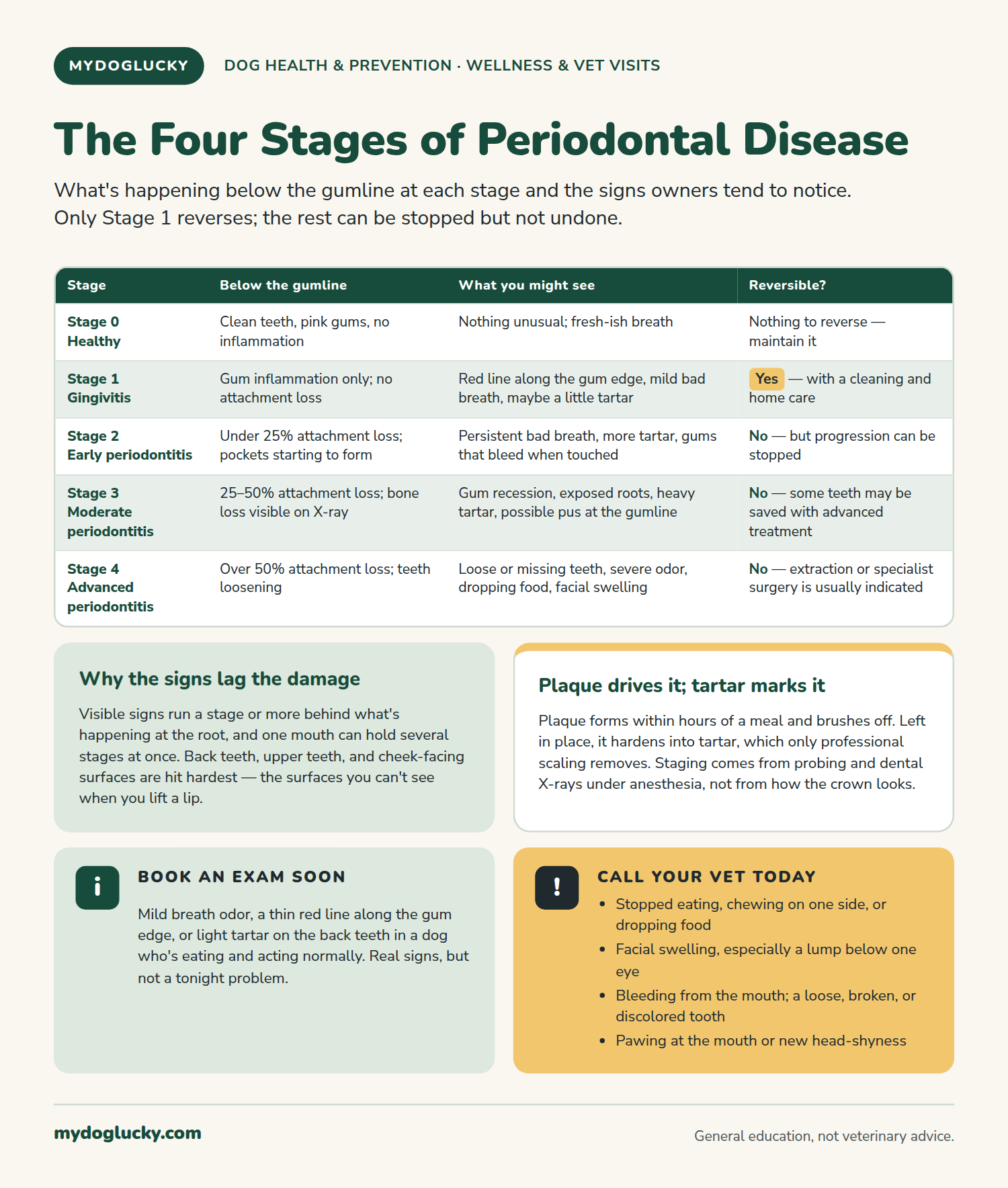
Veterinary dentists grade periodontal disease on a four-stage scale based on how much of the tooth’s attachment has been lost. The staging comes from probing pocket depth and from dental radiographs, not from how the crown looks. Here’s the version from the AAHA 2019 Dental Care Guidelines and Merck, translated.
| Stage | What’s happening | What you might see | Reversible? |
|---|---|---|---|
| Stage 0 (healthy) | Clean teeth, pink gums, no inflammation | Nothing unusual; fresh-ish breath | Nothing to reverse — maintain it |
| Stage 1 (gingivitis) | Gum inflammation only; no attachment loss | Red line along the gum edge, mild bad breath, maybe a little tartar | Yes, with cleaning and home care |
| Stage 2 (early periodontitis) | Under 25% attachment loss; pockets starting to form | Persistent bad breath, more tartar, gums that bleed when touched | No, but progression can be stopped |
| Stage 3 (moderate periodontitis) | 25–50% attachment loss; bone loss visible on X-ray | Gum recession, exposed roots, heavy tartar, possible pus at the gumline | No; some teeth may be salvageable with advanced treatment |
| Stage 4 (advanced periodontitis) | Over 50% attachment loss; teeth loosening | Loose or missing teeth, severe odor, dropping food, facial swelling | No; extraction or specialist surgery is usually indicated |
Two things stand out from that table. First, the visible signs lag the actual damage by a stage or more. Second, a single mouth can hold several stages at once: a healthy front tooth, a Stage 1 canine, and a Stage 3 upper molar that’s been quietly losing bone for a year. Merck notes the back teeth are affected more than the front, the upper teeth more than the lower, and the cheek-facing surfaces more than the tongue side. Those are precisely the surfaces you can’t see when you lift a lip.
Why Small Breeds and Flat-Faced Dogs Are at Higher Risk
Every dog can develop periodontal disease, but the odds aren’t evenly distributed. Merck lists toy and small breeds as a top risk group, and Cornell notes the incidence is worse in smaller breeds and climbs with age. Small dogs carry a full set of 42 teeth in a jaw with far less bone around each root, so the same amount of bone loss represents a bigger share of what’s holding the tooth in. Crowded, rotated teeth trap more plaque.
Flat-faced (brachycephalic) dogs face a similar geometry problem: the same number of teeth packed into a shortened muzzle. Merck names malocclusion and tooth crowding as a periodontal risk factor in their own right. Other factors on the list include age, immune-suppressing conditions such as diabetes or Cushing’s disease, and poor nutritional status. If you live with a small or flat-faced dog, the practical takeaway is simple: start dental care earlier and expect to need it more often.
Signs of Dog Dental Disease, Stage by Stage
Dogs are remarkably good at hiding oral pain. Merck says it directly: “most dogs mask their pain, making diagnosis difficult.” VCA’s page on tooth-root abscesses adds that dogs “may not show obvious signs of pain” even with a condition that is very painful. So the useful skill here isn’t spotting agony. It’s noticing small shifts and taking them seriously before they become large ones.
Bad Breath (Halitosis)
This is the sign that gets owners searching at 11 p.m., and it’s the right one to act on. Merck lists halitosis first among the key clinical signs of periodontal disease. Some mild odor after a meal is one thing. A persistent, sour or rotten smell that fills the room when your dog yawns is bacteria and inflammation, and it usually means the process is already underway beneath the gums. The AVDC notes that by the time bad breath is obvious, significant damage is often already present.
Bad breath has other possible causes too, including kidney disease, diabetes, and something stuck in the mouth. That’s another reason it deserves an exam rather than a breath freshener.
Red, Swollen, Bleeding, or Receding Gums
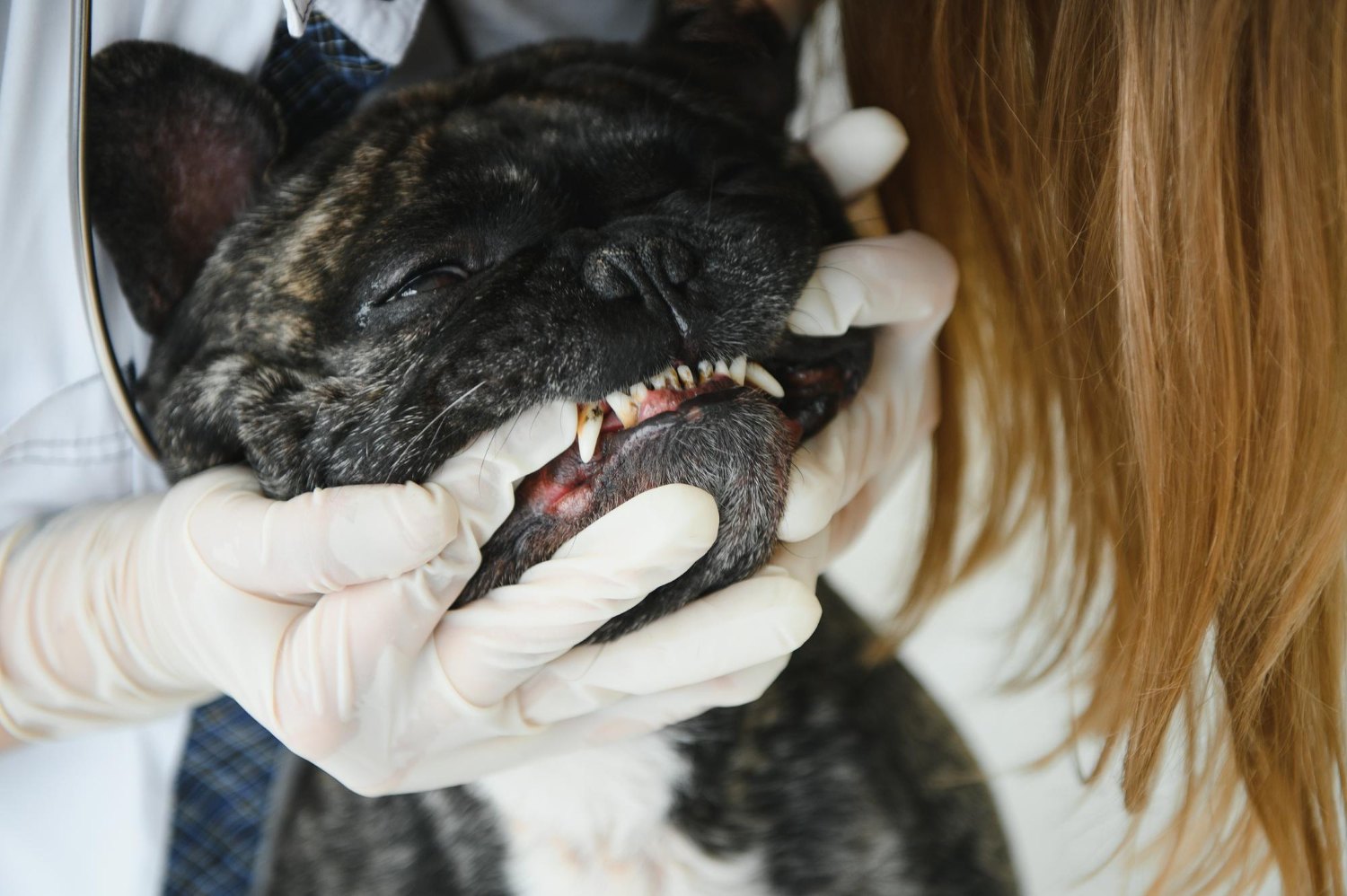
Healthy gums are a fairly uniform coral-pink (or pigmented, in some dogs) with a crisp edge where they meet the tooth. Merck describes the color change from coral-pink to red or purple, along with swelling and bleeding, as the visible face of gingivitis. Later, the gums recede, exposing the root and sometimes the point where the roots split. If you lift the lip and see a thin red line hugging the teeth, that’s worth mentioning at your next visit. If you see pus, that’s worth a call this week.
Tartar You Can See
Yellow to brown deposits along the gumline, heaviest on the upper back teeth and the canines, are the sign most people associate with dog dental disease. Tartar matters, but treat it as a marker rather than the problem itself. A tooth with light tartar can have a deep pocket underneath it, and a tooth with heavy tartar can have healthy bone below. Only probing and radiographs sort that out.
Changes in How Your Dog Eats
Watch for chewing on one side, tilting the head while eating, dropping kibble, taking longer to finish meals, preferring soft food when kibble used to be fine, or suddenly losing interest in a favorite chew. VCA lists difficulty chewing, dropping food, and trouble swallowing among the signs of dental pain. Cornell adds “prolonged eating” and reluctance to chew toys. These are subtle in the moment and obvious in hindsight, which is why a two-line note on your phone helps.
Weight Loss and Behavior Changes From Pain
Here’s a fact that reorders a lot of assumptions: dogs rarely stop eating from dental pain until the disease is advanced. Hunger wins. A dog will chew around a painful tooth, swallow kibble whole, or eat slowly and miserably rather than skip a meal. So “he’s still eating fine” doesn’t rule dog dental disease out. What you may notice instead is gradual weight loss, a dog who’s quieter or grumpier than usual, less interest in play, head-shyness, or, as Cornell notes, behavior changes ranging from withdrawal to irritability. When a dog does stop eating because of the mouth, that’s a same-day call.
Broken and Discolored Teeth
Fractured teeth are a separate problem from periodontal disease, but they travel in the same circles and end in the same chair. Merck lists real bones, hooves, antlers, hard nylon toys, rocks, and fences as common culprits. A fracture that exposes the pulp lets bacteria straight into the root, which can abscess. A tooth that’s turned gray, pink, or purple usually means the pulp inside has died. Either one needs an X-ray, and either extraction or root canal therapy. Neither heals on its own.
What’s worth writing down before the appointment
- When you first noticed the smell, and whether it’s changed.
- Any change in eating: speed, side preference, dropped food, refusal of hard treats.
- Photos of the gumline on both sides if your dog tolerates a lifted lip (never force it).
- Drooling, bleeding, pawing, face-rubbing, or head-shyness, with dates.
- Any hard chews in the rotation, and any incident where a tooth might have been chipped.
- Current weight, if you have a recent number.
This turns “his breath is bad” into a timeline your veterinarian can act on.
Does Dog Dental Disease Affect the Rest of the Body?
You’ll see confident claims online that dental disease “causes” heart, kidney, and liver disease. The honest version is more careful, and it’s still a good reason to act.
What the evidence supports: periodontal disease is a chronic source of bacteria and inflammation, and bacteria from an infected mouth can enter the bloodstream. VCA’s page on dental disease and systemic disease describes exactly that pathway, with appropriately cautious wording. Merck’s clinical reference notes an association between periodontal disease and an increased risk of chronic kidney disease in dogs, with supporting studies cited. The AVMA notes associations with “kidney, liver, and heart muscle changes.”
What the evidence doesn’t do: prove that the bacteria are directly causing disease in those distant organs. The AAHA 2019 guidelines are candid about this. They acknowledge the association between periodontal disease and systemic health, and they also say that “the long-held dogma that specific oral bacteria are directly responsible for infection in distant organs is oversimplified and difficult to prove.” Association is not the same as causation, and the guidelines say so.
So what should you do with that? Two things. First, don’t let anyone scare you with a specific organ-failure forecast. Second, don’t let the uncertainty talk you out of treatment either. The case for treating dog dental disease doesn’t depend on the systemic link at all. It rests on something nobody disputes: a mouth full of infected pockets and loose teeth hurts, every day, and the dog can’t tell you.
What a Veterinary Dental Cleaning Involves and Why It Needs Anesthesia
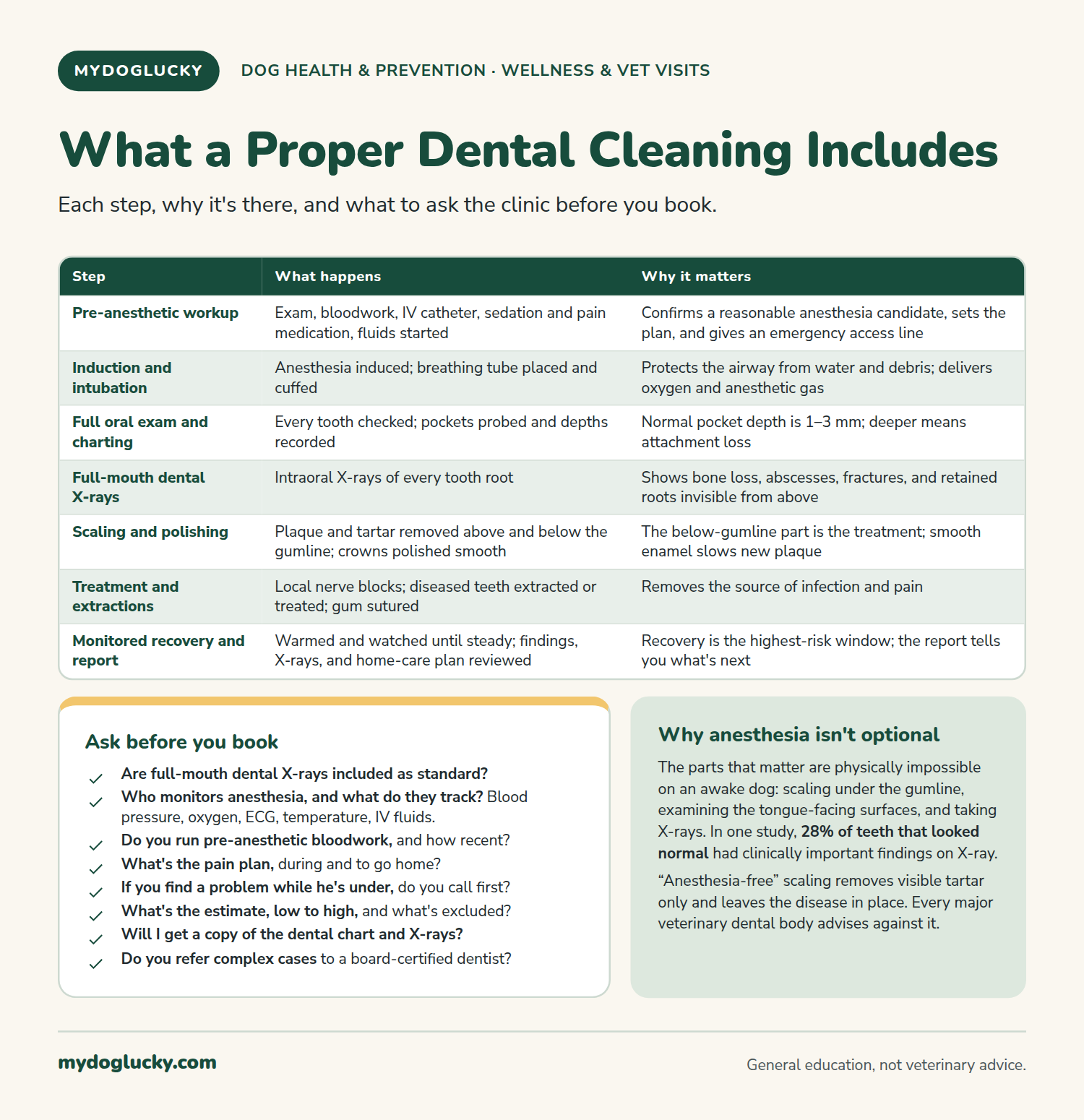
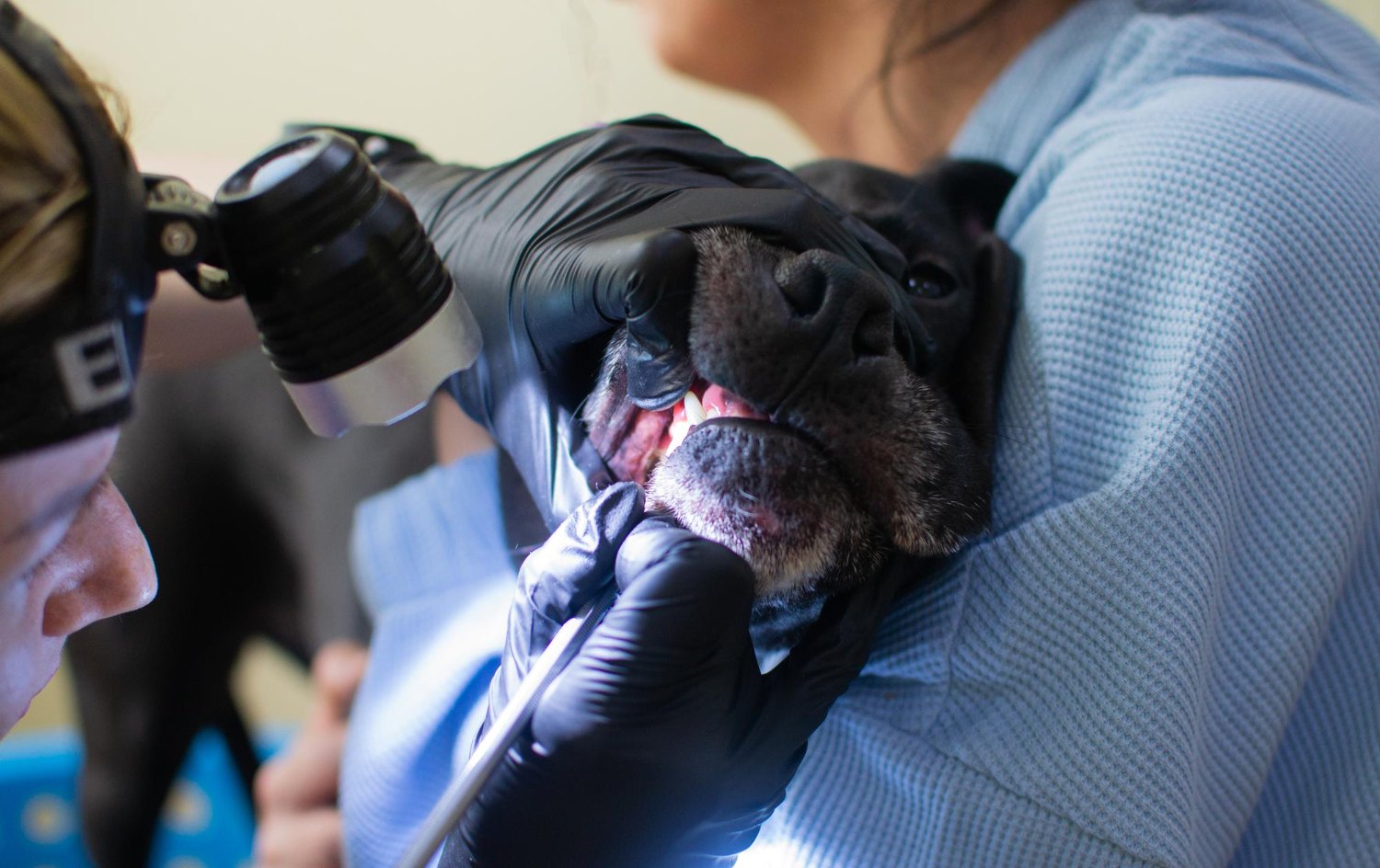
A veterinary dental cleaning goes by several names: “a dental,” a prophylaxis, or in AAHA’s language a comprehensive oral health assessment and treatment (COHAT). Whatever your clinic calls it, the real thing has the same core elements, and the reason it’s done under general anesthesia isn’t convenience. It’s that the parts that matter are physically impossible on an awake dog.
Before the Day: The Pre-Anesthetic Workup
Every anesthesia plan starts with a history and a physical exam, which the AAHA 2020 Anesthesia and Monitoring Guidelines say should be completed and documented within 12 to 24 hours before the procedure. Bloodwork checks kidney and liver function, blood counts, and sometimes more, depending on your dog’s age and health. The guidelines suggest normal results from the last three to six months can be acceptable in a clinically healthy dog, while any abnormal value or health change means testing again right before anesthesia.
Your veterinarian assigns a risk category (the ASA scale borrowed from human anesthesiology) and tailors the drug plan to it. A senior dog, a dog with a heart murmur, or a flat-faced dog with airway concerns gets a different plan than a healthy three-year-old. Cornell’s guidance is worth passing on: age alone is not a reason to skip anesthesia, and a dog with a heart murmur may benefit from a cardiology work-up first. Ask about pre-procedure fasting instructions and whether to give any regular medications that morning.
How Anesthesia Risk Is Managed, With Real Numbers
It’s fair to be nervous about anesthesia. It’s also useful to know the actual numbers. The AAHA 2020 guidelines cite a large study putting the risk of anesthesia-related death in healthy dogs at about 0.05 percent, roughly 1 in 1,849. Risk rises with illness and age, which is exactly why the pre-anesthetic workup exists.
What lowers the risk further is what happens in the room. The guidelines call for an IV catheter in almost all patients, a breathing tube placed as soon as possible after induction to protect the airway (particularly important when a mouth is full of water and debris), warming support, and continuous monitoring of blood pressure, heart rate and rhythm, oxygen saturation, and exhaled carbon dioxide by a trained person whose job is to watch the patient.
The guidelines note that lack of monitoring raises the odds of anesthetic death by a factor of 5 to 35. Local nerve blocks in the mouth reduce how much general anesthetic is needed and provide pain control, and the AAHA dental guidelines describe them as generally increasing safety.
One more number worth knowing: between roughly half and 60 percent of anesthetic deaths in dogs and cats happen after the procedure, mostly in the first three hours of recovery. That’s why a good clinic keeps your dog monitored through recovery rather than parking him in a cage and moving on.
Step by Step: What Happens Under Anesthesia
Here’s the sequence, drawn from AVDC, VCA, Cornell, and the AAHA dental guidelines. Order varies a little between practices.
| Step | What happens | Why it matters |
|---|---|---|
| Awake exam and bloodwork | Physical exam, oral look, lab work reviewed | Confirms your dog is a reasonable anesthesia candidate and sets the plan |
| IV catheter and pre-medication | Sedation and pain medication given; fluids started | Smooths induction, supports blood pressure, gives an emergency access line |
| Induction and intubation | Anesthesia induced, breathing tube placed, cuff inflated | Protects the airway from water and debris; delivers oxygen and anesthetic gas |
| Full oral exam and charting | Every tooth checked; pockets probed and depths recorded | Normal pocket depth in dogs is 1–3 mm; deeper means attachment loss |
| Full-mouth dental radiographs | Intraoral X-rays of every tooth root | Shows bone loss, abscesses, fractures, and retained roots invisible from above |
| Scaling above and below the gumline | Ultrasonic and hand scalers remove plaque and tartar, including subgingivally | The below-gumline part is the treatment; the visible part is cosmetic |
| Treatment and extractions | Local nerve blocks; diseased teeth extracted or treated; gum sutured | Removes the source of infection and pain |
| Polishing and rinse | Crowns polished smooth; mouth irrigated | Smooth enamel slows new plaque; scaling alone leaves micro-scratches |
| Monitored recovery | Warmed, watched until awake and steady | Recovery is the highest-risk window for anesthetic complications |
| Discharge and report | Findings, X-rays, and home-care plan reviewed with you | Tells you what was found, what was done, and what to do next |
Why Full-Mouth Dental X-Rays Aren’t Optional
The AAHA dental guidelines “strongly recommend” full-mouth intraoral radiographs for every dental patient, and they give the reason: in one study, 28 percent of teeth that looked normal on visual exam in dogs had clinically important findings on X-ray. That’s more than one in four healthy-looking teeth hiding bone loss, a dead root, a fracture below the gumline, or a retained root fragment from a tooth that broke off years ago.
Without radiographs, a cleaning is a partial exam. The veterinarian can only treat what they can see, which means a painful tooth can be polished, pronounced fine, and left in place for another year. If a clinic doesn’t take dental X-rays as standard, that’s not automatically a bad clinic, but it’s a reason to ask what they do instead and to consider a practice that does.
Extractions: Why They’re Common and Why They’re Not a Failure
Owners often feel guilty when a dental turns into multiple extractions. It helps to reframe it. A tooth with Stage 4 disease is already lost in every way that matters: it’s loose, infected, and painful, and it’s damaging the bone around neighboring teeth. Removing it removes the pain. Dogs manage remarkably well with fewer teeth, and many owners notice their dog acts years younger a couple of weeks after a mouthful of bad teeth comes out.
Extractions in dogs are surgical procedures. Multi-rooted teeth are sectioned and removed root by root, the socket is cleaned, and the gum is closed with dissolving sutures. A post-extraction X-ray confirms nothing was left behind. Because of the surgery involved, a dental with extractions takes longer, costs more, and has a real recovery period, all covered below. Salvage options such as root canal therapy exist for specific teeth, most often the large canines and the upper fourth premolars, and usually involve a specialist.
Why “Anesthesia-Free” Cleanings Aren’t the Same Thing
You’ll see anesthesia-free dental cleanings advertised at grooming salons, pet stores, and some clinics. They’re cheaper, they skip the scary part, and the teeth look whiter afterward. Every major veterinary dental body says not to use them, and it’s worth understanding why rather than just taking the rule on faith.
The American Veterinary Dental College has held a position against dental scaling without anesthesia since 2004. Its reasoning: tartar removal requires sharp instruments and power scalers, so “even slight head movement by the patient could result in injury to the oral tissues.” The area under the gumline, where the disease actually lives, can’t be reached. The tongue-facing surfaces of the teeth can’t be examined. No X-rays can be taken. The AVDC’s blunt summary is that removing tartar from the visible surfaces “has little effect on a pet’s health, and provides a false sense of accomplishment.”
The AAHA 2019 dental guidelines call non-anesthetic dentistry “not appropriate because of patient stress, injury, risk of aspiration, and lack of diagnostic capabilities.” VCA describes the result as “a slight cosmetic benefit” with “little true medical benefit.” The AVMA points owners to the AVDC’s position. In other words, this isn’t one cautious organization. It’s all of them.
There’s also a quieter cost. An anesthesia-free cleaning can leave you believing the mouth is healthy while a Stage 3 molar keeps losing bone. The money you saved this year tends to show up later as extractions.
What to Ask Before You Book
Clinics vary a lot in equipment, staffing, and how they handle findings. A five-minute phone call sorts most of that out. These questions draw on the AVDC’s own list for pet owners, plus the practical things owners tend to wish they’d asked.
Questions worth asking any clinic before a dental cleaning
- Are full-mouth dental X-rays included as standard? If not, what’s the plan for finding disease below the gumline?
- Who monitors anesthesia, and what do they track? Look for a dedicated trained technician, continuous blood pressure, oxygen saturation, ECG, temperature, and IV fluids.
- Do you run pre-anesthetic bloodwork, and how recent does it need to be?
- What’s the pain plan? Local nerve blocks during the procedure, plus pain medication to go home if extractions are done.
- What happens if you find a problem while he’s under? Will they call you mid-procedure with an updated estimate, or do you set a ceiling in advance?
- What’s the estimate range, and what’s not included? Ask for the low end (cleaning, X-rays, no extractions) and the high end (multiple surgical extractions).
- How long will my dog be monitored in recovery, and when can I pick him up?
- Will I get a copy of the dental chart and X-rays? They belong in your records and matter for the next cleaning.
- Do you refer complex cases to a board-certified veterinary dentist?
You’re not being difficult by asking. Good clinics answer these every day and are usually glad you care.
What Dog Dental Care Costs in the U.S.
There’s no way around it: proper dental care is one of the larger recurring costs of owning a dog, and the numbers surprise people. Here’s what sourced estimates look like, with the caveat that your region, your dog’s size, and what’s found under anesthesia all move the total.
A cost review written by a board-certified veterinary dentist for a major pet-health site (updated October 2025) puts a basic cleaning at a general practice in the range of $350 to $500, with pre-anesthetic bloodwork adding roughly $75 to $200 depending on the dog’s age and health. A 2025 national cost study cited by a healthcare-financing company reported an average of $388 for a dog dental cleaning, with a range of about $307 to $702. Those figures generally cover the cleaning, anesthesia, and monitoring at a routine level. Radiographs may or may not be bundled, so ask.
Extractions are where bills climb. The same veterinary-dentist review lists extraction costs in a very wide range, from a few hundred dollars to well over $1,000 per tooth, depending on the tooth, whether it’s a simple or surgical extraction, and the nerve blocks, sutures, and medications involved. A large multi-rooted tooth is far more work than a small loose incisor. A mouth with several failing teeth can push a dental into four figures, and a specialist procedure, the review notes, can run around $1,500 or more before extractions.
| Item | Sourced range (U.S.) | What moves it |
|---|---|---|
| Pre-anesthetic bloodwork | About $75–$200 | Age, health conditions, how many panels are run |
| Routine cleaning under anesthesia (general practice) | About $300–$700 | Region, dog size, whether X-rays are included |
| Full-mouth dental X-rays | Sometimes bundled, sometimes billed separately | Clinic policy; always ask |
| Extractions | Very wide; a few hundred to $1,000+ per tooth | Tooth type, surgical vs. simple, nerve blocks, sutures |
| Take-home pain medication and antibiotics | Tens of dollars each | Whether extractions were done; dog size |
| Board-certified dentist procedure | Around $1,500 and up before extractions | Complexity, advanced imaging, root canal or surgery |
These are ranges from published sources, not quotes. Prices in major metro areas often sit above them. The useful move is to get a written estimate with a low and high end before the day, and to decide in advance how you want to be contacted if the X-rays reveal more than expected.
Making It More Manageable
A few approaches owners use, none of them a workaround for the procedure itself:
- Treat it as a scheduled expense, not a surprise. For a small dog, that may mean budgeting for a cleaning every year; for a large dog, every year or two. Setting aside a modest monthly amount beats a four-figure shock.
- Ask about dental-month promotions. February is National Pet Dental Health Month in the U.S., and some practices discount cleanings then. Availability varies.
- Check your pet insurance wording. Some plans cover dental illness (extractions for periodontal disease) but not routine cleanings, and many require a recent cleaning on file. Read the exclusions.
- Compare general practice vs. specialist for the specific need. A routine cleaning with a few extractions is squarely general-practice territory. Save the specialist for the cases below.
- Invest in home care. Daily brushing genuinely stretches the interval between professional cleanings, which is the one cost lever that’s fully in your hands.
Aftercare at Home
Your clinic’s discharge sheet outranks anything here. That said, knowing the usual shape of recovery makes it easier to spot when something’s off.
The First 24 Hours
Most dogs go home the same day. The AVDC notes that after a cleaning with no additional procedures, a dog can usually eat and return to normal fairly quickly. Expect some grogginess, wobbliness, and a dog who wants to sleep. Offer water once he’s steady on his feet, and a small, soft meal when the clinic says it’s fine, often that evening. Keep him somewhere quiet, away from stairs and from other pets who might jostle him. A little whining or restlessness as the anesthesia wears off is common; a dog who’s inconsolable, can’t settle, or has bleeding that won’t stop is a call.
If Teeth Were Extracted
Recovery takes longer and needs more from you. Common instructions include:
- Soft food for a set period, typically around one to two weeks, so kibble doesn’t disturb the sutures. Soaked kibble, canned food, or a vet-approved soft diet all work.
- No hard chews, tug, or toys until the recheck. Hard objects can pull sutures and reopen sockets.
- Pain medication exactly as prescribed, on schedule, even when your dog seems fine. Dogs hide pain; the medication is doing its job precisely when he looks comfortable.
- Antibiotics, if prescribed, through the full course. Not every dental needs them; your veterinarian decides.
- No brushing near extraction sites until the gum has healed and the clinic clears it.
- A recheck, usually within a couple of weeks, to confirm the sites are healing and to start the home-care plan.
Sutures are usually the dissolving kind. A little blood-tinged saliva for a day or two is expected. Swelling that grows rather than shrinks, a foul smell that returns, pawing at the mouth, or refusal to eat past the first day or so are reasons to call. Never give a human pain reliever to fill a gap; several are dangerous for dogs.
Starting Home Care After a Cleaning
Here’s an underused fact: a freshly cleaned mouth is the best possible starting point for brushing, because you’re maintaining clean teeth instead of fighting established tartar. Once your veterinarian clears you (right away after a simple cleaning, after healing if there were extractions), start the daily routine. Plaque reforms within hours and mineralizes into tartar within days, so the clock starts the moment your dog walks out.
Preventing Dog Dental Disease at Home
Merck offers the single most useful sentence on this topic: “gum disease will not develop around clean teeth.” Prevention is about keeping plaque from sitting there long enough to harden and inflame. Here’s what works, ranked roughly by evidence and effect.
Daily Brushing: The Gold Standard
Every source in this article agrees. The AVDC calls daily toothbrushing “the gold standard to prevent plaque and calculus.” The AAHA guidelines state that “brushing needs to be done daily to be of benefit.” The AVMA says daily is most effective and several times a week can still help. Merck says daily is best and adds that wiping the teeth with gauze at least every two to three days is an acceptable fallback.
Why daily? Because plaque re-forms in about a day and starts hardening within a couple of days. Brushing once a week removes a fraction of what’s there and leaves the rest to mineralize. If daily feels impossible, most days is still worth doing; the aim is to be on the winning side of the plaque clock more often than not.
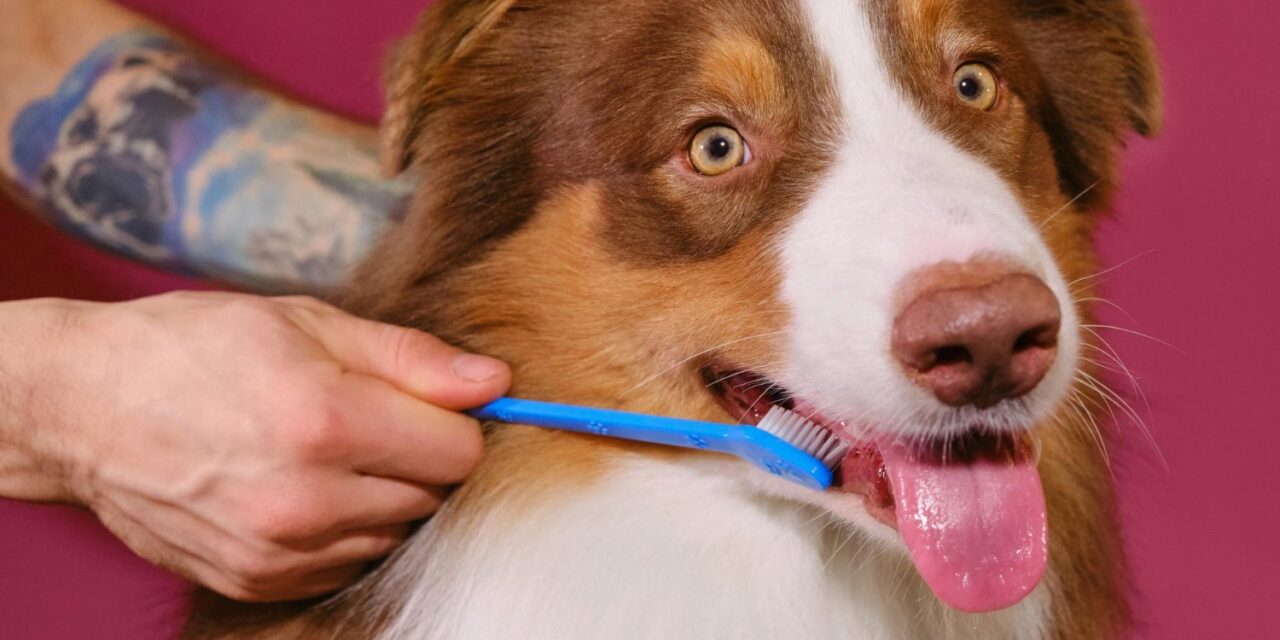
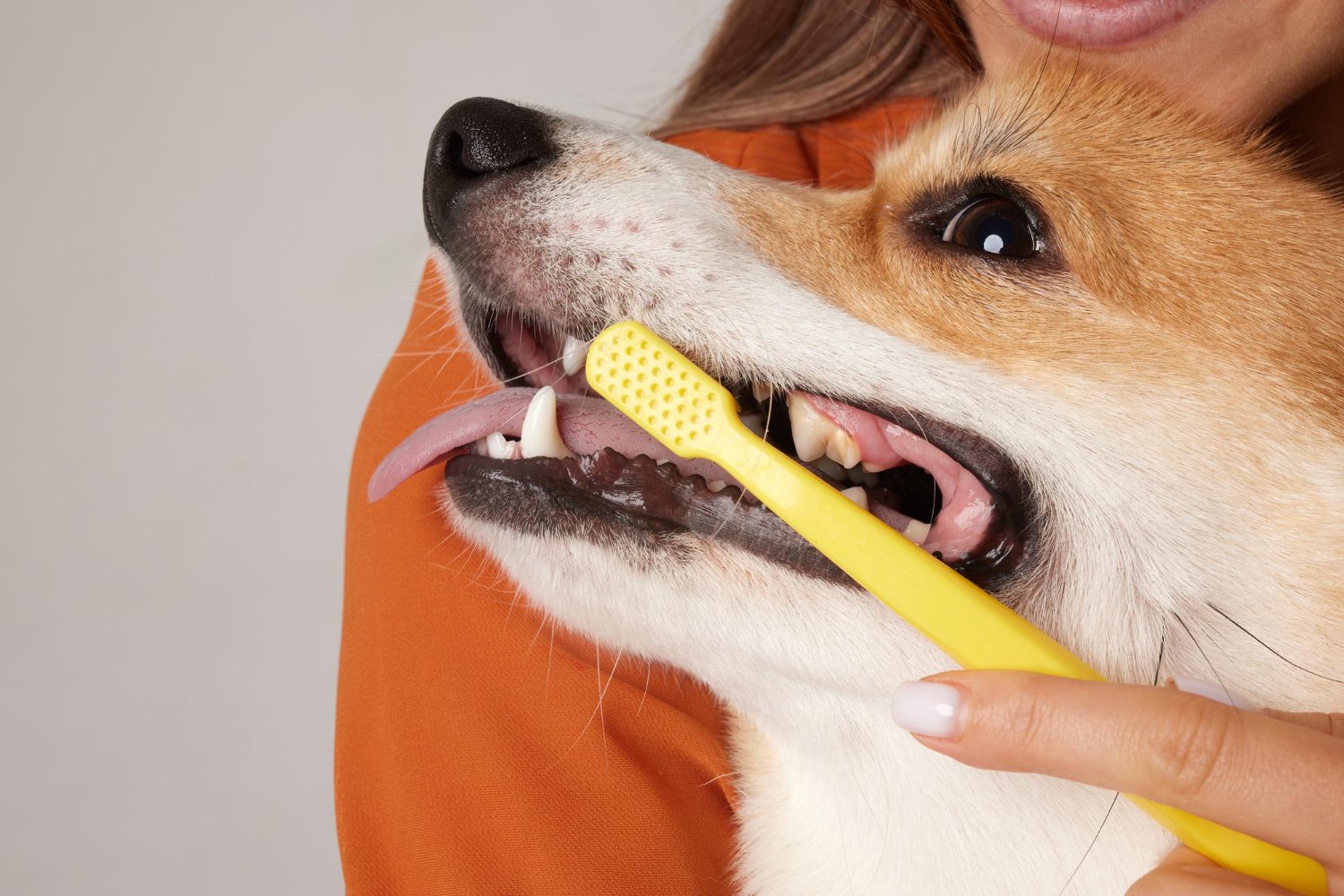
The mechanics matter: a pet toothpaste (human toothpaste contains fluoride and detergents dogs shouldn’t swallow, as Cornell and Merck both note), a soft brush or finger brush, and a gradual introduction so the dog accepts it. We’d rather not compress a whole skill into one paragraph, so the full step-by-step method for teaching a dog to accept brushing lives in a separate MyDogLucky article. The short version: go slower than feels necessary, reward every step, and focus on the outside surfaces of the upper back teeth, which is where the worst disease tends to build.
VOHC-Accepted Chews, Diets, and Water Additives
The Veterinary Oral Health Council is the independent body that reviews manufacturers’ clinical data and awards a seal to products shown to reduce plaque, tartar, or both. It doesn’t run the trials itself; it evaluates whether the submitted evidence meets its standard. Its accepted-products list for dogs covers dental diets, edible chews and treats, rawhide-type chews, water additives, oral gels and sprays, toothpastes, toothbrushes, wipes, and a veterinary-applied sealant. Each product is marked “plaque,” “tartar,” or both.
A useful tip from VCA’s nutrition page: look for the plaque-control claim specifically, since plaque is the actual driver of disease. Dental diets work through larger kibble that the dog has to chew, scraping the crown as it goes, and sometimes through additives that bind minerals in saliva. Regular dry food does not do this; VCA is explicit that clinical studies show “dry food alone does not contribute to improved oral health,” which retires a piece of advice many of us grew up hearing.
None of these products replace brushing. They’re the second line, best used for dogs who won’t tolerate a brush yet or as an add-on. Ask your veterinarian before starting one, especially for a dog with a sensitive stomach, a weight problem, or a health condition. And follow the VOHC’s own safety note: choose the right size and supervise chewing to reduce choking and obstruction risk.
What Does Little or Nothing
Some things are widely believed to help and don’t hold up:
- Regular kibble “cleaning the teeth.” Covered above; the evidence doesn’t support it.
- Breath fresheners, mints, and sprays without a VOHC seal. They mask the smell of infection without touching the infection.
- Anesthesia-free scaling. Cosmetic whitening that leaves the disease in place; see above.
- Cutting sugar. Fine for weight, but VCA notes that sugars “do not contribute to plaque accumulation in dogs,” so it isn’t a dental strategy.
- Hoping tartar will flake off with the right chew. Once plaque has mineralized, only professional scaling removes it. A chew can slow new buildup; it doesn’t undo old buildup.
Hard Chews That Break Teeth
This deserves its own heading, because it’s the prevention habit that most often causes the very problem it’s meant to prevent. Antlers, hooves, real bones (cooked or raw), hard nylon chews, ice cubes, and rocks are all on the veterinary lists of things that fracture teeth. Merck names bones, hooves, antlers, and hard nylon toys specifically. VCA’s tooth-root-abscess page lists bones, antlers, ice cubes, and nylon toys as primary culprits. The AAHA dental guidelines say plainly that there is “not a strong rationale for offering hard treats (antlers, synthetic, or natural bones) that could damage the structural integrity of the tooth.”
The tooth that breaks most often is the upper fourth premolar, the big shearing tooth in the back. It fractures when a dog bites down hard on something that doesn’t give. A quick home test many veterinary dentists suggest: if you can’t dent it with a thumbnail, or wouldn’t want it whacked against your own kneecap, it’s too hard for a dog’s teeth. Softer options and VOHC-accepted chews give the chewing outlet without the fracture risk.
How Often Professional Cleanings Should Happen
There’s no single interval, but there is a starting point. The AAHA guidelines recommend a true dental prophylaxis by one year of age for small- and medium-breed dogs and by two years for large breeds, then an individualized schedule from there. The AVDC recommends annual anesthetized cleanings as a general baseline. In practice, many small dogs need a cleaning every year, some every six to nine months, while a large dog with a good home-care routine may go two years or more. Your veterinarian’s recommendation will come from the last dental chart, the X-rays, and how well plaque is being controlled at home.
When a Board-Certified Veterinary Dentist Is Worth It
A board-certified veterinary dentist is a veterinarian who completed a residency in dentistry and oral surgery and passed the American Veterinary Dental College’s examinations; the credential is “Diplomate, AVDC.” They’re relatively rare, often located in cities or at university hospitals, and they cost more. For most routine dog dental disease, your regular veterinarian is the right choice. Referral makes sense when:
- You want to save a strategically important tooth such as a fractured canine or upper fourth premolar with root canal therapy rather than extraction.
- The case is surgically complex: a jaw fracture, an opening between the mouth and nose that needs repair, a suspected oral tumor, or advanced periodontal surgery to salvage teeth.
- Your dog is a high anesthesia risk because of heart disease, airway problems, or other serious illness, and needs the anesthesia handled by a specialist team, sometimes alongside a veterinary anesthesiologist.
- A previous dental didn’t resolve the problem — persistent pain, swelling, or drainage after treatment.
- Your general practice recommends it. Good clinics know their limits and refer.
If you’re unsure, ask your veterinarian whether a consultation makes sense. Many specialists will review radiographs sent by your regular clinic before committing you to a visit.
Monitor, Call Today, or Go Now
Here’s the same information from the sections above, organized by what to do next.
Monitor, and bring it up at the next visit
- Mild breath odor with no other changes.
- A thin red line along the gum edge in a dog who’s eating and acting normally.
- Light tartar on the back teeth.
- A small chip on a tooth with no color change and no sensitivity.
Book a routine exam if it’s been more than a year, start or restart home care, and write down what you’ve noticed. If any sign below appears, move up a tier.
Call your veterinarian today
- Chewing on one side, dropping food, or a new preference for soft food.
- Persistent strong bad breath, bleeding gums, or pus at the gumline.
- A loose, broken, or discolored (gray, pink, purple) tooth.
- Pawing at the mouth, face-rubbing, jaw chattering, or new head-shyness.
- Facial swelling that’s small and not growing quickly.
- One-sided nasal discharge or sneezing.
- Unexplained weight loss or a dog who’s quieter and grumpier than usual.
This isn’t an emergency room situation, but it’s not a wait-until-the-annual-visit one either. Call and describe exactly what you’re seeing.
Seek emergency care now
- Bleeding from the mouth that doesn’t stop within a few minutes.
- Rapidly growing facial swelling, especially with fever, lethargy, or refusal to drink.
- A dog who can’t close the mouth, whose jaw hangs, or who has had trauma to the face.
- Difficulty breathing, pale gums, or collapse alongside any mouth sign.
- A dog who has stopped eating and drinking entirely, especially a small, senior, or medically fragile dog.
Call ahead if you can, then go.
Common Mistakes and Misunderstandings
Assuming Bad Breath Is Just Part of Owning a Dog
It’s the most common mistake and the most costly one, because it delays care by years. Bad breath is the smell of bacteria. A dog with healthy teeth and gums has breath that’s mostly unremarkable. When the smell is persistent, it’s information.
Waiting Until There’s Visible Tartar to Schedule a Cleaning
Visible tartar means plaque has been sitting for a long time, and the disease below the gumline is usually a stage ahead of what you can see. The AAHA guidelines recommend the first prophylaxis by one to two years of age depending on size, before heavy tartar exists, precisely because the goal is to keep the mouth at Stage 0 rather than to rescue it from Stage 3.
Giving Antlers, Bones, or Hooves “for Dental Health”
Hard chews are marketed as dental care, and they’re one of the leading causes of fractured teeth. A broken upper fourth premolar with an exposed pulp is an extraction or a root canal, not a cleaning. If it wouldn’t dent under a thumbnail, it’s too hard.
Choosing an Anesthesia-Free Cleaning to Avoid the Risk
The risk of anesthesia in a healthy dog is small and actively managed. The risk of an anesthesia-free cleaning is that it treats nothing, can injure the mouth, and leaves you believing the problem is solved. Every major veterinary dental organization advises against it.
Skipping the Dental X-Rays to Save Money
Radiographs are where more than a quarter of clinically important problems in normal-looking dog teeth are found. Declining them turns a comprehensive assessment into a partial one and often means paying for the same anesthesia again when the missed tooth abscesses.
“He’s Still Eating, So His Mouth Must Be Fine”
Dogs eat through dental pain until the disease is advanced. Appetite is a poor test. Watch how he eats, not whether.
Brushing Once a Week and Calling It Home Care
Weekly brushing is better than nothing and much worse than daily. Plaque re-forms in about a day and hardens within a few. The AAHA guidelines are direct: brushing needs to be daily to be of benefit.
Feeling Guilty About Extractions
A Stage 4 tooth is already lost. Removing it is pain relief, not a failure of care. Dogs do very well with fewer teeth, and most owners see a happier dog within weeks.
Treating the Dental as a One-Time Fix
A cleaning resets the clock; it doesn’t stop it. Without home care, plaque returns immediately and tartar follows within weeks. The cleaning is the starting line for the maintenance routine, not the finish line.
Frequently Asked Questions About Dog Dental Disease
Is bad breath in dogs ever normal?
Mild, brief odor right after a meal or a chew is unremarkable. Persistent bad breath is not normal and is most often the first noticeable sign of periodontal disease. Because kidney disease, diabetes, and foreign objects in the mouth can also change breath, a persistent smell deserves a veterinary exam rather than a breath-freshening product.
At what age should my dog have a first dental cleaning?
The AAHA 2019 dental guidelines recommend a true dental prophylaxis by one year of age for small- and medium-breed dogs and by two years for large breeds. Your veterinarian may adjust that based on what the mouth looks like at wellness visits, but earlier than you’d expect is the general rule.
Can dog dental disease be reversed?
Stage 1 (gingivitis) can be reversed with a professional cleaning and consistent home care. Once attachment loss and bone loss have occurred (Stages 2 through 4), the damage is permanent, but progression can be stopped and pain removed through treatment and, where needed, extractions.
Why does my dog need anesthesia for a teeth cleaning when I don’t?
Because you’ll hold still, open wide, and tell the hygienist when it hurts. A dog can’t do any of that, and the treatment that matters happens below the gumline with sharp instruments. Anesthesia also allows X-rays, a full exam of every surface, a protected airway, and pain-free treatment. The AVDC, AAHA, AVMA, and VCA all advise against anesthesia-free cleanings for these reasons.
How risky is anesthesia for a senior dog?
Risk rises with age and illness, but the AAHA anesthesia guidelines are clear that “age is not a disease.” A thorough pre-anesthetic exam, bloodwork, a tailored drug plan, and continuous monitoring manage that risk, and in many senior dogs the daily pain of untreated dental disease is the larger threat to quality of life. For dogs with heart murmurs or other conditions, a specialist work-up before anesthesia is worth discussing.
Do dental X-rays really matter if the teeth look fine?
Yes. In one study cited by the AAHA guidelines, 28 percent of teeth that looked normal in dogs had clinically important problems on radiographs. Bone loss, abscesses, fractured roots, and retained root fragments are all invisible from above the gumline.
How many teeth can a dog lose and still eat normally?
Many dogs with most or all of their teeth extracted eat kibble without trouble once healed, and nearly all manage soft food easily. Dogs don’t chew the way people do; they tend to crush and swallow. Losing painful teeth generally improves eating rather than hurting it.
What does a dog dental cleaning cost?
Published estimates put a routine cleaning under anesthesia at a general practice in the low-to-mid hundreds of dollars, with bloodwork adding roughly $75 to $200. Extractions add substantially, from a few hundred dollars to over $1,000 per tooth depending on the tooth and technique, and specialist procedures run higher. Ask for a written estimate with a low and high end.
Are anesthesia-free dental cleanings ever a good option?
Not as a treatment for dental disease. They can remove visible tartar for cosmetic effect but can’t clean below the gumline, can’t include X-rays, can’t examine the tongue-facing surfaces, and carry an injury risk from sharp instruments in an awake, restrained dog. The AVDC has opposed them since 2004, and the AAHA guidelines call them “not appropriate.”
Can I use human toothpaste on my dog?
No. Human toothpaste contains fluoride and foaming agents that dogs shouldn’t swallow, and dogs swallow everything you put in their mouths. Use a toothpaste made for dogs. The brushing method itself is covered in a separate MyDogLucky article.
Do dental chews actually work?
Some do, to a degree. Products carrying the Veterinary Oral Health Council seal have submitted clinical evidence that they reduce plaque, tartar, or both. They’re a useful supplement, not a replacement for brushing, and they don’t remove tartar that’s already there. Choose the right size, supervise chewing, and skip anything hard enough to break a tooth.
Are small dogs really more prone to dental disease?
Yes. Merck lists toy and small breeds among the top risk groups, and Cornell notes incidence is worse in smaller breeds. Crowded teeth in a small jaw with less bone around each root means plaque traps more easily and bone loss matters more. Flat-faced breeds share the crowding problem.
What is a tooth-root abscess and what does it look like?
It’s an infection at the root of a tooth, usually from a fracture that exposed the pulp or from advanced periodontal disease. The classic sign is swelling below one eye, because the roots of the upper fourth premolar sit just there. Some dogs develop a draining wound on the face. It’s painful even when the dog acts normal, and it needs X-rays and either extraction or root canal therapy. Antibiotics alone don’t fix it.
Does dental disease cause heart or kidney disease in dogs?
There’s an association, and bacteria from an infected mouth can enter the bloodstream, but direct causation hasn’t been proven. The AAHA guidelines call the “oral bacteria directly infect distant organs” idea oversimplified and hard to prove. The strongest reason to treat dental disease is that it’s a chronic, painful infection in its own right.
How do I know if my dog’s mouth hurts?
Rarely from an obvious limp-equivalent. Look instead for one-sided chewing, dropping food, slower meals, avoiding hard treats, drooling, pawing at the face, head-shyness, irritability, or withdrawal. Merck and VCA both note that most dogs mask oral pain. If in doubt, assume a diseased mouth hurts.
My dog just had a cleaning. When do I start brushing?
Right away after a simple cleaning, once your veterinarian confirms there are no sore spots. After extractions, wait until the recheck confirms the gums have healed, usually about two weeks, and avoid the extraction sites until cleared. Starting on freshly cleaned teeth is the easiest possible launch for a brushing habit.
Where This Leaves You
Dog dental disease is common, progressive, mostly invisible, and, at the early stage, reversible. Bad breath is the sign you’ll notice first; the damage you can’t see is the part that matters. A proper cleaning under anesthesia with full-mouth X-rays is how the disease gets found and treated, and a daily brushing habit is how you keep it from coming back as fast.
If your dog has any of the call-today signs above, make the call. If it’s just been a while and the breath has changed, book an exam and ask the questions in the gold panel. And if you’ve been putting off a dental because of the cost or the anesthesia, it’s worth having the frank conversation with your veterinarian about what’s actually in the mouth, what the plan would be, and what it would cost. Dogs don’t tell us their teeth hurt. Checking is how we find out.
Sources
- American Veterinary Dental College. Pet Periodontal Disease (accessed September 2026)
- American Veterinary Dental College. Stages of Pet Periodontal Disease (accessed September 2026)
- American Veterinary Dental College. Position Statement: Dental Scaling Without Anesthesia (adopted April 10, 2004)
- American Veterinary Dental College. Questions to Ask Your Veterinarian about Pet Dental Cleanings (accessed September 2026)
- American Veterinary Dental College. What Is a Professional Veterinary Dental Cleaning? (accessed September 2026)
- American Veterinary Dental College. About the AVDC (accessed September 2026)
- Veterinary Oral Health Council. VOHC Accepted Products (list updated August 2026)
- American Animal Hospital Association. 2019 AAHA Dental Care Guidelines for Dogs and Cats (published May 3, 2019)
- American Animal Hospital Association. 2020 AAHA Anesthesia and Monitoring Guidelines for Dogs and Cats (published February 12, 2020)
- Merck Veterinary Manual (Reiter, A. M.). Dental Disorders of Dogs (last updated October 2025)
- Merck Veterinary Manual (Mulherin, B. L.). Periodontal Disease in Small Animals (last updated April 2025)
- VCA Animal Hospitals. Dental Disease in Dogs (last updated March 12, 2024)
- VCA Animal Hospitals. Dental Disease and Its Relation to Systemic Disease in Pets (last updated March 27, 2024)
- VCA Animal Hospitals. Risks of Anesthesia-Free Dental Procedures (last updated April 23, 2024)
- VCA Animal Hospitals. Dogs, Nutrition, and Periodontal Disease (last updated March 7, 2025)
- VCA Animal Hospitals. Tooth Root Abscess in Dogs (last updated April 24, 2024)
- Cornell University College of Veterinary Medicine, Riney Canine Health Center. Periodontal Disease (accessed September 2026)
- American Veterinary Medical Association. Pet Dental Care (accessed September 2026)
- American Kennel Club. Why Veterinary Dental Procedures Are Recommended for Dogs Over Anesthetic-Free Dental Procedures (accessed September 2026)
- PetMD (Kanwal, M., DVM, DAVDC). How Much Does Dog Teeth Cleaning Cost? (updated October 15, 2025)
- CareCredit, citing the 2025 Synchrony Average Procedural Cost Study. How Much Does Cat or Dog Teeth Cleaning Cost? (published April 24, 2026)
This article is general education for U.S. dog owners. It is not individualized veterinary advice, a diagnosis, or a substitute for an oral exam and dental radiographs performed by a veterinarian. Cost figures are published ranges, not quotes, and vary by region, clinic, and what is found under anesthesia. Stage descriptions are for orientation only; only a veterinarian can stage periodontal disease, and only under anesthesia with radiographs. If your dog has facial swelling, bleeding from the mouth, a broken or loose tooth, sudden drooling, or has stopped eating, contact your veterinarian today rather than waiting.