
Heartworm in dogs is a parasitic infection spread by mosquitoes. The worms themselves, Dirofilaria immitis, grow to adult size inside the blood vessels of the lungs and the right side of the heart, where they can live for five to seven years. It has been diagnosed in all 50 states. Prevention is a prescription product given monthly or by injection every 6 or 12 months, and it works well when it’s given on schedule. Treatment, by contrast, is expensive, takes months, is physically hard on the dog, and carries real risks even when it goes as planned.
That contrast is the whole argument of this article. Year-round prevention plus one annual blood test costs a fraction of what a single infection costs, in dollars and in your dog’s comfort. If you already have a preventive on the shelf and a test on the calendar, you’re doing the important part. Keep going.
If you’re here because a test came back positive, or because your dog has a cough that won’t quit, this guide covers that too. It walks through the red flags first, then how the infection actually works, who’s at risk, how testing and prevention fit together, and what treatment looks like from the owner’s side. It won’t diagnose your dog and it won’t give you a dose. It will help you ask better questions and make fewer of the mistakes that turn a preventable problem into a hard one.
What’s in this guide
- Heartworm in dogs: red flags that need a vet now
- How heartworm spreads: the lifecycle in plain language
- Who is at risk (yes, indoor dogs too)
- Signs of heartworm disease by stage
- Testing: the annual antigen and microfilaria test
- Prevention: how the products work and what a missed dose means
- Treatment overview: what the AHS protocol involves
- Living through treatment: rest, enrichment, and what to watch
- Travel, relocation, and adopting a heartworm-positive dog
- What to observe and record at home
- Monitor vs. call-today vs. go-now
- Common mistakes and misunderstandings
- Frequently asked questions about heartworm in dogs
- Sources
Heartworm in Dogs: Red Flags That Need a Vet Now
Most dogs with early heartworm infection look completely normal. That’s what makes the disease easy to miss and why the annual test exists. But once the worm burden is high enough, or once the lungs and heart have been under strain long enough, signs appear that shouldn’t wait for a routine appointment. Read this list once now, calmly, so you recognize it later.
Seek veterinary care right away if you see:
- Labored or rapid breathing at rest — not panting after play, but visible effort to breathe while lying down.
- Collapse, fainting, or sudden weakness — especially after mild exertion or excitement.
- Pale, white, or bluish gums.
- Dark, bloody, or coffee-colored urine — the American Heartworm Society lists this alongside sudden labored breathing and pale gums as a sign of caval syndrome, a life-threatening blockage of blood flow into the heart.
- Coughing up blood or a cough that has suddenly become severe.
- A swollen, fluid-filled belly appearing over days, often with weight loss elsewhere on the body.
- A dog currently in heartworm treatment who develops fever, appetite loss, shortness of breath, or a worsening cough — these are the post-injection complications your vet asked you to watch for.
Any one of these is enough to call. Caval syndrome in particular is a surgical emergency: the AHS guidelines describe it as “usually fatal within 2 days if surgical extraction of the worms is not pursued promptly.” Don’t wait for morning.
Why Caval Syndrome Is Different From “Advanced Heartworm”
Most heartworm disease progresses slowly, over months and years, as adult worms crowd the pulmonary arteries and the heart works harder to push blood past them. Caval syndrome is a sudden event layered on top of that. A large mass of worms shifts back into the right side of the heart and the large vein that feeds it, physically blocking the blood returning to the heart. The FDA describes it as the point where “blood flowing back to the heart is physically blocked.”
The result is a dog who was coughing yesterday and can barely stand today. Red blood cells get damaged as they squeeze past the worm mass, which is why the urine can turn dark. This isn’t something to monitor overnight. It’s a call-ahead-and-drive situation, and the only fix is a veterinarian physically removing the worms.
The Slower Red Flags That Still Mean “Call Today”
A persistent soft cough, tiring on walks that used to be easy, reluctance to play, and gradual weight loss are the classic early signs. The AHS lists a “mild persistent cough, reluctance to exercise, fatigue after moderate activity, decreased appetite, and weight loss.” None of these is an emergency on its own. All of them deserve a same-day or next-day call, especially in a dog whose prevention has lapsed, who was adopted without records, or who has never been tested.
How Heartworm Spreads: The Lifecycle in Plain Language
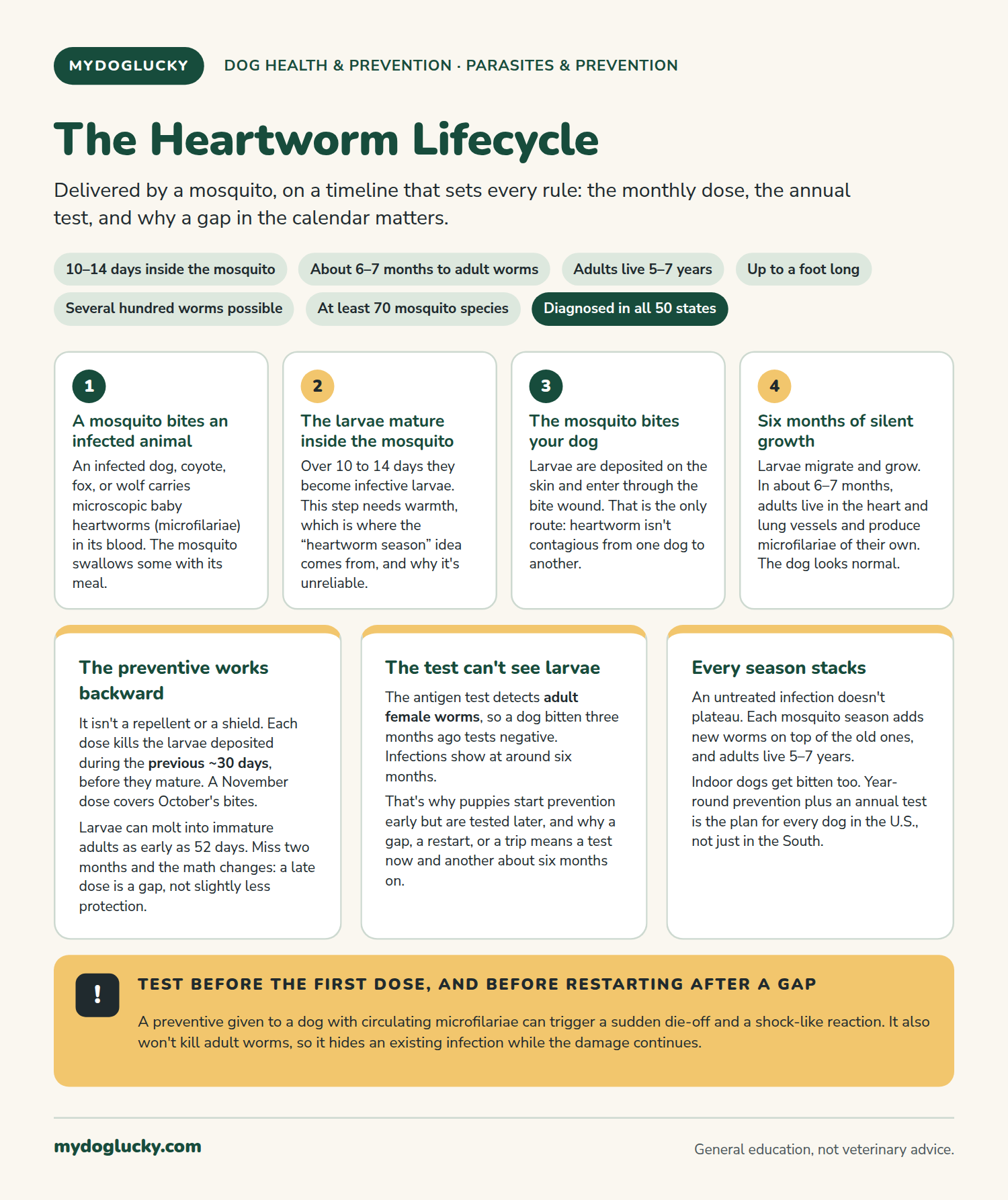
You don’t need a parasitology degree to protect your dog. You do need to understand one thing clearly: heartworm in dogs is not a “worm your dog picks up,” the way an intestinal parasite is. It’s an infection delivered by a mosquito, on a timeline that explains almost every rule your vet gives you.
Step One: A Mosquito Bites an Infected Animal
An infected dog (or coyote, fox, or wolf) carries microscopic baby heartworms, called microfilariae, circulating in the bloodstream. When a mosquito feeds on that animal, it swallows some of them. The Merck Veterinary Manual notes that at least 70 mosquito species can carry the parasite, which is why this isn’t a problem limited to one kind of swamp.
Step Two: The Larvae Mature Inside the Mosquito
Inside the mosquito, those microfilariae develop over “10 to 14 days” into infective larvae. This step needs warmth, which is the origin of the “heartworm season” idea and, as we’ll see, also the reason that idea is less reliable than it sounds.
Step Three: The Mosquito Bites Your Dog
When the same mosquito bites another dog, the AHS explains, “the infective larvae are deposited onto the surface of the animal’s skin and enter the new host through the mosquito’s bite wound.” Your dog can’t catch heartworm from another dog directly. The FDA is explicit: heartworm disease “is not contagious, meaning that a dog cannot catch the disease from being near an infected dog.” The mosquito is the only route.
Step Four: Six Months of Silent Growth
Once inside, the larvae migrate through tissue and grow. According to the FDA, it takes “approximately 6-7 months” from the bite to the point where adult worms are living in the heart and lung vessels and producing their own microfilariae. Adults can reach a foot in length. Dogs, the AHS notes, may end up hosting “several hundred worms,” and each adult can survive “5 to 7 years.”
That six-month window matters for two practical reasons. First, a dog can be infected today and still test negative for months, because the standard test detects adult worms, not larvae. Second, every mosquito season adds new worms on top of the old ones. An untreated infection doesn’t plateau. It stacks.
Why a Preventive Is Given Monthly and Isn’t a Repellent
This is the single most misunderstood part of heartworm care. A heartworm preventive doesn’t keep mosquitoes away and doesn’t build a shield. What it does is kill the young larvae that were deposited by mosquito bites during the previous month, before they can mature into adults. Each dose reaches back roughly 30 days and clears what arrived in that window.
That’s why the schedule is what it is. The AHS guideline class of drugs used for prevention, the macrocyclic lactones (ivermectin, milbemycin oxime, moxidectin, and selamectin), works against those early larval stages. Once larvae have grown past that stage, the monthly preventive loses its grip on them. Veterinary Practice News, in a piece by an AHS research chair, notes that larvae can molt into immature adults as early as 52 days after infection. Miss two months and the math changes.
So a late dose isn’t “a little less protection.” It’s a gap in the calendar during which larvae from an earlier bite may have grown past the point the preventive can reach.
Who Is at Risk (Yes, Indoor Dogs Too)
Short answer: every dog. Longer answer: the odds vary a lot by region and season, and the variation is exactly why so many owners in lower-risk areas get caught out.
Indoor Dogs Get Bitten Too
The AVMA puts it plainly: even indoor pets need protection because “mosquitoes may enter your home.” A dog who goes out for three bathroom breaks a day is outdoors long enough. A dog who never leaves the apartment still shares it with whatever came in through the screen door. Small breed, big breed, apartment or acreage, none of that changes the mosquito’s interest.
Regional Risk Is Real, and It’s Moving
Heartworm is most common in the Southeast and along the Mississippi River Valley, where the mosquito season is long and the density of infected dogs and wild canids is high. But “less common” is not “absent.” The AHS reports heartworm in dogs has been diagnosed in all 50 states. AVMA coverage of the 2024 guideline update noted that the AHS survey showed heartworm rates “continuing upward.” Historically low-incidence states such as Connecticut, Massachusetts, and Oregon were “experiencing unexpected increases.”
Part of that spread is climate. Part of it is dogs. Rescue transport moves thousands of dogs each year from high-prevalence southern shelters to homes across the North and West. Some of those dogs are already infected, and every one of them is a potential reservoir for local mosquitoes. That’s not a reason to avoid adopting a transported dog. It’s a reason to test, treat, and keep every dog in the neighborhood on prevention.
Why Seasonal Prevention Fails More Often Than It Should
The instinct is reasonable. If mosquitoes only fly from May to October, why give a preventive in January? Three problems with that logic:
- The preventive works backward, not forward. A dose given in November kills larvae from October’s bites. Stop in October and October’s larvae are on their own.
- Warm spells don’t check the calendar. A stretch of 70°F (21°C) days in February, a heated garage, or a mosquito that overwintered indoors can all create transmission outside the “season.”
- Restarting requires a test. Every stop-and-start creates a window and a reason to re-test before resuming. Year-round dosing avoids that whole cycle.
For all of these reasons, the AHS guidelines recommend “year-round administration of FDA-approved preventive drugs” for all dogs in the United States, and CAPC agrees: “All dogs, regardless of their lifestyle, should be on year-round heartworm prevention.”
Prevention Isn’t 100 Percent, Which Is Why Testing Still Matters
Preventives are, in the AHS’s words, “highly effective, but not 100 percent effective.” Doses get vomited up unnoticed. A topical gets applied to a wet coat. A chewable gets spit behind the couch. And the AHS and CAPC both now document that some heartworm strains have shown resistance to the macrocyclic lactone class. The 2024 guidelines note that “ML-resistant heartworms have been documented.”
None of that means prevention is unreliable. It means prevention plus an annual test is the plan, not prevention alone. The AHS also suggests a second layer where risk is high: a veterinarian-recommended mosquito-repellent product used alongside the preventive, so fewer larvae ever arrive in the first place. Ask your vet whether that makes sense for your area.
Signs of Heartworm Disease by Stage
Heartworm in dogs is usually staged in four classes, from silent to critical. Where a given dog falls depends on how many worms are present, how long they’ve been there, and how active the dog is, because exercise pushes more blood past the worms and speeds up the damage. Merck notes that active dogs tend to show more dramatic signs than sedentary ones with a similar worm burden.
| Class | What the owner may notice | What’s happening inside |
|---|---|---|
| Class 1 | Often nothing; perhaps an occasional cough | Low worm numbers; early irritation of the pulmonary arteries |
| Class 2 | Mild to moderate cough, tiring on walks, less interest in play | Growing worm burden; lung vessels inflamed; the heart starts working harder |
| Class 3 | Persistent cough, trouble breathing, weight loss, swollen belly, fainting | Right-sided heart failure; fluid accumulation; significant vessel damage |
| Class 4 (caval syndrome) | Sudden labored breathing, pale gums, dark urine, collapse | Worm mass blocking blood return to the heart; surgical emergency |
Early Infection: Usually No Signs at All
This is the frustrating part. A dog in Class 1 is, from the couch, indistinguishable from a healthy dog. VCA describes early infection as “often asymptomatic.” The worms are there, growing and reproducing, but the damage hasn’t accumulated enough to change how the dog looks or acts. This stage is also when treatment is most straightforward, which is the entire case for testing dogs who seem fine.
The Cough, the Tiredness, and the Slow Slide
As the burden grows, the first sign owners tend to report is a soft, dry cough, sometimes only after exercise or excitement. Then walks get shorter because the dog seems to run out of steam. VCA’s list for progressive disease includes “shortness of breath after exercise,” “weakness and exercise intolerance,” and “fainting or disorientation.” Because these changes creep in over months, they’re easy to file under “he’s getting older” or “it’s hot out.” Write them down when you notice them. Patterns are easier to see on paper.
Advanced Disease and Heart Failure
By Class 3, the right side of the heart is struggling against the resistance in the lung vessels. Fluid backs up into the abdomen, producing the swollen belly that sits oddly on a dog who’s otherwise losing weight. VCA lists “abdominal and leg swelling from fluid buildup,” “pale or bluish gums,” “weight loss and poor body condition,” and “anemia.” Dogs at this stage can still be treated, but the plan is more cautious, the risks are higher, and some of the damage may be permanent even after the worms are gone.
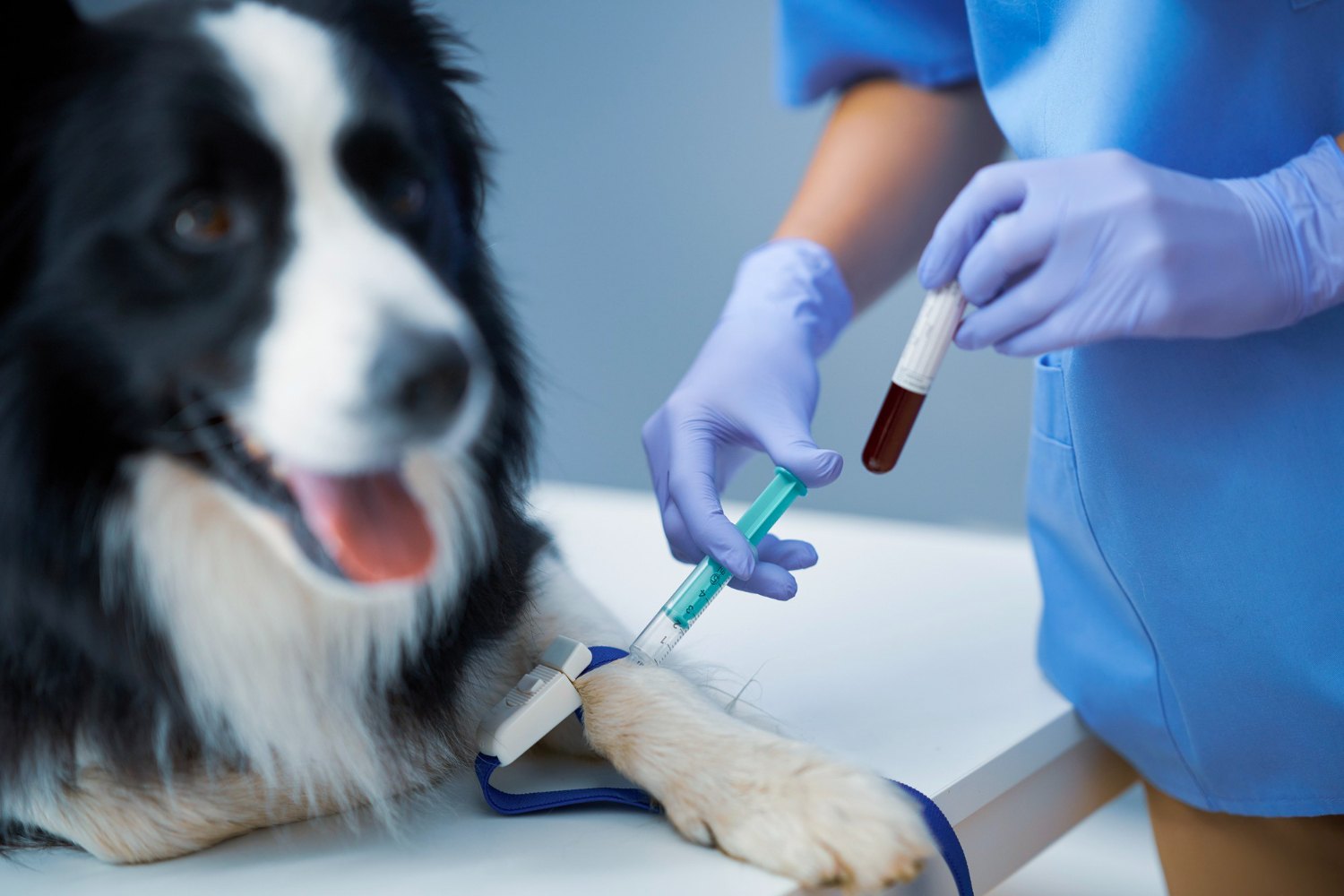
Testing: The Annual Antigen and Microfilaria Test
Testing for heartworm in dogs is the part of the routine that owners most often skip, usually because the dog is on prevention and seems fine. It’s also the part that catches the failures of everything else. Here’s how it works and why the schedule looks the way it does.
Two Tests, One Blood Draw
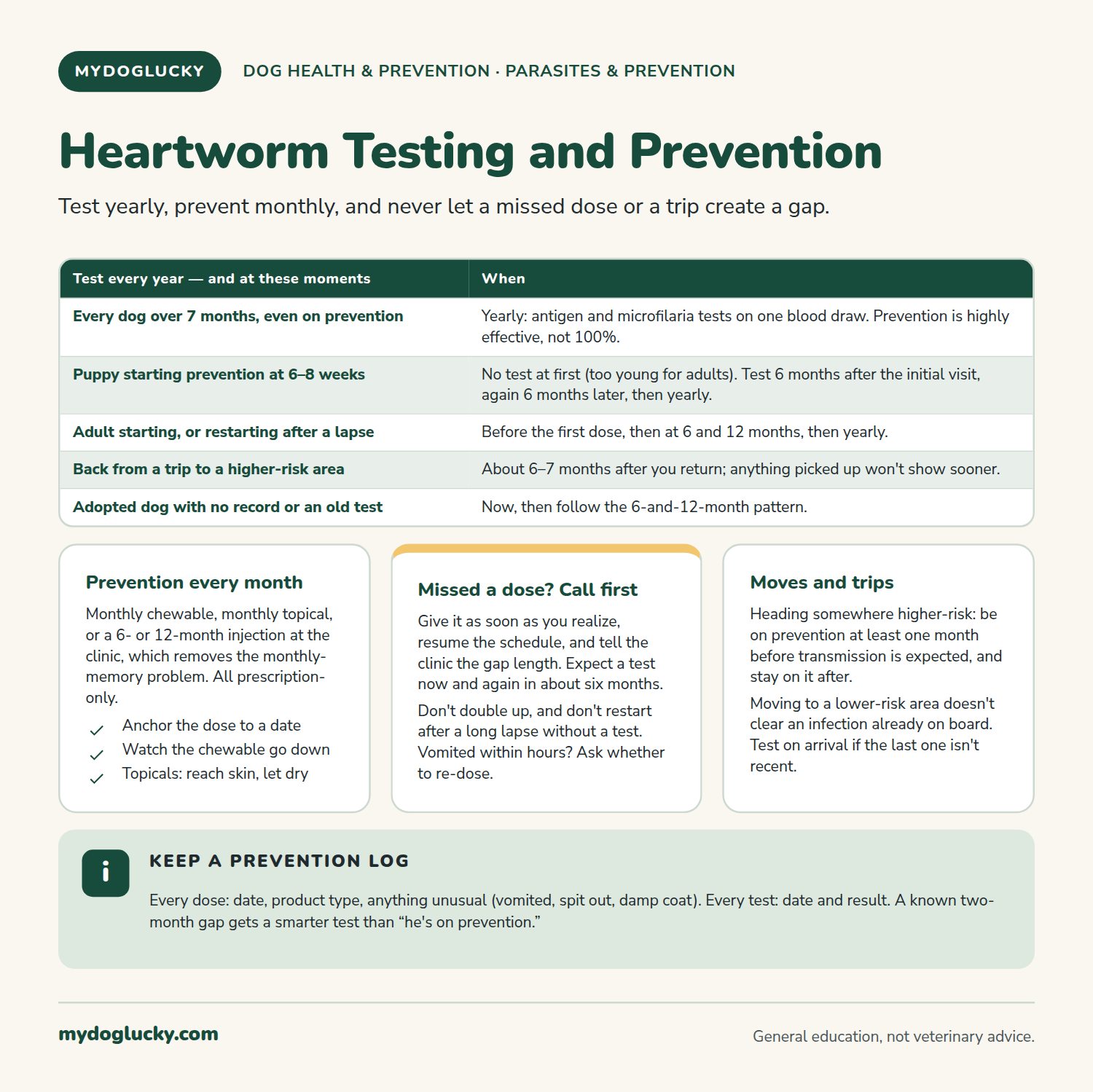
The current AHS guidelines call for “annual screening for all dogs over 7 months of age with both an antigen and a microfilaria test.” CAPC recommends the same: “annual testing of all dogs for both antigen and microfilariae of heartworm.”
- The antigen test detects a protein produced by adult female heartworms. It’s the primary screening tool, but Merck notes it “cannot identify early infections because it can only identify adult, female worms.” A dog bitten three months ago will test negative.
- The microfilaria test looks for the circulating offspring of adult worms under a microscope. It matters for two reasons: it confirms an active, reproducing infection, and it tells your vet whether starting a preventive needs extra care.
Why both? Because they miss different things. In AVMA’s coverage of the 2024 update, a veterinarian noted that “at least one-fifth of heartworm-positive dogs will test negative for microfilaria.” A dog with only male worms can be antigen-positive and microfilaria-negative. So can a dog whose immune system has cleared the microfilariae. The reverse can happen too. Running both is how you avoid the false reassurance of a single result.
Why You Test Before Starting or Restarting a Preventive
The FDA’s warning here is worth quoting in full. If a heartworm-positive dog is given a preventive, “the preventive may cause the microfilariae to suddenly die, triggering a shock-like reaction and possibly death.” That’s the main reason preventives are prescription-only and why a clinic won’t refill a lapsed prescription without a current test.
The AHS guidelines put it as a rule: a dog “must be antigen and microfilaria tested prior to starting or changing products.” The second reason is quieter but just as important. Giving a preventive to an already-infected dog doesn’t kill the adults. It hides the problem while the worms keep doing damage. Testing first means a positive dog gets actual treatment instead of a false sense of security.
Why Puppies Start Prevention Early but Get Tested Later
This confuses a lot of new owners, and the logic is clean once you see it. A puppy under seven months old can’t have adult heartworms yet, because the parasite needs six months or more to mature. So testing a 10-week-old puppy would tell you nothing. Merck notes preventives are “recommended beginning at 6 to 8 weeks of age,” and the AHS guidelines say to start as early as the product label allows and no later than 8 weeks.
The AHS pet-owner guidance lays out the follow-up. Puppies started on prevention are tested “6 months after your initial visit, tested again 6 months later and yearly after that.” That first test happens once any larvae picked up before prevention started would have matured. The second closes the loop. Then it’s annual for life.
Adopted Adults and Dogs With Gaps: The 6-and-12-Month Pattern
An adult dog starting prevention for the first time, or restarting after a lapse, gets tested before the first dose, then at 6 and 12 months, then annually, according to the AHS. Same logic: the first test finds any existing adults, and the follow-ups catch larvae that were already too mature for the preventive to kill when it started. Veterinary Practice News, summarizing AHS guidance, states that “dogs who initially test negative following lapsed heartworm prevention should be retested six months later.”
What a Positive Test Leads To
A positive antigen test on a dog with no signs and no known risk is usually confirmed before anything else happens, either with a second antigen test of a different type or with a microfilaria check. False positives are uncommon but not impossible, and treatment is too significant to begin on a single unexpected result. If the result is confirmed, the next step is staging: figuring out how much damage has been done, which determines how cautiously treatment proceeds. That usually means:
- A physical exam with careful attention to the heart and lungs.
- Chest radiographs (X-rays) to look at the pulmonary arteries and heart size. Merck lists these among the standard tools.
- Bloodwork to check organ function before medications that stress the liver and kidneys.
- Echocardiography (heart ultrasound) in some cases, which can visualize worms directly and assess how the heart is coping.
Ask your vet which class your dog falls into and what that means for the treatment timeline. It’s a fair question, and the answer shapes everything from cost to how long your dog will need to stay quiet.
Prevention: How the Products Work and What a Missed Dose Means
Every product approved to prevent heartworm in dogs in the U.S. is a prescription product, and every one of them is built on the same drug class. What differs is the delivery method, the dosing interval, and which other parasites ride along on the same label. This section describes categories, not brands. Your vet is the right person to choose a specific product, because the right choice depends on your dog’s weight, health history, other parasite risks, and how reliably a given form fits your household.
The Three Delivery Categories
| Category | How it’s given | Practical notes |
|---|---|---|
| Monthly oral (chewable or tablet) | By mouth, once every 30 days, at home | Most common form; many also treat intestinal worms; watch for a dose spit out or vomited within a few hours |
| Monthly topical | Applied to the skin at the shoulder blades, once every 30 days | Useful for dogs who refuse pills; some cover fleas or other parasites; must reach skin, not just coat, and needs time to dry |
| Injectable (6- or 12-month) | Given by the veterinarian in the clinic | Removes the monthly-memory problem; a 2024 primary-care study found the injectable form was associated with the lowest infection risk; requires a clinic visit to renew |
The AVMA summarizes the landscape: “Several safe, effective preventives are available through your veterinarian in the form of monthly oral or topical treatments or long-lasting injections.” All of them, the FDA notes, require a veterinarian’s prescription.
Why Many Preventives Also Cover Intestinal Worms
Because the same drug class that kills heartworm larvae also works against several intestinal parasites, many monthly products are labeled for roundworms, hookworms, and sometimes whipworms as well. Some combine a heartworm preventive with a flea and tick agent in one chewable. That’s convenient, but it’s also why you shouldn’t swap products on your own. Two dogs in the same house may be on different preventives for good reasons, and a product chosen for a dog with a specific health condition may not suit the other one. Read the label with your vet, not against it.
The Biggest Practical Risk: The Dose That Didn’t Happen
Owner reports and clinic experience line up on this point. The most common way a dog on prevention ends up heartworm-positive isn’t product failure. It’s a dose that was given late, forgotten entirely, thrown up in the yard, or applied to a coat that got wet an hour later. The AVMA lists the ways a preventive can fail in one sentence: “a dose might be missed, spit out, vomited, or not fully absorbed.”
A few habits that help:
- Anchor the dose to a date, not a feeling. The first of the month, a recurring phone reminder, a sticker chart on the fridge, whatever you’ll actually look at.
- Watch the chewable go down. Some dogs are master pill-hiders. Check the floor and the dog bed.
- If your dog vomits within a couple of hours of a dose, call the clinic. They’ll tell you whether to re-dose. Don’t decide that yourself.
- Ask whether the injectable form fits your household. For families with rotating caregivers or a track record of missed months, taking the monthly memory out of the equation may be the single most protective decision.
If you missed a dose: call, don’t guess
A dose that’s a few days late is a different situation from one that’s six weeks late, and only your vet can sort out what your dog needs. The general pattern from AHS-aligned guidance: give the missed dose as soon as you realize it, resume the regular schedule, and tell the clinic how long the gap was.
Expect a test now and another about six months later. Larvae from the gap can’t show on an antigen test until they’ve matured. Don’t double up, don’t skip the call because the dog “seems fine,” and don’t quietly restart after a long lapse without a test. The FDA’s warning about giving a preventive to an infected dog applies here.
Cost: Prevention Versus Treatment
Prevention isn’t free, and for a multi-dog household on a tight budget it’s a real line item. It’s still the cheapest part of this entire topic by a wide margin. A 2024 GoodRx cost review put monthly prevention at roughly $6 to $18 per month depending on form, and full treatment of an infected dog at “$500 to $6,000,” with surgery for caval syndrome running “$3,000-$6,000” on top. Prices vary by region, clinic, and the dog’s size and stage, so treat those as orientation, not a quote. The AVMA’s version is simpler: “Preventing heartworm infection is much easier—and much less expensive—than treating it.”
If cost is what’s standing between your dog and prevention, say so at the clinic. Many practices can suggest a lower-cost product in the same drug class, a multi-month purchase that brings the per-dose price down, or a manufacturer rebate. Some shelters and nonprofit clinics offer preventives at reduced cost. The worst option is the silent one, where prevention stops and no one at the clinic knows.
Treatment Overview: What the AHS Protocol Involves
This section describes the shape of treatment so you know what you’re agreeing to and what questions to ask. It deliberately leaves out doses. Your veterinarian sets those based on your dog’s weight, stage, and bloodwork, and the plan can change along the way.
The Goal and the Central Problem
Treating heartworm in dogs has one goal: kill every adult worm and every circulating microfilaria while keeping the dog alive and as comfortable as possible during the process. The central problem is what happens to a dead worm. VCA explains it directly: “Adult heartworms die within a few days of treatment and begin to break down. As they decompose, fragments are carried to the lungs, where they become lodged in small blood vessels.” Those fragments can block blood flow to parts of the lung, an event called pulmonary thromboembolism. The FDA notes that treatment “can cause serious complications, such as life-threatening blood clots to the dog’s lungs.”
Every part of the AHS protocol exists to make that die-off as gradual and survivable as possible. That’s why treatment takes months rather than days, and why the exercise rule isn’t negotiable.
Step 1: Stabilize and Restrict
A dog with significant heart or lung changes may need to be stabilized first, sometimes with medication to reduce inflammation or manage heart failure, before any worm-killing drug is given. Exercise restriction starts on day one, not after the injections. The AHS guidelines describe activity restriction as “ESSENTIAL for minimizing cardiopulmonary complications,” in capital letters, in a document that is otherwise calm.
Step 2: The Doxycycline and Preventive Phase
Heartworms carry a bacterium called Wolbachia inside their bodies that contributes to the inflammation they cause. A course of the antibiotic doxycycline, given for about four weeks under the AHS protocol, weakens the worms and reduces the inflammatory reaction when they later die. At the same time, the dog is started on a macrocyclic lactone preventive to clear larvae and stop new infections from adding to the burden mid-treatment. Cornell’s Riney Canine Health Center describes this stage as a four-week course of doxycycline and an anti-inflammatory, followed by the injections.
Many dogs also receive a corticosteroid at specific points to blunt the lung inflammation. Your vet may schedule a waiting period after the doxycycline course before the next step, so the worms are weakened when the adulticide hits them.
Step 3: The Adulticide Injections
The only FDA-approved drug that kills adult heartworms in dogs is melarsomine dihydrochloride, given by deep intramuscular injection in the lower back. The AHS recommends a three-injection “split” protocol: one injection, then at least a month later, two more injections 24 hours apart. Splitting the doses kills the worms in two waves instead of one, which spreads out the lung’s burden of dead-worm fragments. Cornell reports the three-part protocol is “98% effective at killing the adult worms.”
The injections themselves can be painful at the site, and dogs are often sore, quiet, or reluctant to move for a few days afterward. That’s expected. What isn’t expected, and needs a call, is the list of complications in the red-flag panel above: fever, appetite loss, shortness of breath, or a severe or bloody cough.
Step 4: Weeks of Strict Rest, Then Retesting
After the final injection, the dog is confined and kept calm for at least four to six weeks, with the first week or two being the most dangerous window. Merck describes “cage confinement” for “4–6 weeks after the final injection.” Cornell adds that strict rest should continue for “an additional 6-8 weeks while the worms are dying.” Your vet will set the exact length based on your dog’s stage.
Then comes the follow-up. The AHS protocol calls for a microfilaria test around four months after the start of treatment and an antigen test “9 months after last melarsomine injection.” Only when the antigen test comes back negative does the dog get declared clear. Until then, the dog stays on prevention and the calendar stays marked.
Why “Slow Kill” Is Not the Same as Treatment
Somewhere online, and occasionally from a well-meaning acquaintance, you’ll hear about a “slow-kill” approach: just keep the dog on a monthly preventive, sometimes with doxycycline, and wait for the adults to die of old age. The appeal is obvious. It’s cheap and it skips the injections. The AHS position is unambiguous: “Any method utilizing only MLs as a slow-kill adulticide is not recommended.”
The reasons are practical. Adult worms live up to seven years, and during every one of those years they keep damaging the lungs and heart. The dog would still need strict exercise restriction for that entire time to be reasonably safe, which almost no household sustains. Repeated low-level drug exposure in a dog with living adults is also thought to encourage drug resistance. The 2024 guidelines do include a “spectrum-of-care” section for situations where the full protocol truly isn’t possible, and that’s a conversation to have with your vet, not a reason to default to the cheapest option. If money is the barrier, say that out loud. There are more paths than “everything” or “nothing.”
Treatment Works, but the Heart Remembers
One more thing worth knowing before you sign the estimate. A 2024 study of primary-care records, published in Frontiers in Veterinary Science, found that dogs successfully treated for heartworm still had a meaningfully higher long-term risk of right-sided heart failure and other cardiac conditions than dogs who were never infected. Treatment removes the worms. It can’t always undo what they did. That’s not an argument against treating. It’s the strongest argument there is for never needing to.
Living Through Treatment: Rest, Enrichment, and What to Watch
Ask any owner who has been through it, and they’ll tell you the injections weren’t the hard part. The hard part was the eight to twelve weeks of keeping a dog who feels fine from acting like it. This section is for that stretch.
What “Strict Rest” Actually Means
It means leash walks only, short and slow, for bathroom breaks. No fetch, no dog park, no stairs at a gallop, no wrestling with the other dog, no greeting the mail carrier at full sprint. Crate or small-room confinement when you can’t actively supervise. The AVMA acknowledges that this activity restriction “can be especially challenging,” which is a professional way of saying it’s miserable for everyone involved.
The reason is worth repeating, because it makes the rule easier to hold. When your dog’s heart rate climbs, more blood is pushed through lung vessels that are partly blocked by decomposing worm fragments. A burst of excitement can turn a manageable die-off into a clot. Rest isn’t a comfort measure. It’s the treatment.
Enrichment That Doesn’t Raise the Heart Rate
A bored dog on crate rest is a dog who will eventually explode, and “eventually” often lands at 11 p.m. The goal is to tire the brain while the body stays parked.
- Food puzzles and snuffle mats, worked while lying down. Slow, nose-driven, low effort.
- Frozen stuffed toys that take twenty minutes to finish rather than two.
- Scent games in one room: hide a few kibble pieces under cups and let the dog find them at a walk.
- Calm training: stationary cues like chin rest, “look at me,” or holding a down-stay for treats. Skip anything that involves spinning, jumping, or racing to a target.
- Chewing. Long-lasting, vet-approved chews do double duty as a stress outlet.
- Window time and car rides (with the dog lying down) for a change of scenery without exertion.
If your dog gets over-aroused by any of these, scale back. The measure of success is a dog who ends the session calmer than they started, not a dog who “did enrichment.”
Managing the Household
Crate rest is easier when everyone is on the same page. A sign on the front door reminding visitors not to whip the dog up. A second dog kept separate during play windows. Kids briefed that “gentle” means gentle. A vet-approved plan for anxiety if confinement itself is stressing the dog, since panic is its own kind of exertion. If a family member with a different schedule handles some of the care, write the rules down and post them where the leash hangs.
What to Watch For and When to Call
Your vet will give you a list. VCA’s version of the post-treatment watch list includes appetite loss, shortness of breath, severe coughing or coughing up blood, fever, and depression. Mild lethargy and soreness at the injection site for a few days are expected. A cough that escalates, breathing that looks effortful, gums that lose color, or a dog who collapses after standing up are not. Call for the first group by the next business day and go now for the second.
Travel, Relocation, and Adopting a Heartworm-Positive Dog
The risk of heartworm in dogs follows geography, and dogs move. Both directions matter.
Traveling or Moving to a Higher-Risk Area
If you’re taking a dog from a low-prevalence area to the Gulf Coast for a month, or relocating permanently, the dog needs to be on prevention before the trip and stay on it after. Veterinary Practice News, citing AHS guidance, notes that prevention should begin “at least one month prior to the anticipated start of heartworm transmission.” Mention travel plans at your dog’s next appointment. Your vet may also recommend a mosquito-repellent product for the trip and a test six to seven months after you return, since anything picked up on the trip won’t show on an antigen test until then.
Moving the other direction, from a high-risk area to a low-risk one, doesn’t lower the risk to zero, and it doesn’t clear an infection your dog might already be carrying. Test on arrival if a test isn’t already recent.
Adopting a Dog Who Tested Positive
Shelters, especially in the South, take in heartworm-positive dogs constantly, and many of those dogs are otherwise young, healthy, and excellent. Adopting one is a generous choice. It’s also a commitment with a specific shape. Go in with clear information. Questions to ask the shelter or rescue:
- Which tests were run, and when? Antigen only, or antigen plus microfilaria? Has the diagnosis been confirmed?
- Has the dog been staged? Were chest X-rays or bloodwork done, and what class was assigned?
- Has treatment started? Some shelters begin the doxycycline phase or give the first injection before adoption. Ask exactly what’s been given and on what dates, and get it in writing.
- Who pays for the rest? Some organizations cover the full adulticide protocol through a partner clinic. Others offer a discount or nothing at all. Know the number before you sign.
- What’s the exercise plan? A dog mid-treatment needs the same strict rest at your house that they’d need anywhere. Are you set up for that in the first weeks of a new adoption, when a dog is already stressed?
- Is the dog on a preventive now? A positive dog should be on one to protect against re-infection and to stop spreading microfilariae to mosquitoes.
None of these questions is a reason to walk away. They’re how you avoid learning, three weeks in, that the treatment you thought was done has two injections left and the estimate is four figures.
Fostering and Transport Programs
If you foster or volunteer with a transport group, assume every incoming dog from a high-prevalence region is a heartworm question mark until tested. Keep your own dogs on year-round prevention regardless, because a foster dog carrying microfilariae is a source for the mosquitoes in your yard. Ask the organization for its testing and prevention policy in writing. Good ones have one.
What to Observe and Record at Home
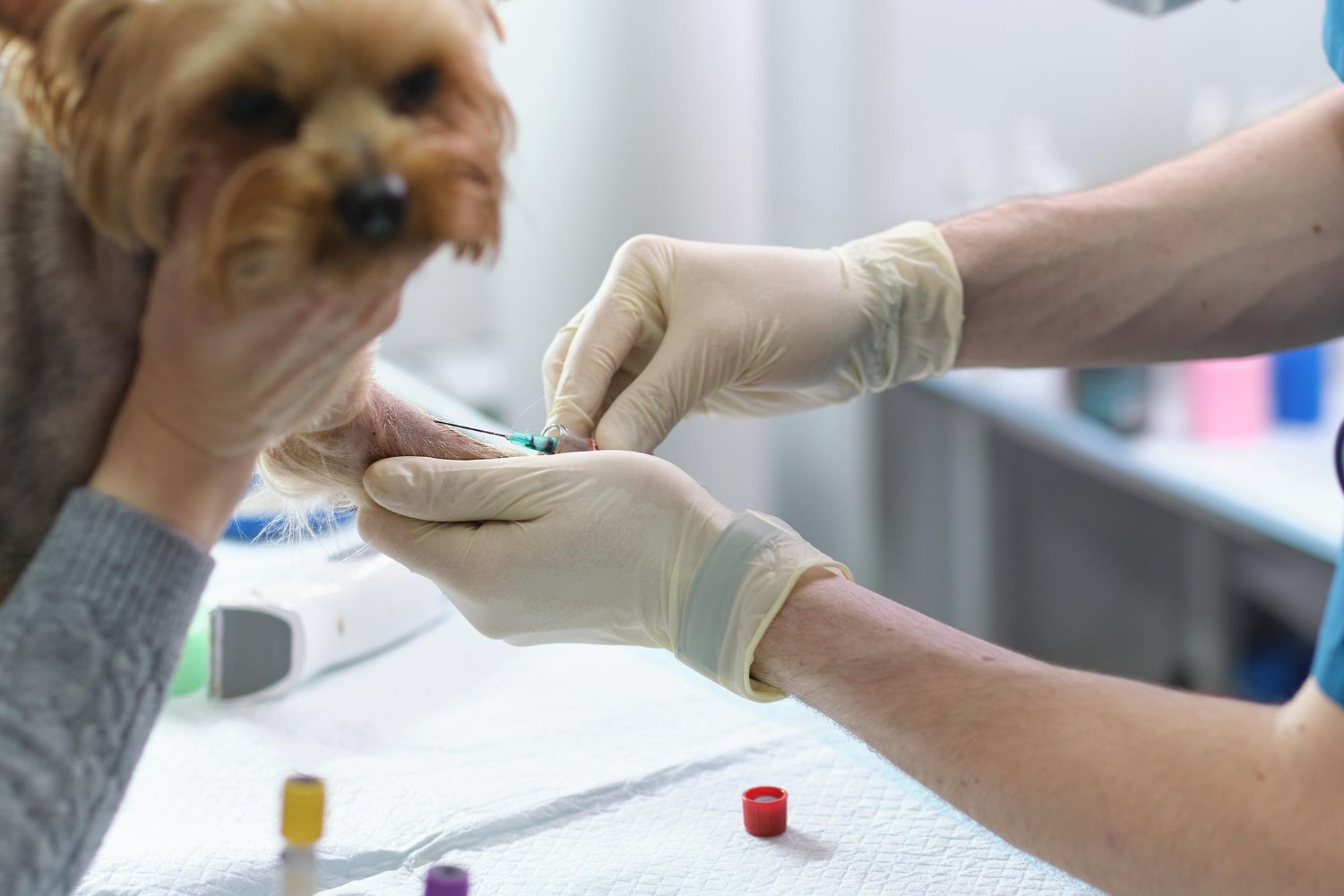
You don’t need to diagnose anything. You do need to be a reliable historian, because the signs of heartworm in dogs are slow and subtle, and a two-line note from March is worth more than a vague memory in September.
A Simple Prevention Log
Keep a running record, on paper or in a notes app, of every preventive dose: date, product type (oral, topical, injection), and anything unusual (vomited, spit out, applied on a damp coat). Add every test date and result. If you switch products, note when and why. This turns “I think we’ve been pretty consistent” into an answer your vet can act on.
Exercise Tolerance
Note the distance or duration of a typical walk and how your dog looks at the end. If the same route starts producing a dog who lags, stops, or lies down partway, that’s a change worth dating. Also note any coughing during or after exertion.
Cough Pattern
Write down when it happens (after exercise, at night, when excited), what it sounds like (soft and dry versus wet), and how often. A short phone video of an episode is genuinely useful to your vet, more so than a description.
Breathing at Rest
When your dog is asleep, count breaths for 30 seconds and double it. Do this a few times on ordinary days so you know your dog’s normal. A resting rate that climbs over weeks, or breathing that looks like it takes effort, belongs on the call list.
Appetite, Weight, and Belly Shape
Monthly weight checks (the bathroom-scale trick: weigh yourself, then weigh yourself holding the dog) catch gradual loss. A belly that looks rounder while the ribs and spine get more prominent is a pattern, not a diet issue.
Gum Color
Lift the lip occasionally on a normal day so you know your dog’s baseline pink. Pale, white, or bluish gums are a go-now sign, not something to compare against later.
What to bring to the appointment
- Your prevention log with dates and gaps, including honest ones.
- Dates and results of past heartworm tests, and where they were done.
- Travel history and where the dog came from, if adopted.
- Any video of coughing or breathing episodes.
- Notes on exercise tolerance, appetite, and weight over the last few months.
A clinic that knows there was a two-month gap last summer will test smarter than one that’s told “he’s on prevention.”
Monitor vs. Call-Today vs. Go-Now
Here’s the same information from above, organized by what to actually do next.
Monitor at home (and keep the calendar)
- Your dog is on year-round prevention with no gaps and a negative test within the last year.
- No cough, normal energy, normal appetite, normal breathing at rest.
- You’re simply due for the next dose or the next annual test.
Give the dose on time, book the test when it’s due, and keep the log. That’s the whole job.
Call your vet today (or the next business day)
- A missed or late dose, a vomited dose, or a gap of any length you’re unsure about.
- A new soft cough, tiring earlier on walks, or reduced interest in play that has lasted more than a few days.
- Gradual weight loss or a belly that seems to be getting rounder.
- A newly adopted dog with no test on record, or a test older than a year.
- Travel or a move to a higher-risk area coming up, or just completed without a plan.
- A dog in treatment with mild lethargy or soreness that lasts longer than expected.
Not an emergency, but not a wait-and-see either. Call, describe what you’re seeing, and let the clinic decide how soon.
Seek emergency care now
- Labored or rapid breathing at rest.
- Collapse, fainting, or sudden severe weakness.
- Pale, white, or bluish gums.
- Dark, bloody, or coffee-colored urine, especially with breathing trouble.
- Coughing up blood.
- A dog in treatment with fever, sudden breathing difficulty, or a severe cough.
Call ahead if you can, then go. Caval syndrome and pulmonary thromboembolism are measured in hours.
Common Mistakes and Misunderstandings
Stopping Prevention in Winter
Covered above and worth repeating because it’s the most common lapse: the preventive kills last month’s larvae, so stopping in October leaves October unprotected. Year-round is the AHS and CAPC recommendation everywhere in the U.S., not just the South.
Skipping the Annual Test Because “He’s on Prevention”
The test exists precisely because prevention can fail quietly. The AHS calls preventives “highly effective, but not 100 percent effective.” One negative test a year is cheap insurance against a missed month you don’t remember.
Buying or Restarting a Preventive Without a Test
Preventives are prescription-only in the U.S. for a reason: giving one to a dog with circulating microfilariae can trigger the shock-like reaction the FDA warns about. If a website will sell you a heartworm preventive without a prescription, that’s a reason to be suspicious of the website, not a shortcut.
Using a Cat Product, a Different Dog’s Product, or a Split Dose
Preventives are dosed by species and weight range. A cat product, a product for a different-sized dog, or a large-dog chewable split “by eye” between two small dogs can all under-dose or over-dose. Some products are dangerous for the wrong species. Every dog gets its own prescription.
Assuming a Repellent Collar or Spray Is Heartworm Prevention
Mosquito-repellent products can reduce bites and are a reasonable add-on, and the AHS now mentions them as a second layer. They are not a substitute for a macrocyclic lactone preventive. Nothing that stays on the outside of the dog kills larvae on the inside.
Treating a “Mild” Cough as Allergies or Age
A soft cough in a dog whose prevention has any gaps, or who came from a high-risk area, deserves a test before it gets a label. The early signs of heartworm in dogs are boring on purpose.
Letting a Dog in Treatment “Have Just One Run”
The dog feels fine. The weather is perfect. One sprint across the yard can dislodge worm fragments into the lungs. Strict rest is the part of treatment that happens at home, and it’s the part only you control.
Choosing “Slow Kill” Because It’s Cheaper
The AHS does not recommend it. Adults keep damaging the heart for years, and the dog would need rest restrictions the whole time. If the standard protocol is out of reach financially, ask about the AHS spectrum-of-care options and about payment plans, rather than defaulting to a plan that isn’t treatment.
Forgetting the Retest After Treatment
Treatment isn’t done when the last injection is given. It’s done when the antigen test comes back negative around nine months later. Mark it now.
Frequently Asked Questions About Heartworm in Dogs
Can my indoor dog really get heartworm?
Yes. Mosquitoes come indoors, and a dog who goes out only for bathroom breaks is outdoors long enough to be bitten. The AVMA and AHS both recommend year-round prevention for every dog regardless of lifestyle.
How long does it take for a dog to show signs of heartworm?
Often a very long time. Adult worms take about six months to mature after the mosquito bite, and many dogs show no signs for months or years after that. By the time a cough or exercise intolerance appears, the infection has usually been present for a while. That delay is the reason for annual testing of dogs who look healthy.
Can I skip the test if my dog has never missed a dose?
The AHS and CAPC still recommend annual antigen and microfilaria testing for every dog on prevention. Doses get vomited without anyone noticing, topicals get rinsed off, and resistant strains have been documented. The test is the backstop.
What happens if I give a heartworm preventive to a dog that already has heartworms?
The preventive won’t kill the adult worms. In a dog with circulating microfilariae, it can cause a sudden mass die-off of those microfilariae, which the FDA warns can trigger “a shock-like reaction and possibly death.” That’s why a test comes before the first dose and before restarting after a gap.
I missed a dose by a week. Is that a problem?
Give it as soon as you remember, get back on schedule, and call the clinic to tell them the size of the gap. A short delay usually calls for less concern than a multi-month lapse, but the clinic decides that, not the internet. Expect a test now and possibly another in about six months.
Why does my puppy get prevention before being tested?
Because a puppy under seven months old can’t have adult heartworms yet, so a test would be uninformative. Prevention starts early to kill larvae as they arrive. Testing follows at about six months after the first dose, again six months later, and then annually.
Does heartworm prevention also treat intestinal worms?
Many products do, because the same drug class works against roundworms, hookworms, and sometimes whipworms. Which parasites a given product covers is on the label. Ask your vet what yours covers and whether your dog needs anything additional for tapeworms or local risks.
How is heartworm in dogs treated?
The AHS protocol involves stabilizing the dog, a roughly four-week course of doxycycline, and starting a monthly preventive. Then comes a series of three melarsomine injections split over about a month, with corticosteroids as needed. Strict exercise restriction applies throughout and for weeks afterward. A microfilaria test and an antigen test follow to confirm the worms are gone. The exact plan depends on the dog’s stage.
How long does heartworm treatment take?
From the first doxycycline dose to the final injection is typically two to three months. Then comes another one to two months of strict rest, then a nine-month wait for the confirming antigen test. Realistically, plan on most of a year before your dog is officially cleared. The hardest stretch is the two to three months around the injections.
Is heartworm treatment dangerous?
It carries real risk, mostly from dead worm fragments lodging in the lungs. That’s why the injections are split, why doxycycline comes first, and why rest is strict. With the full protocol and careful monitoring, most dogs come through. Dogs with advanced disease face higher risk, and your vet will discuss that honestly when staging.
What does heartworm treatment cost?
It varies widely by region, clinic, and stage. A 2024 cost review put the range at roughly $500 to $6,000, with surgery for caval syndrome adding several thousand more. Prevention, by comparison, runs in the range of $6 to $18 a month. Ask for a written estimate that includes staging, medications, injections, follow-up visits, and the retests.
Can heartworm be treated with just the monthly preventive?
The AHS says no: “Any method utilizing only MLs as a slow-kill adulticide is not recommended.” Adults keep damaging the heart and lungs for years, and the approach may encourage resistance. If the standard protocol isn’t affordable, ask about the AHS spectrum-of-care options rather than choosing slow kill on your own.
Can a dog get heartworm again after treatment?
Yes. Treatment doesn’t confer immunity. A treated dog needs year-round prevention and annual testing for life, the same as any other dog.
Can I catch heartworm from my dog?
Not by contact. Heartworm isn’t contagious between animals or to people; the FDA notes a dog “cannot catch the disease from being near an infected dog.” The only route is a mosquito bite. Human heartworm cases are rare and are a question for your physician, not something an infected dog passes to you directly.
Should I adopt a heartworm-positive dog?
Many people do, and many of those dogs go on to long, healthy lives. Go in with the diagnosis confirmed, the dog staged, the treatment status in writing, a clear answer on who pays for the rest, and a realistic plan for weeks of strict rest in a new home.
Do I still need prevention if I live in a cold state?
Yes. The AHS reports heartworm in all 50 states, and its most recent survey data showed increases in historically low-incidence states. Year-round prevention is the U.S.-wide recommendation, and it avoids the stop-restart-retest cycle that seasonal dosing creates.
Is the injectable preventive better than monthly pills?
“Better” depends on the household. A 2024 primary-care study found the injectable form was associated with the lowest infection risk, most likely because it removes the monthly-memory problem. For a family that reliably gives a chewable on the first of every month, a monthly product works well too. Ask your vet which fits your dog’s health history and your routine.
What should I do if my dog vomits right after the chewable?
Call the clinic and describe the timing. Whether to re-dose depends on how long the dose had to absorb, and the clinic can tell you. Don’t assume it “probably stayed down,” and don’t give a second dose on your own.
Does my dog need a heartworm test before boarding or daycare?
Some facilities require proof of a negative test or current prevention; many don’t. Regardless of the facility’s rule, your dog should be on year-round prevention anyway. Heartworm doesn’t spread between dogs at daycare, but mosquitoes at an outdoor play yard don’t need a policy to bite.
Where This Leaves You
Heartworm in dogs is one of the few serious diseases where the owner holds most of the cards. A monthly dose or a scheduled injection, plus one blood draw a year, is the whole prevention plan, and it works. Everything hard about this topic, the months of confinement, the injections, the four-figure estimates, the long-term heart risk, lives on the other side of a gap in that plan.
If your dog is protected and tested, keep doing exactly what you’re doing and put the next test on the calendar now. If there’s been a gap, or if you’ve never really had a plan, call the clinic this week. Say how long the lapse was and ask for a test and a restart. If your dog has a cough you’ve been explaining away, add that to the same call. And if you see any of the go-now signs above, don’t finish this article. Go.
Sources
- American Heartworm Society. Current Canine Guidelines for the Prevention, Diagnosis, and Management of Heartworm (Dirofilaria immitis) Infection in Dogs (2024 revision, October 2024)
- American Heartworm Society. Summary of Highlights: 2024 AHS Canine Heartworm Guidelines (July 2024)
- American Heartworm Society. Heartworm Basics (pet-owner resource, accessed September 2026)
- American Heartworm Society. Heartworm Incidence Maps (2025 map, accessed September 2026)
- Companion Animal Parasite Council. CAPC Guidelines: Heartworm (accessed September 2026)
- U.S. Food and Drug Administration. Keep the Worms Out of Your Pet’s Heart! The Facts about Heartworm Disease (last updated December 22, 2022)
- American Veterinary Medical Association. Heartworm Disease (pet-owner resource, accessed September 2026)
- American Veterinary Medical Association. AHS updates heartworm guidelines for dogs (AVMA News, May 14, 2024)
- Merck Veterinary Manual. Heartworm Disease in Dogs (pet-owner version, accessed September 2026)
- VCA Animal Hospitals. Heartworm Disease in Dogs (accessed September 2026)
- Cornell University College of Veterinary Medicine, Riney Canine Health Center. Heartworm Disease (accessed September 2026)
- ASPCA. Common Dog Diseases (heartworm section, accessed September 2026)
- Nelson, T. “Doctor, I missed a heartworm dose!” Veterinary Practice News (November 13, 2020)
- Frontiers in Veterinary Science. Prevention and long-term outcomes of naturally occurring canine heartworm infection in primary care settings (January 15, 2024)
- GoodRx Health. How Much Does Heartworm Treatment Cost for Dogs? (December 16, 2024; cost ranges only)
This article is general education for U.S. dog owners. It is not individualized veterinary advice, a diagnosis, or a substitute for an in-person veterinary exam. Heartworm preventives are prescription products; never start, stop, switch, or re-dose one without your veterinarian’s direction, and never give a preventive to a dog whose heartworm status is unknown. Treatment protocols and doses described here in outline are set by your veterinarian for your dog. If your dog shows labored breathing, collapse, pale or bluish gums, dark or bloody urine, coughing up blood, or a sudden worsening during heartworm treatment, seek emergency veterinary care right away rather than waiting.