An adult dog vaccination schedule has two parts. The first is a short list of core vaccines every adult dog gets on a fixed cadence, whether he lives on a ranch or in a studio apartment. The second is a longer list of non-core vaccines that your veterinarian adds or skips based on where you live and what your dog actually does with his week.
The general shape looks like this. A booster about one year after the puppy series ends. Then core boosters for distemper, adenovirus, and parvovirus every three years. Rabies on whatever interval your state or county sets. Leptospirosis, which the American Animal Hospital Association (AAHA) now recommends for most dogs, is a yearly vaccine. Lifestyle vaccines like Bordetella, Lyme, and canine influenza are also yearly, if your dog needs them at all.
That’s the skeleton. The rest of this guide puts the details on it. What each vaccine is for. Why the three-year interval exists. How the law treats rabies, and which lifestyle questions decide the non-core list. What titer tests can and cannot tell you. And what a normal reaction looks like versus one that needs a vet now.
One scope note. This article is about adult boosters. The puppy series is its own topic, and MyDogLucky covers it in a separate article on puppy vaccination schedules. If you’re holding a reminder postcard and wondering whether your six-year-old dog really needs everything listed on it, you’re in the right place.
What’s in this guide
- The adult dog vaccination schedule: the short answer
- Core vaccines: DAP and rabies, and why the intervals are what they are
- Rabies and the law: 1-year vs. 3-year products, and what happens after a bite
- Non-core vaccines by lifestyle
- The lifestyle risk planner: the questions your vet asks
- Titer testing: what antibody levels can and cannot tell you
- Vaccine reactions: normal vs. emergency, and the timeline
- Special cases: seniors, prior reactions, immune disease, pregnancy, unknown history
- Record keeping and what boarding, daycare, and groomers ask for
- Cost realities
- What to observe and record after a vaccine
- Monitor, call today, or go now: reactions sorted by urgency
- Common mistakes and misunderstandings
- Frequently asked questions about adult dog vaccines
- Sources
The Adult Dog Vaccination Schedule: The Short Answer
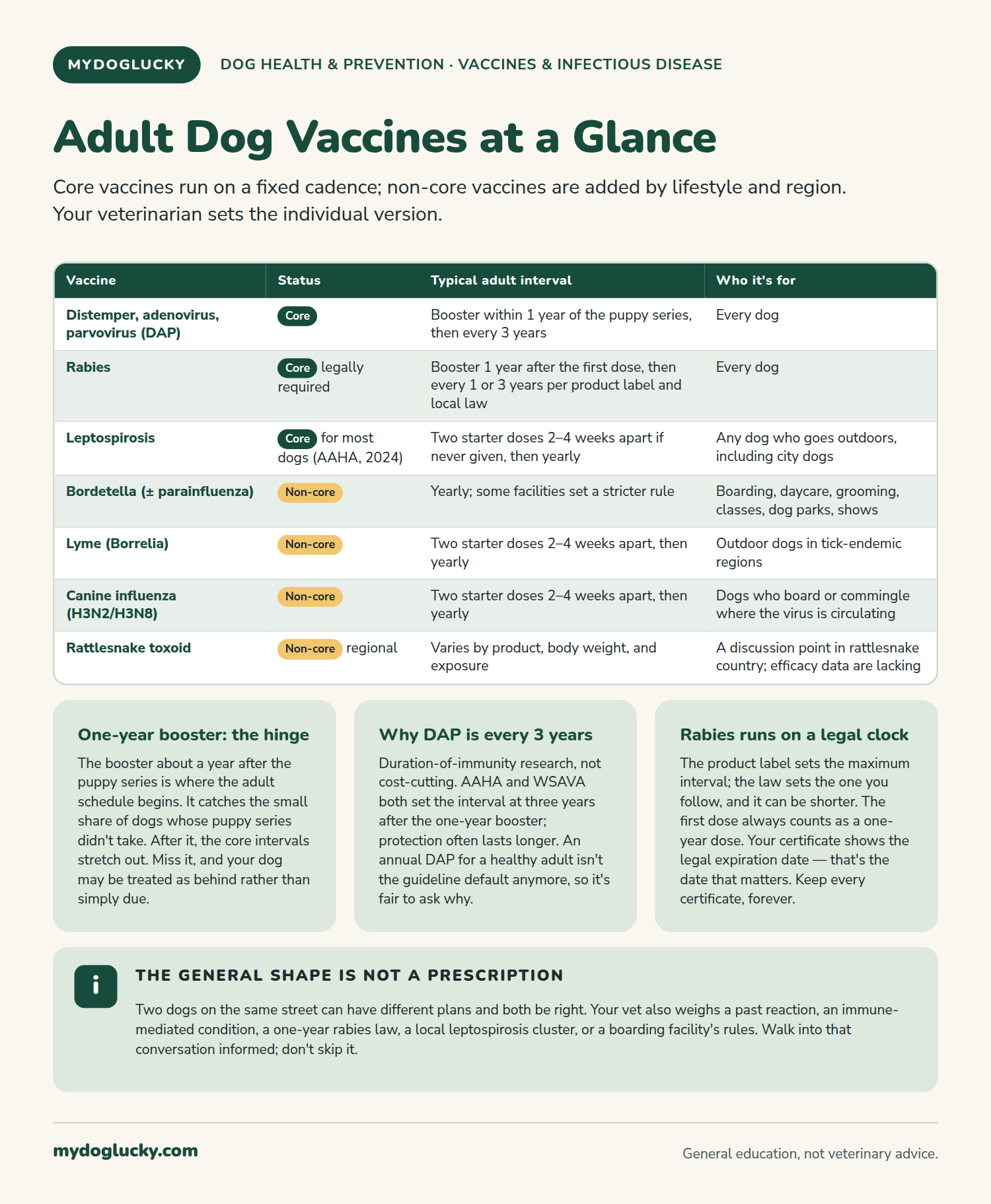
Here’s the general adult dog vaccination schedule in one table, drawn from the AAHA 2022 Canine Vaccination Guidelines (updated in 2024) and the AVMA’s owner guidance. Read it as the map most veterinarians start from, not as the route your own dog will take.
| Vaccine | Status | Typical adult interval | Who it’s for |
|---|---|---|---|
| Distemper, adenovirus, parvovirus (DAP) | Core | Booster within 1 year of the puppy series, then every 3 years | Every dog |
| Rabies | Core, legally required | Booster 1 year after the first dose, then every 1 or 3 years per product label and local law | Every dog |
| Leptospirosis | Core for most dogs (AAHA, 2024 update) | Two starter doses 2–4 weeks apart if never given, then yearly | Any dog who goes outdoors, including city dogs |
| Bordetella (with or without parainfluenza) | Non-core | Yearly; some facilities set their own stricter rule | Boarding, daycare, grooming, classes, dog parks, shows |
| Lyme (Borrelia) | Non-core | Two starter doses 2–4 weeks apart, then yearly | Outdoor dogs in tick-endemic regions |
| Canine influenza (H3N2/H3N8) | Non-core | Two starter doses 2–4 weeks apart, then yearly | Dogs who board or commingle, in areas where the virus is circulating |
| Rattlesnake toxoid | Non-core, regional | Varies by product, body weight, and exposure | A discussion point in rattlesnake country; efficacy data are lacking |
Why “the general shape” is not a prescription
Two dogs living on the same street can have different vaccine plans and both be right. The AAHA guidelines are explicit that “core for an individual patient” means the vaccines required for all dogs plus the ones that dog’s lifestyle and risk factors call for. Your vet also weighs things a table can’t. A past reaction. An immune-mediated condition. A state law that requires a one-year rabies interval, a local leptospirosis cluster, or a boarding facility with its own rules. Use this article to walk into that conversation informed. Don’t use it to skip the conversation.
What “Core” and “Non-Core” Actually Mean
The AVMA describes core vaccines as those “recommended for all dogs and cats, unless there’s a medical need not to vaccinate.” They protect against diseases that are widespread, severe, or a public-health risk, and in the case of rabies, legally mandated. Non-core vaccines are “recommended for certain pets based on their risk of exposure to the disease, such as through their lifestyle or geographic location.”
The line between the two moves as evidence changes. Leptospirosis is the clearest recent example. It was non-core in the 2017 guidelines. AAHA moved it to core for most dogs in a 2024 update, because the disease kept showing up in places, and in dogs, nobody expected. More on that below.
The One-Year Booster: The Hinge Between Puppyhood and Adulthood
The booster your dog gets roughly a year after finishing the puppy series is the point where the adult dog vaccination schedule really begins. The AAHA table calls for “a single dose within 1 year following the last dose” of the puppy series for DAP, and the rabies page calls for a first booster “1 year following initial vaccination, regardless of formulation.”
That booster does an important job. It catches the small share of dogs whose puppy series didn’t take, often because maternal antibodies were still interfering at the last puppy dose. After that one-year booster, the core intervals stretch out. Miss it, and your vet may treat your dog as behind rather than simply due.
Core Vaccines: DAP and Rabies, and Why the Intervals Are What They Are
Two vaccines sit at the center of every adult dog vaccination schedule. One is a combination shot against three viruses. The other is the rabies vaccine, which is the only one the law cares about.
Distemper, Adenovirus, and Parvovirus (DAP)
The DAP combination, sometimes written DA2P or DHP, covers canine distemper virus, canine adenovirus type 2 (which also protects against the type 1 virus that causes infectious hepatitis), and canine parvovirus. Some combination products fold in parainfluenza too, which is why you’ll see DAPP or DHPP on a receipt.
These three viruses share two traits. They can kill an unprotected dog, and modern modified-live vaccines protect against them for a long time. Merck’s owner-facing manual notes that modified-live vaccines “stimulate a strong response by the immune system,” which is why the interval for these can be measured in years instead of months.
Why Every Three Years Is the Evidence-Based Interval for DAP
For decades, most dogs got a DAP booster every year. That changed because of duration-of-immunity research, not cost-cutting. The 2024 WSAVA guidelines state that after the puppy series and the one-year booster, dogs should be revaccinated for distemper, adenovirus, and parvovirus “no more frequently than every 3 years.” The AAHA table matches: “administer subsequent boosters at intervals of 3 years.”
The immune memory these vaccines create doesn’t switch off at the twelve-month mark. Challenge studies and antibody surveys have shown protection lasting well beyond three years in many dogs. Three years is the interval where the guideline authors are confident the vast majority of dogs stay protected. It isn’t the moment immunity ends.
This also means an annual DAP booster for a healthy adult dog isn’t the guideline-supported default anymore. If your clinic still does it yearly, that’s a fair question to ask, calmly and without assuming the worst. Some clinics have specific reasons; some are working from an older habit.
Rabies: The Vaccine With a Legal Clock
Rabies vaccines for dogs are all inactivated (killed) products, licensed in one-year and three-year formulations. AAHA’s schedule is straightforward: a first dose at three months or older, a booster one year later “regardless of formulation,” and then boosters “either 1-year or 3-year intervals based on vaccine product label and local legal requirements.”
Notice what’s doing the work in that sentence. The product label sets the maximum interval. The law sets the interval you must follow, and it can be shorter. That’s the subject of the next section, because it’s where a lot of owners get an unpleasant surprise.
Leptospirosis: The Newest Member of the Core List
Leptospirosis is a bacterial disease spread mainly through the urine of infected wildlife and rodents. The usual route is standing water, damp soil, or a puddle your dog thought was a beverage. It can cause kidney and liver failure, and people can catch it too.
AAHA’s 2024 update reclassified the leptospirosis vaccine from non-core to core for most dogs, and the reasoning is worth understanding. The disease has turned up in dry, high-elevation places like Laramie, Wyoming, and Phoenix, Arizona, where it wasn’t expected. Suburban development has pushed raccoon and rodent populations into more backyards. And AAHA’s own review found the modern vaccine “carries no higher reaction risk than other vaccines,” with adverse events reported at fewer than 53 per 10,000 doses.
The takeaway quote from the AAHA update: “Any dog that goes outdoors can be exposed to leptospirosis,” and “the real risk factor is whether or not the dog is vaccinated.” The schedule is two doses two to four weeks apart if your dog has never had it, regardless of age, then a yearly booster. A dog who lapses for more than a year typically needs to restart the two-dose series, which is one reason to keep this one current.
Rabies and the Law: 1-Year vs. 3-Year Products, and What Happens After a Bite
Rabies is the one part of an adult dog vaccination schedule where medicine and law overlap completely. Understanding the rules before something goes wrong is far easier than learning them in an animal-control office.
Who Requires It, and How Often
According to the Michigan State University Animal Legal & Historical Center’s 2022 survey of rabies vaccination laws, roughly forty states require rabies vaccination for dogs by statute. In most of the rest, county or municipal ordinances fill the gap. AAHA sums it up for owners with a blunt line: “All states require rabies vaccinations,” and lapsed coverage “can result in quarantine costs and fines.”
The interval is where things vary. Many jurisdictions accept a three-year product on its labeled schedule after the first one-year booster. Some require yearly boosters regardless of which product was used. AAHA’s rabies page notes that “age at initial vaccination, timing of booster doses, vaccine formulation, response to overdue booster doses, and whether rabies vaccine exemptions are permitted may all be stipulated in laws or regulations.” Your vet knows your local rule. If you move, ask again, because the rule may change with your address.
A 3-Year Vaccine Doesn’t Always Buy You 3 Years
This trips up a lot of owners. Your dog can receive a three-year rabies product and still be legally due in one year, because your county says so. The certificate your vet issues will show the legal expiration date, not the product’s maximum. That certificate date is the one that matters if your dog bites someone, gets bitten, or needs to board.
One more wrinkle: the very first rabies dose is always treated as a one-year dose, even if a three-year product was used. The three-year clock only starts with the booster after that.
What Happens Legally If a Lapsed Dog Bites Someone
If a dog bites a person, most U.S. jurisdictions follow the NASPHV Compendium of Animal Rabies Prevention and Control, which the CDC references directly. The rule is a ten-day confinement and observation period for a healthy dog “that exposes a person or pet.” That ten-day period applies whether or not the dog is vaccinated, because a dog shedding rabies virus in saliva will show signs within that window.
Vaccination status changes the rest of the story, though. A currently vaccinated dog is usually allowed to serve the ten days at home under owner control. A dog with no proof of rabies vaccination may be required to spend that time at a shelter or veterinary facility, at the owner’s expense. Local authorities also have far more discretion in that case. Bite reports also live on. A lapsed certificate can complicate liability, insurance, and any dangerous-dog proceeding that follows.
What Happens If Your Dog Is Bitten by a Rabid or Unknown Animal
This is where a lapsed booster gets expensive and frightening. Under the 2016 Compendium, which the CDC’s guidance for veterinarians follows, a dog who is current on rabies vaccination and is exposed to a rabid animal should “receive immediate booster vaccination” and “be monitored for signs of rabies for 45 days.” That observation typically happens at home.
A dog who is overdue but has documentation of a previous rabies vaccination is generally handled the same way: booster, then 45 days of observation. That’s a meaningful change from older rules and a real reason to keep every rabies certificate you’ve ever received.
A dog who has never been vaccinated, or has no documentation, faces a very different outcome. The CDC’s summary of the Compendium is direct: unvaccinated dogs exposed to rabies “should be euthanized” or, if the owner is unwilling, placed in “a strict 4-month quarantine” with immediate vaccination. Four months of strict quarantine means isolation, usually at a facility, at the owner’s cost. That’s the real price of a lapsed rabies shot. It’s why this vaccine isn’t the one to let slide because your dog “never goes anywhere.”
The three rabies scenarios, side by side
- Your dog bites a person: ten-day confinement and observation, regardless of vaccine status. Current vaccination usually means confinement at home; no proof usually means confinement at a facility, plus more scrutiny.
- Your dog is exposed to a rabid animal and is current, or overdue with documentation: immediate booster and 45 days of observation, usually at home.
- Your dog is exposed and has never been vaccinated or has no records: euthanasia is the primary recommendation, with a strict four-month quarantine as the alternative.
Local rules can be stricter than the Compendium. Animal control, not your vet, makes the final call.
Non-Core Vaccines by Lifestyle
The second half of an adult dog vaccination schedule is the non-core list, and non-core doesn’t mean unimportant. AAHA puts it plainly: lifestyle-based vaccines “may be equally important depending on your dog’s activities and environment.” It means the decision depends on your dog, not on a rule for all dogs. Here’s what each one covers and who typically benefits.
Bordetella and Canine Parainfluenza (Kennel Cough Vaccines)
Bordetella bronchiseptica is a bacterium, and canine parainfluenza is a virus. Together with a few other pathogens they cause the contagious cough most people call kennel cough. It spreads anywhere dogs share air: boarding kennels, daycare, grooming salons, training classes, dog parks, shows, and shelters.
The AAHA table lists a single intranasal dose for dogs at risk, with boosters “annually.” There are also oral and injectable versions; the injectable form needs two starter doses. Your vet chooses the route based on your dog’s tolerance and how soon protection is needed. The intranasal and oral versions tend to work faster, which matters if boarding is next week.
Many facilities require this vaccine, and some ask for it more often than once a year. That’s a business policy, not a medical finding. It’s worth knowing before you book, so you aren’t scrambling at drop-off. The vaccine reduces the severity and likelihood of illness. It doesn’t make a dog immune to every cause of kennel cough, so a vaccinated dog can still come home coughing.
Leptospirosis: Now Core, but Still a Conversation
Leptospirosis is covered in the core section above, because AAHA now classifies it that way. It lands here too, because plenty of clinics and owners still think of it as an outdoor-dog vaccine. AAHA lists the risk factors as “dogs spending any time outdoors (including urban, suburban, and rural environments), exposure to rodents, and time in kennels or dog daycares.” City dogs who walk past alleys with rats fit that definition just as well as farm dogs. If your dog has never had it, the two-dose start is the same at any age.
Lyme Disease
Lyme disease is caused by the bacterium Borrelia burgdorferi, transmitted by black-legged (deer) ticks. It’s concentrated in the Northeast, upper Midwest, and parts of the Pacific Coast, and its range is expanding. Most infected dogs never show signs, but a minority develop lameness, fever, and swollen joints, and a small number develop a serious kidney condition. AAHA notes that retriever breeds appear predisposed to that kidney form.
AAHA’s guidance: “Dogs that spend time outdoors in endemic regions are most likely to benefit from vaccination.” The schedule is two doses two to four weeks apart, then yearly. Two things the vaccine doesn’t do. It doesn’t replace tick prevention, because ticks carry other diseases too. And it doesn’t help a dog who’s already infected. If you live in or travel to tick country, this is a conversation to have rather than a box to leave unchecked.
Canine Influenza (H3N2 and H3N8)
Canine influenza is a true dog flu. The AVMA describes two strains, “an H3N8 virus, and the other is an H3N2 virus,” with vaccines available for each and “a bivalent vaccine offering protection against both strains.” It spreads where dogs congregate: “animal shelters, boarding facilities, dog daycares, dog parks, and dog shows or competitions.”
Both the AVMA and AAHA stop short of recommending it for every dog. The AVMA states that “routine use of canine influenza vaccines is not recommended. However, vaccination may be advisable in areas where the virus is known to be circulating, particularly for dogs that are boarded or otherwise exposed to other dogs.” AAHA describes the disease as arriving in “multicentric nonsustaining outbreaks,” which is a careful way of saying it flares up in a region, burns through, and quiets down.
Practically, this means your vet’s recommendation may change from year to year. A quiet year in your area means it’s optional. An active outbreak, or a boarding facility that now requires it, moves it onto the list. The schedule is two starter doses then yearly.
Rattlesnake Toxoid: A Regional Discussion, Not a Default
In parts of the Southwest and West, some clinics offer a vaccine intended to reduce the severity of western diamondback rattlesnake envenomation. It comes up often enough in those regions that it belongs in an adult dog vaccination schedule article, if only to set expectations.
AAHA’s position is cautious. The guidelines state there are “no published data documenting the efficacy” of this toxoid in dogs, and that “adverse reactions, including anaphylaxis, in previously vaccinated, then envenomated, dogs have been reported.” The bottom line: a vaccinated dog who is bitten still needs emergency veterinary care and, usually, antivenin. If your vet offers it, ask what they’ve seen locally and what it’s meant to change. Then decide together.
| Lifestyle or location | Vaccines your vet is likely to discuss | Why |
|---|---|---|
| Boarding, daycare, grooming, classes | Bordetella/parainfluenza, canine influenza (if circulating), leptospirosis | Shared air and shared water bowls; most facilities require proof |
| Hiking, camping, hunting, farm or rural life | Leptospirosis, Lyme (endemic regions), rattlesnake toxoid (regional) | Wildlife urine, ticks, standing water, snake habitat |
| Swimming in lakes, ponds, or streams | Leptospirosis | Contaminated water is a primary route of exposure |
| Urban apartment dog, sidewalk walks only | Leptospirosis; Bordetella if using daycare or a groomer | Rats and other rodents; elevator and hallway contact |
| Travel across states or to dog events | Depends on destination: Lyme, influenza, leptospirosis | Disease maps change with geography; outbreaks are regional |
| Multi-dog home or frequent dog-park visits | Bordetella/parainfluenza, canine influenza (if circulating) | Frequent nose-to-nose contact with dogs of unknown status |
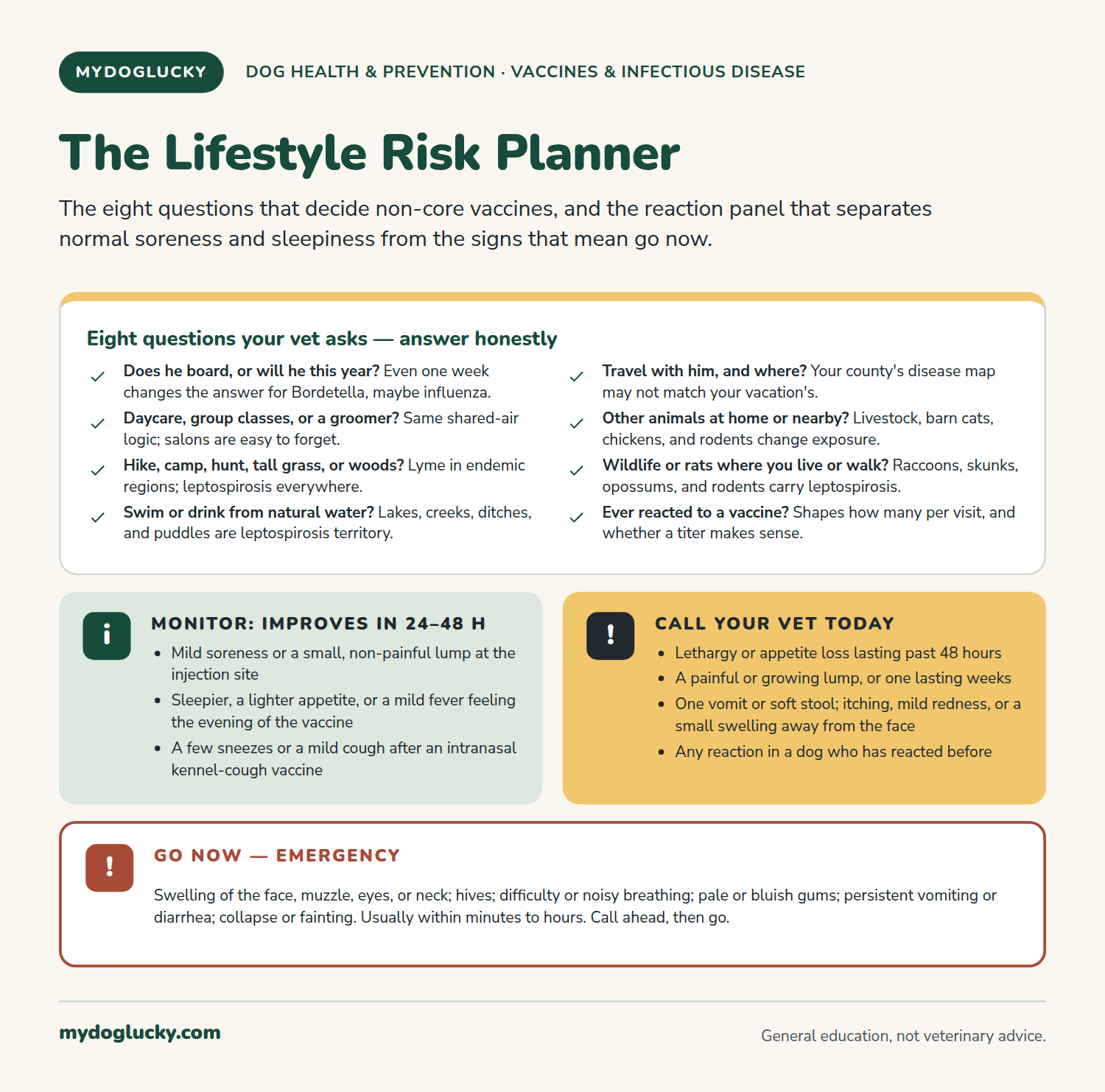
The Lifestyle Risk Planner: The Questions Your Vet Asks
When your vet builds your dog’s individual adult dog vaccination schedule, they’re running through a short risk interview. Knowing the questions in advance makes the visit faster and the plan more accurate. Answer honestly, including the part where your dog drinks from every puddle.
The Eight Questions That Decide the Non-Core List
- Does your dog board, or will he this year? Even one week at a kennel changes the answer for Bordetella and possibly influenza.
- Does he go to daycare, group classes, or a groomer? Same shared-air logic. Grooming salons are easy to forget here.
- Does he hike, camp, hunt, or spend time in tall grass or woods? That’s the Lyme question in endemic regions and the leptospirosis question everywhere.
- Does he swim or drink from natural water? Lakes, creeks, ditches, and standing water are leptospirosis territory.
- Do you travel with him, and where? Your home county’s disease map may not match your vacation’s.
- Are there other animals at home or nearby? Livestock, barn cats, backyard chickens, and rodents all change exposure.
- Do you see wildlife or rats where you live or walk? Raccoons, skunks, opossums, and rodents are leptospirosis reservoirs and, for some, rabies reservoirs.
- Has your dog ever reacted to a vaccine? This shapes how many vaccines are given per visit and whether pre-treatment or a titer makes sense.
Why “He’s an Indoor Dog” Rarely Ends the Conversation
Most owners who say this mean their dog sleeps inside and walks on a leash. That dog still steps in puddles, sniffs where rats have been, and shares an elevator with the neighbor’s dog. AAHA’s leptospirosis update makes the point directly: the risk factor is being unvaccinated, not being rural.
Rabies is the extreme case. Bats get into houses. Picture a truly indoor dog with a lapsed rabies vaccine who catches a bat in the living room. Under the Compendium, that’s an unvaccinated dog exposed to a possible rabid animal. Nobody wants to be explaining “but he never goes outside” in that situation.
What Changes From Year to Year
An adult dog vaccination schedule isn’t set once at age one. WSAVA frames vaccination as one part of an annual health check, “designed around the age, breed, lifestyle, environment and travel activities of the pet and owner.” A move, a new job with a longer commute and daycare, a first camping trip, or a local influenza outbreak can each add a vaccine. A dog who retires from daycare might drop one. The yearly wellness visit is where that gets revisited, even in the two years when no core booster is due.
Titer Testing: What Antibody Levels Can and Cannot Tell You
A titer is a blood test that measures antibodies against a specific disease. Owners often ask about titers as a way to trim an adult dog vaccination schedule. The answer is more nuanced than either “yes, always” or “no, never.”
What a Titer Can Tell You
For distemper, parvovirus, and adenovirus, titers are meaningful. AAHA notes that “protective titers” for these three viruses are the best studied, and WSAVA states that for these diseases, “presence of serum antibody provides evidence of an active humoral immune response, which is very likely to indicate protection from disease.” A dog with a positive titer for those three is, in practical terms, very likely protected.
That makes titers genuinely useful in specific situations. AAHA’s guidelines say routine titer testing is “not usually advised, except in cases in which dogs have a history of adverse responses to vaccination, there is a suspicion of vaccine-related autoimmune disease, or when owners express resistance or hesitancy to having their dogs vaccinated.” The AVMA adds one more: a titer “may help your veterinarian evaluate whether your pet has been previously vaccinated if the animal’s medical history is unclear or unknown.”
What a Titer Cannot Tell You
A negative or low titer doesn’t prove a dog is unprotected. WSAVA is explicit: “absence of detectable antibody does not reliably predict susceptibility to infection and disease,” because titers don’t measure cellular immunity or immune memory. AAHA’s version is nearly the same: a titer, “almost regardless of the amount, is not necessarily indicative of protection or susceptibility.”
Titers also don’t work the same way for every vaccine. For leptospirosis and Lyme, a positive antibody test often reflects infection or exposure rather than protection, which is why those diseases are diagnosed with different tests. For Bordetella and influenza, titers aren’t used to guide boosters in practice.
Why a Titer Never Substitutes for Rabies
This is the firmest line in the whole topic. AAHA’s rabies page states: “Antibody titer levels as correlates of protection have not been established for rabies, and serologic testing is not considered a substitute for vaccination.” The AVMA’s owner guidance agrees that titers “do not replace vaccination programs.”
Legally, that’s the end of the story in almost every U.S. jurisdiction. A rabies titer, however high, won’t satisfy a county clerk, a boarding kennel, or an animal-control officer after a bite. The narrow exception is a medical exemption, which some states allow for dogs with a documented condition that makes vaccination unsafe. That’s a formal process your vet initiates, and even then, an exempted dog is treated as unvaccinated after an exposure.
The Practical Trade-Off
A titer costs money and requires a blood draw. If the result is positive for distemper, parvovirus, and adenovirus, your vet may reasonably defer the DAP booster and retest later. If it’s negative, most vets will recommend the booster anyway. For a healthy dog with no reaction history, the three-year DAP interval is already conservative, and a titer often just confirms what the schedule assumed. For a dog with a reaction history or immune-mediated disease, the calculation is different, and a titer can be worth every dollar.
Vaccine Reactions: Normal vs. Emergency, and the Timeline
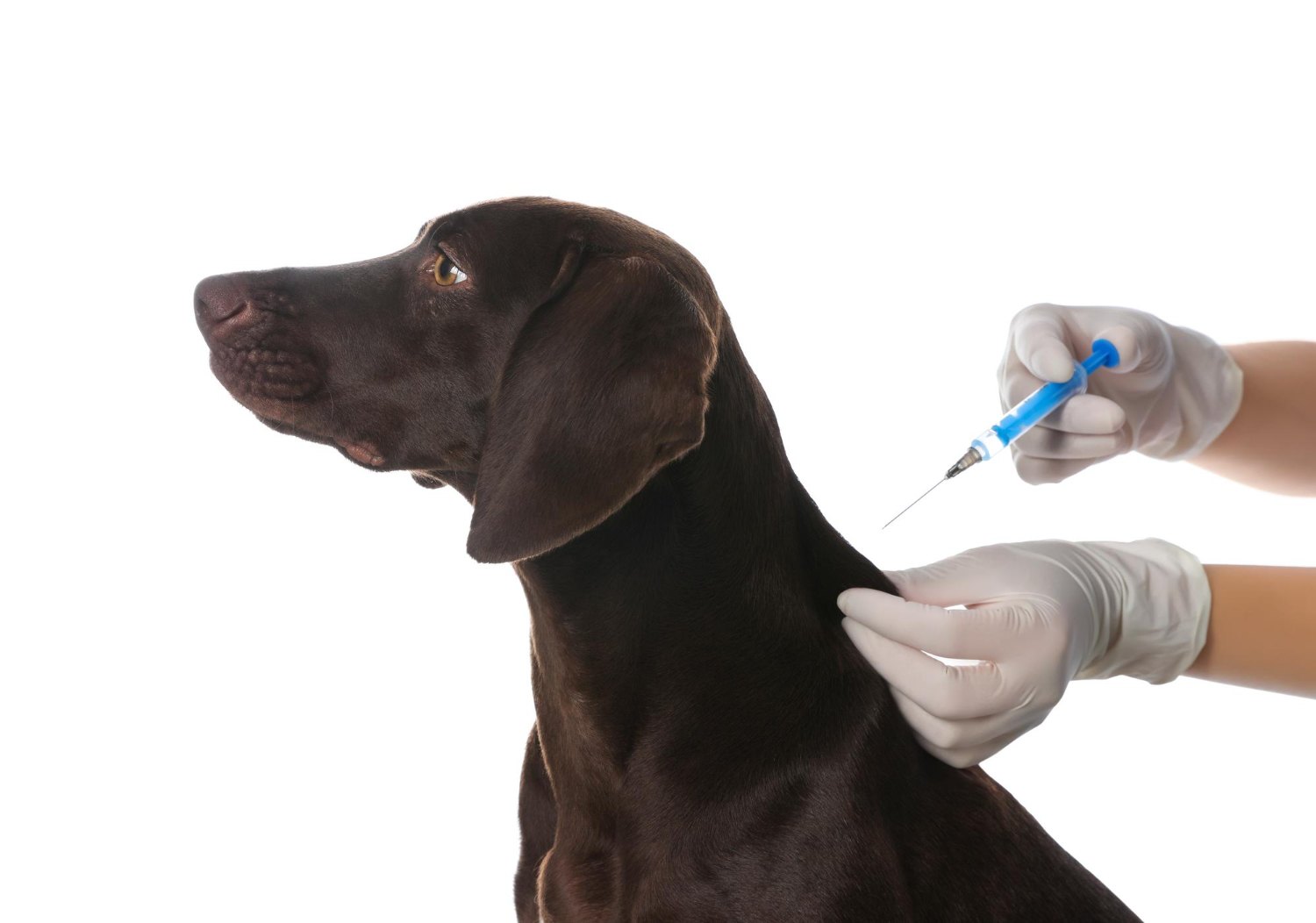
Most dogs move through an adult dog vaccination schedule without much fuss. AAHA’s summary for owners says most reactions are mild and serious allergic reactions are rare. Knowing what “mild” looks like, and when the picture changes, is the part that matters.
What’s Normal in the First 24 to 48 Hours
The AVMA lists the common, expected effects: “tenderness/swelling at injection site,” tiredness, mild fever, and decreased appetite, typically starting within hours and resolving within about a day. VCA’s wording is similar: a dog who “has a temporary loss of appetite or is less lively a day or two after a vaccination” should be back to normal within 24 to 48 hours.
A small, firm lump at the injection site is also common and can linger. VCA’s guidance: “If this lump is painful or persists for more than a few weeks with no decrease in size, consult your veterinarian.” After an intranasal kennel-cough vaccine, “sneezing, mild coughing, or other respiratory signs also may occur 2–5 days after vaccination,” per the AVMA. That’s the vaccine working, not a failed vaccine.
Seek emergency veterinary care right away if you see:
- Swelling of the face, muzzle, or neck, or puffiness around the eyes.
- Hives, which look like raised bumps under the fur, sometimes with itching or red skin.
- Difficulty breathing, noisy breathing, or pale or bluish gums.
- Persistent vomiting or diarrhea, not a single episode.
- Collapse, fainting, or sudden weakness, or a dog who can’t stand.
The AVMA describes these serious allergic reactions as occurring “within minutes to hours” of vaccination. Call the clinic that gave the vaccine if it’s open, or go to the nearest emergency hospital. Don’t wait to see whether it passes.
The Timeline That Helps You Sort It
Timing is a useful clue. Anaphylaxis and serious hypersensitivity reactions tend to happen fast, within minutes to a few hours of the injection. That’s why many clinics ask you to wait in the parking lot for a short while after a first-time vaccine. Facial swelling and hives can appear a little later, sometimes that evening. Ordinary soreness and sleepiness build over the afternoon and fade by the next day. A lump appears over days and shrinks over weeks.
If your dog has a new sign that doesn’t fit the “normal” list, or a normal sign that isn’t improving after 48 hours, that’s a call-today situation, covered below.
Who Is More Likely to React
AAHA’s guidelines note that “adverse reactions of any type are more likely in smaller and younger dogs,” and that reducing the number of vaccines given in one visit is “a particularly useful approach in small dogs.” That doesn’t mean a small dog should skip vaccines. It means your vet may space them across two visits, and it means you should mention any past reaction before the next injection, not after.
Special Cases: Seniors, Prior Reactions, Immune Disease, Pregnancy, Unknown History
The general adult dog vaccination schedule assumes a healthy adult with a known history. Real dogs come with asterisks. Here’s how each common one changes the conversation.
Senior Dogs
There’s a persistent belief that old dogs are “done” with vaccines. The evidence doesn’t support stopping, and it doesn’t support piling on either. WSAVA notes “little evidence that aged dogs and cats that have been vaccinated according to these guidelines throughout life require a specialised or enhanced programme of core revaccination late in life.” AAHA adds that while older dogs may have fewer naive immune cells, they “generally do not lack memory cells created from previous exposure to antigens in early or mid-life.”
Two nuances. WSAVA cites a study in which geriatric dogs vaccinated more than three years earlier were less likely to have protective distemper and adenovirus titers than those vaccinated within three years. That argues for keeping the three-year interval rather than stretching it. And rabies remains legally required regardless of age. For a senior with chronic disease, your vet may adjust timing or use a titer for the DAP decision. Age alone isn’t a reason to stop.
Dogs With a Prior Vaccine Reaction
A past reaction is important information, not an automatic disqualification. AAHA’s guidance: “one cannot presume reactions will automatically recur.” Precautions the guidelines list include “limiting the number of vaccines administered” per visit and, at the veterinarian’s discretion, pre-treating with an antihistamine before the appointment. Some vets also keep the dog at the clinic for observation afterward, or choose a different product or route.
Titers earn their place here. For a dog who reacted badly to a DAP booster, a titer showing protection against distemper, parvovirus, and adenovirus gives your vet a defensible reason to defer. Rabies can’t be deferred on a titer, but the visit can be planned carefully. Bring the record of what happened last time: which vaccine, how long after, what you saw.
Dogs With Immune-Mediated Disease
Dogs living with immune-mediated hemolytic anemia, immune-mediated thrombocytopenia, or similar conditions need an individual plan. AAHA’s framing: “consideration should be given to the stability and condition of the patient, the need for vaccination, and prudent ways to minimize adverse event risk.” In practice, that often means vaccinating only when the disease is stable, spacing vaccines out, using titers for the DAP decision, and, where state law allows, pursuing a formal rabies exemption if the specialist and primary vet agree it’s warranted. This is specialist territory, and it’s fine to ask for that referral.
Pregnant or Nursing Dogs
Ideally, a female dog is fully current before breeding, so the puppies get the best possible maternal antibodies. If a pregnancy is already under way, most vets avoid modified-live vaccines and defer non-urgent boosters. AAHA’s shelter guidance notes that “pregnancy and mild illness or injury are not contraindications” to core vaccines in a shelter setting, where disease exposure is high. For a pet dog at home, the calculation is different. Talk to your vet before the pregnancy if you can, and if you can’t, before assuming anything is safe or unsafe.
Adult Rescue Dogs With No History
Adopting an adult dog with no records is common, and the guidelines are reassuring about it. AAHA states that dogs “with an incomplete or ambiguous vaccination or health history can still be vaccinated with the expectation of a protective immune response and a low risk of serious postvaccination adverse effects,” and offers a rule of thumb: “When in doubt, vaccinate.”
The typical approach for a dog over sixteen weeks with no history is two DAP doses two to four weeks apart per the AAHA table, though WSAVA notes “a single dose of MLV core vaccine will very likely be sufficient” in an adult. Rabies is one dose, treated as a one-year dose, then boosted a year later. Leptospirosis and any lifestyle vaccines start their two-dose series. A shelter’s paperwork usually shows what was given at intake; bring it, even if it’s one line on a card.
Record Keeping and What Boarding, Daycare, and Groomers Ask For
The best adult dog vaccination schedule in the world doesn’t help if you can’t prove it on a Friday afternoon at kennel check-in. Records are the boring part that saves you.
What to Keep, and Where
Keep three things: the rabies certificate (the signed document, not just the tag), the clinic’s vaccination history printout, and any titer results. The rabies certificate matters most, because it’s the document animal control and boarding facilities want. Photograph everything and store it in a phone folder labeled with your dog’s name. Keep the paper originals somewhere you can find in an emergency.
Every time your dog gets a vaccine, ask for an updated printout before you leave. Many clinics also offer an online portal. Set your own reminder for each due date, offset a month early so you have room to book.
What Facilities Typically Require
Boarding kennels, daycares, groomers, and training classes usually ask for proof of rabies, DAP, and Bordetella, often with a minimum lead time so the vaccine has taken effect. Many now ask for leptospirosis and, during outbreaks, canine influenza. Some set their own Bordetella interval that’s shorter than the guideline’s annual booster. Ask when you book, not when you arrive, and ask which document they accept: some want the clinic’s letterhead, not a screenshot.
Rescue transports, dog shows, and interstate travel bring their own paperwork, often a health certificate signed within a set number of days. Your vet’s front desk handles these regularly and will tell you what’s needed.
Why a Documented Overdue Dog Is in a Better Position Than an Undocumented One
This bears repeating because it’s the part of the rabies rules most owners don’t know. After an exposure, a dog whose rabies vaccine lapsed but who has documentation of a prior dose is treated like a current dog: booster and 45-day observation at home. A dog with no documentation is treated as never vaccinated, with the four-month quarantine or worse. A single old certificate in a drawer can be the difference. Keep all of them, forever.
Cost Realities
Vaccine costs vary enough by region and clinic type that any national number is a rough guide. Still, owners deserve a sense of scale before the visit.
What Drives the Bill
The vaccines themselves are often the cheaper line item. Most individual vaccines run in the tens of dollars each at a private practice. The AKC’s puppy-focused guide puts rabies at “usually around $15–20” and notes that shelters and low-cost clinics may charge “approximately $20, or are even free” for core vaccines. Urban clinics typically charge more than rural ones.
The exam fee is separate, and it’s the part that surprises people. A wellness exam is a legitimate charge, not padding. That exam is where the risk interview happens, where a heart murmur or a new lump gets noticed, and where the plan gets adjusted. Titer tests add their own cost, usually more than the booster they might replace.
Ways to Keep It Manageable
- Use the three-year interval. A healthy adult on the guideline schedule has two years out of three with no DAP booster and, in many jurisdictions, no rabies booster either.
- Ask about wellness plans. Many clinics bundle exams and vaccines into monthly payments. Read what’s included before signing.
- Look for low-cost vaccine clinics run by shelters, humane societies, or municipal animal services. They’re legitimate for rabies certificates in most places.
- Skip the non-core vaccines your dog doesn’t need. That’s what the risk planner is for. A dog who never boards doesn’t need influenza on a quiet year.
- Don’t skip the ones he does need. Treating leptospirosis costs far more than preventing it, and a four-month rabies quarantine costs more than a decade of boosters.
One caution from AAHA: vaccines bought online or at feed stores “lack proper storage guarantees and may be ineffective,” and a self-administered rabies vaccine won’t produce a valid rabies certificate, because that document must be signed by a licensed veterinarian. The savings aren’t real if the certificate isn’t.
What to Observe and Record After a Vaccine
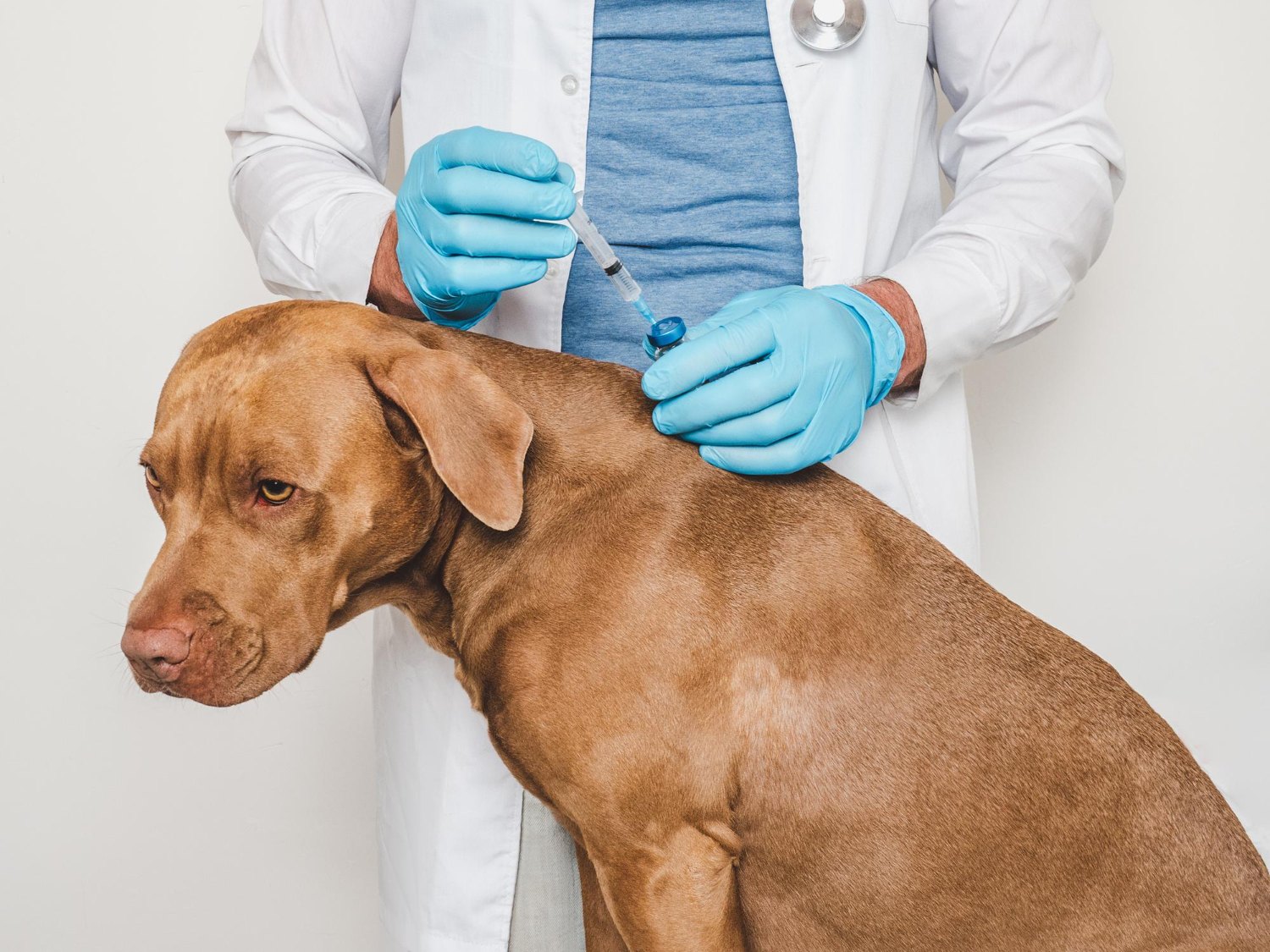
You don’t need to hover. A few deliberate checks in the first two days give your vet exactly what they’d want to know if anything comes up.
The First Hour
If this is a new vaccine for your dog, or he’s reacted before, stay near the clinic for the first twenty to thirty minutes. Watch for facial puffiness, hives, restlessness, drooling, or vomiting. Those early minutes are when the most serious reactions show up, and being a hundred feet from the door is far better than being on the highway.
The First Evening
Note whether he eats dinner, how much he wants to move, and whether the injection site is tender when you touch it lightly. Mild reluctance to jump up, a skipped meal, and a nap that runs long are all on the normal list. Facial swelling, hives, or repeated vomiting are not.
The Next Two Days
Energy and appetite should be trending back to normal by the second day. If your dog got an intranasal kennel-cough vaccine, a few sneezes or a mild cough over the following days is expected. Feel the injection site once a day for a week or so; a small lump is common, and you’re just tracking whether it grows or hurts.
A short vaccine log worth keeping
Write down the date, which vaccines were given, which leg or spot each went into (ask the tech), and anything you notice over the following 48 hours. If a lump forms, note the date it appeared and check it weekly. This log takes two minutes and turns “he seemed off last time” into something your vet can act on before the next round.
Monitor, Call Today, or Go Now: Reactions Sorted by Urgency
Here’s the reaction guidance from the sections above, organized by what to do next.
Monitor at home
- Mild soreness or a small, non-painful lump at the injection site.
- Sleepier than usual, or a lighter appetite, the evening of the vaccine.
- A mild fever feeling (warm ears, less playful) that fades within a day.
- A few sneezes or a mild cough within days of an intranasal kennel-cough vaccine.
Expect improvement within 24 to 48 hours. If it’s improving, no call is needed. If it isn’t, move to the next tier.
Call your vet today
- Lethargy or appetite loss that’s still present after 48 hours.
- An injection-site lump that’s painful, growing, or still there after a few weeks.
- A single episode of vomiting or soft stool with an otherwise normal dog.
- Itching, mild redness, or a small area of swelling away from the face that isn’t spreading.
- Any reaction in a dog with a previous vaccine reaction, even a mild one.
Describe exactly what you’re seeing, which vaccines were given, and how long ago. Ask whether they want to see him and what to watch for tonight.
Seek emergency care now
- Swelling of the face, muzzle, eyes, or neck.
- Hives or widespread raised bumps, especially with itching or red skin.
- Difficulty breathing, noisy breathing, or pale or bluish gums.
- Persistent vomiting or diarrhea.
- Collapse, fainting, staggering, or extreme weakness.
Call ahead if you can, then go. These reactions can progress quickly and are treatable when caught early.
Common Mistakes and Misunderstandings
Letting a Booster Lapse and Assuming the Whole Series Restarts
It depends on the vaccine. A DAP booster that’s late by months, or even a year or two, usually just gets given. Immune memory doesn’t vanish on the due date. Both AAHA and WSAVA lean toward a single dose being enough in a previously vaccinated adult. Leptospirosis, Lyme, and influenza are different: lapse long enough and the two-dose starter series typically restarts. Rabies is a single dose whenever it’s given, but a lapsed certificate has legal consequences until the new one is issued. Don’t skip the visit because you assume it’ll be a full do-over. Ask.
Treating the Reminder Postcard as the Plan
The postcard is a trigger to book an appointment, not your dog’s adult dog vaccination schedule. Clinic reminder systems are often set conservatively, and they don’t know your dog stopped going to daycare or started swimming in the lake. Bring the card, then have the actual conversation about what’s due and what’s changed.
Assuming an Indoor Dog Needs Nothing
Covered above and worth repeating. Rabies is legally required regardless. Leptospirosis reaches city sidewalks. Bats come indoors. An indoor dog may have a shorter non-core list, but “nothing” isn’t on the menu.
Assuming Every Vaccine Is Yearly
The three-year DAP interval has been guideline-supported for years. If your dog is getting DAP annually, it’s reasonable to ask why. Sometimes there’s a good reason. Sometimes there isn’t.
Buying Vaccines Online or at a Feed Store to Save Money
Storage temperature failures can render a vaccine useless, and you’ll never know. A self-given rabies vaccine doesn’t come with a veterinarian-signed certificate, so it carries no legal weight. The savings evaporate the first time you need proof.
Forgetting to Mention a Past Reaction
The tech drawing up the syringe can’t read your dog’s history in your head. Say it at check-in, every time, even if it’s in the chart. Small dogs and dogs with a reaction history may get fewer vaccines per visit or a different approach, but only if someone knows.
Using a Titer to Argue With Animal Control
Titers can inform a DAP decision. They carry no legal weight for rabies, and a boarding kennel doesn’t have to accept one for anything. Know which conversation you’re in.
Skipping Leptospirosis Because Your Vet Used to Call It Optional
Guidance changed in 2024. If your dog’s last plan was built before that, it’s worth asking whether leptospirosis should be added now. The two-dose start works at any age.
Frequently Asked Questions About Adult Dog Vaccines
What is the standard adult dog vaccination schedule?
After the puppy series and a booster about a year later, the core DAP vaccine is given every three years. Rabies is given every one or three years depending on the product and your local law. Leptospirosis is given yearly. Non-core vaccines like Bordetella, Lyme, and canine influenza are yearly if your dog’s lifestyle calls for them. Your vet adjusts this general shape to your dog.
Do adult dogs really need vaccines every year?
Not every vaccine. DAP is every three years for a healthy adult. Rabies may be one or three years by law. Leptospirosis and the lifestyle vaccines are yearly because their protection is shorter-lived. A yearly wellness exam is still a good idea even in the years when no core booster is due.
What happens if my dog is overdue for a booster?
For DAP, a late booster usually just gets given, with no restart. For leptospirosis, Lyme, or influenza, a long lapse may mean restarting the two-dose series. For rabies, one dose brings the certificate back into force, but your dog is legally unprotected until then. Call and ask; don’t avoid the visit because you expect a lecture.
Is a three-year rabies vaccine accepted everywhere?
No. Many jurisdictions accept it, but some require yearly boosters no matter which product was used. Your certificate shows the legal expiration date, which is the one that counts. Check again if you move.
What if my vaccinated dog is bitten by a wild animal?
Call your vet the same day. Under the Compendium the CDC follows, a currently vaccinated dog gets an immediate booster and 45 days of observation, usually at home. Report the exposure to local animal control if required in your area. Don’t handle the wild animal.
What if my unvaccinated dog is bitten by a wild animal?
This is a serious situation. The Compendium’s primary recommendation for a never-vaccinated dog exposed to rabies is euthanasia, with a strict four-month quarantine as the alternative. If you have any old rabies certificate at all, find it now; documentation of a prior vaccine changes the outcome to booster and observation.
Can a titer test replace my dog’s rabies vaccine?
No. AAHA states that protective titer levels have not been established for rabies and that serology “is not considered a substitute for vaccination.” No U.S. jurisdiction accepts a titer in place of a rabies vaccine. Medical exemptions exist in some states but go through a formal process, and an exempted dog is still treated as unvaccinated after an exposure.
Can a titer test replace the DAP booster?
Sometimes. A positive titer for distemper, parvovirus, and adenovirus is a reasonable basis for deferring the booster, especially in a dog with a reaction history or immune-mediated disease. A negative titer doesn’t prove the dog is unprotected, but most vets will boost anyway. Discuss it rather than assuming either way.
Does my indoor dog need the leptospirosis vaccine?
Very likely yes, if he goes outdoors at all, including sidewalk walks. AAHA moved leptospirosis to core for most dogs in 2024 because the disease shows up in cities, suburbs, and dry regions alike, spread by rats and wildlife. The risk factor AAHA emphasizes is being unvaccinated, not living rurally.
Does my dog need the Bordetella vaccine if he never boards?
Maybe not. Bordetella is for dogs who share air with other dogs: boarding, daycare, grooming, classes, dog parks, shows. A dog with none of those exposures may reasonably skip it. If that changes, most versions take effect fast enough to add before a booking, but ask about lead time.
Should my dog get the canine influenza vaccine?
The AVMA and AAHA don’t recommend it routinely. It becomes worth discussing when the virus is circulating in your area and your dog boards, goes to daycare, or attends events. Some facilities require it during outbreaks. Ask your vet what’s happening locally this year.
Is the rattlesnake vaccine worth it?
AAHA notes there are no published efficacy data in dogs and that reactions have been reported in vaccinated dogs who were later bitten. A vaccinated dog still needs emergency care after a bite. Treat it as a regional conversation with your vet, not a default.
What are normal side effects after a dog vaccine?
Soreness at the injection site, tiredness, a lighter appetite, and a mild fever for about a day. A small, non-painful lump can last a few weeks. Sneezing or a mild cough can follow an intranasal kennel-cough vaccine. These should improve within 24 to 48 hours.
What vaccine reaction signs mean I should go to the emergency vet?
Facial or neck swelling, hives, difficulty breathing, persistent vomiting or diarrhea, collapse, or extreme weakness. These serious reactions usually appear within minutes to hours. Call ahead and go.
My dog reacted to a vaccine before. Does that mean no more vaccines?
No. AAHA notes that reactions don’t automatically recur. Your vet may give fewer vaccines per visit, pre-treat with an antihistamine, choose a different product, keep your dog for observation, or use a titer for the DAP decision. Rabies remains legally required. Tell every clinic, every visit.
Do senior dogs still need vaccines?
Yes. A senior’s adult dog vaccination schedule looks much like a younger adult’s. Rabies is legally required at any age, and the evidence doesn’t support stopping core boosters in healthy seniors. WSAVA cites a study suggesting older dogs vaccinated more than three years earlier were less likely to have protective titers, which supports keeping the three-year interval. Your vet may adjust timing for a senior with chronic disease.
I adopted an adult dog with no records. What now?
AAHA’s rule of thumb is “when in doubt, vaccinate.” Expect a rabies dose (treated as a one-year dose), one or two DAP doses, and a two-dose leptospirosis series, plus lifestyle vaccines as needed. Bring any shelter paperwork, even a single card.
How much do adult dog vaccines cost?
Individual vaccines often run in the tens of dollars each, with the exam fee separate. Low-cost clinics run by shelters or animal services can bring rabies and core vaccines down substantially. Costs vary widely by region, so ask for an estimate when you book.
Can I give my dog vaccines at home to save money?
You can buy some vaccines that way, but AAHA warns that storage failures can make them ineffective, and a self-given rabies vaccine won’t get you a legal certificate. For rabies, a licensed veterinarian administers it and signs the certificate, and that signed document is what the law recognizes.
How long before boarding should my dog be vaccinated?
Ask the facility. Many want proof that vaccines were given a set number of days before check-in, so protection has had time to develop. Some want the clinic’s letterhead rather than a photo. Booking the vet visit two to three weeks before a stay avoids most problems.
Where This Leaves You
The adult dog vaccination schedule is less complicated than the reminder postcards make it look. Core vaccines on a fixed cadence. Non-core vaccines by lifestyle. Rabies on the interval the law sets. And one honest conversation a year to keep the plan matched to the dog you actually have. The three-year DAP interval is evidence-based, leptospirosis has earned its place on most dogs’ lists, and titers are a useful tool in specific situations and a poor substitute in others.
The one thing not to improvise is rabies. Keep every certificate, know your local interval, and don’t let it lapse because your dog seems to live a quiet life. For everything else, bring your dog’s real routine to the next wellness visit, answer the eight questions honestly, and let your vet build the version of this schedule that fits.
Sources
- American Animal Hospital Association. 2022 AAHA Canine Vaccination Guidelines (updated 2024).
- American Animal Hospital Association. 2022 AAHA Canine Vaccination Guidelines, full text (PDF).
- American Animal Hospital Association. 2022 AAHA Core and Noncore Vaccines for Dogs (table, PDF).
- American Animal Hospital Association. Key Vaccination: Rabies.
- American Animal Hospital Association. Update: AAHA guidelines designate leptospirosis vaccine as core (updated January 3, 2025).
- American Animal Hospital Association. Top 10 Facts Pet Owners Should Know About AAHA’s Canine Vaccination Guidelines.
- American Veterinary Medical Association. Vaccinations (pet owner resource).
- American Veterinary Medical Association. Canine Influenza.
- American Veterinary Medical Association, JAVMA News. New guidance for pets exposed to rabies (March 1, 2016; summarizes the 2016 NASPHV Compendium).
- American Veterinary Medical Association, JAVMA News. To titer or to revaccinate (July 1, 2016).
- Centers for Disease Control and Prevention. Rabies: Information for Veterinarians.
- World Small Animal Veterinary Association. WSAVA Guidelines for the Vaccination of Dogs and Cats, 2024 (PDF).
- VCA Animal Hospitals. Vaccines for Dogs.
- Merck Veterinary Manual. Vaccines and Immunotherapy (pet owner version).
- Michigan State University College of Law, Animal Legal & Historical Center. Table of Rabies Vaccination Laws (2022).
- American Kennel Club. Your Complete Guide to First-Year Puppy Vaccinations (cost reference).
This article is general education for U.S. dog owners. It is not individualized veterinary advice, a diagnosis, or a substitute for an in-person veterinary exam. Vaccine schedules, rabies intervals, and exemption rules vary by state and locality and change over time; your veterinarian and local animal-control authority have the final word on your dog’s plan and legal status. If your dog shows facial or neck swelling, hives, difficulty breathing, persistent vomiting or diarrhea, collapse, or extreme weakness after a vaccine, seek emergency veterinary care right away rather than waiting.