Parvo in dogs is a veterinary emergency, and the short version comes first: a puppy with vomiting and bloody diarrhea needs a vet today, not tomorrow. Canine parvovirus attacks the lining of the intestine and the bone marrow at the same time. A puppy who seemed a little tired this morning can be dangerously dehydrated by tonight. Without treatment, most infected puppies die. With prompt hospital care, most survive. The gap between those two outcomes is measured in hours, and it is mostly decided by how fast someone picks up the phone.
This guide is written for the owner standing in the kitchen at 11 p.m. with a sick puppy and a search bar. It covers what the virus does, who it targets, how it spreads, what the signs look like at each stage, how a veterinarian diagnoses and treats it, what survival actually looks like, what it costs, and how to keep the next dog from ever getting it. The emergency information sits at the top on purpose.
One scope note. This article is about canine parvovirus specifically. Vomiting and diarrhea in dogs have many other causes, and most of them are far less dangerous. But in an unvaccinated or partly vaccinated puppy, parvo is the cause a veterinarian rules out first, because it is the one that kills. If your dog is fully vaccinated and an adult, read on for context, but the odds are strongly in your favor.
What’s in this guide
- Parvo in dogs: the signs that mean go now
- What canine parvovirus is and why it is so dangerous
- Who is most at risk
- How parvo spreads and why it lingers
- Incubation and signs by stage
- Why “wait and see” is not an option
- How a veterinarian diagnoses parvo
- How parvo is treated
- Survival rates with and without treatment
- The cost of treatment and what to do if you can’t afford it
- Recovery, shedding, isolation, and cleanup
- Preventing parvo in dogs: the vaccine plan and the risky window
- Parvo myths that get puppies hurt
- Common mistakes owners make
- Frequently asked questions about parvo in dogs
- Sources
Parvo in Dogs: The Signs That Mean Go Now
Parvo does not announce itself. The first day usually looks like a puppy who is quieter than normal and skips a meal. By the second day there is vomiting. Then the diarrhea starts, and it is often bloody and foul-smelling. From there, fluid loss outruns anything a small body can replace by drinking. That is the whole reason this disease is so lethal in puppies: they run out of fluid, their blood sugar and electrolytes crash, and bacteria from the damaged gut leak into the bloodstream.
Call a veterinarian now, not tomorrow, if your dog shows any of these:
- Vomiting plus diarrhea in a puppy, especially one under six months old or one who has not finished the full vaccine series.
- Bloody or foul-smelling diarrhea of any amount, in any dog, at any age.
- Repeated vomiting, meaning more than once, or a dog who cannot keep water down.
- Lethargy that is getting worse: a puppy who will not get up, will not engage, or feels limp.
- Refusing food and water for more than a few hours in a young puppy.
- Signs of dehydration: dry or tacky gums, sunken eyes, skin that stays tented when gently lifted.
- A body that feels unusually hot or unusually cold. Parvo can cause fever early and a dangerously low temperature later.
- Collapse, pale gums, or a puppy who is hard to rouse. Go to the nearest open veterinary hospital immediately.
- Any of the above after known contact with a sick dog, a shelter, a pet store, a dog park, or a home that had parvo.
One sign is enough. Call ahead so the clinic can meet you outside and keep your dog away from other patients. Do not wait for “all the symptoms” to line up. Do not try a bland diet first. Do not give any human medication.
What to Say When You Call
Clinics triage parvo differently from a routine upset stomach, so give them the information that moves your dog to the front of the line. Say your dog’s age, whether the vaccine series is finished, when the signs started, whether there is blood in the stool, how many times your dog has vomited, and whether your dog has been anywhere with unknown dogs recently. If you know the dog was exposed to a confirmed parvo case, say so first.
Ask where they want you to park and whether they want you to carry the dog in rather than walking him through the lobby. Most clinics will give you an isolation entrance. That is not an inconvenience. It is the clinic protecting the eight-week-old puppy in exam room two who came in for a vaccine.
If Your Regular Clinic Is Closed
Parvo does not keep business hours. If your veterinarian’s office is closed, call the nearest emergency veterinary hospital. If you live far from one, call your regular clinic’s after-hours line anyway; many forward to an on-call veterinarian or an emergency partner. Tell them what you are seeing and ask where to go. A puppy with bloody diarrhea who waits until 8 a.m. for the regular clinic to open has lost eight to ten hours that matter.
What Canine Parvovirus Is and Why It Is So Dangerous
Canine parvovirus type 2, usually written CPV-2, is a small, tough virus that appeared in dogs in the late 1970s and spread worldwide within a couple of years. According to the AVMA, parvo is “a highly contagious disease caused by canine parvovirus type 2 (CPV-2)” that “impacts white blood cells and the gastrointestinal tract.” The virus has drifted into a few closely related variants over the decades. The AAHA guidelines note the known variants are about 99 percent genetically similar, and current vaccines are considered protective against all of them.
To understand why parvo in dogs is so lethal, you need to know one thing about how it works. The virus can only copy itself inside cells that are dividing quickly. In a young dog, the fastest-dividing cells are in exactly two places: the lining of the small intestine and the bone marrow. Parvo hits both.
What Parvo Does in the Intestine
The inside of the small intestine is lined with tiny finger-like projections called villi. New cells that cover those villi are made in little pockets at their base called crypts. The Merck Veterinary Manual describes how CPV “preferentially infects and destroys rapidly dividing cells of the small intestinal crypt epithelium.” When the crypts die, the intestine cannot replace its lining. The villi collapse and the surface that absorbs water and nutrients is gone.
The practical result is a gut that cannot hold fluid in and cannot keep bacteria out. Fluid pours out as diarrhea, often with blood, because the lining is literally coming apart. At the same time, the bacteria that normally live harmlessly inside the intestine can cross the damaged wall into the bloodstream. That is why a parvo puppy can go from “dehydrated” to “septic” quickly, and why treatment includes antibiotics even though the disease itself is viral.
What Parvo Does in the Bone Marrow
Bone marrow is where white blood cells are manufactured. Parvo destroys the rapidly dividing cells there too, and the marrow stops producing the infection-fighting cells the dog needs most at that exact moment. Veterinarians see this on bloodwork as a very low white blood cell count. Merck lists “leukopenia with lymphopenia and neutropenia” among the classic findings.
Put the two effects together and you have the trap that makes parvo so dangerous. The intestine is leaking bacteria into the blood while the bone marrow has stopped making the cells that would fight them. A healthy adult dog with a mature immune system and a full vaccine history usually has enough reserve to handle this. A ten-week-old puppy does not.
The Heart in Very Young Puppies
There is a less common form of the disease that matters mostly for breeders and for people who take in very young orphaned litters. The AVMA notes that in puppies, parvo “can also damage heart muscle.” This happens when puppies are infected in the womb or in the first weeks of life, before the gut form of the disease is even the main concern. It can cause sudden death or lasting heart damage. Widespread vaccination of adult dogs has made it rare, but it is one more reason to keep a pregnant dog current on her vaccines before breeding.
Who Is Most at Risk
Any unvaccinated dog can get parvo. In practice, parvo in dogs clusters in a few groups, and knowing them helps you calibrate how worried to be about a given bout of vomiting.
Puppies Between Six Weeks and Six Months
This is the heart of the problem. Merck identifies young dogs between six weeks and six months of age as the primary risk group, and Cornell’s Riney Canine Health Center says parvo “commonly affects puppies between the age of 6 weeks to 6 months.” The AVMA narrows the peak further to puppies aged 6 to 20 weeks.
Here is why that window exists. A puppy is born with some protection borrowed from the mother’s milk in the first day or two of life. Those maternal antibodies fade over the following weeks at a rate that differs from puppy to puppy. While they are present, they can block a vaccine from working. As they fade, the puppy becomes vulnerable to real infection. For a stretch of days or weeks in most puppies, maternal protection has dropped too low to prevent disease but is still high enough to interfere with a vaccine dose. Veterinarians call this the window of susceptibility. That is the reason the puppy series is a series, not a single shot.
Dogs Who Started the Vaccine Series but Did Not Finish It
A common and heartbreaking version of this story goes: the puppy got “his shots” at eight weeks from the breeder or shelter, went to a new home, and never received the follow-up doses. Or the second dose happened and the third did not. Or the final dose was given at 12 weeks, when the AAHA guidelines call for the last puppy dose to be given after 16 weeks. In each case, the owner believes the puppy is protected. The puppy is not. One dose in an eight-week-old puppy often gets blocked by maternal antibodies, and a series that stops early leaves the same gap it was meant to close.
Certain Breeds Reported at Higher Risk
Several veterinary sources list breeds that appear more often in parvo case series or that are reported to have more severe disease. Merck names Rottweilers, Doberman Pinschers, English Springer Spaniels, German Shepherd Dogs, and pit bull-type dogs. The AVMA’s list overlaps closely. VCA adds Labrador Retrievers and Arctic sled breeds among dogs reported to have higher fatality rates.
Two hedges belong here. First, the reason for these patterns is not fully understood, and breed popularity, testing patterns, and breeding practices may all play a part. Second, and more important, breed does not determine whether your dog gets sick. Vaccination status does. A fully vaccinated Rottweiler is at far lower risk than an unvaccinated mixed-breed puppy of unknown background. If you have one of the listed breeds, treat it as a reason to be careful about timing and exposure, not a reason to panic.
Adult Dogs With Lapsed or Unknown Vaccines
Adults are usually left out of the parvo conversation, and that gives some owners a false sense of safety. Adult dogs who never completed a series, or whose boosters lapsed years ago, can and do get parvo. Rescued adults with no records, dogs from hoarding situations, and dogs in rural areas with limited veterinary access are the typical cases. Merck also notes that sexually intact males over six months of age appear at increased risk, likely because of roaming and exposure patterns.
Adult dogs generally handle the disease better than puppies, because their immune system is mature and their bone marrow has more reserve. Better is not the same as safe. An unvaccinated adult with bloody diarrhea needs the same urgent call as a puppy.
Dogs Living in High-Exposure Settings
Shelters, rescues, pet stores, boarding facilities, and homes with many dogs concentrate risk simply because more dogs pass through and more feces end up on the floor. This is why the AAHA guidelines have a separate, more aggressive shelter protocol, covered in the prevention section below. It is also why a puppy adopted from a shelter should be watched closely for the first two weeks at home even if he looked healthy on adoption day. He may have been exposed before he left.
The three questions that set your risk level
- How old is the dog? Under six months means high risk until the series is complete.
- Is the vaccine series finished? “Finished” means a final dose given at or after 16 weeks, with the earlier doses on schedule. “He had some shots” does not count.
- Where has the dog been in the past two weeks? Shelters, pet stores, dog parks, sidewalks with heavy dog traffic, and homes with sick dogs all raise the odds.
If the answers are “young,” “no,” and “somewhere with other dogs,” a vomiting episode is a same-day veterinary visit, full stop.
How Parvo Spreads and Why It Lingers
Parvo in dogs moves through what veterinarians call the fecal-oral route. An infected dog sheds enormous numbers of virus particles in feces. Another dog swallows some of it. That sounds like it should require a dog to eat stool, and sometimes it does. Far more often, the transfer is indirect and invisible.
Direct Contact and Fomites
The AVMA describes transmission through “direct contact with infected dogs, contact with their feces (poop), or contact with virus-contaminated surfaces.” VCA is blunt about the second half of that sentence: “Direct contact between dogs is not required to spread the virus.” Virus particles ride on paws, fur, shoes, clothing, leashes, food bowls, crates, car seats, and hands. A veterinarian’s word for any object that carries infection is “fomite,” and with parvo the list of possible fomites is basically everything.
A puppy can catch parvo from a sidewalk where a sick dog defecated three months earlier. From a visitor’s shoes. From a used crate bought secondhand. From a yard the previous tenant’s dog used. From the floor of a pet store. None of that requires the sick dog to still be present, or even alive.
Shedding Starts Before the Dog Looks Sick
This is the detail that undoes most owners’ mental models. According to Merck and the AKC, infected dogs begin shedding virus “within four to five days of exposure,” which is often before the first sign appears. Cornell puts the pre-symptom shedding window at “up to two weeks before any symptoms develop.” A puppy at a training class who looks perfectly healthy can already be seeding the room.
Shedding continues after recovery, too. Merck and the AKC cite up to 10 days after clinical recovery. VCA says “shedding continues for about 14 days after clinical signs resolve.” Cornell recommends isolation for “up to 2 weeks after recovery.” The exact number varies by source and by dog, which is why the safe plan is to treat a recovered dog as contagious for a full two weeks and to ask your veterinarian before ending isolation.
Environmental Persistence
Parvo is a non-enveloped virus, meaning it lacks the fragile outer fatty layer that makes many viruses easy to kill with soap and time. That structure makes it extraordinarily durable. Merck states that CPV persists “indoors at room temperature for at least 2 months” and outdoors “for many months and possibly years.” Cornell says it can “survive in the right conditions for up to a year.” The ASPCA notes it survives on objects like food bowls and carpets for months.
Cold does not kill it. Heat, sunlight, and drying reduce it over time but do not reliably remove it from soil. Practically, this means a yard, a park, or a floor that hosted a parvo dog should be considered contaminated for a long time, and a new puppy should not go there until the vaccine series is complete.
Resistance to Most Household Disinfectants
Cornell describes the virus as “hardy in the environment and resistant to many household disinfectants.” VCA states that “most disinfectants” are ineffective. Merck specifically says quaternary ammonium disinfectants, which are the active ingredient in many everyday surface cleaners and wipes, are unreliable against parvo.
What does work, as a class: diluted chlorine bleach and certain peroxygen-based veterinary disinfectants. Veterinary sources such as VCA, Cornell, and Merck cite a bleach dilution of roughly 1 part bleach to 30 parts water, applied to a surface that has already been cleaned of visible dirt and organic material, and left wet for at least 10 minutes. Bleach only works on hard, non-porous surfaces. It does not work on grass, soil, or fabric, and organic material inactivates it, which is why the pre-cleaning step is not optional.
That is the general principle. Turning it into a full cleaning plan for your specific home, yard, and materials is a conversation for your veterinarian, who may also point you to a specific veterinary-grade product. The recovery section below covers the sequence in more detail.
Can People or Cats Get Parvo From Dogs?
People cannot get canine parvovirus. VCA states there is “no evidence of human transmission.” Humans have their own parvovirus, a completely different virus, and the two do not cross. People can, however, carry the dog virus on their hands, shoes, and clothes, which is how a healthy human becomes the link between a sick dog and a healthy one.
Cats are a more nuanced story. Some CPV-2 variants can infect cats, and VCA notes those infections are generally milder. Cats have a closely related parvovirus of their own, feline panleukopenia, which the standard feline core vaccine covers. If you have a parvo-positive dog and cats in the home, mention that to your veterinarian and confirm the cats are current on their own vaccines.
Incubation and Signs by Stage
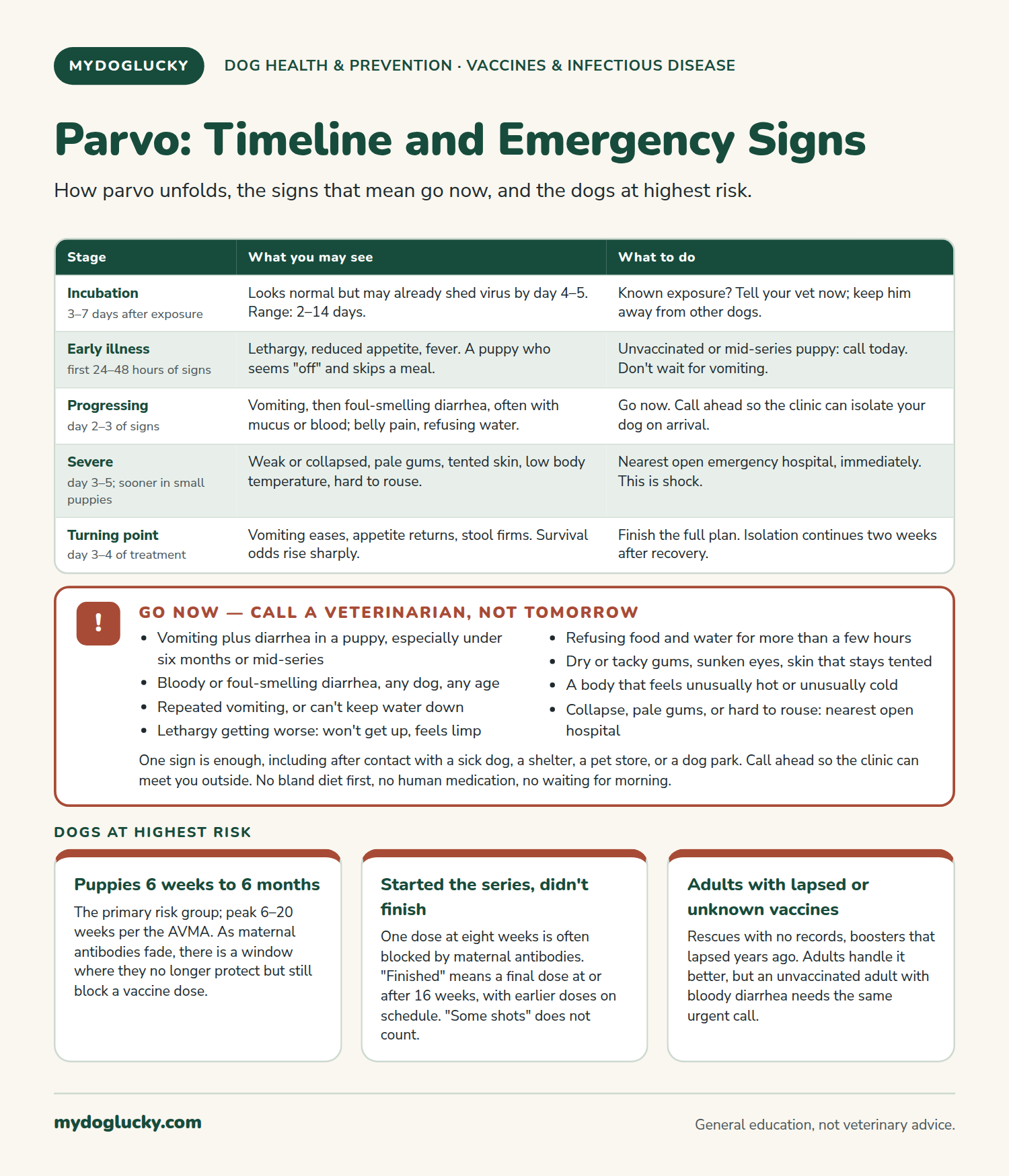
Parvo in dogs follows a fairly predictable sequence, which is useful, because it lets you place your dog on a timeline and understand how much time you may have. Understand this as orientation, not as a checklist to wait through. Every stage below is a reason to call, and later stages are reasons to already be in the car.
Incubation: Exposure to First Signs
Merck reports that clinical signs “generally develop within 5–7 days after infection” with a range of 2 to 14 days. VCA and the AKC give “three to seven days.” During incubation the puppy looks normal. If you know the exposure date, count forward: the second through the tenth day after exposure is when to watch most closely, and the dog may already be shedding by day four or five.
Early Signs: The First 24 to 48 Hours of Illness
Cornell describes the sequence plainly: early symptoms “begin with lethargy, followed by decreased appetite and vomiting.” The very first sign is usually a puppy who is quieter than usual and less interested in food. Many owners describe it as “he just seemed off.” A fever is common at this stage, though you will rarely detect it without a thermometer.
This is the stage where treatment has the best odds and where owners most often wait. A quiet puppy who skipped breakfast is easy to explain away. In an unvaccinated puppy with any exposure history, it should not be.
Progressing Signs: Vomiting, Then Diarrhea
VCA notes that “severe vomiting” usually begins first, followed by diarrhea. The diarrhea “often has a powerful smell, may contain a lot of mucus, and may or may not contain blood.” Owners who have smelled parvo diarrhea once describe it as distinctive and unforgettable; that is not an exaggeration, and veterinary staff often recognize it from across the room. Merck notes that roughly a quarter of dogs never develop visibly bloody diarrhea, so the absence of blood does not rule parvo out.
Abdominal pain, a bloated belly, and drooling from nausea appear on the AVMA’s list of signs at this stage. The puppy stops drinking, or drinks and vomits it back up. Dehydration accelerates.
Severe Signs: Dehydration, Shock, and Sepsis
As fluid loss outpaces intake, the puppy becomes weak, then unable to stand. Gums go pale or muddy. The body temperature, which was high early, can drop dangerously low as the dog goes into shock. Bacteria crossing the damaged gut wall trigger sepsis, and low blood sugar from not eating adds to the collapse. Merck lists low potassium, low blood sugar, and low blood protein among the findings in severe cases.
Death usually comes from dehydration, septic shock, or both. In untreated puppies, it can happen within a few days of the first signs. This stage is survivable with intensive care, but every hour of delay lowers the odds.
| Stage | Typical timing | What you may see | What to do |
|---|---|---|---|
| Incubation | Roughly 3–7 days after exposure (range 2–14) | Nothing. The dog looks normal but may already be shedding virus by day 4–5. | If you know of an exposure, tell your vet now and keep the dog away from other dogs. |
| Early illness | First 24–48 hours of signs | Lethargy, reduced appetite, fever, a puppy who seems “off.” | Unvaccinated or partly vaccinated puppy: call today. Do not wait for vomiting. |
| Progressing illness | Day 2–3 of signs | Vomiting, then foul-smelling diarrhea often with mucus or blood, abdominal pain, drooling, refusing water. | Go now. Call ahead so the clinic can isolate your dog on arrival. |
| Severe illness | Day 3–5 of signs, sooner in small puppies | Weakness or collapse, pale gums, tented skin, low body temperature, unresponsiveness. | Nearest open emergency hospital, immediately. This is shock. |
| Turning point | Day 3–4 of treatment | Vomiting eases, appetite returns, stool firms. Survival odds rise sharply once a dog passes this point. | Continue the full treatment plan. Isolation continues for two weeks after recovery. |
Why “Wait and See” Is Not an Option
With most puppy stomach upsets, a day of observation is reasonable. With suspected parvo in dogs, it is the single most costly mistake an owner can make. The reasons are physical, not cautious hedging.
Puppies Dehydrate in Hours, Not Days
A ten-pound puppy has very little fluid reserve. Vomiting removes fluid from one end, diarrhea from the other, and the puppy cannot drink enough to replace it because drinking triggers more vomiting. Small bodies also lose heat and blood sugar faster. What might be a rough 48 hours for an adult Labrador is a life-threatening 12 hours for a young puppy.
The Damage Compounds
Parvo is not a static problem that waits for you. Every hour, more crypt cells die, more of the gut wall fails, and more bacteria cross into the blood while the bone marrow produces fewer defenders. The dog who arrives at the hospital on day one of signs has a gut that is still mostly intact and a white cell count that has not yet bottomed out. The dog who arrives on day three is fighting dehydration, sepsis, and hypoglycemia at the same time.
Early Treatment Changes the Outcome
The AVMA states it directly: “Prompt, intensive treatment improves your dog’s chance of survival.” The AKC notes that survival odds climb once a puppy makes it through the first three to four days of illness. VCA notes that a dog who has not improved by day three or four of treatment has a poorer prognosis. Both of those observations point to the same conclusion: get the dog into treatment before those days are spent at home.
The Cost of Waiting Is Usually Higher Than the Cost of Going
Owners sometimes delay because they fear the bill. That instinct is understandable, and the cost section below takes it seriously. But a parvo puppy seen on day one of signs often needs less intensive care, a shorter stay, and a lower total bill than the same puppy seen on day three in shock. Waiting rarely saves money on this disease. It usually costs more and lowers the odds at the same time.
How a Veterinarian Diagnoses Parvo
Diagnosing parvo in dogs is fast, which is part of the good news. Most clinics can confirm or strongly suspect parvo within an hour of your arrival.
The Fecal Antigen Test
The workhorse is an in-clinic test that detects parvovirus antigen in a stool sample or a rectal swab. Cornell describes it as “a relatively quick and inexpensive test,” and the AVMA notes that “fecal testing can confirm the diagnosis.” Merck reports that these tests have good to excellent sensitivity. Results usually come back in about ten to fifteen minutes.
A few caveats your veterinarian will weigh. Very early in the disease, or late in the course, the amount of virus in the stool may be too low to detect, so a negative result in a puppy with classic signs does not always end the conversation. A recent modified-live vaccine can occasionally influence the result, so bring the date of the last vaccine. If the picture is unclear, the clinic may send a sample out for PCR testing, which is more sensitive but takes longer.
Bloodwork
A complete blood count is the second pillar. Because parvo suppresses the bone marrow, a very low white blood cell count in a puppy with vomiting and diarrhea strongly supports the diagnosis. VCA notes that reduced white blood cell count “supports a tentative diagnosis.” A chemistry panel checks blood sugar, potassium, protein, and kidney values, which tells the veterinarian how sick the puppy is right now and what the fluid plan needs to correct.
Ruling Out Look-Alikes
Vomiting and bloody diarrhea in a puppy can also come from intestinal parasites, a swallowed object, a toxin, other infections, or dietary indiscretion, and more than one of these can happen at once. Parasites in particular are common in parvo puppies and make the disease worse. Expect a fecal parasite check, and in some cases x-rays or ultrasound if the veterinarian is worried about a blockage. Cornell lists blood work, x-rays, and ultrasound among the additional tests that may be used.
Bring these to the appointment if you can do it safely
- Vaccine records, or the name of the shelter, breeder, or clinic that gave the shots and the dates.
- A fresh stool sample in a sealed bag, if collecting it does not delay leaving.
- A timeline: when the dog last ate, drank, vomited, and passed stool, and what it looked like.
- Any exposure history: shelters, pet stores, parks, sick dogs, visitors with dogs.
- A list of anything else the dog could have eaten or gotten into.
If gathering any of this would cost you more than a few minutes, skip it and go. The clinic can work without it.
How Parvo Is Treated
There is no drug that kills parvovirus inside the body the way an antibiotic kills bacteria. The ASPCA says it plainly: no antiviral drugs exist to eliminate the virus. Treatment for parvo in dogs instead does three things. It keeps the puppy alive while the immune system catches up, it prevents the complications that actually cause death, and, with the newer antibody treatment, it may help the immune system win faster.
Hospitalization and Intravenous Fluids
The foundation of parvo treatment is fluid. Intravenous fluids replace what the puppy is losing, correct electrolyte imbalances, and deliver glucose when blood sugar drops. Merck describes fluid therapy with balanced electrolyte solutions, with dextrose and potassium added as needed. This is not something that can be done with a bowl of water or an oral electrolyte drink at home, because the puppy vomits it back up and the losses are far larger than a puppy can drink.
The AVMA states that severe cases require “immediate, intensive treatment and 24/7 monitoring.” The ASPCA reports that average hospital stays last five to seven days. Some puppies go home sooner, some need longer.
Anti-Nausea Medication
Stopping the vomiting matters for two reasons. It limits fluid loss, and it lets the puppy start eating again, which turns out to be central to recovery. Veterinary anti-nausea drugs, given by injection so the puppy does not have to keep down a pill, are standard. These are prescription medications selected by the veterinarian for the individual dog, not something to reproduce at home.
Antibiotics for Secondary Infection
Antibiotics do nothing to the virus. They are given because the damaged intestine leaks bacteria into the bloodstream while the bone marrow has stopped producing white cells. Merck describes broad-spectrum antimicrobial coverage as standard in hospitalized cases. Think of it as guarding the door the virus broke down.
Nutritional Support
Older protocols withheld food until vomiting stopped. Current practice has shifted. Merck describes “early enteral nutrition,” meaning food delivered into the gut as soon as it can be tolerated, sometimes through a small feeding tube placed through the nose. The reasoning is that the damaged intestinal lining heals faster when it has nutrients to work with. Cornell lists nutritional support, “including feeding tubes when necessary,” among the standard elements of care.
Deworming, Pain Control, and Plasma in Severe Cases
Because intestinal parasites are common in parvo puppies and worsen the gut damage, deworming is usually part of the plan. Pain control addresses abdominal discomfort. In severe cases with very low blood protein, VCA and Cornell mention plasma transfusions. Blood sugar and temperature are monitored around the clock.
The Newer Antibody Treatment
A significant development arrived in 2023. The USDA granted a conditional license to a canine parvovirus monoclonal antibody, a single intravenous dose of a laboratory-made antibody that binds to the virus and blocks it from entering cells. Cornell describes it as “a one-time intravenous injection that neutralizes parvovirus by binding and blocking the virus from entering and destroying cells.” The AVMA reported that in the efficacy trial, all 28 treated puppies survived, and that it is labeled for dogs eight weeks of age and older. Merck cites experimental work in which no dogs receiving the antibody died, compared with 57 percent of dogs given saline.
Several hedges apply. This is a treatment class, not a magic bullet. The AVMA and Merck both describe it as an addition to supportive care, not a replacement for fluids and monitoring. Trial sizes were small. Availability, cost, and licensing status can change, and not every clinic stocks it. Whether it is appropriate for your dog is a decision for the treating veterinarian. Ask about it, and ask what it adds to the estimate.
Outpatient Protocols: A Conversation, Never a DIY Plan
Not every family can afford several days of hospitalization, and veterinarians know it. Researchers at Colorado State University published a study in 2017 comparing standard inpatient care with a structured outpatient protocol for dogs whose owners could not afford hospitalization. In that study, 90 percent of the inpatient dogs survived and 80 percent of the outpatient dogs survived. A later shelter-based study reported an 83 percent survival rate with an outpatient approach. Merck summarizes outpatient protocols as having “approximately 80 percent” success.
Read those numbers carefully. Outpatient care still means a veterinarian examines the dog, confirms the diagnosis, gives the initial injectable treatment in the clinic, and sends the owner home with a precise schedule of fluids under the skin, injectable medication, and daily rechecks. It is intensive, it demands an owner who can follow instructions exactly, and Cornell notes it “can succeed with owner compliance.” It is not “keep the puppy home and hope.” Puppies who are in shock or cannot be stabilized are not candidates.
If you cannot afford hospitalization, say that out loud at the clinic. Ask whether an outpatient protocol is an option for your dog. That question has saved many puppies who would otherwise have been euthanized or left untreated. What it should never become is an internet recipe for treating parvo at home without a veterinarian.
What Treatment Does Not Include
It does not include human anti-diarrhea medication, human anti-nausea medication, or any medication from your own cabinet. It does not include forcing water or broth into a vomiting puppy. It does not include unproven remedies, which delay real care and, in this disease, cost lives. If someone online tells you they cured parvo with a home remedy, the most likely explanation is that the dog did not have parvo.
Survival Rates With and Without Treatment
Survival numbers for parvo in dogs are dramatic on both ends, and both ends are worth knowing.
Without Treatment
Cornell states that “most patients will not survive without treatment.” The AVMA, reporting on the monoclonal antibody approval, described a fatality rate exceeding 90 percent in untreated cases, particularly in unvaccinated puppies under four months of age. Older estimates in the veterinary literature land in the same range. Whatever the precise figure, the direction is clear: an untreated parvo puppy is far more likely to die than to live.
With Treatment
Merck states that “with appropriate supportive care, 70–90 percent of dogs with parvoviral enteritis will survive,” and reports hospitalized survival above 90 percent in some series. The AKC cites 68 to 90 percent survival with treatment. VCA says “most dogs with parvovirus recover if aggressive treatment is used.” Outpatient protocols, when appropriate, have reported survival around 80 percent.
Those are real, sourced ranges, and they mean something simple. Treatment flips the odds. A disease that kills most puppies left alone becomes one that most puppies survive when they get care.
What Moves the Odds Within Those Ranges
Cornell says survival depends on “age, size and how sick the dog is when owners first seek care.” Very young and very small puppies have less reserve. Puppies with heavy parasite loads or other concurrent problems do worse. Dogs that arrive in shock do worse than dogs that arrive on day one of lethargy. The AKC and VCA both point to the third and fourth day as a turning point: puppies who are improving by then usually go on to recover, and those who are not have a poorer outlook.
One more factor is in your control. Speed. Nearly every source cited here says some version of the same thing: earlier treatment means better odds.
Do Survivors Recover Fully?
Most do. Merck notes that most surviving puppies recover fully within about a week of turning the corner. The intestinal lining regenerates, the bone marrow resumes production, and the dog is left with lasting immunity to the virus. Some dogs have a sensitive stomach for a while afterward. Rarely, dogs who had the heart form as very young puppies carry lasting damage. For the typical intestinal case, a dog who leaves the hospital eating and holding down food is expected to live a normal life.
The Cost of Treatment and What to Do If You Can’t Afford It
This section exists because the cost of treating parvo in dogs is the reason many puppies do not get treated, and pretending otherwise helps no one.
What Hospitalization Typically Costs
The AKC notes that treatment “can easily cost thousands of dollars.” The exact figure depends on your region, the type of hospital, the number of days, and how sick the dog is on arrival. Emergency and specialty hospitals in large metropolitan areas cost more than a rural general practice. A puppy caught on day one who stays two or three days costs less than a puppy in shock who needs a week of intensive care, plasma, and around-the-clock monitoring. Ask for a written estimate before treatment starts, and ask what changes it.
What Vaccination Costs by Comparison
A full puppy vaccine series at a private clinic, a low-cost vaccine clinic, or a shelter program costs a small fraction of a single day of parvo hospitalization. That comparison is not meant to shame anyone whose puppy is sick now. It is here for the reader planning a new puppy, because the cheapest parvo treatment is the one you never need.
Options When the Estimate Is Out of Reach
Say the number is more than you have. Here is what to ask about, roughly in order.
- An outpatient protocol. Covered above. Ask directly whether your dog is a candidate and what it would cost instead.
- Payment plans and third-party veterinary financing. Many clinics accept medical credit lines or installment services designed for veterinary bills. Approval is not guaranteed and interest terms vary, so read them.
- Shelter and humane-society parvo programs. Some larger shelters and animal welfare organizations run dedicated parvo treatment wards or low-cost protocols, sometimes for the public and sometimes only for animals they adopted out. Call and ask.
- Low-cost and nonprofit clinics. Community veterinary clinics may offer parvo treatment at reduced rates or know who does locally.
- Veterinary teaching hospitals. If a veterinary college is within driving distance, its hospital may have lower rates or active parvo research programs that offset costs.
- Charitable assistance funds. National and regional nonprofits provide grants for emergency veterinary care. Applications take time, so start immediately and keep the puppy in care while you wait.
- The breeder or adoption organization. If the puppy arrived recently, some contracts and some reputable sources will help with treatment costs or take the puppy back into their own care. This is a call worth making even if it is uncomfortable.
Pet Insurance
An existing pet insurance policy that was in force before the illness began may cover a large share of parvo treatment, subject to its deductible, waiting periods, and exclusions. Policies bought after the puppy is already sick will not cover it. If you are reading this while planning a puppy, this is one of the strongest arguments for enrolling on day one.
What to say at the front desk
“I think my puppy has parvo. I can’t afford the full estimate. What are my options?” Veterinary teams hear this often, and most have a mental list of alternatives they will only offer if you ask. Silence at the counter helps no one, least of all the puppy.
Recovery, Shedding, Isolation, and Cleanup
Bringing a parvo survivor home is a relief and a responsibility. For the next two weeks, the dog is still a source of virus, and everything he has touched needs attention.
The First Weeks at Home
Follow the discharge instructions exactly, including any medications, the feeding plan, and recheck appointments. Expect a bland, easily digestible diet for a stretch and a gradual return to normal food on your veterinarian’s schedule. Soft stool for a few days is common. A return of vomiting, refusal to eat, or new lethargy is a reason to call the same day. The dog will be tired. Rest is part of recovery, not a warning sign, as long as he is eating and drinking.
How Long a Recovered Dog Sheds Virus
Sources differ slightly, and it is safest to plan around the longest estimate. Merck and the AKC cite shedding for up to 10 days after clinical recovery; VCA cites about 14 days; Cornell recommends isolation “for up to 2 weeks after recovery.” Plan on two weeks. During that time, the dog should not visit parks, sidewalks, pet stores, training classes, or friends’ homes. He should eliminate in one designated area of your own property that other dogs do not use. Ask your veterinarian when isolation can end for your dog specifically.
Protecting Other Dogs in the Household
If other dogs live in the home, their status matters. Fully vaccinated adults are at low risk. Unvaccinated dogs or puppies mid-series are at high risk, have almost certainly already been exposed, and should be discussed with your veterinarian immediately. The veterinarian may recommend watching closely for the full incubation period, a booster dose, or in some cases the monoclonal antibody preventively. Keep the recovering dog physically separated from any dog who is not fully protected, with separate bowls, bedding, and elimination areas.
Cleaning Hard Surfaces
Cornell lays out the sequence: remove all organic material first, then apply “properly diluted bleach (1:30 ratio with water)” and let it soak “for at least 10 minutes.” VCA translates that ratio as three-quarters of a cup of household chlorine bleach in one gallon of water. Apply it to floors, crates, bowls, hard toys, doorknobs, car cargo areas, and anywhere the sick dog vomited or had diarrhea. Bleach damages some surfaces and fabrics and is irritating to breathe, so ventilate, wear gloves, and keep pets and children away while surfaces are wet.
Ask your veterinarian whether a veterinary-grade peroxygen disinfectant is a better fit for surfaces bleach would ruin. That is the class of product Merck lists alongside bleach as effective.
Soft Items and Fabric
Bedding, soft toys, towels, and cloth collars that cannot be bleached are usually best discarded. Anything you keep should be washed in hot water with bleach if the fabric tolerates it, then dried on high heat. Carpet is a genuine problem, because parvo survives in it and bleach will ruin it. Steam cleaning reduces contamination but does not reliably eliminate the virus. Discuss carpeted areas with your veterinarian, and keep unvaccinated dogs off them for the long term.
The Yard and Outdoor Areas
There is no reliable way to disinfect soil or grass. Cornell notes that without disinfection the virus may persist “for months to years,” and outdoors that is the reality you plan around. Pick up all stool promptly and bag it. Hose the area to dilute contamination, and let sunlight and drying do slow work over time. Most importantly, do not bring an unvaccinated puppy onto that yard. That restriction should last many months at minimum, and a fully vaccinated new dog is the safer path for that property.
When a New Puppy Can Come Into a Home That Had Parvo
There is no exact safe date, and anyone who gives you one is guessing. The conservative answer, consistent with Merck’s environmental persistence figures, is that a home or yard that hosted parvo should be treated as contaminated for at least several months indoors and up to a year outdoors. The practical answer is different: a new puppy should be fully vaccinated, meaning the last dose after 16 weeks has been given and one to two weeks have passed, before he sets foot in that home. Some veterinarians also recommend an antibody titer test to confirm the puppy responded to the vaccine before arrival. Ask yours.
Immunity After Recovery
A dog who survives parvo is generally considered immune to reinfection for years, and quite possibly for life. Your veterinarian may still recommend continuing the standard vaccine schedule, since the combination vaccine also covers distemper and other diseases. Follow that advice rather than skipping vaccines on the assumption that parvo immunity covers everything.
Preventing Parvo in Dogs: The Vaccine Plan and the Risky Window
Parvo in dogs is one of the most preventable serious diseases there is. The vaccine is highly effective, widely available, inexpensive relative to treatment, and considered a core vaccine for every dog by AAHA, the AVMA, and every other source in this article. Almost every parvo case in the United States is a case of a dog who was not vaccinated on schedule.
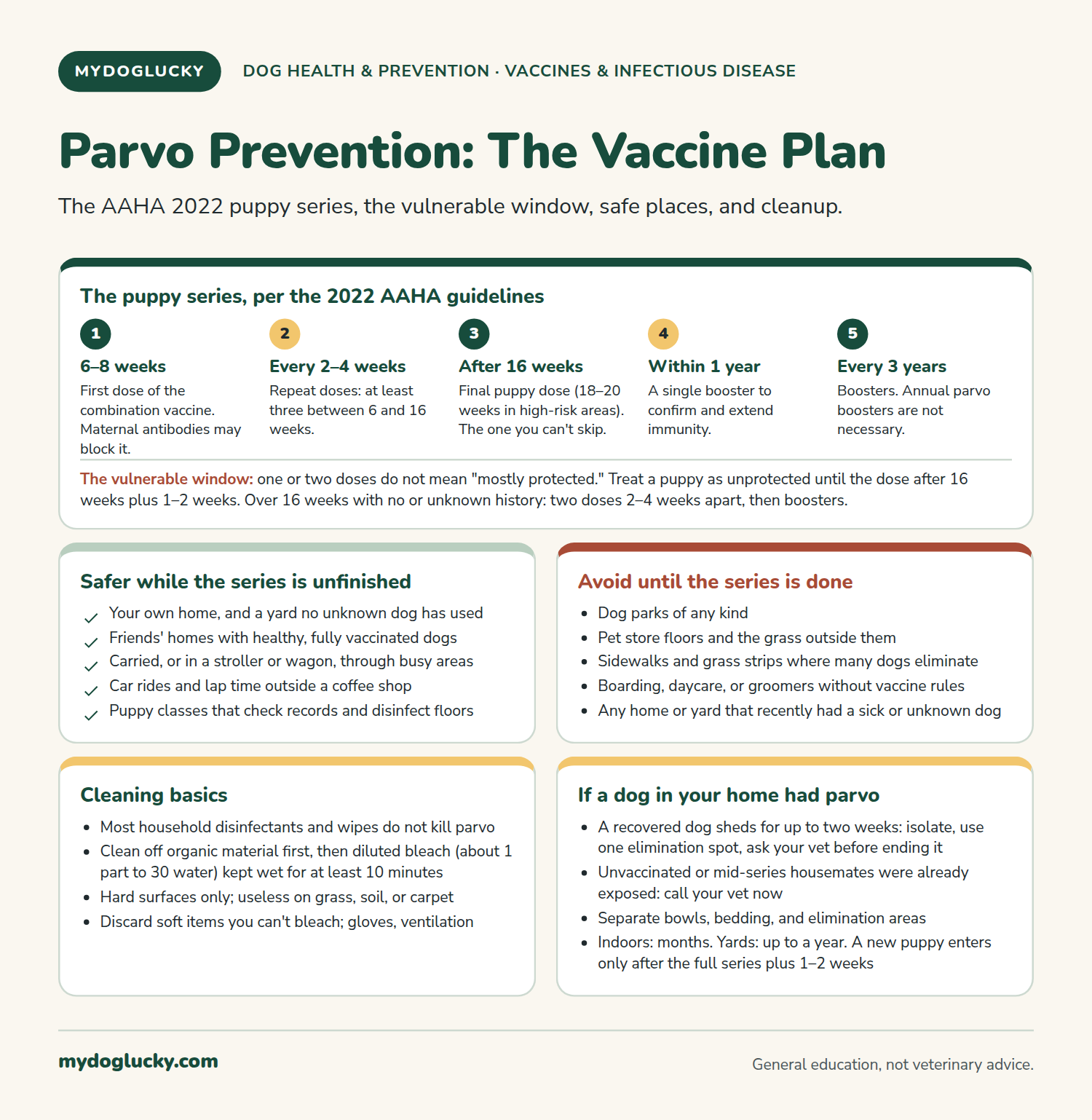
The Puppy Series According to the 2022 AAHA Guidelines
The 2022 AAHA Canine Vaccination Guidelines, published in the Journal of the American Animal Hospital Association and updated in 2024, are the reference most U.S. veterinarians follow. For parvo, they say the “minimum age to begin the primary vaccination protocol in puppies is 6–8 wk,” and that “revaccination is therefore recommended at 2 to 4 wk intervals until greater than 16 wk old.” The guidelines add that “18–20 wk old is preferred particularly in areas of high CPV risk.”
The reason for the repeated doses is maternal antibody interference. AAHA notes that maternal antibodies “may persist for 13–15 wk or possibly longer” and can block a modified-live vaccine from working. Each dose in the series is an attempt to catch the puppy at the moment his mother’s antibodies have dropped low enough for the vaccine to take. The final dose after 16 weeks is the one most likely to succeed in nearly all puppies, which is why it is the dose you cannot skip.
| Timing | What AAHA 2022 recommends for parvovirus | Why |
|---|---|---|
| 6–8 weeks | First dose of a combination modified-live vaccine (the parvo component is usually combined with distemper and adenovirus). | Earliest age the series can begin. Maternal antibodies may block this dose in many puppies. |
| Every 2–4 weeks | Repeat doses. AAHA’s table calls for at least three doses between 6 and 16 weeks. | Each dose is another chance to immunize as maternal antibodies decline. |
| After 16 weeks (18–20 weeks preferred in high-risk areas) | Final dose of the puppy series. | Maternal antibodies have faded in nearly all puppies by now, so this dose is the one most likely to produce protection. |
| Within 1 year of the last puppy dose | A single booster dose. | Confirms and extends immunity into adulthood. Some clinics schedule this closer to six months of age; ask what yours does. |
| Every 3 years after that | Booster doses. AAHA states “annual boosters are not necessary” for parvo. | Duration of immunity is at least three years with the modified-live vaccine. |
| Dogs over 16 weeks with no or unknown history | Two doses, 2–4 weeks apart, then the standard booster schedule. | Older puppies and adults have no maternal antibody interference, so fewer doses are needed to start. |
| Shelter setting | Vaccinate all dogs and puppies 4 weeks and older at or before entry, then every 2–3 weeks until 18–20 weeks. | Exposure risk in shelters is far higher, so the protocol is more aggressive. |
These are the guideline figures. Your veterinarian may adjust the schedule based on the vaccine product, local disease pressure, and your puppy’s history. The two points that do not move: the series is not done until a dose after 16 weeks, and the booster within a year is part of the series.
The Window Before the Series Is Complete
This is the concept most new owners are never told clearly. A puppy who has had one or two doses is not “mostly protected.” He may be fully protected, partly protected, or not protected at all, and there is no way to know from the outside. Until the final dose after 16 weeks has been given and the immune system has had a week or two to respond, treat the puppy as vulnerable.
That does not mean locking a puppy in the house until he is five months old. Socialization during this period is important for behavior, and skipping it creates different long-term problems. It means choosing places carefully.
Safer Places Versus Risky Places Before the Series Is Done
Cornell’s prevention advice includes “avoiding high risk areas (dog parks, pet stores, etc.) when dogs are unvaccinated or still a puppy.” The AKC says to “hold off on letting them interact with unknown dogs or walk around in high-traffic public areas” until the series is finished.
Lower-risk options that still give a puppy the exposure he needs:
- Your own home and a yard no unvaccinated or unknown dog has used.
- Homes of friends whose dogs are healthy and fully vaccinated, with the visit happening at their house or yours rather than a public space.
- Carrying the puppy through busier areas, or using a stroller or wagon, so his paws and mouth do not touch the ground.
- Car rides, sitting on a blanket outside a coffee shop, and watching the world from a lap all count as socialization without ground contact.
- Puppy classes that require proof of vaccination, held on a surface the facility disinfects between sessions. Ask the trainer what they require and how they clean.
Higher-risk places to avoid until the series is complete:
- Dog parks, of any kind. High traffic, unknown vaccine status, and soil that cannot be disinfected.
- Pet store floors and the grass outside them.
- Sidewalks and grass strips in dense neighborhoods where many dogs eliminate.
- Boarding facilities, daycares, and groomers that do not require proof of vaccination.
- Any home or yard that has had a sick dog, or a dog of unknown status, recently.
Puppy Classes and Vaccine Requirements
A well-run puppy class requires every puppy to have started the vaccine series, asks for records, and holds sessions on a cleanable floor. Both the AVMA and many veterinary behavior organizations support enrolling puppies in classes like these before the series is complete, because the behavioral benefits are large and the parvo risk in a controlled setting is small. The key word is controlled. A class in a pet store aisle or on a public lawn is not the same thing. Ask what the vaccine requirement is and how the floor is cleaned. A trainer who cannot answer is telling you something.
Adult Boosters and Lapsed Dogs
After the puppy series and the booster within a year, AAHA recommends parvo boosters every three years. If your adult dog’s records are lost or the last booster was many years ago, the AAHA table calls for two doses two to four weeks apart to restart protection. An antibody titer test is another option some veterinarians use to check whether an adult still has protective immunity. Which route makes sense for your dog is a conversation with your veterinarian.
Before Breeding
Because maternal antibodies are the puppy’s only protection in the first weeks, the mother’s own vaccination status matters enormously. A dam who is current on her parvo vaccine before breeding passes stronger, longer-lasting antibodies to the litter. Anyone planning a litter should confirm her status with a veterinarian well before the pregnancy.
Parvo Myths That Get Puppies Hurt
Some of the most dangerous beliefs about parvo in dogs are also the most common. Each one below has a real cost.
“He Had His Shots, So He’s Protected”
One dose is not a series. Two doses are usually not a series. A series ends with a dose after 16 weeks. Breeders and shelters often give the first dose and mean well when they say the puppy is “vaccinated,” but the follow-up doses are the ones that count, and they are the owner’s job.
“Parvo Only Affects Puppies”
Puppies are the main victims, but unvaccinated adults get parvo too. Adults with mature immune systems tend to survive more often. That is not a reason to skip the vaccine.
“My Yard Is Safe Because We’ve Never Had a Sick Dog”
You do not know every dog who has walked through, and you cannot see the virus. Foxes, coyotes, and stray dogs can also carry it. A yard is a reasonable place for a puppy mid-series if no unknown dogs have used it, but “reasonable” is not “guaranteed.”
“I Can Treat It at Home With Fluids and Rest”
The outpatient protocols described above start with a veterinary exam, a confirmed diagnosis, injectable medication, and daily rechecks. They are not a home remedy. A puppy who is vomiting cannot be rehydrated by mouth, and no amount of rest repairs a gut whose lining has been destroyed.
“If There’s No Blood, It’s Not Parvo”
Merck reports that roughly a quarter of dogs with parvo have diarrhea without visible blood. Blood makes the diagnosis more likely; its absence does not rule it out.
“A Negative Test Means He’s Fine”
The fecal antigen test is good, but it can miss very early or very late infections. A negative result in an unvaccinated puppy with classic signs is a reason for your veterinarian to keep looking, not a reason to go home and wait.
“The Vaccine Can Give My Dog Parvo”
The modified-live vaccine contains a weakened virus that cannot cause the disease in a healthy dog. It can occasionally produce a mild, brief positive on a fecal antigen test, which is why your veterinarian asks about vaccine dates. It does not make the puppy sick with parvo or shed dangerous virus.
“Bleach Fixes Everything”
Diluted bleach on a pre-cleaned hard surface with adequate contact time is effective. Bleach sprayed on grass, soil, or carpet is not. Bleach poured on organic material without cleaning first is largely wasted.
Common Mistakes Owners Make
Waiting Overnight to See If the Puppy Improves
This is the most common and most costly mistake with parvo in dogs, and it deserves to be listed first. A puppy who is lethargic and refusing food in the evening is often vomiting by midnight and dehydrated by morning. The clinic visit that would have been simple at 6 p.m. becomes an emergency at 6 a.m.
Trying a Bland Diet Before Calling
Boiled chicken and rice is a reasonable response to a mild upset stomach in a vaccinated adult. It is the wrong first move for an unvaccinated puppy with vomiting and diarrhea, because it costs a day, and a parvo puppy does not have a day to spare.
Giving Human Medication
Over-the-counter anti-diarrhea and anti-nausea products can be harmful to dogs and can mask the signs your veterinarian needs to see. Nothing from your medicine cabinet belongs in a puppy without a veterinarian’s direction.
Walking the Sick Puppy Into the Lobby
Call ahead. A puppy who may have parvo should not walk through a waiting room full of other puppies. Clinics have isolation procedures, but only if they know you are coming.
Stopping the Vaccine Series Early
Life gets busy, the puppy seems fine, and the 16-week appointment slips. Set a calendar reminder for each dose when you book the first one. The final dose is the one that matters most, and it is the one most often missed.
Taking a Mid-Series Puppy to the Dog Park
The urge to socialize is right; the location is wrong. Use the safer alternatives above and save the park for after the series is done and a week or two has passed.
Ending Isolation as Soon as the Puppy Feels Better
A recovered puppy is still shedding virus for up to two weeks. Walking him at the park on day three of feeling better is how the next family’s puppy gets sick.
Reusing Bedding, Bowls, and Crates From a Parvo Dog Without Disinfecting
Soft items should be discarded. Hard items need the full bleach-and-contact-time treatment. Secondhand puppy supplies from an unknown home carry the same risk.
Bringing a New Unvaccinated Puppy Into a Home That Had Parvo
Grief after losing a puppy to parvo makes the pull toward a new one strong. Wait until the new puppy has completed the full series before he enters that home or yard, and talk to your veterinarian about the timeline.
Assuming a Titer or a Single Adult Booster Is Unnecessary for a Rescued Adult
An adult of unknown history is not automatically protected. Two doses two to four weeks apart, or a titer test to check, is the AAHA-consistent path. Skipping it because “he’s an adult” is a gamble.
Frequently Asked Questions About Parvo in Dogs
How long after exposure does parvo show up?
Most dogs show the first signs three to seven days after exposure, and the full range runs from about two to fourteen days. A dog can begin shedding virus around day four or five, before looking sick. If you know your puppy was exposed, tell your veterinarian now and keep him away from other dogs for the full two weeks.
Can a vaccinated dog get parvo?
A dog who completed the full series, including a dose after 16 weeks and the booster within a year, is very unlikely to get parvo. Rare breakthrough cases happen, usually in dogs whose maternal antibodies blocked the final dose or whose immune system did not respond normally. A dog who had “some shots” but did not finish the series is not fully vaccinated and can absolutely get it.
What are the first signs of parvo in a puppy?
Lethargy and loss of appetite usually come first, often with a fever you cannot feel. Vomiting typically follows within a day, then diarrhea that is often foul-smelling and may contain blood or mucus. In an unvaccinated puppy, the first quiet, food-refusing day is the moment to call.
Can my dog survive parvo?
With prompt veterinary treatment, most do. Sourced survival rates with treatment run from roughly 70 to over 90 percent, depending on how early care starts, the dog’s age and size, and how sick the dog is on arrival. Without treatment, most puppies die. The single biggest thing you control is how fast the dog gets to a veterinarian.
How much does it cost to treat parvo?
Hospitalization commonly runs into the thousands of dollars, and it varies with region, hospital type, length of stay, and severity. Outpatient protocols, when appropriate, cost less. If the estimate is out of reach, say so at the clinic and ask about outpatient care, financing, shelter programs, low-cost clinics, and charitable funds. Do not let the number stop you from making the call.
Is parvo contagious to humans or cats?
Not to humans. People cannot catch canine parvovirus, though they can carry it on shoes, hands, and clothing and pass it to another dog. Some strains can infect cats, generally mildly, and cats have their own related virus covered by their core vaccine. Tell your veterinarian if cats share the home.
How long does parvo live in the house and yard?
Indoors, at least two months at room temperature according to Merck, and longer in protected spots. Outdoors, many months and possibly years. There is no reliable way to disinfect soil. Hard surfaces can be treated with diluted bleach after thorough cleaning; carpet and fabric are much harder and are often best discarded or kept off-limits to unvaccinated dogs.
When can my puppy go to the dog park?
After the final dose of the puppy series, given at or after 16 weeks, plus one to two weeks for the immune system to respond. Until then, choose controlled settings: your own home, homes of friends with fully vaccinated dogs, carrying the puppy in busy areas, and puppy classes that require vaccine records and clean their floors.
My puppy had one parvo shot. Is he protected?
Not reliably. One dose in a young puppy is often blocked by maternal antibodies. He may have some protection or none, and there is no way to tell from the outside. Treat him as vulnerable until the series is complete.
Can a dog get parvo twice?
Dogs who recover from parvo are generally considered immune for years and likely for life. Your veterinarian will probably still recommend continuing the standard combination vaccine schedule, since it covers distemper and other diseases as well.
Where This Leaves You
Parvo in dogs is brutal, fast, and largely preventable. If your puppy is vomiting and has diarrhea and the vaccine series is not finished, stop reading and call a veterinarian. Say the word “parvo” on the phone. Ask where to park. Go. If cost is the barrier, say that too, and ask about every option before anyone talks about giving up.
If your puppy is healthy and you are reading this ahead of time, you are in the best possible position. Book the full vaccine series today, put every dose on the calendar, treat the dose after 16 weeks as non-negotiable, and keep paws off high-traffic ground until it is done. Those steps cost a few appointments and a little patience, and they take one of the deadliest diseases in dogs almost entirely off the table.
Sources
- American Animal Hospital Association. 2022 AAHA Canine Vaccination Guidelines (Ellis J. et al., Journal of the American Animal Hospital Association, published August 15, 2022; updated 2024).
- American Animal Hospital Association. Key Vaccination: Canine Parvovirus (CPV) (2022 guidelines section; accessed September 27, 2026).
- American Animal Hospital Association. Recommendations for Core and Noncore Canine Vaccines (2022 guidelines table; accessed September 27, 2026).
- Merck Veterinary Manual. Canine Parvovirus (professional edition; last reviewed June 2025).
- American Veterinary Medical Association. Canine Parvovirus (pet owner resource; accessed September 27, 2026).
- American Veterinary Medical Association, AVMA News. Canine Parvovirus Treatment Receives Conditional Approval (May 10, 2023).
- Cornell University College of Veterinary Medicine, Riney Canine Health Center. Parvovirus: Transmission to Treatment (updated April 2024).
- VCA Animal Hospitals. Parvovirus in Dogs (Weir M., Panning A., Ward E.; last updated September 18, 2025).
- ASPCA. Common Dog Diseases (parvovirus section; accessed September 27, 2026).
- American Kennel Club. Parvo in Puppies: Symptoms, Causes, Treatment, and Prevention (Dodd C.; last updated October 29, 2025).
- Venn E.C. et al. Evaluation of an Outpatient Protocol in the Treatment of Canine Parvoviral Enteritis, Journal of Veterinary Emergency and Critical Care, 2017; survival figures as summarized in the ASPCApro Canine Parvovirus Outpatient Treatment Research Summaries (November 2025).
This article is general education for U.S. dog owners. It is not individualized veterinary advice, a diagnosis, or a substitute for an in-person veterinary exam. Canine parvovirus is a life-threatening emergency, especially in puppies under six months and in any dog who has not completed the full vaccine series. If your dog is vomiting, has bloody or foul-smelling diarrhea, is lethargic, refuses food and water, or shows signs of dehydration, contact a veterinarian or emergency animal hospital immediately rather than waiting. Survival rates, treatment options, vaccine schedules, and disinfection guidance summarized here come from the dated sources listed above and may change; your veterinarian’s advice for your dog takes precedence.