

Dog diarrhea is a symptom, not a diagnosis. It can mean your dog raided the trash on Tuesday and will be back to normal by Thursday, or it can mean something that needs veterinary attention today. Most single, mild episodes in a dog who’s otherwise eating, drinking, and acting like himself resolve on their own within a day or two.
But certain patterns change that calculation fast — blood in the stool, repeated vomiting alongside it, a dog who seems weak or won’t drink, or diarrhea that just keeps going past a day or two. This guide walks through what’s genuinely urgent first, then what the sign can mean, what’s safe to track at home, and exactly when to call instead of waiting it out.
If you’re standing in the yard right now looking at something you wish you hadn’t seen, you’re not overreacting by searching for answers. Diarrhea is one of the most common reasons dogs see a veterinarian, and for good reason: it can point to something as minor as an ill-advised snack off the counter or something as serious as a parvovirus infection or an intestinal blockage. The task in front of you isn’t diagnosing your dog yourself. It’s figuring out, calmly and quickly, which category you’re likely in — and this article is built to help you do exactly that, in the order that actually matters.
One scope note before we get into it. This guide focuses on diarrhea specifically — causes, red flags, home observation, and when to call. If vomiting is the main symptom instead, or shows up alongside diarrhea, the urgency signs below still apply, but a closer look at “why is my dog throwing up” is really its own topic for another article. And if a recent food switch is part of your dog’s story, the short version is that food changes should happen gradually, not overnight; the prevention section below covers why, and “how to switch dog food” step by step is worth its own separate read.
What’s in this guide
- Dog diarrhea red flags: when it’s an emergency
- How to check your dog for dehydration at home
- What dog diarrhea can mean (not a diagnosis)
- What to observe and record at home
- What a vet may evaluate
- Prevention: lowering the odds of a repeat episode
- What not to do when your dog has diarrhea
- Call-today vs. go-now: the clear breakdown
- Common mistakes and misunderstandings
- Frequently asked questions about dog diarrhea
- Sources
Dog Diarrhea Red Flags: When It’s an Emergency
Most dog diarrhea is unpleasant, not dangerous. A smaller number of cases need same-day attention, and a smaller number still need emergency care right now, tonight, not at the next available appointment. Here’s the list worth memorizing before you need it, because reading it calmly now beats reading it in a panic later.
Seek veterinary care right away if you see:
- Blood in the stool — bright red streaks or clots, or stool that looks dark, tarry, and black.
- Repeated vomiting happening alongside the diarrhea, not just one isolated episode.
- Signs of dehydration — lethargy, sunken-looking eyes, skin that stays “tented” when gently lifted, or dry, tacky gums.
- Abdominal pain or a swollen, distended belly — a hunched posture, a dog who won’t let you touch his stomach, or visible bloating.
- Known ingestion of a toxin or a foreign object — chocolate, a sugar-free product, a household chemical, a toy, a sock, anything he shouldn’t have swallowed.
- A puppy, a senior dog, or a dog with an existing health condition — these dogs have far less physical reserve to absorb fluid loss.
- Diarrhea lasting more than 24 to 48 hours, or clearly getting worse rather than improving.
- A high fever — a dog who feels notably hot, is panting heavily at rest, or seems unusually uncomfortable.
- Collapse, extreme weakness, or an inability to stand.
Any single item on this list is reason enough to call. You don’t need several of them stacked together before it counts.
Blood in the Stool: Bright Red vs. Dark and Tarry
The color of blood in a stool actually tells you something. Bright red blood, sometimes called hematochezia, usually means the bleeding is happening lower in the digestive tract — the colon or rectum — and often shows up as streaks or a coating on otherwise formed stool. Dark, tarry, almost black stool, called melena, usually means blood that’s been digested on its way through, which typically points higher up in the GI tract. Neither one is something to wait out. According to the Merck Veterinary Manual, parvovirus in particular is known for producing severe intestinal damage and bloody diarrhea, which is part of why blood of either kind belongs on your same-day-or-sooner list rather than your wait-and-see list.
You don’t need to identify the exact cause from the color alone, and you shouldn’t try. What matters practically is noticing it, not diagnosing it. Take a photo if you can do it safely and quickly, since it’s useful information for your vet, then make the call.
Why Puppies, Seniors, and Medically Vulnerable Dogs Need a Faster Response
The same episode of diarrhea that a healthy five-year-old Labrador shrugs off can hit a ten-week-old puppy or a fifteen-year-old senior much harder. Puppies have a smaller body mass and a higher relative water turnover, so fluid losses add up faster and dehydration can set in within hours rather than days. Puppies are also more likely to be incompletely vaccinated, which raises the stakes around infectious causes like parvovirus — a disease the ASPCA describes as capable of causing “severe vomiting” and “bloody, foul-smelling diarrhea, which can lead to dehydration” quickly in young, susceptible dogs.
Senior dogs and dogs with existing conditions — kidney disease, diabetes, heart disease, or a compromised immune system — often have less physiological reserve to compensate for fluid and electrolyte losses. That doesn’t mean every senior dog with one soft stool needs an emergency visit. It means the threshold for calling sooner rather than later should be lower for these dogs than it would be for a young, healthy, otherwise normal adult.
Repeated Vomiting, Abdominal Pain, and a Distended Belly
Diarrhea alone raises fluid-loss concerns. Diarrhea combined with repeated vomiting raises them considerably faster, since your dog is losing fluid from both directions while also struggling to keep anything down to replace it. The Merck Veterinary Manual describes hemorrhagic gastroenteritis, a condition marked by “sudden onset of vomiting and bloody diarrhea,” as one of the more serious causes that can progress quickly without treatment.
A visibly swollen or distended abdomen, especially paired with restlessness, unproductive retching, or an inability to get comfortable, deserves emergency evaluation regardless of what the stool looks like. That combination can point toward several different serious problems, some of which are true emergencies measured in minutes rather than hours. This isn’t a moment for a home checklist. It’s a moment to call ahead and go in.
Toxin or Foreign-Object Ingestion Changes Everything
If you know or strongly suspect your dog got into something he shouldn’t have — chocolate, a sugar-free gum or candy containing xylitol, a cleaning product, a plant, medication that isn’t his, or an object like a sock or a toy piece — treat that as urgent information on its own, separate from how the stool currently looks. Diarrhea from a toxin or an obstruction can start mild and escalate, and waiting for the stool to “prove” how serious things are wastes time you may need. Call your vet or an animal poison control line right away and describe exactly what was ingested, roughly how much, and when.
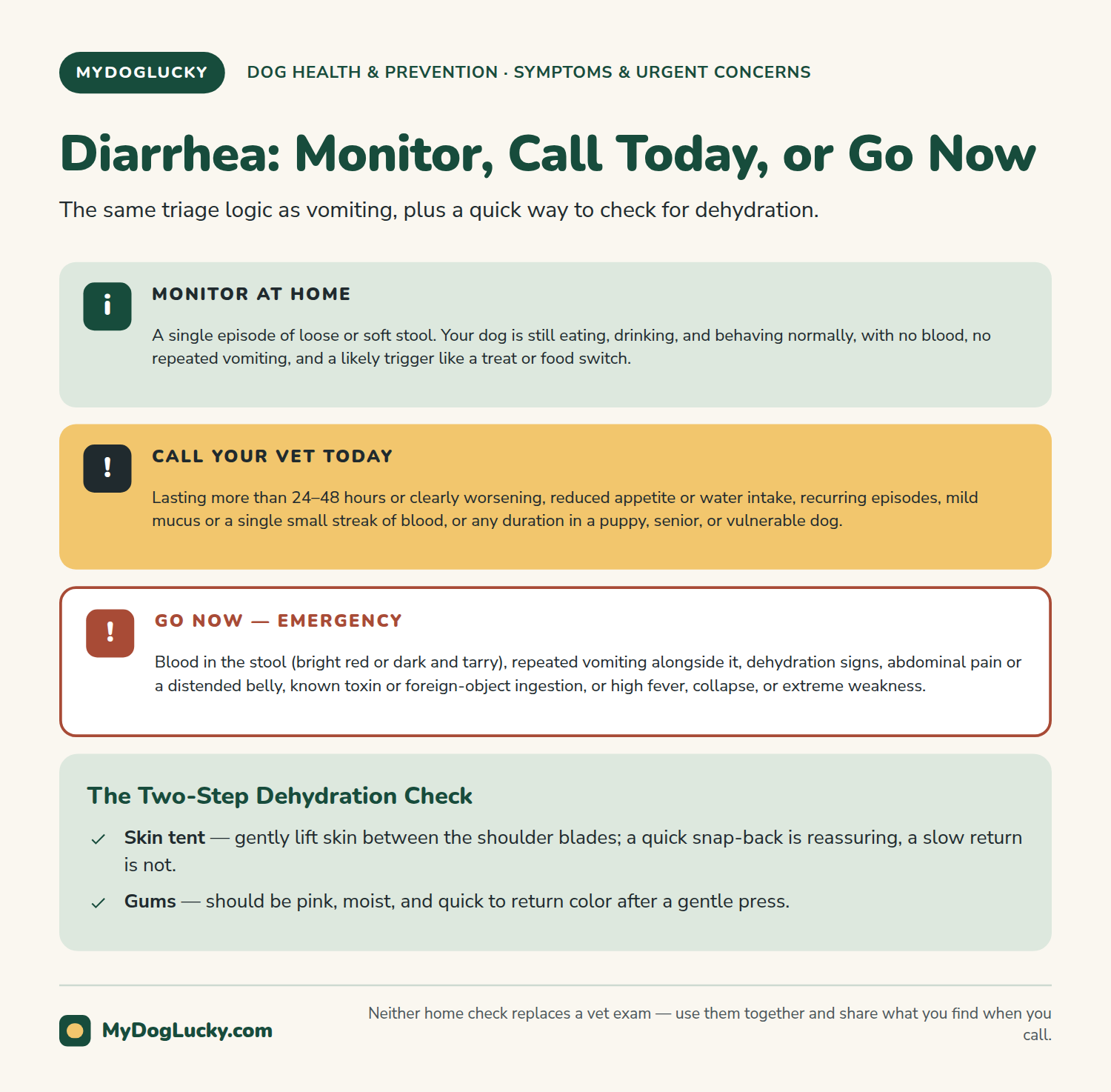
How to Check Your Dog for Dehydration at Home
Diarrhea’s real danger usually isn’t the mess. It’s the fluid and electrolyte loss behind it. Checking your dog for dehydration is a genuinely useful, low-risk skill to know, and it takes about ten seconds once you’ve practiced it. It’s also not a diagnostic test on its own — think of it as one data point that helps you decide how urgently to call, not a way to clear your dog of a problem.
The Skin Tent Test
Gently pinch and lift a fold of loose skin between your dog’s shoulder blades, then let go and watch how quickly it falls back into place. In a well-hydrated dog, the skin snaps back almost immediately. A fold that returns slowly, or one that stays tented for a noticeable moment, suggests meaningful fluid loss and is worth mentioning when you call your vet.
A fair caveat: this test is less reliable on its own in very young puppies, very thin dogs, overweight dogs, and some seniors, since skin elasticity naturally varies with age and body condition. That’s exactly why veterinary guidelines, including the AAHA’s 2024 Fluid Therapy Guidelines, frame hydration status as something assessed through multiple physical signs together rather than any single check in isolation. Use the skin tent as one clue, not the whole answer.
Checking the Gums
Lift your dog’s lip and look at his gums. Healthy gums are usually a consistent pink, moist, and slightly slick to a gentle touch. Press a fingertip gently against the gum, release, and watch the color return — it should come back quickly. Dry, tacky, or pale gums are a meaningful sign. VCA Animal Hospitals lists “dry or sticky gums” and “abnormal gum color” among the recognizable signs of dehydration worth acting on.
Some dogs naturally have pigmented gums that make color harder to read. If that’s your dog, lean more on moisture and texture — dry and tacky versus smooth and wet — rather than trying to judge pink tone against a mental baseline you don’t actually have.
Other Signs Worth Combining With the Tent and Gum Check
No single home check tells the whole story, so look for a pattern instead of one isolated result. Sunken-looking eyes, noticeable lethargy, reduced interest in getting up or moving around, tacky or ropey saliva, and a marked drop in how often your dog is urinating all point the same direction when they show up together. A dog who fails the skin tent test and has dry gums and seems flat and uninterested in you is telling you something different than a dog with one slightly slow skin-tent result who’s otherwise bouncing around the kitchen.
The two-step home dehydration check
- Skin tent: gently lift skin between the shoulder blades, release, and watch it fall back — quick snap-back is reassuring, a slow return or a fold that stays up is not.
- Gums: lift the lip and check for pink, moist, slick gums versus dry, tacky, or pale ones.
Neither check rules out dehydration on its own, and neither replaces a vet exam. Use them together, note what you find, and share it when you call.
What Dog Diarrhea Can Mean (Not a Diagnosis)
Diarrhea is a shared symptom for dozens of very different underlying problems, which is exactly why this section describes broad categories rather than trying to tell you which one applies to your dog. Only a veterinary exam, and often some testing, can actually answer that. What follows is orientation — a map of the territory, not a diagnosis.
Dietary Indiscretion and Sudden Food Changes
“Dietary indiscretion” is the clinical way of saying your dog ate something he shouldn’t have — rich table scraps, garbage, something found on a walk, or simply too much of a treat he doesn’t usually get. According to the AKC, this is one of the most common triggers for dog diarrhea, alongside switching foods too quickly. A dog’s gut microbiome adjusts to a consistent diet over time, and an abrupt switch, even to a “better” or more expensive food, can throw that balance off for a few days.
This category is often the least worrying, especially in an otherwise healthy adult dog who’s still eating, drinking, and acting normal. It’s also the most preventable, which the prevention section below covers in more detail.
Food Intolerance or Sensitivity
Some dogs react to a specific ingredient or to a food that simply doesn’t agree with them, even without a diagnosed allergy. This tends to show up as recurring soft stool tied to a particular food rather than a single isolated episode, and it’s genuinely worth mentioning to your vet if you notice a pattern — diarrhea that reliably follows a certain treat or protein source, for instance. A true food allergy is a distinct, and less common, diagnosis that typically needs a structured elimination process to confirm, not a guess based on one bad week.
Stress-Related Colitis
Dogs’ digestive systems respond to stress in ways that are easy to underestimate. Boarding stays, a move, a new pet or person in the household, fireworks, travel, or even a change in routine can trigger loose stool through what’s often called stress colitis. The AKC lists stress explicitly among the common triggers for dog diarrhea, and it’s a category owners frequently overlook because nothing about the household seems obviously “wrong.”
Stress colitis tends to resolve as the stressor passes or as your dog adjusts, but it’s still worth mentioning to your vet, especially if it recurs around predictable events like boarding or travel, since there may be practical ways to reduce the impact next time.
Intestinal Parasites — Common Enough to Test For
Parasites are common enough in dogs of every age that a fecal test is one of the first, most useful things a vet can check, and it’s worth emphasizing on its own rather than burying it in a list. Roundworms, hookworms, whipworms, giardia, and coccidia can all produce diarrhea, sometimes with mucus or, in heavier infections, with visible blood. The Merck Veterinary Manual notes that hookworm infections specifically can produce “diarrhea with dark, tarry feces” in severe cases, while heavy whipworm infections can cause weight loss and diarrhea with possible blood in the stool.
Puppies are at particular risk, since intestinal parasites are extremely common in young dogs and often require more than one round of treatment to fully clear. A negative fecal test at one visit doesn’t rule parasites out forever either — some parasites shed eggs intermittently, which is one reason your vet may recommend a repeat test if symptoms continue despite an initial clean result.
Viral or Bacterial Infection
Infectious causes range from relatively mild bacterial overgrowth to genuinely dangerous viral disease. Parvovirus is the one most owners have heard of, and for good reason — it’s highly contagious, spreads through contact with infected feces, can survive in the environment for months, and according to the ASPCA, produces severe vomiting, appetite loss, and bloody, foul-smelling diarrhea that can lead to dehydration quickly. Canine distemper is another viral cause the AKC lists among the more serious triggers. Bacterial causes exist too, and can range from mild and self-limiting to something that needs a targeted treatment plan after testing.
This is exactly the category where “wait and see” carries the most risk, particularly in puppies or dogs with an unclear or incomplete vaccination history. If there’s any question about your dog’s vaccine status and he’s showing diarrhea along with other symptoms, mention that clearly when you call.
Medication Side Effects
Diarrhea shows up as a listed side effect for a wide range of medications, including some antibiotics, certain pain medications, and other prescriptions your dog might be taking for an unrelated condition. The AKC notes this directly as a recognized cause. If your dog recently started a new medication and diarrhea followed, that timing is worth mentioning to whichever vet prescribed it — don’t stop a prescribed medication on your own without checking first, since the diarrhea itself may be manageable while the medication is still doing important work.
Chronic Conditions Like Inflammatory Bowel Disease
Some dogs deal with diarrhea that isn’t a one-off event at all, but a recurring or persistent pattern tied to an underlying chronic condition. Inflammatory bowel disease, described in the Merck Veterinary Manual as a condition involving persistent intestinal inflammation, is one example, alongside other forms of chronic small-intestinal or large-intestinal disease. These conditions typically aren’t diagnosed from a single episode — they usually surface after diarrhea keeps recurring despite dietary changes and basic treatment, which is when a vet may recommend more advanced testing or a referral to a specialist.
Toxin Ingestion
Certain toxic substances cause diarrhea as one of several symptoms, sometimes alongside vomiting, tremors, or lethargy. Chocolate is the one most owners already know to watch for, and the AKC specifically names it among the risky items that can trigger diarrhea alongside other illness. Household chemicals, certain plants, spoiled food, and some human medications can all fall into this category too. If toxin exposure is even a possibility, treat it as urgent regardless of how the stool currently looks — see the emergency section above.
Large-Bowel vs. Small-Bowel Diarrhea: Why the Distinction Matters
Vets sometimes sort diarrhea into two broad patterns based on which part of the intestinal tract seems most involved, and knowing this distinction exists helps explain why your vet asks such specific questions. Large-bowel diarrhea, often linked to colitis, tends to show up as frequent, small-volume stools, sometimes with mucus or straining, in a dog whose appetite often stays fairly normal. Small-bowel diarrhea tends to involve larger volumes, sometimes weight loss over time, and can be more closely tied to malabsorption or a more systemic problem.
Neither pattern is a self-diagnosis tool, and plenty of cases don’t sort neatly into one box or the other. What matters is that this is exactly the kind of detail — frequency versus volume, mucus versus none, appetite intact versus declining — that makes your description to your vet genuinely more useful than “he has diarrhea.”
| Cause category | Common accompanying signs | Typical next step |
|---|---|---|
| Dietary indiscretion / sudden food change | Normal appetite and energy; often resolves in 1–2 days | Monitor; return to prior diet if a switch triggered it |
| Food intolerance | Recurs with a specific food or treat | Discuss with your vet; note the pattern |
| Stress-related colitis | Small, frequent stools; possible mucus; tied to a stressor | Monitor; discuss recurring triggers with your vet |
| Intestinal parasites | May include mucus, weight loss, or visible blood | Fecal test |
| Viral or bacterial infection | Vomiting, lethargy, appetite loss, possible fever | Same-day or emergency vet evaluation |
| Medication side effect | Starts after a new prescription | Call the prescribing vet; don’t stop the medication alone |
| Chronic condition (e.g., IBD) | Recurs or persists over weeks despite basic treatment | Full workup with your vet |
| Toxin ingestion | Known or suspected exposure; may include vomiting or tremors | Emergency evaluation |
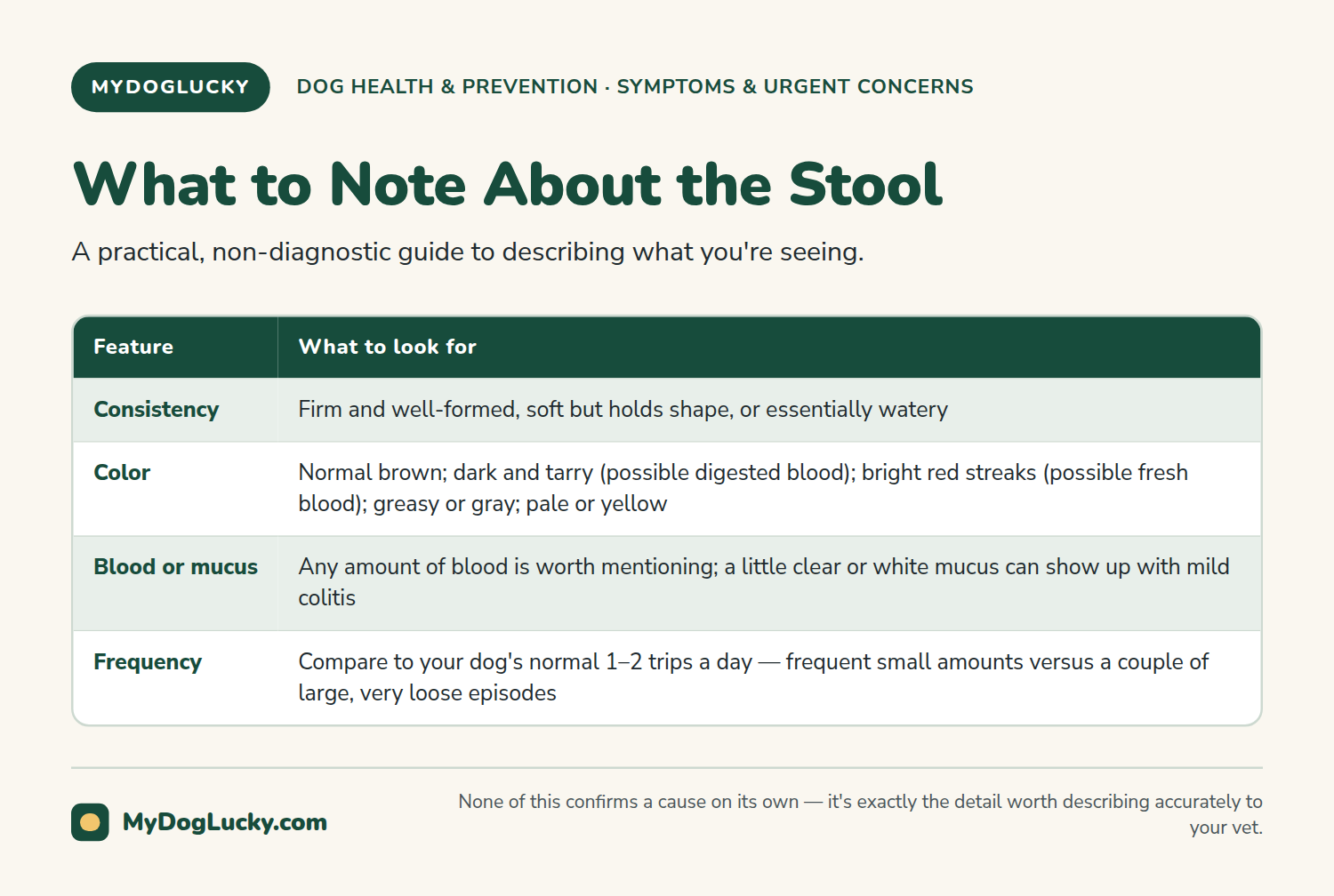
What to Observe and Record at Home
You don’t need to diagnose anything. You do need to be a good, accurate observer, because the details you notice are often what helps your vet triage the call and decide how urgently to see your dog. Here’s what’s genuinely useful to track.
Stool Consistency: A Simple Reference Point
Many veterinary practices use a standardized numbered stool-consistency scale as a quick shared reference — something like firm and well-formed at one end, through soft-but-holds-shape, to a formless pile, and finally watery at the other end. You don’t need to know an exact scale to be useful here. Just describe what you’re seeing in plain terms: does it hold its shape when picked up, is it soft but still somewhat formed, or is it essentially liquid? If your vet’s office uses a specific numbered scale, it’s worth asking so you can describe future changes in the same terms they do.
Frequency and Volume
How many times has your dog had diarrhea today compared to his normal one or two bathroom trips? Frequent small amounts versus a couple of large, very loose episodes can hint at different parts of the digestive tract being involved — a distinction your vet, not you, will interpret, but one that’s genuinely useful for them to know about rather than a detail to skip.
Color
Normal dog stool is generally some shade of brown. A few color shifts are worth flagging specifically: black or tarry stool (possible digested blood), bright red streaks or spots (possible fresh blood), a greasy or grayish appearance (sometimes tied to fat malabsorption or pancreatic issues), or a notably yellow or orange tint. None of these confirm a specific cause on their own, and color alone isn’t diagnostic — but it’s exactly the kind of detail worth describing accurately rather than rounding to “it looked kind of off.”
Presence of Blood or Mucus
A small amount of clear or whitish mucus coating the stool sometimes shows up with mild colitis and isn’t automatically alarming on its own. Blood of any amount, in any color, is always worth mentioning to your vet — not necessarily a reason to panic, but never a detail to leave out when you’re describing what you’re seeing.
Straining
Repeated, unproductive straining after your dog has already passed stool — squatting again and again with little or nothing coming out — is a pattern worth noting on its own, separate from the stool’s appearance. It often points toward irritation lower in the digestive tract and is useful information even when nothing dramatic is visible in the yard.
Appetite and Water Intake
A dog with diarrhea who’s still interested in food and still drinking normally is in a meaningfully different situation than one who’s refusing both. Note whether your dog ate his normal amount, skipped a meal, or seemed uninterested, and whether he’s drinking his usual amount, more than usual, or barely at all. This single pair of observations does a lot of triage work on its own.
Behavior and Energy
This might be the single most useful thing you can track. A dog with one loose stool who’s still playful, alert, and behaving like himself is a different situation than a dog who’s quiet, withdrawn, or reluctant to get up. The AKC’s guidance draws exactly this distinction: soft stool with normal behavior generally warrants a regular vet visit, while diarrhea paired with lethargy or appetite loss moves toward the emergency category.
A simple habit worth building: the three-day log
If the diarrhea isn’t an emergency but also isn’t resolving in a day, jot down a quick note each time: time, stool consistency, color, blood or mucus present or not, whether your dog ate and drank normally, and general energy level. A few lines on your phone is plenty. That short record turns “it’s been happening for a while” into something specific and useful the moment you call your vet.
What a Vet May Evaluate
Knowing what a workup can look like helps set realistic expectations, whether you’re heading in today or scheduling a routine visit for something that’s lingered a bit.
Physical Exam and History
Expect questions about diet, recent changes, access to trash or unfamiliar substances, other pets in the household, travel or boarding history, current medications, and vaccination status, alongside a hands-on exam checking hydration, abdominal comfort, temperature, and overall condition. This conversation is often where the most useful information actually gets exchanged, which is part of why an accurate, specific description from you matters so much.
Fecal Exam and Parasite Testing
A fecal sample lets your vet check for intestinal parasites under a microscope — exactly the kind of testing the Merck Veterinary Manual describes for identifying roundworms, hookworms, whipworms, and other parasites that can cause diarrhea. If you can bring a fresh sample to the appointment, it often speeds up getting an answer the same day rather than waiting on a second visit.
Bloodwork
For diarrhea that’s persistent, severe, or accompanied by other symptoms, bloodwork can help assess hydration status, organ function, electrolyte balance, and signs of infection or inflammation. It’s not automatically needed for a single mild episode in an otherwise healthy dog, but it becomes a more standard part of the workup as severity or duration increases.
Dietary History Review
Your vet will likely walk through exactly what your dog eats — main food, treats, table scraps, supplements, and anything new introduced recently. This isn’t a judgment of your feeding choices. It’s genuinely useful diagnostic information, since a clear timeline connecting a food change to symptom onset can point toward dietary causes without needing more invasive testing.
Imaging for Chronic or Recurring Cases
For diarrhea that persists despite basic treatment, or that keeps recurring, your vet may recommend abdominal x-rays or ultrasound to look for structural issues, and in some cases endoscopy or biopsy to evaluate the intestinal lining directly. The Merck Veterinary Manual lists these among the tools used for more complex or chronic cases. This level of workup is reserved for situations that don’t resolve with more straightforward steps first, not a starting point for a single bad day.
Response to a Bland, Vet-Recommended Diet
For milder cases, your vet may suggest a short course of a bland, easily digestible diet — sometimes a specific prescription recovery formula, sometimes a simple home combination your vet approves for your dog specifically — and watch how your dog responds over the following days. How well symptoms improve on that diet is itself diagnostic information: a quick, full recovery points toward a straightforward dietary cause, while diarrhea that persists despite the diet change points toward something that needs more investigation. This is a decision to make with your vet, not a plan to improvise from something you read online, since the right bland-diet approach and duration can vary by dog.
Prevention: Lowering the Odds of a Repeat Episode
None of the following guarantees your dog never has another loose stool — digestive upset happens to essentially every dog at some point. But these habits meaningfully lower the odds of a repeat, especially for the more preventable categories above.
Parasite Prevention
Consistent parasite prevention, along with routine fecal testing at wellness visits, is one of the more effective ways to reduce diarrhea from this specific cause. The Merck Veterinary Manual notes that puppies benefit from multiple deworming treatments across their first several months, since a single round often isn’t enough to fully clear an infection. Ask your vet about an appropriate prevention schedule for your dog’s age, lifestyle, and region.
Gradual Food Transitions
When you do need to switch foods — a new brand, a life-stage change, or a vet-recommended diet — do it gradually rather than all at once. Mixing in a little more of the new food each day over a week to ten days gives your dog’s digestive system time to adjust, rather than the abrupt swap the AKC specifically flags as a common trigger for loose stool.
Limiting Dietary Indiscretion and Trash Access
Secure trash cans, keep counters clear of anything tempting, and be mindful on walks about what’s within reach of an opportunistic nose. This sounds obvious until you’re standing over an overturned kitchen trash can at 6 a.m. wondering how it happened. A few minutes of prevention — a lidded can, a closed pantry door, a “leave it” cue practiced consistently — genuinely reduces how often this category comes up.
Managing Stress for Stress-Related Colitis
If your dog has a pattern of loose stool around predictable stressors — boarding, travel, fireworks, house guests — think ahead about ways to ease that transition. Familiar bedding, a consistent feeding schedule even while away from home, and, for dogs with a known pattern, a conversation with your vet about options for particularly stressful events can all help. Recognizing the pattern is most of the battle here.
Basic Hygiene Habits That Help the Whole Household
Since some causes of dog diarrhea, particularly certain intestinal parasites, can pose a risk to people too, a few household habits do double duty. Wash your hands after handling stool or cleaning up after your dog, pick up waste promptly rather than letting it sit in the yard, and keep an eye on young children’s contact with areas your dog uses as a bathroom. None of this is about treating your dog as a hazard — it’s ordinary, sensible hygiene that happens to also reduce reinfection risk for your dog himself.
What Not to Do When Your Dog Has Diarrhea
Don’t Give Human Anti-Diarrheal Medication Without Vet Direction
It’s tempting to reach for what’s in your own medicine cabinet, but the AKC is direct about this: “most human medications are ineffective, but some can be harmful.” Certain over-the-counter anti-diarrheal products aren’t appropriate for every dog, can interact with other medications, and can mask a symptom your vet actually needs to see clearly. Call first and ask what, if anything, is appropriate for your specific dog before giving anything.
Don’t Withhold Water
This is worth stating plainly, because it runs against some older, vomiting-focused advice people remember: hydration matters more here than it does with vomiting alone, precisely because diarrhea is actively draining fluid and electrolytes. VCA Animal Hospitals specifically recommends giving a dog with diarrhea “easy access to water.” Unless your vet has told you otherwise for a specific reason, keep fresh water available and let your dog drink normally.
Don’t Ignore a Puppy’s Diarrhea Assuming It Will Resolve on Its Own
“He’s just a puppy, puppies get upset stomachs” is a real, common thought, and it’s also exactly the assumption that costs the most time when it turns out to matter. Puppies dehydrate faster than adult dogs because of their smaller size, and they’re more vulnerable to the infectious causes covered above. A wait-and-see approach that might be reasonable for a healthy adult dog carries meaningfully more risk in a young puppy. When in doubt with a puppy, call sooner rather than later.
Call-Today vs. Go-Now: The Clear Breakdown
Here’s the same information from the sections above, organized by what to actually do next.
Monitor at home
- A single episode of loose or soft stool.
- Your dog is still eating, drinking, and behaving normally.
- No blood, no repeated vomiting, no signs of dehydration.
- A likely, identifiable trigger, like a treat or a food switch.
Watch for the next 24 hours. If it resolves, no call is needed. If it doesn’t, move to the next tier.
Call your vet today
- Diarrhea lasting more than 24 to 48 hours, or clearly worsening.
- Reduced appetite or reduced water intake, without the more severe signs below.
- A puppy, senior, or medically vulnerable dog with diarrhea of any duration.
- Recurring episodes that keep coming back over days or weeks.
- Mild mucus or a single small streak of blood, without other symptoms.
This isn’t an emergency-room situation, but it’s not a wait-it-out one either. Call the office and describe exactly what you’re seeing.
Seek emergency care now
- Blood in the stool — bright red or dark and tarry.
- Repeated vomiting alongside the diarrhea.
- Clear signs of dehydration — lethargy, sunken eyes, tented skin, dry gums.
- Abdominal pain or a visibly distended belly.
- Known toxin or foreign-object ingestion.
- High fever, collapse, or extreme weakness.
Call ahead if you can, then go. Don’t wait to see if it passes.
Common Mistakes and Misunderstandings
Assuming “He’s Still Eating, So It’s Fine” Covers Every Case
A good appetite is a genuinely reassuring sign, but it’s not an automatic all-clear. A dog can be eating normally and still have blood in the stool, a parasite load worth treating, or diarrhea that’s simply lasted too long to keep waiting on.
Reaching for Human Medication First
Covered above, and worth repeating because it’s such a common first instinct: don’t give an over-the-counter human anti-diarrheal without checking with your vet first.
Switching Foods Again Mid-Episode to “Fix” It
Adding another diet change on top of an already upset stomach usually extends the problem rather than solving it. If a food switch triggered the diarrhea, the fix is going back to what your dog tolerated before and reintroducing any change more slowly later, not layering on a third new food to try to correct course.
Waiting Out a Vomiting-Plus-Diarrhea Combination
Each symptom alone might be manageable to monitor briefly. Together, they drain fluid from two directions at once, and that combination belongs on the emergency list covered above, not the wait-and-see list.
Leaving Out an Unclear Vaccine History When You Call
If you’re not certain your dog or puppy is current on vaccines, or you adopted him without complete records, say so clearly when you call. It changes how urgently the office may want to see him, particularly for a young dog.
Assuming One Clean Fecal Test Rules Out Parasites Forever
Some parasites shed eggs intermittently, so a single negative result doesn’t permanently close the door. If symptoms continue or recur despite a clear fecal test, a repeat test is a reasonable next step to discuss with your vet, not a sign the first test was wrong.
Downplaying a Puppy’s Diarrhea Because “Puppies Are Always a Little Sensitive”
There’s some truth to puppies having more digestive sensitivity generally, but that truth gets misused when it becomes a reason to delay a call. Faster dehydration risk in young dogs, covered above, is exactly why this assumption needs a second look.
Frequently Asked Questions About Dog Diarrhea
What does it mean when my dog has diarrhea but is acting completely normal?
It’s often a sign the underlying cause is mild — dietary indiscretion, a minor food sensitivity, or stress — rather than something more serious. Normal appetite, energy, and behavior are reassuring, but monitor for 24 to 48 hours, and call your vet if it doesn’t improve, worsens, or a red-flag sign appears.
How long can dog diarrhea last before it’s a problem?
As a general guideline, diarrhea lasting more than 24 to 48 hours, or that’s clearly getting worse rather than better, warrants a call to your vet rather than continued waiting. Shorter than that, with no red flags and normal behavior, is often reasonable to monitor.
Is it normal for a dog to have diarrhea after a diet change?
Yes, this is one of the most common and recognized triggers. It’s also one of the most preventable — transitioning to a new food gradually over a week to ten days, rather than switching all at once, substantially reduces the odds of this happening.
Should I withhold food from a dog with diarrhea?
This is genuinely a question for your vet rather than a blanket rule, since guidance can depend on your dog’s overall condition. What’s clearer: don’t withhold water. Hydration matters more here than in vomiting-only cases, and easy access to water is standard advice from sources like VCA Animal Hospitals.
Can stress really cause diarrhea in dogs?
Yes. Stress-related colitis is a recognized cause tied to boarding, travel, household changes, or other disruptions to a dog’s routine. It’s easy to overlook because nothing about the household necessarily looks “wrong” to a person, even though it’s a real trigger for the dog.
What color of dog diarrhea is most concerning?
Black, tarry stool (suggesting digested blood) and bright red blood (suggesting fresh bleeding) are the two colors that warrant prompt veterinary attention. Color alone doesn’t diagnose the cause, but either one is worth describing accurately to your vet rather than downplaying.
Can I give my dog Pepto-Bismol or Imodium for diarrhea?
Don’t give either without checking with your vet first. Some human anti-diarrheal products aren’t safe or appropriate for every dog, and they can also mask symptoms your vet needs to evaluate clearly. Call and ask what’s actually appropriate for your specific dog.
How much water should a dog with diarrhea drink?
Let your dog drink normally and keep fresh water easily accessible, since diarrhea depletes fluids and electrolytes quickly. A dog who’s refusing water entirely, or drinking noticeably more than usual, is showing you something worth mentioning when you call.
When should I bring a stool sample to the vet?
Bringing a fresh sample to any appointment for diarrhea is genuinely useful, since it lets your vet run a fecal parasite test the same day rather than asking for a second visit. A small amount collected as close to the appointment as possible, kept cool if there’s a delay, works well.
Is diarrhea always a sign of parasites?
No. Parasites are one common cause among several, including dietary indiscretion, food changes, stress, infections, medication side effects, and chronic conditions. A fecal test is a reasonable step to rule parasites in or out, but it’s not the only possible explanation.
Can a food allergy cause chronic diarrhea in dogs?
It can, though a true diagnosed food allergy is less common than general dietary sensitivity or intolerance. Recurring diarrhea tied to a specific food is worth discussing with your vet, who may recommend a structured elimination approach to identify the actual trigger rather than guessing.
What’s the difference between acute and chronic dog diarrhea?
Acute diarrhea comes on suddenly and typically resolves within a few days, often from a dietary or infectious cause. Chronic diarrhea persists or recurs over weeks, and it’s more often associated with conditions like inflammatory bowel disease, parasites that weren’t fully cleared, or an ongoing food sensitivity — and it generally needs a more thorough workup to identify.
Should I be worried if my puppy has diarrhea but seems fine otherwise?
Take it seriously enough to call your vet, even if your puppy seems bright and playful. Puppies dehydrate faster than adult dogs and are more vulnerable to serious infectious causes, so the threshold for checking in is lower than it would be for a healthy adult.
Can vaccines or medications cause diarrhea in dogs?
Diarrhea is a recognized side effect for some medications, and mild digestive upset can occasionally follow a vaccine visit, though it’s less common than other mild reactions. If diarrhea starts shortly after a new medication or a vaccine, mention that timing directly to your vet.
How is dog diarrhea actually treated?
Treatment depends entirely on the underlying cause, which is exactly why an accurate diagnosis matters more than a generic home remedy. It might involve deworming for parasites, a targeted diet, fluid support for dehydration, or medication for an infection or inflammatory condition — something only your vet can determine after an exam and, often, some testing.
My dog’s stool is partly normal and partly loose. Does that still count?
Yes, it’s worth tracking the same way. Stool that shifts between formed and loose within the same day, or across a few days, is still diarrhea in the sense that matters here — note the pattern, how often it happens, and whether your dog’s appetite and energy stay normal, and use the same monitor-versus-call guidance above.
Can my dog have worms without any visible worms in the stool?
Yes, and this is a common misunderstanding. Many intestinal parasites, including hookworms and whipworms, are identified through microscopic examination of a fecal sample rather than visible worms in the stool. A dog can have a parasite load worth treating even when nothing is visibly different to the naked eye, which is exactly why a fecal test matters more than a visual check.
Is greenish diarrhea a specific warning sign?
A greenish tint can sometimes relate to diet, bile, or how quickly food moved through the digestive tract, and it isn’t automatically a marker of one specific cause. Treat an unusual color as a detail worth mentioning to your vet rather than something to self-diagnose from, especially if it persists or comes with other symptoms.
Can switching treats, not just the main food, cause diarrhea?
Yes. A new treat, a sudden increase in treat volume, or a rich, fatty table-food treat can trigger the same dietary-indiscretion response as switching the main diet. If diarrhea followed a new treat, that’s worth mentioning specifically, since it’s an easy variable to isolate and remove.
What if the diarrhea only happens overnight or first thing in the morning?
Timing alone doesn’t point to a specific cause, but it’s still useful detail. An overnight pattern is sometimes tied to the timing of a meal or treat the evening before, or simply to how long it’s been since the last outdoor trip. Mention the timing pattern to your vet along with everything else you’ve observed.
Where This Leaves You
Dog diarrhea covers an enormous range, from a one-off reaction to a stolen sandwich crust to a sign of something that needs care today. The pattern matters more than any single detail: how long it’s lasted, what else is going on, whether your dog is still acting like himself, and whether any of the red flags above are present. Learning the two-step dehydration check, keeping a simple log when things drag on, and knowing the difference between monitor, call-today, and go-now puts you in a genuinely stronger position than guessing.
When something on the emergency list shows up, don’t spend time trying to talk yourself out of it. Call ahead, describe exactly what you’re seeing, and go. For everything else, a calm, observant day or two at home, followed by a phone call if things aren’t improving, is a reasonable and responsible way to handle one of the most common symptoms in dog ownership.
Sources
- VCA Animal Hospitals. Diarrhea in Dogs
- VCA Animal Hospitals. Heat Stroke in Dogs (dehydration signs)
- American Kennel Club. Dog Diarrhea: Causes and When to See a Vet
- Merck Veterinary Manual. Disorders of the Stomach and Intestines in Dogs
- Merck Veterinary Manual. Gastrointestinal Parasites of Dogs
- ASPCA. Common Dog Diseases (parvovirus)
- American Animal Hospital Association. 2024 AAHA Fluid Therapy Guidelines for Dogs and Cats
- American Veterinary Medical Association. Emergency Care for Pets
⚠️ Needs review before publishing:
– Full triage framework (monitor / call-today / emergency-now tiers) — needs named veterinary reviewer sign-off before this goes live
– Every red-flag claim and every “call vs. go now” threshold — confirm against current source guidance and clinical judgment before publishing
– Dehydration home-check section (skin tent, gum check) — confirm technique description and caveats with a veterinary reviewer
– Confirm all cited source pages are still live and current at time of publishing
This article is general education for U.S. dog owners. It is not individualized veterinary advice, a diagnosis, or a substitute for an in-person veterinary exam. Home checks like the skin tent test and gum check are screening habits, not diagnostic tests, and cannot rule out dehydration or any underlying condition. If your dog shows blood in the stool, repeated vomiting, signs of dehydration, abdominal pain or distension, known toxin or foreign-object ingestion, high fever, collapse, or is a puppy, senior, or medically vulnerable dog with diarrhea, seek veterinary care right away rather than waiting.


Trackbacks/Pingbacks