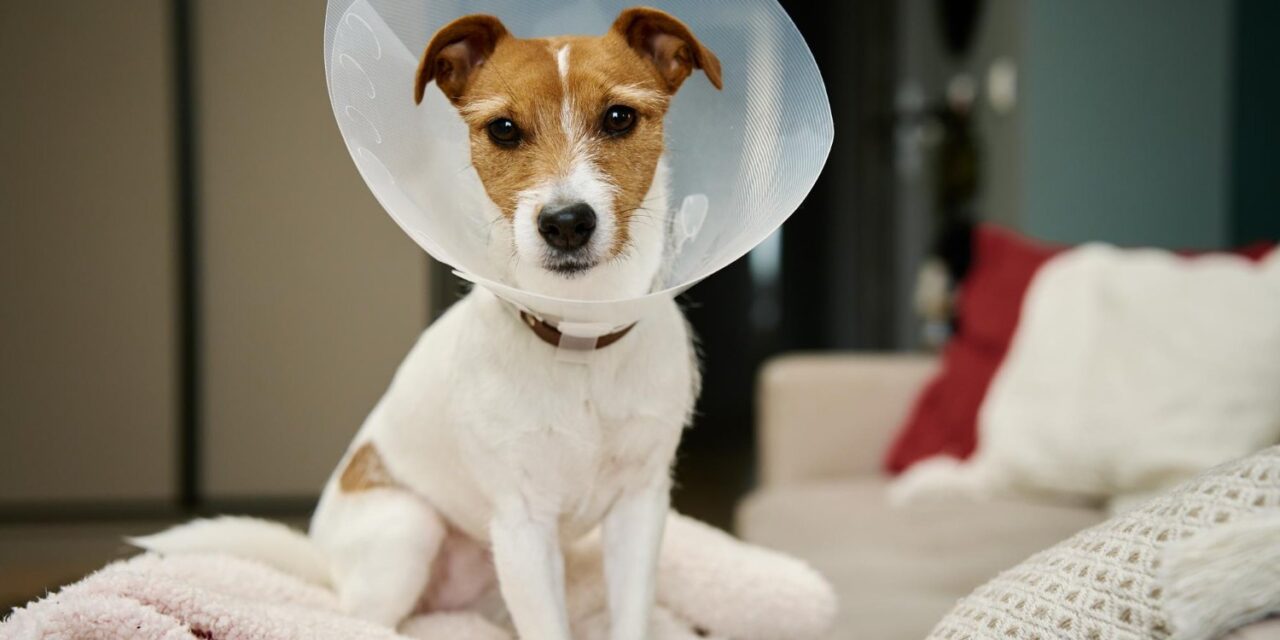
Dog spay recovery takes about 10 to 14 days of real restriction, and the hard part isn’t the first night. It’s day four, when your dog feels fine and the incision doesn’t. A spay is abdominal surgery. The skin closes on the outside long before the body wall underneath regains its strength, which is why surgeons ask for two weeks of leash-only bathroom breaks, no jumping, and a cone that stays on. Neuter recovery follows the same calendar, with a smaller incision and one extra thing to watch: the scrotum.
Most dogs come through this uneventfully. They sleep off the anesthesia, eat a small dinner, and spend two slightly boring weeks being told “no” a lot. A smaller number run into a seroma, a licked-open incision, or a swelling that needs a same-day look. The difference between those two groups is mostly setup, supervision, and knowing which changes are normal and which ones mean you call.
This guide walks through what the surgery involves in plain language, what the first evening looks like, how to handle pain control without ever improvising, what a healing incision should look like each day, how to keep a bored dog still without losing your mind, and exactly when to call versus go. There’s a timeline table, an incision-appearance table, a section on households with other dogs and kids, and answers to the questions owners ask most at 11 p.m. with a flashlight pointed at a belly.
What’s in this guide
- Dog spay recovery: the short answer and the timeline
- Red flags after spay or neuter surgery: call today vs. go now
- What spay and neuter surgery actually involve
- The first evening home
- Pain control: follow the prescribed plan exactly
- Incision care, day by day
- Activity restriction: the 10-to-14-day rules
- Cones, recovery suits, and inflatable collars
- Feeding and bathroom changes after surgery
- Monitoring at home and complications by category
- The recheck appointment
- When dog spay recovery takes longer
- Multi-dog households, kids, and visitors
- What complications cost vs. two weeks of restriction
- Common mistakes during dog spay recovery
- Frequently asked questions about dog spay recovery
- Sources
Dog Spay Recovery: The Short Answer and the Timeline
Plan on 10 to 14 days of restricted activity after a spay, and treat the full two weeks as the default unless your surgeon tells you otherwise. The American College of Veterinary Surgeons describes aftercare as house rest “with no running, jumping or rough play for two weeks following surgery.” VCA Animal Hospitals gives a 7-to-14-day range for incision healing and notes that many dogs are back to normal activity in 5 to 10 days, but the incision itself still needs protecting until the recheck.
Pain medication typically goes home for several days. Skin sutures or staples, if there are any, come out at roughly 10 to 14 days. Buried sutures and tissue glue dissolve or flake off on their own. The cone stays on until the incision is fully healed, not until your dog stops complaining about it.
Why Neuter Recovery Runs on the Same Calendar
A neuter is a smaller surgery. The incision sits just in front of the scrotum, the abdomen isn’t opened, and most males act like nothing happened by the second morning. That’s exactly the problem. As the AKC’s recovery guide puts it, incisions take the same amount of time to heal regardless of their size. A neutered dog who’s allowed to sprint across the yard on day three can split his incision or pool blood in the scrotum just as surely as a spayed dog can strain her belly closure.
So the rules in this article apply to both surgeries. Where something is specific to one or the other, such as scrotal swelling after a neuter or the body-wall concerns after a spay, we’ll say so.
The four rules that prevent most problems
- No licking, ever. Cone or recovery suit on from the moment you get home, including overnight and when you’re in the next room.
- Leash-only outside, even in a fenced yard. Bathroom breaks only, for the full restriction period.
- No stairs, jumping, running, or wrestling. Block the couch. Carry small dogs. Use a pen or crate when you can’t watch.
- Medication exactly as written. No skipping, no doubling, no human pain relievers, no stopping early because your dog “seems fine.”
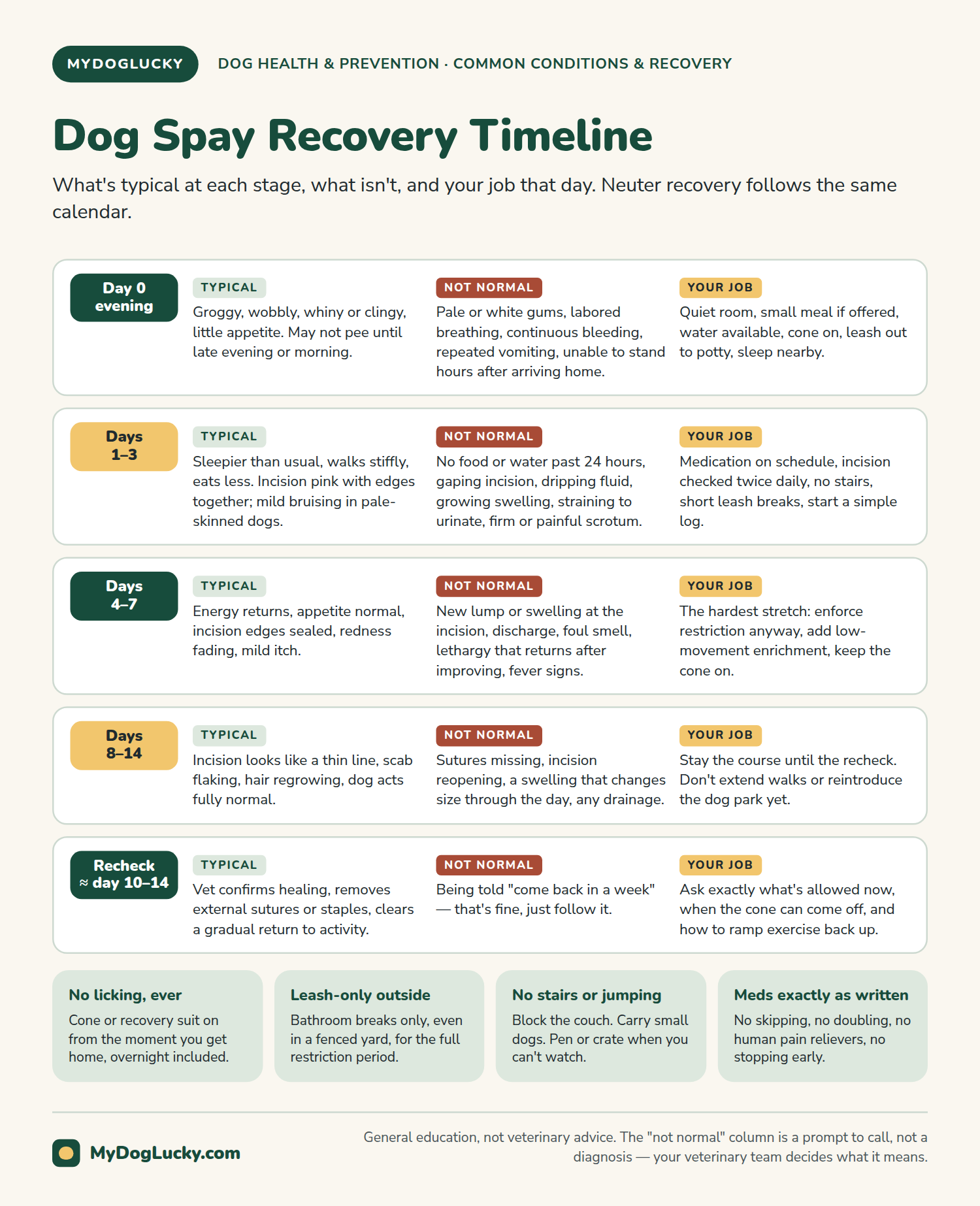
The Recovery Timeline at a Glance
| Stage | What’s typical | What isn’t | Your job |
|---|---|---|---|
| Day 0 (evening) | Groggy, wobbly, whiny or clingy, little appetite, may not pee until late evening or morning | Pale or white gums, labored breathing, continuous bleeding, repeated vomiting, unable to stand hours after arriving home | Quiet room, small meal if offered, water available, cone on, leash out to potty, sleep nearby |
| Days 1–3 | Sleepier than usual, walks stiffly, eats less than normal, incision pink with edges together, mild bruising in pale-skinned dogs | Not eating or drinking at all past 24 hours, gaping incision, dripping fluid, swelling that’s growing, straining to urinate, firm or painful scrotum | Medication on schedule, incision checked twice daily, no stairs, short leash breaks, start a simple log |
| Days 4–7 | Energy returns, appetite normal, incision edges sealed, redness fading, mild itch | New lump or swelling at the incision, discharge, foul smell, lethargy that returns after improving, fever signs | The hardest stretch: enforce restriction anyway, add low-movement enrichment, keep the cone on |
| Days 8–14 | Incision looks like a thin line, scab flaking, hair regrowing, dog acts fully normal | Sutures missing, incision reopening, a swelling that changes size through the day, any drainage | Stay the course until the recheck; don’t extend walks or reintroduce the dog park yet |
| Recheck (≈10–14 days) | Vet confirms healing, removes external sutures or staples, clears a gradual return to activity | Being told “come back in a week” — fine, just follow it | Ask exactly what’s allowed now, when the cone can come off, and how to ramp exercise back up |
Red Flags After Spay or Neuter Surgery: Call Today vs. Go Now
Most of what you’ll see over two weeks is boring and reassuring. The list below exists for the small number of dogs who need help fast. Read it once now, calmly, so you recognize it later.
Go to a veterinarian now (your clinic or an emergency hospital):
- Pale, white, gray, or bluish gums, especially with weakness or a fast heartbeat. This can signal internal bleeding.
- Difficulty breathing or breathing that looks labored, fast, or noisy at rest.
- Continuous bleeding from the incision, or blood that keeps seeping beyond 24 hours.
- The incision has opened and you can see tissue underneath, or anything is protruding.
- A swelling at a spay incision that appeared suddenly, changes size when your dog stands versus lies down, or comes with pinkish watery drainage. These are classic signs of an incisional hernia, which needs a same-day exam.
- Collapse, inability to stand, or a dog who becomes unresponsive.
- Repeated vomiting or a belly that looks distended and tight.
- Straining to urinate with little or nothing coming out, particularly after a neuter.
One item is enough. Call ahead if you can, then go.
Call your veterinarian today:
- Not eating or not drinking for more than 24 hours after getting home.
- Lethargy that persists past day two, or that comes back after your dog had started to perk up.
- Redness spreading outward from the incision, any discharge, a foul smell, or a scab that looks wet.
- A soft, non-painful lump under a spay incision (a possible seroma). Not an emergency, but your vet needs to confirm what it is.
- A scrotum that looks swollen, bruised, firm, or tender after a neuter.
- Signs of fever: your dog feels hot, is shivering, or is panting at rest. Normal canine body temperature runs roughly 100.5–102.5°F (38.1–39.2°C) per VCA.
- Missing sutures or staples, or a cone your dog keeps defeating.
- Diarrhea, a single vomit, or a cough that doesn’t settle within a day.
- Pain that seems worse than the medication is handling: crying when moving, refusing to lie down, guarding the belly.
Monitor at home (normal recovery)
- Drowsiness and clinginess the first night, stiffness the first few days.
- Eating a little less than usual for a day or two while still drinking.
- Slight pinkness at the incision edges, mild bruising, a small dry crust.
- Whining or restlessness the first evening as anesthesia wears off.
- A slightly loose or saggy scrotum after a neuter that is not firm or painful.
Keep watching. If any of these shifts toward the lists above, move up a tier.
What Spay and Neuter Surgery Actually Involve
Understanding what was done makes the restrictions feel less arbitrary. It also explains why a female dog’s recovery has a few extra watch points.
Spay: Ovariohysterectomy or Ovariectomy
A traditional spay is performed under general anesthesia through an incision on the midline of the belly, below the navel. In an ovariohysterectomy, the surgeon removes both ovaries and the uterus. In an ovariectomy, only the ovaries are removed. Both are accepted, both sterilize the dog, and both stop heat cycles. A 2020 review in Today’s Veterinary Practice notes that pyometra risk after either procedure is near zero as long as all ovarian tissue is removed.
Either way, the surgeon works inside the abdomen, ties off blood vessels, and closes in layers: the body wall (a tough sheet of connective tissue called the linea alba), then the tissue under the skin, then the skin itself. That deep layer is the one that matters most for your two weeks of restriction. It holds the abdomen closed while it heals.
The Laparoscopic Option
Some practices offer laparoscopic spays. According to ACVS, the surgeon uses two or three small incisions, usually under an inch, and inflates the abdomen with carbon dioxide to see and work with a camera and long instruments. Vessels are sealed with clips, suture, or a sealing device. The small “portal” incisions are then closed.
The appeal is smaller wounds and, in many reports, less post-operative pain. It costs more, needs specialized equipment, and isn’t available everywhere. One caution worth passing along: the same review noted that laparoscopic outcomes hadn’t yet been compared head-to-head with efficient open techniques in randomized trials. If your dog had a laparoscopic spay, follow your surgeon’s activity plan exactly. Small incisions still go all the way through the body wall.
Neuter: Castration
A routine neuter removes both testicles through a single small incision made just in front of the scrotum. The scrotum itself is usually left in place, and in most young dogs it shrinks over the following weeks. ACVS notes that scrotal ablation, removing the scrotum, “may be discussed by the attending surgeon,” which is more common in older dogs with a large, pendulous scrotum.
Because the abdomen isn’t opened, there’s no body-wall closure to protect. The risks that remain are bleeding into the empty scrotum, licking, and infection at the incision.
Why the Two Recoveries Differ
Put simply: a spay is abdominal surgery and a neuter is not. That changes three things for you at home.
- Pain. The 2022 AAHA Pain Management Guidelines describe surgeries like ovariohysterectomy as involving moderate tissue trauma that warrants a multimodal (multi-drug) plan. Expect a spayed dog to be sorer, for longer, than a neutered one.
- What can go wrong under the skin. A spay carries a small risk of internal bleeding and incisional hernia. A neuter’s signature complication is scrotal swelling.
- How convincing the “I’m fine” act is. Neutered males bounce back visibly faster. That’s not permission to skip the rules.
The First Evening Home
Set up before pickup, not after. You want the recovery space ready, the cone fitted, and the medication instructions read while you can still think clearly.
Have ready before you leave for the clinic
- A crate, exercise pen, or small closed room with a flat, washable bed (no deep, sinky cushions your dog has to climb out of).
- A cone or recovery suit, ideally tried on a day or two earlier so it isn’t brand-new tonight.
- A leash by the door, a flashlight for late-night bathroom checks, and a towel for wet days.
- Baby gates for stairs, cushions or boxes to block the couch, a ramp or a plan to carry small dogs.
- A notebook or phone note for your recovery log.
- Your clinic’s after-hours number and the nearest emergency hospital’s address.
Grogginess, Whining, and the Thousand-Yard Stare
The drugs used for anesthesia and pain can take hours to wear off. VCA’s post-operative instructions say some dogs “appear drowsy for about a day.” Yours may stagger a little, stare at nothing, whine, pant, shiver, or seem to not quite recognize the house. Some dogs are clingy; others want to be left alone in the crate. All of this is typical for the first evening.
What isn’t typical: a dog who can’t stand at all hours after arriving home, breathing that looks like work, or gums that have lost their pink. Those are on the go-now list above.
Water and the First Meal
Leave water available unless your clinic told you otherwise. Small amounts at first are fine; a dog who gulps a whole bowl on a queasy stomach may bring it back up. For food, VCA suggests offering roughly half the usual dinner a few hours after getting home, split into smaller portions if your dog seems nauseous. Skipping dinner entirely tonight is common and not a red flag on its own. Refusing everything, food and water, for more than 24 hours is.
The First Bathroom Break
Clip the leash on before you open the door, even in a fenced yard. Walk slowly to the closest patch of grass, give it a few minutes, and come back in. Many dogs don’t urinate until late evening or the next morning because they received IV fluids at odd times and haven’t had their usual water intake. A dog who is trying to urinate and producing nothing, repeatedly, is different. That one gets a call.
If it’s raining, use a towel to keep the incision area dry when you come back inside. Don’t wipe the incision itself.
Where Your Dog Sleeps Tonight
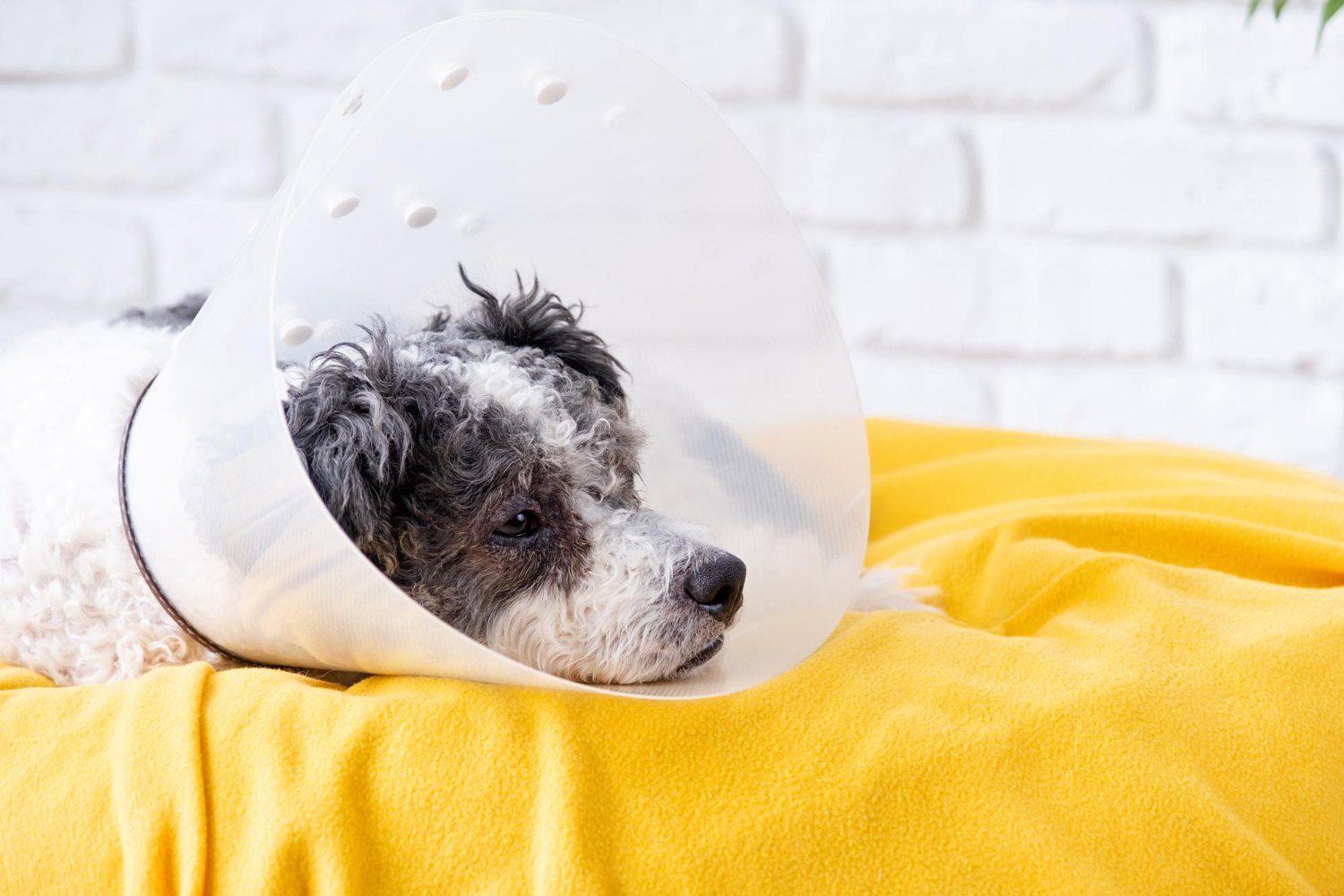
Somewhere you can hear them. A crate or pen next to your bed, or your dog’s usual bed dragged into your room with the door closed, both work. Keep other pets out. Keep the room dim and unexciting. Some dogs cry for the first hour as the sedation lifts and they realize they’re wearing a plastic satellite dish. Sit with them, speak quietly, and resist the urge to remove the cone “just for tonight.” The first night is when most licking happens, because you’re asleep.
Pain Control: Follow the Prescribed Plan Exactly
Your dog will go home with a written plan. It may include a veterinary anti-inflammatory (a veterinary-labeled NSAID), sometimes a second medication for pain, and occasionally a mild sedative for dogs who won’t settle. The AAHA guidelines describe this as multimodal analgesia: several drugs working through different mechanisms, with overlapping coverage that includes “at least the early ‘at-home’ time period.” Many dogs get a long-acting injection at the clinic and then oral medication for three to seven days.
We’re not going to name products or doses here, and you shouldn’t need to. Your clinic already chose them for your dog’s weight, age, kidney function, and the other medications they take. Your job is to give exactly what’s written, at the times written, with or without food as instructed.
Never Give Human Pain Relievers
This is the single most important sentence in this section. Do not give your dog ibuprofen, naproxen, aspirin, or acetaminophen, and don’t give “just half a tablet.” The Merck Veterinary Manual’s pet-owner chapter on human over-the-counter drugs is blunt: these drugs “should not be used in pets unless directed by your veterinarian.” Ibuprofen has a narrow safety margin in dogs and can damage the stomach lining and kidneys; even a single dose can cause severe vomiting and abdominal pain. Naproxen causes intestinal bleeding. Acetaminophen damages red blood cells and the liver.
There’s a second reason this matters after surgery. If your dog is already on a veterinary NSAID and you add a human one, you’ve stacked two drugs from the same class on a dog whose kidneys just went through anesthesia. If your dog seems uncomfortable, the answer is a phone call, not the medicine cabinet.
Don’t Adjust, Skip, or Stop Early
Owners adjust doses for two understandable reasons: the dog seems fine, or the dog seems worse. Neither is a reason to change the plan on your own. A dog who “seems fine” on day three is usually a dog whose pain medication is working. Stopping it early tends to produce a dog who is stiff and reluctant the next morning. A dog who seems worse needs the vet to know, because the fix might be a different drug, a recheck of the incision, or a look for something the pain is hiding.
Two practical notes. If your dog vomits a dose, don’t re-dose; call and ask. If you miss a dose by hours, don’t double up; call and ask. Both take two minutes and remove the guesswork.
How to Tell Your Dog Is Hurting
Dogs rarely cry from surgical pain. AAHA’s guideline puts it well: owners know their dog’s normal behavior, and deviations from it suggest pain. Watch for a dog who won’t eat but seems interested in food, one who stands rather than lies down, one who lies in an odd position, shifts weight constantly, flinches when the belly area is approached, or is unusually quiet and withdrawn. Panting at rest in a cool room, a hunched back, and reluctance to walk to the yard are also worth noting.
Write it down with a time. Then call. “She’s been standing in the corner for an hour and won’t lie down” is exactly the kind of report your vet can act on.
Comfort Measures That Don’t Involve a Pill
AAHA notes that cold therapy is effective and can be applied by owners. Ask your clinic whether a cool compress wrapped in a thin towel, held gently near (not on) the incision for a few minutes, is appropriate for your dog. Beyond that: a firm, flat bed, a quiet room, dim light, a predictable schedule, and your presence. Anxious dogs often settle faster when a person sits on the floor nearby and does nothing in particular.
Incision Care, Day by Day
Look at the incision twice a day, morning and evening, in good light. Take a photo each time from the same angle and distance. A series of photos makes “is that redder than yesterday?” a question you can actually answer, and it gives your vet something concrete if you call.
What Normal Healing Looks Like
Days 1–3. The incision is a straight line with the edges touching. The skin is a normal or slightly reddish pink. In pale-skinned dogs you may see bruising appear a day or two after surgery from blood seeping under the skin edges; VCA describes this as expected. A small amount of dried crust along the line is fine. Wet, dripping, or gaping is not.
Days 4–7. Redness settles. The edges are sealed, and the line may look slightly raised and firm as new tissue forms underneath. Itching often starts now, which is when cones get tested. The area around the shaved patch may look a little pink from clipper irritation.
Days 8–14. The line thins, the scab flakes away, and fine hair begins regrowing. By the recheck, most incisions look like a faint seam. The body wall underneath is still gaining strength, which is why restriction continues even though the skin looks done.
Sutures, Staples, Glue, and Buried Stitches
Clinics close skin in different ways, and it changes what you’ll see and whether anything needs removing.
- External sutures are visible knots on the skin. VCA says non-dissolving sutures are usually removed 10–14 days after surgery.
- Staples are small metal clips. Same removal window, done at the clinic with a special tool. Don’t try it at home.
- Intradermal (buried) sutures run under the skin surface and dissolve on their own. VCA notes they “do not require removal.” You may not see any stitches at all; the line is closed from underneath.
- Tissue glue is sometimes applied over an intradermal closure. It looks like a thin clear or purplish film and flakes off. The ASPCA Spay/Neuter Alliance warns that water affects surgical glue and can open the incision, which is one reason bathing is off the table.
- A small green tattoo line near the incision, applied by many shelters and spay-neuter clinics, is a permanent marker that the dog has been sterilized. It isn’t a problem and doesn’t need care.
Some laparoscopic spays have two or three small incisions instead of one; check each of them.
The Do-Not List for the Incision
- No licking. The ASPCA Spay/Neuter Alliance guide is direct: keep the cone on at all times for 7–10 days, because “even a little licking can cause problems.” Most clinics say until the recheck.
- No bathing, no swimming, no wading, for at least 10 days (ASPCA) and until your vet clears it.
- No hydrogen peroxide, no rubbing alcohol. VCA capitalizes the word NEVER on this one; both damage healing tissue.
- No ointments, creams, sprays, or home remedies unless your vet prescribed them. They keep the area moist and encourage licking.
- No picking at scabs or glue.
- No belly rubs from anyone, including the kids and the neighbor, for two weeks.
If the incision gets dirty, ask your clinic what to do. Many will suggest a gentle dab with a gauze pad moistened with plain water, then patting dry. Don’t scrub.
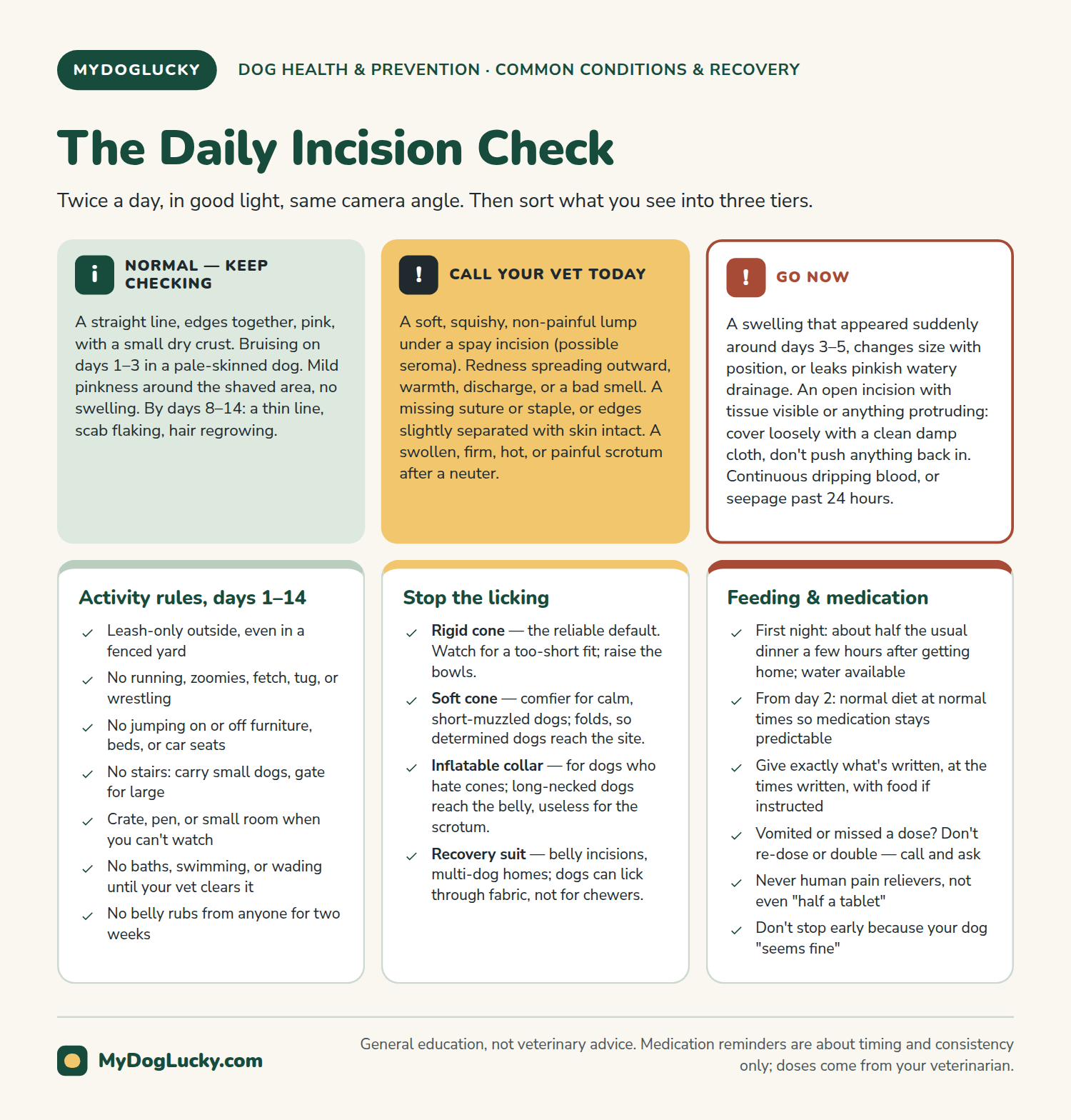
Incision Appearance: Normal, Call Today, Go Now
| What you see | What it usually means | What to do |
|---|---|---|
| Straight line, edges together, pink, dry crust | Normal healing | Keep checking twice daily |
| Bruising appearing on days 1–3 in a pale-skinned dog | Expected seepage under the skin edges | Photograph; mention at recheck; call if it spreads fast |
| Mild pinkness around the shaved area, no swelling | Clipper irritation; often normal | Monitor; keep the cone on |
| Soft, squishy, non-painful lump under a spay incision | Possible seroma (fluid pocket), often from too much activity | Call today; your vet confirms it and may drain it or simply watch it |
| Redness spreading outward, warmth, discharge, bad smell | Possible infection | Call today |
| Missing suture or staple, incision edges slightly separated but skin intact underneath | Partial skin dehiscence | Call today; cone on; no activity |
| Swelling that appeared suddenly around days 3–5, changes size with position, pinkish watery drainage | Possible incisional hernia (body-wall opening) | Go now |
| Incision open with tissue visible or anything protruding | Full dehiscence | Go now; cover loosely with a clean damp cloth; do not push anything back in |
| Continuous dripping blood, or seepage past 24 hours | Bleeding that isn’t stopping | Go now |
| Scrotum swollen, firm, hot, or painful after a neuter | Possible scrotal hematoma or abscess | Call today; go now if your dog is straining to urinate or seems very painful |
Activity Restriction: The 10-to-14-Day Rules
This is where dog spay recovery is won or lost. The AKC’s guide spells out the mechanism: excessive movement can “disrupt ideal healing and cause incisional dehiscence [opening] or seroma [fluid] formation.” Every rule below exists to keep tension off the closure while it gains strength.
What’s Off-Limits
- Running, sprinting to the door, zoomies, fetch, tug, chasing anything.
- Jumping on or off furniture, beds, car seats, and porch steps.
- Stairs. Carry small dogs; block stairs for large dogs with a gate, or walk them up one step at a time on a short leash if your vet approves and there’s no alternative.
- Wrestling or play with other dogs, including gentle play. Other dogs don’t know where the incision is.
- Off-leash time anywhere, including the backyard.
- Long walks, dog parks, daycare, hikes, swimming, and the beach.
- Standing on hind legs to greet people or look out windows.
Leash-Only Bathroom Breaks
For the first few days, a bathroom break is a five-to-ten-minute walk to the nearest suitable spot and back. From about day four onward, many vets allow slightly longer slow walks on a short leash, still no pulling, still no greeting other dogs. VCA’s post-operative guidance keeps dogs indoors except for short leash walks to urinate and defecate. If your dog pulls hard, a front-clip harness that doesn’t cross the incision, or a walk that starts only after they’ve calmed, helps keep the belly muscles from straining.
Apartment dwellers: elevators are fine; stairwells are not. If you have no elevator and a dog too large to carry, ask your clinic before surgery day how to handle it. The answer is usually slow, one-step-at-a-time on a very short leash, twice a day, and nothing else.
Crate, Pen, or Small-Room Setup
You need a place your dog can be safely still whenever you aren’t actively watching. A crate works for crate-trained dogs. An exercise pen works for dogs who find crates stressful. A small room with the furniture blocked off works for dogs who won’t tolerate either. Bathrooms and laundry rooms with hard floors are popular for a reason: easy to clean, easy to block, nothing to jump on.
Put a flat bed inside. Skip the deep orthopedic cushion your dog has to climb out of, and skip the raised cot that’s a jump down. Add a non-slip mat if the floor is slick, because a dog scrambling for traction on tile is straining the exact muscles you’re protecting.
Enrichment That Doesn’t Move the Body
Two weeks of nothing is hard on a young dog. Mental work tires a dog out without tugging on stitches. Keep everything slow, low, and supervised.
- Food puzzles at an easy level, filled with part of the regular meal. Choose ones your dog nudges with their nose rather than flings across the room.
- Lick mats spread with a thin layer of something your vet approves. Licking is calming, and a dog licking a mat is a dog not licking a belly. Make sure the cone allows it, or supervise with the cone off and back on afterward.
- Low-level sniff games: a few pieces of kibble scattered on a towel or in a snuffle mat, or hidden in a box of crumpled paper, all at floor level. No “find it” that sends the dog racing between rooms.
- Stationary training: chin rests, “touch” to a hand held at nose height, calm “watch me,” name recognition, and cone-desensitization games. Skip sits and downs if your vet says so; getting up and down repeatedly tugs on the abdomen.
- Chews your dog can work on lying down, if chewing is normally part of their routine and your vet has no objection.
- Quiet company. Sitting with your dog while you read is enrichment for a social animal.
Three short sessions a day beat one long one. Stop before your dog gets wound up.
The Day-Four Trap
Around day four, most dogs feel good. They stretch, they bring you a toy, they stand at the back door with real intent. It is very tempting to decide that “she knows her own body.” She doesn’t, at least not about connective tissue. The skin is the first thing to seal and the body wall is the last thing to regain strength, and Clinician’s Brief notes that acute incisional hernias usually occur 3 to 5 days after surgery, before wound edges gain significant strength. The energy returning is the medication and the rest working. Keep going.
A sample recovery day (days 3–14)
- Morning: leash out, incision check and photo, medication with breakfast as directed, then crate or pen with a food puzzle.
- Midday: leash out, five minutes of chin-rest or “touch” practice, lick mat, nap.
- Afternoon: quiet time in the same room as you, a chew, a short slow leash walk if allowed.
- Evening: leash out, incision check and photo, medication with dinner as directed, sniff game on a towel, settle for the night with the cone on.
Adjust for your work schedule. If no one can supervise midday, a pen with water and a safe chew is a better plan than a free house.
Cones, Recovery Suits, and Inflatable Collars
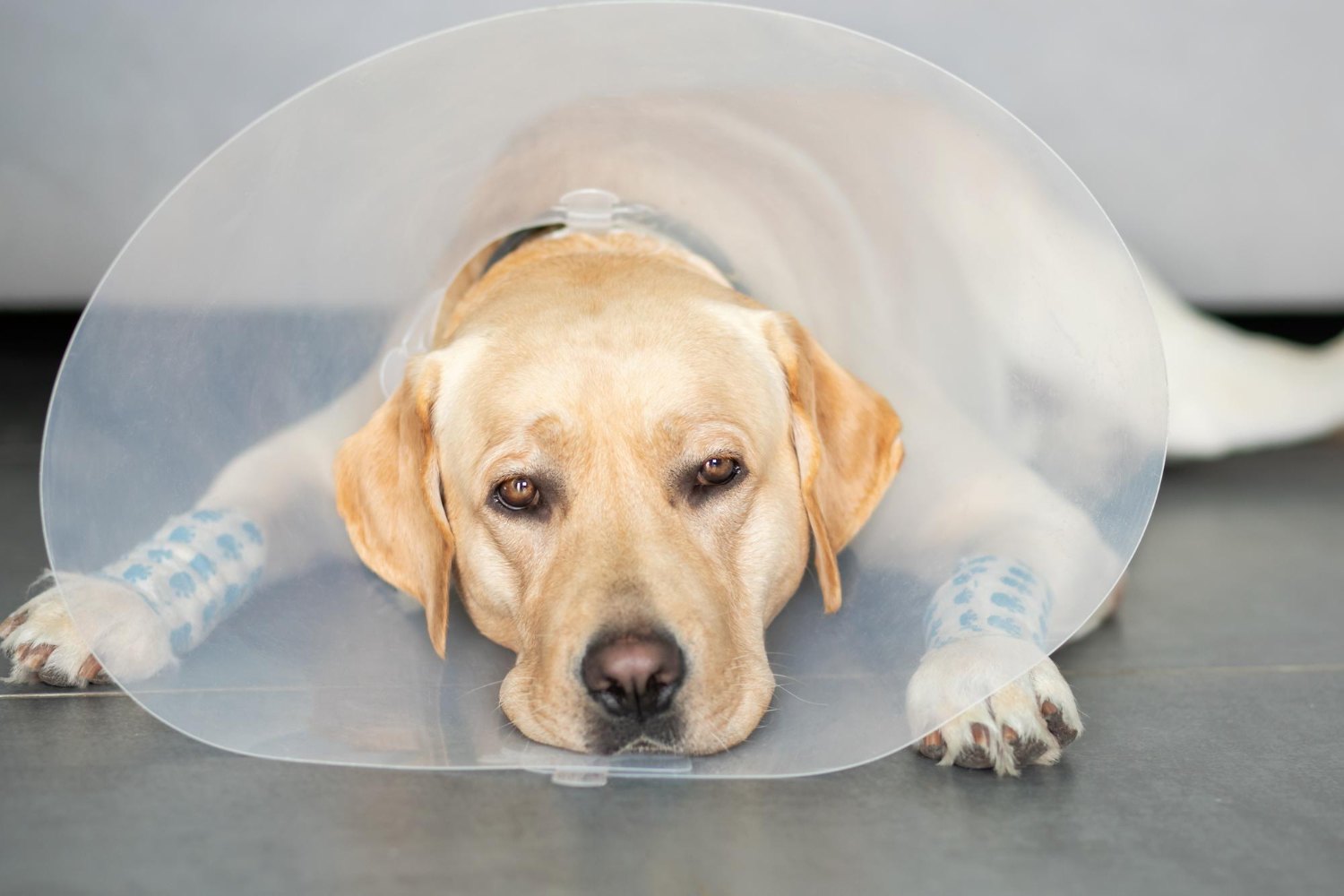
Something has to stop the licking. Which something depends on your dog’s shape, flexibility, and determination. Categories only here; ask your clinic what they stock and what fits your dog.
The Rigid Cone (Elizabethan Collar)
The plastic cone remains the default because it works for the most dogs. VCA notes that with a proper fit, a dog can eat and drink normally, and most dogs adjust within a few hours. The fit test: the cone should extend a little past the tip of the nose, and you should be able to slide two fingers under the neck strap. Too short and a flexible dog reaches the belly anyway. Expect a few days of your dog misjudging doorways and using the cone to plow the water bowl across the kitchen. That part passes, and it’s a lot cheaper than a second surgery.
Tips that help: raise the food and water bowls or use shallow plates, remove low obstacles from the walkway, and let your dog keep the cone on for naps rather than taking it on and off constantly. Every removal is a chance to lick.
Soft Fabric Cones
Quieter, more comfortable for sleeping, and less alarming to some dogs. The trade-off is that a soft cone folds, and a determined dog can bend it enough to reach the incision. They work best for calm dogs, short-nosed dogs who can’t reach far anyway, and as a nighttime swap for a dog who’s been reliable during the day.
Inflatable Collars
The “donut” style stops a dog from bending the neck far enough to reach the flank and back. Many dogs tolerate it better than a cone, and it doesn’t bump into walls. Two limits: long-necked and long-bodied dogs can often reach a belly incision around it, and it does nothing to stop a dog from licking a neuter incision or the scrotum, which are easier to reach. Check, with the collar on, whether your dog can actually get their tongue to the site before trusting it.
Recovery Suits
A recovery suit (“onesie”) covers the abdomen and, on many designs, the groin. VCA lists suits among the alternatives when a dog struggles with a cone. They keep the incision clean and dry, they let the dog sleep normally, and they don’t hit furniture. They aren’t lick-proof: a dog can lick through thin fabric, chew a hole, or work the suit up. Suits need unsnapping for every bathroom break, which is one more step at 6 a.m. Some owners pair a suit with a cone at night for a wiggly dog.
| Option | Works well when | Watch out for |
|---|---|---|
| Rigid cone | You need reliability; dog is flexible or determined | Too-short fit; doorways; raised bowls needed |
| Soft cone | Calm dog, short muzzle, nighttime comfort | Folds; determined dogs reach the incision |
| Inflatable collar | Dog hates cones; incision is on the flank or back | Long-necked dogs reach the belly; useless for the scrotum |
| Recovery suit | Belly incision; dog sleeps better without a cone; multi-dog home | Licking through fabric; must unsnap for bathroom; not for chewers |
Whatever you pick, test it under supervision the first day. If your dog defeats it, switch or combine, and tell your clinic. VCA notes that some dogs benefit from a few days of a sedative-class medication to help them adjust, which is a conversation with your vet, not a decision to make at home.
Feeding and Bathroom Changes After Surgery
The First 24 Hours
Half a normal dinner a few hours after getting home, in small portions if your dog is queasy, and water available. If your dog turns the meal down, try again in the morning. A dog who won’t touch food or water by the next evening needs a call. So does a dog who vomits more than once.
Days 2 to 14
Appetite usually returns by day two. Feed the normal diet at normal times so medication schedules stay predictable. Some clinics ask you to give a medication with food to protect the stomach; if your dog skips a meal, ask before giving that dose on an empty stomach.
A few things shift. Dogs who ate less for two days may not pass stool for two or three days; that’s usually fine as long as they aren’t straining. Some pain medications slow the gut. If your dog strains repeatedly with nothing produced, or hasn’t passed stool by day four, call. A little softness in the stool from stress and medication is common; watery diarrhea is a call-today item.
Because your dog is doing less, you may want to trim treats slightly, but this isn’t the moment for a diet change. Keep the food the same. Save the puzzle feeders and lick mats for portions of the regular meal rather than extras.
Urination After a Spay
Expect a slightly awkward squat for a few days as your dog protects the belly. Frequency should return to normal by day two. Blood in the urine, straining, or repeated attempts with nothing produced are call-today signs; pale gums or a distended abdomen alongside them move it to go-now.
Urination After a Neuter
Some males stand differently for a few days or seem hesitant to lift a leg. That’s ordinary caution. What isn’t ordinary is straining without success, dribbling, or a scrotum that’s swelling. Swelling in that area can make urination uncomfortable and is the most common reason a neutered dog goes back to the clinic in the first week.
The Longer View: Weight
The AVMA notes that spayed and neutered dogs are more at risk of becoming overweight. VCA is more pointed: obesity is the result of overfeeding and lack of activity, not the surgery itself. After the recheck, once exercise is back to normal, weigh your dog monthly for a few months and adjust portions with your vet if the number drifts up. Two weeks of restriction won’t cause weight gain. A year of the same portions with a slower metabolism might.
Monitoring at Home and Complications by Category
You’re not diagnosing anything. You’re collecting the details that let your vet triage a phone call in thirty seconds instead of asking you to come in “just to see.”
The Recovery Log
Twice a day, note: medication given (which, what time), whether your dog ate and drank, urination and stool, energy level in one or two words, the incision (photo plus one line), and anything odd. It takes ninety seconds. By day five you’ll have a record that shows whether a change is a trend or a blip, and you’ll have something to hand the clinic at the recheck.
If your vet asked you to take a temperature, use a digital rectal thermometer with lubricant, with a second person holding the dog, and stop if your dog objects strongly. If they didn’t ask, don’t chase a number; report the signs you see instead.
Complications by Broad Category
These are the categories your vet is thinking about. Rates are low for routine surgeries in healthy dogs, and most problems are caught early when owners check the incision twice daily. This is orientation, not a checklist for diagnosing your dog.
- Anesthesia-related, first 24–48 hours. Nausea, a single vomit, a soft cough from the breathing tube, wobbliness. Mostly self-limiting. A cough that persists, repeated vomiting, or breathing trouble gets a call.
- Incisional: seroma. A pocket of clear-to-yellow fluid under the skin, usually soft, movable, and not painful. Commonly linked to too much activity. Many resolve with rest and time; some are drained at the clinic. Always confirmed by a vet, never assumed.
- Incisional: infection. Spreading redness, warmth, swelling, discharge, odor, often with licking as the trigger. Call today.
- Incisional: dehiscence. The skin edges separate. Partial separation with intact tissue underneath is a call-today item; a fully open incision is go-now.
- Body wall: incisional hernia (spay). The deep closure gives way, and abdominal contents push against the skin. Sudden swelling around days 3–5, changing with position, sometimes with pinkish drainage. Go now.
- Bleeding. External seepage past 24 hours, or the quieter kind: pale gums, weakness, a swelling belly, a fast heart rate. Internal bleeding after a spay is rare and serious. Go now.
- Scrotal (neuter). Bruising and mild looseness are common. A scrotum that’s tight, firm, hot, or painful may be a hematoma (pooled blood) or abscess and can need a second procedure. Call today.
- Urinary. Straining, dribbling, blood, or no urine. ACVS lists urinary obstruction among rare but serious spay complications. Straining with nothing produced is go-now.
- Systemic. Fever, lethargy that returns after improvement, refusal of food and water past 24 hours. Call today.
- Later and rarer. Ovarian remnant syndrome (heat signs months after a spay) and, in some females, urinary incontinence years later. Neither is a recovery-period concern, but both are worth knowing exist.
Seroma vs. Hernia: Why the Difference Matters
Both show up as a lump under a spay incision, and both worry owners. A seroma is fluid under the skin, above the body wall; it’s soft, it stays put, and it’s not tender. A hernia is a gap in the body wall itself; the swelling can appear abruptly, may get larger when your dog stands or strains and smaller when they lie down, and may leak thin pink fluid. Clinician’s Brief describes feeling the “hernia ring” and being able to push the contents back as the diagnostic signs, and recommends immediate examination when warning signs are present because small hernias can enlarge quickly.
You don’t need to make that call. You need to notice a new lump, note whether it changes with position, and phone. If it changed suddenly or is draining, go.
The Recheck Appointment
Most clinics schedule a recheck 10 to 14 days after surgery. Some skip it for dogs with buried sutures and a clean incision, and ask you to send a photo instead. Either way, treat it as the finish line for restriction, not day seven.
At the visit, the vet or a technician examines the incision, checks for swelling, removes external sutures or staples, and asks how your dog has been eating, moving, and toileting. Bring your log and your photos. Then ask, specifically:
- Is the incision fully healed, or do we keep the cone a few more days?
- What activity is allowed this week: leash walks of what length, off-leash when, stairs when, play with the other dog when?
- Is bathing or swimming okay now?
- Should I finish the remaining medication or stop?
- Is there anything about this dog specifically (size, age, the surgery itself) that changes the usual plan?
A gradual ramp is the norm: a few days of longer leash walks, then short supervised off-leash time, then normal play. Going from two weeks of nothing to an hour at the dog park is a recipe for a sore, stiff dog, even with a healed incision.
When Dog Spay Recovery Takes Longer
The two-week framework fits most young, healthy, average-sized dogs. Several situations stretch it, and your surgeon will tell you if your dog is in one.
Large and Giant Breeds
AAHA’s current timing guidance suggests spaying or neutering large-breed dogs after growth stops, often between 9 and 15 months. That means a bigger dog, a longer incision, more tissue to close, and a body that weighs more on every step. ACVS notes that ovariohysterectomy “can be more difficult in larger or obese pets,” with more bleeding and a higher complication risk. Expect the same 14 days as a minimum, sometimes a bit longer, and expect the logistics (stairs, getting into the car, being carried) to be the hard part.
In-Heat or Recently-in-Heat Spays
Blood vessels to the uterus enlarge during heat. VCA notes that spaying before the first heat decreases the risk of bleeding after surgery and provides a faster recovery. Dogs spayed while in heat or soon after can be safely spayed, per the Association of Shelter Veterinarians’ guidelines, but the surgery is more involved and the surgeon may ask for stricter rest and a closer eye on gum color and the incision. Dogs spayed for pyometra are in a different category again: Cornell’s Riney Canine Health Center describes that surgery as “often more complicated than a spay for a normal, healthy dog,” with hospital care for fluids and infection.
Older Dogs
An older dog may have slower wound healing, a longer anesthetic recovery, other health conditions that affect medication choices, and less patience for a cone. Older females are also more likely to have had multiple heats, which means larger vessels. Older males with a large scrotum may have it removed at surgery, which adds an incision. Your vet may run pre-anesthetic bloodwork, choose different pain medications, and ask for a longer restriction. None of this means an older dog can’t recover well. It means the plan is more individual.
Cryptorchid Neuters
When one or both testicles never descended into the scrotum, the surgeon has to find them, in the groin or inside the abdomen. The ASV guidelines require that both testes be removed, with the undescended one located first. Merck notes that retained testicles carry a higher cancer risk, which is why these dogs are neutered rather than left alone. If the testicle was abdominal, your dog effectively had abdominal surgery and should be treated like a spay: the full 14 days, the body-wall concerns, and a same-day call for any sudden swelling. Ask your surgeon which approach was used and what that means for your dog’s restrictions.
Overweight Dogs and Dogs With Other Conditions
Extra body fat makes the surgery longer and the incision deeper, and it puts more pressure on the closure. Dogs with diabetes, heart disease, or bleeding disorders have their own protocols. If your dog is in any of these groups, the general timeline here is a floor. Your vet’s written plan is the ceiling.
Multi-Dog Households, Kids, and Visitors
The ASPCA’s first recovery tip is to provide a quiet place to recover “indoors and away from other animals.” It’s listed first for a reason.
Other Dogs
Your other dog will try to lick the incision. Not out of malice; that’s just what dogs do with wounds. They’ll also invite play at exactly the wrong moment. For two weeks: separate whenever you aren’t actively supervising, walk the dogs separately (the recovering dog gets the short, slow walk), feed separately so nobody guards a puzzle feeder, and let them see and sniff each other through a gate so the separation isn’t stressful. A recovery suit adds a layer of protection if the dogs must share space briefly.
Watch the healthy dog’s energy too. A bored, under-exercised housemate becomes a play instigator. Give that dog a longer walk and their own enrichment so they aren’t the problem.
Cats
Cats are usually less of an issue, though a cat who sleeps on the dog or pounces on a tail can startle a resting dog into a leap. Keep the recovery room cat-free the first few nights.
Kids
Children need three clear rules, repeated: no picking the dog up, no running games or chase, and the crate or pen is a no-visit zone. Give them a job instead. A child can be the official “incision photographer” (with you holding the phone), the person who fills the puzzle feeder, or the one who reads aloud next to the pen. Kids do better with a role than with a list of nos.
Visitors and Deliveries
Doorbells produce jumping. For two weeks, put the dog in the pen before you answer the door, or leave a note asking deliveries to skip the bell. Ask visitors not to greet the dog in a way that invites standing up or spinning, and to skip belly rubs entirely. Most people are happy to help once they know why.
What Complications Cost vs. Two Weeks of Restriction
A routine dog spay in the United States runs anywhere from a couple of hundred dollars at a low-cost clinic to well over a thousand at a private practice, and more for laparoscopic surgery or a large, in-heat, or older dog. Those are orientation figures from a 2025 veterinarian-written cost guide, not a quote; prices vary widely by region and clinic. What owners underestimate is the cost of the second visit.
A seroma check is a recheck fee, maybe with a needle drain. A licked, infected incision means an exam, medication, possibly a wound revision, and a restart of the two-week clock. A dehiscence or an incisional hernia means a second anesthesia and a second surgery, often at emergency rates if it happens on a weekend, plus a longer recovery afterward. A scrotal hematoma can mean a scrotal ablation surgery. None of these is cheap, and every one of them is more common in dogs who were allowed to run, jump, or lick.
Two weeks of gates, leashes, and puzzle feeders costs almost nothing. It’s the best bargain in this entire process.
Common Mistakes During Dog Spay Recovery
Taking the Cone Off “Just While I’m Watching”
A dog can lick an incision open in the time it takes you to answer a text. If the cone comes off for a meal or a lick mat, it goes back on the moment the bowl is empty.
Trusting the Fenced Yard
A fence stops your dog from leaving. It doesn’t stop a squirrel, a neighbor’s dog, or a sudden sprint to the back gate. Leash, every time, for the full period.
Reaching for the Medicine Cabinet
Covered above and worth repeating: no ibuprofen, naproxen, aspirin, or acetaminophen. No “half a tablet.” Call your vet if your dog seems uncomfortable.
Stopping Pain Medication Early Because the Dog Seems Fine
The dog seems fine because the medication is working. Finish the course as written, or ask before stopping.
Letting a Neutered Dog Off the Rules Because It Was “Just a Neuter”
The incision heals on the same schedule as a spay, and the scrotum is where blood pools when a dog runs too soon.
Skipping the Twice-Daily Incision Check
Owners who look once a day, or only when something seems off, miss the day a lump first appeared. Two looks and two photos a day take under a minute.
Bathing the Dog Because the Shaved Belly Looks Grubby
Water softens tissue glue, invites infection, and can reopen a closing incision. Wait until your vet clears it, and use a damp cloth on paws only if needed before then.
Reintroducing Play With the Other Dog on Day Ten
The incision looks healed. The body wall isn’t there yet. Wait for the recheck and the explicit okay.
Treating the Recheck as Optional
Sutures and staples need removal, and a vet’s eye on the incision catches what a phone photo misses. If the clinic offers a photo check for buried sutures, use it; don’t just skip the step.
Frequently Asked Questions About Dog Spay Recovery
How long does dog spay recovery take?
Plan on 10 to 14 days of restricted activity and cone-wearing, with a recheck at the end. Many dogs act normal well before that, and the incision usually looks like a thin line by two weeks, but the deeper closure keeps gaining strength beyond what you can see. A gradual return to full activity follows the recheck.
Is neuter recovery faster than spay recovery?
Dogs feel better faster after a neuter because the surgery is smaller and the abdomen isn’t opened. The incision still takes the same 10 to 14 days to heal, and the scrotum can fill with blood if a dog runs too early. Follow the same restrictions.
What should a spay incision look like on day 3? Day 7? Day 10?
Day 3: a straight, closed line, pink to slightly red, possibly with bruising in pale-skinned dogs and a small dry crust. Day 7: redness fading, edges sealed, slightly raised, itchy. Day 10: a thin line with the scab flaking and hair starting to regrow. Anything wet, gaping, swelling, draining, or smelly is a call, and a suddenly appearing swelling is a go-now.
My dog is whining and restless the first night. Is that pain?
Often it’s the anesthesia and sedation wearing off, plus a strange cone and a strange routine. Give the prescribed medication on schedule, keep the room dim, and sit nearby. If the restlessness continues into the next day, your dog won’t lie down, guards the belly, or pants at rest, call and describe it. Don’t add any human medication.
Can I give my dog something from my own medicine cabinet for pain?
No. Ibuprofen, naproxen, aspirin, and acetaminophen can cause stomach ulcers, kidney damage, liver damage, or bleeding in dogs, and combining them with a veterinary anti-inflammatory makes it worse. If the prescribed plan isn’t keeping your dog comfortable, call the clinic; they can adjust it safely.
How long does the cone stay on?
Until the incision is fully healed and your vet says so, usually through the recheck at 10 to 14 days. The ASPCA Spay/Neuter Alliance’s minimum is 7 to 10 days at all times. Taking it off “for a break” is how most licking injuries happen. A recovery suit or inflatable collar can replace it only if you’ve confirmed your dog can’t reach the site with it on.
My dog jumped on the couch on day 5. What now?
Don’t panic, and don’t assume it’s fine either. Check the incision right away for gaping, bleeding, or new swelling, then check again that evening and the next morning. If everything looks the same as before, note it in your log and tighten up the gates. If anything changed, call. One jump usually doesn’t cause harm; repeated jumps are how seromas and hernias happen.
There’s a soft lump under my dog’s spay incision. Is it an emergency?
A soft, movable, non-painful lump is often a seroma, a pocket of fluid that frequently follows too much activity. It’s a call-today item so your vet can confirm it, not something to assume. A lump that appeared suddenly, changes size when your dog stands versus lies down, feels firm, or leaks thin pink fluid could be a hernia and needs a same-day exam.
My neutered dog’s scrotum looks swollen. Is that normal?
Mild looseness and some bruising are common in the first days. A scrotum that’s tight, firm, hot, or painful to the touch, or that keeps enlarging, may be a hematoma or abscess and needs a call today. If your dog is straining to urinate or seems very painful, go in now.
When can my dog go back to daycare, the dog park, or swimming?
After the recheck and an explicit okay from your vet, then gradually. Swimming and bathing need a fully healed incision, so ask specifically. Daycare and dog parks involve wrestling and sprinting, so most vets suggest a few more days of leash walks first even after clearance. Going from zero to a full afternoon of play is hard on any dog.
Where This Leaves You
Dog spay recovery is mostly a management problem, not a medical one. The surgery is done; your job is to keep the incision closed, dry, and unlicked while the body finishes the work underneath. Set up the space before pickup, give the medication exactly as written, look at the incision twice a day with a camera in hand, and hold the line on leashes and gates through the day-four “I’m fine” performance.
If you see pale gums, an open incision, continuous bleeding, sudden swelling, breathing trouble, or a dog who can’t stand, go in now. If you see discharge, spreading redness, a soft lump, a swollen scrotum, or a dog who won’t eat or drink past the first day, call today. Everything else is a log entry and a photo. Two weeks from now, most of you will have a healed dog and a slightly scuffed cone, and that’s the outcome to aim for.
Sources
- American College of Veterinary Surgeons. Ovariohysterectomy (pet-owner resource; last updated June 19, 2023)
- American College of Veterinary Surgeons. Castration (pet-owner resource; last updated June 29, 2023)
- American Veterinary Medical Association. Spaying and Neutering (pet-owner resource; accessed September 2026)
- American Animal Hospital Association. When Should I Spay or Neuter My Dog or Cat? (last updated February 5, 2026)
- American Animal Hospital Association. 2022 AAHA Pain Management Guidelines for Dogs and Cats (published February 24, 2022; PDF updated June 6, 2022)
- Merck Veterinary Manual. Poisoning from Human Over-the-Counter Drugs (pet-owner version; reviewed October 2020, updated May 2026)
- Merck Veterinary Manual. Reproductive Disorders of Female Dogs (pet-owner version; updated September 2024)
- Merck Veterinary Manual. Reproductive Disorders of Male Dogs (pet-owner version; updated September 2024)
- VCA Animal Hospitals. Spaying in Dogs (Hunter, Williams, Ward; updated November 26, 2024)
- VCA Animal Hospitals. Care of Surgical Incisions in Dogs (Weir, Williams, Llera, Yuill; updated June 20, 2025)
- VCA Animal Hospitals. Post-Operative Instructions in Dogs (Weir, Hunter, Barnette; updated September 18, 2025)
- VCA Animal Hospitals. Elizabethan Collars in Dogs (Barnes, Llera, Ward; updated September 20, 2023)
- VCA Animal Hospitals. Fever of Unknown Origin in Dogs (Hunter, Weir; updated August 30, 2023; normal temperature range only)
- ASPCA. Spay/Neuter Your Pet (accessed September 2026)
- ASPCA Spay/Neuter Alliance (ASPCApro). Postoperative Healing Guide (PDF, August 2023)
- Cornell University College of Veterinary Medicine, Riney Canine Health Center. Pyometra (accessed September 2026)
- Association of Shelter Veterinarians. 2016 Veterinary Medical Care Guidelines for Spay-Neuter Programs (JAVMA, Vol. 249, No. 2, July 15, 2016)
- American Kennel Club. Dog Spay and Neuter Recovery: What to Expect After Surgery (Johnstone; updated August 10, 2026)
- Smeak, D. D. Acute Incisional Hernias: Profile, Diagnosis, Treatment. Clinician’s Brief (November 2015)
- Shivley, J. M., et al. Update on Ovariohysterectomy. Today’s Veterinary Practice (June 10, 2020)
- Koehler, R., DVM, MPH. Seroma in Dogs: Causes, Symptoms, and Treatment. Great Pet Care (January 26, 2024)
- Kearley, M., DVM. Dog Neuter Recovery: How To Care For Your Pup After Surgery. PetMD (June 18, 2024)
- Koehler, R., DVM, MPH. What’s the Cost To Spay a Dog? PetMD (July 22, 2025; cost orientation only)
This article is general education for U.S. dog owners. It is not individualized veterinary advice, a diagnosis, or a substitute for your surgeon’s written discharge instructions, which take priority over anything here. Never give a dog human pain relievers, and never change the dose, timing, or duration of a prescribed medication without asking your veterinarian. If your dog shows pale gums, difficulty breathing, continuous bleeding, an open incision, a sudden swelling at the incision, collapse, repeated vomiting, or straining to urinate without producing urine, seek veterinary care right away rather than waiting.