Resource guarding in dogs means a dog uses body language, sounds, or force to keep something he values from being taken or approached. That “something” can be a food bowl, a chew, a toy, a stolen sock, a bed, a doorway, or a person. The behavior runs from eating faster with a stiff body all the way to a growl, a snap, or a bite. It is common. It is normal dog behavior. And it doesn’t mean your dog is dominant, spiteful, or “bad.” It means your dog believes something valuable is about to be lost.
The trouble is that a guarding dog can hurt someone, and the usual human reactions make the risk larger. People reach in. People scold. People take the bowl away “to show him it’s okay.” Each of those moves can raise the odds of a bite. This guide covers the safer path: recognizing the signals early, lowering risk in your home this week, and finding the right help.
It doesn’t include any “tests” for your dog, and it doesn’t teach you to fix guarding by grabbing things back. For a dog who has growled, snapped, or bitten, the safest plan starts with management and a qualified professional, not a home experiment. If something just happened, read the box below first.
Stop and call a professional if you see any of these
- Any bite, including one that didn’t break skin, and any snap that made contact or came close.
- A growl, snarl, or snap toward a child, or a child anywhere near a guarded item or space.
- Guarding that is getting stronger, faster, or spreading to new items and places.
- A dog who bites with little or no warning, or who stopped growling after being scolded.
- A dog who guards a person, a bed, or a doorway so that people can’t pass safely.
- A dog who swallows food or objects whole to keep them, or who is holding something dangerous.
None of these is a verdict on your dog. They mean the risk is high enough that a plan built for your household is worth more than any article. Until you have one, separate your dog from whatever he guards, don’t reach for it, don’t punish, and call your veterinarian to rule out pain. Then ask for a referral to a veterinary behaviorist or a certified trainer or consultant who uses reward-based methods.
What’s in this guide
- Resource guarding in dogs: the short answer
- What resource guarding in dogs looks like: from subtle signals to a bite
- What dogs guard: food, chews, toys, stolen items, beds, people, and spaces
- Why resource guarding in dogs happens: normal, instinctive, and not about dominance
- Why punishment makes guarding worse
- How serious is it? A high-level look at risk
- Start with your veterinarian: pain and medical causes
- Management first: make your home safer before you train anything
- Children and resource guarding: separation is the plan
- Resource guarding in multi-dog homes
- Trade, drop it, and leave it: three separate skills
- Counter-conditioning and approach-and-add: work for a professional
- When your dog has something you need back: safe retrieval
- Stolen items, scavenging, and guarding away from home
- Resource guarding in adopted and rescue dogs
- When to call a professional right away, and how to choose one
- Common mistakes that make resource guarding in dogs worse
- Troubleshooting: when the plan isn’t working
- A realistic first week
- Frequently asked questions about resource guarding in dogs
- Sources
Resource Guarding in Dogs: The Short Answer
Resource guarding in dogs is normal behavior that becomes a problem when it puts people or other animals at risk. The ASPCA describes guarding possessions from people or other animals as normal for dogs, rooted in the survival instincts of animals who protect what they need. It covers a wide range. At the mild end, a dog runs off with an item or growls. At the severe end, a dog bites or chases people away.
So what should you do about it? The short answer has five parts.
The plan in five lines
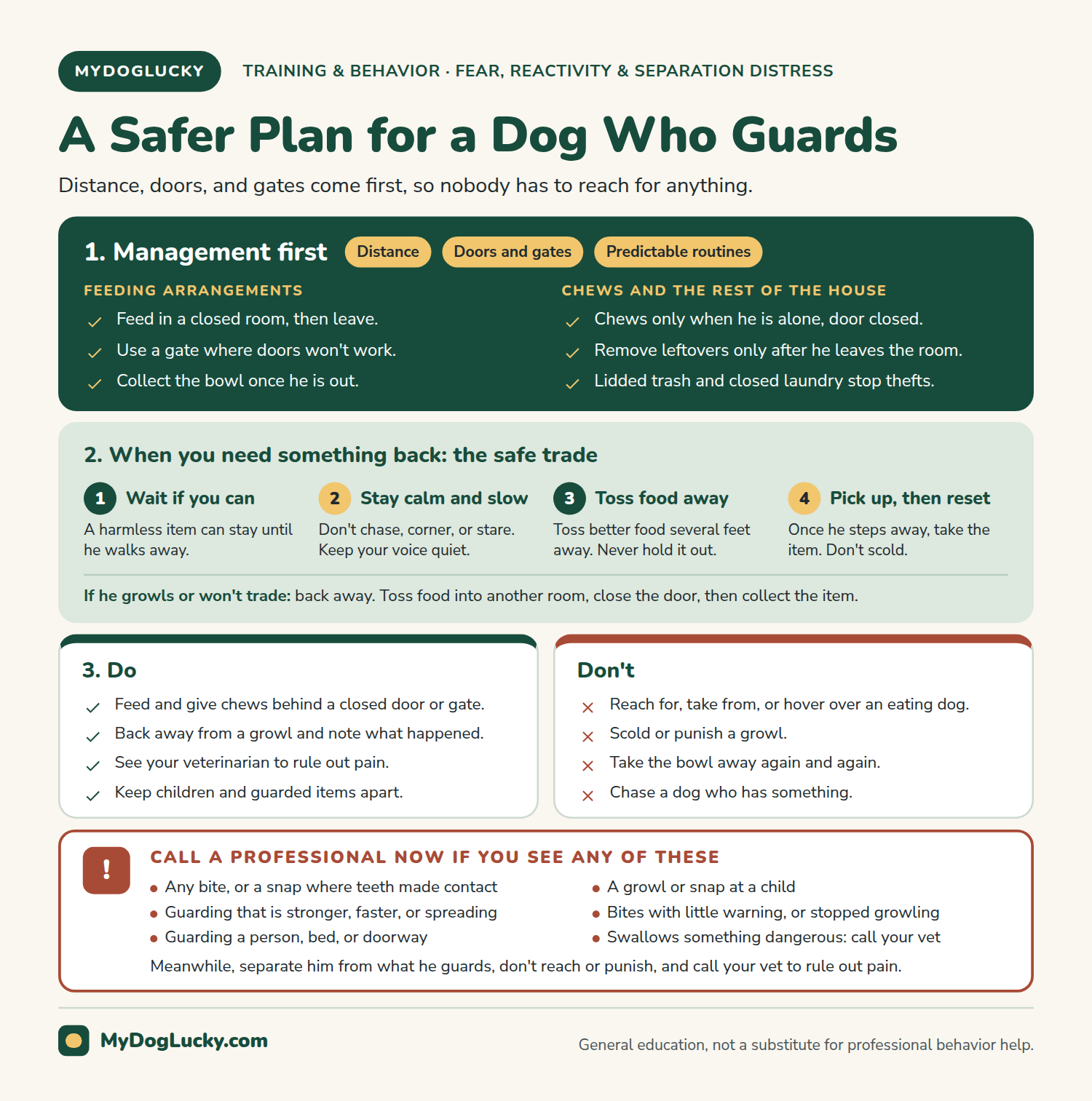
- Prevent the conflict. Feed meals and give chews behind a closed door or gate, and keep guarded items out of reach.
- Respect the warning. A growl is information. Back away, then work out what set it off.
- Skip punishment and confrontation. They suppress the warning, not the worry behind it.
- See your veterinarian. Pain and illness can cause guarding or make it worse.
- Get qualified help early. That means any bite, any growl at a child, and any escalation.
What “Normal” Does and Doesn’t Mean
Normal doesn’t mean safe. And it doesn’t mean you should wait and hope. It means the behavior has an understandable cause. That’s useful, because understandable causes respond to changes in the environment and to careful, reward-based learning.
It also means you can stop asking “what’s wrong with my dog?” A better question is “what does my dog think he might lose, and how do I make losing it feel less likely?” That question points toward management, a professional plan, and patience. It doesn’t point toward confrontation.
What This Guide Doesn’t Cover
This guide doesn’t diagnose your dog, and it doesn’t replace an in-person evaluation. It also doesn’t cover fear-based aggression toward strangers, general dog-to-dog fights, or reactivity on walks. Those overlap with guarding in places, but each deserves its own evaluation. MyDogLucky covers dog body language and fear and reactivity in separate articles.
What Resource Guarding in Dogs Looks Like: From Subtle Signals to a Bite
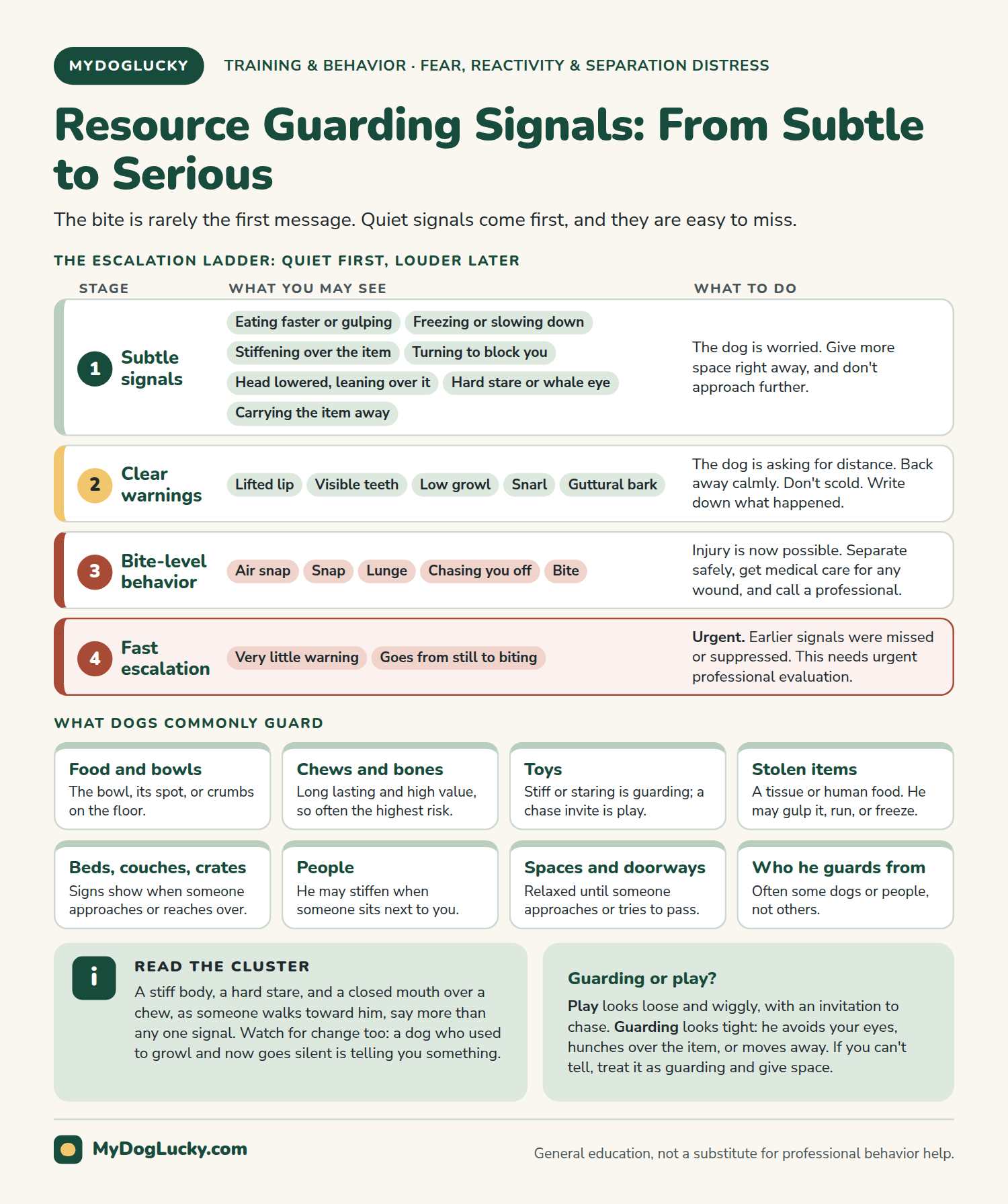
With resource guarding in dogs, the bite is rarely the first message. Most guarding begins with quiet signals that are easy to miss, especially if you’ve never had a reason to look. The ASPCA lists standing stiffly over the bowl, gulping food, tensing or freezing, growling, staring, snapping, snarling, biting, and chasing people away. The American Kennel Club adds a hard stare, “whale eye,” and lifted lips.
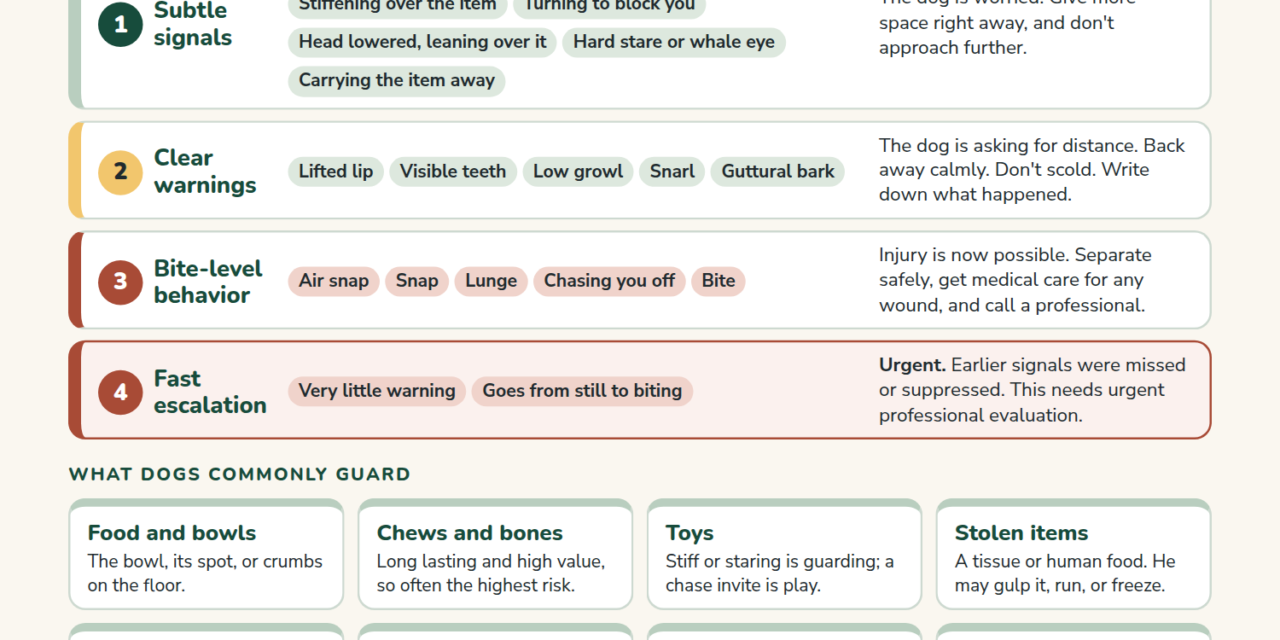
Those signs form a progression. Each step is your dog’s way of saying “please stop” a little more clearly than the last.
The Escalation: Quiet First, Louder Later
A dog who is ignored at one level often moves up to the next. That’s why the earliest signs matter most. They’re your best chance to change the situation while nobody is at risk.
| Stage | What you may see | What it usually means |
|---|---|---|
| 1. Subtle signals | Eating faster or gulping. Freezing or slowing down. Stiffening over the item. Lowering the head or leaning the body over it. Turning to block you. A hard stare or whale eye. Carrying the item away. | The dog is worried. Give more space right away, and don’t approach further. |
| 2. Clear warnings | A lifted lip, visible teeth, a low growl, a snarl, or a guttural bark. | The dog is asking for distance. Back away calmly. Don’t scold. Write down what happened. |
| 3. Bite-level behavior | An air snap, a snap, a lunge, chasing you off, or a bite. | Injury is now possible. Separate safely, get medical care for any wound, and call a professional. |
| 4. Fast escalation | Very little warning. The dog goes from still to biting. | Earlier signals were missed or suppressed. This needs urgent professional evaluation. |
Signals Are Clusters, Not Single Clues
No single signal proves guarding. A dog can stiffen at a loud noise or eat quickly because he’s hungry. What matters is the cluster and the context. A stiff body, a hard stare, and a closed mouth over a chew, while someone walks toward him, tell a much clearer story than any one of them alone.
Watch for change, too. A dog who always ate calmly and now eats fast and turns away from the family is telling you something new. So is a dog who used to growl and now goes silent.
Not Every Guard Looks Like a Guard
Some guarding is quiet. A dog may pick up a sock and slip under a table. Another may lie on the couch, look sleepy, and stiffen as you get close. A third may swallow whatever he grabbed before you can see it. None of them growled, and all three may be guarding.
It also helps to separate guarding from play. A dog who play-bows, bounces, and invites a chase has a loose, wiggly body. A dog who guards tends to look tight. He may avoid your eyes, hunch over the item, or move away with it. When you can’t tell, treat it as guarding and give space. Don’t try to find out.
What Dogs Guard: Food, Chews, Toys, Stolen Items, Beds, People, and Spaces
Resource guarding in dogs isn’t only about the food bowl. Dogs can guard almost anything, and what they guard often changes with the item’s value, the place, and who is nearby. Knowing your dog’s list helps you predict trouble before it starts.
Food and Bowls
Food is the classic trigger. The ASPCA notes that puppies often learn to guard food because of competition with littermates at mealtime. A dog may guard the bowl itself, the spot where it sits, or crumbs dropped on the kitchen floor. Dropped food matters because it lands without warning, often near children.
Chews and Bones
Long-lasting chews are high value and last a long time, which gives a dog a lot to protect. Many dogs who eat kibble calmly change completely when they receive a bone or a hard chew. VCA lists rawhide and similar valuable objects among common triggers. For many households, chews are the item most worth restricting.
Toys
Toys are trickier. Many dogs carry a toy around as part of play and want you to chase them. That’s a game. Guarding looks different: a stiff body, a hard stare, or a dog who moves away and won’t let you near. Some dogs guard only one favorite toy, and others guard any toy while a certain person or dog is close.
Stolen Items
VCA notes that dogs may guard novel or forbidden objects, such as a stolen tissue or human food. This kind of guarding often looks more intense. The dog knows from experience that stolen items get taken back. He may gulp the item, run, or freeze with it in his mouth. Swallowing adds a medical risk on top of the bite risk, which is why stolen items get their own section later in this guide.
Furniture, Beds, and Crates
Some dogs guard a couch, a bed, or a crate. The signs often appear when someone approaches, reaches over, or tries to move the dog. A sleeping dog who is touched suddenly may also react out of startle, not guarding. Either way, the safe response is the same: don’t reach for a dog who is resting, and call him from a distance.
People
Dogs can guard a person. The AKC includes preferred humans among things dogs guard. A dog may stiffen when someone sits next to you, growl at a visitor, or try to block another dog from your lap. This form needs care because the “resource” is you, and you’re often the one who gets bitten if you step in.
Spaces and Doorways
Hallways, doorways, spots under a table, a corner of the yard, and the back seat of a car can all become guarded. The clue is usually the same. The dog is relaxed until someone approaches or tries to pass, then tenses. Narrow spaces raise the stakes, because a person has no room to step away.
Who Is the Dog Guarding From?
Many dogs guard from some individuals and not others. A dog may guard from other dogs but not from people, or from one family member but not another. Researchers at the University of Guelph have studied guarding around people and around other dogs as two separate questions, using owner surveys, which fits what many owners notice at home. Don’t assume a dog who is calm with you is calm with everyone.
Why Resource Guarding in Dogs Happens: Normal, Instinctive, and Not About Dominance
Owners often ask why their dog does this when he has plenty of food, plenty of toys, and a comfortable home. The honest answer is that the behavior isn’t a reasoned decision. It’s an instinct with a long history, shaped by learning and by how the dog feels in a given moment.
A Survival Instinct at Heart
The ASPCA explains that guarding possessions is normal for dogs because animals in the wild who protect valuable resources are more likely to survive. A dog doesn’t know your pantry is full. His brain simply registers something worth keeping and someone getting closer.
Value, Scarcity, and Learning
Dogs also learn. If approaching a dog with a bone regularly ends with the bone disappearing, he may learn that approach means loss. That lesson is easy to teach by accident. Repeated grabbing, chasing a dog who has stolen something, or hovering over the bowl all say “someone is coming to take it.”
Value matters too. A dog may ignore a person near his water bowl and still guard a bone. The more a dog wants something, and the less certain he is that he’ll get it back, the more likely he is to protect it.
Stress, Fear, and Change
Stress can turn a mild habit into a stronger one. A move, a new baby, a new dog, a new schedule, or a stay in a kennel can all make a dog feel less secure about what’s his. Dogs who are afraid or uncertain may guard more. That’s one reason a newly adopted dog can look different in the first weeks than he did on adoption day.
Individual Differences
Some dogs seem more prone to guarding than others. Genetics may play a part, and so may early experience, but nobody can predict guarding from breed or appearance alone. Small dogs guard. Large dogs guard. Puppies guard. Seniors can begin to guard when their bodies change. Treat each dog as an individual.
Why “Dominance” Is the Wrong Frame
Older advice often described guarding as a dog trying to be the boss. That framing doesn’t explain what’s going on. A guarding dog isn’t trying to outrank you. He’s trying to keep something. Reading it as a status contest pushes people toward confrontation, like staring a dog down or forcing him to give things up, and that tends to increase the very worry that drives guarding.
The ASPCA’s guidance on food guarding is direct: do not punish or intimidate your dog when he guards food. Describe what you see, think about what he’s protecting, and change the situation. Judgment about his character adds nothing.
Why Punishment Makes Guarding Worse
Punishment is the most common response to resource guarding in dogs, and it’s the one most likely to backfire. It feels logical. A dog growls at a person, so a person corrects the growl. But the growl was never the problem.
Punishment Silences the Warning, Not the Worry
A growl says “I’m uncomfortable, please back off.” If a dog gets scolded for growling, he learns that growling is dangerous. He doesn’t learn that the person near his bowl is safe. Some dogs then stop growling, and owners assume the problem improved.
The worry is still there. Now it has no early outlet. The next time someone approaches, the dog may skip the growl and go straight to a snap or a bite. That’s how a family ends up saying “he bit out of nowhere.” Usually the warning was there and got trained away.
What the Research and Position Statements Say
The American Veterinary Society of Animal Behavior (AVSAB) recommends reward-based training and cautions that aversive methods can increase fear, anxiety, and aggression. That applies squarely to guarding. A survey by Herron and colleagues of owners of dogs with behavior problems found that confrontational methods, including forcing an object out of a dog’s mouth, provoked aggressive responses in a meaningful share of dogs. Owner reports can’t prove cause and effect, but the pattern fits what the position statements warn about.
The Bowl-Removal Myth
One popular idea says you should take the bowl away again and again so the dog learns you’re allowed to. It sounds sensible. For a dog who is already worried, it does the opposite. Each removal confirms his fear: approach equals loss. VCA’s guidance describes a different aim, which is to teach the dog that a person approaching brings something even better than the item he has.
If a dog has never shown any sign of guarding, gentle practice of that kind can be part of prevention, as a later section describes. For a dog who has guarded, repeated bowl removal isn’t a training plan. It’s a risk.
What to Do Instead
Change what the dog experiences. Give him space. Feed him where nobody needs to approach. Keep valuables out of reach. Then work with a professional on changing how he feels when people are near. None of that requires you to win anything.
How Serious Is It? A High-Level Look at Risk
Owners want to know whether their dog is “dangerous.” Nobody can answer that from an article. What you can do is look at a few factors that help you decide how much management and how much professional help to bring in. Think of it as a way to choose your level of caution, not as a score.
| Question | Lower concern | Higher concern |
|---|---|---|
| How far does it go? | Only subtle signals, such as eating faster or a stiff pause | Growling, snapping, or biting, especially with little warning |
| Any bite history? | No bites and no contact | Any bite, any tooth contact, or a bite that broke skin |
| How predictable is it? | One item, one place, one clear trigger | Many items or places, or triggers that are hard to spot |
| How fast does he recover? | Relaxes soon after the person moves away | Stays tense or hostile long after the moment ends |
| Who could get hurt? | Adults who can follow rules and use gates | Children, older adults, visitors, or anyone who can’t avoid the dog |
| How reliable is management? | Doors and gates are used every time by everyone | Busy household, shared caregivers, or a barrier that sometimes gets left open |
| Has he been punished for warnings? | No | Yes, so the warnings may be suppressed |
A dog’s size changes how much damage a bite can cause. It doesn’t change how seriously guarding deserves to be taken. Small dogs bite too, and a bite to a child’s face is a serious injury from any dog.
Do not “test” your dog
You may see advice online to reach toward the bowl, touch the dog while he eats, or take a chew “to see what he does.” Don’t. Testing puts your hands within reach of a bite. It also rehearses the exact conflict you’re trying to prevent, and each rehearsal can make the guarding stronger.
A professional can assess risk from the history you describe, video of natural events, and safe, controlled observation. You don’t need to provoke your dog to get help.
What You Can Safely Do: Observe and Record
You can write down what has already happened. Note the item, the place, who was nearby, what your dog did first, what happened next, and how you responded. If an incident happens on its own and you can safely record it from a distance, a short video helps a professional a great deal. Never stage a scene for the camera.
A simple incident log
Date and time · Item · Where · Who was nearby · First signal you noticed · What your dog did next · What you did · How it ended. Keep each entry short. A few real examples give a professional more to work with than a long summary.
If Someone Gets Bitten
Separate the dog and the person calmly, without shouting or grabbing. Get medical care for any bite that breaks skin, and for any bite to a child. Reporting rules for dog bites vary by location, so ask your doctor or local animal control what applies. Then call your veterinarian and a behavior professional. A bite is a reason to change the plan, and it doesn’t have to mean the end of the road for the dog.
Start With Your Veterinarian: Pain and Medical Causes
Before you build a behavior plan, book a veterinary visit. Pain and illness can cause resource guarding in dogs or make it stronger, and a plan built on the wrong assumption will stall. This isn’t a way of saying the behavior “isn’t real.” It’s a way of making sure nothing physical is feeding it.
What a Veterinarian May Look For
This list describes broad categories only. It isn’t a diagnosis, and your veterinarian decides what your dog needs.
- Pain. Dental disease, joint or spine problems, ear or skin trouble, and other sore spots can make a dog protective of his space, his bed, or his body. A dog who hurts when someone reaches for him may warn first.
- Digestive and appetite changes. Stomach upset, parasites, and some conditions or medications can change appetite. A dog who is hungrier or feels unwell may act differently around food.
- Aging changes. Vision loss, hearing loss, and cognitive changes can make an older dog startle more easily and react more strongly to being approached.
- Other medical factors. A sudden change in an adult dog with no history of guarding deserves a prompt veterinary visit, since something may have changed in his body.
What to Bring
Bring your incident log, any video you’ve captured safely, a list of foods and treats, and a list of medications and supplements. Say when it started and whether it’s changing. Ask three questions: “Could pain or illness be part of this? Are there exams or tests you’d recommend? Can you refer us to a veterinary behaviorist?”
Tell the Clinic in Advance
Mention guarding when you book. Staff can plan how to handle your dog, and you can skip bringing chews or food into the exam room unless the team asks for them. If your dog is uncomfortable with handling, ask whether a quieter room or a different appointment time is available.
Behavior Medication as One Piece
Sometimes a veterinarian or veterinary behaviorist will discuss behavior medication for a dog whose guarding is tied to anxiety or fear. It isn’t a fix on its own. When it’s used, it’s one part of a plan that also includes management and training, and only a veterinarian who has examined your dog can decide whether it makes sense. Never give your dog a human medication, and never adjust a prescription yourself.
Management First: Make Your Home Safer Before You Train Anything
For resource guarding in dogs, management means arranging the environment so your dog doesn’t need to guard and nobody gets hurt. It’s not a failure to train. It’s the first step of the training plan, and it stays in place while the rest happens. Every time a dog guards successfully, the habit grows. Every time he doesn’t have to, it doesn’t.
The Principle: Distance, Doors, and Predictability
Three ideas run through everything below. Use distance, so nobody is close enough to trigger the behavior. Use doors and gates, so the plan doesn’t depend on anyone’s memory or willpower. And keep routines predictable, so your dog isn’t surprised by a hand or a footstep at the wrong moment. VCA’s guidance lists similar steps: confine access to contested items, allow high-value items only in isolation, and keep tempting items secured or out of reach.
Feeding Arrangements
The ASPCA notes that many dogs who guard food don’t need treatment at all. Their owners can leave them alone while they eat, or feed them in a separate room. That’s a legitimate, complete solution for many households. Here are practical ways to set it up:
- Feed in a closed room. Put the bowl down, close the door, and leave. When he’s done, open the door without stepping in and call him out with a treat tossed into the hallway.
- Use a gate where doors won’t work. A tall gate across a hallway or kitchen doorway keeps people and other pets out. Check that your dog can’t jump it.
- Pick up the bowl when he’s elsewhere. Once he’s out of the room, close the door behind him and collect the bowl. Nobody has to approach an eating dog.
- Keep a fixed routine. Feed at set times in the same place. Predictability lowers the guessing.
- Treat food puzzles like chews. A food-dispensing toy can be a guarded item for some dogs. Serve it behind the same closed door.
If your dog guards his crate or feeds in a crate, don’t rely on the crate as the feeding spot. Use a room with a door instead, so nobody has to reach into a small space.
Chews, Bones, and Toys
Long-lasting chews are often the highest-risk item. Give them only when your dog is alone behind a closed door, in a space where nobody needs to walk past. If you can’t be away from the dog while he has one, skip chews for now.
When the chew is finished, let your dog leave the room through another door, then remove what’s left. Don’t take it while he’s holding it. For toys, put away the ones he guards and keep out only those that don’t trigger him. You can rotate which ones are available.
Trash, Laundry, and Counters
Stolen items start with access. Use lidded or cabinet-stored trash cans. Keep laundry in a closed hamper or a room the dog can’t enter. Store medications, chocolate, and anything toxic out of reach, and don’t leave food at counter height when nobody is watching. Each theft you prevent is one less guarding episode and one less swallowing risk.
Furniture, Beds, and Spaces
If your dog guards the couch or bed, block access when you can’t manage the situation. Close the bedroom door. Use a gate. Give him a comfortable spot somewhere else. Don’t reach for, push, or lift a dog off furniture. If you need him to move, call him from a distance and toss a treat away from the spot so he walks to it on his own.
Don’t touch a sleeping dog to wake him. Say his name softly from a few feet away instead.
When the Dog Guards a Person
If your dog guards you, put a gate or door between him and other people when he’s near you. Keep him off your lap and off the bed when visitors are around. Ask family members not to approach him while he’s close to you. Then call a professional, because guarding a person often needs a tailored plan.
House Rules for Family and Guests
A plan works only when everyone follows it. Write the rules down and put them where people will see them.
A household agreement
- Nobody approaches, reaches for, or takes anything from a dog who is eating or chewing.
- Meals and chews happen behind a closed door or gate. The person who closes it also makes sure it’s latched.
- Children never handle the dog’s food, bowls, chews, or toys.
- Guests meet the dog only after he’s settled in another room or behind a gate.
- Guests don’t offer food, treats, or chews.
- If something drops near the dog, call him away and toss a treat in the other direction. Don’t reach for it.
- Any growl, snap, or bite gets written down and shared with the whole household.
Outings, Daycare, and Boarding
Tell anyone who cares for your dog about the guarding before the first visit, including sitters, walkers, daycares, and boarding facilities. Give them written instructions on what he guards, where, and what setup keeps everyone safe. Skip chews and food at dog parks, group play, and gatherings, since crowds raise the stakes. Ask a professional whether daycare or a dog park suits your dog at all.
Children and Resource Guarding: Separation Is the Plan
Children deserve their own section because the stakes are different. Kids move unpredictably, drop food, reach into bowls, and can’t read a dog’s early warnings the way an adult can. A dog who is safe with adults may not be safe with children, and no article can tell you otherwise.
A study by Arhant and colleagues of caregivers of children up to age six found that injuries by family dogs most often happened around food or when an object was taken from the dog. That finding is a good reason to keep children and guarded items apart. It’s also a reason not to rely on “he’s always been fine.”
Supervision Is More Than Being in the Room
Being in the same room isn’t the same as supervising. Supervision means an adult is within reach, watching both the child and the dog, and ready to step in. The AVMA’s dog bite prevention guidance also stresses supervising children around dogs. That’s a high bar for a busy day. It’s also why physical separation beats supervision as the main plan. Supervision breaks down in the moments when you’re tired or distracted.
Separate With Barriers
Use gates, closed doors, and dog-free zones for the child, not the other way around where possible. Feed and give chews when children aren’t in the room. Set up a dog space that children can’t enter, so an overstimulated or uncomfortable dog can retreat. Keep toddlers’ food off the floor and out of the dog’s reach, and think about where a high chair sits relative to the dog. When visiting children are coming, put the dog in another room before they arrive, and tell their parents he’s off limits.
Teach Children Simple Rules
Kids can learn a few clear rules, though the rules are backup, not the plan. Leave the dog alone when he’s eating, chewing, or resting. Never take something from a dog. If the dog has something he shouldn’t, tell a grown-up instead of grabbing it. If the dog freezes or growls, walk away calmly and find an adult.
A Growl at a Child Is a Call-Today Event
A growl aimed at a child is a serious warning. Separate the dog and the child right away, and call a professional soon. Don’t scold the dog. Don’t decide the growl was “just a warning” and move on. It was a warning, and it gave you information about the risk. The ASPCA also states that no one under 18 should attempt guarding exercises. Children shouldn’t be part of any behavior-change plan for a guarding dog. Families can find more on child and dog safety from organizations such as Doggone Safe and Family Paws.
Resource Guarding in Multi-Dog Homes
Resource guarding in dogs gets more complicated in homes with more than one dog. Dogs can guard from each other, from a person, or from both. As noted earlier, guarding around people and around other dogs are different questions, so don’t assume one tells you about the other.
Separate for Meals and Chews
Feed each dog in a separate space with a door or gate between them. Do the same for chews, bones, and long-lasting treats. Pick up bowls after meals, when the dogs are elsewhere. Don’t let dogs “work it out” over food, because a fight can injure both dogs and people.
Watch the Quiet Signals Between Dogs
Dogs give each other many of the same signals they give people: a freeze, a stiff stare, a body block, a lifted lip. If you see one dog stiffen when another walks near his bone, treat that the same way you would a growl. Separate them calmly and rearrange the setup. Don’t scold the guarding dog. He is doing what dogs do, and scolding may hide the signals you need to see.
Doorways, Beds, and People
Multi-dog homes often have trouble spots: a hallway, a couch, a favorite bed, or a person’s lap. If you see tension there, use gates and separate resting spots. Give each dog a bed in a different place. Don’t put resources in a narrow space where one dog can trap another.
Never Reach Into a Fight
Plan ahead so you never need to break up a fight. If one happens anyway, don’t put your hands between dogs or grab collars. Use a barrier, such as a board, a sturdy cushion, or a gate pushed between them, or use a loud noise to interrupt. Once they’re apart, keep them separated, check both dogs for injuries, and call your veterinarian about any puncture wound. Then contact a professional, since a fight over resources is a sign the setup needs to change.
When One Dog Guards From Another
Persistent tension between dogs in the same home needs a professional look. A veterinary behaviorist or certified consultant can help you decide which dogs can share which spaces. Permanent separation for meals and chews is a valid outcome, and many multi-dog households live safely that way for years.
Trade, Drop It, and Leave It: Three Separate Skills
People often use “drop it,” “leave it,” and “trade” as if they mean the same thing. They don’t. Each is a different skill with a different job, and mixing them up causes trouble. A dog who knows one may not know the others.
| Skill | What your dog learns | Best use | Limits |
|---|---|---|---|
| Trade | “Leaving this gets me something better.” | Getting an item back safely | Only works if the reward is worth more than the item |
| Drop it | “This cue means I can release what’s in my mouth.” | Releasing toys and safe items on request | Unreliable when the dog is aroused or the item is very valuable |
| Leave it | “I don’t pick that up or investigate it.” | Stopping a grab before it happens | Doesn’t help once the dog already has the item |
Trade: A Bargain, Not a Battle
A trade means your dog decides to give up an item because something better is on offer. You don’t grab. You don’t pull. You offer a reward the dog values more, usually a small piece of food he loves, and the dog chooses. The trade works because your dog gets to leave voluntarily.
Drop It: A Release Cue
“Drop it” is a cue for opening the mouth and letting go. You teach it as a game with items your dog doesn’t care about, when he’s relaxed and you’re calm. The dog drops the item, gets a reward, and often gets the item back. Giving it back most of the time matters, because a dog who always loses his toy learns that “drop it” means loss.
Leave It: Before the Grab
“Leave it” happens earlier. It tells your dog not to pick something up, or not to go toward it. It’s useful on walks and around the house, when you see something on the floor before your dog does.
How to Practice
Keep the rules simple:
- Use items your dog doesn’t care about, never the ones he guards.
- Practice when he’s calm, in short sessions.
- Reward with something clearly better than the item.
- Return the item often, so the game feels fair.
- Stop at once if he stiffens, stares, or growls, and call a professional.
Why These Skills Don’t Fix Guarding
These skills are useful tools, but they don’t solve resource guarding in dogs on their own. A dog who is worried about losing a bone isn’t calm enough to learn. And a dog who guards may not drop something valuable on cue, no matter how well he knows the cue. If your dog has growled, snapped, or bitten, teach these skills with a professional’s guidance, and keep his guarded items out of the practice until that professional says otherwise.
Counter-Conditioning and Approach-and-Add: Work for a Professional
Counter-conditioning is a core method behavior professionals use for resource guarding in dogs, because it changes how a dog feels about a person near his things. The idea is simple. A person approaches, something wonderful appears, the person leaves. Over many careful repetitions, the person’s approach starts to predict good things, not loss. That’s “approach and add”: you approach, and you add something, rather than take something away.
What the Published Guidance Describes
Several sources describe versions of this. VCA’s veterinary behaviorists explain the goal as teaching the dog that he’ll receive a treat even more appealing than the object he holds. The ASPCA outlines a program of progressive stages, and the AKC describes staying well away from the dog, tossing high-value food while walking past without stopping, and progressing only when body language improves.
Every one of these sources also draws a line. The ASPCA says to consult a Certified Applied Animal Behaviorist or a veterinary behaviorist if the dog may bite or shows stress during the exercises. VCA says to stop and consult a veterinary behaviorist if the dog growls, snarls, snaps, lunges, or bites. Both say the work belongs to an adult, never a child.
Why a Professional Should Guide It
The method looks easy, and that’s the danger. What decides success is the details: how far away you start, how valuable the item is, how you read tiny changes in posture, and when you move to the next step. Skip one step, or move too fast, and the dog learns the opposite lesson. That’s also when bites happen. A professional watches your dog, sets the distances, and stops the session before your dog crosses a line.
What It Looks Like at a High Level
A professional may begin far away from the dog, with an item of low value, and keep sessions very short. The dog’s response sets the pace. When your dog stays loose and looks toward the approaching person with anticipation, the professional makes the next step slightly harder. If he tightens, they go back to an easier step.
Management stays in place throughout. Counter-conditioning happens in planned sessions, while everyday life still uses doors and gates.
What Success Looks Like
Success isn’t a dog who lets you take anything at any time. It’s a dog who relaxes when you walk by, who looks up expecting something good, and who shows softer body language over weeks. Some dogs improve a lot. Others improve enough to live safely with ongoing management. Nobody can promise a timeline or a cure, and any professional who does is overselling.
A Note on Puppies
VCA describes a prevention approach for puppies who show no guarding: teach the puppy that a person nearby means good things. That can be as simple as walking past the bowl and dropping in something extra, then continuing on. You don’t reach in, you don’t hover, and you don’t take anything. If a puppy freezes, stiffens, or growls at any point, stop and ask a professional to look at him.
When Your Dog Has Something You Need Back: Safe Retrieval
This is one of the moments when people get bitten, so it deserves a plan. Everyone is stressed, and the dog knows exactly what’s about to happen. A safe retrieval trades up, without force, and it never becomes a chase.
Step Zero: Do You Need It Back Right Now?
Sometimes you don’t. If the item is harmless, like a sock or a plastic cup, and your dog isn’t trying to swallow it, you can often let him keep it while you make the area safe. Wait until he loses interest and walks away. Then pick it up. Patience costs nothing and avoids a conflict.
The Safe Trade
When you do need the item, follow these steps:
- Stay calm and slow. Don’t chase, corner, or stare. Keep your body turned slightly away and your voice quiet.
- Get something better. Choose a food your dog loves more than the item. Have several pieces ready.
- Toss the food away from the item. Throw it several feet to the side, so your dog has to move away from what he’s holding. Don’t hold it out toward him.
- Let him leave the item. When he steps away to eat, calmly pick up the item and put it out of reach.
- Don’t scold afterward. The trade worked. Punishing him now teaches the wrong lesson.
- Fix the setup. Work out how he got the item, and close that gap.
If He Won’t Trade or He Growls
Back away. A growl means the risk is high. Keep children and other pets out of the area. If you can, use a door: toss food into another room, let him follow, close the door, and then collect the item. Don’t reach for the item with your hand, and don’t block his exit. If he has something harmless, waiting is safe.
If He Runs
Don’t chase. To a dog, chasing looks like a threat, a game, or both, and either way it makes stealing more rewarding. Sit down, turn away, and ignore him for a moment, or call him cheerfully toward a treat toss. Many dogs will come to investigate once the chase stops.
If the item is dangerous
A dog who holds something sharp, toxic, or a medication is an emergency in itself. Call your veterinarian, an emergency clinic, or a pet poison hotline right away, and tell them what he has and how much he may have swallowed. Get their advice while you try a safe trade. Don’t force your hand into his mouth, and don’t try to make him vomit unless a veterinarian directs you to.
What to Do Afterward
Treat a retrieval as information. Note what the item was and how he got it, then close that gap. If you needed a trade more than once this week, management needs tightening.
Stolen Items, Scavenging, and Guarding Away From Home
Some dogs grab things that aren’t theirs and guard them fiercely. Others pick up things outside and swallow them before you can react. The two behaviors overlap, and both carry a medical risk on top of the bite risk.
Why Stolen Items Get Guarded
Dogs learn quickly which items get taken away. A sock, a tissue, or a piece of food from the counter usually triggers a person chasing and grabbing. So the dog rushes, hides, or swallows. Chasing also turns theft into a game, which encourages more of it. Prevention works best, as described in the management section: keep the items out of reach so the dog never has the chance.
Scavenging on Walks
Walks bring new hazards: food scraps, dropped items, bones, and other things on the ground. A dog who picks them up and guards them is a challenge, because the moment you reach for his mouth is the moment things go wrong. Practical steps include:
- Scan ahead. Notice what’s on the ground before your dog does, and steer around it.
- Use a short, secure leash in areas where scavenging is common.
- Practice “leave it” as its own skill, with neutral items at home first.
- Trade with a toss. Throw a high-value treat away from the item, and then pick up the item after he moves.
- Choose different routes if a route is full of temptation.
Muzzle Conditioning as a Management Tool
For dogs who scavenge dangerous items, a basket-style muzzle, introduced gradually with treats, can be a welfare-friendly management tool. A trainer or veterinary behaviorist can show you how to condition it so your dog is comfortable wearing it. A muzzle is never a punishment. It also doesn’t make it safe to grab a dog’s head or reach into his mouth. It’s one layer among many.
When He Swallows Something
If your dog swallows something that isn’t food, or something that could hurt him, call your veterinarian or an emergency clinic promptly. Guarding and gulping can go together, since a dog who swallows to keep an item is also at risk for a blockage or poisoning. Tell the clinic what it was and when it happened.
Resource Guarding in Adopted and Rescue Dogs
Resource guarding in dogs adopted from shelters and rescues worries many adopters, and many adopted dogs arrive with limited history. That’s nobody’s fault. You may not know what a dog’s earlier home was like, how meals were handled, or what happened when he had something valuable. The kindest approach is to plan carefully without guessing.
What You Know and What You Don’t
A shelter or rescue may note guarding in a dog’s records, or it may not. Behavior in a kennel can differ from behavior in a home. Guarding may fade in a quiet space, or appear once a dog feels settled enough to protect what’s his. Don’t treat the paperwork as a guarantee in either direction. If you were told your dog guards, believe it. If you weren’t, plan as if it could still show up.
The First Weeks: Prevent, Don’t Test
Start with management from the first day. Feed your new dog in a separate space with a door or gate. Skip long-lasting chews at the beginning. Don’t reach toward his bowl or his items, and don’t “check” how he reacts. Give him quiet time to settle, keep routines predictable, and ask your veterinarian to examine him early. Pain, stress, and an unfamiliar body can all affect behavior in the first weeks.
Kindness Without Guesswork
Some dogs guard because resources were uncertain in their past, but nobody can know that about a particular dog. Avoid stories about what “must have happened” to him. He doesn’t need a backstory to deserve patience, and a story can make guarding look like damage when it’s a behavior you can plan around.
If the Home Can’t Be Made Safe
Sometimes a household can’t meet the risk. A toddler crawls, a caregiver has limited mobility, or the layout doesn’t allow separation. Say so honestly and early. Contact the rescue, since many offer support after adoption or can help you weigh the options. Asking for help, or deciding that this match doesn’t work, isn’t a failure. It’s a decision that protects both the dog and the people. If a dog needs to move, the rescue or a professional should be part of that decision, and any new home should be told about the guarding.
When to Call a Professional Right Away, and How to Choose One
Resource guarding in dogs can improve with the right plan, but the right plan often needs a professional. Some situations are urgent, and others are worth booking soon. Knowing which is which helps you act early.
Call Right Away If
- Your dog has bitten, or snapped hard enough that you felt teeth.
- Your dog has growled or snapped at a child, or a child has been near a guarded item.
- Guarding is getting faster, stronger, or more widespread.
- Your dog has stopped giving warnings, or gives very short ones.
- You feel afraid to walk past him, feed him, or leave him with family.
- He holds or swallows dangerous items and won’t trade.
Book a professional soon, even without those signs, if guarding is regular, you can’t separate resources reliably, or several people in the household are worried.
Who to Call
Behavior help comes from several types of professionals. Credentials differ, and in the United States, “dog trainer” isn’t a regulated title, so it’s worth checking.
| Professional | Credential | Can help with |
|---|---|---|
| Veterinary behaviorist | Veterinarian board-certified by the American College of Veterinary Behaviorists (DACVB) | Medical contributors, behavior medication decisions, and a full behavior plan |
| Applied animal behaviorist | Certified Applied Animal Behaviorist (CAAB), through the Animal Behavior Society | Behavior assessment and plans; medication questions go to a veterinarian |
| Certified trainer or consultant | CPDT-KA or CBCC-KA (CCPDT), IAABC certification, or KPA CTP | Coaching on management, skills, and counter-conditioning under a plan |
For bite-level guarding, a veterinary behaviorist or a certified applied animal behaviorist is often the best starting point. A trainer with a behavior credential can then help carry the plan out day to day, ideally alongside your veterinarian.
How to Vet a Professional
A credential tells you a person passed an exam. It doesn’t tell you how they work. Ask these questions before you commit:
- What methods do you use for guarding? Look for reward-based training, management, and counter-conditioning.
- Do you ever use aversive tools or corrections? Avoid anyone who describes prong, choke, or shock collars, alpha rolls, “dominance,” or forcing a dog to give things up.
- How many guarding cases have you handled? Experience with bite-level cases matters.
- What do you do if my dog growls during a session? The right answer is to stop and reduce pressure.
- How do you handle children in the home? A good professional will emphasize separation.
- Will you work with my veterinarian? Guarding plans work best with medical input.
Be cautious about anyone who guarantees results or a timeline. Behavior isn’t predictable enough for that.
Cost and Access
Behavior help can be expensive, and not every area has a specialist nearby. Ask your veterinarian for a referral, and ask whether a veterinary behaviorist or certified consultant works by video. Remote work can help with planning, but ask how they’ll observe your dog and handle safety. Keep management in place while you save or wait.
Common Mistakes That Make Resource Guarding in Dogs Worse
Most mistakes with resource guarding in dogs come from good intentions. They’re worth naming so you can spot them.
Testing the Dog
Reaching toward a bowl or taking a chew “to see what happens” puts you in danger and rehearses the conflict. If you need to know how severe it is, ask a professional.
Removing the Bowl Repeatedly
It feels like teaching. For a worried dog, it confirms the fear and can strengthen guarding.
Punishing the Growl
It silences the warning and leaves the worry in place. A dog who no longer growls isn’t cured. He may be more dangerous.
Chasing a Dog Who Has Something
Chasing can raise arousal, teach the dog to run with items, and lead to a bite. Trade up or wait instead.
Assuming “He’s Fine With Me”
A dog can be gentle with one person and guard from another. Family members, children, and guests may not get the same response.
Relying on Willpower
“I’ll just remember to close the door” works until the day it doesn’t. Use gates and latches so the plan doesn’t depend on memory.
Trading Too Often With Big Rewards
If every theft earns a jackpot, some dogs learn to steal to get a trade. Prevent the access first, then use trades when they’re truly needed.
Waiting to See If It Passes
Guarding doesn’t reliably fix itself. If it’s getting stronger, faster, or broader, get help sooner. Early support often means simpler plans.
Troubleshooting: When the Plan Isn’t Working
Even a good plan runs into problems. These are the most common ones, and what to check first.
He Still Guards Even With Separate Feeding
Check where and when. Is anyone walking past the door? Can he see other dogs or people through a gap? Is he guarding the room itself? Adjust the location, add a visual barrier, and keep your household away from the closed door while he eats. If he’s still tense, tell your veterinarian and your professional.
Someone in the House Keeps Breaking the Rules
This happens in almost every household. The fix is a barrier, not a reminder. If a rule depends on someone remembering, it will fail eventually. Use a latch, a lock, or a gate that a child can’t open. Talk about the risks, not the blame.
He Guards From One Person or One Dog
This is common. The relationship, the place, and the history all matter. Separate the pair around resources, and ask a professional to help you sort out what’s driving it.
He’s Fine at Home but Guards Elsewhere
New places, crowds, and unfamiliar people raise stress. Skip food and chews in those settings. Ask a professional whether daycare, boarding, or dog parks make sense for him.
He Keeps Stealing Things
Look at access first. Then look at needs: is he getting enough exercise, enrichment, and appropriate chew items? Ask your veterinarian whether diet, hunger, or health could be part of it. Trade when needed, but don’t chase.
A Realistic First Week
If resource guarding in dogs feels like a lot to manage, start with a short, practical plan. It focuses on safety and information, not on training.
- Day 1: Call your veterinarian to book a visit. Start your incident log. Separate feeding, and put away any chews or toys he guards.
- Day 2: Set up doors or gates for meals and chews. Hold a short household meeting and share the house rules.
- Day 3: Secure the trash, laundry, and counters. Write down what your dog guards and where.
- Day 4: Contact a veterinary behaviorist, certified consultant, or a referral from your veterinarian. Gather your notes and any safe video.
- Day 5: If there’s no bite-level guarding, practice “drop it” or “leave it” with neutral items for a few minutes. Skip this if he has growled, snapped, or bitten.
- Day 6: Review what worked and what didn’t. Fix any gaps in the barriers.
- Day 7: Write clear instructions for sitters and family. Confirm your veterinary and behavior appointments.
Expect the plan to reduce risk quickly. Don’t expect the guarding itself to change in a week. Behavior change takes longer and depends on your dog, your household, and the professional you work with.
Frequently Asked Questions About Resource Guarding in Dogs
Is resource guarding in dogs normal?
Yes. The ASPCA describes guarding possessions as normal dog behavior with roots in survival instincts. Normal doesn’t mean harmless, though. It ranges from mild to severe, and any level that puts people at risk deserves a plan.
Can resource guarding in dogs be cured?
Nobody can promise a cure. Many dogs improve a lot with management, counter-conditioning, and time. Some improve enough to live safely with ongoing management. A good professional will talk about improvement and safety, not guarantees.
Should I take my dog’s bowl away so he learns it’s okay?
No. For a worried dog, repeated removal confirms that people approaching means loss. Feed him in a separate space and work with a professional on changing how he feels when people are near.
Is my dog trying to be dominant?
No. Guarding is about keeping something, not about status. Framing it as dominance leads to confrontation, which tends to make guarding worse.
My dog growls when I walk past his bowl. What should I do?
Treat the growl as information. Stop walking near him while he eats, and feed him behind a door or gate. Don’t scold. Write down what happened, see your veterinarian, and ask about a behavior professional.
Is my dog guarding, or is he just playing keep-away?
Play tends to look loose and bouncy, with a dog who invites a chase. Guarding tends to look tight, with a stiff body, a hard stare, or a dog who hunches over the item or moves away. If you can’t tell, give space and don’t try to find out.
Can I prevent guarding in a puppy?
Some prevention is possible. VCA describes teaching puppies that a person near the bowl means something good happens, like a treat dropped in. Keep it gentle, don’t take things away, and stop and call a professional if a puppy freezes or growls.
Does a bite over a chew mean my dog is dangerous?
It means your dog needs a professional evaluation, and your household needs a stronger plan. Bites vary in severity, and many families manage guarding safely with support. Don’t rely on anyone who gives a blanket answer without seeing your dog.
My dog guards me from my partner or from visitors. Is that different?
It’s a different pattern, and it needs its own plan. Use gates or doors to separate him when he’s near you, ask others to stay away from him, and contact a professional.
Can my children help train him?
No. The ASPCA states that no one under 18 should attempt guarding exercises. Children can follow simple safety rules, but the plan belongs to adults.
How long will it take to improve?
There’s no reliable timeline. Management reduces risk right away. Changes in how your dog feels usually take weeks to months, and progress isn’t always steady.
Where to Start This Week
If you’re dealing with resource guarding in dogs, start with what protects people and your dog right now. Feed and give chews behind a closed door or gate. Keep guarded items out of reach. Stop reaching for things your dog is holding. Book a veterinary visit to rule out pain, and write down what happens so you have real examples to share.
Then bring in help. Any bite, any growl at a child, and any escalation deserves a veterinary behaviorist or a certified professional who uses reward-based methods. Your dog isn’t broken, and having a dog who guards isn’t a personal failure. With a calm plan, the right support, and doors that stay closed, many households can live safely with resource guarding in dogs.
Sources
- ASPCA. Food Guarding. Common Dog Behavior Issues. Accessed September 28, 2026.
- Horwitz D, Landsberg G. VCA Animal Hospitals. Possessive Aggression in Dogs. Edited July 18, 2019.
- Karetnick J. American Kennel Club. Resource Guarding in Dogs: How to Deal With This Problematic Behavior. Updated March 27, 2026.
- American Veterinary Society of Animal Behavior. Humane Dog Training Position Statement. 2021.
- Herron ME, Shofer FS, Reisner IR. Survey of the use and outcome of confrontational and non-confrontational training methods in client-owned dogs showing undesired behaviors. Applied Animal Behaviour Science 2009;117(1-2):47-54.
- Jacobs JA, Coe JB, Pearl DL, Widowski TM, Niel L. Factors associated with canine resource guarding behaviour in the presence of people: A cross-sectional survey of dog owners. Preventive Veterinary Medicine 2017.
- Jacobs JA, Coe JB, Pearl DL, Widowski TM, Niel L. Factors associated with canine resource guarding behaviour in the presence of dogs: A cross-sectional survey of dog owners. Preventive Veterinary Medicine 2017.
- Arhant C, Beetz AM, Troxler J. Caregiver Reports of Interactions between Children up to 6 Years and Their Family Dog: Implications for Dog Bite Prevention. Frontiers in Veterinary Science 2017;4:130.
- American Veterinary Medical Association. Dog Bite Prevention. Accessed September 28, 2026.
- American College of Veterinary Behaviorists. Find a veterinary behaviorist. Accessed September 28, 2026.
- Animal Behavior Society. Certified Applied Animal Behaviorist program. Accessed September 28, 2026.
- Certification Council for Professional Dog Trainers. Find a certified trainer. Accessed September 28, 2026.
- International Association of Animal Behavior Consultants. Find a behavior consultant. Accessed September 28, 2026.
- Karen Pryor Academy. Certified training partners. Accessed September 28, 2026.
- Doggone Safe. Dog bite prevention education for families. Accessed September 28, 2026.
- Family Paws Parent Education. Dog and baby/toddler safety education. Accessed September 28, 2026.
This article is general education for U.S. dog owners. It is not individualized training, behavior, or veterinary advice for your dog. Growling, snapping, resource guarding, or any bite should be evaluated by a certified trainer, Certified Applied Animal Behaviorist, or veterinary behaviorist, and sudden behavior changes are a reason to talk with your veterinarian first, because pain and illness can change how a dog behaves.