Bringing home a rescue dog goes best when you keep the first weeks small, quiet, and predictable. Your new dog doesn’t know your house, your family, or your rules yet. Give your dog a safe space, a steady routine, and time to watch before joining in.
There’s no single timeline. Some dogs relax in days. Others need weeks or months.
This guide covers what to do before homecoming, the car ride and arrival day, and feeding, potty, and sleep routines. It also covers introductions to other pets, kids, and visitors.
You’ll also get body-language check-ins, a first vet visit plan, and a list of common surprises. And there’s an honest section on what to do when things aren’t clicking. Asking the rescue for help is allowed.
What’s in this guide
- Bringing home a rescue dog: the short answer
- What you know, and what you can’t know yet
- Before homecoming: get the household ready
- Questions to ask the rescue and records to collect
- The car ride and arrival day
- Decompression: why fewer new things helps
- A flexible map of the first month
- Feeding, potty, and sleep routines
- Body-language check-ins and signs to slow down
- Other pets, children, and visitors
- Leaving your dog alone, gradually
- Walks, exercise, and slow socialization
- The first vet visit: what to bring and ask
- Reward-based training in the first weeks
- Common surprises in the first weeks
- When to call your vet, a trainer, or a behaviorist
- When it isn’t working: asking for support and reassessing fit
- Common mistakes when bringing home a rescue dog
- Common questions about bringing home a rescue dog
- Sources
Bringing home a rescue dog: the short answer
Keep the first days quiet and structured. Set up one safe space, one daily routine, and a small circle of people. Then watch your dog and adjust. Observation works better than any calendar.
Most adult rescue dogs do best with fewer new things at first, not more. That means limited visitors, leash or long-line potty breaks, and no dog parks or big introductions early on. Humane World for Animals advises keeping the environment as quiet and consistent as possible for the first week or more. The AKC says a routine and quiet atmosphere should last at least a few weeks.
The first-month map at a glance
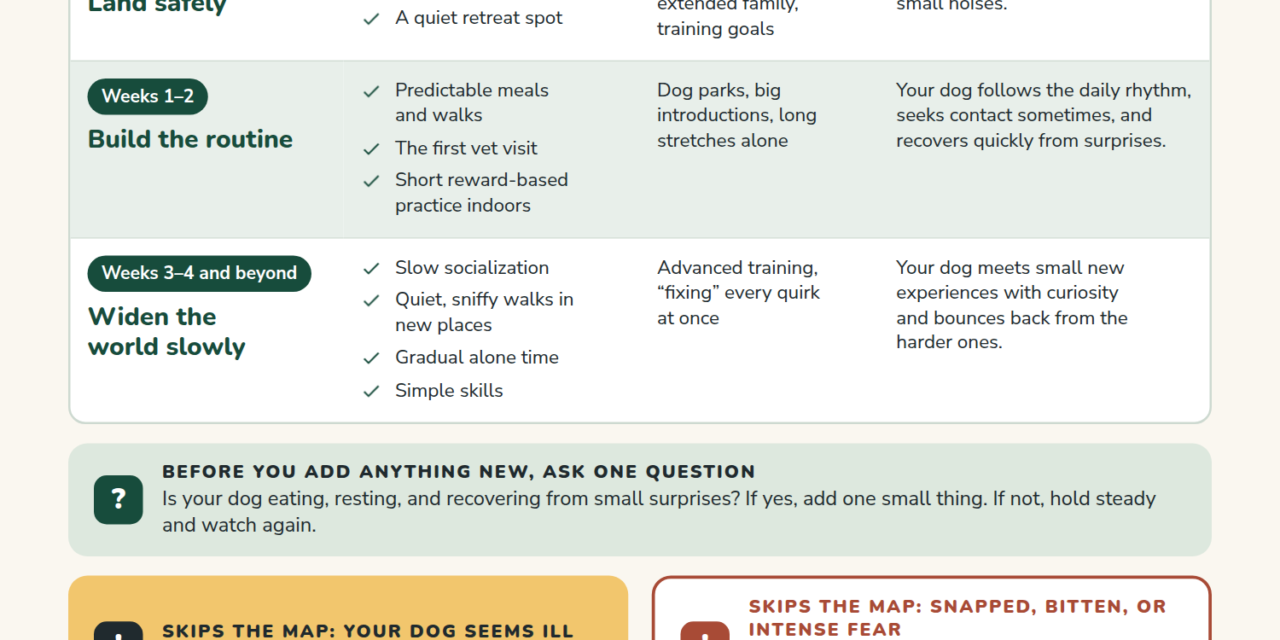
The table below shows a flexible map. Treat the phases as loose guides, not deadlines.
| Phase (illustrative) | Main focus | What can wait |
|---|---|---|
| Days 1–3 | Safe arrival, leashed potty breaks, rest, a quiet retreat spot | Visitors, outings, photos with the extended family, training goals |
| Weeks 1–2 | Predictable meals and walks, the first vet visit, small reward-based wins | Dog parks, big introductions, long stretches alone |
| Weeks 3–4 and beyond | Slow socialization, short practice sessions, gradual alone time | Advanced training, “fixing” every quirk at once |
Move on when your dog is eating, resting, and bouncing back from small surprises. If that isn’t happening yet, stay where you are. Nothing is behind schedule. Your dog isn’t late.
Two situations that skip the map
If your dog seems ill, jump to the section on when to call your vet. If your dog has snapped, bitten, or shows intense fear, read the professional help section before you plan anything else.
Three habits that carry the whole first month
- Fewer new things. One new experience at a time beats five at once.
- The same routine daily. Predictable meals, potty breaks, and rest help a dog learn what comes next.
- Watch more than you push. Let your dog’s behavior set the pace.
What you know, and what you can’t know yet
Adult rescue dogs arrive with a past, and you’ll rarely get the whole story. A rescue may know a lot, a little, or almost nothing. Some dogs came from homes, some as strays, and some spent time with a foster. Each starts from a different place.
That’s why first impressions can mislead. A dog who seems calm on day one may be overwhelmed and quiet. A dog who seems wild may be nervous and excited. Many owners notice that a dog’s personality shows up gradually as the dog relaxes.
Treat everything you learn early as a first draft. Keep notes on what your dog eats, how your dog sleeps, and what makes your dog startle. Share them with your vet and, if you need one, a trainer. Breed guesses on paperwork are exactly that, guesses.
This isn’t a reason to worry. It’s a reason to stay curious.
Before homecoming: get the household ready
Most of the work happens before your dog arrives. That’s good news, because you can do it at your own pace with nobody watching. Bringing home a rescue dog is much easier when the boring decisions are already made.
Hold a household meeting
Sit down with everyone who lives with you and decide the rules before the dog arrives. Humane World for Animals suggests settling the walking schedule, feeding times, furniture access, sleeping location, and off-limits rooms in advance. Consistency helps a dog work out what’s expected.
The examples below are illustrative. Your household will make different choices.
| Decision | Question to settle | Illustrative answer |
|---|---|---|
| Feeding | Who feeds, when, and where? | One adult feeds; a note on the fridge tracks meals |
| Potty and walks | Who takes the dog out first thing and last thing? | Adults only, on leash, for now |
| Furniture and beds | Is the couch allowed? Your bed? Where does the dog sleep? | Decide together; loosening a rule later is easier than adding one |
| Off-limits rooms | Which rooms get a gate or a closed door? | Kitchen gated; bedrooms closed by day |
| Visitors and doors | Who briefs guests and checks latches? | A quick text before guests arrive; everyone checks the gate, out loud |
Time the arrival
Humane World for Animals suggests arranging for your dog to arrive on a weekend or when you can be home for a few days. AAHA’s new-dog checklist also recommends having someone home most days for the first few weeks.
That won’t fit every schedule. If it doesn’t fit yours, line up a family member, friend, or neighbor to cover gaps. Our separate guides on working full time with a dog and on how long you can leave a dog alone cover the planning side.
Set up a quiet safe space
The AKC recommends a quiet space your dog can retreat to whenever they want. That might be a crate, a bed tucked under a table, or a spare bedroom. Your dog may take a few weeks to show you which spot they prefer.
Pick a spot away from the front door, the TV, and the busiest hallway. Add a bed or blanket, water, and a toy unlikely to be swallowed. Then make one rule for the whole household: nobody pets, calls, or reaches into the safe space.
If you use a crate, Humane World for Animals says it should be large enough for your dog to stand up and turn around in. Never use the safe space as punishment.
Secure gates, fences, and doors
A dog who doesn’t know your neighborhood has no idea where home is yet. That makes the first weeks a higher-risk time for bolting. Your fence may have held a previous dog for years. A new dog gets a fresh look at it.
Walk your property before arrival day and check these points:
- Fence line and gaps. Look for gaps at the bottom, loose boards, and spots a determined dog could dig, climb, or squeeze through.
- Gate latches. Make sure they close fully and can’t be nudged open.
- Doors. Leash or gate your dog before anyone opens an exterior door.
- Windows and screens. Check that screens are secure, especially on ground-floor windows.
- Collar and harness fit. Adjust both so they can’t slip off, and put the ID tag on before the car ride.
For the first weeks, use a leash or long line for every trip outside, even in a fenced yard. Humane World for Animals suggests a flat-buckle or martingale collar with an ID tag, plus a harness and a 6-foot leash. A nervous dog in a new place can move fast. A secure setup gives you time to react.
ID tag and microchip registration
Two layers of identification beat one. A tag is visible to anyone who finds your dog. A microchip is the backup if the collar comes off.
AAHA’s checklist says to discuss microchipping at the first vet visit if it hasn’t been done, and Humane World for Animals says to confirm the microchip. Confirming means more than knowing a chip exists:
- Ask the rescue for the microchip number and the name of the registry.
- Check that the registration lists your name, phone number, and address.
- Ask your vet to scan the chip at the first visit.
- Update your details whenever you move or change numbers.
Supplies: buy the basics first
Start small. Humane World for Animals lists a collar and ID tag, a harness and leash, bowls, a bed, and toys. It recommends toys unlikely to be swallowed and suggests avoiding rawhide.
- Walking gear: collar with tag, a well-fitting harness, a standard leash, and a long line for potty breaks and sniffy walks.
- Feeding: two bowls and the food your dog has been eating. Humane World for Animals advises changing foods gradually to avoid digestive upset.
- Rest: a bed or crate, blankets, and gates or a playpen for the safe space.
- Enrichment: a treat-dispensing toy or lick mat. The AKC notes treat-dispensing toys and nosework help dogs decompress.
- Cleanup: waste bags and an enzymatic cleaner for accidents.
The fifth toy can wait until you learn whether your dog likes toys. Before arrival, also clear hazards from floors and counters. AAHA’s checklist recommends removing hazardous items and household chemicals, and our separate guide to dog-proofing your home goes step by step.
Questions to ask the rescue and records to collect
The rescue is your best source of information about your dog’s past. Ask before adoption day when you can, and ask again afterward. Some rescues know a lot, and some don’t. Both answers help.
Questions by topic
The AKC’s guidance on adopting from a rescue sorts useful questions into categories. This table follows that structure, with a few practical additions.
| Topic | What to ask | Why it helps |
|---|---|---|
| Origin and history | How long in the rescue? Surrendered, stray, or transferred? How many homes? | Context for stress and routine |
| Medical care | Vaccines current? Spayed or neutered? Any conditions or medications? | Your vet needs this |
| House habits | House-trained or crate-trained? Current feeding, walk, and sleep routine? | You can keep familiar routines at first |
| Temperament | Likes and dislikes? Quiet spaces or constant company? | Sets up the right environment |
| Children and strangers | Comfortable around children and new people? | Shapes visitor and family plans |
| Other animals | How does the dog act around dogs, cats, and small pets? | Guides introductions |
| Skills and manners | Which cues does the dog know? How are leash manners? | You start where the dog is |
| Behavior concerns | Known issues or triggers? Any bite history? | Safety planning and early help |
| Rescue policies | Return or rehoming policy? Post-adoption support? | A plan B and a place to call |
If the rescue doesn’t know
“We don’t know” is a real answer, and it’s common. Ask what staff or volunteers have observed. If the dog lived with a foster, ask whether you can talk to the foster. Treat gaps as reasons to go slowly, not reasons to worry.
A note on bite history
The AKC’s list includes bite history, and it belongs there. Ask directly what happened, who was involved, and what the circumstances were. A clear answer helps you plan safely.
A bite history doesn’t automatically rule out a dog. It does mean talking with a certified trainer or a veterinary behaviorist before adoption or right after, especially if children live in or visit your home. Ask the rescue what support they offer.
Records to collect on adoption day
Ask for copies, not just verbal summaries. A folder makes the first vet visit much smoother.
- Vaccination record and medical history, including any treatments
- Spay or neuter paperwork, if the surgery has been done
- Microchip number and the name of the registry
- Any heartworm test results and parasite-prevention history
- Current medications, food, and feeding schedule
- Behavior and foster notes, if the rescue has them
- The adoption contract with the return policy, plus a contact for questions
The car ride and arrival day
Arrival day feels big to you. It’s bigger for your dog. Your only jobs are to get home safely and keep things calm. Bringing home a rescue dog doesn’t require a party, a tour, or a photo shoot.
The ride home
Give your dog a chance to relieve themselves before leaving the rescue. Put the ID tag on and check the collar and harness fit. Keep your dog on leash before you open any car door. A dog who bolts from a strange parking lot is very hard to catch.
Secure your dog with a crate or a car-safe harness so your dog can’t reach the driver or jump out an open door. If you can, ask a second adult to ride along. Bring water, a towel, and wipes in case of drooling or car sickness. Never leave your dog alone in a parked car.
Head straight home. Skip the pet store, the park, and the errands. Those can wait until your dog knows where home is.
The first steps at home
Keep your dog on leash and walk to the outdoor potty spot first. Wait quietly and let your dog sniff. If your dog goes, reward calmly with a treat or soft praise. Then head inside on leash.
Let your dog explore at their own pace. Show them the water and the safe space, but don’t push them into it. Keep off-limits rooms closed and the family calm. Everyone can meet the dog, just not all at once.
Skip the big hug-and-play welcome. The AKC advises letting interactions happen on your dog’s terms and not forcing them. Start by spending quiet time near your dog. Offer affection and food rewards when your dog is ready and looking for it.
The first evening
Keep the evening short and boring on purpose. Offer a normal meal, a final potty trip, and a quiet spot to sleep. Dim the lights and turn the TV down. Resist the urge to invite anyone over to meet the newest family member.
Some dogs sleep deeply the first night. Others pace, whine, or stay alert. Both are common. Stay near, keep things low-key, and don’t read a restless night as a sign you’ve made a mistake.
Decompression: why fewer new things helps
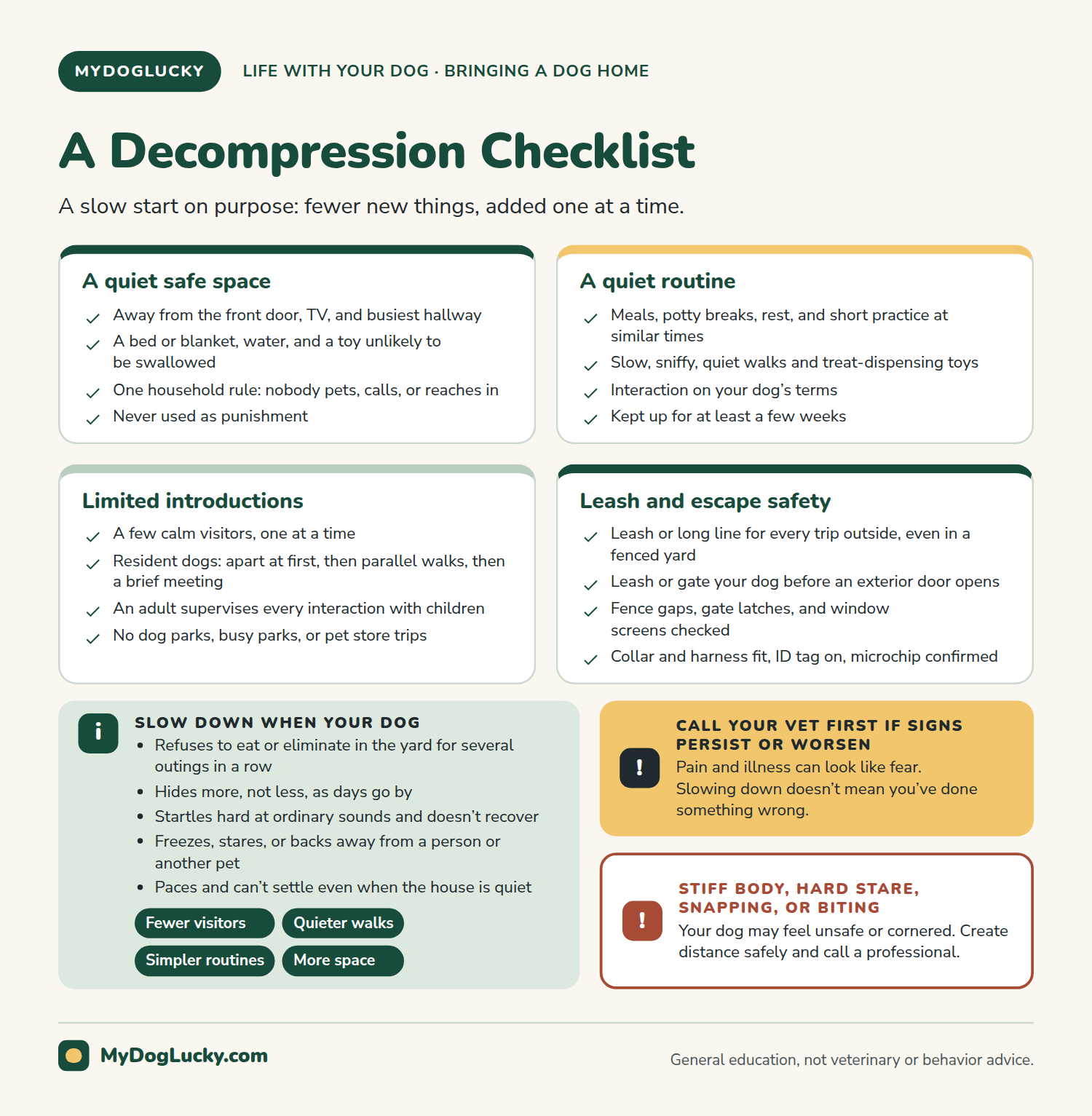
Decompression is the heart of bringing home a rescue dog. It means giving your dog time to settle before you ask for much, a slow start on purpose. The AKC recommends keeping a routine and a quiet atmosphere for at least a few weeks, with consistent times for feeding, potty breaks, naps, training, and play.
The reason is something trainers call trigger stacking. The AKC describes it as a harmful accumulation of stress from multiple stimuli. In a new home, everything is new at once: smells, floors, sounds, people, and rules. A busy weekend with friends can add more than a dog can process.
Fewer new things doesn’t mean nothing happens. It means choosing carefully and adding one thing at a time.
What decompression looks like day to day
- A predictable routine. Meals, potty breaks, rest, and short practice sessions at similar times each day.
- Leash or long-line potty breaks. These keep your dog safe while your dog learns the yard.
- Limited visitors. A few calm people, introduced one at a time.
- No dog parks, busy parks, or pet store trips. Humane World for Animals says most dogs will be overwhelmed simply by the transition to your home.
- Interaction on your dog’s terms. Let your dog come to you. Don’t hover, grab, or pull your dog out of hiding.
The “3-3-3 rule”: a rule of thumb, not a schedule
You’ll likely run into the “3-3-3 rule” online. It usually goes like this: three days to decompress, three weeks to learn the routine, and three months to feel at home. It’s a widely quoted rule of thumb. It isn’t a research-established timeline.
The guidance we reviewed for this article points the other way. Humane World for Animals says adjustment can take days, months, or longer. The AKC says fearful or anxious dogs may need a few weeks or months to feel comfortable.
So use the rule, if you use it at all, as a loose reminder to go slowly. Don’t use it as a deadline.
If your dog is still hiding on day four, nothing has failed. If your dog seems relaxed on day two, keep the routine anyway. Some dogs look settled early and show new behavior later.
Our stance: observation over deadlines
Your dog isn’t on a clock. Watch what your dog does, not what the calendar says. Eating, resting, and recovering from small surprises are better signs of progress than any day count.
A flexible map of the first month
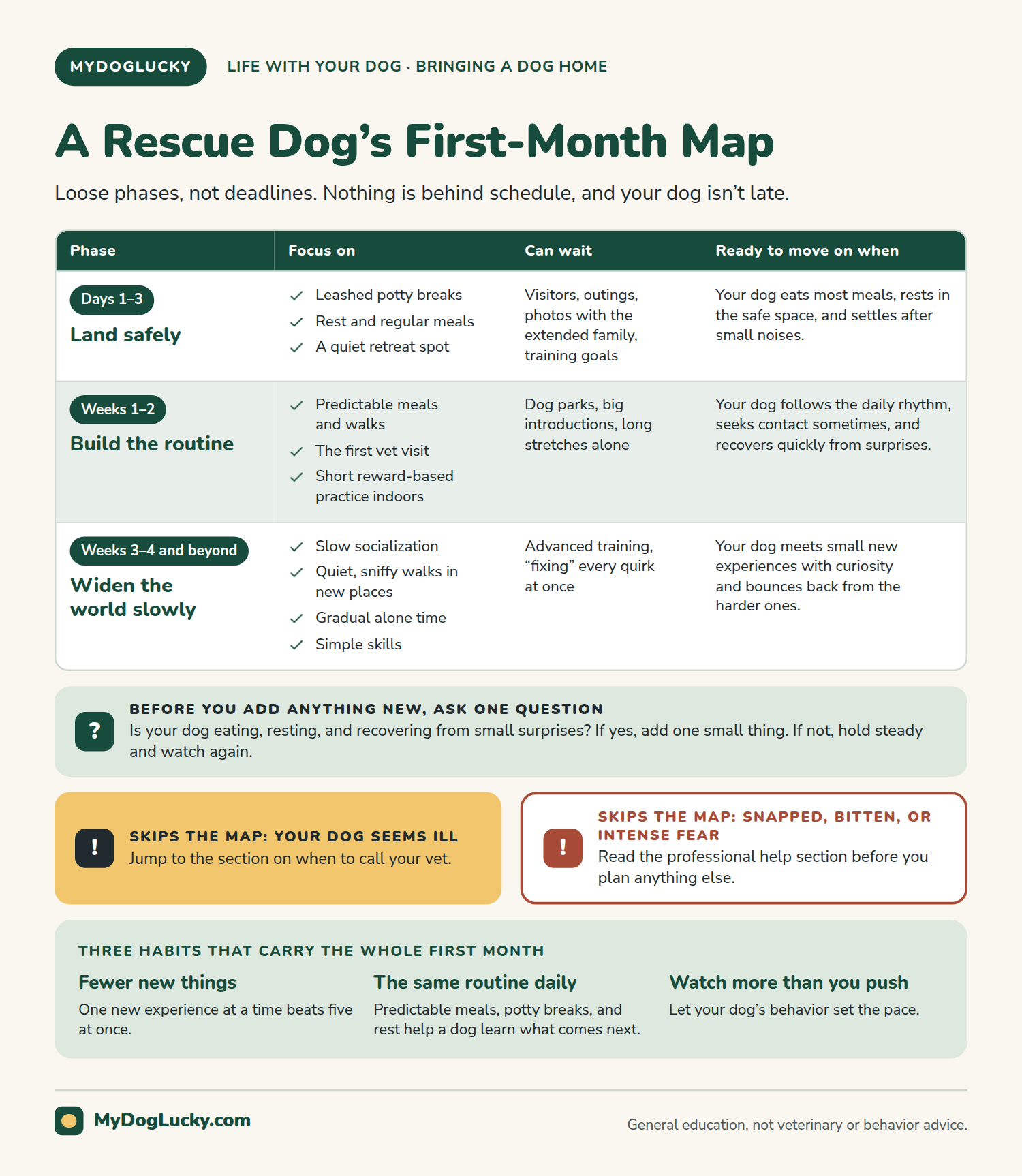
The phases from the short answer look like this in practice. The day ranges are illustrative. Some dogs move faster, and many move slower. Use the “ready to move on” checks instead of the dates.
Days 1 to 3: land safely
- Focus on: leashed potty breaks, rest, meals, and a quiet retreat.
- Ready to move on when: your dog eats most meals, rests in the safe space, and settles after small noises.
Weeks 1 to 2: build the routine
- Focus on: predictable meals and walks, the first vet visit, and short reward-based practice indoors.
- Ready to move on when: your dog follows the daily rhythm, seeks contact sometimes, and recovers quickly from surprises.
Weeks 3 to 4 and beyond: widen the world slowly
- Focus on: slow socialization, quiet sniffy walks in new places, gradual alone time, and simple skills.
- Ready to move on when: your dog meets small new experiences with curiosity and bounces back from the harder ones.
Before you add anything new, ask one question. Is your dog eating, resting, and recovering from small surprises? If yes, add one small thing. If not, hold steady and watch again.
Feeding, potty, and sleep routines
Routines do quiet work. They tell your dog what happens next, which lowers the number of decisions your dog has to make in a strange place. Start simple. You can adjust once you know your dog better.
Feeding routine
Ask the rescue what your dog has been eating, and start with that. Humane World for Animals recommends switching to a new food gradually to avoid digestive upset. Ask your vet how to do that for your dog.
Offer meals at set times in a quiet spot. Keep water available. If your dog doesn’t finish a meal, pick up the bowl after a reasonable while and try again at the next scheduled meal. The AKC calls treat-dispensing toys and nosework particularly beneficial for decompression, and a stuffed toy can make mealtime more interesting.
Not eating at first is common. Many new dogs are too stressed to eat much in the early days. But don’t wait it out if your dog also seems lethargic, vomits repeatedly, or has diarrhea that persists. Call your vet.
Potty routine
Humane World for Animals advises assuming your new dog isn’t house-trained and working from there. It also says to take your dog out every few hours. That’s a good starting frame even if the rescue says your dog is house-trained. Stress and a new environment can undo old habits.
Take your dog to the same spot every time, on a leash or long line. Stand still, stay boring, and give your dog time to sniff. When your dog goes, reward right away with a treat and calm praise. Go out after meals, after naps, and after play.
If an accident happens, clean it up quietly with an enzymatic cleaner. Don’t scold, and don’t rub your dog’s nose in it. Punishment teaches a dog to hide from you, not to go outside. Accidents are information about timing, not misbehavior.
Sleeping arrangements
There’s no single right answer. Choose something you can keep up and that keeps your dog safe. Then keep it consistent for the first stretch. The table compares common setups.
| Setup | Why owners choose it | Watch for |
|---|---|---|
| Crate or pen near your bed | Your dog hears and smells you nearby; contained overnight | Distress in the crate. If your dog panics, stop and ask a professional |
| Dog bed in your bedroom | Close and flexible; easy to hear a night potty request | Roaming or door-dashing; gate the doorway if needed |
| Dog bed in a gated quiet area | Quiet for your dog and easier on your own sleep | Crying from isolation; move closer if your dog seems distressed |
| Your bed | Cozy and comforting for many people and dogs | Guarding the bed, and a habit that’s harder to undo later |
Your dog may ignore the bed you picked and sleep on the bathroom mat instead. That’s fine. Nobody is judging your decorating.
Some dogs also need a nighttime potty trip at first. Keep it quiet, keep the lights low, and go straight back to bed.
Managing food, chews, and beds
Some dogs guard food, chews, toys, or beds, especially in a new place where resources feel uncertain. Our separate guide to resource guarding goes deeper. Here’s the short version for the first weeks.
- Feed your dog in a quiet spot, away from other pets and children.
- Don’t take food or chews away to “test” your dog. It teaches the wrong lesson.
- If you need to pick something up, trade calmly for something better.
- Keep children and other pets away from bowls, chews, and the bed.
- Respect a growl. The AKC notes that punishing growling may create a dog who bites without warning.
If your dog freezes, stiffens, snaps, or bites over food or objects, stop trying to work it out on your own. Call a certified trainer or a veterinary behaviorist.
Body-language check-ins and signs to slow down
Your dog can’t tell you how things are going. Your dog’s body can. A quick check-in a few times a day helps you spot trouble early and celebrate progress. Our separate guide to dog body language goes deeper on individual signals.
Take a quiet moment to watch. Look at posture, ears, tail, eyes, mouth, movement, and appetite. Then ask whether your dog looks looser or tighter than yesterday.
| What you see | What it can mean | Your next move |
|---|---|---|
| Loose, wiggly body; eating; deep sleep; approaching you and leaving when done | Your dog is settling | Keep the routine; add one small new thing at a time |
| Panting when it isn’t hot, pacing, tucked ears or tail, lip licking, yawning, freezing, crouching | Your dog may be stressed | Reduce input, give space, and go back to the last step that went well |
| Staying in the safe space most of the time | Your dog needs distance and time | Leave your dog alone there; sit nearby and stay quiet; keep meals and potty breaks steady |
| Growling | Your dog is communicating discomfort | Give space, look for the trigger, and don’t punish the warning |
| Stiff body, hard stare, snapping, or biting | Your dog feels unsafe or cornered | Create distance safely and call a professional |
Read clusters, not single signals
A yawn can mean your dog is tired. The AKC lists excessive panting, pacing, tucking the ears or tail, lip licking, yawning, freezing, and crouching as common stress signals. Look at several signs together, and consider what’s happening around your dog at that moment.
Signs to slow down
Slow down when you see any of these:
- Your dog refuses to eat or eliminate in the yard for several outings in a row.
- Your dog hides more, not less, as days go by.
- Your dog startles hard at ordinary sounds and doesn’t recover.
- Your dog freezes, stares, or backs away from a person or another pet.
- Your dog is pacing and can’t settle even when the house is quiet.
Slowing down means fewer visitors, quieter walks, simpler routines, and more space. It doesn’t mean you’ve done something wrong. If the signs persist or worsen, call your vet first, because pain and illness can look like fear.
Other pets, children, and visitors
Introductions are the part of decompression people most want to hurry. Resist that. A slow start protects everyone in the house, including the dog who already lives there.
Resident dogs
Humane World for Animals advises making sure resident pets are up to date on their shots and in good general health before you introduce a new dog. Check with your vet first if you’re unsure. Then go slowly. A common approach looks like this:
- Keep the dogs apart at first, with a gate or closed door between them.
- Let them get used to each other’s scent through bedding or closed doors.
- Try parallel walks, with the dogs at a comfortable distance and relaxed on their leashes.
- Move to a brief, calm meeting on neutral ground, with each dog on a loose leash and a handler.
- At home, pick up toys, chews, and bowls, and feed the dogs apart.
- Supervise every interaction, and end each on a good note before either dog gets tense.
Watch both dogs, not just the new one. Stiffness, hard staring, or freezing from either dog is your cue to add distance and take a break. If the tension doesn’t ease, ask a certified trainer to help.
Cats and small pets
Ask the rescue about your dog’s history with cats and small animals. Then build barriers into your plan. Use gates, closed doors, and high perches or rooms where the cat can escape. Keep the first meetings brief and controlled, with the dog on a leash and the cat free to leave.
If your dog stalks, fixates, or lunges at a cat or small pet, separate them and call a certified trainer. Don’t rely on luck.
Children
Ask the rescue how the dog behaves around children, then verify it slowly at home. An adult should supervise every interaction. Teach kids a few simple rules:
- Let the dog come to you. Don’t chase, hug, or corner the dog.
- Stay away from the dog’s bowl, chews, bed, and safe space.
- Never bother the dog while eating or sleeping.
- Pet gently on the chest or shoulder, not over the head.
- Stop when the dog walks away.
Use gates to give both sides a break. If your dog avoids or seems uneasy around kids, that dog needs more distance, not more practice. A certified trainer can help you set that up.
Visitors
Keep visitors few and calm for the early weeks. Tell guests before they arrive. Ask them to ignore your dog at first, avoid direct eye contact, and let your dog approach. Toss a treat and let your dog decide how close to come.
Leash or gate your dog before you open the door. A new dog plus a swinging front door is a common escape story. If your dog retreats to the safe space, that’s a good choice. Let your dog stay there.
Leaving your dog alone, gradually
Leaving your dog alone is a skill your dog learns, not something you can assume. Some rescue dogs do fine. Some panic. Our separate guide to separation anxiety in dogs covers the signs in detail.
AAHA’s checklist suggests having someone home most days for the first few weeks. Plan for that if you can. Then build alone time in small steps:
- Start with departures so short they barely count. Step outside, then come right back.
- Leave a stuffed treat toy or puzzle bowl. Humane World for Animals suggests this for mental and physical distraction when you go out.
- Lengthen the time slowly, only when your dog stays relaxed at the current level.
- Keep arrivals and departures low-key. Don’t make a big fuss.
- Watch how your dog handles each step, and go back a step if your dog struggles.
Recording your dog on a phone or a camera while you’re out can show you what happens when you’re gone.
Watch for constant barking or howling, frantic pacing, or destruction aimed at doors and windows. Drooling or house-soiling that only happens when you leave counts too. If you see these, stop the practice and ask for help. A veterinary behaviorist or certified trainer can build a safer plan, and our separate guide to how long you can leave a dog alone covers the daily-life side.
Walks, exercise, and slow socialization
Walks are enrichment, not just exercise. The AKC recommends slow, sniffy, quiet walks for decompression. It also suggests a long line attached to a well-fitting harness so your dog can explore more freely.
Choose quiet routes and quiet times of day. Let your dog stop and sniff. Keep the pace easy and the distance from other dogs and people generous.
If your dog wants to watch something from far away, let your dog watch. Reward calm looks.
What to skip for now
Humane World for Animals advises avoiding busy parks, dog parks, and pet store visits early on, because most dogs will be overwhelmed by the transition. A dog park mixes unfamiliar dogs, unpredictable play, and a strange place. That’s a lot of new for an unsettled dog.
Socialization for an adult dog is gradual
Adult rescue dogs don’t need to meet everyone and everything. They need small, positive experiences at a distance they can handle. Our separate guide on how to socialize an adult dog lays out a step-by-step plan. Here’s the short version:
- Pick one new thing at a time: a quiet street, a calm neighbor, a sound.
- Start far enough away that your dog stays relaxed.
- Reward your dog for noticing without reacting.
- End the outing before your dog gets tired or tense.
- Take a break day whenever your dog seems overloaded.
For exercise ideas by age and ability, see our separate guide on how much exercise a dog needs. For rainy days, our guide to indoor dog enrichment has options.
The first vet visit: what to bring and ask
Schedule the first vet visit early. Humane World for Animals suggests visiting a veterinarian within a week for a general health check, vaccinations, and preventive flea and tick medicine. AAHA’s new-dog checklist says to schedule the first appointment within the first weeks. So aim for the first week or two.
The visit doubles as a chance to set a health plan. It’s also a chance to see how your dog handles a new place, so let the clinic know your dog is new to you. Ask about low-stress handling if your dog seems anxious.
| Bring | Ask |
|---|---|
| Records from the rescue, including vaccines, medical history, and microchip details | Which vaccines and boosters does my dog need, given these records? |
| Any medication names, doses as written by the rescue, and the current food | What parasite prevention makes sense for my dog and my area? |
| Your notes on appetite, stool, sleep, and behavior | Has my dog been tested for heartworm, and when should we test? |
| A list of questions, including any behavior worries | Can you scan the microchip? Is my dog spayed or neutered? What’s the plan if not? |
| A secure leash and a well-fitting harness | Do you see any pain, dental, skin, or mobility concerns I should watch? |
Vaccines, parasites, and heartworm
AAHA’s checklist says the first visit should cover the health plan, including vaccinations, boosters, and parasite prevention. It also says to discuss microchipping and spaying or neutering if not already done.
Your vet will use your records, your dog’s age and health, and where you live to recommend a plan. That plan belongs to your vet. This guide can’t set it for you.
Heartworm deserves its own mention. The American Heartworm Society says adult dogs over 7 months who haven’t been on prevention need a heartworm test before starting prevention. They need retesting 6 months and 12 months later, and then every year.
The society also recommends year-round prevention and says heartworm disease has been diagnosed in all 50 states. Ask your vet how this applies to your dog. The society’s page was undated when we accessed it in September 2026.
If the rescue already tested your dog or started prevention, bring those records. Your vet may still recommend more testing or a different plan.
Reward-based training in the first weeks
Training starts as soon as your dog arrives, but it doesn’t need to look like training. Every potty reward, every calm moment you notice, and every predictable routine teaches your dog something. Formal practice can be short and simple.
The AKC recommends starting indoors with sessions that are short, fun, and positive. Use treats, toys, and praise to build confidence and motivation. Humane World for Animals agrees, advising you to reward your dog right after something you like. Ask the rescue which cues your dog already knows, and start there.
What to teach first
- Name response. Say your dog’s name, then reward eye contact.
- Settle on a mat. A cozy, rewarding spot helps your dog relax anywhere.
- Potty on cue. A quick reward at the right spot builds the habit.
- Loose-leash basics. Reward your dog for staying near you on the leash.
Teach one skill at a time. Before you raise the difficulty, wait until your dog succeeds most of the time in one setting. If your dog struggles, go back a step.
Count treats as part of the daily food plan so extra rewards don’t add up. Our separate guide to dog training basics lays out the methods in more detail.
Skip punishment, leash corrections, and dominance talk. Reward-based methods build trust, which is what a rescue dog needs most.
Humane World for Animals also suggests considering an in-person or virtual obedience class. Wait until your dog is comfortable enough to enjoy it.
Common surprises in the first weeks
Almost every adopter meets a surprise or two. Most are normal, and some need help. This table shows which is which.
Quick reference
| Surprise | What owners often see | What to try | Call your vet if |
|---|---|---|---|
| Stress-related tummy upset | Loose stool or gas after the move or a food change | Steady routine, the same food, gradual changes, notes on stool | Vomiting repeatedly, blood, lethargy, or diarrhea that persists |
| Not eating at first | Skipped or picky meals | A quiet feeding spot and regular meal times, with no pressure | Refusal continues, or your dog seems ill, weak, or in pain |
| Hiding | Staying in the safe space or behind furniture | Let your dog be; sit nearby; keep the routine | Your dog won’t eat, drink, or go potty, or hides more each day |
| Accidents | Pee or poop inside, even if the rescue said “house-trained” | More leashed breaks, no punishment, enzymatic cleanup | Straining, blood, sudden urgency, or a big change in urination |
| Escape attempts | Bolting at doors, digging, climbing, or slipping out of gear | Gates, leash-before-door routine, a fit check on collar and harness | Your dog is injured; also ask a trainer about panic |
Personality shifts
Many owners notice that a dog who was quiet at first becomes livelier, opinionated, or more affectionate as the weeks go on. That’s usually your dog relaxing. It can also bring out preferences, like a dislike of hats or a strong opinion about the vacuum.
Write those down. They help you plan. If you see new fear, sudden aggression, or signs of pain, call your vet.
When to call your vet, a trainer, or a behaviorist
Knowing who to call saves time and worry.
Call your vet or an emergency clinic now if you see
- Trouble breathing, collapse, or pale or blue gums
- Repeated vomiting, or a swollen, tight belly with unproductive retching
- Straining to urinate with little or nothing coming out
- A seizure, or sudden weakness or inability to stand
- Heavy bleeding, obvious severe pain, or a serious injury
- A possible poisoning, such as a chewed medication, chocolate, or a cleaning product
Don’t wait for a scheduled visit. Call on the way if you can.
Call your vet soon if
Some signs aren’t emergencies, but they do need a professional look. Call your vet the same day or as soon as the office opens if your dog:
- Stops eating and also seems tired or weak
- Has diarrhea or vomiting that continues or keeps coming back
- Limps, cries when touched, or seems stiff or sore
- Coughs, sneezes repeatedly, or has eye or nose discharge
- Scratches, chews, or licks skin constantly, or has red or sore skin
- Shows a sudden change in behavior, including new fear or aggression
Pain and illness can show up as behavior. A dog who snaps when touched might be sore. A dog who hides might feel sick. Rule out medical causes before you assume a training problem.
A certified trainer can help with
A certified trainer who uses reward-based methods can help with everyday skills and with mild worries. Good fits include leash manners, house-training setbacks, pulling, mild fear of new things, and planning safe introductions.
A veterinary behaviorist can help with
A veterinary behaviorist is a veterinarian with advanced training in behavior. Ask your regular vet about a referral if your dog shows:
- A history of biting or snapping, or new snapping or biting
- Intense fear that isn’t easing with time and management
- Self-injury, such as chewing at doors, crates, or their own body
- Extreme distress when left alone
- Aggression that’s getting worse, or that you can’t safely manage
The rescue can help, too
Humane World for Animals says the shelter or rescue can offer tips on basic behavior challenges or refer you to a certified trainer. The AKC also lists post-adoption support as something worth asking about. Call the rescue early. They know your dog’s history, and they want the adoption to work.
When it isn’t working: asking for support and reassessing fit
Sometimes a dog and a household just don’t fit. It doesn’t mean you failed. It doesn’t mean your dog is bad. It means the match needs a closer look, and you deserve support while you figure it out.
Start with help. Talk to your vet to rule out medical causes. Ask a certified trainer or veterinary behaviorist for a plan.
Tell the rescue what’s happening. Many owners find that a few changes to management, routine, or support make a big difference.
If safety is at risk, act on that first. A dog who bites or seriously threatens a child or another pet needs separation and professional help right away. Don’t wait for a scheduled visit.
If you’ve tried support and things still aren’t right, the rescue is a good next call. The AKC lists return and rehoming policies among the questions to ask a rescue, for exactly this situation. Contacting the rescue directly keeps your dog’s history with people who know the dog.
Asking for help, reassessing fit, or deciding a different home is safer for your dog is a responsible choice. It’s not a moral failing. Be honest, be kind to yourself, and put your dog’s safety and welfare first.
Common mistakes when bringing home a rescue dog
These missteps come up again and again. Every one of them starts with good intentions.
Throwing a welcome party
Family and friends want to meet the new dog. Your dog isn’t ready. Wait until your dog has settled, then introduce people one at a time.
Heading straight to the dog park or pet store
It feels like a fun way to celebrate. For most new dogs, it’s too much. Humane World for Animals advises avoiding these places early on.
Leaving doors, gates, and fences to chance
A dog in a new place may bolt. Use leashes, gates, and the leash-before-door routine until you know your dog.
Expecting a timeline
Rules of thumb like 3-3-3 are popular, but they’re not research-established. Watch your dog instead of counting days.
Punishing accidents or growls
Punishment teaches your dog to hide problems from you. The AKC warns that punishing growling may lead to a dog who bites without warning. Give space and look for the cause instead.
Skipping the vet visit
Waiting “until things settle down” can delay vaccines, parasite prevention, and heartworm testing. Book the appointment in the first week or two.
Common questions about bringing home a rescue dog
How long does it take a rescue dog to adjust?
There’s no fixed answer. Humane World for Animals says it can take days, months, or longer. The AKC says fearful or anxious dogs may need a few weeks or months. The “3-3-3” idea is a popular rule of thumb, not a research-established timeline.
Should my rescue dog sleep in my bed?
That’s your decision, and the trade-offs are practical, not moral. A bed nearby comforts many dogs. Sharing your bed can be harder to undo later, and some dogs guard the bed. Pick a plan you can keep and tell everyone in the house.
Can I take my new dog to the dog park right away?
It’s best to wait. Humane World for Animals advises avoiding dog parks early because most dogs are overwhelmed by the transition to your home. Start with quiet walks instead.
My rescue dog isn’t eating. Is that normal?
Many new dogs eat less at first. Keep meals regular, use a quiet spot, and avoid pressure. Call your vet if your dog’s appetite doesn’t return, or if your dog also seems tired, vomits, or has diarrhea.
Is it okay to introduce my dogs on day one?
It’s usually better to start slowly. Keep the dogs apart at first, try parallel walks, and hold short meetings on neutral ground. Make sure your resident dog is healthy and up to date on shots first, as Humane World for Animals advises.
How soon should I take my rescue dog to the vet?
Humane World for Animals suggests within a week, and AAHA’s checklist says within the first weeks. Book early and bring the rescue’s records.
What if my dog seems too quiet or shut down?
Some dogs go quiet when overwhelmed. Give your dog space, keep the routine steady, and avoid pushing interaction. If your dog won’t eat, drink, or go potty, or seems ill, call your vet.
Why is my dog having accidents if the rescue said “house-trained”?
A new place, a new schedule, and stress can undo old habits. Assume you’re starting from scratch, as Humane World for Animals advises. Take your dog out every few hours, reward the right spot, and skip punishment.
What if I’m having second thoughts?
Many owners feel this way in the early weeks. Talk to the rescue, your vet, and a certified trainer, and ask for support before you decide. The section on when it isn’t working covers next steps.
So, bringing home a rescue dog comes down to a few steps. Prepare your home, keep the first weeks quiet, and watch your dog more than the calendar. Book the vet visit, add one new thing at a time, and ask for help early. Your dog will show you the pace.
Sources
- AKC. The Importance of Decompression When Bringing Home a New Dog. Updated March 18, 2026. Used for routine, the safe space, trigger stacking, indoor reward-based sessions, sniffy walks, stress signals, and growling.
- AKC. Questions to Ask When Rescuing a Dog to Find a Great Match. Updated July 31, 2026. Used for the question categories, bite history, and post-adoption support.
- AAHA. New Dog Checklist: Your Step-by-Step Guide to a Successful Start. June 18, 2026. Used for home preparation, someone home most days, and first-visit topics.
- Humane World for Animals. How to Bring Your New Dog Home and Make Them Feel Welcome. Page undated; accessed September 2026. Used for supplies, household policies, arrival timing, a quiet first week, avoiding dog parks, house-training, resident pets, and the first vet visit.
- American Heartworm Society. Heartworm Basics. Page undated; accessed September 2026. Used for heartworm testing, retesting, and year-round prevention.
This article is general education for U.S. dog owners. It is not individualized veterinary or behavioral advice. Ask your veterinarian about anything specific to your dog’s health, and consult a certified trainer or veterinary behaviorist about fear, aggression, or bite history. If your dog shows emergency signs, call your veterinarian or an emergency clinic right away.