Puppy blues is an informal, popular phrase for the mix of exhaustion, overwhelm, and second-guessing that many people feel in the first weeks or months with a new dog. It isn’t a medical diagnosis. It doesn’t mean you chose wrong, and it doesn’t mean you don’t love your dog.
Many owners describe the same odd combination. You adore the small, snoring creature in the crate, and you also miss your old life. Both can be true on the same day, and neither one cancels the other.
This guide is about you, not just the puppy. You’ll see why the early weeks feel so heavy, and you’ll get practical ways to lighten them. Those include protected sleep, a smaller daily plan, a shared task list, and scripts for asking for help. You’ll also find a support ladder, an honest section on when a dog isn’t working out, and a look at the long-term fatigue that can come with adult, senior, or medical-needs dogs.
One note before you start. This is general education, not medical or mental-health advice. If you ever feel hopeless or think about harming yourself or someone else, jump to the crisis block right below the short answer.
What’s in this guide
- Puppy blues: the short answer
- What the term means, and what it isn’t
- Why the early weeks feel so heavy
- Protecting sleep when a puppy wakes you at night
- Shrink the day: a low-effort plan for hard weeks
- Who does what: sharing the load at home
- Paid and unpaid help, and how to ask for it
- Classes, routines, and realistic expectations
- The support ladder: who to ask, and when
- When it’s not working: rehoming or returning a dog
- Long-term caregiver fatigue with adult, senior, or medical dogs
- Common mistakes when you’re overwhelmed
- Common questions about puppy blues and dog owner burnout
- Sources
Puppy Blues: The Short Answer
The short answer: puppy blues are common, informal, and not a diagnosis. Most people who describe them are running on broken sleep while learning a demanding new routine. Many say the feelings ease as sleep improves and the household settles. That doesn’t happen for everyone, though, and no one can give you an exact timeline.
Here’s what tends to help, roughly in order.
- Protect your sleep.
- Shrink the day to the essentials.
- Share the work, and ask people you trust for specific help.
- Bring in a trainer or your veterinarian for dog problems.
- Talk to your own doctor or a licensed therapist if the feelings last or get in the way of daily life.
You don’t have to climb those steps one at a time. Pick the one that matches what you’re feeling right now.
A quick map: what you’re noticing and where to start
| What you’re noticing | A first small step | Who can help |
|---|---|---|
| Exhausted from broken nights | Split night trips into shifts, and give the off-duty person earplugs | A partner, family member, or friend |
| Constantly on watch | Set up one puppy-safe zone with a gate or playpen | A friend who can take a watch while you rest |
| “What have I done?” moments | Say it out loud to one person you trust | A friend, family member, or your own doctor if it lingers |
| Money worry | List essentials versus nice-to-haves, and ask your vet’s office about costs up front | Your vet’s front desk, a trusted friend |
| Biting, crying, or chewing that feels like too much | Manage the space first, then book a class or a consult | A certified trainer or your veterinarian |
| Feelings that linger or get in the way of daily life | Book an appointment and say exactly that | Your doctor or a licensed therapist |
| Hopeless, or thinking about harming yourself or someone else | Use the crisis block below right now | 988 (call or text), or 911 in an emergency |
If you feel hopeless or think about harming yourself or someone else
Please reach out right now. In the United States, you can call or text 988 to reach the 988 Suicide & Crisis Lifeline, or chat online at chat.988lifeline.org. As of September 2026, the Lifeline says it’s free, confidential, and available 24 hours a day, every day of the year.
If you or someone else is in immediate danger, call 911 or go to the nearest emergency room. You don’t need a “big enough” reason to call 988. The Lifeline describes itself as being “for everyone,” including people who “just need someone to talk to.”
Please also tell a person near you how you’re doing. If low mood, constant worry, or feeling overwhelmed lasts or gets in the way of daily life, talk to your doctor or a licensed therapist. A short break, with your puppy safe in a pen or crate, is okay while you make that call.
The crisis block isn’t a prediction about you. It’s here because a tired, overwhelmed person deserves to know that help exists before they need it. The rest of this guide covers the everyday side of the load.
What the term means, and what it isn’t
“Puppy blues” comes from everyday conversation, not from a clinic. Owners use it for the low, anxious, or regretful stretch that can follow bringing a puppy home. You may see other labels for it online too. None of them is a medical or psychological diagnosis.
That matters for two reasons. First, there’s no test, checklist, or official timeline for it. Second, we can’t tell you what you’re experiencing. We can describe what many owners report, but only a licensed health professional can tell you whether something more is going on.
What many owners describe
These are common reports, not a checklist. You might recognize a few of them, or none.
- Love and overwhelm at the same time. You melt when the puppy falls asleep on your foot, and you dread the next potty trip.
- A sudden “what have I done?” moment. It often shows up at night, or after a rough day.
- Missing your old routine. Spontaneous plans, slow mornings, and uninterrupted sleep can feel very far away.
- Guilt about not enjoying every minute. Social media makes it look as if everyone else is delighted all day.
- Irritation. It may be aimed at the puppy, or at a partner who sleeps through the night trips.
- Isolation. Outings and visits often shrink while a puppy is young. Ask your vet what’s safe, and when.
- Second-guessing everything. Food, crate, class, schedule: every choice can start to feel like a test.
Notice what’s missing from that list: any sign of a character flaw. These are understandable responses to heavy, nonstop care work. A puppy needs something from you nearly every waking hour, and that adds up.
What the research says, honestly
We looked for solid research on the puppy blues. In the searches we ran for this article, we didn’t find peer-reviewed studies or position statements from major veterinary or humane organizations that define or measure it. What turned up was mostly popular articles, clinic and therapy blogs, and owner accounts.
So we won’t quote percentages or promise a timeline. This guide leans instead on general sources about sleep and well-being, plus common dog-care patterns described as patterns, not proven facts. Where a fact comes from a source, we name it and give its date.
Normal strain versus something worth telling a professional
You don’t have to sort your feelings into categories. A simpler test is more useful. Are the feelings easing as the weeks pass, or are they staying the same or getting heavier?
Ask a second question, too. Do they get in the way of eating, work, relationships, caring for yourself or your dog, or sleep beyond the puppy’s own night trips? If either answer worries you, tell your doctor or a licensed therapist. You don’t need a label first.
The National Institute of Mental Health (NIMH) says help is available for anyone who is struggling emotionally or has concerns about their mental health. Asking for it isn’t a sign that you can’t handle a dog. It’s a sign that you’re paying attention.
Why the early weeks feel so heavy
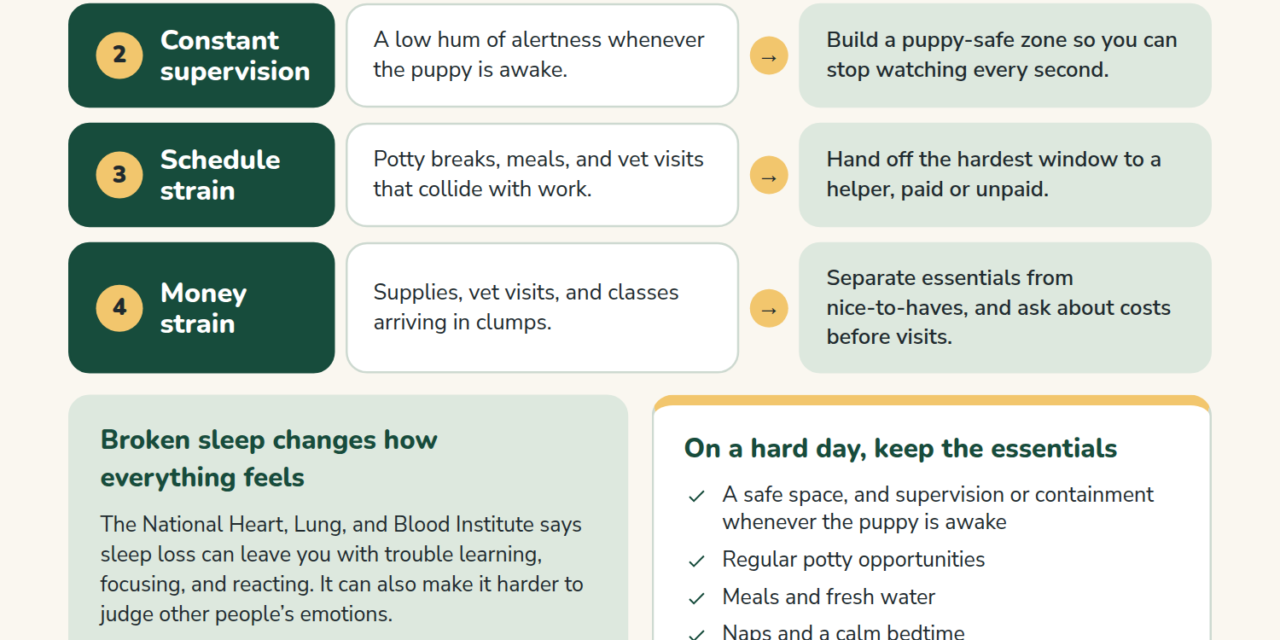
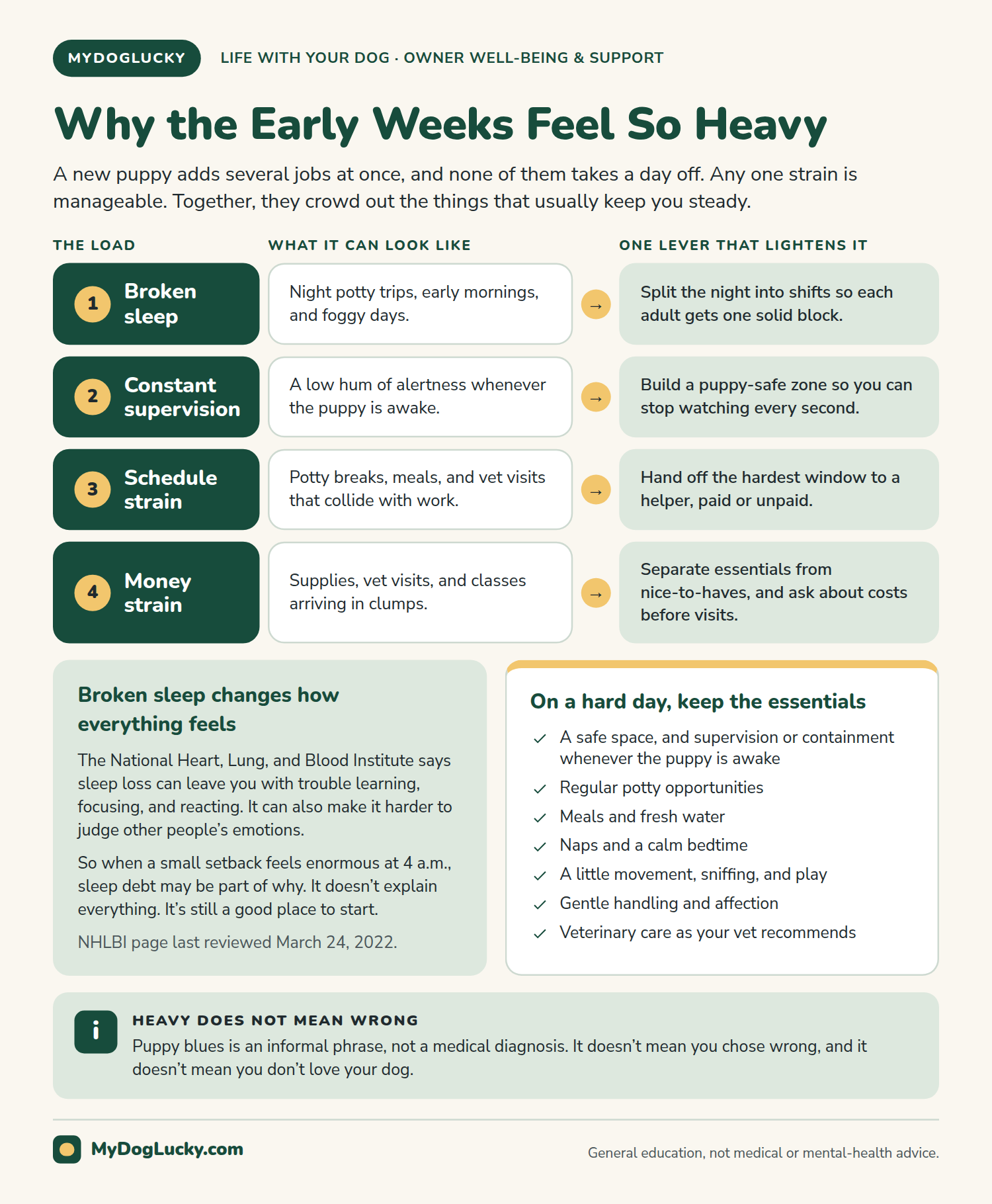
A new puppy doesn’t add one job to your life. It adds several at once, and none of them takes a day off. Sleep, supervision, scheduling, and money all get harder in the same week.
That stacking is a big part of why the puppy blues can feel so hard to shake. Any one of these strains is manageable. Together, they crowd out the rest, the things that usually keep you steady.
| The load | What it can look like | One lever that lightens it |
|---|---|---|
| Broken sleep | Night potty trips, early mornings, and foggy days | Split the night into shifts so each adult gets one solid block |
| Constant supervision | A low hum of alertness whenever the puppy is awake | Build a puppy-safe zone so you can stop watching every second |
| Schedule strain | Potty breaks, meals, and vet visits that collide with work | Hand off the hardest window to a helper, paid or unpaid |
| Money strain | Supplies, vet visits, and classes arriving in clumps | Separate essentials from nice-to-haves, and ask about costs before visits |
Broken sleep changes how everything feels
Sleep loss doesn’t just make you tired. The National Heart, Lung, and Blood Institute (NHLBI) says it can leave you with trouble learning, focusing, and reacting. It can also make it harder to judge other people’s emotions, and it can leave you feeling frustrated, cranky, or worried in social situations. (The NHLBI page was last reviewed March 24, 2022.)
That list reads a lot like a bad week with a new puppy. So when a small setback feels enormous at 4 a.m., sleep debt may be part of why. It doesn’t explain everything. It’s still a good place to start.
Constant supervision wears you down
An awake puppy needs eyes on them. Puppies chew cords, swallow socks, and find new places to pee. Watching is tiring even when nothing goes wrong.
The slippers by the door are now chew toys, and your evenings belong to someone who naps in short bursts and redecorates in between. A puppy-safe zone won’t end that, but it lets you look away for a few minutes without your stomach dropping.
Schedule and money strain are real, too
Potty trips, meals, and vet visits don’t bend around your workday. Costs arrive in clumps: supplies first, then veterinary visits, then classes. None of that means you’re bad at planning.
Money worries deserve respect, not a joke. Start by listing what your puppy truly needs, and what can wait. Then ask your vet’s office to explain likely costs before a visit. Our guides to the cost of owning a dog and whether pet insurance is worth it go deeper on the numbers.
Protecting sleep when a puppy wakes you at night
Sleep is the lever that moves most of the others. So protect it first, even if the dishes pile up. A rested person makes better calls about everything else on this page.
Most young puppies can’t sleep through the night at first. The American Kennel Club (AKC) advises keeping the puppy’s crate in your bedroom, and it says that when a puppy whines, you should quietly carry them out for a quick, boring potty break. The AKC page was updated March 10, 2026.
Keep night trips short and boring
A boring trip is a short trip. Boring also protects your sleep, because the puppy learns that nighttime is for settling down, not for playing.
- Get everything ready before bed. Leash, shoes, a dim light, and a treat pouch by the door mean less fumbling at 2 a.m.
- Keep the lights low and your voice quiet. Go straight to the potty spot, then straight back.
- Skip play and chatter. Calm praise is plenty.
- Don’t scold. A puppy who cries at night is communicating a need, not staging a protest.
- Return your puppy to their bed. The AKC says not to put a crying puppy in your bed unless that’s where you want them to sleep.
The AKC says these night trips typically fade by around four to five months. Puppies vary, so ask your vet what’s reasonable for yours. Our guides to a puppy’s first night home and a puppy sleep schedule cover the puppy’s side in more detail.
If your puppy won’t settle at all
Some nights, the shifts aren’t the problem. The puppy simply won’t settle. Before you assume the worst, run a quick check in order, and keep each step quiet and short.
- Does your puppy need to go out?
- Is the sleeping spot comfortable, not too warm or too cold, and free of drafts?
- Was there calm time before bed, or did the evening end with a burst of excitement?
- Could your puppy be hungry, thirsty, or lonely?
If none of that helps, ask your vet, and call promptly if your puppy seems unwell. The puppy-side guides linked above go through this troubleshooting in more detail.
Split the night into shifts
When two adults share a home, one person shouldn’t do every trip. Shifts protect both of you. Here are common ways households divide the night.
| Household | A shift idea | Watch for |
|---|---|---|
| Two adults, similar schedules | One adult takes trips until an agreed handoff time, and the other takes the rest | Agree on the handoff in advance, and swap halves each week |
| Two adults, one with an early job | The early riser takes the late-evening trip, and the other covers the early morning | Check in weekly, because work schedules change |
| One adult living alone | Keep the puppy’s bed close, prep night gear by the door, and ask a friend for one protected sleep-in | Move your own bedtime earlier when you can |
| Home with children | Adults own the night trips, and kids help with daytime tasks while an adult is nearby | Don’t leave a young child alone with a puppy |
| Rotating or irregular work hours | Write the week’s night plan on a shared note each Sunday | Plan around the night after your longest shift |
An illustrative two-adult night plan (not a prescription)
- Adult A runs the bedtime routine and covers any night trips until the agreed handoff time.
- Adult B covers trips after the handoff, plus the first morning potty break.
- The off-duty adult wears earplugs, or sleeps in another room, and stays in bed.
- You swap halves each week, so nobody owns the early mornings forever.
Count daytime rest, too
Young puppies sleep a lot. The AKC notes that some sleep 16 to 18 hours a day, and it suggests planning several naps in a quiet spot. Those nap windows can be yours too.
When your puppy is asleep in a safe pen or crate, rest with them. Lie down, close your eyes, and skip the screen. Rest isn’t the same as sleep, but many owners find it takes the edge off.
If you’re too tired to be safe
The NHLBI notes that sleepiness while driving contributes to serious crashes. So if you’re very sleepy, don’t drive to the vet or the store. Ask someone else, or reschedule what you can.
If you’re at your limit at night and feel yourself getting short with your puppy, put them in a safe space and step away for a moment. Breathe. Then come back. That pause protects both of you.
Shrink the day: a low-effort plan for hard weeks
You can’t do everything, so choose what counts. During the hardest weeks, a good day can be a small day. Cutting the plan doesn’t make you a worse owner. It makes the plan one you can actually keep.
Start with the essentials, the things every day needs. Everything else is optional, or belongs to someone else for now.
The essentials list
- A safe space, and supervision or containment whenever the puppy is awake
- Regular potty opportunities
- Meals and fresh water
- Naps and a calm bedtime
- A little movement, sniffing, and play
- Gentle handling and affection
- Veterinary care as your vet recommends
An illustrative regular day and a hard-day version
Use the hard-day column when you’re depleted, sick, or short on help. Notice that the essentials stay in both columns. This is an illustration, not a prescription, so adjust it with your vet’s and trainer’s advice for your puppy’s age.
| Part of the day | A regular day | A hard-day version |
|---|---|---|
| Morning | Potty, breakfast, short play, a training moment, nap | Potty, breakfast, nap |
| Midday | Potty, a walk or yard time, chew time | Potty, chew time in the pen |
| Afternoon | Potty, play, a training moment, nap | Potty, a slow sniff around the yard, nap |
| Evening | Potty, dinner, calm play, family time | Potty, dinner, a quiet chew, an early wind-down |
| Bedtime | Potty, quiet settling, bed | The same as a regular day, because bedtime is an essential |
What can wait, and what to ask before you drop it
Many things can slide for a while. Long training sessions can shrink to a few minutes, or pause. Fancy enrichment can become a chew and a sniff. Grooming can drop to basics, and the house can stay messy.
Some early experiences are time-sensitive, though, and that includes socialization. Before you drop anything that involves your puppy’s development, ask your vet and a certified trainer what can wait and what can’t. Then you’re choosing on purpose, not by default.
Management tools that buy you time
Management means arranging the space so your puppy can’t practice problems. It’s the biggest energy saver on the list, because you can’t out-supervise a puppy all day.
- A playpen or exercise pen. A safe spot with chews and a bed lets you shower, eat, or breathe.
- Baby gates. Gate off the room where you spend the most time, so the puppy’s world stays small.
- A crate, introduced gradually. Many owners use it as a resting spot. Our guide to crate training a puppy explains how to do it kindly.
- A written potty schedule. Tape it where everyone can see it, so nobody has to remember it alone.
- A puppy-proofed room. Cords up, shoes away, trash covered. Our dog-proofing your home guide has a checklist.
A gate won’t stop the sock thefts, but it moves them somewhere smaller. Management doesn’t replace supervision when the puppy is loose. It just lets you supervise with less dread.
A reset for the worst hour
Every owner hits an hour when it all piles up: an accident, a howl, a full sink, and no help in sight. Keep a short reset ready.
- Put your puppy somewhere safe, like the pen, with a chew.
- Drink some water.
- Step outside or to a window, and take a few slow breaths.
- Text one person, even something as small as “rough night, can I call later?”
- Come back and do only the next essential thing.
The reset doesn’t fix the day. It gives you a floor to stand on.
Who does what: sharing the load at home
In many households, one person quietly becomes the default puppy person. Nobody chose that. It happens because that person is home, or notices first, or can’t stand a puddle. Over weeks, it can turn into resentment on both sides.
A written task list breaks that pattern. It also makes invisible work visible, such as ordering food, tracking vet dates, and washing bedding. Here’s a starting table. The names are placeholders, so replace them with yours.
| Task | How often | Owner | Backup |
|---|---|---|---|
| Morning potty and breakfast | Daily | Adult 1 | Adult 2 |
| Midday potty and walk | Workdays | A neighbor or walker | Adult 2 |
| Evening meal and potty | Daily | Adult 2 | Adult 1 |
| Night trips | Nightly, in shifts | Adult 1 before the handoff, Adult 2 after | Swap halves weekly |
| Cleanup and bedding laundry | As needed | Whoever is home | Take turns |
| Vet visits, records, and reminders | As scheduled | Adult 1 | Adult 2 |
| Supplies, food orders, and cost tracking | Monthly | Adult 2 | Adult 1 |
| Short practice moments (reward-based) | Daily | Anyone | Rotate |
| Weekend outing | Weekly | Both, or a helper | A friend |
Run a short household meeting
A short talk beats a slow simmer. Try this order.
- List every task, including the invisible ones.
- Mark which ones can’t be skipped, such as night trips and medical tasks.
- Assign owners by schedule and ability, not by who cares more.
- Choose a backup for each task.
- Set a review date a week out, and adjust without blame.
If you live alone
The same table works, with helpers in the “owner” column. Friends, family, neighbors, and paid help can each take a slice. The next section covers how to ask.
If children live in your home
Kids can help with age-appropriate, supervised jobs, such as filling a water bowl or choosing a chew. Adults should own night trips, medical tasks, and any time the puppy and a child are together. Ask your vet or a certified trainer for guidance that fits your child’s age.
If you disagree about the dog
Disagreements are common when two tired people share a puppy. Start with the task, not the person. Try “I’m running low on sleep, and I need us to split the night,” instead of “You never help.”
If arguments about the dog keep getting heated or hurtful, a certified trainer can serve as a neutral outside voice on the dog side. A licensed counselor can help with the relationship side.
Paid and unpaid help, and how to ask for it
Help doesn’t have to mean hiring someone. Many owners get through the hardest weeks on a mix of small favors, swapped chores, and one paid hour here and there. What matters is that the help matches the load that’s draining you most.
- If nights are the problem: ask a family member or friend to cover one night trip a week, or trade a weekend morning.
- If the midday gap is the problem: ask a neighbor, or look into a walker or a daycare that suits your puppy.
- If constant watching is the problem: ask a friend to sit with the puppy while you nap, shower, or go for a walk alone.
- If errands and meals are the problem: ask someone to pick up supplies, or to bring dinner instead of visiting.
- If you need a real break: ask a trusted sitter or family member for a longer stretch. Our guides to dog boarding versus pet sitting and to working full-time with a dog cover the options.
Ask your vet before group settings
Young puppies are still building protection through vaccination. Before you use daycare, group walks, or shared spaces, ask your veterinarian when your puppy can safely be around other dogs and public areas. Our puppy vaccination schedule guide explains the general picture.
What to ask a paid helper
Whether it’s a walker, a daycare, or an in-home sitter, a few questions make a big difference.
- How much experience do you have with puppies?
- What vaccination or health requirements do you have?
- What’s your plan if my puppy has an accident, gets sick, or gets loose?
- How will you update me, and how often?
- Do you use reward-based methods only?
If money is tight
You still have options.
- Trade favors with a friend or neighbor.
- Ask family for time instead of money.
- Use paid help only for the single hardest window of your week.
- Look at nonprofit resource lists for help with vet bills and pet food. The Best Friends Animal Society page in the sources is one place to start.
Scripts you can copy
Asking is the hard part, so here are some ready-made words. Change them to sound like you.
- To a partner: “I’m running on empty. Can we split the night trips so each of us gets one solid block of sleep?”
- To a friend: “Could you sit with the puppy for a couple of hours on Saturday so I can nap? I’ll return the favor.”
- To a neighbor: “Would you be open to a quick midday potty break on Tuesdays and Thursdays? I’m happy to pay you or trade.”
- To family: “The most helpful thing right now would be a meal drop-off, or an hour with the puppy. Which is easier for you?”
- To your employer: “For the next few weeks, I’d like to talk about a little flexibility with my hours while my puppy settles in.”
- To your vet or trainer: “I’m struggling with this part of my puppy’s behavior. What could I try first, and what would tell us it’s time to do more?”
- To your own doctor: “I’ve been feeling overwhelmed since we got our puppy, and it isn’t easing. Can we talk about how I’m doing?”
Classes, routines, and realistic expectations
A class can be support, not just education. Puppy training classes give you structure, an outside expert who can say “this is normal” or “let’s look at that,” and a room of other new owners who are just as tired. Many people find that alone lifts the weight.
Ask your vet about vaccination timing before you enroll. Look for reward-based methods. If a class adds stress instead of easing it, pause, or ask about a private lesson or a virtual option instead. There’s no prize for suffering through the wrong format.
Reset your expectations
Puppies bite, chew, pee in the wrong place, cry, and get a burst of wild energy in the evening. Many owners find these are ordinary for a young dog. Your vet or trainer can tell you whether your puppy’s version is typical. Our guides to how to stop puppy biting and to a puppy’s first night home cover the most common ones.
Progress is uneven. A great day can be followed by a rough one, and that doesn’t mean you’re failing. Some owners also report a bumpier stretch later, as a puppy heads toward adolescence. Ask your trainer what to expect, so it doesn’t catch you off guard.
Track small wins
When everything feels hard, your brain files the good moments under “doesn’t count.” A tiny log fixes that. Each evening, write three lines.
- One win. Nobody chewed a slipper today. That counts.
- One hard thing. Name it plainly, so you can bring it to a trainer or a vet.
- One ask. Note one thing you asked for, or plan to ask for tomorrow.
After a few weeks, the log shows you a pattern. It’s easier to see improvement on paper than in your memory. It’s also a useful record if you later talk to a professional about how you’ve been doing.
A weekly check-in with yourself
Once a week, ask yourself three questions. How’s my sleep, beyond the puppy’s night trips? Are my feelings easing, staying the same, or getting heavier? What one change will I make this week?
Write the answers next to your win log. If “heavier” keeps showing up, that’s your cue to climb a rung on the support ladder below.
The support ladder: who to ask, and when
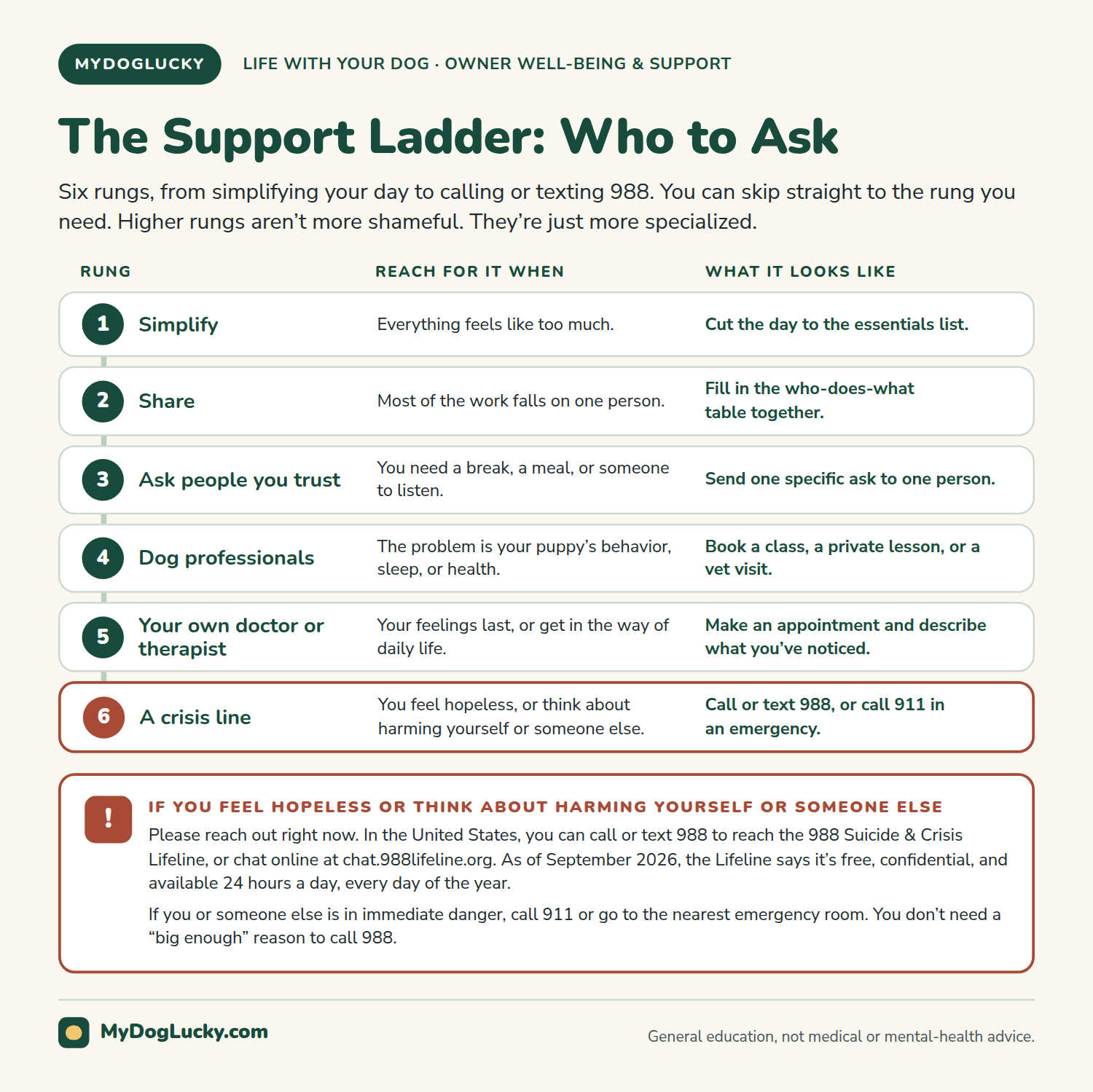
Think of support as a ladder with six rungs. You don’t have to start at the bottom, and you can skip straight to the rung you need. Higher rungs aren’t more shameful. They’re just more specialized.
| Rung | Reach for it when | What it looks like |
|---|---|---|
| 1. Simplify | Everything feels like too much | Cut the day to the essentials list |
| 2. Share | Most of the work falls on one person | Fill in the who-does-what table together |
| 3. Ask people you trust | You need a break, a meal, or someone to listen | Send one specific ask to one person |
| 4. Dog professionals | The problem is your puppy’s behavior, sleep, or health | Book a class, a private lesson, or a vet visit |
| 5. Your own doctor or therapist | Your feelings last, or get in the way of daily life | Make an appointment and describe what you’ve noticed |
| 6. A crisis line | You feel hopeless, or think about harming yourself or someone else | Call or text 988, or call 911 in an emergency |
Rung four: dog professionals
Trainers and vets solve dog problems, and that often lightens the human load. A certified trainer can help with biting, chewing, and sleep routines. Your veterinarian can rule out health causes for changes in appetite, energy, or bathroom habits. If your puppy seems unwell, call your vet instead of waiting to see.
Rung five: your own doctor or therapist
NIMH says a primary care provider can do an initial mental health screening and refer you to a mental health professional. It also lists social workers, psychologists, and psychiatrists among the professionals who can help. (NIMH page last reviewed April 2026.)
You don’t need a dramatic story to make an appointment. “I’ve been overwhelmed since we got a puppy, and it’s not easing” is enough to start. NIMH also notes that treatment works best when you have a good relationship with your provider, and that you shouldn’t stop care without talking to them first.
Rung six: a crisis line
The 988 Lifeline can be a first step, not just a last one. The crisis block near the top of this guide has the details: call or text 988, or chat at chat.988lifeline.org, and call 911 if someone is in immediate danger. Please use it. It’s free, and it’s staffed by people whose job is to listen.
When it’s not working: rehoming or returning a dog
Sometimes the honest answer is that this dog and this household aren’t a workable match right now. That’s hard to read. It’s also a real situation, and it deserves plain words.
Responsible rehoming, or returning a dog to the rescue or breeder, is a legitimate last option. We’re not recommending it. We’re saying it exists, and that thinking about it doesn’t make you a bad person. Many people who reach this point are tired, stretched thin, and trying to do right by the dog.
First, ask what specifically isn’t working
A hard month and a structural mismatch feel identical at 3 a.m. They aren’t the same. Naming the actual problem helps you see whether something can change. This table shows a few common ones.
| What isn’t working | Try first, if it’s safe to | Who can help |
|---|---|---|
| Time and schedule | Build backup care, share tasks, and shrink the day | Family, friends, neighbors, paid helpers |
| Energy mismatch | Add structured exercise and enrichment, and take a class | A certified trainer, your vet |
| Behavior such as biting, chewing, or barking | Manage the space, use reward-based training, and rule out health causes | Your vet, a certified trainer |
| Health needs or costs | Ask your vet what options exist, and look at community resources | Your vet, nonprofit resource lists |
| Housing or lease | Read the lease, and talk with your landlord early | Your landlord, a housing counselor |
| Safety, such as bites or serious aggression toward people | Keep everyone safe with separation now, and call for professional help promptly | Your vet, a veterinary behaviorist |
| Your own well-being | Climb the support ladder above | Your doctor or a licensed therapist |
If safety is at stake, don’t wait until you have a complete plan. Separate the dog and the people who are at risk, and get professional help promptly. Safety comes before every other question on this page.
If you decide it’s the right call
Take it in steps, and don’t decide alone in the middle of the night unless safety is at stake. A few days with some support can change how the choice looks.
- Read your paperwork. Some adoption and purchase contracts ask you to contact the original rescue or breeder first. Check yours.
- Contact the rescue, shelter, or breeder. Ask what their return or rehoming process looks like, what records they need, and how they choose the next home.
- Gather honest records. Share vet records, food, routines, and what you’ve seen of the dog’s behavior, including the hard parts. That honesty protects the dog and the next family.
- Read guidance from humane organizations. Humane World for Animals and Best Friends Animal Society both publish pages on finding a dog a new home. Both are listed in the sources.
- Plan for the aftermath. Grief and guilt are common. Tell someone you trust, and use the support ladder for yourself.
Whatever you decide, the goal is the same. It’s a safe, stable next chapter for the dog, and a livable one for you. Choosing that is not a failure of love.
Long-term caregiver fatigue with adult, senior, or medical dogs
Puppyhood isn’t the only time the load can feel heavy. Many owners of adult dogs with behavior challenges, senior dogs with changing mobility, or dogs with ongoing medical needs describe a different kind of tiredness. It’s steady, long-term, and quiet.
Medication schedules, special diets, extra cleanups, frequent vet visits, and night wakings can add up over months or years. It’s okay to be tired of that. You can be worn out and still love your dog deeply. Both are true.
What long-term strain can look like
Everyone’s version is different. Here are a few patterns owners often describe.
- Dreading a particular time of day, such as the evening medication round or the night wakeup
- Feeling resentful, and then guilty about feeling resentful
- Cutting back on friends, travel, or hobbies without ever deciding to
- Feeling alone with big decisions about treatment or comfort
- Grieving ahead of time as you watch your dog change
None of these mean you’re doing it wrong. They mean the work is real, and it deserves support.
Small reliefs that add up
The same principles from the puppy weeks apply: simplify, share, and ask. Here are some ways to apply them to a long-term caregiving load.
| The load | A small relief | Who can help |
|---|---|---|
| Medication and treatment schedules | Keep one shared written schedule, and use phone reminders | Your vet team can review and simplify the plan |
| Extra cleanup and laundry | Use washable bedding and a simple cleanup routine | A household member, or a helper for the laundry |
| Night waking | Use shift plans like the puppy-night ones, and ask your vet about causes | A partner, family member, or your vet |
| Appointments and records | Keep one folder or note with dates, questions, and results | Anyone in the household |
| Costs | Ask about options and priorities before each visit | Your vet’s office, nonprofit resource lists |
| Emotional weight | Set a regular check-in with one person who listens | A friend, or your own doctor or therapist |
Tell your vet how it’s going
Veterinary teams know that caring for a dog with ongoing needs takes real work. Say it plainly. “This plan is getting hard for us to keep up. What could be simplified, and what matters most?” That’s a fair question, and it’s part of good care.
If your dog’s comfort and daily quality of life are on your mind, ask for a conversation about it. You don’t have to figure that out alone, and you don’t have to wait until a crisis to bring it up.
Respite without guilt
A trained sitter, a family member who has learned the routine, or a short boarding stay can give you a real day off. Write down the routine, including medication times, food, and your vet’s contact information, so the helper isn’t guessing. Our guide to dog boarding versus pet sitting covers what to ask.
Taking a break isn’t neglect. Rested caregivers make steadier decisions, and your dog benefits from that. If the fatigue stays heavy even after you’ve had some rest, the support ladder above applies to you, too.
Common mistakes when you’re overwhelmed
Waiting until you’re at the edge to ask for help
Small asks work better than big rescues. A specific request early in the week beats a desperate one on Friday night.
Trying to fix everything at once
A new schedule, a class, a gate system, and a new sleep plan in one weekend is too much. Pick one change. Give it a week. Then pick the next.
Buying more gear to solve a people problem
Gear can help with management, but it can’t share the night trips. If the real issue is sleep or support, another purchase adds cost without adding relief.
Measuring your week against someone else’s highlights
Social media shows the calm, cuddly minutes. It rarely shows the 2 a.m. potty trip. Comparing your real week to someone’s best moment isn’t a fair test.
Hiding how you feel
Silence makes the feelings heavier. Tell one person. You don’t need a solution first, just a listener.
Pushing through on no sleep
Skipping rest to catch up on chores makes everything harder, including patience with your puppy. Sleep first, chores second.
Punishing a puppy after a rough night
Your puppy isn’t punishing you. Crying, biting, and accidents are needs and immaturity, not spite. Reward-based methods work better, and they keep the relationship on solid footing.
Making a permanent decision in the worst hour
Exhaustion distorts everything. Unless someone’s safety is at stake, sleep, then talk to someone, then decide.
Common questions about puppy blues and dog owner burnout
How long do puppy blues last?
There’s no established timeline. Many owners say the feelings ease as sleep improves and routines settle. If yours aren’t easing, or they’re getting heavier, talk to your doctor or a licensed therapist.
Is it normal to regret getting a puppy?
Many owners say they’ve had the thought at some point. A passing thought doesn’t mean the decision was wrong. It’s a signal to look at what’s overloading you. If the thought keeps coming back, say it out loud to someone you trust.
Are puppy blues the same as a mental-health condition?
“Puppy blues” is an informal phrase, not a diagnosis. We can’t tell you what you’re experiencing. A doctor or licensed therapist can. If your feelings last or interfere with daily life, tell them.
How do I know when to talk to a professional?
If feelings aren’t easing over time, get in the way of eating, work, relationships, or caring for yourself or your dog, or worry you, make an appointment. If you feel hopeless or think about harming yourself or someone else, call or text 988 now.
Does this happen with an adopted adult dog?
Many people describe similar overwhelm after bringing home an adult dog, especially a rescue. It can come with its own uncertainty, since you don’t yet know the dog’s history. Our guide to bringing home a rescue dog covers that side.
What if I resent my puppy?
Flashes of resentment are common when you’re depleted, and they’re a signal to shift the load. If you’re ever worried you might hurt your puppy or someone else when you’re frustrated, put the puppy in a safe space, step away, and call someone. You can also call or text 988.
Is it okay to take a break from my puppy?
Yes. Put your puppy in a safe pen or crate with a chew and take a few minutes to breathe. Longer breaks can come from a helper. Rested owners make better calls.
What if my partner doesn’t seem to feel it?
People experience new-puppy stress differently, and some sleep through the night trips. Use the who-does-what table and the “I’m running low on sleep” script. If it stays tense, a trainer can help on the dog side, and a licensed counselor on the relationship side.
Should I skip puppy class when I’m exhausted?
It’s okay to skip one. If classes are draining you, ask the instructor about a virtual option or a private lesson. A class you dread can add to the load instead of lightening it.
Can I take time off work?
Policies vary a lot by employer and place. Ask your employer what leave or flexibility exists. Even a short adjustment to your hours, such as a later start or a longer lunch, can help in the first few weeks.
How do I explain this to friends without sounding ungrateful?
You can say, “I love her, and I’m exhausted.” Both sentences are true. The right people will hear both, and they’ll often ask how they can help.
How do I find a therapist or a doctor to talk to?
NIMH says a primary care provider can do an initial mental health screening and refer you to a mental health professional. You can also ask about costs and availability when you call. If you need to talk to someone right away, 988 is free and available around the clock.
Will my puppy be okay if I’m not at my best?
Puppies need safe, consistent basics: food, water, rest, potty breaks, and gentle handling. A tired owner who covers those is doing the job. If the basics start to slip, that’s a signal to ask for help, not a verdict on you.
What’s one thing I can do tonight?
Pick one small thing: set up a night-shift plan, write the essentials list, or send one specific ask to one person. That’s enough for tonight.
So, what should you do about the puppy blues? Start smaller than you think you need to. Protect one block of sleep tonight, cut the day to the essentials, and send one specific ask to one person.
If the feelings linger, tell your doctor or a licensed therapist. If you ever feel hopeless, call or text 988.
Sources
- 988 Suicide & Crisis Lifeline. 988 Lifeline home page. Page undated; accessed September 2026. Used for call or text 988, chat at chat.988lifeline.org, 24/7/365 availability, “free and confidential,” and “for everyone.”
- National Institute of Mental Health (NIMH). Find Help (mental health help page). Last reviewed April 2026. Used for primary care screening and referral, the professionals listed, 911 and 988 guidance, and the point about treatment and provider relationships.
- National Heart, Lung, and Blood Institute (NHLBI). Sleep Deprivation (health topic page). Last reviewed March 24, 2022. Used for effects on focus, reaction, mood, and drowsy driving.
- American Kennel Club (AKC). Your First Day at Home With a New Puppy: Tips for Day One. Updated March 10, 2026; no veterinary reviewer listed. Used for the crate in the bedroom, quiet and boring night potty breaks, not putting a crying puppy in your bed unless you want them there, naps, 16 to 18 hours of sleep for some young puppies, and the four-to-five-month note.
- Humane World for Animals. How to Find a New Home for Your Dog or Cat. Undated. Listed as a pointer to the organization’s own guidance; we did not draw specific claims from it.
- Best Friends Animal Society. Rehoming a Pet. Undated. Listed as a pointer to the organization’s own guidance; we did not draw specific claims from it.
- Best Friends Animal Society. Help with vet bills, pet food pantries, and more: resources to help keep your pet. Undated. Listed as a pointer for owners who need financial or supply help; we did not draw specific claims from it.
General education, not medical or mental-health advice. This article is for U.S. dog owners. It doesn’t diagnose any condition, and it isn’t a substitute for care from your own doctor, a licensed therapist, or your veterinarian. If you feel hopeless or think about harming yourself or someone else, call or text 988 or call 911. Ask your veterinarian about anything specific to your dog’s health, behavior, or vaccination status.